
This page is for you if…
- ✓You had a confirmed DVT or PE and want to understand your menopause options before a consult
- ✓You want to understand the real difference between pills, patches, gels, and vaginal estrogen
- ✓You want non-hormonal alternatives when estrogen is off the table
This page can’t help you if…
- −You might have a clot happening now (see emergency strip above)
- −Your event was a stroke or heart attack — see HRT contraindications
- −You need a personal yes/no or a dose — only your clinician can do that
The 30-second version
| Your question | The bottom line |
|---|---|
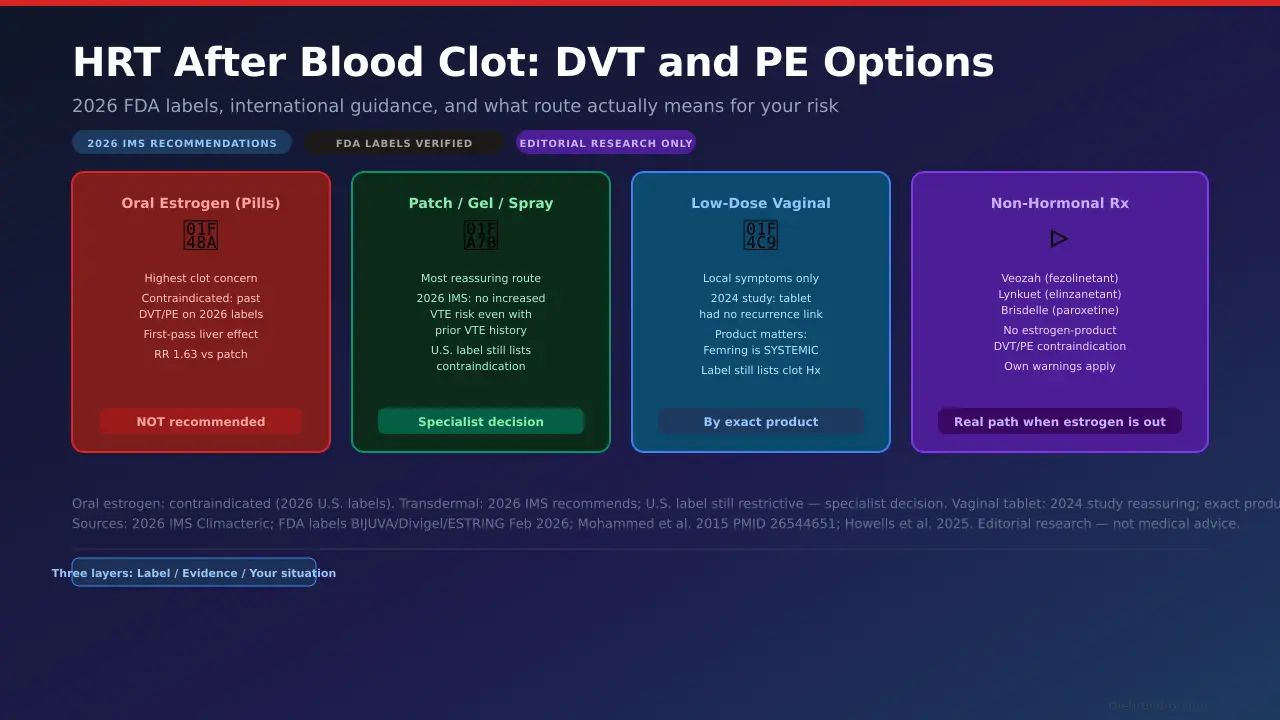
| Estrogen pills? | Highest clot concern. 2026 U.S. labels list a past DVT/PE as a contraindication, and current guidance advises against oral estrogen when clot risk is raised. |
| Patch or gel? | Most reassuring systemic route. 2026 IMS says transdermal estrogen doesn't raise clot risk even after a previous clot — but U.S. labels are still restrictive. Specialist decision, not a self-start. |
| Vaginal estrogen? | A separate, lower-dose conversation for vaginal/urinary symptoms. Reassuring data on tablets — but the exact product matters, and Femring is actually a whole-body treatment. |
| Non-hormonal options? | Real, FDA-approved choices exist for hot flashes: Veozah, Lynkuet, Brisdelle — each with its own rules. |
| Start through a regular online checkout? | Not the right first step. This needs someone who will read your clot history — not a rubber stamp. |
Could this be a new blood clot?
If your search was triggered by new symptoms, get medical help before comparing HRT routes. New one-sided leg or arm swelling, pain or tenderness, warmth, or redness needs prompt evaluation. Sudden shortness of breath, chest pain, coughing up blood, a fast or irregular heartbeat, lightheadedness, or fainting needs emergency care now.
This guide is written for a clot that is already in your past — one that has been diagnosed and either treated or is being managed. It is not a tool to decide whether a clot is happening right now. No website can do that safely. If your clot is old news and you are here to plan your next step, keep reading.
HRT after blood clot: can you take it after DVT or PE?
A past DVT or pulmonary embolism does not mean every menopause treatment is gone forever — but systemic HRT is a specialist decision, not a self-start. Representative current U.S. labels for common estrogen products list a past clot as a contraindication. At the same time, the route— pill versus patch — changes the risk a great deal, and current guidance treats them very differently. Both things are true, and understanding the difference is exactly what this page is for.
Here is why you keep getting different answers. There are three separate layers to this question, and most pages only show you one:
- 1What the drug label says. The FDA-approved prescribing information for a specific product.
- 2What the population evidence and guidelines show. What happened across thousands of women — and it separates pills from patches.
- 3What is right for you. Your specific clot, your health history, and what symptoms you are treating — only a clinician can weigh it.
Our one honest admission
No responsible page can tell you that a route is safe for you personally. The reassuring evidence for patches and vaginal estrogen after a clot is real, but the label still says “contraindicated,” and your individual risk depends on details only a clinician can see. But — and this matters — that is a long way from a dead end. The 2026 International Menopause Society states that transdermal estrogen does not increase VTE risk even in the presence of a previous history of VTE, and recommends it for high-risk women who need HRT.[5] Current U.S. product labels have not caught up to that yet — which is exactly the conflict this page maps.
Why do the FDA label and the research say different things?
Drug labels, population research, and one woman’s medical decision answer three different questions — so they can point in different directions without any of them being “wrong.” On February 12, 2026, the FDA approved labeling changes for an initial group of six menopausal hormone therapy products, removing risk statements about cardiovascular disease, breast cancer, and probable dementia from their boxed warnings.[1] But that did not remove the DVT/PE contraindication, which sits in a separate section of the label.
A boxed warning and a contraindication are two different label sections.Changing wording in one does not change the other. So a headline about “warning changes” in 2026 is not a green light for women with a clot history.
What the population evidence shows: across studies, swallowed (oral) estrogen raises clot risk, while estrogen absorbed through the skin does not appear to. The leading explanation is first-pass metabolism— a swallowed pill passes through the liver first, increasing clot-forming proteins, while a patch or gel skips that step.[8] These route comparisons are observational, not randomized trials, so they may also reflect other differences between the women in each group.
What the guidelines say — and where they now split from U.S. labels:the 2026 IMS recommends transdermal estrogen for high-risk women who require HRT, including women with a previous VTE, and says oral estrogen is not recommended in women at increased VTE risk.[5] Current U.S. product labels still list a past clot as a contraindication for transdermal products.[3] That conflict is real and it is not resolved — which is why the final call belongs with a clinician who knows your specific history.
The HRT Index U.S. HRT-after-Clot Label–Evidence Matrix (v1.1)
Last verified July 2026. An editorial research tool, not a safety score and not personal medical advice. FDA-approved products and compounded preparations are kept strictly separate.
| Option | What the evidence and guidance suggest | Representative current U.S. label | The honest limit | Our editorial takeaway |
|---|---|---|---|---|
| Oral estrogen (pill, alone or with progestogen) | Higher clot risk than patch. 2015 review: oral vs transdermal RR 1.63 for first VTE, 2.09 for DVT (low-confidence evidence).[6] 2026 IMS does not recommend oral estrogen in women at increased VTE risk.[5] | Contraindicated with active or past DVT/PE (BIJUVA, Feb 2026).[2] | Observational evidence; products, doses, and ages differ. | Use only under specialist guidance, if at all. |
| Transdermal estradiol (patch, gel, or spray) | Most reassuring systemic route. 2026 IMS: transdermal estrogen does not increase VTE risk even with a previous VTE; recommends it for high-risk women who need HRT.[5] 2025 specialist series: no recurrence in 12 months in 115 prior-clot women using transdermal estradiol.[7] | Still contraindicated with active or past DVT/PE (Divigel, Feb 2026).[3] | Guideline and label conflict; this requires a specialist, not a self-start. | Best-supported systemic route — specialist decision despite the label. |
| Low-dose local vaginal estrogen (tablet, ESTRING ring, or cream) | Aimed at vaginal/urinary symptoms. 2024 study of vaginal tablet in prior-clot women: no link to recurrence.[9] | ESTRING (Feb 2026) still lists prior DVT/PE and notes some systemic absorption occurs.[4] | Most reassurance is from the tablet; rings and creams differ. | Worth its own conversation for local symptoms — by exact product. |
| Femring (estradiol acetate vaginal ring) | Not a local product. Femring reaches whole-body estrogen levels and is FDA-approved for hot flashes and vaginal atrophy — so it behaves like systemic HRT, not local therapy.[10] | Carries systemic estrogen warnings, including prior DVT/PE.[10] | It is a ring, but it is systemic. | Treat like a systemic route, not a local one. |
| Non-hormonal Rx (Veozah, Lynkuet, Brisdelle) | No estrogen, so no estrogen-product clot contraindication. Each works differently — Veozah and Lynkuet act in the brain's temperature center; Brisdelle is a low-dose SSRI. | Each has its own label, warnings, and monitoring — not an estrogen contraindication.[14][15][16] | Non-estrogen does not mean fine for everyone. | A real path when systemic estrogen is out. |
| Ospemifene (Osphena — pill for painful sex) | A SERM — acts like estrogen in some tissues, blocks it in others. Not vaginal estrogen. | Its label lists a past DVT/PE as a contraindication.[18] | Non-estrogen marketing does not make it clot-neutral. | Not a clot-history workaround. |
| Compounded hormone preparations | The FDA says there is no evidence compounded hormones are safer or more effective than FDA-approved hormone therapy.[20] | Not FDA-approved; no FDA-approved label. | Mixing and dosing less standardized; route does not erase your history. | Never a safer route around a clot. Kept fully separate. |
Why this table seems to contradict itself
Because it is showing you all three layers at once — and that is the point. Population evidence and current guidance can say transdermal estrogen does not raise clot risk while a product label still says “contraindicated.” The right move is not to pick whichever layer sells the easiest answer. It is to show you all three and hand the final call to a clinician who knows your body.
✓ What The HRT Index actually verified
Under The HRT Index Verification Standard, we checked current U.S. prescribing information for representative oral, transdermal, and vaginal estrogen products (BIJUVA, Divigel, ESTRING, Femring); the FDA’s February 12, 2026 menopause labeling update; the 2026 International Menopause Society recommendations; American Society of Hematology guidance on clotting-disorder testing; a 2015 systematic review comparing oral and transdermal clot risk; a 2024 study of vaginal estradiol tablets in women with prior clots; and a 2025 specialist-clinic series of women with prior clots using transdermal estradiol.
We did not verify that any specific online provider routinely accepts women with a past DVT/PE. That is why you will not find a “best provider” pick on this page. Editorial research. Not medically reviewed by a clinician. Educational only — not medical advice.
Now that you can see the conflict, the next step is turning your history into questions your clinician can act on.
The HRT Path tool helps you figure out the right starting point — including when in-person care should come first.
Find my HRT starting point →Does the type of clot you had change the answer?
Yes — a lot. Clinicians need to know whether it was a DVT or PE, whether it was provoked (triggered by surgery, pregnancy, or the birth-control pill) or unprovoked(came out of nowhere), whether it happened once or more than once, and whether you have a clotting disorder or are on a blood thinner. Those details shift how cautious the plan needs to be — but none of them let a web page declare you “cleared.”
- Provoked vs. unprovoked.A clot with a clear trigger that is now gone is generally viewed differently than a clot that appeared for no obvious reason. Unprovoked clots carry a higher chance of recurrence. But “provoked” is not a magic pass, and “unprovoked” is not an automatic “never.”
- Once vs. more than once. A single clot years ago and a pattern of repeat clots are not the same risk picture.
- A clotting disorder (thrombophilia). Factor V Leiden is one of the most common inherited kinds. This can change the math, especially with pills.
- On a blood thinner.If you are on Eliquis, Xarelto, or warfarin, that is important context — but it is not a permission slip.
The HRT Index editorial care-routing framework — not an eligibility determination.
| Your situation | Where to start | What it does not mean |
|---|---|---|
| Possible clot happening now | Urgent medical care | That route research is the priority right now |
| Recent clot, still in treatment | Your treating team | That switching pill-to-patch on your own fixes it |
| Old, single, provoked DVT/PE | Menopause clinician with your full records; hematology if needed | Automatic approval |
| Old unprovoked or repeat clot | Menopause and hematology, working together | A routine online sign-up |
| Known clotting disorder | Specialist review | That route alone cancels the risk |
| Vaginal/urinary symptoms only | A local-product conversation | That you need whole-body HRT at all |
| Currently on a blood thinner | Coordinated review of your clot and bleeding plans | That the blood thinner is a green light |
The right online HRT provider depends on your symptoms, what you have tried so far, your age, your state and your health history. Some situations belong with an in-person clinician first. Use The HRT Index’s Find My HRT Path toolto match your situation to the right starting point — and to flag when online care is not the right first step.
Are estrogen patches or gels safer than pills after a clot?
Patches and gels carry lower clot risk than pills, and current international guidance says transdermal estrogen does not raise clot risk even after a previous clot — but U.S. labels still list a past DVT/PE as a contraindication. This is a real, guideline-supported option that specialists use carefully — not a route to start on your own.
- What “transdermal” means:through the skin. A patch, gel, or spray — all three are systemic, meaning they treat your whole body including hot flashes and night sweats. (Low-dose local vaginal estrogen is different; see the next section.)
- The numbers:a 2015 systematic review found that oral estrogen carried a relative risk of 1.63 for a first VTE and 2.09 for DVT compared with transdermal — with the evidence rated low confidence.[6] These are observational studies, not proof of cause and effect.
- What current guidance says: the 2026 IMS states that, unlike oral estrogen, transdermal estrogen does not increase VTE risk even in the presence of a previous history of VTE, and recommends it for high-risk women who require HRT (with a suitable progestogen if you have a uterus).[5]
- The most recent direct prior-clot series found:a 2025 consecutive specialist-clinic series included 115 women with prior venous or arterial thromboembolism; all had been referred to hematology; no recurrent thromboembolism was recorded within 12 months of starting transdermal estradiol.[7] Genuinely encouraging — but every woman was managed by specialists from the start, and there was no comparison group.
- The label vs. the guidance:current guidance supports transdermal estrogen for women with your history; the U.S. product label still says “contraindicated.”[3] That is a reason to have this conversation with a clinician who can weigh it — not a reason to panic.
Want the deeper route comparison? See how route changes HRT contraindication decisions.
Is vaginal estrogen safe after a blood clot?
Low-dose local vaginal estrogen treats vaginal and urinary symptoms — dryness, irritation, painful sex — not hot flashes, and it is a separate, lower-dose conversation. A 2024 study of the vaginal tablet in women with prior clots found no link to recurrence, but labels still list a past DVT/PE, and one vaginal ring (Femring) is actually a whole-body treatment.
Whole-body symptoms
Hot flashes, night sweats — a systemic question (pills, patches, gels, Femring, or non-hormonal drugs).
Local symptoms
Vaginal dryness, burning, painful sex, some urinary issues — fall under GSM (genitourinary syndrome of menopause). Low-dose local vaginal estrogen is for this bucket.
What the reassuring 2024 study actually studied: one nationwide nested case-control study looked at vaginal estradiol tablets in women with a previous VTE and found no association with recurrence.[9] It did not study rings or creams. Here is the nuance almost no one spells out:
| Form | Directly studied in prior-clot recurrence research? | Label / status | What to do |
|---|---|---|---|
| Vaginal tablet | Yes — the 2024 no-recurrence finding is here[9] | Low local dose; label still lists prior DVT/PE | Bring both facts to your clinician |
| ESTRING (ring) | Not directly | Low local dose; label lists prior DVT/PE and notes some systemic absorption[4] | Ask by exact product |
| Vaginal cream | Not directly | Label states systemic absorption may occur and that oral-estrogen warnings should be considered[11] | Ask by exact product |
| Femring (ring) — SYSTEMIC | No — and it is systemic, not local | FDA-approved for hot flashes and vaginal atrophy; carries systemic estrogen warnings, including prior DVT/PE[10] | Treat like systemic HRT, not a local product |
For the full picture, see our vaginal estrogen guide.
What about progesterone — does it affect clot risk?
If you have a uterus and are prescribed systemic estrogen, you generally need endometrial protection — usually a progestogen — so the decision is never about estrogen alone. Different progestogens may carry different risks.
The 2026 IMS specifically says progestogen choice matters and names micronized progesterone, dydrogesterone, or a levonorgestrel-releasing intrauterine system as suitable options for combination therapy.[5] (Note for U.S. readers: dydrogesterone is not widely available in the U.S. — confirm what is available with your clinician.) What we will not say, because the evidence does not support it: that any progestogen is “clot-free,” or that adding one cancels estrogen’s clot effect.
How long after a blood clot can you start or restart HRT?
There is no single waiting period we can responsibly publish. It depends on where you are in the acute treatment course, whether therapeutic anticoagulation is continuing, and what the longer-term plan is. We know a clean “wait three months” would be easier to remember — but inventing a number here would be exactly the kind of tidy-but-wrong answer that gets women hurt.
- ›Are you in acute treatment, continuing therapeutic anticoagulation, or preparing to stop?
- ›Was the clot linked to estrogen you were already taking?
- ›Was it provoked or unprovoked?
- ›Are you treating whole-body symptoms or local ones?
- ›What does the specific product’s label say?
- ›Would a hematologist’s input change the plan?
“Restarting” is also three different questions: restarting the same pill, switching to a different route, and treating local symptoms are not the same decision.
Can you take HRT while on Eliquis, Xarelto, or warfarin?
Being on a blood thinner (anticoagulant) changes the picture and is part of the conversation — but it is not a green light on its own. In a post hoc analysis of 1,888 women under 60 on therapeutic anticoagulation, recurrent VTE occurred at 3.7% per year during hormonal therapy versus 4.7% per year without it (adjusted hazard ratio 0.56; 95% CI 0.23–1.39). That exposure included contraception as well as HRT, so it was not a dedicated menopause-HRT trial.[12] Reassuring direction — but not blanket permission.
- •A blood thinner is relevant and more reassuring than assuming HRT is impossible— but it does not prove every hormone regimen is fine for you.
- •Bleeding matters too. In the same research, abnormal uterine bleeding was more common with rivaroxaban (Xarelto) than with enoxaparin or a vitamin K antagonist (hazard ratio 2.13).[12] Worth knowing if you are on Xarelto.
- •Whether your anticoagulation is temporary or lifelong changes the plan — a clinician conversation, not a rule you can apply yourself.
- Never stop a blood thinner to make HRT easier. Full stop.
Should you be tested for Factor V Leiden or another clotting disorder?
Not everyone with a past clot needs broad clotting-disorder testing — the guidance supports targeted testing in specific situations, not routine testing for all. The 2026 IMS states plainly that there is no indication for thrombophilia testing before starting HRT.[5] After an actual clot, American Society of Hematology guidance ties testing to how the clot was provoked and whether a result would change your treatment.[13]
The HRT Index editorial summary of current guidance — not a testing recommendation for your case.
| Your situation | What the guidance generally suggests |
|---|---|
| Previous unprovoked VTE, or a clot provoked by surgery | ASH suggests not testing to guide how long to stay on anticoagulation[13] |
| Clot tied to a non-surgical temporary risk, pregnancy/postpartum, or hormones | ASH conditionally suggests testing may be considered in selected cases[13] |
| Thinking about HRT, general population or family history without a known thrombophilia | ASH suggests not testing to guide the HRT decision; IMS: no routine testing before HRT[5][13] |
| A known high-risk clotting disorder in a close relative | Selective testing may be considered[13] |
Why this matters here: Factor V Leiden shows how route interacts with genetics. In a case-control study cited in current menopause guidance, a prothrombotic gene change alone carried an odds ratio of about 3.9 for clots; combined with oral estrogen it jumped to about 25.5, but combined with transdermal estrogen it was about 4.4 — close to the gene change on its own.[5] That is observational evidence, not a randomized trial — but it is a big part of why the transdermal route comes up for women with a clotting tendency.
What if HRT may have caused your blood clot?
If a clot happened while you were on HRT, the first priorities are treating the clot and writing down the exact product, dose, route, and timing — not swapping formulations on your own. There is a real conflict here: representative U.S. labels say to stop estrogen if DVT or PE occurs or is suspected,[2] while the 2026 IMS says immediate discontinuation of oral HRT is not required while therapeutic anticoagulation is in place.[5] Because those instructions conflict, do not decide on your own to continue or stop either treatment — follow the team managing the acute clot.
Detail is your friend. Capture:
- ›The exact brand or generic name
- ›The form: pill, patch, gel, spray, ring, tablet, or cream
- ›When you started it, and when the clot happened
- ›Whether anything else raised your risk at the time (surgery, travel, illness)
- ›Whether it was stopped, and your current blood-thinner plan
What can treat hot flashes if you can’t take estrogen?
If systemic estrogen is out, you still have real, evidence-based options for hot flashes and night sweats — including FDA-approved non-hormonal medicines. These are not estrogen therapies and do not carry estrogen-product DVT/PE contraindications; each has its own warnings, interactions, and monitoring requirements.
Paroxetine (Brisdelle)
A low-dose SSRI and the first non-hormonal drug FDA-approved specifically for menopausal hot flashes. Important: its label warns that aspirin, NSAIDs, warfarin, and other anticoagulants may add to bleeding risk.[16] Flag it if you are on a blood thinner.
Fezolinetant (Veozah)
FDA-approved in 2023. Works in the brain’s temperature-control center instead of through estrogen. Carries a boxed warning for rare but serious liver injury and requires liver blood tests before starting, monthly for the first three months, and again at months six and nine.[14]
Elinzanetant (Lynkuet)
FDA-approved October 24, 2025. A related neurokinin-targeted medicine. Label calls for baseline and early liver testing, and includes cautions around daytime drowsiness, pregnancy, and seizure history.[15]
The HRT Index editorial summary — confirm current labels and fit with your clinician.
| Option | What it targets | What to check |
|---|---|---|
| FDA-approved non-hormonal drug (Veozah, Lynkuet, Brisdelle) | Hot flashes, night sweats | Current label; liver monitoring (Veozah, Lynkuet); bleeding interaction (Brisdelle) |
| Other Rx (SSRI/SNRI, gabapentin, oxybutynin) | Hot flashes, sometimes sleep | Your other meds, blood pressure, drowsiness, interactions |
| CBT or clinical hypnosis | Symptom bother and coping | Access, fit, finding a trained provider |
| Comfort measures (cooling, layering) | Comfort | Not an evidence-based treatment for hot flashes |
Want the full breakdown? See our non-hormonal options guide.
What can treat vaginal dryness or painful sex after a clot?
Vaginal and urinary symptoms are a separate treatment target from hot flashes, so they deserve their own local-symptom plan — often starting with non-prescription steps.
- •Start here (no prescription needed): vaginal moisturizers (used regularly) and lubricants (used for sex). There is no clot question attached to these. If you have pain, bleeding, unusual discharge, or urinary symptoms, get those looked at rather than self-treating.
- •Vaginal DHEA (prasterone / INTRAROSA): FDA-approved for moderate-to-severe painful sex due to menopause. Its only listed contraindication is undiagnosed abnormal genital bleeding. Prior DVT/PE is not a listed INTRAROSA contraindication, but the label also does not establish that it is safe after a previous clot — still a clinician conversation.[19]
- Ospemifene (Osphena)is sometimes marketed as a “non-estrogen” pill for painful sex — but its label lists a past DVT/PE as a contraindication.[18] Not a clot-history workaround.
What about your bones if HRT is off the table?
If systemic HRT is not right for you, your bone health still deserves attention — it just becomes its own conversation instead of a reason to force hormones. Ask your clinician whether you need a formal fracture-risk assessment or a bone-density scan, whether you have other risk factors, and which non-estrogen options fit. Do not let “I can’t take HRT” quietly become “so I will ignore my bones.” It is a separate, manageable decision — bring it up at the same visit.
Is compounded HRT safer after a clot?
No. “Compounded” or “bioidentical” branding does not remove clot concerns, and it should never be presented as a safer way around a past clot. The FDA says there is no evidence that compounded bioidentical hormones are safer or more effective than FDA-approved hormone therapy.[20]
- ›“Bioidentical” is not the same as “compounded.”Bioidentical just means a hormone chemically identical to one your body makes — and FDA-approved bioidentical estradiol and progesterone products exist. It does not mean compounded, safer, or more effective.
- ›Compounded preparations do not have FDA-approved labels. No established clot data. No standardized mixing or dosing.
- ›Route still matters, but route does not make anything “safe.” A compounded cream is not automatically equal to an approved transdermal patch, and it does not erase your clot history.
Can an online provider handle HRT after a clot?
A routine telehealth checkout is not the right starting point for a prior DVT/PE — this needs a provider who will read your clot history, not one that hands out a prescription after a quick form. Online care can support this later, but only when the service can review your records, spot contraindications, coordinate with your other clinicians, and clearly says it accepts cases like yours.
This is why you will not see a “best provider for clots” here. Instead, here is the checklist to run before trusting any provider with this:
| Ask before you sign up | Why it matters |
|---|---|
| Does the service accept women with a confirmed past DVT or PE? | Acceptance policies vary; confirm the policy before paying |
| Does it require clearance from your PCP, hematologist, or a specialist? | The service may require outside records or specialist input |
| Can it review your imaging or discharge records? | Records let the clinician verify the diagnosis, timing, provoking factors, and treatment |
| Does it prescribe FDA-approved products, compounded ones, or both? | You want to know exactly what you would be getting |
| Can it coordinate around your blood thinner? | Anticoagulation questions can't be an afterthought |
| Which cases does it exclude from online care? | Written exclusions let you assess fit before intake |
| Is its policy in writing before intake, or only after? | Before is a good sign |
What records and questions should you bring to your appointment?
The single most useful thing you can do next is bring your clot report, your treatment timeline, your exact previous hormone product, your current blood-thinner plan, and a clear note of which symptoms you want treated.
Records to gather
- ›Your ultrasound, CT, or other imaging report
- ›Hospital or ER discharge summary
- ›Any hematology notes
- ›The date and location of each clot
- ›Whether it was provoked or unprovoked
- ›Any clotting-disorder test results
- ›Family clot history
- ›Your previous hormone product and its form
- ›Your current medication list
- ›Your blood thinner's name and how long you'll be on it
- ›Whether you have a uterus
- ›Your top symptom priorities
Questions for your menopause clinician
- Is my main issue whole-body or vaginal/urinary symptoms?
- How does my exact clot change the decision?
- What does the label say, and how does that compare to current guidance?
- If a patch or gel is being considered despite its label, what evidence supports that for me?
- Would a non-hormonal treatment fit my symptoms better?
- For local symptoms, which exact product and evidence apply?
- Does having a uterus change my full regimen, including progestogen choice?
- What monitoring or follow-up would I need?
Questions for a hematologist (if involved)
- Was my clot provoked or unprovoked?
- What is my long-term chance of another clot?
- Would clotting-disorder testing change anything?
- Is my blood thinner temporary or lifelong?
- How would a hormone decision affect that plan?
- What should you share with my menopause clinician?
How we verified this guide
Who made this:Researched and edited by The HRT Index Editorial Team. We do not put a fake “medically reviewed by” stamp on our pages, and we do not invent an author. This is editorial research, and we label it that way.
How we sourced it, in order of trust:
- Current FDA prescribing information and approvals
- FDA safety communications
- Current specialty-society guidance (IMS, ACOG, American Society of Hematology, The Menopause Society)
- Peer-reviewed studies and reviews
- Provider policies — only for commercial facts
- Reader discussions — only for language and empathy
Where the evidence is limited: route comparisons are mostly observational. Current guidance is reassuring for transdermal estrogen, but U.S. labels still list prior clots as a contraindication. The reassuring vaginal data is about the tablet, not every form. Femring is systemic. We checked representative products — not every product on the market.
Change log
| Date | Update | Sources checked |
|---|---|---|
| July 2026 | Initial verification | FDA labels (BIJUVA, Divigel, ESTRING, Femring, Veozah, Osphena, Intrarosa); FDA Feb 12, 2026 labeling update; 2026 IMS recommendations; ASH thrombophilia guidance; The Menopause Society non-hormone statement; 2015 oral-vs-transdermal review; 2024 vaginal-tablet recurrence study; 2016 anticoagulation analysis; 2025 transdermal case series |
| October 2026 | Scheduled review | Pending |
| Earlier if triggered | Any FDA label or guideline change | Pending |
Frequently asked questions about HRT after blood clot
- Can I take HRT after a provoked DVT?
- A provoked clot with a trigger that is now gone is often viewed differently than an unprovoked or repeat clot — but it does not create automatic eligibility. The cause, the product label, the route, timing, and a specialist's assessment all still matter.
- Can I restart HRT after a pulmonary embolism?
- There is no universal waiting period. Where you are in treatment, whether the clot recurred, your blood-thinner plan, your previous product, and your symptom target all belong in the decision. Restarting the same pill and trying a different route are different questions.
- Are estrogen patches safe after a DVT?
- We won't use the word "safe" for you personally. But the direction is encouraging: the 2026 IMS says transdermal estrogen doesn't raise clot risk even after a previous VTE, and recommends it for high-risk women who need HRT.[5] The catch is that U.S. labels still list a past DVT/PE as a contraindication,[3] so it's a specialist decision, not a DIY switch.
- Can vaginal estrogen cause another blood clot?
- A 2024 study of vaginal estradiol tablets in women with prior clots found no link to recurrence.[9] But don't assume every ring, cream, or dose behaves the same — and Femring is actually a systemic ring, not a local one.[10] It's a conversation worth having for local symptoms, by exact product.
- Is every vaginal estrogen ring a local treatment?
- No. ESTRING is a lower-dose local ring for vaginal atrophy, while Femring is a systemic ring FDA-approved to treat hot flashes as well as vaginal symptoms.[10] The product name matters more than the fact that both are inserted vaginally.
- Does taking Eliquis or Xarelto make HRT safe?
- Being on a blood thinner is relevant context and can be reassuring, but it is not blanket permission. With Xarelto specifically, abnormal uterine bleeding was more common in the research.[12] Your long-term clot and bleeding plans have to be coordinated, and you should never stop your blood thinner to make HRT easier.
- Is aspirin enough to protect me from an HRT-related clot?
- Aspirin is not a substitute for prescribed anticoagulation or individualized VTE management. Do not self-start it to enable HRT. The 2026 IMS does not recommend routine anticoagulation prophylaxis just to start HRT.[5]
- Is superficial thrombophlebitis the same as a DVT?
- No — they are different diagnoses. Check what your original record actually says before applying the DVT/PE framework to yourself, because the plan may be different.
- Does a family history of clots rule out HRT?
- Family history is relevant, but it is not the same as your own confirmed clot. Current guidance does not recommend routine thrombophilia testing before HRT.[5] Bring it up, but do not assume it is a no.
- Does Factor V Leiden mean I can never use HRT?
- There is no universal answer. The specific gene change, your personal and family clot history, the product, the route, and your treatment goal all shape it. Notably, the transdermal route is often raised for women with a clotting tendency because its clot risk in that setting looks close to baseline.[5]
- What if my clot happened while I was on birth-control pills?
- That is relevant history worth sharing — but contraceptive estrogen and menopausal hormone therapy are not the same thing and should not be treated as interchangeable. Bring the exact previous product and the timeline.
- Did the 2026 FDA warning change remove the blood-clot restriction?
- No. On February 12, 2026, the FDA removed some boxed-warning statements (about heart disease, breast cancer, and dementia) from an initial group of products,[1] but the contraindication listing a past DVT/PE stayed on the labels checked.[2][3][4] A warning change is not a green light.
- Is compounded HRT safer after a clot?
- No. The FDA says there is no evidence compounded bioidentical hormones are safer or more effective than FDA-approved hormone therapy,[20] and they do not have FDA-approved labels. Compounded is never a safer workaround around a clot.
- What is the safest menopause treatment after a blood clot?
- There is no one universal safest answer. It depends first on whether your symptoms are whole-body or local, then on your clot's details, the product's label, current guidance, and your broader health. That is the honest answer — and it is why the next step is a prepared conversation, not a purchase.
You have more options than “never” — start by getting ready
A past clot makes this a careful, specialist-led decision — but “careful” is a long way from “hopeless.” Current guidance is more open than most women are told, patches and vaginal estrogen may be on the table for some, and non-hormonal medicines can take on hot flashes when estrogen can’t. The single best thing you can do right now is walk into your appointment prepared.
Start Find My HRT Path →Free · Personalized · Honest enough to tell you when to start in person
Sources
All sources checked July 2026. Confirm the current label revision date for any product at Drugs@FDA or DailyMed before relying on it.
| # | Source |
|---|---|
| [1] | U.S. FDA — FDA approves labeling changes for menopausal hormone therapy products (February 12, 2026) https://www.fda.gov/news-events/press-announcements/fda-approves-labeling-changes-menopausal-hormone-therapy-products |
| [2] | BIJUVA (estradiol/progesterone) prescribing information, rev. February 2026 — Drugs@FDA https://www.accessdata.fda.gov/drugsatfda_docs/label/2026/210132s013lbl.pdf |
| [3] | Divigel (estradiol gel) prescribing information, rev. February 2026 — Drugs@FDA https://www.accessdata.fda.gov/drugsatfda_docs/label/2026/022038s017lbl.pdf |
| [4] | ESTRING (estradiol vaginal ring) prescribing information, rev. February 2026 — Drugs@FDA https://www.accessdata.fda.gov/drugsatfda_docs/label/2026/020472s022lbl.pdf |
| [5] | International Menopause Society — 2026 recommendations and key messages on women's midlife health and menopause (Climacteric) https://www.tandfonline.com/doi/full/10.1080/13697137.2025.2585487 |
| [6] | Mohammed K, et al. — Oral vs. transdermal estrogen therapy and vascular events: a systematic review and meta-analysis (2015), PMID 26544651 https://pubmed.ncbi.nlm.nih.gov/26544651/ |
| [7] | Howells P, Hussain S, Hulme E, et al. — HRT containing transdermal estradiol in women with a personal history of thromboembolism: a consecutive series of 115 cases (2025) https://journals.sagepub.com/doi/10.1177/20533691251369205 |
| [8] | ACOG — Postmenopausal Estrogen Therapy: Route of Administration and Risk of Venous Thromboembolism https://www.acog.org/clinical/clinical-guidance/committee-opinion/articles/2013/04/postmenopausal-estrogen-therapy-route-of-administration-and-risk-of-venous-thromboembolism |
| [9] | Nested case-control study (2024) — Recurrent VTE and vaginal estradiol in women with previous VTE, PMID 39113588 https://pubmed.ncbi.nlm.nih.gov/39113588/ |
| [10] | Femring (estradiol acetate vaginal ring) — FDA-approved for vasomotor symptoms and vulvar/vaginal atrophy; systemic estrogen warnings apply https://reference.medscape.com/drug/femring-vagifem-estradiol-vaginal-1000132 |
| [11] | Estradiol vaginal cream — prescribing/patient information noting systemic absorption may occur (DailyMed) https://dailymed.nlm.nih.gov/dailymed/ |
| [12] | Post hoc analysis of hormonal therapy during therapeutic anticoagulation (EINSTEIN program), recurrent VTE and abnormal uterine bleeding by anticoagulant https://www.sciencedirect.com/science/article/pii/S000649712030344X |
| [13] | American Society of Hematology — Clinical practice guideline on thrombophilia testing (2023) https://www.hematology.org/education/clinicians/guidelines-and-quality-care/clinical-practice-guidelines/venous-thromboembolism-guidelines/thrombophilia |
| [14] | Veozah (fezolinetant) prescribing information with boxed warning and hepatic monitoring schedule (DailyMed) https://dailymed.nlm.nih.gov/dailymed/drugInfo.cfm?setid=cae9f798-24f9-4580-a4fc-e6c710cbda3c |
| [15] | Lynkuet (elinzanetant) prescribing information (approved October 24, 2025) — Drugs@FDA https://www.accessdata.fda.gov/drugsatfda_docs/label/2025/219469s000lbl.pdf |
| [16] | Brisdelle (paroxetine 7.5 mg) prescribing information — bleeding interaction with anticoagulants/NSAIDs — Drugs@FDA https://www.accessdata.fda.gov/drugsatfda_docs/label/2025/204516s009s014lbl.pdf |
| [17] | The Menopause Society — 2023 nonhormone therapy position statement https://menopause.org/wp-content/uploads/professional/2023-nonhormone-therapy-position-statement.pdf |
| [18] | Osphena (ospemifene) prescribing information — DVT/PE contraindication — Drugs@FDA https://www.accessdata.fda.gov/drugsatfda_docs/label/2025/203505s018lbl.pdf |
| [19] | INTRAROSA (prasterone) prescribing information — contraindication: undiagnosed abnormal genital bleeding (DailyMed) https://dailymed.nlm.nih.gov/dailymed/drugInfo.cfm?setid=ada639d4-bac0-2ad0-e053-2a95a90afce7 |
| [20] | U.S. FDA — Menopause (consumer information on compounded bioidentical hormones) https://www.fda.gov/consumers/womens-health-topics/menopause |
| [21] | CDC — Blood clots: signs, symptoms, and risk https://www.cdc.gov/blood-clots/about/index.html |