Which online testosterone blood test for women is best?
| Your priority | Route | Published components | The catch |
|---|---|---|---|
| Lowest cost | Goodlabs — Testosterone, Total, MS | $23 ($11 + $12 visit) | Digital results and educational tools, but no included clinical consultation |
| Someone to talk to | Quest — Testosterone Test | $75 ($69 + $6 fee) | Narrowest published turnaround: 3–5 business days |
| Labeled for women | Labcorp OnDemand — Total Testosterone Test for Women | $79 | Slowest published turnaround: 7–10 days |
| Blood drawn at home | Quest + Quest Mobile | $154 ($75 + $79) | ZIP-specific; not offered for this product in AZ, HI, or PR |
| You want treatment too | A licensed clinician orders it | Varies | May be billed to insurance; coverage depends on your plan |
Is this page for you?
Yes, if:
- You want a testosterone test and your doctor won't order one
- Your main symptom is low sex drive
- A clinician asked you for a baseline or monitoring test and you want it cheaper
- You were told “your levels are normal” and didn't believe that was the end of it
- You're about to see a telehealth provider and want labs in hand
No — and here's where to go instead:
- Facial hair, acne, or irregular periods?Those can warrant evaluation for androgen excess or PCOS. This isn't the page for that question.
- Hoping testosterone will fix fatigue or brain fog?We're going to show you the evidence below, and you won't like it. Read it before you spend $79.
- You want estrogen or progesterone care? Wrong page. Compare HRT providers →
What women are actually trying to figure out
The real question underneath this search is almost never “which test is cheapest.”
It's some version of: Am I imagining this? Is something actually wrong? And if the number comes back normal, do I have to stop asking?
That last one is the fear. We built the page around it.
Where can I get a testosterone blood test for women online?
Goodlabsis a booking platform, not a lab. It sends your order to Quest or Labcorp — and to BioReference for New York and New Jersey customers, because Goodlabs says Quest and Labcorp aren't available directly to consumers there.
Quest and Labcorp OnDemandsell you their own labs' tests directly.
A clinician— your own, or a telehealth provider — orders it as a normal medical test. That's the clearest path to ongoing treatment, though it isn't the only route that can go anywhere.
“No doctor needed” isn't quite true
All three services here arrange for an independent healthcare professional to authorize or oversee your order. That's the mechanism that makes buying a lab test yourself work at all.
Quest charges $6for it and calls it a “physician service fee.” Goodlabs folds it into the price and calls it “physician-reviewed ordering.” Labcorp says its testing “requires an order from an authorized healthcare professional” and contracts with independent providers to supply one.
What does a testosterone blood test for women cost online?
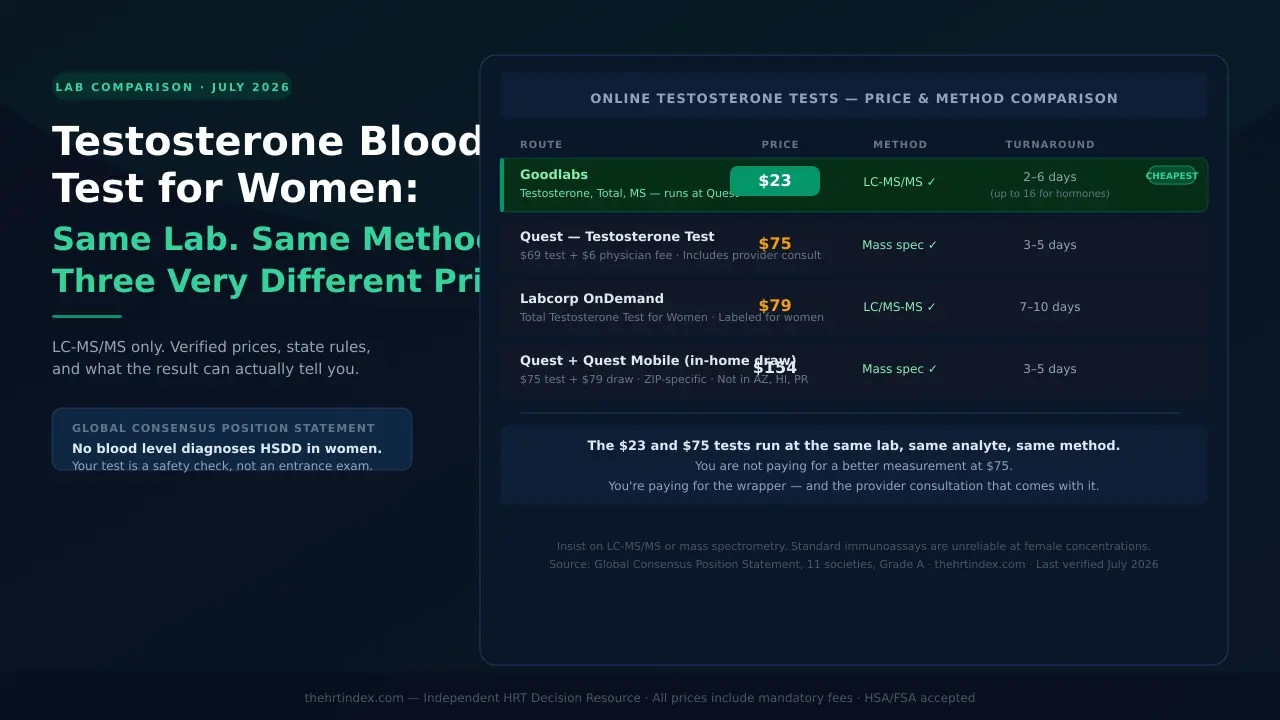
The same lab, the same analyte, the same method — for a third of the price
We checked this twice because we didn't believe it either.
Goodlabs sells “Testosterone, Total, MS.”It's run at Quest. It's mass spectrometry. $11, plus Goodlabs' flat $12 visit fee. Total: $23.
Quest sells its own “Testosterone Test.” Also total testosterone. Also mass spectrometry. Also at Quest. $69, plus a $6 physician service fee. Total: $75.
One honest note: Goodlabs names Quest test code 15983. Quest's consumer product is SKU 15983M, and its consumer page doesn't state in visible text which technical code its requisition uses. We're confident enough to call it the same lab, analyte, and method. We're not calling it the identical test until we've seen a requisition.
The full price ladder — verified July 15, 2026
| Route | Lab | Method | Price | Turnaround | Included support |
|---|---|---|---|---|---|
| Goodlabs — Testosterone, Total, MSCHEAPEST | Quest (BioReference in NY/NJ) | Mass spectrometry | $23 | 2–6 days typical; up to 16 for hormones | Digital results, trend tracking, AI educational explanations. No diagnosis or treatment plan. |
| Goodlabs — Free, Bioavailable and Total, MS | Quest | Mass spectrometry | $34 | Same caveat | Same |
| Quest — Testosterone Test (SKU 15983M) | Quest | Mass spectrometry | $75 | 3–5 business days | Discuss result with an independent healthcare provider at no extra cost |
| Labcorp OnDemand — Total Testosterone Test for Women | Labcorp (test 070001) | LC/MS-MS (stated) | $79 | 7–10 days | Contact if result needs prompt attention |
| Quest + Quest Mobile in-home draw | Quest | Mass spectrometry | $154 | 3–5 business days | Same as Quest; ZIP-specific, not in AZ/HI/PR |
So is the $23 one a trap?
No. But it costs you two things worth naming.
Speed — maybe.Goodlabs says most results arrive in 2–6 business days, but “some specialized tests, especially hormone-related” can take up to 16 business days. Quest publishes a narrower 3–5 business days.
A person.Goodlabs gives you a report, trend tracking, and educational tools. What it doesn't give you is a clinical consultation. Quest includes the ability to discuss your result with an independent healthcare provider at no extra cost.
Does insurance cover it?
Not when you buy it yourself. Quest states its direct purchases aren't billed to insurance and can't be submitted for reimbursement. Goodlabs doesn't bill insurance either. All three take HSA/FSA cards — though eligibility and reimbursement still depend on your plan administrator.
When a clinicianorders it, it may be billed to insurance like any other lab test. But billing isn't coverage: your final cost depends on your plan, deductible, network, medical necessity, and which lab runs it.
A clinician's already waiting on this number? Take the cheapest verified route.
Doing this on your own? Quest's $75 narrows the wait to 3–5 business days and includes provider access.
Want the version made for women, by name? Labcorp OnDemand explicitly labels its women's test.
Do I need free testosterone, or is total enough?
Quick definitions:
- Total testosterone — all of it in your blood: bound to proteins and floating loose.
- Free testosterone — just the loose part. Often calculated from other numbers rather than measured directly.
- SHBG (sex hormone-binding globulin) — the protein that carries most of your testosterone. It shifts how much stays loose.
- HSDD (hypoactive sexual desire disorder) — a clinical diagnosis: persistent low desire causing distress, made only after biological, psychological, relationship, medication, and life-context factors have been assessed.
The eleven medical societies behind the Global Consensus Position Statement concluded that research should focus on total testosterone as the main biomarker rather than “free” testosterone, because evidence that free T is the biologically active fraction is lacking.
The ISSWSH clinical practice guideline says the same: total testosterone is the best available measure, rather than free or bioavailable testosterone or the free androgen index.
This does notmean no woman ever needs SHBG. If your clinician asked for it, get it — Goodlabs sells a combined test at $22 plus the $12 fee. What it means is: don't upgrade to a bigger panel on your own initiative because more numbers feel more thorough.
The gate nobody mentions
Labcorp OnDemand sells a Comprehensive Testosterone Testwith free testosterone and SHBG. Its own product page says it's “clinically appropriate only for individuals assigned male at birth.” If you're a woman, Labcorp points you back to the total-only test.
When should a woman take a testosterone blood test?
| Quest | Labcorp OnDemand | Goodlabs | |
|---|---|---|---|
| Fasting | Required — 8 to 12 hours | Not needed | Check your order form |
| Timing | Morning preferred | 7–10 a.m. recommended | Morning appointment required |
Same analyte. Two of the biggest labs in America. Opposite fasting instructions. Both are defensible — research hasn't found meaningful differences between fasted and non-fasted testosterone levels.
What's a normal testosterone level for a woman?
We're not going to publish a range here and let you measure yourself against it. That would be the most misleading thing on this page.
Reference intervals differ by lab, by method, and by age group. A Quest range and a Labcorp range aren't the same. Your number is also a single moment — testosterone moves across the day and across your cycle.
But the deeper reason is the one above. No validated diagnostic cutoff has been established. So the range on your report tells you whether the lab flagged the result. It cannot tell you whether testosterone is your problem.
Can a testosterone blood test tell me if I need testosterone?
This is the section we built the page for. If you read one thing, read this.
The Global Consensus Position Statement was published in 2019 and endorsed by eleven medical societies — the Endocrine Society, The Menopause Society, the International Menopause Society, ISSWSH, ACOG, the Royal College of Obstetricians and Gynaecologists, and five more. It remains the foundational international statement, now supplemented by 2026 recommendations from the Fifth International Consultation on Sexual Medicine.
Two of its findings matter enormously to you:
- “No cutoff blood level can be used for any measured circulating androgen to differentiate women with and without sexual dysfunction.”
- “A blood total testosterone level should not be used to diagnose HSDD.”
You cannot diagnose HSDD with a blood test. Nobody can. Not you, not your GP, not the best endocrinologist in the country.
Then why test at all?
Fair question, and there's a good answer. The same guideline says that if you're going to try testosterone, a baseline total testosterone should be measured before you start, with a repeat 3 to 6 weeks after starting, and a level every 6 months after that to screen for overuse.
But not to prove you're low.
What testosterone is actually proven to do in women
This is the table we most want you to see. Pulled from the Global Consensus Position Statement, with the evidence grades the panel assigned. Fair warning: it will disappoint some of you. We're publishing it anyway.
| What you've probably heard | What the trials found | Grade |
|---|---|---|
| Sex drive and desire | Benefit. Improves desire, arousal, orgasm, pleasure, and reduces sexual distress in postmenopausal women with HSDD — about one more satisfying sexual event per month vs. placebo | Level I, Grade A |
| Energy and general wellbeing | No demonstrated benefit for general wellbeing | Level I, Grade A |
| Mood and depression | No demonstrated benefit for depressed mood | Level I, Grade B |
| Brain fog and memory | Insufficient evidence to support use | Insufficient |
| Muscle and body composition | No demonstrated benefit for lean body mass, total body fat, or muscle strength | Level I, Grade A |
| Bone density | No demonstrated benefit for bone density at spine, hip, or femoral neck at 12 months | Level I, Grade A |
| Use before menopause | Insufficient data for any recommendation in premenopausal women | Insufficient |
The panel's own summary: the only evidence-based indication is HSDD in postmenopausal women, diagnosed by full biopsychosocial assessment.
You'll see marketing implying testosterone does all seven rows. It doesn't. Now you can tell which ads to ignore.
Can a testosterone test diagnose perimenopause or menopause?
If your actual question is “am I in perimenopause?” — a testosterone test will not answer it. Neither will most hormone panels. Your levels bounce around during the transition, so a single draw catches a moment, not a pattern.
That doesn't mean testing is useless. It means it's answering a different question than the one you're asking. If you're trying to figure out whether what's happening to you is perimenopause, start with your symptoms and your cycle history. Perimenopause symptom checklist →
What do high, low, and normal testosterone results mean in women?
If your result is in range
This is the most common outcome, and the one that makes women give up. Don't.
A result inside the reference interval means the lab didn't flag it. It does not rule out HSDD, because no cutoff distinguishes women with low desire from women without it. Your symptoms didn't become less real when the number came back unremarkable.
If your result is low
A low number is not a diagnosis, and it isn't a prescription. It doesn't establish a female “testosterone deficiency” — that isn't a recognized diagnosis the way male hypogonadism is.
Ask whether the assay was appropriate for female concentrations, whether timing or medications affected it, and — the real question — whether your symptomsfit HSDD. The number is one input into that conversation. It isn't the conversation.
If your result is high
This is the road to prioritize, because it's the one where the test is genuinely informative. High testosterone in women can warrant evaluation for androgen excess or PCOS — particularly alongside unwanted facial or body hair, acne, or irregular cycles. Don't buy another test. Book with a clinician.
Bring this with you
Whatever the number, write these down before your appointment:
- Test name, performing lab, and test code
- Assay method (was it LC-MS/MS?)
- Collection date and time of day
- Whether you fasted
- The reference interval printed on your report
- Current medications, supplements, and any hormone therapy
- Menopause status and cycle timing
- Why you tested — the actual reason
- Your symptoms, and how much distress they're causing
That last line does more work than the number does.
Do at-home testosterone tests work for women?
“At home” means two completely different things, and the difference is everything.
A phlebotomist coming to your house. A professional draws venous blood; it goes to a real lab. Quest offers this for $79 on top of the $75 test — $154 total, where Quest Mobile is available. Not offered for this product in Arizona, Hawaii, or Puerto Rico.
A finger-prick kit you mail in. You collect a capillary sample yourself. Convenient — and only as good as the disclosures behind it.
Labcorp says it plainly on its own women's product page: LC/MS-MS offers better accuracy and sensitivity than traditional immunoassay methods, particularly at the lower levels found in women.
Before you buy any self-collected kit,make the seller show you: specimen type, performing laboratory, assay method, explicit adult-women eligibility, and what happens if your sample is insufficient. If any of those are missing from the product page, that's your answer.
Can I order a testosterone blood test online in my state?
| Vendor | What they publish | What to do |
|---|---|---|
| Quest — Testosterone Test | Collection not available in AZ, HI, PR. No published NY/NJ/RI exclusion for this product. | Enter your ZIP on the product page before paying |
| Quest Mobile (in-home draw) | ZIP-specific; not offered for this product in AZ, HI, PR | Check your ZIP on Quest's mobile-collection page |
| Goodlabs → Quest or Labcorp | Available in most states except NY and NJ | Confirm before ordering |
| Goodlabs → BioReference | Required for NY and NJ customers | Confirm this specific testosterone test is offered through BioReference before you pay |
| Labcorp OnDemand | Eligibility determined during purchase | Start the order; it will tell you |
| Midi Health (treatment, not testing) | Testosterone program in 25 states | See the provider section below |
Is testosterone therapy for women FDA-approved?
Zero. Not one testosterone product is approved by the FDA for use in women. The Global Consensus Position Statement says it directly: “no approved female product is presently approved by a national regulatory body.”
Two different things that get blurred constantly
This distinction is the single most misunderstood thing in women's testosterone:
- Off-label prescribing means a clinician prescribes an FDA-approved drug for a use, dose, or population outside its approved labeling. The drug went through FDA review. The useis outside the label. This is legal, common, and — for women's testosterone — what current guidance prefers.
- A compounded drug is custom-mixed by a pharmacy. It is not FDA-approved.The FDA does not review compounded drugs for safety, effectiveness, or manufacturing quality before they reach you. A compounded product is not an “off-label version” of an approved drug. It's a different regulatory category entirely.
What the guidance actually prefers
There's a clear order, and almost nobody publishes it:
- An approved female product — doesn't exist in the US.
- An approved transdermal testosterone, prescribed off-label at female doses. The guideline calls this “reasonable” where no approved female product exists, provided levels stay in the physiologic female range.
- Compounded testosterone. Current guidance advises against it for HSDD, because the efficacy, safety, and quality-control evidence is limited.
What the guidance says not to use
- Oral testosterone — not recommended. Associated with adverse lipid effects (Level I, Grade A).
- Injectable and pellet/implant preparations that produce supraphysiologic levels— advised against. Once a pellet is in, you can't dial it back.
- DHEA (systemic)— a supplement widely marketed as a “testosterone precursor.” The guideline: systemic DHEA is not associated with significant improvement in libido or sexual function in postmenopausal women with normal adrenal function. Level IA, Grade A. (This is separate from vaginal DHEA products prescribed for genitourinary symptoms, which have their own approved indication.)
What we don't know yet
- Long-term safety hasn't been established.Safety data for physiologic-dose testosterone in women don't extend beyond 24 months.
- The trials excluded higher-risk women. Women at high cardiometabolic risk were generally left out.
- Side effects are real if mild. At physiologic doses, some women get mild acne and increased body or facial hair. The trials did not show alopecia, voice change, or clitoral enlargement at those doses.
- Monitoring isn't optional.Baseline, a repeat at 3–6 weeks, then a level every 6 months to screen for overuse. If there's no benefit by 6 months, the guideline says stop.
Elsewhere in the world
AndroFeme 1, a 1% testosterone cream, was entered on Australia's register on November 23, 2020 for HSDD in postmenopausal women. Europe authorized a testosterone patch called Intrinsa on July 28, 2006, and it was voluntarily withdrawn on May 25, 2012 for commercial reasons. The US has never approved one.
Schedule III means what it says
Testosterone is a Schedule III controlled substance in the US. It requires a prescription from a properly licensed, DEA-registered clinician. Sesamecurrently states its online providers don't prescribe controlled substances, including testosterone — so it's a route to a lab order and a conversation, not to a prescription.
For a full breakdown of the FDA-approved vs. compounded distinction and what it means for treatment, see our guide to low testosterone in women symptoms.
Who can prescribe testosterone to women online?
Winona — not for this question
Winona advertises heavily and you'll see it, so let's be direct.
Winona's current published product catalog doesn't list testosterone. It offers DHEA, which its own site describes as “a safer, gentler way to raise testosterone levels for women.”
Midi Health — what we could verify
Midi launched its testosterone program in October 2025. Per CNBC, it went from under 100 prescriptions a week in a pilot to roughly ten times that as demand grew.
We lined up Midi's published protocol statements against selected guideline recommendations:
| Midi's published protocol | Selected guideline recommendation |
|---|---|
| Labs at baseline, repeat at 4–6 weeks | Baseline before starting, repeat at 3–6 weeks |
| Cream; explicitly avoids pellets | Advises against preparations producing supraphysiologic levels, including pellets |
| Dosing kept well below male dosing | Doses approximating the physiologic premenopausal range |
| Two visits before any prescription | Full biopsychosocial assessment before initiating |
One more thing from Midi's own FAQ: “What if my labs are 'normal' but I still have symptoms? 'Normal' lab ranges can be broad. If you're experiencing symptoms and could benefit, testosterone treatment may still be appropriate.”That's consistent with the guideline principle that a level doesn't diagnose HSDD.
Cost, plainly: Midi publishes self-pay pricing of $250 for an initial visit and $150for continued-care visits, and bills eligible visits to participating insurance plans. It doesn't participate in Medicaid/Medi-Cal and isn't covered by Medicare. Its compounded testosterone starts at $100 for a 90-day supply and is cash-pay.
States:Midi's help center lists AZ, CA, CO, DC, DE, FL, IA, IL, IN, KS, MA, MD, ME, NC, NJ, NM, NV, NY, OH, OR, PA, TX, UT, VA, and WA.
Not your fit if:you're outside those 25 states, you want an FDA-approved product specifically, your main symptom isn't desire, or you're on Medicare or Medicaid. Compare all HRT providers →
How we verified this
What we actually verified
Checked July 15, 2026:
- Read every price directly from each company's own pages — Goodlabs, Quest, Labcorp OnDemand
- Confirmed Goodlabs' $12 visit fee from its billing page and the $11 test price from its product page
- Confirmed Goodlabs' up-to-16-business-day hormone turnaround from its own process guide
- Confirmed Goodlabs' NY/NJ partner-lab routing to BioReference from its help center
- Checked every clinical claim on this page against the cited consensus statement and current recommendations
- Read Midi's published testosterone protocol, pricing, and state list from its own materials
- Confirmed Winona's published catalog lists DHEA rather than testosterone
- Confirmed Labcorp's Comprehensive Testosterone Test is restricted to people assigned male at birth
- Compared Quest's, Labcorp's, and Goodlabs' stated preparation instructions side by side
Not verified — and we'd rather tell you than let you assume
- We have not bought these tests, been drawn, or been treated. No first-hand experience is claimed anywhere on this page.
- Whether Quest's consumer SKU 15983M maps to Quest technical test 15983 on the requisition. We inferred the method from Quest's own test directory.
- Whether this specific testosterone test is orderable through BioReference in NY/NJ.
- Labcorp OnDemand's state-by-state eligibility, which is determined at checkout.
- This page has not been reviewed by a clinician. It's editorial research traced to primary sources. We're not doctors and we don't play them. Every treatment decision belongs to you and someone licensed.
The HRT Index Verification Standard
This page was built with The HRT Index Verification Standard: read every published price, separate FDA-approved from compounded, verify state availability and insurance, and re-check on a fixed schedule (top providers monthly, full roster quarterly). We evaluate on exactly five pillars, in this order: clinical legitimacy, care quality, medication fit, price transparency, access.
No scores. No stars. We don't invent numbers, and we don't rate providers on a scale we made up.
Why this page exists
Because the top results for a woman researching low testosterone are products built to detect hightestosterone. Labcorp's women's testosterone page is subtitled “for women with high testosterone symptoms”— aimed at PCOS and unwanted hair growth. Quest's page states outright that “symptoms of low testosterone in females are not well characterized” — then sells you the test.
Our review didn't find a single current page combining female-appropriate assay verification, complete mandatory pricing, vendor-specific state access, support level, and what the result can and can't establish. So we built one.
On money
If you click some links here, we may earn a commission. It never changed a price, a method, a state list, or a limitation on this page — and it's why Winona, which pays well, isn't recommended here. The evidence said no.
Frequently asked questions
- How do I get my testosterone checked as a woman?
- Order online from Goodlabs ($23), Quest ($75), or Labcorp OnDemand ($79), then visit a lab for a blood draw. No appointment with your own doctor needed. Or ask any licensed clinician to order total testosterone by LC-MS/MS, which may be billed to your insurance.
- How much does a testosterone blood test for women cost online?
- $23 to $79 in published mandatory fees as of July 2026. Goodlabs is $11 plus a $12 visit fee. Quest is $69 plus a $6 physician fee. Labcorp OnDemand is $79. Quest's in-home draw adds $79, for $154 total. Confirm at checkout.
- Do I need to fast for a testosterone blood test?
- It depends who you buy from — the labs disagree. Quest requires an 8 to 12 hour fast. Labcorp OnDemand says no special preparation is needed. Research hasn't found meaningful differences between fasted and non-fasted testosterone levels. Follow the instructions on your own requisition.
- What time of day should a woman test testosterone?
- Morning. It's the one thing all three vendors agree on. Quest prefers morning collection, Labcorp recommends 7 to 10 a.m., and Goodlabs requires a morning appointment.
- What is a normal testosterone level for a woman?
- There's no single agreed number, and ranges differ by lab and method — use the reference interval printed on your own report. More importantly, no validated cutoff separates women with low desire from women without it, so "normal" doesn't answer the question you're asking.
- Can I test my testosterone at home?
- Two different things. A phlebotomist can draw blood at your home — Quest offers this for $79 extra, where available. Mail-in finger-prick kits are riskier, because many don't disclose their lab method, and direct assays are rated highly unreliable at female concentrations.
- Is total or free testosterone better for women?
- For an HSDD baseline and for monitoring, total testosterone is the recommended practical measure — the Global Consensus Position Statement recommends it over free, bioavailable, or the free androgen index. Your clinician may still want SHBG for a specific reason. Get what they asked for.
- Does insurance cover a testosterone test for women?
- Not when you buy it yourself — Quest, Labcorp, and Goodlabs all sell these as cash-pay. All accept HSA/FSA cards, though reimbursement depends on your plan administrator. When a clinician orders it, it may be billed to insurance, but your cost still depends on your plan, deductible, network, and lab.
- How long do testosterone test results take?
- Quest publishes 3 to 5 business days. Labcorp OnDemand publishes 7 to 10 days. Goodlabs says 2 to 6 business days for most tests, but warns hormone tests can take up to 16 business days.
- What are the symptoms of low testosterone in women?
- Quest's own product page says it best: "Symptoms of low testosterone in females are not well characterized." The one thing testosterone is proven to improve is low sexual desire in postmenopausal women with HSDD. The other benefits you've seen attributed to it aren't supported by the trials the consensus statement reviewed.
- Is testosterone therapy for women FDA-approved?
- No product is FDA-approved specifically for women in the US. A clinician may prescribe an FDA-approved male product off-label, or prescribe a compounded product — which is not FDA-approved and isn't reviewed by the FDA for safety, effectiveness, or quality before marketing. Testosterone is Schedule III and requires a prescription.
- Can I take testosterone if I'm not menopausal yet?
- The Global Consensus Position Statement says there are insufficient data to make any recommendation about testosterone in premenopausal women. Some clinicians prescribe it anyway on individual judgment. Go in knowing the evidence base isn't established yet.
- Can a testosterone test diagnose perimenopause or menopause?
- No. In otherwise healthy women 45 and over, menopause is generally identified from menstrual changes, symptoms, and history rather than bloodwork. A testosterone test won't confirm or rule out perimenopause.
- Can I start testosterone based on a low online result?
- No. A low number isn't a diagnosis or a treatment decision, and testosterone is a Schedule III controlled substance requiring a prescription from a licensed clinician. Bring the result to someone who can assess your symptoms alongside it.
- How often should I retest?
- There's no universal interval for testing on your own. If you start treatment, the guideline describes a baseline, a repeat at 3 to 6 weeks, and a level every 6 months to screen for overuse. Your treating clinician sets the schedule.
Still not sure which HRT program is right for you?
Sources
Clinical
- Davis SR, Baber R, Panay N, et al. Global Consensus Position Statement on the Use of Testosterone Therapy for Women. J Clin Endocrinol Metab. 2019;104(10):4660–4666. academic.oup.com
- Parish SJ, Simon JA, Davis SR, et al. ISSWSH Clinical Practice Guideline for the Use of Systemic Testosterone for HSDD in Women. J Sex Med. 2021;18:849–867. pmc.ncbi.nlm.nih.gov
- Fifth International Consultation on Sexual Medicine, 2026 recommendations. Sexual Medicine Reviews. academic.oup.com
- Endocrine Society. Coalition issues international consensus on testosterone treatment for women. 2019. endocrine.org
- MedlinePlus. Testosterone Levels Test. medlineplus.gov
- VA Formulary Advisor. Transdermal Testosterone (Off-Label) for HSDD. March 2025. va.gov
Regulatory
- U.S. Food and Drug Administration. Testosterone Information. fda.gov
- U.S. Food and Drug Administration. Compounding and the FDA: Questions and Answers. fda.gov
- Drug Enforcement Administration. Drug Scheduling. dea.gov
- Therapeutic Goods Administration (Australia). AndroFeme / AndroForte — Lawley Pharmaceuticals. tga.gov.au
Prices and policies — read July 15, 2026
- Goodlabs — Testosterone, Total, MS ($11). goodlabs.com
- Goodlabs — Testosterone, Free, Bioavailable and Total, MS ($22). goodlabs.com
- Goodlabs — Billing, Payments, HSA/FSA ($12 visit fee). help.goodlabs.com
- Goodlabs — How Goodlabs Work (16-day hormone caveat; NY/NJ BioReference routing). help.goodlabs.com
- Quest — Testosterone Test, $69 + $6 physician fee. questhealth.com
- Quest — Testosterone, Total, MS (technical catalog, test 15983). testdirectory.questdiagnostics.com
- Labcorp OnDemand — Total Testosterone Test for Women, $79. ondemand.labcorp.com
- Labcorp — Test 070001, Testosterone Total, Women, Children, and Hypogonadal Males, LC/MS-MS. labcorp.com
- Labcorp OnDemand — Comprehensive Testosterone Test (AMAB restriction). ondemand.labcorp.com
- Midi Health — Testosterone for women. joinmidi.com
- Midi Health — Testosterone Cream (formulation, pricing). joinmidi.com
- CNBC, October 30, 2025 — Midi testosterone launch and demand. cnbc.com
- Winona — Hormone Replacement Therapy (DHEA). bywinona.com
- Sesame — Telehealth visit terms (controlled substances). sesamecare.com
Prices, availability, and provider policies change. We re-check top routes monthly and the full roster quarterly. If you find something out of date, tell us and we'll fix it with a dated correction note.