Testosterone · Labs · Monitoring · Menopause
The Labs, the Timing, and What “Normal” Actually Means
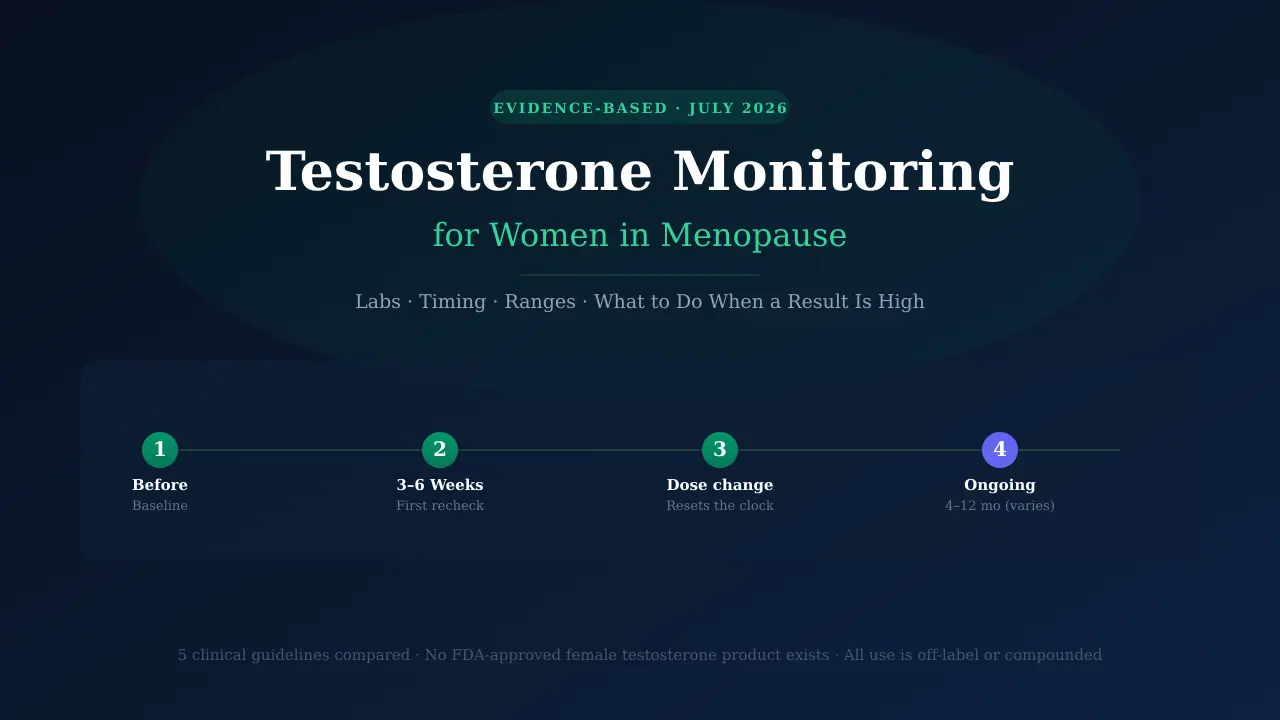
Monitoring usually starts with a total testosterone blood test before treatment, again 3–6 weeks after starting, and after any dose change. Once stable, US guidance says every 4–6 months. The Global Consensus says every 6 months. The British Menopause Society says 6–12 months. The test prevents too much exposure. It does not diagnose low desire or predict who will benefit.
✅ Yes, if:
↔️ Go here instead, if:
⚠️ Stop and contact your prescriber now if:
You’re noticing voice changes, real hair loss, or genital changes right now.Some of those changes may not reverse. This page can wait. That can’t.
We’d rather lose you as a reader than have you finish an article while something that may not undo gets further along.
A comparison of published guidance, verified . Not a testing order for you.
| When | What’s usually checked | Why |
|---|---|---|
| Before you start | Total testosterone. Several US protocols also add SHBG, liver function, and a lipid panel | Set a baseline and catch a high starting level |
| 3–6 weeks after starting | Total testosterone + how you feel + side effects | Catch too much, early |
| After any dose change | Repeat total testosterone | The change reset the clock |
| Once steady | Every 4–6 months (US-oriented) or every 6–12 months (UK) | Confirm you’re still in the female range |
| Every visit | Benefit, distress, acne, hair, voice, skin transfer | A number alone can’t tell you it’s working |
| Around 6 months | The honest checkpoint | If it hasn’t meaningfully helped, guidance says stop or reconsider — not increase |
About The HRT Index
The HRT Index is the independent decision resource for online menopause and HRT care—comparing telehealth providers on clinical legitimacy, care quality, medication fit, price transparency, and access, with every claim verified and dated. The right provider depends on your symptoms, age, what you have tried, health history, and state. Use Find My HRT Path to match your situation before your first consult.
You’ve probably read three pages and gotten three answers. You assumed one of them was wrong. You didn’t. They’re all real. We read the source documents—not other people’s summaries of them—and put the monitoring instructions side by side.
| Source | Baseline labs | First recheck | Once stable | Liver + lipids? |
|---|---|---|---|---|
| Global Consensus (2019) | Total testosterone | 3–6 weeks | Every 6 months | Not specified |
| ISSWSH (2021) | Total T + SHBG | 3–6 weeks; repeat within 6 wks of any dose increase | Every 4–6 months | Yes, at baseline |
| ACOG (2023) | Advises testing patients already using pellets or compounded testosterone | Not specified | Cites 20–80 ng/dL as the physiologic premenopausal range | Not specified |
| US Dept. of Veterans Affairs (Mar 2025) | Total T + SHBG + liver function + lipid panel | 3–6 weeks, and after any dose change | Every 4–6 months | Yes, at baseline |
| British Menopause Society (May 2026) | Total testosterone | 3–6 weeks (BMS calls this aspirational; most NHS clinics review at 2–3 months) | Every 6–12 months | No — says routine lipids or FBC not needed at female doses |
Sources read directly and verified . ACOG’s 2023 consensus addresses compounded hormone therapy and does not publish a full timing schedule comparable to the other four.
Look at the spread.
Your ongoing check could be every 4 months or every 12. The VA—a US government body—says draw liver function and lipids at baseline, while the British Menopause Society, writing 14 months later, says routine safety bloods aren’t needed at these doses. Neither is careless. They were written for different health systems and weigh the same thin evidence differently.
The three US-oriented documents share the same shape: baseline → 3–6 weeks → every few months.But even they aren’t identical. The Global Consensus says six months. ISSWSH and the VA say every 4–6. If your clinician follows a different schedule, that doesn’t make them wrong. It makes it a fair question. And now you know enough to ask it without sounding like you’re accusing anyone of anything.
You now know what the published schedules say. For help choosing a starting point, take the free quiz—no email needed. It suggests a cash-pay online option with its listed price and next steps, or guidance when online care is not the right next step.
Get my personalized HRT match →HSDD(hypoactive sexual desire disorder) is the clinical term for low sexual desire that causes real personal distress—and it’s the only use of testosterone in women that the evidence supports. Major guidance treats it as a diagnosis made after a proper assessment has looked at your relationship, your mental health, your other medications, and your medical history first. Here’s what four separate bodies say about the blood test:
| Source | Can it diagnose HSDD? | Does it predict benefit? | What it’s for |
|---|---|---|---|
| Global Consensus (2019) | No | No | No androgen cutoff separates women with and without sexual dysfunction |
| ISSWSH (2021) | No | No | Baseline, then keep levels in the premenopausal range |
| VA (Mar 2025) | No — levels “are not used to diagnose HSDD and do not predict treatment efficacy” | No | Baseline; confirm you don’t exceed the physiologic premenopausal range |
| BMS (May 2026) | No | No | Establish a baseline; make sure levels aren’t already high before starting |
Verified .
There is no number that means you need this.
So why draw blood at all? Two reasons, and only two:
Your clinical response—did it help, are you getting side effects—sits alongside the number. Neither one works alone.
If a clinic tells you they’ll get your testosterone to an optimal number, they’re describing something the evidence doesn’t support. ISSWSH cites evidence suggesting a bimodal effect: above the recommended physiologic range, sexual desire may actually decrease. “Higher is better” is not what the guideline says—and it may be backwards at the exact thing you came for.
A 2019 systematic review and meta-analysis pooled 36 randomized trials and 8,480 participants. The result for transdermal testosterone versus placebo: roughly one additional satisfying sexual event per month, along with reduced sexual distress and improvements in desire, arousal, orgasm, and self-image. One event a month. Statistically significant, and for a lot of women it genuinely matters. It’s also not what the internet promises.
And the energy, the brain fog, the muscle? The British Menopause Society (May 2026): randomized trials “have not demonstrated the beneficial effects of testosterone therapy for cognition, mood, energy and musculoskeletal health.” The VA says off-label use for bone density, mood, or cognition is not recommended due to lack of evidence of benefit.
BMS reported in May 2026 that a UK trial called ESTEEM—400 participants, funded by the National Institute for Health and Care Research—had recently commenced, looking at menopause quality of life as its main outcome. No results were available when we checked. We’d rather you hear that from us than find out in month six.
| Test | Who asks for it | Why |
|---|---|---|
| Total testosterone | All five | The one thing everyone agrees on. Catches a high starting level and gives you something to compare to later. |
| SHBG | ISSWSH, VA (routine); BMS (in specific situations) | Helps explain a poor response or unexpected side effects |
| Liver function | ISSWSH, VA | Safety baseline. BMS says not needed routinely at these doses. |
| Lipid panel | ISSWSH, VA | Safety baseline. BMS says not needed routinely at these doses. |
Verified .
If your clinic drew only total testosterone, that’s within one legitimate reading of the evidence. If they drew all four, that’s within another. What isn’t fine is nobody being able to tell you which one they follow, or why. That’s a real question you can ask, and the answer will tell you a lot.
This is why “your levels are normal” landed with a thud. The sentence isn’t wrong. It’s incomplete.It’s missing its second half: normal by which range, on which test, for what purpose.
| Source | Population / context | Method | Reported interval | A treatment target? |
|---|---|---|---|---|
| ACOG (2023) | Women on menopausal testosterone therapy | Not specified | 20–80 ng/dL | A physiologic premenopausal range to stay within—not a universal lab interval |
| Quest Diagnostics (test 15983) | Adult women, general | LC-MS/MS | 2–45 ng/dL | No — a reference interval for that assay |
| Clinical Chemistry review (2023) | Adult women, general | LC-MS/MS | 8.7–46 ng/dL (0.3–1.6 nmol/L) | No — a reference interval |
| Guay et al. (ISSWSH) — ages 20–29 | Healthy premenopausal women, no sexual complaints | Historical cohort | 45.5–57.5 ng/dL | No — historical cohort values |
| Guay et al. — ages 30–39 | ″ | ″ | 27.6–39.8 ng/dL | No |
| Guay et al. — ages 40–49 | ″ | ″ | 27.0–38.6 ng/dL | No |
Assembled from the named primary sources and verified .
A real example. Say your result is 50 ng/dL.
Both are correct. They’re answering different questions. If nobody named the range and the assay for you, you got a number, not an interpretation.
You’ve read that women lose about half their testosterone by menopause. Testosterone concentrations dodecline across the reproductive years—but cross-sectional data hasn’t shown a discrete fall caused by natural menopause itself. The drop happens gradually, on the way there, not at the door.
The big exception: surgical menopause. ISSWSH cites data showing women who had both ovaries removed had substantially lower total and free testosterone than age-matched women who reached menopause naturally.
If levels don’t fall at menopause, and no level diagnoses anything, then testing was never about finding a deficiency. It’s a safety check on your dose. A clinic using one low number to diagnose a testosterone deficiency is using the test for a purpose the major guidance doesn’t support.
Here’s the most useful thing on this page. Screenshot it.
| Lab | ✅ Built for female levels | ❌ Not this |
|---|---|---|
| Quest Diagnostics | Test code 15983— Testosterone, Total, LC/MS/MS (CPT 84403) | Standard testosterone immunoassay |
| LabCorp | Test 070001— Testosterone, Total, Women, Children, and Hypogonadal Males, LC/MS-MS | Test 004226— Testosterone, Total (immunoassay) |
Pulled from each laboratory’s own test directory, .
📋 What to look for on your lab report
If the method isn’t printed on the report, ask the lab or your clinician which assay was used. Don’t guess it from the reference range.
LC-MS/MS(liquid chromatography–tandem mass spectrometry) is sensitive enough to measure the very low testosterone levels women actually have—roughly one-tenth of a man’s. The routine test, an immunoassay, performs poorly at those concentrations.
A peer-reviewed Clinical Chemistry review explains the mechanism: DHEAS—another hormone circulating at far higher concentrations—looks similar enough that the antibodies grab it too, producing a falsely high result. High SHBG can make some immunoassays read falsely low.
Quest listed its direct-purchase testosterone test at $69 plus a $6 physician service fee when we checked on . Eligibility, state restrictions, and insurance coverage vary. Coverage for compounded testosterone, visits, and lab work depends on the product, provider, pharmacy, and plan—confirm each one separately before you pay.Midi’s own patient materials say most insurance plans don’t cover compounded medications.
A Clinical Chemistry review notes a case where a lab technician’s own gel use contaminated quality-control samples—the ones the lab runs to check that the machine is working. Because the gel is enormously more concentrated than blood, even a trace near the draw site can produce a markedly increased result.
What a contaminated result looks like in practice:
Your result comes back high. Your clinician does the responsible thing and cuts your dose. You feel worse. Nobody knows why. The gel was on your arm.
| Record | Why it matters |
|---|---|
| Product name | Compounded and manufactured products behave differently |
| Application site | The single biggest contamination variable |
| Date and time of last application | Levels depend heavily on time since application |
| Which arm they drew from | So you can rule contamination in or out |
| Assay used | LC/MS-MS or immunoassay changes what the number means |
| Units and reference range | A number without these is not a result |
Should you skip your dose that morning?Don’t invent a rule. UK guidance from NHS Highland advises women to omit the testosterone dose before a blood test because it can give a falsely high result. But absorption differs by product, and your prescriber’s protocol may differ. Ask your prescriber and follow their instruction—not a rule from the internet, including ours.
| Question | VA (Mar 2025) / ISSWSH (2021) | BMS (May 2026) |
|---|---|---|
| Routine SHBG at baseline? | Yes | Not routine — useful in specific situations |
| High SHBG means? | Associated with a lower likelihood of response | May explain a poor response despite a normal total |
| Low SHBG means? | — | May explain androgenic side effects despite a normal total |
| Oral estrogen consideration? | Named as a cause of raised SHBG | Consider switching oral → transdermal estrogen |
| Raise dose above physiologic range to overcome high SHBG? | No | No |
Verified .
Elevated baseline SHBG is associated with a lower likelihood of respondingto testosterone. It’s raised by oral estrogen (especially conjugated estrogens), thyroid replacement, and untreated overactive thyroid. The BMS suggests considering a switch from oral estrogen to transdermal estrogen when oral estrogen is driving SHBG up—that can lower SHBG and change how much testosterone is available, without adding any testosterone at all.
Low SHBG may explain androgenic side effects when your total testosterone is within range. Acne. Hair growth. A normal number. It’s associated with type 2 diabetes, metabolic syndrome, and higher body weight. If you’ve been told “your labs are fine, so it must be something else” while your skin is telling you otherwise—there’s a real mechanism here. Both ISSWSH and the BMS name it explicitly. See also: Testosterone side effects in depth.
The one thing that isn’t the answer:
Do not let anyone raise your testosterone above the female range to “overcome” high SHBG. The VA: increasing the dose beyond the physiologic range to overcome elevated SHBG is not recommended. ISSWSH says the same. It walks you straight into the side effects.
| Route | FDA status in the US | Adjustable after you take it? | Overshoot concern | Guidance position |
|---|---|---|---|---|
| Transdermal cream/gel | No FDA-approved female product; off-label or compounded | Yes — daily, immediately | Possible; still needs monitoring | Preferred route |
| Pellets | No FDA-approved female product | No — removal needs a procedure | Early peaks above 100–250 ng/dL documented in studies | Not recommended |
| Injections | No FDA-approved female product | No — not until it wears off | Wide swings well beyond physiologic levels (ISSWSH) | Not recommended |
| Oral / troches / lozenges | No FDA-approved female product | Partially | Unpredictable absorption; can affect lipids | Not recommended |
Verified .
The Global Consensus Position Statement is unambiguous: use of any testosterone preparation that results in supraphysiologic concentrations, including pellets and injections, is not recommended. A 2025 review reported early peaks above 100–250 ng/dLin some published pellet studies—well past the female range. Pellets aren’t readily dose-adjustable once implanted; removal may require a procedure and doesn’t instantly reverse exposure. An excessive result is simply harder to manage than with a cream you can turn down tomorrow.
ACOG advises testing patients already using pellets or compounded testosterone to rule out supraphysiologic exposure—a medical body naming one product category and saying: go check those women. No affiliate link here. You’re worried, not shopping.
We’re telling you that even though compounded is what most American women on testosterone are actually taking. It’s what the sources say. And it’s exactly why the pharmacy question is one to ask out loud.
Testosterone is a controlled substance
Testosterone is a Schedule III controlled substance in the United States. It requires a prescription from a licensed clinician. Federal law limits Schedule III prescriptions to no more than five refills, and no fill or refill more than six months after the prescription was issued. Some telehealth platforms don’t prescribe controlled substances at all—which turns out to matter more than you’d think. See our full guide to testosterone’s FDA and legal status.
We checked each company’s own published pages—not review sites—on .
| Provider | Provider-stated offer | What we verified | Monitoring protocol published? | Unresolved before you pay |
|---|---|---|---|---|
| Midi Health | Compounded testosterone cream | Testosterone offered; 24 states + DC listed on its map; most women complete two visits before an Rx; declines pellets | Yes — start → 4–6 wks → every 6–12 months | Whether the lab order defaults to LC-MS/MS; medication and lab costs; your state |
| Sesame Care | Menopause subscription; basic lab work included | Included labs are CBC, A1c, thyroid, lipid panel, and CMP—total testosterone and SHBG are not on the list. Its own safety information states providers cannot prescribe controlled substances online. | n/a | Everything. We removed our link from this page. |
| Winona | DHEA — described by Winona as a testosterone precursor | Winona’s own help center explains why it doesn’t prescribe testosterone | Not published | What follow-up applies to DHEA |
| Hers | Estradiol + progesterone | Published menopause formulary does not list testosterone | Not published | State eligibility; whether the formulary has changed |
| Inner Balance (Oestra) | Estradiol + progesterone vaginal cream — “does not contain added testosterone” | Confirmed. Public page doesn’t disclose a separate testosterone pathway, price, states, or monitoring | Not published | Everything about the separate testosterone pathway |
Read that Sesame row again.
We had a link there. We pulled it. Sesame’s menopause subscription includes lab work—but the labs it includes are CBC, A1c, thyroid, lipid panel, and CMP. Total testosterone isn’t on that list. Neither is SHBG. We’re not going to send you to buy a subscription that doesn’t cover the one test this page spent 2,000 words telling you to ask for.
Winona’s own help center explains that it offers DHEA—a hormone your body canconvert into testosterone—rather than testosterone. ISSWSH: oral DHEA “cannot be recommended for the treatment of HSDD in postmenopausal women with normal adrenal function.” BMS (2026): more research is needed before DHEA can be recommended. If you sign up somewhere expecting testosterone monitoring and receive DHEA, the schedule on this page doesn’t automatically apply.
| Midi (published) | Global Consensus | ISSWSH | VA | |
|---|---|---|---|---|
| Baseline | Labs at start | Total T | Total T + SHBG + LFTs + lipids | Total T + SHBG + LFTs + lipids |
| First recheck | 4–6 weeks | 3–6 weeks | 3–6 weeks | 3–6 weeks |
| Once stable | Every 6–12 months | Every 6 months | Every 4–6 months | Every 4–6 months |
| Pellets | Declines | Not recommended | Not recommended | Not recommended |
Verified .
The honest part. Hear it from us before you pay.
Midi does NOT commit to the tightest monitoring interval on this page. Its published range runs to twelve months—double the Global Consensus and triple the tight end of ISSWSH. If a guaranteed four-month recheck is your priority, an in-person menopause specialist will serve you better, and our Find My HRT Path tool will flag when that’s the right call.
But because Midi publishes a protocol at all, you can hold them to it.Three of the five platforms above publish nothing. A published 6–12 month range is a range with clinician judgment inside it—and a range is something you can have a conversation about.
If you need someone who will prescribe testosterone, order labs, publish what they check and when, and won’t put you on pellets—Midi Health was the only one of the five platforms we reviewed whose current public materials clearly published both a testosterone product and a monitoring schedule. Costs to expect: the visit is billed to insurance; compounded testosterone usually isn’t covered; labs are separate.
Two questions to bring: which interval within 6–12 months does the clinician plan to use, and does the lab order default to LC-MS/MS?
Six steps, in order:
Check the units and the reference range.
A number alone isn't a result. ng/dL and nmol/L differ by about 29×.
Check the method.
If it was an immunoassay, the number may be falsely high before anything else is considered.
Check for contamination.
Where did you apply it? Which arm did they draw from? How long between?
Contact your prescriber.
Tell them all of the above.
Don't adjust your own dose.
Not up, not down, not 'just for a bit.'
Confirm the repeat plan.
ISSWSH advises clinician-guided dose reduction and a repeat test in 2–3 weeks when a level is supraphysiologic — even if you feel completely fine.
The BMS puts it clearly: adverse effects are uncommon if levels stay in the female physiological range.The most common are excess hair growth, acne, and weight gain—usually reversible with a reduction in dose or stopping. Take the reassurance. It’s real. And notice why it holds: because someone is watching the level.
🟡 Usually improve after a clinician-guided change
Tell your prescriber. Don’t stop on your own.
🔴 Don’t wait for these
Contact your prescriber promptly—not at your next scheduled visit. Some of these may not reverse.
If your level is normal but you’re getting side effects: re-read the SHBG section above. Low SHBG may explain androgenic effects despite a total testosterone within range. Both ISSWSH and the BMS name it. If you’ve been dismissed on this, take it back to your clinician. There’s a mechanism, and it’s in the guidelines.
There is no FDA-approved testosterone product for women in the United States. Every testosterone prescription written for a woman here is either off-label use of a product approved for men, or compounded. Internationally that’s shifting—1% testosterone cream is now licensed in Australia, New Zealand, South Africa, and the UK. Not here.
But something did change here. In December 2025, the FDA revised Addyi’s label. Previously approved only for premenopausal women, Addyi now indicates it for women under 65 with acquired, generalized HSDD—low sexual desire causing marked distress, not due to another condition, relationship problems, or another medication.
The postmenopausal trial (Study 6): 447 women under 65 received Addyi and 455 received placebo.At week 24, the mean change in satisfying sexual events per 28 days was 0.9 with Addyi versus 0.6 with placebo—a treatment difference of 0.4. Modest. We’re not going to oversell it, and we’re not going to compare it to testosterone’s numbers.
What the label says you’d be signing up for:
No hormone monitoring. No lab codes. No contamination window. That’s the trade you’re weighing.
A clinic that only ever offers the thing it sells is worth a second look. Ask what they think of Addyi. Listen for whether you get an answer or a redirect.
No affiliate link in this section. Addyi isn’t a partner. That’s rather the point.
The evidence base thins out fast. The VA says testosterone is generally not recommended in premenopausal women due to insufficient evidence. The BMS calls it a controversial area needing more research. If you’re still cycling and you’ve been offered testosterone, that’s not automatically wrong—but it’s off the map the guidelines drew, and you deserve to know that before you start.
This is where the biology actually changes suddenly. ISSWSH cites data showing women who had both ovaries removed had substantially lower testosterone than age-matched women who reached menopause naturally. The monitoring schedule doesn’t change. The context does.
Either way, the same rules hold: no level diagnoses HSDD, no level predicts benefit, and the test is there to keep you from overshooting.
You’ve got about fifteen minutes with someone. Here’s how to use them.
What's the goal of testosterone in my case, specifically?
What did my baseline rule in or out?
Which lab reference range are you using?
Was my test run by LC-MS/MS?
Why did you order SHBG — or why not?
Does your protocol include liver and lipid tests at baseline?
When do we retest after a dose change?
Which symptoms should make me call you before the next visit?
What's the plan if I don't feel a meaningful difference by six months?
Who owns my monitoring and refills going forward?
Uses symptoms, what you have tried, age, state, and health history to suggest a next step. No email required.
Find my next care step →| What | How | Verified |
|---|---|---|
| All five monitoring schedules | Read the primary documents directly (JCEM, J Sex Med, ACOG, VA, BMS) | |
| Midi's protocol | Midi's own testosterone page and FAQ | |
| Quest 15983; LabCorp 070001 & 004226 | The labs' own test directories and technical documents | |
| Quest direct-purchase price ($69 + $6 fee) | Quest's own consumer storefront | |
| Reference intervals | ACOG, Quest, Clinical Chemistry, ISSWSH-cited data — assembled and labeled by us | |
| Sesame's included lab list | Sesame's own menopause FAQ — testosterone and SHBG are not included | |
| Which platforms offer testosterone | Each provider's own published pages, fetched directly | |
| Gel contamination | Peer-reviewed Clinical Chemistry review, 2023 | |
| Addyi indication, trial data, boxed warning | The current FDA prescribing information (revised 12/2025) | |
| Schedule III refill limits | 21 CFR 1306.22 |
Who wrote this and how. The HRT Index Editorial Team. We read the primary guidelines instead of other people’s summaries of them, pulled the lab codes from the laboratories’ own directories, read the FDA label rather than the press release, and dated every claim. This is editorial research. It has not been reviewed by a clinician—we don’t put a clinician’s name on work a clinician didn’t do.
Disclosure.The HRT Index earns a commission if you start care through some links on this page, including Midi Health. It didn’t change what we found. The clearest evidence of that: we removed our own Sesame link from this page after checking its included lab list. How we’re funded.
US-oriented guidance says a baseline before starting, a recheck 3–6 weeks after starting or changing dose, then every 4–6 months once stable. The Global Consensus Position Statement says every 6 months. The British Menopause Society says every 6–12 months.
No. No total testosterone cutoff diagnoses HSDD or predicts who will benefit, and no androgen cutoff separates women with sexual dysfunction from women without it. A high baseline, though, suggests your symptoms probably are not about testosterone.
There is not one number. ACOG cites 20–80 ng/dL as the physiologic premenopausal range for women on testosterone therapy. Quest reports 2–45 ng/dL as its adult-female reference interval for LC-MS/MS test 15983. Those answer different questions — your result only means something against your lab's range and your lab's method.
Total testosterone. The Global Consensus, ISSWSH, and the BMS all name it the best practical measure. The BMS says free testosterone assays are not recommended because their link to biological activity has not been confirmed.
It helps explain two things: why testosterone might not be working (high SHBG), or why you might be getting side effects at a normal total (low SHBG).
It depends whose protocol your clinician follows. The VA and ISSWSH include them at baseline. The BMS in 2026 says routine safety bloods like lipids or FBC are not needed at female doses. Ask which and why.
Do not invent a rule. UK guidance from NHS Highland advises omitting the dose before a test because it can read falsely high, but this varies by product and protocol. Ask your prescriber — and either way, do not apply gel near the arm they will draw from.
A normal result is not evidence it is working. Raise the six-month checkpoint with your clinician — major guidance says if there is no meaningful benefit by six months, treatment should be stopped or reconsidered rather than continued because the level looks fine.
Yes. ISSWSH advises clinician-guided dose reduction and a repeat test in 2–3 weeks when a result is supraphysiologic, even without side effects. But first — ask whether gel contamination could explain the number.
They need the same checks, with one critical difference: pellets are not readily dose-adjustable once implanted, so an excessive result is harder to manage. ACOG advises testing patients using pellets or compounded testosterone for supraphysiologic exposure.
No. There is no FDA-approved testosterone product for women in the United States. All use is off-label or compounded. 1% testosterone cream is licensed in Australia, New Zealand, South Africa, and the UK.
Noticeable improvement usually shows by 6–8 weeks; maximum effect around 12 weeks. The BMS says allow 3–6 months for a full picture. If there is no meaningful benefit by six months, guidance says stop or reconsider.
The evidence does not currently support it. The BMS (2026) says randomized trials have not demonstrated benefit for cognition, mood, energy, or musculoskeletal health. The VA does not recommend off-label use for those indications. The ESTEEM trial is now studying it.
It may produce a number, but the method, reference range, timing, and clinical review still decide whether it means anything. It is not a monitoring plan or a treatment decision.
Take our free 90-second matching quiz. Matches your symptoms, state, age, what you have tried, and health history to your best-fit online service—and flags when online care isn’t the right starting point.
Find My HRT Path →The HRT Index is the independent menopause HRT decision layer for women. Educational only—not medical advice. Not reviewed by a clinician.
Primary sources are linked inline throughout this page. Monitoring facts come from published clinical practice guidelines and government guidance documents. Lab facts come from each laboratory’s own test directories. Regulatory facts come from FDA announcements and prescribing information. Provider facts are provider-published and dated.
