
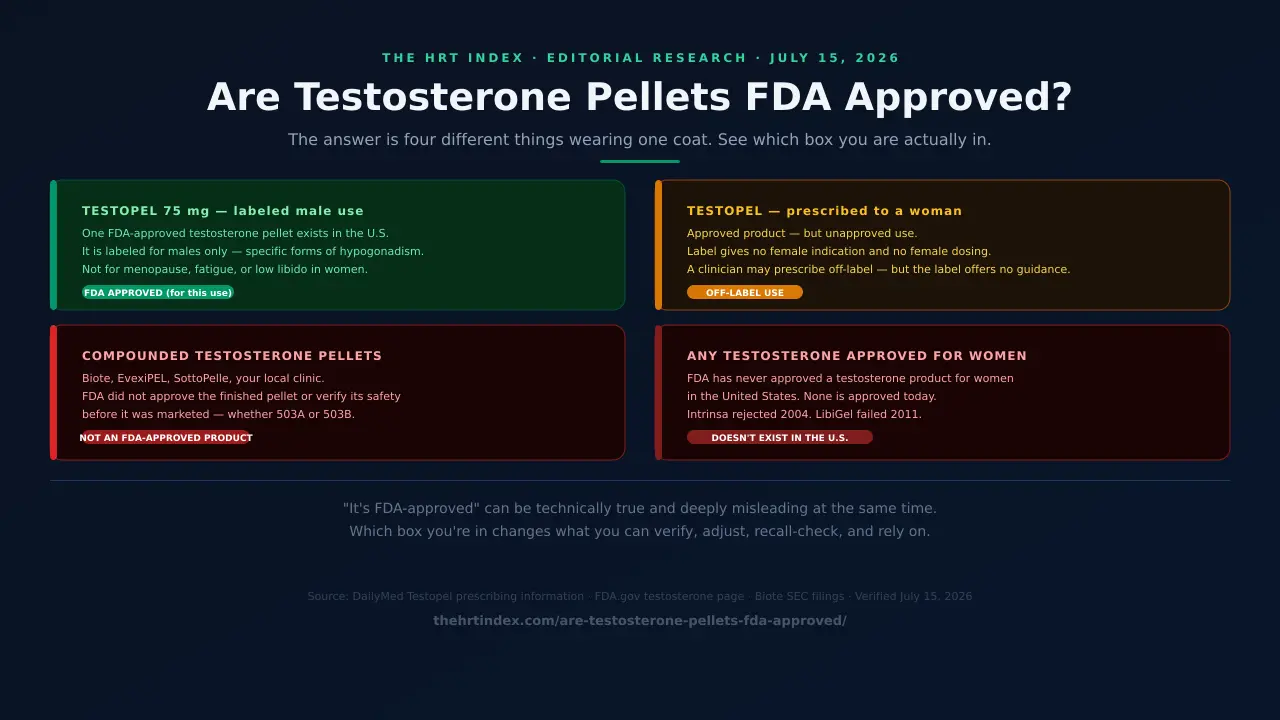
Are testosterone pellets FDA approved?
Some testosterone pellets are FDA-approved and some are not, so a plain yes or no is misleading. Testopel is an FDA-approved 75 mg testosterone pellet whose label lists male indications only. Pellets compounded for women in menopause clinics are not FDA-approved finished products. No testosterone product is FDA-approved for women in the United States.
The confusion isn’t your fault. It’s built into the question. “Are testosterone pellets FDA approved” is actually four questions wearing one coat. Most pages — and a lot of clinic staff — collapse them into a single yes or no. That’s how a technically true sentence leaves you with a false impression.
The four questions:
- Is the finished product approved? Not the hormone. Not the ingredient. The actual pellet.
- Is it approved for your population? Men and women are different labels.
- Is it approved for your condition? Diagnosed hypogonadism in a man isn’t menopause in a woman.
- Is it the approved product at all — or a compounded one? Different regulatory categories, not different brands.
Run any pellet offer through those four and the fog lifts.
The Testosterone Pellet FDA Status Matrix
Classified against the four questions above. Verified July 15, 2026.
| What you’re offered or told | Finished product FDA-approved? | What it means for you | What to ask for |
|---|---|---|---|
| Testopel 75 mg, for a labeled male use | Yes | Not you. The label covers specific testosterone-deficiency conditions in males. | — |
| Actual Testopel, prescribed to a woman | Yes — the product is | Off-label. FDA approved the product, not this use. The label gives no female indication and no female dosing regimen. | Product name, strength, why this over an adjustable option |
| A compounded testosterone pellet | No | FDA did not approve the finished pellet or verify its safety, effectiveness, or quality before marketing. | Exact formula, strength, pharmacy, 503A or 503B, lot number, total cost |
| A pellet from a 503A pharmacy (state-licensed, compounding against a named patient’s prescription) | No | Can be lawfully compounded when federal and state rules are met. Still not an FDA-approved product. | Pharmacy name, license, why an approved option isn’t being used |
| A pellet from a 503B outsourcing facility (FDA-registered, can make office stock) | No | Registration is not approval. FDA says so directly. | Facility name, lot number and current recall status |
| “It’s made with FDA-approved ingredients” | Doesn’t answer it | Ingredient status says nothing about the finished pellet. | “Is the finished pellet FDA-approved?” |
| “It’s from an FDA-registered facility” | Doesn’t answer it | Facility oversight ≠ product approval. | “Where’s the approved product’s label?” |
| A pellet with no paperwork | Can’t be verified | Nobody can make an FDA claim about it. Including us. | Don’t take a verbal label. Get it in writing. |
The line that matters: FDA approval attaches to a specific finished product for a specific labeled use. Not to a hormone. Not to a building. Not to a pharmacy license. Not to the word “bioidentical.”
One honest note in the other direction
“Not FDA-approved” doesn’t mean “illegitimate.” Compounding exists for real reasons — allergies, doses nobody manufactures, formulations that don’t come off a shelf. FDA says so itself. The problem here isn’t that compounding exists. It’s that women are handed a compounded implant while hearing the letters F-D-A, and never told which box they’re actually in.
Which testosterone pellet is FDA approved?
Testopel is an FDA-approved testosterone pellet sold in the United States, and its manufacturer describes it as the only FDA-approved testosterone pellet available. Each pellet contains 75 mg of testosterone. Its label lists male indications — specific forms of hypogonadism and certain cases of delayed puberty. Menopause, fatigue, brain fog, and low libido in women are not on it.
Testopel has a strange backstory. According to a peer-reviewed review in Sexual Medicine Reviews (McCullough, 2014), FDA approved fused crystalline testosterone pellets in 1972 — and then nothing happened. The formulation sat unmarketed for decades until a company bought the patent and brought it to market as Testopel in 2008, into a booming men’s testosterone market.
So when a clinic says “there’s an FDA-approved testosterone pellet,” that’s true. It’s Testopel. It’s labeled for men.
The Label Verification Card
Every field is from the current Testopel prescribing information. Check it yourself before you consent to anything.
| Field | What the current label says |
|---|---|
| Product | TESTOPEL (testosterone pellets) |
| Strength | 75 mg per pellet, unscored implant |
| Route | Subcutaneous implantation |
| Approved population | Males |
| Approved indications | Primary hypogonadism, hypogonadotropic hypogonadism, and selected delayed puberty — in males |
| Female indication | None |
| Female dosing regimen | None provided |
| Male dosing guideline | 150–450 mg subcutaneously every 3–6 months |
| DEA schedule | CIII — requires a valid prescription |
| Marketing status | Abbreviated New Drug Application (ANDA) |
| Removal language | Pellets would have to be removed if complications require testosterone’s effects to be discontinued |
| Reported insertion complications | Implantation site infection; pellet extrusion |
| Source checked | DailyMed current label, July 15, 2026 |
Read the two “None” rows together. No female indication. No female dosing regimen. It isn’t that a woman is forbidden from receiving Testopel — a clinician can prescribe an approved drug off-label, and that’s normal medicine. It’s that the label offers zero guidance on how to do it. No starting dose. No target. No adjustment schedule. Nothing.
Which brings us to the question that actually matters, and it’s not the one you came in with. The question isn’t how many milligrams. It’s what shape does the release curve make — and can anyone predict where you’ll land on it? Turns out somebody measured that. The answer is in the data below.
Is any testosterone FDA approved for women?
No. FDA has never approved a testosterone product for women in the United States, and none is approved today. Two serious attempts failed: the Intrinsa patch was rejected by a unanimous FDA advisory panel vote in December 2004 over unresolved long-term safety concerns, and BioSante’s LibiGel failed its Phase III efficacy endpoints in 2011. Australia’s regulator approved AndroFeme 1 for women in November 2020. That has no effect in the U.S.
This is the fact the whole page turns on. FDA’s own testosterone information page states that approved testosterone products are approved for use in men who have low testosterone plus an associated medical condition— not men who simply feel tired. Certainly not women.
So in routine U.S. clinical care, a woman on testosterone is in one of two categories:
- An FDA-approved male product, used off-label at a fraction of the male dose, or
- A compounded preparation, which is not an FDA-approved product.
That’s it. Not at any price. Not at any clinic. If someone implies their pellet carries an FDA blessing you couldn’t get elsewhere — that blessing doesn’t exist.
Why the gap?
Two different walls, and they’re worth separating because people get this wrong constantly:
- Intrinsa (2004) wasn’t rejected because it didn’t work. It worked. The advisory committee voted unanimously against approval over unresolved long-term cardiovascular and breast-cancer questions, weighed against a benefit measured at roughly one additional satisfying sexual event.
- LibiGel (2011) was different. It failed on efficacy — the placebo group improved almost as much as the drug group.
One died on safety uncertainty. One died on the numbers. Neither is a conspiracy. Both are why there’s still nothing on the shelf. Meanwhile Australia has an approved product for women. The U.S. gap is a real inequity. That still doesn’t make an implant the answer.
The right path depends on your specific situation
Because no FDA-approved testosterone exists for women, every option here is off-label or compounded. The HRT Index’s Find My HRT Path tool matches your situation to the right provider — and flags when online care isn’t the right starting point.
Match my situation to the right path →Free. No account. It asks about health information — here’s exactly what we collect and how to delete it.
What does “off-label” actually mean here?
Off-label means an FDA-approved drug is used for a population, condition, or dose outside its approved labeling. Clinicians may generally prescribe approved drugs off-label when they judge it appropriate — it’s legal and common. But off-label is not the same as compounded. Actual Testopel in a woman is an approved product used outside its label. A compounded pellet is not an approved product at all. Clinics use “off-label” for both, and that’s where women get lost.
This distinction is the single most useful thing on this page, so let’s be slow about it.
| Testopel in a woman | A compounded pellet | |
|---|---|---|
| Did FDA approve this finished product? | Yes | No |
| Did FDA approve this use? | No | No — there’s no approved use to speak of |
| Is there a manufacturer’s label? | Yes (male indications) | No |
| Standardized strength and manufacturing? | Yes | Varies by pharmacy and formula |
| Correct term | Off-label use | Compounded product |
Both are legal. They are not the same thing, and a clinic saying “we use it off-label” might mean either one. Most staff genuinely don’t know the difference. But you need to, because it changes what you’re able to verify. With Testopel, you can pull the label. With a compounded pellet, there’s no label to pull.
If the answer is compounded, your next question is the pharmacy and the lot number. Here’s why that matters more than it did a year ago.
Are compounded testosterone pellets FDA approved?
No. FDA does not approve compounded drugs — it did not approve the finished pellet or verify its safety, effectiveness, or quality before marketing. That’s true whether it came from a 503A pharmacy or a 503B outsourcing facility, and regardless of the brand name on the clinic door. Biote is a practitioner platform, not an FDA-approved drug — and since March 2024 it has owned the 503B facility that makes most of its pellets.
What Biote actually is — and what changed
For years the accurate description was that Biote trains and certifies clinicians in a method and doesn’t touch the pellets. That’s no longer true.
Per Biote’s SEC filings: on March 18, 2024, Biote acquired Asteria Health, a 503B outsourcing facility. Asteria now manufactures a majority of the compounded pellets used by Biote-certified practitioners. Other named Biote 503B facilities include AnazaoHealth and Carie Boyd’s Prescription Shop. The company reports more than 9,200 practitioners across more than 5,300 clinicsas of December 31, 2025. It’s publicly traded as NASDAQ: BTMD.
So Biote is now both the platform andthe manufacturer. The company that trains your clinician also makes your pellet, and that’s worth knowing when you’re evaluating who’s checking whom.
Active recall — check your lot number
On January 26, 2026, Biote disclosed that Asteria Health voluntarily recalled specified hormone pellet lots shipped between May 20, 2025 and January 2026, over possible metal particulate. It was lot-specific — not every pellet. If your clinic uses Biote, your lot number is now a question you need answered before anything goes under your skin.
The Biote Regulatory Timeline
Company statements, FDA records, and our conclusions kept separate. Verified July 15, 2026.
| Date | What happened | Source type |
|---|---|---|
| 2018 | FDA inspects BioTE Medical and finds records describing 4,202 adverse events that had never been submitted to the agency. | FDA statement (Sept 9, 2019) |
| Sept 9, 2019 | FDA publishes its statement. Records suggested possible association with endometrial cancer, prostate cancer, strokes, heart attacks, DVT, cellulitis, and pellet extrusion. FDA could attribute only 61 reports to compounded testosterone pellets because the records lacked critical information. | FDA statement |
| Nov 2019 | At a NASEM open session, founder Dr. Gary S. Donovitz is asked whether his group tests pellets for testosterone release rate over time. He states his practice does not conduct that testing, and instead evaluates patients’ serum levels against target ranges. | NASEM published report |
| July 1, 2020 | NASEM delivers its FDA-commissioned report. Recommends restricting compounded hormone therapy to patients who can’t use approved products, and that FDA’s advisory committee consider pellet dosage forms for the difficult-to-compound list. | NASEM report |
| Mar 18, 2024 | Biote acquires Asteria Health, a 503B outsourcing facility. | Biote SEC filing |
| Dec 19, 2025 | FDA issues Form 483 inspectional observations to Asteria Health. (A Form 483 lists an investigator’s observations. It is not a final FDA determination of violation.) | FDA compounding actions list |
| Jan 26, 2026 | Biote discloses that Asteria voluntarily recalled specified hormone pellet lots shipped May 20, 2025–January 2026, over possible metal particulate. Lot-specific — not a recall of every pellet. | Biote SEC filing (8-K) |
| Dec 31, 2025 | Network reported at 9,200+ practitioners, 5,300+ clinics. | Biote SEC filing |
On the 4,202: those are records, not 4,202 proven drug-caused injuries. An adverse event report never proves causation. But the records weren’t exonerated either — FDA simply couldn’t attribute them because the information wasn’t there. They had accumulated from 2013 to 2018 in a company portal and were never sent to FDA or to the facilities that made the pellets. The scandal isn’t the number. It’s that nobody could tell.
On Donovitz’s 2019 statement: keep this narrow. He described his own practice at one session. It does not describe every current Biote facility or Asteria’s present quality program. But the release rate isthe product — a pellet’s entire premise is controlled release over months. That the founder of the largest pellet network in America told a National Academies panel his practice didn’t measure it is, in our editorial view, the most revealing sentence in this whole story.
The fair counterpoint:the 2020 NASEM report has been challenged. The Pharmacy Compounding Foundation commissioned a non-peer-reviewed white paper from the Berkeley Research Group arguing the FDA-commissioned report wasn’t independent. It’s industry-funded and it isn’t peer-reviewed. It’s also real, documented, and on the record. We’d rather you hear it from us than find it later and wonder what else we skipped.
What testosterone pellets actually do to your level
Published studies consistently report that testosterone pellets push women’s blood testosterone above the physiologic female range in the weeks after insertion, with wide and unpredictable variation between women. ACOG cites 20–80 ng/dL as a physiologic premenopausal range. Reported measurements in women after pellet insertion include roughly 299 ng/dL at week four and about 256 ng/dL at one month.
The yardstick first. ng/dL means nanograms per deciliter — the unit labs use for testosterone in blood. ACOG’s 2023 clinical consensus cites a physiologic premenopausal range of 20–80 ng/dL. A 2025 review puts postmenopausal women at roughly 10–55 ng/dL using LC-MS/MS. We’ll use ACOG’s 20–80 throughout for consistency. Lab ranges vary by assay and age — your lab’s range is the one that applies to you.
Selected published measurements in women
Not a systematic review. These are studies with extractable numbers we could locate and read. Compiled July 15, 2026.
| Study | Design | Dose | Women | What was measured | Result | Limitations |
|---|---|---|---|---|---|---|
| “Testosterone implants in women: Pharmacological dosing for a physiologic effect” (2013) | Clinical series | Individualized: mean 133.3 mg, range 55–240 mg | 154 | Mean at week 4 | 299.36 ± 107.34 ng/dL | Authors argued in favor of pharmacologic pellet dosing. Not a fixed dose. |
| Same study | Clinical series | Individualized | 261 | Mean when symptoms returned / reimplantation | 171.43 ± 73.01 ng/dL | Trough-side value, not early peak |
| Buckler et al. (1998), as reported in Hernandez 2025 | Pharmacokinetic | 100 mg | 30 | ~1 month; ~6 months | ~256 ng/dL, declining to ~83 ng/dL | Secondary reporting. Immunoassay, not LC-MS/MS. |
| Hernandez et al. (2025) | Retrospective chart review, single center | 75 mg (n=19) and 100 mg (n=12) | 31 (220 procedures) | Mean trough values, 100 mg cohort, first 6 months | 68.23 ng/dL | Contrary finding. Sampling didn’t establish the early peak. One author consulted for Marius, Endo, Besins; held Sprout stock. |
| Jiang et al. (2021) | Retrospective, unmatched cohorts | Compounded E2 + T pellets | 384 | Charted mean peak T | ~194 ng/dL | Only 16 women in comparison cohort had T values. Not a controlled comparison. |
| Cureus review (2025) | Structured narrative review (38 studies from 455 records) | Various | — | Early post-insertion peaks | >100–250 ng/dL, wide interindividual variability | Narrative synthesis, not meta-analysis. One RCT across 38 studies. |
The number that matters
Look at row one again. 299 ng/dL at week four came from a paper written to defend pellets. The title is “Testosterone implants in women: Pharmacological dosing for a physiologic effect.”That title is an argument. And the data inside it shows women averaging 299 ng/dL a month after insertion — roughly where many labs put the bottom of the adult male reference range.
Now the part that should actually worry you. That study reported a coefficient of variation of 35.9% at week four and 42.6% when symptoms returned. Translation: the spread was enormous. And this was individualized dosing— mean 133.3 mg, ranging from 55 mg to 240 mg. Clinicians were already trying to tailor it. Women still landed all over the map.
That’s the mechanism. It was never about total milligrams. It’s the shape of the release curve— a front-loaded surge, then a long taper — and the fact that nobody can predict which curve you’ll get until you’re already on it. Which is exactly what the founder of the biggest pellet company told the National Academies his practice doesn’t measure.
Where we argue against ourselves: Hernandez et al. (2025)
It’s a retrospective chart review of 31 women at one center. The 68.23 ng/dL figure is a mean trough— measured on the low end of the cycle, not at the early peak. The study’s own sampling didn’t capture the peak. So it isn’t a counter-finding on peaks. It’s a different measurement entirely. It tells us troughs can sit in range — but can’t tell us what happened at week four, because nobody looked.
The honest summary: the evidence leans hard in one direction, but it is not unanimous, and the whole literature is thin. That 2025 review found one randomized controlled trialacross 38 studies. One. For a treatment sold to hundreds of thousands of American women at several hundred dollars a visit. That’s not a conspiracy. It’s a thin evidence base being marketed like a thick one.
What clinics promise vs. what the research found
Pellet clinics commonly market testosterone for energy, muscle, mood, bone density, and mental clarity. The 2019 Global Consensus Position Statement — endorsed by 11 medical organizations — found no benefit for wellbeing, no benefit for depressed mood, and no effect on bone density, lean body mass, body fat, or muscle strength. The one benefit with strong evidence was sexual function in postmenopausal women diagnosed with HSDD.
Sixteen researchers from eleven organizations met in Berlin in May 2019, drew on systematic reviews and meta-analyses of randomized trial evidence, and issued graded recommendations. Level I / Grade A is their strongest rating.
| The pitch | What the Global Consensus reported | Grade |
|---|---|---|
| “More energy” | No effect on general wellbeing | Level I, Grade A |
| “Better mood” | No effect on depressed mood | Level I, Grade B |
| “Stronger bones” | No effect on bone density at spine, hip, or femoral neck at 12 months | Level I, Grade A |
| “More muscle, less fat” | No significant effect on lean body mass, total body fat, or muscle strength | Level I, Grade A |
| “Mental clarity” / “brain fog” | Insufficient evidence for cognitive performance or preventing decline | Insufficient |
| “Better sex drive” | Real benefit — averaging about one additional satisfying sexual event per month | Level I, Grade A |
Read that last row twice. The one thing testosterone is actually proven to do for women — the only evidence-based indication the statement recognizes — averages roughly one more satisfying sexual event per month. That’s the real effect size. It’s a genuine benefit and it matters to plenty of women. It’s also nothing like what’s being sold.
Then comes the sentence that ends the argument. Recommendation 4(c) states that the efficacy findings above do not apply to injectables, pellets, formulations producing supraphysiological levels, or compounded preparations.
So the pellet you were offered isn’t just outside the label. It’s outside the evidence the entire field rests on. The trials proving testosterone works in women weren’t done with pellets — and the panel said so deliberately.
Why the guidelines single out this route
The 2019 Global Consensus Position Statement, endorsed by 11 medical organizations, recommends against any testosterone preparation producing supraphysiologic concentrations in women — naming pellets and injections specifically. ACOG’s 2023 Clinical Consensus separately recommends preparations other than pellets, citing limited safety data and inability to remove the pellet. ISSWSH’s guideline says implants may produce supraphysiological levels, don’t allow dose titration, and are not recommended.
This isn’t one skeptical doctor. It’s one consensus statement endorsed by eleven organizations, plus ACOG and ISSWSH reaching similar conclusions separately in their own documents, for their own stated reasons.
The Guideline Scope Matrix
| Organization / document | Year | Population | What it says about pellets | Grade |
|---|---|---|---|---|
| Global Consensus Position Statement — endorsed by 11 orgs (IMS, Endocrine Society, EMAS, ISSM, ISSWSH, The Menopause Society, FLASCYM, RCOG, ISE, ESA, RANZCOG) | 2019 | Postmenopausal women | Rec 12(e): any preparation producing supraphysiologic testosterone — including pellets and injections — is not recommended. Rec 4(c): the efficacy findings don’t apply to pellets or compounded products. | Expert Opinion (12e); Level I Grade A underlies 4(c) |
| ACOG Clinical Consensus No. 6 (Obstet Gynecol 2023;142:1266–73) | 2023 | Menopausal women | “Based on the lack of safety data and inability to remove the pellet, ACOG recommends preparations other than pellet therapy for the delivery of testosterone.” Also cites 20–80 ng/dL as the physiologic premenopausal range. | Clinical consensus |
| ISSWSH clinical practice guideline | 2021 | Women with HSDD | Implants may produce supraphysiological levels, don’t allow dose titration — not recommended | Consensus (modified Delphi) |
| The Menopause Society | 2023 | Postmenopausal women | Transdermal gives the most physiologic replacement; intramuscular injections and subcutaneous implants should be avoided because they produce supraphysiologic levels | Position statement |
Four documents. Four independent routes to the same conclusion. They don’t all say it for identical reasons — ACOG leads with removal and safety data; the Global Consensus leads with supraphysiologic levels; ISSWSH leads with titration. That convergence from different angles is what makes it hard to wave off.
What none of them say
Not one says “don’t use testosterone in women.” The Global Consensus recommendation 12(c) endorses off-label use of an approved male formulation where no approved female product exists — provided levels stay in the physiologic female range. That clause is the whole game. Not “don’t.” “Use something you can steer.”
What the FDA did not do
FDA has not added pellets to any list prohibiting compounding. NASEM recommended in 2020 that FDA consider pellet dosage forms for its “demonstrable difficulties for compounding” list. FDA’s proposed rule, published March 20, 2024, named three categories — none of them pellets. That is narrow, though: it doesn’t mean FDA has taken no action involving pellet compounders. It has.
You’ll find articles claiming that “in 2020, the FDA listed estradiol and testosterone pellets on its list of drugs that present demonstrable difficulties for compounding.” That claim is false. The actual sequence:
| When | What happened |
|---|---|
| July 1, 2020 | NASEM recommends FDA’s advisory committee review 10 specific compounded hormones — and consider all hormone preparations in pellet form. |
| March 20, 2024 | FDA publishes its proposed rule (89 FR 19776). Proposes three categories: oral solid modified-release with coated systems, liposome products, and hot melt extrusion. Pellets are not among them. |
| June 18, 2024 | Comment period closes. |
| Today | Still a proposed rule. Not final. |
But here’s the limit of that correction. “Not on the difficult-to-compound list” is not the same as “FDA has taken no action.” FDA maintains a public list of compounding inspections, recalls, and actions — and Asteria Health, Biote’s own 503B facility, appears on it with a Form 483 issued December 19, 2025. The January 2026 lot recall happened with FDA’s knowledge. FDA is very much still inspecting.
We’re including this because it’s true and a lot of pages get it wrong. We’d rather be right than persuasive. If we’ll correct a claim that helps our argument, you can trust the ones that don’t.
“But my clinic said it’s FDA-approved”
Clinics frequently use accurate-sounding phrases that don’t establish what you think they establish. “FDA-approved ingredients,” “FDA-registered facility,” and “FDA-regulated” are all statements about something other than the finished pellet’s approval status. One question resolves it: is this exact finished product FDA-approved for this exact use?
You’re not being paranoid. This language is everywhere, and it usually isn’t a deliberate lie — most staff genuinely don’t know the difference.
The FDA Claim Translator
| What you’ll hear | What it actually establishes | Say this back |
|---|---|---|
| “The pellet is FDA-approved.” | Only true if it’s Testopel. | “What’s the exact product name and strength?” |
| “The ingredients are FDA-approved.” | Nothing about the finished pellet. | “Is the finished pellet itself FDA-approved?” |
| “Our pharmacy is FDA-registered.” | Registration ≠ approval. FDA says registering a 503B facility doesn’t mean it makes approved drugs or that FDA found it compliant. | “Is this compounded? 503A or 503B? What’s the lot number?” |
| “It’s FDA-regulated.” | Facilities are regulated. Products are approved. Different words. | “Has FDA approved this exact pellet for this use?” |
| “We use it off-label.” | May mean real Testopel — or may be loose talk for a compounded pellet. | “Is this actual Testopel, or compounded?” |
| “It’s bioidentical.” | Describes molecular structure. Not a regulatory category. Many FDA-approved products are bioidentical too. | “What’s the finished product’s regulatory status?” |
| “It’s customized for you.” | Signals compounding. Doesn’t establish approval or benefit. | “Why do I need a custom formulation?” |
| “It’s natural.” | Not a regulatory term at all. | “Is it FDA-approved — yes or no?” |
A good clinic answers that clearly and puts it in writing. That’s the standard. Not how fast they answer — whether they’ll write it down.
Can a testosterone pellet be removed?
The Testopel label contemplates removal when complications require testosterone’s effects to be discontinued — so “pellets can never be removed” overstates it. But removal is an in-person procedure, it may not give immediate or complete reversal, and it is not a routine way to adjust a dose. ACOG cites inability to remove the pellet as a reason to prefer other preparations.
Against the pellet critics:you’ll read constantly that pellets “cannot be removed.” That’s not what the label says. Testopel’s prescribing information states pellets would have to be removed when complications require discontinuing testosterone’s effects. Removal is contemplated. It’s real.
Against the pellet clinics:contemplated isn’t routine. Removal requires an in-person procedure and may not provide immediate or complete reversal. Nobody schedules it casually. And the product was never designed to come out — that’s the entire premise.
The Reversibility Matrix
Based on route properties only.
| Pellet implant | Topical cream or gel | |
|---|---|---|
| Stop without a procedure? | No — the implant keeps releasing | Yes |
| Change the dose before the next administration? | No | Yes |
| Requires in-person procedure to remove? | Yes | N/A |
| Does the label contemplate removal? | Yes, for complications (Testopel) | N/A |
| Is removal a reliable dose-adjustment method? | No | N/A |
| If day 3 is wrong… | Wait for the cycle, or have a procedure | Adjust tomorrow |
A note on the “311 days” figure, kept honest
You may see a widely-cited figure — a median of 311 days to return to baseline, ranging from 108 to 1,228 days. That study was on 50 mg compounded estradiol pellets, not testosterone. It tells you something real about how long a fused implant can linger, and about the enormous spread between women. It does notestimate how long a testosterone pellet lasts. We’re flagging it rather than using it, because the cross-hormone leap is exactly the kind of thing this page exists to catch.
Dr. Jick at Cedars-Sinai put the clinical version plainly: if levels come back higher than expected, you can’t adjust the dosing or remove the medication — which is why many clinicians prefer topicals.
Two more things the Testopel label lists in postmarketing reports: implantation site infection and pellet extrusion— the pellet working its way back out through your skin.
What should I ask before getting testosterone pellets?
A responsible consultation should produce clear written answers about the exact product, its approval status, the pharmacy and lot, the indication, the evidence, the monitoring plan, alternatives, cost, and what happens if it doesn’t suit you. A verbal assurance that a pellet is “natural,” “bioidentical,” or “FDA-regulated” is not an answer to any of those.
The eight questions
Take these with you. Ask for the answers in writing.
- 1
Is this actual Testopel, or a compounded pellet?
- 2
Is the finished pellet FDA-approved — yes or no?
- 3
Which pharmacy or facility made it? Is it 503A or 503B?
- 4
What's the lot number — and has that lot been recalled?
This one has a real answer since January 2026.
- 5
What's the exact strength, and how many pellets?
- 6
What condition are you treating, and what evidence supports pellets for it in women?
If the answer is energy, mood, or brain fog — those aren't evidence-based indications.
- 7
When will my testosterone be checked — baseline, 3–6 weeks, then every 6 months?
This is the Global Consensus schedule. If nobody plans to monitor, ask why.
- 8
If my level comes back above your target, what exactly happens next?
Plus the money question, which somehow never makes it into the brochure: what’s the total annual cost, including labs, visits, and reinsertions?
Don’t consent until all eight are answered clearly and in writing.Not because a slow answer proves misconduct — sometimes it’s just an admin gap. But this is an implant. You get to have it in writing first.
Question 7 has a right answer, and it’s not ours — it’s the Global Consensus schedule: a baseline level before you start, a repeat at 3–6 weeks, then every 6 months to screen for overuse. If nobody plans to measure you, ask why.
If not pellets, then what?
Because no FDA-approved testosterone exists for women, every testosterone option is either an approved male product used off-label or a compounded preparation. Guidelines point to adjustable transdermal testosterone — a cream or gel you can titrate — rather than implants. But testosterone is the right target for a narrow problem, and for most menopause symptoms the better answer is an FDA-approved estrogen product.
First, the most useful question: what are you actually trying to fix?
| What’s actually bothering you | Where the evidence points |
|---|---|
| Hot flashes, night sweats | FDA-approved estradiol — patch, gel, spray, or pill. That’s what it’s approved for and what the trials support. Testosterone is not an evidence-based treatment for vasomotor symptoms. |
| Painful sex, vaginal dryness | FDA-approved vaginal estrogen. Local, low dose. Not a testosterone question. |
| Low sexual desire that distresses you (HSDD) | The one place testosterone has Level I, Grade A evidence — via an adjustable route, at a physiologic dose, with monitoring. |
| Fatigue, brain fog, “no energy” | The Global Consensus found no wellbeing benefit and insufficient cognitive evidence. Thyroid, iron, sleep, and mood are worth working up first. |
| Mood | No effect on depressed mood in the trials. Mood symptoms need their own assessment. |
| Bone loss | No effect on bone density at 12 months. Some FDA-approved systemic estrogen products carry an osteoporosis-prevention indication. |
| Muscle, body composition | No significant effect found in the Global Consensus trials. |
One thing to check before you assume: a pellet may contain estradiol as well as testosterone.Ask which hormones are in it and what each one is meant to treat. “Pellet” isn’t a hormone.
If you’re in rows 1, 2, 4, 5, 6, or 7 — testosterone isn’t the medication you’re looking for. Read our guide on FDA-approved HRT options and how to choose a routeinstead. We’d rather lose you to the right page than keep you on the wrong one.
The damaging admission
We’re about to recommend Midi Health. So here’s what should bother you about that, said before we say anything nice:
Midi’s testosterone is compounded. It is not FDA-approved.Their own materials describe it as compounded testosterone therapy. On a page about FDA approval, our recommendation isn’t FDA-approved either. Nobody’s is. It doesn’t exist. That was the whole first half of this page.
So if an FDA-approved label is your hard requirement — genuinely, no compromise — then the honest answer is that testosterone is not your path, and you should be looking at FDA-approved estradiol and progesterone instead. Start here. We mean it. Go.
But if you’re staying, be clear about what you’re actually deciding. There are two separate questions, not one:
- The product question: approved product used off-label, versus a compounded product. This one you cannot solve. There is no approved female testosterone. Every road here is off-label or compounded. That doesn’t go away because it’s inconvenient.
- The route question: can you adjust it, or are you committed for months? You can absolutely win this one — and it’s the one every guideline actually talks about.
Midi: what they say vs. what we verified
Provider statements separated from independent findings. Verified July 15, 2026 — programs change, confirm at intake.
| Midi’s current statement | Independent finding / our note | |
|---|---|---|
| Route | Adjustable topical cream | Aligns with the titration principle every guideline endorses. |
| Regulatory status | Compounded testosterone therapy | Not FDA-approved. This is Global Consensus 12(d), not 12(c). 12(d) covers compounded — and says it can’t be recommended unless no authorized equivalent is available. For women in the U.S., no authorized equivalent exists. That carve-out is the honest basis here. |
| Position on pellets | Their FAQ states pellets release testosterone in uncontrolled amounts and can’t be adjusted once implanted | Matches ACOG, ISSWSH, The Menopause Society, and the Global Consensus. |
| Monitoring | Labs at start, again at 4–6 weeks, then check-ins every 6–12 months | Closely mirrors the Global Consensus schedule (baseline, repeat at 3–6 weeks, every 6 months). |
| Claimed benefits | Markets support for libido, energy, mood, strength | The Global Consensus supports sexual function in HSDD only — and found no benefit for wellbeing, mood, or muscle. Treat the broader claims as marketing, not evidence. |
| Availability | Testosterone program in 25 states (their broader menopause service is wider) | Check the current list before you book — it changes. |
| Insurance | In-network with most PPO plans | Coverage, deductibles, copays, and medication benefits vary by plan. Does not treat Medicaid or Medi-Cal members, even as self-pay. Does not bill Medicare. |
| Visit price | $250 initial self-pay, $150 continued care | If insurance applies, your cost differs. |
| Medication price | Compounded testosterone cream from $100 / 90-day supply | Provider-stated. Your prescription, shipping, and labs are separate. |
Now put the money side by side, because nobody else will. Pellets run several hundred dollars per insertion, two to four times a year, and are commonly excluded from coverage. Midi’s cream starts at $100 for 90 days, with visits that may run through your PPO.
You’re not paying a premium for the irreversible option. You’re paying more for it.
On Medicaid or Medi-Cal? Midi won’t take you, even cash. That’s a real dead end — Find My HRT Path will route you to what actually works in your situation.
One thing we won’t do: Winona is one of our affiliate partners. They don’t prescribe testosterone — they offer DHEA, a testosterone precursor. The same Global Consensus we’ve cited all page says systemic DHEA cannot be recommendedfor HSDD, at Level IA, Grade A. So we’re not sending you there for this. If we did, this page would be arguing against itself.
Paid link: We may earn a commission if you book through the link below. You just watched us tell you not to use a different partner and to leave entirely if you want an FDA label. That’s the deal. Midi’s testosterone is not FDA-approved for women— no testosterone is.
→ Check whether Midi’s testosterone program is available in your state
Takes about a minute. Eligibility, prescribing, labs, and coverage are decided during care, not by a website. Verify visit coverage with your own plan before you book. Not in a Midi state, or on Medicaid? Find My HRT Pathwill match you to what’s available where you are.
See Midi Health’s current states →Does insurance cover testosterone pellets for women?
Coverage is plan-specific, and off-label status alone doesn’t automatically kill it. But several payers classify hormone pellet implantation for menopause symptoms as investigational and don’t cover it, and compounded products are commonly excluded outright. Verify the exact product, diagnosis, procedure code, and compounding exclusion with your own plan before you pay.
“No FDA-approved indication means no coverage” sounds airtight. It isn’t true. Off-label drugs get covered all the time — oncology runs on off-label prescribing. Coverage is decided by benefit design and plan policy, not by a syllogism. What is true is narrower:
| What you’re asking them to cover | What payers actually do |
|---|---|
| Testopel for a labeled male indication | Some payers cover it, including a Medicare billing pathway, with prior authorization and documentation |
| Compounded hormone pellets | Commonly excluded as a category — some payers say so explicitly |
| Pellet implantation for menopause symptoms | At least one Blue Cross plan classifies implantable hormone pellets for women as investigational and therefore not a covered benefit |
| Your labs and office visits | Often adjudicated separately and may be covered |
That last row is the pattern most women hit: labs and visits sometimes covered, pellets usually not.
On CPT 11980:that’s the billing code for subcutaneous hormone pellet implantation. A code is not coverage. It identifies a procedure — it doesn’t establish medical necessity, eligibility, or that your plan pays for it. If a clinic waves the code at you as evidence of coverage, that’s not what it means.
What to actually do:call your plan with the exact product name, the diagnosis code, and CPT 11980, and ask three questions — is the product covered, is the procedure covered, and is there a compounded-drug exclusion? Those can have three different answers.
If you already have pellets
This page cannot tell you whether your situation is urgent — that takes a clinician who has your chart and your labs. What it can do is help you assemble the facts you’re entitled to. If you have symptoms of an infected insertion site, unexplained bleeding, or voice changes, contact your prescriber promptly.
We’ve been hard on this route. Let’s be careful with you specifically. You didn’t do anything wrong.You made a decision based on the information you were given. That’s what everyone does. Here’s what’s worth doing, in order:
- 1Find out what you got. Product, strength, number of pellets, pharmacy or facility, lot number, insertion date. If your pellets came from Asteria Health, the January 2026 recall was lot-specific — ask the clinic to check your lot. Not to alarm you. Because you're entitled to the answer and it takes them thirty seconds.
- 2Find out your number. Ask for your total testosterone from after your last insertion. If nobody drew it, that's the gap to close — not because you're in danger, but because you're currently flying without instruments.
- 3Read it against the right range. Compare the result to your lab's reference range and your clinician's stated target. ACOG cites 20–80 ng/dL as one physiologic premenopausal range. A result above the intended range is worth a prompt conversation about monitoring — with them, not a webpage.
- 4Notice what your body's been saying. Acne, oily skin, new facial or body hair, scalp thinning, mood changes, irritability. If those started after an insertion, that's information, not vanity.
- 5Know what needs a call today. Voice deepening can be permanent — that warrants a prompt call, not wait-and-see. Same with an insertion site that's red, hot, painful, or draining, and any abnormal uterine bleeding.
- 6You can decline the next one. Declining a reinsertion stops future dosing — but the implant you have keeps releasing until it's done. Plan the timing, monitoring, and any transition with your prescriber rather than just not rebooking.
On that last point, one more piece of data, with its limitations attached. The Jiang retrospective compared unmatched treatment cohorts with materially different hormone exposure. Within that limitation: abnormal uterine bleeding was recorded in 55.3% of pellet users with an intact uterus versus 15.2% on FDA-approved therapy, and hysterectomy following that bleeding in 20.3%versus 6.3%. It’s a flawed comparison and we’ve said so. But if you have a uterus and you’re bleeding on pellets, that’s a reason to be seen — not a reason to wait it out.
You’re not in trouble. You’re entitled to your own numbers.
When online care isn’t the right starting point
Some situations need a clinician in the room. An insertion site that looks infected, a pellet extruding, unexplained bleeding, severe or rapidly worsening symptoms, wanting a pellet removed, or a complex history involving breast cancer, blood clots, cardiovascular disease, or liver disease — those start in person.
Already have pellets and feel seriously unwell?
Contact your prescribing clinician now. For severe or rapidly worsening symptoms, get urgent care. Don’t wait on an article or a quiz.
- An insertion site that’s red, hot, swollen, painful, or draining. Call the prescriber today.
- A pellet coming out through the skin. Extrusion is in the label’s postmarketing reports. It needs a clinician.
- Unexplained bleeding. Needs an exam.
- You want it out. That’s a procedure.
- Severe or fast-worsening anything. Urgent care or the ER, not a website.
- A history of breast cancer, blood clots, stroke, heart disease, or liver disease. Hormone decisions here need someone with your whole chart.
- Pregnant or possibly pregnant.
This isn’t a complete list of who shouldn’t use hormone therapy — that’s a conversation, not a checklist. The HRT Index’s Find My HRT Path tool also flags when your answers suggest seeing someone in person first.
How we verified this page
The HRT Index Editorial Teamchecked the current Testopel prescribing information, FDA’s testosterone information page, FDA’s 2019 statement on compounded drug adverse event reporting, FDA’s compounding and outsourcing facility guidance, FDA’s compounding actions list, the 2024 proposed rule on demonstrable difficulties for compounding, the 2019 Global Consensus Position Statement, ACOG Clinical Consensus No. 6, the 2020 NASEM report, Biote’s SEC filings including the January 2026 recall disclosure, payer policies, and the pellet studies cited above. This is editorial research under The HRT Index Verification Standard. It is not a clinical guideline.
Last verified: — read the methodology
The source log
| Source | What it supports | Checked |
|---|---|---|
| Testopel prescribing information (DailyMed) | 75 mg unscored implant, male-only indications, 150–450 mg male dose, Schedule III, ANDA status, removal language, infection and extrusion reports | July 15, 2026 |
| FDA Testosterone Information page | Approved testosterone products are approved for men with an associated medical condition | July 15, 2026 |
| FDA statement, Sept 9, 2019 | Records describing 4,202 unsubmitted adverse events; 61 attributable; 2013–2018 | July 15, 2026 |
| FDA compounding and 503B Q&A | Compounded drugs are not FDA-approved; registration is not approval | July 15, 2026 |
| FDA compounding inspections/recalls/actions list | Asteria Health Form 483, December 19, 2025 | July 15, 2026 |
| Federal Register 89 FR 19776 (Mar 20, 2024) | Proposed DDC list: three categories, pellets not included | July 15, 2026 |
| Global Consensus Position Statement (2019) | Recommendations 4(c), 12(c), 12(d), 12(e); wellbeing, mood, bone, and muscle findings; 11 endorsing organizations | July 15, 2026 |
| ACOG Clinical Consensus No. 6 (2023) | The pellet recommendation; the 20–80 ng/dL range | July 15, 2026 |
| ISSWSH clinical practice guideline (2021) | Implants not recommended; titration | July 15, 2026 |
| NASEM report (2020) | Pellet dosage form recommendation; the Donovitz open-session exchange | July 15, 2026 |
| Biote SEC filings — 2025 annual report and January 2026 8-K | Asteria acquisition; 9,200+ practitioners / 5,300+ clinics; named 503B facilities; lot-specific recall | July 15, 2026 |
| Pellet studies — Glaser 2013, Hernandez 2025, Jiang 2021, Cureus 2025 | Every measurement in the levels table, with design and conflicts | July 15, 2026 |
| Payer policies — UHC, Blue Cross NC, CMS | Coverage varies; investigational classification; Testopel labeled-use pathway | July 15, 2026 |
| McCullough, Sexual Medicine Reviews (2014) | 1972 approval; 2008 market entry | July 15, 2026 |
| Midi Health published materials | Route, pellet position, monitoring, state count, visit and medication pricing, insurance limitations | July 15, 2026 |
Corrections we made to our own earlier draft
- We removed a dose calculation that compared milligram content of an implant to a daily topical dose. Those aren’t the same unit, and the comparison doesn’t hold. It was our own original analysis and it was wrong.
- We corrected our description of Biote’s business, which was based on an older filing and missed the March 2024 Asteria acquisition.
- We corrected our insurance section, which claimed off-label status universally prevents coverage. It doesn’t.
- We corrected a claim about controlled-substance refills that stated a provider’s policy as if it were federal law.
- We demoted the Jiang comparison after finding only 16 women in the comparison cohort had testosterone values.
- We removed a study we had counted as independent corroboration — it was an earlier presentation of the same study line.
Found something outdated or wrong? Tell us. We publish corrections. You just read six of them.
Frequently asked questions
- Is Testopel FDA approved?
- Yes. Testopel is an FDA-approved 75 mg testosterone pellet, supplied as an unscored implant. Its label lists male indications — specific forms of hypogonadism and certain delayed puberty cases. It’s a Schedule III controlled substance.
- Is Testopel FDA approved for women?
- No. The label has no female indication and gives no female dosing regimen. A clinician can prescribe it off-label, which is legal — but the label offers no guidance on how, so there’s no approved starting dose, target, or adjustment schedule to work from.
- Are Biote pellets FDA approved?
- No. Biote is a practitioner training and platform company, not an FDA-approved drug. Its pellets are compounded — a majority by Asteria Health, the 503B facility Biote has owned since March 2024. Compounded finished products are not FDA-approved. Ask for the product, strength, facility, and lot number in writing.
- Were Biote pellets recalled?
- Some lots. On January 26, 2026, Biote disclosed that Asteria Health voluntarily recalled specified hormone pellet lots shipped between May 20, 2025 and January 2026 over possible metal particulate. It was lot-specific, not a recall of every pellet. If your paperwork names Asteria, ask your clinic to check your lot against the recall.
- Are compounded testosterone pellets FDA approved?
- No. FDA did not approve the finished compounded pellet or verify its safety, effectiveness, or quality before marketing. That’s true for both 503A pharmacies and 503B outsourcing facilities.
- Does “FDA-approved ingredients” mean the pellet is FDA approved?
- No. An ingredient claim says nothing about whether the finished pellet — that strength, made that way, for your use — has been approved. Ask: “Is the finished pellet FDA-approved?”
- Does an FDA-registered pharmacy mean the pellet is approved?
- No. FDA states that registering as an outsourcing facility doesn’t mean the facility makes FDA-approved drugs, or that FDA has found it compliant. Registration is about the building. Approval is about the drug.
- Is off-label testosterone prescribing legal?
- Generally yes. Clinicians may prescribe approved drugs for unapproved uses when they judge it appropriate. That’s normal medicine. But off-label means FDA hasn’t determined that use is safe and effective — and it’s not the same as compounded. Testosterone is Schedule III and requires a valid prescription from a licensed prescriber.
- Do I need a new appointment for every testosterone refill?
- Not necessarily under federal law. Schedule III prescriptions may generally be refilled up to five times within six months of the date written; after that, a new prescription is required. Whether you need a new visit depends on your prescriber, your state’s law, and telemedicine rules — not on a single federal rule.
- Can testosterone pellets be removed?
- Sometimes. The Testopel label says pellets would have to be removed if complications require discontinuing testosterone’s effects. But it’s an in-person procedure, may not give immediate or complete reversal, and isn’t a routine way to adjust a dose. ACOG cites inability to remove the pellet as a reason to prefer other preparations.
- Are testosterone pellets safe for women?
- The honest answer is that the evidence isn’t strong enough to say confidently either way — and that’s the problem. A 2025 structured review found one randomized controlled trial across 38 studies. Documented concerns include supraphysiologic early levels, wide unpredictability between women, inability to adjust, insertion site infection, and extrusion. Discuss it with a clinician who knows your history. See also: our full guide on testosterone pellet safety.
- Are testosterone pellets covered by insurance for women?
- Usually not, but it’s plan-specific. Several payers classify hormone pellet implantation for menopause symptoms as investigational, and compounded products are commonly excluded as a category. Labs and office visits are often adjudicated separately. Verify the product, diagnosis, procedure code, and compounding exclusion with your plan.
- Does “bioidentical” mean FDA approved?
- No. Bioidentical describes molecular structure — it isn’t an FDA category. Many FDA-approved hormone products are bioidentical, including estradiol patches and micronized progesterone. The word tells you nothing about approval status.
- Has the FDA banned hormone pellets?
- No. NASEM recommended in 2020 that FDA consider pellet dosage forms for its difficult-to-compound list. FDA’s March 2024 proposed rule named three categories and pellets weren’t among them. That said, “not on that list” isn’t “no FDA action” — FDA inspects compounders, and issued Form 483 observations to Biote’s Asteria Health facility in December 2025.
- What’s the difference between a 503A pharmacy and a 503B facility?
- A 503A is a state-licensed pharmacy compounding against a prescription for a named patient. A 503B is an FDA-registered outsourcing facility that can make office stock and must follow manufacturing standards. Neither one’s finished product is FDA-approved.
- Does the FDA’s 2026 boxed warning change apply to my pellets?
- No. FDA approved boxed-warning changes for an initial six menopausal hormone therapy products on February 12, 2026, removing cardiovascular, breast cancer, and probable dementia language. Compounded pellets have no FDA label, so there’s nothing to update — the change doesn’t reach them either way, and it doesn’t determine what’s right for any individual.
- What should be on my paperwork before insertion?
- Product name, strength per pellet, number of pellets, manufacturer or compounding pharmacy, 503A or 503B, lot number, whether it’s compounded, the condition being treated, total cost, and the monitoring plan. “It’s FDA-regulated” is not paperwork.
Still not sure which HRT program is right for you?
You came with one question. You’re leaving with a real answer: one testosterone pellet is FDA approved, it’s labeled for men, and there’s no approved testosterone for women at all. Everything in this space is off-label or compounded — including what we recommend. We’d rather say that out loud than let you find out later. That’s not a reason to give up on feeling better. It’s a reason to pick a route you can steer, from a source you can verify.
Take the free matching quiz →Free. No account required.
Related pages
- Are testosterone pellets safe for women? (guidelines & risks)
- Pellet therapy side effects women report (what’s urgent, what lasts)
- Are hormone pellets safe? What ACOG, the FDA & NAMS say
- Hormone pellets vs patch: compare FDA status, reversibility, and cost
- Testosterone pellets vs cream for women: side-by-side comparison
- Hormone pellet therapy cost 2026: real prices and hidden fees
- FDA-approved HRT options: how to choose the right route
The HRT Index is an independent editorial resource. We are not a medical provider and this page is not medical advice. All claims are sourced and dated above. Read the full editorial standards.