
Start here: is this urgent?
Before anything else, sort what you’re feeling. Most symptoms aren’t emergencies. A few are. This is about what a symptom might represent— not a claim that a pellet caused it.
| What you’re noticing | What to do |
|---|---|
| Chest pain · sudden trouble breathing · coughing blood · one-sided leg swelling · sudden weakness, face drooping, or trouble speaking · severe allergic reaction · heavy bleeding with dizziness or fainting | Call 911 or your local emergency number now.Don’t spend time deciding whether it’s the pellet. |
| What you’re noticing | What to do |
| Insertion site getting worse instead of better · spreading redness · drainage or pus · the wound opening · a pellet you can see or feel working its way out · voice deepening · any bleeding after menopause · bleeding that won’t stop | Call the clinician who inserted it, or urgent care, today. Not at your next appointment. Today. |
| What you’re noticing | What to do |
| Acne · new facial hair · scalp thinning · breast tenderness · headache · bloating · mood swings · weight change · mild bruising that’s improving | Track it and get it reviewed.Write down when it started and whether it’s getting worse. |
This is symptom sorting by urgency, not a diagnosis. The Testopel prescribing information lists implantation-site infection and pellet extrusion among reported complications. Whether your symptom is one of those is a question for someone who can examine you.
The right online HRT provider isn’t the same for every woman — it depends on your symptoms, what you have tried so far, your age, your state and your health history. Some situations belong with an in-person clinician first. Use The HRT Index’s Find My HRT Path tool to match your situation to the right next step.
The HRT Index is the independent decision resource for online menopause and HRT care — comparing telehealth providers on clinical legitimacy, care quality, medication fit, price transparency, and access, with every claim verified and dated.
Which pellet therapy side effects women report most often?
In a retrospective review of 539 postmenopausal women published in Menopause in 2021, the effects recorded most often among pellet users were weight gain (34.4%), anxiety (18.5%), hair pattern change (13.5%), breast tenderness (10.1%), acne (8.6%), and mood swings (7.0%). Among women with an intact uterus, 55.3% had at least one episode of abnormal bleeding. These are chart-recorded outcomes from a nonrandomized study, not incidence rates.
Most pages stop at the list. We’re going to answer the question underneath it.
You don’t really want to know what can happen. You want to know: am I stuck like this?
One honest limit before you read it. Most of these studies recorded that something happened. Very few followed women to see what happened afterhormone levels came down. So the middle column reflects what the cited sources report plus what’s known about how these hormones behave — it is not a prediction about you. Where reversibility genuinely hasn’t been studied in pellet users, we say so instead of guessing.
The evidence and reversibility map
| What you notice | Does it go away? | What the evidence actually is | Evidence type |
|---|---|---|---|
| Acne, oily skin | Usually improves as androgen exposure falls. Not measured directly in pellet users. | Recorded in 8.6% of pellet users vs 1.3% on FDA-approved therapy (Jiang 2021). In a Glaser cohort, 32 of 285 women (11.2%) reported moderate acne. | Observational |
| Facial or body hair | New growth typically slows once androgen levels drop. Hair that has already turned coarse and dark generally won’t reverse on its own — it has to be removed. | Reported in Glaser 2011 (n=300) and the 2025 evidence review. Reversibility not measured in these cohorts. | Observational |
| Scalp hair thinning | Not established in pellet users. | Jiang recorded “hair pattern change” in 13.5% vs 2.6% — that isn’t necessarily scalp hair loss. Male-pattern baldness appears separately in testosterone labeling. | Observational + drug label |
| Voice deepening | Don’t wait on this one. Androgen-related voice change can persist. Pellet-specific frequency and reversibility aren’t established. | About 1% perceived a voice change in one Glaser cohort. A separate Glaser voice study found no significant deepening at the group level. | Mixed |
| Clitoral enlargement | Not established. Warrants prompt review. | Listed among virilizing effects in testosterone labeling. | Drug label |
| Mood swings, anxiety, irritability | Not measured. The study recorded that it happened; it didn’t follow whether it resolved. | Anxiety 18.5% vs 5.8%; mood swings 7.0% vs 1.9% (Jiang 2021). | Observational |
| Breast tenderness | Not measured in this study. | 10.1% vs 2.6% (Jiang 2021). | Observational |
| Weight change, fluid retention | Not measured — and weight has a lot of causes at this age. | Recorded in 34.4% vs 4.5% (Jiang 2021). General HRT guidance finds little evidence that hormone therapy itself drives weight gain. | Observational |
| Unexpected bleeding | Depends entirely on the cause. Needs evaluation, not waiting. | 55.3% of pellet users with a uterus vs 15.2% (Jiang 2021). | Observational |
| Endometrial thickening | Needs evaluation and management. | Of 258 women on estradiol + testosterone implants with a uterus, 44 (17.1%) had thickening over 5mm at two years (Filho 2007). | Observational |
| Thickened blood (polycythemia) | Generally improves as androgen exposure falls. Female pellet-specific data not established. | Polycythemia appears in testosterone labeling. | Drug label |
| Site infection or hematoma | Treatable. Needs assessment. | Implantation-site infection appears in the Testopel label. | Drug label |
| Pellet extrusion | Acute. Needs wound care. Call your clinician today. | Extrusion appears in the label and was among the reports FDA was able to attribute in 2019. | Drug label + FDA |
| Scarring at the site | Fibrosis is reported. Whether every insertion scar persists isn’t quantified in women. | Reported in the Testopel label. | Drug label |
About the “drug label” rows:those reactions come from voluntary post-marketing reports. The label itself says frequency and causation often can’t be established from them. That’s a real limit, and it cuts both ways — the effect is documented, but nobody can tell you how often it happens.
About the percentages:top-line figures come from the published abstract. Sub-category breakdowns come from MDEdge’s reporting of the study presentation. We flag which is which because you should know.
Sort your own symptoms
Build your question sheet — six questions, one-page printout to hand to your clinician. No email, no account required.
We built it because nobody remembers their questions in the exam room. Nerves erase everything.
How long do pellet side effects last?
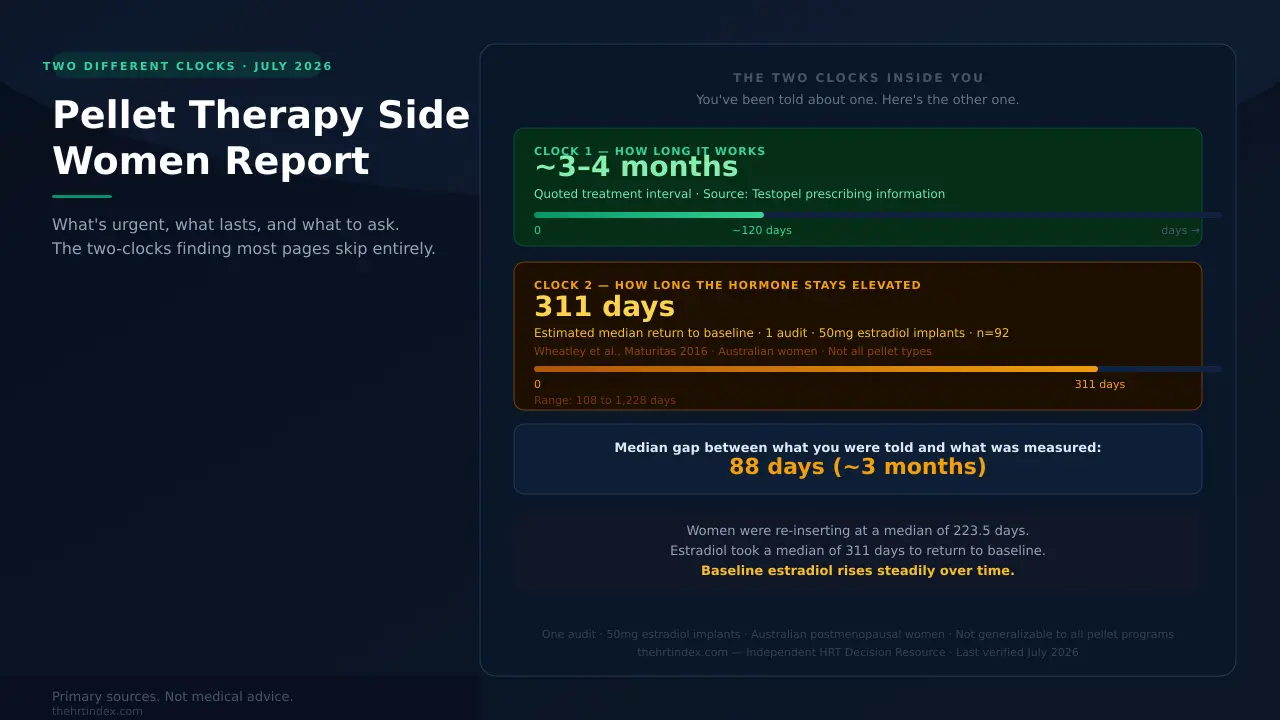
There is no single timeline, because it depends on the hormone, the product, the dose, and the symptom. But two different intervals matter and they are often confused. Clinics typically quote three to four months, which describes how long the treatment effect tends to last. In one Australian audit of 50mg estradiol implants, the estimated median time for estradiol to return to baseline was 311 days.
There are two clocks. You’ve been told about one.
Clock 1 — how long it works.Roughly three to four months. This number is real. Testopel’s own label says the effect ordinarily continues three to four months, sometimes up to six. This is the clock that tells you when to book your next appointment.
Clock 2 — how long the hormone stays elevated.Almost nobody mentions this one exists. And it’s the clock that matters when you’re having a side effect.
Researchers at Monash University in Australia pulled the files of 114 postmenopausal women treated with 50mg estradiol implants.
Wheatley et al., Maturitas 2016 · 50mg estradiol implants · Australian postmenopausal women
Not a study of testosterone pellets or all US compounded pellet programs.
Median gap between implants in actual practice: 223.5 days (range 49–875)
Women were getting re-implanted at a median of 223.5 days. Estradiol took a median of 311 daysto return to baseline. That’s a gap of about 88 days — nearly three months.
Which explains something a lot of women can’t explain. Pellet one felt great. Pellet three felt worse. You assumed you were broken. You weren’t broken. Cumulative exposure is one explanation worth asking your clinician about — and it has a published mechanism behind it.
One real example of how this happens
Genesis Lifestyle Medicine’s public post-care page tells women to call for re-insertion as soon as the symptoms the pellets relieved start to return.The same page says most women re-insert at three to four months. That instruction — dose on symptom return, no mention of a target level — is the practice the 2016 audit identified as producing rising baseline estradiol.
One clinic is one clinic. We’re showing you one documented example, not a survey. But it tells you exactly what question to ask yours: do you re-dose me on symptoms, or on a number?
There’s a name for the other half of this
Tachyphylaxis— when a treatment stops working as well over time. The British Menopause Society uses the term for reduced symptom response despite continuing or escalating estrogen exposure. Push the dose past the licensed range and estradiol can go above normal, which is associated with low mood and anxiety — the opposite of what you wanted.
They flag something else worth knowing: women with pre-existing mental health conditions appear more sensitive to the mood effects of high estradiol.
This is not proof that every returning symptom means your body “needs more,” or that you have tachyphylaxis. But if you’ve felt worse rather than better, there is a recognized mechanism, and you’re not imagining it.
Can hormone pellets be removed?
The implanted dose cannot be adjusted after insertion. Removal is contemplated in some circumstances — the Testopel label says pellets may need to be removed when testosterone effects must be stopped because of complications — while ACOG cites the inability to remove the pellet as a reason to prefer other testosterone preparations. No published source establishes a standard removal window, a success rate, or whether removal reverses symptoms faster.
Half the internet says pellets can’t be removed. The other half says they can be surgically removed if there’s a problem. Both are overstating what’s actually known.
- The dose can’t be turned down. That is the fact everything else hangs on. Once it’s in, future exposure isn’t adjustable the way a patch or pill is.
- Removal is contemplated. Testopel’s label describes removal where testosterone effects must be discontinued because of complications.
- ACOG treats removability as a real problem. Their 2023 guidance says: “Based on the lack of safety data and inability to remove the pellet,” they recommend preparations other than pellet therapy for delivering testosterone.
Those two things sit in tension, and we’re not going to invent a mechanism to resolve them. What we can tell you is what nobody has published: there is no established removal window, no success rate, and no data showing that removal ends symptoms faster.
What to ask before insertion
Don’t accept “it can’t be removed.” And don’t accept “we’ll just take it out.” Neither is established. Ask — specifically, and early, and get the answer in writing.
Can testosterone pellets cause acne, facial hair, hair loss, or voice changes?
Acne, increased facial or body hair, hair pattern changes, and virilizing effects such as voice deepening are recognized concerns with androgen exposure, particularly when levels run higher than intended. In a 2021 comparison, acne was recorded in 8.6% of pellet users versus 1.3% on FDA-approved therapy, and hair pattern change in 13.5% versus 2.6%. A new voice change warrants prompt clinical review rather than waiting.
Acne and oily skin. The most commonly reported androgenic effect. Recorded in 8.6% of pellet users versus 1.3% of the comparison group. In one Glaser cohort, 32 of 285 women reported moderate acne. It generally improves as androgen exposure falls, though that wasn’t directly measured in these studies.
Facial and body hair. New growth typically slows once levels drop. But here’s the part that matters practically: hair that has already converted to coarse, dark terminal hair doesn’t go back to being fine and pale. That has to be removed cosmetically. Slowing the growth and reversing existing hair are two different outcomes, and only one of them happens on its own.
Scalp hair. Be careful with this one, because it’s where most pages overreach. Jiang recorded “hair pattern change” in 13.5% of pellet users. That category isn’t defined narrowly enough to say every case was scalp hair loss. Male-pattern baldness appears separately in testosterone labeling as a reported reaction. Whether pellet-associated scalp thinning reverses hasn’t been studied in these cohorts — and plenty of midlife hair loss has nothing to do with hormones at all. It needs a proper look, not a guess.
Voice deepening. The one not to wait out. About 1% of women in one Glaser cohort perceived a voice change. A separate prospective Glaser study measuring voice found no significant deepening at the group level — we’re telling you that because leaving it out would be scaremongering. But voice deepening does appear in testosterone labeling among reactions reported in women, and androgen-related voice change can persist. There’s no reliable pellet-specific reversibility data either way.
Voice change: call, don’t wait
If it does persist, waiting cost you nothing you could get back. A prompt call is the right move regardless of how it turns out. Voice changes warrant a prompt call rather than a wait-and-see approach.
The unifying thread: all of these track androgen exposure. Which brings us to the numbers.
Are hormone pellets FDA-approved for women?
No. There are no FDA-approved estradiol pellets available in the United States, and there is no FDA-approved testosterone product of any kind indicated for menopause symptoms in women. Testopel — the only FDA-approved testosterone pellet — lists its indications under “MALES” and contains no indication for women or menopause. Most menopause pellet programs for women use compounded estradiol and/or testosterone pellets.
There are three regulatory situations, and clinics blur them constantly:
| Situation | What it means |
|---|---|
| FDA-approved for the stated use | FDA reviewed this product for this population and indication |
| FDA-approved product used off-label | FDA reviewed the product, but not for this use. Legal and common. A clinic could prescribe Testopel to a woman this way |
| Compounded finished drug; not FDA-approved | FDA did not review and approve this finished product for safety, effectiveness, or quality before it was marketed |
What’s actually approved
| Product | FDA status | Approved for whom |
|---|---|---|
| Testopel (testosterone pellet) | FDA-approved | Indications listed under “MALES.” No indication for women or menopause. Schedule III controlled substance. Rx only. Label revised July 2025 |
| Compounded estradiol pellets | Not FDA-approved | No FDA-approved estradiol pellet is available in the US. Riselle was discontinued globally in 2012 |
| Compounded testosterone pellets for women | Not FDA-approved | Compounded finished drug. The prescribing indication is also not FDA-approved |
| Compounded estradiol + testosterone combination pellets | Not FDA-approved | Not approved in any form |
What compounding actually is:combining, mixing, or altering ingredients to make a medication. Section 503A pharmacies generally compound against a prescription for a specific patient. Registered 503B outsourcing facilities can compound certain products as office stock. Compounding can be entirely lawful — an allergy to an ingredient in the commercial product, or a dose nobody manufactures.
What it is not:FDA-approved. FDA did not review and approve the finished compounded product for safety, effectiveness, or quality before marketing. That’s the distinction, and it should never be smudged.
And “bioidentical” is a marketing word, not a regulatory one. FDA-approved estradiol and micronized progesterone are also bioidentical. The word tells you about molecular structure. It tells you nothing about whether anyone checked the product.
Testosterone is also a Schedule III controlled substance in the US and requires a prescription from a licensed prescriber. Any program casual about that is telling you something about itself.
Why the available side effect counts are incomplete
Here’s what happened, precisely.
4,202 adverse events that were never reported to FDA
In 2018, FDA inspectors were at Biote Medical for an inspection that wasn’t even about compounded drugs. In the company’s records they found 4,202 adverse events that had never been reported to FDA. The reports suggested possible associations with endometrial cancer, prostate cancer, strokes, heart attacks, deep vein thrombosis, cellulitis, and pellet extrusion. Because the reports were missing critical information, FDA could attribute only 61 of them. The events had occurred over five years, from 2013 to 2018.
The pellets were made by two outsourcing facilities — Carie Boyd’s Prescription Shop and AnazaoHealth Corporation. Biote marketed them and was not registered with FDA as an outsourcing facility. Biote ran the online portal that collected the reports, and sent them neither to FDA nor to the facilities that made the pellets.
Source: FDA, “Statement on improving adverse event reporting of compounded drugs to protect patients,” September 9, 2019.
Reporting obligations depend on who compounds. Registered 503B outsourcing facilities must report serious adverse events to FDA. Section 503A compounding pharmacies generally don’t carry that federal requirement. There is no comprehensive national registry of hormone pellet use, and no mandatory federal adverse-event reporting covering all compounded hormone pellets.
What’s changing — accurately
In 2020, NASEM recommended that FDA’s Pharmacy Compounding Advisory Committee review ten hormones — and compounded hormone pellet dosage forms specifically — as candidates for the Difficult to Compound lists. FDA’s March 2024 proposed rule did not include hormone pellets among its initial proposed categories.
No final federal rule currently bans compounded hormone pellets.If a product were placed on an applicable list, it wouldn’t qualify for the corresponding compounding exemptions under section 503A or 503B. We check this monthly. If it changes, this page changes.
What do the studies actually show?
In a retrospective study of 539 postmenopausal women, pellet users had roughly eight times the odds of a recorded side effect compared with women on FDA-approved therapy, and mean peak hormone levels well above the ranges ACOG cites for context. A 2025 review applying formal evidence grading rated the evidence for testosterone pellets in women “very low” quality and for estradiol pellets “low.”
Ranges ACOG cites, next to what was measured
ACOG publishes ranges for interpreting hormone levels. A study measured what pellet users’ levels actually were. Nobody has put those two things next to each other.
| Hormone | Range ACOG cites for context | Mean peak in pellet users | Mean peak, FDA-approved comparison group |
|---|---|---|---|
| Estradiol | 40–100 pg/mL described as a reasonable range for symptom relief | 237.7 pg/mL (SD 168.6; range 10–1,111). Four women exceeded 1,000 | 93.5 pg/mL (range 5.5–465.8) |
| Testosterone | 20–80 ng/dL, the physiologic premenopausal range | 194.0 ng/dL (SD 84.9; range 4.3–599). Nine women exceeded 400 | 15.6 ng/dL (range 0.2–70) — below the 20–80 range; this was not a matched testosterone-treatment group |
Ranges: ACOG Clinical Consensus No. 6, November 2023. Measurements: Jiang et al., Menopause 2021. Placing them side by side is our editorial comparison. These are not self-treatment targets.Interpreting a hormone level depends on the exact product, dose, indication, assay, timing relative to insertion, your symptoms, and your lab’s reference range.
What it does show: the mean peak estradiol recorded in the pellet group was roughly 2.4 times the top of the range ACOG cites, and the mean peak testosterone roughly 2.4 times the top of the physiologic premenopausal range. The highest testosterone value recorded was about 7.5 times that ceiling.
What this study does not prove
Now we’ll argue against ourselves, because you deserve the whole thing. Jiang 2021 is a retrospective chart review at one health system. Not a randomized trial. And:
- About 99% of the pellet group received testosterone. Only 4.5% of the comparison group did. So the acne-and-hair gap is substantially a testosterone-versus-no-testosterone comparison, not a clean pellet-versus-patch comparison. Anyone quoting this study without saying that is selling you something.
- 83.5% of pellet patients started treatment for low libido, versus 4.5% of the comparison group. Different women, different starting points.
- The design can’t isolate the effects of route, estradiol dose, testosterone exposure, progestogen use, prescribing practice, patient selection, or differences in clinical decision-making.
The bleeding and hysterectomy findings remain important signals. The measured hormone levels aren’t inference — somebody drew blood. But don’t read any of these percentages as your personal odds.
The strongest case for pellets — and who’s making it
A review published online in December 2025 in the Journal of Clinical Medicinemakes a real argument: dose, reinsertion timing, and endometrial protection materially affect risk. It notes that 25mg implants produce mean levels of 50–70 pg/mL — right in range — and that pellets may genuinely suit women with poor skin absorption or surgical menopause.
Glaser’s cohorts reported low adverse event rates. And the study most often cited in pellets’ defense reported procedure complications below 1% across more than a million pellet procedures.
Three things you should know about that last one:
- It drew on a proprietary BioTracker dataset of practitioner-recorded procedure complications. That’s not the same as every systemic hormone side effect, and it doesn’t establish comparative long-term safety.
- The author, Gary Donovitz, is the founder, Principal-Owner and Chairman of Biote Medical — verifiable from FDA’s own correspondence. Not an accusation. A disclosure.
- The same paper reports that 43% of patients did not continue past their first insertion. Among those who reached a second, reported continuation was about 93%. The reasons for that first-insertion dropoff weren’t captured.
Where the major guidance converges
| Who | When | What they concluded |
|---|---|---|
| ACOG | Nov 2023 | Recommends preparations other than pellet therapy for delivering testosterone, citing lack of safety data and inability to remove the pellet. Compounded therapy shouldn’t be routinely prescribed when FDA-approved formulations exist |
| The Menopause Society (formerly NAMS) | 2022 | Compounded hormone therapy presents safety concerns: minimal regulation and monitoring, overdosing and underdosing, impurities, lack of sterility, and no label outlining risks |
| ISSWSH | 2021 | “Injections, pellets, and oral formulations of testosterone are not recommended” due to potential for supraphysiologic levels and risk of adverse effects. Note: ISSWSH supports carefully monitored transdermal testosterone for appropriately assessed HSDD. They are not hostile to testosterone for women — their concern is the route. This guideline received partial support through an unrestricted educational grant from Lawley Pharmaceuticals, a testosterone manufacturer, which the guideline discloses. |
| NASEM | 2020 | Recommended that compounded hormone pellet dosage forms be reviewed as candidates for the Difficult to Compound lists, citing delivery-mechanism complexity and lack of required bioavailability testing |
| Global Consensus Position Statement (10 societies) | 2019 | Recommends against testosterone preparations that produce supraphysiologic concentrations, including pellets and injections. Compounded testosterone generally not recommended, with a narrow exception where no authorized equivalent exists and the pharmacy meets appropriate quality standards |
This isn’t unanimous — the JCM review and Glaser’s work are real published dissent, and we’ve given them their say. The major professional guidance converges on the same concern, and it’s about the route, not the hormone.
Why pellets carry a different risk if you still have a uterus
Among women with an intact uterus in the 2021 retrospective comparison, 55.3% of pellet users had at least one episode of abnormal uterine bleeding versus 15.2% on FDA-approved therapy. In the same group, 20.3% of pellet users underwent hysterectomy compared with 6.3% of the comparison group. Systemic estrogen without adequate progestogen protection is the mechanism that matters most here.
If you’ve had a hysterectomy, skip ahead. If you still have your uterus, this is the most important section on the page.
Systemic estrogen can stimulate growth of the uterine lining. A progestogen is ordinarily used alongside it to reduce the risk that comes with unopposed systemic estrogen. This isn’t controversial. It’s why, when FDA revised labeling for six menopausal hormone products on February 12, 2026, the endometrial cancer warning for systemic estrogen-alone products stayed.
| Pellet users | FDA-approved therapy | Odds ratio | |
|---|---|---|---|
| At least one episode of abnormal bleeding | 55.3% (136/246) | 15.2% (12/79) | 7.9 (95% CI 3.6–17.0) |
| Underwent hysterectomy | 20.3% (50/246) | 6.3% (5/79) | 3.2 (95% CI 1.1–9.3) |
Jiang et al., Menopause2021. Retrospective, nonrandomized. The confidence interval for hysterectomy runs from 1.1 to 9.3 — very wide. The true effect could be much smaller or much larger than 3.2. It’s a real signal, imprecisely measured. Handle that number carefully. We won’t bury it; we also won’t overstate it.
What was actually found on the endometrium
A separate retrospective study followed 258 postmenopausal women with a uterus using estradiol and testosterone implants for two years.
- 44 of 258 women (17.1%) had endometrial thickness greater than 5mm at the end of year two.
- Those 44 went on to hysteroscopy and biopsy. Among those 44 women: endometrial polyp in 38.6%, histologically normal endometrium in 31.8%, simple endometrial hyperplasia in 20.4%, and myoma or atrophic endometrium in 4.5%.
Filho AM, Barbosa IC, Maia H Jr, Genes CC, Coutinho EM. Gynecol Endocrinol. 2007;23(9):511–517. These are percentages of the 44 women who had thickening, not of all 258. In whole numbers, that’s roughly 17 women with a polyp and 9 with simple hyperplasia out of 258. Nearly a third of the thickened cases turned out to be histologically normal.
Correction logged
An earlier draft of this page misreported the Filho denominators — presenting 38.6% and 20.4% as percentages of all 258 women. They are percentages of the 44 women with thickening. That would overstate the figures roughly six-fold. Fixed and logged here. Corrections policy →
The honest counterweight
No endometrial cancer was reported in this 258-woman cohort during the reported observation period. We’re telling you that because leaving it out would be scaremongering, and because you should be able to trust that we’re not doing that to you.
If you have a uterus and you’re bleeding
You need an evaluation. Bleeding after menopause requires evaluation and should not be dismissed as “just adjusting.” That’s not us being dramatic — that’s standard care.
What to do if you already have pellets
The implanted dose cannot be lowered, but the plan can change. ACOG guidance states that for patients who present already using pellet therapy, clinicians can consider testing to rule out supraphysiologic testosterone levels. For women with an intact uterus, one clinical audit of estradiol implants concluded that continuing progestin therapy after stopping implants was imperative, because estradiol can remain elevated well beyond the treatment interval.
Read this section twice. It’s the reason the page exists.
1. Ask whether testing is appropriate
You don’t have to build this argument yourself. ACOG already made it. Their guidance says that when a patient presents already on pellet therapy, clinicians can consider testing to rule out supraphysiologic testosterone levels.
That’s your permission structure. You’re not being difficult. You’re asking about something a major professional body already put in writing. Ask whether current estradiol and total testosterone testing makes sense for your situation — and ask your clinician to interpret the result against your product, dose, insertion date, assay, and symptoms. Not against a number you read on a website. Including ours.
2. If you have a uterus, ask how long you need progestogen after your last pellet
The question nobody is telling you
The Monash researchers who measured that 311-day median wrote this: “the continuation of progestin therapy after cessation of implant therapy is imperative” for women with an intact uterus. Your last pellet is in. You decide you’re done. You stop everything — pellets andprogesterone — on the same day. That feels logical. But in that audit, estradiol was still measurably elevated long after the treatment interval ended. Median 311 days. The longest was 1,228 days — over three years. We looked. We could not find a single page on the first page of search results that raises this.
So bring the question: “Given that estradiol from implants can stay elevated well past the treatment interval, how long should I continue progestogen after my last pellet?”
3. Don’t try to fix it yourself
No adding hormones to “balance it out.” No supplements to “block” it. Do not add hormones or supplements to counteract pellet effects without clinician direction. Every variable you add makes it harder for anyone to help you.
4. Build your timeline before you call
Write down:
- Every insertion date, including boosters
- Which hormones, and the dose in milligrams, if you know
- The pharmacy or product name
- When each symptom started, relative to the insertions
- Whether it’s improving, holding, or worsening
- Any other medication that changed
“I don’t know” is a legitimate answer. Write it down too — it’s information.
5. Take this script
Copy it if it helps you organize the call.
6. If you’re dismissed, get another opinion
That’s not an attack on your clinician. Sometimes the fit is wrong. You have a right under HIPAA to inspect and get copies of your records held by covered providers and plans, subject to some limited exceptions. Take them and get a second licensed opinion.
A clinician who won’t discuss your own lab values with you is telling you something.
Not sure whether online care is even the right starting point?
The HRT Index’s Find My HRT Path tool walks your situation — symptoms, what you have tried, age, risk history, state — and gives you a personalized next step before your first consult.
It will also tell you when the honest answer is “this belongs with an in-person clinician, not a website.”Some of you reading this are in that group. We’d rather say so than keep you.
How pellets compare to routes you can change
Many non-implant routes allow future dosing to be stopped or changed more promptly under clinician direction. A patch can be removed, a gel not applied, a pill not taken. A pellet continues releasing until it’s gone. That difference in dose control — not the hormone itself — is what most separates pellets from the alternatives.
| Route | FDA-approved for women? | Can future dosing stop promptly? | Dose adjustable? | What insurers say |
|---|---|---|---|---|
| Compounded pellets | No | No | No | Aetna and BCBS North Carolina classify implantable hormone pellets for menopause-related use as experimental, investigational, or unproven |
| Estradiol patch | Yes | Yes — remove it | Yes | Generally covered as a standard prescription |
| Estradiol gel or spray | Yes | Yes | Yes | Generally covered |
| Oral estradiol | Yes | Yes | Yes | Generally covered |
| Systemic estradiol vaginal ring (e.g. Femring) | Yes | Yes — remove it | Fixed dose per ring | Generally covered |
| Low-dose local vaginal estrogen (e.g. Estring) | Yes | Yes | Yes | Generally covered. Local only — not a treatment for hot flashes |
| Transdermal testosterone, clinician-directed | No approved female product — off-label use of an approved product | Yes | Yes | Schedule III. Prescription required. Coverage varies |
| Micronized progesterone | Yes | Yes | Yes | Endometrial-protection component — not an estrogen or testosterone route alternative |
A note on “stop it today”: you can stop a dosing schedule the same day. That doesn’t mean circulating hormone and symptoms end the same day. What changes is that no furtherdose is going in — which is exactly the option a pellet removes.
Coverage depends on your exact indication, product, plan, and benefit language. Pellet insertion is billed under CPT 11980— a code existing doesn’t establish coverage. Call your plan with it and get the answer in writing before you book.
What it costs — with the honest caveats
Published cash prices we reviewed in July 2026 ranged from about $300 to $600 per insertion. Clinics typically describe two to four insertions a year. If those quotes hold and nothing else is billed separately, that’s roughly $1,200 to $2,400 a year, out of pocket.
Here’s the part worth noticing: we could not find a pellet clinic publishing a single, all-in annual number. Labs, consults, follow-ups, and boosters are frequently separate line items, and quotes vary by market and dose. Anyone giving you a confident national pellet price is guessing.
FDA-approved estradiol is generally a standard prescription — a normal copay if your plan covers it. Confirm yours with your pharmacy.
So for estradiol treatment specifically, the trade looks like this: you may be paying cash for a product your insurer classifies as investigational, when an FDA-approved transdermal estradiol is a covered prescription you can peel off your skin.
Two honest counterweights
That comparison holds for estradiol. It does not hold for a testosterone pellet or a combination pellet — an estradiol patch doesn’t replace testosterone, and there’s no FDA-approved female testosterone product at all. And if you have no insurance, the gap narrows considerably. But if you do have coverage, you’re paying a premium to give up control of your dose. Said plainly, that’s a strange trade.
One non-pellet telehealth option to compare
Straight talk first
Midi Health cannot treat Medicaid or Medi-Cal patients — not even as self-pay — and isn’t covered by Medicare. Medicare beneficiaries can self-pay, but Midi states they can’t submit claims for visits, medications, or associated services. If that’s your coverage, Midi isn’t your route. See cash-pay HRT options →
If you have commercial coverage, here’s why they’re worth comparing on this page specifically:
Midi states it does not prescribe testosterone pellets.That’s the relevant fact. It means the one thing you don’t have to manage in that visit is being sold another one. They’re in-network with most PPO plans. They offer FDA-approved menopause hormone options — patches, pills, gels, vaginal formulations, micronized progesterone — and they also offer compounded topical testosterone, which we’re telling you because “FDA-approved only” would be inaccurate and you’d deserve better.
Check whether your plan covers a Midi visit →Provider-stated vs. verified — Midi Health
| Claim | Status | Last checked |
|---|---|---|
| Does not prescribe testosterone pellets | Provider-stated | July 2026 |
| Offers FDA-approved menopause hormone options | Provider-stated | July 2026 |
| Also offers compounded topical testosterone | Provider-stated | July 2026 |
| Self-pay: $250 initial visit, $150 continued care | Verified from Midi’s published pricing | July 2026 |
| In-network with most PPO plans | Provider-stated; plan-specific, not guaranteed | July 2026 |
| Not covered by Medicare; beneficiaries may self-pay without claim submission | Verified from Midi’s published terms | July 2026 |
| Cannot treat Medicaid or Medi-Cal, including self-pay | Verified from Midi’s published terms | July 2026 |
| Care available nationwide; testosterone prescribing may be limited by state law | Provider-stated | July 2026 |
We list what a provider states and what we independently confirmed, separately. Provider marketing is not verified clinical quality, and we won’t present it as such.
Midi not available for your coverage or your state’s prescribing rules? Find My HRT Path points you to cash-pay online care that fits or flags when in-person care should come first.
What to ask before you agree to another pellet
Informed consent should identify the exact hormone, dose, regulatory status, pharmacy, expected exposure period, monitoring plan, endometrial protection plan, complication response, total cost, and alternatives. “Bioidentical,” “custom,” or “optimized” is not enough information to decide with.
Print this. Take it in. Watch their face.
Is the finished product FDA-approved? And is this exact use FDA-approved?
Two questions, not one. A clinic could be using FDA-approved Testopel off-label — in which case the honest answers are “the product is approved for specified male indications” and “this use in a woman is not approved.”
Specific, accurate answers to both parts.
⚑Any answer that stops at “it’s bioidentical.” That describes molecular structure, not approval.
Which pharmacy compounds it — 503A or 503B?
A specific name they’ll write down.
⚑Vagueness. 503A pharmacies generally don’t carry the federal adverse-event reporting requirement that 503B facilities do.
What clinical goal, dose rationale, and lab monitoring do you use — and what’s the minimum reinsertion interval?
A considered answer with an actual monitoring plan.
⚑No monitoring plan at all.
What would prevent or delay another insertion?
Something specific. A level, a symptom, a finding.
⚑“Nothing, we just do it when you’re due.”
What happens if my level comes back higher than intended?
In the Jiang cohort, mean peak estradiol and testosterone in the pellet group sat well above the ranges ACOG cites, with wide ranges and some extreme individual values.
A specific plan.
⚑“That doesn’t really happen.”
I have a uterus. What’s the progestogen plan — and for how long after my last pellet?
They mention continuing it past your last pellet.
⚑A blank look. This is the question.
What’s your documented plan if my voice changes?
A prompt-assessment and escalation plan: who evaluates it, how fast, and whether specialist assessment is part of it.
⚑“Let’s watch it.”
What’s the total annual cost, itemized?
Pellets, insertion, labs, follow-ups, boosters, complication management, cancellation terms.
⚑One number with no breakdown.
Will you run CPT 11980 against my plan before we book?
They’ll check.
⚑“Insurance doesn’t cover this kind of thing.” Ask why. Then read the insurer row in the table above.
If a clinic gets defensive at question 3 or 6, you learned what you needed to learn. And it was free.
What we actually verified
You should be able to check our work.
| What we checked | What we found | Status | Checked |
|---|---|---|---|
| ACOG Clinical Consensus No. 6 | Recommends preparations other than pellets for testosterone; testing can be considered for current pellet patients; cites 40–100 pg/mL estradiol and 20–80 ng/dL testosterone ranges | Verified from current primary source | July 2026 |
| FDA statement on compounded adverse event reporting, Sept 9 2019 | 4,202 unreported adverse events found at Biote in a 2018 inspection; 61 attributable; pellets made by two outsourcing facilities | Verified from current primary source | July 2026 |
| Jiang et al., Menopause 2021 (PMID 33973545) | Top-line figures read from the published abstract | Verified from current primary source | July 2026 |
| Jiang sub-category percentages | Anxiety, mood, breast tenderness, hair, acne, weight breakdowns | Secondary-source detail (MDEdge reporting) | July 2026 |
| Wheatley et al., Maturitas 2016 | 311-day estimated median return to baseline in 50mg estradiol implants; 223.5-day median interval; progestin continuation described as imperative | Verified from current primary source | July 2026 |
| Filho et al., Gynecol Endocrinol 2007 | 44 of 258 with thickening >5mm; polyp 38.6%, normal 31.8%, hyperplasia 20.4% of those 44; no endometrial cancer reported | Verified — corrected from an earlier draft | July 2026 |
| ISSWSH Clinical Practice Guideline 2021 | Injections, pellets, oral testosterone not recommended; Lawley Pharmaceuticals grant disclosed | Verified from current primary source | July 2026 |
| Wender et al., Rev Assoc Med Bras 2025 | GRADE: testosterone pellets “very low,” estradiol pellets “low” | Verified from current primary source | July 2026 |
| Testopel prescribing information | Indications under “MALES”; Schedule III; Rx only; label revised July 2025 | Verified from current label | July 2026 |
| Difficult to Compound List status | NASEM recommended review in 2020; FDA’s March 2024 proposed rule did not include hormone pellets; no final rule bans them | Verified from current primary sources | July 2026 |
| BCBS North Carolina and Aetna pellet policies | Menopause-related pellet implantation classified investigational under the cited policies | Verified from current policies | July 2026 |
| Midi Health | See the provider-stated vs. verified table above | Mixed — labeled per row | July 2026 |
| Published pellet cash pricing | $300–600 per insertion across clinic pages reviewed; no clinic found publishing an all-in annual figure | Editorial observation, dated | July 2026 |
| Genesis Lifestyle Medicine post-care page | Instructs re-insertion when relieved symptoms return | Verified from the public page | July 2026 |
What we did not do
We did not undergo pellet therapy. We did not examine a patient. We’re not clinicians and we won’t pretend to be. This page is editorial research produced under The HRT Index Verification Standard— our documented process: read every published price, separate FDA-approved from compounded, verify state availability and insurance, and re-check on a fixed schedule. It’s not a score, and we don’t assign providers numbers.
Corrections: An earlier draft of this page misreported the Filho endometrial denominators. It’s fixed above and logged. If you find another error, tell us— we’ll fix it and say so.
Frequently asked questions
Editorial answers. Not medical advice. Linked to primary sources throughout.
- How long do hormone pellet side effects last in women?
- It depends on the symptom and the product. Insertion-site effects usually settle in days to weeks. Hormone effects track your levels — and in one Australian audit of 50mg estradiol implants, the estimated median time to return to baseline was 311 days, with a range of 108 to 1,228 days. That’s a different measurement from the three-to-four-month treatment interval clinics quote.
- Can hormone pellets be removed?
- The implanted dose can’t be adjusted. Removal is contemplated in some circumstances — Testopel’s label describes removal where effects must be stopped because of complications — while ACOG cites inability to remove the pellet as a reason to prefer other testosterone preparations. No published source establishes a standard removal window or success rate. Ask your clinician directly.
- Are hormone pellets FDA-approved for women?
- No. There are no FDA-approved estradiol pellets in the US and no FDA-approved testosterone product indicated for menopause symptoms in women. Testopel is FDA-approved with indications listed under “MALES.” Most pellets marketed to women are compounded finished drugs; an approved product like Testopel could also be prescribed off-label, which is a different regulatory situation.
- Is Testopel FDA-approved for menopause?
- No. Its label lists indications under “MALES” and contains no indication for women or menopause. If a clinic describes “FDA-approved testosterone pellets” for menopause, they’re pointing at an approval that doesn’t cover you.
- Do hormone pellets cause weight gain?
- Weight gain was recorded in 34.4% of pellet users versus 4.5% of the FDA-approved group in the 2021 retrospective study. That’s a chart-recorded association, not proof of causation. General HRT guidance finds little evidence that hormone therapy itself drives weight gain, and midlife, sleep, fluid retention, and other medications all overlap.
- Do hormone pellets cause hair loss?
- Jiang recorded “hair pattern change” in 13.5% of pellet users versus 2.6% on FDA-approved therapy — a category that isn’t defined narrowly enough to say every case was scalp hair loss. Male-pattern baldness appears separately in testosterone labeling. Whether pellet-associated scalp thinning reverses hasn’t been studied in these cohorts.
- Can hormone pellets cause facial hair, and does it go away?
- Increased facial and body hair is a recognized androgen effect. New growth generally slows once levels come down. Hair that has already turned coarse and dark doesn’t revert on its own — it has to be removed cosmetically.
- Will voice changes from testosterone pellets reverse?
- Not established. About 1% perceived a voice change in one Glaser cohort, while a separate Glaser study measuring voice found no significant group-level deepening. Voice deepening does appear in testosterone labeling among reactions reported in women, and androgen-related voice change can persist. It warrants prompt review rather than watch-and-see.
- Can hormone pellets cause bleeding after menopause?
- Bleeding was recorded far more often among pellet users with a uterus in the 2021 study — 55.3% versus 15.2%. Whatever the cause, bleeding after menopause requires evaluation and should not be dismissed as “just adjusting.”
- Does insurance cover hormone pellet therapy?
- Usually not for menopause. Aetna and Blue Cross Blue Shield of North Carolina classify implantable hormone pellets for menopause-related use as experimental, investigational, or unproven under the cited policies. Coverage depends on your exact indication, product, and plan. Your labs and consults may still be covered. The insertion code is CPT 11980.
- How much do hormone pellets cost per year?
- Published clinic cash prices we reviewed in July 2026 ranged from about $300 to $600 per insertion, with two to four insertions a year typically described — roughly $1,200 to $2,400 annually if nothing else is billed separately. Labs, consults, and follow-ups often are. We found no clinic publishing an all-in annual figure, so get yours itemized in writing.
- Can I switch from pellets to a patch?
- It’s a common transition, and the timing is the catch: your existing pellet is still releasing, so a clinician needs to account for what’s already in you. If you have a uterus, ask specifically how long to continue progestogen after your last pellet.
- Are bioidentical pellets safer than patches?
- No evidence supports that. “Bioidentical” describes molecular structure, not safety or approval. FDA-approved estradiol and micronized progesterone are also bioidentical — with the difference that FDA reviewed them and you can stop them.
- What should I do if a pellet appears to be coming out?
- Call your clinician today. Pellet extrusion is a recognized complication and needs proper wound care. Don’t dig at it and don’t wait for your next appointment.
- What should I do if I think my pellet dose is too high?
- Screen for emergency symptoms first. Then don’t self-adjust or add anything. Write down your insertion dates, products, doses, and symptom timeline, and ask your clinician whether current estradiol and total testosterone testing is appropriate — plus a written plan if things worsen.
- Is it safe to get another pellet after side effects?
- That’s a decision for you and a clinician who knows your situation. Going back for another insertion without clinical review means potentially repeating a dose that may already be higher than intended. Get the review first. Ask the nine questions above.
- When should I go to urgent care or the ER?
- Chest pain, sudden breathlessness, coughing blood, one-sided leg swelling, sudden weakness or trouble speaking, severe allergic symptoms, or heavy bleeding with dizziness. Call 911 or your local emergency number. Don’t spend time deciding whether the pellet caused it.
One last thing
If you’re sitting there with a pellet in your hip feeling foolish for having paid for it — don’t.
If all you were told was “three to four months,” you weren’t given the whole timing question. A treatment interval and the time a hormone takes to return to baseline are two different clocks, and only one of them gets mentioned. That’s not a failure of your judgment. It’s a gap in what you were handed.
Now you have both clocks, the actual numbers, and the questions.
The implanted dose isn’t adjustable. But the plan is.
Ask whether testing is appropriate. Ask the questions. Build the exit.
You’re not stuck with the decision. Just the pellet — and even that has a clock on it.
Still not sure which HRT program is right for you?
Take our free Find My HRT Path matching quiz and get your personalized next step — symptoms, what you have tried, age, risk history, and state all accounted for.
Take the free Find My HRT Path quiz →Sources
- Jiang X, Bossert A, Parthasarathy KN, et al. Safety assessment of compounded non-FDA-approved hormonal therapy versus FDA-approved hormonal therapy in treating postmenopausal women. Menopause. 2021;28(8):867–874. PMID 33973545.
- Wheatley S, Bell RJ, Stuckey BGA, Robinson PJ, Davis SR. Clinical audit of estradiol implant therapy: Long duration of action and implications in non-hysterectomised women. Maturitas. 2016;94:84–86. PMID 27823750.
- American College of Obstetricians and Gynecologists. Compounded Bioidentical Menopausal Hormone Therapy. Clinical Consensus No. 6. Obstet Gynecol. 2023;142(5):1266–1273.
- U.S. Food and Drug Administration. Statement on improving adverse event reporting of compounded drugs to protect patients. September 9, 2019.
- Parish SJ, Simon JA, Davis SR, et al. International Society for the Study of Women’s Sexual Health Clinical Practice Guideline for the Use of Systemic Testosterone for Hypoactive Sexual Desire Disorder in Women. J Sex Med. 2021;18(5):849–867.
- Filho AMB, Barbosa IC, Maia H Jr, Genes CC, Coutinho EM. Effects of subdermal implants of estradiol and testosterone on the endometrium of postmenopausal women. Gynecol Endocrinol. 2007;23(9):511–517. PMID 17943546.
- Wender MCO, Steiner ML, Fernandes CE, et al. Compounded hormonal pellets: a critical review of current evidence and risks. Rev Assoc Med Bras. 2025;71(7):e20250121. PMID 40802414.
- The North American Menopause Society. The 2022 Hormone Therapy Position Statement. Menopause. 2022;29(7):767–794.
- Glaser R, York AE, Dimitrakakis C. Beneficial effects of testosterone therapy in women measured by the validated Menopause Rating Scale. Maturitas. 2011;68(4):355–361.
- Glaser R, Kalantaridou S, Dimitrakakis C. Testosterone implants in women: pharmacological dosing for a physiologic effect. Maturitas. 2013;74(2):179–184.
- Donovitz GS. Low complication rates of testosterone and estradiol implants for androgen and estrogen replacement therapy in over 1 million procedures. Ther Adv Endocrinol Metab. 2021;12:20420188211015238.
- National Academies of Sciences, Engineering, and Medicine. The Clinical Utility of Compounded Bioidentical Hormone Therapy. Washington, DC: The National Academies Press; 2020.
- Testopel (testosterone pellets) Prescribing Information. Endo USA. Label revised July 2025. DailyMed.
- Subcutaneous Estradiol Pellets as Hormone Therapy in Menopause: Clinical Pharmacology, Patient Selection and Safety Considerations. J Clin Med. 2026;15(1):48. Published online December 2025.
- Davis SR, Baber R, Panay N, et al. Global consensus position statement on the use of testosterone therapy for women. Climacteric. 2019;22(5):429–434.
- British Menopause Society. Tachyphylaxis with HRT. September 2023.
- Blue Cross and Blue Shield of North Carolina. Hormone Pellet Implantation for Treatment of Menopause Related Symptoms. Policy reviewed March 2026.
- Aetna Clinical Policy Bulletin 0345: Implantable Hormone Pellets.
- U.S. Food and Drug Administration. FDA approves labeling changes for menopausal hormone therapy products. February 12, 2026.
- U.S. Food and Drug Administration. Compounding and the FDA: Questions and Answers.
- MDEdge. Hormone pellet safety data ‘not very reassuring at all’ for women. 2021. (Source for Jiang sub-category percentages.)
Last verified: July 2026. This page is updated when primary sources change. Educational only. Not medical advice.