
The short answer
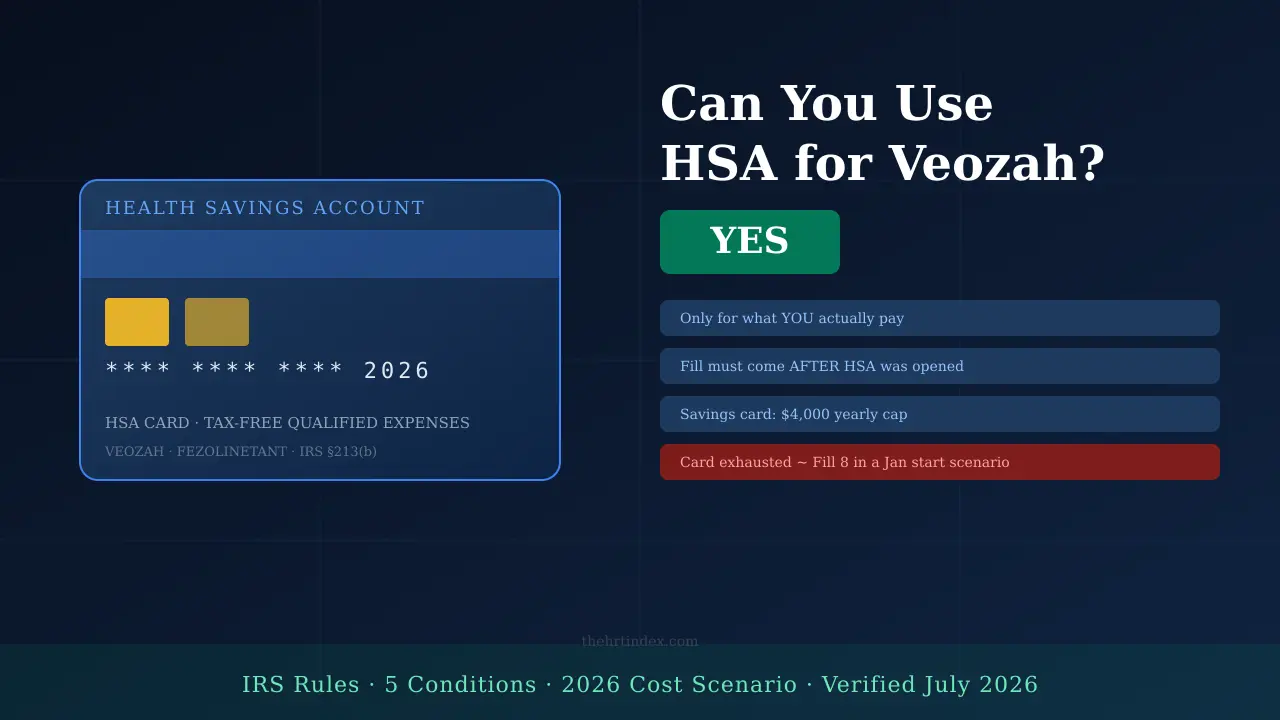
Can you use HSA for Veozah? Yes. Veozah (fezolinetant) is a prescribed medicine, and the IRS counts prescribed medicines as qualified medical expenses — the same category as any other prescription you fill.
But “yes” is the easy half. Five conditions decide how much you can actually use:
- The expense has to be yours. Only what you pay counts — not the sticker price, not the part the savings card covered.
- The fill has to come after your HSA was opened. Not funded. Opened.
- It has to be for you, your spouse, or a tax dependent.
- Nobody else can have paid you back for it.
- You can't also deduct it on your taxes.
Miss one and the answer changes. Most articles mention the first and skip the rest.
The reframe that saves people the most money:
An HSA doesn’t make Veozah cheaper. It doesn’t lower the price by a dollar. It changes whichdollars you pay with — pre-tax instead of post-tax. That’s real money. It’s just not the kind of help most people expect when they land here.
The VEOZAH Savings Card is capped at $4,000 per calendar year. When you’re paying pre-deductible — which is exactly where most people with an HSA live — that cap burns fast. In the scenario we model below, using Veozah’s published list price, it runs dry around the eighth fill, and roughly 91% of the year’s out-of-pocket cost lands after it does.
Your dates won’t match ours. That’s the point. We’ll show you the math, tell you which numbers to swap in, and show you how to run it on yours.
This page is for you if
- You have a Veozah prescription, or you're about to
- You have an HSA or FSA and want to know how much you can use
- You already paid another way and want to pay yourself back
- Your HSA card got declined at the pharmacy
- Your savings card stopped working and nobody explained why
- You're setting your FSA amount for next year because of this drug
Skip this page if
- You want to know whether Veozah is right for you → Non-hormonal menopause options
- You just want the price → How much Veozah costs
- You want to fight a denial → Veozah prior authorization
- You want the full Medicare or Medicaid coverage picture → Veozah with Medicare
Four questions people mash into one
Most of the confusion here comes from one thing: four separate systems, four separate answers, and everybody talks about them like they’re the same question.
| The question | Who decides it | What it actually means |
|---|---|---|
| Will insurance cover Veozah? | Your health plan | Whether the plan pays part of the pharmacy claim |
| Can I use the savings card? | Astellas, the manufacturer | Whether their program lowers what's left for you |
| Can my HSA pay for it? | IRS rules, applied to your facts | Whether you can use pre-tax dollars for what you owe |
| Should I take Veozah? | Your clinician | Whether it fits your symptoms, history, and risks |
A “yes” on one tells you nothing about the others. Your plan can deny it and your HSA still works fine. Your HSA can work fine and Veozah can still be the wrong drug for you. Keep these four apart and the rest of this page is easy.
The Veozah payment stack: what counts in every situation
This table combines the current Astellas savings program terms with the IRS rules on qualified expenses. Neither source contains the other. Every row is labeled so you can see what’s a published fact, what’s our reading of it, and what only your own paperwork can answer.
| Your situation | HSA pays? | Savings card? | What your HSA can pay | The catch |
|---|---|---|---|---|
| Commercial plan covers it, card works | Yes | Yes | Only your final amount — the $30, not the $583 | The $4,000 yearly cap can run out mid-year |
| Commercial plan hasn't approved the claim | Yes | Astellas may cut it to $1,250 across two fills | Whatever you pay after the reduced benefit | The worst-funded row on this table |
| Commercial plan, no card used | Yes | Not used | Your copay, coinsurance, or deductible amount | "Covered" can still mean you owe a lot |
| Paying cash, no insurance | Yes — the whole amount | No. Card not valid for cash-pay patients | The full amount you paid | Check the assistance program before paying retail |
| Assistance program pays 100% | No expense exists | N/A | $0 — you didn't pay anything | Nothing to reimburse |
| On Medicare | Spending existing HSA: yes. New contributions: no | Not valid for a Medicare-reimbursed prescription | Your final out-of-pocket amount | Medicare stops contributions, not your balance |
| On Medicaid, TRICARE, or VA | Spending existing HSA: yes. Contributions: depends | Not valid for government-program prescriptions | Your final out-of-pocket amount | Don't assume — VA has its own rules |
| You paid with a personal card | Yes — pay yourself back later | Depends on the rows above | Your final amount, if fill came after HSA opened | Keep every receipt |
| Fill happened before your HSA existed | No | N/A | $0 | Opening the account later doesn't reach back |
| HSA card declined at the counter | Yes — it's a payment problem, not a tax problem | Depends on the rows above | Same amount as if the card had worked | Pay another way; reimburse yourself later |
Sources:VEOZAH Savings Program Terms & Conditions, Astellas (program code MAT-US-MULB-2025-00080 05/25) · IRC §213(b) · IRC §223 · IRS Publication 502 · IRS Publication 969 · IRS Notice 2004-2, Q&A-26. Verified July 2026.
The HRT Index
Not sure which online HRT path is right for you?
Find My HRT Path matches your symptoms, age, state, and health history to the right cash-pay provider — and flags when online care isn’t the right starting point.
What we actually verified for this page
You should know what we checked and what we didn’t.
Verified in July 2026, from primary sources:
- We read the full VEOZAH Savings Program Terms and Conditions on the Astellas patient support site — not a summary. That's where the $4,000 calendar-year cap, the reduced $1,250 benefit for unapproved claims, the government-program exclusion, the cash-pay exclusion, and the accumulator language come from. Program code MAT-US-MULB-2025-00080 05/25.
- We pulled Astellas' own Connecticut wholesale price disclosure. Veozah's list price is $583.50 for 30 tablets of 45 mg, effective January 14, 2026.
- We read IRS Chief Counsel Information Letter 2021-0014 in full. It answers the single most important question on this page.
- We checked the 2026 numbers against IRS Revenue Procedure 2025-19 (HSA and HDHP limits), Revenue Procedure 2025-32 (FSA limit), and IRS Notice 2026-5 (Bronze and Catastrophic plans).
- We confirmed Veozah's boxed warning and testing schedule against the FDA Drug Safety Communication (updated December 16, 2024) and the current prescribing information.
- We read the current Lynkuet label on DailyMed so the comparison later on this page shows all four of its warnings, not just the flattering one.
- We pulled Midi Health's pricing, insurance, and testosterone pages directly and corrected two things we'd previously gotten wrong from secondary sources.
- We built the cost scenario ourselves from those published numbers. The arithmetic is printed below. You can check it.
What we did not verify, and won’t pretend we did:
- Your plan's negotiated price for Veozah. Nobody writing an article can know this.
- Your plan's formulary tier, deductible, or copay assistance policy. Call the number on your card.
- Astellas' claim that 64% of commercially insured patients have coverage. Their own footnote dates it to July 2024. That's two years old on a live page. We're not repeating it as current.
- Whether any specific telehealth provider prescribes Veozah. We couldn't confirm it from a primary source, so we don't claim it anywhere on this page.
- What your labs will cost. We tried to build a price table and couldn't make it reproducible. We give you a written-estimate script instead.
Can you use HSA for Veozah under IRS rules?
Yes.Veozah requires a prescription, and IRC §213(b) allows medicines and drugs as medical expenses when they’re prescribed. IRS Publication 502 says the same thing plainly: you can include amounts you pay for prescribed medicines. Veozah qualifies on that basis — but qualification of the medicine is only the first of five conditions the expense has to meet.
One detail matters more than it looks,because a competing page gets it wrong. Veozah is not HSA-eligible because it’s FDA-approved. FDA approval isn’t the tax test. Since 2020, over-the-counter medicines have been HSA-eligible with no prescription at all. The medicine-category test for Veozah is simply that it’s prescribed.
Why does that matter to you? Because an insurance denial doesn’t touch your HSA eligibility. Your plan saying “no” doesn’t un-prescribe your prescription.
The five conditions, in plain English
| The condition | What it means for you |
|---|---|
| Prescribed medicine | Veozah requires a prescription. ✅ Done. |
| After your HSA existed | The fill date has to come after your HSA was established. Not funded — established. |
| Eligible person | You, your spouse, or your tax dependent. |
| Unreimbursed | Only what you actually bore. Not the part insurance or Astellas paid. |
| Not claimed twice | Not through an FSA too, and not deducted on Schedule A. |
The four words that run this page
Buried in IRS Notice 2004-2 is the sentence that decides everything here. Qualified medical expenses are the ones you paid — but only to the extent the expenses are not covered by insurance or otherwise.
“Or otherwise.”
That’s where the savings card lives. Astellas isn’t insurance. But when they knock $553 off your fill, that $553 is covered “otherwise.” It was never your expense. So your HSA can’t touch it.
Veozah isn’t one charge
Veozah treatment can create three separate qualified expenses, each with its own receipt.
| The expense | HSA-eligible? | Why |
|---|---|---|
| The prescribing visit | Yes — what you pay for it | Medical care |
| The Veozah prescription | Yes — what you pay for it | Prescribed medicine |
| The required liver blood tests | Yes — what you pay for them | Prescribed medical care |
That third row is the one everyone forgets. The liver tests are required by the FDA label — they are not optional. More on them below.
Calculate your HSA-eligible Veozah amount
Use the worked scenario below to run the numbers on your own fills. Under a minute. No email.
How much of your Veozah cost can your HSA actually pay?
Your HSA can pay the final amount you actually owe after insurance, the savings card, and any other assistance have done their part — as long as the other four conditions are met. Not the list price. Not the shelf price. The number at the bottom of your receipt that came out of your pocket.
Your HSA-eligible amount = what you actually paid − anything that later paid you back
…as long as the fill came after your HSA opened, it was for you or your spouse or your dependent, and you haven’t claimed it anywhere else.
Use the receipt. Don’t rebuild the claim.
Don’t try to reverse-engineer your pharmacy claim. They’re messy. There’s a list price, a negotiated rate, a plan payment, a card adjustment, and a patient responsibility — and they often don’t add up the way you’d expect.
Find the number you paid. Start there. Then run the four other conditions. Everything else on that receipt is somebody else’s money.
Three examples
Illustrations only. Not price quotes. Your numbers will differ.
Example A
Insurance + card
Example B
Cash, no insurance
Example C
Assistance covered it
Example C surprises people.If somebody else paid, you don’t have an expense. Nothing to reimburse. That’s not a loophole closing — that’s just how it works.
Can you use the VEOZAH Savings Card and your HSA together?
Yes — but in order, not at the same time.The savings card is applied at the pharmacy counter and reduces what you owe. Your HSA pays whatever’s left. What you can’t do is reimburse yourself from your HSA for the portion Astellas paid, because that was never your expense. They’re not additive. They’re sequential.
The order of operations
- Your prescriber or their staff submits any prior authorization your plan requires.
- You enroll in the VEOZAH Savings Card. Commercial insurance only. Text SAVE to 90222 or sign up through Astellas.
- The pharmacy runs insurance first, then the card.
- Your HSA or FSA card pays what's left.
- You save the receipt showing your amount.
- You plan for the month the card runs out. Keep reading.
What happens if you get it backwards
Say you paid $30 at the counter, then reimbursed yourself $583.50 because that’s what the drug “costs.” You can’t count Astellas’ share as your qualified expense. If your HSA withdrawals for the year end up bigger than your qualified unreimbursed expenses, the excess goes into your taxable income and is generally subject to an additional 20% tax.
Two things worth knowing. First, the IRS looks at your year in total on Form 8889 — not fill by fill — so if you have other qualified expenses that cover it, you may be fine. Second, the additional 20% tax doesn’t apply after age 65, or in cases of disability or death. Neither of those makes it a good idea. The receipt says $30. Take $30.
Does having the savings card put your HSA at risk?
No.IRS Notice 2004-50 addressed discount cards back in 2004. They don’t disqualify you — as long as you’re still paying the discounted cost until your deductible is satisfied. Use the card.
Allowed vs. not allowed
| Scenario | Allowed? |
|---|---|
| Pay your $30 copay with your HSA card | ✅ Yes |
| Reimburse yourself $30 later | ✅ Yes |
| Reimburse yourself $583.50 when you paid $30 | ❌ No |
| Pay cash, then reimburse the full amount you paid | ✅ Yes |
| Reimburse a fill from before your HSA opened | ❌ No |
| Claim the same $30 through an FSA and your HSA | ❌ No |
| Claim it on your HSA and deduct it on Schedule A | ❌ No |
Does the VEOZAH Savings Card count toward your deductible?
For federal HDHP rules, no — and this comes from the IRS, not your insurance company. In Chief Counsel Information Letter 2021-0014, the IRS stated that a high-deductible health plan’s minimum annual deductible may only be satisfied by medical expenses the covered person actually incurred. The letter is from April 2021, signed by the Branch Chief for Health and Welfare in the Office of Associate Chief Counsel.
What the IRS actually said
“In other words, the minimum annual deductible may only be satisfied by actual medical expenses the covered individual incurred.”
“For example, if a covered individual is prescribed a drug that costs $1,000, but a discount from the drug manufacturer reduces the cost to the individual to $600, the amount that may be credited towards satisfying the deductible is $600, not $1,000. This same principle also applies to a third-party payment, such as a rebate or coupon, that has the same effect as a discount.”
IRS Chief Counsel Information Letter 2021-0014, April 16, 2021
Translated to Veozah: if the card drops your fill to $30, $30 is what credits. Seven months of that is $210 against a deductible that starts at $1,700.
One honest caveat
IRS Information Letters are general and advisory. They’re not regulations. They’re not private letter rulings. They don’t bind anyone the way a regulation does. We’re telling you because it’s true — and this letter is the IRS explaining its own position, in its own words, on this exact question. That’s a great deal more than “a blog said so.”
Why the federal rule works this way
When an HSA-qualified plan doesn’t count the card toward your deductible, that’s usually not the plan being greedy. Think about what would happen if it did. The plan would be paying benefits before the minimum deductible had been met with real money. That risks the plan’s status as a qualified HDHP. And if it isn’t a qualified HDHP, the people on it can’t contribute to an HSA at all.The rule that’s frustrating you is part of what lets HSAs exist.
That said — how a plan displays assistance against its deductible or out-of-pocket maximum can vary, and those two accumulators don’t always get the same treatment. If you think your plan has applied something wrong, ask them to correct it. That’s a legitimate request, not a losing fight.
The question to ask your plan — and get in writing
“Is manufacturer copay assistance credited toward my deductible? Is it credited toward my out-of-pocket maximum? Are those handled the same way?”
Ask before you fill. Get it in an email or secure message, not a phone call. Five minutes here tells you more about your real cost than anything else you can do today.
One more wrinkle: Astellas’ own terms say the offer can’t be combined with arrangements sometimes called “accumulator” or “maximizer” programs. If your plan runs one, ask how that interacts with your card before you enroll.
When could the VEOZAH Savings Card run out? A worked scenario
The savings card has a maximum of $4,000 per calendar year, and the cap resets every January 1. How fast you use it depends on your plan’s negotiated price, your deductible status, and what you’re actually charged at each fill. In the scenario below — a person paying pre-deductible, using Veozah’s published list price as a stand-in — the benefit runs out during the eighth fill, and about 91% of the year’s out-of-pocket cost lands after that.
Read these assumptions first
- Commercial HSA-qualified high-deductible plan, self-only coverage
- Prior authorization approved, plan covers Veozah
- We're using $583.50 as the price — Veozah's wholesale list price (WAC) from Astellas' Connecticut disclosure, effective January 14, 2026. It is not your price. Your plan negotiated its own rate.
- Deductible: $1,700 — the 2026 IRS minimum for self-only coverage. Real plans often run $2,000–$4,000 or more.
- 20% coinsurance after the deductible
- Card reduces the first fill to $0 and refills to $30. Astellas describes these as amounts you "may pay" — not guarantees.
- Treatment starts in January
The month-by-month
| Fill | Card pays | You pay | Card used so far | Your deductible credit |
|---|---|---|---|---|
| 1 (Jan) | $583.50 | $0 | $583.50 | $0 |
| 2–7 (Feb–Jul) | $553.50 each | $30 each | $3,904.50 | $180 |
| 8 (Aug) — cap exhausted | $95.50 — the last of it | $488.00 | $4,000 — exhausted | $668 |
| 9 (Sep) | $0 | $583.50 | — | $1,251.50 |
| 10 (Oct) | $0 | $475.50 | — | $1,700 — met |
| 11 (Nov) | $0 | $116.70 | — | — |
| 12 (Dec) | $0 | $116.70 | — | — |
| Year one total | $4,000 | ≈ $1,960 |
Fill 10 is $475.50 because $448.50 clears the last of the deductible and then 20% coinsurance applies to the rest. Fills 11 and 12 are 20% of $583.50.
Look at the shape
$180
Fills 1–7 (7 months). She thinks Veozah costs $30. Everyone told her it does.
~$1,780
Fills 8–12. Same drug. Same plan. Same dose. The card just hit its ceiling. ~91% of the year’s cost.
Nothing in your plan will warn you. Your pharmacy won’t call. You’ll find out at the counter.
Why the shape holds even when the numbers don’t
We reran this when Veozah’s list price moved from $566.50 to $583.50. The exhaustion fill didn’t budge and the 91% barely moved. That’s the useful part. The cap is a fixed dollar amount and it’s per calendar year. Anything that makes each fill more expensive to the card makes it run out sooner.
What actually changes your date:your plan’s negotiated price, how much deductible you’d already met when you started, and which month you started. Start in September and you may not touch the cap before January resets it. Start in January and you’re in the scenario above.
What to do about it
- Find out your two numbers. Your plan's price for Veozah, and your remaining deductible. One phone call. Everything else follows from those.
- Ask the pharmacy how much card benefit you have left. Do this a couple of fills before you think you're close. Call VEOZAH Support Solutions at 1-866-239-1637.
- Put your date in your calendar. Not August — your date. Set the reminder two fills early so you can confirm the balance before the surprise.
- If you're 55 or older and still contribution-eligible, the 2026 catch-up is $1,000 on top of the $4,400 self-only limit.
The liver tests are part of the cost — and your HSA can pay for those too
Veozah carries a boxed warning for rare but serious liver injury, added by the FDA in December 2024. The label requires hepatic lab testing before you start, monthly for the first three months, then at months six and nine — six scheduled testing points in year one. They’re prescribed medical care, so your HSA can pay what you owe for them. And unlike the savings card’s share, every dollar you pay for them counts toward your deductible.
We looked at the Veozah cost pages we could find in July 2026. We didn’t find one that counted the labs. That’s strange, because they’re not optional. They’re on the label.
What the label requires
| Testing point | What is tested |
|---|---|
| Before you start | ALT, AST, alkaline phosphatase, and bilirubin (both total and direct). If ALT or AST is 2× ULN, or total bilirubin is 2× normal, you don't start. |
| Month 1 | Monthly hepatic labs |
| Month 2 | Monthly hepatic labs |
| Month 3 | Monthly hepatic labs |
| Month 6 | Hepatic labs |
| Month 9 | Hepatic labs |
| Any time symptoms arise | If you have symptoms suggesting a liver problem |
That’s six scheduled time points. Your clinician may combine a draw with other bloodwork, repeat one, or add more.
We tried to price this and couldn’t do it honestly
Cash prices for a hepatic panel range from under $30 to well over $100 depending on the lab, the market, whether there’s a separate draw fee, and whether it’s billed through your plan. A number without all of that attached isn’t data — it’s a guess with a decimal point. We’d rather give you nothing than give you a number you can’t check.
What to do instead
“Can you send this order to an in-network lab, and can I get a written estimate for the panel including any draw fee and ordering fee?”
Then check for one specific thing on your first bill. Most of the tests in a hepatic function panel (CPT 80076) also appear in a comprehensive metabolic panel (CPT 80053). If both codes show up for the same specimen on the same date, ask the lab or your insurer how it was coded. It may be fine. It’s worth one question.
Keep every lab receipt separately. Six draws, six receipts. Each one is its own qualified expense.
An honest note about the alternative
Lynkuet (elinzanetant), from Bayer, was approved in October 2025 for the same use. Non-hormonal, brand-only. It has no boxed warning, and its label requires baseline liver labs plus one follow-up at three months — two testing points instead of six.
But “no boxed warning” is not the same as “safer.” The current Lynkuet label carries four warnings you should know about:
- CNS effects and daytime impairment. In its trials, nervous system effects occurred in 11.9% of people on Lynkuet vs. 3.5% on placebo. A driving simulator study found some people's driving was impaired after the first dose.
- Liver enzyme elevations. Hence the baseline and 3-month bloodwork.
- Risk of pregnancy loss. It's contraindicated in pregnancy.
- Risk of seizures in people with a history of seizures.
Fewer blood draws. A different set of tradeoffs. This is a conversation for your clinician, not a website. → Lynkuet vs. Veozah
Can you pay yourself back if you already paid another way?
Generally, yes.The IRS lets an HSA reimburse qualified expenses that were incurred after the HSA was established, and there’s no requirement to take the money out in the same year. You can pay with a personal card today and reimburse yourself next month or years from now — as long as you keep records showing the expense qualified and wasn’t paid back another way.
This is one of the best features of an HSA and most people don’t know it exists.
The one date that can kill it
The expense has to happen after your HSA was established. Not after you funded it. Not after you first used it. After it existed. Filled Veozah in March and opened your HSA in June? That March fill is not reimbursable. Ever.Opening an account later doesn’t reach backward.
This is the most common way people get this wrong. Find your HSA establishment date and write it down. Your custodian has it.
How to reimburse yourself
- Pay the pharmacy with your personal card
- Save the itemized receipt showing the amount you paid
- Confirm the fill date is after your HSA establishment date
- Take a distribution for that amount. Not a penny more.
- Write down the date and amount
- Don't claim it anywhere else
Don’t apply FSA rules to your HSA
An HSA is notuse-it-or-lose-it. There’s no plan-year deadline for paying yourself back. A competing page on this exact topic says past purchases must be from the “current plan year.” That’s an FSA concept, and it doesn’t apply to an HSA. If you believed it, you’d leave your own money sitting there thinking you’d missed a deadline that doesn’t exist.
Can you still use your HSA after you stop being eligible to contribute?
Yes. Owning and spending an HSA is a completely different question from being allowed to put money in. You need qualifying high-deductible coverage — and no disqualifying coverage — to contribute. But the balance is yours permanently.
A high-deductible health plan is required to contribute. It’s not required to spend. If you’re reading this with an HSA you opened three jobs ago and you’re now on a PPO — or on Medicare — your HSA still works for Veozah. The money doesn’t expire.
| Coverage situation | Contribute? | Spend an existing balance? |
|---|---|---|
| On a qualifying HDHP, no disqualifying coverage | ✅ Yes | ✓ Yes |
| Switched to a PPO | ❌ No | ✓ Yes |
| Enrolled in Medicare | ❌ No | ✓ Yes |
| Covered by a general-purpose health FSA | ❌ No | ✓ Yes |
Can you contribute to an HSA if you also have an FSA or HRA?
Usually not, if it’s a general-purpose one. A general-purpose health FSA or HRA — the kind that can reimburse any medical expense from dollar one — generally blocks HSA contributions, and it can block them for your spouse too. Limited-purpose, post-deductible, and suspended arrangements are designed to coexist with an HSA. The label on the account doesn’t tell you which one you have. The plan documents do.
| Arrangement type | Can you still contribute to an HSA? |
|---|---|
| General-purpose health FSA | Generally no |
| Limited-purpose FSA (dental and vision only) | Generally yes |
| Post-deductible FSA or HRA | Generally yes |
| Suspended HRA | Generally yes |
| Your spouse's general-purpose FSA that covers you | Generally no |
Go read your plan document, or ask HR one question: “Is my FSA general-purpose or limited-purpose?” If you’re contributing to an HSA while covered by a general-purpose FSA, those contributions may not be allowed — and that’s a problem worth catching early, not at tax time.
What if your HSA card gets declined at the pharmacy?
A declined card doesn’t mean the prescription isn’t HSA-eligible. Card authorization and tax qualification are two different systems. Pay another way, get the itemized receipt, and reimburse yourself later if the expense meets the rules.
Ask one question before you leave
“Can you tell me if the decline came from the card, the pharmacy’s coding, or the prescription claim? I’ll pay another way, but I need an itemized receipt.”
- Pay with a personal card
- Get the itemized receipt. This is the part people forget.
- Check that the final amount already reflects your insurance and the card
- Call your HSA administrator later, not now
- Reimburse yourself once it's sorted
The receipt is what matters. The card is plumbing.
Can you use HSA funds if insurance denies Veozah?
Yes.A denial doesn’t change whether Veozah is a prescribed medicine, which is the medicine-category test the IRS applies. Your HSA can pay whatever you end up owing. But the denial does change the savings card: if Astellas determines your commercial claim wasn’t approved, it may reduce total assistance to a maximum of $1,250 for two fills instead of up to $4,000 for the year.
$4,000 vs. $1,250
| Claim status | Published maximum assistance |
|---|---|
| Approved commercial claim | Up to $4,000 per calendar year |
| Astellas determines the claim wasn’t approved | May be reduced to $1,250 across two fills |
The gap between those two published maximums is up to $2,750. If your plan requires prior authorization and it hasn’t been submitted, that piece of paper is standing between two very different ceilings. → How Veozah prior authorization works
The gap in the middle
There’s a spot in the published terms that catches people:
- The savings card isn't valid for cash-paying patients. It needs commercial insurance.
- The Astellas Patient Assistance Program, as publicly described, is for people without prescription insurance.
So if you have insurance that won’t pay for Veozah, you may not fit neatly into either program. Don’t assume you’re stuck. Call VEOZAH Support Solutions at 1-866-239-1637 and ask what applies to your specific claim. Program criteria change and published summaries don’t cover every case.
After a denial
- Get the exact denial reason in writing
- Find out whether it's prior authorization, step therapy, or a flat exclusion
- Ask your prescriber's office to submit the PA or an appeal
- Confirm with Astellas which card limit applies to you now
- Use your HSA for whatever you actually pay meanwhile
Do you need a different prescriber?
Probably not.If your prescriber’s office will submit any prior authorization your plan requires, you have what this page calls for. This section is only for women whose prescriber won’t submit it, or who don’t have one who takes their plan.
If your doctor’s office submits your PA and takes your insurance: you’re set. Go call them.
Still here? Then something’s stuck. And here’s something worth correcting: how you pay for your visit has nothing to do with your savings card. The card depends on the pharmacyclaim — whether your commercial plan approved the prescription. A clinician you pay cash to can write a prescription that runs through your insurance at the pharmacy just fine. What you actually need is a prescriber who will submit the paperwork your plan requires. That’s the whole bottleneck.
If yours won’t, Midi Healthis one option on our approved list. Here’s what we verified from Midi’s own site in July 2026:
| What we checked | Midi Health |
|---|---|
| In-network with most PPO plans | Yes — their words. Coverage varies by plan; deductible, coinsurance, and copays may still apply |
| With insurance, you pay | Your standard copay and deductible |
| Self-pay if not in network | $250 initial visit, $150 continued care |
| Care coordinators verify your insurance eligibility | Yes |
| HSA/FSA accepted for Midi copays and services | Yes — stated in their own FAQ |
| Accreditation | NCQA accredited; LegitScript certified |
| Prescribes Veozah specifically | We could not confirm this from a primary source. Ask before you book. |
| Medicaid / Medi-Cal | Not enrolled. Cannot treat these patients — not even self-pay |
| Medicare | Not covered. Can see Medicare beneficiaries as self-pay, but no claims can be submitted |
We’re leaving that “could not confirm” row in. It’s the row that decides whether Midi is useful to you at all, and we’d rather you ask them than take our guess.
The honest downside
Midi’s self-pay price is $250 for a first visit and $150 after that. If lowest sticker price is what you’re optimizing for, a lower-cost cash-pay platform will beat Midi. But because Midi bills commercial insurance in-network, an insured visit is your normal specialist copay instead of $250 — and their care coordinators verify your eligibility before you’re on the hook. For a drug where the paperwork is the whole game, that’s the part that’s hard to buy elsewhere.
Two hard limits, stated plainly:
Midi is not enrolled with Medicaid or Medi-Cal and cannot treat those patients at all, even self-pay. Midi is also not covered by Medicare — they can see you as a self-pay patient, but no claims can be submitted for your visits or medications. If either is you, Midi is not your route. → Veozah with Medicare
Note: Midi also offers compounded testosterone therapy for women. Compounded medications are not FDA-approved, and the FDA does not review them for safety, effectiveness, or quality before use. That’s separate from Veozah, which is an FDA-approved, brand-name tablet and cannot be compounded.
A patient testimonial published on Midi’s own website reads: “I got a same day appointment and they took my insurance.” — Victoria W. Sourced from Midi’s marketing materials on their pricing page. We have a financial relationship with Midi: if you use our link, we may earn a commission at no cost to you. One person’s experience is not evidence about your network status, your prior authorization, or whether Veozah works or is safe. For that, read the FDA label and talk to a clinician.
Midi Health
Check whether Midi is in-network with your plan →
Free to check. Ask about Veozah specifically before you book. NCQA accredited · LegitScript certified · HSA/FSA accepted
HSA vs. FSA vs. HRA for Veozah
All three can reimburse qualified Veozah expenses, but HSA law and each employer’s plan terms decide how. HSA money is yours, carries over year to year, and can pay you back for old expenses. FSA money generally follows a use-it-or-lose-it rule at the end of the plan year. HRA rules depend entirely on how your employer wrote the plan.
| HSA | Health FSA | HRA | |
|---|---|---|---|
| Who owns it | You | Your employer's plan | Your employer |
| 2026 limit | $4,400 self / $8,750 family | $3,400 employee salary reduction | Employer sets it |
| 55+ catch-up | +$1,000 | No | No |
| Carries over | Yes | Usually not — up to $680 if the plan allows | Depends on the plan |
| Pay back old expenses | Yes, if after your establishment date | Plan deadlines apply | Plan rules |
| Required to contribute | Qualifying HDHP, no disqualifying coverage | No | No |
| Required to spend a balance | No | Plan rules | Plan rules |
What we got wrong before, and the actual advice
An earlier version of this page told you not to “front-load” your FSA — to save it for late in the year when the card runs out. That advice was wrong and we’re correcting it. Your full FSA election is generally available to you from the first day of the plan year, no matter how much has been withheld from your paychecks so far. Spending it in February doesn’t shrink what’s there in October. You’re not wasting anything.
Size your election for the whole year, not for the first seven fills.
The card’s ceiling means your back-half fills can cost many times your front-half fills. Then check three things in your plan document: when does your plan year actually end, does your plan offer a grace period or the $680 carryover, and what’s the claim deadline?
New for 2026: Bronze and Catastrophic plans
Under IRS Notice 2026-5, for months after December 31, 2025, bronze or catastrophic individualcoverage available through an Exchange — and certain identical off-Exchange individual coverage — is treated as a high-deductible health plan for HSA purposes, even where it wouldn’t otherwise meet the thresholds.
If you’re on an individual marketplace Bronze plan, you may be HSA-eligible now when you weren’t in 2025. Worth ten minutes with your plan documents. If it fits, everything on this page just became relevant to you.
Medicare, Medicaid, TRICARE, and VA
The VEOZAH Savings Card isn’t valid for a prescription reimbursed in whole or in part by a government program. Astellas names Medicare, Medicaid, Medigap, TRICARE, VA, and the Department of Defense in their terms. But your HSA is a separate matter: you can still spend an existing balance on Veozah. What changes is contributing — Medicare enrollment stops that.
- Spending an existing HSA: allowed. Your balance doesn't vanish. Use it for Veozah, your labs, your visits.
- Contributing to an HSA: Medicare enrollment ends it. For Medicaid, TRICARE, and VA, whether you can contribute depends on your full coverage picture — VA in particular has its own rules.
- The savings card: not available for a prescription these programs are paying for.
If you’re on Medicare Part D
Look into Extra Help, the low-income subsidy. For 2026, people who qualify pay no premium and no deductible, and no more than $12.65 for a covered brand-name drug at a participating pharmacy. Once total covered drug costs reach $2,100, covered prescriptions are $0for the rest of the year. Veozah still has to be covered by your Part D plan for any of that to apply. → Veozah with Medicare has the full picture.
What records should you keep?
Keep enough to show four things: the expense was for prescribed medical care, it happened after your HSA was established, nobody else paid you back, and you didn’t also deduct it. The IRS says you keep these with your tax records rather than sending them in. HSA distributions get reported on Form 8889, and your custodian sends you Form 1099-SA.
Every fill
Once, at the start
Every lab draw
Four things you cannot claim twice
Does Veozah need a letter of medical necessity for my HSA?
Usually not. The prescription is what puts it in the prescribed-medicine category, and with an HSA youkeep the substantiation — nobody pre-approves it. An FSA or HRA is different. Those administrators can require their own claim documentation under the plan.
HSA-eligible doesn’t mean Veozah is right for you
Being HSA-eligible tells you how you can pay for something. It says nothing about whether you should take it. Veozah (fezolinetant) is a non-hormonal prescription — a neurokinin 3 (NK3) receptor antagonist, which means it acts on the part of the brain that regulates body temperature rather than replacing hormones. It’s approved for moderate to severe hot flashes and night sweats due to menopause, and it carries a boxed warning for liver injury.
From the label:
- Prescription only, non-hormonal, 45 mg once daily. Not a controlled substance.
- FDA-approved May 2023 for moderate to severe vasomotor symptoms (hot flashes and night sweats) due to menopause
- Boxed warning for hepatotoxicity — liver injury. A boxed warning is the FDA's most serious warning.
- Liver testing before you start, monthly for three months, then months 6 and 9
- Contraindicated with known cirrhosis, severe kidney impairment or end-stage kidney disease, or with CYP1A2 inhibitors
Do not choose Veozah because it’s HSA-eligible. Choose it — with a clinician — if it fits your symptoms, your history, your other medications, and a monitoring schedule you can realistically keep. Six testing points in a year is a real commitment. For some women that’s nothing. For others it’s the dealbreaker. Both are legitimate answers.
Not sure which path is right for you?
Get your personalized starting point with Find My HRT Path
It matches your situation — symptoms, state, age, health history — to the right path, and flags when online care isn’t the right starting point.
Frequently asked questions
Is Veozah HSA eligible?+
Yes. It’s a prescribed medicine, which the IRS treats as a qualified medical expense under IRC §213(b). Only what you actually pay counts, the fill has to come after your HSA was established, and it can’t have been reimbursed elsewhere.
Can I use my HSA for my Veozah copay?+
Yes. Whatever you pay at the counter after insurance and the savings card is your qualified amount. That’s the number on your receipt that came out of your pocket.
Can I use the VEOZAH Savings Card and my HSA together?+
Yes, in order. The card applies at the pharmacy and lowers what you owe. Your HSA pays the rest. Never reimburse yourself from your HSA for the portion Astellas paid — that was never your expense.
Does the savings card count toward my deductible?+
For federal HDHP rules, no — IRS Chief Counsel Information Letter 2021-0014 says only expenses you actually incur can satisfy the minimum deductible. If the card drops your fill to $30, $30 is what credits. How your specific plan handles its out-of-pocket maximum can vary — ask in writing.
What happens when the $4,000 card cap runs out?+
You pay your plan’s full cost-share. In our worked scenario, that’s around the eighth fill for someone who starts in January — but your date depends on your plan’s price and your remaining deductible.
When does the savings card cap reset?+
January 1. It’s a calendar-year maximum.
Can I reimburse myself after paying with my own credit card?+
Yes, if the fill came after your HSA was established and nobody else paid you back. There’s no deadline to reimburse yourself from an HSA — unlike an FSA, an HSA is not use-it-or-lose-it.
What if the prescription was filled before I opened my HSA?+
That fill is not reimbursable. Opening an HSA account later does not reach back to cover expenses incurred before the account existed.
Can I use my HSA for the full retail price of Veozah?+
Only if you actually paid the full retail price and nobody reimbursed you. You cannot claim a price you did not pay.
Can my spouse’s HSA pay for my Veozah?+
Yes. An HSA covers the account holder, their spouse, and their tax dependents.
Are the liver blood tests for Veozah HSA-eligible?+
Yes — the amount you pay for them. Veozah carries a boxed warning for liver injury and the label requires hepatic lab testing at six time points in year one. Each draw is a separate qualified expense. Keep a separate receipt for each.
Is the telehealth visit to get Veozah HSA-eligible?+
Yes, for the amount you pay. Medical care, including telehealth visits, is a qualified medical expense under IRS Publication 502.
Does having a savings card disqualify me from contributing to my HSA?+
No. IRS Notice 2004-50 addressed discount cards directly and confirmed they do not disqualify HSA contributions.
Can I contribute to an HSA if I also have a health FSA?+
Generally not if it’s a general-purpose FSA — including your spouse’s, if it covers you. Limited-purpose FSAs and post-deductible arrangements are designed to coexist with an HSA. Check the plan document.
Can I still use my HSA after I go on Medicare or switch to a PPO?+
Yes. You cannot make new contributions, but your existing balance is yours permanently and you can keep spending it on qualified expenses like Veozah fills and liver labs.
What if insurance denies Veozah?+
Your HSA still works. A denial does not un-prescribe your prescription. But Astellas may reduce the savings card to a maximum of $1,250 across two fills instead of up to $4,000 for the year if the commercial claim is not approved.
Can I use GoodRx and my HSA together?+
A GoodRx discount is generally processed as an alternative cash transaction. Ask the pharmacy how they will run it. Whatever you actually pay is your qualified amount, subject to the usual five conditions.
I’m on Medicare — can I still use my HSA for Veozah?+
You can spend an existing HSA balance on Veozah. You cannot make new contributions after enrolling in Medicare. And the VEOZAH Savings Card is not valid for a Medicare-reimbursed prescription.
Should I put more in my FSA next year because of Veozah?+
Possibly. Size your election for the whole year. The savings card’s $4,000 ceiling means your later fills can cost many times more than your early ones. Check your plan’s year-end date, grace period, and carryover allowance first.
Does Veozah need a letter of medical necessity for my HSA?+
Usually not. The prescription is the evidence and you keep the records yourself with an HSA. An FSA or HRA administrator may require its own claim documentation under the plan.
My HSA card got declined. Does that mean Veozah is not eligible?+
No. A declined card is a payment problem, not a tax eligibility problem. Pay another way, keep the itemized receipt, and reimburse yourself later once the card issue is sorted.
Still not sure which HRT program is right for you?
Take our free 90-second matching quiz.
Get your personalized starting point →Educational routing only. Doesn’t diagnose, prescribe, or replace a clinician’s review.
Sources
Tax (IRS)
- IRS Chief Counsel Information Letter 2021-0014 (April 16, 2021; released June 25, 2021)
- IRS Publication 502, Medical and Dental Expenses
- IRS Publication 969, Health Savings Accounts and Other Tax-Favored Health Plans
- IRS Notice 2004-50, Q&A-9 (discount cards)
- IRS Notice 2004-2, Q&A-26 (qualified medical expenses)
- IRS Notice 2026-5 (bronze and catastrophic Exchange coverage)
- IRS Revenue Procedure 2025-19 (2026 HSA and HDHP limits)
- IRS Revenue Procedure 2025-32 (2026 FSA salary reduction limit and carryover)
- Instructions for Form 8889
- Internal Revenue Code §213 and §223
Medical (FDA and labeling)
- FDA Drug Safety Communication, Veozah liver injury (updated December 16, 2024)
- FDA approval announcement, Veozah (May 12, 2023)
- Veozah prescribing information, including boxed warning and hepatic testing schedule — Astellas Pharma US
- Lynkuet (elinzanetant) prescribing information — Bayer HealthCare Pharmaceuticals, via DailyMed
Commercial terms and pricing
- VEOZAH Savings Program Terms and Conditions — veozahsupportsolutions.com (program code MAT-US-MULB-2025-00080 05/25)
- VEOZAH Support Solutions: 1-866-239-1637, Monday–Friday, 8:00 AM–8:00 PM ET
- Astellas Connecticut WAC disclosure, Veozah: $583.50 per 30 tablets (45 mg), pricing as of January 14, 2026
Medicare and provider
- Extra Help drug costs, 2026 — medicare.gov
- joinmidi.com — pricing, insurance, and menopause pages (verified July 2026)
Last verified: