
What we actually verified for this page ()
We reviewed current FDA prescribing information for oral and transdermal clonidine, the 2023 Menopause Society nonhormone position statement, published clinical trials, and the official public pages of the telehealth providers we track (for medication availability, visit process, pricing, insurance, and policies). We used patient forums and review sites only to understand real questions and experiences — never as evidence for medical claims. Using The HRT Index Verification Standard — clinical legitimacy, care quality, medication fit, price transparency, and access — we label each fact as provider-stated, checkout-verified, or not confirmed. We did not sit through a consult, so we cannot promise any single clinician will prescribe clonidine to any single person.
Can you get clonidine for hot flashes online?
Yes. A licensed U.S. telehealth clinician can prescribe clonidine after reviewing your symptoms, your blood-pressure and heart-rate history, your other medicines, and whether online care is right for you. Clonidine is not a controlled substance, so there are no special DEA hoops — though state licensing rules and a clinician's judgment still apply. Getting clonidine online is not the hard part. Deciding whether it's the right choice for you is.
How an online clonidine visit actually works
Most telehealth menopause visits follow the same simple path:
- You fill out a symptom and health-history form.
- You list your current medicines and supplements.
- You share any history of low blood pressure, fainting, falls, a slow heart rate, kidney problems, heart disease, or cancer treatment.
- You have a video visit with a licensed clinician.
- The clinician decides whether any treatment fits — and which one.
- If a prescription makes sense, it's sent to your pharmacy.
- You get a follow-up and monitoring plan, plus clear instructions for missed doses and stopping.
A good clinician might suggest clonidine. They might also suggest something with stronger evidence. Both are wins, because the goal is relief that's safe for you — not a specific pill.
Can you get clonidine online without a prescription?
No. Clonidine is prescription-only, and no legitimate U.S. service should hand it over without a clinician evaluation and a real prescription. Any site offering "no-prescription" or "research-only" clonidine is a safety and legal risk. The upside: because clonidine isn't a controlled substance, a normal telehealth visit is usually enough for a clinician to prescribe it when it's the right fit.
Which online providers actually name clonidine?
Provider facts verified from official public provider pages on July 14, 2026.
| Care route | Names clonidine? | How it works | Cost (self-pay) | Insurance | Best used for |
|---|---|---|---|---|---|
| Sesame | Yes (provider-stated). Its menopause page lists clonidine among non-hormonal options. | Book a one-off video visit or ongoing menopause plan; provider and state options shown at booking. | Visits from $34; confirm menopause plan price at checkout. | Cash-pay only; does not bill insurance. | Clearest low-cost route if you specifically want to price the clonidine path. |
| Midi Health | Discusses non-hormonal medicines but does not publicly guarantee clonidine. Confirm at intake. | Menopause-specialist telehealth in all 50 states; real video visits, not a questionnaire. | $250 first visit, $150 follow-ups (~$50 most insured patients, plan-dependent). | In-network most PPO plans; not Medicaid/Medi-Cal; not Medicare. | Best if you want insurance and a specialist to weigh every option. |
| Your own PCP, OB-GYN, or specialist | Depends on the clinician. | In person or existing telehealth. | Varies by plan. | Often the simplest insurance route. | Preferred if your blood pressure, heart, fainting, kidney, or cancer care is complex. |
Fine print: with both Sesame and Midi, the medicine and any labs are separate from the visit price. Confirm current cancellation and refund terms, and availability in your state, at checkout.
Among the providers we track, Sesame is the only one whose public menopause page names clonidine outright — but naming a medicine is not the same as recommending it, and the clinician may still suggest something better for you. If you'd rather explore the full menu of options, start with our non-hormonal options guide.
Want to price the online route? Check Sesame's current menopause visit cost and clinician availability in your state → (Medicine is extra, and a prescription isn't guaranteed.)
Prefer insurance and a menopause specialist? Check whether Midi is in-network for your exact PPO plan →
Does clonidine actually work for hot flashes?
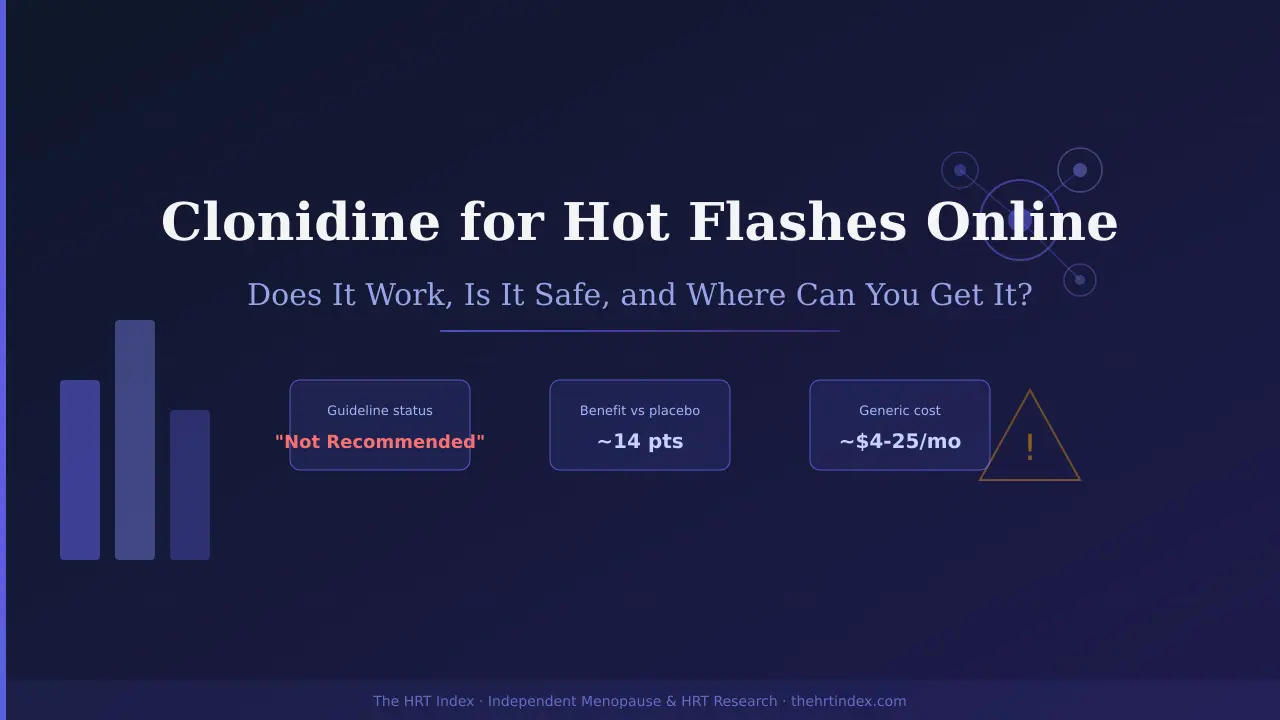
Clonidine can reduce hot flashes for some women, but the average benefit is modest, and most of the research is old or done in specific groups — often women taking tamoxifen for breast cancer. In the best-known trial, hot flashes dropped 38% on clonidine versus 24% on placebo — a real but small edge of about 14 percentage points. Current U.S. menopause guidance rates it as less helpful than several other non-hormonal options.
Clonidine is an alpha-2 adrenergic agonist — a blood-pressure medicine that calms an overactive part of the body's stress-response system. Researchers think that's part of why it can ease hot flashes, though the exact reason isn't fully established. The real question is how much it helps, and the honest answer is: not a lot, on average.
What the actual studies found
We always show the placebo result next to the treatment result — that's the number that tells you what clonidine really added.
| Study | Who was studied | What it reported | The catch |
|---|---|---|---|
| Pandya et al., 2000 (Ann Intern Med) [7] | 194 postmenopausal women with breast cancer on tamoxifen | Hot-flash frequency fell 38% on clonidine vs 24% on placebo at 8 weeks — a between-group difference of about 14 percentage points | Placebo group improved a lot too; clonidine caused more dizziness, dry mouth, drowsiness, and constipation. |
| Goldberg et al., 1994 (J Clin Oncol) — clonidine patch [7] | Women with breast cancer on tamoxifen | About a 20% drop in hot-flash frequency, with the analysis favoring clonidine over placebo | Older, patch-specific, and more side effects than placebo. |
Some older and smaller studies suggested clonidine could cut hot flashes by up to ~46% at higher doses — but that's the ceiling, not the typical result, and higher doses mean more side effects [1]. That gap between "best case" and "average case" is exactly why the numbers get confusing.
The 2023 Menopause Society conclusion: after weighing all the evidence, the Society found clonidine only modestly better than placebo, less effective than SSRIs/SNRIs and gabapentin, and "not recommended" because other treatments have a better balance of benefit and risk [1].
What "modest benefit" really means: Some women get real, noticeable relief on clonidine. Others feel little or nothing. Hot-flash studies almost always show a big placebo response — meaning even the sugar pill helps a lot. The extra benefit clonidine adds on top of that is usually small. That's not a reason to dismiss it entirely. It is a reason to weigh that benefit against the side effects before you commit.
Why online reviews can sound more positive than the studies: Review sites collect the strongest experiences and don't account for the placebo effect, other treatments, or symptoms that faded on their own. Reviews are great for spotting real questions and concerns. They're a poor way to guess how well something will work for you.
Why isn't clonidine recommended for hot flashes?
In its 2023 review, The Menopause Society classified clonidine as "not recommended" for hot flashes. The reasons: the benefit was only slightly better than placebo and weaker than other choices, while the side effects — low blood pressure, dizziness, drowsiness, dry mouth, constipation — and the risk of a blood-pressure spike after stopping tipped the balance against routine use [1].
The leading U.S. menopause experts looked at everything published and concluded: clonidine may help some people, but its average payoff isn't strong enough to make it a go-to hot-flash treatment when better-supported choices exist [1]. The same review recommends several other non-hormonal options and still calls hormone therapy the most effective treatment for women who are good candidates for it.
The one honest trade-off we won't hide:
Clonidine's real advantages are that it's cheap and easy to get — not that it's the most effective or best-supported hot-flash treatment. If your top priority is the strongest relief, clonidine isn't your pick. The newer FDA-approved non-hormonal drugs — Veozah and Lynkuet — have far stronger, more recent trial evidence [10][12]. There is one spot where clonidine's blood-pressure effect can work in your favor: if you also have blood pressure that isn't well controlled, a clinician might weigh clonidine because it can act on both at once — though they'd still compare it against better first-line options for each problem [3].
Does "not recommended" mean no one should ever take it? No. A guideline describes the average balance of benefit and risk. "Not recommended for routine use" is very different from "never appropriate for anyone." For a woman who can't use hormones and hasn't done well on the better-supported options, clonidine may still earn a spot on the list — as long as she's choosing it on purpose, not by accident.
Compare clonidine head-to-head with the better-supported options below — then get matched to the route that fits you with Find My HRT Path →
Why does the NHS mention clonidine when U.S. guidance doesn't recommend it?
In the U.K., clonidine has an approval for hot flushes, so NHS pages mention it — though current U.K. guidance says it shouldn't be offered as a first-choice treatment. In the U.S., the FDA has not approved clonidine for hot flashes. Same drug, different rules. If you've been reading U.K. websites and feeling confused, this is your answer.
In the U.K., clonidine has a formal approval for menopausal hot flushes — but even U.K. guidance says it shouldn't be the first thing you try [9]. In the U.S., the FDA approved clonidine for high blood pressure, not hot flashes, so using it for hot flashes here is off-label (a legal, common practice of prescribing an approved drug for an unapproved use). Off-label is not the same as FDA approval for that use. When you read about a medicine online, the country matters more than most people realize. Licensing, approved uses, tablet strengths, brand names, and insurance systems all differ.
A quick safety catch: milligrams vs micrograms
Clonidine amounts can be written in milligrams (mg) or micrograms (mcg) depending on the product — and 0.1 mg is the exact same amount as 100 mcg. Those tiny numbers are easy to misread. In the U.S., common tablet strengths are 0.1 mg, 0.2 mg, and 0.3 mg [4]. This is one more reason a clinician and pharmacist — not a forum post — must set and confirm your prescription. Never copy or convert a dose you found online.
How does clonidine compare with better-supported non-hormonal options?
Clonidine is the weakest default in this group. Better-supported choices include three medicines that are FDA-approved for moderate-to-severe menopausal hot flashes — Brisdelle, Veozah, and Lynkuet — plus well-supported off-label options like certain antidepressants, gabapentin, and oxybutynin. This is the comparison that actually ends the search.
Sources: The Menopause Society 2023 nonhormone position statement; FDA approvals and labeling for Brisdelle, Veozah, and Lynkuet.
| Option | FDA-approved for hot flashes? | Guideline status | Practical upside | Real trade-off |
|---|---|---|---|---|
| Clonidine | No — off-label | Not recommended (TMS 2023) [1] | Cheap generic; non-hormonal; available on some telehealth routes | Modest benefit; low BP, dizziness, drowsiness, dry mouth; blood-pressure spike if stopped suddenly |
| Paroxetine 7.5 mg (Brisdelle) | Yes [6] | Recommended class (SSRI/SNRI) | First FDA-approved non-hormonal Rx for hot flashes (2013); once-daily pill | Antidepressant effects; can interfere with tamoxifen (lowers its active form) |
| Fezolinetant (Veozah) | Yes [12] | Recommended (2023) | Strong relief in phase 3 trials; non-hormonal, menopause-specific | Boxed warning for rare but serious liver injury; liver tests required [12] |
| Elinzanetant (Lynkuet) | Yes (approved Oct 2025) [10] | Approved after 2023 guideline | Strong trial results; also helps sleep | Drowsiness, liver testing, pregnancy precautions, drug-interaction cautions; brand price [10] |
| Venlafaxine (SNRI) | No — off-label | Recommended class | Better-supported than clonidine; often a first non-hormonal pick | Antidepressant side effects; must be tapered to stop |
| Gabapentin | No — off-label | Recommended | Especially helpful when night sweats wreck your sleep | Drowsiness, dizziness, balance concerns |
| Oxybutynin | No — off-label | Recommended | May help hot flashes and an overactive bladder at once | Anticholinergic effects; more caution in older adults |
Notice what that table shows: there are now three FDA-approved non-hormonal prescriptions specifically for moderate-to-severe menopausal hot flashes. That's new. It's a big reason clonidine — an old blood-pressure drug used off-label — sits at the bottom of the list for most women.
Clonidine vs gabapentin
Current guidance backs gabapentin over clonidine [1]. Both can cause dizziness and drowsiness. Gabapentin has an edge when your worst symptoms are at night, since it's often taken at bedtime to calm night sweats and help sleep. Which one fits depends on your other health conditions and medicines.
Clonidine vs venlafaxine
Venlafaxine is in a guideline-recommended class, and most women will find it works at least as well as clonidine — often better [1]. It's also usually a better fit for women on tamoxifen, because it interferes with tamoxifen less than some other antidepressants do. The catch: it has its own side effects, and you have to taper off it rather than stop cold.
Clonidine vs Brisdelle
Brisdelle (low-dose paroxetine) was the first FDA-approved non-hormonal prescription for hot flashes (2013) [6]. Its big limitation: paroxetine can lower the amount of tamoxifen's active form, so it advises considering avoiding the combination [11]. Clonidine avoids that interaction — but "doesn't interfere with tamoxifen" is not the same as "works better."
Clonidine vs Veozah and Lynkuet
Veozah and Lynkuet are the newest non-hormonal drugs, and their trial evidence is far stronger and more current than clonidine's. Veozah carries a boxed warning for rare but serious liver injury [12]. Lynkuet (approved Oct 2025) has its own cautions [10]. The honest framing isn't "safe vs dangerous" — it's different risk profiles. Clonidine's risks center on blood pressure and stopping; theirs center on the liver and cost.
Not sure where to start for your symptoms, health history, and state? Find care that fits your situation in about 90 seconds with Find My HRT Path →
Who might still consider clonidine for hot flashes?
Clonidine may be worth asking about when hormone therapy is off the table and the better-supported non-hormonal options are unavailable, unaffordable, or poorly tolerated. It's a fallback worth discussing — not a first choice you pick just because it's cheap and easy to get online.
Think of these as reasons to put clonidine on your question list — not as a checklist you can self-approve.
When clonidine may enter the conversation
- ✓Hormone therapy isn't right for you, or you don't want it.
- ✓An FDA-approved non-hormonal option is unavailable, unaffordable, or something you can't take.
- ✓You've already tried a recommended off-label option and it failed or caused problems.
- ✓Your clinician sees a reason it fits your overall health picture.
- ✓You understand the blood-pressure, drowsiness, and stopping precautions and are willing to follow them.
Start in-person or with established care instead if you have...
- →Fainting spells or frequent falls
- →Low blood pressure or a slow heart rate
- →A heart rhythm problem, or you take a beta blocker
- →Several blood-pressure medicines already
- →Kidney problems or frequent dehydration
- →Active cancer-treatment decisions
- →New or unusual flushing that hasn't been checked out yet
If your hot flashes are tied to tamoxifen or breast cancer:
Several clonidine trials were done in women on tamoxifen, so the evidence is relevant — but relevant isn't the same as best [7]. Because some antidepressants (like paroxetine and fluoxetine) can interfere with tamoxifen, options like venlafaxine or gabapentin are often preferred, and clonidine is sometimes considered too [8]. The key move: coordinate this decision with the team managing your cancer treatment, not a general telehealth visit alone.
If you also have high blood pressure:
This is clonidine's clearest case — but it's not automatic. Having high blood pressure doesn't make clonidine a guaranteed "two problems, one pill" solution. A clinician still needs a specific reason to choose it within your overall plan, and they'll factor in your other medicines, your heart rate, and what happens if you miss a dose or stop [3]. When it does work out, that overlap is the strongest reason clonidine earns a place on your list.
Get your personalized, pre-consult action plan in about 90 seconds — Find My HRT Path →
Already set on asking about clonidine? Check current availability and price on Sesame →
What clonidine side effects and safety risks matter most?
The most common effects are drowsiness, dry mouth, dizziness, constipation, low blood pressure, and a slower heart rate — which can mean fainting or falls. FDA labeling carries a serious warning: stopping clonidine suddenly can cause a rapid, dangerous rise in blood pressure ("rebound hypertension"). In rare reported cases, abrupt stopping has led to severe outcomes, which is why it must be tapered under a clinician's guidance.
Everyday effects
- Dry mouth
- Drowsiness and fatigue
- Dizziness
- Constipation
- Headache
- Feeling less alert
- Skin irritation where a patch is worn
Low blood pressure, slow heart rate, and falls
Because clonidine lowers blood pressure, you may feel lightheaded when you stand up — which raises your risk of a fall. Heat, dehydration, or being sick can make that worse. Your clinician may want to check your blood pressure and heart rate before and during treatment. What this page won't do is tell you what blood pressure is "safe enough" to start — that's a personal medical decision.
Sedation, driving, and alcohol
Clonidine can make you sleepy, and that effect gets stronger if you drink alcohol or take other medicines that cause drowsiness — like certain sleep aids, sedating allergy pills, or some anxiety medicines [4]. Ask your prescriber directly how it might affect driving, using equipment at work, and any other sedating medicines you take.
Why you can't just stop clonidine
If you stop clonidine suddenly, your body can respond with a fast spike in blood pressure and a rush of "fight or flight" symptoms — this is called rebound hypertension [16]. That's why missed doses matter and why you can't treat it like a pill you take only when you feel like it. Different products have different taper instructions, so we won't print a one-size-fits-all schedule — your prescriber gives you the exact plan for your exact product. Clonidine is a commitment, not a casual "try it and quit it."
Clonidine and beta blockers
If you take a beta blocker (a common heart or blood-pressure medicine) and clonidine together, FDA labeling contains specific precautions for stopping them safely [16]. Don't change or stop either one on your own — this is handled entirely by your clinician.
A note on age
The Beers Criteria — a widely used guide for prescribing in older adults — advises against clonidine as a first-line blood-pressure treatment in people 65 and older, because of drowsiness, a slow heart rate, and blood-pressure drops that raise fall risk [14]. That doesn't make age 65 alone an automatic no. It's a reason to raise it specifically with your clinician if you're in that age group.
What dose of clonidine is used for hot flashes, and how long does it take to work?
There is no FDA-approved clonidine dose for menopausal hot flashes in the U.S. Your clinician chooses the form, dose, monitoring, and stopping plan — because immediate-release tablets, extended-release tablets, and patches are not interchangeable. Response time varies, so your clinician also sets when to judge whether it's working.
Why we won't give you a personal dose: There's no approved hot-flash dose, the products aren't interchangeable, and the right amount depends on your health and your other medicines. Copying a dose from a study or a forum is exactly how people run into the low-blood-pressure and stopping problems above.
What older studies used (context only): Historical studies reported clonidine amounts in milligrams or micrograms depending on the product, given as daily tablets or as a patch changed on a set schedule [7]. Remember that 0.1 mg equals 100 mcg — the mix-up is real and dangerous. These are study regimens, not recommendations, and they are not a green light to self-dose.
How to tell if it's actually helping
Give yourself a simple way to measure. Before your visit, and once you start, track:
- Daytime hot flashes (how many)
- Night sweats and how often they wake you
- How strong each one feels
- How much it disrupts sleep, work, or your day
- Any dizziness or daytime sleepiness
- Missed doses
- Blood pressure and heart rate — only if your clinician asked you to monitor them
Ask your clinician up front: when should I expect improvement, how much of a drop counts as "working," when should side effects trigger a call, and what's the plan if it doesn't help enough?
Clonidine patch vs pills for hot flashes: which is better?
Neither the pill nor the patch is FDA-approved for hot flashes in the U.S. The patch means fewer daily doses and steadier levels, but takes 2-3 days to reach full effect and can irritate the skin. Tablets are cheap and easy to adjust, but require daily dosing. They are not interchangeable — your clinician decides.
| Question | Oral clonidine (tablets) | Clonidine patch |
|---|---|---|
| FDA-approved for hot flashes? | No | No |
| How often you dose it | Daily, product-specific | Longer intervals (worn on skin), product-specific |
| Skin reaction risk | No patch-site reaction (systemic reactions still possible) | Yes — irritation and sticking issues |
| Time to full effect | Product-specific | About 2-3 days to reach full levels [16] |
| Missed-dose worry | Yes | Different — replacement/application timing |
| Special note | — | Contains aluminum; remove before an MRI (burns have been reported) [16] |
| Clinician must choose it | Yes | Yes |
Tablets can be a good fit if you want the cheapest generic and easy dose adjustments, but you have to remember them daily and side effects still apply. The patch can help if daily pills are hard to keep up with and you want steadier levels, but the slower start, skin reactions, and the MRI note are real trade-offs. Either way, the two aren't swappable — your clinician decides which one, and switching between them needs a plan.
How much does clonidine for hot flashes cost online?
The medicine itself is usually inexpensive — often a few dollars up to about $25 a month, depending on your dose, quantity, pharmacy, and any discount card. But your real cost is the visit plus the medicine plus any labs and follow-ups, minus whatever insurance or a savings card covers. We show visit fees and medicine costs separately, because blending them into one "starting at" price hides what you'll actually pay.
The only cost math that's honest:Your first-90-day cost = first visit + follow-up visits + medicine + any labs − verified insurance or savings-card coverage.
Medicine cost (usually cheap)
Prices verified from Sesame's public pages — confirm at your pharmacy, as they vary by dose, quantity, and location.
- Sesame's own clonidine page lists a typical oral supply at about ~$25/month, depending on dose and pharmacy — verify the exact price for your prescription before you pay [2].
- Generic clonidine tablets are among the cheapest generics available; pharmacy discount cards can lower it further.
- Clonidine is not a controlled substance, so no special dispensing restrictions apply.
Visit cost (your real cost)
Visit costs — sourced from provider pricing pages.
| Provider | Visit cost | Insurance | Notes |
|---|---|---|---|
| Sesame | Visits from $34 | Cash-pay only | Price varies by provider and state; confirm at booking. Medicine billed separately at pharmacy. |
| Midi Health | $250 first / $150 follow-up self-pay (~$50 most insured patients) | In-network most PPO; not Medicaid/Medi-Cal/Medicare | Exact cost depends on your plan. Labs and medicine separate. All 50 states [18]. |
Insurance and HSA/FSA questions to ask:
- Is generic clonidine covered on my plan for off-label use, and at what copay?
- Does it need prior authorization?
- Is the telehealth clinician in-network?
- Can I use my HSA/FSA for this visit? (Confirm with your account administrator.)
Want to see which cash-pay online service fits your symptoms and state? Match my situation with Find My HRT Path →
What to prepare for an online clonidine appointment
Bring a 7-day hot-flash diary, a full list of your medicines and supplements, any recent blood-pressure or heart-rate readings, and details about fainting, falls, heart or kidney conditions, cancer treatment, and past menopause treatments. This helps your clinician decide not just whether clonidine is possible, but whether it's the best choice for you.
Your 7-day symptom record
- Number of daytime hot flashes
- Night sweats and how often you wake
- How strong each episode feels (scale of 1-10)
- Triggers (stress, caffeine, alcohol, heat)
- Impact on sleep, work, and confidence
- Any treatments already tried and how they went
Your medicine and supplement list
- Blood-pressure medicines and beta blockers
- Medicines that slow the heart
- Sleep medicines and sedating allergy pills
- Alcohol use (be honest — it matters for drowsiness)
- Antidepressants
- Tamoxifen, aromatase inhibitors, or other cancer therapies
- All over-the-counter supplements
Seven questions to ask your clinician
- Why clonidine instead of an FDA-approved hot-flash treatment?
- What amount of relief would count as it "working"?
- Which form are you considering — tablet or patch — and why?
- What blood-pressure or heart-rate checks do I need?
- Could any of my medicines increase drowsiness, low blood pressure, or a slow heart rate?
- Exactly how do I handle a missed dose, and how do I stop safely?
- What's our backup plan if clonidine doesn't help enough?
Already set on exploring clonidine? Get your full appointment-prep checklist started at Sesame (visits from $34) → or check insurance coverage at Midi Health →
What do real clonidine reviews say?
Real patient reviews are genuinely mixed. Some women report fast, dramatic relief; others report little benefit, benefit that fades, or side effects like dizziness and drowsiness. A recurring theme is that hot flashes come back when the drug is stopped. Reviews are useful for spotting concerns to raise — but they can't tell you how well clonidine will work for you.
On the positive side, one woman on Drugs.com (posting under "perimenopausal symptoms") who was having 30 to 50 hot flashes a day wrote that after starting clonidine, the hot flashes "practically ceased" [17]. Reviews like that are why some women swear by it.
But the same review pages tell the other half of the story. Another Drugs.com reviewer described stopping her clonidine once she thought her hot flashes were over — only to have them return "with a vengeance" within a day or two, forcing her back onto it [17]. Others describe dry mouth, drowsiness, and dizziness, and a recurring warning from patients themselves: don't stop it suddenly.
These are individual, unverified anecdotes from a public review site. They are not typical results, may leave out important details, and should never be used to pick a dose or judge whether clonidine is safe for you.
Two things worth separating: Some reviewers describe hot flashes returning after they stop — that's the symptom coming back. Separately, FDA labeling warns that stopping clonidine abruptly can cause rebound high blood pressure — that's a different, more serious event [16]. Both are reasons to stop only with a clinician's plan.
Bottom line: is clonidine worth asking about for hot flashes?
Clonidine can be worth a specific conversation when hormone therapy and the better-supported non-hormonal options don't fit. But it shouldn't be your routine or easiest online pick. The right next step depends on your symptoms, blood-pressure and fall risk, other medicines, insurance, state, and whether your situation suits online care at all.
Ask about clonidine when:
- You understand it's off-label and only modestly effective.
- You've compared the better-supported options first.
- Your clinician sees a reason it fits your health picture.
- You can follow the monitoring and stopping plan.
Ask about something else first when:
- You want a treatment FDA-approved for hot flashes (Brisdelle, Veozah, or Lynkuet).
- You haven't yet considered venlafaxine, gabapentin, or oxybutynin.
- Low blood pressure, dizziness, or drowsiness are real concerns for you.
- You want the strongest possible relief.
Start in-person when:
- Your flushing is new, unusual, or unexplained.
- You have a complex heart or blood-pressure history, or take several such medicines.
- You have fainting spells or falls.
- Your oncology team needs to be part of the decision.
- You're already on clonidine and want to stop it safely.
Which route fits you
Choose Sesame if you want a low-cost, cash-pay online route where clonidine is publicly listed — knowing the clinician may still suggest a better option. See Sesame's prices →
Choose Midi if you want insurance and a menopause specialist to weigh every option, not just hand you one drug. Check Midi's coverage →
Choose your own clinician if blood pressure, heart rate, falls, kidney issues, or cancer care are the center of your decision.
Still not sure which path is right for you? Take our free matching tool — it takes about 90 seconds — and get your personalized action plan.
Find My HRT Path →What's changed recently (why this decision looks different than it used to)
Brisdelle (low-dose paroxetine) becomes the first FDA-approved non-hormonal prescription for hot flashes [6].
The Menopause Society's nonhormone position statement classifies clonidine as "not recommended", and recommends SSRIs/SNRIs, gabapentin, fezolinetant, and oxybutynin instead [1].
Veozah (fezolinetant) is FDA-approved for moderate-to-severe hot flashes [12].
The FDA adds a boxed warning for rare but serious liver injury to Veozah and expands liver monitoring [12].
Lynkuet (elinzanetant) is FDA-approved — a newer non-hormonal option that arrived after the 2023 guideline [10].
We re-verified provider access, pricing, and drug labeling for this page.
The short version: the menu of non-hormonal options has grown, which is exactly why an old off-label blood-pressure drug is a harder sell than it once was.
Frequently asked questions
Sources
- [1] The Menopause Society. The 2023 Nonhormone Therapy Position Statement. Menopause. 2023;30(6):573-590. DOI: 10.1097/GME.0000000000002200. (Clonidine classified "not recommended.")
- [2] Sesame. Online Prescription for Clonidine and Online Menopause Treatment pages (medication cost estimate; clonidine listed among non-hormonal options). Verified July 14, 2026.
- [3] NHS (U.K.). Clonidine - Common questions. (Not a routine first-line hypertension treatment.)
- [4] U.S. FDA / DailyMed. Clonidine hydrochloride tablets prescribing information (tablet strengths 0.1/0.2/0.3 mg; sedation and CNS-depressant precautions).
- [6] U.S. FDA. Brisdelle (paroxetine 7.5 mg) — first FDA-approved non-hormonal prescription for moderate-to-severe menopausal vasomotor symptoms (2013).
- [7] Pandya KJ et al. Oral clonidine in postmenopausal patients with breast cancer experiencing tamoxifen-induced hot flashes. Ann Intern Med. 2000;132(10):788-793. Goldberg RM et al. Transdermal clonidine for ameliorating tamoxifen-induced hot flashes. J Clin Oncol. 1994;12:155-158.
- [8] Adverse-effects systematic review of non-hormonal drugs in breast cancer survivors with hot flashes (PMC5065610); paroxetine/fluoxetine CYP2D6 and tamoxifen interference noted.
- [9] NHS (U.K.). About clonidine (U.K. hot-flush use; not recommended as first-line for vasomotor symptoms alone).
- [10] U.S. FDA. Lynkuet (elinzanetant) prescribing information and approval, October 24, 2025 (Bayer). accessdata.fda.gov.
- [11] U.S. FDA. Brisdelle (paroxetine) prescribing information (tamoxifen interaction: reduced active-metabolite concentrations; consider avoiding concomitant use).
- [12] U.S. FDA / DailyMed. Veozah (fezolinetant) prescribing information (approved 2023; boxed warning for serious liver injury added December 2024; liver testing at baseline, monthly for 3 months, and at months 6 and 9).
- [14] American Geriatrics Society. 2023 AGS Beers Criteria (advises against clonidine as first-line hypertension treatment in older adults).
- [16] U.S. FDA / DailyMed. Catapres and Catapres-TTS (clonidine) prescribing information (rebound hypertension on abrupt withdrawal; beta-blocker discontinuation precautions; patch therapeutic levels in ~2-3 days; contains aluminum, remove before MRI).
- [17] Drugs.com. Clonidine user reviews (perimenopausal symptoms). Public, user-submitted comments used only for lived-experience context.
- [18] Midi Health. Pricing and Insurance page and Help Center ($250 first visit / $150 follow-up; ~$50 average out-of-pocket with insurance per Midi; PPO in-network; not Medicaid/Medi-Cal/Medicare; all 50 states). Verified July 14, 2026.
Editorial research; not medically reviewed. This page is educational — not medical advice. The HRT Index Editorial Team · Last verified . See our editorial standards, methodology, and corrections policy.
You came here wanting relief and a clear next step.
The most powerful thing you can do now isn't to chase the cheapest pill — it's to walk into a visit knowing exactly what to ask and which options fit you.