
Which online care route fits your situation?
Three very different kinds of services will prescribe desvenlafaxine — and they are not the same. Choosing the right door affects the quality of your evaluation far more than the pill itself.
| The online route | What it’s built for | Best when… |
|---|---|---|
| Menopause specialist | Treating the whole menopause picture — and comparing hormone and non-hormone options | Hot flashes are your main problem and you want a real comparison, not just a script |
| General telehealth (cash-pay visit) | A quick, low-cost visit with a licensed clinician | You already know you want to discuss it and want the lowest-cost door |
| Psychiatry / mental-health service | Managing depression or anxiety with medication | Depression is the main thing being treated and hot flashes are a separate consideration |
Warning sign: any site that says it will “approve” you before a clinician looks at your history, or lets you “pick your medication” with no evaluation. That’s not how legitimate prescribing works.
Is desvenlafaxine FDA-approved for hot flashes?
No. Pristiq (desvenlafaxine) is FDA-approved for major depressive disorder in adults. Menopausal hot flashes are not an approved use. In 2011 the FDA issued the drugmaker a Complete Response Letter — it declined to approve the hot-flash use in the form submitted. A clinician can still prescribe it off-label when it’s medically appropriate, but the FDA has not judged it safe and effective for this specific use.
Here’s the flaw, stated plainly: desvenlafaxine is not FDA-approved for hot flashes, and the studies behind it are mixed. The drugmaker actually applied for a hot-flash indication, and in September 2011 the FDA responded with a Complete Response Letter — meaning the application couldn’t be approved as submitted. So if your top priority is a pill the FDA specifically approved for hot flashes, that points you to Veozah, Lynkuet, or Brisdelle — not desvenlafaxine.
Now the pivot, because it’s a real one. “Off-label” doesn’t mean fringe.Off-label means a clinician prescribes an approved medicine for a use that isn’t on its official label — something doctors do every day, legally, when evidence supports it. And the evidence here is respectable: The Menopause Society’s 2023 position statement lists SNRIs as a recommended class for non-hormonal hot-flash treatment, with Level I evidence.
So: off-label, yes. Second-rate, no.The class-level guideline support is strong. The individual trial results are mixed. That’s the honest picture.
Does desvenlafaxine for hot flashes actually work?
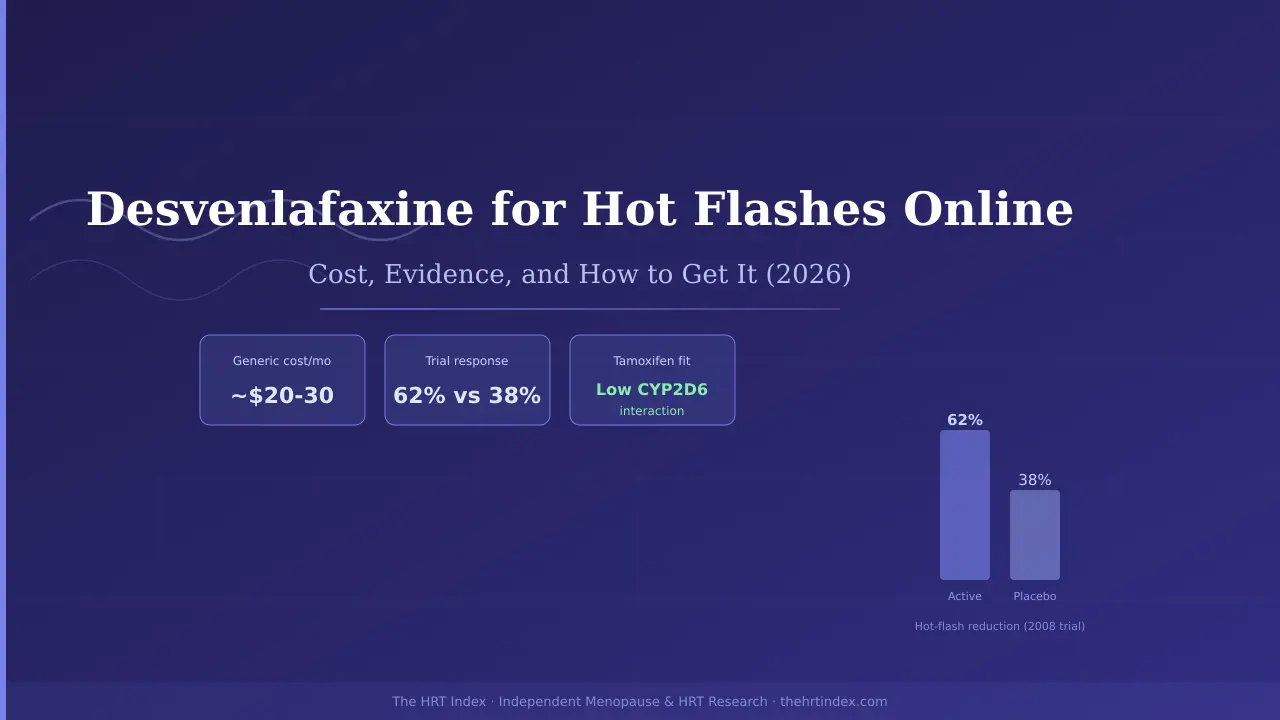
For many women it helps, but the evidence is mixed rather than a slam dunk. In separate trials, desvenlafaxine (especially 100 mg/day) cut moderate-to-severe hot flashes by roughly 62–67% from baseline — but the placebo groups also improved a lot (38–51%), and one large trial found desvenlafaxine no better than placebo at 12 weeks. Averaged across six trials, a pooled analysis still found a real, modest benefit.
These are group averages from studies, not the share of women who will personally benefit. A lot of pages quote one flattering number and stop. Here is the good, the not-so-good, and the average:
Evidence snapshot — sources cited below.
| The study (year) | Who + design | Active-group result | Placebo result |
|---|---|---|---|
| 12-week RCT (2008) | ~365 women; 100 mg/day vs. placebo | ~62% fewer hot flashes | ~38% fewer |
| 12-week RCT (2008) | 458 women; 100 & 150 mg/day vs. placebo | 65.4% / 66.6% fewer; 86.9% completed | 50.8% fewer |
| 12-week RCT (2011) | 485 women; 100 mg vs. tibolone vs. placebo | No advantage over placebo (−5.78 vs. −5.82/day) | ~57% response; hormone did beat placebo |
| Meta-analysis (2013) | Pooled 6 randomized trials | Statistically significant average benefit at 100 mg | — |
Our honest read: Desvenlafaxine likely gives some women a meaningful drop in hot flashes, on top of a large placebo effect. The pooled evidence leans toward “it helps — modestly.” It’s generally a bit weaker than estrogen. That’s why a clinician sets a starting point, then checks whether it’s actually working for you in a few weeks — rather than promising a result.
What doses were studied, and how long does it take to work?
Doses studied (study context only)
Trials studied 50 mg and 100 mg a day. Results at 100 mg were mixed — one large trial was clearly positive and another didn’t beat placebo at 12 weeks. There is no FDA-approved desvenlafaxine dose for hot flashes — the dose is a decision only your prescriber should make, based on your kidney and liver function, other medications, and response.
How long to work
Trials saw changes over days to weeks, but timing varies. In the negative 2011 trial, time to a 50% reduction was 13 days on desvenlafaxine versus 26 days on placebo — yet the two groups landed in the same place by week 12. Early improvement doesn’t prove lasting benefit. Set a baseline for one week before you start, then agree with your clinician on a check-in date.
Can desvenlafaxine make sweating worse?
Yes, and it surprises people. Even though desvenlafaxine can reduce hot flashes on average, excessive sweating (hyperhidrosis) is a listed side effect. About 10% of people on 50 mg reported it versus 4% on placebo (from depression studies). So a small share of women may notice more sweating, not less.
| Pattern | What it tends to look like |
|---|---|
| A menopausal hot flash | A sudden wave of heat, often with flushing; short; may wake you at night; sometimes has a trigger |
| Medication-related sweating | More constant or all-over; happens outside your usual flash pattern; started after the new pill |
Urgent. Sweating plus a racing heart, shivering or tremor, agitation or confusion, fever, muscle stiffness, or diarrhea can signal serotonin syndrome— a rare but potentially life-threatening reaction. Don’t wait it out — seek urgent care immediately.
For ordinary new sweating with none of those red flags: write down when it happens, don’t change or stop the pill on your own, and message your prescriber.
Is desvenlafaxine right for you?
Desvenlafaxine fits best for a woman who can’t or won’t take estrogen, understands it’s off-label, and can get follow-up on blood pressure, side effects, mood, and stopping the drug. It’s a poor first move if your situation is urgent, involves active cancer treatment without oncology input, a mental-health crisis, pregnancy, or a complex medical history.
You may be a good candidate if:
- Hot flashes or night sweats are genuinely bothering you.
- You can’t take estrogen (or have decided against it) and want a non-hormone option.
- Your clinician is also treating depression as a separate goal.
- You’re okay knowing the evidence is mixed and it may take weeks.
- You can stay in a follow-up relationship, not just grab a one-time script.
Start somewhere other than online if:
- New chest pain, fainting, or severe/unexplained symptoms → in-person care now.
- Thoughts of self-harm or a mental-health crisis → call/text 988 right now.
- Taking tamoxifen or in active cancer treatment → loop in your oncology team first.
- Pregnant or might be → tell a clinician before any treatment.
- Seizure disorder, bipolar disorder, uncontrolled high BP, or serious kidney/liver problems.
Not sure whether an SNRI, an FDA-approved hot-flash medicine, hormone therapy, or in-person care belongs on your list? Use Find My HRT Path →It’s free, takes about 90 seconds, and doesn’t promise a prescription — it helps you walk into your consult knowing what to ask.
How does desvenlafaxine interact with tamoxifen?
Desvenlafaxine is not broken down by — and doesn’t meaningfully block — the liver enzyme (CYP2D6) that tamoxifen relies on. Its label states no dose adjustment is needed with tamoxifen. That’s why it’s often chosen over strong CYP2D6 blockers like paroxetine and fluoxetine. The full decision still belongs with your oncology team.
Your body uses CYP2D6 to turn tamoxifen into its active, cancer-fighting form. Some antidepressants block that enzyme. Block it strongly, and you may reduce tamoxifen’s benefit. Here’s the irony: the oneantidepressant the FDA approved for hot flashes — paroxetine (Brisdelle) — is a strong blocker, so it’s often the wrong pick for tamoxifen users.
Source: clinical review, Level A evidence (PMC5482277). Verified July 2026.
| ✓ Lower CYP2D6-interaction concern | Strong CYP2D6 blockers to flag with tamoxifen |
|---|---|
| Desvenlafaxine · Venlafaxine · Escitalopram · Citalopram · Gabapentin (no CYP2D6 effect) | Paroxetine (incl. Brisdelle)· Fluoxetine · Bupropion · Duloxetine |
A 2024 randomized trial in women with breast cancer on tamoxifen found desvenlafaxine improved hot-flash scores faster than placebo — but it enrolled far fewer women than planned (57 randomized, 53 analyzed), and side effects were more common in the active groups (~53–59% any side effect vs. 14% on placebo).
One honest guardrail:“lower interaction concern” is not the same as “combine it without asking.” Your oncologist knows your cancer, your other medicines, and your risks — they should be part of this decision.
What should an online clinician review before prescribing?
A credible visit should confirm your symptoms are menopausal hot flashes, review every prescription and supplement you take, check your blood pressure and mental-health history, weigh kidney, liver, pregnancy, seizure, and cancer-treatment factors, and set up follow-up. Every patient needs a real evaluation, not a checkbox.
A solid clinician will want to know:
- Your symptom pattern — episodic hot flashes and night sweats vs. constant heat, fever, palpitations, or sweating that could point elsewhere.
- Every medicine and supplement — other antidepressants, migraine meds, tramadol, blood thinners, aspirin/NSAIDs, St. John’s wort, and tamoxifen or other cancer therapies.
- Your mental-health history — depression, anxiety, bipolar disorder, prior suicidal thoughts, and how you’ve responded to antidepressants before.
- A follow-up plan — who monitors your response, when the first check-in is, how side effects are handled, and who manages a taper if you stop.
If a service can’t tell you who follows up and how, that’s a red flag.
What are the side effects — and how do you stop it safely?
The most common side effects are nausea, dizziness, insomnia, sweating, constipation, and lower appetite. In hot-flash trials, extra side effects clustered mainly in the first week. The bigger issue is stopping: quitting suddenly can cause dizziness, “brain-zap” sensations, and nausea, so desvenlafaxine must be tapered slowly — sometimes over months — under a clinician’s guidance.
Common side effects at 50 mg (vs. placebo, from depression studies)
| Side effect | 50 mg group | Placebo group |
|---|---|---|
| Nausea | 22% | 10% |
| Dizziness | 13% | 5% |
| Sweating / hyperhidrosis | 10% | 4% |
| Constipation | 9% | 4% |
| Lower appetite | 5% | 2% |
| Discontinued due to side effects | ~4% | ~4% |
From the current Pristiq label; these come from depression trials, not hot-flash trials. At the 50 mg dose, the discontinuation rate was about equal to placebo — for many women it’s well tolerated.
Important safety flags
- Blood pressure. Desvenlafaxine can raise blood pressure, more so at higher doses. The label calls for BP to be controlled before starting and monitored afterward. Say so up front if you have high BP.
- Serotonin syndrome. Combining it with other serotonin-affecting drugs can rarely cause a dangerous reaction. Tell your clinician and pharmacist every medicine and supplement you take.
- Bleeding. Slightly raised bleeding risk with aspirin, NSAIDs, or blood thinners.
- Mood. Like all antidepressants, it carries a boxed warning about higher risk of suicidal thoughts in children and young adults. Any new or worsening mood or behavior change deserves prompt attention.
- Sexual side effects. Possible — though a pooled analysis of hot-flash trials found no statistically significant effect on sexual function versus placebo. Tell your clinician if you notice changes.
On stopping — please don’t wing it.
The label is explicit: taper the dose down gradually rather than stopping cold, and in some people that taper needs to happen over several months. A 25 mg strength exists specifically to help step down. In the original hot-flash trial, close to half of women reported discontinuation symptoms like dizziness, headache, or nausea after stopping — usually short-lived, but a real reason to plan your exit with a clinician instead of quitting on your own.
Which online care route is best for desvenlafaxine for hot flashes?
For a hot-flash-first question, a menopause specialist is usually the best fit — they can compare hormone and non-hormone options and handle your blood pressure and tamoxifen status together. A cash-pay general visit is the lower-cost door if you already know you want to discuss it. A psychiatry service fits better when treating depression is the main event.
Compared under The HRT Index Verification Standard.
| Provider / route | Type | Insurance | Treats hot flashes? | Visit price | Best for |
|---|---|---|---|---|---|
| Midi Health (top pick) | Menopause specialist | Most major PPO; NOT Medicare/Medicaid | Yes — lists SNRIs among non-hormone options | $250 first / $150 follow-up (cash) | Full menopause picture, drug vs. hormones comparison, BP + tamoxifen review |
| Sesame | Cash-pay marketplace | No (cash) | Depends on which clinician you pick | From $34 (no membership) | Lowest-cost live visit; pick a clinician who manages menopause |
| Mental-health service (e.g., Hers) | Telehealth mental-health | Varies | Framed for mood; confirm hot-flash intent | Membership/visit model — confirm current | Hot flashes alongside depression already being treated |
Midi Health — our top pick for menopause-first care
Midi does NOT hand you a guaranteed script — but for most hot-flash-first questions, the menopause expertise and possible PPO coverage make it worth more than the sticker price
Midi is built around menopause, so its clinicians can do something a brief general visit often can’t: look at your hot flashes, blood pressure, tamoxifen status, and all your options together— comparing desvenlafaxine against hormone therapy and the FDA-approved choices — then bill your insurance if you’re in-network. Available in all 50 states; in-network with most PPO plans.
- Cash prices: $250 initial visit, $150 follow-up.
- Hard limits: Not covered by Medicare; cannot treat Medicaid or Medi-Cal patients, even as self-pay.
- One caveat: We couldn’t confirm that desvenlafaxine specifically is on every clinician’s menu — confirm at your visit.
See how Midi can review your options and check your plan →“Midi was incredibly easy. I signed up and had a visit the next day. My clinician was kind and thoughtful. By the end of the day, I had my prescriptions called in.” — Midi Health patient testimonial (individual experiences vary; not a claim about desvenlafaxine specifically).
Sesame — the lowest-cost live visit
From $34 for a live clinician visit; no membership required
A basic Sesame visit is the lowest-cost way among the routes we compared here to talk to a live clinician about an off-label SNRI. The catch: it’s a marketplace, so pick a clinician who actually treats menopause or hot flashes — a prescription is never guaranteed, and the clinician decides.
Compare Sesame clinicians and current visit prices →If depression is part of the picture:A mental-health service can be a reasonable fit, since desvenlafaxine treats depression on-label and hot flashes off-label. Just confirm they’ll manage it with your hot flashes in mind. General psychiatry services prescribe desvenlafaxine as a depression medicine — a real trade-off to weigh against a menopause-first visit.
How much does desvenlafaxine for hot flashes cost?
The medicine is cheap — the visit is the variable. Generic desvenlafaxine ER (50 mg, 30 tablets) runs about $20–$30 a month with a pharmacy discount card. Brand-name Pristiq runs about $435 for the same supply — always ask for the generic. The bigger swing is the online visit.
True first-month cost breakdown.
| Cost piece | What you’ll actually pay | Source |
|---|---|---|
| Generic desvenlafaxine ER, 50 mg × 30 | ~$20–$30/month with a card (GoodRx as low as ~$20; Drugs.com from $25.84; SingleCare ~$17–20) | GoodRx · Drugs.com · SingleCare |
| Without a discount card (retail) | Far higher — GoodRx lists an average around $195 at some pharmacies | GoodRx |
| Brand-name Pristiq, 50 mg × 30 | ~$435 — the generic is the same medicine; always ask for it | Drugs.com |
| The online visit | $34 (basic Sesame cash) up to $250 (Midi, first visit) | Sesame · Midi |
| Follow-ups | Varies (e.g., $150 for a Midi follow-up) | Midi |
| Insurance | Can drop visit to a copay; generic desvenlafaxine generally covered under most Medicare Part D and commercial plans — tier, prior auth, and copay vary | GoodRx |
Money tip: ask the clinician to write for the generic, and have your pharmacist compare a free discount-card price (GoodRx, SingleCare) against your insurance copay — use whichever is lower. A low-cost mail-order pharmacy can also beat your local counter.
Can you take desvenlafaxine with hormone therapy?
Sometimes a clinician uses both for different goals — but no combination is automatically right. Systemic hormone therapy and a non-hormone SNRI aren’t the same tool, and local vaginal estrogen treats vaginal and urinary symptoms, not systemic hot flashes. Each medicine should have a clear purpose and its own safety review. A clinician who compares the full menu is exactly the kind of visit Find My HRT Path is built to point you toward.
How does it compare to venlafaxine, Brisdelle, Veozah, Lynkuet, and hormone therapy?
Desvenlafaxine is one off-label option among several. Venlafaxine is a close cousin with more data. Brisdelle, Veozah, and Lynkuet are FDA-approved — but Veozah and Lynkuet cost far more and require liver blood tests, and Veozah carries a boxed liver-injury warning. Hormone therapy is still the most effective option when it’s safe for you.
Sources: FDA approvals and labels; Veozah pricing Drugs.com/SingleCare.
| Option | FDA-approved for hot flashes? | Hormone? | Main catch / monitoring | Rough cost | Good fit when… |
|---|---|---|---|---|---|
| Desvenlafaxine (Pristiq) | No (off-label) | No | BP checks, taper to stop, mixed evidence | ~$20–30/mo generic | Can’t/won’t take estrogen; on tamoxifen |
| Venlafaxine (Effexor XR) | No (off-label) | No | Similar SNRI issues; more/older data | ~$10–25/mo generic | You want the SNRI with the longest track record |
| Paroxetine 7.5 mg (Brisdelle) | Yes | No | Strong tamoxifen interaction — usually wrong for tamoxifen users | Brand; generic paroxetine cheap at other doses | FDA-approved pill and NOT on tamoxifen |
| Fezolinetant (Veozah) | Yes (2023) | No | Boxed liver-injury warning; liver tests start/monthly×3/months 6&9 | ~$475–$775/mo | Targeted hormone-free FDA-approved option with monitoring capacity |
| Elinzanetant (Lynkuet) | Yes (2025) | No | Liver tests at start and 3 months; pregnancy, seizure limits; new | Brand-only; confirm current price | Same as Veozah, newest option |
| Hormone therapy | Yes (for hot flashes) | Yes | Not right for many with breast-cancer history or certain risks | Varies | You can take estrogen and want the strongest relief |
Context: Veozah and Lynkuet are NK3 receptor antagonists — a newer, hormone-free class that quiets the brain-signaling cells behind hot flashes. They work well, but their liver-monitoring requirements and price tag make desvenlafaxine’s “cheap, no liver tests, but off-label and mixed” profile a genuinely reasonable trade for many women — not a consolation prize. Compare all non-hormonal menopause options →
What if it doesn’t help — or you want to stop?
Don’t stop or change desvenlafaxine on your own. If it isn’t helping by the follow-up you set with your prescriber, a clinician should recheck your symptom baseline, side effects, diagnosis, and other options — and manage any taper, since stopping suddenly can cause withdrawal symptoms that for some people take months to resolve.
A quick reassessment checklist to bring to that visit: Has your hot-flash count actually changed from your baseline? Any new sweating, blood-pressure change, or mood shift? Side effects you can’t live with? Does the original pattern still look like menopausal hot flashes? From there, the next move is usually one of these: keep going with monitoring, adjust the dose under supervision, switch to a different option, try an FDA-approved hot-flash medicine, or revisit whether hormone therapy is right for you.
What to verify before you pay
Your two-minute checklist before booking any online desvenlafaxine visit:
- StateIs the provider licensed where you live?
- Real clinicianWill a licensed clinician actually evaluate you, with a clear route for follow-up?
- Right reasonWill they treat this as hot flashes, weighing your options — not just an antidepressant refill?
- True totalWhat's the all-in cost — visit, medicine (ask for generic), and any labs or follow-ups?
- Safety reviewHave they checked your blood pressure and every medicine you take, especially tamoxifen?
If a service can’t clearly answer these, that’s your answer.
How we researched this page ()
What we verified: the current Pristiq label and its warnings; the FDA’s stance on off-label use and the 2011 Complete Response Letter; the positive andthe negative hot-flash trials plus the pooled meta-analysis; the 2024 tamoxifen trial; FDA status and liver-monitoring rules for Brisdelle, Veozah, and Lynkuet; each provider’s stated care model, prices, states, and insurance; and current generic and brand drug prices.
What we did not verify: whether Midi, Sesame, or any specific provider stocks desvenlafaxine for hot flashes (confirm at intake); your personal insurance coverage; and whether any given clinician will prescribe it. No page can promise you a prescription.
This page is independent editorial research from The HRT Index following our verification standard. It is not medically reviewed by a clinician and is not medical advice. We don’t invent authors, credentials, reviews, or scores. Last verified: See our affiliate disclosure.
Frequently asked questions
The bottom line
If you can’t take estrogen — or you’d simply rather not — desvenlafaxine for hot flashes onlineis a real option worth discussing. It’s off-label and the evidence is mixed, but it’s supported by strong class-level guideline backing, it’s inexpensive, it skips the liver monitoring the newer FDA-approved drugs require, and for women on tamoxifen it has a lower interaction concern than the one antidepressant the FDA approved. The smart move isn’t to chase the fastest script — it’s to talk to a clinician who treats hot flashes, weigh it against your other options, and make the call with your eyes open.
Sources
- FDA action on the hot-flash application — Contemporary OB/GYN; Pristiq label — DailyMed (dailymed.nlm.nih.gov).
- FDA on off-label use — fda.gov/patients/learn-about-expanded-access-and-other-treatment-options/understanding-unapproved-use-approved-drugs-label.
- 12-week efficacy trial (2008) — PubMed PMID 23010882.
- 12-week efficacy trial (2008) — Am J Obstet Gynecol (sciencedirect.com/science/article/abs/pii/S0002937808020012).
- 12-week trial, no advantage over placebo (2011) — PubMed PMID 22066790.
- Pooled meta-analysis (2013) — PubMed PMID 23548358.
- The Menopause Society 2023 Nonhormone Therapy Position Statement — Menopause. 2023;30(6):573–590 (PMID 37252752).
- Tamoxifen/CYP2D6 clinical review (Level A evidence) — PMC5482277.
- 2024 randomized trial in tamoxifen users — Nature (nature.com/articles/s41523-024-00668-w).
- FDA approvals: Veozah (fezolinetant, 2023); Lynkuet (elinzanetant, October 2025).
- Veozah pricing — Drugs.com/SingleCare (July 2026).
- Generic desvenlafaxine pricing — GoodRx, Drugs.com, SingleCare (July 2026).
- Brand Pristiq pricing — Drugs.com (July 2026).
- Midi Health — joinmidi.com/pricing-insurance (verified July 14, 2026).
- Sesame — sesamecare.com/medication/desvenlafaxine (verified July 14, 2026).
Independent editorial research — not medically reviewed by a clinician. Not medical advice. The HRT Index Editorial Team. Last verified: See our editorial standards, methodology, and corrections policy.