The honest bottom line (read this first)
Escitalopram is legitimate and doctor-prescribed for hot flashes — just off-label, which is normal and legal. It won't erase your hot flashes, but for the right woman it genuinely helps, and it can ease the anxiety and broken sleep that so often come along.
For most women who specifically want escitalopram online, the strongest starting point we found is Midi Health — it's menopause-focused, names escitalopram as a non-hormonal option, and is in-network with most PPO plans. If anxiety or low mood is a big part of your picture, Hers is a solid alternative.
If you take tamoxifen for breast cancer, read the tamoxifen section closely — because the one SSRI the FDA approved for hot flashes (paroxetine/Brisdelle) is often the wrong choice for women on tamoxifen, while escitalopram is usually much safer.
Does escitalopram actually work for hot flashes?
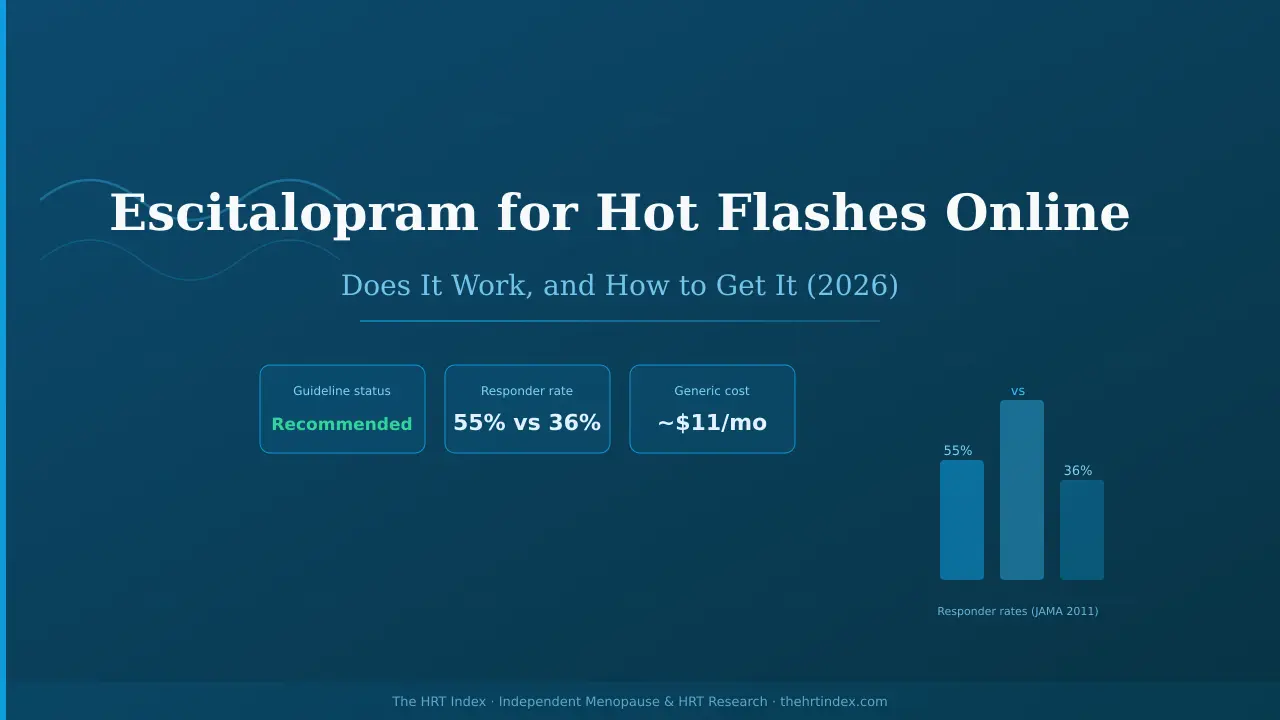
Escitalopram can reduce hot flashes, and most studies show a benefit — but the evidence is not unanimous. In the largest trial, 55% of women cut their hot flashes by half or more, versus 36% on placebo. Two small studies that measured with body sensors found little effect. It helps many women, though hormone therapy generally works better for those who can use it.
Escitalopram is one of several antidepressants with solid trial support for hot flashes. A 2026 International Menopause Society review points to multiple escitalopram studies, most showing meaningful reductions in hot flashes. The Menopause Society recommends this class of drug (SSRIs/SNRIs) with its strongest level of evidence for non-hormonal hot-flash treatment.
The strongest positive trial
A large study published in JAMA in 2011 (Freeman et al.) followed 205 menopausal women — half took escitalopram (10 to 20 mg per day), half took a placebo, and everyone kept a daily hot-flash diary for 8 weeks. The investigators excluded women with a current depressive episode or already on psychiatric medication.
Trial results — Freeman EW et al. JAMA. 2011;305(3):267–274.
| Outcome | Escitalopram | Placebo | What it means |
|---|---|---|---|
| Hot flashes cut per day | 4.6 fewer/day | 3.2 fewer/day | Drug's honest edge: ~1.41 fewer/day |
| Responder rate (≥50% reduction) | 55% | 36% | Number needed to treat ≈ 6 |
NNT of about 6 means: for every 6 women treated, 1 extra woman got a big improvement because of the drug rather than the placebo effect. That's a meaningful but modest result. The benefit did not depend on whether the woman was anxious or depressed.
The studies that pump the brakes
A 2011 paper (Freedman et al., Menopause) reported two small studies — 42 women total — that measured hot flashes with a physiologic recorder on the skin instead of a diary. At 10 mg, escitalopram did nothing measurable. At 20 mg, the device picked up a small drop, but the authors still concluded it was "not effective." Neither study is bigger or automatically better than the JAMA trial — they used different methods with different strengths and weaknesses.
These studies differed in size, design, and how they measured symptoms. That doesn't mean escitalopram is useless — most evidence points to a benefit. It means you can't predict a big response for every woman. Go in expecting "meaningfully better," not "gone." And know this: for many women, feeling less bothered by hot flashes is a win worth having.
One honest catch: Escitalopram is not FDA-approved for hot flashes, and not every study found a benefit. If you want a medication approved specifically for hot flashes, ask about hormone therapy, or the non-hormonal drugs Veozah or Lynkuet. But escitalopram earns its place: The Menopause Society recommends this class with its strongest level of evidence. And if you also have diagnosed anxiety or depression, one medicine can sometimes address multiple issues at once. Still weighing options? Get your personalized plan →
Is escitalopram FDA-approved for hot flashes?
No. Escitalopram is FDA-approved only for major depressive disorder and generalized anxiety disorder. Using it for hot flashes is "off-label," which is legal and common — clinicians do this all the time when research supports it. Three non-hormonal drugs are FDA-approved specifically for hot flashes; escitalopram is not one of them.
Off-label means the drug is FDA-approved and sold legally — just for a different condition than the one being treated. Once a drug is approved, a clinician may prescribe it for another use they judge appropriate based on evidence. There's no official FDA-approved hot-flash dose for escitalopram; your clinician decides based on research and your situation.
Sources: FDA approvals and labeling; The Menopause Society 2023.
| Option | FDA-approved for hot flashes? | What makes it different |
|---|---|---|
| Escitalopram (Lexapro) | No — off-label | Well-studied SSRI; may also help mood, anxiety, and sleep; considered relatively weight-neutral; gentler on tamoxifen than paroxetine |
| Paroxetine (Brisdelle, 7.5 mg) | Yes — the only FDA-approved SSRI for hot flashes | A different SSRI — but strongly clashes with tamoxifen (see below) |
| Fezolinetant (Veozah) | Yes — approved 2023 | Works on brain temperature signals; boxed warning for rare serious liver injury; requires liver blood tests |
| Elinzanetant (Lynkuet) | Yes — approved October 2025 | Newest option; non-hormonal brain-targeted drug |
| Venlafaxine / desvenlafaxine | No — off-label | SNRIs with strong hot-flash evidence; usually gentle on tamoxifen |
| Gabapentin | No — off-label | Nerve-pain drug; can help nighttime hot flashes and sleep; avoids the tamoxifen enzyme entirely |
Note: The Menopause Society's non-hormonal guidance came out in 2023 — before Lynkuet was approved in October 2025. We use the 2023 guidance for what it says about escitalopram, and the current FDA record for the full up-to-date list.
Can you take escitalopram with tamoxifen?
If you take tamoxifen for breast cancer, read this first. The only SSRI the FDA approved for hot flashes — low-dose paroxetine (Brisdelle) — can weaken tamoxifen, because it strongly blocks the liver enzyme your body uses to switch tamoxifen "on." Escitalopram blocks that enzyme only weakly, which is why it's often chosen instead. Always let your cancer team make this call.
Here's the chain in plain words. Tamoxifen doesn't do its job until your liver converts it into an active form called endoxifen — the "on switch" version of the drug. That conversion is done by a liver enzyme called CYP2D6. Strong blocking of this enzyme can lower your endoxifen levels — and a weaker tamoxifen effect is the last thing a breast-cancer patient wants.
The twist: paroxetine — the one SSRI the FDA approved for hot flashes — is a strong blocker of that enzyme. Its own label warns it can reduce tamoxifen's effectiveness. In one small study, paroxetine lowered endoxifen by roughly 64% in women with the common enzyme variant. So the "approved" choice is often the wrong choice for women taking tamoxifen.
Escitalopram is different. It blocks CYP2D6 only weakly. In a small switch study, moving women from paroxetine or fluoxetine to escitalopram or venlafaxine roughly tripled their endoxifen levels. Venlafaxine, desvenlafaxine, and gabapentin also avoid or minimize this interaction.
One honest wrinkle: if hot flashes are your only reason for the medicine (no mood symptoms) and you're on tamoxifen, some clinicians prefer a drug that skips the enzyme altogether — like gabapentin or venlafaxine. See gabapentin for hot flashes or venlafaxine for hot flashes for those comparisons. This decision belongs with your oncology team, not made on your own.
On tamoxifen and still fighting hot flashes? Start with the oncology team managing your tamoxifen — don't change anything on your own. From there, a menopause-focused clinician can help you compare hormone-free options. Find My HRT Path can help you figure out the right kind of care →
Can you really get escitalopram for hot flashes online — and where?
Yes. A licensed telehealth clinician can prescribe escitalopram after reviewing your symptoms, history, and other medications — but no legitimate service will promise the prescription before that visit. The best online path treats your hot flashes as the reason for care, not just as a mental-health issue. For most women who want escitalopram specifically, that's Midi Health.
You can't buy escitalopram over the counter — it's prescription-only, and that's a good thing. What you're really choosing between online isn't the pill. It's the quality of the visit behind it: who evaluates you, whether they understand menopause, and whether they'll weigh all your options.
Provider comparison — verified from official provider pages.
| Provider | Escitalopram for hot flashes? | Insurance? | Price (confirm at checkout) | Best for |
|---|---|---|---|---|
| Midi Health (our pick for most) | Yes — names it as a non-hormonal menopause option | In-network most PPO plans (varies); no Medicaid/Medi-Cal; no Medicare claims | $250 first visit / $150 follow-up self-pay; labs & meds separate | Most women who want escitalopram; PPO users; tamoxifen cases (with oncology) |
| Hers | Prescribed through mental-health service, not a menopause visit | No — cash-pay | From $49/month (confirm what's included) | Women whose anxiety or low mood is a main reason for care |
| Sesame | Not on its menopause plan — confirm which program covers escitalopram in your state | No — cash marketplace | Menopause plan ~$59/month (confirm live price) | Budget menopause care — but confirm escitalopram route first |
| Your own doctor + pharmacy coupon | Yes, if they agree to prescribe off-label | Yes (their visit) | Visit cost + inexpensive generic | Anyone with a doctor who already knows their history |
A provider listing a drug is not the same as a clinician prescribing it to you in your state. Whether you actually get a prescription always depends on the clinician's judgment about you.
Midi Health — our editorial pick for most women
Best when menopause expertise and possible insurance coverage matter more than the lowest sticker price
Among the routes we compared, Midi is the only one that both names escitalopram as a non-hormonal menopause option and runs a menopause-first visit — a live video appointment with a clinician who can weigh escitalopram against hormones and other choices, evaluate your full picture, and factor in your history including tamoxifen. It's in-network with most PPO plans and, per Midi, operates in all 50 states.
- Cost: $250 first visit, $150 follow-up if you self-pay; most insured patients pay around $50 out of pocket per visit, per Midi (your plan determines the exact amount).
- Insurance limits: Midi cannot treat Medicaid or Medi-Cal patients, and it's not covered by Medicare (a Medicare beneficiary can self-pay but can't file a claim).
- Honest trade-off: Not the cheapest cash option. But for most women who want a menopause specialist to weigh all options, it's the best balance of care quality and potential insurance coverage we found.
Check whether Midi is in-network for your plan →"Midi was so easy: I got a same-day appointment and they took my insurance." — Midi-published patient testimonial. Individual care experiences vary.
Hers — when anxiety or low mood is a main reason for care
Best if mood symptoms are central to why you're seeking care
Hers prescribes escitalopram starting at $49 a month (a starting price — confirm the plan, quantity, and what's included at checkout). Be clear-eyed: Hers offers escitalopram through its mental-health service, not a menopause evaluation. So it won't compare hormone therapy against non-hormonal options or work up your vasomotor symptoms. If your hot flashes come alongside real anxiety or sleepless nights, that overlap can make Hers a fit. If you want a menopause-first evaluation, start with Midi.
See Hers' current escitalopram service →Sesame — budget-first, with one important caveat
Check before you pay — escitalopram may not be on Sesame's menopause plan in your state
Sesame runs a cash-pay menopause subscription (advertised around $59 a month; confirm the live price) that includes provider visits and standard labs when ordered. The honest catch: Sesame's menopause plan lists non-hormonal options like paroxetine, gabapentin, clonidine, and sertraline — but not escitalopram. Escitalopram appears in Sesame's separate mental-health service. Before you pay, ask support one question: "Can I get escitalopram for hot flashes, and through which program, in my state?"
See Sesame's current menopause pricing →Who should start with in-person or urgent care instead?
Online care shouldn't assume that every hot flash is menopause. New, unexplained, or severe symptoms deserve an in-person clinician first. Thoughts of self-harm, an inability to stay safe, severe agitation, or signs of mania need urgent help right away — not an online prescription visit.
Start with an in-person clinician — or loop in your existing doctor — if your hot flashes or sweating are new, unusual, or severe; if you have a complex mental-health history (bipolar disorder, a prior manic episode, or serious psychiatric conditions); if you're in active cancer treatment without your oncology team in the loop; or if something just feels off and could be more than menopause. Not sure which bucket you're in? Find My HRT Path is built to flag exactly that →
What does escitalopram for hot flashes cost?
The medication is usually the cheap part — generic escitalopram is inexpensive. What varies most is the clinical visit and follow-up. Compare the care costs, not just the pill, and don't be fooled by a low monthly headline that hides what you'll actually pay.
The drug is usually cheap. As one dated example, GoodRx listed about $11.47 with a coupon versus an average retail price around $57.21 for a common 30-tablet supply (checked mid-2026; these are national figures, not your guaranteed price). With insurance, generic escitalopram is often a low-tier copay. Brand-name Lexapro costs far more with almost never a reason to pay for it. Always check your actual price at your pharmacy.
Realistic first-90-day cost breakdown.
| Route | Care cost (first 90 days) | The medication | What to confirm |
|---|---|---|---|
| Midi (self-pay) | $250 (one visit) or $400 (with one $150 follow-up) | Inexpensive generic; separate | Whether labs are needed; your pharmacy price |
| Midi (PPO insurance) | Plan-specific copay and deductible | Inexpensive generic; separate | Your exact plan responsibility before booking |
| Hers | About $147 for 3 months at the $49/month starting plan | Included in program if prescribed | It's mental-health-framed, not a menopause work-up |
| Sesame | About $177 for 3 months at ~$59/month; labs included when ordered (state exceptions) | Separate; coupon may lower it | Whether escitalopram is available through which program |
| Your own doctor + coupon | Your normal visit cost | Inexpensive generic; separate | Whether they'll prescribe it off-label |
The trap to avoid: a $49 headline isn't automatically cheaper than a $250 visit that your PPO mostly covers. Add up the visit, the medication, any labs, and follow-ups — then compare.
What dose is used, and how long does it take to work?
Dose (study context only)
The Menopause Society's evidence table lists 10 to 20 mg a day, usually starting at 10 mg. A dose of 5 mg is sometimes used to ease in for sensitive or older women, though 5 mg hasn't been tested for hot-flash results. Because the use is off-label, there's no official FDA hot-flash dose — your clinician sets and monitors yours. Do not adjust your dose based on anything you read online.
How long to work
In the largest trial, the groups separated within the first week — faster than escitalopram works for depression — with the dose reassessed at week 4 and the main result measured at week 8. That's a group-level pattern, not a guarantee you'll feel relief within a week. Before you start, spend a week counting your baseline: daytime hot flashes, night sweats, severity, and sleep disruption. That gives you and your clinician a shared benchmark.
One honesty note: in the trial, when women stopped escitalopram, the group that had been taking it reported about 1.59 more hot flashes per day than the placebo group three weeks after stopping. That's a group average — not proof every woman's symptoms came back — but it's why you plan the stopping conversation before you start.
What are the side effects — and will it affect my libido or cause weight gain?
Escitalopram is generally well tolerated, but side effects can include nausea, sleep changes, more sweating, tiredness, dry mouth, and sexual effects. It carries an FDA boxed warning about suicidal thoughts and behaviors in children and young adults up to age 24 in short-term studies, and the label says to watch all patients starting antidepressants. It should be tapered, not stopped suddenly — and it doesn't treat vaginal dryness.
Will it affect my sex drive?
Sexual side effects (lower desire, trouble reaching orgasm) are possible with any SSRI, and they're on escitalopram's label. But in an 8-week trial of non-depressed women taking escitalopram for hot flashes, it did not significantly worsen overall sexual function. That's reassuring — but it's a short study and doesn't erase the labeled risk. Ask your clinician up front how they'll watch for it and what to do if it shows up.
Will it make me gain weight?
Escitalopram is considered one of the more weight-neutral SSRIs. A 2026 International Menopause Society review groups it with the "weight-neutral or weight-loss-favoring" medicines, unlike some alternatives (gabapentin, clonidine, paroxetine) that are more linked to weight gain. Responses still vary person to person — track it and mention any change to your clinician.
Other common effects
- Nausea (often improves after the first week or two)
- Trouble sleeping or feeling sleepy
- Fatigue
- Dry mouth
- Increased sweating — a bit ironic for a hot-flash drug, but documented
Serious risks your clinician screens for
- Boxed warning for suicidal thoughts and behaviors in children, teens, and young adults up to 24 in short-term studies. The label directs clinicians to monitor all patients starting or changing antidepressants.
- Serotonin syndrome — a rare but dangerous reaction if combined with certain other drugs, including MAOIs. Bring a full list of everything you take, including supplements.
- Bleeding risk, especially with aspirin, NSAIDs, or blood thinners.
- Low sodium (hyponatremia) — which can matter more for older adults on certain other medicines.
- Mania — why a good intake asks about any bipolar history.
- Caution with a seizure history or angle-closure glaucoma risk.
What escitalopram will not do: it doesn't treat vaginal dryness, painful sex, or urinary symptoms. Those come from low estrogen in the tissues, and the fixes are different — vaginal moisturizers, lubricants, or prescription options like low-dose vaginal estrogen, vaginal DHEA (prasterone), or ospemifene, depending on your symptoms and history.
Bring every medication, supplement, and past reaction to your visit. It's the single best thing you can do for a safe, useful appointment.
What happens if you stop escitalopram?
Don't stop suddenly. Escitalopram should be lowered slowly with your clinician, because stopping cold can cause discontinuation symptoms like dizziness and "brain zaps." Two separate things can happen when you stop: your hot flashes may return, and you may feel discontinuation effects. They're different, and a clinician can help sort out which is more likely.
- Hot flashes come back. The trial showed the group that stopped escitalopram had more hot flashes return. That's the treated symptom coming back, not a side effect.
- Discontinuation symptoms. Stopping an SSRI too fast can bring dizziness, nausea, mood dips, and those odd "electric shock" sensations some people call brain zaps. Lowering the dose gradually is recommended and may reduce these.
You might get one, both, or neither. Ask your clinician before you start what the stopping plan looks like — who manages the taper, and whether another treatment would take its place.
How does escitalopram compare with HRT and other hot-flash treatments?
Escitalopram is one non-hormonal option, not the automatic next step after hormones. Hormone therapy is still the most effective treatment for hot flashes when it's appropriate for you. Escitalopram fits best when hormones are off the table, when mood symptoms come along, or when you want a low-cost generic.
Sources: TMS 2023 nonhormone position statement; FDA approvals.
| Treatment | Hormonal? | FDA-approved for hot flashes? | Why you might pick it | The catch |
|---|---|---|---|---|
| Hormone therapy (HRT) | Yes | Yes (varies by product) | The most effective option for hot flashes when appropriate | Fit depends on age, timing, uterus, and risk history |
| Escitalopram (Lexapro) | No | No (off-label) | Well-studied; may help mood/anxiety/sleep; weight-neutral; gentler on tamoxifen than paroxetine | Mixed evidence; possible SSRI side effects |
| Paroxetine / Brisdelle | No | Yes | The one FDA-approved SSRI for hot flashes | Strongly interacts with tamoxifen — usually a poor fit there |
| Venlafaxine / desvenlafaxine | No | No (off-label) | Strong hot-flash evidence; usually tamoxifen-friendly | Can raise blood pressure; own withdrawal profile |
| Gabapentin | No | No (off-label) | Good for nighttime flashes and sleep; avoids tamoxifen enzyme | Can cause drowsiness, dizziness, weight gain |
| Veozah (fezolinetant) | No | Yes (2023) | Non-hormonal; targets brain's temperature control | Boxed liver-injury warning; needs liver tests before and during treatment |
| Lynkuet (elinzanetant) | No | Yes (Oct 2025) | Newest non-hormonal; strong trial results | Approved Oct 2025; long-term real-world data still building; pricier |
Escitalopram vs paroxetine (Brisdelle)
Brisdelle is FDA-approved for hot flashes; escitalopram isn't. But Brisdelle clashes with tamoxifen, while escitalopram usually doesn't. Neither is a blanket winner — it depends on you. → See our Paroxetine guide.
Escitalopram vs venlafaxine
Both are off-label with good evidence. Venlafaxine can help mood too, but may nudge up blood pressure and has its own stopping profile. For tamoxifen users, both are gentler than paroxetine on the key enzyme.
Escitalopram vs Veozah or Lynkuet
Veozah and Lynkuet are FDA-approved and work through the brain's temperature system. They can be strong options — but Veozah requires liver monitoring, and both are newer and pricier than a generic SSRI.
Escitalopram vs gabapentin (nighttime)
Gabapentin dosed at bedtime can help hot flashes and sleep, and avoids the tamoxifen enzyme issue — but it can cause drowsiness and weight gain. Escitalopram is once-daily, weight-neutral, but off-label.
Escitalopram vs hormones
If you can safely take hormones and your flashes are strong, HRT will likely control them better. Escitalopram shines when hormones aren't appropriate, or when anxiety and sleep problems are along for the ride.
Torn between hormones, escitalopram, and the newer non-hormonal drugs? That's a real decision. Get your personalized starting plan with Find My HRT Path → Or compare all non-hormonal menopause options →
What should happen if escitalopram doesn't help?
Don't raise the dose or stop it on your own. If escitalopram isn't helping after a fair trial, your prescriber should reassess how long you've taken it, whether you're taking it consistently, any side effects, whether your symptoms are truly menopausal hot flashes, and whether a different hormonal, non-hormonal, or non-drug option would fit better. It's common to need a second try — that's not failure, it's normal.
What should you ask during an online visit?
A good visit should leave you with more than a prescription — it should leave you sure. Bring these questions:
About fit
- What makes you think these episodes are menopausal hot flashes?
- Why escitalopram for me, instead of hormones or an FDA-approved non-hormonal option?
- Does my mood or sleep history change your recommendation?
About results
- What amount of improvement would count as this 'working' for me?
- When will we check in, and what if it isn't helping?
About safety
- Do any of my medications or supplements interact with it?
- Which side effects should make me message you — and which mean urgent care?
- If I'm on tamoxifen, how are we protecting my cancer treatment?
About cost and access
- Is the prescription going to my local pharmacy?
- Is the medication included, or separate? Will I need labs?
- What happens, cost-wise, if you decide escitalopram isn't right for me?
About stopping
- If I want to stop later, who manages the taper?
Jot these down and take them with you. Do not change your dose or stop any medication based on a checklist — that's your prescriber's call.
What we checked ()
Confirmed from primary or first-party sources:
- Escitalopram's FDA-approved uses and its off-label status for hot flashes.
- The JAMA 2011 trial results, including the 55%-vs-36% figure and the 1.41-per-day placebo-adjusted difference.
- The two small 2011 objective-monitoring studies that found little effect.
- The Menopause Society's 2023 recommendation of SSRIs/SNRIs for hot flashes, and a 2026 IMS review.
- The current FDA status of Brisdelle, Veozah (including its liver-monitoring schedule), and Lynkuet.
- The paroxetine–tamoxifen interaction and escitalopram's minimal CYP2D6 effect.
- Midi's published prices, PPO status, and Medicaid/Medicare limits. That Hers offers escitalopram through psychiatric care, and that Sesame's menopause plan lists other non-hormonal drugs — not escitalopram specifically.
This page is independent editorial research from The HRT Index following our verification standard. It is not medical advice and not reviewed by a clinician. See also our affiliate disclosure and editorial standards. Last verified:
Frequently asked questions
Still not sure which path is right for you?
If you've read this far, you probably sense escitalopram might be for you — you just want to be sure before you book anything. This is a real medical decision, and the best answer depends on your symptoms, your history, your state, and your insurance. Don't guess.
Sources
- Freeman EW, et al. Efficacy of escitalopram for hot flashes in healthy menopausal women: a randomized controlled trial. JAMA. 2011;305(3):267–274. (PMID 21245182)
- Freedman RR, et al. Escitalopram treatment of menopausal hot flashes. Menopause. 2011;18(8):893–896. (PMID 21540755) — two small objective-monitoring studies
- Reed SD, et al. Sexual function in nondepressed women using escitalopram for vasomotor symptoms. Obstetrics & Gynecology. 2012;119(3):527–538.
- The Menopause Society (NAMS). 2023 Nonhormone Therapy Position Statement. Menopause. 2023;30(6):573–590.
- International Menopause Society. 2026 IMS Recommendations and Key Messages (imsociety.org).
- FDA / DailyMed — Escitalopram prescribing information (indications; boxed warning).
- FDA — "Understanding Unapproved Use of Approved Drugs (Off-Label)."
- FDA — Brisdelle (paroxetine 7.5 mg) approval and label (tamoxifen-efficacy warning).
- Stearns V, et al. Active tamoxifen metabolite plasma concentrations after coadministration of tamoxifen and paroxetine. J Natl Cancer Inst. 2003;95(23):1758–1764. (PMID 14652237)
- FDA — Veozah (fezolinetant) approval (2023) and boxed liver-injury warning with liver-monitoring schedule.
- Bayer / FDA — Lynkuet (elinzanetant) approval, October 24, 2025.
- Midi Health — joinmidi.com (pricing/insurance; non-hormonal menopause options). Verified July 14, 2026.
- Hers — forhers.com (escitalopram via psychiatry service). Verified July 14, 2026.
- Sesame — sesamecare.com (menopause subscription and medication list). Verified July 14, 2026.
- GoodRx — generic escitalopram price example (~$11.47 coupon vs ~$57.21 retail, mid-2026; verify current price).
Editorial research; not medically reviewed. Educational — not medical advice. The HRT Index Editorial Team · Last verified: See our editorial standards, methodology, and corrections policy.