
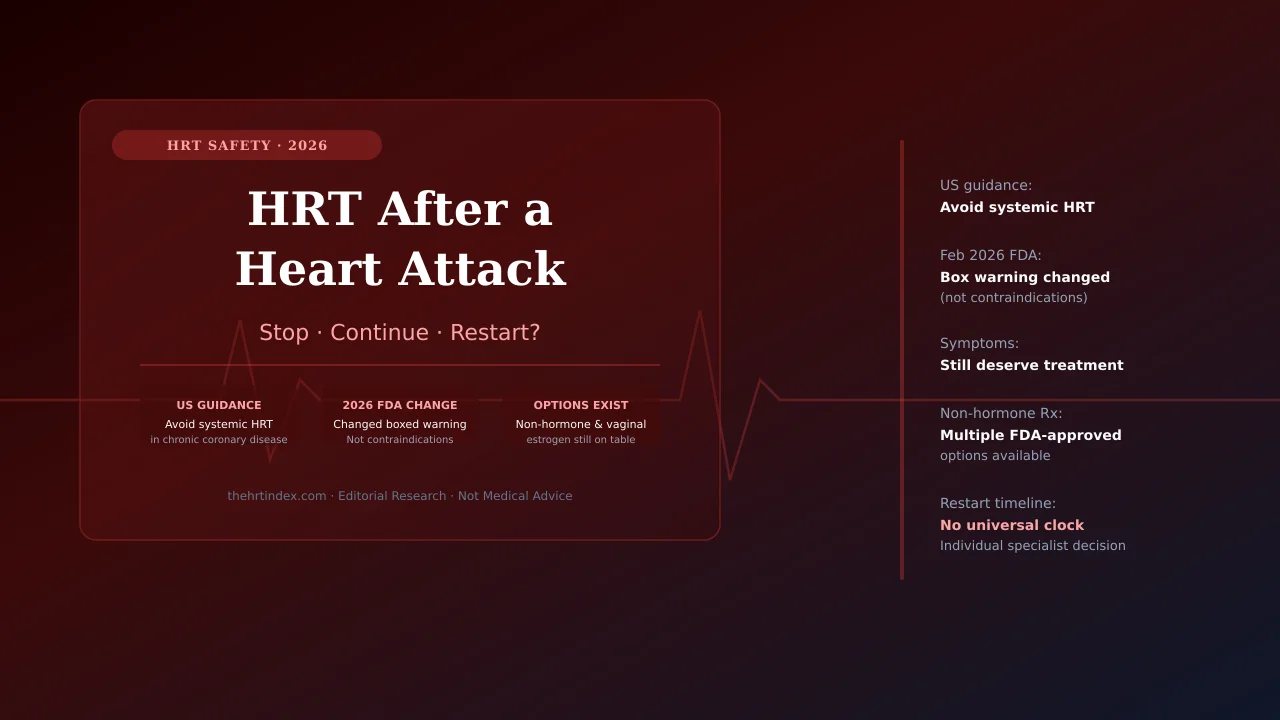
Don’t start, stop, restart, or change hormone therapy on your own. US guidance advises against systemic HRT for women with chronic coronary disease. The 2026 FDA warning change did not clear you. But your symptoms still deserve treatment — and there’s more on the table than you’ve probably been told.
This guide is for you if:you had a heart attack while taking HRT and someone told you to stop; your hot flashes and sleepless nights came roaring back; you want to know whether a patch, gel, or vaginal product changes the answer; you’re thinking about restarting after a heart attack or a stent; or your heart doctor and your gynecologist gave you different answers.
The short answers
| Your question | The short answer |
|---|---|
| Can I start systemic HRT after a heart attack? | Usually no, under current US guidance. Any exception needs a specialist. |
| Should I stop or change my prescription myself? | No. Follow the written instructions you were given, then call your care team. |
| Is a patch safer than a pill? | Better clot profile than pills — but still whole-body hormone, still not cleared after a heart attack. |
| Is vaginal estrogen the same question? | No. It’s a separate decision, and it depends on the exact product. |
| Are there non-hormone options? | Yes. Several, and some are FDA-approved. This is where most women land. |
| Did the 2026 FDA changeclear women who’ve had a heart attack? | No. It changed the warning box, not the “do not use if” list. |
| How long until I can restart? | There’s no waiting period. That’s not the real question. |
Can you take HRT after a heart attack?
For most women in the US, the answer is no — routine systemic HRT is generally not recommended after a heart attack. But “not recommended” is not the same as “impossible forever,” and it is not the same for every woman. Whether you’re starting, continuing, or restarting changes the answer. Low-dose vaginal estrogen and non-hormone treatments are separate decisions with separate answers.
Why US guidance says what it says
In 2023, the American Heart Association and American College of Cardiology published a joint guideline for people with chronic coronary disease— meaning ongoing, established disease in the arteries that feed the heart. Their conclusion on hormones was blunt: women with chronic coronary disease should not receive systemic hormone therapy. The reasoning: it doesn’t reduce major cardiac events or death, and it raises the risk of dangerous blood clots. No upside on the thing you actually need to protect.
The American College of Obstetricians and Gynecologists says the same thing in plainer words: systemic hormone therapy is usually not recommended if you’ve ever had a heart attack.
Note what that guidance is actually about — chronic coronary disease. That’s a specific diagnosis. It’s why the paperwork from your hospital stay matters so much, and why we keep pushing you toward it.
Starting, continuing, and restarting are three different questions
Most pages collapse all three into one answer. They’re not one answer. Find your row — that’s your question.
| Your situation | The real question | Where the evidence points |
|---|---|---|
| You never took HRT | Is it safe to start now? | Current US guidance generally says no for systemic HRT. |
| You were on HRT when it happened | Continue, pause, or switch? | Follow your discharge plan. US labels and your hospital’s written plan govern the immediate decision. Your two doctors settle it. |
| You stopped and want to restart | Is restarting worth it for me? | This is where the evidence looks worst. No self-restart. |
What “systemic HRT” actually means
“Systemic” means the hormone travels through your bloodstream to your whole body. It comes as pills, skin patches, gels and sprays, and some vaginal rings that deliver a whole-body dose. It’s estrogen alone, or estrogen plus a progestogen— the family that includes progesterone. If you have a uterus, a progestogen is generally added to systemic estrogen to protect the uterine lining.
Systemic HRT is used mainly for vasomotor symptoms— the medical term for hot flashes and night sweats. Sleep often improves when night sweats stop waking you.
What should you do if you had a heart attack while on HRT?
Follow the written instructions you were given at the hospital, and call your prescriber and cardiologist quickly. Don’t independently restart, taper, switch, or override a documented stop instruction. Any new chest symptoms are an emergency, not an HRT question.
We know how scary this stretch is. You were finally feeling like yourself again. Then everything got turned upside down, and somewhere in the blur someone said “stop the hormones,” and nobody explained what happens next.
If you’re already home after discharge
- Read your discharge medication list carefully.
- Find your HRT on it. Is it under “continue,” “stop,” or “ask your doctor”?
- Don’t rely on memory. Instructions given in a hospital room, on those days, are almost impossible to hold onto.
- If the list is unclear, or it conflicts with what you remember being told, call before your next dose.
- Ask one of your doctors to write down who owns the final decision about your HRT. This one question saves months of being bounced between offices.
Bring the exact product — not just “I take estrogen”
“Estrogen” isn’t specific enough for this decision. Bring:
- Brand and generic name
- Strength and delivery rate (mg, mcg, or mg/day)
- Form: pill, patch, gel, spray, ring, or cream
- How often you use it
- Whether a progestogen is part of it
- When you took your last dose
- Who prescribed it
- Whether your heart attack came before or after any dose change
Easiest move: put the actual box or a pharmacy printout in your bag. Done.
If your symptoms already came back
Hot flashes and sleepless nights returning right after a heart attack can feel like a second crisis stacked on the first one. That reaction is normal and it’s valid. Stopping HRT can absolutely bring symptoms back, sometimes within days. That’s a real reason to ask your team for symptom relief now. It is not a reason to override the plan on your own.
Does this sound like your situation?
See whether online care is a reasonable starting point — or whether you belong with an in-person clinician first.
Start Find My HRT Path →About 90 seconds. No email required.
Did HRT cause your heart attack?
A heart attack that happened while you were taking HRT does not, by itself, prove HRT caused it. Your doctors need the documented cause of your event, your exact product and dose, any recent medication changes, and the rest of your heart history before anyone can say what role — if any — hormones played.
Timing is not proof
There’s a real difference between three statements:
- “It happened while I was taking HRT.”
- “HRT may have added to my risk.”
- “HRT was found to be the cause.”
Only your medical team, looking at your actual records, can sort out which one fits you. Heart attacks have more than one mechanism — some are caused by plaque, some by a tear in an artery wall, some by a spasm. The answer for you is written in your chart, not in a general rule.
Which record answers which question
Most women walk into these appointments with a symptom list. Walk in with these instead, and you’ll get a real answer instead of a shrug.
| Bring this document | It answers this question |
|---|---|
| Discharge summary | What kind of heart attack was documented — and what were you told to do with each medicine? |
| Cardiac catheterization or angiogram report | Was a blocked artery actually found, or was the cause something else? |
| Stent or procedure report | What was done, and which blood-thinning medicines are you on now? |
| Current medication list | What might interact with a non-hormone hot flash option? |
| Your HRT box or pharmacy printout | Which exact product, dose, and route — and what does that product's label say? |
| Your cardiologist's written diagnosis | Do you have chronic coronary disease, or was this a different mechanism? |
Questions to ask without leading the answer
- “What cause was documented for my heart attack?”
- “Does that change how you view estrogen for me?”
- “Did the form or dose of my HRT matter here?”
- “Are you advising against this one product, all systemic hormones, or both?”
- “Would you put your recommendation in writing for my menopause clinician?”
What does the research actually show about HRT after a heart attack?
The two studies closest to your situation both found harm, not protection. In women who already had coronary disease, a randomized trial found roughly 50% more heart events in the first year of hormone therapy. In women who started HRT after a heart attack, an observational study found more unstable angina. The “timing” evidence you may have read about is about healthy women near menopause — not you.
What each study actually tested
| Study | Type | Who was in it | Heart finding | What it does not settle |
|---|---|---|---|---|
| HERS (1998) | Randomized trial | 2,763 postmenopausal women who already had coronary heart disease; avg age ~67 | No benefit over 4.1 years. About 50% more cardiac events in year one | Didn’t test patches, gels, low-dose vaginal estrogen, or newer regimens |
| CARS analysis (2001) | Observational cohort | 1,857 postmenopausal women after a heart attack; 111 started HRT after the event | Women who started HRT after their heart attack had more unstable angina — about 1.9× in the first six months | Observational. Shows an association, not proof of cause |
| WHI E+P (2003) | Randomized trial | 16,608 generally healthy postmenopausal women, ages 50–79 | No heart protection. Higher coronary risk, especially in year one | Wasn’t a study of women who’d already had a heart attack |
| Menopause Society position (2022) | Guideline review | Women under 60 or within 10 years of menopause, with no contraindications | Benefit-risk generally favorable for symptoms and bone loss | Not about women with established heart disease. Not proof HRT protects the heart |
The CARS row is worth pausing on. Of 1,857 women followed after a heart attack, the ones who startedhormones after their event were the ones with more trouble. That’s exactly the “should I restart?” question — and it’s the closest thing we have to a direct answer.
The “timing” trap
You may have seen headlines saying newer science shows HRT is actually fine for your heart. Here’s what those are really about.
The timing hypothesissays that for women who start HRT early — under 60, or within 10 years of menopause, and with no contraindications— the overall benefit-risk balance is generally favorable. The Menopause Society’s 2022 position supports that. It’s genuinely good news, and it’s why the conversation around HRT has changed so much.
But look at that phrase: with no contraindications. A prior heart attack is a contraindication. You’re not in the group those headlines describe.
And one more thing: favorable timing evidence never claimed HRT protectsyour heart. Even at its most positive, the evidence is about treating symptoms — not preventing heart disease.
Did the 2026 FDA change make HRT safe after a heart attack?
No. On February 12, 2026, the FDA approved labeling changes for six menopause hormone products that removed specific risk statements about cardiovascular disease, breast cancer, and probable dementia from their boxed warnings. The FDA did not say those products were cleared for women with a prior heart attack. And a different section of the label — Contraindications — still lists heart attack.
What changed
The FDA approved boxed warning changes for a first batch of six products: Prometrium, Divigel, Cenestin, Enjuvia, Estring, and Bijuva. The evidence it pointed to involved women starting therapy within 10 years of menopause, generally before age 60 — not women with a heart attack behind them.
What didn’t change
A drug label isn’t one warning. It has parts:
- Boxed warning — the loud box at the top
- Indications — what it’s approved to treat
- Contraindications — the “do not use if” list
- Warnings and precautions
- Adverse reactions
- Patient counseling information
February 2026 changed part 1 for six products. It did not rewrite part 3.
We checked current FDA estrogen labels ourselves — including an estradiol patch label and an estradiol vaginal insert label on DailyMed, the US government’s official label database. Under Contraindications, they say some version of this:
“Active arterial thromboembolic disease (for example, stroke or MI), or a history of these conditions.”
“MI” means myocardial infarction. A heart attack. Or a history of these conditions— meaning a past one counts.
What can treat menopause symptoms after a heart attack?
Your symptoms still deserve treatment. Non-hormone prescription medicines can treat hot flashes without estrogen, and several are FDA-approved. For vaginal dryness or painful sex specifically, low-dose vaginal estrogen puts very little hormone into your bloodstream and is a separate decision. Each option has its own cautions — “non-hormone” doesn’t mean “no risks.”
This is the section we most want you to read. Because the answer to “can I take HRT?” may be no, but the answer to “can anything help me?” is absolutely yes.
Your options, side by side
The HRT Index route map · · Educational summary, not a treatment plan.
| Option | What it treats | Whole-body hormone? | After a heart attack |
|---|---|---|---|
| Oral estrogen (pill) | Vasomotor symptoms; some products also approved for bone loss | Yes | Routine use generally avoided. Oral estrogen has a less favorable clot profile than transdermal |
| Transdermal estradiol (patch/gel/spray) | Vasomotor symptoms; some products also approved for bone loss | Yes | Still not routinely recommended. Better clot profile than pills, but a prior heart attack remains a labeled contraindication |
| Low-dose vaginal estrogen — exact product matters | Vaginal dryness, painful sex, some urinary symptoms | Minimal | Does not treat hot flashes. A separate decision. Check the specific product’s label with your clinician |
| Non-hormone prescriptions — see below | Mainly hot flashes and night sweats | No | The common path when systemic HRT isn’t appropriate. Still needs a full medication review |
| CBT and clinical hypnosis | Hot flash bother, distress, sleep impact | No | Evidence-based, and no drug interactions. Genuinely underused |
| Cooling, trigger avoidance, sleep habits | Comfort | No | Fine to use. But evidence doesn’t support these as treatments — see honest note below |
Three buckets, not one answer
Systemic
Pills, patches, gels, some rings — whole-body. This is the bucket US guidance avoids after a heart attack.
Local vaginal estrogen
Aimed at vaginal and urinary tissue, with low systemic absorption at licensed doses. A separate conversation.
Non-hormone
No estrogen at all — but each option has its own contraindications, interactions, and monitoring needs.
Also worth knowing: not every vaginal product is “local.” Some vaginal rings deliver a systemic dose. Classify the exact product by its current label, not by the word “vaginal.”
Is a patch really safer than a pill after a heart attack?
A patch or gel has a more favorable clot profile than a pill, because it skips the first pass through your liver. That’s a real, established difference. But “better than a pill” is not “cleared after a heart attack.” A patch is still whole-body hormone. It’s still a labeled contraindication with a prior heart attack.
Don’t reach for a compounded patch or cream as a workaround.Compounded hormone products are not FDA-approved, and the FDA doesn’t review them for safety, effectiveness, or quality. Compounding is not a route around a contraindication. More in our HRT benefits and risks guide.
Can you use vaginal estrogen after a heart attack?
Low-dose vaginal estrogen is a genuinely different conversation, because at licensed doses very little hormone reaches your bloodstream. The Menopause Society treats it as a distinct category from systemic therapy, and UK guidance places no cardiovascular limitation on licensed-dose vaginal estrogen.
Here’s the honest wrinkle: US product labels are more conservative, and current estrogen labeling — including for a vaginal insert product we checked — still lists active or prior heart attack under Contraindications. So specialist guidance and the printed label don’t fully line up.
That’s not a reason to panic. It’s a reason to ask about the specific product, and to know this is a legitimate discussion to have rather than an automatic no. Start with our guide to low-dose vaginal estrogen. And remember: it does nothing for hot flashes.
Non-hormone options for hot flashes
The Menopause Society published a 2023 position statement grading non-hormone treatments — and the results overturn a lot of standard advice.
Recommended by The Menopause Society (2023):
- CBT and clinical hypnosis— Level I evidence
- SSRIs and SNRIs— includes low-dose paroxetine (Brisdelle, FDA-approved for hot flashes), and venlafaxine
- Gabapentin
- Fezolinetant (Veozah)— FDA-approved, non-hormone †
- Oxybutynin
- Weight loss and stellate ganglion block
Not recommended by The Menopause Society (2023):
- Clonidine
- Cooling techniques and avoiding triggers
- Paced respiration
- Supplements and herbal remedies
- Exercise, yoga, mindfulness, relaxation
- Soy foods, soy extracts, equol
- Cannabinoids, acupuncture, chiropractic
- Dietary modification, pregabalin, suvorexant
One newer option the 2023 statement predates: elinzanetant (Lynkuet), a non-hormone capsule approved by the FDA on October 24, 2025for moderate to severe hot flashes due to menopause. It’s worth asking about.
† Two things to know about Veozah before you ask for it. In December 2024, the FDA added a boxed warning for rare but serious liver injury. Current FDA instructions call for liver blood testing before you start, every month for the first three months, and then again at months 6 and 9. That monitoring schedule is a real factor in whether this option fits your life. Not a reason to rule it out — a reason to walk in with your eyes open.
Our full list stays updated at non-hormonal menopause options.
Not sure which of these fits your symptoms and heart history?
There are more options here than most women are ever offered, and the right one depends on details a general article can’t see.
Match your situation to a care path →If it tells you online care isn’t your starting point, that’s the tool working, not failing.
Can HRT prevent another heart attack?
No. HRT should not be used to prevent a second heart attack. In women with chronic coronary disease, systemic hormone therapy has not been shown to reduce major cardiac events or death, and it raises clot risk. That’s the core of the 2023 US cardiology guidance.
Treating a symptom and protecting your heart are two different jobs. Keep them separate.
Stay on the heart-protection plan your cardiology team gave you — the medicines, the cardiac rehab, the follow-ups. Don’t swap any of it for hormones, and don’t let anyone sell you hormones as heart protection. Even the most HRT-favorable evidence has never claimed that.
How long after a heart attack can you restart HRT?
There is no universal restart clock. We checked the 2023 US cardiology guidance, ACOG’s patient guidance, current FDA estrogen labeling, and UK guidance — none of them provides a three-, six-, or twelve-month restart rule. For many women the answer stays “don’t restart systemic HRT.” Any exception is an individual specialist decision, not a countdown.
If you’ve read “wait six months and you’re fine,” treat it with suspicion. Someone made that up.
The real question isn’t when — it’s whether systemic hormones should be back on the table at all for your specific heart history. That depends on the documented cause of your heart attack, whether you have chronic coronary disease, how stable you are now, your other risk factors, your symptoms, and which route is even being considered.
Things you’ll see written that aren’t supported by the sources we checked:
- “Wait six months.”
- “Most women can restart after a year.”
- “A patch is fine once you’re stable.”
- “Get cardiology clearance and you’re safe.”
The honest version: there is no clock. There’s a question — should systemic treatment be reconsidered at all? — and it belongs to you and two doctors.
Why do US and UK doctors disagree about HRT after a heart attack?
Because they’re weighing the same evidence differently. US cardiology guidance treats systemic hormone therapy in chronic coronary disease as something to avoid. UK guidance is more case-by-case: the British Heart Foundation says HRT may be possible if the woman, a menopause specialist, and a cardiologist decide together that it’s appropriate. Both positions are real. Neither is a mistake. But UK guidance is not US clearance.
What the US position emphasizes
Randomized trial evidence in women with established disease showed no benefit and early harm. When a treatment doesn’t help the outcome you’re trying to protect and adds clot risk, the recommendation is to avoid it.
What the UK position emphasizes
Severe symptoms are a real harm too. With careful selection, a low dose, a non-oral route, and specialist oversight, some women may reasonably make a different trade. Also: never stopping a medicine without talking to your doctor first.
How to use this:Don’t take the UK position as permission. Take it as evidence that this is a legitimate, individual conversation rather than a door slammed shut. If you want to discuss an exception, bring it as a question, not as a printout that proves your doctor wrong.
When might a specialist still consider systemic HRT after a heart attack?
In narrow cases, a specialist team may discuss it when symptoms are severe, non-hormone options haven’t worked or aren’t tolerated, and both a cardiologist and a menopause-experienced clinician agree on an individual plan. This is an exception path, not the default. UK guidance prefers a low dose and a non-oral route if systemic therapy is considered at all.
We’re including this because leaving it out would be dishonest — not as an invitation to talk yourself into it.
If a specialist team does go down this road, a real decision produces more than “my cardiologist said okay.” It produces, in writing:
- The goal of treatment
- The exact product, dose, and route
- Why the alternatives weren’t enough
- The main known and uncertain risks
- Who monitors you, and how
- A review date
- Clear signals that mean stop and call
- The name of the clinician responsible for refills and changes
Things this decision should never rest on:
- “The patch can’t hurt.”
- “A statin cancels the risk.”
- “Bioidentical hormones are heart-safe.”
- “The UK does it, so US labels are outdated.”
None of those are true. Any clinician who says one should prompt a second opinion.
What should you bring to your cardiologist and menopause clinician?
The best appointment is one where both doctors see the same things: your heart event records, your exact HRT product, your top symptoms, and your medication list. Your goal is a written answer on whether your plan is systemic, local, or non-hormone — plus who owns the decision and what to watch for.
12 questions to bring
- What cause was documented for my heart attack?
- Do you consider me to have chronic coronary disease?
- Does my exact HRT product list a prior heart attack as a contraindication?
- Right now, should I stop, continue, or reassess my HRT?
- Who makes the final call — cardiology, menopause care, or both together?
- Are my worst symptoms whole-body, like hot flashes, or local, like vaginal dryness?
- Could a local treatment handle my symptoms without whole-body hormones?
- Which non-hormone options fit my heart medicines and my history?
- If systemic HRT were ever considered for me, why would the benefits outweigh the risks?
- What product, dose, and follow-up plan would you use, and why?
- What symptoms or test results should make me stop or call urgently?
- When will we re-check this, and who handles my refills?
Documents to gather
- Discharge summary
- Current medication list
- Your actual HRT box, bottle, or pharmacy printout
- Cardiac procedure or stent report
- A short symptom diary — what, how often, how bad
- A list of non-hormone treatments you’ve already tried
If your two doctors disagree
Ask each to write down the reason for their advice, and ask them to talk to each other directly. You should not have to be the messenger carrying conflicting, high-stakes advice between two offices.
Do one thing right now:
Print this page, or screenshot the 12 questions. Then find your discharge summary and put it with your HRT box. That’s ten minutes of work, and it changes your next appointment from “I’m not sure what they said” into a real decision.
Is online HRT the right first step after a heart attack?
We’ll be straight with you: for most women who’ve had a heart attack, a fast online HRT service is not the right first stop. A prior heart attack is exactly the kind of history a responsible service should slow down for — screen carefully, review your records, coordinate with cardiology, and be willing not to prescribe.
It doesn’t mean you’re out of options. It means the orderis different. First the specialist decision. Then — if you land on a non-hormone plan, or local treatment, or an individualized exception — online care can absolutely be part of how you manage it. If you were already cleared by your cardiology and menopause team for a specific plan, an online service may fit well for convenience and refills.
Green flags in an online service (for later)
- It asks about your heart history — clearly, and early
- It can decline or delay prescribing
- A licensed clinician reviews your history before you pay
- It separates FDA-approved from compounded and names the exact product
- You can upload records securely
- It can coordinate with your existing cardiologist
- It’s clear about who handles follow-up and problems
Red flags
- “HRT is safe for almost everyone”
- “The FDA removed the heart risk”
- “A patch is fine even after a heart attack”
- “Compounded is safer because it’s natural”
- No question about your heart history
- Checkout before any safety screening
- A recommendation based on your symptoms alone
You’ve read the evidence. Now find out where you actually stand.
Find My HRT Path takes your symptoms, your history, and your state, and tells you what your realistic next step is — including when that step is an in-person clinician rather than any provider we could send you to.
See where you stand →About 90 seconds. No email.
How was this guide built and verified?
We reviewed current US cardiology guidance, US women’s health guidance, FDA product labeling, the February 2026 FDA labeling action, UK guidance, and current menopause treatment sources. The tables here are our editorial synthesis — not a medical guideline, not a treatment recommendation, and not a claim of firsthand clinical care.
What we actually verified
- The 2023 AHA/ACC chronic coronary disease guidance on systemic hormone therapy: no benefit for major cardiac events or death, increased clot risk
- HERS: 2,763 women with existing coronary disease, avg age ~67, no benefit over 4.1 years, roughly 50% more cardiac events in year one
- The 2001 CARS analysis: 1,857 women after heart attack, 111 who started HRT afterward, more unstable angina (~1.9× in first six months) — observational
- WHI estrogen + progestin: 16,608 generally healthy women, no heart protection, higher risk especially in year one
- The February 12, 2026 FDA boxed warning change and the six products it covered
- That current FDA estrogen labeling retains active or prior heart attack under Contraindications — checked on DailyMed and manufacturer labeling
- The Menopause Society’s 2022 position on timing and route, and its distinction between systemic and low-dose vaginal estrogen
- The Menopause Society’s 2023 non-hormone position statement — the full recommended and not-recommended lists
- Lynkuet (elinzanetant) FDA approval, October 24, 2025
- Veozah’s December 2024 boxed warning and the current liver monitoring schedule
- UK guidance from the British Heart Foundation
What we did not do
- We did not diagnose anyone
- We did not review anyone’s personal medical records
- We did not test an online provider’s intake using a post-heart-attack history
- We did not have a clinician review this page
How we review providers
When we evaluate telehealth providers elsewhere on this site, we use The HRT Index Verification Standard: we read every published price, separate FDA-approved from compounded, verify state availability and insurance, and re-check on a fixed schedule. We judge providers on exactly five things, in this order: clinical legitimacy, care quality, medication fit, price transparency, and access. We don’t publish numeric provider scores. See our methodology and our medical review policy.
Who: The HRT Index Editorial Team. Why this page exists:because women searching this question get caught between a blanket “never,” a headline saying the warning was removed, and two doctors who don’t always agree. We built this to show what each source actually says — and to help you take the next safe step.
Spot an outdated label or source? Report a correction or email partners@thehrtindex.com. We log material corrections.
Frequently asked questions
- Can I stay on HRT after a heart attack?
- US guidance generally advises against systemic HRT once you have chronic coronary disease. UK guidance is more case-by-case and doesn’t call for automatically stopping every woman who was already taking it. Either way, the immediate decision belongs to your discharge plan and your treating teams — follow the written instructions and have your cardiologist and prescriber review your exact regimen together.
- Should I stop HRT immediately after a heart attack?
- Don’t make that change based on a webpage. Follow the written instructions from your hospital and call your prescriber and cardiology team promptly. Estrogen labeling directs that treatment be discontinued if a heart attack occurs or is suspected — but exact wording varies by product, which is why your treating team, not you, should resolve it.
- Can I restart HRT three or six months later?
- No source we checked — US cardiology guidance, ACOG, current FDA labeling, or UK guidance — provides a universal three-, six-, or twelve-month restart rule. The real question isn’t how many months have passed. It’s whether systemic hormones should be considered for your heart history at all.
- Is an estradiol patch safer than a pill after a heart attack?
- A patch has a more favorable clot profile than a pill because it skips the liver’s first pass. But it’s still whole-body hormone, and a prior heart attack remains a labeled contraindication. Better than a pill doesn’t mean cleared after a heart attack.
- Can I take progesterone after a heart attack?
- It depends on the product and the purpose. Don’t assume progesterone is a safe swap just because it isn’t estrogen — some progesterone products also carry cardiovascular contraindications, and Prometrium was one of the six products in the February 2026 FDA labeling action. Check the specific product with your clinician.
- Can I use vaginal estrogen after a heart attack?
- Low-dose vaginal estrogen puts very little hormone into your bloodstream at licensed doses, so it’s treated as a separate category from systemic therapy, and UK guidance places no cardiovascular limitation on it. US labeling is more conservative and can still list prior heart attack as a contraindication. Ask about the exact product. Also note: it does nothing for hot flashes.
- What if I have a coronary stent?
- A stent doesn’t by itself establish what caused your heart attack or make systemic HRT appropriate. Bring your procedure report, discharge medication list, and exact hormone product so cardiology and menopause care can evaluate the underlying diagnosis, your current medicines, and any proposed treatment together.
- What if my paperwork says SCAD or MINOCA?
- These are different mechanisms from the classic blocked-artery heart attack — SCAD involves a tear in an artery wall, and MINOCA is a working diagnosis with several possible causes. Cardiologists may reason about them differently. But a different mechanism is not automatic clearance for hormones. This is a question for the cardiologist who knows your specific diagnosis.
- Can HRT prevent another heart attack?
- No. Systemic hormone therapy hasn’t been shown to reduce major cardiac events or death in women with chronic coronary disease, and it raises clot risk. It should not be used as heart protection.
- What can help hot flashes without estrogen?
- The Menopause Society’s 2023 statement recommends CBT, clinical hypnosis, SSRIs and SNRIs (including FDA-approved low-dose paroxetine), gabapentin, fezolinetant (Veozah), oxybutynin, weight loss, and stellate ganglion block. Elinzanetant (Lynkuet) was FDA-approved in October 2025, after that statement. The right choice depends on your other medicines and history.
- Does cooling or avoiding triggers help?
- Not as treatment. The Menopause Society’s 2023 statement lists cooling techniques and avoiding triggers as not recommended for hot flashes. Use them for comfort if they help. But keep exercising — after a heart attack, that’s for your heart, not your hot flashes.
- Does being under 60 or within 10 years of menopause change the answer?
- For women with no contraindications, being younger and closer to menopause improves the overall benefit-risk balance for HRT. A prior heart attack is a contraindication. The favorable timing evidence describes a different group than women who’ve had a cardiac event.
- Can an online clinic prescribe HRT after a heart attack?
- A responsible service should flag a prior heart attack as high-risk and may hold off pending specialist review. Don’t read a clinic’s willingness to prescribe as proof it’s appropriate for you. Whether a specific provider accepts or manages post-heart-attack patients is worth confirming with that provider directly.
- Did the 2026 FDA change make HRT safe for women with heart disease?
- No. It removed specified risk statements from the boxed warnings of six products. It did not change the Contraindications section, where current estrogen labeling still lists active or prior heart attack. Boxed warning and contraindications are different parts of the label.
- What symptoms mean I should call 911?
- Chest pressure or pain, discomfort spreading to your arm, back, neck, or jaw, shortness of breath, a cold sweat, nausea, or sudden lightheadedness. Call 911 even if you’re not sure it’s another heart attack.
Still not sure which HRT program is right for you?
Take our free Find My HRT Path matching quiz — about 90 seconds, no email required. For a history like a heart attack, it routes you to specialist care first, before any provider.
Start Find My HRT Path →Find My HRT Path asks about your health. We handle those answers under our consumer health data privacy policy.
Sources
Every medical claim above traces to a source below. Guidance and labels change — we re-verify on the schedule in “How was this guide built and verified?”
US cardiology and women’s health guidance
- 2023 AHA/ACC/ACCP/ASPC/NLA/PCNA Guideline for the Management of Patients With Chronic Coronary Disease. Circulation, 2023.
- American College of Obstetricians and Gynecologists — Hormone Therapy for Menopause (patient FAQ).
- American Heart Association — Heart Attack Symptoms in Women; Warning Signs of a Heart Attack.
The trials
- Hulley S, et al. Randomized trial of estrogen plus progestin for secondary prevention of coronary heart disease in postmenopausal women (HERS). JAMA, 1998.
- Alexander KP, et al. Initiation of hormone replacement therapy after acute myocardial infarction is associated with more cardiac events during follow-up. Journal of the American College of Cardiology, 2001.
- Manson JE, et al. Estrogen plus progestin and the risk of coronary heart disease (Women’s Health Initiative). New England Journal of Medicine, 2003.
Menopause guidance
- The Menopause Society (NAMS) — 2022 Hormone Therapy Position Statement. Menopause, 2022.
- The Menopause Society (NAMS) — 2023 Nonhormone Therapy Position Statement. Menopause, 2023.
FDA and labeling
- FDA — “FDA Approves Labeling Changes to Menopausal Hormone Therapy Products,” February 12, 2026.
- FDA — “FDA Requests Labeling Changes Related to Safety Information…” November 10, 2025.
- DailyMed (US National Library of Medicine) — current estradiol transdermal system and estradiol vaginal insert prescribing information (Contraindications).
- Pfizer — Depo-Estradiol prescribing information (Contraindications).
- FDA — Lynkuet (elinzanetant) approval, October 24, 2025.
- FDA — Drug Safety Communication: boxed warning for rare but serious liver injury with Veozah (fezolinetant), updated December 16, 2024.
UK guidance
- British Heart Foundation — Menopause and heart and circulatory conditions.