If you've had a stroke and your menopause symptoms have come roaring back — the hot flashes, the 3 a.m. wake-ups, the dryness that makes sex hurt — you've probably run into three answers that flatly disagree: "never," "patches are fine," and "vaginal estrogen is totally safe."All three are circulating right now. And in 2026 there's a fourth one making the rounds: "the FDA removed the warnings, so it's fine now."
That fourth one is where this gets dangerous — because it's half true, and the half that's missing is the half that's about you. We'll walk you straight through it.
This page is for you if:
- Your stroke or TIA has already been medically evaluated, and things are stable now.
- You want to understand your real options for menopause symptoms.
- You want to walk into your next appointment prepared instead of confused.
This page is not your next step if:
- You have new or returning stroke-like symptoms right now → call 911.
- You want a green light to start, stop, or switch a prescription on your own.
- You want an online provider to prescribe estrogen without your stroke team in the loop.
How do HRT pills, patches, gels, and vaginal products compare after a stroke?
Here is the whole page in one table. After a prior stroke, systemic estrogen in any form still carries a label contraindication, low-dose local vaginal products are a separate question, and non-hormonal options avoid estrogen entirely. Everything below explains and sources each row.
| Your question | The honest bottom line after a previous stroke |
|---|---|
| Oral (pill) systemic HRT | Usually not a routine option. Current labels list a history of stroke as a contraindication. A randomized trial in stroke survivors found no benefit and a possible fatal-stroke signal. |
| Estrogen patch, gel, or spray | "Patches are safer" comes from studies of women without a prior stroke. The same contraindication still applies. Specialist decision only. |
| Vaginal estradiol tablet | A large 2025 study found no significant link to repeat ischemic stroke. Reassuring — but observational, tablet-specific, and ischemic-stroke only. |
| Vaginal ring | Depends entirely on which ring. Estring is low-dose and local. Femring is systemic and treats hot flashes. They are not interchangeable. |
| Vaginal cream | Different product, different label, different absorption. The tablet evidence does not transfer. |
| Non-hormonal prescriptions | Usually the first category clinicians discuss when estrogen is contraindicated. Each has its own warnings — several matter a lot if you take a blood thinner. |
| Routine online care | Usually the wrong first step, unless the service coordinates with your stroke team and sees your records. |
| Compounded "bioidentical" hormones | Never a workaround. Not FDA-approved, and no evidence they are safer than approved therapy. |
The right online HRT provider is not the same for every woman — it depends on your symptoms, what you have tried so far, your age, your state and your health history. A prior stroke is one of the clearest examples of a situation that belongs with an in-person clinician first.
Not sure where your situation fits?
Answer a few private questions and get a personalised starting path — including an honest signal when online care is not the right first move.
Find My HRT Path →Can you take HRT after a stroke?
Most women with a prior stroke should not start or restart systemic HRT — pills, patches, gels, or sprays — on their own or through a routine online form. Current U.S. estrogen labels list a history of stroke as a contraindication. Specialist guidance allows rare, individually reviewed exceptions, which is not the same as a self-serve yes.
Everything hinges on one word, so let's define it. A contraindicationis the label's way of saying: "There's a specific reason not to use this medicine in this situation." On systemic estrogen labels, that reason is written as "active arterial thromboembolic disease (for example, stroke and myocardial infarction), or a history of these conditions."
Read the last part again. "Or a history of these conditions." A past stroke. Not just an active one.
Now the nuance that trips people up. "Contraindicated" and "you may never, ever discuss it" are not the same sentence.A label can say don't use, while a specialist can still — rarely, and after real review — have an off-label conversation about it, weighing your exact stroke, your symptoms, and every alternative first. Off-label means prescribing outside what the label approves, which doctors can legally do using their judgment. What that nuance does not do is turn systemic HRT into a routine, do-it-yourself, or online intake-form option.
So the real answer isn't "no, forever." It's closer to: "Not like this, and not by yourself."
Compounded "bioidentical" hormones are not a loophole
If a stroke history stands between you and estrogen, it's tempting to reach for a compounded "bioidentical" hormone. Please don't treat it as a way around the problem.
A compounded product does not carry an FDA-approved prescribing label. The FDA has said it has no evidencethat compounded "bioidentical" hormones are safer or more effective than FDA-approved menopausal hormone therapy. A stroke history doesn't stop mattering because the medicine came from a compounding pharmacy. Compounded products also come with variable potency and quality — more unknowns on top of an already high-risk situation, not fewer.
You now know this isn't a yes-or-no you can settle alone.
So let's make the conversation you do need go well. Answer a few private questions and get a printable list built around your situation.
→ Build my post-stroke question listThe tool doesn't decide whether HRT is safe for you. It helps you ask the questions that get a real answer.
Didn't the FDA just remove the warnings on hormone therapy?
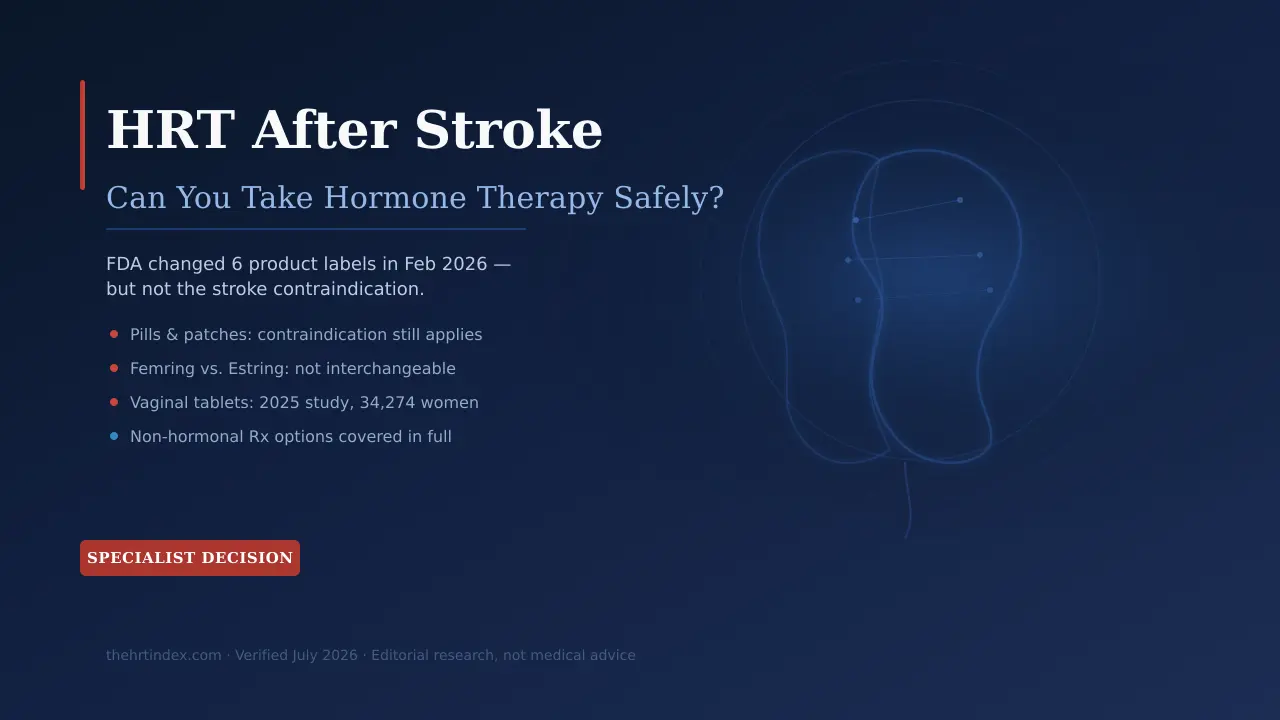
Partly — and the fine print matters more than the headline. On February 12, 2026, the FDA approved updated labels for the first six menopausal hormone therapy products, removing boxed-warning language about heart disease, breast cancer, and dementia. It was not a completed class-wide change, and it did not touch the separate Contraindications section, which still lists a history of stroke.
You've seen the headlines: "FDA removes black box warnings from menopause hormone therapy." Here is what actually happened. On November 10, 2025, the FDA asked manufacturers to remove boxed-warning statements about cardiovascular disease, breast cancer, and probable dementia. On February 12, 2026, the FDA approved the first six product labels reflecting that change. Twenty-nine manufacturers had submitted proposed updates; six were approved first. The rest are still under review. The change is ongoing, not complete.
Then there's the part almost nobody explains. A drug label has many sections. The boxed warning is the summary box at the top. Contraindications is a different section. And on the newly updated labels, that section still reads:
"Active arterial thromboembolic disease (for example, stroke and myocardial infarction), or a history of these conditions."
The box changed. The stroke contraindication didn't.
Which products actually changed, and what stayed
Checked July 2026 — reconfirm each label before relying on it.
| Product | In Feb 12, 2026 batch? | Boxed warning status | Prior-stroke contraindication still listed? |
|---|---|---|---|
| Bijuva (oral estradiol + progesterone) | Yes | CVD / breast cancer / dementia language removed | Yes |
| Divigel (estradiol gel, systemic) | Yes | Removed | Yes |
| Estring (low-dose local vaginal ring) | Yes | Removed | Yes |
| Cenestin (oral synthetic conjugated estrogens) | Yes | Removed | Verify current label |
| Enjuvia (oral synthetic conjugated estrogens) | Yes | Removed | Verify current label |
| Prometrium (progesterone alone) | Yes | Removed | Not an estrogen; no estrogen stroke contraindication |
| Estradiol transdermal patches (multiple makers) | No | Older boxed warning still on current listings | Yes |
| Yuvafem (vaginal estradiol tablet) | No | Full older boxed warning still present | Yes |
| Femring (systemic vaginal ring) | No | Older labeling | Yes |
| Premarin vaginal cream | No | Older labeling | Yes |
Sources: FDA labeling-change announcement (Feb 12, 2026); current DailyMed and Drugs@FDA prescribing information for each product.
Look at what that table shows you. Two vaginal products — Estring and Yuvafem — are in completely different places right now. Same category in casual conversation. Different labels in reality.
One more line worth knowing: hormone therapy is not approved to prevent a first or second stroke, and current prescribing information and NICE guidance both say it should not be used for cardiovascular prevention.
Why do doctors — and websites — give such different answers?
Different sources are answering different questions. One quotes risk in women who never had a stroke. One quotes a specific product's label. One discusses whether a rare individual exception is reasonable. "Lower risk in the general population" is not the same as "proven safe for a stroke survivor."
High-quality randomized evidence on restarting modern HRT after a stroke is lacking.There's no large modern trial that followed stroke survivors on today's low-dose patches and reported back. The strongest sources don't even frame the question the same way. That's frustrating, and it's real, and we won't paper over it.
But thin evidence is exactly why a confident "yes" or a lazy "no" is worth nothing to you — and why keeping four different things separate is worth a great deal:
| What the source is | Who it studied or regulates | What it can tell you | What it can't |
|---|---|---|---|
| A product's FDA label | Regulates that exact U.S. product | Whether prior stroke is a listed contraindication for that product | Whether an individual exception is ever reasonable |
| General-population risk studies (e.g. WHI, route comparisons) | Mostly women without a prior stroke | How estrogen behaves by route and dose in that population | Whether it is safe in a stroke survivor |
| WEST trial | 664 women with recent ischemic stroke or TIA | What happened with oral estradiol after stroke | Anything about modern low-dose patches or vaginal products |
| 2025 vaginal estradiol tablet study | 34,274 women with prior ischemic stroke | Whether tablets were linked to repeat ischemic stroke | Rings, creams, systemic estrogen, or hemorrhagic stroke |
| Specialist guidance (Menopause Society, NICE, BMS) | Clinicians treating individuals | How to weigh an individual case | It doesn't override a U.S. product label |
Most pages collapse those five rows into one sentence. That's how you end up with answers that contradict each other. Keep them separate, and the fog lifts.
On U.S. versus U.K. advice:British sources often sound more open to HRT after stroke, partly because their systems weigh individualised specialist decisions differently. But U.K. guidance doesn't override a U.S. product's FDA label, and a reassuring paragraph written for the U.K. isn't clearance for you. When you compare sources, check which country's label they're actually describing.
In menopause forums, women who've had a stroke or TIA describe being told they can't have any HRT at all, worrying they'll be turned down by providers, and not being able to tell where their stroke symptoms end and their menopause symptoms begin. You're not imagining the mixed messages, and you're not the only one getting them.
What did the WEST trial find about estrogen after a stroke?
The Women's Estrogen for Stroke Trial randomized 664 postmenopausal women, average age 71, who had had an ischemic stroke or TIA within the previous 90 days, to oral estradiol 1 mg daily or placebo for about 2.8 years. Estrogen did not reduce stroke or death, and the estrogen group had a borderline higher risk of fatal stroke.
Almost no page written for patients mentions this trial. It's the single most relevant randomized study to your exact question, so here it is in full.
WEST enrolled 664 postmenopausal women, average age 71, each within 90 days of an ischemic stroke or TIA. Half got oral 17β-estradiol at 1 mg a day; half got a placebo. They were followed roughly 2.8 years (Viscoli et al., New England Journal of Medicine, October 25, 2001).
The results:
- 1
No benefit. 99 strokes or deaths in the estradiol group versus 93 on placebo — no significant difference.
- !
A safety signal. Women on estradiol had a borderline higher risk of fatal stroke (P=0.05 for time to fatal stroke).
- !
Worse outcomes when strokes did happen. Nonfatal strokes in the estrogen group came with slightly worse neurologic and functional deficits.
Two honest caveats, because they cut both ways. WEST used oral estradiol — the route we now know is hardest on clotting. And it was designed to test whether estrogen could prevent another stroke, not whether it could safely treat menopause symptomsin a survivor. So it doesn't close the book on modern low-dose patches.
But it does something important: it's the reason "let's just try it and see" isn't a neutral experiment. When estrogen was actually tested in women exactly like you, it didn't help — and the fatal-stroke numbers moved the wrong way. That's not a scare tactic. That's the evidence base, and you deserve to have it rather than a vague "there just isn't much research."
Does the type and cause of your stroke change the answer?
Stroke isn't one thing. An ischemic stroke (a blockage), a hemorrhagic stroke (a bleed), a TIA, and strokes caused by atrial fibrillation, a PFO, a torn artery, or a clotting disorder all raise different questions about a second stroke. The cause doesn't create an automatic yes — it tells you which risks and which specialists matter.
This is why a one-size answer can't serve you, and why your specific story matters so much.
Ischemic stroke (a blockage)
The most common type — a clot or narrowing blocks blood flow to part of the brain. Two things matter: what caused the blockage, and what medicine you now take to prevent another. This is also the only stroke type covered by both the WEST trial and the reassuring 2025 vaginal-tablet study.
Hemorrhagic stroke (a bleed)
A very different event — a vessel bleeds instead of clogging. The research and the risk math are different, and the vaginal-tablet study does notapply. If your stroke was a bleed, don't borrow reassurance from studies about clots.
TIA (a "mini-stroke" or warning stroke)
A TIA is a temporary episode of neurologic symptoms caused by a brief interruption of blood flow to the brain, spinal cord, or retina — without permanent tissue damage on imaging. Symptoms often fade within minutes or hours. Because it "went away," some women assume it doesn't count. It counts. A TIA is a flashing sign that your risk of a future stroke is higher, and it needs urgent evaluation and the same careful review as a full stroke.
Atrial fibrillation, PFO, artery tears, and clotting disorders
If you were told your stroke had a specific cause, that tells you which door to knock on:
- Atrial fibrillation (an irregular heartbeat that can throw clots) → usually a cardiologist or stroke neurologist.
- A PFO (an opening between the heart's two upper chambers that normally closes after birth but stayed open) → usually a cardiologist.
- An artery tear (dissection) (mechanically different from clogged-artery strokes) → a stroke or vascular neurologist.
- A clotting disorder (thrombophilia) (affects blood's tendency to clot) → often a hematologist.
None of these makes estrogen "safe" on its own. They tell you who needs to be in the room.
What if nobody ever told you the cause?
Then that's your first job — before you ask any clinic about HRT. Get your hospital discharge summary, brain imaging report, neurology note, and current stroke-prevention plan. No one can sensibly weigh estrogen without knowing what kind of stroke you had and why. Gathering those papers is often the highest-value thing you can do this week.
My HRT-After-Stroke Question List
You've just read that your stroke type, its cause, and your symptoms change the entire conversation. This turns those details into a printable page you can hand to a clinician.
It asks about:
- Your stroke type and date
- What caused it, if you know
- Whether you take a blood thinner
- Whether you were on HRT when it happened
- Which symptoms are actually bothering you
- Who is currently involved in your care
It gives you back a one-page summary, a records checklist, the clinician types you likely need, and the exact product-specific questions to ask.
What it will not do:tell you that you're eligible, recommend a product or dose, calculate your stroke risk, or tell you to start or stop anything. That's not modesty — it's the honest limit of what any tool can do without your records in front of it.
→ Start my private question listNo account. No email. Your answers stay in your browser unless you choose to save or print them.
Is an estrogen patch safer than pills after a stroke?
Transdermal estrogen — patches, gels, and sprays absorbed through the skin — generally shows lower clot and stroke risk than pills, but that evidence comes from women without a prior stroke and doesn't establish safety after one. Current U.S. patch labels still list a history of stroke as a contraindication.
This is the "patches are safer" claim, and it's half true in a way that can genuinely mislead you.
Why the skin route is generally gentler:a pill is absorbed through your gut and passes through the liver before reaching the rest of your body. That first pass through the liver has a bigger effect on the proteins that control clotting. Estrogen through the skin largely skips that step. So in the general population, patches and gels tend to carry lower clot and stroke risk than pills. That's real, and it's why a clinician might prefer the skin route if systemic estrogen is ever on the table.
Here's the catch that changes everything for you. The reassuring route-comparison numbers — including the ones in NICE's guidance — are drawn from people with no personal history of stroke. You can't lift a statistic from that population and drop it onto a stroke survivor. And current U.S. patch labels still list "active arterial thromboembolic disease (for example, stroke or MI), or a history of these conditions" as a contraindication — same as the pill.
Specialist guidance holds that when systemic treatment is exceptionally considered after individualised review, the lower-risk approach is low-dose transdermal estrogen, with an appropriate progestogen if you have a uterus, at the lowest effective dose for the shortest appropriate duration — framed particularly around women under 60 and within 10 years of menopause. The U.S. label contraindication and the missing post-stroke evidence still apply. (British Menopause Society, June 2026)
Notice how many conditions are packed into that sentence: individual review, exceptional consideration, route, dose, duration, progestogen, age, timing. "Patches are safer" carries none of them.
If systemic HRT is ever discussed for you, the useful question is: "Does the plan you're proposing match the guidance you're relying on — the route, the dose, the progestogen, the duration, and the follow-up?"
Can you use vaginal estrogen after a stroke?
Vaginal estrogen should be judged by the exact product, not as one category. A large 2025 study detected no statistically significant association between vaginal estradiol tablets and repeat ischemic stroke. It was observational, tablet-specific, and limited to ischemic stroke — so it doesn't cover every ring, cream, or stroke type.
Here's where the news is genuinely more hopeful — with fine print that matters.
First, a definition. Low-dose local vaginal estrogenis a small dose placed where it's needed. It targets the "down there" symptoms of menopause — dryness, burning, pain with sex, and some urinary symptoms — a cluster doctors call genitourinary syndrome of menopause (GSM). Systemic exposure is generally much lower than with systemic HRT, though absorption is not zero and differs by product. Low-dose local products don't treat hot flashes, which are whole-body symptoms.
What the 2025 study actually found
In 2025, Danish researchers published one of the first studies looking specifically at stroke survivors using vaginal estrogen (Ghias Haddadan et al., Stroke, 2025). The honest breakdown:
- Who:
- Postmenopausal women who had already had an ischemic stroke.
- How many:
- 34,274 women, including 3,353 who had a second ischemic stroke, each matched to a similar woman who did not.
- Median age:
- 75.
- What they used:
- Vaginal estradiol tablets — not creams, not rings.
- The finding:
- No statistically significant association with repeat ischemic stroke. For current use, the adjusted hazard ratio was 0.79 (95% CI 0.52–1.20).
- What that actually means:
- The study did not detect a link. The range is compatible with lower risk and with a modestly higher rate. "No significant association found" is not the same as "proven to cause no harm" — it is the strongest reassurance available, not a guarantee.
- The limits:
- Observational, built from prescription records. Tablets only. Ischemic stroke only. It cannot tell you your personal risk.
The authors concluded that vaginal estradiol tablets are not likely to increase recurrent ischemic-stroke risk. That's meaningful, and it's the best evidence anyone has on this question. It's also narrower than the headlines suggest.
Is a vaginal estrogen ring local or systemic?
It depends entirely on which ring. Estring is a low-dose local ring for vaginal symptoms. Femring delivers systemic estradiol and is FDA-approved for hot flashes as well as vaginal atrophy. Both are rings, both go in the vagina, and they are not interchangeable after a stroke.
If you take one product fact from this page, make it this one.
Estring releases a low dose locally, for vaginal symptoms. Femring(estradiol acetate) comes in 0.05 mg/day and 0.10 mg/day and is approved for moderate-to-severe vasomotor symptoms and/or vulvar and vaginal atrophy — hot flashes included. Its own label states that although it is used only in the vagina, the risks associated with oral estrogens should be taken into account. That is a systemic estrogen that happens to be delivered vaginally.
So if you are using a ring and someone tells you "vaginal estrogen is local, you're fine" — the first question is which ring.
| Vaginal product | Local or systemic? | What the evidence or label says | What you can't conclude |
|---|---|---|---|
| Vaginal estradiol tablet (e.g. Yuvafem) | Low-dose local | 2025 study: no significant link to repeat ischemic stroke. Current Yuvafem listing still carries the full older boxed warning, lists prior stroke as a contraindication, and notes systemic absorption occurs. | That every vaginal product is equally studied, or that the label has changed. |
| Estring (estradiol vaginal ring) | Low-dose local | Boxed warning removed Feb 12, 2026; updated label still lists a stroke history as a contraindication. | That lower systemic exposure erases what is printed on the label. |
| Femring (estradiol acetate ring) | Systemic | Approved for hot flashes and vaginal atrophy; label says oral-estrogen risks should be taken into account; lists prior stroke as a contraindication. | That it is comparable to Estring, or covered by the tablet study. |
| Conjugated-estrogen cream (e.g. Premarin cream) | Low-dose local, absorption occurs | Lists a stroke history as a contraindication; notes systemic absorption. | That the tablet study transfers to a conjugated-estrogen cream. |
There's a real tension here: expert opinion and one large observational tablet study point one direction, while several product labels still carry the old contraindication language. That's not permission to pick whichever answer you prefer. It's a reason to walk in and ask about your exact product, by name.
Hot flashes and vaginal symptoms are two different conversations with two different answer sets.
Mixing them up is the most common reason these appointments go nowhere.
→ Sort my symptoms and get the right questionsShould you stop HRT right after a stroke?
If a stroke may be happening now, that is a 911 emergency and medication questions come later. If a stroke already happened and was treated, follow your care team's instructions — and don't restart, switch, or taper HRT on your own afterward based on something you read.
Three situations, three answers.
If symptoms are happening right now: stop reading and call 911. Face drooping, arm weakness, slurred speech, sudden vision loss, loss of balance, or a sudden severe headache. Minutes matter.
If your stroke was already treated: the hospital or your prescriber may have paused or stopped your HRT during the emergency. That decision was made with the information available to the acute-care team. What you can do is ask them to explain it — which is exactly what the appointment prep below is for.
If your menopause symptoms came back after you stopped: we hear you, and this is a real problem, not a small one. When hot flashes, sleepless nights, or vaginal and urinary symptoms return, they can wreck your quality of life. That's valid, and it deserves treatment. The answer isn't restarting on your own — it's bringing it to a clinician who can look at options, including the non-hormonal ones below, with your stroke in mind.
What not to do, plainly:
- ×Don't restart leftover HRT from before.
- ×Don't switch yourself from a pill to a patch thinking that makes it safe.
- ×Don't treat aspirin or a blood thinner as making HRT safe. No evidence supports using either as a workaround.
- ×Don't buy a compounded product to get around a "no."
- ×Don't wait for a routine appointment when new stroke symptoms appear — that's 911.
What non-hormonal treatments can help after a stroke?
When systemic estrogen isn't a fit, non-hormonal options can treat hot flashes, night sweats, sleep problems, and vaginal symptoms. They don't expose you to estrogen — but each has its own warnings and interactions, and some matter a great deal if you take a blood thinner.
This is often the most useful section for a stroke survivor, because it's usually the first category clinicians discuss when systemic estrogen is contraindicated. Here is the map, with the details that actually apply to you. See also the full non-hormonal options guide for provider comparisons and pricing.
| Option | FDA-approved for hot flashes? | What to know after a stroke |
|---|---|---|
| Brisdelle (paroxetine 7.5 mg) | Yes — approved 2013, the first non-hormonal approval for moderate-to-severe vasomotor symptoms | Label carries a boxed warning about suicidality, an increased bleeding risk warning, serotonin syndrome risk, and possible reduced tamoxifen effectiveness. The bleeding warning is a direct conversation to have if you take an antiplatelet or anticoagulant. |
| Veozah (fezolinetant) | Yes — approved May 2023 | Boxed warning for liver injury added December 2024. Requires liver blood tests before starting, monthly for the first 3 months, at 6 months, and at 9 months. Contraindicated in severe kidney impairment. |
| Lynkuet (elinzanetant) | Yes — approved October 24, 2025 | Newest option, so less long-term real-world data. Label includes liver-related and central-nervous-system warnings with baseline and follow-up liver testing. |
| Other SSRIs / SNRIs | No — off-label for hot flashes | Several are supported by evidence, but bleeding risk and drug interactions still need review against your stroke medicines. |
| Gabapentin | No — off-label | Sedation and fall risk are worth discussing, especially during stroke recovery. |
| Oxybutynin | No — off-label | Anticholinergic effects; discuss with your prescriber given other medicines. |
| CBT and clinical hypnosis | Not a drug | Supported by menopause guidance, and they create no drug-drug interactions. |
Sources: current FDA prescribing information for each product; The Menopause Society 2023 Nonhormone Therapy Position Statement.
For vaginal and urinary symptoms
- Vaginal moisturisers (used regularly) and lubricants (used for sex) — non-hormonal, over the counter, genuinely helpful for many women.
- A check for other causes — infection, skin conditions, or pelvic-floor issues — when symptoms don't fit the usual pattern.
The one thing to bring: your full medicine list
Here is where your situation is truly different from the average menopause patient. Look back at that table — bleeding risk, liver testing, sedation — and now consider that you are likely on medicine to prevent another stroke. Rather than guessing at interactions, bring the list:
- Blood thinners (anticoagulants)
- Antiplatelet medicines (e.g. aspirin or clopidogrel)
- Blood-pressure medicines
- Anti-seizure medicines
- Antidepressants
- Anything that affects the liver
- Sleep aids
- Vitamins and supplements
Which doctor should help decide whether HRT is right after a stroke?
A prior stroke usually calls for a menopause-experienced clinician working with your stroke doctor or neurologist. Depending on the cause, a cardiologist, vascular neurologist, or hematologist may be involved. A routine telehealth intake should not be your only risk assessment.
You may need a small team. That's not a hassle — it's the safety net.
Your menopause clinician works out which symptoms need treating, separates systemic from local options, factors in your age, whether you have a uterus, and your past HRT, and names the exact product and label under discussion.
Your stroke doctor or neurologist confirms what type of stroke you had and why, explains your plan to prevent another, and flags anything unresolved.
A cardiologist may join for atrial fibrillation or a PFO. A vascular or stroke neurologist for an arterial dissection. A hematologist for a suspected clotting disorder.
When online care is not your starting point:
A prior stroke or TIA should trigger a coordinated review — not an instant "match me with a provider." Online care may support your follow-up later. It should not replace a look at your stroke records and a conversation with the clinician managing your stroke risk. If a service is willing to prescribe estrogen after a stroke without any of that, treat it as a red flag, not convenience. That single sentence may be the most useful thing on this page.
Not sure where to start after a stroke?
Answer a few questions and our matcher will tell you where to begin — and it will tell you honestly when online care is not the right first move for someone with your history.
→ Find my starting pathWhat to gather before you talk about HRT after a stroke
The useful question isn't "can I take estrogen?" It's: what caused my stroke, what's my risk of another, which symptoms need treating, which exact product and route are we discussing, and what alternatives fit my current medicines. Walk in with those facts and you skip a wasted visit.
About your stroke
- Date of your stroke or TIA
- Type: ischemic, hemorrhagic, or unsure
- Suspected or confirmed cause
- Hospital discharge summary
- Brain imaging report
- Neurology follow-up note
- Current prevention plan
- Blood-pressure status
- Migraines with aura (visual warning signs)
- Past clotting problems
- Blood thinner or antiplatelet medicine
About your menopause
- Your age and menopause status
- Early or surgical menopause
- Whether you still have a uterus
- Symptoms ranked by severity
- HRT products used before
- Why you stopped
- Non-hormonal treatments tried
- Breast, uterine, liver, or clotting history
About any product discussed
- Exact generic and brand name
- Route: pill, patch, gel, spray, vaginal tablet, ring, or cream
- The dose
- FDA-approved or compounded
What should you ask at your appointment?
A good appointment ends with a plan you understand: which symptom you are treating, whether it is systemic or local therapy, which exact product label applies, who owns the stroke-risk call, and what alternatives exist. These eight questions get you there.
- 1
What type of stroke or TIA did I have, and what likely caused it?
- 2
Does my stroke-prevention plan change how you think about treating my menopause symptoms?
- 3
Which exact, current product label are we discussing — and does it list my stroke history as a contraindication?
- 4
Does the "patches are safer than pills" evidence you're using include women who already had a stroke?
- 5
Are my main symptoms systemic (hot flashes) or local (vaginal and urinary) — or both?
- 6
If we're discussing a vaginal product, is it a low-dose local one or a systemic one like Femring?
- 7
Which non-hormonal options fit my current medicines — especially my blood thinner?
- 8
Who will monitor the plan, and what symptoms mean I should call right away?
When the answer is simply "no," a useful follow-up:
"Can you help me understand whether that 'no' comes from my type of stroke, this product's label, another condition, or the lack of research in stroke survivors — and what you'd recommend for my symptoms instead?"
When someone says "patches are safer," a useful follow-up:
"Does that evidence include women who already had a stroke, and how do you read the label for the exact patch we're discussing?"
You've got the questions. Now get them on one page.
With your stroke details and medicines, ready to hand across the desk. Printable. Private. Takes a couple of minutes and makes the next twenty count.
→ Generate my appointment briefWhat does each product's current label and evidence actually say?
Route, what it treats, current U.S. label status, the stroke-specific evidence, and the practical bottom line — assembled in one place.
The HRT-After-Stroke Evidence & Label Reconciliation Matrix — checked July 2026. Product examples are not a complete list. Labels change; confirm any specific product with your clinician or on DailyMed.
| Route / example | What it treats | Current U.S. label (July 2026) | Stroke-specific evidence | Bottom line after a stroke |
|---|---|---|---|---|
| Oral systemic estrogen + progesterone (e.g. Bijuva) | Hot flashes, night sweats | Boxed warning changed Feb 12, 2026; Contraindications still list prior stroke / arterial clot event | WEST: oral estradiol in 664 stroke/TIA survivors — no benefit, borderline higher fatal-stroke risk | Not a routine or self-serve option. Any rare exception is a specialist-plus-stroke-team decision. |
| Estradiol patch / gel / spray (e.g. estradiol patch, Divigel) | Hot flashes, night sweats | Same prior-stroke contraindication. Most patches were not in the Feb 2026 batch and still carry the older boxed warning | Skin route shows lower clot/stroke risk in women without prior stroke; no post-stroke trial data | Don't read "patch = safe after stroke." Lower-risk route only if a specialist exceptionally considers systemic estrogen. |
| Vaginal estradiol tablet (e.g. Yuvafem) | Local: dryness, painful sex, some urinary symptoms | Current Yuvafem listing still carries the full older boxed warning, lists prior stroke as a contraindication, notes systemic absorption | 2025 Danish study, 34,274 women: no significant association with repeat ischemic stroke (current use HR 0.79, CI 0.52-1.20) | The most reassuring evidence available — but observational, tablet-specific, ischemic-only. Ask about your exact brand. Not for hot flashes. |
| Estring (low-dose local vaginal ring) | Local: GSM symptoms | In the Feb 12, 2026 batch — boxed warning removed; updated label still lists prior stroke as a contraindication | Lower systemic exposure; tablet study does not directly cover rings | Ask about this exact product. Lower exposure is real; the label contraindication is also real. |
| Femring (estradiol acetate ring) | Systemic: hot flashes and vaginal atrophy | Lists prior stroke as a contraindication; label says oral-estrogen risks should be taken into account | None specific to stroke survivors; tablet study does not apply | Treat as systemic HRT, not a local product. Being a ring does not make it local. |
| Conjugated-estrogen vaginal cream (e.g. Premarin cream) | Local: GSM symptoms | Lists prior stroke as a contraindication; notes systemic absorption | Tablet study can't be extended to a conjugated-estrogen cream | Separate question from the tablet. Don't assume they're the same. |
| Non-hormonal Rx (Brisdelle; Veozah; Lynkuet; off-label SSRIs/SNRIs, gabapentin, oxybutynin) | Systemic hot flashes | No estrogen contraindication; each has its own warnings. Brisdelle: bleeding risk. Veozah: boxed liver warning + testing at baseline, months 1-3, 6, and 9. Lynkuet: liver and CNS warnings | Doesn't expose you to estrogen | Usually the first category to discuss — with a prescriber who knows every medicine you take. |
| Compounded 'bioidentical' hormones | Varies | Not FDA-approved. No FDA evaluation of safety, effectiveness, or quality before marketing; no evidence they're safer | None establishing safety after stroke | Never a workaround for a stroke history, a contraindication, or specialist review. |
What we actually verified for this page
We reconciled current U.S. product labels, the FDA's 2025–2026 labeling changes, U.S. and U.K. specialist guidance, and stroke-specific research — and we are equally clear about what we could not verify. No fabricated scores, reviewers, or testimonials appear on this page.
What we checked directly (July 2026):
- ✓The FDA's November 10, 2025 request and its February 12, 2026 approval of the first six updated labels — confirmed it was not a completed class-wide change and did not remove the stroke contraindication.
- ✓Current Contraindications language on systemic estrogen labels: "active arterial thromboembolic disease (for example, stroke and myocardial infarction), or a history of these conditions."
- ✓That Bijuva, Divigel, and Estring were in the first batch and retain the prior-stroke contraindication.
- ✓Femring's indication for vasomotor symptoms, its systemic classification, and its stroke contraindication.
- ✓The WEST trial (Viscoli et al., NEJM 2001): 664 women, average age 71, oral estradiol 1 mg vs. placebo, ~2.8 years, no benefit, borderline higher fatal-stroke risk.
- ✓The 2025 Stroke study on vaginal estradiol tablets: 34,274 women, 3,353 recurrent strokes, median age 75, current-use adjusted HR 0.79 (95% CI 0.52–1.20).
- ✓Non-hormonal FDA status and monitoring: Brisdelle (2013; bleeding-risk warning), Veozah (May 2023; liver boxed warning December 2024; testing at baseline, months 1–3, 6, 9), Lynkuet (October 24, 2025).
- ✓FDA's position that compounded bioidentical hormones are not FDA-approved and not shown to be safer.
What we could not verify, and won't pretend to:
- —There is no proven, universal "wait this long, then restart" rule after a stroke.
- —No evidence shows a patch is safe for every stroke survivor.
- —The vaginal-tablet study does not establish safety for every ring, cream, dose, or for hemorrhagic stroke.
- —We did not confirm the current contraindication section of every product named here — including Cenestin and Enjuvia.
- —This page cannot calculate your personal risk of another stroke.
- —This page is editorial research. It was not reviewed by a clinician, and it is not medical advice.
Frequently asked questions about HRT after stroke
- Is a previous stroke an absolute reason not to take HRT?
- For current U.S. systemic-estrogen products, a history of stroke is listed as a contraindication on the label. Specialist guidance allows rare, individually reviewed exceptions — but that is not routine approval, and it is not something to settle online.
- Didn't the FDA remove the hormone therapy warnings in 2026?
- It removed boxed-warning language about heart disease, breast cancer, and dementia from the first six products on February 12, 2026. Other products still carry the older boxed warning. And the separate Contraindications section still lists a history of stroke.
- Does a TIA count as a stroke history for this?
- A TIA is serious cerebrovascular history and should trigger the same specialist-first review. A product label may say 'stroke' or 'arterial thromboembolic disease' rather than naming TIA specifically, so ask how it applies to your exact product.
- How long after a stroke can you restart HRT?
- There is no proven universal waiting period. It depends on your stroke type, its cause, your recovery, your risk of another stroke, your symptoms, the exact product, and your clinicians' judgment.
- Is a low-dose estrogen patch safe after a stroke?
- A patch may carry lower stroke risk than pills, but that evidence comes from women without a prior stroke. Current U.S. patch labels still list a stroke history as a contraindication.
- Is vaginal estrogen safe after a stroke?
- It is product-specific. A 2025 study found no significant link between vaginal estradiol tablets and repeat ischemic stroke. That does not cover every ring, cream, dose, or a hemorrhagic stroke.
- Is Femring the same as Estring after a stroke?
- No. Estring is a low-dose local ring for vaginal symptoms. Femring delivers systemic estradiol and is also approved for hot flashes; its label says oral-estrogen risks should be taken into account. Their dosing, exposure, and post-stroke implications are not interchangeable.
- What did the WEST trial find?
- WEST randomized 664 postmenopausal women who had a recent ischemic stroke or TIA to oral estradiol 1 mg daily or placebo. Estrogen did not reduce stroke or death, and the estrogen group had a borderline higher risk of fatal stroke.
- Can HRT cause another stroke?
- Systemic hormone therapy can affect stroke risk, which is why labeling stays cautious. Evidence on recurrence risk with modern low-dose patches in stroke survivors is limited.
- Can HRT prevent another stroke?
- No. Hormone therapy is not approved for stroke prevention, and current labeling and NICE guidance say it should not be used for cardiovascular prevention.
- I was already on HRT when my stroke happened — what now?
- Follow your care team's instructions, and do not restart or switch products later on your own. Ask which part of the decision relates to the stroke itself, to the product's label, and to your ongoing prevention plan.
- Does taking aspirin or a blood thinner make HRT safe?
- No. No medicine should be treated as offsetting estrogen's vascular risk, and blood thinners carry their own considerations, including interactions with some non-hormonal hot-flash treatments.
- Does a hysterectomy change the answer?
- It can change whether you need a progestogen alongside estrogen, but it does not erase the significance of a previous stroke.
- Can an online HRT provider prescribe after a stroke?
- A service might collect history or help with follow-up, but a prior stroke should trigger records review and coordination with your stroke clinician. Be wary of any provider willing to prescribe estrogen after a stroke without that review.
- What can I take for hot flashes after a stroke?
- Options include Brisdelle, Veozah, and Lynkuet — all FDA-approved and non-hormonal — plus off-label choices like certain SSRIs and SNRIs, gabapentin, and oxybutynin, and behavioral approaches like CBT. The right one depends on your other medicines, so bring your full list.
- Are compounded or 'bioidentical' hormones safer after a stroke?
- No. There is no FDA evidence they are safer or more effective than approved therapy, and they should never be used to get around a contraindication or skip specialist review.
- What if I had early or surgical menopause?
- Replacing hormones at a younger age changes the risk-benefit picture, but a previous stroke remains a major factor. This is a case for coordinated specialist review, not a general online answer.
Where this leaves you
HRT after a stroke is rarely a clean yes, almost never a do-it-yourself decision, and much less hopeless than a flat "never." The answer lives in your details — your stroke type, its cause, your symptoms, and the exact product — and in a conversation with someone who can see all of it.
What you should not do is accept a one-word answer from anyone who hasn't asked you those questions. Not "never." Not "it's fine now, the FDA changed the warnings." You have better questions than that, and you deserve better answers.
Find My HRT Path →Answer a few questions and it will point you to the right starting path — and tell you honestly when online care is not the right first move.
Sources
- U.S. Food and Drug Administration. FDA Approves Labeling Changes to Menopausal Hormone Therapy Products. February 12, 2026. https://www.fda.gov/news-events/press-announcements/fda-approves-labeling-changes-menopausal-hormone-therapy-products
- U.S. Food and Drug Administration. FDA Requests Labeling Changes Related to Safety Information. November 10, 2025. https://www.fda.gov/drugs/drug-alerts-and-statements/fda-requests-labeling-changes-related-safety-information-clarify-benefitrisk-considerations
- U.S. Food and Drug Administration. Menopausal Hormone Therapies with Updated Prescribing Information. https://www.fda.gov/drugs/drug-safety-and-availability/menopausal-hormone-therapies-updated-prescribing-information
- Current U.S. prescribing information (Contraindications) via DailyMed and Drugs@FDA: Bijuva; Divigel; Estring; Femring; Yuvafem; Premarin vaginal cream; estradiol transdermal systems. https://dailymed.nlm.nih.gov
- Viscoli CM, Brass LM, Kernan WN, Sarrel PM, Suissa S, Horwitz RI. A clinical trial of estrogen-replacement therapy after ischemic stroke. N Engl J Med. 2001;345(17):1243-1249. doi:10.1056/NEJMoa010534
- Ghias Haddadan K, Eckert-Lind C, Meaidi A, et al. Recurrent ischemic stroke and vaginal estradiol in women with prior ischemic stroke: a nationwide nested case-control study. Stroke. 2025;56(10):2888-2894. doi:10.1161/STROKEAHA.125.050986
- American Heart Association / American Stroke Association. Vaginal estrogen tablets may be safe for postmenopausal women who have had a stroke. August 21, 2025.
- U.S. Food and Drug Administration. FDA adds warning about rare occurrence of serious liver injury with use of Veozah (fezolinetant). December 2024.
- Lynkuet (elinzanetant) prescribing information; FDA approval October 24, 2025.
- Brisdelle (paroxetine 7.5 mg) prescribing information; FDA approval 2013.
- The Menopause Society. 2023 Nonhormone Therapy Position Statement. https://menopause.org
- National Institute for Health and Care Excellence. Menopause: identification and management (NG23). https://www.nice.org.uk/guidance/ng23
- British Menopause Society. Management of menopause for women with cardiovascular disease (Tool for Clinicians), June 2026.
- U.S. Food and Drug Administration. Menopause (consumer page; compounded 'bioidentical' hormones). https://www.fda.gov/consumers/womens-health-topics/menopause
- American Stroke Association. TIA (Transient Ischemic Attack). https://www.stroke.org
- American Heart Association. Patent Foramen Ovale (PFO). https://www.heart.org
- Centers for Disease Control and Prevention. Stroke Signs and Symptoms. https://www.cdc.gov/stroke
Related resources on The HRT Index