Perimenopause heavy bleeding treatment online can start today. A virtual clinician can assess your bleeding, order a blood count and local imaging when it's appropriate, and prescribe treatment while the workup runs alongside it. What no online service can do is examine you, take a tissue sample, or place an IUD. And if you're older than 45, ACOG recommends tissue sampling as a first-line test.
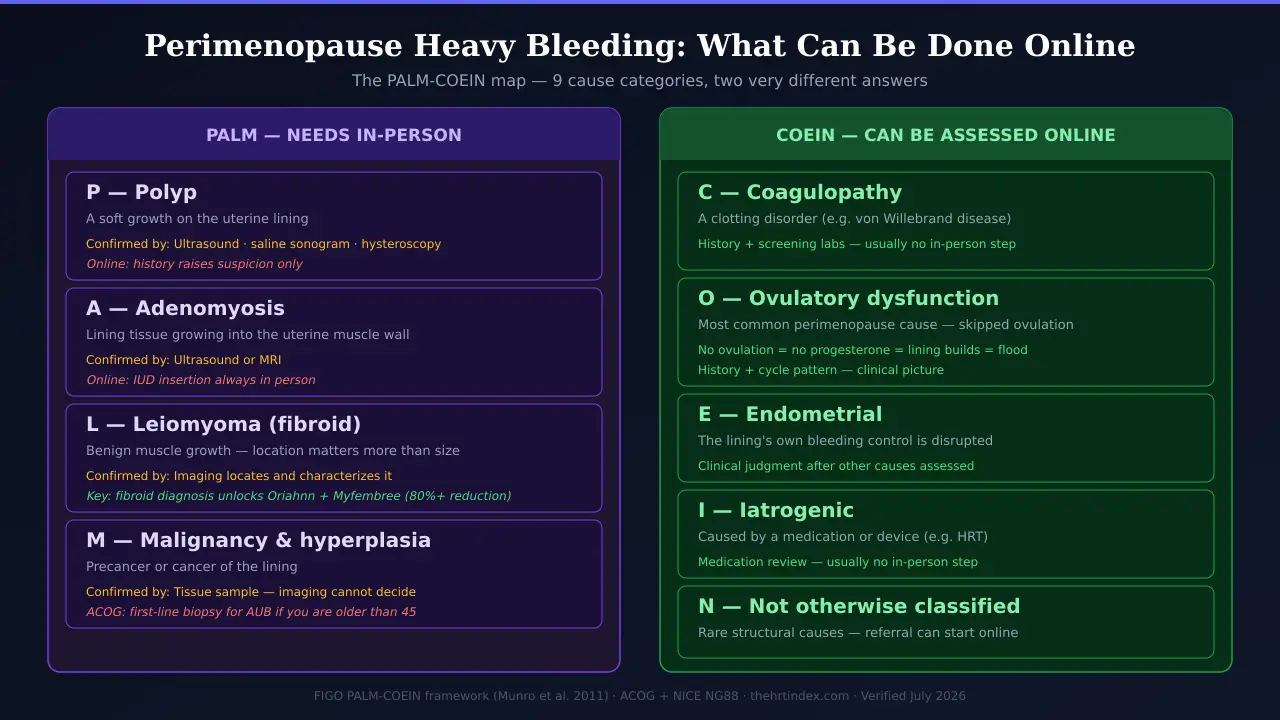
The PALM-COEIN framework (FIGO, Munro et al. 2011). Five of nine cause categories can be largely assessed online. Four cannot be settled without a machine or a microscope. Verified July 2026.
Not all heavy bleeding is the same emergency. Find your line.
Call 911 or go to the ED now if you are:
Get same-day care today if you have:
Book a prompt in-person visit — not online — if:
Red-flag thresholds per ACOG guidance on acute abnormal uterine bleeding and Midi Health clinical content (medically reviewed by Stephanie Osiecki, MD).
There are at least six FDA-approved medications for heavy menstrual bleeding in the US. We read every one of their labels.
Two of them require that you have no fibroids. Two of them require that you do.
Same symptom. Same woman. Opposite requirements. Which means the medication you're eligible for isn't decided by how heavy your bleeding is — it's decided by what's inside your uterus. And you can't know that from a questionnaire.
We'll show you all six labels below. You can check them yourself in about a minute, and we'd rather you trusted the FDA than trusted us.
| Yes, if… | No — go here instead |
|---|---|
| You're 40–55 and your periods got heavy, long, or unpredictable | You've gone 12+ months without a period and you're bleeding → postmenopausal bleeding (evaluated more urgently) |
| You're bleeding through pads and you want it to stop | You're already on HRT and bleeding → Bleeding after starting HRT |
| Your gynecologist's next opening is months away | You're in the 911 or same-day group above → go, now |
| You want to know what can actually be handled online | You might be pregnant → get seen in person, not on video |
| You're wiped out and nobody's checked your iron | Your cycles are fine and you want hot flash relief → Best online HRT providers |
| You're on Medicaid or Medi-Cal | Read on — but skip our Midi section. They can't treat you. We'll explain. |
The right online provider isn't the same for every woman — it depends on your symptoms, what you have tried so far, your age, your state and your health history.
Because a general answer can't resolve those for you, use The HRT Index's Find My HRT Path tool to match your situation to the right provider — and to flag when online care isn't the right starting point — before your first consult.
Find My HRT Path →That “flag when online care isn't the right starting point” line isn't decoration. This page is what it looks like when we mean it.
Answer capsule:A common cause is anovulatory cycles — months where the ovary doesn't release an egg. Without ovulation there's no progesterone, so estrogen goes unopposed and the uterine lining builds up thicker than usual before it sheds. Other causes, including fibroids, polyps, adenomyosis, and less commonly precancerous changes, can produce the same pattern, and more than one can be present at the same time.
In a normal cycle, you ovulate. Ovulation makes progesterone. Progesterone tells your uterine lining: okay, stop building. Then it drops, and you get a period.
In perimenopause, ovulation gets flaky. Some months it happens. Some months it doesn't.
No ovulation → no progesterone → nothing tells the lining to stop → it keeps building → and then it all leaves at once.
Your lining had two months to build and eleven seconds to leave.
You are not unusual and you are not overreacting. The Study of Women's Health Across the Nation (SWAN) found one in three women had episodes of abnormal uterine bleeding during the menopause transition. ACOG reports abnormal bleeding accounts for more than 70% of all gynecologic consults in the perimenopausal and postmenopausal years.
The hard part — and it's why we won't spend two thousand words listing causes at you:
You cannot tell which cause you have by reading about them. A fibroid and an anovulatory cycle produce the same flood. A polyp and a hormone dip produce the same clots. So let's skip to what actually helps.
Answer capsule:No single hormone test identifies the cause. FSH and estradiol fluctuate widely during perimenopause, so a one-day reading reflects that day rather than a stable pattern. No blood test can visualize a structural cause such as a polyp, fibroid, or adenomyosis — those require imaging or tissue.
You're bleeding. Your hormones are obviously involved. So the logical move is: test the hormones, find the problem, fix it.
Except perimenopause hormones don't hold still. FSH and estradiol swing around unpredictably for years. A single reading tells you what was in your bloodstream that morning. Not what's happening in your uterus.
No blood test in existence can see a polyp.
Not FSH. Not estradiol. Not progesterone. Not an expensive at-home panel. Polyps, fibroids, and adenomyosis are physical things inside your uterus. You find physical things by looking at them or by sampling them.
To be precise:blood tests do plenty of useful work. They can find pregnancy, anemia, low iron, thyroid disease, and signs pointing toward a bleeding disorder. Every one of those changes your plan. What they cannot do is show a structural cause. So if you're about to buy a hormone panel hoping it will explain the bleeding — don't.
Answer capsule: Yes, for many women. A virtual clinician can take a history, order a pregnancy test, blood count, and local imaging when appropriate, prescribe treatment, and refer locally. A virtual clinician cannot perform a pelvic exam, take an endometrial sample, insert an IUD, or manage an emergency.
Doctors worldwide sort abnormal uterine bleeding using a framework called PALM-COEIN, published by FIGO (the International Federation of Gynecology and Obstetrics). Nine cause categories. Two groups. More than one can apply to you at once.
Here's what almost nobody points out: FIGO defines the PALM group as the structural categories you evaluate with imaging and tissue. That's not our opinion about telehealth. That's how the categories were built. Four categories cannot be confirmed from an intake form.
| Category | What it is | Can a virtual visit assess it? | What confirms it | What stays in person |
|---|---|---|---|---|
| P— Polyp | A soft growth in the lining | History can raise suspicion | Imaging— ultrasound, saline sonogram, or hysteroscopy | Imaging and any removal |
| A— Adenomyosis | Lining tissue growing into the muscle wall | History and exam can raise suspicion | Imaging— ultrasound or MRI | Imaging; IUD placement if that's the plan |
| L— Leiomyoma (fibroid) | Benign muscle growth. Where it sits matters more than its size | History can suggest a structural cause | Imaging locates and characterizes it | Imaging; procedures if needed |
| M— Malignancy & hyperplasia | Precancer or cancer of the lining | Risk assessment only | Tissue. Imaging can raise suspicion; histology decides | Sampling and treatment |
| C— Coagulopathy | A clotting disorder, like von Willebrand disease | ✓ Yes— history and screening labs | Blood testing; specialist input depends on findings | Usually nothing |
| O— Ovulatory dysfunction | A common cause in perimenopause.Skipped ovulation → unopposed estrogen → thick lining | ✓ Yes— history and pattern | Clinical picture, once other causes are assessed | Usually nothing |
| E— Endometrial | The lining's own bleeding control is off | Considered after other causes are assessed | Clinical judgment | Usually nothing |
| I— Iatrogenic | Caused by a medication or device | ✓ Yes— medication review | Medication history | Usually nothing → Bleeding after starting HRT |
| N— Not otherwise classified | Rare things, like a vascular malformation | Referral can start online | Specialist imaging | Testing and treatment |
Look at the pattern. Five of the nine categories can be worked up largely online. Four of them can't be settled anywhere but in a room with a machine or a microscope. Not “telehealth is useless.” Not “telehealth can do it all.” Five and four.
We pulled the current FDA prescribing information for every medication labeled for heavy menstrual bleeding in the US. Not summaries. The labels. They don't agree with each other. And the way they disagree is the most useful fact on this page.
| Medication | What the label actually says | The condition attached |
|---|---|---|
| Tranexamic acid (generic Lysteda) | Cyclic heavy menstrual bleeding in females of reproductive potential | Section 2.1 is titled “Recommended Testing Prior to LYSTEDA Administration.” It says to exclude endometrial pathology first. Contraindicated with combined hormonal birth control. |
| Natazia (estradiol valerate/dienogest) | Heavy menstrual bleeding in women without organic pathology who choose an oral contraceptive | Requires that no identified organic cause is driving the bleeding. Boxed Warning. |
| Mirena (levonorgestrel IUS 52 mg) | Heavy menstrual bleeding for up to 5 years in women who choose intrauterine contraception | Tied to wanting an IUD. Requires a trained clinician to insert it. |
| Liletta (levonorgestrel IUS 52 mg) | Heavy menstrual bleeding in women who choose intrauterine contraception | Same structure as Mirena. In-person insertion. |
| Oriahnn (elagolix/estradiol/norethindrone) | Heavy menstrual bleeding associated with uterine fibroids in premenopausal women | Requires a diagnosed fibroid. Limited to 24 months because bone loss may continue and may not reverse. Boxed Warning. |
| Myfembree (relugolix/estradiol/norethindrone) | Heavy menstrual bleeding associated with uterine fibroids in premenopausal women | Requires a diagnosed fibroid. Limited to 24 months for the same reason. Boxed Warning. |
Natazia requires that you don't have fibroids. Oriahnn and Myfembree require that you do.
Tranexamic acid wants pathology excluded first. Mirena and Liletta want you to want an IUD.
Six labels. Six different conditions. Not one of them says “heavy bleeding, here's your pill.” And every single condition is something you cannot know from a questionnaire.
Go look for yourself: accessdata.fda.gov, search the drug name, read Section 1. It takes a minute.
If your bleeding turns out to be caused by fibroids, you're not in worse shape. You're in better shape.
Oriahnn's manufacturer reports over 50% average bleeding reduction at month 12. Myfembree's phase 3 LIBERTY trials reported menstrual blood loss reductions of 82.0% and 84.3% from baseline at week 24. Those are big numbers. Bigger than anything else on this page.
And you cannot have either drug until somebody finds the fibroid. So the ultrasound isn't a hoop. For some women it's the key to the most effective medication available. It doesn't just rule things out. It can rule things in— and open a door that stays locked otherwise.
If you came here hoping to buy an online hormone prescription tonight and be done, we think that's the wrong purchase. That's an awkward thing for a site that earns money when you book with hormone providers to say out loud. We're saying it because it's true and you'd find out the hard way.
Online menopause care does NOT include a pelvic exam, an ultrasound, a biopsy, or an IUD insertion. If what you need is a structural diagnosis, a virtual clinic can't finish that job.
But because a virtual visit doesn't require you to wait for a specialist's calendar, it's often the fastest way to get the workup moving. The clinician can assess the bleeding, start treatment if it's appropriate, and order the testing that fits your situation — so that by the time you see someone in person, you're walking in with results instead of starting from zero. That's not second best. That's a head start.
You need a clinician who can assess the bleeding and, when it's appropriate, order local imaging or route you to sampling. Sesame Careis a marketplace where you book directly with licensed clinicians — video orin person — at a cash price you see before you pay. It has an OB/GYN category, and clinicians there can order labs and imaging when clinically appropriate. BBB-accredited and LegitScript-certified.
Check for a Sesame clinician who evaluates abnormal uterine bleeding →Prices show before you book. Confirm the clinician you pick evaluates abnormal bleeding and coordinates local imaging. Sesame advertises general telehealth from around $34 — that's the all-specialty marketplace floor, not a gynecology price.
Answer capsule: Not necessarily. NICE guideline NG88 recommends a full blood count for every woman with heavy menstrual bleeding and states this should be done in parallel with treatment rather than before it. NICE also allows medication to be considered without prior investigation when the history suggests low risk of fibroids, cavity abnormality, adenomyosis, or endometrial pathology.
You have been told, in one way or another, that you need to be patient. Wait for the appointment. Wait for the scan. Wait for the results. Then maybe someone will help you.
That is not what the guidelines say.
NICE says it in plain language: run the blood count alongside treatment. Not before it. Not instead of it. At the same time. And when the history points to low risk, NICE explicitly allows starting medication before investigating at all.
The honest US caveat:ACOG's first-line recommendation for abnormal bleeding in women older than 45 is endometrial sampling. But “sampling is first-line” is not the same sentence as “you must suffer until the pathology comes back.” A clinician can treat symptoms while the evaluation runs.
“What can we start today while the workup is happening?”That sentence is free and it changes a lot of appointments.
→ Find a clinician who can start treatment and order the workup in the same visit.
Check current clinician availability →One appointment can cover both. Ask the clinician to confirm they can do both before you book.
Answer capsule: ACOG recommends endometrial tissue sampling as a first-line test for patients with abnormal uterine bleeding who are older than 45. It is also recommended for younger patients with unopposed estrogen exposure, failed medical management, or persistent bleeding. The sampling itself is an in-office procedure and cannot be performed by any online service, although a virtual clinician can begin the evaluation and arrange local testing.
Age 45 is the hinge in American care. Your answer turns on which side of it you're on.
| ACOG (United States) | NICE NG88 (United Kingdom) | |
|---|---|---|
| What triggers a lining biopsy | Age.First-line for abnormal bleeding when you're older than 45. Also younger with unopposed estrogen exposure, failed treatment, or persistent bleeding | Symptoms and risk— not an age threshold |
| Treating before investigating | Sampling is first-line over 45. The guidance does not say every form of symptom treatment must wait for the workup to finish | Allowed when history suggests low risk of fibroids, cavity abnormality, adenomyosis, or endometrial pathology |
| How the biopsy is taken | In-office sampling | When a biopsy is indicated, take it during diagnostic hysteroscopy. Do not offer a blind biopsy for heavy bleeding |
| Blood count | Part of initial evaluation | Every woman with heavy bleeding — alongside treatment, not before it |
| Thyroid test | Based on the clinical picture | Don't test unless there are thyroid signs or symptoms |
Two national bodies. Two defaults. Not one seamless rule. You're in America, so you're going to meet the ACOG default. If you're older than 45 with abnormal bleeding, a US clinician is likely to recommend sampling early — and that recommendation is standard care, not a sign anyone thinks something is wrong with you.
Answer capsule: In a systematic review of 65 studies of premenopausal women with abnormal uterine bleeding, the endometrial cancer risk was 0.33% overall. But in the subgroup with heavy menstrual bleeding specifically, the risk was 0.11%— roughly 1 in 900. The subgroup with bleeding between periods had a higher risk at 0.52%. These are population averages from published research, not an individual risk score.
Most pages quote 0.33%. That's the figure for all abnormal bleeding lumped together. Split it apart and it looks very different.
0.11%
Endometrial cancer risk in premenopausal women with heavy menstrual bleeding specifically
9 cases in 8,352 women — roughly 1 in 900. Pennant et al., BJOG 2017.
0.52%
Risk in the bleeding-between-periods subgroup— nearly five times higher
Why the evaluation still matters, even when the most likely answer is benign.
Of the five studies in that review that reported atypical hyperplasia in women with heavy menstrual bleeding, not one identified a single case.
The authors' own conclusion was that the risk in premenopausal women with abnormal bleeding is low, and that these women should first undergo conventional medical management.
So why does anyone biopsy at all? Because the risk isn't zero, it climbs with age, and endometrial precancer is treatable when it's found. And because — look back at the FDA Label Map — a woman with fibroids and a woman without fibroids qualify for different medications.Treating blind isn't caution. It's guessing with your body.
One practical note on the procedure: Pain during an endometrial biopsy varies a lot between women. ACOG published clinical guidance in 2025 emphasizing that patients should be counseled about pain and offered pain-management options for in-office uterine and cervical procedures. That's your permission slip to ask. Before you book: who's performing it, what pain control is available, what happens if the sample isn't adequate, and can you bring someone.
This is about postmenopausal bleeding, not perimenopausal. It doesn't change your recommendation. We're including it because if you're in that group, it's the most important paragraph on this page.
On April 16, 2026, ACOG published a Clinical Practice Update in Obstetrics & Gynecology recommending that most patients with postmenopausal bleeding receive both a transvaginal ultrasound and an endometrial tissue sample at the initial evaluation. That's stronger than the previous approach, which allowed skipping the biopsy when the lining measured 4 mm or less on ultrasound.
If you've gone 12 months without a period and you're bleeding now: arrange prompt in-person evaluation. That guidance is about you.
Answer capsule: Common initial evaluation includes a pregnancy test and a complete blood count. Imaging, iron studies, thyroid or coagulation testing, and endometrial sampling depend on age, symptoms, persistence, risk factors, and the suspected cause. A virtual clinician can order laboratory tests and imaging when clinically appropriate.
Most pages that rank for this search don't give you a dollar figure. We're going to give you the billing codes instead, because codes are what get you a real number. Call an imaging center and ask “how much is an ultrasound,” and you'll get “depends on your insurance.” Ask “what's your cash rate on CPT 76856 and 76830?” and you'll get a number.
| Test | CPT code | What it's for | Published cash examples | Orderable virtually? |
|---|---|---|---|---|
| Transvaginal ultrasound | 76830 | First-line imaging. Fibroids, polyps, lining thickness | ~$199 at one published prompt-pay schedule; $225–$1,302 across published hospital files | ✓ Often |
| Complete pelvic ultrasound | 76856 | The through-the-abdomen companion view | ~$233 at the same published schedule | ✓ Often |
| Complete blood count | 85025 | Anemia. NICE recommends this for every woman with heavy bleeding | ~$10–$40 self-pay | ✓ Often |
| Ferritin | 82728 | Iron stores — see the iron section below, this one has a twist | ~$15–$50 self-pay | ✓ Often |
| Pregnancy test | 81025 | You can still ovulate in perimenopause. Ruled out first | ~$10 | ✓ Often |
| Thyroid (TSH) | 84443 | Only if there are thyroid signs. NICE says don't reflex-order it | ~$25–$50 | ✓ Often |
| Saline sonogram | 76831 | A closer look inside the cavity if the ultrasound is unclear | Varies | Usually a gyn |
| Endometrial biopsy | 58100 | ACOG first-line if you're older than 45. Tissue | Varies widely — get the cash rate in writing | ✗ In person only |
Ask the clinician who ordered it: “Which study did you order — 76856, 76830, or both?”
Then call the imaging facility and ask exactly this:
“Does my order include 76856, 76830, or both? Does your written quote include the facility charge and the radiologist's reading fee?”
The published spread on the same transvaginal ultrasound runs from about $225 to over $1,300. Same code. Same machine. Get it in writing before you book.
Answer capsule:Yes. Iron deficiency can develop before hemoglobin falls, so a normal complete blood count does not rule it out. Iron deficiency and menopausal symptoms overlap heavily — both can cause fatigue, brain fog, and breathlessness — and hormone therapy does not treat iron deficiency.
This is the section we most want you to remember.
You're tired. Not regular tired — bonetired. Foggy. Can't find words. Winded on stairs you've climbed for nine years.
You filed all of it under “perimenopause,” because everything online says perimenopause causes fatigue and brain fog. So you go get hormone therapy for fatigue and brain fog, and you wait to feel better.
And you might be treating the wrong thing.
Heavy bleeding drains iron. Iron deficiency causes fatigue, fog, breathlessness, and trouble concentrating — the same list you just handed to your hormones. Hormone therapy does not treat iron deficiency. Not a little. Not at all.
Iron deficiency can show up before your hemoglobin drops. Your CBC can look clean while your stores are running low. The test that looks at stores instead of circulation is ferritin— about $15–$50 cash, CPT 82728.
Ferritin is a protein that stores iron. Iron is what your body needs for enzymes involved in normal neurological function, including the ones that build neurotransmitters. Ferritin is the gauge, not the fuel. Ferritin isn't a perfect test — inflammation and other conditions can push it up and mask a real deficiency. That's a reason to ask about iron studies, not a reason to skip the question.
NICE updated NG88 on July 7, 2026, removing a recommendation about serum ferritin testing from its laboratory tests section. Read that precisely — NICE removed a recommendation. It did not replace it with a rule that every woman gets ferritin. What NICE still says, unchanged, is that every woman with heavy menstrual bleeding should get a full blood count — alongside treatment.
So: the CBC is the standard. Ferritin is a conversation worth having, especially if you're exhausted and your CBC came back fine.
“I understand my CBC was normal. Given how heavy the bleeding is and how tired I am, would ferritin or other iron studies be appropriate?”
Two honest paths. Pick on your wallet, not our commission.
If you have insurance → Midi Health
NCQA-accredited, LegitScript-certified. Self-pay is $250 initial / $150 follow-up, verified July 2026. Initial visits run 30 minutes. Midi states it is in network with most PPO plans. We recommend them because Midi's own clinical content on perimenopausal bleeding lists CBC and ferritin in the workup and states openly that a Midi clinician can refer you to an ob/gyn when an in-person exam is needed.
Check whether Midi takes your insurance →Provider-stated: in network with most PPO plans. Copay and deductible still apply. HSA/FSA accepted.
If you're paying cash, or want to move sooner → Sesame Care
A marketplace where you book directly with licensed clinicians — video or in person— at a cash price you see before you pay. Has an OB/GYN category. BBB-accredited. LegitScript-certified. The only model that publicly lists both video and in-person options.
See cash-pay clinician availability in your state →You see the price before you book. It's a marketplace, so availability varies by state — check before you count on it.
Answer capsule:A structural finding changes which treatments are available rather than closing options. Two FDA-approved medications for heavy menstrual bleeding — Oriahnn and Myfembree — are specifically indicated for heavy bleeding associated with uterine fibroids in premenopausal women, and both are limited to 24 months of use because bone loss may continue and may not be reversible.
A finding is not bad news. A finding is a door.
Go back to the FDA Label Map. Oriahnn and Myfembree exist specificallyfor fibroid-driven heavy bleeding. Myfembree's trials reported blood loss reductions above 80%. Those are the strongest numbers on this page — and they're only available to women who have the diagnosis. Without the scan, you're not eligible. With it, you might be.
Both come with real trade-offs: both carry a Boxed Warning, and both are limited to 24 months because continued bone loss may not reverse. Those aren't casual medications. But they are options that simply don't exist for an undiagnosed woman.
Polyps and fibroids don't all get removed. It depends on size, location, whether it distorts the cavity, your symptoms, whether you want future pregnancy, and what you want. A small fibroid sitting in the wall is a different conversation from one bulging into the cavity. That conversation can only start after someone looks.
Normal imaging is genuinely good news — it rules out the categories that need procedures. You're now in the COEIN half of the map: ovulatory dysfunction, an endometrial cause, a medication effect, or a bleeding disorder. Those are the categories that are most treatable, most manageable online, and where the FDA labels requiring “no organic pathology” now fit you. A normal scan doesn't mean nobody can help. It means you just qualified for a different set of options.
Answer capsule: Tranexamic acid is a non-hormonal prescription option FDA-approved for cyclic heavy menstrual bleeding, though it is contraindicated with combined hormonal contraception. NSAIDs taken during menstruation may reduce both bleeding and pain. Progestin-only approaches avoid estrogen. Anyone taking an anticoagulant, or with a personal or family history of easy bleeding or bruising, should raise that specifically.
Answer capsule:A levonorgestrel IUD is one of the most effective medical treatments for heavy menstrual bleeding, and NICE recommends it as first treatment choice in specified patients, though it requires an in-person exam and insertion. Tranexamic acid is a non-hormonal pill taken only during the period; its pivotal trials reported average menstrual blood loss reductions of about 38–39%. Menopausal hormone therapy is not FDA-approved for heavy menstrual bleeding.
| Treatment | FDA status for heavy bleeding | What the evidence shows | Online? | The catch |
|---|---|---|---|---|
| Levonorgestrel IUD (Mirena, Liletta 52 mg) | ✓ FDA-approved for HMB in women choosing IUC | One of the most effective. NICE's first treatment choice in specified patients | Rx yes. Insertion always in person | Exam first. Bleeding can get worse for the first 3–6 months before it improves. Also prevents pregnancy |
| Tranexamic acid (generic Lysteda) | ✓ FDA-approved for cyclic HMB | ~38–39% average blood loss reduction in its two pivotal trials | ✓ Yes, when appropriate | Label says exclude endometrial pathology first. Contraindicated with combined hormonal birth control |
| Natazia | ✓ FDA-approved for HMB without organic pathology | Studied over 7 cycles vs. placebo | ✓ Yes, after risk screening | Only applies with no identified organic cause. Boxed Warning |
| Oriahnn / Myfembree | ✓ FDA-approved for HMB associated with fibroids | Oriahnn: over 50% reduction at month 12. Myfembree LIBERTY: 82.0% and 84.3% reduction at week 24 | Requires a fibroid diagnosis first | Boxed Warning. Limited to 24 months — bone loss may continue and may not reverse |
| NSAIDs (ibuprofen, naproxen) | Commonly used; not an approved HMB indication for every product | Modest reduction, and helps cramps | ✓ Over the counter | Stomach, kidney, heart, and bleeding history matter. Ask before you start |
| Other combined birth control pills | Product-specific — don't assume yours carries the indication | Cycle control and some reduction | ✓ Yes, after screening | Eligibility depends on smoking, migraine with aura, blood pressure, clot and cardiovascular history, and current medication |
| Progestin / progesterone | Product-specific; many HMB uses are off-label | Can stabilize the lining in appropriate patients | ✓ Yes | Contraceptive progestin, menopausal progesterone, and compounded progesterone are not interchangeable |
| Iron replacement | Treats the deficiency, not the bleeding | May improve fatigue when iron deficiency is contributing | ✓ Yes | Doesn't slow the bleeding. A companion, not a solution |
| Ablation / polyp or fibroid removal / hysterectomy | Procedure-specific | High, for the right cause | ✗ Consultation only | Ablation generally considered after discussing future pregnancy plans and alternatives, and can make later evaluation more difficult |
| Menopausal HRT | ✗ Not FDA-approved for heavy menstrual bleeding | Treats hot flashes and night sweats | ✓ Yes | See below. This is the one that surprises people |
Menopausal hormone therapy is not FDA-approved specifically for heavy menstrual bleeding, and it shouldn't replace evaluating unexplained bleeding. It can change your bleeding pattern — which is a different thing from treating the cause.
HRT doses are symptom-relief doses. Birth control controls your cycle because the dose is high enough to override your ovaries — roughly three to five times the HRT dose. Different job, different size.
Spotting and unscheduled bleeding are common after starting HRT or changing a regimen.If you're already flooding and you add HRT hoping it'll help, you may end up unable to tell whether new bleeding is the medication or the thing you already had — and now your own diagnosis is harder. Also: HRT is not birth control. You can still get pregnant in perimenopause.
A telehealth clinician may prescribe tranexamic acid when it's clinically appropriate. It's non-hormonal, you take it only during your period, and Sesame currently publishes an estimated medication cost of $25–$40 per treated cycle — a provider-stated estimate, not a guaranteed pharmacy price.
Three things worth raising yourself:
One: the birth control interaction is a hard stop, not a caution.
The FDA label lists combined hormonal contraception as a contraindication — Section 4.1. Not a warning. A contraindication. Tranexamic acid slows clot breakdown, combined birth control already raises clot risk, and there have been US postmarketing reports of clots in women taking both. A lot of perimenopausal women are on a combined pill for exactly this problem.If that's you, say it out loud, early.
Two: renal function changes the dose.
The labeled dosing is keyed to serum creatinine. Ask whether your kidney function needs checking given your history.
Three: “cyclic” is doing real work in that indication.
The approval is for cyclic heavy menstrual bleeding. The trials enrolled women with cycles of 21 to 35 days, average age about 40. The patient labeling tells you to tell your provider if your cycles run shorter than 21 days or longer than 35. Perimenopause is often exactly when cycles start drifting outside that window.
Notably, 40% of the women in those trials had fibroids on ultrasound, so it works in real bodies with real findings. And set expectations honestly: about a one-third reductionin blood loss. It's not designed to stop your period.
In our July 2026 review of the public patient-facing pages for the telehealth services on this page — including the two we recommend — we did not find the label's “exclude endometrial pathology” instruction mentioned.
That doesn't make them wrong to offer it. It makes it your question. If you're over 45 and being offered a same-day script, ask:
“The label says to exclude endometrial pathology first. What's our plan for that?”
A clinician should be able to tell you how that instruction applies to your history and what evaluation is planned. That one sentence is worth more than anything else on this page.
→ Ask whether a clinician considers tranexamic acid appropriate for you.
Check Sesame clinician availability →Prescribing isn't guaranteed — it depends on your history and the clinician's assessment. Combined hormonal contraception is contraindicated with oral tranexamic acid, so disclose every hormonal medication before the visit.
Answer capsule: Pregnancy remains possible during perimenopause, and pregnancy-related bleeding is evaluated differently. A pregnancy test is a standard part of initial evaluation for this reason. Heavy bleeding with a positive pregnancy test, or with one-sided pelvic pain or shoulder pain, requires prompt in-person evaluation rather than a virtual visit.
Fertility drops in your 40s. It doesn't hit zero. And because your cycles are already irregular, a missed period doesn't register the way it would have at 30 — so a pregnancy can go unnoticed longer than you'd expect.
Heavy bleeding plus a positive test, or one-sided pelvic pain, or shoulder pain → get seen in person. Now.
And again, because it's the mistake we see most: HRT is not contraception.
Answer capsule: Specific, written details about bleeding give a clinician a clearer basis for assessing severity and choosing tests than general descriptions do. Useful details include products used per hour, clot size, cycle start and stop dates, and symptoms such as dizziness or breathlessness.
Walk in and say:
“My periods are really heavy”
More likely to hear: “It's normal for your age.”
Walk in and say:
“14 days of bleeding, soaked a super tampon hourly for three hours on day two, four clots bigger than a quarter, greyed out twice standing up, ferritin never checked”
You get a different conversation.
Same woman. Same body. Same bleeding. The difference isn't the doctor. It's the data.
Midi's clinical content recommends bringing a bleeding tracker covering two cycles. Good advice. Here's what to capture:
What to record:
Your ask-list — say this out loud at the visit:
“I'm [age] with abnormal uterine bleeding. Given this pattern, what imaging or testing do you recommend? Would ferritin be appropriate? And what can we start today while the workup happens?”
Don't let tracking delay urgent care. If you're in the 911 or same-day group at the top of this page, go. The log can wait. You can't.
Answer capsule:For stable heavy perimenopausal bleeding, two online models fit this symptom: a marketplace where a clinician can assess the bleeding and order local testing when appropriate, and a virtual menopause practice that takes insurance and coordinates local labs and imaging. Services built around asynchronous hormone prescribing are a weaker first destination for bleeding that hasn't been evaluated.
This is an editorial conclusion under The HRT Index Verification Standard, based on the verified facts below. It is not medical advice and it is not a payout ranking. The partner that pays us most is in the “wrong fit” column. That's on purpose.
| Provider | Model | Imaging pathway | Insurance | Published price | Fit for this symptom |
|---|---|---|---|---|---|
| Sesame Care | Marketplace — book a clinician directly, video or in person | Clinicians may order labs and imaging when clinically appropriate | ✗ Cash. Provides a bill you can submit | Shown before booking. The “$34” figure is the all-specialty floor, not a gyn price | 🟢 Best cash fit. The only model here with both video and in-person options |
| Midi Health | Virtual menopause specialist practice | States it coordinates local labs and imaging when clinicians determine they're needed; refers to ob/gyn for exams | ✓ Provider-stated: in network with most PPO plans. NCQA-accredited | $250 initial / $150 follow-up self-pay | 🟢 Best insurance fit. Cannot treat Medicaid/Medi-Cal. Not covered by Medicare |
| Hers | Telehealth; menopause line launched Oct 2025 | Not documented on its public menopause pages | ✗ Cash | Verify at checkout | 🔴 Not our first stop for this |
| Winona | Asynchronous; no required video visit. 37 states + PR | Not documented on its public menopause pages | ✗ No insurance; HSA/FSA eligible | $89/month (stated most popular option) | 🔴 Not our first stop for this — see below |
| Inner Balance (Oestra) | Questionnaire → compounded cream. “No visit needed.” | Not documented | ✗ HSA/FSA only | $199/month months 1–6, then $99.50/month | 🔴 Not FDA-approved for heavy bleeding |
Compounded drugs may be prepared by a licensed pharmacy or physician under section 503A, or by an outsourcing facility under section 503B. Either way, they are not FDA-approved finished drug products, and the FDA does not verify their safety, effectiveness, or quality before marketing. That's not an insult — it's the regulatory category, and the FDA says so in its own consumer guidance.
FDA-approved products— including Mirena, Liletta, Natazia, tranexamic acid, Oriahnn, and Myfembree — went through FDA review for a specific labeled use. Different categories. Different evidence. We don't call them equivalent.
Winona is one of our affiliate partners. It pays us more than the two providers we just recommended. It's still not where we'd send you first for undiagnosed heavy bleeding.
Winona is asynchronous: you complete a detailed intake, a licensed physician reviews it, you get a plan within about 24 hours, medication arrives in roughly a week. That is real clinical involvement. At $89/month, HSA/FSA-eligible, with free shipping, it's a well-built version of what it is.
But their published FAQ states plainly that no video call is required, and their public materials don't document an abnormal-bleeding workflow — no imaging pathway, no sampling referral process, nothing that addresses the four PALM categories. So here's the actual advice: get assessed. Get the picture. Then come back. For plenty of women, the workup shows benign anovulatory bleeding — and that'sthe moment a fast, no-visit hormone service becomes exactly the right call. It's not never. It's not first.
→ Best online HRT providers — for after you've been evaluated
“Bleeding through ultra-tampons in less than 2 hours”
— Nicole Pauzano, 49, school psychologist, describing her perimenopausal bleeding to WebMD (July 2024). Another woman in the same piece, 49, said she couldn't leave the house without fearing an accident in public — and was anemic.
What this supports:this happens to other people, you're not exaggerating. Published journalism.
“I literally flooded. I did it in restaurants. I did it on buses”
— Anonymous participant, Post Reproductive Health(Ray, Maybin & Harper, 2023).
“My PCP said to wait 6–8 weeks, and I couldn't. I liked the immediacy of Midi”
— Cheryl P., a testimonial published by Midi Health on its own website. What this supports: one patient's experience of Midi's speed versus a primary-care wait. It does not prove clinical quality, that results are typical, or that Midi can manage every cause of heavy bleeding. It's a marketing testimonial and we're labeling it as one.
Answer capsule: A well-run virtual visit for abnormal uterine bleeding should end with a specific handoff: which test is needed, how urgently, where it can be completed, who receives the result, and who owns follow-up. Without those details, a patient may be left to coordinate the process herself and repeat her history with a new clinician.
This is where women fall through the floor. They get a referral, and then… nothing. No records. No follow-up. They start over with a new office, tell the whole story again, and lose six weeks.
Don't end the visit without these five answers:
Midi states on its site that it can share your Care Plan and test results with your other providers. Ask them to. That's the difference between a referral and a handoff.
Then one more: “What symptoms mean I should stop waiting and get seen sooner?” Write the answer down.
Answer capsule: This page was produced under The HRT Index Verification Standard: read every published price, separate FDA-approved from compounded, verify state availability and insurance, and re-check on a fixed schedule. Providers are evaluated on five pillars in a fixed order: clinical legitimacy, care quality, medication fit, price transparency, and access.
| What | Source | Verified |
|---|---|---|
| Endometrial sampling first-line when older than 45 | ACOG guidance on abnormal uterine bleeding and endometrial sampling | July 2026 |
| Six FDA labels for heavy menstrual bleeding and the condition attached to each | FDA-approved prescribing information for tranexamic acid, Natazia, Mirena, Liletta, Oriahnn, Myfembree — accessdata.fda.gov / DailyMed | July 2026 |
| "Recommended Testing Prior to LYSTEDA Administration"; CHC contraindication; trial cycles 21–35 days; 40% with fibroids; ~38–39% reduction | LYSTEDA prescribing information §2.1, §4.1, §14 | July 2026 |
| Oriahnn and Myfembree: HMB associated with fibroids, 24-month limit, bone loss may not reverse | Oriahnn and Myfembree prescribing information; FDA approvals May 2020 and May 2021 | July 2026 |
| Myfembree LIBERTY trial blood-loss reductions (82.0%, 84.3%) | Manufacturer phase 3 trial reporting | July 2026 |
| PALM-COEIN category definitions | Munro et al., Int J Gynaecol Obstet 2011;113:3–13 | July 2026 |
| Endometrial cancer risk: 0.33% all premenopausal AUB; 0.11% HMB subgroup (n=8,352); 0.52% IMB subgroup; no atypical hyperplasia cases in five HMB studies | Pennant ME et al., BJOG 2017, DOI 10.1111/1471-0528.14385 — systematic review, 65 studies, n=29,059 | July 2026 |
| ACOG: ultrasound + sampling for most postmenopausal bleeding | ACOG Clinical Practice Update, published April 16, 2026, Obstetrics & Gynecology | July 2026 |
| ACOG guidance on pain counseling and management for in-office uterine procedures | ACOG Clinical Consensus, 2025 | July 2026 |
| NICE NG88 last updated July 7, 2026, removing a recommendation about serum ferritin testing; full blood count still recommended for every woman with HMB, alongside treatment | nice.org.uk/guidance/ng88 | July 2026 |
| Midi pricing, insurance, Medicaid/Medicare limits, visit lengths | joinmidi.com/pricing-insurance and /how-midi-works | July 2026 |
| Winona $89/month, no required video call, no insurance, 37 states + Puerto Rico | bywinona.com — company FAQ and state list | July 2026 |
| Inner Balance pricing: $199/month months 1–6, then $99.50/month | innerbalance.com published treatment page | July 2026 |
| Sesame TXA cost estimate, HSA/FSA, accreditation, appointment types | sesamecare.com published pages | July 2026 |
Who wrote this and why: The HRT Index editorial team. Desk research against primary sources — FDA labels, ACOG, NICE, FIGO, The Menopause Society, and peer-reviewed literature — plus a direct read of every provider's published material.
This page has not been reviewed by a clinician. It's editorial research and we've labeled it as such. We don't invent medical reviewers, and we don't fabricate reviews.
Corrections:if we've got something wrong, tell us. We date every claim so you can hold us to it.
Often, yes. Tranexamic acid, progestins, and combined pills can be prescribed online after appropriate screening. An IUD can be prescribed online but must be inserted in person. What any clinician can do depends on your history, your state, and their assessment.
No. FSH and estradiol swing unpredictably in perimenopause, so one reading reflects that day. And no blood test can visualize a polyp, fibroid, or adenomyosis. Blood tests can still find pregnancy, anemia, low iron, and thyroid problems.
More than 7 days is prolonged. More than 2 weeks needs evaluation. Bleeding every few days through the month also needs evaluation.
Quarter-sized or larger is a reason to be seen. On its own, in a woman who feels otherwise well, it's a prompt appointment — not automatically an emergency.
Not if it's combined birth control. The FDA label lists combined hormonal contraception as a contraindication — a hard no, not a caution — because of clot risk. Tell your clinician what you're taking before anything else.
Not necessarily. NICE recommends running the blood count alongside treatment rather than before it, and allows medication before investigation when the history suggests low risk. In the US, sampling is first-line over 45 — but that doesn't mean symptom treatment must wait for pathology. Ask what can start today.
Rarely. In a systematic review of premenopausal women, the endometrial cancer risk in the heavy-menstrual-bleeding subgroup was 0.11% — roughly 1 in 900. Bleeding between periods carried a higher risk at 0.52%. Evaluation exists to catch the small number of cases and, just as importantly, to identify which treatment fits.
Eventually. Perimenopause averages about four years and can run eight to ten. That's a long time to bleed through your clothes on a guess.
Menopausal HRT is not FDA-approved specifically for heavy menstrual bleeding and shouldn't replace evaluating unexplained bleeding. It can change bleeding patterns, and spotting is common in the first months after starting or changing a regimen. The right regimen depends on your menopause stage, whether you have a uterus, your symptoms, and the cause of the bleeding.
Some cash imaging centers accept self-pay without a referral. Most want an order. A virtual clinician can often write one — that's one of the main things they're useful for here.
It varies widely. It's CPT 58100. Ask for the cash rate in writing before booking, and ask whether pathology is billed separately.
No. It's among the most effective options. It isn't the only one, and it isn't mandatory.
It often isn't ordered reflexively, especially when the CBC looks normal. NICE removed its recommendation about ferritin testing on July 7, 2026 — it didn't create a universal rule either way. If you're exhausted and your CBC was normal, ask whether ferritin or iron studies are appropriate.
Yes. Ovulation still happens in perimenopause, and HRT is not contraception.
No. That's postmenopausal bleeding — evaluated differently and more urgently. In April 2026 ACOG updated its guidance to recommend both ultrasound and tissue sampling for most patients with postmenopausal bleeding. Get seen promptly, in person.
Start with a video visit. Every clinician who treats this has heard it before. Embarrassment has kept a lot of women bleeding for years. Don't let it be your reason.
If you're in the 911 or same-day group→ go now. Nothing on this page matters more.
If you're stable and paying cash → book a clinician who can assess the bleeding, start treatment if it's appropriate, and order what's needed.
Check for a Sesame clinician who evaluates abnormal uterine bleeding →If you're stable and using insurance → a menopause-focused practice that takes PPO plans and coordinates local testing.
Check whether Midi takes your insurance →Cannot treat Medicaid or Medi-Cal. Medicare beneficiaries may self-pay but cannot submit claims.
If you're older than 45, or you've bled after 12 months without a period → your first stop is in-person evaluation. A virtual visit can help coordinate it, but it can't replace it.
If you're still not sure which of those is you — that's the normal place to be, and it's exactly what the tool is for.
Still not sure which HRT program is right for you? Take our free matching quiz — about 90 seconds. It matches your situation to the right provider — and flags when online care isn't the right starting point. If your bleeding hasn't been evaluated yet, it will tell you that plainly.Find My HRT Path →
