
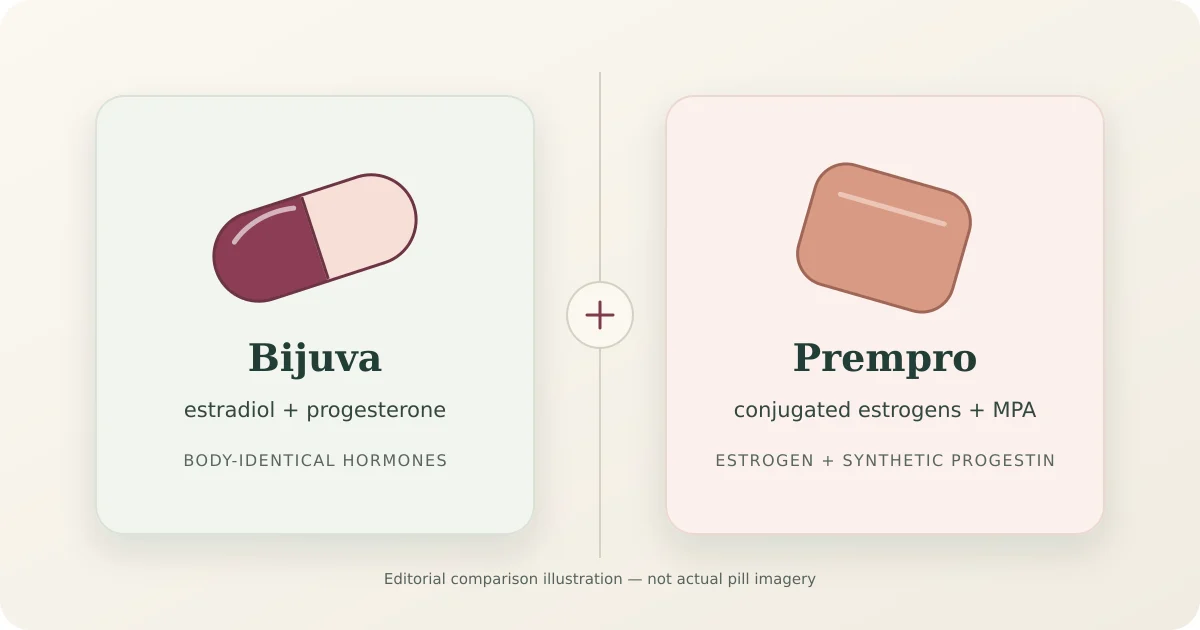
Bijuva vs Prempro comes down to which hormones you want and what you need treated. Bijuva pairs estradiol with progesterone in one evening capsule and is approved for hot flashes. Prempro pairs conjugated estrogens with medroxyprogesterone acetate and is also approved for vaginal dryness and bone-loss prevention. Both are for women with a uterus, and neither is proven better overall.
Bijuva may suit you if you want the hormones your body made before menopause (estradiol and progesterone), hot flashes and night sweats are your main problem, or you have a peanut allergy and want a progesterone option without peanut oil.
Prempro may suit you if it's already working well for you and your insurance covers it, or you want one labeled product that also covers vaginal dryness and bone-loss prevention.
Neither fits if you've had a hysterectomy, want a patch instead of a pill, or have had a blood clot, stroke, heart attack or breast cancer. Those start with a different conversation, and we cover them below.
Paying cash? Both brands cost roughly $256 to $279 a pack without insurance, and Drugs.com currently reports no available generic for either brand. See what each path costs.
The HRT Index is the independent decision resource for online menopause and HRT care — comparing telehealth providers on clinical legitimacy, care quality, medication fit, price transparency, and access, with every claim verified and dated, so women can choose the path that fits their situation before their first consult.
What we actually verified · Last verified October 2026 We read, on October 12, 2026: Bijuva's current DailyMed prescribing information (revised April 2026, with its February changes); Prempro and Premphase prescribing information on Pfizer's labeling site (revised April 2025) and DailyMed (updated April 28, 2026); the FDA's labeling announcement and updated-label list; the Prometrium prescribing information (revised February 2026); Amneal's FDA approval letter and current Drugs@FDA record; listed cash prices on Drugs.com; manufacturer savings and assistance terms; bijuva.com; and Gala's published HRT pages and general terms. Gala's pages publish conflicting offer terms; we have not confirmed which govern an individual HRT plan. We confirmed: what's in each medicine, its approved uses and strengths, and its current warning layout; the FDA approval and discontinued listing for Amneal's Bijuva-referencing generic; listed cash prices; and Gala's published HRT claims. Drugs.com reports no available generic for either brand; we did not verify stock at individual pharmacies. We did not: take either medicine, talk to a prescriber, run an insurance claim or buy anything from Gala. This is a documentation review, not a patient test. We could not confirm: your pharmacy's price, your plan's coverage, or which exact medicines and billing schedule Gala would give you.
We may earn a commission if you start care with a provider through some links on this page, including Gala. That doesn't change the facts or limits we report. How we make money.
On this page: Side by side · Which fits you · Cost · Bioidentical · Boxed warning · Safety evidence · Hot flash relief · Side effects · When neither fits · Questions to ask · Gala · How we checked · Quick answers
Bijuva vs Prempro side by side: what's actually different?
Bijuva and Prempro are both FDA-approved pills that combine an estrogen with a uterus-protecting hormone, and both are taken once a day by mouth. They differ in four ways that matter: the kind of estrogen, the kind of progestogen, what the FDA approved each one to treat, and how their warnings are presented on the 2026 labels. We did not identify a trial testing them against each other.
A quick word on terms, because the names are a mouthful:
- Estrogen is the hormone that calms hot flashes. Both pills have one.
- Progestogen is the umbrella word for hormones that protect the lining of the uterus. Progesterone is the natural one. Medroxyprogesterone acetate (often shortened to MPA) is a lab-made version, called a progestin.
- Systemic means the medicine travels through your whole body. Both pills are systemic.
- Vasomotor symptoms is the medical name for hot flashes and night sweats.
Here is everything in one place. Each row tells you who it matters to.
Table 1. Bijuva vs Prempro, from the FDA labels (checked October 12, 2026)
| Bijuva | Prempro | Who this row matters to | |
|---|---|---|---|
| Estrogen | Estradiol, the same molecule your ovaries made | Conjugated estrogens, a mix of estrogens taken from pregnant mares' urine | Women who care which estrogen they take |
| Uterus-protecting hormone | Progesterone, the same molecule your body made | Medroxyprogesterone acetate (MPA), a synthetic progestin | Women weighing progestogen type (see safety evidence) |
| Form and routine | One capsule each evening, with food | One tablet a day | Bedtime vs. any-time routine |
| Strengths (estrogen / progestogen) | 0.5 mg / 100 mg and 1 mg / 100 mg. The label says to generally start at 0.5 mg / 100 mg. | 0.3 mg / 1.5 mg, 0.45 mg / 1.5 mg, 0.625 mg / 2.5 mg, 0.625 mg / 5 mg | More dose steps with Prempro |
| Related sequential product | None | Premphase, a separate product: estrogen alone on days 1–14, estrogen plus MPA on days 15–28 | Women whose clinician wants a planned monthly bleed |
| FDA-approved uses | Moderate to severe hot flashes and night sweats from menopause | The same, plus moderate to severe vaginal and vulvar dryness and thinning from menopause, plus prevention of bone loss (osteoporosis) after menopause | Women who want a labeled product for more than hot flashes |
| Who it's labeled for | Women with a uterus | Women with a uterus | Had a hysterectomy? Neither is meant for you. |
| Boxed warning on the current label | None. Removed in February 2026. | Yes, for cardiovascular disorders, breast cancer, endometrial cancer and probable dementia | Everyone. It's a label-timing difference, not a trial result (why). |
| Uterine-lining protection in its own studies | Endometrial hyperplasia in 1 of 303 women (0.5/100) and 1 of 281 (1/100) during up to 12 months | Hyperplasia under 1% on Prempro in its one-year studies | Both protected the lining in their trials |
| Ingredients worth knowing | No peanut oil listed. Contains gelatin. | Contains lactose and sucrose | Allergies or sensitivities: ask your pharmacist |
| Maker | Mayne Pharma (licensed from TherapeuticsMD) | Pfizer (Wyeth) | Savings programs differ |
| First FDA approval | 2018 | 1995 | Newer product vs. long track record |
| Generic availability reported by Drugs.com | No available generic reported; Amneal's approved 1/100 product is currently listed as discontinued by FDA | No available generic reported; exact substitution and stock need a pharmacist's check | Price (cost) |
| Listed cash price (Drugs.com) | $278.91 (0.5/100) or $262.33 (1/100) for 30 capsules | $256.30 for 28 tablets, any strength | Cash payers |
| Proven better than the other? | Not established | Not established | Your fit decides |
Source: Bijuva prescribing information, FDA; Prempro/Premphase prescribing information, Pfizer and DailyMed; bijuva.com; Drugs.com Bijuva prices and Prempro prices. All read October 12, 2026.
What "conjugated estrogens" and "medroxyprogesterone" mean in plain words
Conjugated estrogens are a blend. Prempro's label describes it as a mixture of estrogens, mainly estrone sulfate and equilin sulfate, taken from pregnant mares' urine. Equilin is a horse estrogen your body never made. Medroxyprogesterone acetate is built from progesterone in a lab. It does the same main job, protecting the uterus, but it is a different molecule with somewhat different effects in the body.
Here is an easy way to hold it: Bijuva combines estradiol and progesterone, the two molecules named on its label. Prempro uses a different estrogen mixture and a different progestogen. Its mixture includes some estrogen forms also found in humans and others, like equilin, that aren't.
That difference is real. Whether it changes your health outcomes is a separate question, and we get to it honestly in the safety section.
Why both pills include a second hormone
If you still have a uterus, estrogen alone can make the lining of the uterus (the endometrium) grow too thick. Doctors call that endometrial hyperplasia. Over time it can lead to uterine cancer. Adding a progestogen keeps the lining in check.
The labels show how much this matters. In a one-year Prempro study, about 8% of women taking estrogen alone developed hyperplasia (20% counting milder focal cases), compared with under 1% on Prempro. In a three-year Prometrium study, 64% of women on estrogen alone developed hyperplasia, compared with 6% when cyclic progesterone was added.
That's why both of these medicines are only for women who still have a uterus. If you've had a hysterectomy, you generally don't need the second hormone, and Bijuva's own patient information says not to use it.
The honest gap: we did not identify a trial putting Bijuva and Prempro head to head for hot flashes, side effects, breast cancer or blood clots. Each was tested against a placebo (a dummy pill). Different ingredients and different trial percentages don't tell you which one you will tolerate better. Use the differences to shape your conversation with a clinician.
Which one fits your situation?
Bijuva usually fits women who mainly want hot-flash relief with body-identical hormones. Prempro usually fits women already doing well on it, or who want one labeled product that also covers vaginal dryness or bone-loss prevention. Cash payers often save the most by asking a clinician whether separate estradiol and progesterone prescriptions would work for them.
Find the row that sounds most like you.
Table 2. Your situation and the path that fits (editorial judgment, built from the labels)
| Your situation | Path worth discussing first | Why | Your next step |
|---|---|---|---|
| Hot flashes are the main problem, and you want body-identical hormones | Bijuva | Its ingredients and approved use match that goal | Ask your prescriber; price it with any savings program you qualify for |
| You're on Prempro, feel well and it's covered | Staying on it, with a yearly review | A medicine that's working matters. There's no proof that switching helps. | Bring the questions below to your next visit |
| You want hot-flash relief plus help with vaginal dryness or bone-loss prevention from one labeled product | Prempro | Only Prempro is FDA-approved for all three | Ask whether a low-dose vaginal estrogen alone would handle the dryness (vaginal estrogen guide) |
| You have a peanut allergy and want body-identical progesterone | Bijuva | Its label lists no peanut oil. Prometrium, the common progesterone capsule, contains peanut oil. | Confirm ingredients with your pharmacist |
| You're paying cash and $260+ a pack is too much | Separate estradiol and progesterone, chosen by a clinician | Far lower medicine cost. It's a different regimen, not Bijuva. | Ask your own clinician, or see Gala's flat-price plan |
| You have PPO insurance and want visits covered | An in-network clinician | Cash-only services won't bill your plan | Check your formulary for both brands |
| You'd rather use a patch, or blood clots worry you | Neither pill. Ask about an estradiol patch with uterine protection. | Both are pills. Clot risk may be lower with skin-delivered estrogen. | Your clinician, or the care-matching tool just below |
| You've had a hysterectomy | Neither | Both are only for women with a uterus | Ask about estrogen-only options |
| You're over 60, or more than 10 years past your last period, and starting fresh | A careful one-on-one review first | The Menopause Society's guidance supports a more favorable balance with earlier starts; individual review still matters | An experienced menopause clinician |
| You've had a blood clot, stroke, heart attack, breast cancer, liver disease, or bleeding no one has explained | In-person care first | These are listed reasons not to use either medicine | Start with your doctor. Ask about non-hormonal options |
A quick self-check. Three questions settle most of this:
- Do you still have a uterus?
- Is your main problem hot flashes alone, or also vaginal dryness or bone loss?
- Are you paying cash, or does your insurance cover brand medicines?
If you answered "yes, hot flashes, cash," keep reading the cost section. If you aren't sure who should be helping you with this at all, that's a different question, and it deserves its own answer.
The right online menopause care isn't the same for every woman — it depends on your symptoms, what you've already tried, your age, your state and your health history. Some situations belong with an in-person clinician first. Use The HRT Index's Find My HRT Path tool to explore a featured care option for your situation — and to flag when online care isn't the right starting point — before your first consult.
It's free, takes about 60 seconds and doesn't ask for your email. It asks five things: what's bothering you most, what you've tried, your age, your state and any health history a clinician should know about. Then it shows a featured online option, or guidance when online care isn't the right next step. It doesn't choose Bijuva, Prempro or a dose for you, and it doesn't decide whether you should take hormones. A clinician does that. We may earn a commission from the providers it features, which affects which ones appear. Answers stay in your browser.
The tool offers a care-path starting point; it does not choose a medicine or dose.
How much do Bijuva and Prempro cost?
Without insurance, Bijuva lists at about $262 to $279 for 30 capsules and Prempro at about $256 for 28 tablets on Drugs.com (checked October 12, 2026). Under the refill assumptions below, that's about $3,410 to $3,626 paid in the first 365 days, before visits. Drugs.com reports no available generic for either brand. Insurance and manufacturer savings programs can lower the brand price a lot; separate generic estradiol and progesterone cost far less, but that's a different regimen a clinician has to choose.
Compare the same number of days
The packs are different sizes, and that quietly changes the math. Bijuva comes in 30 capsules. Prempro comes in 28 tablets. So a "cheaper" Prempro pack actually covers two fewer days.
The fair way to compare is cost per day, then multiply by 30.
- Prempro: $256.30 ÷ 28 days = $9.15 a day, or about $274.61 per 30 days.
- Bijuva 0.5/100: $278.91 ÷ 30 days = $9.30 a day.
- Bijuva 1/100: $262.33 ÷ 30 days = $8.74 a day.
Per day, they're within about 56 cents of each other. Neither brand is meaningfully cheaper at listed cash prices.
The 28-day pack also changes how often you pay. If you fill on day 1 with no supply on hand and refill when each pack runs out, Prempro's next fills land on days 29, 57 and 85. That's four fills in your first 90 days and 14 fill dates through day 365, including the first fill. Bijuva's 30-day packs mean three fills in 90 days and 13 through day 365. These counts assume the prescription and price stay the same.
The full cost table
Table 3. Cash and program costs, with our math (prices checked October 12, 2026)
Medication cash totals assume no existing supply, a first fill on day 1, unchanged repeat prices, and the stated daily-use arithmetic. They include purchases made through the displayed day, with leftover supply shown separately. They are medicine subtotals, not complete care totals.
| Path | What you buy | Listed price | Per 30 days | Cash due in first 90 days (filling on day 1) | Cash due through day 365, including the first fill | What's not included or still unknown |
|---|---|---|---|---|---|---|
| Bijuva 0.5 mg / 100 mg, cash | 30 capsules | From $278.91 | $278.91 | 3 fills = $836.73 | 13 fills = $3,625.83; covers 390 days | Prescriber visits, ordered labs and any required extras (unknown) |
| Bijuva 1 mg / 100 mg, cash | 30 capsules | From $262.33 | $262.33 | 3 fills = $786.99 | 13 fills = $3,410.29; covers 390 days | Prescriber visits, ordered labs and any required extras (unknown) |
| Prempro, any listed strength, cash | 28 tablets | From $256.30 | about $274.61 | 4 fills = $1,025.20 (covers 112 days) | 14 fills = $3,588.20; covers 392 days | Prescriber visits, ordered labs and any required extras (unknown) |
| Separate generic estradiol 1 mg + generic progesterone 100 mg, cash | Arithmetic example only: one tablet and one capsule daily, only if prescribed; 30-count or 90-count bottles of each | 30-count: $7.44 + $11.77 = $19.21; 90-count: $13.83 + $26.85 = $40.68 | $19.21 with 30-count bottles; $13.56 with 90-count bottles | $57.63 with 30-count bottles; $40.68 with one purchase of both 90-count bottles | Five purchases of both 90-count bottles = $203.40; covers 450 days | Not Bijuva or a dose-equivalence recommendation. Your clinician chooses the products and schedule. Check the exact progesterone product's ingredients. Visits, ordered labs and required extras remain unknown. |
| Gala HRT plan, as advertised on /lp/hrt1 | Advertised telehealth visit, prescription and shipping; exact prescribed products not confirmed | $69/month headline; the applicable charge and interval need confirmation | Not confirmed for the applicable plan | Incomplete | Incomplete | Required medicines, exact products, extras and governing billing interval aren't fully confirmed; another HRT page quoted a 12-week pill/patch offer (details). Cash only. |
Medicine prices: Drugs.com price guides for Bijuva, Prempro, estradiol and progesterone, October 12, 2026. These are listed cash prices, not insurance prices, and your pharmacy may charge more or less. Gala price: Gala's HRT page, October 12, 2026. Arithmetic is ours. An unknown required cost makes a total incomplete, not zero. Promo codes are left out on purpose.
We may earn a commission if you use this link. Confirm the current price, prescribed products, and any additional costs with Gala.
What the numbers mean for you
If insurance covers your brand medicine, the listed price may barely matter. Your plan's copay and any savings program decide what you pay. Start there.
If you're paying cash, the brand pill is the expensive part. At listed prices, a year of either brand costs more than $3,000 before a single visit. That's a fair reason to ask a clinician whether separate estradiol and progesterone could work for you. It's not the same as Bijuva: separate medicines have their own doses and schedules, and the combined capsule is what was tested in Bijuva's trial. But estradiol tablets and progesterone capsules are each available as FDA-approved products, and clinicians often prescribe them together.
If you're paying cash and you're open to a clinician choosing your plan, Gala is worth comparing. Its /lp/hrt1 page advertises $69 a month and says the telehealth visit, prescription and shipping are included. But another HRT page quoted different pill/patch charges over 12-week cycles, and we haven't confirmed that the applicable price covers every medicine you'd need. A headline can't settle the annual savings. Gala doesn't list Bijuva or Prempro, and it doesn't bill insurance. Ask which exact medicines you'd get, the full amount due and how often you'd be charged before you pay.
[PROVIDER LINK: Gala Health | See Gala's HRT plan → | approved Gala HRT tracking component, sub1=bijuva-vs-prempro, sub4=cost-table]
Affiliate link. A Gala clinician decides whether any treatment is right for you.
Savings cards and insurance
Both makers run savings programs for people with commercial insurance. They have rules, and they can't create coverage your plan doesn't give.
Table 4. Manufacturer programs (terms as summarized October 12, 2026)
| Program | Who it's for | What it says | Limits that change the answer |
|---|---|---|---|
| Pfizer savings card (summary includes Prempro) | Eligible commercially insured patients | Summary advertises as little as $25, up to $110 savings per Prempro fill and a $1,440 calendar-year patient maximum | Not for cash payers or government plans. Terms expire December 31, 2026. Pfizer's detailed eligible-product list omits Prempro even though its summary includes it; confirm the applicable enrollment/program before budgeting. The minimum is not guaranteed; the detailed terms also limit redemption to once per 30 days. |
| Bijuva savings card (Mayne Pharma) | Commercially insured patients whose plan covers Bijuva | May lower your out-of-pocket cost; the amount varies with your plan | Your plan must cover Bijuva when you fill. Not for government plans. Current program ends December 31, 2026. |
| Bijuva Medicare Part D alternative program | Eligible people with Part D or Medicare Advantage prescription coverage | An option when the plan doesn't cover Bijuva or costs exceed its eligibility thresholds | Opt out of the Bijuva Part D benefit for the rest of the calendar year; no Part D true-out-of-pocket credit and no submission for insurance, HSA or FSA reimbursement. Notify the plan as required and read the official terms first. |
| Pfizer patient assistance (PAP Connect) | Eligible uninsured or government-insured patients unable to afford treatment, with household income at or below 300% of the federal poverty level | May provide Prempro free | Commercially insured patients are excluded. Other requirements apply, including additional steps for Part D applicants; use the current official eligibility rules. |
Source: Pfizer consumer savings summary, Pfizer detailed savings terms, Pfizer PAP eligibility and patient resources; current Bijuva commercial-card terms; official Bijuva Part D alternative program. Checked October 12, 2026. Our Bijuva insurance guide explains the separate coverage task.
Coverage for Bijuva swings widely between plans. Our Bijuva insurance guide found it excluded on one major national formulary, listed at a higher brand tier on several others, and needing prior authorization on some Medicaid plans. If your pharmacy quote is high, ask: "Is this my deductible, a plan exclusion, or a prior-authorization problem?" Each one has a different fix.
Is there a generic Bijuva or Prempro?
No generic of either one is for sale that we could find (Drugs.com, October 12, 2026). The story with Bijuva is a little tangled, so here it is in order.
The FDA approved Amneal's Bijuva-referencing 1 mg / 100 mg generic on May 16, 2022. A 2021 company announcement described a May 25, 2032 licensed entry date, with possible earlier entry under specified circumstances. More directly relevant today, the current Drugs@FDA record lists Amneal's product as discontinued. So "a generic was approved" and "my pharmacy can't get one" can both be true. We did not verify a 0.5 mg / 100 mg generic.
Drugs.com also reports no available generic for Prempro. We did not independently establish its exact substitutable-generic status in an issuer lookup; ask your pharmacist to check the product and current supply.
One more thing that trips people up: separate generic estradiol and generic progesterone are not a generic Bijuva. They're two different medicines your clinician would prescribe on their own schedule.
Your cost worksheet
Use this before you choose. Fill in what your pharmacy and plan actually tell you. If a line says "unknown," your total is incomplete. It isn't zero.
MY BIJUVA vs PREMPRO COST CHECK (keep this private)

                                  BIJUVA            PREMPRO
Exact strength prescribed:        __________        __________
Quantity / days it covers:        ____ / ____       ____ / ____
Pharmacy and date of quote:       __________        __________
Paying with: insurance / cash / savings card / other
Covered by my plan?               yes / no / PA needed / unknown
Amount due at first fill:         $______           $______
Amount at later refills:          $______           $______
Prescriber visit cost:            $______ / unknown / $0 (confirmed)
Follow-up visits per year:        ____ x $______
Labs (if ordered):                $______ / unknown / not required
Shipping / dispensing:            $______ / unknown / not required
Membership / other required fees: $______ / unknown / not required
Dates/intervals for care charges:  __________________________
Supply already on hand (days):    ______

Cost per 30 days = (price ÷ days covered) × 30
                                  $______           $______
Cash due in first 90 days:        $______           $______
Medicine cash through day 365:    $______           $______
All-in cash through day 90:       $______ / incomplete
All-in cash through day 365:      $______ / incomplete
Anything required with an unknown amount or payment date?
→ My all-in total for that period is INCOMPLETE.
A worked example (made-up numbers, just to show the math): Quote A is $90 for 30 days. Quote B is $84 for 28 days. Both are $3 a day, or $90 per 30 days. But to cover 90 days from scratch, you'd pay three A fills ($270) or four B fills ($336). The extra $66 on B buys supply that runs past day 90. It's not a higher price per supplied day. It's a different payment rhythm. These are medicine subtotals; required care fees and their payment dates belong in the all-in total.
Is Bijuva bioidentical, and does that make it safer?
Yes, Bijuva's estradiol and progesterone have the same chemical structure as the hormones a woman's body makes, which is what "bioidentical" (or "body-identical") means. But that describes the molecules, not the safety. Bijuva's own website says there are no data suggesting body-identical hormones are superior to synthetic ones, and both Bijuva and Prempro are FDA-approved finished medicines.
That disclaimer from the maker is worth sitting with. "Natural" sounds safer. The evidence hasn't shown it, at least not in a trial comparing these two medicines. What it does mean is that you're getting the same molecule your body made before menopause, which some women simply prefer.
Progesterone and medroxyprogesterone are different medicines
Micronized progesterone is progesterone ground into tiny particles so your body can absorb it by mouth. Medroxyprogesterone acetate is a different, lab-made progestin. Both belong to the progestogen family. Both protect the uterine lining. They are not interchangeable at a fixed ratio.
This is where a lot of online confusion starts. Bijuva has 100 mg of progesterone. Prempro has 1.5 to 5 mg of MPA. People see "100 mg vs 2.5 mg" and assume Bijuva's dose is 40 times stronger, or try to work out an "equal" dose. Neither is right. Different drugs work at very different milligram amounts. The numbers don't tell you which is stronger, safer or right for you. Only your prescriber can set a dose.
A better question to ask: "What does this progestogen do for my uterine protection, my side effects and my sleep?"
Bioidentical, FDA-approved and compounded are three different questions
These words get mixed together, especially in ads.
- Bioidentical is about the molecule's shape.
- FDA-approved is about the finished product: the actual capsule or tablet in the box was reviewed by the U.S. Food and Drug Administration for safety, effectiveness and consistent quality.
- Compounded means a pharmacy mixes a custom preparation. The FDA says compounded drugs aren't FDA-approved, and the FDA doesn't check their safety, effectiveness or quality before they're sold.
Bijuva is bioidentical and FDA-approved. Prempro is FDA-approved but not bioidentical. A compounded estradiol-and-progesterone cream may be bioidentical, but it is not FDA-approved, and it isn't a stand-in for either medicine. The Menopause Society puts it plainly: custom-compounded hormones are not safer or more effective than approved bioidentical hormones. Our guide to compounded vs FDA-approved HRT goes deeper.
Peanut allergy and progesterone
This is one practical place where Bijuva stands out. Bijuva's label lists no peanut oil among its inactive ingredients. Prometrium, the best-known brand of oral micronized progesterone, lists peanut oil in both strengths, and its label says not to use it if you're allergic to peanuts.
So if you have a peanut allergy and want body-identical progesterone by mouth, Bijuva is an FDA-approved option to ask your clinician about. If you're offered a generic progesterone capsule instead, ask your pharmacist to check that exact product's ingredients. Bijuva does contain gelatin, and Prempro contains lactose, which matters for some people too.
Sources: bijuva.com; Bijuva label; Prometrium label, revised February 2026; FDA, Compounding and the FDA; The Menopause Society, Hormone Therapy.
Why does Prempro still have a boxed warning when Bijuva doesn't?
On February 12, 2026, the FDA approved updated labels for a first group of six menopause hormone products, removing statements about heart disease, breast cancer and probable dementia from the boxed warning. Bijuva was the only estrogen-plus-progestogen pill in that group, and its label now has no boxed warning. Prempro's label on DailyMed (updated April 28, 2026) still carries one, which reflects when each label was updated, not new proof that one medicine is safer.
A boxed warning (often called a black box warning) is the FDA's most prominent warning format. It sits in a bordered box at the top of a drug's prescribing information. For more than 20 years, after the Women's Health Initiative study, estrogen products carried one.
Here's how 2026 unfolded:
- November 2025: The FDA announced it would begin removing the boxed-warning statements about cardiovascular disease, breast cancer and probable dementia from menopause hormone therapy labels.
- After that: At the FDA's request, 29 drug companies submitted proposed label changes.
- February 12, 2026: The FDA approved the first six: Prometrium (progesterone), three systemic estrogens (Divigel, Cenestin and Enjuvia), Estring (a vaginal ring) and Bijuva.
- Since then: Prempro's label we read on DailyMed, updated April 28, 2026, still shows its boxed warning. Its highlights still say revised April 2025.
What changed on Bijuva's label
Bijuva's updated label removes the boxed warning and adds timing language: it says to consider starting Bijuva in women under 60 or within 10 years of the start of menopause. Important risks, including clots, stroke and breast cancer, remain in the label's warnings section, although the boxed warning was removed. The update also removed the separate probable-dementia warning section; it was more than a change in formatting.
What the difference does and doesn't mean
It means Prempro's label hadn't been through the same update as of our check. That's all.
It doesn't mean Prempro is riskier than Bijuva because of the box. It doesn't mean Bijuva is risk-free. And it doesn't change anything about compounded hormones, which never had FDA-approved labels to begin with.
If you're reading an article that says "both have boxed warnings," check its date. Many comparison pages were written before 2026. If Prempro's label is updated after our check, we'll recheck its wording. A label change alone does not mean the formulation changed. Our explainer on the 2026 HRT label changes has the full background.
Sources: FDA announcement, February 12, 2026; FDA list of updated labels; Bijuva label; Prempro on DailyMed. All read October 12, 2026.
Is Bijuva safer than Prempro? What the evidence shows
We did not identify a direct Bijuva-versus-Prempro trial, and the evidence reviewed does not establish one as safer overall. The biggest trial of combined hormone therapy, the Women's Health Initiative (WHI), tested the same two drugs that are in Prempro, mostly in women older than the typical new user. Observational research suggests progesterone may carry a lower breast cancer signal than synthetic progestins, but that kind of study can't prove cause.
Let's take each piece of evidence in turn, and be clear about what it can and can't tell you.
Table 5. What each kind of evidence can and can't answer
| Evidence | What it studied | What it supports | What it can't tell you |
|---|---|---|---|
| Bijuva's trial (REPLENISH) | Oral estradiol plus progesterone vs. a placebo for one year, with a hot-flash sub-study | Hot-flash relief and uterine-lining safety for Bijuva | Whether Bijuva beats Prempro, or rare long-term risks |
| Prempro's studies (including HOPE) | Prempro strengths vs. placebo and vs. estrogen alone | Hot-flash relief, lining protection and bone density for Prempro | Whether Prempro beats Bijuva |
| Women's Health Initiative | Daily conjugated estrogens 0.625 mg plus MPA 2.5 mg vs. placebo, women 50–79 (average age 63), to prevent chronic disease | The best randomized evidence on long-term risks for that exact combination | The same risk for every dose, age, route, or for Bijuva |
| E3N and similar observational studies | Women who chose different hormone types, followed over time | A reason to think progestogen type may matter | Proof that Bijuva causes fewer cancers than Prempro |
| Online reviews and ratings | Voluntary reports from some users | What people find frustrating, and what to ask | Typical results or safety |
What the WHI found, and why your age matters
The WHI tested daily conjugated estrogens plus MPA, the ingredients in Prempro at its 0.625 mg / 2.5 mg strength. It was stopped early in 2002, when breast cancer cases crossed a preset limit. That news is the reason so many women and doctors grew afraid of hormone therapy.
But the women in the WHI were an average of 63 years old, and many were well past menopause. The study wasn't testing hot-flash relief. It was testing whether hormones prevent heart disease. They don't, and neither medicine should be used for that.
Here's what the results look like for women in their 50s, the age group most likely to start treatment for hot flashes. The numbers are "per 10,000 women-years." Picture 10,000 women each taking the medicine for one year, and count how many had each problem.
Table 6. WHI estrogen plus MPA results, women aged 50–59 at enrollment (annualized per 10,000 women-years; average 5.6-year follow-up)
| Outcome | Estrogen + MPA | Placebo | Difference | Statistically clear? |
|---|---|---|---|---|
| Invasive breast cancer | 33 | 27 | 6 more | No |
| Blood clot in a deep vein (DVT) | 15 | 5 | 10 more | Yes |
| Blood clot in the lung (pulmonary embolism) | 11 | 5 | 6 more | No |
| Stroke | 15 | 10 | 5 more | No |
| Coronary heart disease events | 23 | 17 | 6 more | No |
| All fractures | 120 | 145 | 25 fewer | Borderline |
| Death from any cause | 21 | 31 | 10 fewer | No |
Source: WHI results summarized in the Prometrium prescribing information, revised February 2026, Table 6, and Manson et al.'s 2013 WHI analysis for the all-cause mortality endpoint. "Statistically clear" means the nominal 95% confidence range did not cross "no difference"; these intervals were not adjusted for multiple comparisons. "No" does not establish no risk. The difference column subtracts rounded displayed rates; an estimated difference reported in a study can differ by one. Other labels show numbers from different analyses of the same trial.
Two things stand out. First, the clearest added risk in this age group was blood clots. Second, for breast cancer in women in their 50s who had never used hormones before, the label reports 33 vs. 31 cases per 10,000 women-years, a very small difference.
None of this is a personal risk number. Your own risk depends on your age, your weight, whether you smoke, your family history and much more.
Every label we read, including Prometrium's, also says something important: because the WHI only tested one dose of one combination, it's not known how its findings apply to other doses, other routes or other estrogen-progestogen products, like Bijuva. Without that data, the risks can't be ruled out either.
Does the type of progestogen change the risk?
Some research suggests it might. A large French study called E3N followed women who used different hormone combinations. Women using progesterone had a lower breast cancer signal than women using synthetic progestins like MPA.
But there are three big caveats. It was observational, meaning women chose their own treatments rather than being randomly assigned, so other differences between them could explain the results. Most of the estrogen in that group was delivered through the skin, not by mouth like Bijuva. And Prempro's label notes that large observational studies generally haven't found major differences in breast cancer risk among different estrogen-progestin combinations.
So the fair summary is this: progestogen type is a reasonable thing to discuss with your clinician. It is not proof that Bijuva is safer than Prempro.
Could a patch change the conversation?
Possibly. Both Bijuva and Prempro are pills, so their estrogen passes through your liver first. The Menopause Society says clot risk may be lower with estrogen delivered through the skin, such as a patch, gel or spray. Large observational studies point the same way, though direct trial evidence is limited, and a patch isn't risk-free.
If clots are your main worry, the bigger choice may be pill vs. patch, not Bijuva vs. Prempro. And if you have a uterus, you'd still need a progestogen with a patch. That's a question for your clinician: "Should we talk about a skin-delivered option for me?" Our HRT benefits and risks guide covers routes in more detail.
Which works better for hot flashes and night sweats?
Both Bijuva and Prempro reduced the number and severity of hot flashes compared with a placebo in their own trials, which is why the FDA approved both for that use. We did not identify a trial comparing them, and the reviewed evidence does not establish one as better overall for symptom relief.
One detail from Prempro's label helps explain why trial results are hard to compare. In the HOPE study, women started with about 12 moderate-to-severe hot flashes a day. After 12 weeks, women on Prempro 0.625 mg / 2.5 mg were down to about 1 a day. Women on the placebo were down to about 6 a day.
The placebo group improved too. That's normal in hot-flash studies. It's one reason you can't take a number from one medicine's trial and line it up against another's.
How long before you know if it's working?
Trial checkpoints aren't promises. Both medicines' studies checked hot flashes at weeks 4 and 12, which gives you a sense of the time frame researchers used, not a guarantee for you. A good plan is to agree with your clinician, before you start, on what "better" means for you and when you'll check in.
Something simple helps: jot down how many hot flashes you have, and how many nights you wake up sweating, for a week before you start and then again after a few weeks. Bring those notes to your follow-up.
Both medicines are approved for hot flashes. Neither is approved to treat sleep problems, mood or weight, even though better nights often follow fewer night sweats.
Sources: Bijuva label, clinical studies section; Prempro label, Table 5 (HOPE study).
What side effects and warning signs should you know?
The most common side effects listed for both medicines overlap: breast tenderness or pain, headache, nausea, bloating and vaginal bleeding or spotting. You can't fairly rank them with side-effect percentages from separate trials, because the studies used different women, doses and methods. Some symptoms need prompt or urgent medical attention.
Common side effects, from each label
Bijuva's most common side effects (in at least 3% of women and more than with placebo) were breast tenderness, headache, nausea, vaginal bleeding, vaginal discharge and pelvic pain. Breast tenderness was more common at the higher dose: about 4% of women on 0.5 mg / 100 mg and about 10% on 1 mg / 100 mg, compared with under 1% on placebo. The label generally recommends starting at the lower strength.
Prempro's label lists abdominal pain, weakness, back pain, headache, gas, nausea, depression, itching, breast pain, period-like cramps and vaginal discharge as most common. In the HOPE study, breast pain was reported by 26% of women on 0.625 mg / 2.5 mg, 20% on 0.45 mg / 1.5 mg and 13% on 0.3 mg / 1.5 mg, compared with 8% on placebo.
Those percentages look very different, but they come from different trials that counted side effects in different ways. Both labels warn against comparing rates across trials. What you can take from them: with both medicines, higher doses tended to bring more breast tenderness.
Spotting or irregular bleeding is common in the first months of combined hormone therapy. It should settle. Bleeding that's heavy, keeps going, or starts again after it had stopped needs to be checked.
When to get help
Call 911 or go to an emergency room for chest pain, sudden shortness of breath, sudden trouble speaking or seeing, sudden weakness or numbness on one side of the body, a sudden severe headache, or a painful, swollen leg. These can be signs of a stroke, heart attack or blood clot.
Contact your prescriber promptly for any new vaginal bleeding after menopause, a new breast lump, yellowing of your skin or eyes, or a side effect that won't go away. Don't wait these out, and don't try to fix them by switching medicines on your own.
Sources: Bijuva label, Table 1 and patient information; Prempro label, Tables 1 and 2 and patient information.
When might neither pill be the right choice?
Neither Bijuva nor Prempro is meant for women without a uterus, and both are pills, so women who want a patch or need only local vaginal treatment may be better served by something else. Health history, how far you are from menopause, and whether you're still having periods can also change the conversation entirely.
No uterus
Both medicines include a progestogen only to protect the uterus. Without one, that second hormone usually isn't needed. Bijuva's patient information says plainly not to use it after a hysterectomy. Ask about estrogen-only options instead.
Vaginal dryness only, or bone protection only
Prempro is approved for vaginal dryness and thinning, but its own label says that when vaginal symptoms are the only reason for treatment, a vaginal product should be considered. Low-dose vaginal estrogen works right where it's needed and is absorbed in small amounts. See our vaginal estrogen guide.
Prempro is also approved to prevent bone loss after menopause. But its label says that when that's the only goal, treatment should be limited to women at significant risk, and non-estrogen medicines should be carefully considered first. Bijuva isn't approved for bone protection.
Still having periods, pregnancy questions or starting later
Both medicines are approved for women past menopause. Using either during perimenopause, when periods still come, is a decision some clinicians make, but it would be off-label use. Neither pill is birth control. If you could still get pregnant, are pregnant, breastfeeding or trying to conceive, talk with a clinician before any hormone therapy.
Starting hormone therapy after 60, or more than 10 years after your last period, isn't automatically off the table. It does call for a more careful, individual review. And continuing a medicine you started years ago is a different question from starting fresh. Age alone isn't a rule to stop.
Separate medicines or a different route
Some women do better with two separate prescriptions, such as an estradiol pill or patch plus progesterone. That lets a clinician adjust each hormone on its own. It isn't the same as Bijuva, and a patch plus progesterone is a different regimen again. Ask about the exact products, their schedule, whether each is FDA-approved, and what follow-up looks like.
One thing to know: Prometrium's label is written for use with conjugated estrogens at 200 mg for 12 days a month. Pairing progesterone with estradiol, or taking 100 mg every day, is common practice, but it's a clinician's choice outside that label's exact wording. It's fair to ask your clinician how they chose your schedule.
Premphase, Premarin and other options
- Premphase is a related, separate sequential product: estrogen alone for 14 days, then estrogen plus MPA. It usually brings a planned monthly bleed.
- Premarin is the estrogen in Prempro without the MPA. It's used mainly by women without a uterus.
- Other combinations exist too, including pills with estradiol and other progestins, and combination patches. Our FDA-approved HRT medication list shows the full range.
- Non-hormonal medicines can treat hot flashes when hormones aren't right for you. One of them, fezolinetant (Veozah), carries a boxed warning about rare liver injury and requires liver blood tests. See our non-hormonal options guide.
Sources: Prempro label, sections 2.2 and 2.3; Bijuva patient information; Prometrium label.
What should you ask before starting, switching or renewing?
Bring your exact prescription, your main concern and a real price quote to your clinician. There's no dose-for-dose conversion on either label, so any switch plan has to come from your prescriber. A good visit settles the symptom you're treating, why this medicine fits you, how you'll follow up and what your refills will cost.
You might wonder whether you're the problem for having questions about a prescription. You're not. These are exactly the questions a good clinician wants to hear.
Questions to copy and bring
MY BIJUVA vs PREMPRO QUESTIONS (private)

1. Which symptom are we treating, and how will we know it's working?
2. Why this estrogen and this progestogen, given my history?
3. Do I need help with vaginal dryness or bone loss too, or just hot flashes?
4. Is a pill right for me, or should we talk about a patch or separate medicines?
5. How does my uterus status or stage of menopause change the choice?
6. If I switch, what bleeding or side effects should I expect, and what should I report?
7. Which symptoms mean I should get help right away?
8. When is my follow-up, and who answers my questions in between?
9. Do I need any tests, and why?
10. Will my plan cover this exact medicine and strength? Is there a savings
    program, and what will my next refill cost?
An example of putting it to use: "My pharmacy quoted me $262 for Bijuva. Is that my deductible, an exclusion, or a prior-authorization problem? If it's an exclusion, would Prempro or separate estradiol and progesterone be reasonable for me?"
If you're switching
- Ask your prescriber how to move from one to the other. Don't double up or leave a gap on your own.
- Expect possible spotting or breast tenderness while your body adjusts. Write it down.
- Report bleeding that's heavy, doesn't settle, or returns after it had stopped.
- Book a follow-up. Bijuva's label says to reassess treatment periodically, and to try lowering or stopping at 3- to 6-month intervals where appropriate.
- If you're changing care services, ask who will handle refills and questions so you don't run out.
Labs, in plain words: most women don't need routine hormone blood tests to start or adjust these medicines. Prempro's label notes that hormone levels haven't been shown to help manage hot flashes. A clinician may order specific tests for a specific reason, like thyroid or cholesterol checks. Ask what a test is for and what it costs.
Where does Gala fit if you're paying cash?
Gala doesn't list Bijuva or Prempro on its HRT pages, so it isn't a confirmed route to either brand. It advertises online care, with estradiol pills or patches and oral progesterone among its options, and a $69/month headline on /lp/hrt1. That does not confirm both medicines are included at that price. It doesn't bill insurance.
That combination makes Gala a strong option for one specific woman: she's paying cash, the brand price is the problem, and she's open to a clinician choosing her plan.
Where Gala can win for you
- Price. Gala's /lp/hrt1 page advertises "$69/month — flat, forever" and says the telehealth visit, prescription and shipping are included, with no membership fee. That is a reason to compare a cash-pay care route, but the exact regimen, governing billing interval and required extras need confirmation before calculating annual savings.
- Patch option. Gala lists an estradiol patch as well as a pill. Neither Bijuva nor Prempro comes as a patch.
- Ongoing care. Gala says provider messaging, symptom check-ins and dose changes are included for as long as you're treated.
- HSA and FSA. Gala says it accepts both.
Gala also publishes customer testimonials. One, from a woman Gala identifies as Donna, 55, on its HRT page, says: "Everything was online and simple." That's Gala's own selection, and it speaks to convenience, not to how any medicine will work for you.
What we couldn't confirm, and what to ask
Gala's pages don't all say the same thing, so a few answers have to come from Gala before you pay.
Table 7. Gala's HRT offer: what's published and what to ask (read October 10–12, 2026)
| Topic | What Gala's pages say | Still unclear | Your question |
|---|---|---|---|
| Price and billing | /lp/hrt1 advertises $69/month. A separate /lp/hrt page quoted pills at $207 every 12 weeks and patches at $297 every 12 weeks | Which offer governs your plan and whether all required medicines/extras are included. Twelve weeks is 84 days, not three calendar months. | "What will you charge today, how many days does it cover, and how often after that?" |
| Progesterone | Oral progesterone listed as an option | Whether every required medicine is included in the applicable plan price | "Does the price cover every medicine I'm prescribed, including progesterone?" |
| FDA-approved or compounded | The hub and $69 page say "FDA-approved bioidentical forms"; another HRT landing page carries a notice about compounded medicines | Which exact product you'd receive | "What is the exact product name and maker, and is it FDA-approved or compounded?" |
| Bijuva or Prempro | Not listed | Whether Gala ever prescribes either | "Can you prescribe Bijuva or Prempro specifically?" |
| Charge timing | One page: "If approved, you're charged"; Gala's refund policy describes charging when you complete the intake | Which applies to HRT | "Am I charged before or after the clinician reviews my case?" |
| Cancelling | Landing pages: cancel anytime from your account; general refund policy: requests must arrive 72 hours before your billing date | Which terms govern HRT | "What's my billing date, and can I cancel in my account?" |
| Insurance | Not billed | — | Use insurance elsewhere if that's your priority |
| States and ages | "Most US states"; 18+ for the service overall | No HRT state list or age range | "Do you serve my state and my age for HRT?" |
Source: Gala hormone health and Gala $69 HRT page, checked October 12, 2026; separate Gala HRT landing page, read during the October 12 research; general refund policy, updated February 2026, and terms, updated September 22, 2026, read directly October 12, 2026. Our Gala HRT review covers the wider decision.
Gala is the wrong first stop if
- You want Bijuva or Prempro specifically and Gala cannot confirm it can prescribe the exact brand. Use a prescriber who can confirm that route.
- You want insurance to pay. Gala is cash only.
- You need the exact product confirmed before paying, and Gala can't name it.
- You have a peanut allergy, and Gala can't confirm the progesterone product's ingredients.
- You've had a blood clot, stroke, heart attack, breast cancer or bleeding no one has explained. That starts with in-person care.
Your 20-second check. Are you fine paying cash? Are you open to separate estradiol and progesterone if a clinician recommends it? Are you free of the red flags above? Three yeses means Gala is worth a look, with the questions in Table 7 in hand.
[PROVIDER LINK: Gala Health | Start Gala's HRT assessment → | approved Gala HRT tracking component, sub1=bijuva-vs-prempro, sub4=gala-section]
Affiliate link. A prescription isn't guaranteed. A licensed Gala clinician decides whether any treatment is right for you. For complaints, refund terms and the full checklist, read our Gala Health HRT review.
Other good routes
- Your current prescriber. If you trust them, a better question list may be all you need. Use the questions above.
- An in-network clinician if you want insurance to cover visits. Midi Health says it's in-network with most PPO plans. Check Midi's insurance options (not an affiliate link).
- A menopause practitioner near you through The Menopause Society's directory. Check the listing for MSCP certification and prescribing scope.
- Providers that publish their medicine menu up front, if seeing the exact products matters most. See which online providers prescribe what.
This is a provider link, not a recommendation for Bijuva or Prempro. We may earn a commission if you use it.
How we checked this comparison
We read the FDA prescribing information for Bijuva, Prempro and Prometrium, the FDA's 2026 labeling announcement, listed cash prices and savings-program summaries, and Gala's published HRT pages, all dated in the sources below. We didn't take either medicine, run an insurance claim or buy from Gala, so this is a documentation review. We separate label facts, published prices and our own judgment throughout.
We use The HRT Index Verification Standard, which looks at five things in this order. For a drug comparison, here's what each meant:
- Clinical legitimacy. Both medicines are FDA-approved finished products. We read their labels directly from the FDA, Pfizer and DailyMed.
- Care quality. A medicine has no care model. For the online care route, we report what Gala publishes about follow-up and support, and label it as Gala's statement.
- Medication fit. Ingredients, approved uses, strengths, routes, inactive ingredients and reasons not to use each one.
- Price transparency. Dated cash prices normalized to the same number of days, savings-program limits, and unknown costs marked as unknown.
- Access. Generic availability, insurance and savings programs, and realistic routes to a prescriber.
We don't score medicines, and we don't publish a star rating. Those five pillars sit on top of the detailed checks in our methodology.
How we label claims on this page: "label" or "FDA" means prescribing information or an FDA notice. "Study" means published research. "Gala says" means Gala's own pages. "Our math" means arithmetic we did from dated prices. Anything we couldn't confirm is marked that way.
What would change this page: an update to Prempro's label, a generic coming to market, price or savings-program changes, Gala naming its exact products or changing its price, or any new study comparing these medicines.
What's your next step?
Your next step depends on what's still unsettled. If you have a prescriber, the question list is often all you need. If cost is the problem, a real pharmacy quote and the savings programs come first, and a cash-pay plan like Gala's may be worth comparing. If you aren't sure who should be helping you, start there.
Here's the whole comparison in four lines:
- Hormones: Bijuva is estradiol plus progesterone, the molecules your body made. Prempro is conjugated estrogens plus a synthetic progestin.
- Uses: Both treat hot flashes. Only Prempro is also approved for vaginal dryness and bone-loss prevention.
- Labels: Bijuva's boxed warning was removed in February 2026. Prempro's label still has one. That's timing, not a trial.
- Cost: About $9 a day for either brand at listed cash prices; no available generic reported by Drugs.com; and very different results with insurance or savings cards.
Still not sure what kind of care fits you? Use The HRT Index's Find My HRT Path tool. It asks about your symptoms, what you've tried, your age, your state and your health history, then shows a featured care option or guidance when online care isn't the right starting point. It's free, takes about 60 seconds and doesn't need your email. It doesn't choose a medicine or a dose.
It takes about 60 seconds, does not need your email, and does not choose a medicine or dose.
And if you already have a doctor who knows your history, it's always fair to ask them first.
Bijuva vs Prempro: quick answers
Is Bijuva the same as Prempro? No. Bijuva contains estradiol and progesterone. Prempro contains conjugated estrogens and medroxyprogesterone acetate. Both are once-a-day pills for women with a uterus.
Is Bijuva safer because it's bioidentical? That hasn't been shown. Bioidentical describes the molecule's shape, and Bijuva's maker says there are no data showing body-identical hormones are superior to synthetic ones. We did not identify a trial comparing Bijuva and Prempro.
Does Bijuva still have a black box warning? No. Its label records the boxed warning's removal in February 2026. The risks are still described in the label's warnings section.
Does Prempro still have a black box warning? Yes, on the DailyMed label we read (updated April 28, 2026). It hadn't been part of the FDA's first group of updated labels.
Can I switch from Prempro to Bijuva at an equal dose? There's no dose-for-dose conversion on either label. The milligram numbers aren't comparable because the drugs are different. Your prescriber has to set the new plan.
Which is cheaper? At listed cash prices they're close: about $9.15 a day for Prempro and $8.74 to $9.30 a day for Bijuva. With no supply on hand and fills when each pack runs out, Prempro's 28-day packs mean 14 fills through day 365, including the first fill. Your insurance or a savings card can change the answer completely.
Is there a generic Bijuva or Prempro? Drugs.com reports no available generic for either brand. FDA approved Amneal's Bijuva-referencing 1 mg / 100 mg product in 2022, but its current record says discontinued. Individual pharmacy supply and Prempro's exact substitution status were not verified. Separate estradiol and progesterone are a different regimen, not a generic Bijuva.
Can I take Bijuva if I'm allergic to peanuts? Bijuva's label lists no peanut oil. Prometrium, a common progesterone capsule, does contain peanut oil. Confirm ingredients with your pharmacist.
Does Bijuva help prevent osteoporosis? It isn't FDA-approved for that. Prempro is approved to prevent bone loss after menopause, though its label says other medicines should be considered first when bones are the only goal.
Can I take either one after a hysterectomy? Neither is meant for women without a uterus. Ask your clinician about estrogen-only options.
Why is Bijuva taken at night with food? That's how its label says to take it, as one capsule each evening with food.
Was Prempro the drug in the Women's Health Initiative? The WHI tested daily conjugated estrogens 0.625 mg plus medroxyprogesterone acetate 2.5 mg, the same ingredients as Prempro at that strength.
Will either one cause weight gain? Weight gain was reported in about 2% to 3% of women in Prempro's studies, about the same as or less than placebo in its larger study, and it isn't among Bijuva's most common side effects. Weight often changes in midlife for other reasons. Tell your clinician about any change.
Does insurance cover Bijuva or Prempro? It depends on your plan. Bijuva's coverage varies widely. Our Bijuva insurance guide walks through formularies, prior authorization and appeals.
Does Gala prescribe Bijuva or Prempro? Neither is listed on Gala's HRT pages. Gala lists estradiol pills and patches and oral progesterone. Ask Gala directly if you need a specific brand.
Sources
FDA and prescribing information
- Bijuva (estradiol and progesterone) capsules, prescribing information, FDA, with February 2026 changes. Read October 12, 2026.
- Prempro/Premphase prescribing information, Pfizer, revised April 2025. Read October 12, 2026.
- Premphase/Prempro on DailyMed, updated April 28, 2026. Read October 12, 2026.
- Prometrium (progesterone) capsules, prescribing information, FDA, revised February 2026. Read October 12, 2026.
- FDA: FDA Approves Labeling Changes to Menopausal Hormone Therapy Products, February 12, 2026.
- FDA: Menopausal Hormone Therapies with Updated Prescribing Information. Read October 12, 2026.
- FDA approval letter, ANDA 214293 (estradiol and progesterone capsules, Amneal), 2022.
- FDA: Compounding and the FDA, Questions and Answers.
- Current Bijuva prescribing information, DailyMed, updated September 29, 2026; PI revised April 2026. Read October 12, 2026.
- Current Drugs@FDA record, Amneal ANDA 214293, read October 12, 2026; discontinued marketing status.
- FDA Veozah liver-injury warning, read October 12, 2026.
Medical guidance and research
- The Menopause Society: Hormone Therapy.
- The Menopause Society: The 2022 hormone therapy position statement. Menopause. 2022;29(7):767–794. Full statement read October 12, 2026.
- Writing Group for the Women's Health Initiative Investigators: Risks and benefits of estrogen plus progestin in healthy postmenopausal women. JAMA. 2002;288(3):321–333.
- Manson et al.: Menopausal hormone therapy and health outcomes during the intervention and extended poststopping phases of the WHI randomized trials. JAMA. 2013;310(13):1353–1368. Primary text read October 12, 2026.
- Fournier A, et al.: Unequal risks for breast cancer associated with different hormone replacement therapies, E3N cohort. Breast Cancer Research and Treatment. 2008;107(1):103–111. Full published paper text read October 12, 2026.
- Vinogradova Y, et al.: Use of hormone replacement therapy and risk of venous thromboembolism. BMJ. 2019;364:k4810. Full text read during October 12 initial research; qualified route discussion also supported by the Society statement.
Manufacturers and prices
- bijuva.com and Bijuva cost and savings, Mayne Pharma. Read October 12, 2026.
- Pfizer menopause savings and detailed terms; PAP eligibility and patient resources, read October 12, 2026.
- Bijuva current commercial-card PDF and Part D alternative program, read October 12, 2026.
- BioSpace: TherapeuticsMD settles patent litigation with Amneal for Bijuva, December 2021.
- Drugs.com price guides for Bijuva, Prempro, estradiol and progesterone. Read October 12, 2026.
Gala
- Gala Hormone Health, Gala HRT $69 page and Gala HRT landing page. Read October 12, 2026.
- Gala general refund policy, updated February 2026, and terms, updated September 22, 2026; read October 12, 2026. HRT-specific application of general terms remains a stated question.
- The HRT Index: Gala Health HRT Reviews, last verified October 2026.
The HRT Index
- Find My HRT Path and how it works.
- Does insurance cover Bijuva?, last updated August 3, 2026.
- Methodology and affiliate disclosure.
The HRT Index is an independent editorial publication. We are not a healthcare provider, pharmacy or telehealth service. Nothing here is medical advice, a diagnosis or a treatment plan. For decisions about starting, stopping or changing hormone therapy, talk with a licensed clinician who knows your history. In an emergency, call 911.