
Is bremelanotide right for you? A 40-second self-check
Bremelanotide is a peptide — a short chain of amino acids — that activates melanocortin receptors found throughout the brain and body. It is not a hormone. It is not HRT. It is not a controlled substance. The FDA label says the mechanism by which Vyleesi improves HSDD in women is unknown.
Best for you if
- You are premenopausal
- Desire dropped — it wasn’t always like this
- The drop is regardless of partner or situation
- It bothers you or strains your relationship
- Blood pressure is controlled; no known heart disease
- You want something you take when you want it
- You’re okay with a small injection, or willing to try
Not for you if
- You are postmenopausal — something else now is approved
- Uncontrolled hypertension or known cardiovascular disease — contraindicated
- You take oral naltrexone for alcohol or opioid use
- You’re pregnant, might be, or trying
- Pain or dryness is the real barrier — that needs its own path
- Desire is lifelong low, or specific to one partner
- You want a performance drug — the label explicitly rules that out
If you’re perimenopausal
The label says premenopausal and excludes postmenopausal — it does not name perimenopause as an exclusion. If you’re still cycling, even irregularly, a clinician has to decide. Nobody can settle that from a webpage, including us. Don’t rule yourself out.
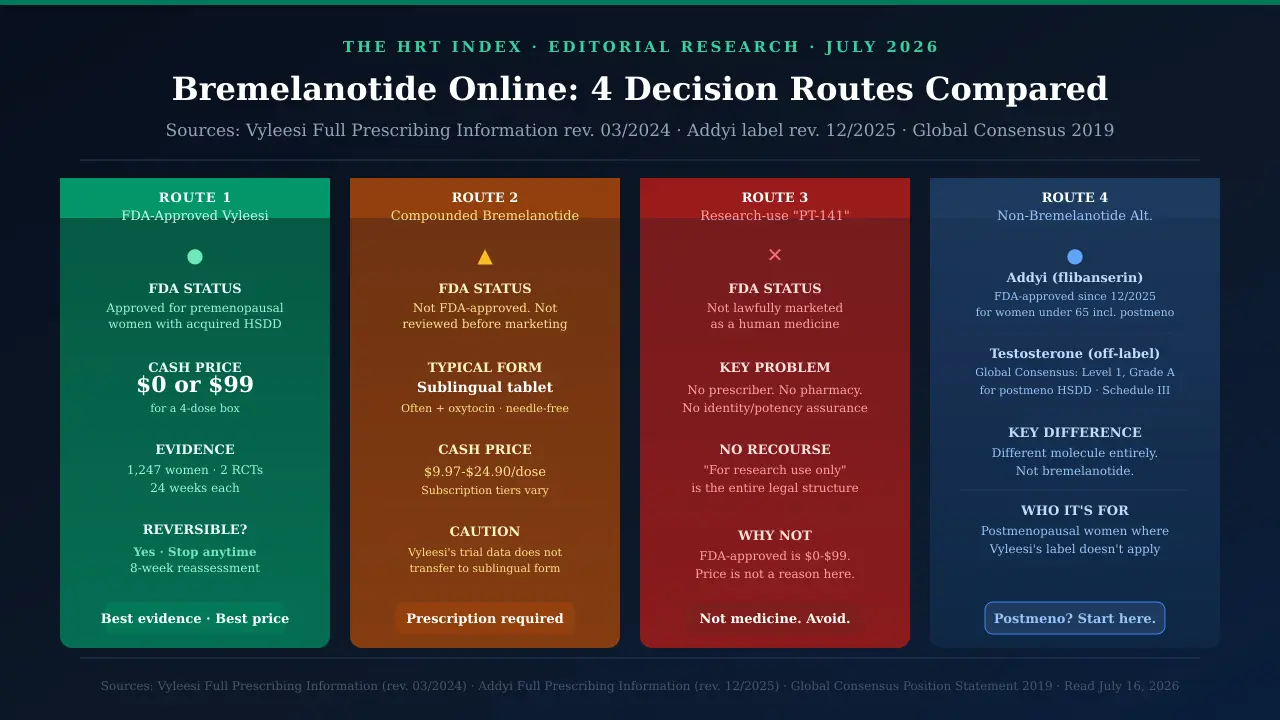
What are the four bremelanotide decision routes?
A woman searching for bremelanotide online has four realistic paths — and only three involve bremelanotide. Three are bremelanotide products. One is not— and for most women reading this page, it’s the one that matters.
| 1. FDA-approved Vyleesi | 2. Compounded bremelanotide | 3. Research-use “PT-141” | 4. Non-bremelanotide alternatives | |
|---|---|---|---|---|
| What it is | Bremelanotide injection, 1.75 mg/0.3 mL autoinjector | Bremelanotide (often + oxytocin), sublingual tablet or nasal | Bremelanotide sold “for research use only” | Addyi (flibanserin) tablet, or off-label transdermal testosterone |
| FDA status | Approved. Reviewed for safety, effectiveness, and quality before marketing | Not FDA-approved. Compounded drugs are not reviewed by FDA before marketing | Not lawfully marketed as a human medicine | Addyi: approved. Testosterone: no FDA-approved female product in the US |
| Approved indication | Premenopausal women with acquired, generalized HSDD | None. A clinician may prescribe, but it has no FDA-approved indication | None | Addyi: women under 65 with acquired, generalized HSDD — including postmenopausal (FDA approval December 13, 2025). Testosterone: postmenopausal HSDD only per consensus |
| DEA schedule | None | None | — | Addyi: none. Testosterone: Schedule III |
| Human trial data | 1,247 women, two 24-week randomized placebo-controlled trials | None published for sublingual bremelanotide + oxytocin that we could identify | None | Addyi: 2,997 premenopausal and 801 postmenopausal women at approved dose. Testosterone: Level 1, Grade A evidence in postmenopausal HSDD |
| Cash price | $99 per 4-dose box from manufacturer’s pharmacy ($24.75 per pen) | $9.97–$24.90 per tablet depending on plan | Varies. Unregulated. | Varies |
| With commercial insurance | $0 for most eligible patients | Not covered. HSA/FSA sometimes claimed. | Not covered | Often covered (Addyi varies by plan) |
| Government plans | Excluded from the $0 program | Not covered | — | Varies |
| Identity, dose, sterility verified | Yes — before marketing | Depends on the pharmacy. Not by FDA before marketing. | No FDA approval-based assurance of any of it | Verified for Addyi |
Sources: Vyleesi Full Prescribing Information rev. 03/2024 · Addyi Full Prescribing Information rev. 12/2025 · vyleesi.com and vyleesi.beyondmd.com, read July 16, 2026.
The one-line version:Route 1 is the real thing and it’s cheaper than you’ve been told. Route 2 is a real prescription for a product nobody reviewed. Route 3 isn’t medicine. Route 4 isn’t bremelanotide at all — and it’s where a lot of our readers should be looking.
Can you actually get a bremelanotide online prescription — or is every site you’re seeing a scam?
Yes, bremelanotide can be legally prescribed through US telehealth. FDA-approved Vyleesi requires a prescription from a licensed clinician. Paying a consultation fee does not guarantee a prescription. The prescribing decision belongs to the clinician, not the drug company and not the platform.
Three companies, three jobs — nobody separates them
| Who | What they actually do | What they do NOT do |
|---|---|---|
| Cosette Pharmaceuticals | Makes and markets Vyleesi. Sets the $99 cash price and runs the $0 copay program | Does not decide whether you get a prescription. Their own site says so. |
| BeyondMD / Prescribery (also branded DocTalkGo, SamaritanMD) | The telehealth funnel Cosette links to. Its affiliated medical group’s US-licensed physicians review your questionnaire and decide | Is not a pharmacy. Is not Cosette. Prescribery is an administrative company that licenses its brand to physician-owned medical groups. |
| BlinkRx | The pharmacy. Checks your insurance, applies the savings program, takes payment, ships free | Does not write prescriptions |
What “legitimate” should actually mean
Before you type your medical history into anything, it should pass all nine:
- The exact product is named — brand name, or “compounded,” with the dose
- FDA-approved vs. compounded status is stated, not implied
- A licensed clinician decides, and you can find out who and where they’re licensed
- The dispensing pharmacy is named
- Consultation cost and medication cost are shown separately
- Nobody promises a prescription before the evaluation
- No “generic Vyleesi” language — there is no generic Vyleesi
- No “FDA-approved pharmacy” language — the FDA does not approve pharmacies
- Refunds, refills, cancellation, and privacy terms exist and are readable
Items 7 and 8 aren’t our opinion. On June 15, 2026, the FDA published a page telling telehealth companies exactly that. We come back to it in the compounded section.
Close the tab on any page that:
- Sells “research use only” product for you to use
- Promises approval before a clinician reviews anything
- Says a compounded drug is “the same as” an FDA-approved one
- Uses Vyleesi’s trial percentages to sell a different formulation
- Won’t name the pharmacy
- Won’t tell you whether it can treat you in your state
Non-affiliate link — we earn nothing
Start here: the route the manufacturer points to
If you’re premenopausal and the profile above sounds like you, the fastest cheap path is the telehealth partner Cosette links from its own homepage. The checkout currently lists $15 for the physician review, marked down from $49, and says a doctor will text or email within 24 hours. That’s contact within 24 hours. It isn’t a promise of approval, and it isn’t delivery. If approved, BlinkRx handles the insurance and ships free. Not sure you’d pass? Read the next section first — it’s the reason people lose that $15.
Open Vyleesi’s official access page →The $15 is non-refundable and does not include the medicine. Paying it does not mean you’ll be approved. Confirm the current fee, your state, and the pharmacy’s price before you enter payment details. Non-affiliate link — we earn nothing.
Who actually qualifies for a bremelanotide prescription?
FDA-approved Vyleesi is indicated only for premenopausal women with acquired, generalized hypoactive sexual desire disorder (HSDD), defined as low sexual desire causing marked distress or interpersonal difficulty not due to a co-existing condition, relationship problems, or medication effects. The label states it is not indicated for HSDD in postmenopausal women or in men, and not indicated to enhance sexual performance.
The label doesn’t say “low libido.” It describes four criteria, and the indication depends on all four.
The four criteria
- Premenopausal. Not “feeling young.” Not “on HRT.” The patient labeling describes women who have not gone through menopause. Twelve consecutive months without a period is the usual retrospective definition of natural menopause when nothing else explains it — but hysterectomy, hormonal contraception, and other causes make period history alone unreliable. Perimenopause is not named as an exclusion. Postmenopause is. If you’re past it, skip ahead.
- Acquired.Desire used to be good and satisfying to you. Then it dropped. If it’s been low as long as you can remember, that’s lifelong HSDD — this drug wasn’t studied in it.
- Generalized.It’s low no matter the situation, the stimulation, or the partner. If it comes back on vacation, or with someone new — that’s real, it’s common, and it’s not what this label describes.
- Not better explained by something else.The label rules out low desire due to another medical or psychiatric condition, relationship problems, or the effects of a medication or drug substance. An SSRI can do this. Thyroid disease can do this. Ruling those out is clinical work. A ten-question web form isn’t built for it.
And you have to actually be botheredby it. The label says “marked distress or interpersonal difficulty.” If your desire is low and you’re genuinely fine with it, that’s not a disorder. That’s a preference.
The hard stops
| Situation | What the label says |
|---|---|
| Uncontrolled hypertension, or known cardiovascular disease | Contraindicated. Not “discuss it.” Contraindicated. |
| High cardiovascular risk, even without diagnosed disease | “Not recommended” |
| Oral naltrexone products for alcohol or opioid addiction | Avoid. Bremelanotide can significantly reduce naltrexone exposure — and naltrexone treatment failure is a different category of risk. |
| Pregnant, might be, or trying | Use effective contraception; discontinue if pregnancy is suspected. Animal studies showed fetal harm. |
| Oral drugs that need a threshold level to work (e.g., certain antibiotics) | Avoid Vyleesi while taking them — it can slow stomach emptying and reduce absorption. |
| Severe kidney or liver impairment | Use with caution. More nausea and vomiting expected. |
| Age 65+ | Safety and effectiveness “have not been established in geriatric patients.” |
The blood pressure part
Vyleesi raises blood pressure. In clinical studies it produced maximum increases of 6 mmHg systolic and 3 mmHg diastolic, peaking 2 to 4 hours after the dose, with heart rate dropping up to 5 beats per minute. Values usually returned to baseline within about 12 hours.
Walk in knowing your actual reading.Not “it’s fine.” The number. It’s the single fastest thing you can do to make this visit useful.
Affiliate link: The HRT Index may earn a commission if you book through the link below. Full disclosure.
→ If you’re not sure you clear all four criteria
Criterion 4 is clinical judgment. So is perimenopause. If you read those and thought I don’t know — that’s the honest answer, and it means a form won’t settle it. Why Midi for this specific question: Midi’s sexual wellness page lists flibanserin (Addyi) and bremelanotide (Vyleesi) under non-hormonal prescriptions, and testosterone under hormonal. Of every route we checked, it’s the only one whose published materials name all three. Visits run about 30 minutes with a licensed clinician. Midi says general care is available in all 50 states and it’s in-network with most PPO plans. Self-pay is $250 for the first visit. Midi cannot treat Medicaid or Medi-Cal patients, even as self-pay. Medicare beneficiaries can be seen self-pay but cannot submit claims.
See if a Midi clinician can evaluate you in your state →What does a bremelanotide prescription actually cost online in 2026?
Vyleesi’s manufacturer publishes $0 for a four-dose box for most eligible commercially insured patients, and $99 for a four-dose box for patients without coverage — about $24.75 per pen. The telehealth partner linked from the manufacturer’s own site publishes a different cash figure: never more than $149 per box. Telehealth consultation fees are listed at $15, non-refundable. Patients on Medicaid, Medicare, or TRICARE are excluded from the manufacturer’s savings program.
Two connected pages. Two cash prices. One click apart.
We read both on the same afternoon, July 16, 2026. vyleesi.com says most commercially insured patients pay $0 for a four-dose box, and that a four-dose box is available for $99 without coverage. vyleesi.beyondmd.com — the third-party telehealth checkout you land on when you click “Continue” — says: Vyleesi is never more than $149/mo per box.
Same drug. Same funnel. Two cash figures, $50 apart, one click from each other. Neither page explains the gap. They may reconcile — $99 could be the program price and $149 a ceiling for cases where something doesn’t apply. We asked. We don’t have an answer in writing, so we’re not going to invent one. We’re telling you it’s a range, and telling you why.
Your first box: the arithmetic nobody publishes
| Your situation | Consult | Medicine | First box, all in | Total ÷ 4 pens |
|---|---|---|---|---|
| Commercial insurance, eligible for the $0 program | $15 | $0 | $15 | $3.75 |
| Cash — manufacturer’s published price | $15 | $99 | $114 | $28.50 |
| Cash — telehealth partner’s published cap | $15 | $149 | $164 | $41.00 |
The consult is a one-time fee, not a per-dose cost. The medicine’s published price is $0 or $99 per four-dose box ($24.75 per pen at $99). Eligibility for the $0 program is evaluated individually. Final price is set at pharmacy checkout.
When the $0 program applies and you use the $15 consult, the FDA-approved drug can run $15 for four doses. That’s less than a single tablet from several compounded sellers. We show that math in the compounded section.
The $1,700 that was actually $98
A Drugs.com reviewer wrote in July 2023 that she panicked when her insurance portal showed her responsible for $1,700 — then called the pharmacy and learned the actual patient payment was $98. One person, in 2023, and we’re not turning it into a rule. But it names a real trap: an insurer’s initial display may not reflect the manufacturer’s savings offer or the final pharmacy-adjudicated amount. If you see a scary number, call the pharmacy before you cancel.
The fine print on “$0” that nobody reads
- Eligibility is evaluated on an individual basis. “Most eligible patients” is not “you.”
- You must be 18 or older
- Patients insured by a government-funded program — Medicaid, TRICARE, and similar — are not eligible. Full stop.
- Assistance applies to a maximum of 2 fills every 30 days
- The program can be modified or discontinued at any time
- Enrollment cannot be retroactive — you can’t fix it afterward
That “2 fills every 30 days” limit is worth doing the math on. Two fills is eight pens. The Vyleesi label says more than eight doses per month is not recommended. The program supports you right up to the label’s ceiling and no further.
If you’re on a government plan, read this before you do anything
- Cosette excludes government-funded plans from the $0 savings program.
- Midi cannot treat Medicaid or Medi-Cal patients at all, even as self-pay. Medicare beneficiaries can use Midi as self-pay patients but cannot submit claims.
What’s actually left:
- Your existing clinician → BlinkRx.Any licensed prescriber can send a Vyleesi prescription to BlinkRx. That may avoid the separate $15 telehealth fee — though your clinician’s own visit charge may still apply. Whether the $99 cash price applies is a question for the pharmacy: ask, don’t assume.
- Sesame Care — a cash-pay marketplace where you choose the clinician and see the visit price before booking. Confirm both the visit and the medication price at checkout.
- An in-person clinician. Sometimes still the right answer, and nobody with an affiliate link is going to volunteer that.
Non-affiliate link — we earn nothing
→ Get your actual number before you decide anything
The published price and your price are two different things. Only the pharmacy can close that gap — and it’s free to find out. BlinkRx checks your coverage, applies any savings offer, and tells you the real number before you pay. Free home delivery.
See Vyleesi’s current pricing and coverage terms →If you’re postmenopausal, read this section instead of the rest of the page
FDA-approved Vyleesi is not indicated for HSDD in postmenopausal women — the limitation is stated in its label. On December 13, 2025, the FDA approved a revised indication for Addyi (flibanserin 100 mg) covering acquired, generalized HSDD in women younger than 65, which includes postmenopausal women. In its trial of 447 postmenopausal women under 65, Addyi produced statistically significant improvements versus placebo in satisfying sexual events, desire, and distress.
What Vyleesi’s label says, exactly
“Vyleesi is not indicated for the treatment of HSDD in postmenopausal women or in men.” That’s not a caution. That’s the FDA-approved label telling you the studies weren’t done in you. Every Vyleesi trial participant was premenopausal. Age range 19 to 56. Mean age 39.
What changed on December 13, 2025
The FDA approved a revised indication for Addyi (flibanserin 100 mg): acquired, generalized HSDD in women less than 65 years of age.No premenopausal restriction. Addyi has been approved since 2015 — but only for premenopausal women. For ten years, the same pill was approved for a 44-year-old and not for a 54-year-old. The label’s own “Recent Major Changes” line dates it: Indications and Usage, 12/2025.
Source: Addyi Full Prescribing Information, rev. 12/2025
What Addyi’s postmenopausal trial actually found
Study 6 (NCT00996372). 447 postmenopausal women under 65 on Addyi, 455 on placebo. Mean age 55. Twenty-four weeks. All numbers below are from the label:
| Endpoint | Addyi | Placebo | Treatment difference |
|---|---|---|---|
| Satisfying sexual events per 28 days (baseline 2.0) | +0.9 | +0.6 | +0.4, p<0.025 |
| Desire (FSFI Desire, scale 1.2–6.0, baseline 1.8) | +0.7 | +0.4 | +0.3, p<0.0001 |
| Distress (FSDS-R Q13, scale 0–4, baseline 3.3) | -0.8 | -0.6 | -0.2, p<0.01 |
These are modest average changes. Nobody should read them as transformation. But note what’s in the top row: a statistically significant improvement in satisfying sexual events, in postmenopausal women. Vyleesi’s trials did not show that in anyone— its satisfying-sexual-events endpoint came back p=0.76 and p=0.70.
These are two different drugs, two different populations, two different studies, and nobody has run them head to head.Both labels warn that adverse-reaction rates from different trials can’t be directly compared. We’re not telling you one is better. We’re telling you what each label reports about its own trials.
Addyi is not a free lunch
It carries a boxed warning — the FDA’s most serious kind:
- Alcohol. Wait at least two hours after one or two standard drinks before taking Addyi at bedtime. Skip the dose entirely if you’ve had three or more. After taking it at bedtime, no alcohol until the next day.
- Contraindicated with moderate or strong CYP3A4 inhibitors — that list includes common antibiotics, antifungals, some blood-pressure drugs, and grapefruit juice
- Contraindicated with any degree of hepatic impairment
- It’s a nightly pill, taken at bedtime, because taking it during the day raises the risk of low blood pressure, fainting, and sedation
- Avoid driving or anything needing full alertness for at least 6 hours after each dose
- In postmenopausal trials, 9% discontinued for adverse reactions versus 5% on placebo
The alcohol rule is the one that decides it for most women. If two glasses of wine is a normal Tuesday, this pill is going to be a negotiation every single night.
Vyleesi vs. Addyi: different shapes, not better and worse
| Vyleesi (bremelanotide) | Addyi (flibanserin) | |
|---|---|---|
| Indicated for | Premenopausal women, acquired generalized HSDD | Women under 65, including postmenopausal, acquired generalized HSDD |
| How you take it | Injection, only when you want it | Pill, every night at bedtime |
| Boxed warning | None | Yes — hypotension and syncope |
| Alcohol | No labeled alcohol restriction | Boxed alcohol warning. Timing rules every night. |
| Satisfying sexual events in its own trials | No significant difference vs placebo (p=0.76, p=0.70) | Significant improvement, pre- and postmenopausal |
| Postmenopausal? | No | Yes, if you’re under 65 |
| Main burden | The needle, and 40% nausea | Nightly dosing, sedation, and the alcohol rules |
Both labels state that adverse-reaction rates from different clinical trials cannot be directly compared. This table is not head-to-head evidence.
The point isn’t that Addyi is wonderful. The point is that it exists for you and Vyleesi doesn’t— and until December 13, 2025, that sentence wasn’t true.
Affiliate link — read this, it’s the point. We may earn a commission if you use it. Midi listed Addyi, Vyleesi, and testosterone together when we verified, July 16, 2026. A listing does not mean every medication is available in every state, or that one visit reaches every option. Full disclosure.
→ Book a Midi sexual wellness visit
If you’re postmenopausal, a Vyleesi-only funnel is structurally incapable of helping you. Midi is the only route we publicly verified whose materials name Addyi, Vyleesi, and testosterone together — general care in all 50 states; testosterone in 25 states and compounded; most PPOs, but coverage varies. No Medicaid or Medi-Cal; Medicare self-pay only. Booking is not a prescription.
Book a Midi sexual wellness visit →What about testosterone?
The 2019 Global Consensus Position Statement on testosterone therapy for women — endorsed by 11 societies — supports one evidence-based indication: HSDD in postmenopausal women, following a full biopsychosocial assessment. No FDA-approved testosterone product exists for women in the US. Testosterone is a Schedule III controlled substance.
What the consensus supports
At approximately physiologic premenopausal doses, in postmenopausal women with HSDD:
- Increased satisfying sexual events — about one more per month (Level 1, Grade A)
- Improvement in desire, arousal, orgasm, pleasure, and responsiveness
- Reduced sexual distress
What it doesn’t support
- Pellets and injections — the recommendations don’t extend to preparations producing supraphysiologic concentrations
- Compounded testosterone generally — narrow exception only where no authorized equivalent exists, with quality requirements
- Premenopausal women — insufficient data
- Testosterone for wellbeing, mood, or cognition — the data show no effect on general wellbeing
What it requires
- Baseline total testosterone before you start
- Recheck at 3 to 6 weeks
- A level every 6 months to screen for overuse
- Stop at 6 months if it isn’t working
The part we have to be straight about, because they pay us
Midi’s testosterone is compounded. Their own page says so, in their own footnote: compounded testosterone is not FDA-approved, and the FDA does not evaluate compounded medications for safety, effectiveness, or quality prior to use. The Global Consensus recommends against compounded testosterone.
We are not going to apply one standard to a company that doesn’t pay us and a softer one to a company that does. What Midi doesdo — and it’s most of what the consensus actually cares about:
- No pellets. Their FAQ says so flatly, with the right reason: pellets release testosterone in uncontrolled amounts and can’t be adjusted once implanted.
- Low dose, adjustable, and stoppable
- Labs at the start, again at 4–6 weeks, then every 6–12 months (consensus says baseline, 3–6 weeks, then every 6 months — close)
- Two visits before a prescription
- An exit: if nothing’s changed by 12 weeks, they’ll suggest other options
Midi’s testosterone program is currently listed in 25 states— not all 50. Check the list before you book. If you want testosterone that isn’t compounded, ask any prescriber about an FDA-approved male product used off-label at a female dose with monitoring. That’s what the consensus actually describes.
Four questions to take to any testosterone visit
- Is this transdermal — a cream or gel — or is it a pellet or an injection?
- What dose, and does it target the premenopausal physiologic range?
- Will you check my baseline total testosterone before I start, and recheck at 3 to 6 weeks?
- Is this an FDA-approved product used off-label at a female dose, or is it compounded?
Does bremelanotide actually work? Here’s the arithmetic they published but didn’t do.
In two identical 24-week randomized, double-blind, placebo-controlled trials of 1,247 premenopausal women with acquired, generalized HSDD, Vyleesi produced statistically significant average improvements in both desire and distress. On the desire measure, Vyleesi improved by 0.5 to 0.6 points against 0.2 for placebo. There was no statistically significant difference between Vyleesi and placebo in the number of satisfying sexual events. 18% of Vyleesi-treated patients discontinued due to adverse reactions, versus 2% on placebo.
Decoding “164%”
Cosette’s homepage leads with two numbers in big type: a 164% increase in desire and a 75% decrease in distress. Both numbers are real. Neither means what you just thought it meant.
The footnote tells you the desire scale runs from 1.2 at the low end to 6.0 at the high end. The label tells you the average woman started at about 2.0. Here’s where 164% comes from:
“164% increase in desire” is a comparison of two average changes. The Vyleesi group’s average change was 164% bigger than the placebo group’s average change. It is not a 164% increase in anyone’s desire. Her actual score moved 0.58 points, from roughly 2.0 to roughly 2.6, on a scale that runs to 6.0.
Nobody hid anything. The scales are right there in the footnotes. Cosette just didn’t do the division. We did.
What the label reports, without the percentages
| What the label says | Study 1 | Study 2 |
|---|---|---|
| Desire (FSFI-Desire, scale 1.2–6.0) — Vyleesi | +0.5 | +0.6 |
| Desire — placebo | +0.2 | +0.2 |
| p-value | 0.0002 | <0.0001 |
| Distress (FSDS-DAO Q13, scale 0–4) — Vyleesi | -0.7 | -0.7 |
| Distress — placebo | -0.4 | -0.4 |
| Satisfying sexual events — Vyleesi vs placebo | No significant difference (p=0.76) | No significant difference (p=0.70) |
| Discontinued due to adverse reactions (pooled) | 18% | 2% (placebo) |
The reviews are polarized, and you should see that honestly
Drugs.com carries 38 reviews of Vyleesi for HSDD, averaging 7.2/10 (read July 16, 2026):
| Rating | Share |
|---|---|
| 10 (top) | 45% |
| 9 | 13% |
| 8 | 5% |
| 7 | 5% |
| 5–6 | 6% |
| 4 | 5% |
| 2–3 | 0% |
| 1 (bottom) | 21% |
58% gave it a 9 or 10. 21% gave it a 1. Nobody gave it a 2 or a 3.That’s a small, self-selected sample of people who felt strongly enough to post — it is not a clinical dataset. But read the one-stars and they’re not “meh” — they’re nausea bad enough to wreck the night.
What we’d tell a friend:Vyleesi requires a needle. It causes nausea in 40% of people. Its average improvements in desire and distress were real but modest. It didn’t move satisfying sexual events at all. If you want a sure thing, this isn’t it, and we’re not going to pretend. And: the label builds in an exit. Section 2.2 says discontinue after 8 weeks if you don’t report an improvement. This is not a medication you sign up for indefinitely and hope. Both paragraphs are true at once. That’s the whole drug.
What is it actually like? Side effects, nausea, and the timing nobody warns you about
In pooled phase 3 trials, nausea was reported by 40% of Vyleesi-treated patients versus 1.3% on placebo, with median onset within one hour and duration of about two hours. Flushing occurred in 20.3%, injection site reactions in 13.2%, headache in 11.3%, and vomiting in 4.8%. 18% discontinued due to adverse reactions vs. 2% on placebo.
The full table, from the label
| Side effect | Vyleesi (n=627) | Placebo (n=620) |
|---|---|---|
| Nausea | 40.0% | 1.3% |
| Flushing | 20.3% | 0.3% |
| Injection site reactions | 13.2% | 8.4% |
| Headache | 11.3% | 1.9% |
| Vomiting | 4.8% | 0.2% |
| Cough | 3.3% | 1.3% |
| Fatigue | 3.2% | 0.5% |
| Hot flush | 2.7% | 0.2% |
| Tingling (paraesthesia) | 2.6% | 0.0% |
| Dizziness | 2.2% | 0.5% |
| Nasal congestion | 2.1% | 0.5% |
| Discontinued due to adverse reactions | 18% | 2% |
The nausea, honestly
40% is the number everyone quotes. It’s the wrong number for the question you’re actually asking. Here’s the shape of it:
- 21% got nauseated on the first dose. Then it dropped to about 3% on subsequent doses.
- Median onset: within one hour. Typical duration: about two hours.
- 13% of women needed anti-emetic medicine
- 8% discontinued the trials because of nausea specifically
Your first dose is the gauntlet. Roughly a one-in-five chance you feel sick, for about two hours.
The Zofran myth, killed by the label itself
Search any forum and you’ll get the same advice: take a Zofran first. The label says that was studied, and it didn’t work.
A phase 4, single-dose, placebo-controlled study: 228 healthy women, randomized 1:1 to 8 mg oral ondansetron or placebo, taken 30 minutes before a dose of Vyleesi. No significant difference in nausea between the groups.The label’s conclusion: pre-treating with oral ondansetron does not reduce Vyleesi-associated nausea and is not recommended.
It also notes something people miss: taking ondansetron after nausea begins has not been formally studied.So “not proven to help beforehand” is not “won’t help once it’s happening.” We’re not giving you a nausea protocol — we’re telling you the popular one was tested and failed, so bring it to your prescriber instead of Reddit.
The skin thing you should actually understand
Focal hyperpigmentation — darkening of skin on the face, gums, and breasts — was reported in 1% of patients using up to 8 doses per month, versus none on placebo. A separate clinical study found that 38% of patients developed focal hyperpigmentation after taking Vyleesi daily for eight days.
The mechanism explains it: bremelanotide activates melanocortin receptors, including MC1R, which sits on the cells that make melanin. Activate it often enough and you make pigment. Risk is higher in people with darker skin. The label says resolution was not confirmed in all patients after stopping. Anyone selling you a bremelanotide product without a dose ceiling is skipping a section the FDA-approved label spent real space on.
The timing thing nobody tells you
The label says inject at least 45 minutesbefore. Every marketing page repeats “45 minutes.” Read the label’s very next sentence:
The optimal window has not been fully characterized, and patients may work out their own best timing. 45 minutes is a floor, not a forecast. The label is telling you to find your own clock.
Plasma concentration peaks at about one hour. Terminal half-life is about 2.7 hours. Some reviewers report onset at two to four hours. Don’t judge your first dose at the 45-minute mark.
The stretching thing
Reading through the Drugs.com reviews, we noticed something not in the label’s adverse reaction table at all: an overwhelming urge to stretch.Six different reviewers on the first page, read July 16, 2026, describe it independently, in different words, clearly without having read each other. One called it the first sign it was working. Another said her body hurt the next day from it. It’s not a labeled adverse reaction. We’re telling you because six strangers said it and nobody else will.
Is PT-141 the same as Vyleesi?
PT-141 and bremelanotide are the same molecule. Vyleesi is one specific FDA-approved product: a 1.75 mg/0.3 mL sterile subcutaneous injection with a defined dose, formulation, manufacturing standard, and approved indication. Products sold online as “PT-141” may be compounded prescriptions, research-use-only chemicals not lawfully marketed as human medicines, or something else. The molecule name tells you nothing about whether a product is FDA-approved.
The analogy that works: “bremelanotide” is like “acetaminophen.” “Vyleesi” is like a specific FDA-approved tablet.Nobody would buy acetaminophen powder from an unlabeled bag online and call it Tylenol. That’s exactly what buying “PT-141” from a peptide site is.
Four things to check on any product page
| Check | Why |
|---|---|
| Route — injection, sublingual, nasal? | The pivotal efficacy trials supporting Vyleesi’s approval used the 1.75 mg subcutaneous injection. Change the route and you change how much drug arrives, and when. |
| Dose | Vyleesi’s studied dose is 1.75 mg. If a page won’t tell you the dose, that tells you something. |
| Prescriber | A named, licensed clinician who can treat you where you physically are |
| Pharmacy | A named dispensing pharmacy. Not “our partner pharmacy.” A name. |
About “research use only”
Some sites sell bremelanotide as a research chemical. There is no FDA approval-based assurance of identity, potency, sterility, manufacturing quality, or labeling accuracy — and no prescriber-to-pharmacy chain at all.No clinician. No pharmacy. No adverse event report. No recourse. You would be injecting an unverified peptide based on a label whose author’s defense is that they told you not to. The FDA-approved version is $99 for four doses, or $0 if you qualify. Price alone is not a reason to substitute.
Why men keep landing on this page:The FDA-approved label closes both doors. It states Vyleesi is not indicated in men and not indicated to enhance sexual performance — in anyone. This page is written for women, and we’re not going to route male performance traffic to a peptide seller to earn a click.
Compounded and “needle-free” bremelanotide: what to know before you order
Compounded bremelanotide — typically a sublingual tablet, sometimes combined with oxytocin — is not FDA-approved Vyleesi and is not a generic version of it. Compounded drugs are not reviewed by the FDA for safety, effectiveness, or quality before marketing. In June 2026 the FDA published a page reminding telehealth companies not to describe compounded drugs as generic versions of, the same as, or clinically proven to produce the same result as FDA-approved drugs.
The FDA published a list five weeks ago. Use it.
On June 15, 2026, the FDA published “FDA to Telehealth Companies: What to Know When Promoting Compounded Drugs.” Its enumerated reminders include these as false or misleading:
- Branding that falsely implies the telehealth company is the compounder
- Describing a compounded drug as a generic version of an FDA-approved drug, or the same as an FDA-approved drug
- Claiming a compounded drug has been FDA-approved or evaluated for safety and effectiveness
- Describing a compounded drug as clinically proven to produce the same result as the FDA-approved drug
- Claiming a compounded drug is sourced from an FDA-approved or FDA-licensed pharmacy — FDA notes it does not approve or license any facility
Take that list back to whatever ad brought you here and score it yourself. There is no generic Vyleesi. A compounded drug cannot be a generic: generics are FDA-approved before marketing, and compounded drugs are not reviewed at all.
The evidence transfer problem
| What was studied (Vyleesi trials) | What gets sold (compounded products) |
|---|---|
| Bremelanotide alone | Bremelanotide + oxytocin — a different formulation |
| 1.75 mg | Dose often not published |
| Subcutaneous injection (~100% bioavailability) | Sublingual tablet or nasal spray. No published human pharmacokinetic study we could identify for sublingual bremelanotide. |
| Nausea: 21% first dose / ~3% after — measured for the injection | The same two figures, quoted for a lozenge that has never been through a trial |
| 1,247 premenopausal women, 24 weeks, placebo-controlled | The same trial results, quoted for a different product |
Why route isn’t a convenience feature for this molecule
The label describes the primary metabolic pathway: it’s a peptide of seven amino acids, and the primary pathway is repeated hydrolysis of the amide bonds — your body disposes of it by taking the peptide apart at the seams. The FDA-approved product is an injection with about 100% bioavailability. Every efficacy number in this article was generated at that exposure. A sublingual tablet is a different journey for a peptide. Maybe enough gets there. Maybe it works fine. We don’t know— and as of July 16, 2026, we did not identify a published human pharmacokinetic study of a sublingual bremelanotide-plus-oxytocin formulation.
The price comparison everybody gets backwards
Compounded sellers benchmark against Vyleesi’s retail price. Watch what happens when you use the manufacturer’s actual published price instead.
| Product | Published price | Cost per dose |
|---|---|---|
| Vyleesi — commercial insurance, eligible for program | $0 / 4-dose box | $0.00 |
| Compounded sublingual — 30-tablet plan | $299 / 30 tablets, every 3 months | $9.97 |
| Compounded sublingual — 20-tablet plan | $249 / 20 tablets, every 2 months | $12.45 |
| Compounded sublingual — monthly subscription | $199/mo / 10 tablets | $19.90 |
| Vyleesi — cash, manufacturer’s published price | $99 / 4-dose box | $24.75 |
| Compounded sublingual — one-time purchase | $249 / 10 tablets | $24.90 |
| Vyleesi — cash, telehealth partner’s published cap | $149 / 4-dose box | $37.25 |
Two things fall out of that table. One: the compounded lozenge’s one-time price ($24.90) is fifteen cents more per dose than the FDA-approved injection’s cash price ($24.75). Not cheaper. More. Two:if you qualify for the $0 program and you fit the label, the FDA-approved drug costs nothing and the compounded one doesn’t. The entire cost argument inverts.
One seller advertises roughly $8–$10 per experience. Do the division on their own published tiers: $299 ÷ 30 = $9.97 — matches. $249 ÷ 20 = $12.45 . $199 ÷ 10 = $19.90 . $249 ÷ 10 = $24.90 . The advertised figure describes their largest plan only.
The refund question
Inner Balance publishes a money-back guarantee. It does not apply to Libida. Their refund policy names Libida explicitly on the exclusion list, alongside supplements, lab tests, third-party services, and NAD+. So: a $249 product, with the dose not published, the dispensing pharmacy not named, the state list not published, and no refund. You should know all four of those before you enter a card.
Affiliate disclosure — read this, it’s the point of the link. We may earn a commission if you use it. Libida is a compounded bremelanotide-and-oxytocin sublingual tablet. It is not FDA-approved Vyleesi. It is not a generic version of Vyleesi. The FDA has not reviewed it for safety, effectiveness, or quality. Vyleesi’s clinical trial results were generated with a 1.75 mg subcutaneous injection and do not establish results for this formulation. Full disclosure.
→ If you want to look at the compounded program — ask these five questions first
Ask before you pay, not after: (1) the exact dose of bremelanotide and oxytocin; (2) the name of the dispensing pharmacy; (3) whether they can dispense in your state; (4) how cancellation works; (5) confirm the refund terms — their published policy excludes Libida.
If you’re premenopausal with commercial insurance:Don’t use this link. Use the $0-or-$99 FDA-approved route above — we make nothing from it, and it’s the better deal and the better evidence. We’d rather tell you that than take the commission.
See Inner Balance’s Libida program →What to verify before you pay for any online prescription
Before paying any online consultation fee, confirm whether the product is FDA-approved or compounded, who the prescribing clinician is and whether they can treat you in your state, whether the fee is refundable if you are declined, which pharmacy dispenses, what the medication costs separately, and what follow-up is included. A legitimate platform describes an evaluation. It does not promise a prescription.
The 12 questions. Copy these before your card is entered.
- Is this FDA-approved Vyleesi, or a compounded product?
- Who is the clinician or medical group — the actual name?
- Can that clinician treat me in the state where I’ll physically be?
- Is the consultation fee refundable if I’m declined? (On the manufacturer’s linked partner, the checkout currently says non-refundable.)
- Does the consult fee include the medicine? (Almost never.)
- Is my cash price $99, $149, or something else?
- Does that price include four autoinjectors?
- Which pharmacy dispenses it?
- Who handles prior authorization if my insurer wants it?
- What follow-up is included if it doesn’t work, or if I feel terrible?
- What happens to refills, auto-renewal, and cancellation?
- Can anything compounded be substituted for what I was prescribed? (The answer should be no.)
Free: the HSDD Consult Prep Sheet
One page. No email. Print it or keep it on your phone. Includes the four label criteria so you can check yourself before you pay, space to record your blood-pressure reading, the medication interactions that matter, the four testosterone questions from the global consensus, the 12 questions above, and blanks for the numbers you’ll be quoted. Download the HSDD Consult Prep Sheet (PDF, no email) →
One privacy note, from the manufacturer’s own page
Cosette states that anything confidential or sensitive you send through their newsletter signup form — it names prior authorization requests and medical or prescription information specifically — is not subject to HIPAA, may not be covered by other privacy protections, and that the company cannot guarantee your information’s security.
That’s a marketing form, not a clinical one, and Cosette deserves credit for saying so in plain English. Don’t type your medical history into a mailing list signup.Use the clinical channel instead, and read the treating medical group’s Notice of Privacy Practices.
How The HRT Index verified this page
Every price cited was read at its published source and dated. FDA-approved and compounded products are kept strictly separate. Medical claims trace to current FDA labels or primary clinical literature. Unresolved facts are labeled as unresolved rather than estimated. No provider received a better conclusion because of what it pays.
See our full verification standard.
What we actually checked, and when
Read at the source on July 16, 2026:
- The full FDA prescribing information for Vyleesi (rev. 03/2024) — indication, limitations, contraindications, adverse event rates, trial tables, pharmacokinetics, and the ondansetron study
- The full FDA prescribing information for Addyi (rev. 12/2025) — the revised indication, boxed warning, exposure numbers, discontinuation rates, and the postmenopausal trial
- vyleesi.com — the $0 and $99 figures, program terms, both telehealth links, the efficacy claims and their footnotes, the alcohol bullet, the HIPAA disclaimer
- vyleesi.beyondmd.com — the $15 consult, the non-refundable term, the $149 cash cap, the 24-hour contact language, and the Prescribery terms of use
- joinmidi.com/sexual-wellness and /testosterone — the Addyi/Vyleesi/testosterone listings, the compounded-testosterone disclosure, the 25-state testosterone list, the all-50-states and PPO claims, $250/$150 self-pay, and the Medicaid and Medicare policies
- innerbalance.com — Libida’s formulation description, the four published price tiers, the per-experience claim, and the refund policy
- FDA, “FDA to Telehealth Companies” — published June 15, 2026
- Davis SR et al., Global Consensus Position Statement, J Clin Endocrinol Metab 2019
- Drugs.com — the Vyleesi review distribution (38 reviews)
What we could not verify
Why the $99 and $149 figures differ (we asked; no written answer yet) · whether the two telehealth entry points on vyleesi.com price differently · which states each telehealth partner serves (not published) · any published human pharmacokinetic study for sublingual bremelanotide (we searched and found none — a bounded negative, not a proof of absence) · Libida’s exact bremelanotide and oxytocin doses, dispensing pharmacy, and state list (not published where we could find them) · what a Vyleesi prescription costs at final pharmacy checkout (only the pharmacy can tell you).
Where we broke from our own defaults
Our normal provider priority does not put Midi first. On this page it does, because Midi is the only route we verified whose published materials list Addyi, Vyleesi, and testosterone together — and on a page where many readers can’t have the drug they searched for, medication fit is the pillar that decides. Fit beat payout. That’s the rule, and this is what it looks like when it costs us.
Our top recommendation — the route Cosette links from its own homepage — pays us nothing.We put it first anyway. And when we found our own advertiser’s testosterone is compounded, we wrote that down instead of leaving it out.
Update schedule
| Element | Cadence | Next review |
|---|---|---|
| Pricing and program terms | Monthly | August 2026 |
| Route availability and provider terms | Quarterly | October 2026 |
| FDA labels and regulatory guidance | Quarterly + immediately on any revision | October 2026 |
| Drugs.com review distribution | Quarterly | October 2026 |
Found something wrong? Tell us and we’ll fix it and date the fix.
Frequently asked questions
- Can I buy bremelanotide online without a prescription?
- No. FDA-approved Vyleesi is prescription-only. Products sold as “PT-141” without a prescription are typically research-use-only chemicals not lawfully marketed as human medicines — no FDA approval-based assurance of identity, potency, or sterility, no prescriber, no pharmacy, no recourse. The approved version is $99 for four doses, or $0 for patients who qualify for the program.
- How much does Vyleesi cost without insurance?
- The manufacturer publishes $99 for a four-dose box — $24.75 per pen. The telehealth partner linked from that same site publishes a cash cap of $149 per box. Neither page explains the difference. Add roughly $15 for the consult, so a realistic first box is $114 to $164. The pharmacy sets the final price. Retail pricing without any program runs dramatically higher and moves constantly.
- Is Vyleesi covered by insurance?
- Coverage varies by plan. The manufacturer’s program says most eligible commercially insured patients pay $0 for a four-dose box, with eligibility evaluated individually. Patients insured by government-funded programs — Medicaid, TRICARE, and similar — are not eligible.Assistance applies to a maximum of 2 fills every 30 days and can’t be applied retroactively.
- Can postmenopausal women take Vyleesi?
- No — the label states it is not indicated for HSDD in postmenopausal women. But as of December 13, 2025, Addyi (flibanserin) is FDA-approved for acquired, generalized HSDD in women under 65, including postmenopausal women. In its postmenopausal trial, Addyi showed statistically significant improvements in satisfying sexual events, desire, and distress. It carries a boxed warning for hypotension and syncope. Full comparison above.
- I’m perimenopausal. Am I ruled out?
- Not automatically. The label says premenopausal and excludes postmenopausal women — it does not name perimenopause as an exclusion. If you’re still cycling, even irregularly, a clinician has to decide whether you fall inside the labeled population. Don’t rule yourself out from a webpage.
- Is bremelanotide a hormone? Is it HRT?
- No. Bremelanotide is a melanocortin receptor agonist— it activates receptors that the FDA label says are found throughout the central nervous system. It is not estrogen, progesterone, or testosterone. It is not hormone therapy and it doesn’t treat hot flashes, night sweats, or vaginal dryness. The label also says the mechanism by which it improves HSDD is unknown.
- Is Vyleesi “female Viagra”?
- No, and the nickname misleads. Viagra affects blood flow. Vyleesi acts on brain receptors, and its label explicitly says it is not indicated to enhance sexual performance. Different target, different question.
- How long does it take to work?
- The label says inject at least 45 minutes beforehand — then says the duration of efficacy is unknown and the optimal window has not been fully characterized,and tells patients to find their own timing. Plasma concentration peaks at about one hour. Don’t judge your first dose at the 45-minute mark.
- How long does it last?
- The label says the duration of efficacy after each dose is unknown. Its terminal half-life is about 2.7 hours. Nobody can give you a reliable number, and anyone who does is making it up.
- How common is the nausea, really?
- 40% of trial patients reported nausea across 24 weeks. Per dose: 21% on the first dose, dropping to about 3% after. Median onset within an hour, lasting about two hours. 13% needed anti-emetic medicine. 8% discontinued the trials over it. The label says it improved for most patients with the second dose, but can happen after any dose.
- Should I take Zofran before my first dose?
- The label says no. A phase 4 study of 228 healthy women tested 8 mg ondansetron 30 minutes before a dose and found no significant difference in nausea.Pre-treatment is not recommended. Taking it after nausea starts hasn’t been formally studied — raise that with your prescriber.
- Can I drink alcohol with it?
- Vyleesi carries no labeled alcohol restriction, and the manufacturer’s site says it’s safe with alcohol. Worth knowing what that rests on: a 24-person study using a 20 mg intranasal formulation that was never approved, at 2.5× Vyleesi’s peak concentration. It found no effect on drug levels, but more flushing and more headache in combination. Ask your prescriber, not a marketing bullet. (Addyi is completely different here — it has a boxed alcohol warning.)
- Does it need refrigeration?
- No. Store at or below 77°F (25°C), don’t freeze it, protect it from light.
- How often can I use it?
- No more than one dose in 24 hours, and more than 8 doses per month is not recommended. More frequent dosing raises the risk of focal hyperpigmentation: it was reported in 1% of patients using up to 8 monthly doses, and in 38% of patients dosed daily for eight days in a separate study.
- What if it doesn’t work?
- The label says discontinue after 8 weeksif you don’t report an improvement. Addyi’s label says the same thing. Both drugs build in a reassessment point rather than assuming you’ll stay on them indefinitely.
- Is compounded bremelanotide the same as Vyleesi? Is it generic Vyleesi?
- No, and there is no generic Vyleesi. Compounded drugs are not reviewed by the FDA for safety, effectiveness, or quality before marketing.The FDA’s June 2026 page on telehealth marketing lists “generic version of” and “the same as” an FDA-approved drug among the claims it identifies as false or misleading. Vyleesi’s trial data came from a 1.75 mg subcutaneous injection and does not transfer to a differently formulated sublingual product.
- Is PT-141 the same as Vyleesi?
- PT-141 and bremelanotide are the same molecule. Vyleesi is one specific FDA-approved product containing it, at a defined dose and route, made to reviewed standards. The molecule name tells you nothing about whether a given product is approved, correctly dosed, sterile, or lawfully sold for human use.
- Is bremelanotide a controlled substance?
- No. Vyleesi carries no DEA schedule. Testosterone, which comes up on this page as an alternative for postmenopausal women, isa Schedule III controlled substance — don’t let the two blur together.
- Will an online consultation guarantee me a prescription?
- No. Every legitimate platform says the same thing, including the manufacturer’s own site: the prescribing decision belongs to the clinician. The consultation fee on the manufacturer’s linked partner is currently $15 and non-refundable.You’re buying an evaluation, not an outcome.
- Can men get a Vyleesi prescription?
- The label states Vyleesi is not indicated in men and not indicated to enhance sexual performance. This page is written for women, and we’re not going to route male performance traffic to a peptide seller for the click.
- I’m on Medicaid or Medicare. What are my options?
- The manufacturer’s $0 savings program excludes government-funded plans. Midi cannot treat Medicaid or Medi-Cal patients at all, though Medicare beneficiaries can be seen as self-pay without submitting claims. What’s left: ask your existing clinician to send a prescription to BlinkRx (which may avoid a second consult fee, though your clinician’s own charges may apply), confirm with the pharmacy whether the $99 cash price applies to you, look at a cash-pay marketplace like Sesame Care, or see someone in person.
So which route is actually yours?
You’ve got everything now. Here’s the short version, by who you are.
If you’re premenopausal and the four criteria fit
The FDA-approved route has the best evidence and probably the best price. $15 for the review. $0 or $99 for the medicine. And the label tells your prescriber to reassess at 8 weeks — this isn’t a lifetime commitment. It’s a question with an answer date.
Non-affiliate — we earn nothing. Prescription not guaranteed.
If you’re postmenopausal, perimenopausal, or honestly not sure
If you’re postmenopausal, Vyleesi’s label closes on you — but Addyi’s expanded indication was approved on December 13, 2025, and its postmenopausal trial moved the endpoint Vyleesi never did. If you’re perimenopausal or unsure of your status, that’s a clinician’s call, not a webpage’s. Either way you need someone who can reach more than one drug.
Affiliate link — we earn a commission. Full disclosure. Lists Addyi, Vyleesi, and testosterone. General care in all 50 states; testosterone in 25 states and compounded. Most PPOs, but coverage varies. No Medicaid; Medicare self-pay only.
Book a Midi sexual wellness visit →If the real problem might not be desire at all
If sex hurts, if dryness is the barrier, if you’re not sleeping, if a medication changed things, if you’re exhausted in a way that has nothing to do with your partner — pain and dryness may be a separate or contributing cause that needs its own treatment path first. Our libido and sexual health guide walks through what else can be driving it.
Get your personalized HRT path
Matches your symptoms, age, health history, and state to the right online service — and flags when online care isn’t the right starting point.
Find My HRT Path →If you want needle-free and you’ve read the compounded section
Go in with the five questions, and know the refund policy excludes it.
Affiliate link — we earn a commission. Compounded, not FDA-approved Vyleesi. Not reviewed by FDA for safety, effectiveness, or quality. Refund policy excludes Libida. Full disclosure.
See Inner Balance’s Libida program →If you’re here because an ad found you and made you feel like your marriage is a problem to be solved with a syringe — it isn’t, and you’re not broken. Low desire is common. The only thing that makes it a disorder is whether it bothers you.If it does, it’s an ordinary medical thing to bring to a clinician, like anything else. If it doesn’t, then nothing on this page needs your money. Either way, you should get to make that call with the actual numbers in front of you. That’s what this was for.
Sources
FDA labeling and regulatory
- Vyleesi (bremelanotide injection) Full Prescribing Information, rev. 03/2024 — Cosette Pharmaceuticals
- Vyleesi FDA-approved Patient Information, rev. 03/2024
- Addyi (flibanserin) Full Prescribing Information, rev. 12/2025 — US FDA. Controlling source for Addyi’s current indication, boxed warning, and postmenopausal trial results.
- Addyi FDA supplement approval letter, electronically signed December 13, 2025 — US FDA. The approval letter dates the expanded indication separately from the later public announcement.
- FDA to Telehealth Companies: What to Know When Promoting Compounded Drugs — US FDA, published June 15, 2026
- Historic First in Women’s Sexual Health: FDA Grants Approval for Addyi in Postmenopausal Women — Sprout Pharmaceuticals, December 15, 2025 (announcement; see source 3 for the label)
Clinical literature
- Davis SR, Baber R, Panay N, et al. Global Consensus Position Statement on the Use of Testosterone Therapy for Women. J Clin Endocrinol Metab. 2019;104:4660–4666.
- Parish SJ, Simon JA, Davis SR, et al. ISSWSH Clinical Practice Guideline for the Use of Systemic Testosterone for HSDD in Women.
Pricing and access — all read July 16, 2026
- vyleesi.com — $0/$99 pricing, program terms, telehealth links, efficacy claims and footnotes, alcohol bullet, HIPAA disclaimer
- vyleesi.beyondmd.com — $15 consult, $149 cash cap, Prescribery terms of use
- joinmidi.com/sexual-wellness — prescription listings, pricing, insurance and government-plan policies
- joinmidi.com/testosterone — compounded testosterone disclosure, 25-state list, lab monitoring schedule
- innerbalance.com — Low Sex Drive Medication — Libida formulation, pricing tiers, per-experience claim
- innerbalance.com — Refund Policy — Libida exclusion
Patient-reported experience (self-selected; not evidence of typical results)
- Vyleesi for HSDD user reviews — Drugs.com, 38 reviews, distribution read July 16, 2026
This page is educational and is not medical advice. The HRT Index is not a clinic and does not prescribe medication. This is editorial research and has not been reviewed by a clinician. Only a licensed clinician who knows your history can decide whether any medication is appropriate for you. We may earn a commission from some links on this page; our top recommendation is not one of them, and no provider’s conclusion was influenced by what it pays. See our affiliate disclosure and corrections policy.