
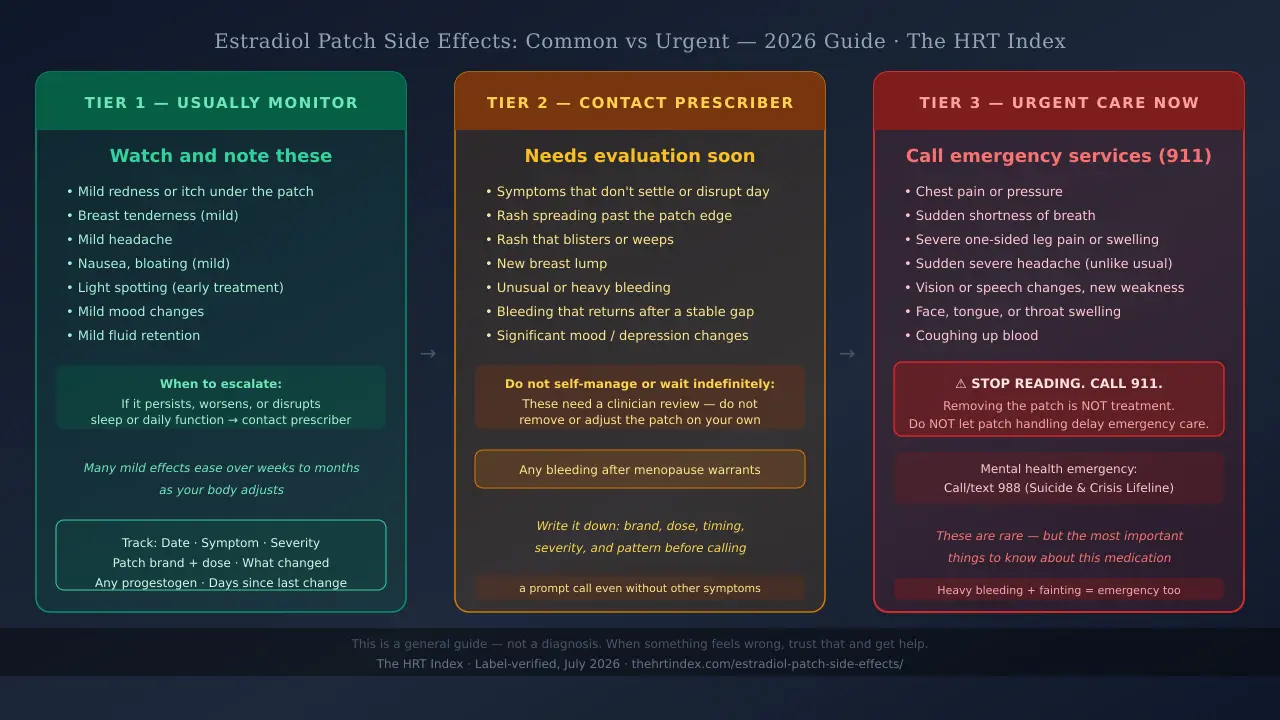
Quick triage: monitor, call, or seek urgent care?
This is a general guide, not a diagnosis. When something feels wrong, trust that and get help.
| Usually monitor and note | Contact your prescriber | Get urgent care now |
|---|---|---|
| Mild redness or itch only under the patch, mild breast tenderness, mild headache, some nausea or bloating | Symptoms that don’t settle or disrupt your day, a rash that spreads or blisters, a new breast lump, unusual or heavy bleeding | Chest pain, sudden shortness of breath, one-sided leg pain or swelling, sudden severe headache, vision or speech changes, or swelling of the face, tongue, or throat |
Is this guide right for you?
This guide is for you if:
- You use — or are starting — an FDA-approved estradiol-only patch for menopause (Climara, Vivelle-Dot, Minivelle, Dotti, Lyllana, or a generic).
- You’ve noticed a symptom since starting, changing your dose, or switching brands.
- You have a patch-site rash, adhesion issue, or a bleeding question.
Not the right page if:
- You have emergency symptoms right now — call 911.
- You use only low-dose vaginal estrogen (cream, ring, or tablet) — different route, different discussion.
- You use a combined estrogen-plus-progestin patch.
- Your estradiol is for gender-affirming care, fertility, or cancer treatment.
Label and supply information rechecked —
We read the current FDA prescribing information and patient labeling for Climara and Vivelle-Dot on DailyMed, confirmed the FDA’s 2025–2026 boxed-warning changes, sourced the patch-versus-pill clot comparison to peer-reviewed studies and ACOG, and rechecked supply context against FDA’s September 3, 2026 statement on October 12, 2026. Last verified:
We did not test these patches, run our own trial, or diagnose anyone. Trial percentages are label evidence — not brand safety scores, and not a prediction of what will happen to you.
What are the most common estradiol patch side effects?
The most commonly reported estradiol patch side effects are redness or itching where the patch sits, headache, breast pain or tenderness, nausea, bloating or abdominal cramps, fluid retention, and irregular bleeding or spotting. Hair loss also appears in patient labeling. Most mild effects can ease over the first weeks to a few months — but a symptom can also come from a progestogen, the patch adhesive, or menopause itself.
One honest thing before we start:we can’t tell you whether your symptom is caused by the patch. Neither can any label, any list, or any AI answer. In the Climara trials, 10% of women on a placebo patch reported headaches too.A headache that shows up on day three feels like proof — but timing isn’t proof.
| Side effect | Often appears | Often eases | What helps / what to note | The version that means: get help |
|---|---|---|---|---|
| Redness or itch under the patch | Early | As you rotate sites | Apply to clean, dry, hair-free skin; move each new patch to a fresh spot; peel old patches off slowly | Blistering, weeping, a rash spreading past the patch, hives, or face/throat swelling → possible allergy, get care |
| Breast tenderness | Early | Often over weeks to a few months | A supportive bra; a warm or cool compress; ask about your dose | A new lump, or a change in a breast's size, shape, or look → contact your prescriber |
| Headache | Early | Often over weeks to a few months | Usually mild; note the pattern | A sudden, severe headache, or one with vision, speech, or balance changes → emergency |
| Spotting or irregular bleeding | First months | Often as your body adjusts | Track the days and how heavy; report if it persists | Heavy bleeding, or bleeding that returns after it had stopped → get it checked |
| Nausea, bloating, fluid retention | Early | Often over weeks to a few months | Simple diet tweaks; ask about your dose if it drags on | Rapid or one-sided leg swelling, or swelling with breathlessness → emergency |
| Mood changes | Varies | Varies | Note timing vs. your patch and any progesterone | New or worsening depression, or any thoughts of self-harm → get help right away (call/text 988 or 911) |
| Weight change | Varies; not clearly established | — | Usual diet and activity | — |
Why the patch can irritate your skin — and how to calm it down
Mild, patch-shaped redness or itching is common, and better technique often settles it. Apply the patch to skin that’s clean, dry, cool, and free of powder, oil, or lotion — the Climara and Vivelle-Dot instructions are specific about this, because oils and creams can stop the patch from sticking and change how much medicine gets through. Rotate to a new spot each time and don’t reuse the same site for at least a week. Peel the old patch off slowly.
Don’t put hydrocortisone, moisturizer, or any product under the patch to stop irritation unless your prescriber or pharmacist gives product-specific instructions. It can interfere with the seal and the dose.
Can it cause hair loss?
Hair thinning appears in the patient labeling, so it’s possible — but the labels don’t establish how common it is, and hair shedding has many causes (thyroid, iron, stress, genetics, menopause itself). If you’re shedding noticeably or it doesn’t let up, note when it started and raise it with your prescriber rather than assuming the patch is the cause.
Could it be the progesterone, not the estradiol?
If you have a uterus and you’re on systemic estrogen, you’re usually also prescribed a progestogen — the umbrella term for natural progesterone and synthetic progestins. That second hormone can drive breast tenderness, mood shifts, bloating, and bleeding changes on its own. So when something feels off, the estradiol patch is only half the picture.
Which estradiol patch side effects need urgent medical care?
Get urgent medical help now for any of these:
- Possible blood clot: sudden shortness of breath, chest pain, coughing up blood, or severe pain, warmth, or swelling in one leg
- Possible stroke: sudden severe headache unlike your usual ones, trouble speaking, sudden vision changes, or weakness/numbness on one side
- Possible serious allergic reaction: swelling of the face, tongue, or throat, trouble breathing or swallowing, hives spreading over your body
If any of these apply, call 911 now. Removing the patch is not treatment, and handling the patch must not delay getting help.
Serious, but usually a prompt appointment rather than 911:a new breast lump, or bleeding that’s persistent or returns after it had stopped. Don’t file these under “just adjusting.” One exception: heavy bleeding with fainting, severe weakness, or severe pain can be an emergency — treat it like one.
Mental health emergency:if you’re experiencing thoughts of self-harm, call or text 988(Suicide & Crisis Lifeline, U.S.), or call 911 / go to your nearest emergency room if you’re in immediate danger.
How long do estradiol patch side effects last?
Some mild “adjustment” effects — spotting, breast tenderness, headache, nausea, bloating — often ease over the first weeks to a few months as your body settles into a steady estrogen level. There’s no universal clock. Any symptom that is sudden, severe, heavy, or clearly worsening should be acted on right away, not waited out.
Days to weeks
Patch-site symptoms, early nausea, headache, breast tenderness. Start a simple note: date, symptom, severity.
Weeks to a few months
Mild effects often start to fade. Note any patch-change day pattern and report it.
By ~3 months
Many women notice mild effects easing. If yours aren't, or they're worsening, flag it — don't tough it out.
New symptom after a stable stretch
Treat it as a fresh question. Check what else changed: new medication, health issue, brand switch.
Is a rash from the estradiol patch normal — or an adhesive reaction?
In the original Vivelle trials (the data used on the Vivelle-Dot label), application-site redness or irritation was reported in 3.2% or fewer women across doses. Mild, limited redness right under a patch can happen, and rotating sites usually settles it. But a rash that spreads beyond the patch, blisters or weeps, hurts, or comes with hives or facial swelling is different and needs a clinician.
Mild irritation (watch)
Faint patch-shaped area that calms down after you remove the patch. Photograph with date and brand name, rotate to a fresh site, and watch whether it comes back.
Possible contact dermatitis (contact prescriber)
Gets worse with repeated patches, spreads past the patch outline, or blisters. The culprit is often the adhesive — but only a clinician can sort it out.
Serious allergic reaction (urgent)
Hives spreading over your body, or swelling of the face, tongue, or throat. The Vivelle-Dot label warns throat/larynx swelling can block the airway. Call 911.
Application and care tips (product-specific — follow your label):
- Use a clean, dry, cool spot on the lower abdomen or buttock — never the breasts or irritated/oily skin.
- Use a new site each time; don’t reuse the same spot for at least a week.
- Shower/swim rules differ by brand: Vivelle-Dot says showering shouldn’t loosen it; Climara warns that swimming, bathing, or sauna may affect delivery.
- If it lifts: press it back down (Climara). Reapply same or new patch on a different spot and keep your schedule (Vivelle-Dot).
- Sticky residue: both labels say let skin dry ~15 minutes, then gently rub with oil-based lotion.
- Don’t cut a patch to adjust your dose — construction varies and it’s not a labeled use.
Can the estradiol patch cause bleeding or spotting?
Yes — spotting or irregular bleeding is a listed effect and often appears after starting or changing a regimen. But there is no “free pass” window where bleeding is automatically fine to ignore. Heavy or lasting bleeding, bleeding that starts after things had settled, and any bleeding after menopause need to be checked.
Early spotting in the first months is common, particularly right after a start, a dose change, or a missed dose. What we can’t do is tell you whyyou’re bleeding from a webpage.
Why having a uterus matters:
Estrogen thickens the uterine lining. Taken unopposed — without a progestogen — it raises the risk of overgrowth and, over time, cancer of the lining. Adding a progestogen has been shown to lower that risk, which is why women with a uterus are usually prescribed both. This is the single most important reason not to self-manage bleeding on the patch.
Before you call, jot down: the dates and how heavy, whether there are clots or pain, your last natural period, whether you have a uterus, the name and schedule of any progestogen, and any missed or late doses.
Can estradiol patches cause headaches, anxiety, mood changes, or palpitations?
Headache and some mood-related effects appear in the labeling, and many women describe anxiety, low mood, or a racing heart on the patch. But those can also come from menopause, from a progestogen, from another medication, or from an unrelated condition — timing is a clue, not a diagnosis. Sudden severe headache, chest symptoms, fainting, or a sustained racing heart need prompt or urgent care.
Headache
Note whether it's your familiar kind, a new pattern, or — the one that matters — a sudden, severe headache or one with vision or speech changes. That last kind is an emergency.
Sudden, severe headache or one with vision/speech/balance changes → emergency (911)
Anxiety or feeling 'wired'
Look at the timing against both your estrogen and your progesterone, and the usual suspects: sleep, caffeine, thyroid medication. Resist the 'estrogen dominance' self-diagnosis you'll see online — a symptom can't tell you your hormone levels. Contact your prescriber if it's strong or interfering.
Low mood or depression
Mild, passing mood dips are one thing. Significant or worsening depression is another. Any thought of harming yourself is an immediate safety issue.
Call/text 988 (Suicide & Crisis Lifeline, U.S.) or 911 / nearest ER if in immediate danger
Palpitations — 'is this the patch or menopause?'
It can be either, or neither. Note your heart rate if you can, how long it lasts, and what came with it. Palpitations do appear in the Climara label's post-marketing reports — but a post-marketing report doesn't prove the patch caused an individual symptom or say how common it is.
Palpitations with chest pain, fainting, or breathlessness → treat as an emergency
Does this mean my dose is too high?A symptom alone can’t tell you that — the Climara label itself notes that blood estrogen levels generally don’t predict how a woman will respond or her risk. See our guide on signs an HRT dose may need review, and never cut a patch or change your schedule on your own.
Do estradiol patches cause weight gain, bloating, swelling, or hair loss?
Bloating and fluid retention are recognized effects and can make you feel heavier — but that’s water, not fat. The Menopause Society’s position is that hormone therapy overall is not associated with weight gain. And rapid or one-sided swelling — especially with breathlessness — isn’t a “weight” question at all; it can be a sign of a clot.
- Water vs. fat: day-to-day puffiness and a bloated middle is usually fluid. The scale jumping a few pounds early on is often water, and it often settles.
- When swelling is concerning: one-sided leg swelling, or swelling with chest pain or shortness of breath, needs urgent care. Persistent generalized swelling without those emergency features should prompt a call to your prescriber.
- Hair loss: it’s in the labeling, so it’s possible, but its frequency isn’t established, and shedding has many causes. Track timing and get evaluated if persistent. Switching brands isn’t a promised fix.
Are estradiol patch side effects different by brand or dose?
Different patch labels report different side-effect percentages — but those numbers are not head-to-head safety comparisonsand they can’t rank one patch as safest. Only some patches ran their own trials. Many generics inherit data from a reference product. The same-looking table can have very different origins.
The Estradiol Patch Evidence Map — label and supply information rechecked
| Patch | Change schedule | Where side-effect data come from | Boxed warning on current label? | Verified |
|---|---|---|---|---|
| Climara | Once weekly | Its own pooled data from 5 clinical trials — 614 women followed for 3 months | Yes (label revised Dec 2023) | Oct 12, 2026 |
| Vivelle-Dot | Twice weekly | Inherited — “no clinical trials were conducted with Vivelle-Dot”; bioequivalent to Vivelle, so the table is original Vivelle data | Yes (label revised Nov 2023) | Oct 12, 2026 |
| Minivelle, Dotti, and generics | Varies (many twice weekly) | Typically inherited via bioequivalence to a reference patch | Confirm your specific product’s current label | Jul 14, 2026 |
Bioequivalence means the patch’s estradiol was absorbed at a rate and extent close enough to the reference product to meet the FDA’s matching criteria — not that the products are identical or were tested head-to-head.
Why a lower dose doesn’t guarantee fewer side effects
If side effects rose neatly with dose, you could rank patches by the numbers. They don’t. Below are real figures from the Climara label — from its own trials:
| Reported effect | 0.025 mg/day | 0.05 mg/day | 0.1 mg/day | Placebo patch |
|---|---|---|---|---|
| Headache | 5% | 18% | 13% | 10% |
| Breast pain | 5% | 8% | 29% | 4% |
| Edema (fluid) | 0.5% | 13% | 10% | 6% |
| Abdominal pain | 0% | 11% | 16% | 8% |
Notice: the numbers don’t climb in a straight line with dose. The placebo column isn’t zero— 10% of women on a fake patch reported headaches. That’s proof that a symptom alone can’t tell you the cause. Don’t shop patches by side-effect percentageand don’t assume the smallest patch is automatically the “safe” one. Dose and product are a fit question for you and your prescriber.
Is the estradiol patch safer than estrogen pills?
For blood-clot risk, the patch is generally considered the lower-risk route. Estradiol absorbed through the skin largely bypasses the liver’s first-pass processing — unlike oral estrogen, which goes through the liver first and nudges up clotting factors. ACOG describes transdermal estrogen as having little or no clot-promoting effect.
In a meta-analysis of observational studies, oral estrogen carried about 1.6 times higher risk of a first blood clot than transdermal — and roughly double the risk of a deep-vein clot. The Climara label notes that the amount of estradiol reaching your bloodstream from a patch is about 20 times higher per milligram than from a pill — precisely because it skips first-pass liver metabolism (which is why patch doses are so much smaller).
Two honest caveats:most of this evidence is observational — from tracking large groups — not from a randomized head-to-head trial, so it’s rated lower-confidence. And the progestogen paired with your estrogen matters too: some carry more clot risk than others. The takeaway isn’t “the patch is risk-free” — it’s “the patch is a lower-clot-risk route.” See our oral vs. transdermal comparison for more.
What are the possible long-term risks of an estradiol patch?
Long-term risk can’t be read off the short-term side-effect table. It depends on your age, how long since menopause you started, how long you use it, your dose and route, whether you have a uterus, whether you take a progestogen, and your personal health history.
- Uterus and the lining: estrogen without a progestogen raises uterine-lining cancer risk in women with a uterus — which is why both are usually prescribed together.
- Breast, heart, and dementia — with the fine print: the big WHI trials mostly studied oral hormones, not estradiol patches. In WHI, estrogen alone (oral) did not raise breast cancer risk overall; the increase showed up mainly with estrogen plus a progestin. The dementia signal came from WHI Memory Study in women 65–79 using oral hormones; labels say it’s unknown whether it applies to younger women.
- Age and timing: starting within 10 years of menopause (before 60) looks meaningfully different from starting much later.
For the full picture, see our HRT benefits and risks guide.
What changed in the FDA estrogen warning in 2026?
In November 2025, the FDA and HHS announced they would remove the boxed warning from menopause hormone products and rewrite labels with age-specific guidance. On February 12, 2026, the FDA approved the first batch of updated labels for six products: Bijuva, Cenestin, Divigel, Enjuvia, Estring, and Prometrium. No estradiol patch was in that first group. The uterine-lining cancer warning stays for systemic estrogen-only products.
| Patch | In the Feb 2026 first six? | Boxed warning on current label we checked? | Verified |
|---|---|---|---|
| Climara | No | Yes — present (label revised Dec 2023) | Jul 14, 2026 |
| Vivelle-Dot | No | Yes — present (label revised Nov 2023) | Jul 14, 2026 |
Check the current label for your exact patch. The Climara and Vivelle-Dot DailyMed prescribing information checked October 12, 2026 still includes those boxed warnings; FDA has not established when an individual patch label will change. When in doubt, check your patch’s current FDA label, and talk to your prescriber about how the updated science applies to you. See our 2026 HRT label changes guide for the full story.
Estradiol patch shortage in 2026 — the short version
In its September 3, 2026 update, FDA acknowledged difficulty accessing usual estradiol patches because of increased demand and said it was working with all six manufacturers to expand supply. FDA said patches remain available, although particular products or brands may vary by pharmacy and location.
Important:don’t ration or stretch your patches — wearing one longer than prescribed can under-dose you. Call your prescriber before you run out. Gels and sprays are also transdermal — they keep the lower-clot-risk advantage of the patch. Whether to switch is a prescribing decision.
For the full, regularly-updated picture, see our estradiol patch shortage tracker.
Should you remove or stop the estradiol patch when side effects start?
No — don’t remove, stop, cut, or change a prescribed patch just because an online list matches what you feel, unless you have emergency warning signs or your clinician tells you to. First, rule out the red flags. If none apply, write down the details and contact your prescriber.
Here’s the order of operations for a new, non-emergency symptom:
- Check the red flags (chest pain, breathlessness, one-sided leg pain, sudden severe headache, vision/speech/weakness changes, face or throat swelling). If any are present, call 911 now.
- Write down the facts — exact brand and dose, when it started, how strong, what makes it better or worse, and any other symptoms.
- Use the product instructions for application problems (lifting, residue, a patch that fell off, a missed change).
- Contact your prescriber for anything that persists, disrupts your day, or worries you.
If you already removed it in a moment of worry — that’s okay.
Save the box so you have the exact name and dose, note when you removed it, and call your prescriber or pharmacist for the specific next step. Don’t be embarrassed — it’s a reasonable instinct.
How to throw away a used patch (from both Climara and Vivelle-Dot labels):
Used patches still contain active hormone. Fold the sticky sides together, put it in a sturdy child-proof container, and place that in the trash. Don’t flush it, and keep used and unused patches away from children and pets.
What should you track before contacting your prescriber?
Your 90-second symptom record:
- Brand and manufacturer, and the dose (e.g., 0.05 mg/day)
- Once-weekly or twice-weekly, and today’s application site
- Date and time you applied it
- Is this your first patch, a dose change, or a brand switch?
- The symptom, when it started, and how strong (mild / moderate / severe / interfering)
- What makes it better or worse, and any symptoms with it
- Bleeding: dates, heaviness, clots, pain
- Any progesterone/progestogen, and any other medication changes
Photographing a skin reaction:include the date, keep identifying features out of the frame, don’t upload it to any website by default, and show it to your clinician directly.
Reporting a side effect to the FDA: you can report to FDA MedWatch. Reporting helps the system spot patterns — but it is not a substitute for getting medical care.
How do you tell a side effect from a dose issue — or a care problem?
A symptom list can’t tell you your dose is wrong, or which change you need. Sometimes what’s really missing is responsive care — a clinician who will actually review your route, dose, brand, bleeding, and history together.
- Signs the real problem is follow-up, not the medicine: you’ve messaged and heard nothing back, there’s no clear path to review your dose or route, no guidance for persistent bleeding, no plan for a significant rash, or no obvious after-hours support.
- When online care may not be the right starting point: if you have emergency symptoms, need a hands-on exam, have significant unexplained bleeding, carry a complex or unstable medical history, or your symptoms fall outside a telehealth clinic’s scope.
What a good menopause provider should be able to explain, in this order:
- Clinical legitimacy — who evaluates and prescribes for you, and where they’re licensed.
- Care quality — how follow-up, messaging, and dose adjustments actually work.
- Medication fit — FDA-approved vs. compounded options, routes, and how your uterus/progestogen needs are handled. See our FDA-approved vs. compounded guide.
- Price transparency — the real cost of the consult, follow-ups, labs, and medication.
- Access — whether they cover your state, take your insurance, and how you fill your prescription.
If your current setup can’t help you adjust or investigate this: Find My HRT Path is a free, ~90-second quiz that matches your symptoms, health history, age, what you have tried, and state to a care starting point — before you pay for a consult.
See which care model fits your situation →Keep reading:
If you're comparing patches after a refill change, see Dotti and Lyllana refill differences.
For the product-by-product reader feedback, see what women say in estradiol patch reviews.
Frequently asked questions
Sources and how we verified this page
We built this page from primary and authoritative sources, checked , under The HRT Index Verification Standard: read the current published labels, separate a product’s own trial evidence from evidence inherited through bioequivalence, confirm the FDA’s 2026 labeling actions, rechecked supply context against FDA’s September 3, 2026 statement on October 12, 2026, date every claim, and mark anything we couldn’t confirm rather than guess. Last verified:
- Climara (estradiol transdermal system) — FDA prescribing and patient labeling, DailyMed
- Vivelle-Dot (estradiol transdermal system, Sandoz) — FDA prescribing and patient labeling, DailyMed
- FDA — labeling changes for menopausal hormone therapy, Feb 12, 2026
- HHS/FDA — Nov 10, 2025 announcement on removing HRT boxed warnings
- Mohammed et al., oral vs. transdermal estrogen and vascular events — J Clin Endocrinol Metab
- ACOG — route of administration and VTE risk
- The Menopause Society — hormone therapy patient education
- FDA — estradiol transdermal patch availability update, September 3, 2026
Update history
— Published. Verified the current Climara and Vivelle-Dot FDA labels directly; confirmed the 2026 FDA labeling transition and the six first-batch products; confirmed the patch supply situation against ASHP and major reporting.
— Updated.Attributed the rash statistic to the original Vivelle trials, rechecked FDA’s September 3 patch-access statement, and removed the unsupported label-change timetable.
Educational information only. This page is not medical advice and is not a substitute for your clinician. If you have emergency symptoms, call emergency services (911 in the U.S.).
Still not sure whether the patch — or online HRT at all — is right for you?
Take our free 90-second Find My HRT Path quiz and get a personalized next step before your consult. It matches your symptoms, health history, age, what you have tried, and state to the care route most likely to fit you.
Start Find My HRT Path → (free, ~90 seconds)