
Estradiol vs Premarin: Which Estrogen Is Right for You?
Researched and written by the editorial team at The HRT Index. This page is editorial research. It has not been reviewed by a clinician. Educational only — not medical advice.
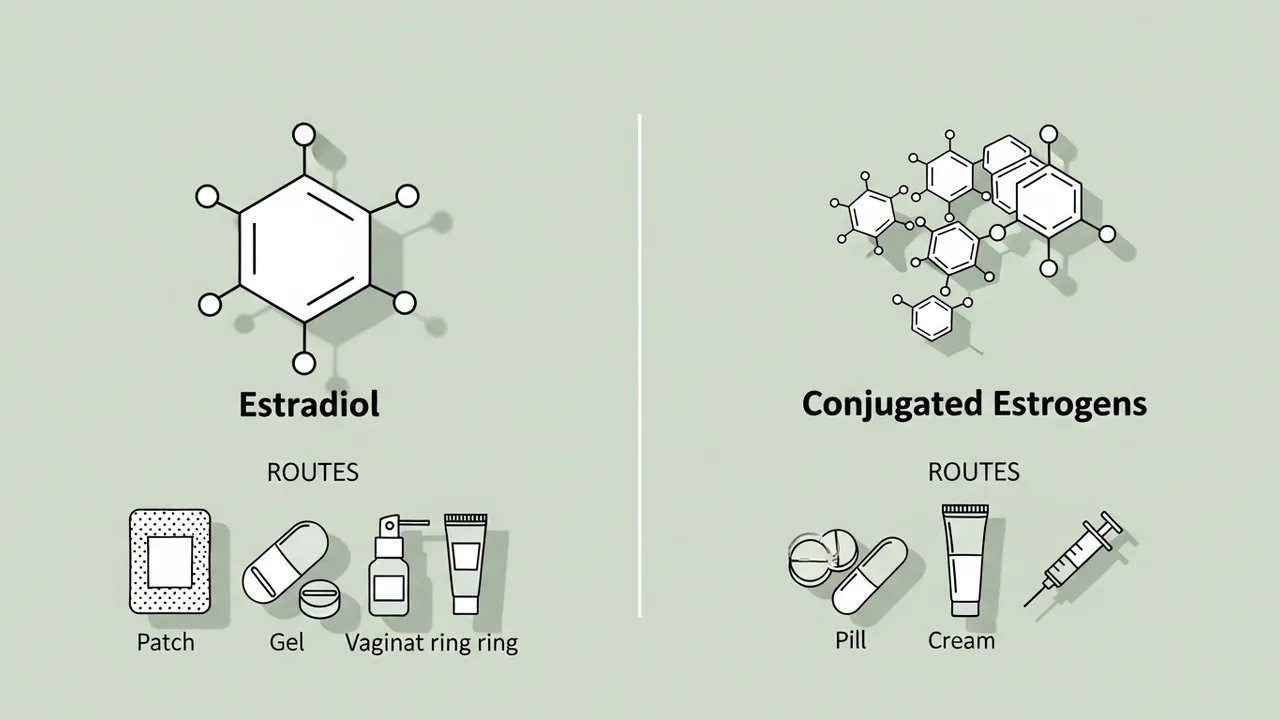
For most women choosing between estradiol vs Premarin, transdermal estradiol — the patch, gel, or spray — is the better place to start. Not because estradiol is a better molecule, but because delivery through the skin skips the liver, where clotting risk is raised. Among pills, one head-to-head study found conjugated estrogens roughly doubled the odds of a blood clot compared with oral estradiol. Your answer changes based on your uterus, your risk history, your insurance, and your route preference.
That's the 40-second answer. Here's the part nobody else is telling you.
Four things about this decision changed in the last eight months. Three of them are big. And one of them contradicts what some of the largest pharmacy websites in America are still telling women today — on pages that rank on the first screen of this exact search.
- Premarin tablets now have a generic. The first one, 83 years after Premarin's 1942 approval. It costs about a fifth of the brand's retail price.
- The FDA pulled the scariest boxed warnings off six hormone products in February 2026. Premarin wasn't one of them. Neither was your estradiol patch. And two of the six aren't even sold anymore.
- Estradiol patches are hard to get. So are both vaginal creams. Pharmacists say there's a shortage. The FDA says there isn't. There's a reason they disagree, and we'll show you what it is.
- The only randomized head-to-head trial we could find says estradiol doesn't win everything. We'll show you the exact place where Premarin came out ahead.
We opened the FDA's own documents. We read Premarin's label. We pulled prices with dates on them. Here's what we found, and what it means for the decision you're actually trying to make.
Best for you / not for you
Estradiol is probably your starting point if you:
- Want the lowest clot risk — then choose a patch, gel, or spray, not a pill
- Want a hormone chemically identical to the estrogen your ovaries used to make
- Want options: patch, pill, gel, spray, ring, vaginal cream
- Are paying cash. Generic estradiol tablets run about $12.60 with a coupon.
- Have low libido as a leading symptom
Premarin — or its new generic — deserves a serious look if you:
- Have mood as your dominant symptom, and estradiol hasn't helped
- Took it for years, tolerated it, and don't want to switch
- Want a pill and can't get a patch right now
- Have a prescriber with a specific clinical reason for it
Neither — until you see a clinician in person — if you have any of the contraindications printed on both drugs' labels:
- Undiagnosed abnormal genital bleeding
- Known, suspected, or a history of breast cancer
- Known or suspected estrogen-dependent cancer
- Active or prior deep vein thrombosis or pulmonary embolism
- Active or prior arterial thromboembolic disease, such as stroke or heart attack
- Liver impairment or disease
- A known clotting disorder, such as protein C, protein S, or antithrombin deficiency
Those aren't suggestions. They are the “do not use” list on both labels.
Estradiol vs Premarin at a glance
| Estradiol | Premarin (conjugated estrogens) | |
|---|---|---|
| What it is | One estrogen: 17β-estradiol | A blend of estrogens — mostly estrone sulfate and equilin sulfate |
| Where it comes from | Made in a lab from plant sterols | Collected from the urine of pregnant mares |
| In your body naturally? | Yes. Identical molecule. | Partly. Equilin is a horse estrogen. You've never made it. |
| Initial FDA approval | Listed as 1975 on current labels | 1942 |
| Generic available? | Yes, many, for decades | Tablets: yes, since November 2025. Cream: no. |
| Ways to take it | Patch, pill, gel, spray, ring, vaginal cream, vaginal insert | Pill, vaginal cream, injection. No patch. There has never been one. |
| Cash price, 30 days | Tablets from ~$12.60 with a coupon | Brand from ~$99 with a coupon. Generic from ~$61.58. |
| Boxed warning updated 2026? | Only Divigel (gel), Estring (ring), Bijuva (pill) | No |
| Supply, July 2026 | Patches and vaginal cream constrained | Vaginal cream constrained. Tablets fine. |
Prices: GoodRx product pages, coupon prices last updated 07/02/26. Prices swing by pharmacy and ZIP code — sometimes threefold within the same chain. Confirm at the counter.
The HRT Index is the independent decision resource for online menopause and HRT care — comparing telehealth providers on clinical legitimacy, care quality, medication fit, price transparency, and access, with every claim verified and dated, so women can choose the path that fits their situation before their first consult.
Before you read another word
The right online HRT provider isn't the same for every woman — it depends on your symptoms, what you have tried so far, your age, your state and your health history. Some situations belong with an in-person clinician first. Because a general answer can't resolve those for you, use The HRT Index's Find My HRT Path tool to match your situation to the right provider.
Get your personalized HRT path →What we actually verified for this page
Not “researched.” Verified. Here's the receipt.
| What we checked | How we checked it | When |
|---|---|---|
| Which six products had boxed warnings removed | Read the FDA's published list of menopausal hormone therapies with updated prescribing information | Jul 9, 2026 |
| That Premarin's boxed warning is unchanged | Pfizer's current Premarin prescribing materials still name endometrial cancer, cardiovascular disorders, breast cancer, and probable dementia | Jul 9, 2026 |
| The WHI breast cancer number | Read it in Premarin's own FDA label | Jul 9, 2026 |
| That Cenestin and Enjuvia are discontinued | Manufacturer discontinuation records; both appear on the FDA's Discontinued Drug Product List | Jul 9, 2026 |
| That a generic Premarin tablet exists | FDA/HHS announcement, Nov 10, 2025; Ingenus commercial launch announcement, Nov 13, 2025 | Jul 9, 2026 |
| Cash prices for six products | GoodRx product pages, coupon prices last updated 07/02/26 | Jul 9, 2026 |
| Patch and cream supply | ASHP shortage bulletins for estradiol transdermal system (updated Apr 22, 2026) and estradiol vaginal cream (created Jun 6, 2026), against the FDA's shortage database | Jul 9, 2026 |
| Midi, Hers, and Sesame policies and prices | Read directly off each provider's own public pages | Jul 9, 2026 |
What we did not verify
We didn't fill a prescription. We didn't complete any provider's checkout. And we could not confirm whether Midi Health will write a prescription for conjugated estrogens — their public copy describes FDA-approved bioidentical hormones, and Premarin is FDA-approved but not bioidentical. Ask before you book. We'd rather tell you that than pretend.
What's actually different between estradiol and Premarin?
Estradiol is one hormone. Premarin is a blend.Estradiol products contain 17β-estradiol, the same estrogen molecule the ovaries produce. Premarin contains conjugated estrogens collected from the urine of pregnant mares — mainly sodium estrone sulfate and sodium equilin sulfate, plus several horse estrogens the human body never makes. Both are FDA-approved. Neither is compounded.
That's the whole chemical difference. It's smaller than most people assume, and it matters more than most people are told.
Where Premarin comes from
PREgnant MARes' urINe. That's the name. FDA-approved since 1942, which makes it older than the ballpoint pen. We're not going to dance around it. You already know. Pretending otherwise would cost us the only thing that makes this page worth reading.
Which one is the “natural” one? The internet has this backwards.
Here's something we noticed while reading the pages currently ranking for this search. Several call Premarin “a synthetic hormone” and estradiol “natural.” That is exactly backwards.
- Premarin is isolated from a natural biological source. It contains molecules — like equilin — that your body has never produced and never will.
- Estradiol is synthesized in a laboratory, usually from plant sterols. It is molecularly identical to the estrogen your ovaries made for forty years.
So which is “natural”? If natural means from nature, Premarin wins. If natural means what your body recognizes, estradiol wins. Pick the definition you actually care about. Just don't let a page that has the two words swapped make the choice for you.
Is Premarin compounded?
No. This confuses a lot of women, so let's kill it. Premarin is an FDA-approved finished drug product. So is estradiol. Both went through FDA review. Both have standardized doses, tested purity, and a printed label.
Compounded hormones are a different category entirely. A compounding pharmacy mixes them for one patient at a time. The FDA does not review, test, or approve those finished products before they're dispensed. The Menopause Society and the American College of Obstetricians and Gynecologists both caution against routine use of compounded hormone therapy when FDA-approved options exist.
Even Sesame — a telehealth company that will prescribe compounded hormones if a provider thinks they're appropriate — states on its own site that compounded “bioidentical” therapy is prescribed and dispensed outside formal FDA regulation and standardization, and that studies have not shown it to be safer or more effective than conventional hormone therapy.
Neither drug on this page is compounded. If someone is selling you a compounded “bioidentical” cream by comparing it favorably to Premarin, they're comparing across a regulatory line that matters.
There is no “bioidentical” Premarin
“Bioidentical” is a marketing word, not an FDA category. Some FDA-approved drugs happen to be bioidentical — estradiol and micronized progesterone both are. Premarin isn't. Some compounded products claim to be bioidentical. That claim describes the molecule's shape. It tells you nothing about whether the product was tested, whether the dose is accurate, or whether it's sterile.
Read next: FDA-approved vs. compounded HRT →
Is estradiol safer than Premarin?
Estradiol is not automatically safer, and Premarin is not automatically dangerous. Most of the safety difference people attribute to the molecule is actually caused by the route. Estrogen swallowed as a pill passes through the liver first and raises clotting factors. Estrogen absorbed through skin does not. Among pills, one head-to-head study found conjugated estrogens roughly doubled the odds of a blood clot compared with oral estradiol.
This is the most important section on this page. Read it slowly. There are two separate questions hiding inside “which is safer.” Almost every page online mashes them together.
Question 1: Pill or patch? (The bigger lever.)
When you swallow estrogen, it goes to your liver before it reaches the rest of you. Doctors call this first-pass metabolism. The liver responds by making more clotting proteins. When estrogen goes through your skin — patch, gel, or spray — it enters the bloodstream directly. No first pass. No clotting-protein bump.
| Study | What it looked at | What it found |
|---|---|---|
| Swedish national target trial (BMJ, 2024) | 919,614 women, ages 50–58, 2007–2020 | Higher clot risk with oral estrogen-only (HR 1.57), oral continuous combined (1.61), oral sequential (2.00). No strong evidence transdermal estrogen increases risk for any disease studied. |
| ESTHER case-control | 259 women with clots, 603 controls | Oral estrogen: odds ratio 4.2. Transdermal estrogen: odds ratio 0.9 — essentially no signal. |
The Menopause Society's 2022 Hormone Therapy Position Statement puts it plainly: transdermal routes and lower doses may decrease the risk of venous thromboembolism (a blood clot in a vein) and stroke.
Two honest footnotes
- “Transdermal equals zero risk” is an overclaim. At least one analysis of that Swedish cohort found an elevated clot hazard for transdermal estrogen combined with a progestogen. Skin delivery lowers risk. It doesn't erase it.
- Sweden barely uses Premarin. That trial compared oral estradiol to transdermal estradiol. It answers the route question beautifully. It cannot answer the molecule question at all.
Question 2: Which pill? (The smaller lever — but a real one.)
Only one study has ever compared these two molecules head to head at the same route. Smith and colleagues, JAMA Internal Medicine, 2014. Researchers found a health system whose preferred pharmacy estrogen switched from conjugated estrogens to estradiol partway through the study period. That gave them 384 postmenopausal women, all taking one or the other as a pill.
| Outcome | Conjugated estrogens vs. oral estradiol | Statistically significant? |
|---|---|---|
| Venous thrombosis (blood clot) | Odds ratio 2.08 (95% CI 1.02–4.27) | Yes (p = .045) |
| Heart attack | Odds ratio 1.87 (0.91–3.84) | No (p = .09) |
| Ischemic stroke | Odds ratio 1.13 (0.55–2.31) | No (p = .74) |
They also drew blood from the women without clots and measured clotting tendency directly. Women on conjugated estrogens showed a stronger clotting profile (p < .001). The lab work agreed with the outcome data.
The honest limits. Observational, not randomized. Sixty-eight clot cases. The authors themselves wrote that the findings “need replication.” Nobody has run the randomized trial. That's the actual state of the evidence — and saying so is the reason you should believe the rest of this page.
What the WHI actually studied
Here's what almost nobody tells you. Every number you're afraid of came from one drug, at one dose, in older women.
The Women's Health Initiative estrogen-alone substudy tested oral conjugated estrogens, 0.625 mg per day. That is Premarin. The average woman in it was 63 years old — more than a decade past the average age of menopause. It did not test estradiol. It did not test patches.
Estradiol product labeling says this directly: the only estrogen studied in the WHI trials was conjugated estrogens 0.625 mg per day, and the relevance of those findings to other doses, other routes, and other estrogen products is not known.
And now the part that will surprise you. It is printed in Premarin's own FDA label:
After an average of 7.1 years of follow-up, daily conjugated estrogens 0.625 mg alone was not associated with an increased risk of invasive breast cancer. Relative risk 0.80, with a 95% nominal confidence interval of 0.62 to 1.04.
Numerically fewer cases than placebo, though the confidence interval crosses 1.0. The breast cancer signal that terrified an entire generation came from the estrogen plus progestin substudy — relative risk 1.24. Not estrogen alone. Not Premarin by itself.
Do not read that as “estrogen prevents breast cancer.” It doesn't say that. A large meta-analysis of prospective studies published in The Lancet in 2019 found a relative risk of 1.33 for breast cancer among women using estrogen-only therapy for five to fourteen years. The evidence is genuinely mixed.
The honest summary: the drug you were told causes breast cancer did not cause it in the trial that made everyone believe it did — and the manufacturer prints that on the box. That's not a reason to take Premarin. It's a reason to stop being afraid of the wrong thing.
So what do you do with all this?
You now know route beats molecule. You know the WHI tested one drug in older women. You know both labels share the same hard stops. What you don't know is which route fits your uterus, your risk history, your state, and your insurance. We can't answer that from here, and any page that pretends to is guessing.
The HRT Index's Find My HRT Path tool matches your situation to the right online service and next step — and it will tell you when online care isn't the right starting point at all.
Get your personalized HRT path →Did the FDA remove the boxed warning from your estrogen?
On February 12, 2026, the FDA approved labeling changes removing cardiovascular disease, breast cancer, and probable dementia from the boxed warnings of six menopausal hormone products. Premarin was not among them. Neither was any estradiol tablet or estradiol patch. The endometrial cancer warning stayed on systemic estrogen-alone products. Twenty-nine manufacturers submitted proposed changes; six were approved in the first batch.
You saw the headlines. “FDA removes black box warning from HRT.” Big news. Real news. Then you picked up your prescription, and the scary paragraph was still printed on the box. Here's why. And here's the table nobody else has published.
Which products actually got relabeled
Checked against the FDA's published list of menopausal hormone therapies with updated prescribing information, July 9, 2026.
| Product | What's in it | Warning updated? | Still sold in the US? |
|---|---|---|---|
| Divigel (estradiol gel) | Estradiol | Yes — Feb 2026 | Yes |
| Estring (estradiol vaginal ring) | Estradiol | Yes — Feb 2026 | Yes |
| Bijuva (estradiol + progesterone capsule) | Estradiol | Yes — Feb 2026 | Yes |
| Prometrium (progesterone) | Progesterone | Yes — Feb 2026 | Yes |
| Cenestin (synthetic conjugated estrogens, A) | Conjugated estrogens | Yes — Feb 2026 | No. Discontinued 2014. |
| Enjuvia (synthetic conjugated estrogens, B) | Conjugated estrogens | Yes — Feb 2026 | No. Discontinued 2016. |
| Premarin tablets | Conjugated estrogens | Not on the FDA's updated list | Yes |
| Premarin Vaginal Cream | Conjugated estrogens | Not on the FDA's updated list | Yes |
| Generic conjugated estrogens tablets | Conjugated estrogens | Not on the FDA's updated list | Yes |
| Estradiol tablets (Estrace, generics) | Estradiol | Not on the FDA's updated list | Yes |
| Estradiol patches (Climara, Vivelle-Dot, generics) | Estradiol | Not on the FDA's updated list | Yes |
| Prempro (conjugated estrogens + progestin) | Conjugated estrogens | Not on the FDA's updated list | Yes |
Read that table again. Then read these three sentences, which as far as we can tell have not been written anywhere else.
Of the six products in the FDA's first batch, only four are actually for sale in the United States. Cenestin and Enjuvia — the two conjugated-estrogen products whose warnings were removed — were discontinued by their manufacturer in 2014 and 2016.
Pfizer got Estring relabeled. Pfizer did not get Premarin relabeled. Same company. Same agency. Same month. One product's warning changed. The other's didn't.
And the drugs most American women are actually taking — a generic estradiol patch or tablet — are not on that list.
So what does the label in your hand mean?
- If your product is one of the six above and the old warning is still on the box, that's most likely old inventory or a printing transition.
- If your product is Premarin, Premarin Vaginal Cream, generic conjugated estrogens, an estradiol tablet, or an estradiol patch, the FDA's public list does not show it relabeled yet. The old warning on your box is current for that product.
Either way, this tells you nothing about whether your drug is more dangerous than the ones that were relabeled. It tells you where your manufacturer is in a queue of twenty-nine.
What changed, and what didn't
- Removed boxed-warning language about cardiovascular disease, breast cancer, and probable dementia
- Removed the instruction to use “the lowest effective dose for the shortest duration”
- Kept the endometrial cancer warning on systemic estrogen-alone products, for women with a uterus
- Added guidance to consider starting therapy in women under 60, or within 10 years of menopause
What this does not mean
A labeling change is not a new clinical trial. The FDA convened an expert panel, reviewed the literature, took public comment, and concluded the old warning overstated the risk for the women it was applied to. That's the correction of a distortion. It is not a guarantee of safety, and anyone selling it to you as one is selling you something. Your estrogen didn't get safer in February. The label got more honest.
Do this before you scroll
Go get the box. Find the product name on the front. Then find it in the table above. Thirty seconds. It's the single most useful thing on this page, and it's the reason we built the table instead of writing another paragraph about how confusing all this is.
Then, if you want to know what your next step should be — not just what your label says — Find My HRT Path takes your symptoms, your history, your age, and your state and points you to the right next step and the right provider. It also tells you when to stop reading websites and call a doctor.
Does one actually work better?
The only randomized head-to-head trial we could find is KEEPS, which assigned 727 recently menopausal women to oral conjugated estrogens 0.45 mg, a transdermal estradiol patch delivering 50 micrograms daily, or placebo, for four years. Hot flashes, sleep, and bone density improved equally on both. Mood improved on the oral conjugated estrogens. Sexual function improved on the estradiol patch. Neither affected memory or thinking.
Everything else you've read about which one “works better” is opinion, anecdote, or extrapolation. This is the trial.
KEEPS, domain by domain
The Kronos Early Estrogen Prevention Study. 727 healthy women, ages 42 to 58, all within three years of their last period. Randomized. Double-blind. Placebo-controlled. Four years. Both hormone arms also received oral micronized progesterone for 12 days a month.
| What was measured | Winner | The finding |
|---|---|---|
| Hot flashes and night sweats | Tie | Both beat placebo |
| Sleep | Tie | Both improved it |
| Bone density | Tie | Both preserved it |
| Mood | Oral conjugated estrogens | Positive effect on mood |
| Sexual function | Estradiol patch | Improved with the patch. Not with the pill. |
| Memory and thinking | Neither | No significant effect from either |
| Artery thickening (carotid IMT) | Neither | Neither slowed it |
| Coronary calcium buildup | Trend → oral conjugated estrogens | A trend, not a finding |
| Serious side effects | Tie | No severe adverse events, including no clots, in either arm |
The sexual-function result comes from a separate analysis of 670 of those women, published in JAMA Internal Medicine in 2017, using a validated scoring instrument. The patch improved scores versus placebo. The pill did not.
The limits, stated up front. KEEPS was designed to measure artery thickening, not to settle symptom debates. The sexual-function analysis wasn't pre-planned. Four years isn't a lifetime. And 0.45 mg is a low dose of conjugated estrogens — it tells you nothing about 0.625 mg or 1.25 mg.
The thing nobody tells you
Estradiol does not win everything. If a page told you it does, that page hasn't read the trial.
In the only randomized head-to-head we could find, women on oral conjugated estrogens — Premarin's molecule — had better mood outcomes than women on the estradiol patch. There was also a trend toward less coronary calcium buildup on the oral conjugated estrogens.
If mood is the symptom wrecking your life, that is a real, published point in Premarin's favor. Bring it up. Say the drug's name.
But here's why it usually still doesn't win. Premarin doesn't come in a patch. It never has. There is no transdermal conjugated estrogen, anywhere, at any price. And the single biggest safety lever in menopausal hormone therapy is getting the estrogen through your skin instead of your liver.
So for most women, a mood edge on a pill is outweighed by a clot advantage that only exists on skin — and skin only exists as estradiol.
If mood is genuinely your priority: ask about oral estradiol first. Same route. Same first pass. Better clot profile than conjugated estrogens, per Smith 2014. If that fails you, conjugated estrogens is a legitimate thing to want — and further down, we tell you exactly which providers will write it and which won't.
One more signal, honestly reported
A small randomized imaging study led by Stanford researchers, published in PLOS ONE in 2014, followed women at elevated dementia risk who'd started hormone therapy within a year of menopause. Those who continued estradiol preserved metabolic activity in brain regions that predict dementia. Those who continued Premarin did not.
We include it because it's real. We're also telling you it was small, used imaging endpoints rather than actual cognitive testing, and found that adding a progestogen erased the benefit entirely. A signal worth knowing. Not a reason to pick a drug.
Why do doctors still prescribe Premarin?
Doctors prescribe Premarin because a patient's plan covers it, because she tolerates it and has taken it for years, because mood is her dominant symptom, or because conjugated estrogens are the most-studied estrogen in medical history.The Women's Health Initiative ran its estrogen-alone substudy on this molecule for an average of 7.1 years. No estradiol product has an equivalent long-term randomized outcome trial.
This is the question women whisper. If it comes from horses and it's expensive, why is anyone still on it? Fair. Four real answers.
1. It's the most-studied estrogen ever made
This is the irony almost nobody points out. Premarin frightens people because it was studied. The WHI enrolled roughly 27,000 women across two substudies, followed the estrogen-alone group for an average of 7.1 years, and published hard outcomes: strokes, clots, fractures, cancers, deaths.
No estradiol patch has that trial. No estradiol pill has that trial. When a clinician tells you transdermal estradiol is safer, she is reasoning from observational data, biological mechanism, and KEEPS — good evidence, but not a seven-year randomized outcome trial. Premarin is the estrogen we know the most about, precisely because it's the one that scared everybody. That cuts both ways, and an honest page says so.
2. It won on mood in the one head-to-head trial
See the KEEPS table above. If mood is what's ruining your life, that's a real reason.
3. The breast cancer data on estrogen alone is not what you think
Relative risk 0.80 in the WHI estrogen-alone substudy. Printed in Premarin's own label. That finding lives inside the very trial people cite to avoid the drug.
4. It works, she tolerates it, and her plan pays for it
Sometimes that's the whole answer. Don't panic-switch off a drug that's working because of an article on the internet. Including this one.
The question to ask instead
If your prescriber hands you Premarin, don't argue. Ask:
“Is there a clinical, coverage, or tolerability reason you prefer conjugated estrogens for me over generic estradiol?”
If she has one, you'll hear it in ten seconds. If she doesn't, you'll hear that too.
What do estradiol and Premarin cost in 2026?
Brand Premarin tablets are commonly reported at $278 to $285 cash for thirty 0.625 mg tablets, or from about $99 with a discount coupon.Since November 2025, a generic conjugated estrogens tablet exists — it starts around $61.58 with a coupon. Generic estradiol tablets remain cheapest, from about $12.60. There is still no generic for Premarin Vaginal Cream.
Now the part where the internet is wrong.
Yes. There is a generic Premarin tablet.
For 83 years there wasn't. Premarin is collected from a biological source and it's a mixture, not a single molecule. Proving a copy is equivalent is genuinely hard. That's why nobody managed it until now.
On November 10, 2025, the FDA and HHS announced approval of a generic version of Premarin, calling it “the first such approval in more than 30 years” for this hormone therapy.
On November 13, 2025, Ingenus Pharmaceuticals announced the commercial launch of Conjugated Estrogens Tablets, USP, in all five FDA-approved strengths: 0.3 mg, 0.45 mg, 0.625 mg, 0.9 mg, and 1.25 mg.
When we checked on July 9, 2026, several of the highest-ranking pages for this search still said no generic Premarin exists.
GoodRx contradicts itself. Its Estrace vs. Premarin comparison page stated there is no generic form of Premarin available. Its conjugated estrogens product page sells the generic and lists prices starting at $61.58, “last updated on 07/02/26.” Same website. Same day.
To be scrupulously fair: GoodRx is right that there's no generic for Premarin Vaginal Cream. The generic exists for tablets only. That distinction matters enormously, and it's the reason you should read the cream section below before you fill a cream prescription.
But if you've been paying $280 a month for Premarin tablets because a website told you there was no alternative — there is one now. Ask your pharmacist.
The full price picture
Checked July 2026. Cash and coupon prices vary by pharmacy, quantity, and ZIP code. These are real numbers we found, not guarantees. Confirm at the counter.
| Product | Cash price | With a discount coupon | Notes |
|---|---|---|---|
| Generic estradiol tablets | ~$39.67 average retail | from ~$12.60 | Cheapest systemic option |
| Generic conjugated estrogens tablets | — | from ~$61.58 | Launched Nov 2025. All five strengths. |
| Brand Premarin tablets | ~$278–$285 | from ~$99 | Pfizer savings card: as little as $25 per fill |
| Generic estradiol vaginal cream | — | from ~$29.00 (42.5 g tube) | Supply constrained |
| Premarin Vaginal Cream | ~$578–$590 average retail | from ~$236.65 | No generic exists. Supply constrained. |
| Estradiol patch | varies | varies | Supply constrained — see below |
Sources: GoodRx product pages, coupon prices last updated 07/02/26; GoodRx conjugated estrogens.
About that “fifth of the brand” figure, since we said it up top and we owe you the arithmetic: $61.58 against a retail cash price of roughly $280 is about a fifth. But if you were already using a coupon on brand Premarin at $99, switching to the generic saves you closer to 38%. Both are true. Which one applies to you depends on whether you've been paying sticker price.
About that manufacturer coupon
Pfizer offers a savings card that can bring a Premarin copay down to as little as $25 per fill, with an annual cap of $1,440. The exact maximum per fill varies by product and program terms — confirm at enrollment rather than trusting a number you read online, including ours.
Then read the eligibility terms:
Available to commercially insured patients only. State and federal beneficiaries and cash-paying patients not eligible.
Sit with that for a second. If you have Medicare, Medicaid, TRICARE, or the VA — you cannot use it. If you have no insurance at all and you're paying $280 out of pocket — you cannot use it.
The women who most need help paying for Premarin are precisely the women the card excludes. Pfizer's patient assistance program (RxPathways) exists for the uninsured and underinsured, and it's worth applying to. But the coupon you'll see advertised is not for you. That's not an accusation. It's how nearly every manufacturer copay card in America works. We're telling you because your pharmacist may not.
Two things you can do in the next four minutes
Both free. Neither requires an account.
1. Look at the box in your medicine cabinet. Check it against our label table above. Is your warning current, or is your manufacturer still in the queue?
2. Pull up your pharmacy's price for the other molecule. Generic estradiol tablets. Or generic conjugated estrogens. Same ZIP, same quantity.
Most women who do this find at least one number that surprises them. Then, when you want to know which next step and which provider actually fit your situation — take Find My HRT Path. It's free, and it will tell you if online care isn't your right first step.
Take Find My HRT Path →Estradiol cream vs Premarin cream: which is better for dryness and painful sex?
For vaginal dryness, painful sex, and menopause-related bladder symptoms, both estradiol vaginal cream and Premarin Vaginal Cream are FDA-approved and work similarly. The difference is price: generic estradiol vaginal cream starts around $29 a tube with a coupon, while Premarin Vaginal Cream averages roughly $578 to $590 retail, or about $236.65 with a coupon. As of July 2026, both creams appear on ASHP drug shortage bulletins.
If your symptoms are only below the belt — dryness, burning, pain with sex, urinary urgency, recurring UTIs — you may not need whole-body hormone therapy at all.
Doctors call this cluster genitourinary syndrome of menopause, or GSM. It responds to local estrogen: a small amount applied where the problem is, with minimal absorption into the rest of you.
This is the single most useful triage question on this entire page, and most women never get asked it.
- Local symptoms → local estrogen.
- Whole-body symptoms (hot flashes, night sweats, sleep) → systemic estrogen.
- Both → your prescriber may use both.
Systemic estrogen labels say it outright: when treating only vulvar and vaginal symptoms, topical vaginal products should be considered.
The cream comparison
| Estradiol vaginal cream | Premarin Vaginal Cream | |
|---|---|---|
| Active ingredient | Estradiol | Conjugated estrogens, 0.625 mg per gram |
| FDA-approved for | Vulvar and vaginal atrophy from menopause | Atrophic vaginitis, kraurosis vulvae, and painful sex from menopause |
| Generic available? | Yes | No |
| Cash price | — | ~$578–$590 average retail |
| With coupon | from ~$29.00 per 42.5 g tube | from ~$236.65 |
| Boxed warning updated Feb 2026? | No | No |
| Supply, July 2026 | On ASHP shortage bulletin | On ASHP shortage bulletin |
| Comes from | Lab synthesis | Pregnant mares' urine |
That's roughly an 8-to-20× price difference between two products used for the same symptoms.
Both creams are short right now
This is the part no one has connected. ASHP opened a shortage bulletin for estradiol vaginal cream on June 6, 2026. Viatris and Teva have it on back order. Padagis has it on allocation. Premarin Vaginal Cream has also appeared on ASHP's shortage list, attributed to Pfizer manufacturing delays.
So the cheap option and the expensive option are both hard to get. If your pharmacy has one and not the other, that — not the molecule — may be the deciding factor this month. Ask about vaginal estradiol inserts and rings too. They're a different supply chain.
The detail that tells you something
Look back at our boxed-warning table. Estring is Pfizer's estradiol vaginal ring. It was in the FDA's first relabeling batch. Premarin Vaginal Cream is Pfizer's conjugated estrogens vaginal cream. It was not.
Same company. Same category — local vaginal estrogen. Same regulatory moment. The FDA asked manufacturers to condense the safety information on vaginal products and prioritize what's actually relevant to a local formulation, because very little of a vaginal estrogen reaches the rest of your body. Estring's label reflects that now. Premarin Vaginal Cream's does not.
Don't read that as a head-to-head safety ranking. It isn't one. It means one product's paperwork got through and the other's didn't.
If you were switched off Premarin cream because of insurance
You are not imagining the whiplash. It's one of the most common reasons women land on this page. Here's the reassurance, stated carefully: GoodRx's own pharmacist-written guidance says these two creams are similarly effective and can be switched. But there is no standard dose conversion between them. Your prescriber picks the dose. Don't do the math yourself, and don't assume “same amount, same schedule.”
Questions to ask before you fill either cream
- Am I treating only vaginal symptoms, or do I also have hot flashes?
- Is there a reason generic estradiol cream wouldn't work for me?
- How much cream, how often, and for how long?
- What bleeding or side effect means I should call you?
- Is what you're prescribing FDA-approved, or compounded?
If your symptoms are only vaginal
You may not need a systemic HRT decision at all. That's a real possibility, and it's cheaper, simpler, and lower-risk than the one you came here to make. Find My HRT Path asks about your symptom pattern first — before anything else — and points you to online care that fits or flags when an in-person clinician should come first.
See which online care fits you →Should you choose a patch, pill, gel, or vaginal estrogen?
Route is chosen by symptom pattern first, then by risk history.Vaginal symptoms alone usually point to local vaginal estrogen. Hot flashes and night sweats require systemic therapy. Among systemic routes, transdermal delivery — patch, gel, or spray — avoids first-pass liver metabolism and may lower clot and stroke risk compared with pills, according to The Menopause Society's 2022 position statement.
Once you've decided which molecule, you still have to decide which route. Most pages stop before this. It's the decision that actually changes your risk.
Our route table has two columns you won't find anywhere else: whether that product's boxed warning was updated, and whether it's currently hard to get.
| Route | Best for | Clot-risk profile | In the FDA's first relabeling batch? | Supply, July 2026 |
|---|---|---|---|---|
| Estradiol patch | Hot flashes, night sweats, sleep | Lowest — skips the liver | No | On ASHP shortage bulletin |
| Estradiol gel (Divigel, EstroGel) | Same as patch | Lowest — skips the liver | Divigel: yes | Not on the ASHP bulletins we checked |
| Estradiol spray (Evamist) | Same as patch | Lowest — skips the liver | No | Not on the ASHP bulletins we checked |
| Estradiol pill | Same, cheapest option | Higher — first-pass liver | No | Available |
| Premarin / generic CE pill | Same, plus mood | Higher — and higher than oral estradiol (Smith 2014) | No | Available |
| Vaginal cream | Dryness, painful sex, bladder symptoms only | Minimal — local absorption | No | Both creams on ASHP bulletins |
| Vaginal ring / insert | Same as cream | Minimal — local absorption | Estring: yes | Check with your pharmacy |
| Systemic estradiol ring (Femring) | Whole-body symptoms, no daily dosing | Skips the liver | No | Check with your pharmacy |
Three practical notes.
First: estradiol gel is the only transdermal estradiol product in the FDA's first relabeling batch, and it wasn't on the ASHP shortage bulletins we checked in July 2026. That makes it the most available skin route right now. The catch is that gels and sprays are less often covered by insurance than patches. Confirm stock with your pharmacy before you get attached to a plan.
Second: notice the pill rows. Both pills carry the same route penalty. Switching from Premarin to oral estradiol improves your molecule, not your route. Switching from Premarin to a patch improves both.
Third: if you have a uterus, you'll need a progestogen alongside systemic estrogen — and ASHP has recently listed some progesterone products as short too. Ask about that in the same phone call.
Will insurance cover Premarin, or make you try estradiol first?
Many insurance plans place brand Premarin on a non-preferred tier.Some require prior authorization, and some require step therapy — meaning you must try generic estradiol first and fail on it before the plan will cover Premarin. Generic estradiol is almost always on the lowest tier. The new generic conjugated estrogens tablet should improve this over time, but formularies update on their own schedule.
Two words worth knowing, because they'll show up on a rejection letter.
Formulary — the list of drugs your plan covers, sorted into tiers. Lower tier, lower copay.
Step therapy — the plan makes you try a cheaper drug first. If it doesn't work, then they'll cover the expensive one.
For estrogen, the cheap drug is almost always generic estradiol. The expensive one is Premarin.
Which means: for a lot of American women, the choice between estradiol and Premarin was never really theirs. Their plan chose. That's maddening — and it's also worth knowing that the plan happened to choose the drug with the better clot data among pills. Small consolation. But it's true.
What to do about it
- Call your plan and ask what tier Premarin is on. Before the appointment, not after.
- Ask whether step therapy applies. If it does, you're trying estradiol first regardless.
- Ask your pharmacist to price the new generic conjugated estrogens. Substitution rules vary by state, and your prescriber can allow it or block it by writing “brand necessary.”
- If you're paying cash, compare all three: brand Premarin (~$99 coupon), generic conjugated estrogens (~$61.58), generic estradiol (~$12.60).
- HSA and FSA dollars work for all of it. More on HRT costs and payment options →
If you have PPO insurance and you're leaning toward estradiol
Midi Health is in-network with most PPO plans and licensed in all 50 states. Midi says it prescribes FDA-approved bioidentical hormones, and that its HRT comes as a pill, patch, vaginal ring, or topical cream or gel. Insured patients pay their standard specialist copay and deductible. Self-pay is $250 for an initial visit and $150 for continued care. Midi is NCQA-accredited and LegitScript-certified.
Check whether Midi is in-network in your state →Now the part where we tell you not to book.
Midi is not enrolled with Medicaid or Medi-Cal, and it cannot treat Medicaid or Medi-Cal patients — not even as self-pay.And Midi is not covered by Medicare: it can see Medicare beneficiaries as self-pay patients, but you cannot submit a claim for the visit, the medication, or anything else. If that's you, Midi is the wrong door and we'd rather you know now than after the intake form.
But because Midi is in-network with most PPO plans and stays inside FDA-approved hormones, an insured woman can walk out with an estradiol patch, pill, gel, ring, or cream for a standard specialist copay — instead of a monthly subscription for a product the FDA never reviewed.
One more limit, and it's the one that matters on this page. Midi's own copy describes prescribing FDA-approved bioidentical hormones. Premarin is FDA-approved, but it is not bioidentical. On Midi's published scope, conjugated estrogens does not appear to be on the menu. If Premarin specifically is what you want, ask Midi before you book.
If Midi isn't your door, this is: Sesame Care runs a cash-pay menopause subscription. You pick your own clinician, basic lab work is included if your provider orders it, and prescriptions go to yourlocal pharmacy — where your insurance, your Medicare Part D plan, or a $12.60 coupon pays for the actual drug. Sesame doesn't bill insurance for the visit, so no plan can tell it who to treat.
What we could not verify: Sesame's May 2025 launch announcement priced the menopause subscription at $99 per month. Its current menopause page does not display a subscription price. Confirm the price at checkout.Sesame's published menopause medication list includes estradiol, progesterone, DHEA vaginal inserts, and estrogen-plus-progestin combinations such as Prempro — which contains conjugated estrogens. Standalone Premarin is not on that published list. Because you choose your own provider, ask them directly.
See Sesame's menopause care and confirm current pricing →Sesame lab routing varies by state. In AZ, OK, SD and WI orders go to LabCorp. In HI, to Clinical Labs of Hawaii. In NY, NJ and RI you pay Quest directly. In ND you take the order to any lab and pay the lab directly. Cancel at least three hours before your first visit for a full refund.
Can you switch from Premarin to estradiol?
Yes, and many women do— usually because of cost, an insurance change, route preference, or the equine source. There is no exact one-to-one dose conversion, and no standard conversion between the two vaginal creams. The Canadian Menopause Society's published equivalency table groups conjugated estrogens 0.625 mg, oral estradiol 1 mg, and a 50 microgram estradiol patch as standard-dose equivalents. Your prescriber picks the dose.
The most common reasons women ask us about switching, in the order we hear them:
- Insurance stopped covering Premarin, or moved it to a higher tier
- The cream costs more than a car payment
- She read where it comes from
- She wants a patch, and Premarin doesn't make one
- Side effects or irritation
- Her pharmacy can't get her usual product
Every one of those is a legitimate reason to have the conversation.
The approximate equivalency table
This is a table for talking to your prescriber. It is not a conversion you can perform yourself.
Adapted from the Canadian Menopause Society's Systemic MHT Equivalency Table, which states plainly that these equivalencies are approximate expert consensus, are not based on serum estradiol or pharmacokinetic data, and do not replace individualized clinical judgment.
| Dose category | Conjugated estrogens (pill) | Estradiol (pill) | Estradiol patch | Estradiol gel (Divigel) |
|---|---|---|---|---|
| Low dose | 0.3 mg | 0.5 mg | 25 mcg/day | 0.5 mg sachet |
| Standard dose | 0.625 mg | 1 mg | 50 mcg/day | 1.0 mg sachet |
Higher doses exist for both drugs. They are titrated by a prescriber against your symptoms, not read off a chart.
Why the chart is art, not arithmetic
Two reasons. The second is the interesting one.
First: blood estrogen doesn't rise in a straight line with dose. A cross-sectional study of 344 postmenopausal women on oral hormone therapy (Scientific Reports, 2021) measured actual blood levels:
| What they took | Average blood estradiol |
|---|---|
| Conjugated estrogens 0.45 mg | 60.1 pg/mL |
| Estradiol 1 mg | 65.8 pg/mL |
| Conjugated estrogens 0.625 mg | 76.8 pg/mL |
| Estradiol 2 mg | 107.6 pg/mL |
Doubling the estradiol dose from 1 mg to 2 mg raised blood levels by 60%. Not 100%. And look closer. Conjugated estrogens 0.45 mg — a strength that doesn't appear on the standard-dose row at all — landed closest to estradiol 1 mg. The study's authors concluded exactly that.
Second: KEEPS randomized women to conjugated estrogens 0.45 mg versus a 50 mcg patch, and got comparable symptom relief. That's real-world equivalence, tested in a trial, at a dose below what the chart calls standard.
Neither of those findings replaces the chart. Both are worth raising with your prescriber, in exactly those words, if a straight 0.625-to-1 mg swap leaves you feeling overdosed.
What to actually expect
- Give it 8 to 12 weeks. Relief isn't instant, and the first two weeks lie to you.
- Don't switch drug and dose in the same week. You won't know what caused what.
- If you have a uterus, nothing about the progestogen changes. You need one with either molecule. The endometrial cancer warning stayed on both labels for a reason.
- Do not self-convert, double up, or stop suddenly. Your prescriber picks the dose and the follow-up plan.
What if your estradiol patch is out of stock right now?
As of July 2026, the American Society of Health-System Pharmacists lists multiple estradiol transdermal patch products on back order or allocation. The FDA has not formally declared a shortage and says all six manufacturers are producing at full capacity. Both organizations are right, because they measure different things. The cause is demand: estrogen patch prescriptions rose roughly 162% over two years.
Your pharmacist says it's on back order. The FDA's shortage database doesn't list it. Here's why they disagree, and it's the most useful thing in this section.
ASHP's shortage database is built from public reports — pharmacists, prescribers, patients. The FDA's data comes from manufacturers. As ASHP's Michael Ganio explained to CNBC, that leaves the FDA trying to quantify demand without being able to track prescriptions that go unfilled — so it's “always challenging for the FDA to put a label on” a shortage.
Manufacturers report they're making plenty. Pharmacies report they can't get it. Both statements can be true at once when demand outruns capacity.
What's actually happening
| Source | Says |
|---|---|
| ASHP (updated Apr 22, 2026) | Amneal's Lyllana and Dotti patches on back order, no release date. Noven on intermittent back order. Zydus on allocation. Viatris and Sandoz have some strengths. Bayer has short-dated Climara. |
| ASHP (created Jun 6, 2026) | Estradiol vaginal cream on back order at Viatris and Teva; on allocation at Padagis. |
| FDA (June 2026) | Estradiol patches are not in shortage. All six manufacturers report producing at full capacity. |
| Why | Estrogen patch prescriptions rose ~162% in two years (HealthVerity). Among women 45–54, estrogen prescriptions rose 184% from 2018 to 2026 (Truveta). |
| How long | Industry sources told Reuters the crunch could last up to three years. |
Sandoz called it “unprecedented demand that cannot be fully met at present.” Patches are complex to manufacture. You can't just run the tablet line faster.
Here's the part that matters for this decision
Read this carefully. It's the connection nobody has drawn.
The estradiol patch — the route with the best safety data — is the exact product that's hardest to get right now. Meanwhile, the molecule women were told to avoid just got a generic at about a fifth of the brand's retail price.
That's the actual landscape in July 2026. It creates a real temptation to reach for the pill.
Resist it in this order:
- A different patch brand or strength. Some presentations are stocked while others aren't. Ask your pharmacist to check all six manufacturers.
- Estradiol gel or spray. Still transdermal. Still bypasses the liver. Still gets you the route advantage. Divigel is also the one estradiol product whose boxed warning has actually been updated. Downside: less often covered by insurance.
- A systemic estradiol vaginal ring (Femring).
- Oral estradiol. Cheap, available, effective. This is where the clot difference reappears.
- Oral conjugated estrogens — brand or generic. Same route trade-off as any pill, plus the molecule difference from Smith 2014.
A backordered patch does not make Premarin the right answer. It makes oral estradiol the most likely right answer. The new generic makes conjugated estrogens a viable oral option. It does not make it the preferred one.
A word on what your pharmacist may suggest instead. Some compounding pharmacies are marketing custom estrogen creams during the shortage. Those are not FDA-approved, insurers rarely cover them, and — as we said above — even companies that prescribe them acknowledge they sit outside FDA regulation and standardization. That may still be a reasonable choice for you. It should be a knowing one.
If the patch is what you want, and you can't find one
On April 22, 2026, Hers launched a menopause and perimenopause specialty offering estradiol patch kits starting at $134 per month, with progesterone added where clinically appropriate. The company publicly stated it had secured sufficient inventory to let eligible patients start or continue treatment without disruption — during the same week Reuters reported the crunch could last years.
That's a specific, dated, checkable claim. It's why we're pointing you there instead of somewhere with a bigger commission. Price and availability last checked July 9, 2026.
Check estradiol patch availability and eligibility with Hers →What you should know first, in Hers' own words. Hers' disclosure states that hormone therapies including estradiol tablets, progesterone, transdermal estradiol, and estradiol vaginal cream “are not approved or evaluated by the FDA for the prevention, diagnosis, or treatment of perimenopause but may be prescribed off-label at a healthcare provider's discretion.” That's standard across all menopause telehealth — FDA approvals are written for menopause, and perimenopause prescribing is off-label almost everywhere. Hers says it plainly. Others don't. Also: not available in all 50 states.
Prefer to use insurance? Go back to Midi. Want a specific drug at your own pharmacy? Sesame.
Who should choose estradiol? Who should choose Premarin?
Estradiol is the better default for most women, mainly because it is the only one of the two available as a patch, gel, or spray. Choose estradiol for the lowest clot risk, the widest route choice, or the lowest cash price. Conjugated estrogens is a reasonable choice if mood is your dominant symptom and estradiol hasn't helped, if you've tolerated it for years, or if you want a pill and can't get a patch.
Here's the thing we want you to hear, because we suspect nobody has said it to you.
You are allowed to treat this. Menopause is not a character test. If your symptoms are wrecking your sleep, your work, or your marriage, wanting relief is not vanity and it is not weakness. The women in the KEEPS trial who took hormones slept better and had fewer hot flashes than the women who didn't. That's the whole finding. It's allowed to be that simple.
What follows is just helping you pick.
Choose estradiol if you...
| Your situation | Why estradiol |
|---|---|
| Want the lowest clot risk | Only estradiol comes as a patch, gel, or spray |
| Have migraine with aura, BMI over 30, or other clot risk factors | Guidelines favor a transdermal route where risk is elevated |
| Have low libido as a leading symptom | KEEPS: sexual function improved on the patch, not the pill |
| Are paying cash | Generic tablets from ~$12.60 |
| Want a pill, but the better pill | Smith 2014: oral estradiol had lower clot odds than conjugated estrogens |
| Object to animal-derived medication | Estradiol is synthesized from plant sterols |
| Have only vaginal symptoms | Generic estradiol vaginal cream, ~$29 vs. ~$236.65 |
Consider conjugated estrogens if you...
| Your situation | Why conjugated estrogens |
|---|---|
| Have mood as your dominant symptom, and estradiol failed | KEEPS: positive effect on mood |
| Have been stable on Premarin for years | Don't panic-switch because of an article. Including this one. |
| Want an oral option and your patch is backordered | Now ~$61.58 as a generic |
| Value the deepest long-term outcome data | The WHI followed this molecule for an average of 7.1 years |
| Have a prescriber with a specific clinical reason | Ask her to say the reason out loud |
See someone in person first if you...
Have any of the contraindications listed near the top of this page. Undiagnosed abnormal genital bleeding. A history of breast cancer or estrogen-dependent cancer. A prior clot, stroke, or heart attack. Liver disease. A known clotting disorder. Or if you're simply not sure your symptoms are menopause at all.
No telehealth intake form should be your first stop for any of those. We'd rather send you away than send you wrong.
And if you came here wanting compounded “bioidentical” hormones
This isn't the page for that decision — and here's what's worth knowing before you go: neither drug on this page is compounded. Premarin and estradiol are both FDA-approved. If a provider is selling you a compounded cream by comparing it favorably to Premarin, they're comparing across a regulatory line that matters.
Some providers offer both. Winona, for example, prescribes compounded formulations and an FDA-approved estradiol patch. If you go that route, get it in writing which one you're being prescribed. They are not the same thing, and they are not regulated the same way.
Read this first: FDA-approved vs. compounded HRT: what the difference actually means →
Which online providers actually prescribe what you need?
Telehealth providers differ in what they prescribe, who they bill, and where they're licensed. Midi Health is in-network with most PPO plans and says it prescribes FDA-approved bioidentical hormones in pill, patch, ring, cream, and gel form. Hers offers cash-pay estradiol patch kits from $134 per month with publicly claimed secured supply. Sesame Care runs a cash-pay menopause subscription and sends prescriptions to your own pharmacy.
We reviewed these under The HRT Index Verification Standard — our documented process: read every published price, separate FDA-approved from compounded, verify state availability and insurance, and re-check on a fixed schedule. Top providers monthly. Full roster quarterly.
We evaluate on exactly five pillars, always in this order: clinical legitimacy, care quality, medication fit, price transparency, access. We do not assign numeric scores, because a number would imply a precision we don't have.
| Provider | Best for | Cost | Prescribes | The limitation, stated plainly |
|---|---|---|---|---|
| Midi Health | PPO-insured women who want FDA-approved estradiol | Standard copay + deductible insured; $250 initial / $150 follow-up self-pay | FDA-approved bioidentical hormones: pill, patch, ring, cream, gel | Cannot treat Medicaid or Medi-Cal patients, even as self-pay. Not covered by Medicare; Medicare beneficiaries can self-pay but cannot submit claims. Conjugated estrogens is not on its published scope. |
| Hers | Women who want an estradiol patch during the supply crunch | Estradiol patch kits from $134/mo | Estradiol (patch, pill, cream), progesterone | Not in all 50 states. Perimenopause prescribing is off-label — as it is nearly everywhere. |
| Sesame Care | Women who want a specific drug at their own pharmacy | Cash-pay subscription. Price not displayed on its current menopause page — confirm at checkout. | Your chosen provider's discretion. Published list includes estradiol, progesterone, Prempro, DHEA inserts. | Doesn't bill insurance for the visit. Lab routing and payment vary by state. |
How to pick, in one line each
- PPO insurance and you want estradiol? → Midi.
- Need a patch and can't find one? → Hers.
- Want a specific drug at your own pharmacy, or you're on Medicare? → Sesame.
- On Medicaid or Medi-Cal? → Not Midi. Your state plan or an in-person clinician.
- Not sure? → Find My HRT Path.
- Any contraindication from the list above? → In person. Today.
What women say
Three real, publicly posted comments, accessed July 2026. We didn't write them, and we can't verify anyone's outcome.
A user reviewing estradiol on WebMD's public drug review page described being switched from Premarin to generic estradiol after several years, and wrote that she had “never felt this good.”
On that same page, a different reviewer described the opposite: she tried estradiol because Premarin had become too expensive, found the cream caused burning, and went back. Nothing else worked for her.
A patient review posted on Sesame's own website — vendor-published, so weigh it accordingly — describes getting an HRT prescription during a perimenopause visit and picking it up locally: “I was able to pick them up from my local Costco in a few hours.”
These are individual experiences. They are not evidence that either medication is safe or effective for you, and results are not typical. We include them because the disagreement is the point: two women, same two drugs, opposite conclusions. That's what makes this a decision instead of a fact.
What to ask your clinician
Print this. Bring it. Twelve questions, in the order that actually helps.
- Are we treating hot flashes and night sweats, vaginal symptoms, or both?
- Is what you're prescribing local vaginal estrogen or systemic estrogen?
- Is it FDA-approved or compounded?
- Is it estradiol, or conjugated estrogens, or something else?
- Why this route — patch, pill, gel, cream, ring, or spray?
- I have / don't have a uterus. Do I need a progestogen?
- Given my clot history and my age, would you start me on skin or a pill?
- If a pill: is there a reason to choose conjugated estrogens over oral estradiol?
- Is what you're prescribing affected by the current supply problems?
- Will my plan make me try estradiol first before covering Premarin?
- What is the exact price at my pharmacy — with insurance, with a coupon, and cash?
- How long should I give this before we decide it isn't working?
Stop asking the wrong question
Don't walk in and ask:
“Which is better, estradiol or Premarin?”
Ask this instead:
“Given my symptoms, my risk history, whether I have a uterus, the route I'd prefer, and what my insurance covers — should I be on local vaginal estrogen, systemic estradiol, conjugated estrogens, or something else entirely?”
That's the sentence. That's the whole reason this page exists. If you take nothing else, take that.
Frequently asked questions
- Is there a generic for Premarin?
- Yes, for tablets. The FDA and HHS announced approval of the first generic conjugated estrogens tablet on November 10, 2025, and Ingenus Pharmaceuticals announced its commercial launch on November 13, 2025, in all five strengths. Coupon prices start around $61.58. There is still no generic for Premarin Vaginal Cream.
- Is Premarin the same as estradiol?
- No. Estradiol is a single hormone, 17β-estradiol, identical to the estrogen your ovaries produced. Premarin is a mixture of conjugated estrogens collected from the urine of pregnant mares, including horse estrogens like equilin that the human body never makes. Both are FDA-approved. They are not interchangeable at the same dose.
- Which is safer, estradiol or Premarin?
- Neither is automatically safer. Route matters more than molecule: estrogen taken as a pill raises clotting factors in the liver, while estrogen absorbed through skin does not. Among pills, one head-to-head study found conjugated estrogens roughly doubled the odds of venous thrombosis compared with oral estradiol. Since Premarin has never existed as a patch, transdermal estradiol is the lower-clot-risk option by default.
- Did the FDA remove the black box warning from Premarin?
- Not as of July 2026. On February 12, 2026, the FDA approved changes removing cardiovascular, breast cancer, and dementia language from the boxed warnings of six products: Prometrium, Divigel, Cenestin, Enjuvia, Estring, and Bijuva. Premarin was not among them. Neither were estradiol tablets or estradiol patches. Twenty-nine manufacturers submitted proposed changes; more batches are expected.
- Why is Premarin's warning still on the box if the FDA changed the rules?
- Because the FDA is approving the changes product by product. The first batch had six products, and two of them — Cenestin and Enjuvia — aren't sold in the United States anymore. If your product isn't on the FDA's updated list, the warning on your box is current for that product. It tells you where your manufacturer sits in the queue, not that your drug is more dangerous.
- Why do doctors still prescribe Premarin?
- Because it's covered, because a patient tolerates it and has taken it for years, because mood is her dominant symptom, or because conjugated estrogens are the most-studied estrogen in medical history. The Women's Health Initiative followed its estrogen-alone group on this molecule for an average of 7.1 years. No estradiol product has an equivalent long-term randomized outcome trial.
- Does Premarin cause breast cancer?
- Premarin's own FDA label states that in the WHI estrogen-alone substudy, after an average of 7.1 years, daily conjugated estrogens 0.625 mg alone was not associated with an increased risk of invasive breast cancer (relative risk 0.80). The increased risk seen in the WHI came from the estrogen-plus-progestin group. Separately, a 2019 Lancet meta-analysis of observational studies found a relative risk of 1.33 with five to fourteen years of estrogen-only use. The evidence is mixed. Discuss your personal risk with a clinician.
- Can I switch from Premarin to estradiol?
- Many women do, usually because of cost, insurance, route preference, or the equine source. There is no exact one-to-one dose conversion, and no standard conversion between the two vaginal creams. Your prescriber chooses the dose. Do not convert yourself, combine products, or stop suddenly.
- What dose of estradiol equals 0.625 mg of Premarin?
- The Canadian Menopause Society's equivalency table groups conjugated estrogens 0.625 mg with oral estradiol 1 mg and a 50 mcg/day patch as standard-dose equivalents. That table is approximate expert consensus and is not based on blood-level data. Blood-level studies suggest conjugated estrogens 0.45 mg may sit closest to estradiol 1 mg. Treat any chart as the start of a conversation with your prescriber.
- Does estradiol or Premarin cause weight gain?
- The Menopause Society's guidance is that hormone therapy is not associated with weight gain. Weight changes around menopause track more closely with aging and metabolic shifts than with which estrogen you take.
- Is Premarin bioidentical?
- No. “Bioidentical” isn't an FDA category, but in common use it means a molecule identical to one your body makes. Estradiol qualifies. Micronized progesterone qualifies. Premarin does not — it contains equine estrogens your body never produces.
- Is Premarin compounded?
- No. Premarin is an FDA-approved finished drug product, manufactured to a standardized formula and reviewed by the FDA. Compounded hormones are mixed by a pharmacy for individual patients and are not FDA-approved as finished products.
- Is Premarin made from horse urine?
- Yes. Its name is a contraction of “pregnant mares' urine.” The estrogens are isolated from that source. This is a legitimate reason for some women to prefer estradiol. It is not, on its own, a medical safety argument.
- Is estradiol cream cheaper than Premarin cream?
- Substantially. Generic estradiol vaginal cream starts around $29.00 for a 42.5 gram tube with a coupon. Premarin Vaginal Cream has an average retail price of roughly $578 to $590, or about $236.65 with a GoodRx coupon. There is no generic for Premarin Vaginal Cream. As of July 2026, both creams appear on ASHP drug shortage bulletins.
- Which is better for vaginal dryness: estradiol cream or Premarin cream?
- Both are FDA-approved vaginal estrogens used for the same menopausal symptoms, and pharmacist-written guidance describes them as similarly effective. Price is the main practical difference, and there is no standard dose conversion if you switch. Both are supply-constrained as of July 2026.
- Which is better for hot flashes?
- In the only randomized head-to-head we could find — the KEEPS trial — oral conjugated estrogens 0.45 mg and a 50 mcg estradiol patch reduced hot flashes comparably. For vasomotor symptoms, the more important questions are dose, route, and how long it's been since your last period.
- Which is better for low libido?
- In the KEEPS sexual-function analysis of 670 women, transdermal estradiol improved sexual function scores compared with placebo. Oral conjugated estrogens did not. That's one trial, in one population, and the analysis wasn't pre-planned — but it's the best evidence that exists.
- Which is better for mood?
- KEEPS found a positive effect on mood with oral conjugated estrogens that it did not find with the estradiol patch. This is the one clear place where Premarin's molecule outperformed estradiol in a randomized trial. Bring it up with your prescriber if mood is your main symptom.
- Do I still need progesterone with either one?
- If you have a uterus and you're taking systemic estrogen, yes. Estrogen without a progestogen increases the risk of endometrial cancer. That warning stayed on both labels in 2026, and the FDA said explicitly it was not removing it. Women who've had a hysterectomy generally don't need one.
- Is vaginal estrogen the same as systemic HRT?
- No. Vaginal estrogen treats local symptoms — dryness, painful sex, some bladder symptoms — with minimal absorption into the rest of your body. Systemic HRT treats whole-body symptoms like hot flashes and night sweats. If your only symptoms are vaginal or urinary, ask whether local therapy alone is enough.
- Why is my estradiol patch out of stock?
- Demand. Estrogen patch prescriptions rose roughly 162% over two years, accelerating after the FDA announced it was removing the boxed warnings in November 2025. ASHP lists multiple patch products on back order. The FDA has not declared a formal shortage and says manufacturers are running at full capacity — because ASHP's data comes from public reports and the FDA's comes from manufacturers. Industry sources have told Reuters the crunch could last up to three years.
- Does insurance cover Premarin?
- Often, but usually on a non-preferred tier, and frequently behind prior authorization or step therapy — meaning you try generic estradiol first. Generic estradiol is nearly always on the lowest tier. Call your plan and ask for the tier and the step-therapy rules before your appointment.
- Can an online provider prescribe Premarin?
- Some can. Many menopause telehealth platforms prescribe FDA-approved bioidentical hormones — meaning estradiol and progesterone — and may not write conjugated estrogens at all. If Premarin or its generic is specifically what you want, confirm before you pay. A cash-pay clinician visit that routes the prescription to your own pharmacy is often the more reliable path.
- Is compounded estradiol the same as FDA-approved estradiol?
- No. Compounded products are mixed by a pharmacy and are not FDA-approved as finished products. The FDA does not verify their safety, effectiveness, or quality before they're dispensed. The Menopause Society and ACOG both caution against routine use of compounded hormone therapy when FDA-approved options exist.
Why you can trust this page
We didn't rewrite other people's articles.
We opened the FDA's published product list and read which six products actually got relabeled — then checked which of those six are still sold. Two aren't.
We read Premarin's own FDA label, which is where we got the breast cancer number that most pages about Premarin never mention.
We pulled prices with dates attached and found that GoodRx's comparison page and GoodRx's own product page disagreed about whether a generic Premarin exists.
We read both ASHP shortage bulletins and found that the cheap cream and the expensive cream are both hard to get.
We read the one randomized head-to-head trial that put these two drugs against each other, and reported the place where estradiol lost.
We told you where our top-rated provider is the wrong choice for you, and we told you what we couldn't verify.
That's the whole method. It isn't clever. It's just what nobody bothered to do.
If we removed every link on this page, the boxed-warning table would still be the only one of its kind we could find. That's the standard we hold ourselves to.
Still deciding?
You've got a lot here. Chemistry, trials, prices, labels, supply. And you may still not know what youshould do — because the honest answer depends on your uterus, your risk history, your route preference, your state, and your insurance. That's not a cop-out. That's the actual shape of this decision.
Still not sure which HRT program is right for you? Take our free matching quiz.
Find My HRT Path →It maps your symptoms, your history, your age, and your state to the right online service and next step — and it will tell you when online care isn't the right starting point at all.
Because sometimes the most useful thing a website can do is tell you to close the laptop and call a doctor.
Sources
All accessed July 9, 2026.
Regulatory
- FDA — Menopausal Hormone Therapies with Updated Prescribing Information. Product list and label documents.
- FDA — FDA Approves Labeling Changes to Menopausal Hormone Therapy Products. February 12, 2026.
- HHS — Fact sheet: FDA initiates removal of black box warnings from menopausal hormone replacement therapy products. November 10, 2025.
- Ingenus Pharmaceuticals. FDA approval and launch of the first generic equivalent to Premarin tablets. November 13, 2025.
- DailyMed — PREMARIN (conjugated estrogens) tablet, full prescribing information.
- Pfizer Medical. Premarin boxed warning and prescribing information, current.
Clinical
- Smith NL, et al. Lower risk of cardiovascular events in postmenopausal women taking oral estradiol compared with oral conjugated equine estrogens. JAMA Intern Med. 2014;174(1):25–31.
- Miller VM, et al. The Kronos Early Estrogen Prevention Study (KEEPS): what have we learned? Menopause. 2019;26(9).
- Taylor HS, et al. Effects of oral vs transdermal estrogen therapy on sexual function in early postmenopause: KEEPS ancillary study. JAMA Intern Med. 2017;177(10):1471–1479.
- Johansson T, et al. Contemporary menopausal hormone therapy and risk of cardiovascular disease: Swedish nationwide register based emulated target trial. BMJ. 2024;387:e078784.
- Canonico M, et al. (ESTHER study). Oral vs. transdermal estrogen and venous thromboembolism.
- The North American Menopause Society. The 2022 hormone therapy position statement. Menopause. 2022;29(7):767–794.
- The North American Menopause Society. The 2020 genitourinary syndrome of menopause position statement.
- Collaborative Group on Hormonal Factors in Breast Cancer. Lancet. 2019;394(10204):1159–1168.
- Rasgon N, et al. PLOS ONE. 2014. Estradiol vs. conjugated estrogens and cerebral metabolism.
- Serum estradiol level according to dose and formulation of oral estrogens in postmenopausal women. Sci Rep. 2021;11.
- Canadian Menopause Society. Systemic MHT Equivalency Table.
- American College of Obstetricians and Gynecologists. Guidance on compounded bioidentical menopausal hormone therapy.
- FDA — Compounding and the FDA: Questions and Answers.
Commercial and supply
- ASHP Drug Shortage Detail: Estradiol Transdermal System. Updated April 22, 2026.
- ASHP Drug Shortage Detail: Estradiol Vaginal Cream. Created June 6, 2026.
- CNBC. Estrogen patches are in short supply as women seek menopause support. June 26, 2026.
- AARP. How to navigate estrogen patch shortages. March 13, 2026.
- Reuters. Hims & Hers expands into menopause care as estrogen patch demand rises. April 22, 2026.
- GoodRx product pages for Estrace, Premarin, Premarin Vaginal Cream, and Conjugated Estrogens. Coupon prices last updated 07/02/26.
- Midi Health. Pricing and insurance. Bioidentical hormone therapy.
- Sesame Care. Online menopause treatment.
- Hims & Hers. Menopause specialty launch disclosures.
Last verified: July 9, 2026. Researched and written by The HRT Index editorial team. Prices, supply, and FDA labeling change. We re-check pricing, supply, and label status monthly, and providers quarterly. If you find an error, email partners@thehrtindex.com. We date every fix.
The HRT Index is reader-supported. We may earn a commission from some provider links on this page. Commissions never change whether we label a product FDA-approved or compounded, and they never change our verdict. We have no financial relationship with the makers of either product on this page. Find My HRT Path collects sensitive health information and is governed by our consumer health data and privacy policy. See our full affiliate disclosure.