
EstroGel vs Divigel: The Five Differences That Actually Change Your Decision
By The HRT Index Editorial Team. Last verified: July 10, 2026. Editorial research, independently verified against current FDA prescribing information and DailyMed primary sources. Not medically reviewed by a clinician. Educational only — this is not medical advice.
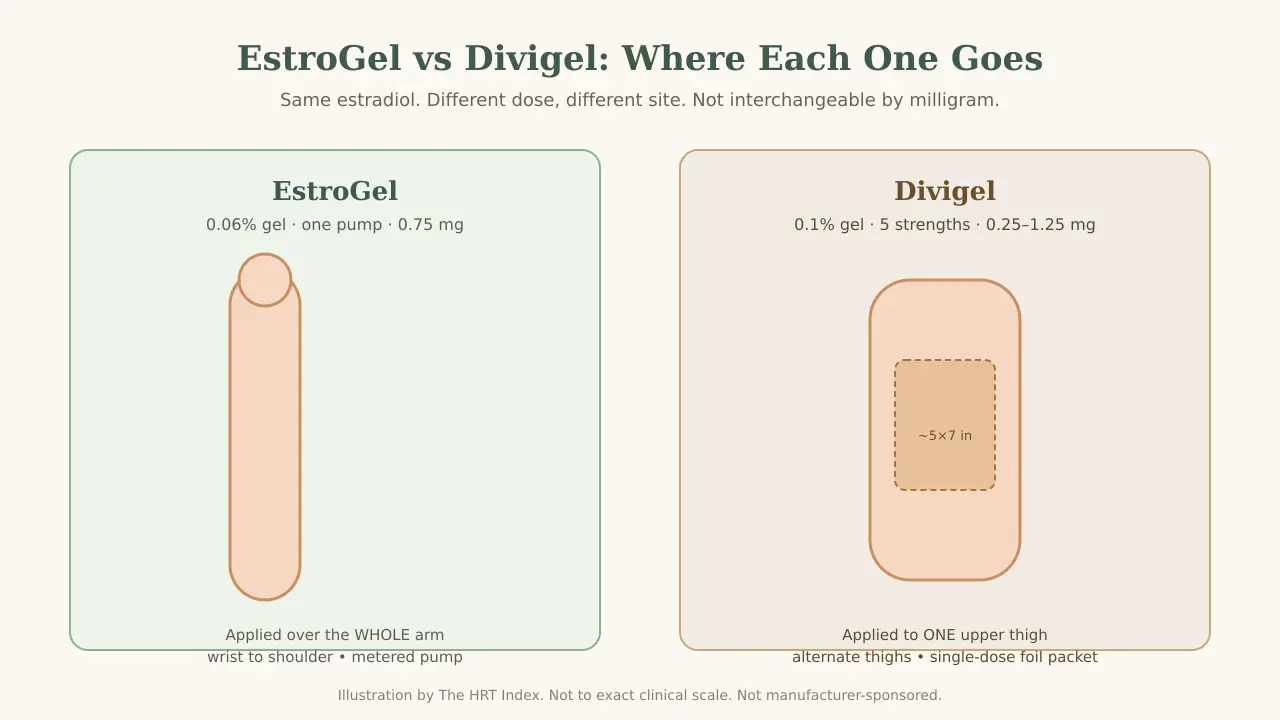
EstroGel vs Divigel is a choice between two FDA-approved estradiol gels that contain the same active drug. EstroGel has one approved dose — 0.75 mg — spread over a whole arm, and it is also approved for vaginal and vulvar atrophy. Divigel has five packet strengths, 0.25 to 1.25 mg, applied to the thigh. No head-to-head trial has ever compared them. Do not match milligrams when switching.
Now here's the part that sends women back to the search bar. Pick up Divigel this month and the paper insert warns you about one thing. Pick up EstroGel and it warns you about four. Same molecule. Two different frightening paragraphs. We pulled both labels. We know exactly why. And it has nothing to do with which drug is safer.
Some provider links below are affiliate links, and we may earn a commission at no extra cost to you. What appears on this page is decided under The HRT Index Verification Standard — never by payout.
Best for / not for you if
| EstroGel may fit you if | Divigel may fit you if |
|---|---|
| Vaginal dryness or painful sex is part of why you're treating. It's the only one of the two FDA-approved for that | Your clinician wants a starting strength below 0.75 mg. Divigel starts at 0.25 mg; EstroGel has no lower approved dose |
| You'd rather have one pump than open a packet every morning | You want a small, coverable application area instead of a bare arm |
| You want a simple routine with a single approved dose | You'd rather carry individually sealed daily doses when you travel |
| Brand EstroGel's label lists no propylene glycol, which matters if you react to it | The shorter warning in the box would settle your mind. That's a real reason. It just isn't a safety reason |
Neither may be right for you if you have a history of breast cancer, another estrogen-driven cancer, blood clots (DVT or PE), stroke, heart attack, unexplained vaginal bleeding, liver disease, a known clotting disorder, or a serious allergy to either product. Both labels list these as contraindications. This is not the complete list. Read the full label with a clinician who knows your history.
EstroGel vs Divigel: the five differences at a glance
| EstroGel | Divigel | |
|---|---|---|
| Doses available | One: 0.75 mg | Five: 0.25 to 1.25 mg |
| Where it goes | Whole arm, wrist to shoulder | One upper thigh, ~5×7 inches |
| FDA-approved for | Hot flashes and vaginal/vulvar atrophy | Hot flashes only |
| Boxed warning today | Full four-part warning | One part: endometrial cancer |
| Delivery | Metered pump | Single-dose foil packets |
Before you go further
The right online HRT provider isn't the same for every woman — it depends on your symptoms, what you have tried so far, your age, your state and your health history. Some situations belong with an in-person clinician first.
Use The HRT Index's Find My HRT Path tool to match your situation to the specific questions and next steps that fit you. Free. No prescription needed to use it.
Use Find My HRT Path →What is actually the same about EstroGel and Divigel?
Both EstroGel and Divigel deliver 17β-estradiol — the same estrogen molecule the ovaries produce — through the skin and into the bloodstream. Both skip the liver's first-pass metabolism. Both are prescription-only. Both are alcohol-based and flammable until dry. Both carry the same contraindications. The active drug is not the difference between them.
Here is our own label-derived calculation. It took two numbers and a divide sign, and we've never seen anyone else do it.
Divigel's label reports its estradiol-to-estrone ratio at steady state: 0.42 to 0.65. (Estrone is a weaker estrogen your body makes when it processes estradiol. A higher ratio means more estradiol relative to estrone.)
EstroGel's label doesn't print a ratio. But it prints the two numbers you'd need. After 14 days, average estradiol over 24 hours was 28.3 pg/mL. Estrone was 48.6 pg/mL.
28.3 ÷ 48.6 = 0.58.
That lands inside Divigel's published range.
Now the honest part, because this is where a page like this could mislead you. Those figures come from two separate product studies, years apart. Section 12.2 of both labels says the same thing: comparing estrogen exposure across different products, to predict how well one will work or how safe it is for one woman, may not be valid. Our number is descriptive. It is not proof of equivalence.
Both gels also:
- Bypass the liver on the way in, unlike an estrogen pill.
- Can interact with drugs that speed up or slow down the CYP3A4 enzyme — St. John's wort, rifampin, carbamazepine, ketoconazole, ritonavir, and grapefruit juice among them. Tell your prescriber everything you take.
- State that blood estrogen levels don't reliably predict how an individual woman responds.
- Are flammable until they dry. No cigarettes, no gas stove, no candle.
Hold onto this for the next section: a boxed warning describes a label, not a molecule. Sponsors submit labeling changes. The FDA approves them product by product, on different timelines. Two products with the same active drug can carry different warning text on the same Tuesday.
Why does Divigel's warning look shorter than EstroGel's?
In February 2026 the FDA approved shortened boxed warnings for six menopausal hormone therapy products. Divigel was one of them; EstroGel was not. As of July 2026, Divigel's boxed warning covers only endometrial cancer, while EstroGel's still lists endometrial cancer, cardiovascular disorders, probable dementia, and breast cancer. The FDA's February 2026 labeling action did not identify Divigel as safer than EstroGel.
What actually happened, with dates
November 10, 2025. The FDA and HHS announced they were beginning to remove the broad boxed warnings from estrogen products for menopause. The warnings had been in place since 2003, added after the Women's Health Initiative trial. HHS noted that the WHI population had an average age of 63 — more than a decade past the average age of menopause in the US, which is around 51.
One warning was explicitly kept: endometrial cancer, for systemic estrogen-alone products in women who still have a uterus.
Then the paperwork. At the FDA's request, 29 companies submitted proposed labeling changes. Each product's label is a separate submission and a separate approval. This is not a switch someone flips.
February 12, 2026. The FDA approved the first batch. Six products: Prometrium, Divigel, Cenestin, Enjuvia, Estring, Bijuva.
July 10, 2026 — what we checked ourselves. We pulled both labels from DailyMed, the National Library of Medicine's official label database.
- Divigel's label, revised 2/2026, now carries a one-part boxed warning about endometrial cancer. Its “Recent Major Changes” section records the removal of the cardiovascular, breast cancer, and probable dementia language.
- EstroGel's label, revised 5/2026 — three months after the FDA's action — still carries all four.
- EstroGel does not appear on the FDA's published list of products with updated prescribing information.
Two independent confirmations. Same answer.
What this means, and what it doesn't
| This is real | This is not what it means |
|---|---|
| The insert in your box will say different things depending on which gel you pick up | Divigel is safer than EstroGel |
| Your pharmacist may describe the risks differently for each | The FDA compared the two drugs and found a safety gap |
| A friend on the other product is reading a different warning than you | The estradiol in one box differs from the estradiol in the other |
| EstroGel's label has not yet been updated to the shorter format | EstroGel's risks got worse, or Divigel's disappeared |
The drugs did not change in February 2026. The paperwork did, for some products before others.
One more thing worth saying plainly: removing a risk from the boxed warning did not delete it from the label. Cardiovascular and cancer warnings still appear in Divigel's Warnings and Precautions section. They moved. They didn't vanish.
Why the endometrial cancer warning stayed on both
Because it's the one risk that is specific, dose- and duration-related, and directly addressable. If you have a uterus and you take estrogen alone, the lining of your uterus can thicken. Over time that raises the risk of endometrial cancer. Adding a progestogen has been shown to reduce the risk of that thickening. It lowers the risk. It doesn't make treatment risk-free.
That's why the FDA kept this one and let the others move. It isn't a scare. It's an instruction. We cover it below.
Is Divigel stronger than EstroGel?
No product is universally stronger, and the two cannot be compared by milligrams. EstroGel is a 0.06% gel; Divigel is 0.1%. One pump of EstroGel is 1.25 grams of gel containing 0.75 mg of estradiol. A 1.25-gram packet of Divigel contains 1.25 mg. The same weight of gel holds a different amount of drug. No randomized head-to-head trial has compared them.
The gram trap
Both labels talk in grams of gel and milligrams of estradiol. People mix them up constantly.
| Grams of gel | Milligrams of estradiol | |
|---|---|---|
| One pump of EstroGel | 1.25 g | 0.75 mg |
| Divigel's largest packet | 1.25 g | 1.25 mg |
| Divigel's 0.75 mg packet | 0.75 g | 0.75 mg |
Look at rows one and two. Same 1.25 grams. Different drug amount. That's what a different concentration means.
Now look at row three. To deliver 0.75 mg, EstroGel needs 1.25 grams of gel spread across your whole arm. Divigel needs 0.75 grams on a patch of thigh the size of two palm prints. Same milligrams. Different gel volume, different surface area, different formula.
Our no-conversion rule
We will never publish a dose-conversion chart between these two products. Not here, not in the FAQ, not in a tool.
We could build one. It would get traffic. It would also be a document that helps a woman change her own hormone dose in her bathroom based on a table she found on the internet. The labels don't support the underlying comparison. So we don't publish it. That's the whole rule. It's the most valuable thing on this page, and it's the thing we're refusing to sell you.
About the 2016 indirect comparison
There has never been a randomized trial putting EstroGel head to head against Divigel. We searched through July 10, 2026 and found none. What exists is a Bayesian network meta-analysis published in Menopause in 2016 — Derzko and colleagues. It compared the two indirectly, by lining up separate placebo trials. It's the study behind most “Divigel wins” claims you'll read.
Three limitations that matter:
1. It's indirect. Different trials, different patients, different years, stitched together statistically. That's a legitimate method. It is not the same as a head-to-head trial.
2. Check the author list. One author's listed affiliation is Teva Canada Innovation — a pharmaceutical company. The paper compares two commercial products and concludes in favor of one of them. That doesn't invalidate the analysis. It's a relationship you deserve to see printed next to the conclusion, and the full disclosure statement is in the paper.
3. The “losing” EstroGel dose is not an approved US dose. This is the part that matters most. The study's headline finding is that Divigel 1.0 mg had the largest estimated efficacy and EstroGel 1.5 mg had the smallest. But EstroGel's only FDA-approved dose in the United States is 0.75 mg — one pump. The 1.5 mg arm comes from a phase 3 trial that randomized 73 women to 1.5 mg and 75 women to 0.75 mg. Only 0.75 mg was approved.
So the most-quoted result compares Divigel's top dose against an EstroGel dose your pharmacy cannot dispense. What did the study find at the doses you'd actually be prescribed? That EstroGel 0.75 mg performed similarly to Divigel 0.25 mg and 0.5 mg. And that Divigel 1.0 mg had the largest estimated effect — while also carrying a higher estimated risk of treatment-related side effects.
Our read: no direct evidence establishes one product as superior at US-labeled doses.
What about half-life?
EstroGel's label reports an apparent terminal half-life of about 36 hours. Divigel's, about 10 hours. Do not conclude Divigel “wears off faster.” Those figures came from two separate studies with different designs and sampling. Section 12.2 of both labels — again — says cross-product comparisons like this one may not be valid. They describe the studies. They don't describe your Tuesday.
Which estradiol gel is right for you?
The choice comes down to five things: whether vaginal dryness is part of your symptoms, whether your clinician wants a starting strength below 0.75 mg, where on your body you'd rather apply it, who touches your skin, and what your plan covers.
Find yourself below. Most women land in two or three rows at once.
| If this is you | Ask about | Because |
|---|---|---|
| Hot flashes, and you have a uterus | Either gel — plus an endometrial-protection plan | Estrogen alone can thicken the uterine lining |
| Vaginal dryness is your only symptom | Neither, first | See the vaginal dryness section below |
| Your clinician wants a starting strength below 0.75 mg | Divigel, which starts at 0.25 mg | EstroGel has no lower approved dose |
| Standard estrogen doses have given you side effects | Ask whether a lower labeled strength fits | Only Divigel offers one |
| Any bleeding after menopause | Call your clinician before choosing anything | Bleeding needs evaluation, not a product swap |
| Toddlers climb on you, or a dog sleeps against your legs | Read the transfer section first | The two products' evidence differs |
| You put lotion on your arms every morning | Read the skin-care section first | This one genuinely surprises people |
| You're switching off a patch | Read the shortage section | Don't match milligrams |
Notice what isn't on that list: “whichever is stronger.” That row doesn't exist, because that question doesn't have an answer.
More than one row describes you?
Of course it does. That's where a general article stops working. Your symptoms, your uterus status, your risk history, your state, and your coverage all pull in different directions — and no article can hold all of them at once.
See which starting point fits your situation — The HRT Index's Find My HRT Path tool matches your situation to a specific next step, and it flags when online care isn't the right first move at all. Free. No prescription needed to use it. Nothing to cancel.
Use Find My HRT Path →Where do you apply each gel, and can it get on other people?
EstroGel is applied once daily over one entire arm, from wrist to shoulder. Divigel is applied to an area of about 5 by 7 inches on one upper thigh, alternating thighs each day. Both labels warn about skin-to-skin transfer. In EstroGel's transfer study, mean estradiol did not change in the women who were touched. In Divigel's, some elevation over baseline was seen in male partners, and the label calls the degree of transfer inconclusive.
The routines are not the same size
EstroGel. Prime a new pump by pressing it five times and discarding that gel. Then one pump daily. Spread it over one whole arm, inside and outside, wrist to shoulder. It dries in two to five minutes; allow five minutes before dressing. Wash your hands. Prevent contact with that arm for at least an hour.
Divigel. Tear open a packet. Squeeze the whole thing onto one upper thigh. Spread it over about two palm prints. Switch thighs tomorrow. Let it dry completely, then cover the site with clothing. Wash your hands. Don't wash the site for an hour.
That's a bare arm for an hour versus a covered thigh. If you have a job, a toddler, or a summer, that difference is not trivial.
The transfer studies, side by side
This is what women are most frightened of, and what most articles handle worst. So here's exactly what each label reports.
| EstroGel's study | Divigel's study | |
|---|---|---|
| Dose applied | 1.25 g daily for 14 days | 1.0 g, single dose |
| Who applied it | 24 postmenopausal women | Postmenopausal women |
| Contact | 15 minutes, arm to arm, 1 hour after applying | 15 minutes, thigh to arm, at 1 and 8 hours |
| Who they touched | 24 postmenopausal women | Male partners |
| Result | No change in mean estradiol in the women touched | Some elevation over baseline in the men |
| The label's own word | — | “Inconclusive” |
Now read it again and notice what you're comparing. One study had women touching women. The other had women touching men. Different doses. Different body parts. Different timing. These are not two runs of the same experiment.
Divigel's transfer study was inconclusive. EstroGel's was not. Because the two studies used different populations, sites, doses, and timing, they cannot establish which product transfers more.
Divigel's label does go further in one specific way: it carries explicit patient counseling about children and pets — watch for unexpected breast growth or early sexual development in a young child, and know that pets can be exposed too. EstroGel's label doesn't include that section.
That is a difference in what each label says. It does not establish a product-level safety difference. And note the direction it runs: EstroGel's label was revised more recently (5/2026) than Divigel's (2/2026), and it still doesn't include that counseling. So the difference isn't about which label is newer.
What to take from this: on either gel, let it dry and wash your hands. Divigel's label says to cover the site after it dries. EstroGel's says to prevent contact with the arm for at least an hour. Follow the one you're given.
For some households, a smaller thigh site that gets covered by clothing may simply be easier to manage than a bare arm. That's a routine-fit judgment, not evidence of lower transfer.
Can lotion, sunscreen, or showering change how much you absorb?
With EstroGel, yes, and by a large margin. In a randomized crossover study of 42 postmenopausal women, applying moisturizer one hour after EstroGel increased mean estradiol exposure by 38% and peak levels by 73%. Sunscreen applied one hour after decreased both by 16%. Divigel's label states that the product-specific effect of sunscreen and topical lotions was not evaluated.
If you moisturize your arms every morning, this is the most useful paragraph on this page.
The moisturizer number
EstroGel's label contains a Warnings and Precautions section — 5.18 — titled “Moisturizer Lotion Application.” It's right there in the official prescribing information. Most women have never read it. The study behind it: randomized, open-label, three-period crossover, 42 healthy postmenopausal women.
- Moisturizer, one hour after the gel: mean AUC (total exposure) up 38%. Mean Cmax (peak level) up 73%.
- Sunscreen, one hour after the gel: mean AUC and Cmax both down 16%.
Seventy-three percent is not a rounding error. That's a large change in measured exposure caused by a bottle of lotion. What the study did not establish is what that change does for any individual woman. It's a reason to talk to your prescriber, not a reason to panic.
What was never studied
Applying lotion or sunscreen before the gel. Neither label addresses it. We're not going to invent a rule. And for Divigel, the product-specific effect of sunscreen and topical lotions was not evaluated. Divigel's label notes that studies of other estradiol gels have shown sunscreen can change absorption.
“Not evaluated” is not the same as “no effect.” It means nobody looked.
The one-hour rule is a floor, not a green light
Both labels say don't wash the application site for at least one hour. Nearly everyone reads that as “after one hour, nothing is lost.” The labels say otherwise:
- Washing EstroGel's arm at exactly one hour reduced the mean average 24-hour serum estradiol concentration by 22%.
- Washing Divigel's thigh at exactly one hour reduced mean total 24-hour estradiol exposure by 30 to 38%, and removed all detectable estradiol from the skin surface.
So one hour is the minimum instruction, not the point at which nothing is lost.
Three practical rules
- Apply the gel at a time of day when you can keep the site dry for at least the labeled interval.
- If you use lotion or sunscreen on the same skin, tell your prescriber and your pharmacist. Especially with EstroGel.
- Tell your prescriber before you change a same-site skin-care routine while they're still assessing whether your dose is working. Otherwise nobody will know what caused what.
Will either gel help vaginal dryness or painful sex?
EstroGel is FDA-approved for moderate-to-severe symptoms of vulvar and vaginal atrophy; Divigel is not. However, EstroGel's own label instructs prescribers to first consider a topical vaginal product when vaginal symptoms are the only treatment target. Divigel's label states it should never be applied in or around the vagina.
We're going to argue against the whole subject of this page for a moment. If dryness is your only symptom, neither of these gels is where you should start.
EstroGel is approved for it. The FDA labeled it for moderate-to-severe vulvar and vaginal atrophy — the medical name for the thinning and drying of vaginal tissue after estrogen drops. The evidence is real: in EstroGel's trial, vaginal wall cytology showed a statistically significant increase in superficial epithelial cells at week 12 (P≤0.001), while placebo showed no change. That was a tissue measurement, not a head-to-head symptom comparison against Divigel.
But EstroGel's own label adds a limitation of use. When vaginal symptoms are the only thing you're treating, consider a topical vaginal product first.
Divigel isn't approved for it at all. Its label lists hot flashes, and it says not to apply it in or around the vagina.
Read those two facts together. The product with the broader approval is telling you to look at a different product first.
If dryness or painful sex is the whole story, close this page. A local vaginal product targets the tissue that needs it without starting a systemic gel. We'd rather lose the click than send you toward a systemic route before you've compared the local ones.
Compare local vaginal estrogen options →If you have hot flashes and dryness, that's a different conversation. Bring both. EstroGel's dual indication is a legitimate reason to name it by name.
Do you need progesterone with EstroGel or Divigel?
If you have a uterus and you use systemic estrogen, you generally need an endometrial-protection plan. Both labels state that adding a progestogen has been shown to reduce the risk of endometrial hyperplasia, the thickening that can precede cancer. Women who have had a hysterectomy generally do not need one, though a history of endometriosis can be an exception. The prescriber decides.
Some vocabulary first, because these words get used sloppily:
- Progesterone is the hormone your body makes.
- Progestin is a synthetic version.
- Progestogen is the umbrella word covering both.
Three things to hold onto:
- Report any vaginal bleeding after menopause. Right away. Both labels say so. It usually doesn't mean cancer. It does mean someone needs to look.
- Progestogens carry their own risks, different from estrogen's. Read that drug's label too.
- This isn't a supplement you add yourself. It's a second prescription and a clinical decision.
Worth knowing: Prometrium — micronized progesterone — was in the same February 12, 2026 batch of six products whose labels the FDA updated. Same day as Divigel.
How progestin and progesterone differ, and which one fits →Which one works better for hot flashes?
Both reduced moderate-to-severe hot flashes compared with placebo, in their own separate trials. EstroGel's trial enrolled 145 postmenopausal women aged 29 to 67 and showed significant reductions in frequency and severity at weeks 4 and 12. Divigel's enrolled 495 women with a mean age of 54.6, all of whom had at least 50 moderate-to-severe hot flushes per week at baseline. No randomized trial has compared the two directly.
Most pages won't show you this. The two trials weren't remotely alike.
| EstroGel's trial | Divigel's trial | |
|---|---|---|
| Women enrolled | 145 | 495 |
| Ages | 29 to 67 | 34 to 89 (mean 54.6) |
| Doses tested | 0.75 mg vs placebo | 0.25, 0.5, 1.0 mg vs placebo |
| Length | 12 weeks | 12 weeks |
| Entry requirement | Moderate-to-severe hot flushes | At least 50 per week |
| Race reported | 81.4% White | 86.5% White, 10.1% Black |
| Result | Significant at weeks 4 and 12 | 0.5 and 1.0 mg significant at week 4; all doses by week 12 |
Different sizes. Different age ranges. Different entry bars. Different dose arms. You cannot line up “week 4” in one trial against “week 4” in the other and crown a winner. They weren't the same experiment. Anyone telling you Divigel works faster — or that EstroGel does — is comparing two things that were never built to be compared.
Notice something else. Both trials were overwhelmingly white, and one enrolled women as old as 89 — while Divigel's current label now advises considering initiation in women under 60 or within 10 years of menopause onset. That's the honest state of the evidence for these two products. It isn't a scandal. It's just true, and you should hear it from us before someone sells you certainty.
On “peaks and valleys.” If your symptoms swing, verify these before you blame the brand: your exact dose, whether you apply at the same time every day, whether you're covering the full application area, when you shower, what lotion you use, and whether the pharmacy switched your manufacturer.
What do EstroGel and Divigel cost in 2026?
Both products have generics. The FDA approved the first EstroGel-equivalent generic — estradiol gel 0.06% from Solaris Pharma — on April 22, 2024, and Solaris launched it that same month; additional manufacturers have entered since. Generic estradiol gel 0.1%, Divigel's generic, has been available in all five packet strengths. Cash prices depend on the exact manufacturer, NDC, strength, quantity, ZIP code, pharmacy, and payment route.
Both have generics. Say it out loud.
You'll still find pages telling you EstroGel has no generic. That stopped being true in April 2024.
- EstroGel's generic: estradiol gel 0.06% in a metered pump. First approved for Solaris Pharma Corporation on April 22, 2024, and identified by the FDA as the first approved applicant. Solaris launched an AB-rated version that month. Other manufacturers have since been added, including Encube Ethicals.
- Divigel's generic: estradiol gel 0.1%, sold in the same five packet strengths, from manufacturers including Xiromed.
Ask the pharmacy which manufacturer and NDC they can actually supply. That is not a pedantic question. Here's why.
Two recalls you should know about before you fill
Both involve the 0.25 mg packet — the exact strength we suggested above for women who want to start low. We're telling you because it would be dishonest not to.
| Company | Product | What happened | Scale | When |
|---|---|---|---|---|
| ANI Pharmaceuticals | Estradiol gel 0.1%, 0.25 mg. NDC 70954-531-20, lot M251109, expiring Nov 2027 | Class II recall. Some single-dose packets were empty or only partially filled | ~3,964 cartons, nationwide | Initiated May 2026 |
| Padagis US LLC | Estradiol gel 0.1%, 0.25 mg/g | Class II recall. Some packets may not have been fully sealed, potentially allowing ethanol loss | ~4,944 cartons, nationwide | Classified February 2025 |
Read these carefully, because they are narrower than they look.
- Neither is a recall of brand Divigel. Neither is a recall of EstroGel.
- Both are lot-specific. They do not mean generic estradiol gel is unsafe.
- A Class II recall means the FDA judged the problem could cause temporary or reversible health effects — here, getting less drug than prescribed.
- Two different companies, sixteen months apart, both with packet-integrity defects on the same strength. That's a pattern worth knowing when you're the one holding the packet.
What to do: check the manufacturer name, the NDC, and the lot number printed on your carton. If it matches, call your pharmacy. Don't stop treatment on your own — call. And check the FDA's enforcement report database, which is where recalls are published.
The quantity trap
When you look up EstroGel on a discount site, check what quantity is showing before you read the price. Discount pages sometimes default to a multi-pump fill. A headline price sitting next to a much larger “average retail” figure can look like a monthly cost when it isn't. Each 50-gram EstroGel pump supplies 30 labeled daily doses after priming. Three pumps is 90 doses — three months, not one.
Then compare that to generic Divigel, which is quoted per 30 packets — already one month.
Same day. Same ZIP code. Same pharmacy. Brand and generic priced separately. Exact strength. Days supplied stated. Raw price shown before any per-month division.
If a page gives you a price without those six things, it's giving you a number, not an answer.
Our own pricing snapshot for this page is being re-run against that standard and will be published here with the capture date, ZIP, pharmacy, manufacturer, and NDC for each product. Until it is, we're not going to print a winner.
One more thing about the generics
Generic doesn't mean identical packaging or identical inactive ingredients. Brand Divigel's label lists propylene glycol and 56% alcohol. Brand EstroGel's lists no propylene glycol. The Solaris 0.06% generic lists 44.89% alcohol; the Encube 0.06% generic lists 46.12%.
None of that changes the estradiol. All of it matters if you have a contact allergy. Verify the inactive ingredients of the exact manufacturer and NDC your pharmacy will dispense.
Which gel is more likely to be covered by insurance?
There is no universal coverage winner. Formulary status varies by insurer, employer, state, plan year, brand versus generic, exact strength, and manufacturer. Generics are typically placed on lower tiers than brands, and a brand may require prior authorization or step therapy. In 2026, out-of-pocket spending on drugs covered by a Medicare Part D plan is capped at $2,100, not counting premiums or drugs the plan doesn't cover.
This is where most women actually get stuck. Not on the pharmacology. On the phone.
Four things decide your price:
- Brand or generic. Different products, different tiers.
- Your plan's rules. A plan may require step therapy, prior authorization, or a formulary exception. If it does, ask for the plan's current criteria and its exception or appeal process. Both exist.
- Coupon or insurance — one or the other. You cannot apply both to a single fill. Ask the pharmacist to price it both ways. And know that a cash or discount-card purchase may not count toward your deductible or your Part D out-of-pocket total.
- Medicare Part D. The 2026 cap is $2,100. Once you hit it, covered drugs cost you nothing for the rest of the calendar year. Premiums and non-covered drugs don't count toward it.
One structural note worth hearing: in national coverage of the 2026 patch shortage, a menopause specialist observed that non-patch options are less likely to be covered by insurance than patches. Gels are frequently the harder thing to get paid for. That has nothing to do with the drug.
Here's the part nobody tells you
Everything above is useless on its own. You cannot buy either gel. Both are prescription-only. Which one you actually get is decided by two people who aren't you: a prescriber who knows the difference between a 0.06% pump and a 0.1% packet, and a plan that will pay for one of them. That combination is harder to find than the medication is.
Our one honest admission
Midi Health is not an FDA-approved-only prescriber, and if you clicked through expecting that, you'd be misled.
Midi runs a “Custom Rx” store that sells compounded hormone products, including a compounded estradiol gel starting at $60 for a 30-day supply and a compounded estradiol cream from $45. Midi's own site carries the required language: compounded drugs are not FDA-approved, and the FDA has not verified their safety, effectiveness, or quality.
Let us be blunt about what that means for you specifically. A compounded estradiol gel is not EstroGel. It is not Divigel. It is not a generic of either. It has no FDA label, no boxed warning to read, no NDC to check against a recall, and no formulary code. Everything on this page — the label diff, the transfer studies, the recall table — exists only because these are FDA-approved products.
But if you want EstroGel, Divigel, or an FDA-approved generic — the products this entire page is about — Midi remains one of the few menopause telehealth services that will bill your commercial insurance rather than hand you a cash invoice. Midi says it is in-network with most PPO plans. Its published self-pay prices are $250 for an initial visit and $150 for continued-care visits. It holds NCQA accreditation.
You just have to say so at intake. Here is the sentence:
“I want an FDA-approved estradiol gel — EstroGel, Divigel, or an FDA-approved generic — sent to my retail pharmacy. Not a compounded product.”
Say that, and the compounding question resolves itself before it costs you anything.
A patient testimonial published by Midi on its own website reads, in part: “…I got a same day appointment and they took my insurance.” — Victoria W. Read that for exactly what it is. It's a testimonial the company published on its own marketing page. It describes scheduling and billing — not a medical outcome. It is not evidence that any hormone will work for you, and it is not a promise about your appointment. We include it because it describes the one thing you can verify for yourself at intake, before you pay.
Disclosure: this is a paid link. The HRT Index may earn a commission if you use it. Compensation does not change our conclusions, and no service can guarantee which medication a clinician will prescribe.
Check Midi's current insurance coverage and menopause visit availability
Check Midi →Two hard stops, straight from Midi's own pricing page:
- Medicaid or Medi-Cal? Midi cannot treat you. Not even as a self-pay patient.
- Medicare? Midi is not covered by Medicare or any Medicare-related plan. You can be seen as a self-pay patient, but you cannot submit any claim for the visit, the medication, or related services.
If either applies to you, don't waste an hour finding out at checkout. Here's what HRT actually costs without insurance →
Can a clinician switch you from a patch to a gel during the shortage?
ASHP currently lists product-specific estradiol transdermal patch shortages. The FDA, using a different methodology, had not declared an estradiol shortage as of reporting in June 2026. Transdermal gel delivers estradiol through the skin, as a patch does, and is one clinician-directed alternative when a prescribed patch is unavailable. Patch doses cannot be converted to gel doses by matching milligrams.
If you're here because your pharmacy said “backordered,” this is your section.
What's happening, in numbers
- Estradiol patch prescriptions climbed about 162% over two years, according to HealthVerity data reported by CNBC in June 2026.
- Prescriptions among women aged 45 to 54 rose about 184% between 2018 and 2026, according to Truveta data reported by NBC News — including roughly 20% between July 2025 and February 2026 alone, right after the FDA's November announcement.
The FDA and ASHP disagree, and both are right
Almost nobody explains this. ASHP — the American Society of Health-System Pharmacists — lists specific estradiol patch products in shortage, based on reports from pharmacists and clinicians. The FDA has not declared an estradiol shortage. It uses a different definition, tied to total national supply versus total national demand.
So a pharmacist can truthfully say “there's a shortage” and the FDA can truthfully say there isn't. Check both databases. Neither is lying. They're measuring different things, and articles that flatten this into one answer are giving you less information, not more.
A gel is a reasonable alternative. Milligram-matching is not.
Gel and patch both put estradiol through the skin and both bypass the liver on the way in. Clinicians have been moving women from patches to gels; one physician quoted in national coverage said she suggests gels to patients who can't find patches.
But several pages ranking right now assert that one pump of EstroGel produces blood levels comparable to a 0.05 mg/day patch. That is precisely the inference Section 12.2 of both gel labels warns against. We are not going to give you that number, even though you want it and it would make this page more satisfying. Your prescriber picks the dose.
What to do instead:
- Ask when your prescriber wants to see you after a formulation change.
- Ask your pharmacist whether the gel is in stock before the prescription gets sent.
- Ask whether a 90-day fill is possible, and whether your plan allows an early refill.
Can you switch between EstroGel and Divigel?
Switching requires a new prescription. The two products differ in concentration, gel volume, application site, and formulation, and matching the printed milligrams does not make them interchangeable. One pump of EstroGel is 1.25 grams of gel containing 0.75 mg of estradiol; a Divigel packet containing 0.75 mg holds 0.75 grams of gel.
What not to do
- Don't match milligrams and switch on your own.
- Don't split a Divigel packet. The label says apply the entire packet.
- Don't use two pumps of EstroGel to “double” your dose. One pump is the approved dose.
- Don't apply either gel to a body site its label doesn't name.
- Don't use both products unless your prescriber specifically directs you to.
- Don't assume 0.1% means “the strong one.”
What to bring to the conversation
Write these down before you call:
- Current product, and the manufacturer name printed on the box
- Current strength, and how many you were dispensed
- What time of day you apply it, and where
- Missed doses in the last month
- Whether you shower, moisturize, or swim within an hour of applying
- Any bleeding, breast tenderness, or headache
- The exact price you were quoted, and by which pharmacy
- Why you want to switch
If your prescriber won't call you back
That's the barrier most women actually hit. Not medical risk. Phone tag. The switch still requires a clinical decision and a new prescription — but you can't have the decision if you can't reach the decider.
If you don't have insurance, or you'd rather pay a known price once than wait for a callback, Sesame is worth a look. It's a marketplace where clinicians publish visit prices up front, you choose your own provider, and prescriptions go to your local pharmacy. Sesame's menopause subscription includes basic lab work if your provider orders it.
What we verified, and what we didn't. Sesame's own site states that it does not bill health insurance, and that medication costs are not included in the subscription price. Sesame's published medication list names estradiol as the generic for Estrace, Climara, and Divigel — it does not list EstroGel. Sesame's clinicians can also prescribe compounded BHRT if they judge it appropriate, and Sesame's own FAQ states that BHRT is prescribed outside formal FDA regulation and that studies have not shown it is safer or more effective than standard hormone therapy.
So ask for the FDA-approved product by name, exactly as you would with any provider.
A patient testimonial published by Sesame on its own website, attributed only to a “Real Sesame patient,” describes filling an HRT prescription quickly: “…pick them up from my local Costco in a few hours.” Same caveat as before. It's a company-published, anonymous account of a scheduling and pharmacy experience. It is not evidence of medical benefit.
See current cash-pay menopause visit options on Sesame
Check Sesame →Confirm before you pay: which clinician, which state, the exact visit price, whether they'll prescribe the gel you want, and what your pharmacy will charge for it. Medication cost is separate. The clinician determines whether to prescribe at all.
Disclosure: this is a paid link. The HRT Index may earn a commission if you use it. It does not change what's written above.
The honest downsides of each
EstroGel's drawbacks are a single approved dose, a large application area with an hour-long contact restriction, a documented interaction with body moisturizer, and a boxed warning that has not yet been updated. Divigel's are an inconclusive transfer study, no vaginal atrophy indication, unstudied sunscreen effects, daily packet waste, and propylene glycol in the brand formula.
| EstroGel | Divigel |
|---|---|
| One approved dose. The label says the lowest effective dose “has not been determined.” | The transfer study in male partners was inconclusive |
| A larger wrist-to-shoulder application area, with contact prevented for at least an hour | Not FDA-approved for vulvar or vaginal atrophy |
| Moisturizer raised mean exposure 38% and peak levels 73% in the label study | Sunscreen and lotion effects were never evaluated for this product |
| Still carries the full four-part boxed warning as of July 2026 | One foil packet of waste per day |
| A new pump wastes 5 priming depressions | Brand label lists propylene glycol |
| Pump must be discarded after 30 doses even if gel remains | Brand label lists 56% alcohol |
Two more things. Application-site reactions were reported by 0.6% of women taking EstroGel in its controlled trials. That's uncommon. Divigel's label also lists application-site reactions.
The two products' side-effect lists look different — EstroGel's trials reported headache, flatulence, and breast pain at 5% or higher; Divigel's reported irregular bleeding, breast tenderness, vaginal yeast infection, and upper respiratory infection. Do not compare those lists. Different trials, different populations, different reporting. Both labels say adverse reaction rates from separate trials cannot be compared directly.
What we actually verified
This page was researched by reading primary sources, not by summarizing other articles.
On July 10, 2026, we:
- Pulled the current FDA prescribing information for EstroGel and Divigel, plus representative generic labels for estradiol gel 0.06% (Solaris Pharma; Encube Ethicals) and estradiol gel 0.1% (Xiromed), from DailyMed — and compared them field by field.
- Confirmed against the FDA's own published list of menopausal hormone therapies with updated prescribing information that Divigel appears on it and EstroGel does not.
- Read the FDA and HHS announcements of November 10, 2025 and February 12, 2026 in full.
- Verified the first EstroGel-equivalent generic approval (Solaris Pharma, April 22, 2024) against the FDA's first-time generic approvals record and a commercial launch bulletin.
- Checked current recall activity on generic estradiol gel and found two lot-specific Class II recalls.
- Read the only comparative study between the two products, including its author affiliations.
- Calculated EstroGel's estradiol-to-estrone ratio from labeled values, and marked it as our arithmetic.
- Read Midi's and Sesame's own pricing, coverage, and product pages rather than third-party reviews.
What we did not do: we did not test these products. We received no samples. This page was not reviewed by a clinician, and we haven't pretended otherwise.
What we could not verify, and are telling you anyway:
- Whether a specific generic is stocked at your pharmacy today.
- Your formulary, your copay, or your local inventory.
- Which product any telehealth clinician will prescribe to you.
- Whether you are medically eligible for systemic estrogen.
- A same-day, same-ZIP, same-pharmacy price comparison. That capture is in progress and will be published here with its full method.
Why we don't publish patient reviews of these drugs. We do not use patient testimonials as evidence of comparative efficacy or safety. On a page comparing two prescription drugs, “this one changed my life” functions as a medical claim from an unverifiable source. The two testimonials above describe scheduling and billing at a telehealth company, are published by those companies on their own sites, and are labeled as such.
How we compare things. This review follows The HRT Index Verification Standard — our documented process for reviewing providers and medications: read every published price, separate FDA-approved from compounded, verify state availability and insurance, and re-check on a fixed schedule (top providers monthly, full roster quarterly). It is a process, not a score. We do not assign numeric ratings to drugs or providers, and we never will.
We evaluate on exactly five pillars, in this order: clinical legitimacy, care quality, medication fit, price transparency, access.
FDA approval is a regulatory action, not an endorsement. Our evidence comes from current FDA labels and peer-reviewed literature.
What to say at your appointment
Screenshot this. Bring it. These are questions, not instructions — the prescriber chooses the product and the dose.
- “I'm interested in a transdermal estradiol gel rather than a pill. Does that route fit my history and my treatment goal?”
- “Do I need an endometrial-protection plan, given my uterus status?”
- “Which product and labeled strength fit my symptoms and history?”
- “Does Divigel's labeled 0.25 mg starting strength fit my situation?”
- “Because vaginal dryness is part of my symptoms, does EstroGel's indication matter here — or should we discuss a local vaginal treatment first?”
- “Before you send it — which one is on my plan's formulary, and does it need prior authorization?”
- “I use lotion on my arms every morning.” (Matters for EstroGel. Say it anyway.)
- “Is generic substitution appropriate? Is there a specific manufacturer or NDC you want the pharmacy to use?”
- “When should we reassess this product and dose?”
If you take nothing else, take number 4. It is often the question that changes what you pay.
Frequently asked questions
Is Divigel the same as EstroGel?
No. Both contain estradiol and both are FDA-approved systemic gels, but they differ in concentration (0.1% vs 0.06%), packaging, number of approved doses, application site, and FDA-approved indications. The active drug is the same. The products are not interchangeable.
Is Divigel stronger than EstroGel?
No product is universally stronger. Divigel is a more concentrated gel, so 1.25 grams of Divigel holds 1.25 mg of estradiol while 1.25 grams of EstroGel holds 0.75 mg. Concentration is not clinical strength, and no head-to-head trial has compared them.
Is 0.75 mg of Divigel the same as one pump of EstroGel?
Both deliver 0.75 mg of estradiol on paper. That does not make them interchangeable. Divigel's 0.75 mg comes in 0.75 grams of gel on a small patch of thigh; EstroGel's comes in 1.25 grams spread over a whole arm. Only a prescriber should switch you.
Why is Divigel's boxed warning shorter now?
Because the FDA approved a shortened boxed warning for Divigel on February 12, 2026, as part of a first batch of six hormone therapy products. Divigel's remaining boxed warning covers endometrial cancer. This is a labeling change. It is not a finding that Divigel is safer.
Does EstroGel still have a boxed warning?
Yes. As of July 10, 2026, EstroGel's label — revised 5/2026 — still carries the full boxed warning covering endometrial cancer, cardiovascular disorders, probable dementia, and breast cancer. EstroGel does not appear on the FDA's list of products with updated labels.
Is Divigel safer than EstroGel because its warning is shorter?
No. Both contain identical estradiol delivered through the skin. The difference reflects which manufacturer's labeling change has been approved, not a difference in the drug. Removing risks from a boxed warning does not delete them from the label.
Is there a generic for EstroGel?
Yes. The FDA approved the first EstroGel-equivalent estradiol gel 0.06% from Solaris Pharma on April 22, 2024, and it launched that month. Additional manufacturers have entered since. Ask your pharmacy which manufacturer and NDC it can supply.
Is there a generic for Divigel?
Yes. Generic estradiol gel 0.1% is marketed in the same five single-dose packet strengths, by manufacturers including Xiromed.
Has generic estradiol gel been recalled?
Two lot-specific Class II recalls have affected the 0.25 mg strength of generic estradiol gel 0.1%: ANI Pharmaceuticals recalled roughly 3,964 cartons (NDC 70954-531-20, lot M251109) in May 2026 after packets were found empty or partially filled, and Padagis US LLC recalled roughly 4,944 cartons in early 2025 for packets that may not have been fully sealed. Neither is a recall of brand Divigel or of EstroGel. Check the manufacturer, NDC, and lot on your carton.
Can I use Divigel for vaginal dryness?
Divigel is not FDA-approved for vaginal atrophy, and its label says not to apply it in or around the vagina. EstroGel is approved for it, but EstroGel's own label directs prescribers to consider a topical vaginal product first when vaginal symptoms are the only concern.
Can I put EstroGel on my thigh, or Divigel on my arm?
No. Each label names a specific application site — the arm for EstroGel, the upper thigh for Divigel — and the absorption data was generated at that site.
Can estradiol gel transfer to my husband, my kids, or my pets?
Both labels warn about skin-to-skin transfer. EstroGel's transfer study found no change in mean estradiol in the women who were touched. Divigel's found some elevation in male partners and called the degree of transfer inconclusive. Divigel's label carries specific counseling about children and pets. Let the gel dry and wash your hands.
What should I do if someone touches wet gel?
Divigel's patient instructions direct the exposed person to wash the area of contact with soap and water right away, and note this is especially important for men and children. Follow the instructions in the patient leaflet you were dispensed, and call your clinician if you're concerned.
What if I miss a dose?
Divigel's patient instructions give explicit guidance: don't double the dose; if your next dose is less than 12 hours away, wait and apply your normal dose the next day; if more than 12 hours away, apply the missed dose and resume normally; if you spill a packet, don't open a new one. EstroGel's label does not publish an equivalent missed-dose rule — check your patient leaflet or ask your pharmacist.
How long do I have to wait before showering?
Both labels say at least one hour. But washing at exactly one hour still reduced measured 24-hour estradiol exposure by about 22% with EstroGel and 30 to 38% with Divigel. One hour is a minimum, not a point where nothing is lost.
Does lotion affect estradiol gel absorption?
With EstroGel, yes. Moisturizer applied one hour after increased mean exposure by 38% and peak levels by 73% in a controlled study. Sunscreen decreased both by 16%. For Divigel, the product-specific effect was not evaluated.
Do I need progesterone with EstroGel or Divigel?
If you have a uterus and use systemic estrogen, you generally need an endometrial-protection plan. Both labels state that adding a progestogen reduces the risk of endometrial hyperplasia. Women who have had a hysterectomy generally do not need one, though endometriosis can be an exception. The prescriber decides.
Can I switch from an estradiol patch to a gel?
Yes, with a prescription. Both deliver estradiol through the skin. But patch doses cannot be converted to gel doses by matching milligrams — both gel labels caution against comparing exposure across products this way.
Which is more likely to be covered by insurance?
There is no universal answer. Coverage depends on your insurer, plan year, brand versus generic, exact strength, and manufacturer. Generics typically sit on lower tiers; brands more often require prior authorization or step therapy. Ask your plan about its current criteria and its exception process.
Which costs less, EstroGel or Divigel?
It depends on brand versus generic, strength, quantity, pharmacy, ZIP code, and payment route. Both have generics. Check the quantity shown on any discount page — an EstroGel listing may be a multi-pump fill, since one 50-gram pump supplies 30 daily doses.
Does EstroGel's longer half-life mean steadier levels?
No. EstroGel's label reports about 36 hours and Divigel's about 10, but those came from separate studies with different designs. Both labels warn that exposure comparisons across products may not predict how an individual woman responds.
Should I get my estrogen levels checked to see which one is working?
Both labels state that serum estrogen concentrations don't reliably predict an individual woman's response. A serum result alone should not rank these two products. Symptom response and clinical assessment guide management, and a clinician may still test for other reasons.
Sources
Primary — every medical and regulatory claim on this page
- DailyMed — EstroGel (estradiol gel, metered), ASCEND Therapeutics US, LLC. NDA 021166. Label revised 5/2026. Retrieved July 10, 2026.
- DailyMed — Divigel (estradiol gel), Vertical Pharmaceuticals, LLC. NDA 022038. Label revised 2/2026. Retrieved July 10, 2026.
- FDA — FDA Approves Labeling Changes to Menopausal Hormone Therapy Products, February 12, 2026.
- FDA — Menopausal Hormone Therapies with Updated Prescribing Information (product list).
- HHS / FDA — HHS Advances Women's Health, Removes Misleading FDA Warnings on Hormone Replacement Therapy, November 10, 2025.
- FDA — First-Time Generic Drug Approvals, 2024: estradiol transdermal gel (metered) 0.06%, Solaris Pharma Corporation, approved April 22, 2024.
- Optum — New Generics bulletin, April 25, 2024: Solaris launch of AB-rated estradiol gel 0.06%.
- DailyMed — Estradiol gel 0.06%, Solaris Pharma Corporation.
- DailyMed — Estradiol gel 0.06%, Encube Ethicals, Inc. ANDA 218214.
- DailyMed — Estradiol gel 0.1%, Xiromed LLC.
- FDA enforcement report; state board of pharmacy recall alerts — ANI Pharmaceuticals, Class II recall, estradiol gel 0.1% 0.25 mg, NDC 70954-531-20, lot M251109, exp. Nov 2027, ~3,964 cartons, initiated May 2026.
- FDA enforcement report — Padagis US LLC, Class II recall, estradiol gel 0.1% 0.25 mg/g, ~4,944 cartons, classified February 2025.
- Derzko C, Sergerie M, Siliman G, Alberton M, Thorlund K. “Comparative efficacy and safety of estradiol transdermal preparations for the treatment of vasomotor symptoms in postmenopausal women: an indirect comparison meta-analysis.” Menopause. 2016;23(3):294–303. PMID 26382309.
- “Transdermal estradiol gel for the treatment of symptomatic postmenopausal women.” Menopause. PMID 22282101. (Phase 3 randomization: 1.5 mg, n=73; 0.75 mg, n=75.)
- Medicare.gov — How much does Medicare drug coverage cost? 2026 Part D out-of-pocket cap: $2,100.
- Society of Gynecologic Oncology, November 2025 — confirmation that the endometrial cancer boxed warning is retained for systemic estrogen-alone products.
Secondary — market, supply, and provider context only. Never used for clinical claims.
- CNBC, June 26, 2026 — estradiol patch supply; HealthVerity prescription data; ASHP versus FDA shortage methodology.
- NBC News, May 11, 2026 — Truveta prescription data; insurance coverage of non-patch transdermal options.
- joinmidi.com/pricing-insurance — self-pay pricing, PPO network, Medicaid/Medi-Cal exclusion, Medicare policy, NCQA accreditation, published patient testimonials.
- joinmidi.com/estrogen-shortage and joinmidi.com/store — Midi Custom Rx compounded products and pricing; compounded-drug disclaimer.
- sesamecare.com/service/menopause-treatment — subscription model, no insurance billing, medication cost separate, published medication list, BHRT statement, published patient testimonials.
- GoodRx — pricing pages for EstroGel, Divigel, and estradiol. Retrieved July 2026. Pending a same-day, same-ZIP, same-pharmacy re-capture.
How we keep this current. Both brand labels are re-checked monthly until EstroGel's boxed warning transition resolves. The FDA's updated-label list, monthly. FDA enforcement reports and manufacturer recall notices, monthly and on publication day. Provider policies, monthly. Shortage status, monthly, against both the FDA database and ASHP. Generic manufacturers and NDCs, quarterly. Pricing, quarterly. When something changes, this page changes — and we'll say what changed and when.
Still not sure which HRT program is right for you?
Take our free matching quiz →