
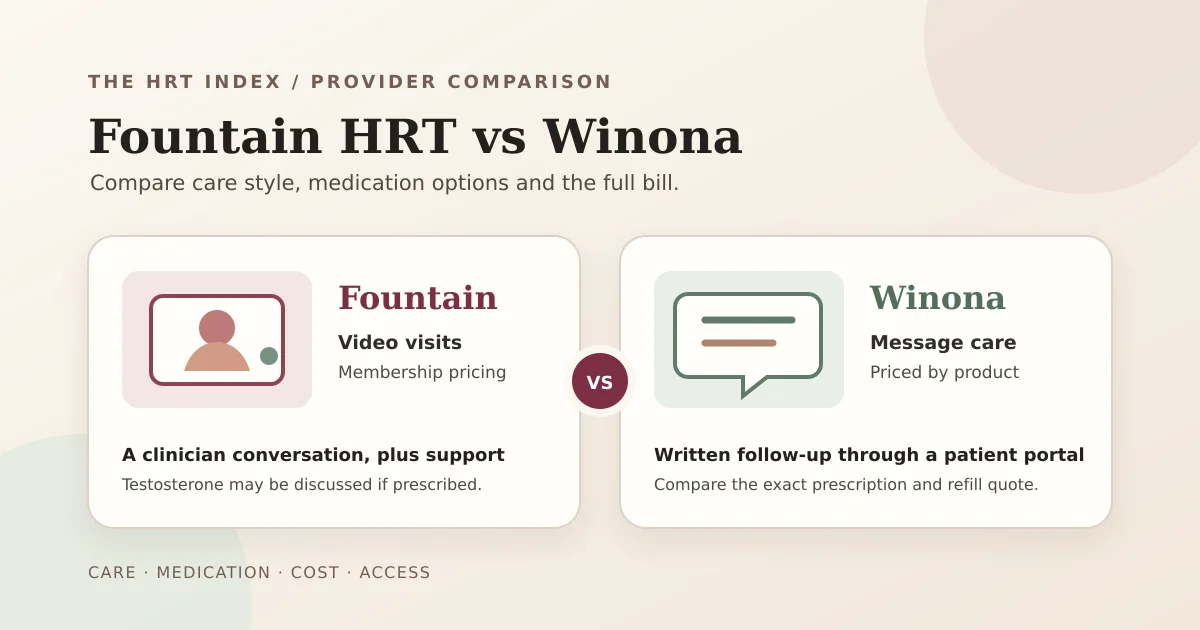
Fountain HRT vs Winona comes down to testosterone, care style and cash. Fountain bundles video visits, 24/7 text support and, if prescribed, testosterone (no U.S. product is FDA-approved for women) into a membership that works out to about $150–$199 per four weeks. Winona sells estrogen and progesterone product by product, from $39–$149 a month, with message-only care and no testosterone.
So here's the short version. If you don't specifically want testosterone or face-to-face video visits, Winona is worth comparing: its tablet-plus-capsule example has a lower advertised starting sum. Your complete prescription and actual billing quote decide the cost. If you do, Fountain is the one of these two that offers them. And if neither feels right, there are good third paths, including insurance-billed care and Gala Health HRT, which we cover below.
- Lean toward Fountain if you want to talk with a clinician about testosterone, you'd rather see your clinician on video, and you can manage its upfront and renewal payments. The $1,948.92–$2,587 figures below allocate cost to 52 weeks of care; they are not a first-year cash budget.
- Lean toward Winona if you're 35 to 59, live in one of the 37 states (or Puerto Rico) it serves, are happy to message instead of meet, and don't need testosterone.
- Look at a third path if you need insurance to pay, you want a simple flat price without building a cart of products, or you have unexplained bleeding or a history of blood clots, stroke or hormone-sensitive cancer. In that last case, start with a clinician who can review your history.
The HRT Index is the independent decision resource for online menopause and HRT care — comparing telehealth providers on clinical legitimacy, care quality, medication fit, price transparency, and access, with every claim verified and dated, so women can choose the path that fits their situation before their first consult.
How we make money: we may earn a commission from labeled links to Winona and Gala Health. We have no affiliate relationship with Fountain, and its links on this page are ordinary editorial links. Commissions can affect which options we feature and how prominent a button is. They do not change the facts below. Our affiliate disclosure.
What we actually verified · Last verified October 2026
- On October 12, 2026, we read Fountain's HRT page, Terms of Use and Return & Refund Policy; Winona's FAQ, product prices, state list and cancellation policy; and Gala's hormone-health page and HRT landing page.
- We checked medical points against the FDA, The Menopause Society and published testosterone guidelines.
- We did not sign up, pay, have a consult or receive medication from any of these companies. This is a documentation review.
- Still not confirmed: every current Fountain kit component's exact product, route and approval status; Fountain's HRT age range and state list; Fountain's exact assessment charge; Winona's dispensed product/manufacturer and exact refill quote; and Gala's checkout price, full medication inclusions and applicable HRT cancellation terms. We say so wherever it matters.
Fountain HRT vs Winona at a glance
Fountain's clearest differences are video care and a testosterone conversation; Winona's are message-based care and separate product prices. Medication fit, access and the complete bill decide which suits you. Prices below are the companies' own published prices, checked October 12, 2026.
| What matters | Fountain HRT | Winona |
|---|---|---|
| Testosterone | Offered if prescribed. No FDA-approved testosterone product for women exists in the U.S.; exact product status needs confirmation. | Not prescribed. Offers DHEA instead. |
| How you talk to a clinician | Scheduled face-to-face video visits; separate concierge text/phone support advertised "24/7." | Secure messages only. No phone or video visits. Doctors typically reply in 24–48 hours. |
| Medication type | "Custom Hormone Therapy Kit." Exact current product, route and approval status of every component were not confirmed. | Mix: tablets, capsules and patch listed as FDA-approved by Winona; body and vaginal creams are compounded. |
| How you pay | One membership: $199 every 4 weeks, $499 every 12 weeks, or $1,799 every 48 weeks. | Per product, from $39–$149 "per month." No separate membership fee. |
| Allocated cost per 52 weeks | $1,948.92 (Pro) to $2,587 (Starter) | Checkout amount unconfirmed; separate calendar-month and 28-day examples below |
| Routine hormone blood tests | Not part of standard care, per Fountain's HRT page | Not required, per Winona |
| Insurance | No insurance involved | Doesn't bill insurance. HSA/FSA cards accepted. |
| Who can sign up | Platform terms require 18+; HRT-specific age range and state availability unconfirmed | Women 35–59; 37 states plus Puerto Rico |
| Follow-up | Fountain describes ongoing video visits and month-by-month fine-tuning | Free, unlimited follow-up messages; physician check-in after 10 weeks |
| If a clinician says you don't qualify | "Pay nothing if not qualified," per Fountain | The online visit is free; you pay when an order processes |
| Canceling | Cancel anytime by text or email; unused prepaid months refunded pro-rata; shipped meds not refunded | Cancel anytime in your account; full refund only within a 24-hour window before the pharmacy starts filling |
Sources: Fountain HRT, Fountain terms, Fountain return policy, Winona FAQ, Winona products, Winona states, Winona cancellation policy. All checked October 12, 2026.
One honest warning before you go further. Neither "bioidentical" nor "all-inclusive" tells you which exact medicine will arrive at your door. Fountain names the hormones but we couldn't verify every current kit product and route. Winona's current product pages list its patch, tablets and capsules as FDA-approved and its creams as compounded; older help and general treatment wording conflict with those listings. Whichever you choose, ask for the exact product name and your full first bill before the pharmacy fills anything. We give you the exact questions to copy further down.
The right online menopause care isn't the same for every woman — it depends on your symptoms, what you've already tried, your age, your state and your health history. Some situations belong with an in-person clinician first. Use The HRT Index's Find My HRT Path tool to explore a featured care option for your situation — and to flag when online care isn't the right starting point — before your first consult.
It asks five short questions: what's bothering you most, what you've tried, your age, your state and any health history a clinician should know about. No email is needed, and your answers stay in your browser. It points you to a featured online care option or tells you when a different starting point makes more sense. It doesn't diagnose, prescribe or decide whether hormone therapy is right for you. It doesn't feature Fountain. How it works.
Fountain HRT vs Winona: which one should you choose?
If you don't specifically want testosterone or video visits, Winona's message-based care is worth comparing; its tablet-plus-capsule example has a lower advertised starting sum than Fountain's plans. Fountain makes more sense if you want a clinician-led conversation about testosterone, prefer face-to-face video visits and value around-the-clock support enough to pay more. Neither one bills insurance.
Think of it as two different styles of care, not a good one and a bad one.
Fountain is the "concierge" model. You take a quiz, then have a video visit with a clinician. If treatment is prescribed, a custom kit ships, and a support team handles scheduling, shipping and reminders. Fountain says you can text or call anytime and that it typically responds within 10 minutes. You pay one membership price for everything Fountain says is included.
Winona is the "message and order" model. You fill out an online intake. A physician reviews it, and communication takes place through the patient portal. If treatment is right for you, the pharmacy fills it and ships it. You pay for each product you're prescribed. There's no membership fee, no video call and no testosterone.
A two-question self-check
Answer these honestly. They change where you should start.
- Do you specifically want to talk with a clinician about testosterone because of low sexual desire that bothers you?
- Do you need to see and talk to your clinician face to face, rather than in writing?
- Yes to either: Fountain is the one of these two that offers both. Read the testosterone section first, because testosterone helps a narrower group of women than ads suggest.
- No to both: message-based care may suit you. Compare Winona's full prescription quote with Gala's published bundle and billing terms.
- "I'm not sure": that's completely normal. Find My HRT Path was built for exactly this spot.
Who each one is not for
Fountain may not be your best fit if you're on a tight budget, want to see every price for every product before you commit, or want to know before you pay whether your medicines are FDA-approved finished products. We couldn't confirm every current kit component's product details.
Winona may not be your best fit if you're under 35 or 60 or older, live outside its 37 states and Puerto Rico, want to talk on video, or want testosterone.
Neither may fit if you need insurance to pay, or your history needs a careful in-person review first.
If messaging suits you, you're 35 to 59, Winona serves your state, and testosterone isn't on your list, Winona's free online visit is a low-cost way to get a physician's opinion. Bring the questions from this page so you know your exact product and refill price before the pharmacy starts filling.
Sponsored link. Winona's clinicians decide whether treatment is appropriate. A prescription is never guaranteed.
What will you actually pay for Fountain HRT vs Winona?
Fountain publishes first-plan payments of $199 to $1,799, depending on the term, and allocated costs of $1,948.92 to $2,587 per 52 weeks of care. Assessment fees, extras and exact first-charge timing remain unconfirmed. Winona's cost depends on which products you're prescribed: two example regimens add up to $93 or $188 a month at advertised starting prices. Fountain bills in four-week blocks, and Winona refills 30-day supplies every 28 days, so both can charge you more often than "monthly" suggests.
If you've found online HRT prices confusing, you're not alone. Most pages show you one friendly number. But three different numbers decide what this costs you:
- Due today: what leaves your account at checkout.
- Cash by day 90: what you'll have paid after about three months.
- Allocated cost per 52 weeks: a common 364-day care period, separate from cash needed for renewals.
Why "every 4 weeks" isn't the same as "every month"
Fifty-two weeks is 364 days and contains 13 four-week care periods, not 12. At $199 per period, the allocated cost is $2,587 ($199 × 13), not $2,388 ($199 × 12). A calendar year is slightly longer: with the first charge on day 0, another renewal on day 364 falls inside the first 365 days.
Winona has a similar wrinkle. Its FAQ says 30-day supplies are processed every 28 days, and 90-day supplies every 84 days. Its product prices are advertised "per month." We couldn't confirm at checkout whether each advertised price is charged per 28-day refill, so we show both ways below.
The Real Bill: Fountain HRT plans
| Fountain plan | Published price and billing | Published first-plan payment | Cash by day 90* | Allocated cost per 52 weeks of care | Allocated per 4 weeks |
|---|---|---|---|---|---|
| Starter | $199 every 4 weeks | $199 | $796 (days 0, 28, 56, 84) | $2,587.00 | $199.00 |
| Standard | $499 every 12 weeks | $499 | $998 (days 0, 84) | $2,162.33 | $166.33 |
| Pro | $1,799 every 48 weeks | $1,799 | $1,799 (day 0 only) | $1,948.92 | $149.92 |
*Assumes your first charge is on day 0 and prices don't change. Cash by day 90 includes payments that buy care beyond day 90. For example, Standard's second payment on day 84 covers you through day 168. Fountain describes the membership as covering medication, shipping, visits and support. Not included in these figures: any separate assessment charge (we couldn't confirm one for HRT) and any extra costs your clinician might order. Source: Fountain HRT, checked October 12, 2026. The math is ours.
Cash needed in the first 365 days is different. With unchanged prices, first charge on day 0 and renewals counted on days 0–364, Starter takes 14 payments ($2,786), Standard five ($2,495) and Pro two ($3,598). Those payments buy 392, 420 and 672 days of coverage, respectively. This is scheduled bundle cash, not a complete checkout total or cost consumed during that year; assessment and required extras remain unknown.
What this means for you: Fountain's lowest price ($149.92 per four weeks) needs $1,799 paid at once. That covers 48 weeks, which is 336 days, a bit less than a full year. If you prepay and change your mind, Fountain's policy says unused prepaid months are refunded pro-rata, but shipped medicine and care already given are not. Ask exactly how that refund is figured before you prepay.
The Real Bill: Winona example regimens
Winona prices each product separately. What you pay depends on what's prescribed. These are examples, not recommendations. A clinician decides what fits you.
| Example Winona regimen (if prescribed) | Advertised starting price | Cash by day 90 if charged per 28-day refill | Allocated cost per 52 weeks, charged per 28-day refill | Cost per 12 calendar months, charged monthly |
|---|---|---|---|---|
| Estrogen tablets + progesterone capsules | $54 + $39 = $93 | $372 | $1,209 | $1,116 |
| Estrogen patch + progesterone capsules | $149 + $39 = $188 | $752 | $2,444 | $2,256 |
| Estrogen body cream with progesterone (compounded) | $89 | $356 | $1,157 | $1,068 |
These are sums of Winona's advertised "from" prices, checked October 12, 2026 on Winona's product page. Higher strengths, extra products and supply sizes can change the bill. The 28-day columns are hypothetical: they assume the advertised sum is the charge for every 28-day refill. Winona's actual order amount was not confirmed. The calendar-month column is a separate 12-payment illustration. Use your actual checkout quote before relying on any number here.
What this means for you: the cheapest Winona example ($89 cream) isn't the same medicine as the patch example ($188). They're different products with different regulatory status, which we explain in the next section. Don't pick a medicine just because it's cheaper. Pick the care you and your clinician agree on, then compare the bill.
Side by side: the first 12 weeks
| Path | Published plan payments or illustrative medication sums |
|---|---|
| Fountain Starter | $597 (three four-week payments) |
| Fountain Standard | $499 (one payment) |
| Fountain Pro | $1,799 published first-plan payment; buys 48 weeks; assessment/extras unconfirmed |
| Winona tablets + capsules | $279 — three times the advertised monthly sum; actual 12-week bill unconfirmed |
| Winona patch + capsules | $564 — three times the advertised monthly sum; actual 12-week bill unconfirmed |
| Winona combined cream | $267 — three times the advertised monthly rate; actual 12-week bill unconfirmed |
Same sources and assumptions as above. The Fountain cash window here is days 0–83, before the day-84 renewal. Fountain's figures include the care it bundles (visits, support, testosterone if prescribed); separate assessment and required extras remain unconfirmed. Winona's rows are arithmetic from advertised prices, not confirmed cash charges. Its advertised medication prices include free shipping and follow-up care. Neither is a like-for-like medical comparison.
What a complete quote should show you
Before you pay either company, your quote should answer every line below. If a required cost is unknown, the total is incomplete, not zero.
- Any one-time visit or assessment fee
- Every prescribed medication and its price
- Any membership fee
- Any lab tests your clinician wants, and who pays
- Shipping and tax, if any
- The exact amount due today
- The next charge amount and the exact date it processes
- Any minimum commitment
- The cancellation cutoff, and what can be refunded
Also separate a one-time promotion from the regular renewal price. A first-order discount doesn't tell you what month four costs.
Plan with your own quote
The tables above separate first payments, day-90 cash and allocated care cost. For your own quote, write down the first amount, exact refill dates, all required extras and supplied coverage. Add the charges due inside each period; if any required charge is unknown, your estimate is incomplete.
If both bills feel heavy, a simpler flat-price plan may fit better. Gala Health HRT advertises one monthly price that it says includes the clinician review, prescription and shipping, with no membership fee. We cover its strengths and its open questions below.
Sponsored link. Confirm your exact medication, total price and renewal date with Gala before you pay.
What medications can you get, and which are FDA-approved?
FDA approval belongs to a specific finished medicine, not to a company or to the word "bioidentical." Winona labels its estrogen tablets, estrogen patch and progesterone capsules as FDA-approved and its body and vaginal creams as compounded. Fountain names the hormones in its custom kit but doesn't say publicly whether each one is FDA-approved or compounded.
Three words, explained simply
- Bioidentical means the hormone has the same chemical shape as the one your body makes. It says nothing about who made the medicine or whether the FDA approved it.
- FDA-approved means the FDA reviewed that exact finished product for safety, effectiveness and manufacturing quality before it was sold. FDA-approved bioidentical estradiol and progesterone products exist.
- Compounded means a pharmacy mixed the medicine for an individual prescription. Compounded drugs are not FDA-approved and don't get that premarket review. FDA
Compounding can meet a real need, like a dose or form that isn't sold commercially, or an allergy to an inactive ingredient. But "custom," "natural" or "bioidentical" doesn't make a compounded product safer or better. ACOG says compounded bioidentical hormones shouldn't be prescribed routinely when FDA-approved options fit, and The Menopause Society has raised safety and quality concerns about them. ACOG · The Menopause Society
Product by product
| Product | What's in it (per provider) | Advertised starting price | FDA status and what to ask |
|---|---|---|---|
| Winona estrogen tablets | Oral estradiol | $54/month | Winona lists it as FDA-approved. Ask for the product name and manufacturer. |
| Winona progesterone capsules | Oral progesterone | $39/month | Winona lists it as FDA-approved. Winona's listed progesterone capsules contain peanut oil; tell your clinician about any peanut allergy. |
| Winona estrogen patch | Estradiol through the skin | $149/month | Winona lists it as FDA-approved. Ask the brand, strength and whether it's in stock. |
| Winona estrogen body cream with progesterone | Estradiol + estriol + progesterone, rubbed on skin | $89/month | Compounded by a state-licensed compounding pharmacy. The finished cream is not FDA-approved. |
| Winona estrogen body cream | Estradiol + estriol | $89/month | Compounded. Not FDA-approved. |
| Winona vaginal estrogen cream | Estradiol, used in the vagina | $89/month | Compounded. Ask whether an FDA-approved vaginal product would fit you. |
| Winona DHEA | DHEA | $27 per 3-month supply | Different hormone from testosterone. Ask what it's for and the evidence for your symptoms. |
| Fountain custom kit | Estrogen, progesterone and testosterone, "in precise, personalized dosages" | Included in membership | Every current component's product, route and approval status unconfirmed. Ask for each product, form and pharmacy. |
Sources: Winona products, estrogen tablets, progesterone capsules, estrogen patch, Winona combined cream page, Fountain HRT, checked October 12, 2026. An older FDA-status help article and the general treatments page conflict with the current product-specific approval labels; the exact medicine dispensed still needs confirmation.
About estriol. Two of Winona's creams contain estriol, a weaker form of estrogen. Winona's product page says the active ingredients are FDA-approved. That's not the same as the finished cream being FDA-approved, and the FDA notes that estriol isn't an ingredient in any FDA-approved drug product. FDA menopause information
About Fountain's "custom" kit. Fountain says its kits are exclusive to Fountain and dosed for each person. A custom dose doesn't establish compounding or FDA approval. A January 2025 Fountain product document describes a compounded progesterone troche, but we couldn't confirm that product's current availability or identify every current kit component. Ask for the exact finished products. Its terms say you can ask your provider to send a prescription to the pharmacy of your choice, which is worth asking about if you prefer a specific FDA-approved product.
If you have a uterus, ask how your lining is protected
The endometrium is the lining of your uterus. If you have a uterus and use estrogen that works throughout your body, you generally also need a progestogen, like progesterone, to protect that lining. The Menopause Society
That's why the form matters. Oral micronized progesterone has evidence for this job. Progesterone in a cream rubbed on the skin is a different question. Listing progesterone as an ingredient doesn't confirm that a cream provides enough uterine-lining protection. The Menopause Society explains why adequate progesterone matters. If you're offered a combined cream, ask:
"Which exact progestogen product is protecting my uterine lining, and what evidence supports this form for that?"
If you want a patch or a specific product
You can tell either company what you'd prefer, but a preference isn't a guaranteed prescription. A clinician decides.
Also, local and whole-body treatment do different jobs. Low-dose local vaginal estrogen mainly treats dryness, pain with sex and some urinary symptoms. Those local products aren't meant to treat hot flashes. Systemic estrogen (pill, patch, gel or body cream) works throughout your body. Our vaginal estrogen guide explains the difference.
A worked example: if you want a patch, Winona's $149 patch and its $89 combined cream are not two prices for the same thing. Winona lists the patch as FDA-approved. If you have a uterus and use systemic estrogen, you generally need an appropriate progestogen plan; Winona lists progesterone capsules from $39 more. The other is a compounded cream with estriol in it. Compare what you're getting first, then the price.
For a deeper explainer, see compounded vs FDA-approved HRT and HRT benefits and risks.
Does Fountain HRT's testosterone make it better than Winona?
Not by itself. Fountain offers testosterone and Winona doesn't, so Fountain is the one of these two to consider if you want a clinician-led conversation about it. But no testosterone product is FDA-approved for women in the U.S., and the strongest evidence supports it for one thing: low sexual desire that causes distress after menopause, once other causes are checked.
Fountain's HRT page calls testosterone "a key ingredient" that other programs leave out. It links testosterone to libido, body fat, energy and bone density, and says its kit "includes testosterone, unlike other programs." That's Fountain's marketing framing. Here's what the evidence says.
What the evidence supports
Hypoactive sexual desire disorder (HSDD) means low sexual desire that lasts, that bothers you, and that isn't better explained by something else, such as pain, depression, medication side effects, relationship strain or poor sleep.
A 2019 global consensus statement from major menopause and sexual-health societies concluded that HSDD in postmenopausal women is the only condition with good evidence for testosterone treatment. It did not support testosterone for energy, mood, weight, muscle, bone health or general well-being. A blood testosterone number alone doesn't diagnose HSDD. Global Consensus Position Statement · ISSWSH clinical guideline
So if low desire is what's bothering you most, testosterone may be worth discussing. For hot flashes or night sweats, menopausal hormone therapy has stronger evidence. Sleep or mood problems need their own assessment; testosterone isn't an established treatment for them.
Three separate facts about testosterone for women
- Off-label use. No testosterone product is FDA-approved for women in the U.S. If an FDA-approved male product is prescribed to a woman, that use is off-label. FDA testosterone information
- Compounded testosterone is also not FDA-approved as a finished product.
- It's a controlled substance. Testosterone is a Schedule III drug under federal law and always needs a prescription. Prescribers must follow federal and state rules for controlled substances, so availability can vary by state. DEA drug scheduling
Possible side effects the guidelines discuss include acne and unwanted hair growth. Guidelines call for baseline and follow-up testosterone checks and monitoring for side effects. Long-term safety has not been established.
Does Winona have an alternative?
Winona says plainly that it does not prescribe testosterone, and it offers prescription DHEA instead. Winona FAQ DHEA is a different hormone. It isn't a testosterone substitute, so don't treat the two as interchangeable. If you're curious, read does Winona prescribe testosterone?
Questions to ask Fountain before adding testosterone
- "Why do you think testosterone fits my symptoms, and what else should we rule out first?"
- "What form and product would you use, and is it FDA-approved for anyone or compounded?"
- "Your HRT page says routine hormone monitoring isn't standard. How will you check my testosterone level and side effects if I take it, and is that included in my plan?"
- "Is testosterone available in my state?"
- "What happens if I want to stop?"
Fountain isn't the only option for testosterone
Fountain's page says it's "the only HRT program that offers testosterone treatment, face-to-face video visits, and 24/7 support." Fountain isn't the only online menopause service offering testosterone. Midi describes a testosterone program with video visits and lab monitoring in participating states. That doesn't establish whether another service offers Fountain's exact combination of testosterone, video visits and 24/7 support. Our libido guide covers this in more depth.
If a testosterone conversation and face-to-face video visits are what matter most to you, Fountain is the one of these two built around both. Go in with the questions above, and ask what your plan would include before you pick a prepaid term.
We don't earn a commission from Fountain.
Video visits vs messaging: how care actually works at each
Fountain uses scheduled face-to-face video visits with a clinician, plus a support team you can text or call any time. Winona uses written messages through a patient portal, with physician replies typically within 24 to 48 hours, free unlimited follow-ups and a check-in after 10 weeks. Neither style guarantees better treatment. They suit different people.
How Fountain works
Fountain describes three steps: a quiz (it says about 5 to 15 minutes), a video visit with a menopause-trained clinician, and, if prescribed, a kit that ships in days. Its plan boxes list a video visit as included. One box says 30 minutes and another says 20, so ask which applies to you.
After that, Fountain says clinicians "fine-tune your treatment month after month" through ongoing video visits. Its support team coordinates visits, handles shipping and sends reminders. Fountain says it typically responds within 10 minutes, by text or phone.
That support team is not the same as your clinician. Quick replies about shipping or scheduling are helpful. They don't mean a clinician is on call around the clock for medical decisions. If you have an urgent medical problem, call 911 or get urgent care.
One more thing worth knowing: Fountain itself doesn't practice medicine. Its terms explain that care comes from independent, physician-owned medical groups that use Fountain's platform. Fountain terms
Here's how one Fountain HRT patient described the access:
"Being able to reach providers quickly has made getting and taking HRT a breeze." — Lindsay W., Trustpilot review, March 25, 2026
That's one person's experience of service. It isn't proof of care quality or of how treatment will work for you.
How Winona works
You create an account and complete a medical intake. A Winona physician reviews it in the patient portal. Winona's onboarding explains that if you don't list questions and the physician decides treatment is appropriate, your prescription can process without a separate conversation. So write your questions into the intake if you want answers before anything ships.
After that, you message your physician whenever you like. Winona says its physicians typically reply within 24 to 48 hours and asks patients to contact its care team if they haven't heard back after 48 hours. Winona says a physician checks in after 10 weeks and may change your dose or method then. Follow-ups are free and unlimited. Winona FAQ
A claim worth correcting
Several "Fountain vs Winona" articles we reviewed are labeled as paid partnerships with Fountain. Some suggest Winona "sets it and leaves it." Winona's own FAQ describes the 10-week physician check-in, possible dose changes and unlimited follow-ups. It's fair to say Winona is message-only. It isn't fair to say it never adjusts care.
Which style suits you?
- If you think better out loud, want to see a face, or have a lot of questions at once, video may feel better.
- If you'd rather write questions when they come to you, at 11 p.m. if that's when they pop up, messaging may feel easier.
- If you'd like both video access and insurance billing, a scheduled, insurance-billed service may suit you better than either of these.
Do Fountain HRT or Winona require blood tests?
Winona says hormone testing isn't required to start. Fountain says routine hormone-level monitoring isn't standard HRT care, with tests ordered when clinically indicated; ask whether your initial evaluation or proposed treatment needs tests. Routine hormone testing is rarely needed to guide ordinary menopausal hormone therapy.
Hormone levels swing a lot during perimenopause, sometimes from day to day. So a single blood test usually doesn't tell a clinician much about whether estrogen will help. The Menopause Society 2022 position statement
Two important exceptions:
- Labs for a reason. A clinician may still order tests if your symptoms could come from something else, like a thyroid problem.
- Testosterone is different. Guidelines call for checking testosterone levels when it's used, to keep levels within the physiologic female range and watch for side effects. If you take testosterone through Fountain, ask how that monitoring happens and who pays.
You may see other reviews praise Fountain for "lab monitoring." Fountain's current HRT page says routine hormone-level monitoring is not standard. Some patients describe having labs. The fair takeaway: ask Fountain directly what tests you'd have, why, and whether they're included.
The question that cuts through it: "What would this test change about my treatment, and who pays for it?" More testing on its own isn't a sign of better care.
Does insurance cover Fountain HRT or Winona?
No. Both are cash-pay services that don't bill insurance. Winona accepts HSA and FSA cards. If you have a PPO plan or need your visits covered, compare an insurance-billed menopause service first, since your real cost there could be lower.
Fountain's HRT page says "No insurance involved," and its terms say it isn't an insurance product. Fountain HRT
Winona says it doesn't work with or bill insurance companies. You can pay with an HSA or FSA card and request receipts. Winona FAQ Some older Winona help pages talk about submitting receipts to your insurer for possible reimbursement, while its newer terms restrict third-party claims. Until Winona clears that up, budget as if insurance won't pay you back, and ask Winona which rule applies to your order. Insurance help · Payment help · Terms, section 5 · Telehealth consent
HSA/FSA isn't insurance reimbursement. These accounts can pay eligible expenses; accepting an HSA/FSA card does not mean a service bills your insurer.
If insurance has to pay
Midi Health is an online menopause service that bills many PPO plans. Its published self-pay prices are $250 for a first visit and $150 for a follow-up. Medication is separate and may go through your pharmacy coverage. Coverage depends on your plan and state, so check before booking. Midi pricing and insurance
If insurance needs to pay for your visits, check your plan and state before choosing a cash-pay subscription.
If you already have a prescriber you like and your problem is mostly price, ask your pharmacy for a cash or insurance quote on your exact prescription. Sometimes the fix is a different pharmacy, not a different provider.
Who can use them? Age and state limits
Winona lists HRT care for women ages 35 to 59 in 37 states plus Puerto Rico. Fountain's platform terms require users to be 18 or older, but that doesn't establish its HRT program's age range; we couldn't confirm the full HRT state roster. Both are U.S.-only. Confirm your program access before you pay.
These are company rules, not medical cutoffs. Many women start or continue hormone therapy outside these ages with their own clinicians.
Winona's age range. Winona says it is "only able to safely provide HRT treatment plans for women 35–59 years of age." It doesn't say what happens to existing patients after they turn 60, so ask if that's near for you. Winona FAQ
Winona's states, as listed October 12, 2026:
See all 37 states plus Puerto Rico
Arizona, California, Colorado, Connecticut, Delaware, Florida, Georgia, Hawaii, Idaho, Illinois, Indiana, Iowa, Kentucky, Maine, Maryland, Massachusetts, Michigan, Minnesota, Missouri, Montana, Nebraska, Nevada, New Hampshire, New Jersey, New York, North Carolina, Ohio, Oklahoma, Oregon, Pennsylvania, South Carolina, Tennessee, Texas, Virginia, Washington, Wisconsin, Wyoming, and Puerto Rico.
Source: Winona states served
Fountain's access. Fountain's terms say the platform "may not be available in your state" and that users must be 18 or older. We didn't find an HRT-specific age range or state list. Fountain also runs a separate men's testosterone program, so don't rely on state lists from that program. Check during Fountain's quiz before paying. Fountain terms
Not sure whether your age, state or history changes where you should start? Find My HRT Path applies each featured service's published age and state limits for you, and flags when online care isn't the right first step.
Can you cancel Fountain HRT or Winona and get a refund?
Yes, you can cancel either one anytime. Fountain refunds unused, prepaid future months pro-rata but doesn't refund shipped medication or care already given, and says you pay nothing if a clinician finds you don't qualify. Winona gives a full refund only within a 24-hour window before the pharmacy starts filling an order; after that, prepared medication can't be refunded.
Canceling future charges and getting money back are two different things. Here's how each works.
| Question | Fountain HRT | Winona |
|---|---|---|
| Does it renew automatically? | Yes, at the end of each billing period, until you cancel | Yes, refills ship on schedule until you cancel, delay or skip |
| How do you cancel? | Text or email Fountain | Future subscription: Account Settings → Cancel Subscription. Current order: Treatment → Manage Prescription → Cancel Current Order, within 24 hours |
| Refund if you don't qualify? | "Pay nothing if not qualified" | The online visit is free; you're charged when an order processes |
| Refund on medication already shipped? | No | No, once it's prepared |
| Window to cancel an order for a full refund | Not stated | 24 hours after the order processes, before pharmacy fulfillment |
| Prepaid future months | Refunded pro-rata, per Fountain's policy | Monthly and three-month supplies offered; full payment when orders process; no long-term agreement advertised |
| Disputes | Binding arbitration, per Fountain's terms | Check Winona's current terms |
Sources: Fountain return policy (updated April 3, 2024), Fountain terms, Winona cancellation policy, checked October 12, 2026.
What this means for you:
- With Fountain, the bigger your prepayment, the more it matters how the pro-rata refund is figured and when cancellation takes effect. Get the answer in writing before choosing Pro.
- With Winona, watch for the email that says your order is processing. That starts your 24-hour window to cancel or edit it.
Canceling a subscription is a billing decision. It's not a medical instruction. Talk with your clinician before stopping or changing any hormone therapy.
Switching between them? Avoid a refill gap
If you're moving from Winona to Fountain, from Fountain to Winona, or to a different service, plan the hand-off so you don't run out or pay twice.
Have this ready:
- Your current prescription labels (exact product, strength and form)
- Your pharmacy and refill dates
- How much medicine you have left
- What's working, what isn't, and what changed
Ask the new clinician:
- "Can you review my current treatment, and how soon?"
- "When could my first order ship?"
- "How do we avoid a gap?"
Then check the old service: when the next charge processes, and the cutoff to cancel it.
A worked example: say your Winona 84-day refill processes next week and you want to try Fountain. Book the Fountain evaluation first and ask when a kit could ship. Then decide whether to cancel or delay the Winona refill before it processes. Don't assume a new service will give you the same product, a bridge supply or a seamless transfer. Ask. And don't change, overlap or stop medicines without your clinician's guidance.
What to trust in Fountain and Winona reviews
Several of the "Fountain vs Winona" comparisons we reviewed are labeled as paid partnerships with Fountain, so read their verdicts as advertising. Reviews are most useful for service patterns, like response times, refills and refunds. They can't tell you whether a medicine will work for you.
Here's how the main sponsored claims line up with what the companies themselves publish.
| Claim you may see | Where it comes from | What we found (October 12, 2026) |
|---|---|---|
| Fountain includes testosterone | Fountain | Offered when prescribed; not automatically included in every woman's treatment. No FDA-approved testosterone product is indicated for women in the U.S. |
| Fountain is the only program combining testosterone, video visits and 24/7 support | Fountain's HRT page | The exact combination's exclusivity wasn't verified. Midi offers a testosterone program with video visits and labs; this alone doesn't disprove the combined claim. |
| Fountain monitors your labs | Sponsored articles, some reviewers | Fountain's own HRT page says routine hormone-level monitoring isn't standard care. Ask. |
| Winona "sets it and leaves it" | Fountain-sponsored comparison | Winona describes a 10-week physician check-in, possible dose changes and unlimited follow-ups. |
| Fountain's kit is FDA-approved, or compounded | Not stated by Fountain | Unknown. Ask for each product's name and status. |
| Winona is all FDA-approved | Some general pages | Product-specific. Tablets, capsules and patch are listed as FDA-approved; creams are compounded. |
| Both are "all-inclusive" | Marketing | Fountain bundles care into a membership. Winona charges per product, with care and shipping included. |
About star ratings. Fountain's review pages mix its women's HRT and men's testosterone programs, and company-wide ratings don't separate them. We don't use any company-wide star rating as an HRT score.
Common themes in Fountain HRT reviews include quick text responses and access to testosterone. Some reviewers also describe getting no improvement, or leaving for a provider that took their insurance. Treat all of it as one person's experience, not a prediction of yours.
A third option: when Gala Health HRT fits better
Gala Health HRT is worth comparing if you want a simple cash-pay plan with an estradiol pill or patch, progesterone and ongoing provider messaging, you don't need testosterone, and you prefer to compare a bundled price rather than add up separate products. Gala says your medication, provider review and shipping are included in one price, with no membership fee and the option to cancel anytime.
Think of Gala as another path to compare. Its bundled price can be simpler to read than Winona's product-by-product model, but its published 12-week payment still requires prepayment and your exact prescription needs a quote.
What Gala says it offers
From Gala's hormone health page, checked October 12, 2026:
- Treatments: estradiol as a pill or patch; progesterone (oral, or vaginal per its FAQ); low-dose vaginal estradiol as a cream or tablet; and non-hormonal options when hormones aren't right for you.
- Care: a U.S.-licensed clinician reviews your five-minute assessment and builds a plan. Provider messaging, symptom check-ins and dose adjustments are included "for as long as you're treated."
- Shipping: your prescription ships free.
- Payment: cash-pay, no insurance needed, FSA and HSA accepted, cancel anytime.
- Labs: Gala says hormone testing usually isn't needed and that clinicians order labs only when they'd change the plan.
- Perimenopause: Gala says its plans cover the years before and after the final period.
Where Gala can beat both, for the right reader
- Price, if the published offer applies to your prescription. On October 12, 2026, Gala's HRT landing page listed pills at an advertised $69/month, billed $207 every 12 weeks, and patches at $99/month, billed $297 every 12 weeks. A second HRT page still described a flat $69 monthly price. Confirm which offer applies and whether it includes every prescribed product. We couldn't confirm checkout.
- A smaller published prepayment than Fountain Pro. The $207/$297 terms are still 12-week payments, not pay-as-you-go monthly bills. They are much smaller than Fountain's $1,799 Pro prepayment if those Gala terms apply.
- One bundled offer to compare. Gala says medication, provider review and shipping are included. Ask specifically whether estrogen plus any needed progesterone, local treatment or other medicine is covered by your quote.
Here's how the published 12-week amounts work if they apply to your plan and renew unchanged, with the first charge on day 0:
| Published Gala offer | First published payment | Scheduled cash by day 90 | Cost allocated to 52 weeks of care |
|---|---|---|---|
| Pill offer: $207 every 12 weeks | $207 | $414 (days 0 and 84) | $897 |
| Patch offer: $297 every 12 weeks | $297 | $594 (days 0 and 84) | $1,287 |
These are calculations from provider advertising, not verified checkout totals. The allocated cost is not first-year cash: five unchanged payments inside days 0–364 would total $1,035 or $1,485 and buy 60 weeks. Required extras and all medication inclusions remain unconfirmed. The conflict between Gala's two pages is what to resolve before you pay.
Gala's honest limits
- Testosterone isn't listed in the HRT offering we reviewed. If it's a firm requirement, choose a service with a confirmed relevant consultation or ask Gala before paying.
- Video access needs clarification. Gala's /lp/hrt1 page says some states require a short video visit before prescribing. Ongoing scheduled video access wasn't established.
- No insurance billing.
- Cancellation needs a direct answer. The linked general policy sets a 72-hour notice cutoff before renewal and generally excludes refunds except medical disqualification. It is GLP-1 branded, so confirm the applicable HRT terms, charge timing and refund rule.
- FDA status needs a direct answer. Gala's main hormone page says it prescribes "FDA-approved bioidentical forms." One of its HRT landing pages also carries a general statement that compounded drugs aren't FDA-approved. Ask Gala which exact product you'll receive, and whether it's an FDA-approved finished product.
- Access: Gala says it's available in "most" U.S. states and confirms your state during its assessment. We didn't find a published age range.
In a patient's words
"I'd been suffering through night sweats for two years. Within three weeks of starting estradiol I was sleeping through the night again." — Marisa, 49, testimonial published by Gala on its hormone health page
That's a testimonial Gala chose to publish. Results vary, and it isn't evidence of how treatment will work for you.
If Fountain feels like too much and Winona feels like too many pieces, Gala is another bundled option to check. Take its five-minute assessment, then confirm your exact medication, total price and renewal date before you pay.
Sponsored link. A Gala clinician decides whether treatment is appropriate. A prescription is never guaranteed.
Which path fits your main need?
Match the service to the one requirement you can't give up. A low price can't win if it fails that requirement.
| Your main need | Start here | Confirm before paying |
|---|---|---|
| A testosterone conversation plus video visits | Fountain HRT | Each product and its FDA status; testosterone monitoring; your state |
| Message-based care and a Winona product that fits | Winona | You're 35–59 and in a Winona state; exact product; refill price and date |
| A bundled cash-pay pill or patch offer; no specific testosterone requirement | Gala Health HRT | Price at checkout; what's included; exact product; your state |
| Insurance to pay for visits | Midi or another in-network menopause clinician | Your plan and state coverage |
| FDA-approved finished medicine only | A provider that names the exact product before you pay (Winona's tablets/patch/capsules, or others in our full comparison) | Product name and manufacturer |
| You're stable on treatment and just want it cheaper | Your current clinician plus a pharmacy price check | The exact prescription's pharmacy price |
| You're still unsure | Find My HRT Path | — |
When neither Fountain nor Winona is the right start
Start with a clinician who can review your history, not an online checkout, if you have vaginal bleeding a doctor hasn't explained, might be pregnant, or have had a blood clot, stroke, heart attack, active liver disease, or breast or another hormone-sensitive cancer. Those situations need a careful review before anyone recommends hormone therapy.
That review doesn't always have to happen in person, but it does need a clinician who has your full history. Unexplained bleeding, especially after menopause, may need an exam or tests.
Also think twice about a cash-pay subscription if:
- Good insurance would cover a menopause specialist.
- You're already stable on a treatment that works and are only switching because an ad made another service sound more complete.
A provider comparison can't settle this part of your history. The Menopause Society keeps a directory of clinicians with menopause training.
Questions to copy before either intake
You don't need to pick your own treatment before a consult. But you should know what you're agreeing to buy. Put these questions into your intake or first message, before the pharmacy fills anything.
Copy the ones that matter to you:
- What exact medicine will I receive: product name and manufacturer? Is it an FDA-approved finished product, or compounded?
- What form will each medicine be (pill, patch, cream, other), and how much is in each supply?
- If I have a uterus and use whole-body estrogen, which exact product protects my uterine lining, and what evidence supports that form?
- What is my complete first payment, including any visit fee, every medicine, labs and shipping?
- What will each refill cost, and on which exact dates will it process?
- If testosterone is suggested, why, what monitoring is planned, and who pays for it?
- Who answers my medical questions between refills, and how fast?
- What's my cancellation cutoff, and what, if anything, can be refunded?
- If I switch services or have an age-related change in eligibility, what happens to my prescription, records and remaining supply?
These questions work for Fountain, Winona, Gala or any online menopause service.
How we compared Fountain HRT and Winona
We compared public documents from each company, checked October 12, 2026, against medical sources from the FDA, The Menopause Society and published testosterone guidelines. We didn't sign up for care, receive medication or score either service with a number.
We use The HRT Index Verification Standard. It looks at five things, in this order:
Clinical legitimacy
Who actually provides care, whether a licensed clinician prescribes, and whether each medicine is FDA-approved or compounded. Fountain's care comes from independent medical groups using its platform; we couldn't confirm every current kit product. Winona identifies which products it considers FDA-approved and which are compounded.
Care quality
How you reach a clinician, how follow-up works, and how problems get handled. Fountain offers video visits and fast support for logistics. Winona offers messaging, a 10-week check-in and unlimited follow-ups. Fast support replies aren't the same as clinical quality, so we don't score them that way.
Medication fit
The hormones, forms, regulatory status and evidence. Fountain offers testosterone; Winona doesn't. Winona lists some products as FDA-approved and others as compounded. For anyone with a uterus, we look at how the lining is protected.
Price transparency
What's due today, how often you're charged, the full regimen cost, missing costs and how much you could lose by canceling. Fountain publishes plan prices but not its exact products. Winona publishes product prices, but the exact refill charge needs a checkout quote.
Access
Age and state rules, insurance and payment options, and how appointments work. Winona publishes its age range and state list. we couldn't confirm Fountain's HRT-specific age range or full state roster.
Read our full methodology and affiliate disclosure. For more provider-level detail, see our Winona HRT review, Winona HRT cost breakdown and Gala Health HRT review.
Frequently asked questions
Is Fountain HRT better than Winona?
Neither is better for everyone. Fountain fits women who want video visits and a testosterone conversation and can pay more. Winona fits women 35 to 59 in its states who are happy with messaging and don't need testosterone. See which one to choose.
Does Fountain HRT prescribe testosterone to women?
Fountain says its kits can include testosterone when a clinician decides it's appropriate. No product is FDA-approved for women: an approved male product used in a woman is off-label, while a compounded product is unapproved. The strongest evidence supports testosterone for distressing low sexual desire after menopause.
Does Winona prescribe testosterone?
No. Winona says it doesn't prescribe testosterone and offers prescription DHEA instead. DHEA is a different hormone.
How much does Fountain HRT cost per month?
Fountain bills in four-week blocks, not months: $199 every 4 weeks, $499 every 12 weeks, or $1,799 every 48 weeks. Allocated to 52 weeks of care, that's $1,948.92 to $2,587, excluding unconfirmed extras. Cash in the first 365 days can be higher because of prepaid renewals; see the cost table.
Is Winona cheaper than Fountain?
Not always. Winona's tablet-plus-capsule example starts at a $93 advertised monthly sum; its patch-plus-capsule example is $188. Fountain's allocated four-week amounts are $149.92–$199. These aren't complete like-for-like quotes, so compare your prescription and actual billing terms.
Is Fountain HRT compounded?
The "custom" description does not establish compounding or FDA approval. Fountain has documented a compounded progesterone troche historically, but its current kit products and status remain unconfirmed. Ask for each product name, form and approval status.
Is Winona FDA-approved?
Winona is a company, not a medicine. It lists its estrogen tablets, estrogen patch and progesterone capsules as FDA-approved. Its body and vaginal creams are compounded and not FDA-approved.
Is Fountain HRT the same as Fountain TRT?
No. FountainHRT is the women's menopause program. FountainTRT is a separate men's testosterone program. Don't apply one program's lab rules, states or reviews to the other.
Do I need blood tests for either one?
Winona says hormone testing isn't required to start. Fountain says routine hormone monitoring isn't standard HRT care; ask whether your evaluation or proposed treatment needs tests. Testosterone calls for separate baseline and follow-up monitoring.
Do Fountain or Winona take insurance?
No. Both are cash-pay. Winona accepts HSA/FSA cards. If you need insurance billed, compare an in-network option like Midi first.
Can I use Winona or Fountain in perimenopause?
Both describe perimenopause care. Winona lists HRT ages 35–59; Fountain's platform minimum of 18 doesn't establish its menopause-program age range. Confirm access, and a clinician still decides whether treatment fits.
Can I switch from Winona to Fountain, or back?
You can seek a consultation with the other service if it serves you. The new clinician must review your treatment and decide what, if anything, to prescribe. Bring your labels and refill dates, plan the timing to avoid a gap, and don't stop or change medicines without clinical guidance. See switching.
Is Gala Health a good alternative to both?
For some women, yes: those who want a bundled cash-pay pill or patch offer with ongoing support and don't specifically need a confirmed testosterone program. Ask about all medication inclusions and video access in your state. Confirm the price, exact product and your state first.
Still deciding?
You don't have to solve every hormone question before getting help. If you want testosterone and video care, Fountain is the one of these two to explore. If you want message-based care, you're 35 to 59 and Winona serves your state, compare its full prescription quote. If you want a bundled offer, check Gala's exact price and billing terms. And if the right starting point still isn't clear, let your situation decide.
Find My HRT Path asks five quick questions about your symptoms, what you've tried, your age, your state and your health history. It suggests a featured online care option that fits, or tells you when a different starting point makes more sense. It's free, takes about 60 seconds and doesn't need your email.
Sources
Provider pages, checked October 12, 2026
- Fountain: FountainHRT · Homepage and bundle inclusions · Historical progesterone troche document (January 30, 2025; current availability unconfirmed) · Terms of Use (last updated April 3, 2024) · Return & Refund Policy (last updated April 3, 2024)
- Winona: FAQ · Estrogen tablets · Progesterone capsules · Estrogen patch · Older FDA-status help · General treatments · Onboarding · Pricing inclusions · Insurance help · Payment help · Terms · Telehealth consent · All products and prices · Estrogen body cream with progesterone · States served · Cancellation and refund policy · Homepage
- Gala Health: Hormone health · HRT landing page · Second HRT landing page · Linked general refund policy · Terms
- Midi Health: Pricing and insurance · Testosterone program
- Claim-check source: Alloy's testosterone answer (April 9, 2024 page; says it does not prescribe testosterone)
Medical and regulatory sources
- FDA: Menopause information · Compounding and the FDA · Testosterone information · Menopausal hormone therapy labeling changes, February 12, 2026
- The Menopause Society: Hormone therapy · 2022 Hormone Therapy Position Statement · Find a menopause practitioner
- ACOG: Compounded bioidentical menopausal hormone therapy
- Global Consensus Position Statement on the Use of Testosterone Therapy for Women (2019)
- ISSWSH Clinical Practice Guideline on testosterone for HSDD in women (2021)
- DEA: Drug scheduling
The HRT Index is an independent editorial publication. We're not a healthcare provider, pharmacy or telehealth service. Nothing on this page is medical advice, a diagnosis or a treatment plan. For decisions about starting, stopping or changing hormone therapy, talk with a licensed clinician who has reviewed your full medical history.