
Gala Health vs Midi Health: Which Online Menopause Care Fits You?
Last updated: Last verified:
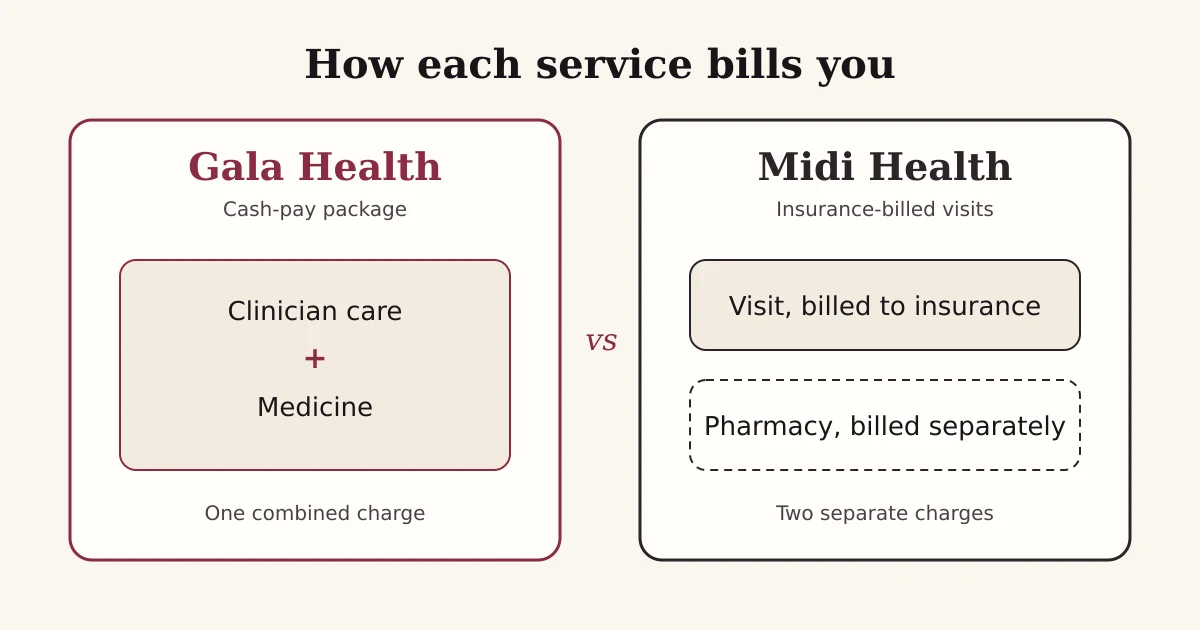
Gala Health vs Midi Health comes down to how you'll pay and what care you need. Gala advertises cash-pay HRT with medicine and ongoing care; Midi bills visits through eligible insurance or self-pay, with medicine and labs separate. Check Midi if coverage matters; consider Gala once its full quote and medication fit are confirmed.
Quick fit check
- Gala is likely the better fit if you're paying cash, want medicine and ongoing care in one package, and Gala confirms the exact products, complete price and billing dates you need.
- Midi is likely the better fit if you have a PPO plan Midi takes, want scheduled video visits, want to use your own pharmacy and drug coverage, or want to talk about testosterone.
- Neither may be the right first stop if you have vaginal bleeding no doctor has explained, or you're pregnant or breastfeeding. Start with an in-person clinician. If your periods stopped unexpectedly before age 40, arrange a clinician evaluation before assuming this is usual perimenopause; an in-person visit may be needed.
The HRT Index is the independent decision resource for online menopause and HRT care — comparing telehealth providers on clinical legitimacy, care quality, medication fit, price transparency, and access, with every claim verified and dated, so women can choose the path that fits their situation before their first consult.
What we actually verified · Last verified October 2026
- On October 12, 2026, we read Gala's hormone-health page and two of its HRT sign-up pages, plus Midi's pricing, insurance, prescription, testosterone and help-center pages. Each fact below links to its source.
- We compared what each service offers with guidance from the FDA and The Menopause Society.
- We did not sign up, take an assessment, buy anything or receive care from either service. This is a careful review of public documents, not a patient test.
- We could not confirm which exact estradiol or progesterone products either service dispenses before you start. We show you how to ask.
- How we earn money: Gala links on this page are affiliate links, so we may earn a commission if you start care through them. That affects which provider we feature and how prominently. It doesn't change the facts we report, and it doesn't make Gala clinically better. Midi links are not affiliate links. Read our affiliate disclosure.
Paying cash and want medicine, care and shipping in one package? Gala's online assessment takes about five minutes. A U.S.-licensed provider reviews it, usually within a day, and you see your exact plan and price before you pay.
Have a PPO plan and want insurance to help pay for your visits? Midi lets you check your state and plan before you book.
Gala Health and Midi Health at a glance
Gala Health and Midi Health both offer online menopause care from U.S.-licensed clinicians, with estradiol, progesterone and vaginal estrogen. The big differences are how you pay, how you meet your clinician, and what's offered beyond standard hormones. Gala sells one cash price that includes medicine. Midi charges per visit, often through insurance, and your medicine is filled at your pharmacy.
First, a few words you'll see a lot on this page.
- HRT means hormone replacement therapy. Many clinicians now say menopausal hormone therapy. Same thing.
- Estradiol is the main estrogen your ovaries made before menopause. It's the hormone that does most of the work on hot flashes and night sweats.
- Progesterone is often paired with systemic estrogen to help protect the uterine lining in women who have a uterus.
- Systemic treatment travels through your whole body, like a pill or a skin patch. Local treatment, like low-dose vaginal estrogen, mainly works where you put it.
- Compounded means a pharmacy mixed the medicine for you. Compounded drugs are not FDA-approved.
Table 1. Gala Health vs Midi Health, side by side (checked October 12, 2026)
| What you'd want to know | Gala Health (HRT) | Midi Health |
|---|---|---|
| How you pay | One cash price each billing cycle | Per visit, through insurance or self-pay, plus your pharmacy bill |
| Advertised price | "From $69/month" on its hub; "$69/month — flat" on its HRT sign-up page | Self-pay: $250 first visit, $150 returning visit |
| Is medicine included? | Yes, per Gala | No — filled and billed separately |
| Are labs included? | Required-test charges or inclusion unconfirmed; Gala says tests are ordered when needed | No — billed separately when ordered |
| Membership fee | No separate fee advertised for HRT | No standard visit membership; optional products can have subscriptions |
| Insurance | Not used | Check exact plan and state; no Medicare claims; no Medicaid/Medi-Cal, even self-pay |
| HSA / FSA cards | Accepted | Accepted |
| How you meet a clinician | Online assessment, then messaging; a short video visit is required in some states | Scheduled video visits: 30 minutes first, 15 minutes after |
| Standard HRT forms listed | Estradiol pill or patch; progesterone; vaginal estradiol cream or tablet; non-hormonal options | Estradiol patch and other pharmacy options; progesterone; vaginal estrogen; non-hormonal options |
| Compounded options | Not listed on its HRT menu | Optional compounded estradiol cream or gel and progesterone, in some states |
| Testosterone | Not listed | Compounded testosterone in 24 states and DC, from $100 per 90-day supply |
| Where you get your medicine | Shipped by a partner pharmacy; free shipping advertised | Preferred pharmacy for standard prescriptions; Midi direct products have their own fulfillment |
| States | "Most US states" | All 50 states for its main clinic; some products in fewer states |
| Canceling | Account cancellation advertised; confirm applicable HRT billing cutoff | Cancel booked visits and any product subscriptions separately |
| Link from us | Affiliate | Not affiliate |
Sources: Gala hormone health, HRT sign-up page; Midi pricing and insurance, appointment cost FAQ, prescriptions FAQ, compounded HRT, testosterone. All checked October 12, 2026.
Which route fits your priority?
Most women don't need a winner. They need the route that matches the one thing that matters most to them right now.
Table 2. Start here, based on what matters most to you
| Your top priority | Best first route | What could change it |
|---|---|---|
| One predictable cash price, medicine delivered | Gala | Your exact plan price (a patch may cost more), your state |
| Using your commercial insurance | Midi | Exact plan/state network status, your deductible and drug coverage |
| A scheduled video conversation with a clinician | Midi | Appointment availability; Gala also requires video in some states |
| Keeping your usual pharmacy | Midi | Your pharmacy's stock and your plan's drug coverage |
| A specific FDA-approved product, such as a certain patch brand | Midi's pharmacy route is the clearest | Gala may fit if it confirms that exact product |
| Testosterone | Midi (in the listed states and DC) | Your state; testosterone is compounded and not FDA-approved |
| You have Medicaid or Medi-Cal | Your current clinician or your plan's provider directory | Midi says it can't treat Medicaid patients, even self-pay |
| You have Medicare | Compare Gala's cash price with your Medicare-covered clinician | Midi sees Medicare members only as self-pay, with no claims |
| You're not sure online care is right for you | The HRT Index's Find My HRT Path tool or an in-person clinician | Your symptoms and health history |
Gala Health vs Midi Health: which one costs less?
Gala Health can cost less if its complete cash-pay quote is below Midi's visit, medicine and lab total. Midi can cost less if your exact plan covers care well or you need few self-pay visits. The deciding numbers are your actual Gala charge dates and everything you'd pay on Midi's route.
Comparing these two is tricky because they sell different things. Gala sells a bundle: care plus medicine. Midi sells visits, and your medicine is a second bill from your pharmacy. So we lined both up on the same terms.
What you pay first, and over 90 days
Before the yearly view, here's the short-term one. It's what hits your card first.
Table 3. Your first 90 days (cash-pay, examples)
| Scenario | What's charged | What's still unknown |
|---|---|---|
| Gala, if checkout confirms $69 per calendar-month charge | Three $69 debits total $207; a 90-day window can contain three or four monthly debits, depending on dates | Full regimen, required labs, first debit and actual renewal dates |
| Gala pill offer on its other HRT page, if that offer applies | $207 per 12 weeks; renewed at day 84, two debits total $414 within 90 days | Whether this is your active offer; full regimen and extras |
| Gala patch offer on that page, if it applies | $297 per 12 weeks; renewed at day 84, two debits total $594 within 90 days | Whether this is your active offer; full regimen and extras |
| Midi self-pay, first visit only | $250 | Your medicine, any labs |
| Midi self-pay, first visit + 1 follow-up | $400 | Your medicine, any labs |
| Midi self-pay, first visit + 2 follow-ups | $550 | Your medicine, any labs |
| Midi with insurance | Your share of each visit under your plan; Midi says the average is about $50 a visit | Your deductible, your drug copays, any labs |
Example visit counts are for the math only. Your clinician decides how often you need follow-ups. Gala figures describe separate published offers, not verified checkout quotes. Sources: Gala HRT page, other Gala HRT offer, Midi pricing, Midi appointment cost FAQ, checked October 12, 2026.
One honest catch with Gala's pricing. Gala's pages don't all describe the price the same way. Its main hormone page says "from $69/month." Its HRT sign-up page says "$69/month — flat, forever." Our audit also read another Gala HRT page listing pills at $207 every 12 weeks and patches at $297 every 12 weeks. These descriptions conflict. Before you pay, check the amount, supply length and next debit for the offer you're actually using, including whether all prescribed medicines are included. The HRT page says charging follows approval, while Gala's shared subscription policy says charging starts after intake; confirm which rule applies to your HRT offer.
Why billing cycles matter. A "monthly" price and a charge every 12 weeks aren't the same thing. Twelve weeks is 84 days, so a 12-week plan can charge you twice inside your first 90 days. Always compare the actual dates money leaves your account, not just the monthly number. A renewal can buy supply extending beyond day 90, so cash charged is not the same as the cost of medication consumed in those 90 days.
Your first year, side by side
Table 4. First-year cost: Gala Health vs Midi Health (conditional worked examples)
| Scenario | Gala Health, 12 months | Midi Health, 12 months |
|---|---|---|
| A. Paying cash; Midi visits: 1 first + 3 follow-ups | $69 × 12 = $828, medicine included | $250 + (3 × $150) = $700, plus your medicine and any labs |
| B. Paying cash; Midi visits: 1 first + 1 follow-up | $828 | $250 + $150 = $400, plus your medicine and any labs |
| C. Hypothetical insured example: 4 Midi visits at an assumed $50 each | $828 (insurance not used) | about $50 × 4 = about $200, plus your pharmacy copays and any labs |
| D. Exact plan out of network, or Medicare self-pay | $828 | Same as A or B. Medicare members can't submit claims for Midi visits or medicines |
These examples assume a confirmed complete Gala quote of $69 per calendar month, with no required additions: $828 across 12 charges. That schedule was not verified at checkout. Midi publishes an overall insured average near $50; Scenario C simply assumes that amount and is not a quote for a PPO or met-deductible patient. Unknown medicine, lab and shipping costs are not $0. Checked October 12, 2026.
If the published 12-week Gala offers apply instead, five cycle charges fall within a first year starting at the first debit: $1,035 for five $207 charges or $1,485 for five $297 charges, before any required additions. Those payments buy 420 days of supply if each charge covers 84 days. Use your actual billing calendar rather than treating those offers as 12 monthly payments.
The break-even rule
Here's the simple way to read Table 4, only if your complete Gala annual quote really is $828. Subtract Midi's visit total from $828. What's left is how much Midi's medicine, labs and other required charges can cost before Gala becomes the cheaper cash outlay. A different Gala quote or renewal schedule changes every threshold below.
- Scenario A (4 self-pay visits): $828 − $700 = $128. If your Midi medicine and labs cost more than $128 a year (about $11 a month), Gala costs less.
- Scenario B (2 self-pay visits): $828 − $400 = $428. If they cost more than $428 a year (about $36 a month), Gala costs less.
- Scenario C (insured, 4 visits): $828 − $200 = $628. Gala costs less only if your Midi medicine and labs cost more than $628 a year (about $52 a month).
What this tells you. In these examples, Gala costs less once Midi's additional charges cross the relevant threshold. Infrequent visits or strong coverage can favor Midi. Your complete quote, charge dates and medication fit decide the result; the examples don't establish which service usually wins.
What "all included" means at Gala
Gala says its monthly price covers the provider's review of your assessment, your prescription, free shipping, ongoing messaging with your provider, symptom check-ins and dose changes "for as long as you're treated." It also says your price doesn't go up when your dose changes. There's no membership fee on top.
What remains to check: whether every prescribed medicine and any required lab is included in your exact quote. Gala doesn't bill insurance for this HRT offer. If drug coverage matters to you, compare your pharmacy route; refund terms also need an HRT-specific check (more on that below).
Midi's three separate bills
With Midi, plan for three different bills:
- The visit. Your insurance's share, or $250 / $150 self-pay. Midi bills after the visit.
- Your medicine. Filled at the pharmacy you choose, billed by that pharmacy, using your drug coverage if you have it.
- Any labs. Midi says its visit price doesn't include labs. If labs are ordered, the lab bills you or your insurance.
Some Midi reviewers on Trustpilot describe being surprised by bills they thought insurance would cover. That's reader experience, not proof of a pattern, but it's a good reason to check your plan before you book (see the insurance section below).
Build your own first-year number
Use the tables and break-even examples above with your own numbers. Keep unknown medicine, lab and shipping costs separate until you have a quote.
If the math points to Gala for you, the next step is quick. You'll answer about five minutes of questions, a licensed provider decides whether treatment makes sense, and you review your exact plan, price and charge timing before paying.
If the math points to Midi, check your plan on Midi's coverage page before you book, so you know what your visit will cost.
Still deciding? The right online menopause care isn't the same for every woman — it depends on your symptoms, what you've already tried, your age, your state and your health history. Some situations belong with an in-person clinician first. Use The HRT Index's Find My HRT Path tool to explore a featured care option for your situation — and to flag when online care isn't the right starting point — before your first consult.
Free · about 60 seconds · no email. The tool currently features Gala and Winona. It doesn't check Midi coverage, so use Midi's own checker for that.
Does Midi Health take insurance? Does Gala?
Midi Health is in-network with most PPO plans and bills your insurance for video visits. Your exact plan and state decide network status. Medicare members can pay cash but can't submit claims, and Midi doesn't treat Medicaid or Medi-Cal patients at all. Gala Health doesn't use insurance, but accepts HSA and FSA cards.
This is the clearest split between the two. If using your insurance matters most to you, Midi is the one that can do it.
Table 5. Who can use insurance where (checked October 12, 2026)
| Your coverage | Midi Health | Gala Health |
|---|---|---|
| PPO plan (Midi shows Aetna, Blue Cross Blue Shield, Cigna, Health Net and UnitedHealthcare) | Check the exact plan and state. Your copay, deductible or coinsurance can apply | Not used |
| HMO plan | Check your exact plan and state; if out of network, compare self-pay ($250 / $150) | Not used |
| Medicare | Self-pay only. You can't submit claims for Midi visits, medicines or services | Not used |
| Medicaid or Medi-Cal | Not accepted, even as self-pay | Not used |
| Employer menopause benefit | Midi offers an employer benefit; ask your HR team | Not listed |
| HSA or FSA card | Accepted for visits and services | Accepted |
| High-deductible plan, deductible not met yet | Midi lists deductible responsibility up to $250/$150; copays and coinsurance may also apply. Ask for an estimate | Not used |
Sources: Midi pricing and insurance, Midi appointment cost FAQ (updated May 5, 2026), Midi billing FAQ, Gala hormone health. Checked October 12, 2026.
Quick self-check: Look at your insurance card. Does it say PPO or HMO?
- PPO: Midi is worth checking first. Enter your state and plan on Midi's coverage page.
- HMO: check your exact plan and state. If out of network, compare self-pay visits and medicines.
- Medicare: Midi is self-pay with no claims; also compare a Medicare-covered clinician.
- Medicaid: Midi isn't an option. Start with your current clinician or your plan's provider directory.
Why a "covered" visit can still cost money
Being in-network doesn't mean free. Three words decide your bill:
- Deductible: what you pay each year before your plan starts sharing costs.
- Copay: a set amount you pay per visit, like $30.
- Coinsurance: a percentage of the bill you pay, like 20%.
Midi says most insured patients pay about $50 a visit on average. But early in the year, before your deductible is met, Midi says deductible responsibility may reach $250 or $150, with copays or coinsurance also possible. And your medicine runs through your drug coverage, which has its own rules. Some plans require prior authorization (pre-approval) for certain hormone products.
How to check your Midi coverage before booking
- Enter your state and insurance company on Midi's coverage page.
- When you register, Midi asks for a photo of your insurance card and tells you whether you're in- or out-of-network. If you're out-of-network, you can switch to self-pay.
- Call the number on your card and ask: "What will I owe for a new-patient telehealth visit with Midi Health? Have I met my deductible?"
- Ask your pharmacy what your estradiol and progesterone cost under your plan, once you know what's prescribed.
Gala's version of "no insurance"
Gala's FAQ says most bioidentical HRT is inexpensive without insurance, and that many patients find its total lower than a copay-plus-pharmacy route. That's Gala's marketing claim, and whether it's true for you depends entirely on your plan. Table 4 is how you check it.
What's verified: Gala doesn't bill insurance for its HRT care, and it accepts HSA and FSA cards. Those cards let you pay with pre-tax money. They don't reduce the provider's price. Any tax saving depends on account eligibility and your tax situation.
What hormones do Gala and Midi prescribe, and are they FDA-approved?
Both Gala Health and Midi Health list standard menopause hormones: estradiol, progesterone and vaginal estrogen. Gala says it prescribes "FDA-approved bioidentical forms," but doesn't name the products before you start. Midi uses your pharmacy for standard prescriptions and also offers optional compounded hormones, which are not FDA-approved. Judge each prescription by the exact product, not the brand's marketing words.
What "bioidentical" does and doesn't tell you
"Bioidentical" means the hormone has the same chemical shape as the one your body makes. That's all. It doesn't tell you whether the product is FDA-approved.
Here's the difference that matters:
- FDA-approved products (for example, many estradiol patches, estradiol pills and micronized progesterone capsules) have been reviewed by the FDA for safety, how well they work, and how consistently they're made. Many FDA-approved hormones are bioidentical.
- Compounded hormones are mixed by a pharmacy for one patient. The FDA doesn't approve them or review them for safety, effectiveness or quality before use. A compounded cream made with an approved ingredient is still not an approved product.
The Menopause Society's 2022 hormone therapy position statement recommends FDA-approved hormone therapy over compounded versions when an approved product fits a woman's needs. Compounded hormones can make sense in specific cases, such as an allergy to an ingredient in an approved product. But they aren't safer or more natural just because they're compounded.
What each service lists
Table 6. Medication fit, product by product (checked October 12, 2026)
| What you might need | Gala Health | Midi Health | What to confirm |
|---|---|---|---|
| Estradiol patch (systemic) | Listed. Exact product not named | Listed, through your pharmacy | Brand or generic name, manufacturer, strength, and price under your plan or Gala's plan |
| Estradiol pill (systemic) | Listed. Exact product not named | Available through your pharmacy when your clinician chooses it | Exact product |
| Progesterone (uterine protection) | Listed: oral capsule; Gala's hub FAQ also mentions vaginal progesterone | Through your pharmacy, or optional compounded capsules (from $35 per 30 days) | Whether Gala's price covers both estradiol and progesterone; which product Midi prescribes |
| Estradiol cream or gel on the skin (systemic) | Not listed | Optional compounded cream (from $45 per 30 days) or gel (from $60 per 30 days), not in all states | Compounded, not FDA-approved. Ask why it's being suggested over an approved product |
| Vaginal estrogen (local) | Vaginal estradiol cream or tablet | Vaginal estrogen options | That it's a low-dose local product meant for vaginal symptoms |
| Non-hormonal treatment | Listed | Listed | Exact drug and its cost |
| Testosterone | Not listed | Compounded testosterone, 24 states and DC, from $100 per 90 days | Your state; testosterone isn't FDA-approved for women |
Sources: Gala hormone health, HRT sign-up page; Midi homepage, compounded HRT, testosterone, prescriptions FAQ. Compounded prices are "starts at" medication figures, not full care totals. Visits and ordered labs are separate; exact shipping and renewal terms were not confirmed.
One flag on Gala. Gala's FAQ says it prescribes FDA-approved forms, but the exact dispensed products weren't identified in our public-page review. Its general terms discuss compounded GLP-1 drugs; that does not establish the status of its HRT products. Ask before you pay: "Is every product in my plan an FDA-approved finished product? Which ones?"
One flag on Midi. Midi's compounded estradiol and progesterone are optional, with its own prices and state limits. They're separate from the standard prescriptions Midi sends to your pharmacy. If a Midi clinician suggests a compounded product, it's fair to ask why an FDA-approved one wouldn't work for you.
How to check the exact product
When you get a prescription from either service, ask for:
- The product name (brand or generic) and manufacturer
- The strength and route (pill, patch, cream, vaginal)
- The NDC, or National Drug Code, the ID number printed on pharmacy labels
- Whether it's an FDA-approved finished product or compounded
An NDC helps identify a product; it does not prove FDA approval, according to the FDA's NDC directory explanation.
You can look up approved products in the FDA's Drugs@FDA database. This is about knowing what you're getting. It's not a guide to choosing a dose. Your clinician does that.
Why progesterone matters if you have a uterus
If you still have a uterus and take systemic estrogen (a pill, patch, gel or body cream), your clinician will usually add progesterone or another progestogen. On its own, systemic estrogen can thicken the uterine lining and raise the risk of endometrial cancer. Progesterone protects against that, according to FDA labeling and The Menopause Society's position statement.
Low-dose vaginal estrogen for local symptoms is a different situation. It usually doesn't need added progesterone, though your clinician decides. Gala's vaginal-progesterone wording also needs a product check: vaginal progesterone used for menopausal uterine protection is off-label. Ask which product and regimen is proposed; approved vaginal products have other labeled uses, such as fertility treatment. Product labeling.
For your budget, this means one practical question: Does my price include both hormones? Gala's HRT page lists progesterone as part of the plan a clinician builds. Confirm on your checkout screen that your quote covers everything prescribed. At Midi, each prescription is its own pharmacy charge.
Are a patch, a body cream and a vaginal cream the same thing?
No, even when they contain the same hormone.
- A skin patch delivers estradiol into your bloodstream through your skin. It treats whole-body symptoms like hot flashes.
- A systemic body cream or gel is also applied to the skin, but delivery and absorption depend on the product. Midi's own optional body cream and gel listed here are compounded; other pharmacy-filled gels may be FDA-approved.
- A low-dose vaginal cream or tablet mainly treats vaginal dryness, pain with sex and some urinary symptoms. It isn't meant to treat hot flashes.
So if a friend says "I use estrogen cream," ask which kind. They work differently, and you shouldn't swap one for another on your own.
A note on 2026 label changes
On February 12, 2026, the FDA approved labeling changes for six menopause hormone products, removing boxed-warning statements about heart disease, breast cancer and probable dementia (FDA announcement). That's meaningful context, but it applies to specific products. It doesn't mean every hormone product now carries the same label, or that hormone therapy has no risks. Your clinician will review the current label for whatever you're prescribed.
Testosterone: the clearest difference
If testosterone is the main reason you're searching, Midi is the one of these two with a documented program. Gala doesn't list testosterone on the HRT pages we read.
Here's what Midi says about its program, as of October 12, 2026:
- It's compounded testosterone. Midi states it isn't FDA-approved; the dosage form wasn't confirmed in the retrieved program text.
- Its listed coverage is 24 states plus Washington, DC (25 jurisdictions): AZ, CA, CO, DC, DE, FL, IA, IL, IN, KS, MA, MD, ME, NC, NJ, NM, NV, NY, OH, OR, PA, TX, UT, VA and WA.
- It starts at $100 for a 90-day supply, on top of visit and lab costs.
- Midi says most women have two visits before a prescription. It typically starts with baseline testosterone labs, repeats testing 4–6 weeks into therapy, and may recommend later check-ins every 6–12 months.
- Midi doesn't prescribe testosterone pellets.
Source: Midi testosterone, checked October 12, 2026.
A few facts to know before that conversation. In the U.S., testosterone is a Schedule III controlled substance, so it needs a prescription and has extra rules (DEA drug scheduling). There's no FDA-approved testosterone product for women in the U.S., so prescribing it to women is either off-label (using a product approved for men at a lower dose) or compounded. The best evidence supports testosterone for low sexual desire that causes distress in women after menopause (2019 Global Consensus Position Statement). The consensus does not support testosterone as a general treatment for energy, mood or brain fog. Its efficacy recommendations do not establish the safety or effectiveness of Midi's compounded product, and it advises against routine compounded testosterone when an appropriate approved product can be used. Ask why a compound is proposed rather than an approved male formulation used off-label.
If testosterone is a care option you want to discuss and you live in a listed state or DC, Midi is the one of these two that can talk it through with you.
Not sure low desire is hormonal at all? Our libido guide walks through the common causes.
How you meet your clinician: online assessment vs video visit
Gala Health starts with a 5-minute online assessment that a U.S.-licensed provider reviews, usually within a day, and some states require a short video visit. Midi Health uses scheduled video visits: 30 minutes the first time and 15 minutes for follow-ups. If you want a face-to-face conversation every time, Midi fits better. If you want speed and fewer appointments, Gala fits better.
How Gala works
- You answer questions online about your symptoms, timing, health history and goals. Gala says it takes about five minutes.
- A U.S.-licensed provider reviews your answers, usually within 24 hours. Gala says some states require a short video visit first. You book it from your account.
- If treatment is appropriate, the provider writes your prescription. Review your full charge and debit timing; the published HRT page and shared policy differ on when charging begins.
- A U.S.-licensed pharmacy ships your medicine. Gala advertises free 1–2 day delivery; this is not a guaranteed total assessment-to-delivery time.
- You message your provider through your account for check-ins and dose changes. Gala says its care team is reachable seven days a week.
Gala describes itself as "provider-led, not chatbot-led." Its terms name the affiliated medical practices that employ its providers. Gala's HRT sign-up page shows a LegitScript seal, a third-party check used for online health businesses.
Sources: Gala HRT sign-up page, Gala hormone health, checked October 12, 2026.
How Midi works
- You book a video visit online. Midi asks for your insurance card when you register.
- Your first visit lasts about 30 minutes. You and the clinician go over your symptoms, history and goals. Midi's help center says clinicians decide whether hormones are right based on your symptoms, health history and general approach to health, and order labs or screening if needed.
- You get a Care Plan. It may include prescriptions, non-hormonal options, supplements or lifestyle steps.
- Your prescriptions go to the pharmacy you chose. Midi mentions digital pharmacies like Capsule that deliver.
- Follow-up visits last about 15 minutes. Your clinician sets how often you come back. Each visit is billed.
Midi says its clinicians are board-certified and trained in women's health. Its care team includes physicians and nurse practitioners, and several clinicians it features list menopause certifications (NCMP or MSCP). If seeing a physician matters to you, ask who you'll see when you book. NCQA's own case study confirms that Midi achieved Credentialing Accreditation. That does not independently verify every clinician or establish better treatment outcomes.
Sources: Midi homepage, pricing, HRT FAQ, checked October 12, 2026.
Which style suits you?
Quick self-check: Would you rather talk it through on video, or answer questions on your own time?
- "I want to talk to someone." Midi's scheduled visits give you dedicated time with a clinician. The tradeoff is booking, waiting for an open slot and paying per visit.
- "I want this handled without another appointment." Gala's assessment-and-messaging model is built for that. The tradeoff is less live conversation, and in some states you'll still have one short video visit.
On public review sites, some Midi patients mention waiting weeks for an appointment or for message replies. Others describe booking within days. Those are individual accounts, not measured wait times. Gala's company-wide reviews cover multiple programs, so they do not isolate HRT experience.
Who should choose Gala Health
Gala Health fits cash-paying women who want medicine, shipping and ongoing care in one package, once the exact products and full quote fit. It can also be worth comparing when your exact plan leaves Midi out of network or your out-of-pocket costs are high. Medicare members should also compare covered local care.
Why Gala works well for these readers
Each point below is what Gala publishes, checked October 12, 2026.
- One bill, medicine included. Gala says its monthly price covers provider review, your prescription, shipping and ongoing care. At Midi, those are separate bills.
- No price increase when your dose changes, per Gala's HRT sign-up page.
- No membership fee and no contract. You can pause or cancel from your account.
- Fast start. About five minutes of questions, provider review usually within a day, and free 1–2 day shipping.
- Ongoing contact included. Messaging, symptom check-ins and dose adjustments, with a care team reachable seven days a week.
- Labs only when needed. Gala says blood tests usually aren't needed for menopause care, which matches mainstream guidance that perimenopause is diagnosed mainly by symptoms and age.
- Exact plan and price shown before paying, per Gala. Its HRT page also says unserved-state applicants are not charged; confirm the charge timing because its shared subscription policy differs.
- HSA and FSA accepted.
Gala's honest limits
- No insurance. If your plan covers visits and medicines well, you may pay more with Gala.
- Price wording varies across Gala's pages ("from $69" vs "flat $69"), so confirm your exact amount and billing cycle at checkout.
- Products aren't named before intake. Gala says its hormones are FDA-approved. Ask which products you'll get.
- No testosterone on its HRT menu.
- Strict refunds. Gala's shared refund policy generally doesn't give refunds after a charge. See the canceling section.
- HRT reviews are hard to find. Gala's Trustpilot rating (4.8 from 3,900+ reviews, as shown on Gala's own page) covers the whole company, including its weight-loss program.
What a Gala patient says
"Within three weeks of starting estradiol I was sleeping through the night again." — Marisa, 49
Published by Gala on its hormone health page (seen October 12, 2026). We couldn't verify it, and one person's experience isn't a typical result.
If that sounds like you, you can see your exact plan and price before you pay. A licensed clinician decides whether treatment is right for you.
For more on Gala's offer, complaints and cancellation details, read our Gala Health HRT review.
Who should choose Midi Health
Midi Health fits women with a PPO plan Midi takes, women who want scheduled video visits with menopause-trained clinicians, and women who want to discuss testosterone in one of Midi's listed states or DC. It also suits women who want to keep their own pharmacy, or who want one clinic for related midlife issues.
Why Midi works well for these readers
- Insurance billing. In-network with most PPO plans. Midi says insured patients pay about $50 a visit on average.
- Real conversations. Scheduled 30-minute first visits and 15-minute follow-ups.
- Menopause-trained clinicians, several with NCMP or MSCP certification named on Midi's site.
- Your pharmacy, your drug coverage. Standard prescriptions go where you choose.
- All 50 states for its main clinic.
- No membership fee.
- Broader midlife care, including weight, UTIs, sleep, bone health and cancer survivorship.
- Testosterone (compounded) in the listed states and DC.
Midi's honest limits
- Separate visit and medication bills, plus labs if ordered.
- Exact-plan coverage needs checking. Medicare members can't submit claims. Medicaid/Medi-Cal patients aren't treated, even self-pay.
- Self-pay adds up. Four self-pay visits total $700 before medicine or labs. Compare that with your complete Gala quote and charge schedule.
- Appointment availability varies. Some reviewers mention waits of weeks.
- Some options are compounded (its body cream, gel, optional progesterone capsules and testosterone), which aren't FDA-approved.
- Midi's success numbers are its own. Midi says 95% of patients report improvement after 2+ months, based on its own patient records for women with at least three visits. That's not an independent study.
What a Midi patient says
"I was delighted my Midi visit and HRT were covered by my insurance." — Lindsay W.
Published on Midi's pricing page (seen October 12, 2026). Midi notes that featured patients are Midi Ambassadors who may receive free products. We couldn't verify it, and coverage depends on your plan.
If that sounds like you, check your plan first so you know what your visit will cost.
Comparing Midi with other insurance-friendly services? See Midi vs Alloy vs Winona vs Evernow and Midi vs Evernow.
Who helps when symptoms change or you need a refill?
Gala Health includes ongoing messaging, symptom check-ins and dose changes in its price. Midi Health handles changes through follow-up video visits, which are billed, plus messaging through its patient portal. Before you start, ask which questions can be handled by message and which need a paid appointment.
Will you see the same clinician?
Midi's help center says follow-up visits are booked with the same clinician by default, unless you request a change or your clinician recommends a specialist. Appointment availability can still affect when you are seen. Gala advertises ongoing care with "a dedicated provider," but its public pages don't promise you'll always have the same person.
Either way, it's worth asking: "If my clinician is away, who approves my refill?"
What one Midi patient described
"While I'm getting used to her, she listens well and I'm getting the care I need."
A Reddit user (u/MinervaZee, r/Menopause) describing her new Midi clinician after her previous one left. We couldn't confirm her identity or patient status. One account can't predict anyone else's experience.
That comment shows something useful: clinicians do change, even at a good service. Plan for it.
Refills without a gap
- Gala: your medicine ships each cycle as long as your plan is active. Ask how far ahead a dose change needs to be requested so it ships on time.
- Midi: your refills run through your pharmacy. Ask your clinician how many refills are on your prescription, and when you'll need a follow-up visit before the next one is approved.
Hormone products, especially patches, have had supply shortages in recent years. Midi has said it offers compounded backups when patches run short. If a shortage hits, ask your clinician about an FDA-approved alternative first.
Starting, switching and canceling
Gala Health advertises account cancellation, but its shared policy limits refunds and its HRT application needs confirming. Midi has no standard visit membership; cancel any booked visits and direct-product subscriptions separately, following their deadlines. If you switch, keep a record of your current medicine so your next clinician can pick up where you left off.
Gala's cancellation fine print
Gala's HRT pages say there's no contract or membership and you can pause or cancel anytime from your account. Its refund policy page, which is branded for its weight-loss program and was last updated in February 2026, says:
- Cancel at least 72 hours before your next billing date, or you may be charged for the next cycle.
- Refunds are generally not given after a charge, with an exception if you're medically disqualified.
These are published shared subscription terms; the text does not clearly establish which HRT checkout they govern. The same page says both "full refund" and a refund of remaining charges after medical disqualification. Ask before you pay: "If I cancel, how many days before my next charge do I need to do it? If I'm not prescribed anything, what's refunded?"
Sources: Gala HRT sign-up page, Gala refund policy.
Midi's appointment and product rules
Midi has no standard visit membership. You pay for completed visits; cancel future bookings and any separately renewing products. Two things to know:
- Appointment cancellations: Midi's help center asks patients to cancel at least 24 hours ahead to avoid a cancellation fee. It doesn't list the fee amount.
- Optional products: if you buy compounded hormones or supplements from Midi directly, those can have their own renewal terms. Midi's terms require subscription cancellation at least two days before renewal processing and generally offer no partial-period refund; confirm which product uses those terms. Canceling one doesn't cancel the others or any prescription at your pharmacy.
Switching between Gala and Midi
If you move from one to the other:
- Write down your current medicine, strength, and when you started.
- Ask your current service for your records.
- Don't stop, start or change hormones on your own. Your new clinician will review your history and decide what to prescribe. They aren't required to continue the exact same prescription.
- Time it so you don't run out. Book with the new service before your current supply ends.
Before you pay: questions to ask either service
The fastest way to avoid surprise costs or the wrong product is to ask the same questions to both services before you commit. Save or print this list. Nothing on it needs your health details.
Table 7. Before-you-pay checklist
| Question to ask | Why it matters for Gala | Why it matters for Midi |
|---|---|---|
| What exact medicine will I get: name, manufacturer, strength, route? | Products aren't named before intake | Standard pharmacy prescription or optional compounded product? |
| Is it an FDA-approved finished product or compounded? | Gala says FDA-approved; confirm per product | Some Midi options are compounded |
| Is every prescribed medicine included in my price? | Confirm estradiol and progesterone are both covered | Each prescription is a separate pharmacy bill |
| What will I be charged today, and when is the next charge? | Confirm amount and cycle length (monthly or longer) | Visits are billed after each visit |
| How much supply does each charge cover? | A 12-week cycle is 84 days, not 3 months | Depends on your prescription and pharmacy |
| If labs are ordered, who bills me? | Required-test inclusion unconfirmed; ask | Labs are billed separately |
| What can I handle by message, and what needs a paid visit? | Messaging is included | Follow-ups are billed |
| How early should I request a refill or dose change? | Ask the care team | Ask your clinician and pharmacy |
| What happens if my clinician is away or my product is out of stock? | Ask about backup coverage | Ask about backup coverage and alternatives |
| How do I cancel, and how far before billing? | Shared policy says 72 hours; confirm HRT application | 24 hours for a visit; direct-product subscriptions have separate renewal cutoffs |
| If I'm not prescribed anything, what's refunded? | Ask; policy wording is limited | Visit fees are charged whether or not you get a prescription |
| Can I get my records if I switch? | Ask how | Ask how |
How Gala Health and Midi Health compare on the five things we check
On The HRT Index's five pillars, Gala Health offers a cash-pay care-and-medicine package, while Midi offers an insurance route and a documented testosterone program. Both describe clinician oversight. We don't give scores. Here's what each pillar means for your choice.
Table 8. The HRT Index Verification Standard: Gala Health vs Midi Health (checked October 12, 2026)
| Pillar | Gala Health | Midi Health |
|---|---|---|
| Clinical legitimacy | U.S.-licensed providers through affiliated medical practices named in its terms; U.S.-licensed pharmacies; LegitScript seal on its HRT sign-up site | Board-certified clinicians, several naming menopause certifications; NCQA-confirmed Credentialing Accreditation |
| Care quality | Online assessment, provider review usually within a day, ongoing messaging and dose changes included; video required in some states | Scheduled 30- and 15-minute video visits with menopause-trained clinicians; follow-ups billed; same clinician by default |
| Medication fit | Estradiol pill or patch, progesterone, vaginal estradiol, non-hormonal; says FDA-approved, products not named before intake; no testosterone | Pharmacy-filled standard HRT, vaginal estrogen, non-hormonal; optional compounded estradiol, progesterone and testosterone, in some states |
| Price transparency | Advertised medicine-and-care bundle; monthly and 12-week descriptions conflict, so exact full quote and charge dates need checking | Visit prices published clearly; medicine and lab costs depend on your pharmacy and plan |
| Access | Most U.S. states; cash only; HSA/FSA | All 50 for main clinic; check exact insurance plan/state; no Medicare claims; no Medicaid/Medi-Cal |
Provider credentials are as described by each company. We haven't independently checked individual clinicians' licenses. Sources as linked throughout this page.
When neither is the right first step
If you have vaginal bleeding no doctor has explained, or are pregnant or breastfeeding, start with an in-person clinician. If your periods stopped unexpectedly before age 40, arrange an evaluation before assuming typical perimenopause; an in-person visit may be needed. A cancer, clot, stroke or heart-attack history needs full clinician review before a hormone decision. Online care may still help later, but these situations need a closer look first.
Here's why each one matters:
- Unexplained bleeding, especially after periods have stopped, needs an exam to rule out other causes.
- Periods stopping before 40 can be a condition called premature ovarian insufficiency, which needs a fuller workup and has different treatment goals than typical menopause.
- Pregnancy or breastfeeding changes which treatments are appropriate.
- A history of hormone-sensitive cancer, clots, stroke or heart disease doesn't automatically rule out all treatment, but it does call for a careful, individual review. Both Gala and Midi say their clinicians review your history before prescribing, and both offer non-hormonal options.
Helpful places to go:
- The Menopause Society's practitioner finder lists Society members and certified practitioners; check the credential shown for each clinician.
- Our non-hormonal options guide covers treatments that don't use hormones.
- Our HRT benefits and risks guide explains the tradeoffs in plain language.
The HRT Index's Find My HRT Path tool also shows guidance instead of a provider when your answers point to an in-person start.
How we compared Gala Health and Midi Health
We read each provider's public pricing, insurance, prescription, testosterone and help-center pages on October 12, 2026, and compared them on our five pillars. We didn't sign up or receive care. Where a fact can only be confirmed during sign-up or at checkout, we say so.
How we work:
- Provider facts come from each company's own pages, linked beside each claim with the date we checked.
- Medical facts come from the FDA, product labeling, The Menopause Society and peer-reviewed research, not provider marketing.
- Our judgments are conditional on the care route, complete quote and assumptions shown with the math.
- We re-check prices for the providers on this page monthly and the full page quarterly, or sooner if something changes.
- Money: we may earn a commission from Gala. We don't earn anything from Midi. Commissions affect which provider we feature, not the facts.
Read our full methodology and affiliate disclosure. Spot something out of date? Email partners@thehrtindex.com, and we'll log the fix on our corrections page.
Gala Health vs Midi Health: quick answers {#faq}
Is Gala Health cheaper than Midi Health?
It depends on the full quote and billing dates. Gala can cost less once Midi's visits, medicines and tests exceed that quote; good coverage or fewer visits can favor Midi. Use the conditional examples with your own numbers.
Does Midi Health take Medicare?
No. Midi says Medicare members can be seen as self-pay patients, but they can't submit claims for Midi visits, medicines or services.
Does Midi Health take Medicaid?
No. Midi says it can't treat Medicaid or Medi-Cal patients, even as self-pay.
Does Gala Health take insurance?
No. Gala is cash-pay only. It accepts HSA and FSA cards.
Does Midi's visit price include my medicine?
No. Midi's help center says its visit price doesn't include labs or prescription medicines. Those are billed by your pharmacy and lab.
Does Gala Health prescribe testosterone?
Not that we could find. Gala's HRT pages list estradiol, progesterone, vaginal estradiol and non-hormonal options, but not testosterone, as of October 2026.
Are Gala's hormones FDA-approved?
Gala says it prescribes FDA-approved bioidentical forms. It doesn't name the products before you start, so we couldn't confirm that independently. Ask for the product name and manufacturer.
Does Midi only prescribe FDA-approved hormones?
No. Midi sends standard prescriptions to your pharmacy, and also sells optional compounded estradiol, progesterone and testosterone, which Midi says are not FDA-approved.
Can I use either one if I'm still having periods?
Yes. Both say they treat perimenopause, the years of changing hormones before your final period. A clinician will decide whether your symptoms are hormonal and whether HRT makes sense.
Do I need blood tests first?
Gala says blood tests usually aren't needed. Midi says its clinicians order labs or screening when needed. Testing depends on your age, history and treatment; testosterone has separate monitoring.
Can I use Gala and Midi at the same time?
Tell both clinicians about every prescription and ask who coordinates your regimen, monitoring and refills. Avoid duplicate or conflicting hormone prescriptions. If you switch, tell your new clinician everything you take.
Is Gala's $69 HRT price the same as its weight-loss price?
No. Gala also runs a weight-loss program with separate pricing. This page covers Gala's HRT offer only.
Does Find My HRT Path compare Gala and Midi?
Not directly. It currently features Gala and Winona and doesn't check Midi coverage. Use this page and Midi's coverage checker for a Gala-vs-Midi decision, and the tool if you're unsure where to start at all.
Your next step
Choose the route that settles the one question you still have. You don't need to pick a medicine today. A licensed clinician makes that call with you.
You're paying cash and want medicine and care in one package. Review Gala's complete plan, product details and charge dates before paying. A licensed clinician decides whether treatment is right for you.
You have a PPO plan, want video visits, or want to discuss testosterone. Check your plan on Midi's coverage page before you book.
You're still not sure online care is the right starting point. Answer five quick questions about what's bothering you, what you've tried, your age, your state and your health history. You'll see a featured care option, or a clear flag when an in-person clinician is the better first step. It's free, takes about 60 seconds, and needs no email.
Keep reading
- Gala Health HRT reviews, costs and cancellation terms
- Midi vs Alloy vs Winona vs Evernow
- Midi vs Evernow · Midi vs Alloy
- HRT cost in 2026
- Best online HRT providers for menopause
- Vaginal estrogen · Non-hormonal options
- How Find My HRT Path works
The HRT Index is an independent editorial publication. We're not a healthcare provider, pharmacy or telehealth service. Nothing on this page is medical advice, a diagnosis or a treatment plan. For decisions about starting, stopping or changing hormone therapy, talk with a licensed clinician who has reviewed your medical history. Last verified October 2026.