
The HRT Index is the independent decision resource for online menopause and HRT care — comparing telehealth providers on clinical legitimacy, care quality, medication fit, price transparency, and access, with every claim verified and dated, so women can choose the path that fits their situation before their first consult.
Why are my hot flashes not improving on HRT?
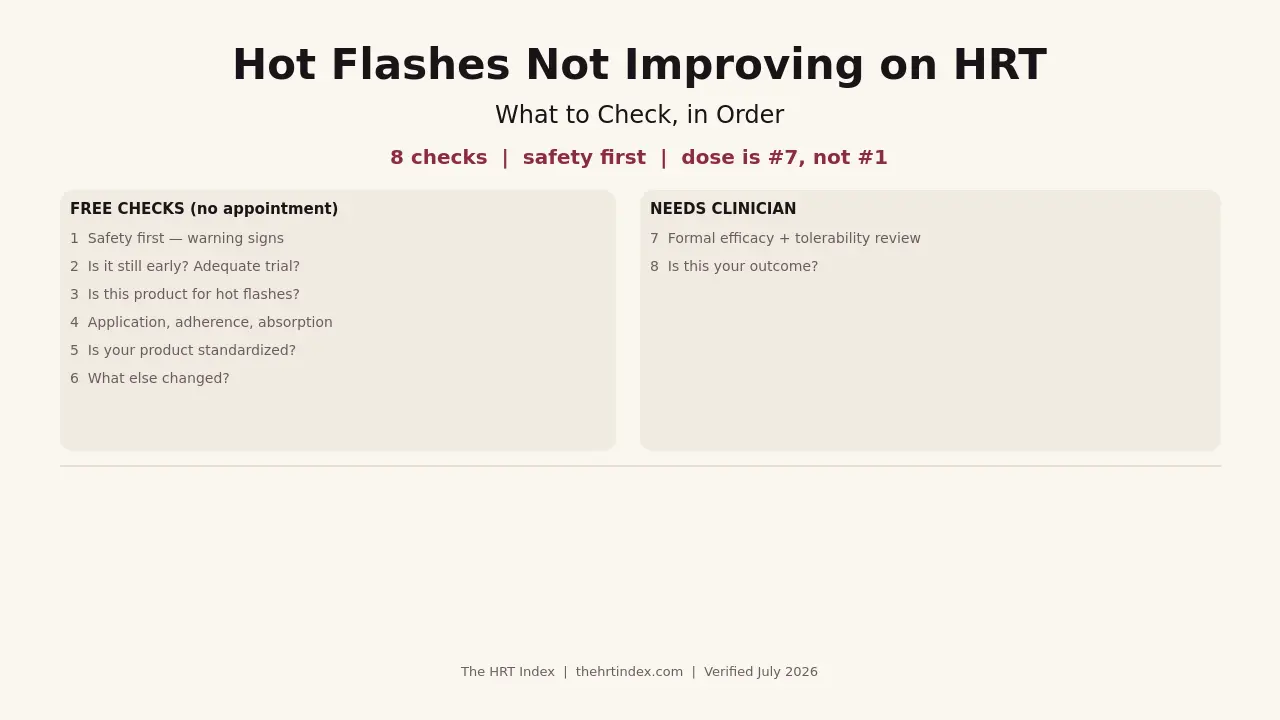
Persistent hot flashes on hormone therapy usually trace to one of eight things: the treatment is still early, the product isn’t indicated for hot flashes, application or adherence needs review, the product isn’t a standardized FDA-approved one, something else you’re taking or doing has changed, the symptoms may not be from menopause, the plan needs a formal clinical review, or the dose genuinely needs adjusting. The Menopause Society’s position is that hormone therapy remains the most effective treatment for hot flashes and night sweats. What’s usually in question is the plan — not whether estrogen works.
Most pages hand you an unsorted list of causes. That’s not useful at 2am with your shirt stuck to your back.
So here’s ours, in order. And the column that matters most is the third one — because a symptom can’t tell you what to take. It can only tell you what to ask.
The HRT Index troubleshooting order: safety first, then timing, product, use, and clinical-review questions.This is our editorial sequence for working through the problem — not a ranking of how common each cause is. Nobody has published prevalence data that would let anyone rank these honestly, and we’re not going to pretend otherwise.
| # | What to check |
|---|---|
| 1 | Safety first |
| 2 | Is it still early? |
| 3 | Is this product even for hot flashes? |
| 4 | Application, adherence, or absorption |
| 5 | Is your product standardized? |
| 6 | What else changed? |
| 7 | Does the plan need a real review? |
| 8 | Is this your outcome? |
Sources: rows 2–4 and 7 from current FDA product labels and The Menopause Society’s 2022 Hormone Therapy Position Statement. Row 3 from FDA product labeling. Row 5 from ACOG’s Clinical Consensus on compounded bioidentical menopausal hormone therapy, November 2023. Row 1 from Mayo Clinic and Cleveland Clinic.
Notice what’s missing from the top of that list? “Your dose is too low.” It’s number seven, and it’s a review, not a verdict. That’s not us being cautious. It’s that six other things are cheaper, faster, and more common to miss — and the woman who checks them first walks into her appointment with something a clinician can actually act on.
The right online HRT provider isn’t the same for every woman
It depends on your symptoms, what you have tried, age, health history, and state. Use the tool to match your situation — and to flag when online care isn’t the right starting point.
Find My HRT Path →Free · No dose recommendations, ever · Flags when online care isn’t the right starting point · How we handle your health data.
How long is HRT supposed to take to work on hot flashes?
There is no single timeline that applies to every product and dose. The Menopause Society’s 2022 position statement specifically notes that certain lower doses — oral conjugated estrogens 0.3 mg, oral estradiol up to 0.5 mg, and the 0.025 mg estradiol patch — may take 6 to 8 weeks to provide adequate symptom relief. Clinical trials commonly measure change at weeks 4 and 12. Severe, worsening, or concerning symptoms should be raised with a clinician earlier, regardless of the calendar.
Let’s be honest about “give it time.” Early in treatment, it’s fair advice. After an adequate trial on an unchanged plan, it stops being advice and starts being a way to end the conversation.
Three different questions hide inside “how long?” and they get tangled together constantly:
- When should I feel something? Depends on your product and dose. Ask your prescriber what they’re expecting and when.
- When is it fair to judge? After the review point you and your clinician agreed on — and if nobody set one, that’s the first thing to fix.
- When should I call anyway? Whenever symptoms are severe, getting worse, or come with anything on the warning list. The calendar never overrides that.
If nobody ever told you what week six was supposed to look like, you weren’t given a plan. You were given a prescription. Those are different things, and the gap between them is where most of this frustration lives.
“It worked, then it stopped”
This is a genuinely different pattern from “it never worked,” and it deserves its own investigation. Don’t let anyone collapse the two.
Details worth checking in the two weeks before symptoms returned:
- A refill, or a different manufacturer printed on the box
- Missed or delayed changes
- A patch that started lifting
- A new prescription or supplement
- Illness, major stress, or a schedule change
- Where and when you’re applying it
These are prompts to investigate, not established causes. Bring the timeline, not the frustration. The timeline is what gets acted on.
Not sure whether anything is actually changing, or whether you’ve just gotten used to it?
Our free 7-day HRT response logis a short daily log built for exactly this. It turns “it’s not working” into something a clinician can read in ten seconds.
Is my hot flash treatment even meant to treat hot flashes?
Low-dose local vaginal estrogen products — vaginal creams, tablets, inserts, and the Estring ring — are not indicated for vasomotor symptoms and should not be expected to treat hot flashes. Systemic products are the ones labeled for hot flashes and night sweats. Confusing the two is one of the most common reasons a woman is “on HRT” and still flashing, and it is a category question, not a dose question.
This one takes thirty seconds to check and it’s the cheapest fix on the page. Look at your box.
The systemic vaginal ring almost nobody mentions
If patches won’t stay on your skin, there’s an FDA-approved option that gets skipped constantly, mostly because of its shape.
Femring is a vaginal ring — but unlike Estring and low-dose vaginal creams, Femring is systemic. It’s approved for moderate-to-severe vasomotor symptoms and delivers 0.05 or 0.10 mg of estradiol per day. Do not lump it in with local products. It’s a whole-body treatment that happens to be shaped like a ring, and its route may be worth discussing when a systemic vaginal ring is clinically appropriate for you.
The option for women who can’t tolerate progesterone
If you have a uterus and take systemic estrogen, you need an endometrial-protection plan. That’s usually a progestogen. But it isn’t the only FDA-approved way to do it.
Duavee pairs conjugated estrogens with bazedoxifene, an estrogen agonist/antagonist. It’s FDA-approved specifically for treating moderate-to-severe vasomotor symptoms in women with a uterus, and the bazedoxifene component reduces the risk of endometrial thickening that estrogen alone can cause. Its label is explicit: women taking Duavee should not take progestins, additional estrogens, or additional estrogen agonist/antagonists.
If progesterone side effects are the real reason your treatment isn’t working — the low mood, the bloating, the fog that shows up on the days you take it — this is a conversation that exists and that most women are never offered. It isn’t right for everyone, and it carries its own warnings, including cardiovascular ones. But it is a real, approved, progestin-free path, and you’re allowed to ask about it.
Go deeper: Estradiol Patch vs Estradiol Gel · Estradiol Patch vs Pill · Do you need progesterone if you have a uterus?
Could my HRT not be absorbing?
Serum estradiol levels vary widely between women using transdermal estradiol. In a 2025 cross-sectional study of 1,508 patients at a single UK specialist menopause clinic, published in Menopause, the reference interval across the whole cohort — patches, gels, sprays, and a mix of licensed and off-label doses — ran from 54.62 to 2,050.55 pmol/L, with a median of 355.26 pmol/L. At the highest licensed transdermal dose, 24.84% of participants fell below the authors’ predefined 200 pmol/L threshold. That threshold is the study team’s operational definition, not a universal US treatment target.
Read the caveats in that paragraph carefully, because they’re the whole story. That interval is nota same-patch, same-dose comparison. It’s the spread across a mixed group using different routes and different doses — only 61.87% were on licensed doses at all. And these were patients at a specialist menopause clinic, which means they’re enriched for exactly the women standard treatment didn’t work for.
What the Glynne 2025 study does support
Variation between women on transdermal estradiol is real and substantial, and the number on the box is a delivery rate, not a promise about what reaches your bloodstream.
What it does not support
A target number for you, a rule about self-adjusting, or a blanket route recommendation. The study itself states there is no clinical threshold above which every patient gets symptom relief.
The finding that cuts against the obvious answer
Variance was significantly greater in gel users and in younger participants. So you’d think: gel is the problem, switch to a patch. Except patch users were about 1.5 times more likely than gel users to fall below the authors’ low-level threshold.Greater variability and lower average levels aren’t the same finding, and the study never tested whether switching routes improved anyone’s symptoms.
So the honest conclusion isn’t “switch from gel to a patch.” It’s that route, application, timing, and whether selective testing would change anything are all fair questions— and no page on the internet, including this one, can pick your route for you.
What quietly costs you dose
Application instructions differ by product. Check the current patient instructions for your exact brand or generic, then record these for your pharmacist or prescriber:
- Whether the patch lifts, wrinkles, or peels before change day
- Where you’re applying it, and whether clothing rubs it
- Lotion, oil, or powder on the skin first
- Whether the pharmacy swapped your manufacturer
- Whether a change day slipped
- Whether gel goes on at different times, in different spots, or before it fully dries
These are things to record, not explanations to conclude. → How to Apply an Estradiol Patch
On the dose question specifically
We’re not rebuilding it here, because we built it properly elsewhere. If your question is “how many strengths exist and what does my number mean” — that’s our estradiol patch dosage guide. If it’s “are these symptoms a low-dose pattern” — that’s HRT dose too low symptoms.
One rule holds regardless: never add a second patch, cut a patch, change your schedule, or double up after a miss on your own. The point of this page is to get you a real review, not a workaround.
Does it matter that my HRT is compounded and not FDA-approved?
Yes, and specifically for this question. ACOG’s Clinical Consensus states that compounded bioidentical menopausal hormone formulations lack rigorous quality control or oversight, which can result in variable absorption and potency — causing hormone levels that are too high or too low. If you’re using a compounded cream, troche, or pellet and your symptoms haven’t responded, potency variation is a candidate explanation you cannot rule out by waiting longer.
Compounded drugs can be lawfully preparedwhen federal and state conditions are met. Traditional 503A compounding is generally patient-specific and primarily state-regulated. 503B outsourcing facilities are FDA-registered and subject to additional federal requirements. Compounding exists for real reasons — an allergy to an excipient, a dose or combination no approved product makes, a documented shortage.
Neither category makes a compounded drug FDA-approved. The FDA has stated it does not have evidence that compounded bioidentical hormones are safe and effective, or safer or more effective than FDA-approved hormone therapy.
Here’s why that matters for you specifically, right now. The question you’re asking is “how much is actually reaching me?” FDA-approved products have FDA-reviewed manufacturing, labeling, dosing, safety, and efficacy data behind them. They still don’t guarantee your individual serum level — nothing does. But they remove one variable from a problem you’re trying to solve. When you’re hunting for a signal, removing variables is the entire job.
This is not an argument that compounded hormones don’t work. If you specifically wanted a compounded formulation and you’re doing well on it, nothing here is a reason to change. This section is for the woman whose response is the problem.
Worth asking if you’re on a compounded product:
- Is there an FDA-approved option that meets the same clinical need at this route and dose?
- Which pharmacy compounds this — and is it 503A or 503B?
- Is a potency or certificate document available?
One caveat on that last one: a third-party potency report is a quality document. It does not convert a compounded product into an FDA-approved one, and it doesn’t establish clinical equivalence. Useful, but don’t let it be sold to you as more than it is.
Go deeper: Is Compounded HRT Safe? FDA Facts and Risks
Wait — is this even a hot flash?
Not every episode of heat, flushing, or sweating comes from menopause, and those causes don’t respond to estrogen at any dose. Mayo Clinic lists medication side effects, thyroid problems, some cancers, and cancer treatment among the causes. Cleveland Clinic adds infections, endocrine tumors, diabetes, sleep disorders, anxiety and panic conditions, alcohol, and a long list of common medications. Certain patterns call for evaluation rather than a dose change.
The common ones worth ruling out first: thyroid, in both directions. Medications — including tamoxifen and aromatase inhibitors, which cause hot flashes by design. Alcohol. Sleep apnea. Anxiety and panic. None of these are exotic. All of them are missable if nobody looks.
Patterns that need evaluation, not a dose change
| Pattern | Why it needs evaluation |
|---|---|
| Drenching night sweats with fever | Needs evaluation for causes beyond menopause. Cleveland Clinic lists infections among the causes of night sweats. |
| Losing weight without trying | Needs evaluation for causes beyond menopause. Cleveland Clinic lists cancers including leukemia and lymphoma among the causes of night sweats. |
| A racing heart at rest that persists | Can occur with several medical and medication-related conditions, including thyroid overactivity and endocrine tumors, and warrants evaluation. |
| Sweats or flushing that started after a new medication | Many common drugs can cause it — including certain antidepressants, steroids, some blood pressure and migraine medications, tamoxifen, and aromatase inhibitors. |
| Flushing with persistent diarrhea or wheezing | An atypical pattern that warrants evaluation. Cleveland Clinic lists carcinoid tumors among the causes of night sweats. |
| Heavy, persistent, or post-menopausal bleeding | Contact your clinician promptly. |
| Flashes that began before age 40 | Needs evaluation, including for primary ovarian insufficiency. |
One question worth asking yourself
Did estrogen ever do anything at all?Whether treatment never helped, partly helped, or helped and then stopped is genuinely useful history. None of those patterns identifies the cause by itself — but it’s the first thing a good clinician will ask you, and knowing your own answer before you walk in changes the shape of the appointment.
Should I have my estradiol level checked?
Routine estradiol monitoring is not recommended for menopausal hormone therapy. The Menopause Society’s 2022 position statement says serum hormone testing is rarely needed, and that salivary and urine testing for dosing purposes are unreliable and not recommended. Separately, the authors of the 2025 Glynne study argue that selected testing may help identify low levels in some women who aren’t responding. That is the study authors’ conclusion — not a Menopause Society recommendation, and not a universal treatment target.
What’s not in dispute:you don’t need a level to start treatment, and there’s no number you should be chasing. Treatment is titrated to how you feel.
What’s genuinely contested:whether a level helps in the specific case of a woman on an apparently adequate regimen who isn’t responding. Guideline bodies say testing is rarely needed. The 2025 study authors say selected testing has a role for suspected poor absorption. Both of those things are true statements about who said what. Neither settles your case.
So here’s the useful move. Don’t ask for a test. Ask the clinical question the test would answer:
“Would an estradiol level help evaluate absorption in my case — and would the result change what we do?”
If the answer is no, you’ve lost nothing and learned something. If the answer is yes, you’ve just had a much better conversation than “I want my levels checked.”
What the FDA changed in 2026 — and whether it’s about you
On November 10, 2025, the FDA requested that manufacturers remove specified boxed-warning language from menopausal hormone therapy labels — including the language on cardiovascular disease, breast cancer, and probable dementia — along with the recommendation to use the lowest effective dose for the shortest duration. The boxed warning about endometrial cancer was retained for systemic estrogen-alone products. The wording only changes on labels whose supplements the FDA approves; the first six revised labels were approved February 12, 2026.
If you’ve been kept on a low dose because someone told you the goal was the smallest amount for the shortest time — that instruction came from a drug label.In November 2025, after a scientific review and a July 2025 expert panel, the FDA asked for it to come out. You weren’t being difficult. You were following a rule. The FDA asked for the rule to be removed.
What the FDA actually did, with dates
- November 10, 2025 — HHS and the FDA announced requested labeling changes across menopausal hormone therapy products.
- Requested removed: boxed-warning language on cardiovascular disease, breast cancer, and probable dementia.
- Requested removed: the recommendation to use the lowest effective dose for the shortest amount of time.
- Requested added: for systemic products, consideration of starting therapy for moderate-to-severe hot flashes in women under 60 or within 10 years of menopause onset.
- Retained on purpose: the boxed warning on endometrial cancer for systemic estrogen-alone products.
- February 12, 2026 — the FDA approved the first batch of six revised labels: Bijuva, Divigel, Cenestin, Enjuvia, Prometrium, and Estring. Twenty-nine drug companies had submitted proposed labeling changes.
One number from the FDA’s own analysis: of roughly 41 million US women aged 45 to 64, about 2 millionwere prescribed systemic estrogen or estrogen-progestogen therapy in 2020. The agency’s own conclusion was that hormone therapy may be under-utilized among women likely to benefit.
What did not change
- A request is not a finished label. The FDA asked. Companies file. The FDA approves them one at a time. Your product’s label changes when your product’s supplement is approved — not before.
- A label change does not set your dose. It removes an instruction. It does not issue a new one.
- The endometrial-cancer boxed warning stays on systemic estrogen-alone products. The FDA kept it deliberately.
- Important contraindications and warnings remain, and they differ by product. Check your label and your own history.
Why your box may still say the old thing
Six labels approved out of 29 companies’ submissions. None of the first six were estradiol patches. So if your patch leaflet still carries the old strong warning, the news wasn’t fake — your product’s supplement hasn’t been approved yet. We track it here: 2026 HRT Label Changes Explained.
How to raise it without it landing as an argument
“I read that the FDA requested removal of the ‘lowest effective dose for the shortest duration’ language in November 2025 and has started approving revised labels. Has the label for my exact product changed — and does that affect how you’d assess my treatment?”
That’s a question, not a challenge. It gives your clinician room to think out loud instead of getting defensive. And it signals you’ve read a primary source rather than a Facebook group, which changes the temperature of the room more than you’d expect.
Can I use Veozah, Lynkuet, or Brisdelle if HRT isn’t enough?
There are three FDA-approved non-hormonal prescription treatments specifically indicated for moderate-to-severe vasomotor symptoms due to menopause: paroxetine mesylate 7.5 mg (Brisdelle), approved 2013; fezolinetant (Veozah), approved May 2023; and elinzanetant (Lynkuet), approved October 24, 2025. Whether any of them can be combined with your current hormone therapy is a prescriber and pharmacist question — and for Veozah specifically, the current label contraindicates concomitant use with CYP1A2 inhibitors, and estrogen is identified as a weak CYP1A2 inhibitor.
| Brisdelle (paroxetine mesylate) | Veozah (fezolinetant) | Lynkuet (elinzanetant) | |
|---|---|---|---|
| FDA approved | 2013 | May 2023 | October 24, 2025 |
| Drug class | SSRI, at a dose below the psychiatric range | NK3 receptor antagonist | Dual NK1 + NK3 receptor antagonist |
| Dose | 7.5 mg once daily at bedtime | 45 mg orally once daily | 120 mg — two 60 mg capsules — once daily at bedtime |
| Boxed warning | Yes — suicidal thoughts and behaviors | Yes — liver injury. Added December 16, 2024 | None in current US prescribing information |
| Liver testing | Not required | Before treatment, monthly for the first 3 months, then at months 6 and 9 | Before treatment and approximately 3 months after starting |
| Key contraindications | Concurrent MAOI use, or within 14 days of stopping one | Known cirrhosis; severe renal impairment or end-stage renal disease; concomitant CYP1A2 inhibitors | Pregnancy |
| Combining with systemic HRT | Not established in the pivotal VMS trials | Estrogen is identified as a weak CYP1A2 inhibitor, and the label contraindicates CYP1A2 inhibitors. HRT was prohibited in the SKYLIGHT trials | Not established for menopausal HRT add-on use in the pivotal trials |
| Other label cautions | Can reduce the effectiveness of tamoxifen. Also: bleeding risk, serotonin syndrome. Not indicated for any psychiatric condition | — | CNS impairment or drowsiness, liver enzyme elevations, pregnancy loss risk, seizure-history precautions, photosensitivity. Avoid grapefruit and strong CYP3A4 inhibitors |
| Studied in women on breast cancer endocrine therapy | No | Trial in progress | Yes — OASIS-4 |
Three things that table tells you
One: the Veozah question has an answer, and it isn’t “maybe.”Veozah’s current US label contraindicates use with CYP1A2 inhibitors. Estrogen is identified as a weak CYP1A2 inhibitor — by the manufacturer’s own medical information materials, and by Drugs, DynaMed, and UpToDate. That is not an unstudied add-on with an open door. It’s a specific interaction question that has to go to your prescriber or pharmacist with your exact estrogen product named.
Two: “hormone-free” does not mean “safer.”Two of the three non-hormonal options carry boxed warnings. The hormone-free one you may have heard of most requires six liver blood tests in nine months. If part of what’s kept you quiet about asking for more estrogen is a sense that hormones are the risky choice and everything else is gentler — that framing does not survive contact with the labels.
Three: OASIS-4 is not what it looks like. Lynkuet was studied in women whose hot flashes came from endocrine therapy for hormone-receptor-positive breast cancer. That’s a real and valuable finding. It is not evidence for adding Lynkuet on top of menopausal hormone therapy. Different question.
And one thing worth naming for anyone on tamoxifen: Brisdelle’s label warns that paroxetine can reduce tamoxifen’s effectiveness. Paroxetine at 10 mg daily for four weeks has been shown to decrease plasma concentrations of endoxifen — tamoxifen’s active metabolite — by 64%. If you’re on tamoxifen, this is a conversation to have before, not after.
Go deeper: Non-hormonal options for menopause symptoms
What if more estrogen isn’t the answer?
If symptoms persist after an adequate, correctly used regimen, the next step is a clinical review rather than an assumption. Depending on your product, history, benefit, and side effects, the discussion may include a route or formulation change, a revised hormone therapy plan, or an FDA-approved or off-label non-hormonal treatment. Older off-label options include certain SSRIs, SNRIs, gabapentin, and oxybutynin. The Menopause Society’s 2023 nonhormone therapy position statement does not recommend clonidine, citing more effective alternatives and its adverse effects.
We’re keeping this short because we have a whole page on non-hormonal options and a summary would be worse than sending you there.
The ceiling
Some women improve substantially and never reach zero flashes. That’s real, and we’re not going to pretend otherwise. Nobody who’s honest can promise you zero.
Here’s the distinction that actually matters, and it’s not a medical one. It’s this: is the burden you’re carrying an informed outcome after a full review — or is it just the options nobody ever mentioned?
The first one is peace. The second one is a robbery. You’re allowed to find out which one you’re in. That’s the entire reason this page exists.
Can your provider actually fix this?
Working through a treatment that isn’t controlling symptoms takes repeated clinical contact — a real conversation, a change, a review, another change. Some telehealth care models are built around that. Some are built around shipping a stable prescription. Both are legitimate; they’re built for different women. If your care model doesn’t contain a titration conversation, no amount of asking will produce one.
“Is my HRT working?” is very often really the question “can my provider escalate me?”
For this specific reader, The HRT Index compares escalation care on four practical things: whether there’s live clinical contact, whether FDA-approved options exist across more than one route, whether non-hormonal options are on the table, and what a change actually costs you.
Online HRT providers, escalation view — verified July 2026
| Feature | Midi Health | Sesame | Hers |
|---|---|---|---|
| Live clinical contact | Live video visits with menopause-trained clinicians; ongoing adjustment is the model | Marketplace — you choose your clinician; subscription includes video visits and unlimited messaging | Provider-stated: "unlimited online access to provider messaging, regular check-ins, and treatment adjustments as needed" |
| FDA-approved routes | Estradiol patch, pill, vaginal, plus progesterone | FDA-approved estradiol, filled at your pharmacy or delivered | Estradiol pill, patch, vaginal cream, plus micronized progesterone |
| Compounded-primary? | No | No | No |
| Non-hormonal options | Provider states non-hormonal options may be available — confirm exact formulary at intake | Depends on your individual clinician — confirm at intake | Confirm at intake |
| Labs | Confirm at intake | Basic labs included when ordered — but patients in New York, New Jersey, Rhode Island, and North Dakota may be responsible for paying the lab directly under Sesame's current policy | Confirm at intake |
| Insurance | In network with most PPO plans; not enrolled with Medicare or Medicaid; HMO plans are out of network | Cash marketplace; HSA/FSA; no insurance billing | Cash-pay subscription; no insurance |
| Cost | Self-pay: $250 initial visit, $150 continued-care visit. With insurance, you pay your plan's copay, deductible, and coinsurance | Subscription — verify current price and term in the checkout flow. Medication costs are not included | Verify current price and plan term during the Hers assessment or checkout |
| States | Provider states nationwide availability — verify eligibility during booking | Depends on clinician licensure and state — verify during booking | Not available in all 50 states — check yours first |
Every cell above is either a claim published by the provider or a figure we could trace to a dated primary source. Where a provider doesn’t publish something, we say “confirm at intake” instead of guessing. Pricing and formulary are the fastest-changing facts on this page, and a stale number is worse than an honest gap.
Our one honest admission
Midi does not offer flat monthly pricing, and it does not bill Medicare or Medicaid. Self-pay is $250 for your first visit and $150 for each follow-up — so if you need three reviews in a year, that adds up faster than a subscription does. If fixed, predictable monthly cost is what matters most to you, Sesame or Hers is the better fit and you should go there instead.
But that trade-off is exactly what buys you the thing you came here for. Midi’s differentiator in this comparison is live, ongoing clinical follow-up with menopause-trained clinicians, plus insurance billing where it’s in network. That model fits someone who needs repeated treatment review. What it can do is make sure the conversation actually happens more than once.
And if your provider can adjust your dose — stay with them.Someone who knows your history is worth more than any column in that table. This section is for the woman whose care model structurally can’t, not for the woman whose clinician simply hasn’t yet.
Paid links — we may earn a commission at no extra cost to you. See our full disclosure.
Not sure which cash-pay option fits your state, your history, and your symptoms? Find My HRT Path — free →
A note on compounded providers: compounded care may be appropriate when a prescriber identifies a clinical need that an available FDA-approved product can’t meet. When what you’re trying to establish is how much is actually reaching you, standardized, well-documented products are the ones that let you find out. We cover the rest here: Is Compounded HRT Safe?
What should I say at my appointment?
The most useful thing you can bring to a treatment review is specifics: your exact product and strength, how long you’ve been on it unchanged, what your symptoms did and when they stopped changing, and what’s changed since. A general complaint gets sympathy. A dated pattern gets a plan.
Instead of saying:
“I’m still having hot flashes.”
Say this:
“I’m at week 14 on Vivelle-Dot 0.05 mg twice weekly, unchanged since March. I went from 12 flashes a day to 7, and the improvement stopped at week 6. Can we review whether the dose, the route, how I’m using it, or something else needs attention — and what the safest next step is?”
Same woman. Same problem. Completely different appointment. The second one isn’t harder. It’s just written down. That’s the whole difference.
Four things to write down before you go
- Exact product and strength — off the box, not from memory
- How long unchanged — the actual date of your last change
- What your symptoms did — a number before, a number now, and roughly when they stopped moving
- What changed around any flare-up — refill, brand, missed doses, new medicine, illness
Our free 7-day HRT response logcollects exactly these. Two weeks of it beats two years of “it’s not working.”
Three openers that work
If you’ve had an adequate trial with no change:
“I’ve been on [product and strength] since [date] with no change. My flashes went from [X] to [Y] and stalled around week [Z]. Can we review the dose, the route, and whether anything else should be looked at?”
If you suspect application or absorption:
“My patch lifts before change day. I’ve read that levels vary a lot between women on transdermal estradiol. Would looking at route or application — or a level — change what we do here?”
If your prescriber says you’re at the highest appropriate dose and symptoms are still disruptive:
“Is it time to look at something that isn’t estrogen?”
If you get a no
Ask for the reason. Don’t argue — ask. If the reason turns out to be “we like to keep it at the lowest dose for the shortest time”— you now know something about that sentence you didn’t know an hour ago. Go back and reread the FDA section, and bring the question, not the fight.
What we verified, and what still needs confirming
Last verified:
Traced to a primary source:
- Every FDA regulatory statement, dated: the November 10, 2025 labeling request, the February 12, 2026 approval of the first six revised labels, the December 16, 2024 addition of Veozah’s boxed warning, and the October 24, 2025 Lynkuet approval.
- Every drug fact in the three-drug comparison — indication, dose, boxed warning, liver monitoring, contraindications, and interaction language — read from current FDA and DailyMed prescribing information.
- Duavee’s indication, its women-with-a-uterus limitation, and its instruction not to take progestins alongside it, from the current label.
- Femring’s systemic status, vasomotor indication, and delivery rates, from the current label.
- The Glynne 2025 figures — including the cohort composition, the authors’ own 200 pmol/L threshold, and the study’s stated limitations, all reproduced on this page rather than hidden.
- Clinical positions attributed to the organization that holds them: The Menopause Society (2022 Hormone Therapy Position Statement; 2023 Nonhormone Therapy Position Statement) and ACOG (Compounded Bioidentical Menopausal Hormone Therapy, Clinical Consensus, November 2023).
Provider-stated, and labeled as such:
Every claim in the provider table is either published by the provider or traceable to a dated source, checked in July 2026. Cells marked “confirm at intake” are ones the provider doesn’t publish or that move too fast to publish responsibly.
Not used as evidence: forum posts, patient anecdotes, and manufacturer promotional material. None of them appear on this page as support for a medical, safety, or efficacy claim.
Found an error? Send us the claim and the source: partners@thehrtindex.com
See our methodology and medical review policy.
Frequently asked questions
How long does HRT take to work for hot flashes?
There is no single timeline for every product and dose. The Menopause Society's 2022 position statement notes that certain lower doses — including oral conjugated estrogens 0.3 mg, oral estradiol up to 0.5 mg, and the 0.025 mg patch — may take 6 to 8 weeks to provide adequate relief. Clinical trials commonly measure change at weeks 4 and 12. Severe or worsening symptoms should be raised with a clinician earlier, regardless of the calendar.
Why are my hot flashes not improving on HRT?
Common explanations include treatment that is still early, a product that is not indicated for vasomotor symptoms, application or adherence issues, a compounded product whose potency cannot be verified, another medication or health change, symptoms that are not from menopause, or a plan that needs a formal review. Persistent flashes do not prove that hormone therapy cannot help you.
Can HRT stop working after it worked?
Symptoms can return, and it is a different pattern from treatment that never worked. Details worth checking include a refill or manufacturer change, missed or delayed doses, patch adhesion, application changes, a new medicine or supplement, illness, and whether the symptom pattern itself changed. Those are investigation prompts, not established causes.
Does vaginal estrogen treat hot flashes?
Low-dose local vaginal estrogen products — vaginal creams, tablets, inserts, and the Estring ring — are not indicated for vasomotor symptoms and should not be expected to treat hot flashes. One exception worth knowing: Femring is a vaginal ring that is systemic, and it is approved for moderate-to-severe vasomotor symptoms at 0.05 or 0.10 mg per day.
Should I get my estradiol level checked?
The Menopause Society's 2022 position statement says serum hormone testing is rarely needed for menopausal hormone therapy, and that salivary and urine testing for dosing are unreliable and not recommended. The authors of a 2025 observational study argue that selected testing may help identify low levels in some women who are not responding — but that is their conclusion, not a guideline recommendation, and there is no universal target number.
Can my HRT not be absorbing?
Levels vary substantially between women using transdermal estradiol. A 2025 cross-sectional study of 1,508 patients at a UK specialist menopause clinic found a whole-cohort reference interval of 54.62 to 2,050.55 pmol/L across mixed routes and doses, with 24.84% of those on the highest licensed transdermal dose falling below the authors' 200 pmol/L threshold. The study documents variation; it does not establish a target for any individual.
Does compounded HRT work as well as FDA-approved HRT?
Compounded drugs are not FDA-approved for that specific formulation's safety, effectiveness, or batch-to-batch consistency, and ACOG notes this can produce variable absorption and potency. The FDA has stated it does not have evidence that compounded bioidentical hormones are safer or more effective than FDA-approved hormone therapy. The categories are not equivalent.
Can I take Veozah with estrogen?
Veozah's current US label contraindicates concomitant use with CYP1A2 inhibitors, and estrogen is identified as a weak CYP1A2 inhibitor. Hormone therapy and other vasomotor treatments were also prohibited in the SKYLIGHT trials that supported its approval. This needs to go to your prescriber or pharmacist with your exact estrogen product named, not be assumed either way.
Is Lynkuet different from Veozah?
Yes. Lynkuet (elinzanetant), approved October 24, 2025, blocks both NK1 and NK3 receptors and is dosed as two 60 mg capsules at bedtime. Veozah (fezolinetant) blocks NK3 only, is dosed at 45 mg once daily, and carries a boxed warning for liver injury added in December 2024 plus liver testing at baseline, monthly for three months, and at months 6 and 9. Lynkuet has no boxed warning in its current US prescribing information and requires liver testing at baseline and around three months.
How many FDA-approved non-hormonal treatments are there for hot flashes?
Three are specifically indicated for moderate-to-severe vasomotor symptoms due to menopause: paroxetine mesylate 7.5 mg (Brisdelle), approved 2013; fezolinetant (Veozah), approved 2023; and elinzanetant (Lynkuet), approved 2025. Two of the three carry boxed warnings — Brisdelle for suicidal thoughts and behaviors, Veozah for liver injury.
What can I take if HRT doesn't stop my hot flashes?
The next step is a clinical review, not an assumption. The conversation may cover a route or formulation change, a revised hormone plan, one of the three FDA-approved non-hormonal drugs, or off-label options including certain SSRIs, SNRIs, gabapentin, and oxybutynin. The Menopause Society's 2023 nonhormone position statement does not recommend clonidine.
Can hot flashes be something other than menopause?
Yes. Mayo Clinic lists medication side effects, thyroid problems, some cancers, and cancer treatment among the causes. Cleveland Clinic adds infections, endocrine tumors, diabetes, sleep disorders, anxiety and panic conditions, alcohol, and many common medications. Drenching sweats with fever, unexplained weight loss, a persistent racing heart at rest, or flushing with diarrhea or wheezing need prompt evaluation rather than a dose change.
Did the FDA remove the warnings from HRT in 2026?
Partly, and product by product. In November 2025 the FDA requested removal of boxed-warning language on cardiovascular disease, breast cancer, and probable dementia, along with the 'lowest effective dose for the shortest duration' recommendation. The endometrial-cancer boxed warning was retained for systemic estrogen-alone products. Six revised labels were approved February 12, 2026, out of 29 companies' submissions — none of the first six were estradiol patches.
Do I need progesterone if I have a uterus and my dose goes up?
Most people with a uterus using systemic estrogen need an endometrial-protection plan, and it is usually a progestogen. There is an FDA-approved exception: Duavee pairs conjugated estrogens with bazedoxifene instead of a progestin, and its label says not to take progestins alongside it. Follow the regimen you were prescribed and never add or stop protection on your own.
Should I switch HRT providers if mine won't adjust my dose?
Ask why first. If your provider will discuss dose, route, and next steps, familiarity with your history is worth more than any feature comparison. If the care model structurally cannot offer a titration conversation — an intake-only subscription with no live visit, for example — that is a mismatch no amount of asking will fix.
The bottom line
Hot flashes not improving on HRT is a solvable problem far more often than it’s a dead end.
The order matters more than anything else. Rule out the warning signs. Confirm your regimen has had a fair trial. Check that your product is even meant to treat hot flashes. Look at how you’re using it and what kind of product it is. Ask what else changed. Thenhave the dose conversation — with a real review behind it instead of a shrug.
And if you’ve been told to stay small and stay quiet: the FDA asked for that instruction to come off these labels in November 2025, and it’s been approving the revised ones since February.
You’re not failing HRT. You’re standing on one rung of a ladder nobody showed you.
Now you’ve seen it.
Still not sure which HRT program is right for you?
Take our free matching quiz — about 90 seconds. It weighs your symptoms, what you have tried so far, your age, your health history, and your state.
Get my personalized action plan →Sources
FDA and regulatory
- U.S. Food and Drug Administration. “FDA requests labeling changes related to safety information to clarify the benefit/risk considerations for menopausal hormone therapies.” November 10, 2025.
- U.S. Food and Drug Administration. “FDA Approves Labeling Changes to Menopausal Hormone Therapy Products.” February 12, 2026. First six products: Bijuva, Divigel, Cenestin, Enjuvia, Prometrium, Estring; 29 companies submitted proposed changes.
- U.S. Food and Drug Administration. “FDA adds warning about rare occurrence of serious liver injury with use of Veozah (fezolinetant) for hot flashes due to menopause.” Boxed Warning added December 16, 2024.
- U.S. Food and Drug Administration. “Drug Trials Snapshots: LYNKUET.” Approval date October 24, 2025.
- U.S. Food and Drug Administration. “Compounding and the FDA: Questions and Answers” — 503A and 503B distinctions.
Prescribing information (FDA / DailyMed)
- VEOZAH (fezolinetant) — indication, dosing, boxed warning, hepatic monitoring schedule, contraindications including CYP1A2 inhibitors.
- LYNKUET (elinzanetant) — indication, dosing, hepatic testing, pregnancy contraindication, CYP3A4 interactions.
- BRISDELLE (paroxetine) — indication for moderate-to-severe VMS, boxed warning for suicidal thoughts and behaviors, MAOI contraindication, tamoxifen warning.
- DUAVEE (conjugated estrogens/bazedoxifene) — indication in women with a uterus for moderate-to-severe VMS; instruction not to take progestins alongside it.
- FEMRING (estradiol acetate vaginal ring) — systemic, 0.05 and 0.10 mg/day, indicated for moderate-to-severe vasomotor symptoms.
Clinical positions
- The North American Menopause Society. “The 2022 Hormone Therapy Position Statement of The North American Menopause Society.” Menopause. 2022;29(7):767–794.
- The North American Menopause Society. “The 2023 Nonhormone Therapy Position Statement of The North American Menopause Society.” Menopause. 2023;30(6):573–590.
- American College of Obstetricians and Gynecologists. “Compounded Bioidentical Menopausal Hormone Therapy.” Clinical Consensus. November 2023.
Absorption and variation
- Glynne S, Reisel D, Kamal A, et al. “The range and variation in serum estradiol concentration in perimenopausal and postmenopausal women treated with transdermal estradiol in a real-world setting: a cross-sectional study.” Menopause. 2025;32(2):103–111. doi:10.1097/GME.0000000000002459. (Single-center, UK specialist menopause clinic; cross-sectional; n=1,508; 61.87% on licensed doses. Greater variance in gel users; patch users more likely than gel users to fall below the authors’ 200 pmol/L threshold.)
Non-menopausal causes
- Mayo Clinic — Hot flashes: symptoms and causes.
- Cleveland Clinic — Night sweats: menopause, other causes, and treatment.
Provider information — provider-stated, checked July 2026, confirm at intake
- joinmidi.com — pricing and insurance, how Midi works, HRT and coverage pages.
- sesamecare.com — menopause treatment plan, included services, and state laboratory policy.
- forhers.com — menopause page and treatment access.
This page is editorial research from The HRT Index. It is not reviewed by a clinician and it is educational only — not medical advice. FDA-approved and compounded options are labeled distinctly throughout; compounded products are never implied to be equivalent to, safer than, or more natural than FDA-approved medication.