
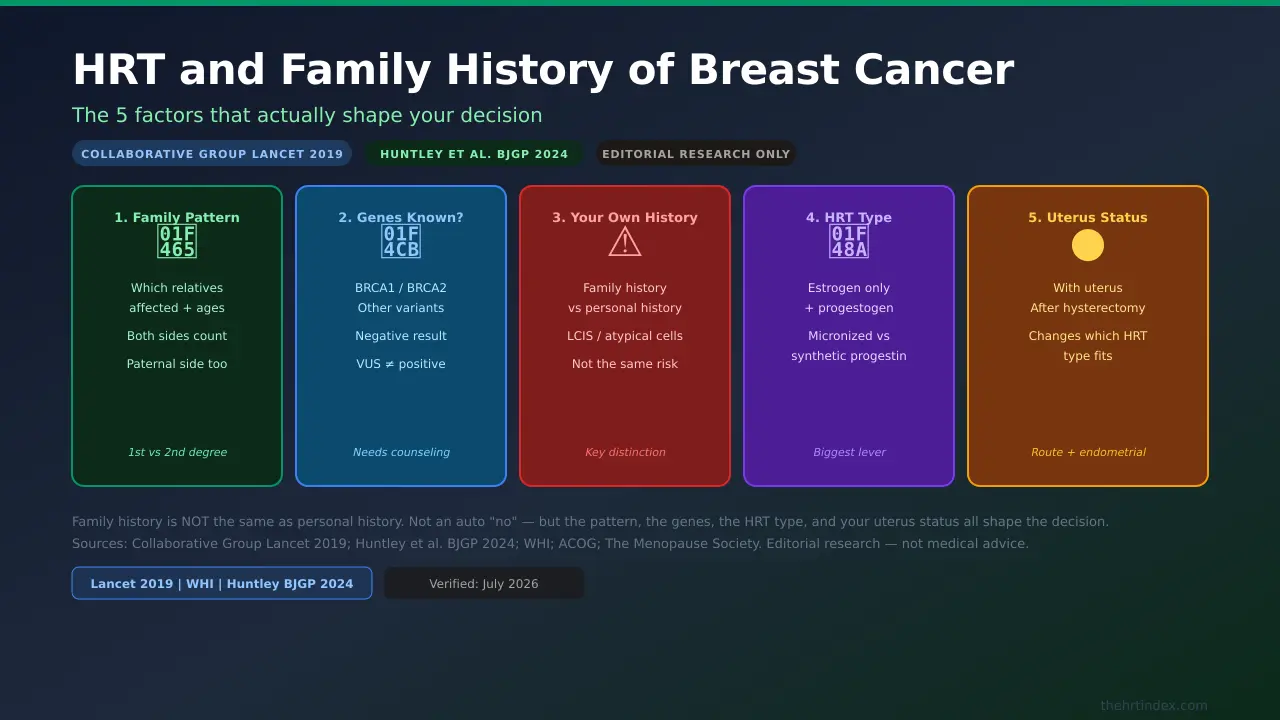
Where you land — at a glance
| Your situation | Bottom line | Your first step |
|---|---|---|
| Family history only, no clear strong pattern | Not an automatic "no" to HRT | Build a full family history, then talk options with a menopause-trained clinician |
| Early diagnoses, several relatives, male breast cancer, or a breast-and-ovarian pattern | May need a hereditary-risk review first | A familial-risk screen and, if it flags, genetics — before a routine online HRT signup |
| Known inherited gene change (like BRCA1 or BRCA2) | Not ordinary "family history" | A specialist-guided plan |
| You've had breast cancer yourself | A different clinical category | Oncology or a breast specialist first |
| LCIS, atypical hyperplasia, or another high-risk breast finding | Higher risk, but not cancer | A breast-risk assessment before deciding |
| Only vaginal or urinary symptoms | Local treatment is judged separately | Ask about low-dose vaginal and non-hormonal options |
Not sure which lane you're in? The HRT Index's Find My HRT Path tool walks you through a few quick questions, points you to the right starting path, and flags when your situation should begin with an in-person clinician instead of an app. Educational routing only — not a diagnosis or an approval.
Is this guide for you?
Read this if:
- ✓Breast cancer affected your mother, sister, daughter, aunt, or grandmother
- ✓You've never had breast cancer yourself
- ✓You're weighing systemic HRT, vaginal estrogen, or an online consult
- ✓You're not sure whether you need genetic testing first
This page isn't your decision tool if:
- ✗You've personally had breast cancer or DCIS
- ✗You have a new breast lump, nipple change, or skin change
- ✗You already know you carry a gene change like BRCA but don't have a specialist plan yet
- ✗You have unexplained bleeding
Can you take HRT if breast cancer runs in your family?
In most cases, yes — with an individual review. A family history of breast cancer is a risk factor your clinician weighs. It is not, by itself, an automatic barrier to hormone therapy. The clear line is a personal history of breast cancer, which usually rules out systemic HRT. How strong your family history is, and which type of HRT you're considering, shape the rest.
Everything hangs on the difference between two terms:
Family history means a blood relative had breast cancer. It nudges your baseline risk up. It does not, on its own, prove you carry an inherited gene change, and it does not automatically take HRT off the table.
Personal history means you have had breast cancer — either invasive breast cancer or DCIS (ductal carcinoma in situ, a noninvasive or stage 0 breast cancer). That's a different clinical category. For women who've had breast cancer, systemic HRT is generally not recommended, apart from uncommon cases handled through shared decisions with an oncology team (The Menopause Society).
| Category | What it means | What it changes |
|---|---|---|
| Family history | A relative had breast cancer | Raises your starting risk; doesn't prove you carry a gene change; may still allow a routine menopause consult |
| Personal history | You had invasive breast cancer or DCIS | Changes the whole treatment category; systemic HRT generally isn't a routine telehealth decision |
| High-risk breast finding | You have LCIS, atypical hyperplasia, or a similar finding | Higher risk, but not cancer; needs a breast-risk assessment before deciding |
The honest part most reassuring pages skip
Family history raises your starting risk. So if HRT adds any risk, that small increase lands on a bigger number than it would for a woman starting lower. A "small bump" sounds harmless until you remember your baseline may already be higher. That's real.
But that's exactly why the useful question isn't "Is HRT safe?" — it's "What's my real starting point, which type of HRT am I considering, and who should sign off on the decision?" Once you answer those three, the path gets clearer and a lot less frightening.
What counts as a "strong" family history of breast cancer?
"Family history" is not one risk level. Concern rises with more affected relatives, younger ages at diagnosis, cancer in both breasts, male breast cancer, a breast-and-ovarian (or pancreatic/prostate) pattern, and any known inherited gene change. And the paternal side counts just as much as the maternal side — a fact that trips up a lot of people, and even some intake forms.
Here's what actually moves the needle, and what to write down before any appointment:
- →Which relative — mother, sister, and daughter (first-degree) carry more weight than an aunt or grandmother (second-degree). But several second-degree cases on the same side can still form a real pattern.
- →Which side of the family — maternal and paternal both matter.
- →Age at diagnosis — younger is a stronger inherited signal.
- →One breast or both — cancer in both breasts raises concern.
- →More than one separate cancer in the same person.
- →Male breast cancer in the family — an important flag.
- →Other cancers in the lineage — ovarian cancer, pancreatic cancer, and aggressive or early prostate cancer can be part of the same inherited patterns (especially BRCA-related ones).
- →Ancestry linked to founder gene changes — for example, Ashkenazi Jewish ancestry.
- →Any genetic testing already done — and the exact result, in writing.
The HRT Index Family-History Decision Grid
This grid routes your family pattern to a starting care lane. It is an editorial decision framework assembled from U.S. genetics guidance, NCI risk-model documentation, and menopause and breast-cancer research — not a score, and not a diagnosis.
| Your family pattern | Why it matters | What it changes about HRT | Best place to start |
|---|---|---|---|
| One relative, diagnosed later in life, no cluster, no known gene change | A single later case usually carries less inherited signal | Family history alone isn't an automatic block; clinician still needs full details | A menopause-trained clinician who takes a full family history |
| One first-degree relative diagnosed young | Earlier age raises the chance of an inherited pattern | Sort out inherited risk before treating systemic HRT as routine | A clinician who runs a validated familial-risk screen; genetics if the screen flags |
| Several relatives on the same side | More cases, stronger signal; both sides count | Baseline may be meaningfully higher, so a small added risk matters more in absolute terms | Genetics or a high-risk breast clinic before a routine systemic-HRT intake |
| Male breast cancer in the family | A recognized flag for inherited risk | A single online checkbox can't resolve this | Genetics / high-risk breast lane first |
| Breast cancer plus ovarian, pancreatic, or prostate cancer in the family | Some inherited syndromes show up as these combinations | The open question is inherited risk, not which provider is easiest | Genetics / high-risk breast lane |
| A known inherited gene change (BRCA1, BRCA2, and others) | This is not ordinary "family history" | No generic page should hand you a blanket yes. It depends on the gene, your history, and your specialist plan | Genetics / high-risk breast specialist plus a menopause clinician |
| Dense breasts, atypical cells, or LCIS, plus family history | These add risk on top of family history and can change which screening and which model fit | Family history can't be judged alone here | A breast-risk clinic or a clinician who does formal risk assessment |
| Unknown or incomplete family history | Adoption, small families, or lost records make family-history tools less reliable | Don't assume "average," and don't assume "blocked." Name the uncertainty | A clinician-led assessment; genetics may still fit |
| You've had breast cancer yourself | A different clinical category entirely | Systemic HRT is generally not recommended for survivors, outside uncommon specialist-led decisions. Vaginal treatment is judged separately | Oncology or a breast specialist first — not a routine online signup |
These lanes are routing suggestions, not eligibility rulings. A clinician or genetic counselor makes the actual call.
See which care path should come first
Routine menopause visit, hereditary-risk review, or specialist first? Answer a few quick questions in Find My HRT Path and you'll get a starting lane plus what to bring. No account required. Educational routing only — not a diagnosis, a cancer-risk score, or an "approved."
Find My Starting LaneHRT and family history of breast cancer: does it multiply your risk?
The evidence says it doesn't appear to. The largest analysis ever done — pooling records from more than 100,000 women who developed breast cancer — found the risk linked to HRT did not differ substantially based on family history (Collaborative Group on Hormonal Factors in Breast Cancer, Lancet, 2019). Your baseline is higher because of your family, so your absolute numbers are higher. But HRT doesn't appear to stack extra risk on top because of family history.
Two separate dials
Think of it this way. One dial is your starting risk, set partly by your family history — turned up a little, or a lot, depending on your pattern. The other dial is the added risk from HRT. The evidence suggests those dials don't feed each other. Family history turns up the first dial. It doesn't make the HRT dial turn faster.
A 2025 pooled analysis also found no clear sign that family history multiplies HRT's effect, though its estimates for higher-risk women were imprecise. Nobody is claiming HRT is protective in that group. The takeaway is steady: family history raises your baseline, not the size of HRT's bump.
Relative risk vs. absolute risk — the trick your brain plays
A "40% higher risk" sounds enormous. But 40% higher than a small number is still a small number. If two women each add the same relative risk from HRT, and one starts at a low baseline while one starts high, the same percentage increase produces a bigger jump in real cases for the second woman. That's the key absolute-risk point: a similar relative effect can produce a larger absolute difference when the starting risk is higher.
And your baseline can't be guessed from "my mom had breast cancer." It takes a proper assessment — exactly why we won't slap a percentage on you here, and why you should be suspicious of any page or app that does.
Why studies seem to argue with each other
You'll find pages that say "HRT is basically safe" and others that say "HRT raises breast cancer risk," and both cite real research. They're not lying — they're describing different things:
- –Randomized trials vs. observational studies. The gold-standard Women's Health Initiative (WHI) trial and large real-world studies sometimes disagree, especially about estrogen-only HRT.
- –Different hormones. "HRT" isn't one drug. The estrogen type, the progestogen type, the dose, and the schedule all change the risk.
- –How long, and how it's taken. Longer use adds more risk. Daily progestogen adds a bit more than the every-other-week kind.
- –When you start. Age at first use matters.
- –Different definitions of "family history." Studies don't all define it the same way.
What's still genuinely unknown
- !There's no randomized trial covering every modern HRT recipe in every family-history subgroup.
- !Long-term data on the newer, possibly-lower-risk progesterone in high-risk women is thin.
- !Most gene-carrier data comes from special situations, like women who've had risk-reducing surgery.
- !No article can turn any of this into a reliable personal percentage without a formal assessment.
How much does HRT increase breast-cancer risk, with and without family history?
For 5 years of HRT started at age 50, the extra 20-year breast-cancer risk is roughly 1 in 50 for estrogen-plus-daily-progestogen, about 1 in 70 for the intermittent version, and about 1 in 200 for estrogen-only — and vaginal estrogen was the one type not linked to extra risk in that analysis (Collaborative Group, Lancet, 2019).
The general picture
| Type of HRT | Extra breast-cancer cases over 20 years | In plain terms |
|---|---|---|
| Estrogen + daily progestogen | About +2 per 100 users | ~1 extra case per 50 women |
| Estrogen + intermittent progestogen | About +1.4 per 100 | ~1 extra case per 70 women |
| Estrogen-only | About +0.5 per 100 | ~1 extra case per 200 women |
| Low-dose vaginal estrogen | No excess detected in that analysis | — (not proof of zero risk) |
Modeled excess breast-cancer cases from ages 50-69 for women of average weight in developed countries who started HRT at 50 and used it for 5 years. Ten years of use roughly doubles the excess. Source: Collaborative Group, Lancet 2019.
What happens when family history raises the baseline
Researchers modeled hypothetical unaffected 50-year-old women with different family histories (Huntley et al., British Journal of General Practice, 2024). Their "strong" example was a woman with two first-degree relatives diagnosed at age 50. These are modeled illustrations for a UK population — not a prediction for you — but they show the shape of the thing clearly.
| Modeled profile | Breast cancer by age 80, no HRT | After 5 years HRT | After 10 years HRT | Dying of breast cancer (no / 5yr / 10yr) |
|---|---|---|---|---|
| "Average" (family history unknown) | 9.8% | 11.0% | 12.4% | 1.7% / 1.8% / 2.0% |
| "Strong": two first-degree relatives diagnosed at 50 | 19.6% | 22.4% | 25.2% | 3.2% / 3.5% / 3.8% |
Modeled estimates for combined-cyclical HRT starting at age 50. UK population; not observed personal outcomes. Source: Huntley et al., BJGP 2024.
Read those death columns slowly. For the strong-history woman, 5 years of HRT moved her risk of dying from breast cancer from 3.2% to 3.5%. The study put it in human terms: out of 343 women with a strong family history, about 11 would die of a breast cancer diagnosed between 50 and 80 if none used HRT — and if all 343 took 5 years of HRT, roughly one more would.
The study's conclusion: for women with a strong family history, most of their breast-cancer risk comes from their baseline, not from adding HRT.
A few things this table is NOT
- — It does not predict your personal risk. It's modeled family patterns, not observed outcomes.
- — It shows one HRT scenario (combined-cyclical). Estrogen-only numbers are smaller.
- — It did not test micronized progesterone or non-oral options like patches — data wasn't available for those.
- — It should never be turned into a calculator where you pick "strong" and it shows you these numbers as yours.
Which type of HRT changes breast-cancer risk the most?
The type of HRT is one of the biggest levers in this whole decision. Combined estrogen-plus-progestogen has the clearest link to added breast-cancer risk. Estrogen-only has a different, more reassuring pattern — but usually applies only to women without a uterus. And low-dose vaginal estrogen is judged separately, because so little of it reaches the bloodstream.
| HRT type | Who it's usually for | What the best evidence shows | Evidence strength | The catch |
|---|---|---|---|---|
| Low-dose vaginal estrogen | Vaginal/urinary symptoms; very little reaches the bloodstream | The one type not linked to extra breast-cancer risk in the 2019 Lancet analysis; reassuring survivor data too | Large real-world + survivor data | Doesn't treat hot flashes or night sweats; "no excess detected" isn't "zero risk in every case" |
| Estrogen-only (systemic) | Women without a uterus (after hysterectomy) | WHI: estrogen alone linked to ~23% fewer breast cancers and fewer deaths over ~20 years. Real-world studies show a small rise (~1 in 200) | Trial (reassuring) vs. observational (small rise) — an honest split | Applies to the specific product/population studied; with a uterus, raises endometrial-cancer risk |
| Combined, with micronized progesterone | Women with a uterus who need endometrial protection | Real-world data suggest lower breast-cancer risk than synthetic progestins — reassuring for roughly the first 5 years, unclear after | Observational; biologically plausible; not proven by a big trial | "Reassuring" is not "zero." Long-term, high-risk data is thin |
| Combined, with synthetic progestin | Women with a uterus (older/standard regimens) | WHI: CEE plus medroxyprogesterone acetate linked to ~28% more breast cancers over long-term follow-up | Randomized evidence for that regimen; real-world evidence varies | Risk rises with duration; daily progestogen edges out intermittent |
"Micronized progesterone" — what is that?
It's a form of progesterone chemically the same as what your body makes. FDA-approved oral micronized progesterone exists (for example, Prometrium and approved generics). Real-world studies (like the French E3N study) suggest it may carry less breast-cancer risk than older synthetic progestins for the first few years. Two cautions: it's not risk-free — the long-term data in high-risk women isn't there yet — and a compounded progesterone isn't FDA-approved just because it's called "micronized" or "bioidentical." See our micronized progesterone guide for more.
"Is a patch safer than a pill for breast cancer?"
A patch (transdermal estrogen) is linked to a lower risk of blood clots than pills. But the evidence does not support saying a patch erases or clearly lowers breast-cancer risk when the rest of the recipe is the same. Don't let a marketing line oversell the patch.
"Can I just drop the progesterone to lower my risk?"
Generally only if you don't have a uterus. If you do, estrogen without a progestogen raises endometrial (uterine) cancer risk, so you need adequate endometrial protection. This is a clinician's call, not a self-adjustment.
FDA-approved vs. compounded — do not let anyone blur these
| FDA-approved medication | Compounded hormone product |
|---|---|
| Reviewed by the FDA for safety, effectiveness, dose, and labeling | Not FDA-approved |
| Standardized, labeled strength and prescribing information | Mixed for an individual prescription |
| Some products contain estradiol and progesterone chemically identical to your body's hormones | "Bioidentical" is a description, not an FDA approval or a safety rating |
| Product-specific safety and warning information | FDA doesn't pre-review it for quality, strength consistency, or labeling the way it does an approved drug |
The FDA has said it does not have evidence that compounded "bioidentical" hormones are safer or more effective than FDA-approved therapy. "Bioidentical" doesn't mean approved, safer, or better — and confusingly, some FDA-approved products already contain hormones chemically identical to your own. If a provider implies compounded hormones are safer for a woman worried about cancer, that's a reason to be more skeptical, not less.
What the 2025-2026 FDA label change did — and didn't do
In November 2025, the FDA asked drugmakers to update the labeling across menopausal hormone products, including removing breast-cancer, heart-disease, and probable-dementia language from the prominent boxed warning. By February 2026, the FDA had approved updated prescribing information for the first six products — Prometrium, Divigel, Cenestin, Enjuvia, Estring, and Bijuva — with more expected to follow (FDA, 2026).
What matters for you: removing warning language is not the same as proving there's no risk. Breast-cancer information still lives elsewhere in the prescribing information. Treat "no more boxed warning" as labeling caught up with the science, not as HRT became risk-free.
Do you need genetic counseling or BRCA testing before HRT?
Not every woman with one affected relative needs genetic testing before discussing HRT. U.S. guidance supports using a short, validated family-history screen first; if that screen and a genetic counselor suggest it, testing follows (U.S. Preventive Services Task Force, 2019 recommendation; an update was in progress at last check). Testing is a considered step with counseling around it — not a checkout add-on to a hormone subscription.
Patterns that should prompt a closer look at inherited risk before starting systemic HRT:
- !Several affected relatives.
- !Diagnoses at young ages.
- !Cancer in both breasts, or more than one separate cancer in one relative.
- !Male breast cancer in the family.
- !Breast cancer alongside ovarian, pancreatic, or aggressive prostate cancer in the family.
- !A gene change already known in the family.
- !A family so small or unknown that risk can't be read confidently.
What genetic counseling actually does
A counselor maps your family tree in detail, figures out who in the family is most useful to test first, picks the right test, explains what a positive, negative, or uncertain result would mean, and connects any result to your screening and prevention plan. That interpretation is the whole value. A raw gene result without it can mislead you.
Which breast-risk tool is which? (And the mix-up to watch for)
One common error: calling the NCI's tool "Tyrer-Cuzick." It isn't. The NCI tool is the Gail Model. Tyrer-Cuzick is a separate model.
| Tool | What it's good for | The big limitation |
|---|---|---|
| NCI BCRAT (the Gail Model) | Estimates U.S. breast-cancer risk from personal factors, prior biopsies, and first-degree family history | Doesn't include breast density or an extended family tree; can't accurately calculate risk for LCIS, DCIS, prior breast cancer, or a known high-risk gene change |
| Tyrer-Cuzick / IBIS | Adds more family and personal factors and breast density; can even factor in planned future HRT | Only as good as the details you feed it, and depends on the version |
| BOADICEA / CanRisk | Uses your extended family tree plus genetic and other risk factors | Needs careful input; it's a clinician-level tool, not an HRT-eligibility calculator |
| BRCAPRO and brief family-history screens | Estimate the chance you carry a BRCA-type gene change, to guide a genetics referral | Estimate variant likelihood — not every part of treatment suitability |
"I had a negative BRCA test — doesn't that mean I'm fine?"
Not necessarily. A negative result can mean very different things:
- –A known family gene change was tested for, and you didn't inherit it (genuinely reassuring).
- –A gene panel found nothing — but the right relative was never tested first, so the family's actual gene change might be unknown.
- –Your family's risk involves genes the test didn't cover.
- –Your family history still puts you above average even without any gene change found.
A "variant of uncertain significance" is not a positive result. A direct-to-consumer spit kit may not check the genes or variants that matter, and it doesn't come with expert interpretation.
What if you carry a BRCA1, BRCA2, or another inherited gene change?
A known inherited gene change (a pathogenic variant) is a different level of conversation than family history alone. Whether HRT is even on the table can depend on the specific gene, whether you've had breast cancer yourself, whether you've had risk-reducing surgery, your uterus status, your age, and your current screening plan. This is specialist territory, not a fast online intake.
What we can say, and it's reassuring: for cancer-free BRCA1/2 carriers who've had their ovaries removed to reduce risk, observational cohort studies have not found that short-term HRT afterward raises breast-cancer risk overall, and estrogen-only appears lowest-risk (with the clearest signal in the BRCA1 group). Two boundaries on that:
- !This shouldn't be stretched to every other gene (PALB2, TP53, CHEK2, ATM, and others), to women who've already had breast cancer, or to every surgical situation.
- !These decisions are made with a genetics and breast-risk team who know your full picture — not from an app's checkbox.
If you carry an inherited gene change, your first step is coordinated specialist care. See the FAQ below for the specific "HRT after risk-reducing ovary removal" question.
What about dense breasts, atypical cells, LCIS, or a past biopsy?
These can raise your risk on their own, separate from family history. They don't all mean cancer — but they make a simple "my mom had it" assessment incomplete, and they may call for a risk model or a breast clinic that factors in your pathology and breast density.
Dense breasts
Common and a breast-cancer risk factor in their own right. Dense tissue also makes mammograms harder to read. Density plus family history can change your formal risk estimate and your screening plan — but density alone doesn't ban HRT.
Atypical hyperplasia and LCIS
Significant personal breast findings even though they're not invasive cancer. They matter to the decision, and they're exactly the situations where the simpler Gail Model can't accurately estimate your risk.
Warning: more screening is not a risk eraser. Extra imaging may catch a cancer earlier. It does not make a treatment-related risk disappear, and it doesn't turn an unsuitable therapy into a suitable one.
What if you've personally had breast cancer?
This is a different clinical category from family history. Systemic hormone therapy is generally not recommended for women who've had breast cancer, apart from uncommon cases handled through shared decisions with an oncology team. An ordinary online HRT signup should not be your first step here.
If you've had breast cancer, the decision depends on things only your oncology team can weigh: your tumor's receptor status, any treatment you're on now (like an aromatase inhibitor), your recurrence risk, how long it's been, and your symptoms and goals. It is not decided by whether a relative's cancer was receptor-positive.
Stop here and get specialist input first if you:
- ✗Have had invasive breast cancer, or DCIS with an unresolved plan
- ✗Are in active breast-cancer treatment
- ✗Notice a new breast change (lump, nipple change, skin change)
- ✗Are on an aromatase inhibitor with severe vaginal symptoms
- ✗Were told HRT is off-limits for a reason that hasn't been reviewed
Your first move is oncology or a breast specialist — not a website, and not an app.
For women who have had breast cancer and are weighing options, see our guides to vaginal estrogen after breast cancer and menopause treatment for breast cancer survivors.
Can you use vaginal estrogen with a family history of breast cancer?
Low-dose vaginal estrogen is judged separately from full-body HRT, because far less of it reaches the bloodstream and it treats local symptoms rather than hot flashes. Family history alone is generally not treated as a reason to avoid it. A personal history of breast cancer — especially with an aromatase inhibitor — needs an individual conversation.
Vaginal estrogen may help:
- ✓ Vaginal dryness and irritation
- ✓ Pain with sex
- ✓ Some recurring urinary symptoms
- ✓ Genitourinary syndrome of menopause
It will NOT reliably treat:
- ✕ Hot flashes
- ✕ Night sweats
- ✕ Whole-body symptoms
Major professional guidance (ACOG) suggests starting with non-hormonal options for women who've had breast cancer, then considering low-dose vaginal estrogen if those don't work. For women on an aromatase inhibitor, ACOG calls for shared decision-making among the patient, gynecologist, and oncologist. For women with family history and no personal history, it's generally not restricted.
Want the full breakdown? See our low-dose vaginal estrogen guide.
Can an online HRT provider handle a strong family history safely?
Sometimes yes — but only when the service digs deep enough. Telehealth can be a fine starting point for straightforward family-history cases, if the provider collects real detail, separates family from personal history, uses licensed clinicians, and can refer you onward. A strong inherited pattern, a known gene change, a personal cancer history, or a new breast symptom may belong with a specialist first.
The honest limitation: not every service is built to evaluate inherited breast-cancer risk. If a platform shrinks your history down to one yes/no box and rushes you to checkout, that convenience is not evidence that it fits your situation.
We review providers using The HRT Index Verification Standard — five pillars, in order: clinical legitimacy, care quality, medication fit, price transparency, and access. For a family-history reader:
So where does that leave you?
- →If your family pattern looks straightforward, comparing reputable providers is a reasonable next step — see our HRT provider comparison once you've read this page.
- →If you're in the middle (a stronger pattern that may need a hereditary-risk review), use the tool to find a service with real referral depth — don't just pick the fastest checkout.
- →If you're in the specialist-first or personal-history lane, skip the provider hunt for now. Your next step isn't an online prescription.
What should you bring to your HRT appointment?
A short visit gets far more useful when your clinician can see a structured family history instead of "breast cancer runs in my family." Bring the affected relatives, which side of the family, their ages at diagnosis, any gene-test results, your own breast history, your symptoms, your uterus status, and your current medications.
Your three-generation family sketch
For each relative with cancer, note:
- ✓Who they are and which side (mom's or dad's)
- ✓Their current age, or age at death
- ✓The type of cancer (including ovarian, pancreatic, or prostate, if any)
- ✓Age at diagnosis
- ✓One breast or both
- ✓Whether they had genetic testing, and the exact result
- ✓Your ancestry, if it's linked to founder gene changes (e.g., Ashkenazi Jewish)
- ✓Where the information came from (and mark anything you genuinely don't know as "unknown")
Records to gather
- ✓Your latest mammogram report and any breast-density notice
- ✓Any MRI or ultrasound reports
- ✓Any past biopsy results
- ✓Your own gene-test report, if you have one (the actual document)
- ✓Whether you've had a hysterectomy or your ovaries removed
- ✓Your current medications and symptoms, and how badly they're affecting you
- ✓Any bleeding history
Questions to ask (bring these written down)
- 1.Is my family pattern strong enough to need a familial-risk screen, genetics, or a high-risk breast review first?
- 2.Which risk model fits me, and what are its limits for my situation?
- 3.Does it account for my dad's side, my breast density, and any past biopsy?
- 4.Am I asking about full-body HRT, or treatment for local vaginal symptoms?
- 5.Do I need a progestogen because I still have a uterus?
- 6.Which FDA-approved options make sense to discuss?
- 7.What does the evidence say about my specific dose, type, and length of use?
- 8.What screening schedule fits my baseline risk?
- 9.What would make us stop, switch, or re-check?
- 10.Who coordinates my care if I need genetics or breast-risk review?
Turn this into a plan for your consult
Start Find My HRT Path to sort out your starting lane and what to bring — free, and no account required. It's the difference between hoping your clinician asks the right questions and walking in already holding them.
Build My Appointment PlanWhat are the non-hormonal alternatives if systemic HRT isn't your first step?
A good alternative matches your symptom, not just the label "non-hormonal." Hot flashes, sleep trouble, mood changes, vaginal dryness, and urinary symptoms each have different evidence-based options. A pause for risk assessment doesn't mean you have to suffer with zero relief.
Compare options by the symptom you actually need to treat in our non-hormonal options guide.
How should mammograms and breast screening change when you use HRT?
Screening should match your baseline risk, and it should continue whether or not you use HRT. Higher-risk women may need extra imaging — but screening is a way to find cancer early, not proof that HRT is safe for you, and not protection against getting cancer in the first place.
Before you start HRT: is your routine screening up to date? Has any formal risk assessment recommended a different schedule for you? Is there an unresolved breast symptom that needs looking at first?
While on HRT: keep an eye on whether it's actually meeting your original goal, and flag any bleeding, breast changes, dose changes, or new family diagnoses. A new diagnosis in the family is a reason to re-check the plan with your clinician — not a reason to stop cold on your own, and not something to ignore.
Combined estrogen-plus-progestin therapy can increase breast density and can make mammograms harder to interpret. Tell whoever reads your mammogram that you're on HRT.
What we actually verified for this guide
What we verified:
- ✓The Women's Health Initiative long-term (~20-year) follow-up on estrogen-only vs. combined HRT and breast cancer — and the specific regimens and populations each arm studied.
- ✓The 2019 Lancet worldwide analysis (Collaborative Group on Hormonal Factors in Breast Cancer), including its finding that HRT's breast-cancer risk did not differ substantially by family history, and its absolute-risk figures.
- ✓The 2024 British Journal of General Practice modeling study — we read the actual results tables and matched every number in our table to the source.
- ✓Real-world evidence comparing micronized progesterone with synthetic progestins.
- ✓ACOG guidance on vaginal estrogen and genitourinary symptoms.
- ✓The FDA's 2025-2026 labeling changes, straight from the FDA's own materials.
- ✓The correct names and limits of the major breast-risk tools (the NCI tool is the Gail Model, not Tyrer-Cuzick).
How this page was produced:
The HRT Index Editorial Team reviewed primary research and current materials from the FDA, the National Cancer Institute, the U.S. Preventive Services Task Force, and The Menopause Society; separated family history from personal history and high-risk breast findings at every step; checked the risk-model facts; and assembled the family-pattern decision grid. This is editorial research. It has not been reviewed by a clinician, and we're not going to pretend otherwise or invent a reviewer.
What we did NOT verify or claim:
Your personal risk; your eligibility for HRT; any provider's private protocol; that any single formulation is safe for every high-risk woman; or any first-person or testimonial experience.
For how we work and how to flag an error, see our editorial standards, medical review policy, corrections page, consumer health data privacy policy, and affiliate disclosure.
Frequently asked questions
These questions reflect what women in this situation actually ask. They appear here as visible content only — not as FAQ schema markup.
- Can I take HRT if my mother had breast cancer?
- Possibly, with an individual review. Her age at diagnosis, whether other relatives were affected, whether there was cancer on your father's side, and the type of HRT you're considering all matter. Don't let a yes/no checkbox stand in for a full assessment.
- What if my sister was diagnosed before age 50?
- A young diagnosis in a first-degree relative is a stronger inherited signal than a single later case. Ask whether a validated family-history screen and genetic counseling should come before a routine systemic-HRT intake.
- Does HRT cause breast cancer if it runs in my family?
- There's no simple yes/no that covers every HRT type. Family history raises your baseline; some combined HRT types are linked to more breast cancers; and a higher baseline means the same relative increase shows up as a bigger absolute number. The 2019 Lancet analysis found the HRT-related risk itself didn't differ substantially in women with a family history.
- Do I need a mammogram before starting HRT?
- You should be appropriately screened for your age and risk, but the timing and type are individual. A normal mammogram isn't a clearance certificate, and it doesn't resolve inherited risk.
- Can HRT increase breast density or make mammograms harder to read?
- Combined estrogen-plus-progestin therapy can increase breast density and can make mammograms harder to interpret. That affects screening and reading — it doesn't by itself decide whether HRT is right for you. Tell whoever reads your mammogram that you're on HRT.
- Do I need BRCA testing before HRT?
- Not automatically. A short, validated family-history screen helps decide whether genetic counseling and testing make sense for you (U.S. Preventive Services Task Force).
- Can you take HRT after risk-reducing ovary removal if you carry BRCA1 or BRCA2?
- For cancer-free BRCA1/2 carriers who've had their ovaries removed, observational cohort studies have not found that short-term HRT afterward raises breast-cancer risk overall, and estrogen-only appears lowest-risk (clearest in BRCA1). This is a specialist-led decision that also depends on your uterus status and personal history — not something to settle from an online intake, and not automatically true for other gene changes.
- Is vaginal estrogen safer than full-body HRT for breast risk?
- It's a different category with much lower systemic absorption, used for local vaginal and urinary symptoms. Family history alone generally isn't a barrier; a personal cancer history still needs an individual conversation, and an aromatase inhibitor means looping in your oncologist.
- Is an estrogen patch safer than a pill for breast cancer?
- A patch has advantages for some risks (like blood clots), but the route alone doesn't justify saying breast-cancer risk is eliminated. The whole recipe — including whether a progestogen is used — is what matters.
- Is micronized progesterone safer with a family history?
- Real-world data suggest it may carry less breast-cancer risk than older synthetic progestins, at least short-term. That's worth asking about — but it's not proof of zero risk, especially long-term or in high-risk women.
- Are compounded "bioidentical" hormones safer?
- No evidence shows compounded bioidentical hormones are safer or more effective than FDA-approved therapy. They're not FDA-approved, and "bioidentical" is a description, not a safety rating — some FDA-approved products are also chemically identical to your body's hormones.
- What if I don't know my family history?
- Don't guess. Note what's unknown, and discuss your own breast history, density, biopsy history, and ancestry with a clinician. Risk tools are less reliable when the family picture is incomplete.
- Can I take HRT after a negative BRCA test?
- A negative test is only one piece. What it means depends on who was tested, which genes were covered, and whether your family history still puts you above average without a gene change found.
- What if a relative is diagnosed after I've already started HRT?
- A new diagnosis can change your family picture and the right risk assessment. Don't stop or continue automatically on the family news alone — tell your prescribing clinician and reassess the pattern, your regimen, how long you've used it, and your screening plan.
- Can I take HRT after having breast cancer myself?
- Systemic HRT generally isn't recommended for survivors, outside uncommon specialist-led decisions. This isn't the same question as family history — please start with your oncology team.
- Which type of clinician should I see first?
- It depends on your facts — it might be a menopause-trained gynecologist or primary-care clinician, a genetic counselor, a high-risk breast specialist, or an oncologist. The Find My HRT Path tool routes you to the right type rather than pretending there's one universal answer.
Still not sure which HRT approach fits your situation?
Take our free Find My HRT Path matching quiz — it turns your answers into an educational routing result and a question list for your consult, and it tells you honestly when your first step should be an in-person clinician instead of an app.
Take the Free QuizNo account required. Educational routing only — not a diagnosis.
Sources
| Citation | What we used it for |
|---|---|
| Collaborative Group on Hormonal Factors in Breast Cancer. Lancet 2019;394(10204):1159-1168. | Absolute-risk figures; finding that HRT-related risk did not differ substantially by family history; vaginal estrogen the exception. |
| Chlebowski RT, et al. WHI randomized trials, ~20-year follow-up (2019-2020). | Estrogen alone (CEE, post-hysterectomy) vs. combined (CEE + MPA) and breast cancer incidence. |
| Huntley C, et al. Brit J Gen Pract 2024;74(746):e610-e618. | Modeling of breast-cancer risk in women with family history taking HRT; source of the baseline/HRT tables. |
| Fournier A, et al. (E3N cohort); systematic review on progesterone vs. synthetic progestins. | Micronized progesterone vs. synthetic progestins and breast-cancer risk. |
| American College of Obstetricians and Gynecologists (ACOG). | Vaginal estrogen; shared decision-making for aromatase-inhibitor users. |
| The Menopause Society (formerly NAMS). Hormone therapy position statement. | Contraindications and individualized decision-making. |
| U.S. Preventive Services Task Force. BRCA-related cancer: risk assessment, counseling, testing (2019). | Who warrants genetic counseling before systemic HRT; update in progress at last check. |
| U.S. National Cancer Institute. Genetics of breast/gynecologic cancers (PDQ); Gail Model. | Gene-change patterns; risk-tool descriptions. |
| U.S. Food and Drug Administration. Menopausal hormone therapy labeling updates (2025-2026). | First approved product relabelings; boxed-warning changes; compounded bioidentical hormone information. |
| Recent pooled analyses of menopausal hormone therapy and breast cancer by familial-risk level (2025). | No clear multiplicative interaction with family history; imprecise estimates in higher-risk subgroups. |