HRT for Perimenopause Irregular Periods: What It Can Fix, What It Can't, and What to Do First
Menopausal HRT is not approved to regulate a perimenopausal cycle. The estrogen products are approved for hot flashes and night sweats, and one estradiol label reports irregular bleeding among its most common side effects. Hormone therapy can still change bleeding, and ACOG says it may help heavy menstrual bleeding in perimenopause. But unexplained bleeding gets evaluated before systemic estrogen. That order isn't optional.
That sounds like a door closing. It's the opposite. Here's what we found when we opened the actual FDA labels: the bleeding check is not the wall between you and hormone therapy. It's the door.
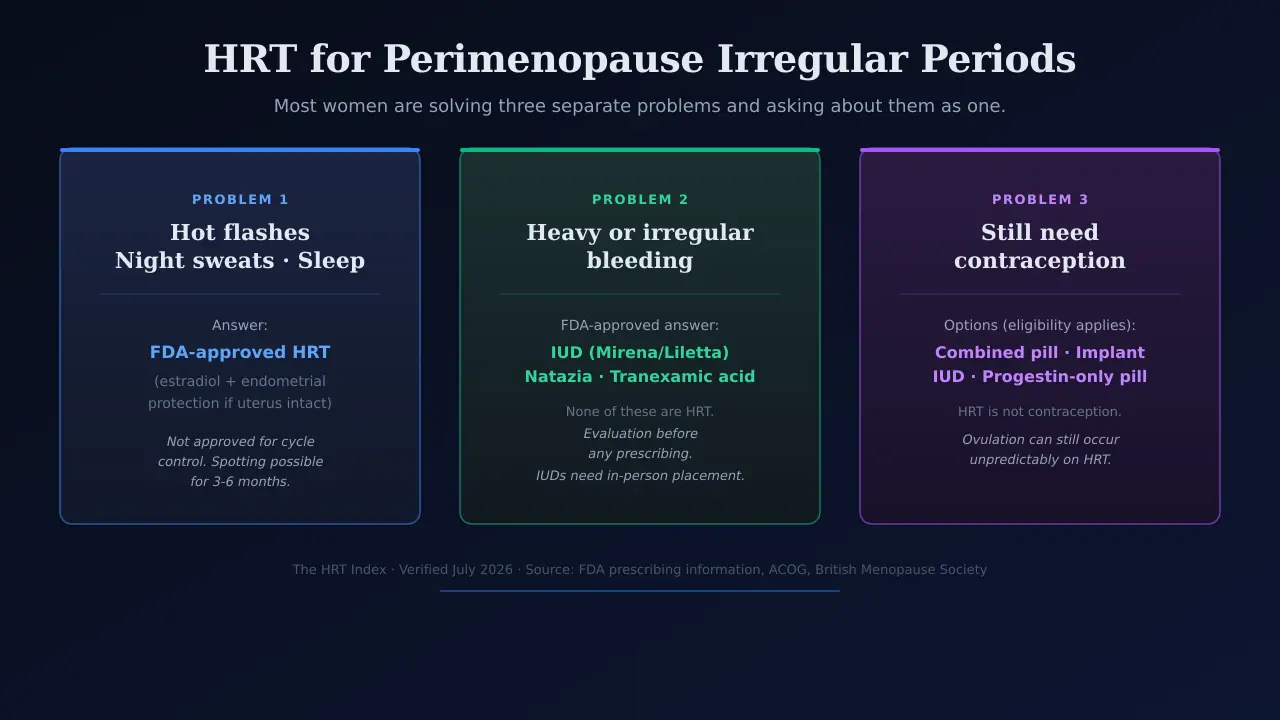
Most women in perimenopause are solving three separate problems. One medicine rarely handles all three. Source: FDA prescribing information · Verified July 2026
This page contains affiliate links to Sesame and Midi Health. The HRT Index may earn a commission at no extra cost to you. Compensation does not determine our conclusions, and we are not paid for placement. Full disclosure.
Is this page for you?
Yes, if:
- ✓Your periods have gone haywire and you're wondering if HRT is the fix
- ✓You started HRT and now you're spotting, and nobody warned you
- ✓You've been told you're “too early” because you still get periods
- ✓You have hot flashes andunpredictable bleeding and can't tell which to fix first
- ✓You're wondering if online care is a smart place to start
Stop — get care now:
- Heavy bleeding not slowing + fainting, breathlessness, or weakness → Emergency
- Severe pelvic, abdominal, or chest pain
- Possible pregnancy with pain, fainting, or heavy bleeding
Prompt evaluation needed:
- Any bleeding after 12 months without a period
- New bleeding between periods or after sex
- Prolonged or repeated heavy bleeding
- A new pattern of very frequent cycles
Does HRT for perimenopause irregular periods actually regulate bleeding?
Not as an approved use. FDA-approved systemic estrogen products are indicated for moderate-to-severe hot flashes and night sweats due to menopause — not for cycle control. Hormone therapy can still change bleeding, and it may reduce heavy menstrual bleeding in perimenopause, but that effect depends on the regimen, the underlying cause, and the individual.
We opened the FDA prescribing information for Divigel, an FDA-approved estradiol gel, revised February 2026. Under “most common adverse reactions,” the first thing listed is metrorrhagia— bleeding at irregular intervals, often between expected periods. That trial reported metrorrhagia in 9.6% of women at the 1.0 g/day dose versus 1.6% on placebo, in a 12-week trial of 495 postmenopausal women.
One honest caveat: that trial studied postmenopausal women.It does not measure whether estradiol regulates a perimenopausal cycle — because nobody designed a trial to ask that. The absence of that trial is itself the answer to your question.
What the labels actually say
Assembled from cited labels and guidance on July 2026.
| Option | Exact FDA-approved indication | Approved for heavy bleeding or cycle control? | Expected effect on bleeding | Contraceptive? | Endometrial-protection role | Needs in-person procedure? | Evidence status |
|---|---|---|---|---|---|---|---|
| Divigel (estradiol gel) — label rev. 02/2026 | Moderate-to-severe hot flashes and night sweats due to menopause | No | May change bleeding; metrorrhagia among most common adverse reactions | No | None (estrogen alone) | No | FDA label |
| Bijuva (estradiol + progesterone) — label rev. 02/2026 | Moderate-to-severe hot flashes in women with a uterus | No | May change bleeding | No | Yes, as the combined product | No | FDA label |
| Prometrium (micronized progesterone) — label rev. 02/2026 | Reducing endometrial hyperplasia risk in non-hysterectomized postmenopausal women taking conjugated estrogens; secondary amenorrhea in selected patients | No | Used off-label for bleeding control; outcome varies | No | As labeled, with conjugated estrogens in that postmenopausal population | No | FDA label |
| Mirena (52 mg levonorgestrel IUD) | Contraception up to 8 years; heavy menstrual bleeding up to 5 years in patients choosing intrauterine contraception | Yes — heavy bleeding | Typically reduces blood loss; spotting common early | Yes | Used off-label as the progestogen component of some HRT plans | Yes — insertion | FDA label |
| Liletta (52 mg levonorgestrel IUD) | Contraception; heavy menstrual bleeding in patients choosing intrauterine contraception | Yes — heavy bleeding | Typically reduces blood loss; spotting common early | Yes | Same off-label consideration; confirm device and date | Yes — insertion | FDA label |
| Natazia (estradiol valerate + dienogest) | Contraception; heavy menstrual bleeding in patients without organic uterine pathology who choose an oral contraceptive | Yes — heavy bleeding | May reduce blood loss in eligible patients | Yes | Yes, as a combined contraceptive | No | FDA label |
| Tranexamic acid | Cyclic heavy menstrual bleeding | Yes — heavy bleeding, non-hormonal | Reduces blood loss during periods | No | No | No | FDA label |
| Compounded estradiol/progesterone | None — compounded drugs are not FDA-approved | No | Not established through FDA review | No | Not established through FDA review | No | No FDA product label |
Read down the “approved for heavy bleeding or cycle control” column. The four green rows are the ones nobody calls HRT.Two of them require someone to put a device in your uterus. One is a birth control pill. One isn't a hormone at all. If the bleeding is the problem, the approved tools sit outside the category you came here searching for.
Why estradiol can make your bleeding worse at first
In perimenopause, your ovaries haven't stopped. They've gone erratic. Some months you ovulate. Some months you don't. Estrogen spikes and crashes. Your uterine lining builds and sheds on whatever schedule those swings dictate.
Now add estradiol from a patch or a gel. You haven't replaced the signal. You've stacked a second one on top of it. Two hormone sources, one uterus. Of course it gets strange for a while.
Current British Menopause Society guidancereports unscheduled bleeding — bleeding the regimen wasn't supposed to cause — in up to 40% of users during the first six months after starting HRT.
Four in ten. In the first six months. That's not a rare event.
So if you start hormone therapy and start spotting, you haven't failed and it hasn't failed. But “common” is not the same as “ignore it.” Heavy, painful, worsening, or newly-returned bleeding still gets a phone call. The timeline for what to expect — and when to stop waiting — is in the table below.
Which bleeding is normal in perimenopause, and which needs checking first?
Shorter cycles, longer cycles, skipped months, and changes in flow are all common during the menopause transition. Some patterns still warrant clinical evaluation rather than being attributed to hormones: very heavy bleeding, bleeding longer than seven days, bleeding between periods, bleeding after sex, repeatedly very short cycles, or any bleeding after 12 months without a period. ACOG recommends endometrial sampling as a first-line test for abnormal uterine bleeding in women older than 45.
Unexplained abnormal bleeding isn't a doctor's opinion about you. It's printed on the label. Systemic estrogen products list undiagnosed abnormal genital bleeding under contraindications — the section that means do not start this drug in this situation. Satisfy the label. The conversation you actually want opens up.
| What you'd actually say | What a clinician calls it | Why it matters | When to be seen |
|---|---|---|---|
| "I'm soaking a pad or tampon every hour and it isn't slowing" — with faintness, breathlessness, or severe weakness | Acute heavy menstrual bleeding with instability | Blood loss plus instability is an emergency, not a symptom | Emergency or same-day care |
| "Clots the size of a quarter or bigger" | Heavy menstrual bleeding with clots | A recognized sign of heavy bleeding. With faintness or breathlessness, it is urgent | Prompt evaluation; same-day if unwell |
| "My periods are two weeks apart" / "twice in one month" | Frequent menstrual bleeding | Could be a cycle that skipped ovulation. Could be a polyp or fibroid. The interval alone can't tell you which | Prompt evaluation, especially if new or you're over 45 |
| "I bled for ten days" | Prolonged menstrual bleeding | Same | Prompt evaluation |
| "I spot between periods" | Intermenstrual bleeding | Polyps, fibroids, and lining changes present exactly this way | Prompt evaluation |
| "I bleed after sex" | Postcoital bleeding | Needs cervical evaluation | Prompt evaluation |
| "I hadn't bled in over a year and now I am" | Postmenopausal bleeding | A different category with a higher index of suspicion | Prompt evaluation. Always. |
| "I might be pregnant" | Possible pregnancy | Testing comes first — this is on a stick, not a scan. With pain, fainting, or heavy bleeding, it's urgent | Test, then call. Urgent if symptomatic |
| "Longer gaps, then a normal-ish period, nothing else odd" | Typical menopausal transition pattern | Common. Usually nothing | Mention it at your next visit |
Age changes the sampling threshold. It isn't the only thing that does.
ACOG recommends endometrial sampling as a first-line test for abnormal uterine bleeding in women older than 45. Under 45, it's indicated with a history of unopposed estrogen, risk factors for uterine cancer, persistent bleeding, or bleeding that didn't respond to treatment. Pregnancy possibility, clinical stability, medication exposure, and exam findings all move the threshold too.
If your doctor reaches for a biopsy, it's because a guideline told them to. Not because they think you have cancer. Being checked doesn't mean anyone expects to find something. It means a change big enough to affect your treatment shouldn't be guessed at.
Before you book anything — build the thing that makes you hard to dismiss
“My periods are all over the place” isn't a history — it's a feeling. A clinician can't work with it. Write down your last few cycles in the format a clinician actually intakes: cycle intervals, bleeding days, flow, clots, spotting, medication changes and dates. Then check it against our symptom checklist and the questions to ask.
→ See the symptom checklist and questions to askFree. No signup. It doesn't diagnose anything.
What tests might I need before starting HRT for irregular bleeding?
Evaluation is individualized. Depending on age, risk factors, and findings, it may include menstrual and medication history, pregnancy testing, blood count or iron studies, pelvic and cervical examination, transvaginal ultrasound, endometrial sampling, saline-infusion sonography, or hysteroscopy. No single test rules out every cause, which is why the workup sometimes has more than one step.
| Test | What it may identify | What it can't rule out by itself | What may follow |
|---|---|---|---|
| Pregnancy test | Pregnancy | Ectopic or early pregnancy depending on timing | Serial hCG or ultrasound if symptoms suggest it |
| Pelvic and cervical exam | Cervical lesions, visible sources, uterine size or shape | Anything inside the uterine cavity | Imaging |
| Blood count / iron studies | Anemia and iron deficiency from blood loss | The cause of the bleeding | Treatment for anemia alongside the workup |
| Transvaginal ultrasound | Fibroids, some polyps, features suggesting adenomyosis, ovarian findings, endometrial thickness | Every focal lesion. Hyperplasia. Cancer. A normal scan is not a clean bill of health | Sampling, saline-infusion sonography, or hysteroscopy |
| Endometrial sampling (biopsy) | Hyperplasia and cancer in the tissue sampled | A focal lesion the sampler missed | Hysteroscopy or targeted sampling |
| Saline-infusion sonography | Focal lesions ultrasound alone can miss | Tissue diagnosis | Hysteroscopy or targeted biopsy |
| Hysteroscopy | Direct view of the cavity; targeted removal | — | Definitive tissue diagnosis |
That fourth row is the one to remember.A normal ultrasound does not mean nothing is wrong. It narrows the list. If someone tells you a clean scan settles the question, they've told you something the scan can't do.
The biopsy, since that's the word that scares people.It's often brief and office-based. Pain varies — genuinely varies, and anyone who tells you it's always mild is guessing about your body. Ask what pain management is available before you book; topical anesthetic and pre-procedure anti-inflammatory medication may be options. Whether you can drive yourself home depends on whether sedation is used. Ask that too.
What it costs
Cash prices for a pelvic or transvaginal ultrasound vary widely by market, facility, and whether interpretation and facility fees are billed separately. A range pulled from thin air would be exactly the math this site exists to refuse.
Before you book, ask for four things:
- The full self-pay price, including interpretation and any facility fee
- Your estimated insurance responsibility, if you have coverage — compare both numbers
- Whether an imaging order or referral is required first
- Whether the quoted price covers both abdominal and transvaginal imaging, if both are ordered
Eligible visits and diagnostic tests may be payable with HSA or FSA funds, subject to your plan's rules.
If your bleeding hasn't been looked at, this is your step
The wait for a gynecologist is the reason a lot of women give up on this and go looking for a shortcut. There's a cash-pay route that skips the queue.
→ See OB/GYN visits and pelvic-imaging options near you on SesameSesame lists cash-pay OB/GYN appointments and pelvic imaging in some markets. Availability, price, and whether an imaging order is required are location-specific — verify all three before booking. Sesame is not an online HRT provider. Last verified July 2026. Affiliate link.
Quick honesty break
We disclosed it at the top and we'll say it plainly here: The HRT Index may earn a commission if you book through some links on this page. The first thing we told you to do is book a gynecology appointment. It may delay the HRT conversation you actually came for by weeks. We're telling you anyway.
Most of this search does the opposite: “You can absolutely take HRT while you're still having periods!” It's true. It's what you wanted to hear. And it skips the one question the FDA label says has to be answered first. We'd rather you came back in a month with a clear result and got the thing you actually came for.
The right online HRT provider isn't the same for every woman— it depends on your symptoms, what you have tried, age, health history, and state. Because a general answer can't resolve those for you, use The HRT Index's Find My HRT Path tool to match your situation to the right provider — and to flag when online care isn't the right starting point — before your first consult.
What else could be causing this besides perimenopause?
Clinicians classify causes of abnormal uterine bleeding using PALM-COEIN, a system published by the International Federation of Gynecology and Obstetrics. PALM covers structural causes assessed by imaging or tissue sampling. COEIN covers non-structural causes. Ovulatory dysfunction linked to the menopause transition falls under AUB-O. More than one cause can be present at once.
PALM — Structural causes
Assessed with imaging and, when needed, tissue.
| Letter | What it means | In plain English |
|---|---|---|
| P | Polyp | A small growth on the uterine lining. Common. Usually benign. A classic cause of spotting between periods. |
| A | Adenomyosis | Uterine lining tissue growing into the muscle wall. Heavy, painful periods. |
| L | Leiomyoma | Fibroids. Non-cancerous muscle growths. Extremely common by your forties. |
| M | Malignancy and hyperplasia | Cancer of the lining, or thickening that can precede it. This is what sampling is for. |
COEIN — Non-structural causes
Imaging won't show these.
| Letter | What it means | In plain English |
|---|---|---|
| C | Coagulopathy | A bleeding or clotting disorder. Sometimes found in your forties for the first time. |
| O | Ovulatory dysfunction | This is where perimenopause sits. Ovulation has gone unpredictable, so bleeding has too. |
| E | Endometrial | A problem with the lining itself, without a visible growth. |
| I | Iatrogenic | Caused by a medication or device. HRT lives here. So does an IUD. |
| N | Not otherwise classified | The rest. |
One: “it's just perimenopause” is the O.AUB-O may be the leading explanation without every other letter being conclusively eliminated — that's normal.
Two: causes coexist. You can have a fibroid andan anovulatory cycle. Finding one doesn't retire the search. That's why a normal ultrasound doesn't end the conversation.
Three: look at the I.Iatrogenic — caused by treatment. If you start estradiol and start spotting, HRT can contribute to AUB-I. But a medication explanation doesn't exclude a structural, ovulatory, or endometrial cause sitting underneath it.
Can you start HRT while you're still having periods?
Yes. Still having periods does not by itself rule out a menopause treatment discussion. Women with bothersome perimenopause symptoms are commonly prescribed hormone therapy while still cycling. What changes is the regimen: current UK British Menopause Society guidance generally recommends sequential (cyclical) HRT for users who have menstruated within the preceding 12 months, and continuous combined HRT after sufficient amenorrhea. US prescribing is individualized.
There is no rule that says wait until your periods stop. What does determine the plan: your symptoms, your history, whether you have a uterus, whether you could get pregnant, and what your bleeding has been doing.
What “you're too early” might actually mean
| What they said | What they might have meant |
|---|---|
| "You're too early, you still have periods" | "Continuous combined HRT would be badly timed for you right now" — which is true, and fixable |
| "Let's check your hormones first" | Routine FSH and estradiol levels aren't useful for managing hot flashes. Ask what question the test would answer |
| "Let's talk about the pill instead" | They think you need cycle control and contraception, not menopause therapy — which might be right |
| "I want to look at that bleeding first" | This one is correct. It's the label. It's not a brush-off. |
| "Come back when your periods stop" | Ask what's actually behind it: regimen timing, contraception, unexplained bleeding, another contraindication, or no eligible treatment target yet |
Four of those five are conversations, not refusals. Knowing which one you got changes what you say next.
Sequential versus continuous — the regimen mismatch worth asking about
Sequential HRT(also called cyclical): estrogen every day, plus progestogen for part of each cycle — usually 10 to 14 days. It typically produces a planned withdrawal bleed.
Continuous combined HRT: estrogen and progestogen every day, no break. The goal is no bleeding.
Current BMS guidance is direct: continuous combined HRT started during ongoing ovarian activity can contribute to irregular bleeding, and sequential is generally recommended for women who've menstruated in the previous 12 months.
Say this out loud at your appointment:
“I've had a period in the last twelve months. Should I be on a sequential regimen rather than continuous combined?”
What to expect, and when to stop waiting
| When | What's expected | What isn't — call your prescriber |
|---|---|---|
| Before you start | — | Write down your last three cycles now. This is your baseline, and you won't remember it in four months. |
| First 3 months | Spotting, unscheduled bleeding, timing that makes no sense | Heavy bleeding, pain, anything that frightens you. Call. |
| Months 3–6 | Bleeding gradually becoming more predictable | Bleeding getting worse rather than better |
| After a dose change | The clock resets — roughly 3 more months of possible spotting | Same rules |
| After 6 months | Many women have settled. Not all will be bleed-free or fully predictable | Still bleeding unpredictably? That's a review, not a refill. Ask about the regimen, the progestogen, and whether imaging is warranted |
| Any time after 12 months with no period | Nothing. There's no expected here | Any bleeding. Report it. |
Low-dose vaginal estrogen — the cream, tablet, or ring for dryness and painful sex — does not regulate periods. If your problem is bleeding, that isn't the tool. If your problem is dryness, it might be exactly the tool.
Can progesterone alone regulate irregular perimenopause periods?
Micronized progesterone is FDA-approved for reducing endometrial hyperplasia risk in non-hysterectomized postmenopausal women taking conjugated estrogens, and for secondary amenorrhea in selected patients. Neither indication establishes it as a treatment for unpredictable perimenopausal bleeding. Progestogens are used off-label for bleeding control in some plans, and the outcome depends on the cause of the bleeding.
The friend who told you progesterone fixed her cycles may be telling the truth about her experience. What she can't tell you is why it worked for her, or whether the same cause is driving yours.
Progesterone has a labeled indication for secondary amenorrhea — periods that have stopped. That's a different problem from periods that are unpredictable, and the two get blurred constantly. And the contraindication applies here exactly as it does to estrogen: abnormal genital bleeding of unknown etiology. Which puts you back at the same door.
What HRT actually does (and why you probably still want it)
Menopausal hormone therapy is the most effective treatment for vasomotor symptoms and for genitourinary syndrome of menopause, and it prevents bone loss and fracture — the 2022 position of The Menopause Society, endorsed by more than 20 international organizations. For most healthy symptomatic women younger than 60 or within 10 years of menopause onset who have no contraindication, the benefit-risk balance is generally favorable. Regulating an irregular cycle is not among its approved uses.
You were probably right about HRT. Just not about this specific job.
Hot flashes. Night sweats. Waking at 3am soaked and staying awake until 5. Painful sex. Bone loss you can't feel yet. That's what it's approved for. That's what the evidence supports. And if you're under 60 or within ten years of the transition, have an eligible symptom, and no contraindication — you may be squarely in the group where the balance tips favorable.
Brain fog, anxiety, irritability, and insomnia are not stand-alone approved indications, and hormone therapy isn't recommended to prevent or treat cognitive decline. Some women think more clearly on it — most likely because it fixed the hot flashes and gave them their sleep back. That's a real benefit. It's an indirect one. We laid out that evidence separately.
The FDA rewrote the warning labels. Here's what actually changed.
The FDA announced it would remove boxed-warning statements about cardiovascular disease, breast cancer, and probable dementia from menopausal hormone therapy products.
The FDA approved the first six products with updated labels: Prometrium, Divigel, Cenestin, Enjuvia, Estring, and Bijuva. As of February 12, 2026, 29 companies had submitted proposed changes. The FDA also removed the instruction to use the lowest effective dose for the shortest duration.
What it does not mean: The FDA revised the boxed warning. It did not erase cardiovascular, breast, clot, or dementia information from labeling entirely; much of it remains in product-specific warnings and precautions. And it retained an endometrial cancer boxed warning on systemic estrogen-alone products. That warning directs clinicians to perform adequate diagnostic measures — including endometrial sampling when indicated — to rule out cancer in women with abnormal genital bleeding of unknown cause.
If you're on an estradiol patch, or Premarin, or Estrace, your label may still read the old way. Label updates are product-specific. The full benefits-and-risks picture is here.
If you've already been checked and told “it's just perimenopause”
If your bleeding has been evaluated and is no longer unexplained, that specific contraindication may no longer apply to you. A clinician still reviews the rest — pregnancy possibility, uterus status, breast and clot history, liver disease, medication interactions, and your individual benefit-risk balance — before prescribing. Being cleared on the bleeding removes one barrier, not all of them.
You did the thing. You went. You sat in the paper gown. You got the scan. They found nothing, told you it was normal for your age, and sent you home with no plan and no prescription.
The specific thing that was blocking estrogen — unexplained bleeding — is off the table. What's left is the ordinary eligibility conversation every woman has: your history, your risks, your symptoms, your goals. You're allowed to have that conversation now. Not after your periods stop. Now.
What we'd tell you about Midi Health
The flaw first.Midi does not perform pelvic exams, ultrasounds, endometrial biopsies, or IUD placement. A virtual encounter can't. If your bleeding hasn't been evaluated, an in-person route is your starting point — and Midi's clinicians would tell you the same.
Because Midi isn't trying to be your gynecologist, it gets to be something else: a virtual clinic focused entirely on women's midlife health, in network with most PPO plans, staffed by clinicians who do this and only this. For a woman whose evaluation is already done, it's exactly the room she's been trying to get into.
| Availability | All 50 states |
| Insurance | In-network with most PPO plans — verify your specific plan. Deductibles, coinsurance, and copays may still apply. |
| Cash price | $250 first visit, $150 follow-ups — excludes labs and medications |
| Visit length | About 30 minutes for the first visit |
| Medicare | Not covered. Can be seen as self-pay, but no claims can be submitted |
| Medicaid / Medi-Cal | Cannot treat you at all — not enrolled, not even self-pay |
| Medications | FDA-approved hormone therapy |
| In-person care | Doesn't perform it; coordinates it |
| Patients | 230,000+ — provider-stated, not independently verified |
The Medicaid line is a real dealbreaker.If you're on Medicaid or Medi-Cal, Midi is not an option — full stop, even paying cash. On Medicare, you can be seen, but you'll pay $250 and $150 out of pocket with no way to claim it back. If either is you, the full provider comparison shows which of the providers we track take what, by state.
If your bleeding has been evaluated, this is your step
If a clinician found no other contraindication, a menopause-focused virtual consultation is a reasonable next move. You don't need to wait for a referral you're not going to get.
→ See Midi's insurance and state availabilityVirtual visits with clinicians who focus on perimenopause and menopause. All 50 states. Not available for Medicaid or Medi-Cal. Last verified July 2026. Affiliate link.
HRT, birth control, or an IUD — which one matches your goal?
These solve different problems and get confused constantly. Menopausal hormone therapy treats menopause symptoms and is not contraception. Combined hormonal contraception prevents pregnancy and can make cycles more predictable. Two 52 mg levonorgestrel IUDs, one oral contraceptive, and non-hormonal tranexamic acid carry FDA approval for heavy menstrual bleeding. Which fits depends on the cause of the bleeding, whether contraception is needed, and individual medical eligibility.
Most women in perimenopause are solving three separate problems and asking about them as one: (1) symptom relief — hot flashes, sleep, mood; (2) bleeding control — predictability, or just less of it; (3) pregnancy prevention — still live, still real. Three decisions. One medicine rarely handles all three.
| If your main goal is… | What matches | Why | What it's not |
|---|---|---|---|
| Hot flashes, night sweats, sleep — bleeding is annoying but not the problem | FDA-approved HRT (estradiol, plus endometrial protection if you have a uterus) | The approved use, and it works | Not a cycle regulator. Possible spotting for 3–6 months |
| Predictable cycles + symptom relief, and you could still get pregnant | Combined hormonal contraception | For eligible users: contraception, cycle predictability, and relief of some symptoms | Not HRT. Suitability depends on cardiovascular, migraine, smoking, blood pressure, and clot risk |
| The heavy bleeding IS the problem | A 52 mg levonorgestrel IUD (Mirena or Liletta), Natazia, or tranexamic acid | All FDA-approved for heavy menstrual bleeding, with different eligibility | The IUDs require in-person placement and are approved for heavy bleeding in patients choosing intrauterine contraception |
| Heavy bleeding AND hot flashes | A 52 mg levonorgestrel IUD + estradiol | The IUD addresses bleeding; the estradiol addresses hot flashes | Using an IUD for endometrial protection with HRT is off-label. A 2025 review supports it for up to five years; confirm the device and insertion date |
| You want to avoid hormones for the bleeding | Tranexamic acid | FDA-approved for cyclic heavy menstrual bleeding, non-hormonal | Requires clinician review of clot risk and medication interactions. Doesn't treat hot flashes or provide contraception |
| Bleeding evaluated, eligible symptoms remain | Discuss an FDA-approved hormone product with a clinician | You're who the February 2026 label changes were written for | Still an eligibility conversation, not a formality |
Why endometrial protection isn't optional
If you have a uterus and take systemic estrogen, you need endometrial protection. The Prometrium label reports a 36-month study in postmenopausal women with an intact uterus. Endometrial hyperplasia occurred in 64% of women on conjugated estrogens alone. With the same estrogen plus cyclical Prometrium: 6%.
That's why the retained boxed warning exists. Unopposed systemic estrogen with an intact uterus is not a plan, whatever a Facebook group told you.
Reading that table and thinking “possibly three of those”?
That's the normal answer. Almost nobody is one clean row — and being unable to pick is not a failure of yours. It's the actual shape of this decision. The HRT Index's Find My HRT Pathtool sorts it. It asks about your symptoms, what you have tried, age, health history, and state, then shows your best-fit online service with its listed price — and flags when online care isn't the right first step.
→ Get your personalized action planFree. No signup. About 90 seconds.
What changes if I already have an IUD, or I've had a hysterectomy?
Uterus status changes the plan. With an intact uterus, systemic estrogen requires endometrial protection. After hysterectomy, estrogen-only therapy is commonly used, though the reason for surgery and whether the ovaries were removed still matter. If you have a hormonal IUD, whether it can serve as the progestogen component of an HRT plan depends on the exact device, its insertion date, and your clinician's judgment.
If you have a hormonal IUD
Don't assume it's covering you. Bring the exact brand, the dose, and the insertion date to your appointment — not “I think it's a Mirena, maybe three years ago?” Whether a device can serve as endometrial protection in an HRT plan is clinician-directed, device-specific, and time-limited. A 2025 review supports 52 mg levonorgestrel devices for that use for up to five years, but that doesn't stretch to every hormonal IUD or past the studied duration. A copper IUD supplies no progestogen at all.
If you've had a hysterectomy
Estrogen-only therapy may be appropriate — but the reason for the surgery matters, and so does whether your ovaries were removed. Don't assume they were. And any unexpected vaginal bleeding after hysterectomy still gets reported, not filed under “impossible.”
Can you still get pregnant during perimenopause if you're on HRT?
Yes. Menopausal hormone therapy is not contraception and does not reliably prevent ovulation, which can still occur unpredictably during perimenopause. CDC guidance addresses when contraception is no longer needed; that decision follows age- and method-specific criteria, not bleeding patterns alone.
Three things nobody connects:
1.Contraceptive and menopausal estrogen aren't the same thing. Contraceptive regimens are designed to suppress ovulation and prevent pregnancy. Menopausal HRT isn't.
2.HRT doesn't reliably stop you ovulating. It wasn't designed to and doesn't claim to.
3. The trap:If you're on HRT and your periods “stop,” you can't read that as menopause. The therapy may have changed your bleeding. Your natural cycle is now hidden underneath it. The one signal you'd normally use — twelve months of nothing — is no longer legible.
What can run alongside HRT, depending on eligibility: a levonorgestrel IUD (which may also cover your progestogen requirement — confirm device and date), a copper IUD, a progestin-only pill, an implant, an injection, a barrier method, or permanent contraception. Combined hormonal contraception is generally used instead of systemic HRT, not on top of it. See our full comparison: HRT vs. birth control for perimenopause.
What about compounded “bioidentical” hormones for irregular periods?
Compounded hormones are not FDA-approved. The FDA does not conduct premarket review of a compounded product for safety, effectiveness, or quality, and there is no FDA-approved use for any of it, including cycle regulation. The FDA's position is that compounded drugs serve patients whose medical needs cannot be met by an FDA-approved product.
They're right about routine hormone testing. Genuinely.
The cash-pay platforms have a line about lab work: hormone levels swing hour to hour in perimenopause, so a blood draw is a snapshot of a moving target, and treating based on symptoms is more useful. Their position is consistent with the labeling — the FDA's own estradiol labeling says serum FSH and estradiol levels are not useful in managing moderate-to-severe hot flashes. If a clinician says you need a hormone panel before you can be treated for hot flashes, ask what question the test would answer.
But here's what gets sold as the same thing, and isn't:
“You don't need a hormone test” and “you don't need an evaluation” are two different claims. They get bundled. Watch for it.
A hormone panel tells you almost nothing about whether estradiol will help your hot flashes. An ultrasound tells you whether there's a polyp or a fibroid, and sampling tells you about the lining. A platform that skips the blood draw is being current. A telehealth model that doesn't arrange or coordinate an indicated bleeding evaluation is not an appropriate first route for unexplained bleeding.
We are not routing you to a compounded product from this page,and that's a decision, not an oversight. Speed, cash payment, or marketing preference doesn't establish the patient-specific medical need required for compounding to be appropriate.
Never assume “bioidentical” means FDA-approved.Some FDA-approved products contain hormones structurally identical to your own — Prometrium is one. “Bioidentical” describes a molecule. It says nothing about whether that specific product was reviewed by anyone.
What online HRT providers can and can't do for perimenopausal bleeding
A virtual encounter cannot itself perform a pelvic examination, transvaginal ultrasound, endometrial biopsy, or IUD placement. Some platforms can order, refer, or coordinate those services. What separates them is whether they recognize the limitation, whether they coordinate the required care, and what they disclose about refunds.
Provider-stated, verified July 2026. These are the provider models discussed on this page, not a complete market comparison. The full comparison across every provider we track is here.
| Provider | Model | Insurance | Can it evaluate bleeding? | What they state themselves | Right first stop? |
|---|---|---|---|---|---|
| Sesame (cash-pay care marketplace, not an HRT provider) | In-person + telehealth | No — cash; HSA/FSA | Closest available. Lists cash-pay OB/GYN appointments and pelvic imaging in some markets. Availability, price, and order requirements are location-specific | Its guidance names abnormal or severe vaginal bleeding among reasons a clinician may recommend in-person follow-up | Yes — if your bleeding hasn't been evaluated |
| Midi Health | Virtual menopause specialty clinic, all 50 states | Yes — most PPOs. Not Medicare (self-pay, no claims). Cannot treat Medicaid/Medi-Cal. Cash $250/$150 | No — virtual only. Coordinates in-person care | Clinicians work with you on staying current with in-person care | Yes — if you've been evaluated |
| Hers | Direct-to-consumer telehealth | No — cash | No | Oral from $79/mo, patch from $134/mo (provider-stated). Subscriptions renew unless cancelled before processing; partially used periods generally aren't refunded | Only after evaluation. Confirm exact dispensed product at intake |
| Winona | Direct-to-consumer. Offers both FDA-approved options and compounded hormone creams — not equivalent | No — cash; HSA/FSA. Compounded estrogen cream with progesterone $89/mo | No | States routine hormone blood testing isn't required. That's about testing, not about evaluating abnormal bleeding | Only after evaluation, and only with FDA status confirmed |
| Inner Balance (Oestra) | Direct-to-consumer. Compounded estradiol + progesterone vaginal cream — not FDA-approved | No — cash; HSA/FSA | No | No separate live appointment advertised; a licensed clinician reviews submitted health information | Not for unexplained bleeding |
Five questions to ask any online service before you pay
- 1.If I report unexplained bleeding, who reviews it before anything is prescribed?
- 2.Can your clinician order an ultrasound, or coordinate one where I live?
- 3.What happens if I turn out to need an in-person exam?
- 4.Which of your medications are FDA-approved, and which are compounded?
- 5.If your clinician declines to prescribe, is the consultation fee refunded?
If a service can't answer number one clearly, that's your answer.
What should I ask at my first consult?
Screenshot this. Take it in.
- 1.What makes you think this bleeding fits perimenopause rather than something else? (You're asking them to name the letter.)
- 2.Does my pattern need imaging or sampling before we talk treatment?
- 3.What symptom are we actually treating with HRT?
- 4.I have a uterus — how will this plan protect my lining?
- 5.I've had a period in the last twelve months. Should I be on a sequential regimen rather than continuous combined?
- 6.What bleeding should I expect from this exact regimen, and for how long?
- 7.How much bleeding, or what kind, means I call you instead of waiting?
- 8.Does this prevent pregnancy? If not, what's my plan, and when can I stop?
- 9.Would a contraceptive method or a non-hormonal option match my goals better?
- 10.When do we review whether this is working, and what would make us change it?
Bring your history, written down.
Last three bleed start dates and lengths. Flow against your own normal. Clots, spotting between periods, bleeding after sex. Any medication you started or changed, and when. Uterus status. Whether pregnancy is possible. Your other symptoms.
→ See the symptom checklist and questions to askFree, no signup.Our perimenopause symptoms checklist covers what else to track while you're at it.
How we researched this page
We read the FDA prescribing information directly — not summaries of it — for the products this question turns on, and recorded what each is approved to treat, what it lists as contraindicated, and what its trials reported. We read every published price on the providers listed and recorded what each states in their own words.
What we actually verified — July 2026
- •FDA prescribing information, read directly: Divigel, Prometrium, and Bijuva (all revised 02/2026); Mirena; Liletta; Natazia. Indications, contraindications, boxed warnings, adverse reaction tables.
- •The Divigel adverse reaction table: metrorrhagia in 9.6% at 1.0 g/day versus 1.6% on placebo, in a 12-week trial of 495 postmenopausal women.
- •The Prometrium hyperplasia data: 6% versus 64% over 36 months in postmenopausal women with an intact uterus.
- •FDA's page listing which menopausal hormone therapies have updated prescribing information — six products approved as of February 12, 2026, with 29 companies having submitted proposed changes.
- •Every published price on the providers listed.
- •Midi's insurance position, including the Medicaid exclusion and the Medicare limitation, from Midi's own pages.
- •Hers' subscription and cancellation terms from its published terms.
- •ACOG guidance on endometrial sampling in women older than 45 with abnormal uterine bleeding.
- •The FIGO PALM-COEIN classification.
- •The Menopause Society's 2022 hormone therapy position statement.
- •Current British Menopause Society guidance on unscheduled bleeding on HRT.
What we did not do
We did not sign up for any service, complete a checkout, or test cancellation. Where a fact came from a provider's own page, we've labeled it provider-stated rather than independently verified. We did not consult a clinician for this page. This page has not been medically reviewed. Our medical review policy explains how we label pages that are reviewed. Found something wrong? Email partners@thehrtindex.com. Material corrections are logged on our corrections page.
The HRT Index Verification Standard
We read every published price. We separate FDA-approved from compounded. We verify state availability and insurance. We re-check on a fixed schedule — top providers monthly, full roster quarterly. We evaluate providers on exactly five pillars, always in this order: clinical legitimacy, care quality, medication fit, price transparency, access. We don't publish numeric scores, and we don't accept payment for placement. Full methodology here.
By The HRT Index Editorial Team. Independent research. Last verified .
Frequently asked questions
Can you take HRT if you still have periods?
Yes. Still having periods doesn't by itself rule out a hormone therapy discussion. For a woman with a uterus who's still cycling, current British Menopause Society guidance generally recommends a sequential (cyclical) estrogen-plus-progestogen regimen, which provides endometrial protection and typically produces a planned withdrawal bleed. US prescribing is individualized.
Will HRT stop my irregular periods?
Not reliably, and it isn't approved for that. Sequential HRT typically produces a planned bleed rather than stopping bleeding. Continuous combined HRT aims for no bleeding, but starting it while you're still cycling can contribute to irregular bleeding, per current British Menopause Society guidance.
Why am I spotting more since I started HRT?
Unscheduled bleeding is reported in up to 40% of HRT users during the first six months, and can recur for about three months after a dose change — your own ovaries are still producing hormones unpredictably alongside the medication. Heavy, painful, worsening, or newly-returned bleeding warrants a call to your prescriber rather than waiting it out.
Is it normal to have two periods in one month during perimenopause?
Shorter cycles can occur during perimenopause, but a new or recurrent pattern — especially with heavy or prolonged bleeding, or with other risk factors — deserves clinical review. The cycle interval alone can't identify the cause.
How do I know if my perimenopause bleeding is serious?
Patterns warranting prompt clinical evaluation include very heavy bleeding, bleeding lasting more than seven days, bleeding between periods, bleeding after sex, repeatedly very short cycles, and any bleeding after 12 months without a period. Heavy bleeding accompanied by faintness, breathlessness, or severe weakness warrants emergency or same-day care.
What is PALM-COEIN?
PALM-COEIN is the classification system published by the International Federation of Gynecology and Obstetrics for causes of abnormal uterine bleeding. PALM covers structural causes assessed by imaging or tissue — polyp, adenomyosis, leiomyoma, and malignancy or hyperplasia. COEIN covers non-structural causes — coagulopathy, ovulatory dysfunction, endometrial, iatrogenic, and not otherwise classified. Perimenopause falls under ovulatory dysfunction, and more than one cause can be present at once.
Does a normal ultrasound rule out every cause of abnormal bleeding?
No. Transvaginal ultrasound can identify fibroids, some polyps, features suggesting adenomyosis, ovarian findings, and endometrial thickness. It does not rule out every focal lesion, and it does not rule out hyperplasia or cancer. Depending on age, risk factors, and findings, endometrial sampling, saline-infusion sonography, or hysteroscopy may follow.
Are Mirena and Liletta both approved for heavy periods?
Yes. Both are 52 mg levonorgestrel intrauterine systems FDA-approved for contraception and for treating heavy menstrual bleeding in patients who choose intrauterine contraception. Mirena's labeling covers heavy menstrual bleeding for up to five years. Both require in-person placement.
Do I need my hormones tested to be diagnosed with perimenopause?
Usually not. FDA labeling for estradiol products states that serum FSH and estradiol levels are not useful for managing moderate-to-severe hot flashes, because levels fluctuate substantially during perimenopause. Testing may still be appropriate when age, possible pregnancy, cycle-suppressing medication, thyroid disease, or another diagnosis changes the question.
Should I take birth control or HRT for perimenopause?
It depends which problem you're solving. Menopausal HRT treats menopause symptoms and isn't contraception. Combined hormonal contraception prevents pregnancy and can make cycles more predictable; suitability depends on cardiovascular, migraine, smoking, blood pressure, and clot risk. Some combined contraceptives also carry an FDA-approved indication for heavy menstrual bleeding.
Can I get pregnant during perimenopause on HRT?
Yes. Menopausal hormone therapy is not contraception and doesn't reliably prevent ovulation, which can still occur unpredictably. CDC guidance addresses when contraception is no longer needed based on age and method. If HRT has altered your bleeding, you can't use your periods stopping as the signal that you've reached menopause.
Can progesterone alone regulate irregular perimenopause periods?
Micronized progesterone is FDA-approved for reducing endometrial hyperplasia risk in non-hysterectomized postmenopausal women taking conjugated estrogens, and for secondary amenorrhea in selected patients. Neither establishes it as a treatment for unpredictable perimenopausal bleeding. Progestogens are used off-label for bleeding control, and outcomes depend on the underlying cause.
Do I need progesterone if I still have a uterus?
If you're taking systemic estrogen and have a uterus, you need endometrial protection. The Prometrium label reports a 36-month study in which endometrial hyperplasia occurred in 64% of women on conjugated estrogens alone versus 6% on the same estrogen with cyclical progesterone. Protection is usually a progestogen, though an FDA-approved estrogen/SERM combination uses a different mechanism for eligible postmenopausal women.
What changes if I've had a hysterectomy?
Estrogen-only therapy is commonly used after hysterectomy, since endometrial protection is no longer needed. The reason for the surgery and whether the ovaries were removed still affect the plan. Any unexpected vaginal bleeding after hysterectomy should still be reported to a clinician.
Can vaginal estrogen regulate my periods?
No. Low-dose vaginal estrogen treats local vaginal and urinary symptoms — dryness, painful sex, some urinary symptoms. It isn't a treatment for menstrual cycle irregularity and isn't a substitute for systemic therapy when your main problem is hot flashes.
What if I start bleeding after 12 months without a period?
Get it evaluated promptly. Bleeding after 12 months without a period is postmenopausal bleeding, a different diagnostic category with a higher index of suspicion than perimenopausal bleeding. It's not a wait-and-see situation.
Does insurance cover HRT for perimenopause?
Coverage varies widely by plan and medication. FDA-approved hormone therapy is commonly covered; compounded hormones generally are not, because compounded drugs are not FDA-approved. Midi Health is in-network with most PPO plans but cannot treat Medicaid or Medi-Cal patients and is not covered by Medicare.
Still not sure which HRT program is right for you?
You came here for a yes or a no. What you got was an order of operations. But look at what you now know that almost nobody searching this does. You know the check isn't the obstacle. It's the door.
If you're still not sure which lane you're in, the tool uses your symptoms, what you have tried, age, health history, and state, and tells you where to start. Including when the answer is “not online.”
→ Find My HRT PathFree. No signup. About 90 seconds.