
Long-Term Safety Evidence · Updated July 2026
Is Vaginal Estrogen Safe Long Term? What the Evidence Actually Shows
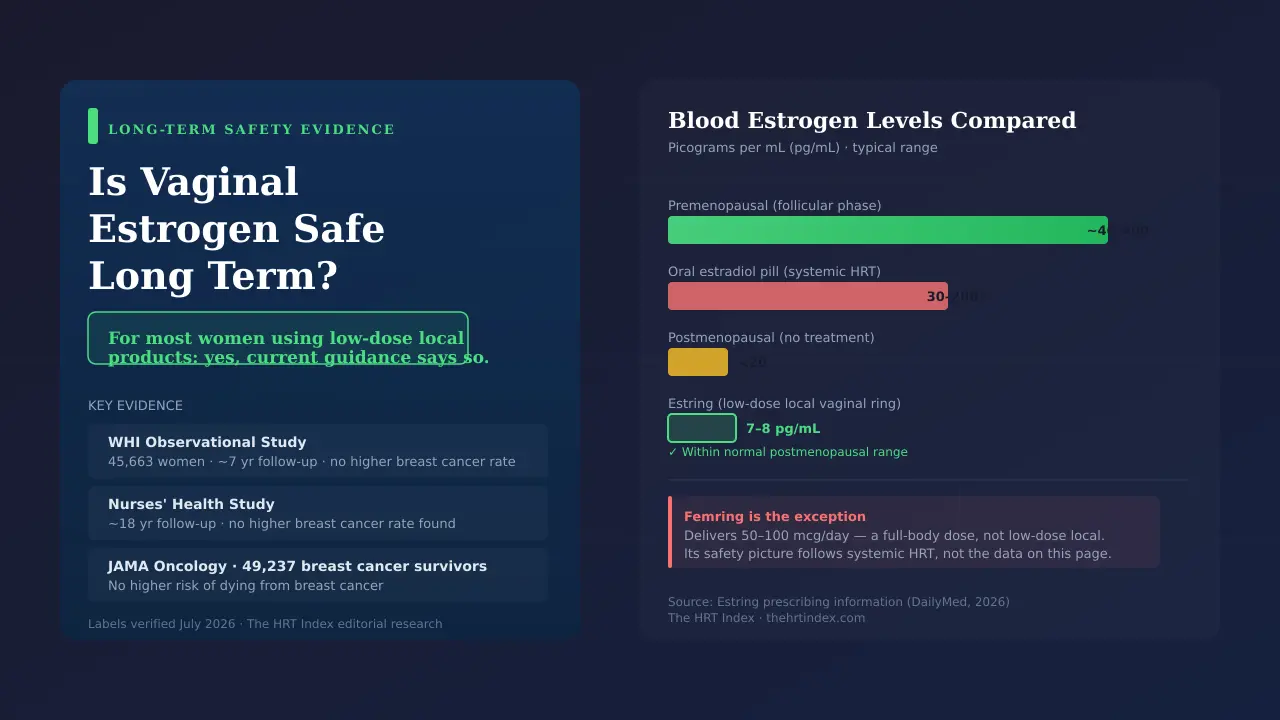
Is vaginal estrogen safe long term? For most women past menopause using a standard low-dose local product, current guidance supports using it for as long as symptoms need it, when a clinician agrees it still fits. Large studies followed women for up to 18 years and did not find higher rates of breast cancer, uterine cancer, stroke, or blood clots. A few situations change the answer: taking an aromatase inhibitor after breast cancer, any bleeding after menopause, or using a full-body or compounded product.
The quick version
| Question | Short answer |
|---|---|
| Can you use low-dose vaginal estrogen long term? | For most women, yes — for as long as symptoms need it, with periodic check-ins |
| Is it the same as estrogen pills? | No. It’s low-dose and local; very little reaches your bloodstream |
| Do you need progesterone with it? | Usually not with a standard low-dose local product; full-body estrogen is different |
| Which product is the exception? | Femring — it’s a vaginal ring, but a full-body dose |
| When should you get medical advice first? | Breast cancer (especially on an aromatase inhibitor), or any bleeding after menopause |
This reassurance most likely fits you if:
- You’re past menopause and using an FDA-approved, low-dose vaginal product — a cream, tablet, small insert, or the Estring ring — for dryness, painful sex, or recurrent-UTI prevention under a clinician’s plan.
- Your doctor knows your health history.
- You’ve had no bleeding since menopause.
- None of the warnings on your exact product’s label apply to you.
Pause and talk with a clinician first if:
- Your ring is Femring(it looks like Estring but is a full-body dose — big difference, explained below).
- You’ve had breast cancer — especially if you take an aromatase inhibitor (anastrozole, letrozole, or exemestane).
- You’ve had any bleeding after menopause.
- You’re using a compoundedproduct, or you don’t know your product’s name or strength.
The right starting point depends on your symptoms, product, history, and state. Because a general answer can’t resolve those for you, use the tool that was built for exactly this.
Find My HRT Path →First, know which product you’re holding
“Vaginal estrogen” isn’t one thing. Most vaginal products — creams, tablets, small inserts, and the Estring ring — are low-dose and local, meaning they treat the tissue right where they’re placed. One ring, Femring, goes in the same spot but delivers a full-body dose. Compounded products are made to order and aren’t FDA-approved. The safety answer changes depending on which of these you have.
This is the step almost every other article skips, and it’s the one that matters most. So before we talk about risk, find your product.
Low-dose, local, FDA-approved
These are the ones the long-term safety research is mostly about:
- Estring— a soft ring you wear for 90 days. Releases about 7.5 micrograms of estradiol a day.
- Vagifem and its generic Yuvafem— a small 10-microgram vaginal tablet.
- Imvexxy— a small softgel insert, 4 or 10 micrograms.
- Estrace Vaginal Cream 0.01%(or an FDA-approved generic estradiol vaginal cream 0.01%) — a measured-dose cream; how much reaches your body can vary with the amount prescribed and how it’s applied.
- Premarin Vaginal Cream— a conjugated-estrogen cream.
One honest note: those big studies looked at vaginal-estrogen use broadly. They didn’t run a separate 7- or 18-year safety trial on each brand and dose. So if you use one of these at its low local dose, the general evidence on this page applies to you — but your product’s own label and your medical history still drive the individual decision.
The full-body one (this is different): Femring
Femring is a ring, and you put it in the vagina — so it’s easy to lump in with Estring. Don’t. Femring delivers 50 to 100 micrograms of estradiol a day and is made to treat whole-body menopause symptoms like hot flashes. That’s roughly 7 to 13 times the daily dose of Estring. It raises the estrogen in your blood on purpose. So the low-dose-local safety story on this page does not simply carry over to Femring. It belongs in the full-body HRT conversation, which has its own, more individual risk picture.
Compounded vaginal estrogen
Some pharmacies mix custom estrogen creams to order. The FDA does not review each finished compounded product for safety, quality, or potency the way it reviews approved drugs, and the FDA has said it doesn’t have evidence that compounded hormones are safer or more effective than FDA-approved hormone therapy. Potency can vary, so you can’t assume a compounded cream’s dose or absorption from a study of an FDA-approved product. An FDA-approved product is generally preferred when one will do the job.
Product comparison: type, approval, and boxed-warning status
| Product | Type | FDA-approved? | Boxed warning (July 2026) |
|---|---|---|---|
| Estring (ring) | Low-dose, local | Yes | Boxed warning removed — FDA’s first updated group, Feb 2026 |
| Vagifem / Yuvafem (tablet) | Low-dose, local | Yes | Current label still carries the boxed warning |
| Imvexxy (insert) | Low-dose, local | Yes | Current label still carries the boxed warning |
| Estrace / generic cream 0.01% | Low-dose, local | Yes | Current label still carries the boxed warning; check your exact brand |
| Premarin Vaginal Cream | Low-dose, local | Yes | Current label still carries the boxed warning |
| Femring (ring) | Full-body dose | Yes | Full-body product — a different safety picture from the low-dose products above |
| Compounded vaginal estrogen | Made to order | No | No FDA label at all — not part of this review |
Labels are being updated one product at a time, so always check your own product’s current leaflet.
Not sure whether your product is low-dose local, full-body, or compounded — or what to do next?
Find your best-fit HRT path → (about 90 seconds)How much actually gets into your body?
Low-dose vaginal estrogen puts a small amount of estrogen on vaginal tissue, where it does most of its work. Only a little reaches the bloodstream — usually keeping blood estrogen within the normal after-menopause range. “Low,” though, is not the same as “zero,” and the exact amount can vary by product, dose, and how you use it.
Here’s why this is the whole ballgame. The frightening risks of estrogen — the ones in that boxed warning — come from estrogen circulating through your body at higher levels. Low-dose vaginal estrogen barely raises that circulating level, so most of those risks don’t follow it.
We have real numbers for this. Take Estring. Its prescribing information reports that women’s blood estradiol settled around 7 to 8 picograms per milliliter— squarely inside the range you’d see in an untreated woman after menopause. Only about 8%of the daily dose released by the ring is absorbed into the body unchanged (range: about 3% to 13%). That’s the good news, with a real number attached.
The honest caveat: absorption isn’t literally zero, and a cream measured out by hand can vary more than a fixed-dose tablet or ring. Estring’s own label notes the first ring gives a slightly bigger early estrogen bump than the second, likely because treated tissue absorbs a bit less once it heals. None of this changes the big picture, but it’s why “it’s only local, so it can’t matter” is the wrong way to think, and why your clinician still wants your full history.
What the long-term studies actually show
Several large studies have followed women using vaginal estrogen for years — up to 18 in one case — and compared them with non-users. They did not find higher rates of the major cancers or heart problems the old warning raised. These are real-world (observational) studies, not tightly controlled trials, so they can’t prove zero risk for every person — but they’re the strongest long-term evidence we have, and they point one clear direction.
We pulled the main studies into one place so you can see them side by side — the size, how long women were tracked, what turned up, and, just as important, what each one can’t tell you.
One key point before you read it: “follow-up” means how long researchers tracked women — not that every woman used vaginal estrogen the whole time. Women could start, stop, or change use during those years.
| The worry | What the research found | Study · design · follow-up | What it can’t tell us |
|---|---|---|---|
| Breast cancer (no cancer history) | No higher rate of breast cancer in users vs non-users | WHI Observational Study — 45,663 women, tracked ~7 yrs; Nurses’ Health Study — tracked ~18 yrs | Real-world data, not a controlled trial — can’t prove zero risk for every individual |
| Uterine (endometrial) cancer | Cancer rate 0.03%, pre-cancer rate 0.4% | Review of 20 randomized trials — 2,983 women, mostly ~1 yr each | Most trials ran about a year, so very-long-term randomized proof is thin |
| Stroke | No clear, statistically significant link to a second stroke | 2025 study of vaginal estradiol tablet users | Results ranged from lower to somewhat higher, none statistically significant; tablets only |
| Heart disease & clots | No higher rate; some measures were lower in users | WHI Observational Study — 45,663 women | Lower numbers may reflect healthier users, not a benefit of the medicine |
| Survivors — dying from breast cancer | No higher risk of dying from breast cancer | JAMA Oncology — 49,237 women with breast cancer (~5% used it) | Measured mortality, not the cancer returning; observational |
| Survivors — cancer returning (overall) | About the same (17.6% users vs 17.1% non-users; another study’s hazard ratio 1.08) | US study — 42,113 women; Danish study — 8,461 women, ~10 yrs | Observational; the aromatase-inhibitor subgroup is the exception (next row) |
| Survivors on an aromatase inhibitor | About 39% higher chance of recurrence (hazard ratio 1.39, 95% CI 1.04–1.85) | Danish study — aromatase-inhibitor subgroup | A smaller subgroup; observational — a real signal, not proof of cause |
The honest catch
Most of this long-term evidence is observational — real-world studies, not the gold-standard randomized trial. Those studies can show that users and non-users had similar outcomes, but they can’t prove, the way a trial can, that the medicine caused none of the difference. And there is no decades-long randomized trial of vaginal estrogen. Here’s why that’s reassuring rather than scary: these aren’t small or sloppy studies — they’re some of the largest women’s-health studies ever run, they followed women for many years, and they keep landing in the same place. That consistency is a big part of why the FDA reviewed the evidence and started changing the warnings in 2025.
Does long-term vaginal estrogen cause breast cancer?
In women with no history of breast cancer, low-dose vaginal estrogen has not been linked to a higher rate of breast cancer, even with years of use. The large studies above — 45,663 women in one, tracked ~18 years in another — found no higher rate in users. Survivors are a separate question, answered next.
The reason lines up with how little gets absorbed: your circulating estrogen barely rises, and the big population studies bear that out. Those studies can’t prove the exact biological reason the numbers came out even — but the pattern is consistent, and it’s about as steady as this kind of evidence gets.
What about family historyof breast cancer? Family history isn’t the same as a personal diagnosis, and it doesn’t create a simple rule. Bring it — along with any genetic testing — to your clinician, who can weigh it against your full picture.
Is vaginal estrogen safe after breast cancer?
For many survivors, low-dose vaginal estrogen can be considered — after non-hormone options fall short, and as a shared decision with your cancer team. Large studies have not shown a higher risk of the cancer coming back or of dying from it overall. The clear exception is survivors taking an aromatase inhibitor, where one large study found a higher chance of recurrence. That group needs an individual plan.
You deserve specifics here, not a shrug. Three big studies:
- A JAMA Oncology study of 49,237 women with breast cancer (about 5% used vaginal estrogen after diagnosis) found no increase in dying from breast cancer among users. Note what it measured: mortality, not recurrence.
- A US study of 42,113 women found the cancer returned in 17.6% of vaginal-estrogen users versus 17.1%of non-users — essentially the same.
- A Danish study of 8,461 survivors found no overall rise in recurrence (hazard ratio 1.08).
Exception: survivors taking an aromatase inhibitor
The same Danish study found that survivors taking an aromatase inhibitor (a pill like anastrozole, letrozole, or exemestane that lowers estrogen) had about a 39% higher chance of recurrence(hazard ratio 1.39, 95% CI 1.04–1.85) when using vaginal estrogen. This is a real signal from a large study, not a technicality. If you are on an aromatase inhibitor, vaginal estrogen is nota straightforward choice — you need an individual plan with your oncology team. The ACOG guidance on urogenital symptoms after breast cancer addresses this group specifically.
See our full page on vaginal estrogen after breast cancer for a deeper look at the guidance and what questions to bring to your oncologist.
Frequently asked questions
The bottom line
For most women, standard low-dose local vaginal estrogen can be a safe long-term treatment — used for as long as symptoms need it, when your clinician agrees it still fits. The strongest way to hold that reassurance is to know your exact product (low-dose local, not Femring or compounded), to accept that the long-term evidence is large and consistent but not from a decades-long trial, and to respect the real exceptions: a full-body or compounded product, any warning on your product’s own label, breast cancer history — especially with an aromatase inhibitor — and any bleeding after menopause.
You came here scared of a warning. The honest takeaway is that the warning was built on a different drug, the research on yourkind of estrogen is genuinely reassuring, and the few things that could change the answer for you are knowable and checkable. That’s not permission from a website — it’s the information to have a sharper, calmer conversation with the clinician who knows you.
Still not sure which HRT program is right for you?
Take our free 90-second matching quiz. A few quick questions match your symptoms, your history, and your state to the right next step — and flag if you should see someone in person first.
Start Find My HRT Path →Verification & methodology
Boxed-warning status for each product was checked against current DailyMed and manufacturer prescribing information in July 2026. Study citations link to the primary source (PubMed, PMC, JAMA, JNCI, or Stroke journal). Observational study findings are summarized as reported; limitations are noted in-table. This page does not constitute medical advice.
Last updated: ·Last verified:
Sources
- U.S. FDA — FDA Approves Labeling Changes to Menopausal Hormone Therapy Products (Feb 12, 2026)
- U.S. FDA — FDA Requests Labeling Changes to Clarify Benefit/Risk for Menopausal Hormone Therapies (Nov 10, 2025)
- U.S. FDA — Menopause / compounded hormone therapy
- Estring prescribing information — DailyMed (dose, absorption, warnings)
- Crandall et al., Menopause (2018) — WHI Observational Study: vaginal estrogen and breast/endometrial/cardiovascular events
- Bhupathiraju et al., Menopause (2019) — Vaginal estrogen and chronic disease risk in the Nurses' Health Study
- Menopause (2019) — Endometrial safety of low-dose vaginal estrogens (review of 20 randomized trials)
- Stroke (2025) — Vaginal estradiol tablets and recurrent ischemic stroke
- McVicker et al., JAMA Oncology (2024) — Vaginal estrogen therapy and survival in females with breast cancer
- Cold et al., JNCI (2022) — Systemic or vaginal hormone therapy after early breast cancer (Danish cohort)
- ACOG — Treatment of urogenital symptoms in individuals with a history of estrogen-dependent breast cancer
- The Menopause Society — Hormone Therapy Position Statement