
Night Sweats Not Improving on HRT? — The HRT Index 5-Check Sequence
Night Sweats Not Improving on HRT? What to Check, in Order
Published: 2026-07-17 · Last verified: July 2026
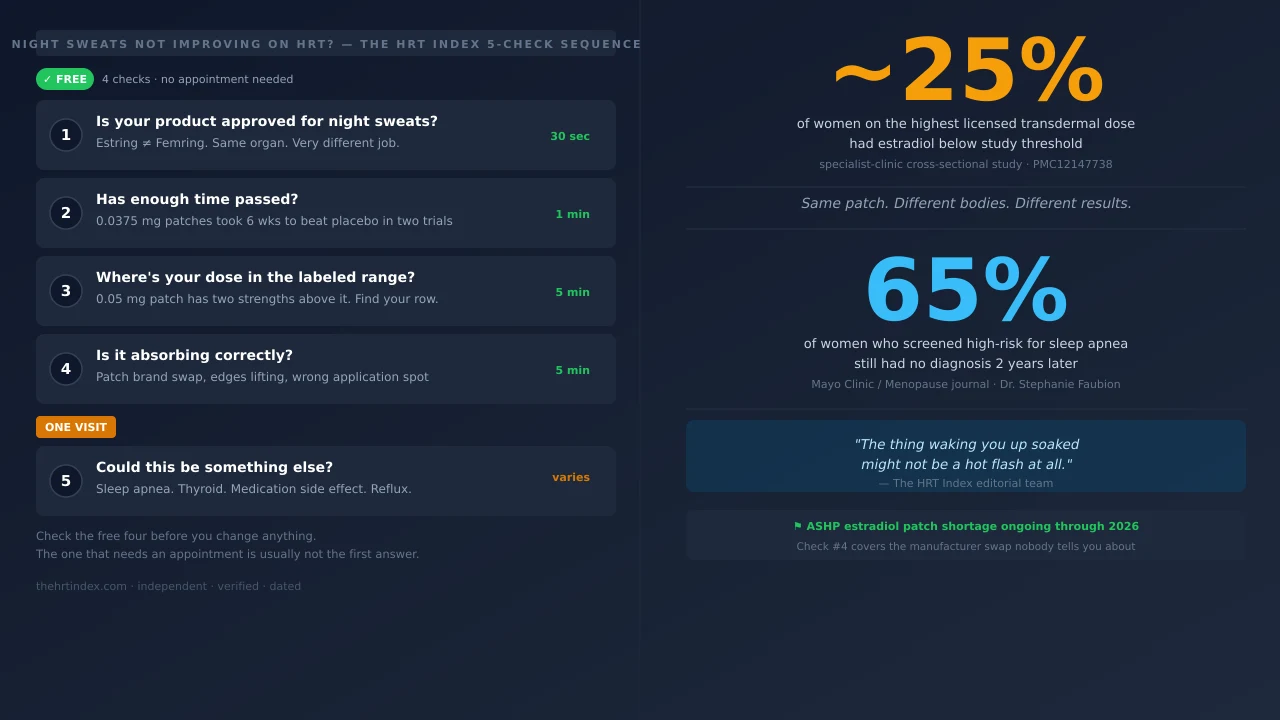
Night sweats not improving on HRT don’t automatically mean you need more estrogen. Five things are worth checking first, in this order: whether your product is even meant to treat night sweats, whether enough time has passed, where your dose sits in its FDA-labeled range, whether it’s absorbing, and whether something other than menopause is doing this.
Here’s the part that surprises most women: several of those five have nothing to do with your dose. And one of them you can check in about thirty seconds, right now, by reading the box in your bathroom.
Do not increase, double, stop, or change your prescription hormones based on this page. Everything here is meant to help you walk into your next appointment with a pattern instead of a shrug.
Reader-supported: some provider links below are affiliate links and we may earn a commission if you start care through them, at no extra cost to you. It never changes what we verify or what we recommend. Full disclosure.
Is this page for you?
Read on if:
- ✓You’re on HRT for menopause or perimenopause and still waking up soaked.
- ✓The sweats never really went away — or came back after a good stretch.
- ✓You want to know what’s actually happening before you ask for a bigger dose.
This isn’t your page if:
- →You haven’t started HRT yet. Start with HRT benefits, risks, and who it’s right for.
- →Your main problem is daytime brain fog or fatigue. See HRT dose too low symptoms.
Emergency warning signs — do not continue reading
Chest pain, trouble breathing, one-sided calf pain or swelling, face drooping, slurred speech, or sudden weakness: get emergency care now. Very heavy bleeding with fainting or rapid pad soaking is urgent care. Any bleeding after menopause, or unexpected bleeding on HRT, needs a prompt call to your clinician. See HRT side effects: normal vs red flag.
Read this first: when night sweats need a doctor, not a website
Most people who report persistent night sweats in primary care don’t turn out to have a serious underlying disorder. What matters is the pattern and what comes with it (American Family Physician).
Three findings are classic B symptoms— the term doctors use when they’re checking for lymphoma. Any one of them is worth a call— you don’t need all three:
- ■Drenching night sweats that soak your bedclothes and make you change them.
- ■Unexplained weight loss of more than 10% of your body weight over six months, without trying.
- ■Fevers above 100.4°F (38°C) that keep coming back with no explanation.
Also worth a prompt call: new swollen glands in your neck, armpit, or groin, or a cough that’s lasted more than three weeks.
One B symptom does not mean you have lymphoma. Plenty of women reading this have drenching sweats and nothing else wrong. It means the pattern deserves a clinician’s eyes rather than a search bar’s. That’s the whole point of telling you.
If that’s not you, keep going. The next table probably has your answer.
Start here: is your product even meant to treat night sweats?
Before you think about dose, check what you’re actually taking. This is the fastest fix on this page, and for some women it’s the whole answer. The medical term for the heat-and-sweat episodes of menopause is vasomotor symptoms— that’s the phrase the FDA uses on the label.
| What you’re taking | Form | Type | FDA-approved for moderate-to-severe VMS? |
|---|---|---|---|
| Climara, Vivelle-Dot, Minivelle, Dotti, Lyllana, generic estradiol patch | Patch | Systemic | ✓ Yes |
| Menostar (0.014 mg/day patch) | Patch | Systemic, very low dose | ✕ NoApproved only to help prevent bone loss after menopause |
| EstroGel, Divigel, Elestrin, generic estradiol gel | Gel | Systemic | ✓ Yes |
| Evamist | Spray | Systemic | ✓ Yes |
| Estradiol tablets, Premarin, Bijuva, Activella, Angeliq | Pill | Systemic | ✓ Yes |
| CombiPatch, Climara Pro | Patch (E+P) | Systemic | ✓ Yes |
| Femring (0.05 or 0.1 mg/day) | Vaginal ring | Systemic | ✓ Yes |
| Estring (7.5 mcg/day) | Vaginal ring | Local vaginal therapy | ✕ No |
| Vagifem / Yuvafem | Vaginal tablet | Local vaginal therapy | ✕ No |
| Imvexxy | Vaginal insert | Local vaginal therapy | ✕ No |
| Estrace vaginal cream, Premarin vaginal cream | Vaginal cream | Local vaginal therapy | ✕ No |
| Intrarosa (prasterone) | Vaginal insert | Local vaginal therapy | ✕ No |
| Osphena (ospemifene) | Pill | Systemic, not an estrogen | ✕ NoApproved for painful sex and dryness |
Two words worth knowing
Systemic means whole-body: the medicine reaches your bloodstream and travels everywhere, including the part of your brain that runs your internal thermostat. Local vaginal therapyis aimed at the tissue you apply it to. Some estrogen still gets into your bloodstream — it isn’t zero — but it’s much less than a systemic product, and those products aren’t approved or expected to treat night sweats.
Femring and Estring are both estradiol vaginal rings. Same route. Same organ. Femring is systemic. Estring is not. Which one you got matters enormously — and nobody tells you that.
If you’re on Estring, Vagifem, Imvexxy, or a vaginal cream and you’ve been waiting for your night sweats to lift — this isn’t a dose problem. The product is doing a different job. Persistent night sweats don’t mean it failed.
Not sure where to seek care for symptoms that persist?
Find My HRT Path uses your symptoms, age, state, and health history to suggest online care or an in-person first step. About 90 seconds, free, no email required.
Find My HRT Path →Find My HRT Path asks health-related questions. Your answers are handled under our Consumer Health Data Privacy Policy.
Why are my night sweats not improving on HRT?
Persistent night sweats on hormone therapy have several common explanations: the product may not be a systemic one, the treatment may not have had enough time, the prescribed regimen may need review, the medicine may not be absorbing as intended, or the sweating may have a cause unrelated to menopause. The symptom alone cannot identify which explanation applies.
“Still sweating at night” is one sentence that can mean five completely different things. Each one has a different fix. Some of them are free.
The five checks are our editorial framework for organizing this — not a validated medical test, and not an exhaustive list of every possible cause.
Our one honest admission
The most common thing we’d have to tell you is also the least satisfying: it may still be too early to judge.
We know. You didn’t search at 3am in a wet t-shirt to be told to wait. But if time is your answer, you’re not a treatment failure — you’re mid-course. And if time isn’tyour answer, you’ve learned something concrete, and the rest of this page is built to tell you what to do with it.
Do you get hot flashes during the day too?
Answer it honestly. Not “sort of.” Not “maybe once.”
If yes — you flash in the daytime too:
Timing, product, dose, and absorption are all worth working through. Read the next four sections.
If no — nights only:
Read those sections anyway. But pay real attention to What if this isn’t menopause? especially if you also have snoring, gasping, heartburn, a recent medication change, or alcohol close to bedtime.
How long should HRT take to stop night sweats?
Response time varies by product, regimen, symptom severity, and individual. Roughly three months on a steady regimen is a standard treatment-review checkpoint, and NICE guidance recommends earlier review when treatment is ineffective, causes side effects, or symptoms worsen (NICE NG23).
What the Vivelle-Dot label actually says
In two of the original Vivelle-Dot trials, the 0.075 and 0.1 mg/day doses beat placebo at week 4. The 0.0375 and 0.05 mg/day doses did not differ from placebo until roughly week 6. Then a separate 12-week study was run, and in that one, 0.0375 mg/day did beat placebo at week 4 (FDA prescribing information, Vivelle-Dot).
Some of the doses women commonly start on took six weeks to look like anything at all in a controlled trial. Not six weeks to work perfectly. Six weeks to beat a sugar pill.
So if you’re at week five and panicking — week five can still be inside the response window.
When “give it time” stops being a real answer
| Where you are | What it means | What to do |
|---|---|---|
| Under 4 weeks | Genuinely early | Track it. Don't change anything unless symptoms are severe, worsening, or a warning sign appears |
| 4–8 weeks | Still inside the window for many products | Check your routine and your patch. Watch the trend, not last night |
| 8–12 weeks | A fair judgment starts to become possible | If nothing's moved, start building your case |
| Around 3 months, no meaningful change | The standard checkpoint has arrived | Request a formal review of your regimen, route, and product |
| Any time | Warning signs override the calendar | Get seen |
One thing that will make your next appointment ten times more productive:
Track two weeks. Episodes per night. Drenching or just damp. Daytime flashes, yes or no. Alcohol. Which nights you changed your patch. Two weeks of that beats six months of “it’s still bad.”
Are you near the top of your dose range, or is there room above you?
Most women have no idea where they sit. Let’s fix that in one table. Two columns do different jobs: Marketed strengths are everything the product comes in. Labeled starting dose for vasomotor symptoms is where the label says to begin for this purpose.
| Your product | Marketed strengths | Labeled starting dose for VMS | Highest marketed |
|---|---|---|---|
| Vivelle-Dot, Minivelle, Dotti, Lyllana (twice weekly) | 0.025, 0.0375, 0.05, 0.075, 0.1 mg/day | 0.0375 mg/day | 0.1 mg/day |
| Climara (weekly) | 0.025, 0.0375, 0.05, 0.06, 0.075, 0.1 mg/day | Per label | 0.1 mg/day |
| Divigel / generic estradiol gel 0.1% | Packets of 0.25, 0.5, 0.75, 1.0, 1.25 g gel (0.25–1.25 mg estradiol) | 0.25 g packet (0.25 mg estradiol) | 1.25 g packet (1.25 mg estradiol) |
| EstroGel 0.06% | One pump = 1.25 g gel = 0.75 mg estradiol | 1.25 g/day | 1.25 g/day — one approved daily dose for VMS |
| Evamist | 1–3 sprays/day | 1 spray/day | 3 sprays/day |
| Premarin (pill) | 0.3, 0.45, 0.625, 0.9, 1.25 mg | 0.3 mg | 1.25 mg |
| Femring | 0.05, 0.1 mg/day | 0.05 mg/day | 0.1 mg/day |
Find your row. Find your number.
If you’re on a 0.05 mg patch, two higher strengths are marketed. If you’re on a 0.0375 mg twice-weekly patch, you’re at the labeled starting dose — with three strengths above it.
If you’re on EstroGel:
The label lists 1.25 g/day as the approved daily dose for vasomotor symptoms. There isn’t a higher labeled rung. For you, “ask for more gel” isn’t the conversation. “Ask about a different product” might be.
This table tells you what’s on the label. It does not tell you what dose you need. What it does is make sure nobody can end the conversation by telling you you’re “already on hormones,” as if that settles it. Persistent symptoms mean your treatment response deserves a review. You’re allowed to ask for one.
Now turn what you just found into something you can use.
Find My HRT Path takes your symptoms, what you have tried, age, state, and health history and suggests a care starting point before your appointment. About 90 seconds, free.
Find my care starting point →Can poor absorption make HRT stop working?
Transdermal estradiol absorption varies between individuals, so the dose on the box is not always the exposure the body gets. In one cross-sectional specialist-clinic study, 24.84% of women using the highest licensed transdermal dose had serum estradiol below the study’s chosen threshold of 200 pmol/L (Menopause / PMC). That threshold is study-defined, not universal, and a low result does not by itself prove a dose should increase.
Same patch. Different bodies. Different results. This is where the fix is often free.
| Route | What can go wrong | What to check |
|---|---|---|
| Patch | Edges lifting, or the whole thing coming off. About 3% of Vivelle-Dot systems detached in a 3.5-day wear period (FDA label). | Clean, dry, lotion-free skin. Press 10 seconds. Rotate the spot. If it lifts by day two every time, say so at your appointment. |
| Patch | Your manufacturer changed. A different maker can mean a different patch size, backing, or adhesive — and a different real-world stick. | Compare the box to your last one. Note any difference in how it stays on. |
| Patch | Cutting it. | Don't cut a patch unless your exact product's labeling and your prescriber or pharmacist support it. Ask for the strength you actually need. |
| Gel | Wrong spot. Divigel goes on the upper thigh; Elestrin on the upper arm and shoulder. Washing before it dries. Lotion or sunscreen over the top. | Follow your product's label, not the general idea that gel goes on skin. |
| Spray | Evamist goes on the inner forearm. | Read your own label. |
| Pill | Your liver processes it first. Some medicines — and grapefruit — can change your levels. | Full medication and supplement review, including anything herbal. |
| All routes | Doses get missed. Twice-weekly patches especially. | Two weeks of honest tracking before you conclude anything. |
Did your patch brand change without anyone mentioning it?
Estradiol patches have been in tight supply through 2026. Here’s the strange part: the American Society of Health-System Pharmacists lists multiple estradiol patch products in shortage. The FDA’s shortage database doesn’t list one. Both institutions are real. They use different reporting criteria (NBC News, May 2026; CNBC, June 2026).
The gap between them is where you live: your pharmacy quietly swaps manufacturers to keep you supplied, and nobody thinks to mention it.
When we checked DailyMed on July 17, 2026, estradiol gel 0.1% alone had eight separate label records from eight different labelers — Divigel plus generics from Xiromed, Amneal, ANI, Encube, NorthStar, Padagis, and Trigen. Same drug on paper. Eight different products in your hand.
If your symptoms came back the same month your box looked different — write it down. That’s a free phone call to your pharmacist. Make it before you ask for a bigger dose.
Should you get your estradiol level checked?
Usually not for this purpose. Current FDA prescribing information for systemic estradiol states that serum FSH and estradiol levels are not useful in the management of moderate-to-severe vasomotor symptoms. The standard approach is to adjust treatment based on symptoms rather than a target blood number. A clinician may still order a level to answer a specific question, such as assessing absorption when someone is not responding at an apparently adequate transdermal dose.
What the label actually says
“Serum follicle stimulating hormone (FSH) and estradiol levels are not useful in the management of moderate to severe vasomotor symptoms.”
Section 5.20, current prescribing information for estradiol gel 0.1%, checked July 17, 2026. The same statement appears across systemic estrogen prescribing information from Premarin, Elestrin, Femring, and others. Different companies. Different products. Same line.
When a level is worth doing
There is a real situation where a level helps. If you’re at a solid transdermal dose, using it correctly, and still soaked, a level can contribute to figuring out whether the medicine is getting in. The useful question is: can the person ordering it tell you what specific question the result answers, and how the answer would change what you do next? If yes, that’s medicine. If the answer is “so we can see where your levels are” — that’s not a plan.
Things nobody should be telling you:
- • “You need your estradiol above X.”
- • “This panel will optimize your hormones.”
- • “A normal level proves your dose is fine.”
- • “Saliva testing is more accurate.”
What if this isn’t menopause?
Night sweats are a nonspecific symptom with a broad differential. When systemic hormone therapy has had adequate time and sweating persists — particularly without daytime hot flashes — other causes deserve consideration. Common ones include sleep-disordered breathing, thyroid disease, medication effects, reflux, and alcohol.
Sleep apnea: the one nobody checks
Mayo Clinic researchers screened middle-aged women reporting severe hot flashes and night sweats and found they were more likely to score at intermediate or high risk for obstructive sleep apnea — a condition where your airway repeatedly narrows or closes during sleep and your breathing stops and restarts.
Here’s the number that should stop you: two years later, 65% of the women who had screened at intermediate or high risk still had not been diagnosed with it (Mayo Clinic, published in Menopause).
Dr. Stephanie Faubion — Medical Director of The Menopause Society and the study’s senior author — explained why women get missed. Sleep apnea, she said, is often thought of as a man’s disease. Women present differently: headache, insomnia, anxiety, bone-deep exhaustion. Every one of those reads as menopause, gets treated as menopause, and the airway never gets looked at.
The thing waking you up soaked might not be a hot flash at all. And no dose of estrogen has ever fixed an airway.
The rest of the list
| Possible cause | The clue | Possible next step |
|---|---|---|
| Obstructive sleep apnea | Snoring, gasping, witnessed pauses, morning headaches, unrefreshing sleep. Often no daytime hot flashes. | Ask whether a home sleep-apnea test or in-lab sleep study fits your situation |
| Overactive thyroid | Heat intolerance, weight loss, palpitations, tremor | TSH, sometimes free T4 |
| A medicine you already take | Sweating started or worsened after a new prescription | Medication review with your prescriber or pharmacist |
| Reflux (GERD) | Heartburn too. Worse after late meals or a drink. | History-based assessment; clinician may consider a treatment trial |
| Alcohol | The sweats reliably follow the nights you drank | A tracked alcohol-free stretch — not a diagnostic test, just information |
| Anxiety or panic | Sweats arrive with dread and a pounding heart | Clinical assessment |
| Infection (TB, HIV, endocarditis) | Fever, cough over three weeks, weight loss, exposure history | Testing selected from symptoms, risks, exposures, and exam |
| Lymphoma or other blood cancer | B symptoms — see top of page | Clinical exam and directed testing. A diagnosis generally requires a tissue biopsy. |
The irony worth one sentence at your appointment
Venlafaxine (Effexor) is one of the medicines prescribed off-label for hot flashes. Sweating is also a common adverse reaction listed on its label. So if your night sweats got worse after an antidepressant was added to help your night sweats — that’s a documented, recognized thing, not you being unlucky.
Sometimes it’s both
You can have real vasomotor symptoms andsomething else going on at night. Address one and not the other and you’ll still wake up soaked, convinced HRT failed you. It didn’t. It only ever covered half the problem.
If your sweats are nights-only, and especially if there’s snoring or gasping involved, here’s the sentence to use:
“Before we talk about my estrogen dose — should I be assessed for sleep apnea?”
No link. No product. It’s the cheaper question, and it costs you nothing to ask.
What women actually say about this
Real comments from public menopause forums. Anecdotes, not medical evidence.We include them because recognizing your own experience in someone else’s words is worth something at 3am.
“Night sweats in spite of HRT, anyone?”
— r/Menopause, accessed July 17, 2026
“I don’t get hot flashes anymore because of HRT but still get night sweats sometimes.”
— r/Menopause, accessed July 17, 2026
The daytime/nighttime split, described perfectly by someone who had no idea it had a name.
“It helps so much initially … then it seems like it stops working.”
— r/Menopause, accessed July 17, 2026
See the “What if HRT worked, and then stopped?” section below.
What if HRT worked, and then stopped?
Symptoms that return after a period of relief are a different troubleshooting pattern from symptoms that never improved. Things worth mapping against the return date include missed or late doses, patch adhesion, a product or manufacturer change, progression through the menopause transition, new medications, and changes in alcohol or sleep.
“It worked and then it stopped” is a recognizable and demoralizing pattern. It’s also one where a timeline often does real work, because there’s usually a date attached to it.
Build the timeline
Write these down. You’ll remember more than you think.
- •When did you start?
- •When did it first genuinely help?
- •What was the best stretch?
- •When did the sweats come back? Get as close to a date as you can.
- •What product and route were you on at each point?
- •Did you miss or run late on doses around then?
- •Did the pharmacy give you a different brand or manufacturer?
- •Any new medicines or supplements?
- •Alcohol change? Weight change? New stress? Worse sleep?
The order we’d run it in:
Product and manufacturer first — it’s free and it’s one phone call. Then missed doses and adhesion. Then medication and health changes. Then the conversation about your regimen.
That’s our editorial order for organizing the question, not a validated diagnostic sequence.
And one honest possibility:if you’re in perimenopause, your own hormone production is still swinging around. Symptoms can genuinely fluctuate, and a changed pattern is a legitimate reason to ask for a review. It doesn’t mean the drug failed you.
What can a clinician consider when HRT isn’t enough?
As of July 2026, the FDA-approved non-hormonal prescription options for moderate-to-severe vasomotor symptoms are Brisdelle (paroxetine 7.5 mg), Veozah (fezolinetant), and Lynkuet (elinzanetant). Two of the three are newer than most of the internet realizes. Here’s the current picture — with the same detail for each, because a table that lists one drug’s warnings and skips the others isn’t a comparison, it’s an ad.
| Lynkuet (elinzanetant) | Veozah (fezolinetant) | Brisdelle (paroxetine 7.5 mg) | |
|---|---|---|---|
| What it is | Blocks two brain receptors (NK1 and NK3) involved in temperature control. Not a hormone. | Blocks one receptor (NK3). Not a hormone. | The only FDA-approved SSRI for hot flashes. Not a hormone. |
| FDA approved | October 24, 2025 | May 2023 | 2013 |
| How taken | 120 mg (two 60 mg capsules) once daily at bedtime | Once daily | 7.5 mg once daily at bedtime |
| Boxed warning | None | Rare but serious liver injury | Suicidal thoughts and behaviors |
| Liver monitoring | Baseline, then follow-up per label | Before starting; monthly for first 3 months; then months 6 and 9 | Not required |
| Also on the label | CNS effects and next-day impairment warnings; contraindicated in pregnancy | Not for use with certain CYP1A2 inhibitors; avoid in cirrhosis and severe kidney disease | Serotonergic and drug-interaction warnings. Can reduce how well tamoxifen works. |
Two of the three are dosed at bedtime
Lynkuet and Brisdelle both. If your problem is specifically the nights, that’s worth naming at your appointment.
“Hormone-free” doesn’t mean safer
Two of the three non-hormonal options carry a boxed warning. What actually decides safety is your history, your other medicines, and the current label — not whether a molecule is a hormone.
About those 2026 hormone label changes
The FDA requested class-wide labeling changes on November 10, 2025. As of its February 12, 2026 announcement, revised prescribing information had been approved for six named products — Prometrium, Divigel, Cenestin, Enjuvia, Estring, and Bijuva — and 29 companies had submitted proposed changes (FDA). More have landed since.
One piece did not go away: systemic estrogen-alone products keep a boxed warning about endometrial cancer in women with a uterus. Warning status now differs by product and by manufacturer. The label in your box is the only one that describes what you’re actually taking.
Hit the ceiling on what you’re taking?
The next conversation is about a different product, not a bigger dose of the same one. Find My HRT Path helps you see which options fit your state, age, symptoms, and health history.
See what your options look like →What exactly should you say to your prescriber?
A productive message identifies the product and dates, describes whether symptoms never improved or returned after relief, quantifies the impact, notes delivery details and associated symptoms, and requests a review rather than a specific dose. That gives a clinician a pattern to work from instead of a general complaint.
You’ve done the work. Don’t waste it by walking in and saying “it’s still bad.” Copy this. Fill in the blanks. Send it through your portal.
Subject: Review request — night sweats not improving
I’ve been using [product and route] as prescribed since [date], most recently changed on [date]. I’m currently having night sweats [how many nights per week], waking [number] times, and changing [clothes / bedding].
The symptoms [never really improved / improved partly / improved and then came back around (date)].
I checked: [missed doses / patch adhesion / whether the manufacturer changed / where I apply it]. I also want to flag: [daytime hot flashes yes or no / new medicines / snoring or gasping / measured fever / weight change / cough].
Looking at my product’s FDA label, I’m currently on [your dose], and I can see the labeled range for hot flashes and night sweats goes up to [the highest strength].
Could we review whether this still looks like vasomotor symptoms, whether my regimen or route should change, and whether anything else should be evaluated? I haven’t changed anything on my own.
Better questions than “can you raise my dose?”
- •“Does this still look like vasomotor symptoms to you?”
- •“Is my product a systemic one, and is it expected to treat night sweats?”
- •“Where does my dose sit in the labeled range for this product?”
- •“Could this be an absorption issue rather than a regimen issue?”
- •“Should I be assessed for sleep apnea first?”
- •“At what point would you refer me to a menopause specialist?”
Bring or attach:
Your two-week log. Your medication list. A photo of your product box, including the manufacturer name. Your treatment dates. Any temperatures you took.
Do you need online care, or an in-person visit?
Online menopause care can be a reasonable setting for a stable treatment review when there are no warning signs and a clinician can get an adequate history. New systemic symptoms, significant diagnostic uncertainty, or a likely need for an examination or immediate testing may make in-person care the better starting point.
Online review may fit if:
- ✓Your question is "my regimen isn't controlling my symptoms — can we review it?"
- ✓You have no warning signs from the top of this page.
- ✓You can supply your treatment history, product, and dates.
- ✓The service is licensed in your state.
In-person may be better if:
- →You have any B symptom, new swollen glands, a persistent cough, or unexplained fever.
- →Something has changed in a way that doesn't feel like your usual pattern.
- →You're likely to need an exam or same-day testing.
- →Your situation is complicated and you'd rather not sort it out over video.
Not sure which side you’re on? Find My HRT Path checks your situation — including whether online care is even the right starting point — before you book or pay.
What if you can’t get a timely HRT review?
If you’ve been parked on the same dose for six months, can’t get a follow-up inside a month, or’ve been told to “give it more time” twice without anything changing — that isn’t your body. That’s a care model that wasn’t built for review.
Affiliate disclosure: The provider links below are affiliate links — we may earn a commission if you start care through them. The facts in this table are provider-stated and dated. The fit recommendation is our editorial judgment under The HRT Index Verification Standard. Full disclosure.
| Provider | Why it fits this problem | May prescribe | Cost | Insurance | States |
|---|---|---|---|---|---|
| Midi Health | Menopause-trained clinicians. 30-minute first visit, 15-minute follow-ups. Built as an ongoing practice, so review and adjustment are the model. | FDA-approved estradiol (patch, pill, gel, vaginal) and progesterone | Self-pay: $250 first visit, $150 follow-up. Deductibles, coinsurance, and copays may apply with insurance. | Yes — in-network with most PPOs | All 50 |
| Sesame | A fast second opinion without leaving your current prescriber. You pick the clinician. Prescriptions go to your own pharmacy on your own drug coverage. | FDA-approved estradiol | Menopause plan from $59/month. Medication costs separate. | Cash marketplace. HSA/FSA eligible. | Depends on clinician |
| Hers | Unlimited provider messaging, regular check-ins, and treatment adjustments as needed. Flat monthly cost. | FDA-approved estradiol (pill, patch, vaginal cream) and micronized progesterone | Plan price and commitment term shown after assessment. | Cash-pay subscription | Confirmed during assessment |
Our honest read — and the limitation you need first
Midi is the strongest fit for this specific problem, because their model isthe fix. Midi’s own site says it plainly: if you’re not getting the relief you want, your clinician will adjust your dose or switch you to a different form of HRT. That sentence is the exact thing you haven’t been able to get. (Midi is an affiliate partner.)
The limitation — two doors:
- • Medicare: Midi is not covered. Medicare beneficiaries can be seen as self-pay, but cannot submit any claims.
- • Medicaid or Medi-Cal: Midi cannot treat you at all — not even as self-pay.
If you’re on Medicaid, Sesame’s cash pricing is the more realistic route— it’s the lowest published entry point, and prescriptions go to your own pharmacy where your drug coverage may still apply.
A note on compounded providers.Compounded hormone products are not FDA-approved. That’s why options like Winona aren’t on this comparison — if your FDA-approved product isn’t working, the fix is to work the labeled range, check absorption, or look at another cause. Swapping to a compounded product mid-troubleshoot adds a variable exactly when you need fewer. We cover it honestly here: FDA-approved vs compounded HRT.
Have a PPO?
Check whether Midi is in-network with your plan →About a minute. Have your insurance card handy.
Want a fast second opinion without switching?
Check Sesame’s menopause price →Want one flat monthly price?
Check Hers eligibility & plan price →Still not sure which model fits your state, your health history, and your symptoms?
Find My HRT Path — free →What we verified
Checked July 2026
- ✓Current FDA prescribing information for each product in the tables — which carry an indication for moderate-to-severe vasomotor symptoms, marketed strengths, labeled starting dose, and what they say about blood testing.
- ✓The FSH/estradiol testing line confirmed in Section 5.20 of a currently-revised estradiol gel 0.1% label on DailyMed, and found again in prescribing information from Premarin, Elestrin, and Femring.
- ✓Eight separate DailyMed label records for estradiol gel 0.1%, from eight labelers, each with its own revision date.
- ✓The Vivelle-Dot trial timing, including both the week-6 result and the separate week-4 result — read from the label's Clinical Studies section rather than a summary of it.
- ✓The 2026 patch supply situation, checked against both the ASHP shortage bulletin and the FDA's shortage database — which currently disagree, because they use different reporting criteria. We've said so rather than picking the one that reads better.
- ✓The FDA hormone-label timeline: changes requested November 10, 2025; six products approved February 12, 2026; 29 companies submitted proposals; systemic estrogen-alone products retain a boxed warning for endometrial cancer.
- ✓Lynkuet, Veozah, and Brisdelle dose, administration, boxed warnings, and monitoring from each product's current prescribing information.
- ✓Midi, Sesame, and Hers statements about pricing, insurance, state availability, and visit structure, read on their own sites.
- ✓Clinical sources: NICE NG23 on treatment review timing; Mayo Clinic / Menopause on sleep-apnea screening risk; American Family Physician on the persistent night sweats workup.
What we did not do:We did not test these products or these providers ourselves. Every provider fact above is provider-stated and labeled that way. This page is not reviewed by a clinician. It’s editorial research read against primary sources.
A note on timing: The FDA is in the middle of rewriting menopause hormone therapy labels. Warning status now varies by product and by manufacturer. We re-check these tables monthly. Spot a stale row? partners@thehrtindex.com. Material corrections get logged on our corrections page.
See our methodology and medical review policy.
Frequently asked questions
How long does HRT take to work for night sweats?
Response time varies by product, dose, and person. Around three months on a steady regimen is a standard review checkpoint, and NICE recommends earlier review if treatment isn't working, causes side effects, or symptoms worsen. The FDA label for Vivelle-Dot shows the difference dose can make: in two original trials the 0.075 and 0.1 mg doses beat placebo at week 4, while 0.0375 and 0.05 mg didn't separate until around week 6 — though a separate study found 0.0375 mg superior to placebo at week 4.
Does vaginal estrogen help night sweats?
Estring, Vagifem, Imvexxy, and vaginal estrogen creams are local vaginal therapies. They aren't FDA-approved or expected to treat vasomotor symptoms like night sweats. Some estrogen is still absorbed — it isn't zero — but far less than a systemic product. The exception is Femring, a vaginal ring that delivers systemic estradiol and does carry an FDA indication for moderate-to-severe vasomotor symptoms.
Should I get my estradiol level checked if my night sweats aren't improving?
Usually not for that purpose. Current FDA prescribing information for systemic estradiol states that serum FSH and estradiol levels are not useful in managing moderate-to-severe vasomotor symptoms. Treatment is adjusted to symptoms, not a target number. A clinician may still order one to answer a specific question — such as assessing absorption when someone isn't responding at an apparently adequate transdermal dose.
What's the highest dose of estradiol patch?
The highest marketed strength for Vivelle-Dot, Minivelle, Climara, and their generics is 0.1 mg/day. For the twice-weekly products, the labeled starting dose for vasomotor symptoms is 0.0375 mg/day — so several strengths sit above where many women begin. Marketed strength and labeled starting dose aren't the same thing.
I have night sweats but no hot flashes during the day — is it still menopause?
It can be. But night-only sweating widens the list of questions worth asking, because reflux, alcohol, medication effects, and sleep-disordered breathing all cluster at night. Mayo Clinic research found that middle-aged women reporting severe night sweats more often screened at intermediate-to-high risk for obstructive sleep apnea, and 65% of that group still had no diagnosis two years later.
Can HRT make night sweats worse?
The first weeks can be rocky while your body adjusts. But if sweating clearly worsened after a specific medicine was added, that's worth raising. Sweating is a common adverse reaction on the label for venlafaxine — which is itself sometimes prescribed off-label for hot flashes.
When should I worry about night sweats?
Any one of three findings — drenching night sweats that soak your bedclothes, unexplained weight loss over 10% in six months, or recurring fevers above 100.4°F — is a classic B symptom and deserves a clinician's evaluation. You don't need all three. New swollen lymph nodes or a cough lasting over three weeks also warrant a prompt call. One B symptom does not mean lymphoma; it means the pattern needs proper eyes on it.
My patch brand changed — could that matter?
Possibly. Estradiol patches have been in tight supply through 2026, and pharmacies substitute between manufacturers, sometimes without flagging it. A different manufacturer can mean a different patch size, backing, or adhesive, and a different real-world stick. Timing alone doesn't prove a meaningful change in absorption, but it's worth recording and raising. Your pharmacist can tell you exactly what changed.
Can I cut my estradiol patch to make it last through a shortage?
Don't, unless your exact product's labeling and your prescriber or pharmacist support it. Cutting these patches is generally off-label and the available data is product-specific, so the delivered dose can become unpredictable. If supply is the problem, ask your pharmacist about alternative manufacturers or your prescriber about a different route.
What can I take if HRT isn't working for my night sweats?
That's a clinician's call, and it may not be another drug — continuing, changing route, switching products, or evaluating another cause are all on the table. The FDA-approved non-hormonal options for moderate-to-severe vasomotor symptoms are Lynkuet (elinzanetant), Veozah (fezolinetant), and Brisdelle (paroxetine 7.5 mg). Veozah and Brisdelle each carry a boxed warning; Lynkuet does not. Others, like gabapentin and oxybutynin, are used off-label.
Should I increase my HRT dose myself?
No. Take prescription hormones exactly as directed. Don't take more, take less, or stop without talking to your clinician. Track your pattern and bring it to your appointment instead.
How often should HRT be reviewed?
Around three months after starting or changing is a common checkpoint, then roughly yearly once you're stable. Reach out sooner if symptoms worsen, side effects appear, or bleeding concerns you.
Still not sure which HRT path is right for you?
You don’t have to keep guessing at 3am.
Find My HRT Pathtakes your symptoms, what you have tried, your age, health history, and your state, and turns them into a clear care match and next step — and it tells you honestly when online care isn’t the right starting point. Free, about 90 seconds.
Get my personalized next step →The HRT Index is the independent menopause HRT decision layer for women. Educational only — not medical advice. Always confirm treatment decisions with a licensed clinician.