
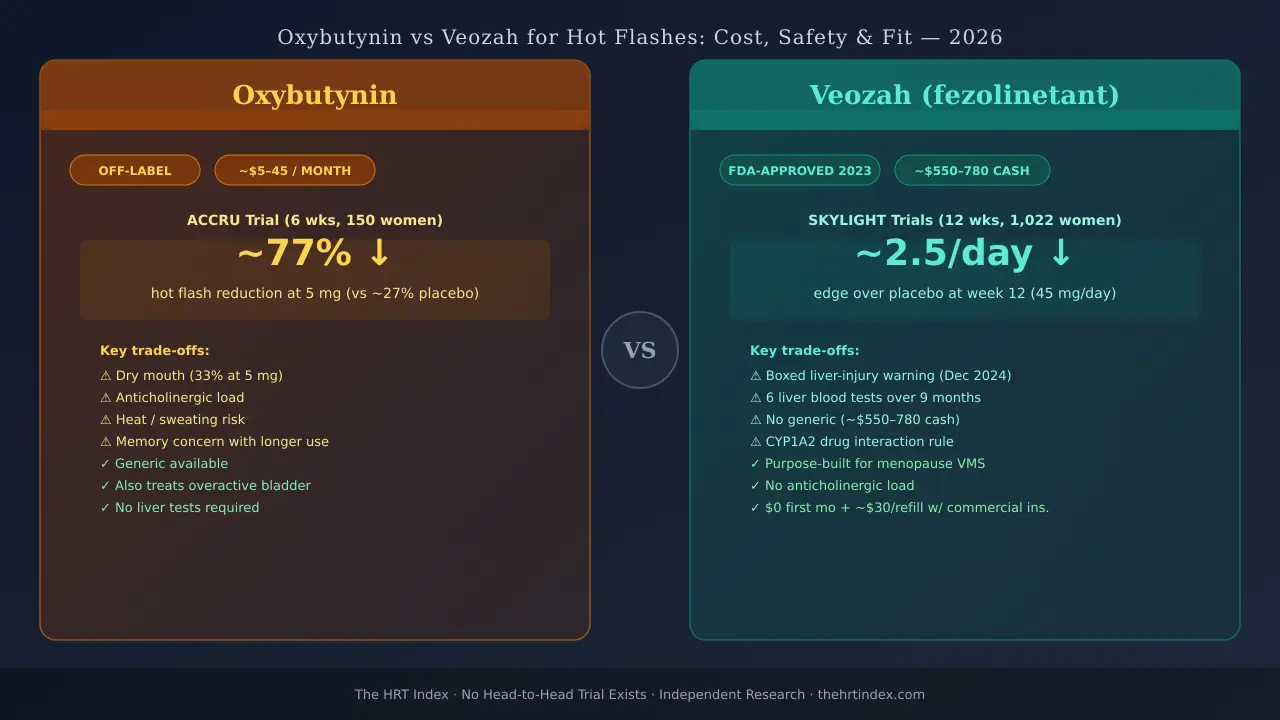
Best for / not for you
Oxybutynin may fit if you…
- Have a tight budget, or can’t get Veozah covered.
- Also deal with an overactive bladder — one medicine, two problems.
- Are working with a doctor avoiding certain antidepressants with tamoxifen.
- Are younger, take few other drying medicines, and don’t work in the heat.
- Understand and accept that hot-flash use is off-label.
Veozah may fit if you…
- Want a medicine FDA-approved specifically for menopausal hot flashes.
- Have moderate-to-severe hot flashes (not occasional).
- Have commercial insurance, which can make cost competitive.
- Can complete six liver blood tests over your first nine months.
- Want to avoid anticholinergic dry mouth, constipation, and heat effects.
Talk to a clinician before either one if you…
- Have cirrhosis, serious kidney disease, urinary retention, uncontrolled narrow-angle glaucoma, or severe constipation.
- Have memory concerns, or already take several “drying” medicines.
- Have unexplained bleeding, or symptoms no one has looked at yet.
- Aren’t sure whether hormone therapy is off the table for a real medical reason.
Not sure which service fits your symptoms, health history, and state?The HRT Index’s free matching quiz takes about 90 seconds and flags when in-person care is the safer first step.
Take Find My HRT Path (free, ~90 sec) →What we actually verified
We reviewed the current FDA/DailyMed prescribing information for both medicines, the FDA’s liver-injury safety communication, the pivotal placebo-controlled trials, current manufacturer savings terms, dated pharmacy-price examples, and Midi Health’s published pricing and policies. We did not complete an intake, obtain either medicine, or receive a clinician consult for this review. No prescription, coverage decision, or price is guaranteed.
Last verified: Prices are dated examples — they vary by pharmacy, ZIP code, and discount program.
The oxybutynin vs Veozah comparison, side by side
Our 9-Month Treatment Burden Matrix— because the real question isn’t “which trial had a bigger percentage” but “which medicine’s cost, side effects, and monitoring can you actually live with for the first nine months?”
Sources in section links below.
| Decision factor | Oxybutynin | Veozah (fezolinetant) | What it means for you |
|---|---|---|---|
| FDA status for hot flashes | Not approved. Approved for overactive bladder; hot-flash use is off-label. | FDA-approved for moderate-to-severe vasomotor symptoms due to menopause (May 2023). | "Non-hormonal" doesn't mean they have the same FDA standing. |
| What it is | Anticholinergic — blocks a nerve signal; also used for bladder problems. | NK3 receptor blocker — acts on the brain's temperature-control center. | Different pathways, different risks. |
| Dose studied for hot flashes | 2.5 mg or 5 mg liquid oral formulation, twice a day, for 6 weeks (study regimen, not dosing advice). | One 45 mg tablet once a day. | Veozah's program was built for menopause; oxybutynin's was borrowed. |
| Who was tested | 150 women, ~65% on tamoxifen or aromatase inhibitor. | 1,022 women, average age 54, avg. 10–12 moderate-to-severe hot flashes/day. | The two trials studied different women — can't be stacked. |
| How much it cut hot flashes | ~7.5 fewer/day at 5 mg twice daily; ~4.8 fewer at 2.5 mg; vs ~2.6 fewer on placebo. | ~2.5 fewer/day than placebo at week 12 (~6–8 fewer from baseline). | Both beat placebo. But you can't line up the numbers — see below. |
| Head-to-head evidence | None found. | None found. | No trial proves a universal winner. |
| Cash price (no insurance) | ~$5–$45/month (generic). | ~$550–$780/month (no generic). | This gap is the whole reason people compare them. |
| With insurance/savings | Covered by most plans; often low generic copay. | Commercial insurance + savings card: $0 first month, ~$30/refill (not valid for Medicare/Medicaid/TRICARE/VA). | Veozah's cost is really an insurance question. |
| Liver blood tests | None required. | Six checkpoints: before starting, months 1, 2, 3, 6, and 9. | Real time — and possibly real cost — for Veozah. |
| Most serious warning | No boxed liver warning; serious contraindications apply (urinary retention, narrow-angle glaucoma, severe slow gut). | Boxed warning (FDA's most prominent) for rare but serious liver injury. | Belongs at the top of your list, not the fine print. |
| Most common side effects | Dry mouth (33% at 5 mg), constipation, trouble urinating, blurry vision, drowsiness. | Stomach pain, diarrhea, trouble sleeping, back pain; liver-enzyme rises. | Different daily trade-offs. |
| Sweating/heat | Can reduce sweating → overheating risk in hot weather. | No comparable warning. | Decisive for athletes and outdoor workers. |
| Long-term memory concern | Yes — linked with cognitive risk with longer use, especially after 65. | No anticholinergic burden; too few over-65 women in trials to know. | Age and duration of use matter a lot. |
| Also treats | FDA-approved for bladder symptoms; used off-label for heavy sweating. | Not indicated for anything but menopausal hot flashes/night sweats. | Oxybutynin can be a two-for-one for some women. |
| Generic available | Yes. | No. | Drives most of the price difference. |
Before you compare those numbers: oxybutynin’s “7.5 fewer a day” and Veozah’s results come from different studies, in different women, over different lengths of time. You can’t stack them as a race. We explain exactly why in the efficacy section below.
Oxybutynin vs Veozah: which should you ask your doctor about?
Neither is a clear universal winner — they’ve never been tested against each other. Veozah has the stronger case when you want an FDA-approved-for-menopause medicine and can handle the cost and liver testing. Oxybutynin has the stronger case when cost is the barrier, or when you also have bladder urgency — as long as its anticholinergic and heat effects fit your life.
As of our July 2026 review, no randomized study has put the two side by side. Any page showing you a tidy scoreboard is stretching the evidence. Four facts decide the comparison for you personally:
- FDA-approved vs off-label. Veozah is approved for menopausal hot flashes. Oxybutynin is approved for the bladder and used off-label for flashes.
- Liver tests vs anticholinergic load. Veozah adds blood draws. Oxybutynin adds dry mouth, constipation, and a long-term memory question.
- Brand-only vs cheap generic. One can cost hundreds a month. One can cost the price of lunch.
- Your own history and medicine list. A contraindication or a drug interaction can end the debate before cost even matters.
Which works better for hot flashes, oxybutynin or Veozah?
Both cut hot flashes more than a placebo in their own trials, but their results can’t name a winner. Oxybutynin’s six-week trial and Veozah’s 12-week trials enrolled different women, ran for different lengths, and had different placebo responses — so a direct “which is stronger” claim isn’t supported by the data.
Oxybutynin — the ACCRU trial
6 weeks; 150 enrolled, ~113 evaluable; ~65% on tamoxifen or an aromatase inhibitor. Source: Leon-Ferre et al., JNCI Cancer Spectrum, 2020.
| Group | Fewer hot flashes/day | Drop from baseline |
|---|---|---|
| Oxybutynin 5 mg twice daily | ~7.5 fewer | ~77% |
| Oxybutynin 2.5 mg twice daily | ~4.8 fewer | ~60% |
| Placebo | ~2.6 fewer | ~27% |
Veozah — the SKYLIGHT 1 and 2 trials
12 weeks; 1,022 women; average age 54. Source: Veozah prescribing information; SKYLIGHT 1, The Lancet, 2023.
| Group | Fewer hot flashes/day at week 12 |
|---|---|
| Veozah 45 mg (Trial 1 / Trial 2) | ~6.4 / ~7.5 fewer |
| Placebo (Trial 1 / Trial 2) | ~3.9 / ~5.0 fewer |
| Veozah’s edge over placebo | ~2.5 fewer per day |
Why you can’t simply compare these numbers:
- Different placebo responses. Oxybutynin’s placebo dropped 2.6/day; Veozah’s dropped 3.9–5.0. A drug only gets credit for the gap above placebo.
- Different trial lengths. Six weeks for oxybutynin, twelve for Veozah.
- Different women. Oxybutynin’s trial was mostly women who couldn’t take estrogen, many on breast-cancer treatment. Veozah’s was general moderate-to-severe menopause.
- No study pitted them against each other.
Which works faster, oxybutynin or Veozah?
Both trial programs saw early improvement, but no head-to-head study proves which starts working faster. Oxybutynin’s trial showed a drop by week 1 and its biggest drop by week 4. Veozah’s trials measured their main results at weeks 4 and 12, with improvement often showing up in the first week.
A smarter move: before you start anything, agree with your clinician on what “working” means for you — say, cutting your nightly wake-ups in half — and when you’ll check back to decide whether it’s worth continuing.
Which costs less: oxybutynin or Veozah?
Oxybutynin almost always costs less — generic versions run about $5–$45 a month, while Veozah has no generic and costs roughly $550–$780 in cash. But with commercial insurance and the manufacturer savings card, Veozah can drop to $0 the first month and about $30 per refill — so for many insured women, the “expensive” one ends up cheaper at the counter.
Veozah pricing — checked July 2026
| Source (checked July 2026) | Veozah 45 mg, 30 tablets |
|---|---|
| Wholesale list price | ~$583.50 (Jan 2026 — sticker price patients don't actually pay) |
| GoodRx | ~$700 retail / ~$485 with coupon |
| SingleCare | ~$778 average cash |
| Astellas savings card (commercial insurance only) | $0 first month, then ~$30/refill |
Three things the sticker hides:
- The savings card has strings. $0 first month and $30/refill only with commercial insurance. Not valid for Medicare, Medicaid, TRICARE, VA, or other government programs.
- Coverage isn’t a sure thing. About 64% of commercially insured people had a covering plan as of mid-2024 — plans often require prior authorization or step therapy.
- The real number is the nine-month total. Add the medicine, six liver blood tests, and your visits. For oxybutynin, add medicine and visits.
Quick nine-month cost gut-check:
- Your medicine (generic oxybutynin, or Veozah with your specific coverage + savings card)
- Your visits (initial + follow-ups)
- For Veozah: six liver-test checkpoints (ask whether lab fees are separate)
- Any copay, coinsurance, or deductible your plan applies
What drugs can’t you take with Veozah?
Veozah is contraindicated with CYP1A2 inhibitors — medicines that slow how your body clears it and can push its levels too high. It’s also off the table with known cirrhosis or severe kidney disease. Oxybutynin has its own cautions too — drying effects add up with other anticholinergic medicines, and strong CYP3A4 inhibitors can raise its levels.
We’re not printing a complete list because these lists change and a stale one is dangerous. Bring every medicine and supplement you take to your prescriber or pharmacist and have them check it against the current label before you start either drug. That full review applies to both.
Which has the safer side effects?
Neither medicine is risk-free; they just put the burden in different places. Veozah’s main concern is the liver, plus required blood tests and drug interactions. Oxybutynin’s burden is anticholinergic — dry mouth, constipation, trouble urinating, reduced sweating, and extra caution in older adults.
Note: columns measured differently — not apples-to-apples. See notes below table.
| Effect | Oxybutynin (6-week hot-flash trial) | Veozah (across 3 phase-3 trials) |
|---|---|---|
| Dry mouth | 33% at 5 mg twice daily; 21% at 2.5 mg; 7% on placebo | Not a commonly reported effect |
| Diarrhea | Less frequent at 2.5 mg than placebo; no clear difference at 5 mg | 3.9% vs 2.6% placebo |
| Stomach/abdominal pain | Reported by some (symptom-score data) | 4.3% vs 2.1% placebo |
| Trouble sleeping | Not a highlighted effect | 3.9% vs 1.8% placebo |
| Back pain | Not a highlighted effect | 3.0% vs 2.1% placebo |
| Trouble urinating | Reported by some (symptom-score data) | Not listed among common effects |
| Liver-enzyme rise (>3× normal) | No required monitoring schedule | 2.3% vs 0.9% placebo (pooled trials) |
Veozah percentages are incidence rates from its trials. Several oxybutynin entries come from participant-reported symptom scores, not the same kind of incidence math — don’t read them as identical measurements.
What does Veozah’s boxed liver warning actually mean?
Veozah carries a boxed warning — the FDA’s most prominent — for rare but serious liver injury, added December 16, 2024. The label requires liver blood tests before starting, monthly for the first three months, and again at months 6 and 9.
What it means in real life is six liver checkpoints in your first nine months. From the prescribing information:
| Check | When | What’s tested |
|---|---|---|
| 1 | Before you start | ALT, AST, ALP, total and direct bilirubin |
| 2 | Month 1 | Liver panel |
| 3 | Month 2 | Liver panel |
| 4 | Month 3 | Liver panel |
| 5 | Month 6 | Liver panel |
| 6 | Month 9 | Liver panel |
- Don’t start if your ALT or AST, or total bilirubin, is already at least twice the normal limit.
- Stop if liver enzymes go above five times the normal limit, or above three times and total bilirubin is above twice the limit.
- In trials, liver-enzyme rises above 3× normal happened in 2.3% on Veozah vs 0.9% on placebo — most had no symptoms and recovered.
- Stop Veozah immediately and get medical care for: new tiredness, loss of appetite, nausea or vomiting, itching, yellow eyes or skin, pale stool, dark urine, or belly pain.
Smart questions before you pay: Who orders each blood test? Are the lab fees included? Can I get them done locally? Who calls me if a result is off? What’s my total expected lab cost on my plan? See the Veozah prior authorization guide for insurance tips.
Does oxybutynin cause dementia?
It’s not accurate to say oxybutynin has been proven to cause dementia in any one person. But oxybutynin is an anticholinergic that reaches the brain, and observational research links greater cumulative anticholinergic exposure with higher dementia risk — especially in adults over 65. Age, dose, how long you use it, and your other medicines all matter.
What we do know
Oxybutynin crosses into the brain and can cause confusion, drowsiness, and (rarely) hallucinations. Large observational studies link long-term bladder anticholinergic use to a higher chance of dementia in older adults, with a dose-response pattern — more cumulative exposure, higher associated risk (BMJ, 2024). The 2023 AGS Beers Criteria flags oxybutynin as having the strongest evidence for adverse cognitive effects among bladder antimuscarinics, and the 2024 AUA/SUFU guideline says clinicians should discuss the potential risk of dementia and cognitive impairment when prescribing.
What we don’t know
Those studies are mostly about people using it for years at higher bladder doses. They show an association, not proof that a short hot-flash course causes dementia. The doctor who led oxybutynin’s main hot-flash trial specifically advised using it for a shorter rather than longer time because of the memory concern. The concern grows with older age, longer use, higher cumulative anticholinergic burden, and existing memory issues.
Can oxybutynin make heat or exercise less safe?
Yes — and it’s a practical difference most comparisons skip. Oxybutynin can reduce sweating, and its label warns that anticholinergic medicines can cause overheating and heat stroke in hot weather. Veozah carries no comparable warning.
Take this seriously if you: work outdoors or in a hot kitchen or warehouse; run, hike, or train hard; exercise in spaces without good air conditioning; live somewhere with brutal summers; or already struggle to stay cool or hydrated.
One caution: don’t flip “less sweating” into a selling point. Reduced sweating may be partof how oxybutynin eases hot flashes, but not sweating in the heat is a safety risk, not a sign it’s working.
Which one needs more caution after 65?
Oxybutynin — higher general caution after 65
The pile-up matters: existing cognitive impairment, constipation, trouble emptying the bladder, glaucoma, frailty, a history of dizziness or falls, several anticholinergic medicines at once, or trouble staying hydrated in the heat all raise the stakes. If several of these describe you, this is an “in-person first” conversation.
Veozah — not automatically safer after 65
Cirrhosis, serious kidney disease, an interacting CYP1A2 medicine, trouble getting to lab appointments, or a cost you can’t sustain are all concerns. The trials also didn’t include enough over-65 women to be sure of the results in that group.
Which matters more if you take tamoxifen or had breast cancer?
This can’t be decided from a diagnosis alone. Oxybutynin’s main trial directly included many women on tamoxifen or aromatase inhibitors, and oxybutynin doesn’t strongly block CYP2D6 — the enzyme certain antidepressants block, which matters in tamoxifen users. But that doesn’t prove it’s safe for cancer outcomes. Veozah hasn’t been established for women on hormonal breast-cancer therapy. Your oncology team must be in the loop.
- Oxybutynin’s trial directly enrolled breast-cancer patients. About 65% of the 150 women were on tamoxifen or an aromatase inhibitor. Oxybutynin is not a strong CYP2D6 inhibitor — relevant because some antidepressants block that enzyme and may reduce tamoxifen’s benefit. This does not prove anything about cancer outcomes.
- Veozah’s picture here is thinner. Its safety and benefit have not been established for women receiving hormonal therapy for breast cancer. Dedicated studies are underway but without reported results yet (ClinicalTrials.gov).
Questions for your cancer team: Does either interact with my treatment? Do the liver checks overlap with monitoring I already do? Is there a reason to avoid an anticholinergic in my case?
Is oxybutynin the better fit if you also have bladder urgency?
Possibly — because oxybutynin is FDA-approved for overactive bladder, so one medicine might address two problems for some women. But don’t count on a guaranteed double benefit, and don’t confuse overactive bladder with vaginal dryness, painful sex, or repeated urinary infections, which need a different workup.
- Overactive bladder (urgency, frequency, leaking with urgency) is not the same as trouble emptying your bladder. Oxybutynin can make urinary retention worse — it’s off the table if that’s your issue.
- Vaginal dryness, painful sex, and recurrent urinary infections usually point to genitourinary syndrome of menopause and need their own evaluation. See our vaginal estrogen guide for those symptoms — it’s a different conversation than hot flashes.
Can you take oxybutynin and Veozah together?
No — don’t combine them on your own.
There’s no evidence that taking both works better than either alone. Any overlap or switch should happen only if a prescriber specifically directs and manages it, after reviewing your full medicine list and health history. And don’t swap in the over-the-counter oxybutynin patch as a stand-in for the liquid formulation studied for hot flashes — that’s not the same thing.
What if neither oxybutynin nor Veozah fits?
These are two non-hormonal options — not the whole menu. If you can take estrogen, hormone therapy is still the most effective treatment for hot flashes. Other non-hormonal choices worth discussing include certain antidepressants (SSRIs/SNRIs), gabapentin, the newer dual NK1/NK3 drug elinzanetant (Lynkuet), and evidence-based non-drug options like cognitive behavioral therapy.
| Your situation | Worth discussing |
|---|---|
| Hormones may be an option for you | Systemic hormone therapy — the most effective choice for flashes |
| Hot flashes plus poor sleep | Gabapentin |
| Flashes plus low mood or anxiety | A selected SSRI/SNRI (with interaction check, especially on tamoxifen) |
| Want an approved non-hormonal drug but Veozah doesn't fit | Low-dose paroxetine (Brisdelle) — the only FDA-approved SSRI for hot flashes; or elinzanetant (Lynkuet), FDA-approved Oct 2025, no liver boxed warning |
| Mostly vaginal dryness or painful sex | A genitourinary-syndrome workup and local treatment, not a systemic hot-flash drug |
| You'd rather skip medication | Cognitive behavioral therapy and clinical hypnosis are evidence-based non-drug options; cooling measures help comfort but aren't equal-evidence treatments |
How to prepare for your appointment about oxybutynin vs Veozah
One-week symptom log
- Daytime hot flashes (count per day)
- Night sweats and wake-ups
- How bad they are, and what they interrupt
- Sleep lost
- Bladder urgency, constipation, or dry mouth you already have
Full medicine list
- Prescriptions
- Over-the-counter sleep and allergy pills
- Supplements
- Any cancer medicines (tamoxifen, aromatase inhibitors)
Seven questions to bring
- Am I medically eligible for either one?
- Which risk profile matters more in my case — liver monitoring, or anticholinergic and heat effects?
- Does anything I take cause a CYP1A2 or anticholinergic problem?
- Who orders and reviews the Veozah liver tests, and what will they cost me?
- How will we define success, and when do we check back?
- Which symptoms mean I should stop and get help?
- What’s the next option if this doesn’t work, costs too much, or I can’t tolerate it?
If Veozah is on the table: your six-check calendar
| Check | Target timing | Date to book |
|---|---|---|
| Baseline | Before starting | _____________________ |
| Month 1 | ~4 weeks in | _____________________ |
| Month 2 | ~8 weeks in | _____________________ |
| Month 3 | ~12 weeks in | _____________________ |
| Month 6 | ~6 months in | _____________________ |
| Month 9 | ~9 months in | _____________________ |
Where to actually get this prescribed and monitored
Both medicines need a prescription, and Veozah needs a clinician willing to run those six liver checks. Here’s the option that fits this decision — laid out honestly, with what we could actually verify.
Midi Health — what it says, and what we confirmed
| What Midi states | Confirmed from a primary source? |
|---|---|
| In-network with most PPO plans | Yes — Midi's pricing page |
| Self-pay: $250 first visit, $150 follow-ups (labs and meds extra) | Yes — Midi's pricing page |
| Most insured patients pay around $50 out-of-pocket per visit | Yes — Midi's stated figure |
| Doesn't accept Medicaid or Medi-Cal; Medicare only as self-pay | Yes — Midi's pricing page |
| Lists fezolinetant (Veozah) among non-hormonal options | Yes — Midi's own article |
| Clinicians can order and review bloodwork as part of care | Yes — Midi's stated care model |
| Will prescribe Veozah or oxybutynin in your case | No — a clinician decides; no prescription is guaranteed |
| Your exact coverage, copay, and lab costs | No — confirm with your plan and at intake |
| A guaranteed fully integrated six-panel Veozah workflow | No — confirm at intake who orders each lab and where |
The honest trade-off:Midi isn’t the cheapest option if you’re paying cash. At $250 for a first visit, some flat-fee clinics cost less. But because Midi bills insurance, insured patients typically owe a copay rather than the full visit price, and a menopause-focused clinician can discuss both drugs, order the liver labs Veozah needs, and adjust your plan — instead of leaving you to chase it alone.
Check Midi’s coverage and pricing → (Affiliate link.)Need Medicaid billed? Call your plan for an in-network clinician. For cash-pay online care, use Find My HRT Path → to find a service that fits your symptoms and state.
How we compared these two medicines
We ran this through The HRT Index Verification Standard: we read every published price, kept FDA-approved and off-label uses clearly separate, traced each medical claim to a primary source, and dated everything. Sources, in order of weight: FDA and DailyMed labeling and FDA safety communications; the pivotal randomized trials; The Menopause Society and high-quality clinical reviews; current manufacturer program terms; the featured provider’s published pricing and policies; and dated pharmacy-price tools.
On the “no head-to-head trial” point: as of our July 2026 literature review, we found no randomized study that assigned women directly to oxybutynin versus Veozah. If that changes, we’ll update this page. This page is independent editorial research — not medically reviewed by a clinician and not medical advice. Last verified:
Keep reading:
For an over-the-counter supplement comparison, see Relizen's evidence and costs.
For more on Veozah's benefits and liver tests, read the complete guide.
Frequently asked questions: oxybutynin vs Veozah
In public forums and searches, three worries come up again and again: the sticker shock of Veozah, the idea of not sweating during a workout on oxybutynin, and the anxiety of committing to a medicine that needs regular liver tests. Those are the right things to be thinking about — and every one of them is answered above.
Still not sure which option is right for you? Take our free 90-second matching quiz and get a personalized next step before your consult.
Find My HRT Path → (free, ~90 seconds)Sources
- U.S. FDA. Drug Safety Communication: FDA adds Boxed Warning for rare but serious liver injury with Veozah (fezolinetant). Dec 16, 2024.
- DailyMed / Astellas. VEOZAH (fezolinetant) Prescribing Information — indication, contraindications, hepatic monitoring, adverse reactions. 2026.
- Leon-Ferre RA, et al. Oxybutynin vs Placebo for Hot Flashes in Women With or Without Breast Cancer (ACCRU SC-1603). JNCI Cancer Spectrum, 2020.
- SKYLIGHT 1 — The Lancet, 2023; pooled SKYLIGHT analyses — Menopause / Advances in Therapy.
- MDedge. Oxybutynin rapidly quells hot flashes — investigator commentary on trial duration and cognitive caution.
- DailyMed. Oxybutynin Prescribing Information — contraindications, anticholinergic effects, heat/sweating warning.
- BMJ, 2024, Risk of dementia associated with anticholinergic drugs for overactive bladder (PMC11580265); AGS Beers Criteria (2023); AUA/SUFU guidance (2024).
- GoodRx and SingleCare — dated pharmacy price examples for Veozah and oxybutynin (July 2026). Prices vary by pharmacy, ZIP, date, and coupon.
- Astellas — VEOZAH Savings Program terms; wholesale acquisition cost disclosure (Jan 2026).
- Midi Health — Pricing & Insurance page and non-hormonal treatment article.
- Bayer / FDA — elinzanetant (Lynkuet), dual NK1/NK3 receptor antagonist, FDA approval October 2025.
- ClinicalTrials.gov — ongoing fezolinetant studies in women with breast cancer on endocrine therapy (NCT06440967).
Update log
— Initial verification of current FDA labels, pivotal trial data, wholesale and displayed pharmacy prices, manufacturer savings terms, and provider policies.
Independent editorial research — not medically reviewed by a clinician. Not medical advice. The HRT Index Editorial Team. See our editorial standards, methodology, and corrections policy.