Systemic Estrogen vs Local Estrogen: Which One Do You Need?
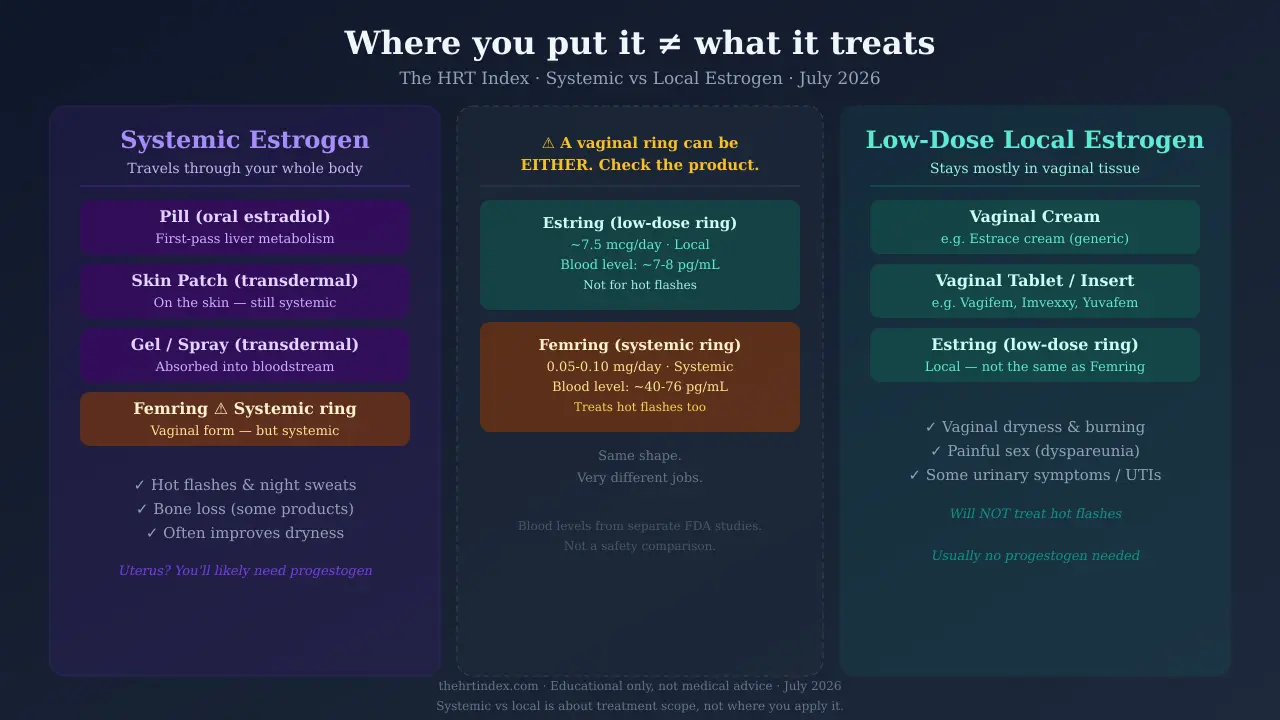
Here's what trips almost everyone up: it's not about where you put the medicine. A patch goes on your skin and still treats your whole body. A vaginal ring might be local — or systemic. Mix those up and you can spend months treating hot flashes with something that was never going to touch them. We show you how to get it right, and hand you a symptom-by-symptom map so you know exactly which conversation to have before your first appointment.
Local estrogen is probably your starting point if
your symptoms are mostly below the belt — vaginal dryness, burning, itching, painful sex, or repeat UTIs — and hot flashes aren’t really your problem.
Systemic estrogen is probably your starting point if
hot flashes, night sweats, or wrecked sleep are what’s driving you crazy, or you want to prevent bone loss with a product approved for that.
A conversation about both may fit if
you’ve got hot flashes and stubborn dryness — for example, a patch calmed your night sweats but sex still hurts.
This page can’t route you by itself if
you have unexplained bleeding after menopause, a history of breast or another estrogen-dependent cancer, a serious clot, stroke, or liver history, or you’re not sure which symptoms you actually have. Those belong with a clinician first.
Systemic estrogen vs local estrogen at a glance
| Question | Systemic estrogen | Low-dose local (vaginal) estrogen |
|---|---|---|
| Main job | Hot flashes and night sweats, plus (with some products) preventing bone loss | Vaginal + urinary symptoms only: dryness, burning, painful sex, some urinary issues |
| Will it treat hot flashes? | Yes | No — it won’t touch them |
| Common forms | Pill, skin patch, gel, spray, higher-dose vaginal ring (Femring) | Vaginal cream, tablet/insert, low-dose ring (Estring) |
| Gets into your bloodstream? | Yes — on purpose | Minimal (not zero) |
| Protect your uterine lining if you have a uterus? | Yes — usually a progestogen (one product uses bazedoxifene instead) | Usually not needed — but report any bleeding |
| Helps prevent bone loss? | Some products, yes | No |
| Can you use both at once? | Yes, under a clinician’s guidance | Yes — sometimes added when vaginal symptoms persist |
Here's the two-minute version of why this matters. Estrogen isn't one thing. “Systemic” and “local” describe how far the medicine travels and what it's built to treat— not where you apply it. Once that clicks, the rest of the decision gets a lot simpler.
The HRT Index is the independent decision resource for online menopause and HRT care — comparing telehealth providers on clinical legitimacy, care quality, medication fit, price transparency, and access, with every claim verified and dated.
The right estrogen therapy — and the right provider — isn't the same for every woman. It depends on your symptoms, what you have tried so far, your age, your state and your health history. Use The HRT Index's Find My HRT Path tool to see your best-fit care route.
Systemic estrogen vs local estrogen: what's the real difference?
Think of it like heating your home. Systemic estrogen is turning up the furnace for the whole house. Local estrogen is a small space heater in one cold room. Both use “heat.” They're doing very different jobs.
Systemic estrogen (estrogen that travels through your bloodstream to reach tissues all over your body) is the tool for vasomotor symptoms— the medical name for hot flashes and night sweats. Because it reaches everywhere, it can also ease vaginal symptoms, and some systemic products are approved to help prevent bone loss after menopause. It comes as pills, skin patches (these are transdermal — through the skin — but make no mistake, they're systemic), gels, sprays, and one higher-dose vaginal ring (Femring — more on that below).
Low-dose local vaginal estrogen (a small dose placed in the vagina that mostly stays in nearby tissue) is the tool for genitourinary syndrome of menopause, or GSM— the umbrella term for the vaginal, vulvar, and urinary changes that come with lower estrogen. That's dryness, burning, itching, dyspareunia (the medical word for painful sex), and some urinary symptoms. It comes as vaginal creams, vaginal tablets or softgel inserts, and one low-dose vaginal ring (Estring).
The honest nuance most pages skip
Local does not mean risk-free, and it does not mean “zero absorption.” A little estrogen can still cross into your bloodstream from a vaginal product — it's just far less than a systemic dose. All the FDA-approved estrogen products discussed here require a U.S. prescription. We say “minimal absorption,” never “none,” because the truth holds up and the myth doesn't.
The two name traps that fool almost everyone
Trap #1 — “It's on my skin, so it's local.” No. A patch, gel, or spray is applied to the skin, but it's designed to soak into your bloodstream and treat your whole body. Topical is not the same as local.
Trap #2 — “It's a vaginal ring, so it's local.” Not necessarily. There are two very different estrogen rings, and they do very different jobs. We give you a side-by-side further down so you never mix them up.
The questions this page answers
These are the recurring decision questions we built this page to resolve:
- “I'm on a patch anda vaginal cream — is that too much estrogen?”
- “Does using an estradiol cream mean I need progesterone too?”
- “My patch fixed my hot flashes, so why do I still have dryness?”
- “Wait — a vaginal ring can be systemic?”
The answer to each depends on the exact product, your symptoms, whether you have a uterus, and your personal history. We'll hit every one below.
Which symptoms does systemic estrogen treat versus local estrogen?
Start with your loudest symptom. It usually points you to the right conversation faster than anything else.
| Your symptom or goal | Local vaginal estrogen | Systemic estrogen | Could both be discussed? |
|---|---|---|---|
| Hot flashes | No | Yes | — |
| Night sweats | No | Yes | — |
| Poor sleep caused by night sweats | No | Yes (by calming the night sweats) | — |
| Vaginal dryness | Yes | Sometimes helps | Yes |
| Vulvar burning or itching | Yes | Sometimes helps | Yes |
| Painful sex (dyspareunia) | Yes | Sometimes helps | Yes |
| Urinary urgency or frequency | Guideline-supported estrogen route for GSM urinary symptoms | Not the first estrogen choice for this alone | Yes |
| Preventing recurrent UTIs | May reduce future risk (guideline route); does not treat an active UTI | No established preventive benefit | Only if hot flashes also need treatment |
| Preventing bone loss | No | Yes (with a product approved for it) | — |
| Low libido | Not the main tool | May help indirectly if dryness, hot flashes, or poor sleep are the cause; not a reliable fix for desire itself | Maybe |
| Brain fog or mood | Not a reason to pick this route | Not a route-selection reason on its own; treating hot flashes may improve related sleep or mood | Maybe |
| Bleeding after menopause | No — get it checked | No — get it checked | No |
How do I know which estrogen scope to ask about? (Our Estrogen Scope Discussion Map)
We call this the Estrogen Scope Discussion Mapon purpose. It doesn't diagnose you and it doesn't prescribe. It tells you which question to raise firstso your appointment starts in the right place. Every row points to a conversation, not a pill — and every row is tied to a source you can check yourself.
| If this sounds like you | The first question to raise | Example FDA-approved forms | Evidence type | The catch you must not skip | Source |
|---|---|---|---|---|---|
| Bad hot flashes or night sweats, not much vaginal/urinary trouble | “Should we talk about systemic estrogen — or a non-hormone option?” | Estradiol patch, pill, gel, spray | FDA-approved indication (VMS) | Low-dose local estrogen won’t treat hot flashes. Whether systemic is right still depends on your history. | FDA; The Menopause Society |
| Dryness, burning, painful sex, or GSM-type urinary symptoms, but hot flashes aren’t a big deal | “Can we start with a low-dose local vaginal product?” | Estradiol cream, Vagifem, Imvexxy, Estring | FDA-approved indication (GSM/VVA) | Infections, skin conditions, pelvic-floor issues, and unexplained bleeding can look just like GSM. | The Menopause Society (GSM guidance) |
| Both hot flashes and vaginal/urinary symptoms | “Could one systemic plan cover both, and if dryness lingers, do we add a local product?” | Systemic estrogen ± a local add-on | Guideline-supported | Systemic estrogen can ease dryness, but some women still need a local add-on. | The Menopause Society |
| A patch, gel, or spray is on the table | “Let’s treat this as a systemic-estrogen decision.” | Vivelle-Dot, Climara, Divigel, EstroGel, Evamist | Editorial routing | “On the skin” doesn’t mean local. It’s systemic. | The Menopause Society; FDA labels |
| A vaginal ring is on the table, but you’re not sure which one | “Which exact ring is this, and is it approved for hot flashes?” | Estring (local) vs Femring (systemic) | Editorial routing | Estring is local; Femring is systemic. The name matters. | FDA product labels |
| You have a uterus and are considering systemic estrogen | “What will protect my uterine lining?” | Estrogen + a progestogen, or estrogen + bazedoxifene (Duavee) | FDA-approved indication | With a uterus, systemic estrogen needs endometrial protection. The exact plan depends on the product. | FDA; The Menopause Society |
| You have a uterus and are considering standard low-dose vaginal estrogen | “Does this specific product and dose need any added protection or monitoring?” | Estradiol cream, Vagifem, Estring | Guideline-supported | Standard low-dose vaginal estrogen usually doesn’t need a progestogen — but “never” is too strong. Report any bleeding. | The Menopause Society |
| Breast cancer, an estrogen-dependent cancer, or you take an aromatase inhibitor | “Let’s decide this together — and loop in my oncology team.” | Individualized | Editorial routing (safety) | Never assume “safe for all survivors.” Some low-dose local options may be considered after non-hormone steps, with your treating team involved. | ACOG; The Menopause Society |
| Unexplained bleeding after menopause | “I need this evaluated first.” | None — evaluation first | Editorial routing (safety) | Don’t blame it on dryness and don’t route it to online HRT. Get it checked. | Estring FDA label (lists unexplained genital bleeding as a contraindication) |
| Someone offers a compounded product as “the same” or “cleaner” than an approved one | “Why compounding instead of an FDA-approved option?” | Depends on the product | Editorial routing | Compounded estrogen isn’t FDA-approved and isn’t a default in current GSM guidance. Don’t assume it’s equal. | The Menopause Society (GSM guidance); FDA |
How to read this map: these rows tell you which treatment scope is worth discussing. They do not tell you whether estrogen is safe or right for your body. Your exact product and dose, whether you have a uterus, any bleeding, your cancer and clotting history, your liver health, your other medications, and the real cause of your symptoms can all change the answer.
And here's our one honest admission, because you deserve it straight: this page cannot tell you if estrogen is safe for you personally. We can't see your labs, your history, or your body. No article can, and any page that pretends to is selling you something. What we cando is get you to the right question, flag the moments that need a real clinician, and make sure you're not walked into a product that can't help you. That's the whole job.
Not sure which row describes you?
The HRT Index's Find My HRT Path tool walks you through your symptoms, what you have tried, age, state, and health history in about 90 seconds — then shows your best-fit online service with its price, or guidance when online care is not the right next step. No email required.
See my best-fit care routeFind My HRT Path may route to providers The HRT Index has an affiliate relationship with; that doesn't change the tool's routing logic — see our full disclosure.
Can you use systemic and local estrogen together?
A woman gets a patch, her night sweats calm down, but sex still hurts. That's not a failure — it's just that systemic and local estrogen aim at different targets, and sometimes you need both aimed at once.
Why doesn't the systemic dose always fix the dryness? Because vaginal tissue can be stubborn. Systemic estrogen helps a lot of women's GSM, but not all the way for everyone. Adding a low-dose local product delivers estrogen right where the tissue needs it.
| Your situation | The next conversation | What adding a local product would (and wouldn’t) do |
|---|---|---|
| Systemic controls hot flashes, but dryness or painful sex persists | Ask about adding low-dose local estrogen | Targets the tissue directly; won’t change your hot-flash control |
| Only vaginal/urinary symptoms, no hot flashes | Start local; systemic usually isn’t needed | Local handles it; systemic adds body-wide exposure you may not need |
| Urinary symptoms without hot flashes | Ask about local vaginal estrogen (the guideline route for GSM urinary symptoms) | Local is the estrogen route here; not a reason to start systemic |
| Both hot flashes and vaginal symptoms, nothing treated yet | Ask whether one systemic plan covers both, then add local if dryness lingers | — |
| New or unexplained bleeding | Stop and get evaluated first | Neither adding nor combining is the answer until it’s checked |
Adding a low-dose local product on top of systemic estrogen is notthe same as simply “doubling your dose.” Different forms release different amounts and reach different places. But “not automatically too much” isn't the same as “always fine for everyone.” Before you combine them, your clinician should confirm the exact systemic and local products and doses, whether you have a uterus and your protection plan, any new bleeding, your cancer/clot/stroke/heart/liver history, and your other medications.
Do you need progesterone with systemic or local estrogen?
Plain definitions first. Progesterone is a hormone your body makes. Progestogen is the broader family that includes progesterone and lab-made versions called progestins. The endometrium is the lining of your uterus.
When you take systemic estrogen and still have a uterus, that estrogen can build up the uterine lining. Over time, unopposed estrogen raises the risk of the lining overgrowing and, potentially, endometrial cancer. So you protect the lining. Usually that means adding a progestogen. There's also one FDA-approved pill that pairs conjugated estrogens with bazedoxifene— a different kind of lining protector — and with that specific product you do notadd a separate progestin. If you've had a hysterectomy(surgery to remove the uterus), there's no lining to protect, so estrogen alone is usually fine.
When you use standard low-dose vaginal estrogen, so little reaches the bloodstream that a progestogen generally isn't prescribed just for it — even if you have a uterus. The Menopause Society's position is that low-dose vaginal estrogen doesn't appear to raise endometrial cancer risk. A 2019 systematic review of 20 randomized trials (2,983 women) found endometrial cancer in about 0.03% and hyperplasia (lining overgrowth) in about 0.4% — though those trials were mostly short-term.
| Your situation | How the lining is protected | Don’t assume |
|---|---|---|
| Systemic estrogen + uterus | Add a progestogen (progesterone or a progestin) | That you can skip it |
| Systemic estrogen + uterus (one specific product) | Conjugated estrogens + bazedoxifene (Duavee) protects the lining without a separate progestin | That you add a progestin on top — you don’t |
| Standard low-dose local vaginal estrogen | Usually no added protection needed (minimal absorption) | That “never” is absolute — report any bleeding |
| Systemic estrogen after hysterectomy | No lining to protect — estrogen alone | That your situation is identical to everyone’s |
| Unexplained bleeding after menopause | Not a protection question — get it evaluated | That it’s “just the estrogen” |
Does local vaginal estrogen get into your bloodstream?
We keep hammering “minimal, not zero” because absolutes are how trust breaks. If a page tells you vaginal estrogen neverenters your bloodstream, and then you read a label that mentions absorption, you stop believing the whole page. So here's the real picture, straight from the Estring label.
The low-dose Estring ring releases about 7.5 micrograms of estradiol a day over 90 days. Blood levels bump up briefly right after you place it, then return to the untreated postmenopausal range within about eight hours. Across a year of use, mean steady-state blood estradiol measured 7.8, 7.0, 7.0, and 8.1 picograms per milliliter at weeks 12, 24, 36, and 48 — very low numbers. Only about 8% of the estradiol released each day is absorbed into the body. Translation: some absorption, but a small fraction of what a systemic dose delivers.
What actually changes how much gets absorbed: the product and dose (a standard low-dose cream, tablet, or ring is very different from a higher-dose or compounded formula); where and how it's placed; your starting tissue (very thin, dry tissue may absorb differently early on, then change as it heals); and starting versus maintenance dosing. Because so little is absorbed, low-dose vaginal estrogen has a lower risk profile than systemic therapy — though any specific product's own warnings still apply.
One thing we won't do is hand you a “safe blood level” number to chase. Reading a blood estradiol result depends on the test, your baseline, the timing, the product, and the reason you're checking. That's a clinician conversation, not a DIY threshold. And this is exactly why “it's vaginal, so it's local” fails as a rule — because a higher-dose vaginal product is systemic.
Is local estrogen safer than systemic estrogen?
If your symptoms are only vaginal or urinary, low-dose local estrogen is a reasonable, lower-risk first step, and that's genuinely reassuring for women who were scared off estrogen entirely. But the honest framing isn't “which is safer in the abstract?” It's “which scope does my symptom actually need, and what are the risks of this specific product for me?” Two women with the same symptom and different histories can get different right answers — which is why the clinician-first flags later on matter, and why we don't hand out one-size safety verdicts.
What changed in FDA estrogen warnings in 2026?
For years, the FDA's class-wide approach applied the most serious “boxed warning” (the black-box warning) — about risks like heart disease, breast cancer, and dementia — across systemic and local vaginal menopausal estrogen products. A lot of that language came from older research on systemictherapy, which scared many women away from treatments that could have helped. For scale: the FDA noted that in 2020, about 41 million U.S. women were 45–64, yet only about 2 million women aged 46–65 received a prescription for systemic estrogen.
Here's what actually happened:
- November 2025:The FDA requested removal of the boxed-warning language about cardiovascular disease, breast cancer, and probable dementia from menopause estrogen products — systemic andlocal — and asked companies to update their labels. Twenty-nine companies submitted proposed changes. The FDA also requested removing the old “use the lowest effective dose for the shortest amount of time” recommendation.
- February 12, 2026: The FDA approved the first batch of six relabeled products, and added guidance that many women may benefit from starting hormone therapy before age 60 or within 10 years of menopause.
- What stayed: The endometrial-cancer boxed warning remains on systemic estrogen-alone products — which is exactly why the endometrial-protection rule above exists when a uterus is present.
Verified label status as of July 13, 2026:
| Product | Category | Label updated in the first batch (Feb 12, 2026)? |
|---|---|---|
| Prometrium (progesterone) | Progestogen alone | Yes |
| Divigel (estradiol gel) | Systemic estrogen alone | Yes |
| Cenestin (synthetic conjugated estrogens A) | Systemic estrogen alone | Yes |
| Enjuvia (synthetic conjugated estrogens B) | Systemic estrogen alone | Yes |
| Estring (estradiol vaginal ring) | Local vaginal estrogen | Yes — the only local vaginal product in the first batch |
| Bijuva (estradiol + progesterone) | Systemic combination | Yes |
| Vagifem/Yuvafem, Imvexxy, Estrace cream, Premarin Vaginal Cream, Vivelle-Dot, Climara, EstroGel, Evamist, Femring, and others | Various | Not on the Feb 12, 2026 updated-list as of July 13, 2026 — check the product’s current label |
Is that vaginal ring local or systemic? Estring vs Femring
| Question | Estring | Femring |
|---|---|---|
| Placed in the vagina? | Yes | Yes |
| Treatment scope | Local | Systemic |
| Treats hot flashes? | No — vulvar/vaginal symptoms only | Yes |
| Approved for | Moderate-to-severe vulvar and vaginal atrophy due to menopause | Moderate-to-severe hot flashes and vulvar/vaginal atrophy due to menopause |
| Dose | About 7.5 mcg of estradiol released per day, over 90 days | 0.05 or 0.10 mg estradiol per day, over 90 days |
| Endometrial protection if you have a uterus? | Standard low-dose local rule usually applies (generally not needed) | Systemic rule applies (protection needed) |
| Label status | Updated in the Feb 12, 2026 FDA batch | Not on the Feb 12, 2026 list as of July 13, 2026 — current label still carries earlier warnings |
How to check any estrogen product yourself (a 3-step trick)
You don't need a medical degree to sort local from systemic:
- Get the exact name— both the brand and the generic (for example, “estradiol”).
- Read the current FDA or official labelfor what it's approved to treat— not a store's marketing blurb.
- Look for hot flashes.For the products discussed here, approval to treat hot flashes or night sweats identifies systemic scope. If a product is only approved for vulvar/vaginal symptoms, it's local.
That one question — “is it approved for hot flashes?” — settles most confusion in seconds.
For a full side-by-side on these two rings, see our dedicated page: Femring vs Estring.
What if you have a history of breast cancer, blood clots, stroke, liver disease, or unexplained bleeding?
| Your flag | What this page can say | What it can’t say | Who to involve |
|---|---|---|---|
| Unexplained postmenopausal bleeding | Get it evaluated before choosing any estrogen | Whether it’s harmless | Your clinician, often with an exam or imaging |
| Breast cancer history, or you take an aromatase inhibitor | Non-hormone options usually come first; some low-dose local may be considered after, through shared decision-making | That vaginal estrogen is safe for all survivors | Your oncology team |
| Another estrogen-dependent cancer history | This is individualized | A blanket yes or no | The team that treated you |
| Prior clot, stroke, heart disease, or serious liver disease | Whether estrogen fits depends on the exact condition, route, and timing | That any single route is safe for you | A clinician who knows your history |
When online care may not be your starting point
Telehealth fits a lot of women. But some situations really do call for in-person or specialist care first: unexplained bleeding; symptoms that could be an infection or something acute; active, complex cancer treatment; a significant unresolved clotting, heart, or liver history; symptoms that haven't improved after treatment with no clear diagnosis; or anything that needs a physical exam, imaging, or a procedure.
Your symptom pattern is only one part of the decision — your history and your safety flags matter just as much. If you're not sure whether an online provider is even the right first move for you, don't guess.
Not sure if online care is right for your situation?
The HRT Index's Find My HRT Path tool flags the exact situations that deserve in-person or specialist care before it ever points you to a provider.
See if online care is right for meHow long does local or systemic estrogen take to work?
For local treatment, many products start with daily use for about two weeks, then drop to a couple of times a week. Consistency matters more than speed, and tissue change is gradual — don't judge it after a few days. For systemic treatment, hot-flash relief also builds over weeks, and how fast varies by product and person.
If things stall, read the signal correctly: hot flashes improved but dryness lingers means you may need a local add-on; local treatment eased dryness but night sweats continue means the local product was never meant to touch hot flashes; no GSM improvement at all means it's worth rechecking the diagnosis, the product, and how it's being used. And some symptoms deserve a faster call to your clinician — new bleeding, severe or worsening symptoms, or signs of an allergic reaction.
What side effects should I expect, and what symptoms need prompt care?
Common and usually manageable can include mild local irritation with vaginal products, or breast tenderness, mild nausea, headache, or breakthrough spotting with systemic products — things that often ease as your body adjusts.
What do systemic and local estrogen cost?
Decide the scope, then shop for access. Cost might change which affordable productyou choose; it shouldn't flip a hot-flash problem into a dryness product or the reverse.
Typical cash-pay ranges for common strengths and quantities, with pharmacy coupons, as of July 2026. Treat these as a rough map, not a quote — confirm at checkout.
| Product (type) | Rough cash-pay range (common strengths, with coupons) | Notes |
|---|---|---|
| Generic estradiol tablets — systemic | ~$12–$27 for a 90-day supply | Among the cheapest systemic options |
| Generic estradiol patches — systemic | Commonly ~$36–$100+; less with coupons | Vivelle-Dot and Climara have generics |
| Estradiol gel/spray (Divigel, EstroGel, Evamist) — systemic | Higher; often brand-priced | Manufacturer savings programs may apply |
| Generic estradiol vaginal cream — local | ~$16–$120 per tube | How long a tube lasts varies by person |
| Premarin Vaginal Cream — local | Often $200+ per tube retail | Brand only; a manufacturer savings program exists for eligible patients |
| Generic estradiol vaginal inserts (Vagifem generic/Yuvafem) — local | Generic 8-pack often under $40; brand ~$180 | Generic is far cheaper |
| Estradiol vaginal inserts (Imvexxy) — local | Brand runs high; a first generic was FDA-approved in December 2025 | Generic availability at a given pharmacy can lag its approval |
| Estring — local low-dose ring | Often several hundred dollars per ring; lasts ~90 days | A manufacturer savings program exists for eligible patients |
Smart questions for your pharmacy or insurer: Is this exact product covered, and is a generic available? Does it need prior authorization? Does the price jump after an intro period? Can I get a 90-day supply to lower the per-month cost?
Once you know your scope, you can compare HRT costs and how coverage works across care options — a separate step our cost guide is built for.
FDA-approved vs compounded estrogen: not the same category
The named brand products in this article — such as Estring, Femring, Imvexxy, Vagifem/Yuvafem, Premarin Vaginal Cream, Divigel, and Bijuva — are FDA-approved. A dosage-form category (“a cream” or “a patch”) by itself does not establish FDA approval, and compounded versions can exist in many of those forms.
Compounded hormones may be prepared by a compounding pharmacy, a physician, or an FDA-registered outsourcing facility, under the applicable federal rules. There are legitimate reasons a clinician might compound something — a true allergy to an ingredient, or a dose that isn't made commercially. But compounded products are not FDA-approved, the FDA does not review them for safety, effectiveness, or quality before they're marketed, and they shouldn't be sold to you as identical to an approved option.
Current GSM guidance from The Menopause Society doesn't recommend compounded vaginal estrogen as a default choice. To learn more, see why FDA-approved and compounded hormones are different categories.
If someone offers you a compounded product, the fair question is simple: why compounding instead of an FDA-approved version, and what are my approved options?
What should you ask before you fill an estrogen prescription?
Save or screenshot this and bring it with you. It's meant to be filled in during a real appointment.
Pre-consult checklist
My treatment target
- Which symptoms are we treating — vaginal/urinary (GSM), whole-body (hot flashes), both, or possibly something else?
- What would this product not be expected to fix?
My product
- Is this local or systemic?
- What's the exact brand, generic name, dose, and form?
- Is it FDA-approved for this use? If it's compounded, why — and what approved options exist?
My uterus and protection plan
- Do I have a uterus? (And if I had surgery, was it a hysterectomy or an ablation?)
- Do I need endometrial protection, and what's the plan?
My safety and monitoring
- Which parts of my history change the risk here?
- What bleeding or symptoms should I report right away?
- When will we check whether it's working, and what would make us switch?
My access
- Can I fill this at my regular pharmacy, and is it covered?
- What will it cost after any intro period, and what if the first product doesn't agree with me?
You've done the reading. Now get your best-fit care route.
The HRT Index's Find My HRT Path tool takes your symptoms, what you have tried, age, state, and health history, then shows your best-fit online service — its price and what happens next, or guidance instead — in about 90 seconds. No email required.
Match my symptoms to a care routeHow we verified this
What we actually verified for this page ():
- Which estrogen products carry updated FDA labels after the November 2025 boxed-warning removal — checked against the FDA's live “Menopausal Hormone Therapies with Updated Prescribing Information” list (first batch of six approved Feb 12, 2026).
- That the endometrial-cancer boxed warning stays on systemic estrogen-alone products — checked against FDA and HHS statements.
- The endometrial-protection rules for systemic vs low-dose vaginal estrogen, including the estrogen-plus-bazedoxifene option — checked against The Menopause Society 2022 Hormone Therapy Position Statement and the Duavee label.
- Which products are systemic vs local, including Estring (local) vs Femring (systemic), and the Estring blood-level figures — checked against current FDA/DailyMed labels.
- The first generic Imvexxy approval (Dec 8, 2025) — checked against the FDA.
- Cash-pay price ranges — checked around July 2026 via GoodRx and Drugs.com; these change often, so confirm your price at checkout.
What we did not do: we did not use these products ourselves, complete a consult, interview patients, or run a medical study.
We review providers with a documented process we call The HRT Index Verification Standard— reading every published price, separating FDA-approved from compounded, verifying state availability and insurance, and re-checking on a fixed schedule. You can read the full method on our methodology page. Spot an error or an out-of-date price? Tell us and we'll fix it.
Sources:FDA, “FDA Approves Labeling Changes to Menopausal Hormone Therapy Products” (Feb 12, 2026); FDA, “Menopausal Hormone Therapies with Updated Prescribing Information” (live list); HHS, “FACT SHEET: FDA Initiates Removal of ‘Black Box’ Warnings…” (Nov 10, 2025); FDA/DailyMed, Estring label — PK, dose, contraindications; FDA/DailyMed, Femring label; FDA/DailyMed, Duavee label; The Menopause Society, 2022 Hormone Therapy Position Statement & GSM guidance (MenoNote); ACOG, treatment of urogenital symptoms in individuals with a history of estrogen-dependent breast cancer; AUA/SUFU/AUGS, genitourinary syndrome of menopause and recurrent-UTI guidance; Menopause (2019) systematic review on endometrial safety of low-dose vaginal estrogens (20 RCTs, 2,983 women); Mayo Clinic; Cleveland Clinic; GoodRx and Drugs.com (costs, checked ~July 2026). Verification completed July 13, 2026.
Frequently asked questions
Is vaginal estrogen considered HRT?
Yes. Vaginal estrogen is a form of hormone therapy. But standard low-dose vaginal estrogen has a narrower job — vaginal and urinary symptoms — and much lower absorption than systemic menopausal hormone therapy, so it’s discussed and dosed differently.
Can local estrogen treat hot flashes?
No. Standard low-dose local vaginal estrogen is not designed to treat hot flashes or night sweats. For those, you need systemic estrogen or a non-hormone option.
Is an estrogen patch “local” because it goes on the skin?
No. A patch is applied to the skin (transdermal) but is systemic — it’s built to absorb into your bloodstream and treat your whole body. Topical is not the same as local.
Can systemic estrogen help vaginal dryness?
Often, yes. Systemic estrogen can improve vaginal dryness for many women. But some still need a low-dose local product on top for full relief.
Can I use a patch and vaginal estrogen at the same time?
Sometimes, under a clinician’s guidance — usually when systemic therapy handles hot flashes but dryness or painful sex lingers. Adding a low-dose local product isn’t the same as doubling your dose, but your clinician should confirm the products, doses, and your history first.
Do I need progesterone with vaginal estrogen?
Usually not, just for standard low-dose vaginal estrogen — even if you have a uterus — because so little is absorbed. Higher-dose or non-standard products may be different, and any unexplained bleeding should be evaluated.
Do I need progesterone with systemic estrogen?
Usually yes if you still have a uterus, to protect the uterine lining — with a progestogen, or in one FDA-approved product (Duavee), with bazedoxifene instead. The exact plan depends on the product. If you’ve had a hysterectomy, estrogen alone is often appropriate.
Is Estring local or systemic?
Local. Estring is a low-dose vaginal ring indicated for moderate-to-severe vulvar and vaginal atrophy due to menopause — not for hot flashes.
Is Femring local or systemic?
Systemic. Femring is a higher-dose vaginal ring approved to treat hot flashes as well as vulvar and vaginal atrophy, so systemic-estrogen precautions apply.
Does vaginal estrogen get into your bloodstream?
A little, but typically far less than systemic therapy — the accurate phrase is “minimal absorption,” not “none.” With the low-dose Estring ring, for example, about 8% of the estradiol released each day is absorbed, and blood levels stay very low.
Can local estrogen help recurring UTIs?
It may reduce the risk of future recurrent UTIs in postmenopausal women as part of a clinician’s GSM plan; it does not treat an active UTI. Not every urinary symptom is estrogen-related, so get symptoms properly evaluated.
Can I use local estrogen without taking systemic HRT?
Yes. If your symptoms are only vaginal or urinary and the product is right for you, low-dose local estrogen can be used on its own.
Is local estrogen safer after breast cancer?
There’s no blanket “yes.” Non-hormone options usually come first, and some low-dose local options may be considered afterward through shared decision-making with your treating team. Don’t start it on your own.
Is compounded vaginal estrogen the same as an FDA-approved product?
No, and it shouldn’t be presented that way. Compounded products aren’t FDA-approved, the FDA doesn’t review them for safety, effectiveness, or quality before marketing, and they aren’t a default in current guidance.
How long can I use vaginal estrogen?
For ongoing vaginal symptoms, it’s often used long-term with periodic check-ins, because symptoms tend to return when it’s stopped. There’s no single stopping rule that fits everyone — review it with your clinician.
What if my vaginal symptoms don’t improve?
Reassess how long and how consistently you’ve used it, the product and dose, and whether the diagnosis is right. Add systemic therapy only if you also have a separate systemic reason to, such as bothersome hot flashes.
Are prasterone or ospemifene the same as local estrogen?
No — they’re not vaginal estrogen. Prasterone is a vaginal insert containing DHEA (a hormone), and ospemifene is an oral selective estrogen-receptor modulator. Both can be worth discussing for certain GSM symptoms if estrogen isn’t preferred or appropriate for you.
What changed with FDA estrogen warnings in 2026?
In November 2025, the FDA requested removal of boxed-warning language about cardiovascular disease, breast cancer, and probable dementia from menopause estrogen products. On February 12, 2026, the FDA approved updated labels for the first batch of six products. The endometrial-cancer boxed warning stays on systemic estrogen-alone products. Label updates roll out product by product — not all products carry the new wording yet.
The decision in three lines
- Ask about local treatmentwhen your symptoms are limited to dryness, burning, painful sex, or urinary issues, and there's no safety flag.
- Ask about systemic treatment when hot flashes or night sweats are the goal and a clinician has looked at your history.
- Ask about both — or get evaluated first when both symptom groups stick around, or when your history, your product, or an unclear diagnosis makes a simple answer unsafe.
Still not sure which HRT program is right for you?
Take our free 90-second matching quiz — The HRT Index’s Find My HRT Path tool shows your best-fit online service, its listed price, and what happens next, with no email required, and it flags when online care isn’t the right first step.
Find My HRT PathFind My HRT Path may route to providers The HRT Index has an affiliate relationship with; that doesn't change the tool's routing logic — see our full disclosure.