
Thermella reviews point to a modest benefit: in a small trial, its formula reduced total hot flashes by about 2.2 more a day than placebo, without a significant advantage in overall sleep quality. It's a hormone-free supplement, not an FDA-approved treatment. Whether it's worth trying depends on your health history, medicines and upfront cost.
Best for: women about 40 to 65 with frequent, bothersome hot flashes who want to weigh a hormone-free supplement, have checked their medicines and history with a clinician or pharmacist, and are comfortable with the buying terms. Bonafide’s three-month subscription costs $120 upfront; that is a purchase option, not a required treatment trial.
Think twice if:
- you've had breast cancer or take tamoxifen or an aromatase inhibitor — talk with your oncology team first;
- you have liver disease or take several daily medicines;
- you want the most effective relief available — systemic hormone therapy still holds that title for suitable women. For cash-pay clinician-led care, prescription care through Gala (affiliate link) is worth exploring; confirm the exact medication, total and availability before paying;
- you mainly want better sleep, weight loss or help with dryness — overall sleep quality did not significantly beat placebo, and the hot-flash evidence does not establish a treatment for weight or vaginal symptoms.
Already decided? See Thermella's current plans at Bonafide — then read the return rules before you pay.
The HRT Index is the independent decision resource for online menopause and HRT care — comparing telehealth providers on clinical legitimacy, care quality, medication fit, price transparency, and access, with every claim verified and dated, so women can choose the path that fits their situation before their first consult.
What we actually verified · Last verified October 2026
We read, on October 16, 2026: Bonafide's Thermella product page, its two clinical-trial pages, its return policy and its terms; the full published placebo-controlled trial (Maturitas, 2026); the full open-label study published October 15, 2026; both ClinicalTrials.gov records; Thermella listings and reviews on Target and Amazon; the published abstract of The Menopause Society's 2023 nonhormone statement and its current position-statement index; NIH safety pages on green tea and turmeric; current prescribing information for Veozah and Lynkuet; and Gala Health's hormone-health, HRT-offer, non-hormonal and linked refund-policy pages.
We confirmed: the listed main ingredients (600 mg curcumin extract, 150 mg decaffeinated green tea extract, 85 mg spirulina extract per two tablets); Bonafide's advertised prices ($60 single box plus $5 shipping, $45 monthly, $120 every three months, $210 every six months); its unopened, sealed return rule; and the study designs, reported outcomes and eligibility limits described below. Advertised prices are not a completed checkout quote.
We did not: buy, take or lab-test Thermella, complete a checkout or medical assessment, or contact Bonafide or Gala. This is a documentation review, not a product test or an independent test of the current retail tablets.
We could not confirm: Bonafide's unpublished "97%" pooled data; why Bonafide lists the controlled trial as 65 women when the paper reports 74; the exact supply in Bonafide's selected one-time box; or the total and exact dispensed medication for an individual Gala HRT order.
Money note: We may earn a commission if you sign up with Gala Health through our links. The Bonafide, Thermella, Target, Amazon and Midi links on this page are untracked editorial links, not affiliate links. How affiliate links support The HRT Index.
On this page: Verdict · Does it work? · Who was studied · Customer reviews · Ingredients · Side effects · Breast cancer · Cost · Cancel or return · If it doesn't work · vs Relizen · vs prescriptions · Online care · FAQ
Thermella reviews: our verdict before you buy
Thermella has something useful for a supplement review: a published placebo-controlled trial. But the benefit in that trial was moderate, the research was paid for by the company, and participants were screened for generally good health and frequent hot flashes. Whether it's worth buying depends on your health history, how much relief you need and how much money you're willing to spend before you know if it helps you.
Here's the verdict, in plain words.
- Does it work? On average, a little better than a dummy pill for hot flashes. Overall sleep quality did not significantly improve more than placebo in the controlled trial.
- Is it safe? Neither study reported a serious adverse event, but adverse events did occur and the studies were short. Two of its ingredients have reports of liver injury in the wider world, and important higher-risk groups were excluded or not separately reported.
- Is it worth the money? It may be worth considering if you prefer a supplement and your clinician or pharmacist finds no reason to avoid it. Match your first purchase to the financial commitment you are comfortable with, knowing an opened bottle cannot be returned.
We judge every product and service against The HRT Index Verification Standard. Thermella is a supplement, not a telehealth provider, so here is how it measures up on each of our five pillars — in words, not a made-up score.
| Pillar | What we found for Thermella |
|---|---|
| Clinical legitimacy | One randomized, placebo-controlled trial (74 women, 12 weeks) published in Maturitas in 2026, plus one open-label study (134 women) published October 15, 2026. Both were sponsored by Bonafide. It is a dietary supplement, not an FDA-approved drug. |
| Care quality | Buying Thermella does not include ongoing menopause clinical care. Bonafide offers customer support by phone, text, chat and email. |
| Medication fit | Hormone-free. The controlled trial excluded any breast-cancer history, diabetes and significant liver disease; the open-label study did not report a breast-cancer-survivor subgroup. Neither establishes safety when combined with other hot-flash treatments. |
| Price transparency | Prices and plans are clearly listed. Return rules are strict: unopened, sealed products only. |
| Access | No prescription needed. Sold at Bonafide, Amazon and Target. Not covered by insurance; HSA/FSA use requires a separate approval step. |
Where do you fit? Use this to jump to what matters most for you.
| Your situation | Your best next move on this page |
|---|---|
| You want to know if it really works | Read Does Thermella work? and who was studied |
| You're ready to buy and want the cheapest sensible plan | Go to cost, then cancel or return |
| You've had breast cancer or take hormone-blocking medicine | Read the breast cancer section and talk with your oncology team |
| You've tried supplements and still can't sleep through the night | Read what to do if it doesn't work and online care |
| Your symptoms are tolerable and you're just curious | Keep this guide. You don't have to buy anything. |
One limitation to know up front: Bonafide's standard return policy covers only unopened, sealed products. So if your reason for returning it would be "it didn't help me," that money is spent. Plan your first purchase with that in mind.
Does Thermella work? What the clinical studies show
In a 12-week placebo-controlled trial, women taking Thermella's formula had a reduction of about 2.2 more total hot flashes a day than women taking a placebo, and their hot flashes interfered less with daily life. The same trial found no statistically significant difference from placebo in overall sleep quality or overall menopause quality of life. A newer study without a placebo group reported improvements from each woman's starting point, but a study like that can't show how much of the change came from the supplement itself.
A few terms first, because they change how you read every number below:
- A placebo is a look-alike pill with nothing active in it. People in hot-flash studies often feel better on a placebo, partly because hot flashes naturally rise and fall.
- Randomized means chance decided who got the real product and who got the placebo.
- Double-blind means neither the women nor the researchers knew who got what.
- Open-label means the treatment is not hidden from participants or researchers. In this particular open-label study, everyone took the product and there was no comparison group.
The placebo-controlled trial (Maturitas, 2026)
This is the most important study in this review, because it compares Thermella's formula against a placebo. The registry uses a research code name, and the full paper identifies the formula as Thermella, a "botanical neurokinin inhibitor." It was given as capsules with the same three main extract amounts listed for today's tablets; that is a formula match, not a head-to-head test of the finished capsule and tablet products.
Here's what the full paper and the trial registry show:
- Who: Women ages 40 to 65 recruited from community medical practices in the United States. Eligibility required at least six months without periods and at least five self-reported moderate-to-severe hot flashes a day. In the actual enrolled group, every woman was at least 12 months past her final period.
- How long: 12 weeks. The study ran from December 2022 to April 2024.
- How many: 74 women were randomized and 68 finished (32 on the formula, 36 on placebo).
- Main result: Total hot flashes dropped by 2.2 more per day than placebo at week 12. Scores on the Hot Flash Related Daily Interference Scale — a questionnaire about how much hot flashes get in the way of work, sleep, mood and daily life — also improved more than placebo, including its sleep-interference item.
- What didn't beat placebo: overall menopause quality of life (the MENQOL questionnaire) and sleep quality (the Pittsburgh Sleep Quality Index).
- Safety: The study found no significant difference in adverse-event frequency. In the 23 women with paired blood tests — 12 taking the formula and 11 taking placebo — no clinically significant estradiol or liver-test changes were detected.
Source: Lederman et al., Maturitas 2026;211:109023 — full paper, PubMed abstract and ClinicalTrials.gov NCT05813067, checked October 16, 2026.
What does "2.2 fewer a day than placebo" look like? Here's an example with made-up numbers. These are not results from the trial. Imagine two women who each start with 8 hot flashes a day. The one on a placebo improves to 6, because placebo effects in hot-flash studies are real. If the woman on Thermella got exactly the trial's average extra benefit, she'd be at 3.8 a day on average — about 4. Some women in a trial do much better than average and some do no better at all, so your own result could land anywhere.
There's one more distinction worth knowing. The controlled trial reports a drop of 6.0 total hot flashes a day with the formula and 3.8 with placebo. The difference is 2.2. The full 6.0 includes improvement that might also happen without the active supplement, so the comparison with placebo is the fairer estimate of what the product added. Keep total hot flashes separate from moderate-to-severe hot flashes; they are different outcomes.
What "91%," "94%" and "97% of women" do — and don't — mean
Bonafide's pages say 94% of women had fewer hot flashes at one month and 97% at three months, citing a combined analysis of two trials that hasn't been published ("data on file"). Its trial page also says 91% of women in the controlled trial saw improvement in moderate-to-severe hot flashes.
Those numbers describe the share of women reported to improve, not the amount of improvement. The unpublished pooled data do not let us verify the exact improvement threshold, denominator or placebo comparison. Here's a made-up example: if 97 out of 100 women each had one fewer hot flash a week, you could truthfully say "97% experienced fewer hot flashes." That wouldn't mean anyone's hot flashes dropped by 97%. It also wouldn't tell you how many of those 97 women would have improved on a placebo.
We also found a counting puzzle. Bonafide's Thermella trials page describes the controlled trial as including 65 women. The published abstract says 74 were randomized and 68 finished. Bonafide's public pages don't explain the difference, so we use the published counts.
The newer open-label study (published October 15, 2026)
A second study, published in Women's Health Reports on October 15, 2026, followed 134 women who took Thermella for up to 12 weeks. Everyone knew they were taking the real product. All 134 finished the first four weeks, 113 finished the optional eight-week extension, and 112 had complete data.
What it reported, compared with each woman's own starting point:
- Moderate-to-severe hot flashes fell by 3.3 a day (71.6%) by week 12, from an average of about 4.6 a day at the start.
- Night sweats and hot-flash interference scores dropped too.
- A sleep-disturbance score (PROMIS) improved by 9 points, and the share of women reporting moderate-to-severe sleep problems fell from 55% to 19%.
- Joint pain, mood and overall menopause scores also improved.
The authors are clear about the limits, and we think readers should hear them in plain words:
- There was no placebo group, so the study can't prove the supplement caused the changes.
- Women had to report at least five moderate-to-severe hot flashes a day to join. People who enter a study at a bad stretch often improve anyway — researchers call this regression to the mean.
- Most women were recruited from a database kept by Bonafide, which may include people who already used its products.
- Women were paid extra to stay for the extension, and some who dropped out said it wasn't working for them. Both can make later results look better.
- The study ended in December 2024, but its registry record was first posted publicly in February 2026, about 14 months later. That was after the results had been collected, not prospective public registration.
Even so, this study adds useful facts. It included perimenopausal women (still having some periods) and 14 women whose menopause came from surgery — groups the controlled trial left out. It also recorded side effects in detail (see side effects).
Source: Lederman et al., Women's Health Reports, 2026 (doi:10.1177/26884844261497587), full text read October 16, 2026.
Why the sleep claims need their own answer
Bonafide says 89% of women had better sleep. That figure comes from the open-label study. In the placebo-controlled trial, overall sleep quality on the Pittsburgh Sleep Quality Index did not improve significantly more than with placebo. A separate question about how much hot flashes disrupted sleep did improve. Those are different measures: the trial supports less hot-flash interference, but has not established an overall sleep-quality benefit beyond placebo.
So here's the honest version. If night sweats are what wake you up, fewer night sweats may help you sleep. If you have trouble falling or staying asleep for other reasons, there's no controlled evidence that Thermella fixes that. For sleep-specific options, see our guide to menopause and sleep.
Who paid for the research — and why it matters
Bonafide sponsored both studies. In the controlled trial, three authors received consulting fees from Bonafide and one is a Bonafide employee. In the open-label study, the declared conflicts say the work was sponsored by Bonafide, a subsidiary of Pharmavite, while the funding statement on the same page says the authors received no financial support. That mismatch doesn't make the results wrong. It does mean we'd like to see an independent trial before calling the case settled.
An independent clue about curcumin
One small independent study gives the curcumin idea some support. In a 2026 pilot trial from Thailand, 40 postmenopausal women took either curcuminoids (1,000 mg a day) or a placebo for 12 weeks. The curcumin group had about 7 fewer hot flashes a week than the placebo group, but overall quality-of-life scores didn't differ. The authors call the results preliminary. This was not Thermella, so it can't prove Thermella works. It does suggest the main ingredient is worth studying. (Buntoonprayuk et al., BMC Complementary Medicine and Therapies, 2026)
Bonafide's claims next to the published evidence
| What Bonafide says | Where the number comes from | What the published evidence shows | What it means for you |
|---|---|---|---|
| "94% of women experienced fewer hot flashes & night sweats in one month"; "97% at month three" | Combined analysis of two trials, "data on file" (not published) | The controlled trial reports a reduction of 2.2 more total hot flashes a day than placebo at week 12 | These describe a share of women, not a percentage reduction in symptoms. We could not verify the pooled response threshold or placebo comparison. The total-hot-flash difference of 2.2 per day is clearer. |
| "91% experienced an improvement in moderate to severe hot flashes" (trial of "65 women") | Bonafide's trials page | The abstract reports 74 randomized and 68 finishing | Use the published counts. Bonafide hasn't publicly explained the 65. |
| Starts working "as early as two weeks"; best results by month three | Pooled data on file; manufacturer guidance | Open-label study: most improvement came by week 4, with smaller gains after | Early change is possible. The open-label pattern can't separate product from placebo effects. |
| "89% of women experienced better sleep" | Open-label study (no placebo) | Controlled trial: no significant overall sleep-quality difference versus placebo, but less hot-flash-related sleep interference | Do not treat the 89% figure as placebo-controlled proof of better overall sleep. |
| "No hormones & no harmful side effects" | Trials | Controlled trial: no significant adverse-event difference. Open-label: 26% reported at least one adverse event; none were classified serious, and none led to withdrawal | These are short-term observations, not a promise of no harm. One open-label event was severe; see the safety section. |
| "First non-prescription solution to block NKB" | U.S. Patent 11,779,627; animal studies | The papers describe preclinical neurokinin-pathway findings; human brain target engagement was not measured. Estradiol was measured in a small trial subgroup | The proposed mechanism is not proof of the same effect as Veozah. Thermella is not FDA-approved and has not been directly compared with that drug in the research reviewed here. |
| "Trusted by 42,000+ women" | Company statement | — | We can't check this. |
Source: Bonafide product page, Bonafide clinical trials, Thermella trials page, and the two studies linked above, all checked October 16, 2026.
Our read: The strongest honest claim is that Thermella's formula modestly reduced hot flashes compared with placebo in healthy postmenopausal women, with open questions about sleep, long-term use and higher-risk groups. It is not a cure-all for menopause, and it isn't a natural version of a prescription drug.
That leaves the bigger question: is a supplement the right starting point for you at all?
The right online menopause care isn't the same for every woman — it depends on your symptoms, what you've already tried, your age, your state and your health history. Some situations belong with an in-person clinician first. Use The HRT Index's Find My HRT Path tool to explore a featured care option for your situation — and to flag when online care isn't the right starting point — before your first consult.
It asks five questions: what's bothering you most, what you've tried, your age, your state and any health history a clinician should know about. It's free, takes about 60 seconds and doesn't ask for your email. It doesn't diagnose anything or decide whether a treatment is right for you.
Care navigation
Find my hot-flash care pathWere women like you in the Thermella studies?
Both Thermella studies screened women 40 or older for generally good health and at least five self-reported moderate-to-severe hot flashes a day. The placebo-controlled trial left out anyone with any history of breast cancer, a hysterectomy, surgical or chemotherapy-induced menopause, significant liver disease or diabetes. If those describe you, the controlled results do not directly establish safety or benefit for you, and that's a question for your clinician rather than a reason to panic.
This isn't a medical test. It shows whether the published research included women in your situation. A "not studied" answer doesn't mean Thermella is unsafe for you — it means these studies do not answer that question.
| If this describes you… | Placebo-controlled trial (2022–2024) | Open-label study (2024) | What it means for you |
|---|---|---|---|
| Any history of breast cancer, including now on tamoxifen or an aromatase inhibitor | Not included — all excluded | No survivor subgroup reported; the registry excluded cancer within 2 years, apart from localized skin cancer | These papers do not establish safety for your situation. See breast cancer. |
| Another cancer in the last 5 years (except localized skin cancer) | Not included | Cancer within 2 years was excluded; no separate longer-term survivor results | Ask your cancer care team. |
| Still in perimenopause | None in the enrolled group: all were at least 12 months past their final period, although eligibility allowed 6 months | Included (about half the women) | Only the uncontrolled Thermella evidence reviewed here includes this group. |
| Hysterectomy | Not included | Not stated | Results may not apply. |
| Menopause caused by surgery to remove the ovaries | Not included | Included (14 women) | Only uncontrolled evidence applies to you. |
| Menopause caused by chemotherapy, radiation or medicine | Not included | 1 woman | Essentially no evidence. |
| Significant liver, kidney or heart disease, or a gut condition that affects absorption | Restricted by eligibility; some baseline medical histories were still recorded, without condition-specific results | Significant conditions or hepatic impairment were excluded | The papers do not establish safety for these conditions. Ask your clinician first; see side effects. |
| Diabetes | Not included | Not stated | Ask your clinician first. |
| Taking HRT, an SSRI/SNRI, gabapentin, fezolinetant or another menopause supplement | Not included | Not included | Combinations weren't tested. |
| Age 66 to 70 | Not included (40–65) | Included (40–70) | Only uncontrolled evidence. |
| Under 40 | Not included | Not included | Hot flashes before 40 deserve a clinician's evaluation. |
| BMI 35 or higher | Not included (18.5–34.9) | Not included (18.5–34.9) | Not studied. |
| Smoked in the last 3 years | Not included | Not separately reported | No controlled result for this group; the open-label report does not resolve it. |
| Fewer than 5 moderate-to-severe hot flashes a day at screening | Not eligible under the screening rule | Not eligible under the screening rule; diary baseline later averaged about 4.6 | No dedicated trial of women selected for less frequent symptoms. Frequency and severity are different. |
| Generally healthy, 40–65, periods stopped 12+ months ago, 5+ self-reported moderate-to-severe hot flashes a day at screening | Closest to the actual enrolled group | Included | The controlled evidence is most directly relevant to this group; it is not individual medical clearance. |
Source: ClinicalTrials.gov NCT05813067, the controlled trial, ClinicalTrials.gov NCT07408115, and methods of the open-label study. Checked October 16, 2026.
If you landed in a "not studied" row, that's useful information, not a dead end. Take this table and the ingredient list to your clinician or pharmacist. If you'd like help figuring out what kind of care fits your history, Find My HRT Path is built for exactly that question.
What do real Thermella customers say?
Customer reviews of Thermella are mixed: some women say it changed their days and nights, others say it did nothing, and some say it worked at first and then faded. That mix does not confirm or refute the trial result; reviews lack a comparison group. Reviews can tell you what questions to ask, but they can't predict how you'll respond.
A sample of recent reviews, not a success rate
These are recent reviews we read on Target's Thermella listing on October 16, 2026. Each one says it was originally posted on hellobonafide.com. We didn't verify any reviewer's experience.
| Reviewer and date | Stars | What she said | What it tells you |
|---|---|---|---|
| Barbara p., October 12, 2026 | 5 | "It works for me!" | This reviewer reports clear relief. |
| Jennifer M., July 24, 2026 | 4 | Says it helps with frequency, especially at night, but wishes it were stronger. | This reviewer reports partial relief. |
| Michelle C., August 24, 2026 | 3 | Worked well at first, "doesn't seem to be working as well now" after about a year. | Results can change over time; the cause isn't known. |
| Leonarda L., July 24, 2026 | 2 | "It seems like I'm not taking anything." | This reviewer reports no benefit. |
In a Reddit discussion about hot-flash relief, readers describe strong relief, and one preferred Thermella to Bonafide's older product, Relizen. Some also reported using other products, so even a positive account cannot isolate Thermella's effect. We use these for the questions they raise, not as medical evidence.
Star ratings at a glance
| Where | Rating | Number of ratings | Checked |
|---|---|---|---|
| Amazon listing (ratings pooled across pack variants) | 3.8 out of 5 | 251 | October 16, 2026 |
| Target (one-month bottle) | 4.1 out of 5 | 154 | October 16, 2026 |
Why store stars aren't independent proof
The same review can appear on more than one site. Every Target review we sampled was originally posted on Bonafide's own website, so Target's stars aren't a separate check on Bonafide's. Star averages also shift as new reviews come in, and people choose whether to write a review. That makes them a self-selected group, not a representative trial sample. That's why we built our verdict on the studies and the buying terms, not on a borrowed rating.
What's in Thermella, and is it a hormone?
Thermella is a hormone-free dietary supplement made from three plant and algae extracts: curcumin (from turmeric), decaffeinated green tea extract and spirulina extract. It contains no estrogen or progesterone. "Hormone-free" doesn't mean risk-free or FDA-approved, though — it's a supplement, which the FDA does not approve for safety and effectiveness before it's sold.
The current formula
| Ingredient | Amount per 2 tablets | What it is |
|---|---|---|
| Longvida® curcumin extract | 600 mg | A turmeric extract made to be absorbed more easily. The open-label paper says it's standardized to 23% curcuminoids. |
| Decaffeinated green tea extract | 150 mg | A concentrated tea extract, not a cup of tea. The open-label paper says it's standardized to 50% EGCG, which works out to about 75 mg of EGCG a day. Bonafide says it has less than 5 mg of caffeine. |
| Spirulina extract | 85 mg | An extract of blue-green algae containing phycocyanin. |
Other ingredients include microcrystalline cellulose, stearic acid, maltodextrin, lecithin and a coating that includes carmine (a red color made from insects), among others. If you avoid any of these, read the full label on Bonafide's site.
Sources: Bonafide product page; intervention section of the open-label study. Checked October 16, 2026.
Label directions: two tablets once a day, with or without food. In the controlled trial, women took the product in the morning with food. These are the manufacturer's directions and the study's method, not personal dosing advice.
How it's supposed to work
When estrogen drops at menopause, a brain signal called neurokinin B gets louder in the area that controls body temperature. Your brain's "thermostat" becomes touchy and decides you're overheating when you're not. That sets off the flush, sweat and racing heart of a hot flash.
Two prescription drugs, Veozah and Lynkuet, block the receptors that neurokinin B acts on. Bonafide says Thermella's plant blend calms the same signal. In rats with their ovaries removed, the blend lowered neurokinin B activity and cooled skin temperature. The human studies reviewed here did not measure this brain-pathway effect. We found no head-to-head trial against Veozah or Lynkuet.
"Hormone-free" isn't the same as "FDA-approved"
Bonafide says its products are made in an FDA-registered facility that follows Good Manufacturing Practices. Registration means the factory is listed with the FDA and has to follow manufacturing rules. It doesn't mean the FDA reviewed whether Thermella works or approved it as a treatment. A patent, a "clinically tested" badge or third-party testing for purity doesn't mean that either.
Thermella side effects and safety: what to know about your liver
Neither published study reported a serious adverse event. In the open-label study, most events were mild; in the controlled trial, no Thermella participant withdrew because of an adverse event, although its safety table lists one placebo withdrawal. The bigger open question is the liver: curcumin products made for high absorption and green tea extract have each been linked to rare cases of liver injury, so women with liver problems should check with a clinician first. Ingredient warnings tell you what to watch for, not how often a problem happens with Thermella.
What the studies recorded
In the controlled trial, 10 of 37 women taking the formula and 9 of 37 taking placebo reported an adverse event; each group had 20 events. The difference was not statistically significant. No clinically significant liver-test changes were detected in the small paired-testing subgroup of 12 Thermella and 11 placebo participants over 12 weeks.
In the open-label study, 35 of 134 women (26%) reported at least one adverse event, for a total of 54 events. An adverse event is a health problem during a study; it is not automatically caused by the product. Independent reviewers classified events affecting 19 participants as "possibly related" to Thermella; none were rated probably or certainly related.
| What was reported (open-label study, 54 events) | Number of events |
|---|---|
| Colds, sinus and throat infections, flu-like illness, COVID-19 and other infections | 21 |
| Headache | 9 |
| Stomach upset (stomach bug, nausea, bloating, belly pain) | 5 |
| Fatigue | 3 |
| Kidney or urinary symptoms (one kidney stone, one episode of kidney pain, urinary frequency) | 3 |
| Skin (rash, acne, paleness) | 3 |
| Back, joint or muscle pain | 3 |
| Other single events (swelling, nosebleed, low mood, low blood sugar, more hot flashes, tingling, dizziness) | 7 |
One event was rated severe: kidney pain that led to an emergency room visit without a hospital stay. It was rated "possibly related" because of its timing, and it went away. The study classified no event as serious, and no participant withdrew because of an adverse event. In research, "severe" describes intensity, while "serious" refers to outcomes such as hospitalization; the two words are not interchangeable. Without a placebo group, nobody can say which of these events the product caused. Colds and COVID-19, for example, are common in any group of people over three months.
Source: safety table in the open-label study, October 16, 2026.
The liver question: curcumin and green tea extract
Curcumin. The National Center for Complementary and Integrative Health (NCCIH), part of the NIH, says regular turmeric or curcumin is likely safe in recommended amounts for two to three months, but that highly bioavailable curcumin products — made to be absorbed better — may harm the liver, and liver damage has been reported in some people taking them. Thermella uses Longvida, which its own researchers describe as highly bioavailable. This is an ingredient-level warning, not a measured rate of liver injury from Thermella.
Green tea extract. NCCIH says liver injury from green tea products is uncommon and has mostly been reported with extracts in pill form. A 2020 United States Pharmacopeia review linked case reports to EGCG intakes from about 140 mg to about 1,000 mg a day, with big differences between people, and found that taking it on an empty stomach raises how much reaches the body. Thermella's listed daily serving works out to about 75 mg of EGCG, according to its researchers — below that case-report range. That is not an established safe threshold, and it does not settle the safety of the complete blend.
What this adds up to: The controlled trial detected no clinically significant liver-test changes over 12 weeks in its small tested subgroup. But both ingredients carry a known, rare liver signal, the trials restricted significant liver disease or hepatic impairment, and the published Thermella studies reviewed here followed participants for no longer than 12 weeks. If you have liver disease, drink heavily, take other turmeric or green tea supplements, or take medicines that affect the liver, ask before you start.
Sources: NCCIH Turmeric (updated April 2025); NCCIH Green Tea (updated February 2025); USP review of green tea extract, Toxicology Reports 2020. Checked October 16, 2026.
Signs to stop and call a clinician
NCCIH lists these as possible signs of liver damage from turmeric or curcumin products: fatigue, nausea, poor appetite, dark urine and yellow skin or eyes (jaundice). It advises stopping turmeric or curcumin products right away and talking with your health care provider if you notice them. Belly pain is another sign the USP lists for green tea extract. For trouble breathing, swelling of the face or throat, or severe symptoms, get urgent care.
Medicine interactions
NCCIH notes that green tea extract can lower blood levels of atorvastatin (a cholesterol drug), that high doses of green tea can reduce the effect of nadolol (a blood pressure and heart drug), and that green tea has shown an interaction with raloxifene (an osteoporosis drug). It also says green tea may interact with other medicines. For turmeric, NCCIH advises talking with your provider before combining any herbal product with medicines.
The easiest step is to bring your full list of medicines and supplements — plus a photo of Thermella's label — to a pharmacist. Ask whether your pharmacy offers a medicine-and-supplement review and whether it has a fee.
Pregnancy and breastfeeding
If you're in perimenopause, pregnancy is still possible. NCCIH says turmeric supplements during pregnancy may be unsafe and that green tea contains caffeine. Women who were pregnant or breastfeeding were excluded from both Thermella studies. A tiny caffeine amount does not resolve the safety of the other ingredients during pregnancy or breastfeeding.
Is Thermella safe after breast cancer or while taking tamoxifen?
We don't know, because the published placebo-controlled Thermella trial reviewed here excluded every woman with any history of breast cancer, and the open-label study didn't report results for survivors. Bonafide points to a lab test showing its blend had no effect on one type of breast cancer cell in a dish, which is encouraging but isn't a human safety study. This is a decision to make with your oncology team.
We know this section matters to a lot of women reading. Hot flashes from breast cancer treatment can be relentless, and "hormone-free" sounds like exactly what you need. Here is what's actually known.
What was tested: In a lab, the blend didn't affect MCF-7 cells, a common estrogen-sensitive breast cancer cell line. In the controlled trial, estrogen levels didn't change in the women tested — but none of them had breast cancer.
The tamoxifen question: Tamoxifen works partly by being turned into an active form in the body called endoxifen. In a 2019 study of women with breast cancer, a very high dose of curcumin — 1,200 mg three times a day, far more curcumin than Thermella contains and in a different form — lowered endoxifen levels by 7.7%, which wasn't statistically certain on its own, and by 12.4% when combined with black pepper extract (piperine). The authors advised caution. A 2020 study found that green tea supplements (300 mg of EGCG a day) did not change endoxifen levels. We found no Thermella-specific interaction study with tamoxifen or aromatase inhibitors. The separate ingredient studies do not establish that the complete blend is safe with either treatment.
Sources: Hussaarts et al., Cancers 2019; Braal et al., Breast Cancer Research and Treatment 2020. Checked October 16, 2026.
Options designed for this situation: The Menopause Society's 2023 statement lists non-hormone options with good evidence, including certain antidepressants (SSRIs and SNRIs), gabapentin, oxybutynin, fezolinetant (Veozah), cognitive behavioral therapy and clinical hypnosis. Several of these medicines are used off-label for hot flashes, meaning they're FDA-approved for something else. Some antidepressants can interfere with tamoxifen, which is why your oncology team should choose. A Bayer-funded phase 3 trial studied elinzanetant (Lynkuet) in women with hot flashes associated with endocrine therapy for breast cancer or prevention. Its current FDA indication is moderate-to-severe hot flashes due to menopause; treatment-induced symptoms outside that indication require an off-label discussion with the oncology team. See our guide to non-hormonal options.
Questions to bring to your oncologist:
- Is a curcumin supplement OK with my current hormone therapy?
- Is green tea extract OK with my medicines?
- Should my liver tests be checked if I try it?
- Is there a prescription non-hormonal option you'd rather I try?
- How should I track whether anything is helping?
If you've had breast cancer, the next step isn't a sales page — it's a clinician who reads your history. When you tell Find My HRT Path about a history of breast cancer or another hormone-sensitive cancer, it shows only one careful option: a service whose clinicians review your history before recommending any treatment, including non-hormonal options. It never decides that hormone therapy is right for you.
Care navigation
Find My HRT Path — explore care optionsHow much does Thermella cost?
Thermella costs $60 per box plus $5 shipping as a one-time purchase at Bonafide, or $45 a month, $120 every three months or $210 every six months on subscription, with free shipping on subscriptions (checked October 16, 2026). Amazon showed a 30-day option from $48.99 and a different 28-day option at $44.99; Target listed a 30-day bottle at $47.99. Retailer shipping, tax, seller and availability need a checkout check. The smallest monthly price isn't the smallest first payment, so compare what leaves your account today, how much supply you get and when the next charge comes.
What you pay now, and what comes next
| Way to buy | Advertised monthly equivalent | Listed first-payment base (before tax) | Cash for your first 3 months of supply | Automatic renewal | Shipping |
|---|---|---|---|---|---|
| Bonafide monthly subscription | $45 | $45 | $135 (three charges of $45) | $45 every month | Included |
| Bonafide 3-month subscription | $40 | $120 | $120 (one charge) | $120 every 3 months | Included |
| Bonafide 6-month subscription | $35 | $210 | $210 (one charge; covers 6 months) | $210 every 6 months | Included |
| Bonafide single box (no subscription) | — | $65 ($60 + $5 shipping) | See note below | None | $5 per order |
| Amazon 30-day bottle (60 tablets) | — | Offers from $48.99; no featured offer for the selected 30-day variant | From $146.97 in item prices if three 30-day bottles are bought at $48.99 each | None for a one-time offer; check the seller | Not established; check selected offer |
| Target 30-day bottle (60 tablets) | — | $47.99 item price | $143.97 in item prices if three bottles are bought at the same price | None for a one-time order | Varies by order and fulfillment |
Source: Bonafide product page, Amazon listing and Target listing, checked October 16, 2026. Totals are our arithmetic, not completed checkout quotes. Retailer totals exclude any shipping and tax; unknown charges are not zero. Here, three months of supply means 90 days for the pack comparison, not three exact calendar billing dates. Prices change; check your checkout screen. The three-month monthly-subscription total models continuing for three purchases; it is not a required three-month minimum commitment.
About the single box: Bonafide's product page shows $60 a month crossed out next to each subscription price, which suggests a single box is a one-month supply — and Target and Amazon both sell the 60-tablet bottle as one month. Bonafide's page didn't state the single box's tablet count clearly when we checked, so confirm it at checkout. If it is a 30-day box and you place three separate orders at $60 plus $5 shipping each, 90 days would cost $195 before tax. A multiple-box checkout could have different shipping.
Watch the retailer pack size. Amazon’s $44.99 option in our capture covered 28 days, not 30. Three of those packs cost $134.97 but cover only 84 days. Buying enough whole packs for 90 days would require four, costing $179.96 in item prices and supplying 112 days. That is why a lower bottle price is not always the lowest cash commitment.
A worked example: the cheapest plan can cost more up front
- Monthly: $45 × 3 = $135 for three months. You pay $45 at a time.
- 3-month plan: $120 for the same three months. That saves $15, but you pay $75 more on day one than you would on the monthly plan.
- 6-month plan: $210 for six months. Two 3-month orders would cost $240, so you'd save $30 — but you pay $90 more up front than one 3-month order. Compared with six monthly charges ($270), you'd save $60.
The 6-month plan works out to about $1.17 per day of supply, the 3-month plan about $1.33 and the monthly plan about $1.50, using 30-day months for this comparison. Those figures assume you use all the supply purchased; they are not a recommendation to take it for that long. Because opened bottles can't be returned, paying for six months up front is a financial bet that Thermella will work for you. It doesn't make the product work any better.
Optional browser-only tool
Compare the cash commitment
Model listed item prices, package size and separate orders. One supply period is 30 days; it is not a calendar billing schedule or a recommended time to take Thermella. The static table above remains available without this tool.
Your estimate
3 separate purchases would provide 90 days of supply for a 90-day horizon, leaving 0 extra days.
- First-payment base, before tax
- $45.00 item price + $0.00 shipping = $45.00 before tax.
- Modeled item subtotal
- $135.00 in item prices across 3 purchases.
- Shipping across separate orders
- $0.00 based on 3 separate orders.
- Estimated tax
- Not calculated. Enter a tax rate and specify which parts are taxable; unknown tax is not zero.
- Pre-tax subtotal for the requested horizon
- $135.00 before any unknown tax.
- Estimated total including entered tax
- Not established as a complete checkout total.
- Supply and renewal terms
- 90 days bought; 0 days beyond the requested horizon. Monthly; continuation can be cancelled under the stated terms
- Item-price equivalent per supply day
- $1.50 per supply day.
- Item plus known shipping per supply day
- $1.50 per supply day; tax not included.
Bonafide direct-sale returns are for unopened, sealed products only: 30 days from shipment for a first order and 14 days for refills, with $7 return shipping deducted. Amazon and Target policies differ.
This compares money and package size—not treatment effectiveness, medical suitability or how long to take Thermella. It assumes separate orders, constant prices and the stated package supply; grouped shipments can have different shipping charges.
These fields stay in this browser tab. They are not saved, added to the page address, sent to analytics or session replay, or attached to affiliate links. Refreshing or closing the tab clears them.
Insurance, HSA and FSA
Bonafide says its products aren't covered by traditional insurance, Medicare or Medicaid. It offers an HSA/FSA route through a partner called Truemed: you fill out a short health survey, a licensed provider decides whether your order qualifies, and if it does, you get a letter of medical necessity by email. Not everyone qualifies, and how much you save depends on your own taxes and plan. We didn't subtract any savings from the table above.
Promotions
When we checked, Bonafide was adding a free 14-day travel-size bottle to Thermella orders "for a limited time while supplies last." Sponsored articles have also offered first-order discount codes. Treat any deal as temporary, and judge the plan on its regular price.
Can you cancel Thermella or get a refund?
You can cancel a Thermella subscription at any time, but to stop the next shipment and charge, Bonafide's terms say you must cancel at least five business days before your next processing date. Returns are a separate thing: Bonafide accepts only unopened, sealed products — within 30 days of shipment for a first order and 14 days for refills — and deducts a $7 return-shipping fee. That means Thermella isn't a risk-free trial.
| What you want to do | Bonafide's published rule | What it means in real life |
|---|---|---|
| Stop the next subscription shipment and charge | Cancel at least 5 business days before your next processing date | Use the processing date in your account, not the date you expect the box to arrive. Weekends and holidays don't count as business days. |
| Return a first order | Unopened and sealed, within 30 days of the shipment date | Once you open it to try it, the standard return option is gone. |
| Return a refill (recurring order) | Unopened and sealed, within 14 days of the shipment date | The window is shorter for refills. |
| Return shipping | $7 deducted from the refund | A refund won't return every dollar. |
| You bought it at Target or Amazon | That store's own return rules apply | Bonafide's direct-sale policy covers only hellobonafide.com purchases. |
Source: Bonafide returns and Bonafide terms and conditions, checked October 16, 2026.
We couldn't find a published answer to one question: if you prepay for three or six months and cancel partway through, do you get any money back? Ask Bonafide's support team before choosing a longer plan.
Three small habits that protect your money:
- Save your order confirmation email.
- Put your next processing date on your calendar, with a reminder early enough to allow at least five business days plus a cushion for holidays.
- When you cancel, keep the cancellation confirmation.
If you've read this far and Thermella still feels like the right first step, go in with your eyes open.
Check Thermella's current plans and renewal dates at Bonafide
Review the plan you pick and its renewal date before you pay.
How long does Thermella take to work — and what if it doesn't?
Bonafide says some women notice fewer hot flashes in about two weeks and that results are best by month three, which matches the 12-week length of its studies. In the open-label study, most of the improvement showed up by week 4. If you don't see enough change, or it fades, that's a reason to revisit your options with a clinician — not to take more on your own.
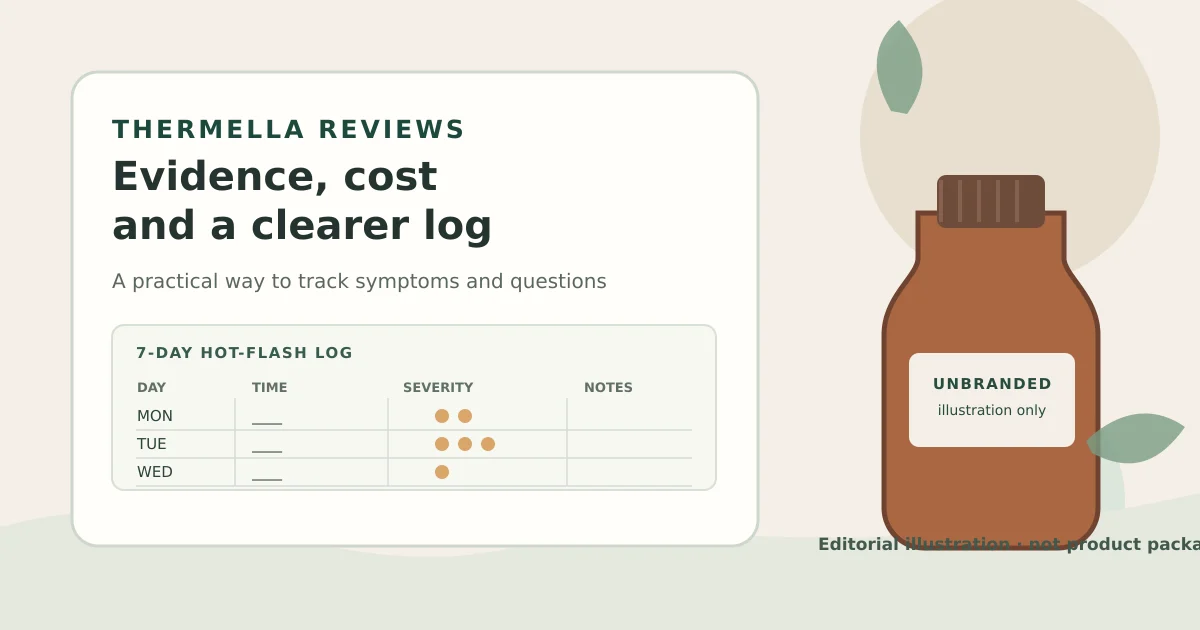
Keep a simple log
A short record turns "I think it's helping?" into something you and a clinician can actually look at. Here's a simple version you can copy onto paper or into your phone's notes. It's not a medical test or a scoring tool.
How to count, using the symptom categories described in the Thermella study:
- Mild: you feel hot but don't sweat.
- Moderate: you feel hot and sweat, but keep doing what you were doing.
- Severe: you feel hot and sweat enough that you have to stop what you're doing.
| Date | Daytime hot flashes (all) | How many were moderate or severe | Night sweats that woke you | Notes (missed dose, alcohol, stress, new medicine, heat) |
|---|---|---|---|---|
| Day 1 | ||||
| Day 2 | ||||
| Day 3 | ||||
| Day 4 | ||||
| Day 5 | ||||
| Day 6 | ||||
| Day 7 | ||||
| Average per recorded day or night |
You can record a week now and repeat later when it is useful to you and your clinician. Do not delay needed care or change treatment just to complete a log. Compare the averages, and note other changes that could affect them. Divide each column’s total by the number of days or nights actually recorded; a blank is missing information, not zero. The moderate-or-severe count is part of the daytime total, not an extra count to add. For a sense of scale: in the controlled trial, the average extra benefit over placebo was about 2 fewer hot flashes a day. Going from 10 a day to 9 is a different story than going from 10 to 4.
Want a printable version? Use the hot-flash log and clinician questions PDF. It includes four reusable weekly sheets; choose your own dates. Our HRT for hot flashes guide has more context.
When it fades, stops working or never starts
The customer reviews sampled above describe these different experiences. The Thermella studies reviewed here lasted up to 12 weeks; they do not establish what happens over a year. A few things to know:
- Don't increase the dose on your own or stack it with other hot-flash supplements. The studies reviewed here do not establish the safety or benefit of doing either.
- Changing symptoms deserve a fresh look. If you started in perimenopause and are now past your last period, or your hot flashes suddenly changed, a clinician can help sort out why.
- You don't have to "finish" three months before asking for help. If your symptoms are wrecking your sleep or your work, you can talk with a clinician any time.
- Seeing a clinician doesn't mean agreeing to hormones. You can ask about non-hormonal prescriptions too.
If you've given a hormone-free supplement a real try and you're still waking up soaked, that isn't a willpower problem. It may simply mean you need something stronger. The Menopause Society calls hormone therapy the most effective treatment for hot flashes, and FDA-approved non-hormonal medicines exist too.
Gala advertises clinician-led hormone or non-hormonal care, with an HRT offer at $69 a month including clinical review, medication and shipping. Confirm whether that price covers your exact prescription and any needed labs; its listing of a medicine does not prove every drug is included. Gala is cash-pay. Its HRT offer and linked GLP-1-titled refund policy give different payment assurances, so confirm the HRT-specific charge timing and refund terms before submitting a paid intake. See the offer and limits below.
A clinician-led care option
Start Gala's HRT assessmentThermella vs Relizen: which Bonafide hot-flash product?
Relizen and Thermella are two different Bonafide hot-flash supplements with completely different ingredients. Relizen is made from a purified Swedish flower pollen extract, while Thermella is a curcumin, green tea and spirulina blend aimed at the neurokinin B pathway. We found no head-to-head study of the two, so neither can be called better based on the evidence reviewed here.
| Thermella | Relizen | |
|---|---|---|
| Main ingredient | Curcumin extract, decaffeinated green tea extract, spirulina extract | Purified Swedish flower pollen extract (Sérélys) |
| Hormone-free | Yes | Yes |
| How it's said to work | Calms the neurokinin B "thermostat" signal | Bonafide doesn't tie it to the neurokinin pathway |
| Directions | 2 tablets once a day | 2 tablets once a day |
| Bonafide's claim | Placebo-controlled trial published in 2026 | Says 7 in 10 women reported reduced hot-flash frequency after 12 weeks in a customer survey |
| Monthly subscription | $45 | $42 |
| 3-month plan | $120 ($40/month) | $114 ($38/month) |
| 6-month plan | $210 ($35/month) | $198 ($33/month) |
| Single box | $60 + $5 shipping | $58 + $5 shipping |
Source: Bonafide Thermella and Bonafide Relizen, checked October 16, 2026. We didn't review Relizen's studies for this guide.
One woman in the Reddit discussion said Thermella worked better for her than Relizen, but she also described using another supplement. That's one person's experience, not an isolated comparison. If Relizen didn't help you, it's reasonable to wonder whether a different ingredient might — just know that Thermella's evidence is its own, not proof that it beats Relizen.
Thermella vs Veozah, Lynkuet and HRT: what changes the choice?
The real choice isn't "natural versus unnatural." It's which kind of help you need. Hormone therapy is the most effective treatment for hot flashes according to The Menopause Society, and two FDA-approved non-hormonal drugs, Veozah and Lynkuet, block the brain signal Thermella aims at. Thermella can be bought without a prescription and has a clearly listed direct-buy price. Its evidence base is smaller, and buying it does not include clinical care. Which route costs less depends on the exact medicine, visits, labs and your insurance; the raw results from separate trials do not establish Thermella's relative benefit.
| Thermella | Systemic hormone therapy (with uterine protection when needed) | Veozah (fezolinetant) | Lynkuet (elinzanetant) | |
|---|---|---|---|---|
| What it is | Dietary supplement | Specific FDA-approved systemic hormone products are available as pills, patches, gels and sprays; compounded products are not FDA-approved | FDA-approved nonhormonal prescription tablet, approved 2023 | FDA-approved nonhormonal prescription capsules, approved October 2025 |
| Prescription needed | No | Yes | Yes | Yes |
| Evidence for hot flashes | One sponsor-funded placebo-controlled trial (74 women) plus one open-label study | The most effective treatment, per The Menopause Society | Recommended by The Menopause Society (2023) | Phase 3 trials led to FDA approval |
| Monitoring | No product-specific routine test schedule established; ask your clinician what your history requires | Clinician follow-up; systemic estrogen usually needs a progestogen or another approved protective approach when the uterus is present | Boxed warning for rare serious liver injury; liver tests before treatment, monthly for the first 3 months, then at months 6 and 9, and when symptoms require | Liver tests before treatment and at 3 months; sleepiness and daytime impairment warnings, plus a seizure-risk warning |
| Who it isn't for | Evidence does not establish safety after breast cancer or with significant liver disease | Systemic treatment is generally not appropriate with certain histories such as breast cancer, clots or stroke; the exact product and history matter | Contraindicated with cirrhosis, severe renal impairment/end-stage renal disease or CYP1A2 inhibitors; prescriber checks the full list | Contraindicated in pregnancy; important drug interactions and hepatic, renal and seizure precautions require prescriber review |
| Cost | Direct subscription equivalents $35–$45 per month, with $45–$210 due upfront depending on plan; one-time and retailer costs above | Depends on the prescribed product, visits, extras and coverage. Gala advertises a $69/month HRT base; not every regimen’s total is verified | Request a current prescription quote and include visits and liver tests; coverage and out-of-pocket cost vary | Request a current prescription quote and include visits and liver tests; coverage and out-of-pocket cost vary |
Source: The Menopause Society 2023 nonhormone statement; 2022 hormone therapy statement; current Veozah prescribing information and Lynkuet prescribing information; FDA compounding questions and answers; and Gala’s HRT-specific offer. Checked October 16, 2026.
What The Menopause Society says about supplements
The Menopause Society’s 2023 non-hormone statement did not recommend supplements or herbal remedies for hot flashes based on the evidence it reviewed. It recommended cognitive behavioral therapy, clinical hypnosis, SSRIs and SNRIs, gabapentin, fezolinetant, oxybutynin, weight loss and stellate ganglion block. Thermella's controlled trial was published in 2026, after that statement, and the Society’s current position-statement index still lists the 2023 nonhormone statement as of our check. Thermella's own researchers write that major guidelines don't yet endorse any herbal or nutraceutical supplement as an evidence-based therapy.
Hormone therapy in 2026, briefly
On November 10, 2025, the FDA requested changes to menopause hormone-therapy warnings. On February 12, 2026, it announced approval of revised labeling for an initial six products, removing boxed-warning statements about cardiovascular disease, breast cancer and probable dementia. That did not mean every product’s label changed at once or that those risks disappeared.
The endometrial-cancer boxed warning remains for systemic estrogen-only products. Women with a uterus using systemic estrogen usually need a progestogen — progesterone or a related medicine — or another approved way to protect the uterine lining. Low-dose vaginal estrogen is different: it treats local vaginal/urinary symptoms, not hot flashes, and usually does not require added progestogen, as explained in The Menopause Society’s GSM statement.
For bothersome hot flashes, the benefit-risk balance of systemic hormone therapy is generally more favorable under 60 or within 10 years of menopause when there are no contraindications. That is not an automatic age-based approval. See the FDA’s labeling update, The Menopause Society’s hormone-therapy guidance, HRT benefits and risks and HRT for hot flashes.
Don't compare percentages across studies
You'll see big percentages for every option, including Thermella's 71.6% in its open-label study. Those numbers come from different women, different measures and different study designs. A percentage drop from a study with no placebo can't be lined up against one from a placebo-controlled drug trial. A well-designed head-to-head trial would give the most direct comparison. We found none for Thermella versus these options; simply lining up unadjusted percentages from separate trials is not a substitute.
When is online menopause care a better next step?
Online menopause care makes more sense than another supplement when you want a licensed clinician to look at your symptoms and history and talk through prescription options — hormonal or not. The right service depends on whether you'll pay cash or use insurance, which medicines you want to consider, your state and your health history. If you're not sure, Find My HRT Path can help you sort that out first.
Where Gala Health HRT fits
Gala is our featured option for readers who want cash-pay clinician-led menopause care online, provided its available treatment, state coverage and terms fit their needs. Here's why it earns a look from someone reading about Thermella:
- A clear advertised starting point. Gala’s HRT offer advertises $69 a month with clinician review, medication and shipping. Three monthly base charges would be $207. Compared with Thermella’s three-month subscription equivalent of $40 a month, that is a $29 monthly advertised-base difference for a different kind of help: clinician care and a prescription when appropriate. It is not an all-in comparison until the exact prescription, any labs and charge timing are confirmed.
- Hormone and non-hormonal options in one place. Gala lists estradiol pills and patches, progesterone, vaginal estradiol and non-hormonal options — its non-hormonal page names fezolinetant — for clinician consideration. The listing does not establish that a particular branded medicine is included in $69, available in your state or appropriate for you. Vaginal estradiol is a local-symptom option, not a hot-flash treatment.
- Ongoing support. Gala says provider messaging, symptom check-ins and dose adjustments are included for as long as you're treated.
- HSA and FSA cards accepted.
And here's what you should confirm before paying, because our review of Gala's public pages found gaps:
| What to check | What Gala's public pages say | What to do |
|---|---|---|
| Care model | A U.S.-licensed clinician reviews your online assessment and builds a plan; messaging included | Expect an intake form, not a quick checkout. A clinician decides whether any treatment is right for you. |
| Medication type | Gala's main FAQ says it prescribes FDA-approved bioidentical forms; one of its HRT landing pages also carries a notice about compounded medications | Ask which exact product you'd receive and whether it's FDA-approved or compounded. "Bioidentical" alone doesn't tell you. |
| Price | $69/month advertised on the HRT-specific offer | Confirm the amount due now, recurring interval, minimum commitment, exact medication(s), labs or other extras, and whether a brand drug such as Veozah is included. A required unknown cost makes the total incomplete. |
| Access | Public materials describe adults and “most U.S. states”; a complete HRT-specific state list and age range were not verified | Check age/state service availability before paying; do not assume a listing means your preferred prescription is available. |
| Billing and refunds | The HRT offer gives no-charge-if-unavailable and cancel-anytime assurances. Its linked refund policy is titled for Gala GLP-1 and describes intake charging, a medical-disqualification refund and 72-hour cancellation notice | Ask which agreement governs HRT, when the first charge happens, what is refundable and when cancellation takes effect. We could not confirm that the GLP-1 policy governs an HRT order. |
Source: Gala hormone health, HRT-specific $69 offer, HRT landing page with compounded-drug notice, Gala non-hormonal options and linked refund policy, checked October 16, 2026; our full Gala Health HRT review, last verified October 2026.
"Gala's provider walked me through the options and I started HRT." — Allison, 51, testimonial published on Gala's hormone-health page. Not independently verified; individual experiences vary.
If you're ready for a clinician-led conversation instead of another supplement, and cash-pay care suits you, Gala is worth exploring. Confirm the exact medicine, your total and the HRT-specific terms before you pay.
A clinician-led care option
Start Gala's HRT assessmentWhen you want to use insurance
Gala doesn't bill insurance. If you'd rather use your plan, Midi Health says it's in-network with most major insurance plans, mostly PPO plans, and has a coverage checker where you enter your state and plan. Midi's self-pay prices are $250 for a first visit and $150 for a returning visit — visit prices only, before any medication. Midi says it is out of network with Medicare, accepts self-pay Medicare patients, and that those patients cannot submit claims to Medicare for its visits or related medications and services; clarify that restriction with Midi and your plan before booking. It does not accept Medicaid. Your own gynecologist or primary care clinician is another good option, and The Menopause Society keeps a directory of certified menopause practitioners.
Check your insurance coverage with Midi
Source: Midi pricing and insurance, checked October 16, 2026. For more insured options, see our full comparison of online HRT providers.
How we reviewed Thermella
This is a documentation-based review, not a product test or medical consultation. We read the company’s pages and policies, both published Thermella studies and their registry records, independent safety sources and a sample of customer reviews. We checked consequential claims against primary evidence and labeled company claims, conflicting numbers and details we could not establish.
We separate three kinds of information on this page:
- Medical and regulatory facts — from published studies, the FDA, the NIH and The Menopause Society.
- Company statements — from Bonafide's and Gala's own pages, labeled as theirs.
- Our editorial judgment — clearly marked as "our read" or "our verdict."
We apply The HRT Index Verification Standard using the same five public decision pillars in the same order. They group the more detailed criteria in our site methodology; this documentation review does not assign a score:
| Pillar | How we applied it here |
|---|---|
| Clinical legitimacy | Separated supplement from drug; read study designs, sizes, comparison groups and funding; used FDA labeling for prescription claims. |
| Care quality | Distinguished product support from ongoing menopause clinical care and from the separate HSA/FSA qualification review. |
| Medication fit | Listed exact ingredients and amounts; showed who was and wasn't studied; flagged interactions and liver questions. |
| Price transparency | Showed money due now, renewal amounts, supply, shipping, unknowns and return limits. |
| Access | Separated store availability from clinician rules; labeled anything we couldn't verify. |
We do not assign Thermella a star rating or numerical score in this review. We didn't buy or take Thermella, and no clinician reviewed this page. We'll recheck prices monthly and the full page at least every three months, and sooner if new research or policy changes come out. Read our methodology and affiliate disclosure. If you spot something out of date, email partners@thehrtindex.com.
Your before-you-buy (or before-you-book) checklist
You don't have to solve every menopause question today. You just need enough information to pick one good next step, without mistaking a product promise, a subscription discount or a featured provider for medical advice.
| Question | What to write down | If you're not sure |
|---|---|---|
| What problem am I trying to change? | Your 7-day hot flash and night sweat average, and what bothers you most | Bring your log to a clinician. |
| Was someone like me studied? | Your row in the who was studied table | Ask your clinician or pharmacist. |
| What exactly am I buying? | Product, tablets per day, supply, label | Read the full label or ask a pharmacist. |
| What's due today, and when is the next charge? | Checkout total and processing date | Don't rely on the monthly equivalent — use the receipt. |
| What if I stop? | Cancel deadline (5 business days before processing), return rules (unopened only) | Check the seller's terms before paying. |
| Does my health history change the plan? | Your medicines, supplements and conditions | Your clinician or oncology team first. |
Still sorting out the care side? The free Find My HRT Path quiz asks about your symptoms, what you've tried, your age, your state and your health history. Then it shows a featured care option to explore based on your answers, or guidance when online care is not the right place to start. A clinician still needs to review medical suitability.
Care navigation
Find My HRT Path — freeThermella reviews FAQ
Is Thermella FDA-approved?
No. Thermella is a dietary supplement, and the FDA doesn't approve supplements for safety or effectiveness before they're sold. Being made in an FDA-registered facility is not the same as FDA approval. Veozah and Lynkuet are FDA-approved prescription drugs for menopause hot flashes.
Is Thermella the same as Veozah?
No. Both aim at the neurokinin pathway that triggers hot flashes, but Veozah is an FDA-approved drug tested in large trials, and it carries a boxed warning about rare liver injury. Thermella is a supplement tested in two sponsor-funded studies, and we found no direct comparison of the two.
Does Thermella help with weight loss?
There's no evidence that it does. Neither study reported weight loss as a result, and Bonafide doesn't market it for weight. If weight is your main concern, see our menopause weight care guide.
Does Thermella help with vaginal dryness or low libido?
The evidence we reviewed doesn't show it. Those are separate concerns with their own treatments. For vaginal dryness and related local symptoms, low-dose vaginal estrogen is one well-studied option; it is not a general treatment for low libido or hot flashes. See our vaginal estrogen guide.
Can I take Thermella with HRT or another hot-flash medicine?
That's a question for your clinician or pharmacist. Both studies excluded women using HRT, SSRIs or SNRIs, gabapentin, fezolinetant or other menopause supplements, so those combinations haven't been tested.
Does Thermella have caffeine?
A little. Bonafide says a serving contains less than 5 mg of naturally occurring caffeine from the decaffeinated green tea extract. Decaffeinated does not mean caffeine-free.
Can I take it at night?
Bonafide's label says two tablets once a day, with or without food. In the controlled trial, women took it in the morning with food. If timing matters to you because of other medicines, ask your pharmacist.
Is Thermella safe after breast cancer?
We don't know. Women with any history of breast cancer were excluded from the controlled trial, and a hormone-free label doesn't answer that question for your history and medicines. Start with your oncology team and read our breast cancer section.
Does Thermella help night sweats?
The studies counted night sweats along with hot flashes, and the open-label study reported fewer night sweats. But the controlled trial did not find a statistically significant overall sleep-quality advantage over placebo, even though hot-flash-related sleep interference improved. If night sweats are what wake you up, fewer of them may help.
Where is Thermella cheapest?
Among the regular prices checked here, Bonafide’s six-month plan has the lowest advertised daily equivalent, about $1.17 using 180 days of supply, but costs $210 upfront. Amazon’s $44.99 option covered 28 days, not 30; its 30-day listing showed offers from $48.99. Target’s 30-day listing was $47.99. Check the selected pack, seller, shipping and tax before choosing.
Can I get my money back if Thermella doesn't work?
Usually not once it's opened. Bonafide accepts returns only on unopened, sealed products — within 30 days for first orders and 14 days for refills — minus a $7 shipping fee.
Is Thermella HSA or FSA eligible?
Possibly. Bonafide works with Truemed, which uses a health survey and a licensed provider's review to decide if your order qualifies. If it does, you get a letter of medical necessity. Approval isn't guaranteed.
Who makes Thermella?
Bonafide Health, LLC, based in Harrison, New York. Its research papers describe Bonafide as a subsidiary of Pharmavite.
What if I'm still having periods?
The controlled trial allowed a last period at least six months earlier, but all enrolled women were at least 12 months past their final period. The open-label study included perimenopausal women and reported similar changes, but without a placebo group. Pregnancy is still possible in perimenopause, and NCCIH says turmeric supplements may be unsafe in pregnancy.
Sources
The sources used below were checked on October 16, 2026; abstracts, full-text access and other limits are labeled where relevant.
Thermella research
- Lederman S, et al. Neurokinin pathway botanical antagonist for menopausal vasomotor symptoms: a randomized, double-blind, placebo-controlled study. Maturitas. 2026;211:109023. Full paper and PubMed abstract (full text, tables and disclosures read)
- ClinicalTrials.gov. NCT05813067: Herbal Nutraceutical Supplementation on Vasomotor Symptoms in Menopausal Women.
- ClinicalTrials.gov. NCT07408115: Herbal Dietary Supplementation on Vasomotor Symptoms in Menopausal Women (open-label study; public record first posted February 12, 2026).
- Lederman S, et al. Standardized botanical blend for vasomotor and nonvasomotor menopause symptoms: a decentralized open label trial. Women's Health Reports. First published online October 15, 2026. doi:10.1177/26884844261497587 (full text read)
- Buntoonprayuk J, et al. Curcuminoid supplementation for vasomotor symptoms in postmenopausal women: a pilot randomized trial. BMC Complementary Medicine and Therapies. 2026. PubMed and publisher results/funding disclosures
Company and retailer pages
- Bonafide: Thermella product page, clinical trials, Thermella clinical trials, returns, terms and conditions, Relizen
- Target Thermella listing and reviews
- Amazon Thermella listing and pack variants
- Reddit discussion (reader language and objections only, not clinical evidence)
Safety and regulation
- NCCIH. Turmeric: Usefulness and Safety (updated April 2025)
- NCCIH. Green Tea: Usefulness and Safety (updated February 2025)
- Oketch-Rabah HA, et al. United States Pharmacopeia comprehensive review of the hepatotoxicity of green tea extracts. Toxicology Reports. 2020. PubMed
- Hussaarts KGAM, et al. Impact of curcumin (with or without piperine) on the pharmacokinetics of tamoxifen. Cancers. 2019. PubMed
- Braal CL, et al. Influence of green tea consumption on endoxifen steady-state concentration in breast cancer patients treated with tamoxifen. Breast Cancer Research and Treatment. 2020. PubMed
Treatment guidance and prescription drugs
- The Menopause Society (formerly NAMS). The 2023 nonhormone therapy position statement. Menopause. 2023;30(6):573-590. PubMed
- The Menopause Society. 2022 hormone therapy position statement (abstract) and current position-statement index.
- The Menopause Society. 2020 genitourinary syndrome of menopause position statement (abstract; low-dose vaginal estrogen and progestogen distinction).
- Current approved Lynkuet prescribing information on DailyMed and label PDF.
- Current approved Veozah prescribing information on DailyMed and label PDF.
- Cardoso F, et al. Elinzanetant for Vasomotor Symptoms from Endocrine Therapy for Breast Cancer. New England Journal of Medicine. 2025;393:753–763. PubMed abstract.
- FDA. Menopausal hormone therapy labeling changes; February 12, 2026 approval announcement.
- FDA. Dietary supplements; compounding questions and answers.
Care providers
- Gala Health: hormone health, HRT-specific offer, HRT page with compounded-medication notice, non-hormonal options, linked GLP-1-titled refund policy (HRT applicability not confirmed).
- Midi Health: pricing and insurance
Educational content only. Not medical advice. The HRT Index is not a healthcare provider, pharmacy or telehealth service. Talk with a licensed clinician before starting, stopping or combining treatments, supplements or medicines.