
Climara vs Vivelle-Dot: Size, Schedule, and What You Can Actually Get in 2026
By The HRT Index Editorial Team. Last verified: July 10, 2026. Editorial research. Not medical advice. This page has not been reviewed by a clinician.
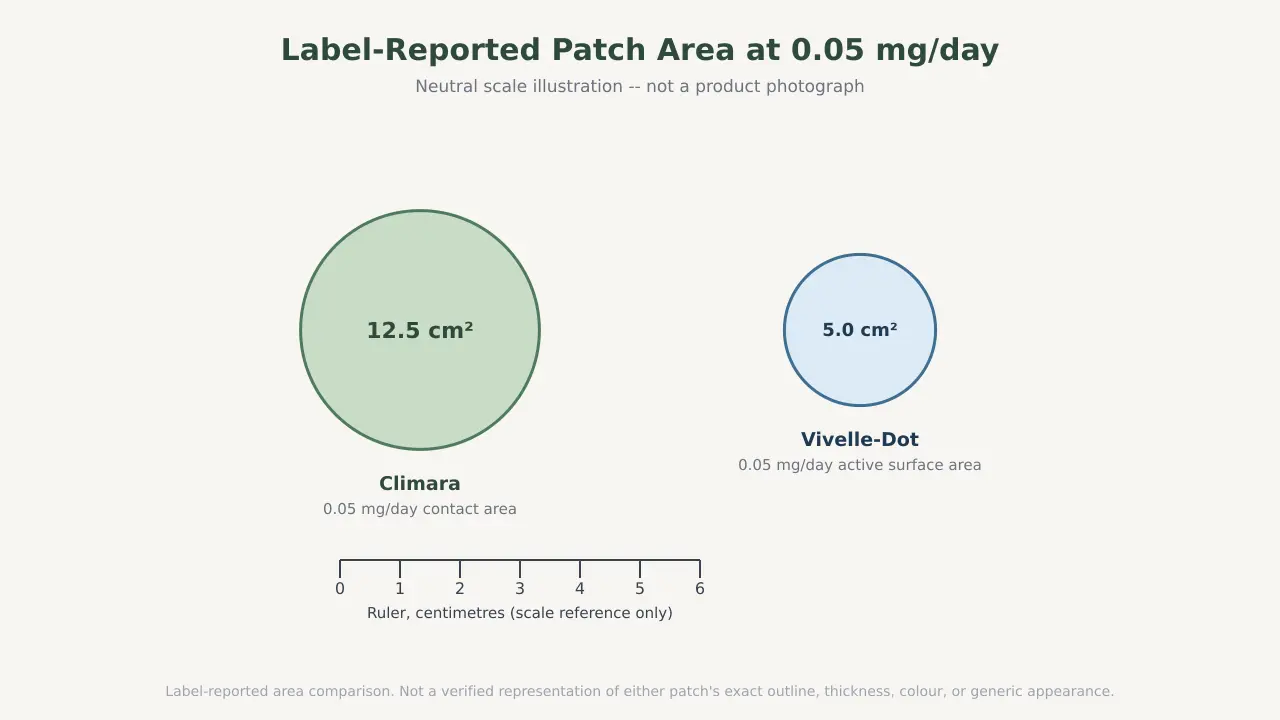
Label-reported area comparison. Not a product photograph, and not a verified representation of either patch's exact outline, thickness, colour, or a generic manufacturer's appearance.
Climara vs Vivelle-Dot is mainly a trade between patch size and how often you change it. Climara is worn seven days and comes in six strengths. Vivelle-Dot is changed twice a week and is about 60% smaller at every matching strength. No trial has established which one relieves menopause symptoms better. Your skin, your dose, your coverage, and what your pharmacy can actually get will decide it.
That's the honest headline. Now the part almost nobody tells you.
There is one head-to-head study of these two patches. It didn't measure hot flashes — it measured skin. Both labels disagree about water. One patch makes a dose the other doesn't. And in July 2026, the two authorities that track drug supply in this country don't agree on whether there's a shortage at all.
Here's all of it, checked against the labels themselves.
Some links on this page are affiliate links. No provider paid for inclusion, ranking, or the conclusions below. Disclosed links may earn us a commission at no extra cost to you.
Best for you / not for you
| Climara is probably your patch if… | Vivelle-Dot is probably your patch if… |
|---|---|
| You want to think about it once a week | You want the smallest patch on your body |
| You're prescribed 0.06 mg/day — it's the only one that makes it | Skin redness under the patch is your main complaint |
| You want the product ASHP currently lists as available in every strength | You want the product whose instructions specifically address showering |
| A larger patch on your abdomen doesn't bother you | You'd rather rotate skin sites more often |
Neither one is your patch yet if:
You still have a uterus and haven't discussed a progestogen (the second hormone used to protect the lining of the uterus). Or if you have unexplained vaginal bleeding, or a history of breast cancer, another estrogen-driven cancer, blood clots, stroke, heart attack, liver disease, or a clotting disorder. Both labels list these. Bring that list to a clinician before you fill anything.
And if vaginal dryness or painful sex is your only symptom — stop here. Both labels say to consider a topical vaginal product first. A whole-body patch may be the wrong tool for a local problem. Read our vaginal estrogen guide instead.
What we actually verified
On July 10, 2026, we opened and read:
- The current Climara prescribing information on DailyMed (Bayer HealthCare Pharmaceuticals; label revision 12/2023; DailyMed record updated March 26, 2026).
- The current Vivelle-Dot prescribing information and Instructions for Use on DailyMed (Noven Pharmaceuticals for Sandoz Inc.; Initial U.S. Approval: 1996).
- Ibarra de Palacios P, et al. “Comparative study to evaluate skin irritation and adhesion of Estradot and Climara in healthy postmenopausal women.” Climacteric. 2002 Dec;5(4):383–9. PMID 12626218.
- Noven Pharmaceuticals' SEC Form 10-K, confirming that Estradot and Vivelle-Dot are the same DOT Matrix patch under different names.
- The FDA's announcements of November 10, 2025 and February 12, 2026 on menopausal hormone therapy labeling.
- The ASHP Drug Shortage Detail record for Estradiol Transdermal System, updated July 1, 2026.
- Midi Health's published pricing and insurance page, and Sesame's published estradiol page.
What we did not do: We have not worn either patch. We ran no study. No provider paid for inclusion or influenced our conclusions.
Product specifications come from the two current labels. The direct-comparison figures come from the 2002 study. Supply status comes from ASHP. Prices and provider policies come from the named sources, on the date shown. The area-difference and yearly-application calculations are our own arithmetic, and we show the math.
The HRT Index is the independent decision resource for online menopause and HRT care — comparing telehealth providers on clinical legitimacy, care quality, medication fit, price transparency, and access, with every claim verified and dated, so women can choose the path that fits their situation before their first consult.
Climara vs Vivelle-Dot: what's the bottom line?
Climara and Vivelle-Dot are both FDA-approved estradiol transdermal systems— patches that deliver 17β-estradiol, the same estrogen a premenopausal ovary makes, through the skin. Both labels carry the same four indication categories. No trial has established which product relieves menopause symptoms better. One direct study did compare them for skin irritation, adhesion, and estradiol delivery, and it favored the smaller patch on irritation.
Here's the honest version in one line:
Pick Vivelle-Dot for the smaller patch and less skin redness. Pick Climara for fewer changes and the strength you can currently fill. Then let your skin and your pharmacy break the tie.
Both labels contain the same four indication categories: moderate-to-severe hot flashes and night sweats; moderate-to-severe vulvar and vaginal atrophy symptoms; certain causes of low estrogen; and prevention of postmenopausal osteoporosis. Each is subject to that product's own limitations. Read the label you're handed.
The right online HRT provider isn't the same for every woman
It depends on your symptoms, what you have tried so far, your age, your state and your health history. Some situations belong with an in-person clinician first. Because a general answer can't resolve those for you, use The HRT Index's Find My HRT Path tool to match your situation to the right provider — and to flag when online care isn't the right starting point — before your first consult.
What's actually different between the two patches?
At the same 0.05 mg/day strength, Climara's label-reported contact area is 12.5 cm² and Vivelle-Dot's label-reported active surface area is 5.0 cm². The Climara system contains 3.8 mg of estradiol; the Vivelle-Dot system contains 0.78 mg. Climara is worn seven days and comes in six strengths. Vivelle-Dot is replaced twice weekly and comes in five.
The comparison pages we reviewed all say Vivelle-Dot is “smaller.” None of them said by how much.
So we pulled both labels and built the table.
Table 1 — Patch area and estradiol content, strength by strength
| Dose (mg/day) | Climara area | Estradiol in Climara | Vivelle-Dot area | Estradiol in Vivelle-Dot | Relative area diff. |
|---|---|---|---|---|---|
| 0.025 | 6.5 cm² | 2.0 mg | 2.5 cm² | 0.39 mg | 62% smaller |
| 0.0375 | 9.375 cm² | 2.85 mg | 3.75 cm² | 0.585 mg | 60% smaller |
| 0.05 | 12.5 cm² | 3.8 mg | 5.0 cm² | 0.78 mg | 60% smaller |
| 0.06 | 15 cm² | 4.55 mg | not made | — | — |
| 0.075 | 18.75 cm² | 5.7 mg | 7.5 cm² | 1.17 mg | 60% smaller |
| 0.1 | 25.0 cm² | 7.6 mg | 10.0 cm² | 1.56 mg | 60% smaller |
Areas and estradiol content are quoted from each product's current FDA-approved label. The relative area difference is our calculation. Climara reports contact surface area, Vivelle-Dot reports active surface area. These figures do not establish the exact outline, backing dimensions, thickness, or appearance of the patch you'll be handed.
Look at the 0.05 row. Same daily dose. Climara covers two and a half times more skin and holds roughly 4.9 times more estradiol.
Climara is a seven-day adhesive-matrix system. Vivelle-Dot is replaced every three to four days. The labels state the wear periods and the drug content. They don't spell out a single cause for the design difference — though a patch that has to keep releasing for a full week needing a larger drug load is the obvious reading, and that reading is ours, not the label's.
A smaller patch is not a weaker patch. Both deliver the labeled amount per day. Size tells you what shows under your waistband. It tells you nothing about how well the medicine works.
Ready to ask a clinician which strength and schedule fit you?
Midi bills most PPO plans and prescribes FDA-approved patches, gels, and sprays. Sesame lets you pick your own clinician and pay a transparent per-visit price.
Both affiliate links, disclosed. Neither guarantees Climara or Vivelle-Dot specifically — the prescribing clinician decides.
The glue is different, and that turns out to matter
If you've peeled off a patch and found an angry red square underneath, this is the section you came for.
The two products use different adhesive systems. Straight from the labels:
| Climara | Vivelle-Dot | |
|---|---|---|
| Backing film | Polyethylene | Polyolefin |
| Adhesive | Acrylate copolymer | Acrylic and silicone adhesives |
| Other inactive ingredients | Fatty acid esters | Oleyl alcohol, povidone, dipropylene glycol |
| Layers | 3 | 3 |
Vivelle-Dot's silicone-and-acrylic blend is Noven's DOT Matrix technology — the design that made the world's smallest estrogen patch possible.
If one patch irritated your skin, the other one is not the same glue. That gives your clinician and pharmacist a specific, physical difference to look at. It does not predict how your skin will respond. Take the ingredient list with you if you have a known sensitivity to something on it.
What Climara's label doesn't say — and what the one head-to-head study found
Read this before you trust anything else we tell you.
Climara does NOT have water data or complete adhesion data. Its label says swimming, bathing, and sauna use have not been studied, and that these activities may reduce both how well the patch sticks and how much estradiol it delivers. It goes further: adhesion was formally studied for only two of six sizes — the 6.5 cm² and 12.5 cm² systems. For the 18.75 cm² and 25 cm² patches (0.075 and 0.1 mg/day), the label states adhesion potential has not been studied at all.
And in the only direct comparison we found, Climara caused more skin redness than the smaller patch. We'll give you those numbers in full, including who funded the study, two sections down.
If skin reactions or the water are your priority, Vivelle-Dot is the better-documented product, and you should say exactly that to your prescriber. Start with our once-weekly vs twice-weekly estradiol patch guide before your consult.
But because Climara runs for seven days, it's the only one of the two that asks for one decision a week instead of two. For a woman whose actual problem is remembering — and that is most women — that is the whole game. It is also, right now, the one product ASHP lists as available in every strength. We'll show you that record too.
Do Climara and Vivelle-Dot come in the same strengths?
Climara and Vivelle-Dot share five strengths: 0.025, 0.0375, 0.05, 0.075, and 0.1 mg/day. Climara makes a sixth — 0.06 mg/day — that Vivelle-Dot does not. A woman prescribed Climara 0.06 mg/day has no matching strength on Vivelle-Dot, so a clinician must choose a different product, strength, or regimen.
This is the most decision-changing fact on the page.
Five strengths overlap. On 0.05 mg/day? There's a 0.05 mg/day version of both.
One doesn't. Climara makes a 15 cm² system delivering 0.06 mg/day. Vivelle-Dot's ladder runs 0.05, then 0.075. Nothing in between.
So if you're on Climara 0.06 and someone hands you a twice-weekly patch, something about your dose changed. That's not a substitution. That's a new prescribing decision, and you deserve to know it was made and why.
“Vivelle-Dot has no 0.06 mg/day. What exact product, strength, and schedule are you giving me instead, and why that one?”
Don't assume the next number up or down is the right answer. Your clinician may reach for a different formulation entirely.
What the number on the box does and doesn't mean
“0.05 mg/day” is a nominal delivery rate — the amount the patch is designed to release per day. The same number on two boxes does not make the boxes interchangeable. Different area. Different adhesive. Different wear time. Different instructions.
One more thing worth knowing: Vivelle-Dot's label directs starting therapy at 0.0375 mg/day for hot flashes and for vulvar and vaginal atrophy, with adjustment guided by how you respond. The two products don't necessarily put you on the same rung to begin with.
Once a week or twice a week — which is easier to live with?
Climara is replaced once every seven days. Vivelle-Dot is replaced twice weekly, every three to four days. Across 52 uninterrupted weeks that is roughly 52 scheduled applications versus roughly 104. Neither schedule has been shown to control menopause symptoms better than the other.
52 versus 104. That's arithmetic on the labeled schedules, not a label claim — and it's the number that shapes your year.
For some women, 52 is the entire argument. One reminder. Sunday morning. Done.
For others, twice-weekly is better. They'd rather not wear one sticker for a full week. They like moving it more often.
That calculation describes how often you apply adhesive. It does not establish which product irritates your skin less — each Climara system covers more area and stays put longer, and those cut against each other. The direct study, below, has more to say about that than any arithmetic can.
Real prescriptions also run cyclic or interrupted schedules. Your count may differ.
Not sure which online care path fits your situation?
That's a different question from which patch is smaller. It turns on your symptoms, what you have tried, your age, your health history, and your state — and no article can resolve those for you.
Get your personalized action plan with Find My HRT Path →Free. About 90 seconds. It routes you to a care path and flags when online care isn't the right starting point. It does not evaluate or recommend a dose — only a clinician can do that.
Which patch sticks better, and which irritates skin less?
A 2002 randomized, open-label, intrapatient study directly compared the 5 cm² patch (Estradot, sold in the United States as Vivelle-Dot) with the 12.5 cm² Climara patch at 0.05 mg/day in 100 healthy postmenopausal women. Very slight redness occurred with 21.4% of the smaller patches and 32.3% of the larger ones, a statistically significant difference. More small patches held above 90% adherence — 87.5% versus 82.0% — but that difference was not statistically significant. Both patches delivered estradiol reproducibly.
We told you earlier that we'd give you the numbers. Here they are, along with everything that's wrong with them.
The one direct comparison
Published in Climacteric in December 2002 by Ibarra de Palacios and colleagues. One hundred healthy postmenopausal women wore both patches at the same time, on the same body, for seven days.
| Outcome | 5 cm² patch (Estradot / Vivelle-Dot) | 12.5 cm² patch (Climara) |
|---|---|---|
| Very slight redness | 21.4% of applications | 32.3% of applications (p = 0.0028) |
| Overall redness score | 0.22 | 0.41 |
| Patches holding >90% adherence | 87.5% | 82.0% (not statistically significant) |
| Patches that came off completely | 0.5% | 3.0% |
| Estradiol delivery | Reproducible | Reproducible |
Estradot is Vivelle-Dot. Noven's own SEC filing confirms it licensed Novartis to sell Vivelle-Dot under the Estradot name outside the United States, Canada, and Japan. Same DOT Matrix patch.
Now the four things you need to know about that study
We are handing you the limitations because you can't judge the numbers without them.
- Novartis paid for it. The lead author's affiliation is Novartis Pharma AG — and Novartis was the company selling the smaller patch. A study funded by the maker of the product that wins is not fraud, but it is a thumb on the scale. Weigh it accordingly.
- The small patch was worn twice as long as it's meant to be. Both patches stayed on for seven days. Vivelle-Dot's labeled wear is three to four. It held anyway, which is interesting — but that's not how you'll use it.
- It was open-label. Everyone knew which patch was which.
- It never measured hot flashes. Not once. It measured skin and adhesion and blood levels. So there is still no evidence that either patch relieves menopause symptoms better. Anyone who tells you otherwise is guessing.
What survives all four caveats: at 0.05 mg/day, the smaller patch caused less redness, and the difference on redness was statistically significant. The adhesion difference was not.
The two label studies, which cannot be ranked against each other
Each company also ran its own adhesion testing. These are useful, and they are not a head-to-head.
| Climara | Vivelle-Dot | |
|---|---|---|
| What was studied | Placebo patches | The product itself, across 3 short-term trials |
| Observations | 1,654, in 112 women aged 45–75 | 471 |
| Wear period measured | 7 days | 3.5 days |
| Which sizes | Only 6.5 cm² and 12.5 cm² | ~80% were the 0.05 mg/day system |
| Result | ~90% of observations showed essentially no lift | 85% adhered completely through wear |
| Came off completely | ~5% of systems | 3%, reapplied or replaced |
| Sizes with no adhesion data | 18.75 cm² and 25 cm² | — |
Why 90% versus 85% is not a score. One used placebo patches. The other used the real thing. One measured over seven days, the other over 3.5. They counted different events. Lining them up and crowning a winner would be like timing one runner over a mile and another over 800 meters.
So we don't. We show you what each company tested — and what neither of them bothered to.
What both labels tell you to do
- Clean, dry skin. No lotion, no oil, no powder.
- Never on or near the breasts.
- Avoid the waistline. Tight clothing rubs patches off.
- Press firmly for about 10 seconds, especially the edges.
- Rotate sites. Wait at least a week before reusing one.
- Do not cut a patch to change your dose. Neither label provides instructions or data for cut-patch dosing.
If a patch falls off
Both labels agree on the thing that matters: stay on your original schedule.
- Climara: reapply it in a different spot. If it won't stick, apply a new system for the remainder of the seven-day interval. Wear only one at a time.
- Vivelle-Dot: reapply the same system, or apply a new one to another location. Either way, continue the original schedule.
You don't restart. You don't double up.
Can you shower, swim, or use a sauna with either patch?
Vivelle-Dot's FDA-approved Instructions for Use state that showering will not cause the patch to fall off. They do not make an equivalent statement about swimming, bathing, heavy sweating, or sauna use. Climara's label states that swimming, bathing, and sauna use have not been studied, and that these activities may decrease adhesion and estradiol delivery.
This is the sentence-level difference nobody publishes. Read it precisely, because precision is the whole point.
| Water and heat | |
|---|---|
| Climara | Swimming, bathing, and sauna use were not studied. The label says they may decrease adhesion and estradiol delivery. |
| Vivelle-Dot | The Instructions for Use say showering will not cause the patch to fall off. Swimming, bathing, sweating, and sauna use are not addressed. |
Three things follow, and all three are useful:
“Not studied” does not mean “falls off.” Plenty of women swim in a Climara patch. Bayer just never tested it, so Bayer won't promise it — and we won't promise it on Bayer's behalf.
“Not addressed” is not reassurance either. Vivelle-Dot's instructions cover showering. They say nothing about laps in a pool or twenty minutes in a sauna. Silence is not a green light.
So if you're in the water often, neither label answers you. One addresses showering. One warns you off. That gap is worth naming out loud at your appointment — it's a better argument than “I heard it sticks better,” because it's true, and it's in writing.
Where does each patch go on your body?
Climara is applied to a clean, dry area of the lower abdomen or the upper quadrant of the buttock. Vivelle-Dot is applied to a clean, dry area of the lower abdomen or the buttocks. Neither is applied to the breasts, and both labels direct users to avoid the waistline and to rotate application sites.
Small differences worth knowing:
| Climara | Vivelle-Dot | |
|---|---|---|
| Where | Lower abdomen, or upper quadrant of the buttock | Lower abdomen or buttocks |
| Never | On or near the breasts | On the breasts |
| Press for | About 10 seconds, with your fingers | About 10 seconds, with your palm |
| Also avoid | Areas where sitting would dislodge it; oily, damaged, or irritated skin | The waistline; oily, damaged, or irritated skin |
| Rotate sites | Yes | Yes — at least one week before reusing a site |
Climara's label specifically warns against spots where sitting would knock it loose. That's a small, practical instruction, and it's the kind of thing that gets skipped when someone paraphrases a label instead of reading it.
Do Climara and Vivelle-Dot have different side effects?
Both products carry the same boxed warning topics and substantially overlapping warnings and contraindications, because both deliver systemic estradiol. Their labels list common adverse reactions from different clinical programs, so those percentages cannot be compared to each other. The one direct comparison of the two patches found significantly less skin redness with the smaller 5 cm² system at 0.05 mg/day.
Two categories, and people mix them up constantly.
Whole-body effects come from the estrogen. Both labels list headache and breast tenderness among the most common. Vivelle-Dot's label also lists nasopharyngitis, sinusitis, sinus headache, upper respiratory tract infection, back pain, and depression among reactions occurring in 10% or more of users. Climara's label reports its own adverse-reaction table from its own trials.
Those two tables came from different clinical programs. Different populations, different designs, different reporting. We're not going to line them up and hand you a winner. Nobody honestly can.
Skin effects come from the patch itself — and here, for once, there is a real head-to-head. In the 2002 study above, at the same 0.05 mg/day dose, the smaller patch produced very slight redness in 21.4% of applications versus 32.3% for the larger one. That difference was statistically significant. Overall redness scores were 0.22 and 0.41.
So: if your complaint is estrogen side effects, switching brands is unlikely to be the fix — talk about dose and route. If your complaint is the square of angry skin, the smaller patch has the only evidence in its favor. Say so out loud.
Do Climara and Vivelle-Dot still have a boxed warning?
Yes. As of July 10, 2026, the current labels for both Climara and Vivelle-Dot still carry boxed warnings. The FDA requested class-wide labeling changes for menopausal hormone therapy on November 10, 2025, and approved revised labels for a first group of six products on February 12, 2026. Neither estradiol patch was in that group.
You have almost certainly read that the FDA “removed the black box warning from HRT.”
That headline is real. Applied to these two patches, it is not yet true.
November 10, 2025. The FDA requested labeling changes — removing cardiovascular disease, breast cancer, and probable dementia language from the boxed warning. The agency also said it was not seeking to remove the endometrial cancer boxed warning for systemic estrogen-alone products.
February 12, 2026. The FDA approved the first six revised labels:
- Prometrium (progesterone capsules)
- Divigel (estradiol gel)
- Cenestin (synthetic conjugated estrogens, A)
- Enjuvia (synthetic conjugated estrogens, B)
- Estring (estradiol vaginal ring)
- Bijuva (estradiol/progesterone capsule)
No estradiol patch is on that list.
July 10, 2026, when we checked. Climara's live DailyMed label — record updated March 26, 2026, revision date 12/2023 — still opens with its boxed warning covering endometrial cancer, cardiovascular disorders, probable dementia, and breast cancer. Vivelle-Dot's current label likewise still carries its boxed warning and still cites the Women's Health Initiative stroke and blood-clot findings and the WHI Memory Study dementia findings.
What this means, and what it doesn't
A class-wide FDA request does not by itself revise an individual product's approved labeling. Until the FDA approves a revised label for that product, the current label is the controlling document. For these two patches, the current label still has a boxed warning on it.
FDA's review looked at two WHI studies — estrogen plus progestin in women with a uterus, and estrogen alone in women without one — along with later literature and public input. Neither study tested Climara against Vivelle-Dot. The FDA's requested labeling adds language about starting therapy in women under 60, or within ten years of menopause onset. Whether that applies to you is a conversation with a clinician, not a conclusion you can draw from a press release.
And practically: if you pick up your refill next month and the paper insert still carries a black box, nothing has gone wrong. That is the current, correct, FDA-approved label.
We re-check this monthly. When it changes, this page changes, and the date at the top changes with it.
Do Climara and Vivelle-Dot work the same?
Both are FDA-approved systemic estradiol patches sharing the same four indication categories. No trial has been identified that establishes either as more effective for menopause symptoms. Climara's label cautions that comparing serum estrogen concentrations across different estrogen products may not validly predict an individual woman's efficacy or safety.
You'll find blood-level charts on other sites. Numbers like “Cavg 41 pg/mL.” They look rigorous. They're being used badly.
Here's why, in the manufacturer's own words. Climara's prescribing information states that a serum estrogen concentration does not predict an individual woman's therapeutic response, and that exposure comparisons across different estrogen products may not be valid for inferring efficacy or safety.
Read that again. The company that makes Climara is telling you not to do the exact thing that competing pages do with Climara's numbers.
Both labels report pharmacokinetic data from their own studies, using different designs. Neither was built to be laid alongside the other.
We had those numbers. Publishing them as a scoreboard would have made this page look more authoritative and been less true. So there's no scoreboard.
What we searched, so you can check us
We searched PubMed and the two current labels for a trial comparing Climara and Vivelle-Dot on menopause-symptom relief. We found one direct comparative trial — the 2002 skin-and-adhesion study above. It measured local tolerability, adhesion, and estradiol delivery. It did not measure hot flashes, night sweats, sleep, or any symptom outcome. If a symptom-efficacy trial exists, we did not find it, and we'd like to know. Tell us.
What actually answers your question
Not a chart. A notebook.
Track your symptoms, your application days, skin response, edge lifting, any bleeding, and — this one matters — which manufacturer's patch you were actually dispensed. Do it through whatever follow-up interval your clinician sets.
That log will tell you more about your body than every comparison table on the internet. Including ours.
Can you actually get either patch right now?
As of ASHP's July 1, 2026 update, estradiol transdermal systems are listed in shortage. Bayer's Climara is listed as available in all six strengths. Sandoz's once-weekly patches are on allocation at two strengths and on back order at four, with no estimated release date. Noven's product, distributed by Grove Pharmaceuticals, is on intermittent back order. The FDA, using different criteria, has not added estradiol patches to its official shortage database.
We said at the top that something non-clinical was deciding this. Here it is.
Two authorities. Two answers.
ASHP — the American Society of Health-System Pharmacists, whose bulletins are prepared by the University of Utah Drug Information Service — lists estradiol transdermal systems in shortage.
The FDA has not. As reported by CNBC in June 2026, an FDA spokesperson said estradiol patches are not currently in shortage and that manufacturers report producing at full capacity. As reported by NBC News in May 2026, FDA Commissioner Marty Makary said the November boxed-warning change drove a large increase in demand, but not enough to constitute a shortage.
Both can be true. The two organizations use different criteria and different reporting channels. That's why your pharmacist sounds more worried than the federal government does.
What ASHP's July 1, 2026 record actually says
| Manufacturer | Product | Status |
|---|---|---|
| Bayer | Climara (brand, once-weekly) | Available, all six strengths. The 0.06 mg/day is short-dated, expiring March 2027. |
| Sandoz | Once-weekly estradiol patches (generic) | 0.025 and 0.06 mg/day on allocation. 0.0375, 0.05, 0.075, and 0.1 mg/day on back order, no estimated release date. |
| Noven, distributed by Grove Pharmaceuticals | Estradiol transdermal patches | All presentations on intermittent back order, weekly releases. Reason given: increased demand. |
| Zydus | Twice-weekly estradiol patches | All presentations on allocation to contracted customers. |
ASHP's bulletin tracks additional manufacturers. Read the current entry before you rely on any of this.
The finding nobody else has published
One product on that list is shown as available across every strength it makes: Bayer's brand Climara.
And here's the part that will save you a phone call. ASHP's entry does not tell you whether brand-name Vivelle-Dot is in stock. The Noven products in that bulletin are distributed by Grove Pharmaceuticals — Noven's generic arm. Brand Vivelle-Dot is packaged by Sandoz, and Sandoz's entries in that bulletin are once-weekly patches, which brand Vivelle-Dot is not.
So: the widely repeated claim that “Vivelle-Dot is backordered” is being read out of a record that doesn't say that. Brand Vivelle-Dot's national availability is simply not resolved by any public source we could find. You have to check the NDC at your own pharmacy. We'll show you how, below.
The shortage does not split neatly into “weekly available, twice-weekly gone.” It splits by manufacturer, by strength, and by the day of the week you call.
Why demand jumped
Two figures, from two different analytics firms, measuring two different things:
- HealthVerity, reported by CNBC in June 2026: estrogen patch prescriptions rose 162% over two years.
- Truveta, reported by NBC News in May 2026: prescriptions of estrogen-based therapies among women aged 45–54 rose 184% from 2018 to 2026.
Different populations, different windows. Don't add them together. Both point the same direction.
Sandoz has said publicly that the shift in prescribing created demand it cannot currently meet, and that estradiol patches are complex to manufacture. Only a handful of companies make them.
If your patch is backordered
- Call ahead. Don't drive. Ask for the exact product, manufacturer, and NDC number in stock — not “do you have estradiol patches.”
- Ask your prescriber whether a therapeutically equivalent substitution is permitted, and what must not change — schedule, strength, or reference product.
- Ask your insurer and pharmacy how early that specific prescription can be refilled. Limits vary by plan and medication. Don't assume.
- Do not ration. Don't stretch wear time. Don't cut a patch.
- Ask whether another FDA-approved transdermal form is appropriate. Estradiol gel and spray use the same route through the skin. Switching requires its own prescription and dosing plan — it isn't a swap you make at the counter.
If you've called three pharmacies and heard “backordered” three times
That is not a willpower problem, and it is not going to be fixed by trying harder. It's a prescribing problem. You need a clinician who can write a flexible script and send it where the stock actually is.
Midi Health states that it prescribes FDA-approved hormone options including patches, is in network with most PPO plans, and operates in all 50 states. Prescriptions go to your own retail pharmacy, which is what lets you chase the product that's in stock.
Check Midi insurance and state availability →Read this before you book. Midi is not enrolled with Medicaid or Medi-Cal and cannot treat those patients — not even as self-pay. If that's you, start with our Medicaid and HRT coverage guide. Midi is not covered by Medicare or any Medicare-related plan, though Medicare beneficiaries may use Midi as self-pay patients and cannot submit claims for Midi visits, medications, or related services. If that's you, go in with your eyes open — or read our Medicare and HRT coverage guide first.
Affiliate link. Disclosed. Midi's insurance and pricing statements verified on joinmidi.com, July 10, 2026.
One real patient quote, and exactly what it proves
Midi publishes patient testimonials on its own website. This one speaks to the objection this section is about — how quickly you can get a prescription moving:
“By the end of the day, I had my prescriptions called in.” — Katherine G., published on joinmidi.com
What that is: a real, attributable, provider-published testimonial about one patient's experience getting a prescription sent.
What it is not: independent evidence, a typical result, a promise about your timeline, or any claim about whether hormone therapy will work for you.
We're showing it because it's honest about what it is. We do not invent testimonials, and we don't dress marketing quotes up as clinical proof.
Are generic estradiol patches the same as Climara and Vivelle-Dot?
FDA-approved generic estradiol patches are bioequivalent to their reference product, meaning they deliver comparable amounts of estradiol into the bloodstream. Bioequivalence does not mean the patch is physically identical. Generic systems may differ in adhesive, backing, inactive ingredients, size, and appearance, and the manufacturer you receive can change between refills.
This matters more in 2026 than it normally would, because during a shortage your pharmacy fills with whatever it can get.
Bioequivalence is a statement about your bloodstream. It's not a statement about the sticker.
So the thing that changed between the refill that worked and the refill that gave you a rash may not be “the medicine.” It may be the adhesive on a different company's patch, at the same strength, with the same name on the bag.
Which is why you write down the NDC. The National Drug Code identifies exactly whose patch you got. It is the single most useful thing you can record about your own prescription, and almost nobody does it.
Ask for it. Write it on the box. When something changes, you'll know what changed.
What do Climara and Vivelle-Dot cost?
Neither product has a universal price advantage, and headline prices are frequently compared incorrectly. Four Climara systems and eight Vivelle-Dot systems each represent roughly four weeks of treatment under their labeled schedules, so per-box and per-patch comparisons are misleading. A valid comparison requires the same strength, the same treatment period, the same brand or named generic, the same pharmacy, and the same date.
Before the numbers, two warnings about everybody else's numbers.
Warning 1: the box trap
A box of Climara holds 4 patches. That's about a month. A box of Vivelle-Dot holds 8 patches. That's also about a month.
Because you change one weekly and the other twice weekly.
Never compare per box. Never compare per patch. Compare per month. A “cheaper box” can be the same monthly cost, or more.
Warning 2: the two headline prices you're reading aren't the same thing
We checked GoodRx's own drug pages on July 10, 2026. The Climara page and the Vivelle-Dot page defaulted to different configurations — different products, different pack sizes, different wear schedules. Their two headline figures never formed a controlled, same-strength, same-quantity, same-location comparison.
Readers see the two numbers and conclude one drug costs three times the other. That conclusion isn't supported by what those pages were showing.
What we can actually say, with sources
| Figure | Source |
|---|---|
| Brand Vivelle-Dot, 8 patches at 0.05 mg — average cash price $70.90 | GoodRx HRT cost guide, updated March 30, 2026 |
| Generic estradiol patch, carton of 8 — around $30 with a GoodRx coupon | GoodRx HRT cost guide, updated March 30, 2026 |
Those two figures come from the same source, on the same page, for comparable 8-count cartons. That's why we'll print them. We will not print a range we can't trace to one dated observation of one exact product.
Prices move constantly and vary by pharmacy, ZIP code, strength, and discount program. Confirm yours at checkout before you fill.
The three questions that actually decide your price
- Will my plan cover the brand, or push me to a generic?
- Is prior authorization required for what I'm prescribed?
- What is the cash price for the generic, at my pharmacy, today?
Ask the pharmacist to run your insurance and a discount card and tell you which is lower. You cannot combine them, so you want to know before you pay.
Two routes forward, depending on how you pay
If you have PPO insurance: a prescriber who bills your plan is usually the cheapest path, because generic patches sit at a low copay tier. Midi is in network with most PPO plans; in-network members pay their plan's copay, deductible, or coinsurance.
See if Midi is in network in your state →If you're paying cash: Midi's published self-pay rates are $250 for an initial visit and $150 for continued care. Prefer to choose your own clinician and pay per visit? Sesame publishes upfront pricing, lets you pick your provider, and sends prescriptions to your local pharmacy for pickup.
Compare current Sesame estradiol visit prices →Both affiliate links, disclosed. Midi pricing verified on joinmidi.com and Sesame's pathway verified on sesamecare.com, July 10, 2026. On either service, the clinician decides whether estradiol is appropriate and which formulation. Neither guarantees Climara or Vivelle-Dot.
Is Climara or Vivelle-Dot discontinued?
Neither product is discontinued. As of July 10, 2026, DailyMed lists active Climara records under Bayer HealthCare Pharmaceuticals and active Vivelle-Dot records under Sandoz, both with New Drug Application marketing status. ASHP listed Bayer's Climara as available on July 1, 2026. Local pharmacy inventory still requires verification by NDC.
The “discontinued” rumor comes from a real fact that got mangled. Vivelle — the original, larger patch — is discontinued. Vivelle-Dot is a different product, and it isn't.
Here are the five claims we kept running into, and what the primary sources say.
| Incorrect claim reviewed | What we found |
|---|---|
| “Vivelle-Dot was discontinued in the U.S. in late 2023.” | Two different products. Vivelle is discontinued. Vivelle-Dot is not. DailyMed carries a current Vivelle-Dot label, Sandoz as packager, Initial U.S. Approval 1996, New Drug Application marketing status. Local stock still needs checking. |
| “Bayer discontinued Climara in late 2023.” | No. Bayer HealthCare Pharmaceuticals is the listed packager on Climara's current DailyMed record, updated March 26, 2026, NDA marketing status. ASHP listed six Bayer Climara NDCs as available on July 1, 2026. |
| “The FDA removed the black box warning from HRT.” | Incomplete. Requested November 10, 2025; approved for six named products February 12, 2026. Neither patch is among them. The endometrial cancer boxed warning is being retained for systemic estrogen-alone products. |
| “Vivelle-Dot was FDA approved in 1994.” | No. The label states Initial U.S. Approval: 1996. |
| “Climara and Climara Pro are the same.” | No. Climara Pro contains estradiol plus levonorgestrel, a progestin. Different product, different label. |
The lesson generalizes: check the label, not somebody's summary of the label.
How do you switch from Climara to Vivelle-Dot, or back?
Climara and Vivelle-Dot are different labeled products with different wear schedules, so a switch requires a prescribing decision rather than a pharmacy substitution. Vivelle-Dot's label states that treatment may be initiated at once in a woman switching from another estradiol transdermal therapy, and directs a one-week interval for women withdrawing from oral estrogen. Climara's current label does not state the same product-switch rule.
Read that capsule carefully, because there's a trap in it.
The two labels do not say the same thing about switching. Vivelle-Dot's label explicitly covers starting it when you're coming off another estradiol patch — start at once — and coming off an estrogen pill: wait about a week, or start sooner if symptoms return first. Climara's current label doesn't carry an equivalent product-switch instruction.
So do not read Vivelle-Dot's rule and apply it in the other direction. Get the removal date, the application date, the strength, and the schedule from your clinician or pharmacist for the exact product you were prescribed.
Say this at the pharmacy counter
It works because it asks for the four things that determine what actually ends up in your hand:
“Can you confirm the exact product name, the manufacturer, the NDC number, and whether this is the weekly or the twice-weekly version? Is it in stock today or on order? If you can't get that one, what can you get — so I can clear it with my prescriber before you fill it?”
NDC is the word doing the work. “Estradiol patch” is not specific enough. Two generics at the same strength can be physically different objects.
Five questions for your prescriber
- Vivelle-Dot has no 0.06 mg/day. If I'm switching off it, what exact product, strength, and schedule are you giving me, and why that one?
- Is a therapeutically equivalent substitution permitted here — and what must not change?
- I swim / sauna / sweat heavily. Does that change what you'd choose?
- I have a uterus. What's the plan for a progestogen?
- When do we check whether this dose is still right?
What we will not give you
A dose-conversion calculator. A cut-the-patch workaround. A day-by-day switching schedule.
Not because we couldn't write one. Because a web page cannot see your labs, your history, or your uterus — and anyone selling you a personalized estradiol conversion online is selling you confidence they haven't earned.
Find your next step before a consult
Our matching tool points you to cash-pay online menopause care that fits your symptoms, what you have tried, age, state, and health history, with the service's listed price and what happens next — or guidance when in-person care should come first.
Get your Find My HRT Path action plan →Free. About 90 seconds. No email required to get your plan.
What matters more than which patch you pick
Medical history weighs more heavily than patch brand. Whether you have a uterus, whether symptoms are systemic or vaginal-only, and whether you have a history of blood clots, stroke, breast cancer, or liver disease all matter more than size or schedule. The two labels have substantially overlapping contraindications and warnings.
We've spent thousands of words on two similar objects. Here's the part that outranks all of it.
If you have a uterus
Estrogen taken alone can thicken the lining of the uterus and raise endometrial cancer risk. Both labels say clinicians should generally consider adding a progestogen when systemic estrogen is prescribed to a postmenopausal woman with a uterus, to reduce that risk.
Whether a progestogen is appropriate for you, which one, and for how long is an individual prescribing decision — not something a page can settle. But it is the same conversation regardless of which patch you choose. Read our progesterone vs progestin guide before your consult.
If vaginal symptoms are your only symptom
Both labels say the same thing: when treatment is solely for vulvar and vaginal atrophy, consider a topical vaginal product first.
A systemic patch treats your whole body. If your only complaint is dryness or painful sex, you may be reaching for a bigger tool than the job needs. That's a separate route decision, and it belongs before the choice between two patches.
Get emergency care — not a telehealth visit — for these
Vivelle-Dot's patient information directs immediate attention for possible cardiovascular and neurologic warning signs.
Call emergency services for sudden changes in vision or speech, sudden severe headache, severe chest pain, severe leg pain, shortness of breath, or sudden weakness.
Get prompt clinician assessment — not an emergency room, but soon, and in person — for unexplained vaginal bleeding, a new breast lump, or a relevant history of cancer, blood clots, cardiovascular disease, liver disease, or serious allergy.
No comparison table is worth a delay on any of those.
A word about compounded hormones
Some telehealth companies sell compounded hormone creams, mixed by a pharmacy to a custom formula.
Compounded products are a different regulatory category. They are not FDA-approved. The FDA states that compounded drugs are not FDA-approved and that the agency does not verify their safety, effectiveness, or quality before they are marketed. They are not “more natural.” They are not equivalent to an approved product, and we will never write that they are.
That doesn't mean nobody should ever use one. It means it's a different decision than the one this page is about. If you're weighing it, read our FDA-approved vs compounded HRT guide, where we lay out that trade honestly on its own terms.
How we verified this
The HRT Index Verification Standard is our documented review process: read every published price, separate FDA-approved from compounded, verify state availability and insurance, and re-check on a fixed schedule — top providers monthly, the full roster quarterly.
We evaluate on exactly five pillars, always in this order:
- Clinical legitimacy — FDA approval status, current label, manufacturer, prescription status.
- Care quality — for any provider named, whether a licensed clinician evaluates you and follows up.
- Medication fit — schedule, strength, patch area, route, uterus status, adhesive.
- Price transparency — exact product, quantity, treatment period, pharmacy, and date.
- Access — stock, shortage status, state availability, insurance, substitution friction.
We publish no numeric scores. A number would imply a precision we don't have.
Source order: FDA and current FDA-approved labeling → DailyMed records → peer-reviewed literature → ASHP shortage data → official provider and insurer pages. Forums and reviews, where used at all, tell us how women describe their problems. They are never medical evidence.
Who wrote this: The HRT Index editorial team. This page is editorial research and has not been reviewed by a clinician. We say so because it's true, and because we'd rather tell you than paste a stranger's credentials on our work.
Two things we got wrong and fixed. An earlier version of this page said no head-to-head trial existed. One does — the 2002 Climacteric study — and we've published it above, including the fact that it was funded by the company whose patch won. An earlier version also read ASHP's Noven back-order entries as covering brand Vivelle-Dot. They cover Grove-distributed generics. Both are corrected. We'd rather show you the repair than pretend it never happened.
How we keep it true: we re-check the boxed-warning status and ASHP's shortage record monthly, and label specifications quarterly. The date at the top only moves when we've actually re-read the sources.
Why Winona and Inner Balance are missing from this page
We have affiliate relationships with Winona and Inner Balance (Oestra). Neither appears as a recommendation here.
Both are compounded-first providers. Neither can supply Climara or Vivelle-Dot. Under our FDA-Approved Override rule, compounded-first providers are never featured as recommendations on FDA-approved brand pages — regardless of what we're paid. Hers is not featured either; its FDA-approved patch pathway needs verification before it appears on a page like this.
Midi leads on evidence here: FDA-approved hormone options, in network with most PPO plans, all 50 states, retail-pharmacy dispensing. Sesame serves the pay-per-visit, choose-your-clinician reader. Both route to a local pharmacy — that is not an exclusive Midi capability.
Affiliate disclosure: The HRT Index may earn a commission when you book through links on this page. It doesn't change what we found in the labels, and it didn't change what we wrote. See our full affiliate disclosure.
The bottom line
Climara vs Vivelle-Dot is a choice between a larger once-weekly system and a smaller twice-weekly one. But that's not the only difference, and anyone who tells you it is hasn't read the labels.
They also differ in available strengths — only Climara makes 0.06 mg/day. In adhesive chemistry. In what their instructions say about water. In how much estradiol sits in the patch on your skin. And in the one direct comparison anyone has run, the smaller patch caused less redness.
What that comparison never measured was whether either one relieves a single hot flash better. Nobody has measured that. So the rest of the decision belongs to you: your skin, your schedule, your dose, whether you have a uterus, and — this year especially — what your pharmacy can actually put in your hand.
Walk into your appointment with a preference, not a verdict. Say which trade you'd rather make. Ask why your clinician disagrees, if she does. Write down the NDC.
You've been told these are basically the same. Now you know precisely how they aren't.
Still not sure which HRT program is right for you?
Take our free 90-second matching quiz. Find My HRT Path maps your symptoms, what you have tried, your age, your health history, and your state to a specific starting point — and it will tell you honestly when online care isn't the right first step.
Find My HRT Path →Frequently asked questions
- Are Climara and Vivelle-Dot the same?
- No. Both are FDA-approved estradiol patches, but they differ in change schedule, patch area, adhesive ingredients, strength range, and instructions. Climara is worn seven days; Vivelle-Dot is replaced twice weekly.
- Which patch is smaller, Climara or Vivelle-Dot?
- Vivelle-Dot, at every shared strength. At 0.05 mg/day, Vivelle-Dot's label-reported active surface area is 5.0 cm² and Climara's label-reported contact area is 12.5 cm² — about 60% smaller.
- Is 0.05 mg Climara the same as 0.05 mg Vivelle-Dot?
- They share the same labeled daily delivery rate, but they are not interchangeable. Different area, different adhesive, different wear period, different instructions. Only a prescriber should direct a switch.
- Which estradiol patch works better?
- No trial has been identified that establishes either as more effective for menopause symptoms. The one direct comparison of the two patches measured skin irritation, adhesion, and estradiol delivery — not symptom relief.
- Which patch causes less skin irritation?
- In a 2002 direct comparison at 0.05 mg/day, very slight redness occurred with 21.4% of the 5 cm² patches and 32.3% of the 12.5 cm² Climara patches, a statistically significant difference. The study was funded by the smaller patch's manufacturer and was open-label.
- Which patch sticks better?
- In that same study, 87.5% of the smaller patches versus 82.0% of Climara patches held above 90% adherence, but that difference was not statistically significant. Each label also reports its own adhesion study; those two studies used different designs and cannot be ranked against each other.
- Can I swim with a Climara patch on?
- Climara's label states that swimming, bathing, and sauna use have not been studied, and may decrease adhesion and estradiol delivery. Vivelle-Dot's Instructions for Use say showering will not cause the patch to fall off; they do not address swimming or sauna use.
- Do estradiol patches still have a black box warning in 2026?
- Yes. The FDA approved revised labels for six menopausal hormone therapy products on February 12, 2026. No estradiol patch was among them. As of July 10, 2026, both Climara and Vivelle-Dot still carry boxed warnings.
- Is Vivelle-Dot discontinued?
- No. The original Vivelle patch was discontinued. Vivelle-Dot is a different product with a current FDA label and active marketing status under Sandoz. Local pharmacy stock still varies.
- Is Climara discontinued?
- No. Bayer is the listed packager on Climara's current DailyMed record, updated March 26, 2026, and ASHP listed Bayer's Climara as available on July 1, 2026.
- Can my pharmacist substitute Climara for Vivelle-Dot?
- A pharmacist should not treat them as the same schedule-specific product. Whether a particular generic or alternative may be substituted depends on therapeutic-equivalence coding, how the prescription is written, and state law. Ask, and verify the NDC.
- Is Climara the same as Climara Pro?
- No. Climara Pro contains estradiol plus levonorgestrel, a progestin. It is a different product with a different label.
- Can I cut an estradiol patch in half to lower my dose?
- Neither current U.S. label provides instructions or data supporting cut-patch dosing. Do not cut or alter either patch to change your dose unless a prescriber or pharmacist gives product-specific instructions.
- Do I need progesterone with either patch?
- If you have a uterus, both labels say your clinician should generally consider adding a progestogen to reduce endometrial cancer risk. The complete regimen is an individual prescribing decision.
- Is there an estradiol patch shortage?
- ASHP listed estradiol transdermal systems in shortage as of July 1, 2026. The FDA, using different criteria, has not added them to its official shortage database. Availability varies by manufacturer, strength, and pharmacy.
- Which one is cheaper?
- There's no universal answer. Compare the same strength over the same number of weeks at the same pharmacy — not per box. Climara comes 4 patches to a box and Vivelle-Dot 8, and both cover roughly a month.
Sources
All accessed July 10, 2026.
- CLIMARA (estradiol transdermal system) prescribing information. Bayer HealthCare Pharmaceuticals. DailyMed.
- VIVELLE-DOT (estradiol transdermal system) prescribing information and Instructions for Use. Noven Pharmaceuticals for Sandoz Inc. DailyMed.
- Ibarra de Palacios P, Schmidt G, Sergejew T, Quebe-Fehling E, Lockhart L, Krinsky L. “Comparative study to evaluate skin irritation and adhesion of Estradot and Climara in healthy postmenopausal women.” Climacteric. 2002;5(4):383–9. PMID 12626218.
- Noven Pharmaceuticals, SEC Form 10-K.
- FDA. “FDA Requests Labeling Changes Related to Safety Information to Clarify Benefit/Risk Considerations.” November 10, 2025.
- FDA. “FDA Approves Labeling Changes to Menopausal Hormone Therapy Products.” February 12, 2026.
- FDA. “Compounding and the FDA: Questions and Answers.”
- ASHP / University of Utah Drug Information Service. Drug Shortage Detail: Estradiol Transdermal System. Updated July 1, 2026.
- CNBC. “Estrogen patches are hard to find, and it may not be resolved any time soon.” June 2026.
- NBC News. Reporting on estrogen-based therapy prescription growth and FDA shortage determination. May 2026.
- GoodRx. HRT cost guide, updated March 30, 2026; Climara and Vivelle-Dot drug pages, retrieved July 10, 2026.
- Midi Health. Pricing & Insurance; HRT; How Midi Works. joinmidi.com. Retrieved July 10, 2026.
- Sesame. Menopause Treatment; Telehealth Visit; Medication. sesamecare.com. Retrieved July 10, 2026.
Last updated: July 10, 2026. Researched and written by The HRT Index editorial team. Prices, supply, and FDA labeling change. We re-check the boxed-warning status and ASHP's shortage record monthly, and label specifications quarterly. If you find an error, email partners@thehrtindex.com. We date every fix.
The HRT Index is reader-supported. We may earn a commission from some provider links on this page. Commissions never change whether we label a product FDA-approved or compounded, and they never change our verdict. Find My HRT Path collects sensitive health information and is governed by our consumer health data and privacy policy. See our full affiliate disclosure.