
Once Weekly vs Twice Weekly Estradiol Patch: Which One Fits You?
By The HRT Index editorial research team. Last verified: July 2026. Educational research. Not medical advice. This page has not been reviewed by a clinician, and we say so plainly rather than implying otherwise.
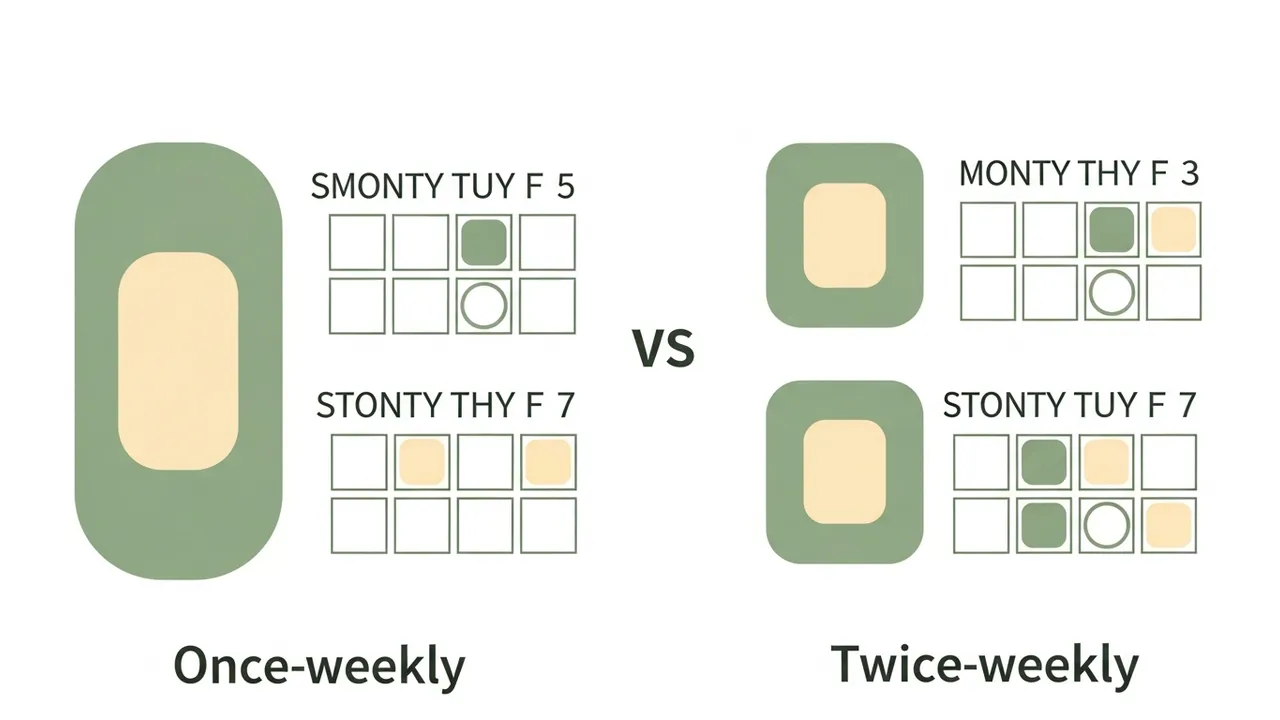
If you're weighing a once weekly vs twice weekly estradiol patch, here's the answer before you scroll: at the same labeled strength, both patches are built to deliver the same amount of estradiol per day. A 0.05 mg/day once-weekly patch and a 0.05 mg/day twice-weekly patch each carry the same nominal delivery rate— the phrase the FDA labels actually use — of 0.05 mg through the skin every 24 hours. The once-weekly patch is bigger and holds more drug because it has to keep releasing hormone for seven days instead of three or four.
So what actually differs? Four things. How often you change it. How much patch sits on your skin. What each manufacturer's own adhesion data shows. And the one almost nobody mentions: which strengths exist on each schedule.
That last one matters more than it sounds. There is one strength that exists on the once-weekly side and simply does not exist on the twice-weekly side. If it's your dose, “just switch schedules” isn't something your prescriber can do without also changing how much estrogen you get. We'll name it, and show you exactly where we found it.
There's also a second surprise waiting in the labels: the two schedules don't even start at the same dose. More on that in a moment.
Everything below came out of the FDA-approved drug labels. We opened eight of them.
The HRT Index may earn a commission from some provider links. It never changes what we publish, and we date every claim.
Best for you / not for you
A once-weekly patch is probably the better fit if:
- You'd rather change a patch 4 times a month than 8
- You've missed doses before — forgetting is your real enemy, not peeling
- Your pharmacy can reliably fill a once-weekly product right now
- You're on 0.06 mg/day, because no twice-weekly patch is made at that strength
A twice-weekly patch is probably the better fit if:
- Your patches lift, curl, or peel — especially with heat, sweat, or swimming
- You want the smallest possible patch (Minivelle is the smallest at every strength)
- You're on a higher dose and don't trust a large patch to stay put for a full week
- You'd rather wear a smaller sticker twice than a bigger one once
This is not where you should start if:
- You have a uterus and you're being offered estrogen by itself. Stop. That decision outranks this one, and we cover it below.
- You have a history of blood clots, stroke, heart attack, breast cancer, liver disease, or vaginal bleeding nobody has explained. Every patch label on this page lists those in its contraindications. That's an in-person conversation first.
Your three honest next steps
Need a prescription, refill, or switch?
Choose by the constraint that matters. Do not change patch schedules or strengths without clinician approval.
Cash-pay + home delivery
Winona publishes an FDA-approved estradiol patch replaced every four days, from $149/month. It does not bill insurance directly.
Start Winona's free patch intake →Sponsored link. A clinician decides whether treatment is appropriate; a prescription is not guaranteed.
Insurance, seven-day, 0.06 mg, or exact brand
Ask your prescriber about exact products or your plan about coverage; use the quiz for cash-pay online care.
See my online-care match →Free · about 90 seconds · no email to see the result
Already have a responsive prescriber
A schedule or strength review may only require a concise portal message, not another paid appointment.
Jump to the exact message ↓Once weekly vs twice weekly estradiol patch: what actually changes?
A once-weekly estradiol patch stays on for seven days. A twice-weekly patch is changed every three to four days, on two set days each week. At the same labeled strength, both carry the same nominal delivery rate— the amount of estradiol the patch is designed to release through the skin every 24 hours. The number on the box (0.025, 0.05, 0.075) is that delivery rate. It is not how much drug is inside the patch.
That one distinction clears up most of the confusion women bring to this question.
How often do you change an estradiol patch?
Once weekly means one change day, every 7 days. Twice weekly means two change days, spaced 3 to 4 days apart. Which one you're on is set by your brand, not by preference. Climara, Menostar, and Climara Pro are seven-day patches. Vivelle-Dot, Minivelle, Dotti, Lyllana, and CombiPatch are twice-weekly.
| Once weekly | Twice weekly | |
|---|---|---|
| How long you wear it | 7 days | 3–4 days |
| Patch changes per 28 days | 4 | 8 |
| Patches in a typical box | 4 | 8 |
| Label starting dose for hot flashes | 0.025 mg/day | 0.0375 mg/day |
| Label starting dose for osteoporosis prevention | 0.025 mg/day | 0.025 mg/day |
| Physical patch size | Larger | Smaller |
| The usual failure | Forgetting is rare. Lifting is the risk. | Staying on is easier. Forgetting is the risk. |
The starting doses are not the same — and almost nobody says so
Read that table again. The two schedules do not begin in the same place.
Climara's prescribing information says to start therapy at 0.025 mg per day applied once weekly for moderate-to-severe hot flashes. But DOTTI's label, LYLLANA's label, and the generic twice-weekly estradiol transdermal system label all say to start at 0.0375 mg per day applied twice weekly for the same symptoms.
The 0.025 mg/day twice-weekly patch does exist. Its labels list it as the starting dose for prevention of postmenopausal osteoporosis — not for hot flashes.
Why this matters to you: if you were started on a 0.025 mg/day twice-weekly patch for hot flashes and you feel like it isn't doing much, you may be sitting one step below where those labels start for your symptom. That is a conversation with your prescriber, not a reason to change anything yourself.
The rule people break
Apply your patch on the same day — or the same two days — every single week. Write them down. If you're twice-weekly, pick two days spaced three to four days apart and treat them as fixed. Monday and Thursday. Tuesday and Friday. Sunday and Wednesday.
And four things you should never do on either schedule:
- Don't stretch a patch past its wear time to make a box last longer
- Don't change it early because symptoms crept back — call your prescriber instead
- Don't cut, overlap, or double up patches
- Don't assume a new box runs on the same schedule as your old one
That last one is catching a lot of women right now. Which brings us to the table you actually came for.
Which estradiol patches are once weekly, and which are twice weekly?
Climara, Menostar, and Climara Pro are worn for seven days. Vivelle-Dot, Minivelle, Dotti, Lyllana, and CombiPatch are changed twice a week. The brand determines the schedule — you don't.If you've been switched to a different brand, your change days almost certainly changed with it, whether or not anyone told you.
We pulled every number below straight from the FDA-approved prescribing information.
Estrogen-only patches
| Product | Schedule | Strengths (mg/day) | Patch size (cm²) | Estradiol per patch (mg) | Patches / 28 days |
|---|---|---|---|---|---|
| Climara (Bayer) | Once weekly | 0.025 · 0.0375 · 0.05 · 0.06 · 0.075 · 0.1 | 6.5 · 9.375 · 12.5 · 15 · 18.75 · 25 | 2 · 2.85 · 3.8 · 4.55 · 5.7 · 7.6 | 4 |
| Menostar (Bayer) | Once weekly | 0.014 only | 3.25 | 1.0 | 4 |
| Vivelle-Dot (Noven) | Twice weekly | 0.025 · 0.0375 · 0.05 · 0.075 · 0.1 | 2.5 · 3.75 · 5.0 · 7.5 · 10.0 | 0.39 · 0.585 · 0.78 · 1.17 · 1.56 | 8 |
| Minivelle (Noven) | Twice weekly | 0.025 · 0.0375 · 0.05 · 0.075 · 0.1 | 1.65 · 2.48 · 3.30 · 4.95 · 6.6 | 0.41 · 0.62 · 0.83 · 1.24 · 1.65 | 8 |
| Dotti / Lyllana (Amneal) | Twice weekly | 0.025 · 0.0375 · 0.05 · 0.075 · 0.1 | 1.89 · 2.83 · 3.78 · 5.66 · 7.55 | 0.314 · 0.470 · 0.627 · 0.940 · 1.253 | 8 |
| Alora | Twice weekly (historical) | 0.025 · 0.05 · 0.075 · 0.1 | — | — | Discontinued |
Source: Climara PI · Menostar PI · Vivelle-Dot PI · Minivelle PI · DOTTI PI · LYLLANA PI. Alora: FDA-based availability sources and manufacturer reporting list all Alora strengths as no longer marketed. Do not treat it as a fill option.
Three rows deserve a pause.
Menostar is not for hot flashes. It's a once-weekly patch delivering 0.014 mg/day from a 3.25 cm² system containing 1 mg of estradiol, and it is approved only to help prevent osteoporosis after menopause. If someone handed you Menostar and you're trying to stop night sweats, that's a conversation to have this week.
Climara has a 0.06 mg/day strength. Nothing on the twice-weekly side does. Vivelle-Dot, Minivelle, Dotti, and Lyllana all go 0.05, then jump straight to 0.075. Hold that thought.
Alora is gone. It appears on a lot of pages still ranking for this question. It is no longer being made. If your old prescription says Alora, you need a new one.
Combination patches (estrogen + progestogen)
If you have a uterus and want a single patch containing both hormones, the current U.S. menu is two FDA-approved products — and each one locks in a schedule:
| Product | Schedule | Dose per day | Patch size |
|---|---|---|---|
| Climara Pro (estradiol + levonorgestrel) | Once weekly | 0.045 mg / 0.015 mg | 22 cm² — holds 4.4 mg estradiol + 1.39 mg levonorgestrel |
| CombiPatch (estradiol + norethindrone acetate) | Twice weekly | 0.05 mg / 0.14 mg, or 0.05 mg / 0.25 mg | 9 cm² or 16 cm² |
Two products. Two different progestogens. Two different schedules. Pick the combination patch, and the schedule comes with it.
Thinking about switching patch schedules?
If your current patch isn’t working for your routine or isn’t available, ask your prescriber about a switch; our quiz points you toward cash-pay online care that fits.
Get my online-care match →Where the schedule is printed on your box
Before you change anything, find the answer on the packaging. It's in four places:
- The pharmacy label — “apply 1 patch weekly” or “apply 1 patch twice weekly”
- The carton — cartons hold 4 (once weekly) or 8 (twice weekly)
- The foil pouch — the brand name is printed here
- The Medication Guide tucked inside
If your count changed from 8 to 4, or 4 to 8, your schedule changed. That's not a pharmacy mistake. That's a different product.
Found your patch? Write it down before you forget.
Your brand. Your dose. Your change days. Whether symptoms return before change day. Whether it lifts. Those five lines are the whole conversation with your prescriber — and we've already put them on one page for you, with the label facts filled in.
See the full dose & schedule conversion chart →Why is the once-weekly patch so much bigger?
Because it has to keep releasing estradiol for seven days instead of three or four, so it carries more drug across more skin. At 0.05 mg/day, Climara's patch is 12.5 cm² and holds 3.8 mg of estradiol. Vivelle-Dot's is 5.0 cm² and holds 0.78 mg. The bigger patch is not a bigger dose. Both carry a labeled delivery rate of 0.05 mg per day.
We did the arithmetic from the label values. Here's what it looks like at the strength most women are actually prescribed.
| At 0.05 mg/day | Climara (1×/wk) | Vivelle-Dot (2×/wk) | Dotti / Lyllana (2×/wk) | Minivelle (2×/wk) |
|---|---|---|---|---|
| Patch on your skin at any moment | 12.5 cm² | 5.0 cm² | 3.78 cm² | 3.30 cm² |
| Estradiol inside each patch | 3.8 mg | 0.78 mg | 0.627 mg | 0.83 mg |
| Patches per 28 days | 4 | 8 | 8 | 8 |
| Total estradiol dispensed / 28 days | 15.2 mg | 6.24 mg | 5.02 mg | 6.64 mg |
| Labeled delivery rate | 0.05 mg/day | 0.05 mg/day | 0.05 mg/day | 0.05 mg/day |
All figures calculated from each product's FDA-approved prescribing information.
Climara's patch covers 2.5 times the skin of Vivelle-Dot and 3.8 times the skin of Minivelle at that dose. Over a month it carries roughly 2.4 times more estradiol than Vivelle-Dot and 3 times more than Dotti.
And all four carry the same labeled delivery rate.
The extra drug is a reservoir, not a dose. A seven-day patch has to still be releasing hormone at hour 168 — which means it has to start with far more than it will ever hand over. It's also why every one of these labels tells you the used patch still contains active hormone, and why you fold it sticky-side-in and throw it away where a child or a pet can't reach it.
If you've been quietly worried that the giant new patch is a stronger dose — it isn't. That's the single most common thing women get wrong here. You can put it down.
Notice something else in that table: three twice-weekly patches, same 0.05 mg/day, three different sizes. Vivelle-Dot is 5.0 cm². Dotti is 3.78. Minivelle is 3.30. If your pharmacy switched your generic and the new one feels different on your skin, you're not imagining it.
Which schedule stays on better?
There is no head-to-head adhesion trial comparing today's once-weekly and twice-weekly patches, so there's no clean winner. But each manufacturer published its own adhesion data inside its FDA label, and those numbers have never been placed side by side.Broadly: the twice-weekly patches report strong adhesion over their shorter wear time, and Climara reports about 90% of observations with essentially no lift over seven days — for its two smallest patches only.
Here is every adhesion figure we could find in the labels.
| Product | Schedule | How it was studied | Observations | Result | Complete detachment | Wear time studied |
|---|---|---|---|---|---|---|
| Climara | 1×/wk | Placebo patches, 112 women aged 45–75, upper outer abdomen, 3 weeks running | ~1,650 | About 90% showed essentially no lift | About 5% | 7 days |
| Vivelle-Dot | 2×/wk | Combined data, 3 short clinical trials (~80% were the 0.05 mg/day patch) | 471 | 85% adhered completely | 3% detached and were reapplied or replaced | 3.5 days |
| Minivelle | 2×/wk | Combined bioequivalence and dose-proportionality studies (~65% were the 0.1 mg/day, 6.6 cm² patch) | 208 | About 98% scored a 0 — at least 90% of the patch stayed stuck | 1 woman | 84 hours |
| Climara Pro | 1×/wk | Placebo patches, 104 women aged 45–75, upper outer abdomen, weekly for 3 weeks | Scored days 2, 4, 5, 6, 7 | Mean scores in the highest category on a 0–4 scale | Not reported as a percentage | 7 days |
Source: Section 12.3 (Adhesion) of each product's FDA-approved prescribing information.
Read this before you read anything into that table.
These are four separate studies, run by different manufacturers, using different scoring systems, different wear times, and different women. They were never compared against each other, and this table cannot be used to rank the products. We show you what each label says because nobody else does — not because the numbers line up. They don't.
The gap we're not going to pretend isn't there
Here's the thing that stopped us cold when we read Climara's label.
Climara reports adhesion data for the 6.5 cm² and 12.5 cm² systems. It does not report adhesion data for the 18.75 cm² and 25 cm² systems — the 0.075 mg/day and 0.1 mg/day doses.
Those are the two largest patches. On the schedule that asks them to stay on the longest.
If your dose is 0.075 or 0.1, and you swim, sweat, live somewhere humid, or your skin runs oily — that missing data is real, and a twice-weekly patch is the better-evidenced bet. Minivelle is the smallest patch sold at every strength.
But we still don't tell most women to avoid once-weekly, and here's why. The once-weekly patch trades size for four fewer applications a month. In practice, missed patches end more hormone therapy than lifted patches do. If your honest failure mode is forgetting, the bigger patch is solving your actual problem.
Patches failing you no matter what you try? Compare estradiol patch and gel options →
What the labels say to do when a patch falls off — and the instructions differ
| Product | If it falls off |
|---|---|
| Climara | Reapply it somewhere else. If it won't stick, apply a new patch for the rest of the 7-day interval, then return to your normal change day. |
| Vivelle-Dot | Reapply the same patch, or put a new one on a different spot. Either way, keep your original change days. |
| Climara Pro | Reapply the same patch to a different spot on your lower abdomen. If it won't stick, use a new one and keep the original schedule. |
Every label also tells you to press the patch down firmly with your palm or fingers for at least 10 seconds, especially around the edges. Most people press for two.
Climara's label adds that swimming, bathing, and sauna use may reduce adhesion — and that those activities were not studied.
Take five minutes and turn this into a plan.
A specific complaint gets a specific fix. “It doesn't stick” gets a shrug. The chart gives you the exact sentence to send: your brand, your dose, where it lifts, what day it fails.
Read the full patch-adhesion troubleshooting guide →Does one schedule keep hormone levels steadier?
One older head-to-head study exists, and it favored the once-weekly patch — but it compared products that are not the products most women use today.In 1997, two randomized crossover studies compared 12.5 cm² and 25 cm² once-a-week adhesive patches against 10 cm² and 20 cm² twice-a-week Estraderm patches. Both kept serum estradiol in the therapeutic range; the once-a-week patch produced more constant mean levels with smaller peak-to-trough swings.
That's the honest headline. Now here's what it does and doesn't tell you — and this is where most pages either overclaim or pretend the evidence doesn't exist.
| What the study was | What that means for you today |
|---|---|
| Published 1997, Therapeutic Drug Monitoring | Nearly thirty years old |
| Run by researchers at 3M Pharmaceuticals | 3M developed the once-weekly patch being tested. The maker of the winning product ran the comparison. |
| Compared against Estraderm | Estraderm was a reservoir patch — a liquid drug pouch. It is no longer marketed. |
| Today's twice-weekly patches (Vivelle-Dot, Minivelle, Dotti, Lyllana) are drug-in-adhesive matrix patches | A completely different delivery design from the one that lost |
| Sample: healthy postmenopausal women, one-week wear | Pharmacokinetics, not symptom relief |
So: a study that found the once-weekly patch steadier, run by that patch's manufacturer, against a competitor that no longer exists, using a technology no current twice-weekly product uses.
It is real evidence. It is not the answer to your question.
We found one page-one result telling readers the once-weekly patch is steadier. We found another telling them the opposite. Neither mentioned who ran the study or what it compared against. Now you know both.
And there's a bigger reason the labels can't rank the schedules
Most of today's twice-weekly patches were never tested in their own clinical trials.
The generic twice-weekly estradiol transdermal system label states outright that no clinical trials were conducted with it, and that it is bioequivalent to Vivelle. Minivelle says the same. DOTTI's label says it was shown bioequivalent to the original estradiol formulation.
That's not a scandal — bioequivalence is a legitimate, rigorous pathway. But it means the evidence base is a chain of comparisons back to older products, not a set of modern trials pitting schedule against schedule. Nobody has run the study you actually want.
What the labels do show: placement changes your levels
| What the label reports | Product | The finding |
|---|---|---|
| Buttock delivers more than abdomen | Climara 25 cm² (0.1 mg/day), 38 women, crossover | Peak concentration about 25% higher and average concentration about 17% higher on the buttock than the abdomen |
| Buttock is also less variable | Climara | Levels varied less from woman to woman on the buttock than on the abdomen |
| Same direction, twice-weekly side | Vivelle 0.1 mg/day, 17 women | About 79 pg/mL above baseline on the abdomen; about 88 pg/mL on the buttocks |
| Dose scales the way you'd expect | Climara, abdomen | Average steady-state levels of about 40 pg/mL (12.5 cm² patch) and about 80 pg/mL (25 cm² patch) |
| It clears quickly once removed | Climara Pro | After removal, estradiol levels fall with a mean terminal half-life of about 3 hours |
pg/mL means picograms per milliliter — the standard unit for measuring hormone in blood.
Two things worth taking from that, and neither one is about the schedule.
Placement is not a detail. A 17–25% difference between abdomen and buttock is larger than the gap between two adjacent patch strengths. If you moved where you wear it, you may have changed something. Tell your prescriber where it goes.
The patch stops delivering once it's off, and levels fall fast. A roughly three-hour half-life is why “it fell off Tuesday and I found it Wednesday” is genuinely worth reporting, not shrugging off.
Approved spots, per each label:
- Climara — lower abdomen (below the belly button) or upper quadrant of the buttock
- Vivelle-Dot — trunk of the body, including abdomen or buttocks
- Minivelle — lower abdomen (below the belly button) or buttocks
- Dotti / Lyllana — lower abdomen or buttocks
- CombiPatch — lower abdomen
Never the breasts. Rotate spots, with at least a week before reusing one. Skip the waistline, where clothing rubs. Skip skin that's oily, broken, or lotioned.
Do estradiol patches still have a black box warning?
As of our July 2026 verification, yes — and it is identical on once-weekly and twice-weekly patches. On February 12, 2026, the FDA approved labeling changes to six menopausal hormone therapy products, removing language about cardiovascular disease, breast cancer, and probable dementia from the boxed warning. No estradiol patch was among them.
Half the pages ranking for patch questions right now tell women the FDA removed the black box warning from HRT patches. That's not what happened. The sequence matters, so here it is.
November 10, 2025. The FDA requested labeling changes from drug makers. It asked them to remove cardiovascular disease, breast cancer, and probable dementia language from the boxed warning; remove endometrial cancer language except for systemic estrogen-alone products; drop the “lowest dose for the shortest time” recommendation; and add guidance about starting therapy for moderate-to-severe hot flashes in women under 60 or within 10 years of menopause.
February 12, 2026. The FDA approved those changes for six products. The agency's own published list names them:
| Category | Product |
|---|---|
| Progestogen alone | Prometrium |
| Systemic estrogen alone | Divigel, Cenestin, Enjuvia |
| Topical vaginal estrogen | Estring |
| Systemic estrogen + progestogen | Bijuva |
Not one patch on that list. Divigel is an estradiol gel. Not a patch.
Today. The patch labels we checked still open with the boxed warning. Climara's current prescribing information on DailyMed begins: WARNING: ENDOMETRIAL CANCER, CARDIOVASCULAR DISORDERS, PROBABLE DEMENTIA…
Twenty-nine drug companies submitted proposed labeling changes at the FDA's request, so this may keep moving. It simply had not reached the estradiol patches as of the FDA's published list.
The Menopause Society's position, for balance: it agreed with removing the boxed warning from low-dose vaginal estrogen, which it describes as a safe and effective therapy for a condition most menopausal women experience. But it notes that systemic estrogen still carries potential risks for certain individuals that should be reviewed in detail before starting — and that risks are low for younger, healthy women starting closer to the menopause transition, and greater for older women further from it.
Also worth knowing: the FDA kept the endometrial cancer warning on systemic estrogen-alone products. That's the warning that matters most if you have a uterus.
What all of this means for your schedule decision: nothing. The boxed warning is the same on both. It is not a reason to choose one over the other. Anyone using it to sell you a schedule is selling you something.
Can you switch from a once-weekly to a twice-weekly patch?
At most strengths the same labeled mg/day exists on both schedules — but 0.06 mg/day exists only on the once-weekly side.No twice-weekly patch is made at that strength. If it's your dose, switching schedules means changing your dose: down to 0.05 (about 17% lower) or up to 0.075 (25% higher). Switching schedules is always a prescriber-approved product change, never something to do on your own.
This is the most useful thing on this page, and we haven't seen it anywhere else.
| Your current dose | Does the same mg/day exist on the other schedule? |
|---|---|
| 0.014 mg/day (Menostar) | No. Once-weekly only. |
| 0.025 mg/day | Yes — but note the twice-weekly labels list 0.025 as the osteoporosis-prevention starting dose |
| 0.0375 mg/day | Yes |
| 0.05 mg/day | Yes |
| 0.06 mg/day | No. Must move to 0.05 or 0.075. |
| 0.075 mg/day | Yes |
| 0.1 mg/day | Yes |
| Combination patch | Climara Pro (weekly) ↔ CombiPatch (twice weekly) — different progestogens, not interchangeable |
“The same mg/day exists” is not “swap it yourself.” Every one of these moves is a new prescription.
Three more things nobody tells you:
Same number, different product. Switching manufacturers at the same strength changes the adhesive, the patch size, and sometimes the approved spots. The dose on paper is the same. The experience on your skin may not be.
Coming off pills? The Climara and twice-weekly estradiol labels say to start the patch about one week after stopping oral estrogen — or sooner if symptoms come back before then.
Your pharmacist cannot substitute across schedules. Once-weekly and twice-weekly are different products with different directions. That takes your prescriber.
Here's the ask, and it's a message — not an appointment.
Send your prescriber four things: your brand and dose, your change days, exactly when symptoms return or the patch lifts, and which schedule you'd rather be on.
Get the dose-matching chart and exact wording to use →Why does my patch feel like it wears off before change day?
“Wearing off” near the end of an interval is one of the most common complaints on both schedules. It can come from dose, absorption, placement, adhesion, sweating, or a plan that needs adjusting. It is a reason to call your prescriber. It is not a reason to change your patch early, add a second patch, or stretch the next one.
On a once-weekly patch, women describe it around day five or six. On a twice-weekly patch, they describe it near the end of the wearing time. The complaint is real either way — and the labels don't settle it. None of them publish end-of-interval trough levels in a way that lets you compare schedules.
What they do tell us is that estradiol clears quickly once the patch comes off. Climara Pro's label reports a mean terminal half-life of about three hours after removal.
Track it before you talk about it
Two weeks of notes will do more for you than two hours of searching.
| Day | What to write down |
|---|---|
| Day 1 | Fresh patch. Where you put it. |
| Day 2 | Any skin reaction? |
| Day 3–4 | Twice-weekly change point. Symptoms before you swap? |
| Day 5–6 | Weekly watch point. Hot flashes back? Sleep worse? Mood shift? |
| Day 7 | Weekly change point. Was the patch still fully stuck? |
Then say this
To your prescriber:
“I'm on [brand] at [dose], changed [once weekly / twice weekly]. Around [day 5 / the end of the interval], [hot flashes / night sweats / sleep] come back. Is this end-of-interval symptom return, and would a different dose, brand, or schedule fit me better? Also — since I [have / don't have] a uterus, can we confirm my progestogen plan?”
To your pharmacist:
“Can you confirm the exact product and schedule I was dispensed — is it once-weekly or twice-weekly? Is my usual product in stock, and if not, is there an FDA-approved estradiol patch alternative my prescriber could approve?”
Copy those. They work because they're specific. Vague complaints get vague answers.
If you have a uterus, the schedule isn't your first decision
If you still have a uterus and you're taking systemic estrogen, you generally need a progestogen alongside it to protect the lining of your uterus. Estrogen alone raises the risk of endometrial cancer. This decision sits above the schedule decision, and no patch schedule changes it.
A progestogen is progesterone, or a progesterone-like medication — micronized progesterone, levonorgestrel, or norethindrone acetate, for example.
Estradiol patch labels treat women with and without an intact uterus differently, and the boxed warnings state that adding a progestogen to estrogen therapy reduces the risk of endometrial hyperplasia, which may be a precursor to endometrial cancer.
Here's a detail that catches people out. DOTTI's label instructs that the patch be given continuously to a woman who does not have an intact uterus — but on a cyclic schedule for a woman who does (for example, three weeks on, one week off). If your directions include an off-week and you didn't expect one, that's why.
And when the FDA reworked the boxed warnings in 2026, it kept the endometrial cancer warning on systemic estrogen-alone products. That wasn't an oversight.
You have three routes:
| Route | What it looks like | What it does to your schedule |
|---|---|---|
| Patch + separate progestogen | Any patch, plus a progesterone capsule or other progestogen | You keep full control of the schedule |
| Climara Pro | One patch: estradiol + levonorgestrel | Locks you into once weekly |
| CombiPatch | One patch: estradiol + norethindrone acetate | Locks you into twice weekly |
Fewer pills means accepting the schedule that comes with the product.
Four questions, depending on where you sit
| Your situation | What to ask |
|---|---|
| You have a uterus | “What's my progestogen plan, and how often do I take it?” |
| You've had a hysterectomy | “Any reason I'd still need a progestogen?” |
| You're not sure | “Can you confirm my uterine status before we do systemic estrogen?” |
| You've had unexplained bleeding | “Do I need an in-person evaluation before starting or changing anything?” |
One line that matters, and we'll be blunt
FDA-approved estradiol patches and compounded hormone products are not the same category. The FDA states that compounded drugs are not FDA-approved, and that the agency does not verify their safety, effectiveness, or quality before they're marketed. Every patch on this page is FDA-approved. If someone offers you a compounded cream as an equivalent to a patch, it isn't one — and it's perfectly fine to say you want the approved product.
This isn't a decision to make from a search results page.
Uterus status, risk history, route, and coverage all interact — and one wrong assumption costs you months. Find My HRT Path maps your symptoms, what you have tried, your health history, your age, and your state — and it will tell you plainly if your situation belongs with an in-person clinician before anything else.
Get your personalized HRT path →Which schedule can you actually get in 2026?
Right now, that may not be your call. According to the ASHP drug shortage bulletin for estradiol transdermal systems, updated July 1, 2026, four manufacturers are reporting shortages across both schedules, while two report available product. The FDA has not designated estradiol patches as being in shortage. ASHP lists one. Both are true. They measure different things.
| Manufacturer | Products | Status (ASHP, July 1, 2026) |
|---|---|---|
| Viatris (Mylan) | Once-weekly and twice-weekly | Available |
| Bayer | Climara once-weekly | Available |
| Sandoz | Once-weekly | On shortage; no reason given |
| Noven (via Grove) | Vivelle-Dot, Minivelle | On shortage, attributed to increased demand |
| Amneal | Dotti, Lyllana (twice-weekly) | On shortage; no reason given |
| Zydus | Twice-weekly | On shortage; no reason given |
Supply status verified against the ASHP bulletin dated July 1, 2026. This changes weekly — check before you act on it.
Read that table carefully, because the easy story is wrong. Both schedules are hit. Sandoz's once-weekly patches are on shortage too. What's true is narrower and more useful: every manufacturer currently reporting available product supplies a once-weekly patch, and Viatris is the only one reporting both. That's a reason to ask your pharmacist about both schedules — not a reason to assume one is safe.
Why you can't get a straight answer anywhere
Because two different definitions of “shortage” are in play.
- The FDA has not designated estrogen patches as being in shortage. Officials have said manufacturers are running at full capacity. FDA Commissioner Marty Makary described the industry as barely keeping up.
- ASHP does list a shortage. Its bulletin is built from reports by pharmacists, physicians, nurses, and patients — the people standing at the counter. It first added estrogen patches in January 2026.
Neither is lying. A woman told “backordered” at her pharmacy is not experiencing an FDA-defined shortage. That's why every article you've read contradicts every other article you've read.
The demand shock is real and measurable. Estrogen patch prescriptions rose 162% over two years, according to HealthVerity data reported by CNBC. Sandoz has said publicly that recent prescribing changes created “unprecedented demand” it cannot fully meet, and that it is shipping extra supply to the U.S. Patches are harder to manufacture than pills. A new production line takes years, not months.
If your pharmacy says it's backordered
- Call before you're down to your last patch. Ask your pharmacy and your plan how early your refill can be processed — the rules vary by plan, drug, and state.
- Ask about the other schedule, not just the other brand. Viatris supplies both. Bayer supplies once-weekly.
- Ask your prescriber whether the prescription should name the dose, the schedule, and whether generic substitution is allowed if clinically appropriate and permitted in your state.
- Don't stretch a patch to make the box last. It's the one move that reliably makes symptoms worse.
- Don't fill early at multiple pharmacies. It worsens the shortage for the next woman.
- Ask about gel or spray as a bridge. Same route, through the skin — but the dose is not a one-to-one swap, so it needs a prescriber.
Can't fill anything at all? Read our full estradiol patch shortage guide →
So which one should you use?
For most women starting out, either schedule is a reasonable place to begin. The deciding question is simple: what's more likely to go wrong for you — forgetting, or peeling?Everything below is our editorial conclusion drawn from the label facts above. It is not medical advice, and it does not replace your prescriber's judgment.
| If you… | Consider | Why |
|---|---|---|
| Forget medications; want the simplest routine | Once weekly | Four changes a month, not eight |
| Have had patches lift, curl, or fall off | Twice weekly | Smaller patch, shorter wear |
| Want the smallest possible patch | Minivelle (twice weekly) | 1.65–6.6 cm² — smallest sold at every dose |
| Are on 0.075 or 0.1 mg/day and worried about adhesion | Twice weekly | Climara's label reports no adhesion data at 18.75 cm² or 25 cm² |
| Are on 0.06 mg/day and doing well | Stay once weekly | No twice-weekly patch is made at that strength |
| Swim, sauna, sweat heavily, or live somewhere humid | Twice weekly, and ask about buttock placement | Labels note water and heat may reduce adhesion |
| Have a uterus and want one combined patch | The product decides: Climara Pro (weekly) or CombiPatch (twice weekly) | Only two combination patches are approved |
| Need osteoporosis prevention at the lowest dose | Menostar (once weekly) | 0.014 mg/day — osteoporosis prevention only, not hot flashes |
| Were started on 0.025 mg/day twice weekly for hot flashes | Ask about the dose, not the schedule | Twice-weekly labels start hot-flash treatment at 0.0375 mg/day |
| Have a uterus and were offered estrogen alone | Stop and ask about a progestogen | Unopposed systemic estrogen raises endometrial cancer risk |
| Have a history of clots, stroke, heart attack, breast cancer, liver disease, or unexplained bleeding | See a clinician in person first | These appear in the contraindications of every one of these labels |
Find your row. That's your conversation.
How to get a prescription, a switch, or a strength change
If you already have a prescriber, this is a message — not an appointment. Send your brand, dose, and change days. If you don't have one, or yours is booked past your last patch, telehealth is a reasonable path for a straightforward schedule or strength change — as long as the platform prescribes FDA-approved medication and sends it to your own pharmacy, so your insurance can pay for it.
That last part isn't a small detail. It's most of the money.
Cash prices for estradiol patches swing hard by product, pharmacy, and coupon. On July 8, 2026, GoodRx listed generic twice-weekly estradiol patches (0.05 mg/day, 8-patch carton) at a coupon price as low as $36.23, against retail figures that varied from roughly $37 to over $105 depending on which product page you landed on. A covered prescription usually lands under a normal copay. That gap is the whole reason the provider you pick matters here.
Provider-stated vs. verified
Before we recommend anyone, here's what each provider says about itself, what we could confirm, and what you have to check yourself.
| Provider | Provider-stated claim | What we verified (July 2026) | What you must confirm before booking |
|---|---|---|---|
| Midi Health | Available in all 50 states, with insurance coverage for virtual visits and prescriptions; in-network with most PPO plans; prescribes FDA-approved hormone therapy, including patches | These statements appear on Midi's own site, alongside its disclosure that coverage varies by plan and that deductibles, coinsurance, and copays may still apply | Whether your specific plan is in-network; whether Midi is licensed in your state; your copay |
| Midi Health — exclusions | “Not enrolled with and not participating providers with state healthcare programs (Medi-Cal, Medicaid)… cannot treat Medicaid or Medi-Cal patients, even as self-pay.” Not covered by Medicare; Medicare beneficiaries may be seen as self-pay but cannot submit claims | Stated directly on Midi's own site | Nothing. If this is your coverage, Midi cannot see you. |
| Sesame Care | Online menopause visits; you choose your own clinician; prescriptions sent to your local pharmacy | Sesame is a marketplace where the patient selects the provider | The clinician's background, the listed visit price, and whether they'll prescribe a patch |
We have no financial relationship that changes any row in that table. What we could not verify — a provider's current cash price to you, or whether a given clinician will write a patch prescription — we've left as your job, because it is.
Our cash-pay pick for this specific situation: Winona
For a reader who wants an online medical review and is open to a patch that Winona says is replaced every four days, Winona is the closest commercial match to this page.
- Midi says it is available in all 50 states with insurance coverage for virtual visits and prescriptions, and in-network with most PPO plans (coverage varies by plan)
- Prescribes FDA-approved hormone therapy, filled at your own pharmacy — the only way the patches on this page reach you, since every one of them is a pharmacy-dispensed FDA-approved product
- Clinicians who specialize in midlife women's health, with initial visits of 30 minutes
Now the part most affiliate pages would bury.
Midi does not accept Medicaid, Medi-Cal, or Medicare. Midi states plainly that it is not enrolled with state healthcare programs and cannot treat Medicaid or Medi-Cal patients — not even as self-pay. It is not covered by Medicare, though Medicare beneficiaries can be seen as self-pay patients who cannot submit claims.
If that's your coverage, Midi is the wrong door. Don't book with them. Go here instead: HRT insurance coverage and plan-verification steps →
But that exclusion is exactly what makes Midi work for everyone else. Because Midi built around commercial insurance instead of government programs, it can do the one thing a cash-pay menopause subscription generally can't: route an FDA-approved estradiol patch through the pharmacy benefit you already pay for. Not a membership. Not a compounded cream shipped from a compounding pharmacy. The actual product, with the actual label we've been quoting all over this page — billed to your plan.
If you're PPO-insured and you want a Climara or a Vivelle-Dot, that's the whole ballgame.
Does that sound like your situation?
It's a coverage check, not a purchase. You'll know before you book.
Start Winona's free medical intake →If you're paying cash for a single visit
Sesame Care is worth a look if you need one appointment to change a schedule or strength — not ongoing menopause management. It's a marketplace where you choose your own clinician, and prescriptions go to your local pharmacy.
Two honest caveats. Because you pick the provider, menopause expertise varies by clinician — read the profile before you book. And listed prices move.
See current Sesame visit prices and clinician profiles →
Check the number yourself before you book. We won't print a price we haven't verified this month. The HRT Index may earn a commission from the links above. See our affiliate disclosure.
Who should not book anything today
If you have a history of blood clots, stroke, heart attack, breast cancer, liver disease, a clotting disorder, or vaginal bleeding that hasn't been explained — do not start with telehealth. Every one of these patch labels lists those as contraindications. Any platform willing to skip that conversation isn't the right platform.
Find My HRT Path flags when in-person care comes first →What we actually verified
What we did. We opened the FDA-approved prescribing information for Climara, Menostar, Vivelle-Dot, Minivelle, Dotti, Lyllana, Climara Pro, and CombiPatch on DailyMed and accessdata.fda.gov, plus FDA-based availability sources for Alora. Every patch size, drug content, adhesion figure, pharmacokinetic value, application instruction, starting dose, and indication on this page was pulled directly from those labels. We checked boxed-warning status against the FDA's own published list of products with updated prescribing information. We checked supply against the ASHP shortage bulletin and the FDA's public statements, and pricing against GoodRx on the date shown.
What we did not do. We did not test these patches. We did not run a study. We have no firsthand wear data — and neither does any other page publishing on this topic, including the ones that sound like they do.
Why there are no patient testimonials here. We won't republish anonymous forum posts as testimonials, and we won't use a patient story to imply a prescription drug works. Both would be easy. Both would be wrong on a page about hormone therapy.
What changes, and how often we re-check it:
| Claim on this page | Source | Last checked | What could change it |
|---|---|---|---|
| Patch sizes, drug content, starting doses, adhesion data | FDA prescribing information (DailyMed) | July 2026 | Label revisions — quarterly check |
| Boxed-warning status of patches | FDA's list of MHT products with updated prescribing information | July 2026 | FDA approves patch label changes — monthly check |
| Manufacturer supply status | ASHP shortage bulletin, July 1, 2026 | July 2026 | Changes weekly — monthly check, verify before relying on it |
| Cash prices | GoodRx | July 8, 2026 | Continuous — quarterly check |
| Alora discontinuation | FDA-based availability sources | July 2026 | Unlikely to reverse |
| Midi and Sesame claims | Each provider's own site | July 2026 | Coverage and pricing change — monthly check |
You know the patch difference. Now choose the right way to get help.
Cash-pay and open to Winona's every-four-days patch with home delivery?
Start Winona's free patch intake →Sponsored link. A Winona clinician determines whether treatment is appropriate. Prescription treatment is not guaranteed.
Need insurance or an exact patch? Ask your plan or prescriber; the quiz is for cash-pay online care.
Find my cash-pay online care match →Frequently asked questions
- How often do you change an estradiol patch?
- It depends on the product, not on you. Climara, Menostar, and Climara Pro are worn seven days and changed once weekly. Vivelle-Dot, the Noven authorized generic to Minivelle, Dotti, Lyllana, and CombiPatch are changed every three to four days, twice weekly. Apply it on the same day, or days, every week.
- Is Climara once weekly or twice weekly?
- Climara is a once-weekly patch. Its FDA label says to start at 0.025 mg per day applied to the skin once weekly for moderate-to-severe hot flashes, and it comes in six strengths from 0.025 to 0.1 mg per day.
- Is Vivelle-Dot once weekly or twice weekly?
- Vivelle-Dot is a twice-weekly patch, replaced every three to four days. It comes in five strengths from 0.025 to 0.1 mg per day.
- Is a once-weekly estradiol patch a stronger dose than a twice-weekly one?
- No. At the same labeled strength they carry the same nominal delivery rate — the amount released through the skin per day. The once-weekly patch is larger and holds more estradiol because it must keep releasing for seven days. At 0.05 mg/day, Climara's patch is 12.5 cm² and holds 3.8 mg; Vivelle-Dot's is 5.0 cm² and holds 0.78 mg. Both are labeled to deliver 0.05 mg per day.
- Do once-weekly and twice-weekly patches start at the same dose?
- No. Climara's label starts treatment for moderate-to-severe hot flashes at 0.025 mg/day once weekly. The Dotti, Lyllana, and generic twice-weekly estradiol transdermal system labels start at 0.0375 mg/day twice weekly for the same symptoms. On the twice-weekly side, 0.025 mg/day is the label's starting dose for prevention of postmenopausal osteoporosis.
- Is there a twice-weekly version of the 0.06 mg estradiol patch?
- No. The 0.06 mg/day strength exists only on the once-weekly side. Twice-weekly patches go from 0.05 mg/day to 0.075 mg/day. Switching schedules at that dose means changing your dose, which requires your prescriber.
- Which two days should I change a twice-weekly patch?
- Any two days spaced three to four days apart, kept the same every week — Monday and Thursday, Tuesday and Friday, or Sunday and Wednesday. Consistency matters more than which days you pick.
- What should I do if my estradiol patch falls off?
- Follow your product's instructions, because they differ. Climara's label says to reapply it elsewhere, and if it won't stick, use a new patch for the rest of the seven-day interval. Vivelle-Dot's says to reapply the same patch or a new one and keep your original change days. Either way, keep your original schedule and tell your prescriber if it keeps happening.
- Where should I put an estradiol patch?
- On clean, dry skin in the area your brand's label approves — usually the lower abdomen or upper buttock. Never on the breasts. Rotate spots, avoid the waistline, and skip skin that's oily, broken, or irritated. Press firmly for at least 10 seconds. Placement affects your levels: Climara's label reports peak concentrations about 25% higher on the buttock than the abdomen.
- Which estradiol patch is smallest?
- Noven's FDA-approved authorized generic to Minivelle has the smallest label-reported footprint at the compared strengths, from 1.65 to 6.6 cm². Noven says the Minivelle brand itself is no longer marketed.
- Is Alora still available?
- No. FDA-based availability sources and manufacturer reporting list all Alora strengths as discontinued. If your prescription names Alora, you need a new one.
- Do estradiol patches still have a black box warning?
- As of our July 2026 verification, yes. The FDA approved boxed-warning changes for six menopausal hormone therapy products on February 12, 2026 — Prometrium, Divigel, Cenestin, Enjuvia, Estring, and Bijuva. No estradiol patch was among them. The warning is identical on once-weekly and twice-weekly patches, so it isn't a reason to choose one over the other.
- Do I need progesterone with an estradiol patch if I have a uterus?
- Generally yes. Systemic estrogen taken without a progestogen raises the risk of endometrial cancer in women with a uterus. The FDA kept the endometrial cancer warning on systemic estrogen-alone products when it revised the boxed warnings in 2026. Confirm your plan with your clinician before starting or changing anything.
- Are compounded hormone creams the same as an FDA-approved estradiol patch?
- No. The FDA states that compounded drugs are not FDA-approved, and that the agency does not verify their safety, effectiveness, or quality before they are marketed. Every patch discussed on this page is an FDA-approved product.
- Which schedule is easier to get right now?
- It varies by product, strength, and week. The ASHP bulletin updated August 12, 2026 lists Bayer Climara and Viatris once-weekly presentations as available, with selected twice-weekly presentations on backorder. The FDA has not designated estradiol patches as being in shortage. Ask your pharmacist which exact product and strength is in stock today.
Sources
All accessed July 9, 2026.
Primary sources
- FDA-approved prescribing information via DailyMed and accessdata.fda.gov (Climara, Menostar, Vivelle-Dot, Minivelle, Dotti, Lyllana, Climara Pro, CombiPatch).
- FDA — Menopausal Hormone Therapies with Updated Prescribing Information. February 12, 2026.
- FDA — FDA Approves Labeling Changes to Menopausal Hormone Therapy Products. February 12, 2026.
- FDA — FDA Requests Labeling Changes… for Menopausal Hormone Therapies. November 10, 2025.
- FDA — Compounding and the FDA: Questions and Answers.
- The Menopause Society. Statement on the FDA hormone therapy announcement.
- ASHP, Drug Shortage Detail: Estradiol Transdermal System. Updated July 1, 2026.
- Harrison LI, et al. Comparative serum estradiol profiles from a new once-a-week transdermal estradiol patch and a twice-a-week transdermal estradiol patch. Ther Drug Monit. 1997;19(1):37–42.
- MedlinePlus, Estradiol Transdermal Patch.
- CNBC, CNN, NPR, and NBC News reporting on estradiol patch supply.
- Midi Health. Pricing and insurance.
- Sesame Care. Online menopause treatment.
- GoodRx pricing pages, coupon prices last updated 07/08/26.
Last verified: July 9, 2026. Researched and written by The HRT Index editorial team. Prices, supply, and FDA labeling change. We re-check pricing, supply, and label status monthly, and providers quarterly. If you find an error, email partners@thehrtindex.com. We date every fix.
The HRT Index is reader-supported. We may earn a commission from some provider links on this page. Commissions never change whether we label a product FDA-approved or compounded, and they never change our verdict. Find My HRT Path collects sensitive health information and is governed by our consumer health data and privacy policy. See our full affiliate disclosure.