
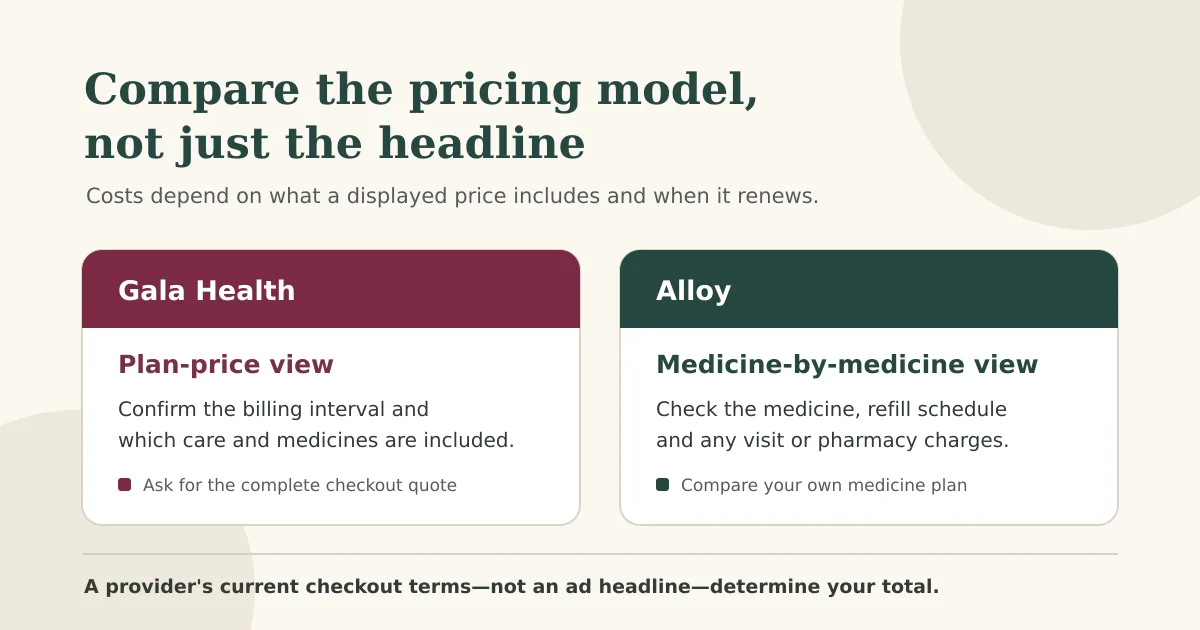
Gala Health vs Alloy comes down to your medicines and how you pay. Gala's advertised $69 plan may cost less for a patch if your quote covers every needed medicine and required cost. Alloy publishes product-specific prices and three-month supplies; its pill-only minimum is lower than Gala's advertised rate. Confirm exact products and billing dates.
Below, we price six common plans side by side, so you can find your own number instead of trusting a headline.
Gala is likely the better first look if you:
- Pay cash and want an estradiol patch, or estrogen and progesterone on one bill
- Want to compare an advertised $69 charge with a three-month medication charge, and will confirm the amount due now
- Are comfortable asking Gala to name your exact medicine before you pay
Alloy is likely the better first look if you:
- Want to compare published medication routes, prices and FDA-approval claims before you start; confirm the exact generic product
- Want an estradiol gel or spray, which Gala doesn't list
- Have a clinician-proposed estradiol pill-only plan or only vaginal cream and want to compare its published starting price
- Already have a recent mammogram
Start somewhere else if you:
- Want insurance to pay for visits (an in-network clinician or Midi Health)
- Want testosterone (Alloy says it is not prescribing it; Gala does not list it in the HRT materials we reviewed)
- Have unexplained vaginal bleeding: get it evaluated in person before treatment. A history of blood clots, stroke, heart attack, liver disease, or breast or uterine cancer needs clinician or specialist review before considering systemic hormones; an exam or tests may be needed.
The HRT Index is the independent decision resource for online menopause and HRT care — comparing telehealth providers on clinical legitimacy, care quality, medication fit, price transparency, and access, with every claim verified and dated, so women can choose the path that fits their situation before their first consult.
We may earn a commission if you start care with Gala Health through our link. Our Alloy and Midi links are not affiliate links. That affects which button we feature, not what we report. How we make money.
What we actually verified · Last verified October 2026
We read, on October 12, 2026: Gala's hormone-health and estradiol pages, its $69 HRT offer page, its refund policy (last updated February 2026) and its terms (last updated September 22, 2026). Alloy's product and price pages, its terms of use (last revised May 28, 2026) and Alloy help-center articles on cost, billing, supply, sign-up, insurance, labs, mammograms, testosterone, messaging, cancelling and pharmacy transfers.
We confirmed: the published price inputs used in our examples; Alloy's three-month supply and billing rule; its mammogram rule for recurring hormone prescriptions; and that neither company bills insurance directly. Alloy says it is not prescribing testosterone; Gala does not list it. Our totals are calculations, with the assumptions below—not prices the providers published.
We did not: sign up, pay, talk with a clinician or receive medicine from either company. This is a documentation review, not a patient test.
We could not confirm: whether Gala's $69 covers both estrogen and progesterone at checkout, how often Gala bills, the exact products Gala dispenses, Gala's state list and age range, or Alloy's full state list.
On this page: What you'll pay · Medicines · Which fits you · When Gala wins · When Alloy wins · Care and screening · Insurance · Access · Cancel and switch · Clinician first · How we checked · Quick answers
Gala Health vs Alloy: what will you actually pay?
Gala Health vs Alloy pricing depends on which medicines a clinician prescribes and the bill behind them. Twelve $69 Gala charges total $828; four Alloy patch-plus-progesterone fills plus its consult start at $1,525. Those are conditional subtotals, not verified savings. Alloy publishes lower starting oral and standalone-vaginal prices than Gala's advertised bundle rate.
The two companies price in very different ways, which is why one headline can't answer this.
Gala advertises one flat price: "$69/month — flat, forever," with no membership fee, on its dedicated HRT offer page. It says that price covers the online visit, the prescription and shipping, and won't rise when your dose changes. What it doesn't publish is which exact medicines the $69 includes, or whether it bills every calendar month or every few weeks. Its main hormone-health page describes the care model; the dedicated offer page is where we confirmed the $69 headline. Your selected quote still matters.
Alloy prices each product separately on its solutions page. You pay a one-time $49 consult for hormone therapy, then each medicine. Alloy only sells three-month supplies, and refills bill and ship automatically every three months. So a "$100 a month" patch is really a $300 charge each quarter.
Here are the prices each company published when we checked.
Published HRT prices, checked October 12, 2026 (before discounts)
| Item | Gala Health | Alloy |
|---|---|---|
| Visit or consult | Included in $69 (Gala's statement) | $49, one time (for hormone therapy) |
| Estradiol pill | Listed under advertised $69 offer; selected product/inclusion unconfirmed | From $39.99 a month, billed $119.97 per 3 months |
| Estradiol patch | Listed under advertised $69 offer; selected product/inclusion unconfirmed | $100 a month, billed $300 per 3 months |
| Estradiol gel | Not listed | $69.99 a month, billed per 3 months |
| Evamist estradiol spray | Not listed | $69.99 a month, billed per 3 months |
| Progesterone | Listed; whether it's inside the same $69 is unconfirmed | From $23 a month, billed per 3 months |
| Vaginal estradiol cream | Listed; price for this alone unconfirmed | $119.97 per tube (about 3 months); no purchased $49 consult on standalone path; prescriber review still required |
| Shipping | Free (Gala's statement) | Free |
| Billing rhythm | "Every cycle"; calendar month or shorter is unconfirmed | Every 3 months |
"From" means a starting price; your prescribed dose can cost more. Unconfirmed is not the same as included.
The cost table: six common plans, side by side
This is the heart of the page. We took each company's published prices and ran the math for the plans clinicians commonly prescribe. These are examples, not quotes, and not advice about which plan you need. A clinician decides that.
How we counted:
- Alloy: $49 consult once for systemic HRT, then each product in three-month supplies. The first column is the initial supply subtotal, not a guaranteed first-90-day cash total. The year-one example uses four medication charges plus the consult; the year-two example uses four charges without it. Oral and progesterone rows use published starting prices.
- Gala: $69 per assumed charge. Three/four charges total $207/$276; twelve/fourteen total $828/$966. Those are illustrative billing scenarios, not its verified schedule or complete quote. The exact products, inclusion of all prescribed medicines and required extras remain unconfirmed.
- For a real 90-day total, count actual payment dates. Three calendar months can be shorter than 90 days, so a renewal can fall inside the window.
- No discount codes. A promotion changes one bill, not the plan.
Gala vs Alloy cost by plan: known charges and conditional examples (October 12, 2026)
| Plan a clinician might prescribe | Alloy: initial 3-month supply + consult | Alloy: year 1 example, 4 fills + consult | Alloy: year 2 example, 4 fills | Gala: 3 / 4 assumed charges | Gala: 12 / 14 assumed charges | Conditional arithmetic, not verified savings |
|---|---|---|---|---|---|---|
| Estradiol patch + progesterone | From $418.00 | From $1,525.00 | From $1,476.00 | $207 / $276, incomplete* | $828 / $966, incomplete* | Alloy starting subtotal minus Gala assumption: $559–$697* |
| Estradiol patch alone, if prescribed | $349.00 | $1,249.00 | $1,200.00 | $207 / $276, incomplete* | $828 / $966, incomplete* | Alloy subtotal minus Gala assumption: $283–$421* |
| Estradiol gel or spray + progesterone | From $327.97 | From $1,164.88 | From $1,115.88 | No matched Gala route confirmed | No matched Gala route confirmed | No matched comparison |
| Estradiol pill + progesterone | From $237.97 | From $804.88 | From $755.88 | $207 / $276, incomplete* | $828 / $966, incomplete* | Gala assumption minus Alloy starting subtotal: $23.12–$161.12* |
| Estradiol pill alone, if prescribed | From $168.97 | From $528.88 | From $479.88 | $207 / $276, incomplete* | $828 / $966, incomplete* | Gala assumption minus Alloy starting subtotal: $299.12–$437.12* |
| Vaginal estradiol cream alone | $119.97, no purchased consult | $479.88 | $479.88 | Standalone Gala price unconfirmed | Standalone Gala price unconfirmed | No verified Gala total |
*Gala figures assume the advertised charge covers every medicine in that row and no required extras. This has not been confirmed. Differences compare those assumptions with Alloy's listed starting-price scenario; they are not promised savings or proof that the products are interchangeable. The 12-charge illustration assumes calendar-month billing; 14 charges illustrate the first 365 days of hypothetical 28-day billing starting on day 0. Neither is Gala's confirmed interval, and they are not a verified range of all possible Gala bills. Unknown required costs make the total incomplete. These tables do not replace actual checkout or refill dates.
What the numbers mean for you
If you want a patch, Gala is worth the first look. Alloy's patch plus progesterone starts at $123 a month equivalent, or $369 per three-month fill. If Gala's written $69 quote covers both suitable medicines with no required extras, its assumed twelve/fourteen-charge subtotals are $559–$697 below Alloy's four-fill starting example plus consult. That is a useful reason to compare the offer, not money we can promise you'll save.
If you want a pill with progesterone, the starting-price examples are close. Three assumed Gala charges ($207) are $30.97 below Alloy's initial three-month minimum of $237.97; this is not an exact 90-day comparison. Four Alloy fills plus the consult start at $804.88, $23.12 below twelve assumed Gala charges. Four later fills start at $755.88, $72.12 below twelve Gala charges. Your prescribed price and Gala's actual contents and interval can change the answer.
If you only need a pill or only vaginal cream, Alloy gives you a clear lower-priced starting point to compare. Its pill minimum is below Gala's advertised bundle rate. Its standalone vaginal cream has a published price; Gala's corresponding standalone price is unconfirmed. A clinician prescribes systemic estrogen alone mainly after hysterectomy; low-dose vaginal estrogen usually doesn't need a progestogen. Let that clinical decision set the row, not the price.
One rule protects you from both companies' marketing: don't add or drop progesterone yourself to make one price look better. Whether you need it is a medical question, and we explain why below.
Why your first charge looks so different
This is where many women get surprised, so let's walk through it.
At Alloy, you pay in two steps. First, the $49 consult. Then a doctor reviews your intake, usually within one to two business days, and proposes a plan. Your hormone medicine doesn't ship until you approve the plan and authorize payment. That medicine charge covers three months at once.
So for a patch plus progesterone, the two payments are:
- $49 at intake
- From $369 when you approve the plan ($300 patch + progesterone starting at $69, three months each)
That's from $418 across the consult and medication payments at the listed starting progesterone price. Confirm your actual prescription and checkout total.
At Gala, the advertised first charge is $69. But Gala's own pages disagree on when it's charged. Its refund policy says you're charged for the first month when you finish the intake form. One of its HRT landing pages says you're charged if approved. Ask before you pay.
A Reddit user in r/Menopause put the Alloy surprise plainly: the site lists monthly prices, but you have to buy three months at a time. That's one person's frustration, not a complaint about care. It's still worth knowing if your budget is tight this month.
Why "90 days" and "three charges" aren't always the same
A "monthly" price doesn't tell you how many times you'll be charged in your first 90 days. You need the actual billing dates.
Here's a made-up example to show why. Say Gala billed every 28 days starting on day 0. Charges would land on days 0, 28, 56 and 84. That's four $69 charges, or $276, inside 90 days. With calendar-month billing, a 90-day window can contain three or four charges, depending on the dates. For example, February 1, March 1, April 1 and May 1, 2026 all fall before May 2, the end of that 90-day window. We are not saying Gala uses either schedule. We're saying the actual dates change the math, so ask.
We count the first 90 days from your first charge, including that start and excluding the point 90 days later. A charge exactly at the end belongs to the next window. The same date check matters at Alloy: a three-month renewal from February 1 to May 1, 2026 is only 89 days later.
What a missed cancel date costs at each
Here's a difference worth asking about. Alloy's three-month billing can put more money at stake in one renewal than Gala's advertised charge. The actual amount and any refund depend on your plan and applicable policy.
- Alloy, patch + progesterone: the next three-month charge starts at $369 at the listed progesterone minimum; your prescribed charge may be higher.
- Gala: the next charge would be $69 if your quote confirms that charge and the linked cancellation rule applies to HRT.
Smaller confirmed bills mean less money at stake in a renewal. If you're nervous about subscriptions, compare that alongside the exit terms. We cover the published deadlines and what still needs confirmation in the cancel section.
If you're paying cash and want a patch or one bundled bill, Gala's offer is worth checking now. Confirm the amount due, the renewal dates, and that the written quote covers every medicine you're prescribed and any required extras.
We may earn a commission if you start care with Gala through this link. Confirm the full quote and billing dates before paying.
Only need a pill, or only vaginal cream? See Alloy's posted HRT prices
A payment worksheet you can copy
Fill this in for whichever company you're considering. Keep it private.
MY HRT PAYMENT CHECK (private — don't share health details)

Company and offer page: ______________________   Date checked: ________
Medicines the clinician proposed: _____________________________________

Charged at intake:          $______  (or "unknown")
Charged when plan approved: $______  (or "unknown")
Recurring charge:           $______  every ______ (month / 28 days / 3 months / unknown)
First charge date: ________  Next charge date: ________
Covers ALL my medicines?    yes / no / unknown
Labs, if ordered:           included / $______ / unknown
Shipping:                   included / $______
Supply each shipment lasts: ______
Last day to cancel before the next charge: ________ (confirmed in writing?)

FIRST 90 DAYS = every charge that lands in 90 days + every required extra
If any line says "unknown," my total is INCOMPLETE. Don't write $0.
A price per month, a supply that lasts three months, and money charged every three months are three different facts. Write down all three.
Still not sure which kind of care you need? The price table can help, but it can't choose the right care for you. The right online menopause care isn't the same for every woman — it depends on your symptoms, what you've already tried, your age, your state and your health history. Some situations belong with an in-person clinician first. Use The HRT Index's Find My HRT Path tool to explore a featured care option for your situation — and to flag when online care isn't the right starting point — before your first consult.
It's free, takes about 60 seconds and doesn't ask for your email. It asks five quick questions and points you to a featured online option, or to guidance when online care isn't the right first step. It doesn't diagnose anything or decide whether you should take hormones; a clinician does that. We may earn a commission from the providers it features, and that affects which ones appear. See what the tool does and doesn't do.
Do Gala and Alloy offer the medicine you need?
Both companies list estradiol pills and patches, progesterone, vaginal estradiol and a non-hormonal option. Alloy also lists an estradiol gel, the Evamist spray and a low-dose birth control pill, with public route-specific prices. Evamist is named by brand; the exact manufacturer of an unnamed generic still needs confirmation. Gala says it prescribes FDA-approved forms but doesn't name the exact products.
First, a few words in plain English.
- Estradiol is the main estrogen your body makes before menopause. It's the hormone most HRT replaces.
- Systemic treatment travels through your bloodstream to your whole body. Pills, patches, gels and sprays are systemic. They're used for hot flashes and night sweats.
- Transdermal means through the skin. Patches, gels and sprays are transdermal.
- Local vaginal treatment mostly stays where you put it. It's used for dryness, pain with sex and some urinary symptoms.
- A progestogen is a hormone that protects the lining of the uterus. Progesterone is one kind.
Medicine options listed by each company, checked October 12, 2026
| Medicine and route | Gala Health | Alloy | What to ask |
|---|---|---|---|
| Estradiol pill (systemic) | Listed | Listed, from $39.99/month | "Which tablet and strength?" |
| Estradiol patch (systemic, through skin) | Listed | Listed, $100/month; labeled FDA-approved | "Which patch, which strength, how often do I change it, and is it in stock?" |
| Estradiol gel (systemic, through skin) | Not listed on pages we read | Listed, $69.99/month | "Which gel product?" |
| Evamist estradiol spray (systemic) | Not listed on pages we read | Listed by brand name, $69.99/month | — |
| Oral progesterone | Listed | Listed, from $23/month | "How will my plan protect my uterus?" |
| Vaginal progesterone | Mentioned in Gala's FAQ | Not listed | "Is this use approved for menopause, or off-label?" |
| Vaginal estradiol (local) | Cream or tablet listed | 0.01% cream listed, $119.97 per tube; labeled FDA-approved | "Is local treatment enough for my symptoms?" |
| Non-hormonal for hot flashes | Listed; Gala names fezolinetant on its non-hormonal page | Paroxetine 10 mg listed, $34.99/month equivalent; hot-flash use is off-label | "Which drug, what monitoring, and what does it cost?" |
| Low-dose birth control pill (perimenopause) | Not listed | Listed, $39.99/month | — |
| Testosterone | Not listed | Not prescribing | See clinician section |
Sources: Gala hormone health, Gala $69 offer page, Alloy solutions, Alloy vaginal cream. "Not listed" means not on the pages we read, not proof it's unavailable.
Off-label means an approved medicine is used for a purpose or route outside its approved labeling; it is different from a compounded drug being unapproved.
The plain read: Alloy lists more estrogen routes and tells you more before you pay. Gala lists the common pill, patch, progesterone, vaginal estradiol and non-hormonal options under its advertised offer; which are covered together is unconfirmed. If a gel or spray matters to you, compare Alloy's documented option rather than assuming Gala offers the same route.
Does "bioidentical" mean FDA-approved?
No. "Bioidentical" describes the shape of the hormone molecule. It means the hormone matches the one your body makes. It says nothing about whether the finished medicine was approved by the FDA.
Both FDA-approved products and pharmacy-mixed ("compounded") products can be bioidentical. The difference is the finished medicine:
- An FDA-approved product, the actual pill or patch in the box, was reviewed by the U.S. Food and Drug Administration for safety, effectiveness and consistent quality.
- A compounded product is mixed by a pharmacy for a patient. The FDA says compounded drugs are not FDA-approved and the agency doesn't check them for safety, effectiveness or quality before they're sold.
The Menopause Society says custom-compounded hormones are not shown to be safer or more effective than approved bioidentical hormones. (The Menopause Society, Hormone Therapy)
Where each company stands:
- Alloy labels its estradiol patch and vaginal cream "FDA-approved" on their product pages and names its spray, Evamist, by brand. Evamist is listed in the FDA's Drugs@FDA database. Alloy does sell compounded products elsewhere, such as some weight-care medicines, and labels them as compounded. Its hormone therapy line is presented as FDA-approved.
- Gala's FAQ says it prescribes "FDA-approved bioidentical forms." But it doesn't name the products. And when we reviewed Gala on October 10, one of its other HRT landing pages carried a footer notice about compounded medicine. That doesn't prove Gala dispenses compounded HRT. It leaves the exact medicine Gala would dispense unresolved.
If FDA-approved is a must for you, ask Gala this before you pay:
"What is the exact product name and maker of the medicine I'd receive, and is it an FDA-approved product or compounded?"
Alloy is the simpler first stop for comparing published routes and approval claims. For a firm product requirement, still confirm its exact generic or choose an identified branded option with your clinician.
Why having a uterus changes the comparison
If you still have a uterus and take systemic estrogen, you generally need a progestogen too. Estrogen alone can thicken the uterine lining and raise the risk of uterine cancer. The progestogen protects against that. This is standard guidance from The Menopause Society.
That's why our cost table has separate rows. "Estrogen alone" is mainly for women who've had a hysterectomy.
Two cautions about what the companies say:
- Gala's offer page says progesterone is skipped "if an IUD already covers it." Some levonorgestrel IUDs are used off-label in the U.S. for uterine-lining protection during systemic estrogen therapy, but whether yours is enough depends on its type, its age and your history. That's a clinician's call for your case, not a line on a sales page. Tell the clinician what IUD you have and when it was placed.
- Gala's FAQ mentions vaginal progesterone. FDA-approved vaginal progesterone products are labeled for fertility-related uses, such as Crinone. Using one to protect the uterus during menopause hormone therapy would be off-label. Off-label use isn't automatically wrong, but you should know it's happening and ask how your protection is confirmed.
Is vaginal cream a replacement for a patch?
No. They do different jobs.
Low-dose vaginal estrogen mainly treats vaginal and some urinary symptoms. It won't fix hot flashes. A patch, pill, gel or spray is systemic and treats whole-body symptoms like hot flashes and night sweats.
Two quick examples:
- Your main problem is night sweats, and you're offered only a vaginal cream? That's a mismatch worth raising.
- Your only problem is dryness or pain with sex? You may not need systemic therapy at all. Low-dose vaginal estrogen generally doesn't require a progestogen.
If local treatment is all you need, Alloy's cream is $119.97 for about three months, with no consult required on that standalone path (a doctor still reviews your request). Read more in our vaginal estrogen guide.
Pill or patch: does it matter?
It can. Gala's estradiol page says patches have a "slightly safer profile for clot risk." The Menopause Society is more careful: clot risk may be lower with transdermal estrogen like a patch, gel or spray. No route is safest for every woman. Your history decides, with your clinician.
What we can tell you is the price effect in our conditional examples: a patch is where Gala's advertised bundle is most attractive if it covers the required products, while Alloy's starting oral prices compete closely.
A note on non-hormonal options
Both companies list a non-hormonal choice for hot flashes.
- Gala names fezolinetant (brand name Veozah) on its non-hormonal page. Its FDA label carries a boxed warning about rare but serious liver injury and calls for liver blood tests before and during treatment. Ask Gala how those tests are arranged, who pays, and whether this medicine is inside the $69.
- Alloy lists 10 mg paroxetine at $34.99 a month equivalent. Its use for menopausal hot flashes is off-label: the FDA-approved hot-flash product is 7.5 mg paroxetine. Confirm the exact product and discuss benefits, risks and interactions with the clinician. More options are in our non-hormonal guide.
Gala or Alloy: which one fits your situation?
Gala is worth comparing for cash-pay patch care or estrogen and progesterone on one bill, if its written quote covers the needed products and costs. Alloy fits readers who want a clear product menu, gel or spray, or published oral/vaginal starting prices. Confirm screening requirements at either service. For insurance-billed visits, neither is the first stop.
Find the row that sounds most like you.
Which to look at first, by situation
| Your situation | Look at first | Why | What to confirm |
|---|---|---|---|
| Paying cash, want a patch, still have a uterus | Gala to compare | Conditional bundle example is attractive beside Alloy's starting patch-plus-progesterone charges | Exact products, both included, required extras, amount due and billing dates |
| Want one simple bill for estrogen and progesterone | Gala | One advertised price for the plan | Both medicines included, in writing |
| Tight budget this month | Gala to compare | Advertised $69 charge versus Alloy's three-month medication charge | Actual amount due, when charged and how often |
| Nervous about getting stuck in a subscription | Compare exit terms | Smaller confirmed billing chunks may help, but cancellation ease was not tested | Both applicable deadlines, next charge and cancellation confirmation |
| Want a gel or spray | Alloy | Gala doesn't list them | Product and price at your dose |
| Pill only, if your clinician proposes it | Alloy to compare | Four fills plus consult start at $528.88, below twelve assumed Gala charges | Your prescribed price and Gala's full quote |
| Vaginal dryness only | Alloy | $119.97 per tube, no consult | Whether local care fits your symptoms |
| Must confirm an FDA-approved finished product first | Alloy menu, then confirmation | Clearer public routes/prices; Evamist named by brand | Exact generic manufacturer/product and intended use |
| Want menopause-specialist physician credentials stated up front | Alloy | Names its board-certified team | Who your assigned doctor is |
| No recent mammogram and unsure how to arrange screening | Ask both clinicians | Alloy has a recurring-refill rule; Gala's HRT requirements are unconfirmed | Accepted screening interval, documents and arrangements |
| Want testosterone | No confirmed fit here | Alloy says no; Gala does not list it | Discuss with a qualified clinician; see Midi vs Alloy |
| Want insurance to pay for visits | Neither first | Both are cash-pay | In-network clinician or Midi |
| Happy with your current doctor and refills | Neither | No need to switch what works | — |
| Unsure what you need | Find My HRT Path | Five questions, safety checks first | — |
| Unexplained bleeding | In-person evaluation first | Needs evaluation before treatment | — |
| Past clot, stroke, heart attack, liver disease, breast or uterine cancer | Clinician or specialist review | These can rule out systemic hormones; not every form of menopause care | In-person examination/testing if needed |
A 20-second self-check
Answer these honestly. Nobody sees your answers.
- Am I fine paying cash instead of using insurance?
- Do I want a patch, or estrogen and progesterone on one bill?
- Will I confirm the exact medicines, full bill and access, and have a clinician review my health history before treatment?
Three yeses? Gala is worth comparing. Confirm the medicines, full bill, billing dates and whether it serves your age and state before you pay. A clinician still decides whether treatment fits.
Answered no to number 2 because your clinician proposed only a pill or vaginal cream? Compare Alloy's published price with your complete Gala quote.
Unexplained bleeding? Start with an in-person evaluation. A history that complicates hormones? Ask a clinician or specialist to review it before considering systemic treatment; an exam or tests may be needed. That's not a no to all menopause care.
If the Gala rows describe you, the next step is simple: check that your checkout screen shows $69 covering every medicine you're prescribed, and that you know your billing date.
We may earn a commission if you start care with Gala through this link. Confirm the full quote and billing dates before paying.
When is Gala Health the better choice?
Gala can be the better choice when you want an estradiol patch or one bundled bill, and its written quote covers every needed medicine and required cost for the same care period at a lower total. Its potential advantage is price and simplicity, not a claim of better medical results.
Here's the case for Gala, using only what Gala publishes and what our math shows.
1. A strong conditional price case for patch users. Twelve assumed Gala charges are $828 versus Alloy's four-fill patch-plus-progesterone starting subtotal of $1,525 with consult. The Gala figure is about 54% of that subtotal. It only becomes your comparison if the quote covers both suitable medicines, required costs and the same care period.
2. An advertised smaller billing chunk to check. Gala advertises $69 per month. Alloy's patch-plus-progesterone starting scenario involves $49 for the consult and from $369 for medicine. If this month's budget is tight, confirm Gala's actual first payment before relying on the gap.
3. One price that Gala says won't change with your dose. Its offer page says there's no price rise when your dose changes and no membership fee. That's a marketing promise, not a contract we've seen, so take a screenshot of it at checkout. But it's a useful promise if your clinician adjusts you a few times in the first months.
4. Care that continues. Gala says provider messaging, symptom check-ins and dose adjustments are included for as long as you're treated, and that its care team answers any day of the week through your account. A US-licensed clinician reviews you, usually within a day, and some states require a short video visit first.
5. Billing chunks worth comparing. If your Gala quote confirms a $69 recurring charge, less money is at stake in one renewal than in Alloy's starting patch-plus-progesterone fill. Confirm the applicable HRT exit terms too.
6. Perimenopause is covered. Gala says its plans are built for the years before and after your last period, not just full menopause.
What would make Gala a poor fit
An attractive price is a poor fit if it can't meet a firm need. Here's where Gala falls short today, and what to do instead.
- It doesn't name its finished products on the pages we read. If you need a specific patch brand or written approval confirmation, ask first. Alloy's menu offers more detail, but confirm its exact generic too.
- Its pages disagree on a few things. The advertised price is not a product-specific quote. One page mentions compounded medicine while its FAQ says FDA-approved. "Cancel anytime" sits next to a written 72-hour cutoff. None of this makes Gala a bad choice. It means you ask before you pay. Our full Gala Health HRT review lays out every conflict and the seven questions that settle them.
- Its legal documents were written for weight loss. Gala's terms are titled for "Gala GLP-1," and its refund policy mentions a weight-loss journey. Ask which terms apply to your HRT plan.
- No published state list or HRT age range. Gala says it serves most US states and won't charge you if it can't serve yours.
- No gel, spray or testosterone listed.
One question to ask yourself before you check out: Would I still want this plan if my quote didn't include the exact route I need? If the answer is no, settle the medicine question in writing first.
When is Alloy the better choice?
Alloy is the better first look when its public medication menu resolves your route preference or gives you a price to compare. Systemic HRT has a one-time $49 consult and three-month supplies; standalone vaginal cream does not require purchasing that consult. Confirm the exact generic and prescribed price.
Here's the case for Alloy.
1. More medication information before you start. Alloy publishes routes, prices and approval claims. Evamist is named by brand; manufacturers for unnamed generics still need confirmation. That's the clearer public menu of the two, not a guarantee of a particular generic.
2. More ways to take estrogen. Pill, patch, gel and the Evamist spray, plus a low-dose birth control pill for women still having periods in perimenopause.
3. Clear starting costs for pill-only and vaginal-only plans. Four pill fills plus consult start at $528.88 versus twelve assumed Gala charges of $828. Four standalone cream charges total $479.88 with no purchased consult; Gala's standalone price remains unconfirmed.
4. Named physician team. Alloy says its doctors are board-certified and menopause-specialized, and it names its medical team, including Chief Medical Advisor Dr. Sharon Malone, MD, FACOG, MSCP. (MSCP means Menopause Society Certified Practitioner.) These are Alloy's statements; you can look up any clinician on the Menopause Society practitioner directory.
5. A published screening requirement. Alloy requires an updated mammogram for recurring hormone prescriptions. Ask what recency and documents it accepts, and follow the screening schedule your clinician recommends.
Alloy's real limits
- Big quarterly charges. "Per month" prices are billed three months at a time. A patch-plus-progesterone fill starts at $369 after the one-time consult.
- The patch is expensive cash-pay. $100 a month, the highest estrogen price on Alloy's menu.
- The mammogram rule. If you haven't had one recently, a doctor may allow a single fill, but recurring prescriptions need an updated mammogram.
- You can't send the first prescription to your local pharmacy. New prescriptions go to Alloy's partner pharmacy. Moving later refills out requires at least one order, cancelling your Alloy subscription, and giving up doctor messaging.
- No testosterone.
What one Alloy patient said about the service: "Simple to use website, doctor very responsive and knowledgeable. Customer service reps very helpful." — Billie, verified Alloy review on Trustpilot, experience dated September 11, 2026. This is one person's service experience, not proof of results or typical reply times. Reviews on Trustpilot also include complaints about customer service and order mix-ups, so read the recent low-star reviews too.
If a clear route and posted price matter most, start with Alloy's menu. If a specific generic is the dealbreaker, get its identity confirmed too.
How do care, messaging, labs and mammograms compare?
Both companies use online intake, a licensed clinician's review and ongoing messaging. One practical difference is screening documentation: Alloy requires an updated mammogram for recurring hormone refills; Gala's HRT requirements are unconfirmed. Gala says hormone tests usually aren't needed, while Alloy says it does not require or order bloodwork.
How care works at each, as each company describes it (checked October 12, 2026)
| Question | Gala Health | Alloy | Ask before you start |
|---|---|---|---|
| How you start | About 5-minute online assessment | 5–10 minute medical intake | — |
| Who reviews you | "US-licensed provider"; assigned clinician identity not confirmed before intake | Board-certified, menopause-specialized doctor (Alloy's statement) | "Who is my clinician, and what is their license?" |
| Live visit? | Short video visit required in some states | Messaging-based | "Can I have a live visit if I want one?" |
| Review time (company's estimate) | "Usually within 1 day" | "Within 1–2 business days" in its help center; "less than 12 hours" in marketing | "What happens if it takes longer?" |
| Ongoing contact | Messaging, check-ins, dose adjustments included | Unlimited doctor messaging while your prescription is active; replies usually within 24–48 business hours | "How fast do clinicians usually reply?" |
| Blood tests | "Usually not"; ordered only when they'd change the plan; who pays is unclear | Not required; Alloy doesn't order labs | "If I need a test, who arranges and pays for it?" |
| Mammogram | Not mentioned on pages we read | Required for recurring hormone prescriptions | "What screening do you require?" |
| Emergencies | Not for emergencies | Not for emergencies | Call 911 |
These are company statements, not response times we measured.
Does "no labs required" mean no testing is ever needed?
Not exactly. For otherwise healthy women aged 45 or older, NICE's menopause guidance identifies typical menopause presentations from symptoms and cycle history without routine laboratory tests. Testing can be useful in other situations, including younger ages. The Menopause Society says serum hormone testing is rarely needed to guide hormone therapy. A provider's no-routine-labs policy is not a promise that no tests are needed. But some situations and some medicines do need tests. Fezolinetant, for example, needs liver blood tests. Ask how your company handles that before you rely on it.
What about the mammogram rule?
Alloy's rule is simple: to keep getting hormone refills, you need an updated mammogram. A doctor may approve a one-time fill without one. Alloy's chief medical officer has written about why this matters.
Here's an honest way to think about it. Breast screening should follow your clinician's advice for your age and risk. Alloy's rule is a provider-specific refill requirement; its public help page doesn't define "updated" as a test within the last year. Gala's silence does not prove it has no screening requirement.
Quick self-check: Do I know what screening each service requires for recurring refills?
- Yes: compare the documented requirement with your records and clinician's advice.
- No: ask Alloy what interval and documents it accepts, and ask Gala for its HRT screening/refill policy before enrolling.
What if something changes during treatment?
A new symptom, a side effect or a plan that isn't working needs a clinician's review. Don't change your own dose based on a comparison page, including this one. Before you sign up, learn how to reach your prescriber and what happens to your next shipment and bill if your medicine changes. For the bigger picture on benefits and risks, see our HRT benefits and risks guide.
Can you use insurance or your own pharmacy?
Neither Gala nor Alloy bills health insurance for hormone therapy. Both accept HSA and FSA cards. Alloy gives you an itemized receipt you can try to submit to a PPO plan yourself, but reimbursement isn't guaranteed. If insurance is your priority, check an in-network clinician first.
- Gala: its FAQ says plainly that Gala is cash-pay, and it accepts FSA and HSA cards.
- Alloy: its help center says it does not bill or accept insurance directly, but some patients get reimbursed by PPO plans after purchase, and HSA/FSA funds can be used for eligible charges.
An HSA or FSA lets you pay eligible expenses with pre-tax money. It's a payment method, not the same as insurance covering the cost.
Which camp are you in?
| Your coverage | What usually makes sense |
|---|---|
| PPO with low copays | Check an in-network option first; covered generic estradiol at a local pharmacy can be cheap |
| PPO, deductible not met | Compare carefully; a covered visit may still cost more than a cash plan before your deductible |
| No insurance or very high deductible | A cash plan like Gala's or Alloy's is built for you |
| Medicare | Neither bills Medicare. Midi Health has said Medicare visits there are self-pay without claims; your own covered clinician is a good first check |
| Medicaid | Neither bills Medicaid. Midi has said it can't accept Medicaid patients; start with a covered local clinician |
Can Alloy send my prescription to my local pharmacy?
Not at first. Alloy sends new prescriptions only to its partner pharmacy. After at least one order, you can transfer future refills of a non-weight product by contacting that pharmacy, Curexa. But you also have to cancel your Alloy subscription, and you lose member benefits, including unlimited doctor messaging. Alloy's transfer policy also notes it can't send a new prescription straight to your local pharmacy. Before you transfer, ask who will prescribe your future refills.
Gala's terms say a third-party partner pharmacy fills prescriptions. We couldn't confirm Gala's transfer-out policy for HRT.
When to check Midi or your own clinician instead
If you have a commercial insurance plan and want visits covered, Midi Health is one online route to check. Its current pricing page says it is in-network with most PPO plans, with $250 first visits and $150 follow-ups for self-pay; medication and any labs need separate cost checks. Your own covered primary-care doctor or gynecologist is another useful option. Check your actual plan and total costs. We compare Midi and Alloy side by side in Midi vs Alloy.
If using insurance is your main goal, check a covered route before paying for a cash plan.
Can Gala and Alloy treat you where you live?
Both companies serve U.S. adults in the states where their clinicians are licensed, but we did not confirm a complete HRT state list for either service. Gala says it serves most U.S. states and won't charge you if it can't serve yours. Confirm your state and age during intake before paying anything beyond what's refundable.
What each company says:
- Gala says it's "available across most US states," that eligibility is confirmed during the assessment, and that "if we can't serve your state yet, you won't be charged." Its terms require users to be at least 18. It publishes no HRT age range.
- Alloy's terms say services are limited to U.S. states where they're available and require users to be older than 18. Its help center has a "Where is Alloy available?" answer we couldn't read in full.
Online clinicians can only treat you in states where they're licensed, and each company sets its own age limits. Don't assume a weight-loss state list or a general 18+ rule tells you who gets hormone therapy.
What if you move, or your health changes?
A move to a new state or a new health concern can change who can prescribe for you. Before assuming your subscription will keep working, ask your clinician how they'll handle it. Keep your own private record of your current medicine, your prescriber's contact, and your next refill and billing dates. Never put health details into a website form you don't need to.
Can you cancel or switch without a surprise charge or a gap in refills?
Cancelling a subscription is a billing step; stopping or changing your medicine is a medical decision. Gala's linked policy asks for 72 hours' notice, but its HRT applicability is unconfirmed. Alloy's terms give seven-day subscription and five-business-day shipment notices; confirm the dates for your order. Its consult/service fees are non-refundable.
Here are the rules side by side, as each company publishes them.
Cancel, refund and refill rules (checked October 12, 2026)
| Item | Gala Health | Alloy |
|---|---|---|
| How to cancel | Offer page: "pause or cancel anytime from your account." Refund policy: contact customer service, or use your account "if applicable" | Dashboard: cancel each product separately |
| Notice needed | Linked policy: at least 72 hours before billing; HRT applicability unconfirmed (refund policy) | At least 7 days before renewal and 5 business days before a shipment processes (terms) |
| Order already processing | Not stated | Can't be cancelled |
| Service or consult fees | No refund except medical disqualification | Consult and service fees non-refundable |
| Medicine refunds | No refund on cancellation except medical disqualification | Only on the first shipment of each product, requested within 30 days of receipt |
| If a clinician won't prescribe | Policy says "full refund," then later "the remainder" of charges. Ask which applies | $49 consult is non-refundable; medicine isn't charged until you approve a plan |
| Amount at stake in a renewal | $69 if the quote and applicable HRT policy confirm it | The prescribed quarterly charge; patch + progesterone starts at $369 |
A refund request is not a guaranteed refund. And Gala's refund policy and terms were written for its weight-loss program; ask whether they govern your HRT plan.
The deadlines, with real dates
Say your next charge is November 15, 2026. These are notice examples; confirm which rule governs your HRT order and its exact processing date.
- Gala: if the linked 72-hour rule applies, your request must be received by November 12 at the same time of day. A November 13 request would miss that stated cutoff.
- Alloy: the seven-day renewal clause points to November 8. The separate shipment clause requires five business days before processing; ask Alloy for the exact date, including how holidays are counted. If processing has begun, support says the order cannot be canceled.
Send cancellations early and in writing, and save the confirmation.
A reported problem worth knowing
On our Gala review page, we logged a Better Business Bureau review from a Gala HRT subscriber, Jayne W, dated September 1, 2026. Her published account says starting was easy but she could not cancel on the website and had to email. That's one person's account, which we can't confirm. The fix costs nothing: cancel early, in writing, and ask for a reply confirming it.
Switching from Alloy to Gala (or the other way): a checklist
Switching services is possible, but approval and an uninterrupted supply are never guaranteed. Don't cancel your current care until your next clinician has reviewed you. Keep this list private.
- My current medicine's exact name, route, strength, and the pharmacy that fills it
- My current prescriber's contact, and how to get my records
- How much medicine I have left, and my next refill date
- Who will review me and prescribe next, and whether I need a new intake
- My next charge date and next shipment-processing date, for every product
- The last day to cancel, confirmed in writing
- What I lose when I cancel (for example, messaging access)
- My cancellation confirmation, saved
The one question that prevents surprise charges:
"My next charge is on [date] and my next shipment processes on [date]. What exact date must you receive my cancellation so neither happens?"
When should you see a clinician before choosing either?
A comparison page can't tell you whether hormone therapy is right for you, and neither can a care-finder result. Unexplained vaginal bleeding needs evaluation in person before treatment. A history of blood clots, stroke, heart attack, liver disease or breast or uterine cancer needs clinician or specialist review before considering systemic hormones; an in-person exam or tests may be needed.
The Menopause Society lists several of these histories as contraindications to oral or transdermal systemic hormone therapy; local treatment and non-hormonal care require their own review. (The Menopause Society, 2022 position statement) A history like this doesn't always mean no treatment at all. Non-hormonal options exist, and some cancer survivors are treated by specialists. It means the decision belongs with someone who knows your full history.
A few more facts worth having before any consult:
Timing matters. The Menopause Society says hormone therapy's benefits for bothersome symptoms generally outweigh its risks for healthy women who start within 10 years of menopause or before age 60. Outside that window, the decision is more individual.
Unexplained bleeding comes first. Bleeding after menopause, or bleeding you can't explain, needs to be checked in person before anyone talks about HRT.
FDA labels changed in 2026. On February 12, 2026, the FDA approved labeling changes for the first six menopausal hormone therapy products, removing boxed-warning statements about heart disease, breast cancer and probable dementia. That doesn't make hormone therapy risk-free, and it doesn't change the status of compounded products. Our 2026 label changes explainer has the details.
Testosterone. Alloy says it is not prescribing it; Gala does not list it in the HRT materials we reviewed. In the U.S., testosterone is a Schedule III controlled substance requiring a prescription, and no testosterone product is FDA-approved for women. Using an approved male product for menopausal symptoms is off-label; compounded testosterone is not FDA-approved. If it's what you want to explore, see the testosterone section of Midi vs Alloy and talk with a qualified clinician.
None of this is advice to start, stop or change a medicine. It's what to bring up so the clinician has the whole picture. To find a certified menopause practitioner near you, The Menopause Society keeps a public directory.
How did we compare Gala Health and Alloy?
We read both companies' public hormone-therapy pages, prices, help-center articles and legal policies on October 12, 2026, checked medical points against the FDA and The Menopause Society, and ran our own cost math. We did not sign up, pay or receive care at either company. This is a documentation review.
We use The HRT Index Verification Standard, which looks at five things, in this order. We don't give either company a score.
The HRT Index Verification Standard: Gala Health vs Alloy
| Pillar | Gala Health | Alloy | Status |
|---|---|---|---|
| 1. Clinical legitimacy | Named legal entity (AI Coaching Inc., d/b/a Gala GLP-1); terms name its affiliated medical groups; a licensed clinician decides; assigned clinician identity not confirmed in public materials | Board-certified, menopause-specialized doctors (Alloy's statement); named medical team | Models documented; individual licenses not checked |
| 2. Care quality | Messaging, check-ins and dose adjustments advertised; HRT cancellation complaint on record | Unlimited messaging while prescription is active; 24–48 business-hour reply expectation; mammogram rule for refills | Advertised, not tested |
| 3. Medication fit | Pill, patch, progesterone, vaginal estradiol, non-hormonal; products not named; conflicting compounded wording | Pill, patch, gel, Evamist spray, progesterone, vaginal cream, paroxetine, low-dose birth control; product approval claims must be distinguished from approved uses (10 mg paroxetine for hot flashes is off-label) | Alloy menu clearer; exact generics not confirmed |
| 4. Price transparency | $69 flat on one offer page; billing interval and full inclusions unconfirmed | Every product priced; three-month billing disclosed | Alloy clearer; Gala patch value depends on the full quote |
| 5. Access | "Most US states"; HRT age/state limits unconfirmed; adult account terms; cash, eligible HSA/FSA | Available U.S. states; HRT age/state limits unconfirmed; adult account terms; cash, eligible HSA/FSA; mammogram for recurring refills | Complete HRT limits not confirmed |
What would change our view:
- Gala's checkout showing a price other than $69, or not covering progesterone
- Gala naming its products in writing (a good change for Gala if they're FDA-approved)
- A clear, HRT-specific cancellation policy from Gala
- Alloy changing its prices, billing rhythm or mammogram rule
- Either company adding testosterone or insurance billing
Our full approach is in our methodology. We earn commissions from Gala, not Alloy. We still tell you when Alloy is the better fit, because a one-sided page wouldn't help you.
What should you do next?
Take the one step that matches the question you've already answered.
- You want a patch or one flat bill, and you'll confirm what $69 covers: check Gala's current HRT plan.
- You want a clear product menu, a gel or spray, or a clinician-proposed pill-only/vaginal-only plan: see Alloy's posted prices and confirm the exact product.
- Insurance decides it for you: check a covered clinician or Midi Health.
- You have unexplained bleeding: get an in-person evaluation. Other history complicates systemic hormones: have a clinician or specialist review it; exam/testing may be needed.
- You're still not sure which kind of care fits: use the free matching quiz.
If the Gala rows fit you, here's the plan. Open Gala's offer, confirm the $69 covers every medicine you're prescribed, note your billing date, and screenshot the checkout. Also confirm access and cancellation terms before paying; a clinician decides whether treatment is appropriate.
We may earn a commission if you start care with Gala through this link. Confirm the full quote and billing dates before paying.
Still deciding between kinds of care, not just these two brands? You don't have to choose from two ads alone. Find My HRT Path asks about your symptoms, what you've tried, your age, your state and your health history. Then it shows a featured care option, or tells you when online care isn't the right first step. It's free, about 60 seconds, and no email is needed.
And if you already have a doctor who knows your history, it's always fair to ask them first.
Gala Health vs Alloy: quick answers
Is Gala Health cheaper than Alloy? Gala's patch offer is worth comparing if the full quote covers the needed medicines and costs. Our conditional annual examples differ by $559–$697 from Alloy's starting patch-plus-progesterone subtotal, but they are not verified savings. Alloy has lower oral starting prices than Gala's advertised bundle rate; Gala's standalone vaginal price is unknown.
Is Alloy's $49 a monthly fee? No. Alloy calls it a one-time consult fee for hormone therapy. Your medicines are charged separately, three months at a time. Standalone vaginal cream doesn't need the consult.
Are Gala's hormones FDA-approved or compounded? Gala's FAQ says it prescribes FDA-approved bioidentical forms, but it doesn't name its products, and one of its HRT pages has mentioned compounded medicine. Ask Gala for the exact product name before you pay.
Are Alloy's hormones FDA-approved? Alloy labels HRT options FDA-approved and publishes their routes and prices. Evamist is named by brand; confirm the exact generic product, strength and intended use with the clinician.
Does Alloy require a mammogram? Does Gala? Alloy requires an updated mammogram for recurring hormone prescriptions, though a doctor may allow one fill. Gala's pages don't mention a mammogram rule. Ask, and keep up with screening either way.
Do Gala or Alloy take insurance? No. Both are cash-pay and accept HSA and FSA cards. Alloy provides itemized receipts for possible PPO reimbursement.
Does either prescribe testosterone? Alloy says it isn't prescribing testosterone. Gala doesn't list it in the HRT materials we read, so don't assume its plan includes it.
How fast does each start? Gala says a provider usually reviews you within a day, and some states require a short video visit. Alloy's help center says one to two business days. These are company estimates, not guarantees.
Can I get Gala's or Alloy's prescription at my local pharmacy? Alloy sends new prescriptions to its partner pharmacy. With an active subscription and at least one order, you can request transfer through Curexa; cancel separately to prevent new charges. Transferring ends member benefits, including messaging. Gala's HRT transfer policy is unconfirmed.
Why do some sites list Gala HRT at a different price? Some reviews dated July 2026 list $79 a month. Prices on other pages may refer to a different offer or a promotion. Gala's HRT offer page showed $69 a month when we checked in October 2026. Your checkout screen is the price that counts.
Is Gala Health the same company as Gala GLP-1? Yes. Gala's terms name the company as AI Coaching Inc., doing business as Gala GLP-1. Its weight-loss prices and reviews don't apply to its HRT plan.
Does Find My HRT Path tell me whether I should take HRT? No. It's free care navigation that points to a featured online option or to guidance. It doesn't diagnose, prescribe, or decide whether hormones are right for you. A clinician does that.
Sources
Gala Health (read October 12, 2026)
- Gala — Hormone Health
- Gala — Estradiol pill or patch
- Gala — $69 HRT offer page
- Gala — Subscription Services Cancellation and Refund Policy, last updated February 2026
- Gala — Terms of Service, last updated September 22, 2026
- Gala — Non-hormonal options
- Gala — Alternate HRT landing page
- BBB — Gala customer reviews, Jayne W, September 1, 2026; account unverified
- The HRT Index — Gala Health HRT reviews, background and existing review owner
Alloy (read October 12, 2026)
- Alloy — Solutions and prices
- Alloy — Estradiol patch
- Alloy — Estradiol pill
- Alloy — Progesterone
- Alloy — Estradiol gel
- Alloy — Evamist
- Alloy — Paroxetine 10 mg
- Alloy — Low-dose birth control pill
- Alloy — Estradiol vaginal cream
- Alloy — Terms of Use, last revised May 28, 2026
- Alloy — Medical team, provider-published credentials; individual issuer checks not completed
- Alloy help center: cost, billing, three-month supplies, what to expect after sign-up, insurance, labs, mammogram, testosterone, messaging, cancelling, pharmacy transfer
- Trustpilot — myalloy.com reviews
Other routes
Medical and regulatory
- The Menopause Society — Hormone Therapy
- The Menopause Society — 2022 Hormone Therapy Position Statement
- NICE — Menopause: identifying perimenopause and menopause, recommendations 1.3.1–1.3.6
- FDA — Brisdelle 7.5 mg prescribing information
- FDA — Testosterone Information
- DEA — Drug Scheduling
- The Menopause Society — Find a Menopause Practitioner
- FDA — Compounding and the FDA: Questions and Answers
- FDA — Labeling changes to menopausal hormone therapy products, February 12, 2026
- Drugs@FDA — Evamist (NDA 022014)
- DailyMed — Veozah (fezolinetant) label
- DailyMed — Crinone (vaginal progesterone) label
Related on The HRT Index
- Gala Health HRT reviews
- Alloy menopause review
- Midi vs Alloy
- Best online HRT providers for menopause
- HRT cost in 2026
- Vaginal estrogen
- Non-hormonal options
- HRT benefits and risks
The HRT Index is an independent editorial publication. We are not a healthcare provider, pharmacy or telehealth service. Nothing here is medical advice, a diagnosis or a treatment plan. For decisions about starting, stopping or changing hormone therapy, talk with a licensed clinician who knows your history. In an emergency, call 911.