
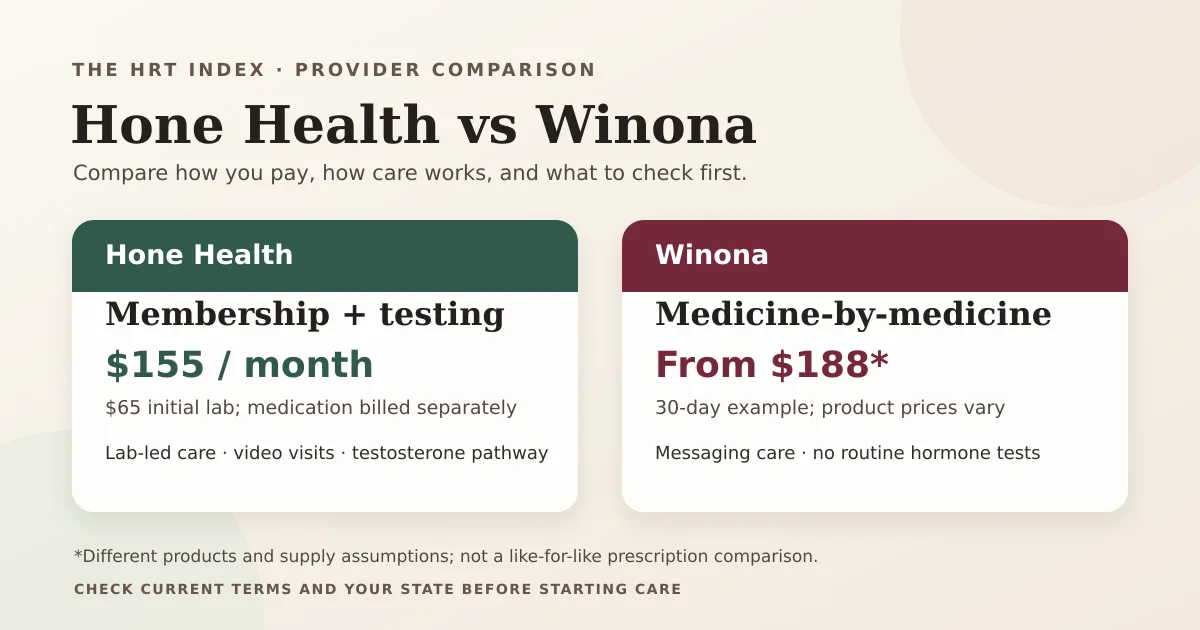
For our two-medicine example — estrogen through the skin plus progesterone — the listed prices add up to from $188 per 30-day supply at Winona and $262 in monthly price units at Hone, plus Hone's $65 starting lab. Here's the surprise: Hone's estrogen gel ($58) has a lower listed medicine price than Winona's patch ($149). Hone's membership makes its listed subtotal higher. These are different products, not identical prescriptions; the cost section separates their billing dates and supply assumptions.
The HRT Index is the independent decision resource for online menopause and HRT care — comparing telehealth providers on clinical legitimacy, care quality, medication fit, price transparency, and access, with every claim verified and dated, so women can choose the path that fits their situation before their first consult.
Winona is likely the better fit if you:
- want the lower total bill of the two
- would rather skip a blood draw
- are between 35 and 59
- are happy to message a doctor instead of meeting on video
- want an estrogen pill (Hone doesn't offer one)
Hone is likely the better fit if you:
- want a broad initial lab panel and scheduled follow-up testing
- want live video visits with a physician
- want a clinician to talk through testosterone with you
- live in Alabama, Mississippi, New Mexico, Utah, Vermont or West Virginia, where Winona isn't listed
Start somewhere else if you: need insurance to pay, live in a state neither one lists, or have unexplained bleeding or a history of blood clots, stroke, heart disease, or breast or uterine cancer.
Hone Health, Winona and Gala are affiliate partners. We may earn a commission if you start care through a labeled link, at no extra cost to you. Partner relationships can affect which providers we feature. They don't change the facts, prices or limits on this page. How we make money
If one of those lists sounds like you, you can go straight there. If you're already leaning toward lower cost without routine hormone tests:
If regular labs and face-to-face video care are what you're after:
What we actually verified · Last verified October 2026
We read on October 14, 2026: Hone's women's menopause pages, patch and progesterone pages, HRT cost page, and help-center articles on Premium, the detailed women's lab schedule, payment breakdown, membership, states, billing and cancellation. Winona's product list, FAQ, patch and capsule pages, FDA-status help article and cancellation policy. Gala's main HRT page, both HRT offers, non-hormonal options and refund policy. Midi's pricing page, both Trustpilot profiles and the attributed service reviews. On the medical side: the FDA, DEA, The Menopause Society, ACOG, the ISSWSH guideline, the British Menopause Society's May 2026 PDF and the current Veozah label.
What those checks establish: what the providers currently publish, and whether our calculations follow the stated assumptions. We did not independently inspect an assigned clinician's license or a dispensed medicine. We distinguish provider claims from FDA and clinical guidance.
We confirmed in provider documents: Hone's $65 initial panel, $155 monthly membership ($1,860 annualized), separate medicine charges, 33-state women's list and video consults. Its women's help pages require an at-lab first panel; its marketing separately advertises home draws where available. Winona publishes per-product prices, 28-day billing for a 30-day supply, ages 35–59, 37 states plus Puerto Rico, message-only physician care and no routine hormone-test requirement.
We did not: sign up, pay, see a clinician or receive medicine from either company. This is a documentation review, not a patient test.
We could not confirm: a Hone patch restock date; the exact medicines and manufacturers either company would dispense; Hone's women's HRT start-age limits; or Gala's complete patch-plus-progesterone price, supplied quantity, HRT age/state roster and applicable refund terms. Hone's help center explicitly labels its oral progesterone compounded; the product page is silent, not an opposing approval claim.
On this page: At a glance · Which fits you · Real cost · What $155 buys · Medicines · Blood tests · Testosterone · Care and speed · States, ages, insurance · Cancelling · Other options · In-person first · Questions to ask · How we compared · Bottom line · FAQ
Hone Health vs Winona at a glance
Hone Health and Winona both offer hormone replacement therapy (HRT) for menopause through cash-pay online care, but they are built differently. Winona sells each medicine on its own with no membership. Hone charges a monthly membership for labs and video doctor visits, then bills your medicine on top.
Think of Winona like a pharmacy with a doctor attached. You pay for what's prescribed. Think of Hone like joining a clinic. You pay to belong, and your medicine is extra.
Here is everything side by side.
| What you're comparing | Hone Health (women's Premium) | Winona | What it means for you |
|---|---|---|---|
| How you pay | $65 lab to start, then $155 a month, plus each medicine | Each medicine priced on its own; no membership | Hone's fee alone is about $1,925 in year one before any medicine |
| How often you're charged | Membership every month; medicine on its own cycle | Every 28 days for a 30-day supply (or every 84 days for a 90-day supply) | Expect two separate Hone charges in some months; 14 Winona charges in a first 365-day example starting with a charge on day 0; 13–14 in a later calendar year |
| Blood tests | Required broad initial at-lab panel; core follow-ups at about 3, 6, 9 and 12 months, then less often; individual schedule varies | Routine hormone tests not required | Hone includes monitoring; not every initial marker repeats quarterly |
| How you talk to the doctor | Live video consult with a licensed physician; follow-up consults included | Messages only; no phone or video; replies usually within 24–48 hours | Pick the style you'll actually use |
| Estrogen options | Gel; patch (listed, but its help center says unavailable due to a national shortage); compounded Bi-Est cream; vaginal products | Tablets, patch, compounded body creams, compounded vaginal cream | Hone says it does not prescribe systemic estrogen pills. No gel is listed on Winona’s reviewed menu. |
| Progesterone | Oral capsules, $49 (help center labels them compounded); compounded cream, $79 | Capsules from $39 (labeled FDA-approved); compounded creams | More detail in the medicines section |
| Testosterone | Yes — compounded injection or cream, after a doctor's review (not FDA-approved for use in women; listed products are compounded) | No; offers DHEA instead | The biggest clinical difference between them |
| Insurance | Not accepted for HRT; HSA/FSA accepted | Not billed; HSA/FSA accepted | Neither is in-network with your health plan |
| Ages | No start-age range found in reviewed women’s pages | 35–59 to start | Over 59? Ask Hone |
| States | 33 | 37 plus Puerto Rico | See the full state table |
| Shipping | Free; carrier varies | Free USPS (2–5 business days) after a 24-hour hold; paid faster options; not discreet packaging | Speed and privacy differ |
| Leaving | Cancel anytime; pause up to 3 months; membership and prescriptions cancel separately | Cancel or pause 30, 60 or 90 days in your account; refund only within a 24-hour order window | Both: act before the next charge |
All rows from each company's own pages, checked October 14, 2026: Hone women's Premium, Hone payment breakdown, Hone states, Hone HRT cost and insurance, Winona products, Winona FAQ. Prices change, so confirm at checkout.
The quick read:
- Winona is the lower-cost, no-lab, message-only option.
- Hone's membership buys labs, video visits and testosterone options.
- Neither bills insurance.
Which one fits you: Hone Health or Winona?
Choose Winona if cost and skipping blood tests matter most and you're 35 to 59 in one of its states. Choose Hone if you want regular deep lab testing, live video visits, or a clinician to look at testosterone, and you live in one of its 33 states. Some women are better off starting with neither.
A lot of women land here after feeling brushed off by a doctor. That's real, and it's tiring. The good news is that this choice is less about which company is "better" and more about which kind of care you'll actually use. Find your situation below.
| Your situation | Start with | Why | What to do next |
|---|---|---|---|
| You’re paying cash and want the lower listed bill of the two | Winona | Its patch-plus-capsule subtotal is from $188 per 30-day supply; Hone’s gel-plus-capsule subtotal is $262 in monthly price units | Compare the actual prescription and payment dates |
| You'd like an estrogen pill | Winona | Hone says it doesn't prescribe estrogen pills | Ask Winona which tablet and strength |
| You want scheduled lab monitoring | Hone | Core follow-ups are included; cholesterol and thyroid follow different schedules | Check your state, then the $65 panel |
| You want to see a physician on video | Hone | Winona is message-only | Check Hone's state list |
| Low sex drive is a big reason you're looking | Hone, or a menopause specialist | Winona doesn't prescribe testosterone | Read the testosterone section first |
| You're 35 to 39 | Winona | It publishes HRT from age 35; Hone doesn't publish a range for women | Confirm during intake |
| You're 60 or older | Ask Hone first | Winona starts HRT only up to 59 | Use the age question in our question sheet |
| You live in AL, MS, NM, UT, VT or WV | Hone | Winona doesn't list these states | Check Hone's women's plan |
| You live in CT, DE, HI, ID, ME, MN, NH, NJ, PA, SC or Puerto Rico | Winona | Hone's women's plan doesn't list these | Check Winona's intake |
| You live in AK, AR, KS, LA, ND, RI, SD or Washington, D.C. | Neither — look at other options | Neither lists your location | See Gala and other options below |
| You need insurance to pay | Neither first | Both are cash-pay | An in-network clinic or your own doctor |
| You want a non-hormonal hot-flash medicine | Neither reviewed menopause menu lists one | Gala lists fezolinetant | See other options below |
| You have unexplained bleeding, or a history of clots, stroke, heart disease, or breast or uterine cancer | An in-person clinician | These need a full review first | See "When to start in person" |
Editorial fit judgments based on each company's published model and policies, checked October 14, 2026. Not medical advice.
A 20-second self-check
Nobody sees these answers but you. Each one points you somewhere.
- Do you prefer a service built around routine testing? Yes → Hone. No → compare Winona (or Gala); a clinician may still recommend tests.
- Would you pay about $155 a month for video visits and repeat labs? No → Winona.
- Is testosterone part of why you're looking? Yes → Hone, after you read what the evidence says.
- Does your state show up for your choice in the state table? No → the other one, or one of the other options.
If you answered and still feel split, that's normal. It usually means your choice depends on a few personal things at once.
The right online menopause care isn't the same for every woman — it depends on your symptoms, what you've already tried, your age, your state and your health history. Some situations belong with an in-person clinician first. Use The HRT Index's Find My HRT Path tool to explore a featured care option for your situation — and to flag when online care isn't the right starting point — before your first consult.
It's free, takes about 60 seconds and doesn't ask for your email. It asks five questions: what's bothering you most, what you've tried, your age, your state and any health history a clinician should know about. It doesn't diagnose you, choose a medicine or decide whether hormones are right for you. A clinician does that. One honest note: the tool currently features Gala and Winona, not Hone, and our partner relationships affect which providers it shows and in what order. (How it decides)
How much do Hone Health and Winona really cost?
For our skin-estrogen-plus-progesterone example, Winona's listed prices add up to from $188 per 30-day supply and Hone's to $262 in monthly price units, plus Hone's $65 starting lab. Hone's gel has a lower medicine price than Winona's patch, but its $155 membership makes the subtotal higher. Winona came out lower in the whole-body estrogen examples below; the prescriptions and time units are not identical.
First, what "per month" means at each
The two companies use "per month" differently. That trips people up.
- At Hone, care and medicine have separate billing streams. Your membership bills every month. Your medicine bills on its own cycle, when the pharmacy processes a shipment. (Hone billing)
- At Winona, "per month" means a 30-day supply that's charged every 28 days. So you get 13 or 14 charges a year, not 12. (Winona FAQ)
Neither is a trick. But it means you can't compare the headline numbers directly. We separate listed price units, assumed medicine supply and the dates cash leaves your account. Hone's actual medication supply per charge isn't established by its monthly price label.
Similar treatment routes, priced at both
We matched each plan as closely as each menu allows. Hone doesn't list an estrogen pill. Winona doesn't list a gel. Hone's patch is listed at $58, the same price as its gel, but Hone's own help center says the patch is "currently unavailable due to a national shortage," so we priced the gel. We did not find an estradiol patch entry in the FDA shortage list reviewed on October 14, 2026. Hone's wording is its own availability report, not a confirmed FDA national-shortage designation. Neither list proves a particular pharmacy has stock.
| Plan (how the medicine is taken) | Hone Health | Winona | Difference |
|---|---|---|---|
| Skin estrogen + progesterone capsules (when both are prescribed) | Gel $58 + progesterone $49 + membership $155 = $262 in monthly price units, plus $65 to start | Patch from $149 + capsules from $39 = from $188 per 30-day supply | $74 difference between listed subtotals; not a verified same-period saving |
| Skin estrogen only (when no separate progestogen is needed) | Gel $58 + $155 = $213 in monthly price units, plus $65 to start | Patch from $149 per 30-day supply | $64 difference between listed subtotals; confirm medicine supply and billing |
| Estrogen pill + progesterone | Not offered | Tablets from $54 + capsules from $39 = from $93 per 30-day supply | Only Winona offers this |
| Compounded cream route | Bi-Est cream $80 + progesterone capsules $49 + $155 = $284 a month | Estrogen-and-progesterone body cream from $89 per 30-day supply | Different products; not a like-for-like swap |
| Vaginal estrogen only | Estrace cream $40 + $155 = $195 a month (Vagifem: $220) | Vaginal estrogen cream from $89, refilled when you ask | Winona's refill timing varies, so its yearly total depends on your use |
| Testosterone add-on | Injection from $28 a vial, or cream $60 a month, plus membership | Not offered | Only Hone offers this |
Prices from Hone's women's Premium menu and Winona's product list, checked October 14, 2026. Winona prices are "from" prices; your strength and supply can change the quote. Hone notes its prices are estimates that can vary by dose. These are billing illustrations, not quotes.
What that looks like over a year
Here's what the example prices produce under the assumptions shown. Hone's column buys 12 monthly medication price units plus 12 memberships; its actual medicine days per fill still need confirming. For Winona, we show both cash charged and a prorated supply cost. Neither is a complete personal quote, and the two companies' columns do not establish identical 365-day treatment plans.
| Plan | Hone: $65 + 12 monthly price units and memberships (assumed) | Winona: cash in first 365 days (14 assumed 30-day-supply charges) | Winona: prorated value of 365 medicine-supply days (not cash charged) |
|---|---|---|---|
| Skin estrogen + progesterone | $3,209 ($65 + 12 × $262) | $2,632 | $2,287 |
| Skin estrogen only | $2,621 | $2,086 | $1,813 |
| Estrogen pill + progesterone | Not offered | $1,302 | $1,132 |
| Compounded cream route | $3,473 | $1,246 | $1,083 |
Our arithmetic from published starting prices, October 14, 2026. Winona's prorated supply value = price per 30-day supply × 365 ÷ 30, rounded to the nearest dollar; it is not an offer to buy a fraction of a refill. Its cash column assumes the first charge on day 0 and no pauses or changes. Hone's column assumes 12 monthly memberships and 12 medication price units; it does not verify 365 medicine-supply days or the actual pharmacy charge schedule. Dose changes, other prescribed items and required outside care remain extra. Different creams and routes are not clinically equivalent.
What the numbers mean for you:
- In the two-medicine illustration, the difference between Hone’s assumed $3,209 and Winona’s prorated $2,287 is about $922. That is a difference between these models, not a confirmed annual saving for equivalent treatment.
- Hone's separate care fee is what changes this example. Its gel's listed monthly medicine price is $91 below Winona's patch price. Winona's tablet starts at $54 and its progesterone at $39 versus Hone's $49 progesterone; those are reference prices, not matched product-and-supply quotes.
- What the extra care fee buys at Hone: video visits, medication management and scheduled follow-up labs. Its detailed schedule lists core panels at 3, 6, 9 and 12 months in year one, with cholesterol every six months and normal thyroid testing annually. If you'd use those services, the fee can be worth considering. If you just want estrogen and progesterone refilled, it may buy more service than you want. (Hone's women's lab schedule)
Your first 90 days, in real dates
Big totals hide something simple: when money actually leaves your account. Here's one plan, with a pretend start date of October 14, 2026. No pauses, no changes.
Winona, skin estrogen + progesterone, $188 per 30-day supply (hypothetical):
| Charge | Date | Cash charged | Running total | Medicine bought so far |
|---|---|---|---|---|
| First order | Oct 14, 2026 | $188 | $188 | 30 days |
| Refill 1 | Nov 11, 2026 | $188 | $376 | 60 days |
| Refill 2 | Dec 9, 2026 | $188 | $564 | 90 days |
| Refill 3 | Jan 6, 2027 | $188 | $752 | 120 days |
Four charges fall inside your first 90 days, even though three "months" of medicine would be $564. That fourth charge isn't a hidden fee. It buys your next month early, because 28-day billing runs a little ahead of a 30-day supply.
Hone, gel + progesterone (hypothetical): $65 for the initial lab, plus three $155 membership charges and three $107 monthly medication price units, gives $851. That is a three-period budget illustration, not a verified first-90-day bill. Membership activation, the pharmacy's charge dates and each fill's supply must be confirmed separately.
The $752 Winona example buys 120 nominal supply days. The $851 Hone example uses three monthly medication price units and three memberships, with actual supply and charge dates unresolved. Use the timeline to plan cash—not to claim these buy the same amount of treatment.
A worked example
Illustrative, not a real patient. Dana is 52, still has her uterus, and has read that a skin estrogen might suit her.
- At Winona: a patch from $149 plus progesterone capsules from $39 = from $188 per 30-day supply, charged every 28 days. At those prices, a prorated 365 days of medicine is about $2,287; 14 charges in the first 365 days total $2,632 and buy 420 nominal supply days.
- At Hone: $65 for the lab, then gel $58 + progesterone $49 + membership $155 = $262 in monthly price units. Twelve of those units plus the lab total $3,209; the medicine quantity and pharmacy billing dates still need confirmation.
Those models differ by about $922, or $77 when spread over 12 months; they are not verified equal-supply quotes. Dana asks herself: Would I use repeat lab panels and video visits enough to consider the extra care fee? If yes, she looks closer at Hone. If no, she looks closer at Winona. Before paying either, she asks which exact patch or gel she'd get, whether it's in stock, whether her progesterone is FDA-approved or compounded, and how many days each charge buys.
Don't anchor on the wrong price
Three numbers on these sites are easy to misread.
- Hone's $25 "Basic" plan doesn't include hormone therapy. Hone's own help center says Premium is the plan for menopause care. Budget with $155, not $25. (Hone membership tiers)
- Winona's $54 tablet isn't a full two-medicine plan. If your clinician prescribes separate oral progesterone for uterine protection, its listed price adds from $39. Some women have another appropriate source of protection; ask what applies to your plan.
- Winona's DHEA is $27 for three months, not $27 a month. And it isn't a testosterone substitute.
You may also see Hone's lab shown as "$165" crossed out to "$65." We use $65, the current advertised entry offer—not a guaranteed permanent price. Hone's membership comparison separately lists treatment-start costs from $220 before medicine: the $65 panel plus the first $155 membership. Its entry offer includes a consult; confirm when membership billing begins and which amounts are charged before your first visit. (Hone membership comparison)
What can still add to your bill
These aren't in any number above. If one applies to you, your total isn't complete until you know its cost. An unknown cost is never zero.
- At Hone: a different dose or product than the ones we priced; extra medicines; a pending prescription you forget to cancel when you leave.
- At Winona: faster shipping ($15, $25, $50 or $75 per order); the 90-day supply price, which isn't listed; vaginal cream refills; add-ons like sleep or hair products.
- At both: any outside tests or visits your clinician sends you for.
A cost worksheet you can copy
MY HRT COST CHECK — HONE vs WINONA (keep this private)

                              HONE                       WINONA
Medicines prescribed:         ____________________       ____________________
Exact product + strength:     ____________________       ____________________
FDA-approved or compounded?   ____________________       ____________________
Starting charge:              $65 listed lab + $______   $______
Membership start / next date:  __________ / __________    no separate membership
Membership:                   $155 / month               none
Medicine charge:              $______ every ____ days    $______ every ____ days
Supply each charge buys:      ____ days                  ____ days
Shipping:                     free / $____               free / $____
Next charge date(s):          ________  ________         ________
Last day to cancel:           ________                   ________

MEDICINE COST PER 30 SUPPLY DAYS = each medicine charge ÷ its confirmed supply days × 30.
Add each medicine separately. Keep calendar-month membership, one-time fees and
shipping separate; do not spread them over a guessed medicine supply.
CASH IN A DATE WINDOW = the sum of all dated charges in that window.
If any line says "unknown," the total is INCOMPLETE — never write $0.
If the lower bill and no blood tests settle it, Winona lets you see each product's price before it's charged, and you can cancel a new order within 24 hours for a full refund.
Want more detail on Hone's listed prices? Our Hone women's HRT cost guide includes an estimator and scenario table. An estimate is not a pharmacy quote; confirm quantity and billing before relying on it.
What does Hone's $155 membership actually pay for?
Hone says its women's membership is a $1,860-a-year program billed as $155 a month, which you can cancel any time. It splits that money three ways: $1,020 to the doctors' practice, $130 to the lab and $710 to Hone for its app, support and operations. The fee covers your first video consult, follow-up consults, regular lab panels and medication management — but not the medicine.
Hone publishes this split in its own help center. (Hone payment breakdown)
Where your $155 a month goes
| Who gets paid | Per year | Per month | Share of the fee |
|---|---|---|---|
| Broad Health P.A. or other affiliated medical practices (doctor visits and medical care) | $1,020 | $85 | 55% |
| The clinical lab (lab testing) | $130 | about $11 | 7% |
| Hone, the company (app, technology, member support, card fees, operations) | $710 | about $59 | 38% |
| Total | $1,860 | $155 | 100% |
Source: Hone, "Women's Premium Membership Overview and Payment Breakdown," checked October 14, 2026. Monthly figures are our division of Hone's yearly numbers.
In plain words: a bit more than half pays for the doctors. A small slice pays for the labs. Almost two-fifths pays Hone to run the service.
What's included, and what isn't
Included in the $155, according to Hone:
- your first live video visit with a licensed Hone physician
- follow-up consults with no extra visit fee
- core follow-up lab panels at about 3, 6, 9 and 12 months, then 18 and 24 months; other panels follow different schedules, and your doctor can change the timing
- medication management and dose changes
- free shipping
- customer support
Not included:
- the $65 first lab panel
- your medicine
- insurance billing of any kind
Hone also says that if, after your first consult, the doctor decides treatment isn't right for you, it refunds your first $155 membership fee. It doesn't say the $65 lab is refunded. (Hone payment breakdown) Hone's linked women's offer also advertises the first physician consultation as included with the $65 test. Confirm when membership starts and whether any additional payment is required before your appointment; we did not complete checkout. (Hone's women’s offer)
What's in the lab panel
Hone markets its broad initial women's panel as checking 50-plus markers. In plain terms, its published list includes:
- Hormones: total and free testosterone, estradiol, progesterone, FSH (a hormone that rises as the ovaries slow down) and SHBG (a protein that carries hormones in the blood)
- Cholesterol: a full lipid panel plus ApoB, a marker of the particles that carry cholesterol
- Blood count: red cells, white cells and platelets
- Metabolism, liver and kidneys: blood sugar, salts, liver enzymes and kidney function
- Thyroid: TSH, free T4, free T3 and thyroid antibodies
The full initial panel does not repeat every three months for everyone. Hone's detailed schedule repeats the core blood-count, metabolic and hormone panels; it schedules cholesterol plus ApoB every six months and normal thyroid results annually. Abnormal thyroid results may lead to thyroid testing at each visit. Your clinician sets the actual schedule. (Detailed women's lab schedule)
Those tests can give a clinician information about issues beyond menopause, including thyroid function and cholesterol. But the panel is a service you're buying, not proof that every test is needed for every woman. Ask what question each test will answer. More on that in the blood-test section.
So, is it worth it?
It's worth it if you'll use what it buys. That means you want your numbers tracked over time, you like seeing a doctor on video, or you want testosterone looked at. It's probably not worth it if you mainly need estrogen and progesterone refilled, or if you already get yearly labs through your own doctor.
If repeat labs and a video visit with a physician are what you want, check that Hone's women's plan serves your state before you pay for the $65 panel.
A prescription is never guaranteed. Hone says it refunds the first $155 if its doctor decides treatment isn't right for you.
Are Hone's and Winona's medicines FDA-approved or compounded?
Both companies sell a mix. Winona says its estrogen tablets, progesterone capsules and estrogen patches are FDA-approved and its creams are compounded in its own pharmacies. Hone sells brand-name vaginal estrogens plus an estradiol gel and patch, but its help center labels its oral progesterone, Bi-Est cream and several other creams as compounded. Ask either company for the exact product name before you pay.
Three words, in plain English
- FDA-approved means the finished medicine — the actual patch, pill or gel you'd use — was reviewed by the U.S. Food and Drug Administration for safety, effectiveness and quality. Many approved generics are inexpensive.
- Compounded means a pharmacy mixes the medicine for a patient. The FDA puts it plainly: compounded drugs are not FDA-approved, and the FDA doesn't check their safety, effectiveness or quality before they're sold. (FDA) Compounding can have a real place, such as when a patient needs a formulation an approved medicine cannot provide, including avoidance of an allergenic ingredient. But compounded isn't the same as approved.
- Bioidentical describes the molecule. It means the hormone is shaped like the one your body makes. It says nothing about approval. Many FDA-approved products are bioidentical, and so are many compounded ones. The Menopause Society says custom-compounded hormones are not safer or more effective than approved bioidentical hormones. (The Menopause Society)
So when you see "bioidentical," your next question is always: Is this an approved product, or compounded?
Product by product
| Medicine | Hone Health (plus $155 membership) | Winona | What to ask before paying |
|---|---|---|---|
| Estradiol patch (whole-body) | $58 a month; help center says "currently unavailable due to a national shortage"; product page lists it with no note | From $149; Winona says it's FDA-approved; five strengths, changed once or twice a week | "Is the patch in stock, and which brand or maker is it?" |
| Estradiol gel (whole-body) | $58 a month; not labeled compounded or approved | Not offered | "Which manufacturer makes this gel?" |
| Estradiol tablet (whole-body) | Not offered — Hone says it prescribes only skin routes for systemic estrogen | From $54; Winona says it's FDA-approved | "Which strength and product?" |
| Oral progesterone | $49 a month; help center labels it "(compound)"; product page says "100mg capsules" with no label | From $39; Winona says it's FDA-approved; contains peanut oil | Hone: "Is this a compounded capsule or an approved product?" Winona: "I have a peanut allergy — what's my option?" |
| Whole-body creams | Bi-Est (estradiol plus estriol) $80, compounded; progesterone cream $79, compounded | Estrogen cream, progesterone cream and a combination cream, from $89, compounded | "What protects my uterine lining with this, and what's the evidence?" |
| Vaginal treatments (local) | Estrace estrogen cream $40 and Vagifem estrogen inserts $65 (brand names in Hone’s menu); estriol cream $58, compounded; DHEA vaginal cream $55 in the help menu ($56 on its women’s page), compounded—not estrogen | Vaginal estrogen cream from $89, compounded | “Is a low-dose local treatment enough, and what exact product and price apply?” |
| Testosterone | Compounded injection for women (25 or 50 mg/mL) from $28 a vial; compounded cream $60 a month | Not prescribed | See the testosterone section |
| DHEA | Vaginal cream: $55 help-center estimate; women’s page lists $56 | Oral DHEA, from $27 for 3 months | Different routes and uses; neither is a proven stand-in for testosterone for HSDD |
| Non-hormonal hot-flash medicine | None listed | None listed for hot flashes | See other options below |
| Who fills it | Partner pharmacies; the reviewed women’s menu does not identify the dispensing pharmacy for your order | Winona says it operates two compounding pharmacies, in El Dorado Hills, California, and Twin Falls, Idaho | “Which pharmacy and manufacturer will supply my medicine?” |
Sources: Hone women's Premium menu, Hone progesterone, Hone estradiol patch, Hone HRT cost page, Winona products, Winona patch, Winona progesterone capsules, Winona FAQ. Checked October 14, 2026. "Says it's FDA-approved" means the company says so. We didn't see the product that would be shipped to you.
The surprise: progesterone
Many reviews describe Winona as "the compounded one." For progesterone capsules, the labels point the other way. Winona says its capsules are FDA-approved. Hone's own help center labels its oral progesterone capsules as compounded. Hone's product page doesn't say either way.
If an FDA-approved progesterone matters to you, Winona's labeling is clearer today. Still, ask both companies to name the exact product before you pay.
Where their own pages disagree
A company contradicting itself doesn't prove bad care. It does mean you should ask one clear question instead of picking the version you like best.
| Topic | One page says | Another page says | Ask this |
|---|---|---|---|
| Winona and FDA approval | Tablets, capsules and patches are FDA-approved (FAQ) | The same FAQ says all its HRT options are "compounded by a licensed pharmacist," and a help article from October 2025 says its treatments are not FDA-approved | "Is my product an approved product? Which one?" |
| Hone progesterone | Help center explicitly labels oral progesterone compounded | Product page describes 100 mg capsules without stating approval status—silence, not a contrary approval claim | “Which compounded or approved finished product would you dispense?” |
| Hone patch | Product page lists it at $58 | Help center: "Currently unavailable due to a national shortage" | "Can I get the patch now, or will I start on gel?" |
| Hone lab draw | Marketing page: go to a partner lab, or someone can come to you free "if available in your area" | Help center: women's Premium "Requires At-Lab Testing" | "Do I need to go to a lab in my area?" |
| Hone commitment | "No commitments. Cancel anytime." | Help center: an "annual clinical program" of $1,860, billed monthly, cancel any time | "Can I stop after one month with no further charges?" |
| Winona's progesterone cream | Winona says its cream protects the uterus "as effectively as oral capsules" | The British Menopause Society says progesterone through the skin is unlikely to protect the lining reliably | "What evidence supports this for my uterus?" |
Provider pages and British Menopause Society guidance checked October 14, 2026. Some rows show a genuine contradiction; others show a detail one page leaves out.
If you have a uterus, ask how it's protected
The endometrium is the lining of your uterus. Whole-body estrogen on its own can make that lining overgrow, which raises the risk of uterine cancer. With systemic estrogen, someone who has a uterus generally needs adequate progestogen protection—progesterone or a similar medicine. That is not the same as low-dose local vaginal estrogen, which generally does not require an added progestogen. Your clinician should explain the protection in your exact plan. (The Menopause Society)
That's why the cream question matters at both companies:
- At Winona, the combination body cream and progesterone cream are compounded. Winona says the cream protects the uterus as well as capsules, but cites no study on that page.
- At Hone, a Bi-Est cream paired with a progesterone cream would be all-compounded and all-skin.
The British Menopause Society's clinician guidance says progesterone absorbed through the skin is too variable to rely on for protecting the lining, and doesn't recommend compounded creams or gels for this. (British Menopause Society)
One question to ask either company: "What protects my uterine lining in this exact plan, and what evidence supports it?"
This is education, not advice to start, stop or change anything. If you're on a cream now, talk it through with your prescriber.
Skin estrogen or a pill?
Hone says it prescribes skin (transdermal) routes for systemic estrogen, because it believes skin routes are safer for blood pressure, clots and stroke. (Hone) The Menopause Society's wording is more careful: the risk of blood clots goes up with hormones taken by mouth and "may be lower" with a patch, gel or spray. (The Menopause Society)
"May be lower" is the honest phrasing. A clinician picks the route based on your history. Winona offers both a pill and a patch, so you have the choice there. For whole-body estrogen, Hone lists skin routes; it also lists local vaginal treatments.
Local or whole-body: compare them separately
Whole-body (systemic) estrogen — a patch, gel or pill — treats hot flashes and night sweats. Local vaginal estrogen — a low-dose cream or insert — mainly treats vaginal dryness, pain with sex and some bladder symptoms. It isn't meant to treat hot flashes. (The Menopause Society)
So don't price a vaginal cream against a patch. If dryness is your only problem:
- At Hone you'd pay the $155 membership for a $40 brand-name cream.
- At Winona you'd pay from $89 for a compounded cream.
- Your own doctor may be able to prescribe an FDA-approved vaginal estrogen that your insurance covers.
Our vaginal estrogen guide goes deeper.
A note on the 2026 label changes
On February 12, 2026, the FDA approved label changes for six menopausal hormone therapy products. The changes removed boxed-warning statements about heart disease, breast cancer and probable dementia. (FDA) That doesn't make hormone therapy risk-free, and it doesn't make compounded products approved. The current label for your exact medicine is what counts. See our 2026 label changes explainer.
For the bigger picture, read compounded vs FDA-approved HRT and our FDA-approved HRT medication list.
Do you need Hone's blood tests? Does Winona require any?
Hone's women's help pages require an initial $65 at-lab panel and include scheduled follow-up testing. Winona does not routinely require hormone tests. ACOG says perimenopause can usually be recognized from age, symptoms and period changes; testing may be offered for changed bleeding before age 45, especially before 40.
Why hormone tests can mislead
In perimenopause, your hormones go up and down from day to day. A single blood test is a snapshot of a moving target. That's why major menopause guidance says hormone testing is usually unnecessary to recognize typical perimenopause. (ACOG)
Winona follows that approach. Its FAQ says it doesn't require bloodwork, and its doctors prescribe and adjust based on your symptoms. (Winona FAQ) Gala says testing is usually not needed too.
When labs genuinely help
Labs aren't useless. They matter when:
- your symptoms could be something else, like a thyroid problem
- you have menstrual changes before age 45, especially before 40, and a clinician needs to investigate early or premature menopause
- you're starting testosterone, which needs monitoring
- a clinician identifies a reason to check cholesterol, blood sugar or blood counts
Hone's initial panel covers those types of tests, but the clinician still has to decide what your symptoms and results mean and whether other tests are needed. More testing isn't proof of better menopause care. Whether you value this monitoring and video-care service enough to pay $155 a month is a separate choice.
Three questions that make any lab test useful
Ask these before any test, at either company or anywhere else:
- "What question will this test answer?"
- "Could the result change my care?"
- "What happens if the result is normal but my symptoms continue?"
Two quick examples
Illustrative. Lisa, 47, has hot flashes, poor sleep and has never had her thyroid checked. She likes the idea of talking through results with a doctor on video. Hone's model fits how she wants care.
Maria, 53, had a full checkup with her own doctor in the spring. She mainly wants help with hot flashes and does not want to pay for repeat testing unless a clinician explains what it would add. Winona's service model fits that preference better; her previous checkup alone does not settle whether further tests are needed.
Neither choice is wrong. They're different kinds of care. Our guide to whether you need blood tests for HRT has more.
Testosterone: Hone offers it, Winona doesn't — what that means
Hone may prescribe compounded testosterone injections or cream to women after a doctor's review. Winona doesn't prescribe testosterone and offers DHEA instead. No testosterone product is FDA-approved for women in the U.S. Prescribing an approved men's product to a woman is off-label; a compounded preparation is separately an unapproved finished drug. Testosterone is a prescription-only Schedule III controlled substance. (FDA, DEA)
If low sex drive is part of why you're here, this may be the biggest difference between the two. Here's what the evidence says.
What testosterone is proven to help
The main guideline on this comes from the International Society for the Study of Women's Sexual Health (ISSWSH). The strongest evidence is for hypoactive sexual desire disorder (HSDD) after menopause. ISSWSH also discusses treatment for some women in their late reproductive years, while noting that evidence is more limited. HSDD means low sexual desire that lasts and causes real distress. It requires a full assessment of health, relationships, mood and other causes—not a blood test alone. (ISSWSH guideline)
Testosterone isn't proven to fix energy, mood, weight, muscle or "aging" in women. Hone's own page says its injections can help with bone loss and irregular periods. Those aren't evidence-based uses.
How the guideline says to use it
- It favors low-dose testosterone through the skin (a gel, cream or patch), with monitoring.
- It says compounded testosterone can't be recommended, because there isn't enough evidence on safety, effectiveness or consistent strength.
- It doesn't recommend pellets, injections into the muscle or pills.
- It notes there's no U.S.-approved testosterone product for women. When it was published, Australia was the only country with an approved one.
Hone's women's injection is a compounded product given under the skin. Its cream is compounded too. That puts both outside what the guideline prefers. It doesn't mean a Hone doctor's choice is wrong for every woman. It means you deserve the full picture and a clear reason for the plan. The guideline also notes that long-term safety has not been established. Its specific warning about injections into muscle concerns a different route from Hone's injections under the skin; the compounded-product concern still applies.
What about Winona's DHEA?
Winona offers oral DHEA, a hormone your body can turn into other hormones, as its alternative to testosterone. (Winona FAQ) The ISSWSH guideline does not recommend oral DHEA for HSDD in postmenopausal women with normal adrenal function: larger studies did not establish a sexual-function benefit. This is different from a local vaginal DHEA treatment for painful sex. Oral DHEA is not a like-for-like testosterone substitute.
Questions to ask any clinician about testosterone
- "Is my low desire what's called HSDD, and how did you decide?"
- "Why this form — cream or injection — and is it compounded?"
- "What blood tests will we do, and how often?"
- "What side effects should I watch for?"
If testosterone is a big reason you're looking and you want a physician to evaluate it with lab monitoring, Hone is the one of these two that offers that conversation.
You can also read our guides to online testosterone therapy for women and whether any testosterone is FDA-approved for women.
What care feels like: video visits vs. messaging
Hone gives you a live video visit with a licensed physician after your labs, then follow-up consults included in the membership. Winona is message-only: you write, a board-certified physician replies — usually within 24 to 48 hours — with a check-in around week 10. Winona can be quicker to start because there's no lab step.
| Hone Health | Winona | |
|---|---|---|
| Who reviews you | A licensed physician working through an affiliated medical practice | One of 30+ board-certified physicians licensed in your state, per Winona |
| Video or phone | Yes — live video consult | No — messages only |
| First steps | Buy the $65 lab → in-lab blood draw → video consult → prescription if appropriate | Online intake → matched with a doctor → prescription if appropriate |
| How fast, per the company | Hone's illustrated timeline shows a consult around day 5 and medicine around day 10 | After prescribing: a 24-hour hold, 1–2 business days to prepare, then 2–5 business days by mail |
| Ongoing contact | Follow-up consults, dose changes and support | Unlimited messaging; doctor check-in after 10 weeks |
| Ask for a different doctor | Not stated | Yes, if another is licensed in your state and taking patients |
| Packaging | Not stated | Winona says it can't offer discreet packaging |
| Is a prescription guaranteed? | No | No |
Sources: Hone women's Premium, Hone menopause page, Winona FAQ. Checked October 14, 2026. These are company statements; we didn't time anything.
Hone: labs first, then a conversation
You buy the lab panel and get your blood drawn at a partner lab. A Hone physician reviews your results and history, then meets you on video to talk through options. Its getting-started page places membership activation after the consultation; the payment terms also describe refunding an initial $155 membership fee if treatment is declined. Confirm your membership charge date before paying; prescribed medicines have a separate billing stream. After that, your care team adjusts the plan as you go.
The upside is a real conversation and a fuller picture of your health. The trade-off is time and money before you get any medicine.
Winona: write, wait, receive
Winona is "asynchronous." That means you send a message and the doctor replies later, not live. If you don't ask questions in your intake and you're a good fit, the doctor may prescribe right away. (Winona FAQ)
Some women love this. It's quick, and you can write at midnight. Others want to see a face. A portal that's open all day isn't a doctor who replies instantly, and it isn't for emergencies.
What reviews can — and can't — tell you
Reviews are good at spotting service problems like billing, shipping and slow replies. They can't tell you whether a medicine will work for you.
On Trustpilot (October 14, 2026), Hone shows 4.8 from 12,406 reviews and Winona 4.6 from 8,759. Both companies invite customers to leave reviews. Hone's number covers its whole business, including men's care, so it isn't a menopause-only score. (Hone on Trustpilot, Winona on Trustpilot)
A Hone reviewer identified as A, in a review published October 6, 2026 with an experience date of September 18, 2026, said the physician “took the time to explain my results in a way I could understand.” The review explicitly discusses menopause. That's one person's report of service, not independently verified treatment or a promise of results. (Original review) Hone's own product-page testimonials are marked “Compensated Hone Patient,” which is worth knowing.
On Winona's Trustpilot page, a reviewer identified as chrissy, with an experience date of October 7, 2026, praised the doctor but said the portal did not show pricing clearly and was hard to navigate. That is one account, not a finding about every patient. (Review on Winona's Trustpilot profile) Winona's published 24-hour cancellation window is a separate, confirmed reason to know your order timing. More on that below.
States, ages and insurance: can Hone or Winona treat you?
Winona starts HRT for women 35 to 59 and serves 37 states plus Puerto Rico. Hone's women's plan serves 33 states and doesn't publish an age range for women. Twenty-seven states have both, six have only Hone, ten have only Winona, and seven states plus Washington, D.C., have neither. Neither company takes insurance for HRT.
Every state, side by side
| Who serves you | States |
|---|---|
| Both (27) | Arizona, California, Colorado, Florida, Georgia, Illinois, Indiana, Iowa, Kentucky, Maryland, Massachusetts, Michigan, Missouri, Montana, Nebraska, Nevada, New York, North Carolina, Ohio, Oklahoma, Oregon, Tennessee, Texas, Virginia, Washington, Wisconsin, Wyoming |
| Hone only (6) | Alabama, Mississippi, New Mexico, Utah, Vermont, West Virginia |
| Winona only (10, plus Puerto Rico) | Connecticut, Delaware, Hawaii, Idaho, Maine, Minnesota, New Hampshire, New Jersey, Pennsylvania, South Carolina, and Puerto Rico |
| Neither (7, plus D.C.) | Alaska, Arkansas, Kansas, Louisiana, North Dakota, Rhode Island, South Dakota, and Washington, D.C. |
Our comparison of Hone's women's Premium state list and Winona's state list, checked October 14, 2026. A listed state doesn't guarantee every medicine is available there — controlled medicines like testosterone and some compounded products can be limited by state. Hone’s women’s help pages require at-lab testing; confirm whether a local home draw is actually available before relying on that marketing option.
If you're in a "neither" location, you're not out of options. See other options below, or our online HRT by state guide.
If you're 35 to 39
Winona publishes that it treats women from 35. Hone doesn't publish a minimum age for women's HRT, so ask. If you're under 35 with menopause-type symptoms, see a clinician in person first — new symptoms at that age deserve a full look.
If you're 60 or older
Winona starts HRT only for women up to 59. Its FAQ also says there's no limit on how long you can stay on treatment once you start, so if you're turning 60, ask how that works. (Winona FAQ)
Hone's clinical policy page says its patients range from 25 to 80 and that physicians decide the right treatment. (Hone) That isn't the same as a published rule for starting HRT at 60-plus, so ask before you pay for the lab.
For women without contraindications who are younger than 60 or within 10 years of menopause, The Menopause Society describes the benefit-risk balance of hormone therapy as generally favorable for bothersome symptoms. Starting later isn't an automatic no, but risks need a careful, one-on-one review; this is not an age-based promise of greater symptom relief. (The Menopause Society) See our guide on starting HRT after 60.
A question to copy: "Do you accept new patients my age, and what happens to ongoing care when a patient turns 60?"
Insurance, HSA and FSA
Neither company bills your health insurance. Hone says it doesn't accept insurance for HRT but does take HSA and FSA payments. (Hone) Winona doesn't work with insurance either, accepts HSA/FSA cards, and gives you receipts you can submit for possible reimbursement. (Winona FAQ)
An HSA or FSA lets you pay with pre-tax money. It doesn't make either company in-network. Your plan administrator decides what's eligible.
If insurance is a must, both of these are the wrong first stop. Midi Health is an online menopause clinic that's in-network with many PPO plans; check your exact state and plan. Its self-pay visits are $250 for the first and $150 for follow-ups, with possible additional costs. It doesn't accept Medicaid or Medi-Cal patients. Medicare beneficiaries can attend as self-pay patients, but Midi says they cannot submit claims related to its visits, medications or associated services. (Midi, checked October 14, 2026) We don't earn a commission from the direct Midi link here. Your own doctor may also prescribe generic estradiol and progesterone that your plan covers.
See also: does insurance cover HRT for menopause?
Cancelling, pausing and switching
Both let you cancel anytime. Winona lets you cancel or pause for 30, 60 or 90 days in your account, but refunds an order only within its 24-hour processing window. Hone lets you pause for up to three months, but its membership and prescriptions cancel separately, shipped orders aren't refundable, and its own pages describe when cancellation takes effect in three different ways.
| Hone Health | Winona | |
|---|---|---|
| How to cancel | Submit Hone's Membership Cancellation Form; cancel pending prescriptions separately with support | Account settings → Billing Details → Cancel Subscription |
| Pause | Up to 3 months, no billing during the pause | 30, 60 or 90 days |
| Refund on an order already charged | Unprocessed medicine orders: full refund. Processed or shipped orders: no refund. | Full refund only within the 24-hour processing window |
| If the doctor won't prescribe | First $155 membership refunded, per Hone | Ask during intake; prescription not guaranteed |
| The trap to avoid | Cancelling membership doesn't stop a pending prescription — and cancelling a prescription doesn't stop membership | Refills process automatically every 28 days unless you pause or cancel first |
Sources: Hone cancellation and refund policy, Hone payment breakdown, Winona FAQ, Winona cancellation policy. Checked October 14, 2026.
Hone's three versions of "when cancellation starts"
| Hone page | What it says |
|---|---|
| Cancellation and refund policy | Cancellation counts from the moment you submit the form, even if Hone processes it later; any charge after that is refunded |
| Women's Premium page | Cancellation takes effect at the end of your current billing period |
| Membership billing page | Cancellation takes effect immediately; fees already paid aren't refundable |
These wordings don't clearly settle when access ends. Don't guess: submit the form before your renewal date, save the confirmation with its timestamp, and separately ask support to cancel any pending prescription. Ask which effective date applies to your membership and remaining care access.
Your deadlines, with real dates
Hypothetical.
- Winona: your next refill processes November 11, 2026. Cancel or pause in your account before that day. If it has already started processing, you have 24 hours to cancel that order for a refund.
- Hone: your membership renews November 14, 2026. Submit the cancellation form by November 13, keep the timestamp, and message support the same day to cancel any prescription that hasn't shipped.
Switching from one to the other
Joining the other company means a new intake and a new doctor's decision. That doctor may choose a different product or strength. To avoid a gap:
- Ask how a new intake and any testing would be charged before you sign up; joining another service may create overlapping fees.
- Tell the new doctor exactly what you take now, including the dose.
- Agree with your clinicians who will handle refills during the change, then coordinate cancellation with the billing dates. A new prescription alone does not guarantee it is in stock or has shipped.
Don't stop or change your hormones on your own. Ask your current or new clinician how to switch safely. Our guide to switching HRT providers walks through it.
A continuity checklist
Before you change anything, save these:
- your medicine names, strengths and pharmacy
- your last visit notes and any lab results
- your renewal and refill dates
- your cancellation confirmation
- who will manage refills during the change
And if your current treatment is working with a clinician you trust, you may not need to switch at all.
If neither fits: Gala Health and other options
If you want a cash-pay alternative without a separate membership fee, Gala Health is worth a close look. One HRT page advertises $207 every 12 weeks for pills and $297 for patches; another advertises $69 a month. It lists progesterone as a possible plan component, but we could not confirm the complete two-medicine price or supply. Get those details before paying.
Gala sits between these two. It's cash-pay like both, has no separate membership fee like Winona, and lists pill and skin estrogen options. Here's where its published offer can be attractive, using Gala's own pages from October 14, 2026—not a completed checkout or a confirmed equivalent prescription.
Where Gala can beat both
- A lower advertised starting price for skin estrogen. Gala's 12-week page lists patches at $297 every 12 weeks. Gala calls that $99 a month; 12 weeks is 84 days, so the advertised charge averages about $106 per 30 days, not $99 per calendar month. Winona's patch-plus-capsule subtotal starts at $188 per 30-day supply and Hone's gel-plus-capsule subtotal is $262 in monthly price units. Gala's full two-medicine quote is still needed before calling it cheaper for the same plan. (Gala 12-week page)
- One price that includes care. Gala says its cash price includes the medicine, the provider review and ongoing care, with no membership fee. (Gala hormone health)
- Progesterone listed as part of care. Gala's HRT offer lists oral progesterone among possible plan components, but that alone does not prove every item is included in every advertised price. Its IUD wording also needs a clinician's check: not every IUD protects the uterine lining during systemic estrogen use. Ask about your specific device and how long it has been in place. (Gala HRT offer, BMS guidance)
- No routine labs. Gala says hormone tests are usually not needed, and its clinicians order labs only when they'd change the plan.
- A non-hormonal option to ask about. Gala lists fezolinetant, the medicine sold as Veozah, which is FDA-approved for moderate to severe hot flashes due to menopause. Neither reviewed Hone nor Winona menopause menu lists it. Veozah has a boxed warning for liver injury and requires liver blood tests before treatment, monthly for the first three months, then at months six and nine. Ask about the medicine and lab costs separately; neither is established by Gala's HRT headline price. (Veozah label)
- Speed and privacy. Gala says a U.S.-licensed provider usually reviews an intake within 24 hours, with a short video visit required in some states. It advertises free, discreet 1–2 day delivery and support seven days a week. Those are provider-published timelines, not times we measured.
- Another state-fit check. Gala says it serves most U.S. states and won't charge if it cannot serve yours. We couldn't confirm its HRT roster, so we cannot establish wider reach or coverage in any specific state missing from Hone's and Winona's lists.
What Gala's year could look like
| Plan being investigated | Gala: conditional 12-week offer calculation—not a confirmed full-plan quote | Winona: prorated supply-price example | Hone: 12 monthly price-unit example |
|---|---|---|---|
| Skin estrogen + progesterone, when prescribed | Full-plan total incomplete. $297 per 84-day charge would prorate to about $1,291 per 365 supply days only if each charge buys 84 days and includes every prescribed item | From about $2,287 per 365 medicine-supply days | About $3,209 for 12 monthly price units plus initial lab; actual supply not confirmed |
| Pill + progesterone, when prescribed | Full-plan total incomplete. $207 per 84-day charge would prorate to about $899 per 365 supply days only if each charge buys 84 days and includes every prescribed item | From about $1,132 per 365 medicine-supply days | Not offered |
Our arithmetic, October 14, 2026. Gala's billing interval is published, but its supplied quantity and the complete progesterone-inclusive price were not confirmed. The conditional $899/$1,291 figures are not verified treatment totals or savings. At the advertised amounts, five 84-day charges beginning on day 0 would mean $1,035 for pills or $1,485 for patches in the first 365 days, before any unconfirmed required items. The first advertised charge is $207 or $297—not $69 or $99. If all 84 supply days were included per charge, those five payments would buy 420 supply days. Keep cash charged separate from prorated supply value.
What Gala's pages don't settle yet
Gala has two HRT pricing pages live. Our link goes to an offer that says "$69 a month, flat — the same price for as long as you stay." A separate Gala page lists pills at $69 a month billed $207 every 12 weeks, and patches at $99 a month billed $297. Gala says your exact plan and price are shown before you pay; we did not complete checkout. The $207 pill cycle averages about $74 per 30 days if it supplies all 84 days.
| What Gala publishes | What's still unclear | Ask Gala this |
|---|---|---|
| “FDA-approved bioidentical forms” on its main pages | The exact products, makers and complete treatment bundle are not identified for your prescription | “What exact medicine and maker will I receive? Is it FDA-approved or compounded?” |
| $69 a month on the linked offer | Whether a patch costs $69 or $99 a month, and whether every item in your plan is included | "Does my price cover every medicine in my plan, including progesterone?" |
| "Cancel anytime" | Its written refund policy (February 2026) asks for 72 hours' notice before billing, allows refunds mainly for medical disqualification, and is written for its weight-loss program | "Which cancellation rules apply to my HRT order, and what's my deadline?" |
| "If approved, you're charged" | The refund policy says the first charge happens when you complete intake | "When exactly is my card charged?" |
| "Most US states" | No published state list or age range for HRT | "Can you treat me at my age, in my state?" |
Sources: Gala hormone health, Gala 12-week page, Gala HRT offer, Gala refund policy. Checked October 14, 2026.
None of these unknowns says Gala can't give good care. They're the questions to settle before you pay.
Gala publishes this from an HRT patient it identifies as Donna, 55: "Everything was online and simple." Gala chose that quote. Read it as a description of sign-up, not a promise of results.
If you'd rather avoid a separate membership fee and want another cash-pay patch or pill offer to compare, Gala is the one to check next. Confirm the full prescription price, amount charged now and next billing date. Its lower advertised price is a reason to investigate—not proof that your complete plan will cost less.
Affiliate link. A prescription is never guaranteed. Need insurance? Gala doesn't take it either — see the Midi option above. Want our full side-by-side? Read Gala Health vs Winona and our Gala Health HRT review.
Other routes worth knowing
- Your own doctor or gynecologist: may cost less if your insurance covers visits and the prescribed generic medicines.
- A Menopause Society–certified practitioner: the Society keeps a public directory.
- A wider comparison: our best online HRT providers for menopause compares a wider range of services.
When to start with an in-person clinician instead
Some health histories and symptoms need an exam or a full review that an online form can't replace. If any of these apply to you, start in person before choosing between Hone and Winona.
- Unexplained vaginal bleeding, especially after menopause. It needs checking first.
- A history of breast cancer, uterine cancer, blood clots, heart disease or liver disease. These can make systemic hormone therapy inappropriate and need a full clinical review. Low-dose local vaginal treatment is a different decision; do not assume every estrogen product has the same risk profile. (The Menopause Society) A non-hormonal option or a specialist may be the right path. See menopause treatment if you can't take estrogen.
- A past stroke.
- You might be pregnant, are breastfeeding or are trying to conceive.
- You're under 35 with menopause-type symptoms.
- New, severe or unexplained symptoms. If anything feels urgent, go to urgent care or call 911.
Choosing not to use hormones, preferring non-hormonal care, or staying with a clinician you already trust are all valid outcomes. Our guide to who shouldn't take HRT has more.
What to ask before you pay
Ask for the known charges and renewal terms before each payment, and the exact prescription before accepting a medicine order. A clinician may need to evaluate you before the prescription is known; clarify what you are paying for at that earlier step. An advertised starting price isn't your final plan.
Copy-and-paste question sheet
Send this through either company's portal or support form. It doesn't ask you to share health details publicly.
I'm comparing online menopause care. Before each payment, please confirm what is known at that step:
If the prescription is not decided yet, please explain the assessment charge and refund rules.

1. The exact medicine names, strengths, and makers (or compounding pharmacy)
   I would receive — and whether each finished product is FDA-approved or compounded.
2. Every charge before my first shipment, and what each one covers.
3. Every recurring charge, how often it bills, and how many days of supply each one buys.
4. Whether any labs, visits, or shipping cost extra.
5. Whether you can treat me at my age and in my state.
6. How I reach my clinician (message, phone, or video) and how fast they usually reply.
7. Who handles side effects or a prescription that needs changing.
8. If I have a uterus: what protects my uterine lining in this exact plan,
   and what evidence supports it?
9. What I need to cancel separately, the deadline before each charge,
   and the refund rules.
10. If I switch providers later, how do I get my records and avoid a gap in refills?
How we compared Hone Health and Winona
We compared Hone and Winona by reading each company's public pages, prices and policies on October 14, 2026, and checking medical claims against the FDA, The Menopause Society, ACOG, the British Menopause Society and the ISSWSH guideline. We didn't sign up, pay or receive care from either, so this is a documentation review. We don't give either a score.
We use The HRT Index Verification Standard, which looks at five things, in this order.
| Pillar | What we looked for | Hone Health | Winona |
|---|---|---|---|
| 1. Clinical legitimacy | Licensed clinicians, screening, who prescribes and who fills | Hone describes licensed physicians through Broad Health P.A. or affiliated practices; live video consult; prescription not guaranteed; partner pharmacies not named | 30+ board-certified physicians, per Winona; its own two compounding pharmacies; conflicting FDA wording across its pages |
| 2. Care quality | Contact style, follow-up, dose changes | Video consults, repeat labs, follow-ups included | Messaging with 24–48 hour replies, week-10 check-in, can request another doctor |
| 3. Medication fit | Routes, product status, uterine protection, other options | Gel, brand-name vaginal estrogens, compounded creams, progesterone labeled compounded, testosterone; patch unavailable per its help center; no pill | Tablet, patch and capsules labeled FDA-approved; compounded creams; DHEA; no testosterone; no gel |
| 4. Price transparency | Every charge, interval, inclusions, refunds | Itemized fee disclosure; medicines priced separately; cancellation wording conflicts | Per-product "from" prices; 28-day billing explained; 90-day price not shown |
| 5. Access | Ages, states, insurance, practical start | 33 states, in-lab testing, no published women's age range, cash only | 37 states plus Puerto Rico, ages 35–59, no routine hormone tests, cash only |
What would change this comparison:
- Hone's estradiol patch coming back in stock
- Hone confirming whether its progesterone is compounded or approved
- either company changing prices, states or age rules
- Gala publishing a state list and confirming exactly what its price includes
Both Hone and Winona pay us commissions. Gala does too. We still point you to options that pay us nothing — Midi Health and your own doctor — when they fit you better. Full details are in our methodology and affiliate disclosure.
Hone Health vs Winona: the bottom line
For women whose prescribed options fit these examples and who prefer message-based care without routine hormone tests, Winona has the lower listed subtotal. Hone's higher care fee can be worth considering for scheduled labs, video visits or a testosterone evaluation. Gala is another cash-pay offer to investigate, but confirm its full plan rather than assuming its headline price covers everything. If you're still unsure, the free matching tool can help.
-
Lower listed cost, no routine hormone tests, messaging is fine, age 35–59: Winona.
-
Labs every few months, video visits, testosterone, or a Hone-only state: Hone.
-
No separate membership, another advertised patch offer, or a non-hormonal option to ask about: Gala. Confirm the full price and state fit first; its HRT roster is not established here.
-
Insurance decides it: an in-network clinic or your own doctor.
-
A red flag from the in-person list: a clinician who can examine you.
Still torn? You don't need to have the whole decision figured out. The HRT Index's Find My HRT Path tool asks five quick questions about your symptoms, what you've tried, your age, your state and your health history. It points you to a featured care option, or flags when online care isn't the right place to start.
Hone Health vs Winona: common questions
Hone pairs a separate membership with testing and video visits; Winona prices care by medicine and uses messaging. The answers below summarize those differences, while the cost tables show the assumptions behind the numbers.
Is Hone Health or Winona cheaper?
Winona has the lower listed subtotal in the whole-body estrogen examples we priced. Skin estrogen plus progesterone starts at $188 per 30-day supply at Winona versus $262 in monthly price units at Hone, plus Hone's $65 lab. The annual table separates cash from supply value; it is not a comparison of verified identical 365-day prescriptions.
How much does Hone Health cost for women?
Hone's women's HRT plan costs $65 for the first lab panel, then $155 a month, which Hone describes as a $1,860-a-year program billed monthly. Medicines are extra: most hormone medicines run $40 to $80 a month each, and testosterone injections start at $28 a vial. Hone's $25 Basic plan doesn't include hormone therapy.
How much does Winona cost?
Winona prices each medicine separately: tablets from $54, progesterone capsules from $39, the patch from $149 and creams from $89. A 30-day supply is charged every 28 days. There's no membership fee.
Is Winona FDA-approved?
FDA approval applies to medicines, not the Winona service. Winona says its estrogen tablets, progesterone capsules and patches are FDA-approved; its compounded creams are not. Some of its pages conflict, so confirm the exact finished product and manufacturer rather than treating the whole company as “FDA-approved.”
Is Hone Health's HRT compounded?
Some of it. Hone's help center labels its Bi-Est cream, progesterone cream, testosterone products, several vaginal creams and its oral progesterone capsules as compounded. Its Estrace and Vagifem are brand-name products, and its gel and patch aren't labeled either way. Ask for exact product names.
Does Hone Health require blood work for women?
Yes. Hone's women's help pages require a $65 initial at-lab panel and include scheduled follow-ups. Core tests repeat about every three months in year one, but not every initial marker does; cholesterol and normal thyroid testing follow different schedules. Winona does not routinely require hormone testing.
Does Winona prescribe testosterone?
No. Winona offers oral DHEA instead, which isn't a proven substitute for treating HSDD. Hone may prescribe compounded testosterone after a doctor's review. No U.S. testosterone product is approved for women: using an approved men's product is off-label, while a compounded preparation is separately not FDA-approved.
Can I talk to a doctor on video?
At Hone, yes — your first consult is a live video visit, and follow-ups are included. Winona is message-only, with physicians usually replying within 24 to 48 hours.
Is Hone's estradiol patch available?
Hone's help center reports that its patch is unavailable due to a national shortage, while its product page still lists $58. The FDA list we reviewed did not establish an estradiol-patch national shortage. Its gel is also listed at $58; a menu listing does not confirm pharmacy stock. Ask what is available for your prescription.
Which states do Hone and Winona serve?
Hone's women's plan serves 33 states and Winona serves 37 plus Puerto Rico. Both serve 27 of the same states. Neither lists Alaska, Arkansas, Kansas, Louisiana, North Dakota, Rhode Island, South Dakota or Washington, D.C.
Is there an age limit?
Winona starts HRT only for women 35 to 59. Hone doesn't publish an age range for women starting HRT; it says its patients range from 25 to 80 and its physicians decide.
Does either one take insurance?
No. Both are cash-pay and accept HSA or FSA payments. If you need insurance to pay, an in-network clinic like Midi Health or your own doctor is a better first stop.
Can I cancel anytime?
Yes, at both. At Winona, cancel or pause before your next refill; a new order can be refunded only within 24 hours. At Hone, submit the cancellation form before renewal and cancel any pending prescription separately — shipped orders aren't refundable.
Does paying guarantee a prescription?
No. At both, a clinician decides whether treatment is right for you. Hone says it refunds your first $155 membership fee if its doctor decides treatment isn't appropriate.
Do I need to stop having periods before I can get help?
No. Both companies treat perimenopause, the years before your final period. If you could still get pregnant, ask your clinician about birth control too — don't assume menopause hormone therapy prevents pregnancy.
Do I need a new provider if my current treatment works?
Not necessarily. If your treatment works with a clinician you trust, compare cost and access first. A comparison like this isn't a reason to change a plan that's working.
Can Find My HRT Path choose between Hone and Winona for me?
Not directly. The HRT Index's Find My HRT Path tool currently features Gala and Winona, not Hone. It points you to a featured care option, or to guidance when online care isn't the right start. It doesn't diagnose you or pick a medicine.
Sources
Hone Health (checked October 14, 2026)
- Women's Premium Membership: Full Clinical Insight for Women
- Women's Premium Membership Overview and Payment Breakdown
- Women’s Lab Schedule on the Premium Plan, updated September 9, 2026 (checked October 14, 2026)
- Membership Overview: Compare Basic, Plus and Premium
- Service Availability by State (2026)
- Order Cancellation and Refund Policy
- Understanding Your Membership Fee and Medication Billing
- Menopause treatment page, women's care page, progesterone, estradiol patch
- HRT cost, insurance and testing
- Clinical stance on treatment
Winona (checked October 14, 2026 unless noted)
- Product list and prices
- FAQ
- Estrogen patch
- Progesterone capsules
- Cancellation and refund policy, dated October 29, 2025 (checked October 14, 2026)
- Are Winona's treatments FDA approved?, dated October 23, 2025 (checked October 14, 2026)
Gala Health (checked October 14, 2026)
- Hormone health
- HRT 12-week pricing page
- HRT $69 offer page
- Refund policy, updated February 2026
- Non-hormonal options (checked October 14, 2026)
Reviews (checked October 14, 2026)
- Hone Health on Trustpilot
- Winona on Trustpilot
- A’s Hone service review, published October 6, 2026; experience September 18, 2026 (checked October 14, 2026)
Other providers
- Midi Health pricing and insurance (checked October 14, 2026)
Medical and regulatory
- FDA — Compounding and the FDA: Questions and Answers (checked October 14, 2026)
- FDA — Labeling changes to menopausal hormone therapy products, February 12, 2026 (checked October 14, 2026)
- The Menopause Society — Hormone therapy (checked October 14, 2026)
- ACOG — Do I need to have testing of my hormone levels during perimenopause? (checked October 14, 2026)
- ISSWSH Clinical Practice Guideline for Systemic Testosterone for HSDD in Women, 2021 (checked October 14, 2026)
- British Menopause Society — Progestogens and endometrial protection, reviewed February 2026 (checked October 14, 2026)
- DailyMed — Veozah (fezolinetant) prescribing information (checked October 14, 2026)
- DEA — Drug scheduling, including testosterone (checked October 14, 2026)
- FDA — Testosterone information (checked October 14, 2026)
- FDA — Drug shortages list (checked October 14, 2026; not a pharmacy stock check)
Keep reading
- Hone Health women's HRT cost and review
- Winona HRT review
- Midi vs Hone Health
- Gala Health vs Winona
- Best online HRT providers for menopause
- How Find My HRT Path works
The HRT Index is an independent editorial publication. We're not a healthcare provider, pharmacy or telehealth service. Nothing here is medical advice, a diagnosis or a treatment plan. For decisions about starting, stopping or changing hormone therapy, talk with a licensed clinician who knows your history. In an emergency, call 911.