
Hone Health Women’s Hormone Therapy Cost: What You’ll Really Pay (2026)
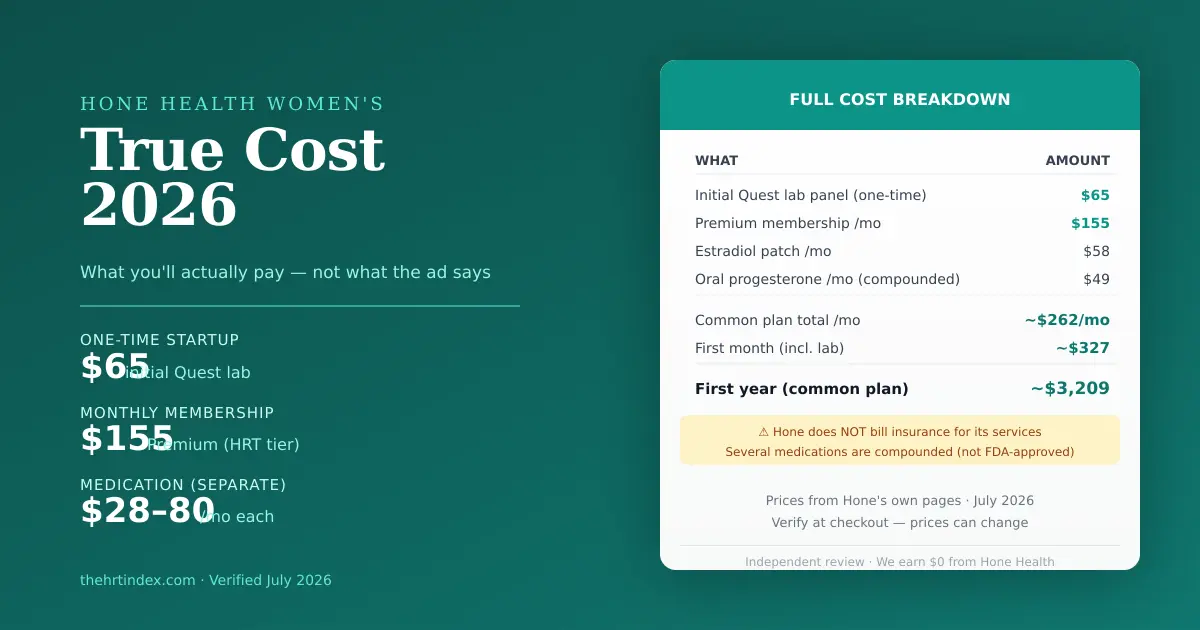
As of July 2026, Hone Health women’s hormone therapy cost is $65 for an initial Quest lab panel, then $155 per month for Premium membership, plus the cost of your medication billed separately. A common estradiol-patch plan runs about $213/month; a patch-plus-progesterone plan about $262. Hone doesn’t bill insurance for its own services, and its women’s program is currently listed in 33 states.
By The HRT Index Editorial Team · Last verified · Educational only — not medical advice, and not medically reviewed by a clinician.
We’re independent. Some Hone Health links on this page are affiliate links, labeled right beside the link; The HRT Index may earn a commission if you use one, at no extra cost to you. Some links to alternative providers on this page are also sponsored and labeled right beside the link. How we make money →
Here’s what the older “$149” write-ups still floating around get wrong: they’re citing a price Hone has since changed. Hone’s own website even shows two different pricesright now — and almost none of those write-ups mention that a couple of Hone’s women’s hormones aren’t FDA-approved at all, or that one is a controlled substance. We went through Hone’s current pages this month, ran the math on real prescription combos, and sorted out exactly what you’d be buying.
Ready to check the live terms?
Review Hone’s current women’s price and state availability before you decide whether its lab-heavy model fits.
Check Hone’s current price and state → (affiliate)Affiliate link: The HRT Index may earn a commission if you use it, at no extra cost to you.
✓ Hone is a good fit if you…
- Want a lab-heavy, physician-monitored plan and don’t mind paying cash
- Want a clinician to evaluate off-label options — like testosterone for low libido
- Like one membership that bundles labs, video visits, and dose changes
- Live in one of the 33 states where Hone’s women’s program is available
✗ Skip Hone if you…
- Want your insurance to cover visits with the least hassle
- Want the lowest-cost, FDA-approved-only care
- Need medication fast — Hone’s lab-first process takes weeks or more
- Only need vaginal estrogen for dryness — $155/mo is a lot for one local product
Not sure if Hone is right for your situation?
Use The HRT Index’s free 90-second matching quiz to find the right provider for your symptoms, state, and health history.
How much does Hone Health women’s hormone therapy cost?
The short answer
Budget $65 for your first lab panel, then $155/month for Premium, plus medication on top. A common estradiol-patch plan runs about $213/month; add progesterone and it’s about $262/month. Over a first year, that’s roughly $2,600–$3,200for common plans — mostly out of pocket, since Hone doesn’t bill insurance for its services. See our full online HRT cost guide to compare across providers.
Let’s break down every charge, using Hone’s own posted prices. Think of Hone less like a pharmacy and more like a membership: you pay a monthly fee for the care, and you pay for your medicine separately.
Hone’s cost at a glance
| What you pay | When | Amount (2026) | In the membership? |
|---|---|---|---|
| Initial lab panel | Before your first visit | $65 | No — separate, one-time |
| Premium membership | Every month | $155 | Yes — this is the care plan |
| Basic membership | Every month | $25 | Not the HRT plan — see below |
| Your medication | Each refill | $28–$80 each | No — billed separately |
| Follow-up labs + visits | While a member | Included | Yes |
| Shipping | Each refill | Included by Hone | Carrier varies |
| Insurance billing | — | Not offered | See insurance section |
The number almost everyone gets wrong
You’ll see “$25/month” thrown around as Hone’s price. That’s not the price of treatment. Hone’s Basic plan is a labs-and-longevity membership — but it does not include hormone therapy. Hone presents Premium at $155/monthas its women’s hormone-therapy tier. Budget for Premium, not Basic.
What it really costs — first month and first year
Budgeting examples using Hone’s posted prices — not medical advice. Assumes 12 unchanged monthly charges.
| Example plan | Meds/mo | First month | Ongoing/mo | First year |
|---|---|---|---|---|
| Membership only | $0 | $220 | $155 | $1,925 |
| Estradiol patch or gel | $58 | $278 | $213 | $2,621 |
| Patch + compounded oral progesterone | $107 | $327 | $262 | $3,209 |
| Compounded Bi-Est + compounded progesterone | $129 | $349 | $284 | $3,473 |
| Estrace vaginal cream only | $40 | $260 | $195 | $2,405 |
| Vagifem inserts only | $65 | $285 | $220 | $2,705 |
| Testosterone injection | $28 | $248 | $183 | $2,261 |
Hone Women’s True-Cost Estimator
Want your own number instead of an example? Pick your exact plan below. Nothing you enter is saved or sent anywhere — it runs privately in your browser.
Your next step
The safest way to lock in your real cost is to check the price Hone shows for your state today.
See Hone’s current women’s price and availability → (affiliate)Affiliate link: The HRT Index may earn a commission if you use it, at no extra cost to you. We link it so you can confirm today’s price before you pay.
Why do some Hone pages say $149 and others $155?
The short answer
Hone’s newest women’s pages list Premium at $155/month, while some older Hone pages still show $149. Budget with $155 — the most recent figure — and confirm the exact price at checkout.
When we checked in July 2026, Hone’s own website wasn’t fully in sync — different pages showed different numbers. Here’s what we found:
| Detail | Newer Hone pages | Older Hone pages still live |
|---|---|---|
| Premium membership | $155/month | $149/month |
| Initial lab panel | $65 | $60 |
| Biomarkers tested | 50+ | 40+ |
Hone’s live pages simply aren’t in sync. That’s the reason you might see “$149” on a blog and “$155” at checkout. Our rule: budget with the newest posted price ($155), show you the older one so nothing feels hidden, and tell you to confirm the number on the screen before you enter a card.
What’s included in Hone’s $155 Premium membership?
The short answer
Premium ($155/month) includes your first video visit, ongoing medication management, follow-up visits, and regular lab testing — no separate charge per visit after you start. Not included: the $65 initial lab, your medication, and any insurance billing.
Included in Premium
- Your initial video consult with a licensed physician
- Ongoing care and medication management
- Follow-up visits (no per-visit fee after the first)
- Regular lab testing on a scheduled cadence
- Messaging support and dose adjustments
- Shipping on your medication
Not included — budget separately
- The $65 initial lab panel
- Your medication ($28–$80 each, per month)
- Insurance billing or prior authorizations
- Any product or dose Hone doesn’t list
Why Basic isn’t the same thing
Basic ($25/month) is a labs-and-longevity plan without hormone therapy. Premium is the tier you’re comparing for HRT — so use $155, not $25, when you budget.
How much do Hone’s women’s medications cost — and which are FDA-approved?
The short answer
Hone’s medication prices run from $28/month (testosterone injection) to $80/month(compounded Bi-Est), billed on top of membership. Hone’s menu is a mixof FDA-approved and compounded products. Compounded means a pharmacy custom-mixes it — it is not FDA-approved.
Two quick definitions:
✅ FDA-approved
Reviewed by the FDA for safety, effectiveness, and quality. Made the same way every time.
🟦 Compounded
A licensed pharmacist mixes ingredients to fill a prescription. The finished product is not FDA-approved; the FDA doesn’t review its safety or quality before it’s sold.
Hone’s women’s menu: price and status
| Product | Price/mo | Status | What it means for you |
|---|---|---|---|
| Estradiol patch | $58 | ✅ FDA-approved | A comparable generic patch often runs ~$35–$45/mo with a GoodRx coupon |
| Estradiol gel | $58 | ✅ FDA-approved | Rub-on estrogen; commercial generics exist |
| Estrace vaginal cream | $40 | ✅ FDA-approved brand | Local estrogen for vaginal dryness |
| Vagifem inserts | $65 | ✅ FDA-approved brand | Local estrogen insert |
| Oral progesterone capsules | $49 | 🔶 Compounded — not FDA-approved | Hone’s own menu labels these “(compound)”; ask about concentration and pharmacy |
| Testosterone injection | from $28 | ⚠️ Off-label; Schedule III | Manufactured or compounded formulation depending on your state; no testosterone is FDA-approved for women |
| Testosterone cream | from $60 | 🔶 Compounded + off-label; Schedule III | Compounded, off-label, and a controlled substance |
| Bi-Est cream | $80 | 🔶 Compounded — not FDA-approved | Estriol has no FDA-approved U.S. product |
| Estriol vaginal cream | $58 | 🔶 Compounded — not FDA-approved | Marketed as “gentler,” but that’s a sales claim, not an FDA finding |
| Progesterone cream | $79 | 🔶 Compounded — not FDA-approved | No FDA-approved progesterone cream exists |
| DHEA cream | $55 | 🔶 Compounded | Hone lists $38–$56 across different pages — confirm at checkout |
For FDA-approved options, Hone names the medication but its partner pharmacies don’t guarantee a specific brand or manufacturer — confirm the exact product, dose, and quantity before you pay.
What the doctors’ groups actually say
The American College of Obstetricians and Gynecologists (ACOG) put it plainly in its 2023 guidance: compounding pharmacies often use “bioidentical” as a marketing term, but “evidence to support marketing claims of safety and effectiveness is lacking.” ACOG says compounded hormone therapy should not be used routinely when an FDA-approved option exists, and that there is no FDA-approved testosterone product for menopausal symptoms.
Source: ACOG Clinical Consensus on Compounded Bioidentical Menopausal Hormone Therapy, 2023.
The honest catch with Hone
Hone does notbill insurance for its services, and several products on its women’s menu are compounded — no FDA approval and straight cash pricing. If your top priority is using insurance and getting FDA-approved-only medicine at the lowest price, Hone is the wrong tool — and an in-network menopause clinic like Midi may cost you less. But if you want a lab-driven membership, real physician monitoring, and access to routes most menopause services won’t offer, that’s exactly what Hone is built for.
If insurance and FDA-approved care matter most to you: Check whether Midi is in-network for you → (sponsored) — Midi is in-network with most PPO plans and offers FDA-approved options.
Coverage and out-of-pocket costs vary; Midi can’t treat Medicaid or Medi-Cal patients, even self-pay, and Medicare doesn’t cover Midi visits. Sponsored. The HRT Index may earn a commission if you start care with Midi, at no extra cost to you. Hone links on this page are also affiliate links. Details →
If you’re staying with Hone: See Hone’s current women’s medication menu and prices → (affiliate) Then ask, in writing, for the product name, dose, pharmacy, and whether it’s FDA-approved or compounded before you commit.
Does Hone take insurance, HSA, or FSA?
The short answer
Hone does not bill insurance for its services and doesn’t do prior authorizations. But you can ask Hone to send an eligible commercial prescription to a local pharmacy, where insurance may apply — you handle coverage and prior authorization. HSA/FSA cards may cover labs and medication depending on your plan.
Hone’s own charges are cash-pay.The initial test, the $155 membership, and Hone’s partner-pharmacy medication are billed directly to you. No deductible or copay — but also no insurance knocking the price down.
Your medication is where insurance can come in.Hone lets you ask to use a local pharmacy instead of its partner pharmacy. If your prescription is an eligible commercial (FDA-approved) product, that local pharmacy may bill your insurance. But you’ll need to confirm coverage, prior authorization, and whether the pharmacy can fill it. Most large retail pharmacies don’tfill compounded prescriptions, so Hone’s compounded products generally stay cash-pay.
On HSA/FSA:Hone can process those cards, but your plan administrator decides what’s eligible. Ask about the lab, visits, membership, and medication separately. One heads-up: Hone says its receipts don’t include diagnosis or procedure codes, so check that the paperwork will satisfy your administrator before you count on reimbursement.
When will Hone charge me?
The short answer
Hone runs two independent billing cycles.Your membership renews monthly. Your medication is charged separately — Hone processes that charge about four business days before it sends your prescription to the pharmacy. You may see more than one Hone charge in a month.
The membership chargerenews about every 30 days. It covers the care — visits, labs, support — not the medicine.
The medication chargeis its own cycle. Hone processes it roughly four business days before transferring your prescription to the pharmacy, then the pharmacy fills and ships it. The medication charge won’t line up neatly with your membership date or the day your package arrives.
How to avoid a surprise
- 1.Write down your membership renewal date
- 2.Write down each medication refill date
- 3.Ask whether changing your dose changes the price
- 4.Check your account billing history if a charge looks unexpected
- 5.Ask what happens to a refill that’s already processing if you cancel
Can I cancel Hone — and what can still be charged?
The short answer
Yes. Hone lets you cancel anytime and pause your membership for up to three months. But there are no partial-month refunds, and canceling your membership does not automatically cancel a prescriptionalready in progress — those are two separate actions.
No lock-in contract. But three things catch people:
- 1No partial refunds. Cancel mid-cycle and you’re not refunded for the rest of that month. Cancel before your next renewal date if you’re stopping.
- 2Membership and prescriptions cancel separately. Turning off your membership doesn’t stop a refill that’s already processing or shipped. Hone generally can’t refund an order that’s gone out. Handle both separately.
- 3Use the cancellation form and save proof. Hone’s dedicated policy says to submit its Membership Cancellation Form, and your cancellation takes effect when you submit it. Keep the confirmation and the timestamp. You can also pause for up to three months without being billed.
Does Hone require bloodwork — and is that normal for HRT?
The short answer
Yes — Hone’s women’s program requires lab testing through Quest Diagnostics, and follow-up labs are built into the membership. But required lab testing is part of Hone’scare model, not a universal rule for starting hormone therapy. ACOG says hormone testing generally isn’t recommended before starting therapy for menopausal symptoms, because hormone levels fluctuate day to day.
Hone leans hard on labs — it’s a selling point. Its panel covers 50+ biomarkers across hormones, thyroid, blood count, metabolism, cholesterol, and liver and kidney markers. Follow-up testing runs quarterly in your first year, then about every six months once you’re stable.
Here’s the nuance:needing a big lab panel to start treatment is Hone’s requirement, not a law of menopause care. ACOG’s guidance is that menopause is usually diagnosed from your age and symptoms. Labs can still be useful — to set a baseline, check general health, or monitor certain treatments — but don’t let anyone tell you a blood test is the only “real” way to begin.
- Hone’s women’s program uses in-person Quest testingas the baseline. An at-home draw is offered in some ZIP codes — confirm before you pay.
- A prescription is never guaranteed. You’re paying for the evaluation and the care, not a promised medication.
What states offer Hone’s women’s hormone program?
The short answer
Hone’s women’s program is available in 33 states and requires in-person Quest lab testing. An older Hone page still lists 32 (without Iowa), so confirm the current list before you pay.
This surprises people who read that Hone is “50-state licensed.” Availability depends on the program, and the women’sprogram is narrower. As of our July 2026 check, Hone lists women’s care in these states:
Alabama, Arizona, California, Colorado, Florida, Georgia, Illinois, Indiana, Iowa, Kentucky, Maryland, Massachusetts, Michigan, Mississippi, Missouri, Montana, Nebraska, Nevada, New Mexico, New York, North Carolina, Ohio, Oklahoma, Oregon, Tennessee, Texas, Utah, Vermont, Virginia, Washington, West Virginia, Wisconsin, and Wyoming.
33 states as of July 2026. This list can change — confirm your state on Hone’s site before paying.
If Hone isn’t available where you live:don’t just pick the next provider off a list. Get matched to an option that actually serves your state.
Take Find My HRT Path →Is Hone worth it for women?
The short answer
Hone can be worth its higher cash price for a woman who values deep lab testing, ongoing physician oversight, and access to routes like clinician-evaluated off-label testosterone. It’s a poor value if you need insurance, want the cheapest FDA-approved care, want to skip extensive labs, or live outside its 33 states.
Whether Hone is worth it comes down to what you want your money to buy. Here’s the honest reframe: Hone’s medications aren’t cheaper than what’s out there — its $58 estradiol patch is a comparable FDA-approved generic you could often get for ~$35–$45 with a coupon at a local pharmacy. You’re paying ~$155/month for the membership, the labs, the monitoring, and access to compounded and testosterone options.
Hone is probably worth it if…
- You’re comfortable paying cash and value a lab-heavy, closely monitored approach
- You want a clinician to evaluate off-label testosterone for low sexual desire
- You like one membership that bundles visits, labs, and dose changes
- You can reach a Quest lab and you’re in a covered state
Hone is probably not worth it if…
- You want to use insurance or need prior-authorization help
- You want the lowest-cost, FDA-approved-only treatment
- You’d rather not do a full lab panel to get started
- You only need one local product like vaginal estrogen
- Your state isn’t on the list
How we sized it up
We ran Hone through The HRT Index’s five pillars: clinical legitimacy, care quality, medication fit, price transparency ($65 + $155 + separate medication, with two different published prices we flagged), and access (cash-pay, 33 states, Quest required). See our full methodology. Hone is legitimate and genuinely higher-touch — just priced accordingly.
Our verdict
Hone is a credible, lab-heavy, self-pay program. Realistically you’re looking at $65 to start and $155/month before medication. Choose it because you want its monitoring and wider menu — not because a starter price makes it look cheap.
Check Hone pricing and availability → (affiliate)Affiliate link: The HRT Index may earn a commission if you use it, at no extra cost to you.
How does Hone compare to other online HRT options?
Looking at Winona specifically? Read our Hone Health vs Winona comparison for the full cost, lab, medication, and state-by-state breakdown.
The short answer
Hone costs more than simpler cash-pay services because it separates a $155 care membership from your medication and requires lab testing. If you want insurance, Midi is usually the lower out-of-pocket path. If you want a cheaper cash-pay route, the right pick depends on whether you want FDA-approved (Hers) or compounded (Winona) treatment.
| Provider | What it is | Cost (July 2026) | Best for the woman who… | Insurance? | FDA or compounded? |
|---|---|---|---|---|---|
| Hone Health | Membership + separate meds | ~$183–$322/mo all-in | wants deep labs, monitoring, off-label testosterone | ✗ Not for its services | Both — several compounded |
| Midi Health(sponsored) | Insurance-based menopause clinic | $250 first / $150 follow-up; in-network PPO | wants FDA-approved care and to use her insurance | ✓ Yes (not Medicare/Medicaid) | FDA-approved + compounded line |
| Hers(sponsored) | Cash-pay online menopause care | Oral from $79/mo, patches from $134/mo | wants a simpler cash-pay route with commercial meds | ✗ No | FDA-approved options |
| Winona(sponsored) | Cash-pay online menopause care | Compounded cream from $89/mo; FDA patch from $149/mo | wants compounded cream or a low-priced patch | ✗ No | Both — compare separately |
Prices confirmed from each provider’s own site, July 2026 — confirm at checkout. Sponsored links are marked; we may earn a commission from Hone at no extra cost to you. See our full provider comparison.
What do real Hone customers say?
The short answer
Hone’s company-wide Trustpilot profile showed 4.8 out of 5 from about 11,900 reviewswhen we checked in July 2026. That’s not a women’s-only rating — it covers Hone’s whole business — and the number can change daily.
We only quote real, named reviews. We’d never use them to promise a medical outcome.
“[My Hone doctor] explained things to me in a way that no doctor ever has before.”
“For a $155 membership, I expect better handling” — a 2026 reviewer whose medication arrived late and a bottle arrived damaged.
Individual experiences vary and aren’t necessarily typical. These reflect customer-service experiences, not medical results.
What should you verify before paying Hone?
The short answer
Before you enter a card, confirm nine things: your state, whether you can reach a Quest lab, today’s lab fee, today’s membership price, your exact medication and dose, whether it’s FDA-approved or compounded, the pharmacy and refill cost, when each charge hits, and how to cancel.
- 1Is Hone’s women’s program available at your exact address?
- 2Can you realistically get to a Quest lab (or is a home draw offered in your ZIP)?
- 3Does checkout show $65 for the starter lab today?
- 4Does checkout show $155 (or $149) for Premium today?
- 5What’s the exact medication name, route, and dose you’d get?
- 6Is that exact product FDA-approved or compounded? Ask for the manufacturer or pharmacy.
- 7Which pharmacy fills it — can you use your own local pharmacy — and what does each refill cost?
- 8When are the membership and medication charged (two separate cycles)?
- 9How do you cancel, and how do you stop a refill that’s already processing?
Two bonus questions: Can you download your lab results and visit notes? And what happens to your money if the clinician decides not to prescribe treatment?
How we verified this guide
The short answer
We read Hone’s current women’s pricing, membership, medication, lab, insurance, billing, cancellation, and state-availability pages; separated FDA-approved from compounded; and calculated real cost scenarios from the newest posted numbers. We re-check top providers monthly. See our Verification Standard.
What we verified
- Hone’s current women’s medication menu and prices
- That Basic excludes hormone therapy and Premium ($155) is the HRT tier
- The $65 initial lab and the $149-vs-$155 membership discrepancy
- The cash-pay-for-services policy, the local-pharmacy option, and HSA/FSA handling
- The two billing cycles, and the cancellation and pause terms
- Which products Hone labels compounded, and which name commercial brands
- 33-state women’s availability with required Quest testing
What we did not verify firsthand
A completed checkout, a shipped package or pharmacy label, support response times, any personal treatment outcome, an actual cancellation, or mobile-lab availability at a specific ZIP. For anything that can change, we tell you to confirm it. See our review policy.
Frequently asked questions
How much does Hone Health cost per month for women?
What is the $65 Hone charge?
Are medications included in Hone’s $155 membership?
Why do some Hone pages say $149 and others $155?
What does Hone cost for a full year?
Does Hone accept insurance?
Can Hone send my prescription to a local pharmacy, and can I use insurance there?
How long does Hone take from labs to medication?
What happens if the Hone clinician doesn’t prescribe treatment?
Does Hone require bloodwork for women?
Is Hone testing 40+ or 50+ biomarkers?
What states is Hone available in for women?
Can I cancel Hone anytime?
Can I pause Hone?
Are Hone’s hormones FDA-approved?
Does Hone prescribe testosterone to women?
Is a prescription guaranteed after I pay?
Is Basic enough for hormone therapy?
Is Hone worth it for women?
Still not sure which HRT program is right for you?
You’ve got the real number now. If you’re still weighing Hone against an insurance clinic, a cheaper cash-pay option, or whether online care is even the right first step — don’t guess. Take our free 90-second matching quiz.
Affiliate link: The HRT Index may earn a commission if you use the Hone link, at no extra cost to you.
Sources
Sources verified July 2026: Hone Health’s women’s menopause and help-center pages (membership tiers, medication prices, labs, insurance, billing, cancellation, local-pharmacy policy, and state availability); Hone’s Trustpilot profile (rating and review count, checked July 20, 2026); ACOG Clinical Consensus on Compounded Bioidentical Menopausal Hormone Therapy, 2023; FDA guidance on compounded drugs; and the current pricing pages for Midi, Hers, and Winona. Prices and policies can change — confirm current details at checkout before you pay. This article is educational and is not medical advice. See our medical review policy.
Last verified: · The HRT Index Editorial Team