
The answer to “is estradiol 0.01 cream a low dose” is usually yes in U.S. guidance at the common vaginal maintenance amount: 0.5 to 1 gram, one to three times a week. The 0.01% is the strength (0.1 mg per gram), so your dose depends on how many grams you use and how often.
Grab your tube and your pharmacy label. Three numbers decide this question, and you already have all three: the strength, the grams, and how often.
The short version
- Usual low-dose use: 0.5 to 1 gram, one to three times a week, after the first couple of weeks. That's 50 to 300 micrograms (mcg) of estradiol a week, placed in the vagina.
- Higher, short-term use: the label's starting amount is 2 to 4 grams a day for 1 to 2 weeks, then about half that. That's 200 to 400 mcg a day, and it's meant to be temporary.
- The answer changes if you keep using starting amounts long-term, use the cream on skin somewhere else, have a compounded cream of a different strength, or have unexplained bleeding or a breast cancer history.
- It isn't a hot-flash treatment. Low-dose vaginal estrogen is used for vaginal and urinary symptoms.
The HRT Index is the independent decision resource for online menopause and HRT care — comparing telehealth providers on clinical legitimacy, care quality, medication fit, price transparency, and access, with every claim verified and dated, so women can choose the path that fits their situation before their first consult.
What we actually verified · Last verified October 2026 - The FDA-approved label for estradiol vaginal cream USP 0.01% (Estrace and generics): strength, dosing, warnings. Checked October 17, 2026. - The Menopause Society's position statement on vaginal and urinary symptoms of menopause, including its dose and blood-level table. Checked October 17, 2026. - The FDA's 2025–2026 boxed-warning changes and its list of updated labels. Checked October 17, 2026. - The European Medicines Agency's 2020 decision on 0.01% estradiol creams. Checked October 17, 2026. - The American Urological Association's official 2025 guideline overview and the American Urogynecologic Society's December 2025 advisory. Checked October 17, 2026. - Gala Health's hormone, vaginal estradiol, HRT price and linked policy pages. Checked October 17, 2026; the exact vaginal product and full checkout total remain unconfirmed. - What we didn't do: we didn't use any service as a patient, buy medicine, or have a clinician review this page. This is a documentation review.
We may earn a commission from clearly marked partner links. That never changes the dose math or the safety information here. How we make money.
On this page: What 0.01% means · Your dose in micrograms · Cream vs tablet vs ring · Why Europe says "high-strength" · Does it reach your blood? · Progesterone and tests · The boxed warning · When to see a clinician first · How long a tube lasts · Questions to ask · Where to get it · FAQ
What does "0.01%" on estradiol cream actually mean?
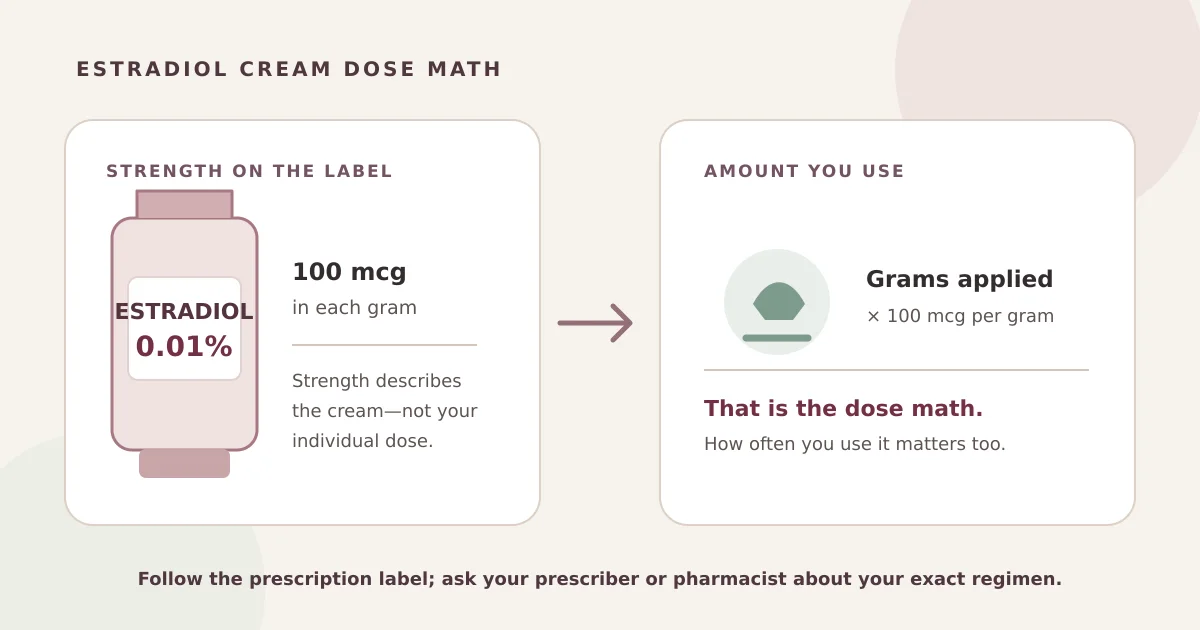
The 0.01% on estradiol vaginal cream is the strength, not the dose. It means every gram of cream holds 0.1 milligram (mg) of estradiol, which is the same as 100 micrograms (mcg). How much estradiol you actually use depends on how many grams you put in each time.
Estradiol is the main estrogen your ovaries made before menopause. In this cream, it's mixed into a thick base. The label for estradiol vaginal cream USP 0.01%, sold as the brand Estrace and as FDA-approved generics, says each gram contains 0.1 mg of estradiol.
Here's the part that trips people up. "0.01%" sounds tiny. But that number alone doesn't tell you the dose. It's like a drink that's 5% juice. That tells you how strong the drink is. It doesn't tell you how many glasses you had.
Your applicator measures grams of cream. The micrograms tell you how much estradiol is inside those grams.
How much estradiol is in the cream you measure
| Cream you measure | Estradiol inside (mg) | Estradiol inside (mcg) |
|---|---|---|
| 0.5 gram | 0.05 mg | 50 mcg |
| 1 gram | 0.1 mg | 100 mcg |
| 2 grams | 0.2 mg | 200 mcg |
| 3 grams | 0.3 mg | 300 mcg |
| 4 grams | 0.4 mg | 400 mcg |
Our arithmetic from the label strength of 0.1 mg per gram. These are amounts placed, not amounts absorbed into your blood. The rows explain units; they're not suggested doses. Source: estradiol vaginal cream 0.01% label, checked October 17, 2026.
Don't mix this up with other estradiol products. A few things look similar but aren't the same:
- Estradiol tablets you swallow come in milligram strengths like 0.5 mg, 1 mg and 2 mg. That's a different route and a different job.
- Estradiol gels for your skin are made to treat hot flashes through the whole body.
- Compounded "estradiol cream" from a compounding pharmacy can be made at almost any strength. Read the strength on that label, usually in mg per gram. Compounded drugs are not FDA-approved.
- Femring is a vaginal ring, but it's designed to deliver a whole-body dose. It isn't a low-dose local vaginal estrogen product.
If your tube says "estradiol vaginal cream USP, 0.01%" or "Estrace," this guide is about your cream.
Is estradiol 0.01 cream a low dose? It depends on your grams and how often
At the commonly used ongoing amounts listed by The Menopause Society, 0.5 to 1 gram one to three times a week, estradiol 0.01 cream is a low dose: 50 to 300 mcg a week placed in the vagina. The label's starting amount of 2 to 4 grams a day is much higher. It's meant only for the first weeks, while the tissue heals.
Two sources decide what "usual" looks like for this cream:
- The FDA-approved label says to start with 2 to 4 grams a day for one or two weeks. Then you gradually cut down to about half that amount for a similar stretch. After the vaginal lining has healed, it allows a maintenance dose of 1 gram, one to three times a week. (Label)
- The Menopause Society's position statement lists estradiol 0.01% cream with a commonly used starting dose of 0.5 to 1 gram a day for 2 weeks. The common maintenance dose is 0.5 to 1 gram one to three times a week. It groups the cream with the other low-dose vaginal estrogen products. (Menopause, 2020)
Notice the gap. The label's starting range is higher than the commonly used range in The Menopause Society's statement. That's one big reason women get mixed messages.
Your 0.01% cream dose, per use and per week
| How much cream each time | Estradiol per use | 1 time a week | 2 times a week | 3 times a week | Who describes this amount |
|---|---|---|---|---|---|
| 0.5 g | 50 mcg | 50 mcg | 100 mcg | 150 mcg | Menopause Society common maintenance |
| 1 g | 100 mcg | 100 mcg | 200 mcg | 300 mcg | FDA label maintenance and Menopause Society common maintenance |
Starting phase (first weeks only)
| Starting pattern | Estradiol per day | Estradiol per week | Who describes this amount |
|---|---|---|---|
| 0.5–1 g daily for 2 weeks | 50–100 mcg | 350–700 mcg | Menopause Society common starting dose |
| 2–4 g daily for the initial 1–2 weeks | 200–400 mcg | 1,400–2,800 mcg | FDA label starting range, before the reduction described above |
Amounts placed, not absorbed. Our arithmetic from the label strength (100 mcg per gram). Sources checked October 17, 2026.
Two examples (made-up prescriptions, for the math only)
- Maria's directions say 1 gram twice a week. That's 100 mcg each time and 200 mcg a week. It matches both the label's and The Menopause Society's maintenance pattern.
- Dana's directions say 2 grams every night, and she's been doing it for two months. That's 200 mcg a day, or 1,400 mcg a week. It matches the label's starting range, which is meant to be short. That doesn't mean Dana is doing something wrong. Her clinician may have a reason. It does mean it's worth asking, "Is it time to step down?"
The math can't tell you whether your dose is right for your body. It only tells you where your directions sit next to the label and the guidance.
A 3-question self-check
You don't need to share your answers anywhere. Just read down.
- Where do you use it? Inside the vagina → this is the labeled route. On the vulva (the outside folds) or vaginal opening → clinicians may advise this, but it is outside the label's applicator instructions. Confirm where and how much with your prescriber. On skin somewhere else, like your arm, thigh or face → that's not how this cream is labeled. Ask the person who prescribed it.
- How much each time? 0.5 to 1 gram → within The Menopause Society's common maintenance amounts. 2 to 4 grams → the label's starting range.
- How often, after the first two weeks? One to three times a week → the usual ongoing pattern. Still every day at starting amounts after a month or more → a good thing to ask about.
What your answers mean:
- Vaginal use, 0.5 to 1 gram, one to three times a week: Those numbers match The Menopause Society's common maintenance pattern. That comparison doesn't decide whether treatment fits your health history.
- Starting amounts, still in the first few weeks: This is the label's starting phase. It's expected to be short.
- Anything else: It may still be right for you, but you deserve to know why. Bring the question card below to your pharmacist or prescriber.
Please don't change how much you use on your own. Your prescriber knows your history and may have a reason for your plan.
Why do my label, my prescription and the internet list different amounts?
Your cream's leaflet describes a starting phase and a smaller maintenance phase, while your pharmacy directions reflect your clinician's own plan. A mismatch is a reason to ask, not a reason to pick whichever number looks smaller. Your pharmacist can help you clear it up.
There are three common reasons for confusion.
1. The leaflet and your prescription are different documents. The leaflet shows the product's labeled range. Your pharmacy label shows what your clinician actually prescribed. The Menopause Society lists a commonly used starting dose of 0.5 to 1 gram, lower than the leaflet's starting range.
2. The applicator may not show your amount. Applicators are marked in grams. If your directions say 0.5 gram and you can't find a 0.5 mark, don't guess. Ask your pharmacist to show you how to measure it. Some clinicians also suggest putting a small amount on the vulva with a fingertip. That's a question for your prescriber, because a fingertip isn't a measuring tool.
3. Online advice mixes up products and countries. A post about a compounded cream, a skin gel or a European product may not apply to your tube.
Here's a sentence you can use at the pharmacy counter:
"My prescription says grams, times a week. Here's my applicator. Can you show me which mark to use, and does this match what the leaflet calls the maintenance dose?"
You'll find a full question card further down. You can copy it or print it.
How does 0.01% cream compare with the 10 mcg tablet, the insert and the ring?
Studies reviewed by The Menopause Society found similar relief of dryness and painful sex with the vaginal estrogen products tested. A 1-gram dose of 0.01% cream holds 100 mcg, which is ten times the estradiol in a 10 mcg tablet. Unlike tablets, inserts and rings, the cream isn't pre-measured.
That doesn't make the cream "too strong." Each product releases estradiol differently, so the numbers on the box aren't swap-able. A 100 mcg cream dose and a 10 mcg tablet aren't a 10-to-1 trade. No one should switch products using this table. It's here to help you understand your options and talk them through with your clinician.
Low-dose vaginal estrogen products, side by side
| Product | Form | Estrogen amount described | Common ongoing schedule | Weekly amount applied or released | Blood estradiol in cited studies—not a dose target* | Pre-measured? | FDA-approved |
|---|---|---|---|---|---|---|---|
| Estrace or generic estradiol cream 0.01% | Cream with applicator | 50–100 mcg estradiol (0.5–1 g) per use | 1–3 times a week | 50–300 mcg applied | Variable (older studies) | No — you measure it | Yes |
| Vagifem or Yuvafem | Vaginal tablet in applicator | 10 mcg estradiol per tablet | 2 times a week | 20 mcg applied | Vagifem study: mean 5.5 pg/mL on day 83, after 12 weeks | Yes | Yes |
| Imvexxy | Soft insert, placed with a finger | 4 mcg or 10 mcg estradiol per insert | 2 times a week | 8 or 20 mcg applied | Mean 3.6 or 4.6 pg/mL on day 14 of the initial daily-use phase | Yes | Yes |
| Estring | Soft ring, changed every 90 days | About 7.5 mcg estradiol released per day | New ring every 90 days | About 52.5 mcg released | Mean 8.0 pg/mL at 12 weeks | Yes | Yes |
| Premarin vaginal cream | Cream with applicator | 0.625 mg conjugated estrogens per gram | 0.5–1 g, 1–3 times a week in The Menopause Society's common-use table | Not comparable mcg-for-mcg (a mix of different estrogens) | Variable | No | Yes |
| For contrast: Femring | Ring, every 90 days | Whole-body estradiol dose, starting at 0.05 mg a day | Every 90 days | — | Systemic | Yes | Yes. Treats hot flashes too; not a low-dose local product |
\Common-use schedules are from The Menopause Society's 2020 statement; they are not all the same as product-label directions. Blood values are study means from the product labels, measured at different treatment stages with different methods. They are not a head-to-head comparison or a prediction of your blood level. Pg/mL means picograms per milliliter. For context, the Society reports about 3 to 5 pg/mL after menopause without treatment on sensitive tests; cream studies used older, less accurate tests. Sources: Menopause Society statement; cream label; Vagifem label; Imvexxy label; Estring label. Checked October 17, 2026.*
Not sure which form, or whether you need more than vaginal treatment? That's where a general page runs out. The right online menopause care isn't the same for every woman — it depends on your symptoms, what you've already tried, your age, your state and your health history. Some situations belong with an in-person clinician first. Use The HRT Index's Find My HRT Path tool to explore a featured care option for your situation — and to flag when online care isn't the right starting point — before your first consult.
No email required. "Vaginal dryness or painful sex" is one of the choices in the first question. The tool doesn't diagnose you, choose a dose, or decide whether you get a prescription.
What actually differs between them
- Cream may soothe faster, possibly because the cream base itself is moisturizing. It can also go right on the vulva and the vaginal opening, where many women feel the burning. The trade-offs are that some women find it messy, a few react to the cream base, and the dose depends on you measuring it. The Menopause Society notes that this can lead to using more than recommended.
- Tablets and inserts are tidy and exact. After two weeks of daily use, most people use one twice a week. The 4 mcg Imvexxy insert is the lowest-dose fixed insert in this table.
- The ring is the "set it and forget it" option. You put in a new one every 90 days. It can slip out with straining or sex, especially after a hysterectomy or with prolapse.
Who might ask about a pre-measured option? You might, if you want the smallest exact dose, if you've been told to keep estrogen as low as possible, if measuring is hard for you, or if the cream irritates you. Ask your clinician. Cost and insurance often decide which one you can actually get.
Why do some sources call 0.01% estradiol cream "high-strength"?
In Europe, regulators call creams with 100 mcg of estradiol per gram "high-strength." That's the same strength as U.S. 0.01% cream. They limit those creams to a single course of up to 4 weeks. In the U.S., the FDA label describes ongoing maintenance at 1 gram, one to three times a week; The Menopause Society lists 0.5 to 1 gram at that frequency.
In 2019 and 2020, the European Medicines Agency's safety committee reviewed 0.01% estradiol creams sold in Europe. It was concerned about estradiol reaching the bloodstream. It decided these creams should be used for one treatment period of no more than 4 weeks, and not alongside other hormone therapy. (EMA referral, confirmed January 16, 2020)
So if you read a UK or European site that says "0.01% is high-strength," it's telling the truth about its own rules. It just isn't describing how U.S. products are labeled and used.
Three rule-books for the same 0.01% strength
| FDA label (U.S.) | The Menopause Society (2020) | European Medicines Agency (2020) | |
|---|---|---|---|
| What it covers | Estradiol vaginal cream USP 0.01% | U.S. and Canadian treatments for genitourinary syndrome of menopause (GSM), the vaginal and urinary changes linked to lower estrogen | Affected 100 mcg/g creams sold in Europe |
| Starting amount | 2–4 g a day for 1–2 weeks, then about half | 0.5–1 g a day for 2 weeks | — |
| Ongoing use | 1 g, 1–3 times a week | 0.5–1 g, 1–3 times a week | Not allowed; a single course of up to 4 weeks |
| How it's described | Vaginal cream for menopause-related vaginal changes | Listed among low-dose vaginal estrogen options | "High-strength" |
| With other hormone therapy | Clinician's decision | Low-dose vaginal estrogen may be added to whole-body therapy if needed | Should not be combined |
Source: cream label; Menopause, 2020; EMA. Checked October 17, 2026.
What this means for you
- Don't apply Europe's 4-week stop rule to your own U.S. prescription. Ask your prescriber instead.
- The European decision is still a fair reminder that more cream means more estradiol, and more can reach your blood.
- A lower-strength cream has also been studied. One trial tested a 0.003% estradiol cream containing 15 mcg in 0.5 gram, given three times a week after a 2-week daily start. In a trial that randomized 550 women after menopause, the lower-strength cream reduced painful-sex scores more than placebo. (Primary Menopause trial, 2018) A research formula is not proof that you can buy that product today. The table above includes FDA-approved fixed-dose inserts and tablets you can ask about.
A good question for your clinician: "Is there a lower-dose or pre-measured option that would work as well for me?"
Does estradiol 0.01% cream get into your bloodstream?
Some estradiol from vaginal cream can reach your blood. The FDA label says so plainly. At low doses, blood levels generally stay in the normal after-menopause range, according to The Menopause Society. Absorption rises with the dose, which is one reason the 2–4 gram starting amount is meant to be short.
"Local" means where the treatment is aimed. It doesn't mean "none gets anywhere else." Doctors call medicine that travels through the bloodstream "systemic."
What the evidence shows, honestly
- For the tablet, insert and ring, newer studies used sensitive blood tests. Levels stayed close to normal after-menopause levels. In some studies they were no different from a placebo (a look-alike with no medicine).
- For cream, the blood-level studies are older and used less accurate tests. The Menopause Society describes one older study where 0.2 mg of estradiol cream a day for 3 weeks raised blood levels. It describes another where 0.5 mg a day for 3 weeks didn't. Those older results cannot predict the blood level from your own prescription.
- The Menopause Society also notes that bleeding, breast tenderness and nausea have been reported in some vaginal cream studies. Those effects were tied to the dose. That suggests the dose was big enough to reach the whole body. (Menopause, 2020)
Signs to tell your clinician about: vaginal bleeding or spotting, breast tenderness that doesn't settle, or nausea. Bleeding after menopause always needs a check, whatever the cause.
Will it help hot flashes? It isn't designed to. Low-dose vaginal estrogen treats the vagina, the vulva and the lower urinary tract. If you also have hot flashes, night sweats or poor sleep, the options are whole-body estradiol (a pill, patch, gel or spray, plus progesterone if you have a uterus) or non-hormonal medicines such as fezolinetant. See HRT for hot flashes and non-hormonal options.
What about a partner? The Menopause Society says the effect on a male partner who's exposed to the cream is unknown. Ask your clinician or pharmacist about timing and partner contact for your exact product.
Do you need progesterone or blood tests with estradiol cream?
The Menopause Society says a progestogen isn't needed when low-dose vaginal estrogen is used for vaginal and urinary symptoms. That guidance covers low-dose use, not every amount of cream. Routine checks of the uterine lining aren't recommended for low-risk women without symptoms, but any bleeding needs to be checked.
A progestogen is progesterone or a similar medicine. It's used with whole-body estrogen to protect the lining of the uterus, which is also called the endometrium.
Here's what the guidance says about low-dose vaginal estrogen:
- Progesterone usually isn't needed. The Menopause Society says a progestogen is not indicated with low-dose vaginal estrogen. It also notes that clinical trials of uterine-lining safety only lasted up to 1 year. Longer observational studies have been reassuring. (Menopause, 2020)
- Routine lining checks aren't recommended for low-risk women without symptoms. The Menopause Society says women at higher risk of endometrial cancer, for example because of obesity or diabetes, may need monitoring. The American Urological Association's 2025 guideline also says clinicians shouldn't check the uterine lining in women with GSM solely because they use vaginal hormone treatment. (AUA guideline; Menopause Society statement)
- Bleeding changes everything. Any spotting or bleeding after menopause needs a proper evaluation, which may include an ultrasound or a biopsy.
When the answer might be different: if you're still using starting amounts every day for a long time, if you also use whole-body estrogen, or if your cream is compounded. In any of these cases, ask your prescriber how the guidance applies to you. Our guide to progesterone with vaginal estrogen goes deeper.
Do you need a blood test to prove your dose is low? Usually not. The cream's label says blood estrogen and follicle-stimulating hormone (FSH) tests have not been shown useful for managing these vaginal and vulvar symptoms. Your clinician may order tests for a different reason. If they do, follow their plan.
Is the boxed warning still on estradiol cream in 2026?
Yes, on the Estrace and generic cream labels we checked on October 17, 2026. In November 2025, the FDA asked makers of menopause hormone products, including vaginal ones, to change the boxed warnings. The FDA's updated-label list still named Estring as its only vaginal product; the cream labels we read still carried boxed warnings.
A boxed warning is the black-bordered warning at the top of some drug labels. The heart, breast-cancer and dementia warning language followed the Women's Health Initiative studies. Those studies tested hormones taken by mouth; participants averaged 63 in the main trials. They did not test low-dose vaginal products. The uterine-cancer warning has a separate basis: estrogen can stimulate the uterine lining.
What happened, in order
| Date | What the FDA did | What it means for your cream |
|---|---|---|
| November 10, 2025 | Asked makers of all menopause hormone products, vaginal ones included, to remove the boxed-warning language on heart disease, breast cancer and probable dementia, and to shorten vaginal labels to the information that matters most for local use | Change requested, not yet made |
| February 12, 2026 | Approved the first six updated labels. Estring was the only vaginal product among them | Estradiol cream wasn't on the list |
| October 17, 2026 (our check) | The FDA's updated-label list still showed those six products; we also read current Estrace, Encube and Mylan cream labels on DailyMed | Those checked cream labels still displayed boxed warnings; we did not inspect pharmacy stock or every manufacturer's label |
Source: FDA labeling request; FDA list of updated labels. Checked October 17, 2026. We re-check monthly.
What that means for you: the FDA's request did not update every product label at once. The Menopause Society said in 2020 that the risks described in those warnings are highly unlikely with low-dose vaginal estrogen, citing low absorption and reassuring large studies. The American Urogynecologic Society also backed the request in December 2025. Ask your clinician how your exact dose, product label and history fit together.
A warning's removal doesn't make any medicine risk-free, though. That's why the next section matters.
When should you talk to a clinician before using estradiol cream?
Most women with vaginal dryness or painful sex after menopause are candidates for low-dose vaginal estrogen. Every prescription needs clinician approval. Some situations need extra review first: unexplained vaginal bleeding, a history of breast cancer or another estrogen-sensitive cancer, and a history of blood clots or stroke. The cream's label lists these among the reasons not to use it.
Get checked first if you have:
- Unexplained bleeding or spotting after menopause. This always needs an in-person evaluation before anyone blames dryness. The label lists undiagnosed abnormal genital bleeding as a reason not to use the cream.
- A history of breast cancer, or another estrogen-sensitive cancer. The label says not to use it. The Menopause Society says the data are too limited to confirm safety, and the decision should involve your oncologist, especially if you take an aromatase inhibitor (a medicine that blocks estrogen). The American Urological Association's 2025 guideline says clinicians may recommend low-dose vaginal estrogen for women with a breast cancer history, through shared decision-making with the whole care team. The Menopause Society's 2022 guidance also supports considering low-dose vaginal estrogen with the oncologist when non-hormonal care has not helped. This is a specialist conversation, not an online checkbox.
- Past blood clots, stroke, heart attack, a clotting disorder or liver disease. These are on the cream's list of contraindications (reasons not to use it). The Menopause Society notes that vaginal estrogen hasn't been linked to blood clots in large studies. Still, the decision belongs with a clinician who knows your history.
- Symptoms whose cause is unclear, or that don't improve after about three months. Yeast, skin conditions like lichen sclerosus, and other problems can look like menopause dryness. An exam can sort that out.
- Burning with urination right now, fever or back pain. That could be a bladder or kidney infection. Vaginal estrogen isn't an antibiotic. It can lower the chance of future urinary tract infections (UTIs). The AUA guideline recommends low-dose vaginal estrogen to reduce future infections in women with recurring UTIs. That prevention use is off-label for this cream, meaning outside its FDA-approved indication. It doesn't treat a current one.
Call 911 for chest pain, trouble breathing, sudden weakness on one side, trouble speaking, or a severe allergic reaction.
The HRT Index's Find My HRT Path tool asks about your health history as part of care navigation. It offers a featured care option or guidance when online care isn't the right starting point. It does not replace the clinical review these situations need.
How long does a tube of estradiol 0.01% cream last?
A 42.5-gram tube contains about 14 to 85 weeks of cream at the maintenance schedules shown below, before waste. That is quantity math, not permission to use a tube past its expiration or the pharmacy's use-by date. A full label-style starting phase can use up most of a tube on its own.
The 42.5-gram tube is a common size (about 1½ ounces). The label notes that the number of doses per tube varies with your dose and handling.
How long one 42.5 g tube lasts (no waste)
| Your schedule | Grams per week | About how long one tube lasts |
|---|---|---|
| 0.5 g, once a week | 0.5 g | 85 weeks |
| 0.5 g, 2 times a week | 1 g | 42 weeks |
| 1 g, once a week | 1 g | 42 weeks |
| 0.5 g, 3 times a week | 1.5 g | 28 weeks |
| 1 g, 2 times a week | 2 g | 21 weeks |
| 1 g, 3 times a week | 3 g | 14 weeks |
| Starting example: 2 g daily for 2 weeks, then 1 g daily for 2 weeks | 42 g over 4 weeks | About 1 tube for the starting phase |
| Starting example: 1 g daily for 2 weeks | 14 g over 2 weeks | About a third of a tube |
Our arithmetic: 42.5 ÷ grams per week, rounded down to whole weeks. Spills and leftover cream can make a tube run out sooner. Starting examples are illustrations, not instructions. Source for tube size: generic estradiol vaginal cream 0.01% label, checked October 17, 2026.
Turn it into a monthly cost
Cost per month = your tube price ÷ (weeks per tube ÷ 4.3)
Worked example (made-up price): say a tube costs you $90 and you use 1 gram twice a week. That's 21.25 weeks, or about 4.9 months using 4.3 weeks per month. $90 ÷ 4.9 ≈ $18 a month for the medicine. You still pay the $90 tube price up front; $18 is an average, not a monthly bill. It excludes any visit, membership or lab fees. Your real price depends on your insurance, your pharmacy and whether you buy brand or generic. Ask your plan whether it covers your exact generic and what you would pay. We compare buying options in where to buy vaginal estrogen online.
What should you ask your pharmacist or prescriber?
The most useful next step is to confirm your product, your grams and your schedule, then ask one clear question about each. "Is this a low dose?" is hard for anyone to answer in a hurry. "I use 1 gram three times a week — is that maintenance?" is easy.
Copy this question card
Bring your tube, the box and your pharmacy label. Fill in what you know and leave a blank where you don't.
My estradiol cream — questions for my care team
Product name on the tube: _____ Strength on the tube: __ My directions say: grams, times a (day / week) My starting schedule ends on: __ (or: "I wasn't told") My ongoing directions are: __ (or: "I don't have separate ones") Other hormones or cancer medicines I take: _____
- Am I still in the starting phase? When should I move to a maintenance dose?
- Can you show me how to measure my amount on this applicator?
- My leaflet and my pharmacy label say different things. Which do I follow?
- Would a pre-measured option, like a 10 mcg tablet or 4 mcg insert, work as well for me?
- Can I put some on the vulva or opening with a fingertip?
- Does my history (uterus, bleeding, cancer, clots) change anything, including whether I need progesterone?
- When should we check whether it's working, and what should make me call sooner?
- What do I do if I can't get my next refill on time?
What if it hasn't helped yet?
Give it time, but not forever. The Menopause Society says vaginal symptoms often improve within a few weeks. Full benefit can take up to 12 weeks. The Menopause Society also says that if urinary symptoms haven't improved after about 3 months of vaginal estrogen, other treatments are worth a look.
Don't wait out bleeding, fever, worsening pain or new discharge, though. Call your clinician about those.
Where can you get vaginal estradiol if you don't have a prescription?
In the U.S., estradiol vaginal cream needs a prescription. You can get one from a gynecologist or primary care clinician, or through an online menopause service. Gala Health is one online service that lists vaginal estradiol cream or tablets alongside whole-body HRT and non-hormonal options, with cash pay and home delivery.
Pick by the need you still have, not by who's loudest online.
Which route fits what you still need
| If you… | Best next step | Why |
|---|---|---|
| Already have a prescription and the directions are unclear | Your pharmacist or prescriber | They can match your directions to your exact tube. Use the question card |
| Have vaginal dryness, painful sex or recurring UTIs and hot flashes, night sweats, sleep or mood symptoms | Gala Health | Lists vaginal estradiol, whole-body estradiol, progesterone and non-hormonal medicines, so you can ask about both vaginal and whole-body symptoms during assessment |
| Want vaginal estradiol without a clinic visit or insurance | Gala Health, or Wisp for cream only | Online assessment and home delivery. Gala includes ongoing messaging |
| Want insurance to pay, or a local pharmacy | Your gynecologist or primary care clinician | Ask your plan about coverage and your pharmacy about the exact prescription's cost |
| Want a specific pre-measured product (4 mcg insert, 10 mcg tablet) or the ring | Ask any service which exact product you'd get before paying | Not every service names its products. Gala lists "cream or tablet" and doesn't list a ring |
| Have unexplained bleeding, a breast cancer history, or past clots or stroke | Your clinician or oncology team, in person first | These need individual review |
| Aren't sure | The HRT Index's Find My HRT Path tool | Points you to a fitting option, or tells you when online care isn't the right start |
When Gala Health is a strong fit
Gala lists four menopause treatment groups: estradiol pills or patches, micronized progesterone, vaginal estradiol cream or tablets, and non-hormonal medicines including fezolinetant. A licensed clinician reviews your online assessment and decides whether any treatment fits. Gala says vaginal estradiol can be used on its own or alongside whole-body HRT. (Gala hormone health; Gala vaginal estradiol, checked October 17, 2026)
Where Gala stands out for women asking this question
- Vaginal symptoms plus whole-body symptoms. Low-dose vaginal cream isn't a treatment for hot flashes; sleep disrupted by night sweats may need another approach. Gala lists both local and whole-body treatments, so you can discuss both kinds of symptoms with its clinician. Confirm whether your prescribed plan includes both and whether that changes the price.
- No gynecologist, or long waits. You start with an online assessment, which Gala says takes about 5 minutes. Treatment ships to your door for free, Gala says.
- Follow-up is part of the plan. Gala says provider messaging, symptom check-ins and dose adjustments are included "for as long as you're treated." That matters for exactly the questions on this page, like stepping down from a starting dose.
- Cream or tablet. If measuring cream bothers you, you can ask about the tablet.
- Cash-pay care. Gala says its pricing includes the medicine, the provider review and ongoing care. It accepts FSA and HSA cards and advertises cancellation at any time. One Gala HRT landing page advertised $69 a month at our October 17, 2026 check. That doesn't establish a vaginal-only price or the amount due at checkout.
Limits to know before you start
- The exact product isn't named. Gala's pages don't identify the vaginal cream strength, tablet dose or maker. Its FAQ says it prescribes FDA-approved forms, while a separate HRT landing page carries a compounded-drug notice. We could not match the vaginal product to a specific approved label. Ask: "Which product, strength and manufacturer would I get, and is that finished product FDA-approved or compounded?"
- Pricing for vaginal-only care isn't spelled out. We didn't find a separate price for vaginal estradiol. Different Gala HRT pages show different billing terms. Before you pay, confirm what's due today, how often you're billed, and whether vaginal and whole-body treatment together cost more. Gala's linked subscription policy calls for 72 hours' cancellation notice and limits refunds, but uses weight-loss wording. Ask which terms apply to HRT.
- No insurance billing. If your plan covers generic vaginal estradiol, a pharmacy route may cost you less.
- Its absorption wording goes further than the label. Gala's vaginal estradiol page describes the treatment as having no systemic hormone exposure. The FDA label says some absorption may occur. We go by the label.
- A ring isn't listed. Estring isn't on the Gala pages we reviewed. Ask before paying if that is the product you want.
- Not a starting point for some women. If you have unexplained bleeding or a breast cancer history, see your clinician or oncology team first.
"Gala's provider walked me through the options and I started HRT." — Allison, 51, Gala patient
Published by Gala on its hormone health page. We didn't independently verify it, and one person's experience isn't evidence of results.
If you're ready to discuss vaginal estradiol and want a clinician to look at your other symptoms too, Gala is a useful place to start. See what Gala offers, then confirm the exact product and price for your situation before you pay.
Gala is an affiliate partner. A licensed Gala clinician decides whether any treatment is right for you. Full details are in our Gala Health HRT review.
Other good routes
- Your own gynecologist or primary care clinician. This is best if you have insurance, need an exam, or have a complicated history.
- A menopause specialist. The Menopause Society keeps a directory of Society members and certified practitioners. Find a menopause practitioner. The directory doesn't promise insurance, telehealth or appointments, so check with the office.
- Wisp (affiliate partner). Wisp advertises estradiol vaginal cream starting at $20, with local pharmacy pickup or home delivery. It's a narrower, cream-focused option. That starting figure does not establish your full cost. Confirm the consultation charge, medication cost, exact product and age requirements before paying.
- Compare more services: best online HRT providers for menopause.
Check these before you pay any service
- The exact medicine: name, strength, form, and whether it's FDA-approved or compounded
- Amount due today and how often you'll be billed (monthly or every few weeks)
- Whether the price includes the medicine, shipping and follow-up messages
- Any visit, membership or lab fees, which are unknown until the service tells you
- Whether it serves your state and your age
- How to cancel, how much notice you must give, and what happens to refills afterward
If a required cost is unknown, your total is unknown. It isn't zero.
Other questions about estradiol 0.01% cream
These short answers cover the questions women ask most after the dose question.
How many micrograms are in 1 gram of estradiol 0.01% cream? 100 mcg, which is 0.1 mg. Half a gram holds 50 mcg. See the conversion table.
Is 0.5 gram of estradiol cream a low dose? At the common maintenance schedule described here, yes: 0.5 gram holds 50 mcg, and The Menopause Society lists 0.5 to 1 gram one to three times a week. The amount and the schedule belong together.
Is 4 grams of estradiol cream a lot? It's the top of the label's starting range: 400 mcg a day for 1 to 2 weeks before cutting back. Ask your prescriber before staying there.
Can I use estradiol 0.01 cream every day? Daily use is normal at the start. Long-term daily use is a decision for the person who prescribed it. Please don't change your plan on your own.
Is estradiol 0.01% the same as 0.1 mg? 0.01% equals 0.1 mg per gram of cream. Your dose depends on how many grams you use.
Is a full applicator 1 gram? Not necessarily. Applicators are marked in grams. Use the mark that matches your directions, and ask your pharmacist if you're unsure.
Is Estrace the same as generic estradiol cream 0.01%? Same active ingredient, same strength, and the generics are FDA-approved. The inactive ingredients in the cream base can differ, so tell your pharmacist if one irritates you.
Does "bioidentical" mean FDA-approved? No. "Bioidentical" means the estradiol molecule matches what your body made. FDA approval applies to a finished product. Estrace and its generics are approved; compounded creams aren't. Neither is "safer" just because of the word.
Can I put estradiol vaginal cream on my face? It's labeled only for vaginal use. Using it on your face is off-label, which means outside its approved use. Talk to a dermatologist or your prescriber rather than trying it on your own.
Can I buy estradiol 0.01% cream over the counter? Not in the U.S. It needs a prescription. Over-the-counter vaginal moisturizers are hormone-free and aren't the same thing.
Can I use it with an estrogen patch or pill? Sometimes. The Menopause Society says low-dose vaginal estrogen can be added to whole-body therapy if vaginal symptoms remain. Your clinician should know about both. Europe's rules for its high-strength creams say not to combine them, which is another place the countries differ.
Will it help my UTIs? It can lower the chance of future infections. The AUA guideline recommends it for women with recurring UTIs after menopause. UTI prevention is a guideline-supported use outside this cream's FDA-approved vaginal-atrophy indication (off-label). It won't treat an infection you have right now.
Is it safe if I've had breast cancer? The cream's label says not to use it. Some cancer teams do allow low-dose vaginal estrogen after review. Decide with your oncologist.
How we checked this guide
We read the product label, regulator decisions and clinical guidance, then kept those separate from what providers say about their own services. This is a documentation review. We didn't use any service as a patient, and no clinician reviewed this page.
The HRT Index Verification Standard
| Pillar | What we checked for this page |
|---|---|
| Clinical legitimacy | The FDA-approved cream label, The Menopause Society's 2020 statement, the AUA's official 2025 guideline overview, FDA label-change notices and the European regulator's decision |
| Care quality | Gala's published support model (messaging, check-ins, dose changes), stated as Gala's claims, not tested by us |
| Medication fit | Vaginal versus whole-body treatment; cream versus tablet, insert and ring; who should see a clinician first |
| Price transparency | What Gala's price includes, what it doesn't say (the exact product and a vaginal-only price), and how to estimate your own tube cost |
| Access | Prescription routes, insurance versus cash pay, and when online care isn't the right start |
Read more about our methodology and how we make money.
Primary sources and service pages
- Estradiol vaginal cream USP 0.01%, prescribing information: Estrace on DailyMed; Encube generic, patient labeling revised July 2025; Mylan generic. Current labels checked October 17, 2026.
- FDA approval record for the Encube generic: Drugs@FDA, ANDA 209767, approved March 5, 2018. Approval record checked October 17, 2026.
- The North American Menopause Society (now The Menopause Society). The 2020 genitourinary syndrome of menopause position statement. Menopause. 2020;27(9):976–992. Full statement; PubMed. Also: 2022 hormone therapy position statement.
- Product-specific prescribing information: Vagifem; Imvexxy; Estring, 2026 label.
- AUA/SUFU/AUGS. Genitourinary Syndrome of Menopause guideline, 2025. Guideline; official 2025 overview.
- European Medicines Agency. Estradiol-containing (0.01% w/w) medicinal products for topical use, referral, 2020. EMA.
- U.S. FDA. Labeling-change request, November 10, 2025; first label approvals, February 12, 2026; updated prescribing-information list. Checked October 17, 2026.
- American Urogynecologic Society. December 2025 practice advisory on vaginal-estrogen boxed warnings.
- Randomized trial of 0.003% estradiol cream for painful sex after menopause. Menopause. 2018. Primary publication.
- U.S. FDA. Understanding the risks of compounded drugs.
- Gala Health. Hormone health; vaginal estradiol; $69 HRT landing page; separate HRT landing page with compounded-drug notice; refund policy; terms. Provider-published information checked October 17, 2026.
- Wisp. Estradiol product page. Provider-published starting price and service details checked October 17, 2026.
- The HRT Index. Find My HRT Path and how it works.
Understand your cream, but still not sure where to get care? The HRT Index's Find My HRT Path tool asks about your symptoms, what you've already tried, your age, your state and your health history. Then it shows a featured care option, or tells you when online care isn't the right starting point. It's free, takes about 60 seconds, and doesn't ask for your email.
Educational content only. Not medical advice. Talk with a licensed clinician before starting, stopping or changing hormone therapy.