
Low Progesterone Symptoms Perimenopause: Real Signs, Lookalikes and Tests
Low progesterone symptoms in perimenopause that may track with your cycle include shorter or irregular cycles, spotting before your period, heavier bleeding, worse PMS, and sleep or anxiety that flare before bleeding. Hot flashes, poor sleep and anxiety alone don't prove low progesterone — thyroid, low iron, mood and estrogen changes look similar — so your two-cycle pattern says more than one blood test.
Get help now, not later, if: you're soaking a pad or tampon every hour for more than two hours and you also feel lightheaded, short of breath or have chest pain. That's an emergency, so call 911. Bleeding between periods, after sex, or any bleeding after menopause also needs a prompt visit, even if hormones turn out to be part of the story. (ACOG)
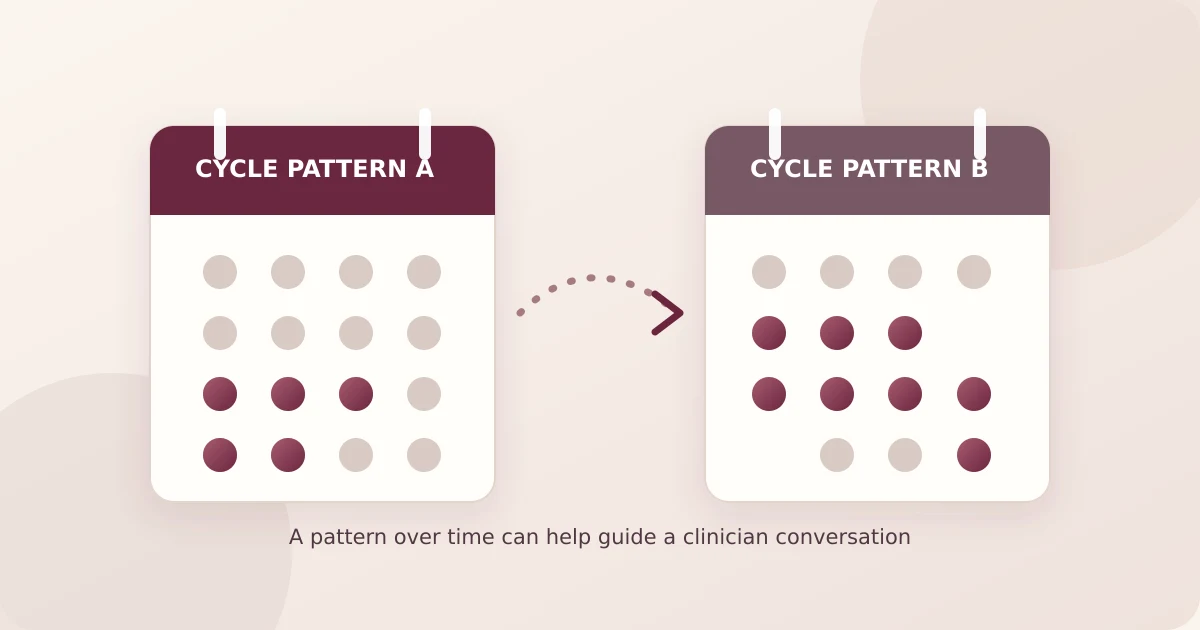
This guide is for you if you still get periods (even messy, unpredictable ones), you're somewhere around your late 30s to early 50s, and your cycle, sleep or mood has changed in a way you can't explain. Maybe your periods still look "normal" on paper, yet you feel like you're coming apart.
It's not the right starting place if you're pregnant or trying to get pregnant, because progesterone means something different in fertility care and an OB-GYN or fertility clinic is your best first stop. If your periods stopped 12 or more months ago, skip to after menopause.
One promise up front: you don't have to prove a hormone deficiency to ask for help. Symptoms that disrupt your sleep, work or relationships deserve care, whatever the lab says.
The HRT Index is the independent decision resource for online menopause and HRT care — comparing telehealth providers on clinical legitimacy, care quality, medication fit, price transparency, and access, with every claim verified and dated, so women can choose the path that fits their situation before their first consult.
We checked the medical sources and provider pages on this page on October 17, 2026, unless another date is shown. This is editorial research, not firsthand treatment. We may earn a commission if you start care through some links. That can affect which providers we feature, but it doesn't change what we report. How we make money
On this page: The signs · Why it happens · Bleeding red flags · Testing · Lookalikes · Does progesterone help? · Other options · Two-cycle tracker · Where to get care · Gala · Questions to ask · After menopause · FAQ
Low progesterone symptoms perimenopause can bring: what they can and can't tell you
In perimenopause, the symptoms most closely tied to low progesterone are the ones linked to your cycle: shorter cycles, spotting before your period, heavier or longer bleeding, stronger PMS, and sleep or mood that worsens in the days before bleeding. Other symptoms often blamed on progesterone, like hot flashes, vaginal dryness and brain fog, are just as tied to estrogen changes or to other health problems. No symptom list can confirm a deficiency on its own.
That's the honest version, and it matters. A lot of what you'll read online lists 10 or 12 "low progesterone symptoms" and then sells you a hormone test or a cream. Many of those symptoms are real. They just aren't specific to progesterone.
Here's why the cycle-linked symptoms are the better clues. Your body makes most of its progesterone after you ovulate (release an egg). In perimenopause, ovulation becomes less regular. Some months it happens, some months it doesn't. (ACOG) When it doesn't, there's little progesterone that month, and the signs often show up around your period.
The five clues that track your cycle
- Cycles getting shorter. Your period used to come every 28 days. Now it's every 23 or 24. For many women this is one of the first changes.
- Spotting for a few days before your period starts. Light brown or pink spotting that leads into a full period.
- Heavier or longer periods, sometimes with clots. Without enough progesterone, estrogen can keep thickening the uterine lining (the endometrium), so there's more to shed. ACOG notes that overgrowth of the lining most often comes from too much estrogen and not enough progesterone. (ACOG)
- PMS that's worse than it used to be. Breast tenderness, bloating, short temper or tears that hit harder in the days before bleeding.
- Sleep and anxiety that flare in the week or so before your period, then ease once it starts.
If several of these happen together, and they rise and fall with your cycle, that's a real pattern worth writing down and bringing to a clinician.
The symptoms everyone blames on progesterone
Hot flashes and night sweats. Waking at 3 a.m. Low sex drive. Brain fog. Weight gain around the middle. Joint aches. These are common in perimenopause, and they can make life miserable. But they overlap heavily with estrogen swings, poor sleep, stress, thyroid problems and more. Seeing them on a "low progesterone" list doesn't mean progesterone is the cause, or that progesterone is the fix.
The symptom sorter
Use this table to see how closely each symptom links to the ovulation changes that lower progesterone, how much it overlaps with estrogen changes, what else should be ruled out, and what to track. The "link" ratings are our editorial reading of the sources below. This table won't diagnose you. Its job is to help you describe what's happening clearly.
What each symptom can tell you, and what to do with it
| What you notice | Link to low progesterone (editorial) | Overlap with estrogen changes | Other causes worth ruling out | What to write down | See someone soon if… |
|---|---|---|---|---|---|
| Cycles getting shorter | Close link | Some | Thyroid problems; pregnancy if a period is "missing" in between | Day 1 of each period; days between periods | Periods come less than 21 days apart |
| Spotting before your period | Close link | Some | Polyps, fibroids, hormonal birth control, infection | Spotting days before full bleeding | Spotting between periods or after sex |
| Heavier or longer periods | Close link | Strong | Fibroids, polyps, adenomyosis, bleeding disorders, blood thinners | Pads or tampons per day; clots; days of bleeding | Bleeding more than 7 days, or soaking a pad or tampon every hour |
| Worse PMS (bloating, breast tenderness, irritability) | Close link | Strong | Premenstrual dysphoric disorder (PMDD), depression, thyroid problems | Which days it starts and stops | Thoughts of harming yourself (call or text 988 now) |
| Sleep worse before your period | Close link | Strong | Night sweats, sleep apnea, anxiety, alcohol, late caffeine, medicines | Hours slept; wake-ups; whether you wake hot or worried | Loud snoring, gasping, or falling asleep during the day |
| Anxiety or mood swings before your period | Partial | Strong | Anxiety disorder, depression, thyroid problems | Mood 0–3 each day; cycle day | Panic, severe low mood, or thoughts of self-harm |
| Night sweats | Partial | Strong | Infection, thyroid problems, some medicines | Number per night | Fever, or weight loss you can't explain |
| Hot flashes | Weak | Strong | Thyroid problems, some medicines | Number per day | Fainting or chest pain |
| Headaches or migraines changing pattern | Partial | Strong | Blood pressure, other nerve or brain causes | Days and cycle day | Sudden, severe "worst ever" headache (emergency) |
| Low sex drive | Weak | Strong | Depression, relationship stress, medicines, pain with sex | Notes only | — |
| Tiredness | Weak | Some | Low iron from heavy periods, thyroid problems, depression, sleep apnea | Energy 0–3 | Short of breath, dizzy, very pale |
| Brain fog | Weak | Strong | Poor sleep, thyroid problems, low iron, depression | Notes only | Sudden confusion (emergency) |
| Weight gain around the middle | Weak | Strong | Thyroid problems, medicines, sleep, blood sugar | Not needed for this question | — |
| Vaginal dryness or pain with sex | Weak | Strong (estrogen) | Infection, skin conditions | Notes only | Bleeding after sex |
| A lab result flagged "low" | Depends on timing | — | Test taken before ovulation, or in a month with no ovulation | The full report, date and cycle day | Ask what the result would change (see testing) |
Source: The HRT Index Editorial Team; see the primary sources linked in this section.
Bleeding numbers come from ACOG's abnormal uterine bleeding guidance (last reviewed August 2025), which also lists ovulation problems in perimenopause, PCOS and an underactive thyroid among the causes of bleeding changes. Link ratings are The HRT Index's editorial judgment, not a validated clinical tool.
How to read your result
- Mostly top rows, they rise and fall with your cycle, and no red flags? Low progesterone from irregular ovulation is a reasonable thing to raise with a clinician. Track two cycles first if you can (our free tracker makes it easy).
- Mostly hot flashes, dryness and brain fog? Estrogen changes are probably doing more of the work. Ask about HRT for hot flashes and local vaginal treatment instead of focusing on progesterone.
- Anything in the far-right column? Get that checked first. Hormones can wait a week. Unexplained bleeding can't be waved away.
Why does progesterone drop in perimenopause?
Progesterone normally rises after you ovulate, and in perimenopause ovulation becomes less predictable. In a month with late, weak or skipped ovulation, the usual progesterone rise is small or missing. Estrogen doesn't fall in a neat line either, so the balance between the two can feel off for years before periods stop.
How a normal cycle works, in four steps
- First half (the follicular phase): estrogen builds up the lining of your uterus.
- Ovulation: an ovary releases an egg, often somewhere in the middle of the cycle.
- Second half (the luteal phase): the leftover follicle makes progesterone. Progesterone steadies the lining and tends to have a calming, sleepy effect.
- Progesterone falls, and your period starts.
A 28-day cycle is just the textbook example. Plenty of healthy cycles are shorter or longer.
What changes in perimenopause
ACOG puts it simply: during perimenopause, some months the ovaries release an egg and some months they don't. (ACOG) No egg means little progesterone that month.
Here's an example (made up, not real data):
- Month 1: you ovulate early, on day 12. Your period arrives on day 24. The second half of your cycle was short, and you slept badly for the week before.
- Month 2: you don't ovulate. Your period comes late, on day 39, and it's heavy.
- Month 3: things feel almost normal.
That's why you can feel fine one month and awful the next. It isn't in your head. It's ovulation coming and going.
It isn't a smooth decline
You'll often read that progesterone "drops first, then estrogen." Real life is messier. A Swiss study followed 127 perimenopausal women aged 40 to 56 for a year. Both estradiol (the main estrogen) and progesterone swung up and down a lot, but neither showed a steady decline over those 12 months. (Grub et al., 2021) The practical meaning: this month's hormones may not predict next month's.
What about "estrogen dominance"?
"Estrogen dominance" is a popular phrase online, but it isn't a diagnosis in the ACOG and Menopause Society patient guidance we read. The real, measurable concern is narrower: in some perimenopause months, estrogen stays normal or high while progesterone stays low, and that mismatch can overgrow the uterine lining and cause heavy or irregular bleeding. (ACOG)
So if you've seen "high estrogen, low progesterone symptoms" lists, here's how to use them. The part that matters medically is the bleeding. Heavy, long or between-period bleeding is the symptom to get checked. Be wary of anyone who uses "estrogen dominance" to sell a detox kit, a supplement stack or a test that promises your perfect hormone ratio. Your symptoms and history guide care, not a ratio on a lab sheet.
Which bleeding changes need a doctor first?
Some bleeding changes are a normal part of perimenopause, but ACOG says certain patterns should be checked: bleeding between periods or after sex, very heavy bleeding, periods lasting longer than 7 days or coming less than 21 days apart, and any bleeding after menopause. Low progesterone can cause some of these. So can polyps, fibroids and changes in the uterine lining that need an exam or ultrasound to sort out.
When it's an emergency
ACOG's example: if you're changing pads or tampons every hour for more than two hours in a row and you also have chest pain, shortness of breath, or feel lightheaded or dizzy, get emergency care right away. (ACOG) Don't wait for a hormone test or a quiz.
When to book a prompt visit
ACOG lists these as abnormal uterine bleeding (ACOG, reviewed August 2025; ACOG, reviewed February 2024):
- Cycles shorter than 21 days or longer than 35 days
- Cycle length that varies by more than 7 to 9 days
- Bleeding that lasts more than 7 days
- Bleeding that soaks through one or more pads or tampons every hour
- Bleeding or spotting between periods
- Bleeding or spotting after sex
- Bleeding after menopause
A quick reality check: in perimenopause, some irregularity is common, and the first two bullets may describe a lot of women your age. That's exactly why a clinician should look at the whole picture. Heavier, longer, between-period, after-sex and after-menopause bleeding are the ones not to sit on.
What a clinician may do
ACOG lists tests such as a pelvic ultrasound, an endometrial biopsy (a small sample of the lining), sonohysterography (an ultrasound with fluid), and hysteroscopy (a thin camera into the uterus). (ACOG) Most of these need an in-person visit. An online menopause service can't do them for you.
We mean that. Our own free care-navigation quiz sends anyone with vaginal bleeding a doctor hasn't explained to guidance only, with no provider links. (How it works)
Two more things worth knowing. Heavy periods can lower your iron, which by itself causes tiredness and brain fog, so ask whether a blood count makes sense. And pregnancy is still possible in perimenopause, so a missed or strange period can mean pregnancy.
If your bleeding is normal for you, or it's already been checked, the next question is where to get care. That depends on more than progesterone.
The right online menopause care isn't the same for every woman — it depends on your symptoms, what you've already tried, your age, your state and your health history. Some situations belong with an in-person clinician first. Use The HRT Index's Find My HRT Path tool to explore a featured care option for your situation — and to flag when online care isn't the right starting point — before your first consult.
It's free, takes about 60 seconds and doesn't ask for your email. It asks about your symptoms, what you've tried, your age, your state and your health history. Then it shows a featured online care option or guidance about a better starting point. It isn't a test for low progesterone, and it doesn't decide whether you should take hormones. A clinician does that. If period changes are your main concern, pick the closest symptoms and answer the bleeding question honestly. That question is there to keep you safe. We may earn a commission from the services it features.
Can a blood test show whether progesterone is low?
A progesterone blood test can show whether you probably ovulated in the cycle it was taken, if it's timed right. It can't diagnose perimenopause, and it can't prove your symptoms come from low progesterone. ACOG says most women don't need hormone testing in perimenopause, because age, symptoms and period changes are usually enough.
What ACOG says
According to ACOG, your clinician should be able to tell whether you're in perimenopause from your age, your symptoms and changes in your periods, so you probably don't need hormone testing. If you're under 45 and your bleeding has changed, and especially if you're under 40, a blood test may be offered to check for early or premature menopause. (ACOG, September 2025)
Why "day 21" can mislead you
A "day 21" progesterone test assumes a 28-day cycle with ovulation around day 14. The American Society for Reproductive Medicine (ASRM) says a progesterone check should generally be done about one week before your next period is expected, not on one fixed cycle day like day 21. (ASRM, 2021) That guidance comes from fertility care, but the logic applies to you: in perimenopause, when your cycle could be 23 days or 40, "day 21" might land before you ovulate, or in a month you didn't ovulate at all.
Even a well-timed test is a snapshot. In the large U.S. SWAN study, a single mid-luteal progesterone blood test only weakly matched the progesterone a woman made across that whole second half of her cycle (correlation 0.26; it explained about 7% of the difference). (Santoro et al., 2020)
The same number can mean two different things
Here's a made-up example using one lab's published reference ranges. Mayo Clinic Laboratories lists progesterone ranges of 0.89 ng/mL or less in the follicular phase (before ovulation) and 1.8 to 24 ng/mL in the luteal phase (after ovulation). (Mayo Clinic Laboratories, checked October 17, 2026)
| Example result | When the blood was drawn | That lab's range for that phase | What it means | What it still can't tell you |
|---|---|---|---|---|
| 0.5 ng/mL | Before ovulation | 0.89 ng/mL or less | Normal for that phase | Whether you'll ovulate later; what's causing your symptoms |
| 0.5 ng/mL | Meant to be after ovulation | 1.8–24 ng/mL | Below that lab's after-ovulation range | Whether the timing was right, whether you ovulated that month, and whether it would change your care |
Source: The HRT Index Editorial Team; see the primary sources linked in this section.
The number stayed the same. The timing changed what it meant. These are one lab's ranges, not targets for treatment, and your own report's ranges and units are the ones that count.
What each kind of test can and can't tell you
| Test | What it measures | What it can tell you in perimenopause | What it can't tell you |
|---|---|---|---|
| Progesterone blood test (timed about a week before your expected period) | Progesterone that day | Whether you likely ovulated that cycle, if timed right | Your "level" in general; whether symptoms come from progesterone; whether you need treatment |
| At-home urine progesterone-metabolite (PdG) kits | A breakdown product of progesterone in urine over several days | A rough picture of ovulation across days | A diagnosis or a treatment need; check any kit's claims carefully |
| Saliva hormone tests | Hormones in saliva | Little that changes care | Reliable levels for diagnosis or dosing |
| "Full panel" dried urine tests | Hormones and their breakdown products | Interesting data | Proof that symptoms come from progesterone, or a dose for you |
| FSH and estradiol blood tests | A brain signal to the ovaries, and estrogen | Helpful if you're under 40 to 45 and your periods are changing (ACOG) | A diagnosis of perimenopause in your mid-40s or later, because both swing up and down |
| Thyroid, blood count, pregnancy test | Common lookalike causes | Can find a fixable non-hormone cause | Anything about progesterone |
Source: The HRT Index Editorial Team; see the primary sources linked in this section.
Collecting a sample at home is fine. The problem is when a result or a "hormone ratio" is used to pick a personal hormone dose without a clinician who knows your history.
If you already have a "low" result
Before you buy another test, gather the details that make this one useful. Bring the full report, not just the word "low," to the clinician who ordered it:
- Why the test was ordered
- The date it was drawn
- Where you were in your cycle (first day of your last period, and when the next one came)
- Every medicine you take, including birth control, hormones and supplements
- The lab's own range and units
Then ask: "Was this result expected at that point in my cycle, and would it change my care?"
What else causes these symptoms in your 40s?
Thyroid problems, low iron from heavy periods, depression or anxiety, sleep apnea, PCOS, some medicines and pregnancy can all look like "low progesterone." A good clinician checks the ones that fit your story, because several are quick to test and easy to treat.
- Thyroid problems. An underactive thyroid is one of the causes ACOG lists for ovulation problems and bleeding changes. (ACOG) It can also cause tiredness and low mood. Ask: "Should we check my thyroid?"
- Low iron. Heavy periods can drain your iron. Low iron can make you tired, foggy and short of breath.
- Depression and anxiety. Perimenopause can bring on first-time or returning depression and anxiety. Both are real and treatable, and they deserve care in their own right, not just a hormone label.
- Sleep apnea. Loud snoring, gasping at night or heavy daytime sleepiness point here, not to progesterone.
- PCOS. Polycystic ovary syndrome can cause irregular cycles at any age, and ACOG lists it among ovulation problems. (ACOG) Read is it PCOS or perimenopause?
- Medicines. Hormonal birth control, blood thinners, aspirin and the copper IUD can change bleeding. (ACOG)
- Pregnancy. Still possible until you've gone 12 months without a period.
If you're thinking about harming yourself, call or text 988 in the U.S. right now. You don't need to sort out your hormones first.
Does taking progesterone help low progesterone symptoms?
Sometimes, but it isn't guaranteed. Progesterone has a clear, proven job in one situation: protecting the uterine lining when you take estrogen. Using it for perimenopause symptoms like poor sleep or night sweats is off-label, and the best trial in perimenopausal women found mixed results.
Two different jobs: protecting the lining and easing symptoms
These are separate questions, and mixing them up causes a lot of confusion.
- Protecting the lining. If you still have a uterus and take systemic estrogen (estrogen absorbed into your bloodstream, like a pill or patch), you need a progestogen to protect against uterine cancer. The Menopause Society is direct about this. (Menopause Society) A progestogen is the family that includes progesterone itself and lab-made versions called progestins.
- Easing symptoms. Whether progesterone helps your sleep, night sweats or mood is a different question with weaker evidence. Having lots of "low progesterone symptoms" doesn't make the answer yes.
What each situation is really about
| Your situation | What the clinician is trying to fix | Why a "low progesterone" label doesn't settle it | A useful question to ask |
|---|---|---|---|
| You'd take estrogen and still have a uterus | Protecting the uterine lining | The protection depends on the whole regimen, not a symptom count | "How will my uterine lining be protected?" |
| Poor sleep or night sweats | Relief of that symptom and its cause | Evidence for progesterone here is mixed, and symptoms don't prove a deficiency | "What benefit should we look for, and when will we review it?" |
| Hot flashes and you'd rather avoid estrogen | A non-estrogen option that fits your history | A symptom doesn't decide the only kind of treatment | "Which non-hormonal option fits me, and does it need monitoring?" |
| Vaginal dryness or pain with sex | Local tissue symptoms | Local vaginal treatment is a separate question from progesterone | "Would local treatment or an exam help more?" |
| Heavy bleeding, or you still need birth control | Bleeding control, and preventing pregnancy | May call for a different plan, or in-person care | "Can one plan handle my bleeding and my birth control?" |
Source: The HRT Index Editorial Team; see the primary sources linked in this section.
This table is for questions, not for choosing a product or dose.
What the FDA label actually covers
Oral micronized progesterone is sold as the brand Prometrium and as generics. "Micronized" means the progesterone is ground very fine so your body absorbs it better. The label says it's chemically identical to the progesterone your ovaries make. (DailyMed: Prometrium, read October 17, 2026)
It's FDA-approved for two uses:
- Preventing overgrowth of the uterine lining (endometrial hyperplasia) in postmenopausal women with a uterus who take conjugated estrogens tablets
- Treating secondary amenorrhea, meaning periods that stopped after you'd had them before
Using it for perimenopause symptoms like sleep or night sweats is off-label. That means a clinician is prescribing an approved medicine for a use that isn't on its label. It's legal and common. It doesn't by itself make the use right or wrong for you. It does mean your prescriber is making a judgment call, and it's fair to ask about it.
Two more facts people often miss:
- It isn't birth control. Progesterone capsules have no approval as a contraceptive. If you still need to prevent pregnancy, say so.
- "Bioidentical" describes the molecule, not the approval. Many FDA-approved products are bioidentical. So are many compounded ones. Compounded drugs are mixed by a pharmacy and aren't FDA-approved, and the FDA doesn't check their safety, effectiveness or quality before they're sold. (FDA) The Menopause Society says custom-compounded hormones aren't safer or more effective than approved bioidentical hormones. (Menopause Society)
What the perimenopause trial found
The most useful study for you is a 2023 Canadian trial that only included women still having periods. (Prior et al., 2023)
- Who: 189 perimenopausal women aged 35 to 58 with bothersome hot flashes or night sweats.
- What: nightly oral micronized progesterone or a placebo (a dummy pill) for three months.
- Main result: the main hot-flash and night-sweat score was not significantly better than placebo. The researchers called the result inconclusive and said they couldn't rule out a small but meaningful benefit.
- Other results: women on progesterone reported fewer and milder night sweats, better sleep quality and less disruption to daily life. Depression scores didn't differ. More women on progesterone said their periods had stopped (28% vs 14%).
- Side effects: no serious side effects. Mild-to-moderate side effects were reported more often with progesterone. One woman stopped because of a new heart-rhythm problem.
- A note on accuracy: the journal later published a correction to two questionnaire numbers in one table. (Correction) It didn't change the main result.
The fair reading is this. The trial supports a conversation, not a promise. It doesn't prove progesterone fails, and the secondary improvements don't turn its main result into a win. It was short, and three months can't show every long-term benefit or risk. For the deeper sleep evidence, read progesterone for sleep in menopause and other causes of menopause sleep problems.
Side effects and who needs a careful review
- Drowsiness and dizziness. The label says to take it at bedtime because some women feel very drowsy or dizzy. (DailyMed) Feeling sleepy isn't proof you were low. It's how the drug works for many people.
- Peanut oil. Prometrium capsules contain peanut oil, and the label says not to use them if you're allergic to peanuts. Generic capsules may differ, so check the specific product.
- Your history matters. The Menopause Society says women with breast cancer, uterine cancer, unexplained uterine bleeding, liver disease, a history of blood clots or cardiovascular disease generally shouldn't use hormone therapy. (Menopause Society) If any of those apply, start with a clinician who can review your full history.
- New or worse mood symptoms. Tell your prescriber. Don't assume you need more.
About the 2026 label changes. On February 12, 2026, the FDA approved labeling changes for six menopausal hormone therapy products, removing boxed-warning statements about heart disease, breast cancer and probable dementia. (FDA) That announcement didn't name progesterone products, and it isn't a finding that hormones are risk-free. Check the current label of the exact product you're offered. Our 2026 label changes explainer has more.
Nothing here tells you to start, stop or change a medicine. It's what to bring up so the conversation is a good one. For the full treatment question, see taking progesterone without estrogen.
What other treatments do clinicians use for these symptoms?
The right option depends on your main problem: heavy or irregular bleeding, sleep and mood, or hot flashes. Clinicians may discuss hormonal birth control or a hormonal IUD, estrogen plus progesterone, non-hormonal medicines, or practical steps for sleep and stress. All of these are decisions for a clinician who knows your history.
Options map: your main problem and what's on the table
| Your main problem | Options a clinician may discuss | Approval status | Evidence and notes |
|---|---|---|---|
| Heavy or irregular bleeding (after red flags are checked) | Hormonal IUD; combined pill, patch or ring; progestin pills or shot; tranexamic acid; anti-inflammatory pain relievers like ibuprofen; procedures if needed | Depends on the product and use | All are on ACOG's list of treatments for abnormal uterine bleeding (ACOG). Hormonal birth control also prevents pregnancy. A hormonal IUD needs an in-person visit. |
| Sleep worse before periods, night sweats | Oral micronized progesterone at bedtime | Off-label for perimenopause symptoms | One three-month trial: main score not better than placebo; women reported fewer night sweats and better sleep (Prior 2023) |
| Hot flashes and night sweats, plus cycle symptoms | Estradiol plus a progestogen (systemic HRT) | Estradiol products are approved for menopausal hot flashes; progesterone is approved to protect the lining after menopause | The Menopause Society says hormone therapy helps control moderate to severe hot flashes when started within 10 years of menopause or before age 60, and that women with a uterus need a progestogen (Menopause Society). Ask how it applies while you're still having periods. |
| Hot flashes, but you can't or don't want to take hormones | Non-hormonal medicines, such as fezolinetant (Veozah) | Fezolinetant is approved for moderate to severe hot flashes due to menopause | Its label carries a boxed warning about rare but serious liver injury and requires liver blood tests before and during treatment (DailyMed). Ask whether it fits while you're still having periods. |
| PMS-type mood, anxiety or low mood | Talk therapy, antidepressants, sometimes hormonal options | Depends on the product | Severe mood symptoms deserve care right away, not a wait for hormone answers |
| Vaginal dryness or pain with sex | Low-dose vaginal estrogen | Approved local products exist | A separate question from progesterone; local estrogen won't fix hot flashes |
| You want to start with lifestyle | A steady sleep schedule, less alcohol, regular activity, stress support | n/a | Helpful for how you feel; not a test or proof of a hormone cause |
Source: The HRT Index Editorial Team; see the primary sources linked in this section.
Hormonal birth control and the hormonal IUD
These are easy to overlook, but in perimenopause they can steady bleeding and prevent pregnancy at the same time. A hormonal IUD releases a progestin inside the uterus. It has to be placed in person, so an online-only service can't provide it. If you're moving from birth control to HRT later, see switching from birth control to HRT.
Estrogen plus progesterone
When hot flashes and night sweats are a big part of your picture, a clinician may talk about systemic HRT. With a uterus, estrogen comes with a progestogen. Some HRT products were studied mainly in women after menopause, so it's fair to ask how the plan fits someone who still has periods.
Can you raise progesterone naturally?
No food or supplement is an established substitute for menopause care. Steps that help sleep and stress can still help you feel better, even though they don't prove anything about your hormones.
Try this simple experiment. For two weeks, note each night you wake up and whether alcohol, late caffeine, sweating or a new medicine lined up with it. That tells you more than any "progesterone-boosting" food list. Cognitive behavioral therapy for sleep or menopause symptoms is also worth asking about.
Be careful with creams and "hormone balance" products:
- Over-the-counter progesterone creams aren't regulated as prescription hormone therapy, and the dose varies. A British Menopause Society review found that progesterone cream on the skin isn't shown to protect the uterine lining. (BMS review) So it's not a stand-in for real protection if estrogen is involved.
- Supplements can interact with medicines. Ask what's in the bottle and what evidence supports that exact product for your symptom.
- Wild yam and "phyto-progesterone" foods show up on many clinic blogs. Don't treat them as equal to prescription treatment.
Read more in compounded vs FDA-approved HRT and our FDA-approved HRT medication list.
How to track two cycles before your appointment
Write down, every day for two cycles, whether you're bleeding and how heavily, how you slept, your mood or anxiety, and any hot flashes or night sweats. Two cycles of notes show a clinician whether your symptoms cluster before your period, which a single hormone test can't. If two cycles feels like too much, start with what you have, because even one week of notes helps.
Pick the one problem you most want help with. That's enough to start a useful conversation.
The free two-cycle tracker
Copy this into a notebook or the notes app you trust. Use 0–3 scales: 0 = none, 1 = mild, 2 = moderate, 3 = severe. Leave a blank if you forget. A blank means "not recorded," never zero.
Opens your browser's print dialog. Nothing you enter is stored or sent.
| Date | Cycle day | Bleeding (none / spotting / light / medium / heavy) | Pads or tampons used | Bled after sex? | Sleep (0 = awful, 3 = great) | Mood/anxiety (0–3) | Hot flashes (number) | Night sweats (number) | Breast tenderness? | Headache? | Notes |
|---|---|---|---|---|---|---|---|---|---|---|---|
Source: The HRT Index Editorial Team; see the primary sources linked in this section.
Your one-page visit note
Fill this in before the appointment and bring it with the tracker.
| Visit note | Your answer |
|---|---|
| The main problem I want help with | |
| When it started or changed | |
| How it affects sleep, work, family or daily life | |
| Period dates and how they've changed | |
| How often symptoms happen (nights a week, times a day), if I know | |
| Medicines, hormones, birth control and supplements (name and how I take them) | |
| What I've tried and what happened | |
| Important health history or past reactions to medicines | |
| Could I be pregnant? Do I still have a uterus? | |
| Any test report (date, units, the lab's range, why it was ordered) | |
| My first question | "What could explain this pattern, and what would change the next step?" |
| My follow-up question | "How will we know if the plan is working, and when should I call you sooner?" |
Source: The HRT Index Editorial Team; see the primary sources linked in this section.
Keep these private. Share them only with the clinician you choose.
From The HRT Index · Educational research, not medical advice · thehrtindex.com/low-progesterone-symptoms-perimenopause/
What a finished tracker can show (made-up example)
- Cycle 1: 24 days. Spotting on days 21–23. Sleep scores 0–1 on days 18–24 and 2–3 the rest of the time. Anxiety 2–3 on days 19–24.
- Cycle 2: 41 days. Heavy bleeding on days 1–3, with 6 pads on day 2.
- Summary for the clinician: a short cycle, then a long one (they differ by 17 days, more than ACOG's 7–9 day range); spotting before bleeding; sleep and anxiety worst in the 6 days before bleeding; one heavy period.
That summary doesn't diagnose low progesterone. It gives a clinician a clear picture in two minutes.
Two made-up examples of how the next step changes
Example A. A 47-year-old notices shorter cycles and several bad nights each week before her period, with no worrying bleeding. Her tracker supports a routine conversation about perimenopause symptoms. It doesn't prove progesterone is the right prescription. It does make the visit much more useful.
Example B. A 43-year-old has new bleeding after sex and read online that low progesterone is common. The new bleeding comes first, with an in-person check. A hormone quiz isn't the way to rule out its causes.
Where can you get care for low progesterone symptoms?
Your own OB-GYN or primary care clinician is a strong first stop, especially if you have insurance or need an exam. Insurance-based menopause services and cash-pay online services can also work for routine symptoms. The best fit depends on your bleeding, your insurance, your age and state, and how you want to pay.
Three kinds of care, side by side
| Care route | Best fit | Cost and payment | Main tradeoff | Next step |
|---|---|---|---|---|
| Your own OB-GYN or primary care clinician | You need an exam, an ultrasound, bleeding checks, a hormonal IUD, or you have a complex history | Depends on your plan, visit, tests and pharmacy | Wait times and menopause know-how vary | Book a visit, or use The Menopause Society's practitioner directory |
| Midi Health (insurance-based, online visits) | You want menopause-focused visits and to use insurance | Midi says it's in-network with most PPO plans; self-pay $250 first visit, $150 follow-ups; medicines and labs separate (checked October 10, 2026) | Being in-network doesn't tell you your own copay or deductible; Midi says Medicare is out of network and it can't accept Medicaid patients | Check your plan with Midi |
| Gala Health HRT (cash-pay, online) | You're 40 or older, paying cash or HSA/FSA, with no unexplained bleeding, and want a clinician to consider progesterone or HRT | Advertised from $69 a month, "all included"; doesn't bill insurance | Exact product not named; billing and cancellation terms to confirm | See Gala section below |
Source: The HRT Index Editorial Team; see the primary sources linked in this section.
What the first 90 days can cost
These are examples built from published prices, not quotes. Prices change. An unknown cost isn't $0. If any required cost is unknown, the total is incomplete.
| Path | Due first | After that | 90-day example | Still unknown | Insurance | Checked |
|---|---|---|---|---|---|---|
| Your own clinician | Your plan's visit cost | Pharmacy price for anything prescribed | Depends on your plan | Visit cost, labs, ultrasound, medicine price | Yes, your plan | n/a |
| Midi Health, self-pay | $250 first visit | $150 per follow-up visit; medicine filled at your pharmacy | $400 if you have one follow-up, plus medicine and any labs | Medicine, labs, how many follow-ups you need | Most PPO plans (Midi's statement) | October 10, 2026 |
| Gala Health HRT | $69 advertised (confirm at checkout) | $69 per charge; billing interval to confirm | $207 for 3 charges; $276 if billed every 28 days (4 charges land in 90 days) | Exact product; labs if ordered; whether every medicine you're prescribed is included | No; FSA/HSA accepted | Hub read October 17, 2026; policy October 10, 2026 |
| Alloy (non-affiliate) | $49 one-time consult | Progesterone from $23 per 1-month supply; estradiol priced separately | $118 if progesterone alone were prescribed and filled 3 times ($49 + 3 × $23) | Whether Alloy prescribes progesterone alone for your situation; other medicines | Not billed | October 10, 2026 |
Source: The HRT Index Editorial Team; see the primary sources linked in this section.
Math check: Midi $250 + $150 = $400. Gala 3 × $69 = $207; 4 × $69 = $276. Alloy $49 + (3 × $23) = $118. Sources: Midi pricing, Gala hormone health, Alloy, as checked on the dates shown. See HRT cost in 2026 for full first-90-day math.
A quick way to choose: if you have a PPO with a low copay, start with your own clinician or an in-network service. If you have no insurance or a high deductible, you're 40 or older, and your bleeding has been checked or is normal for you, a flat cash plan is built for you.
Is Gala Health HRT a good fit for low progesterone symptoms?
Gala can be a good fit if you're 40 or older, paying cash or with an HSA or FSA card, your bleeding is normal for you or already checked, and you want a clinician to consider progesterone or estrogen without a hormone-testing detour. It's the wrong first stop for unexplained or heavy bleeding, for trying to conceive, for a hormonal IUD, or if you need insurance to pay.
What we actually verified · Last verified October 2026
We read on October 17, 2026: Gala's hormone-health page and progesterone page, plus The HRT Index's Find My HRT Path pages.
From our October 10, 2026 Gala review: Gala's $69 HRT landing page, a second HRT landing page, its refund policy (dated February 2026), terms of service (dated September 22, 2026), and its Trustpilot and Better Business Bureau pages.
We confirmed: Gala lists four HRT categories, including micronized progesterone. It says hormone blood or saliva testing is "usually not" needed. It says its plans cover perimenopause. It advertises menopause treatment from $69 a month, "all included." It accepts FSA and HSA cards and doesn't bill insurance.
We did not: sign up, pay, talk to a Gala clinician or receive medicine. This is a documentation review.
We could not confirm: the exact progesterone product and maker, whether Gala prescribes progesterone alone in perimenopause, the price on your checkout screen, a state list or an HRT age range.
Why Gala fits this question
For women who want a clinician to look at their symptoms and consider progesterone, estrogen or a non-hormonal option through one online service at one advertised price, Gala is our featured cash-pay route. Here's what supports that, based on Gala's own pages:
- It offers the treatments this question leads to. Gala lists four menopause treatment categories, each needing a clinician's approval:
| Gala category | What Gala lists | Why it matters to you | What we couldn't confirm |
|---|---|---|---|
| Estradiol pill or patch | Systemic estrogen for hot flashes, night sweats and other menopause symptoms | If hot flashes and night sweats are a big part of your picture | Exact brand, strength and maker |
| Micronized progesterone | Protects the uterine lining during estrogen treatment and may improve sleep | Central to this guide; also the uterine protection you'd need with estrogen | Whether it's prescribed alone in perimenopause; exact product |
| Vaginal estradiol cream or tablet | Local treatment for vaginal dryness and painful sex; Gala also says it helps prevent recurring UTIs | A separate fix for dryness that progesterone won't solve | Exact product |
| Non-hormonal options, including fezolinetant | Hot flash and night sweat treatment without estrogen | If you can't or don't want to take hormones | Price, monitoring arrangements (fezolinetant needs liver blood tests) |
Source: Gala hormone-health and progesterone pages, read October 17, 2026. These are Gala's descriptions, not independent proof of benefit.
- It doesn't push hormone testing. Gala's FAQ says hormone tests usually aren't needed because levels swing too much in perimenopause, and that labs are ordered when they'd change the plan. That matches ACOG's guidance. For a reader stuck on "should I test first?", that removes a step.
- It says it treats perimenopause, not only menopause. That matters if you still have periods.
- One advertised price. Gala's page says menopause treatment starts at $69 a month, "all included, no insurance needed," with free shipping and provider messaging and dose changes "for as long as you're treated."
- HSA and FSA cards accepted. Whether a charge qualifies depends on your account's rules.
One 51-year-old Gala patient, in a testimonial Gala chose and posted, said: "Gala's provider walked me through the options." It's one person's story about the service, not proof of what will happen for you.
What to know before you pay
- The exact product isn't named. Gala's main pages say it prescribes FDA-approved bioidentical forms. A second Gala landing page carries a general notice about compounded medicine. That notice doesn't prove your prescription would be compounded, but it's worth one question.
- Cancellation terms don't fully match. Gala's hormone page says "cancel anytime." Its written refund policy (dated February 2026) says a cancellation request must arrive at least 72 hours before your billing date, or you're charged again. That policy also includes weight-loss wording, so ask which terms apply to HRT.
- One real complaint. On the Better Business Bureau site, a reviewer said on September 1, 2026 that starting Gala's HRT subscription was easy but cancelling was hard, that she had to email and got no timeline. That's one account we can't confirm. The lesson costs nothing: cancel in writing, early, and keep proof.
- No insurance billing, no in-person exam. Gala can't do an ultrasound or place an IUD.
Where Gala's own pages leave questions, and what to ask
| Topic | What one Gala page says | What another says | Ask Gala before you pay |
|---|---|---|---|
| Medication type | Main page: FDA-approved bioidentical forms | Second landing page: general compounded-medication notice | "What exact product and maker would I get, and is it an FDA-approved product or compounded?" |
| Cancelling | Hormone page: cancel anytime | Refund policy: request at least 72 hours before billing date | "Which written terms apply to my HRT plan, and what's my billing date?" |
| What $69 covers | "All included" | No itemized list for two or three medicines | "Does the price cover every medicine I'm prescribed, including progesterone? Are labs ever extra?" |
Source: The HRT Index Editorial Team; see the primary sources linked in this section.
Gala's price, laid out plainly
| Item | What Gala says | What you can conclude |
|---|---|---|
| Advertised price | From $69 a month, "all included" | A monthly advertised price, not a personal quote |
| Due today | Shown at checkout (we didn't see it) | Confirm before entering your card |
| Three charges | 3 × $69 = $207 | Example only; 4 charges ($276) if billed every 28 days |
| Membership fee | None, per Gala's $69 landing page | Doesn't prove every possible extra is included |
| Labs | "Usually not" needed | Who pays if labs are ordered is unknown |
| Insurance | Doesn't bill insurance; FSA/HSA accepted | Use an insurance route if coverage matters most |
| States and ages | "Most US states"; no HRT age range published | Confirm your state and age before paying |
| Cancelling | See conflict above | Get the answer in writing |
Source: The HRT Index Editorial Team; see the primary sources linked in this section.
A 20-second self-check
Nobody sees your answers.
- Am I 40 or older, and is my bleeding normal for me or already checked?
- Am I OK paying cash or with an HSA or FSA card instead of insurance?
- Am I open to the clinician choosing between progesterone, estrogen plus progesterone or a non-hormonal option, as long as I'm told the exact product?
Three yeses? Gala is worth a look. Keep the questions below open while you go through the assessment, and screenshot your checkout page.
Gala may pay The HRT Index if you enroll. A licensed clinician decides whether any treatment is right for you, and a prescription is never guaranteed.
Any no? That's a good answer too, and here's where to go instead:
- Insurance matters most: check whether your plan covers an in-network menopause service before choosing a cash plan.
- You want to see exact products and prices before you start: Alloy publishes its menu and prices (we don't earn from Alloy).
- You're 35 to 39: Gala doesn't publish an HRT age range. Our quiz shows a different featured service for this age group, and your own clinician is a strong choice. If you're offered a hormone cream, ask how your uterus is protected.
- Unexplained or heavy bleeding, trying to conceive, or you want a hormonal IUD: start with an in-person clinician.
For the full details, read our Gala Health HRT review or the comparison of online HRT providers.
What should you ask your clinician about low progesterone?
Bring your two-cycle notes and ask what's most likely driving your symptoms, whether anything needs checking first, and which options fit your bleeding, sleep and mood. These questions keep the visit about you, not about a single lab number.
- Looking at my notes, do these symptoms fit perimenopause, and do they line up with my cycle?
- Does any of my bleeding need an ultrasound or another check first?
- Should we check my thyroid, iron or anything else before talking about hormones?
- Do I need a hormone test at my age? If it came back low, what would change?
- What are my options for the problem that bothers me most: bleeding, sleep, mood or hot flashes?
- If progesterone is an option, which exact product is it, and is this use on-label or off-label for me?
- Do I still need birth control, and could that also help my symptoms?
- If I take estrogen too, how will my uterine lining be protected?
- Which side effects should make me call you?
- When will we know if it's working, and what's plan B if it isn't?
For a broader list, see our perimenopause symptoms checklist.
Low progesterone symptoms after menopause: what changes?
After menopause, progesterone is low for everyone because ovulation has stopped, so "low progesterone" isn't a separate problem to diagnose. Symptoms after menopause are mostly about lower estrogen. Progesterone matters mainly to protect the uterine lining if you take estrogen and still have a uterus.
That's why Prometrium's lining-protection approval is written for postmenopausal women who take estrogen. (DailyMed) If you have hot flashes, sleep trouble or dryness after menopause, ask about the treatments for those symptoms, not about raising progesterone.
One firm rule: any bleeding after menopause needs to be checked. (ACOG) If you're not sure which stage you're in, read perimenopause vs menopause and the 12-month rule.
How we researched this page
We read current ACOG and Menopause Society patient guidance, FDA drug labels and announcements, the key studies on hormones in perimenopause, and the provider pages shown, on the dates listed. This is editorial research, not medical review, and nothing here is a diagnosis or a treatment plan.
We apply The HRT Index Verification Standard, using five public pillars, in this order:
| Pillar | What we checked on this page |
|---|---|
| 1. Clinical legitimacy | Whether each care route uses licensed clinicians and reviews your history before prescribing |
| 2. Care quality | Follow-up and support, and whether a route can examine you when bleeding needs it |
| 3. Medication fit | FDA-approved vs compounded; on-label vs off-label; capsules vs creams; systemic vs local |
| 4. Price transparency | Amount due now, recurring charges, billing interval, inclusions, unknowns and cancellation |
| 5. Access | Age, state, insurance, and situations that need in-person care first |
Source: The HRT Index Editorial Team; see the primary sources linked in this section.
We don't give providers a score. Our depth label here is documentation review: we read public materials but didn't sign up, pay, attend a visit, take a test or receive medicine. Our tables interpret the sources to help you ask better questions. They don't report a patient test.
Read our methodology, affiliate disclosure and medical review policy. See a mistake? Email partners@thehrtindex.com and we'll log the correction on our corrections page.
Frequently asked questions
Is low progesterone a sign of perimenopause?
Often, yes. Ovulation becomes less regular in perimenopause, and most progesterone is made after ovulation. But low progesterone also happens with PCOS, thyroid problems and other causes, so it isn't proof of perimenopause by itself.
What are the first signs of low progesterone in perimenopause?
Usually changes in your cycle: shorter cycles, spotting before your period, or heavier periods. Some women also notice worse PMS and poorer sleep in the days before bleeding.
Can I have perimenopause symptoms while my periods are still regular?
Yes. Early changes can be subtle, and a regular-looking calendar doesn't show every hormone change. New symptoms deserve a conversation either way.
Is waking at 3 a.m. a sign of low progesterone?
Not by itself. Waking at a certain hour doesn't identify a hormone problem. Note whether you wake hot, worried or for another reason, and whether it happens mostly before your period.
Can low progesterone cause anxiety?
It can contribute, especially in the days before a period. But anxiety in perimenopause has many causes, and it's treatable either way. If anxiety is severe or constant, tell a clinician now instead of waiting for a hormone answer.
What progesterone level is normal in perimenopause?
There's no single number. Normal depends on where you are in your cycle, the lab's method and any hormones you take. One lab lists 0.89 ng/mL or less before ovulation and 1.8 to 24 ng/mL after. See the worked example for why timing changes everything.
What day should I test progesterone?
ASRM says about one week before your next period is expected, not automatically on day 21. In perimenopause that's hard to predict, and ACOG says most women don't need hormone testing at all.
Do progesterone creams work?
Over-the-counter creams aren't regulated as prescription hormone therapy, and a British Menopause Society review found progesterone cream on the skin isn't shown to protect the uterine lining. They're not a substitute if estrogen is involved.
Is progesterone FDA-approved for perimenopause?
Not for perimenopause symptoms. Oral micronized progesterone is approved to treat missed periods (secondary amenorrhea) and to protect the lining in postmenopausal women taking estrogen. Using it for sleep or night sweats in perimenopause is off-label.
What's the best progesterone for perimenopause?
There's no single best. Clinicians often use oral micronized progesterone because it's FDA-approved and the most studied. The right choice depends on your symptoms, bleeding, birth-control needs and history.
Is micronized progesterone the same as the birth control mini-pill?
No. They're different drugs used for different purposes. Micronized progesterone for menopause care isn't birth control, and pregnancy is still possible in perimenopause.
Will progesterone stop my periods?
It can change your bleeding. In the 2023 perimenopause trial, 28% of women on progesterone said their periods had stopped, compared with 14% on placebo. Any new or heavy bleeding still needs checking.
Do I need progesterone if I don't have a uterus?
After a full hysterectomy, protecting the lining is no longer a reason to take it. Any other proposed use needs its own conversation about benefits and risks.
Can I get progesterone online?
Yes. Some online menopause services prescribe it after an intake if a clinician thinks it fits. Unexplained bleeding should be checked in person first.
Do I have to wait until menopause to ask for help?
No. Perimenopause symptoms can be assessed and treated now. You don't need a full year without periods to ask for relief.
The bottom line
Cycle-linked symptoms are the best clues to low progesterone in perimenopause: shorter cycles, spotting before your period, heavier periods, worse PMS, and sleep or anxiety that flare before bleeding. Check the bleeding red flags first. Track two cycles instead of chasing one test. Then choose the care that fits your age, insurance and history.
You don't have to name the hormone before asking for help. You just need a clear picture of what's happening, and now you have the tools to make one.
Still not sure what kind of care fits? That's a different question from "is it low progesterone," and it's the one The HRT Index's free matching quiz is built for. It asks five questions about your symptoms, what you've tried, your age, your state and your health history. Then it shows a featured care option, or a clear flag that an in-person clinician is the better place to start. It's free, takes about 60 seconds and needs no email.
Sources
All checked October 17, 2026 unless another date is shown.
Medical and regulatory
- ACOG. Abnormal Uterine Bleeding. Last reviewed August 2025.
- ACOG. Perimenopausal Bleeding and Bleeding After Menopause. Last reviewed February 2024.
- ACOG. Do I need to have testing of my hormone levels during perimenopause? September 2025.
- The Menopause Society. Hormone Therapy. Page modified July 29, 2026.
- The Menopause Society. Find a Menopause Practitioner.
- American Society for Reproductive Medicine. Fertility evaluation of infertile women: a committee opinion. 2021.
- DailyMed. Prometrium (progesterone) capsules label.
- U.S. Food and Drug Administration. FDA Approves Labeling Changes to Menopausal Hormone Therapy Products. February 12, 2026.
- U.S. Food and Drug Administration. Compounding and the FDA: Questions and Answers. Checked October 10, 2026.
- DailyMed. Veozah (fezolinetant) label. Checked October 10, 2026.
- British Menopause Society. Progestogens and endometrial protection. Checked October 10, 2026.
- Mayo Clinic Laboratories. Progesterone, Serum (PGSN) reference values.
Research
- Prior JC, et al. Oral micronized progesterone for perimenopausal night sweats and hot flushes: a Phase III Canada-wide randomized placebo-controlled 4 month trial. Scientific Reports. 2023;13:9082. Author correction.
- Santoro N, et al. Daily luteal serum and urinary hormone profiles in the menopausal transition: Study of Women's Health Across the Nation. Menopause. 2020;27(2):127–133.
- Grub J, et al. Steroid hormone secretion over the course of the perimenopause: findings from the Swiss Perimenopause Study. Frontiers in Global Women's Health. 2021.
Providers
- Gala. Hormone Health and Progesterone. Read October 17, 2026.
- Gala refund policy (February 2026), terms of service (September 22, 2026), HRT landing pages, and Better Business Bureau review page, as documented in our Gala Health HRT review. Checked October 10, 2026.
- Midi Health. Pricing and insurance. Checked October 10, 2026.
- Alloy. Solutions and prices. Checked October 10, 2026.
The HRT Index is an independent editorial publication. We're not a healthcare provider, pharmacy or telehealth service. Nothing here is medical advice, a diagnosis or a treatment plan. For decisions about starting, stopping or changing hormone therapy, talk with a licensed clinician who knows your history. In an emergency, call 911.
Keep reading