
Who this guide is for
This guide is for you if…
- You’ve been prescribed Lynkuet (or your doctor brought it up) for moderate-to-severe hot flashes or night sweats.
- You want the exact liver-test schedule, in plain English.
- You’re nervous about the “new drug” thing and want to know what’s actually known.
- You’re weighing it against Veozah and want the monitoring side by side.
- You just started and you’re wondering why you feel foggy or sleepy the next morning.
This page can’t clear you to start if…
- There’s any chance you could be pregnant.
- Your ALT or AST is 2× or more above the normal limit, or your total bilirubin is 2× or more.
- You have moderate or severe liver impairment (Child-Pugh B or C), or end-stage kidney disease (eGFR below 15).
- You have a history of seizures.
- You take medicines or supplements that clash with it (covered below).
- You’re having a possible liver-injury symptom right now — stop Lynkuet and seek medical attention.
The one honest catch — and why it’s not a dealbreaker
Lynkuet is new. The FDA approved it on October 24, 2025. The longest solid, placebo-controlled study of it ran about one year. So it can’t yet answer every “what about five years from now?” question the way a decades-old medicine can.
Here’s why that shouldn’t scare you off. Because it’s new, it comes with a clear, built-in monitoring plan, the current U.S. label, and the FDA’s own approval review to lean on — you’re not flying blind. If you specifically want a treatment with a long, well-worn track record, hormone therapy or older non-hormonal options have that, and our Find My HRT Path tool can suggest where to start a clinician conversation. But if you want a hot-flash medicine with a short, modern safety checklist, two tests is the whole schedule — and you’re about to know exactly what those tests are for.
We’re The HRT Index, and we read the full FDA prescribing information so you don’t have to squint at the fine print. Every medical and regulatory claim on this page traces to the current U.S. label, FDA review documents, or peer-reviewed research; anything about cost is dated.
What does Lynkuet safety and monitoring actually require?
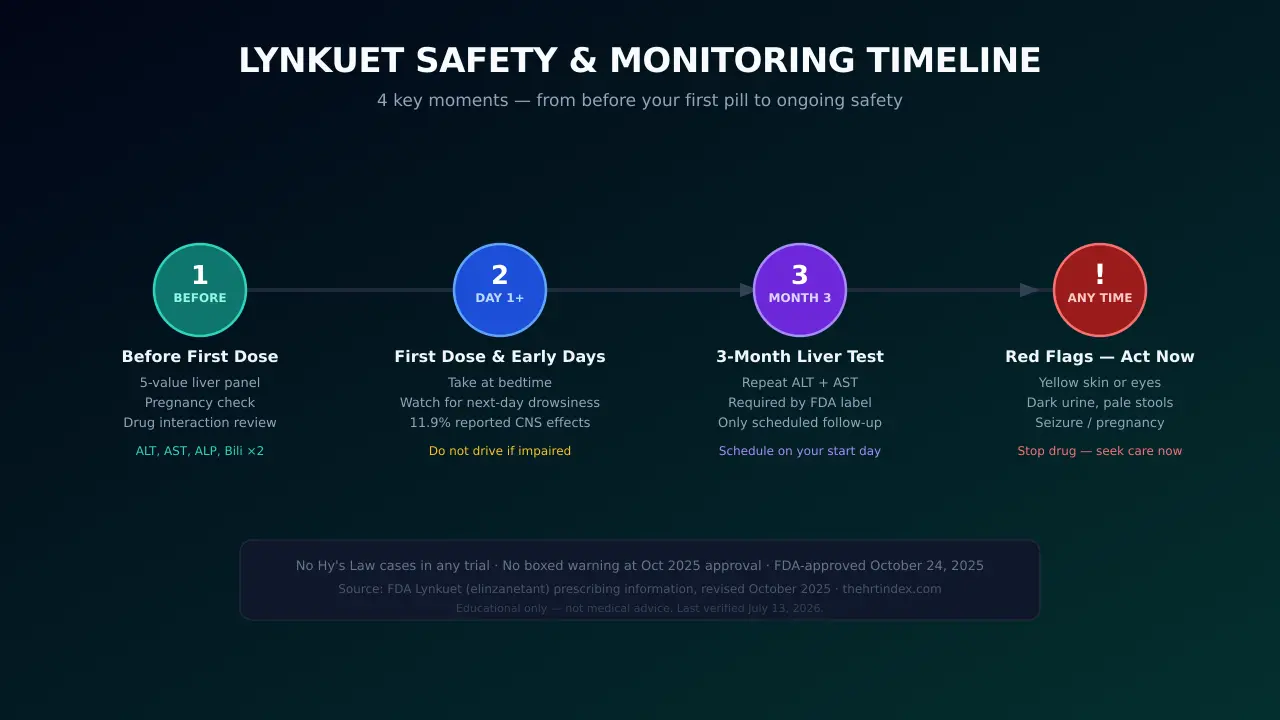
Lynkuet safety and monitoring starts before your first dosewith a liver blood test, ruling out pregnancy when relevant, and a review of your other medicines. After that, the label asks for one more liver test at three months — plus stopping right away and getting medical care if certain warning symptoms show up. Two scheduled tests, a short symptom list, and a couple of things to plan around.
Think of it in four moments:
- Before your first pill — get the baseline tests and the go/no-go check.
- The first dose and early days — watch for next-day drowsiness; don’t drive if you feel it.
- Three months in — one repeat liver-enzyme test.
- Any time — know the red flags, and re-check interactions whenever you add a new medicine.
The HRT Index Lynkuet Safety & Monitoring Matrix
| When / trigger | What gets checked | What the label says | What it means for you |
|---|---|---|---|
| Before first dose | Pregnancy status (if you could be pregnant) | Exclude pregnancy in women who could become pregnant; Lynkuet is contraindicated in pregnancy | Yes, a menopause drug can still require a pregnancy check — perimenopause can surprise you |
| Before first dose | ALT, AST, ALP, total bilirubin, direct bilirubin | The baseline liver panel the label spells out | Confirm the order explicitly includes direct bilirubin rather than assuming it does |
| Before first dose | Starting cutoff | Don't start if ALT or AST is ≥2× the lab's upper limit of normal, or total bilirubin is ≥2× it | A result below that cutoff can still need your prescriber's read — it's not a DIY call |
| Before first dose | Your full medicine + supplement list | Avoid strong CYP3A4 inhibitors and grapefruit; a moderate inhibitor means a lower dose; avoid strong and moderate CYP3A4 inducers | Bring everything — prescriptions, over-the-counter, vitamins, herbs |
| Before first dose | Seizure history | Use with caution if you've had seizures or take things that lower the seizure threshold | Mention it even if your last seizure was years ago |
| Before first dose | Liver and kidney status | Not recommended in moderate/severe liver impairment or end-stage kidney disease | This is your prescriber's call, based on your history and labs |
| First dose + early days | Drowsiness, dizziness, feeling faint | These nervous-system effects hit ~11.9% on Lynkuet vs ~3.5% on placebo | Don't drive or do risky work while you feel it — bedtime dosing doesn't guarantee a clear morning |
| ~3 months after starting | Liver enzymes (ALT/AST) | Re-check liver transaminases at three months | Put the date on your calendar the day you start |
| Any time | Liver-injury warning signs | Stop Lynkuet immediately and get medical attention, including a liver test | Treat this like a smoke alarm — act, don't wait it out |
| If labs go high | Stopping cutoffs | Stop if enzymes top 5× normal, or top 3× normal with bilirubin above 2× normal; clinician rules out other causes | These are numbers your clinician tracks — don't try to trend your own |
| If pregnancy is possible | Contraception + testing | Use effective birth control during treatment and for 2 weeks after; test if pregnancy is suspected; stop if confirmed | Plan this up front so a surprise doesn't catch you off guard |
| When a medicine changes | Re-check interactions | Any new prescription, OTC, or supplement should trigger a fresh interaction review | Make "new medicine? re-check" a standing rule |
| If you miss a dose | Dosing | Take the next dose the following day; never double up | Simple, but worth writing down |
| Ongoing | Skin / sun sensitivity | Mild-to-moderate photosensitivity in ~0.5% vs ~0.1% on placebo, starting anywhere from day 1 to day 290 | A new rash or sun reaction isn't always a "first week only" thing — report it |
Enter your start date and get your 3-month test reminder, baseline checklist, prescriber questions, and printable red-flag card. No email. Nothing stored.
Drug and food interactions to know about
Lynkuet is processed by a liver enzyme pathway called CYP3A4. Any drug or food that strongly affects that pathway can raise or lower Lynkuet levels in your blood to unsafe ranges.
Avoid entirely
- Strong CYP3A4 inhibitors (e.g., ketoconazole, itraconazole, clarithromycin)
- Strong CYP3A4 inducers (e.g., rifampin, carbamazepine, phenytoin)
- Moderate CYP3A4 inducers
- Grapefruit and grapefruit juice
Dose adjustment needed
- Moderate CYP3A4 inhibitors (e.g., fluconazole, verapamil, diltiazem)
- Your prescriber or pharmacist sets the new dose
Extra caution
- Drugs that lower the seizure threshold
- Other sedating medicines (may worsen drowsiness)
There’s no blanket answer for antidepressants, antibiotics, antifungals, or supplements — it depends on the exact product. Bring your complete list: prescription, OTC, vitamins, herbals. Your prescriber or pharmacist does the interaction check, not this page.
The checklist tool includes a printable list of questions about interactions, labs, and your specific history.
Which liver tests do you need before starting Lynkuet?
Before your first Lynkuet pill, the label calls for five liver values: ALT, AST, alkaline phosphatase (ALP), total bilirubin, and direct bilirubin.You shouldn’t start if your ALT or AST is at least twice the lab’s upper limit of normal, or if your total bilirubin is at least twice that limit. These are the label’s required baseline checks — your prescriber reads them in the context of your history and other results. (FDA label)
Let’s decode them, because “get a liver panel” isn’t very helpful when you’re the one getting stuck with the needle.
- ALT and AST are two enzymes that leak into your blood when liver cells are stressed or damaged. Higher numbers can mean the liver is irritated.
- ALP (alkaline phosphatase) is another liver-related enzyme that helps round out the picture.
- Total and direct bilirubinmeasure a waste product the liver processes. The pattern can help a clinician think through possible causes — but these numbers don’t diagnose a cause on their own.
- “Upper limit of normal” (ULN) just means the top of the normal range your specific lab uses. Every lab prints its own range on the result.
The “did they order all five?” checklist
Here’s a small thing that trips people up: a generic “liver panel” order doesn’t always spell out directbilirubin. So when your order is placed, it’s fair to ask:
- Does this include ALT and AST?
- Does it include alkaline phosphatase?
- Does it include both total and direct bilirubin?
- Who reviews the result before I take the first pill?
- Where does my three-month test order come from?
What if one number is a little high, but not double?
The label defines a hard do-not-start line: 2× the normal limit. It does notsay every smaller bump is fine. A number below the cutoff can still matter — depending on your liver history, symptoms, alcohol use, or other medicines. There’s no one-size answer here, and we won’t invent one. Your prescriber decides whether to repeat the test, wait, or look for another cause. That’s exactly what a good clinician is for.
When is the three-month Lynkuet liver test due?
The label asks for one repeat liver-enzyme test (ALT/AST) about three months after you start Lynkuet. That’s the only scheduled follow-up it requires— though symptoms, an abnormal result, or your history can lead your clinician to test more often. It’s the one built-in check to catch a liver problem early. (FDA label)
This is also the biggest practical difference between Lynkuet and its close relative Veozah. Veozah carries a boxed warning for serious liver injury (added December 2024) and a more extensive monitoring schedule. Lynkuet’s schedule is shorter — a difference the FDA’s own review documents explain in the liver safety section below.
Get the date on your calendar the day you start
The cleanest way not to miss this is to schedule it up front. Our monitoring checklist tool adds three calendar months to your start date and gives you a reminder range to drop into your phone — labeled as a reminder, not an official FDA deadline. One line to add to your notes: “Confirm the exact timing with my prescriber.”
And if the three-month test slips past its date? Don’t quietly keep taking the pills, and don’t quietly stop, either. Call the prescribing office or a pharmacist and ask what to do. That’s not a decision this page can make for you.
Which Lynkuet warning signs mean stop and get help?
The label says to stop Lynkuet immediately and seek medical attention — including a liver test — if you notice possible signs of liver injury. Get medical help right away for a seizure or loss of consciousness, and stop the drug if you find out you’re pregnant.These are the “don’t wait until Monday” symptoms. Screenshot them. (FDA label)
Possible liver-injury red flags
Stop Lynkuet and get medical care, including a liver test, if you notice:
- New or unusual tiredness
- Loss of appetite
- Nausea or vomiting
- Itching (pruritus)
- Yellow skin or eyes (jaundice)
- Pale or light-colored stools
- Dark (tea-colored) urine
- Stomach (abdominal) pain
Don’t talk yourself into “it’s probably nothing” and wait it out. In the studies, enzyme rises were usually mild, caused no symptoms, and settled after stopping the drug — but catching a real problem early is the whole point.
Seizure or loss of consciousness
If you have a seizure or lose consciousness, get medical help right away. Lynkuet’s prescribing information, revised August 2026, reports seizures during postmarketing use as well as a seizure in a trial participant. The label advises discussing seizure risk with every patient and using caution in people with a seizure history or conditions that lower the seizure threshold. Voluntary postmarketing reports cannot establish the frequency or prove causation for every reported event. Tell your prescriber about any seizure history before treatment.
If you think you might be pregnant
Pregnancy is the one hard “no” for Lynkuet. If pregnancy is possible, get tested. If it’s confirmed, stop the drug and tell your clinician. One important detail: the pregnancy-loss and stillbirth warning comes from animal reproduction studies— there aren’t enough human pregnancy data to measure the risk directly. Plan ahead anyway: the label advises effective birth control during treatment and for two weeks after your last dose.
Our monitoring checklist tool below prints a wallet-size red-flag card with the drug name, symptom list, and a blank line for your prescriber’s number. Stick one on the fridge. Keep one in your bag.
Includes the red-flag card, baseline checklist, prescriber questions, and your 3-month test date.
Can Lynkuet make you too sleepy to drive or work safely?
Yes — this is the big one to plan around. In the trials, nervous-system effects like drowsiness, fatigue, dizziness, and feeling faint happened in about 11.9% of women on Lynkuet, versus about 3.5% on placebo. If you feel any of it, don’t drive or do anything risky until it passes. It’s usually mild, but it’s real, and it can linger into the next morning for some people. (FDA label)
Why taking it at bedtime doesn’t fully solve it
Lynkuet is dosed at night, which helps. But the label still carries a daytime-impairment warning for a reason. In a driving-simulator study, some women were still impaired nine hours after their first dose— even though the group average didn’t cross the study’s impairment line. Fewer women were affected after five nights in a row, though that doesn’t guarantee you’ll be one of them. Treat the first few mornings with respect.
Plan your first dose around your life
It’s worth talking through with your clinician:
- Do you drive early in the morning?
- Do you operate machinery or work a safety-sensitive job?
- Are you the overnight caregiver for a child or parent?
- Do you have a history of falls or fainting?
- Do you take anything else that makes you sleepy?
A simple alertness log beats a vague memory
| Date | Took bedtime dose? | Morning alertness (1–5) | Dizziness or near-fainting? | Drove or did risky work? | Called clinician? |
|---|---|---|---|---|---|
| Day 1 | |||||
| Day 2 | |||||
| Day 3 |
If the sleepiness is heavy or sticks around, that’s a “tell your prescriber” moment, not a “push through it” one.
What are the most common Lynkuet side effects?
In the year-long OASIS-3 trial, the side effects reported most often on Lynkuet — and more than on placebo — were headache, fatigue, dizziness, drowsiness, belly pain, rash, diarrhea, and muscle spasms. Across all side effects in that trial, about 89.5%in the Lynkuet group were mild or moderate. These numbers describe the women in the study; they’re not a prediction for you. (FDA label)
Side effects in the 52-week trial (OASIS-3)
Reactions reported in at least 2% of women on Lynkuet and more often than placebo — from 313 women on the drug and 314 on placebo. The last column is simple subtraction, not an adjusted risk estimate.
| Side effect | Lynkuet | Placebo | Difference vs placebo |
|---|---|---|---|
| Headache | 9.6% | 7.0% | +2.6 pts |
| Fatigue | 7.3% | 2.9% | +4.4 pts |
| Dizziness | 6.1% | 1.9% | +4.2 pts |
| Drowsiness (somnolence) | 5.1% | 1.3% | +3.8 pts |
| Belly pain | 4.5% | 2.5% | +2.0 pts |
| Rash | 4.2% | 1.6% | +2.6 pts |
| Diarrhea | 3.8% | 1.0% | +2.8 pts |
| Muscle spasms | 3.2% | 0.6% | +2.6 pts |
Who stopped the drug because of a side effect?
In OASIS-3, about 12.5% of women on Lynkuet stopped because of a side effect, versus 4.1%on placebo. The specific reasons the label calls out (at 1% or more, and more than placebo) were belly pain (1.6%), fatigue (1.6%), depression (1.6%), and headache (1.3%). So most women who had side effects kept going — but about 1 in 8 stopped.
Two more worth knowing
- Sun sensitivity (photosensitivity):mild to moderate in about 0.5% on Lynkuet vs 0.1% on placebo — and it started anywhere from day 1 to day 290. A new sun reaction isn’t automatically a “first week” thing. Report it.
- The uterine lining: in the trials, 477 women on Lynkuet had biopsies, and no endometrial cancerswere found, with abnormal findings at 0.8% — in line with the normal background rate.
What this table can’t tell you
It can’t tell you your personal odds. It can’t say which of your symptoms are from Lynkuet. And you can’t line these numbers up against a different drug’s trial and call it a fair fight — different studies, different people, different rules. “More common than placebo” also doesn’t mean “severe.” Keep all of that in mind before you spiral over a percentage.
For a deeper dive on side effects and rates, see our full Lynkuet side effects page.
Is Lynkuet actually safe for your liver?
Here’s the honest, sourced answer: in the studies, liver-enzyme spikes of concern were uncommon, no case met the “Hy’s Law” lab pattern used to flag dangerous liver injury, and the FDA’s own toxicology team concluded Lynkuet is unlikely to be as hard on the liver as Veozah.But the label still requires the baseline and three-month tests — and real-world experience is still limited. Reassuring data, a built-in safety net, and honest humility because it’s new. (FDA label) — (FDA review)
The liver numbers, in one place
Different studies measured liver enzymes over different time windows. Here they are together — they don’t clash; they’re just different snapshots.
| Source | Population & window | Lynkuet | Placebo | What it shows |
|---|---|---|---|---|
| FDA-approved label | 3 trials, first 12 weeks | ALT/AST ≥3× ULN: 0.6% | 0.4% | Enzyme spikes were uncommon early on |
| Pooled analysis (Bayer-funded, corrected Apr 2026) | Postmenopausal women, weeks 1–52 | ALT/AST ≥3× ULN: 1.2% | 1.0% | Rates stayed low over a full year; no Hy's Law cases |
| FDA review (NDA 219469) | Phase 3 liver review | A handful of elevations; one possible drug-related case (ALT >8× ULN) | — | No case met Hy's Law criteria |
The part almost no consumer page tells you: why the monitoring is light
When the FDA reviewed Lynkuet, its computational toxicology team ran a chemical-structure comparison against Veozah. They found a difference. Veozah contains a ring structure that can break down into reactive fragments believed to cause its liver toxicity. Lynkuet’s structure is far less likely to do that. The FDA’s conclusion, in its own words: Lynkuet “is unlikely to have a hepatotoxic potential comparable to that of fezolinetant.” (FDA review)
That chemistry was onepart of the FDA’s reasoning — not the whole thing. The review also pointed to the lack of clinically significant liver injuries or Hy’s Law cases in the trials, and to the fact that the risk could be managed through the label itself. Put together, that’s why Lynkuet got a short monitoring plan instead of the boxed warning Veozah carries. For a direct comparison, see our Veozah vs. Lynkuet page.
Why the label still asks for tests anyway
If the data look this calm, why bother with blood tests at all? Two reasons. First, this whole drug class has a liver history — Veozah got a boxed warning after rare but serious real-world cases. Second, animal studies of elinzanetant showed liver injury at high doses. So the FDA did the sensible thing: it allowed the drug with a short, clear monitoring plan rather than no plan.
Notably, the independent liver-safety board on the pooled analysis felt routine monitoring might not even be necessary — but the current U.S. label still requires the baseline and three-month tests.When the research and the label seem to disagree, we follow the label. That’s the rule your prescriber follows too.
What’s still unknown (stated plainly)
- Multi-year, everyday use beyond the trials.
- Very rare side effects that studies aren’t big enough to catch.
- How women over 65 respond (the trials didn’t include enough of them to say).
- How it behaves in people the trials excluded.
- How it plays with the messy mix of medicines real people actually take.
Build your Lynkuet monitoring checklist
Enter your start date below and get your exact 3-month test reminder window, a baseline-test checklist, a printable prescriber question list, and a red-flag card. No email. Nothing is stored or sent — this tool runs entirely in your browser.
Lynkuet Monitoring Checklist
Enter your start date and fill in your details — then print. No email required. Nothing is stored or sent. Education only, not medical advice.
Baseline liver panel — confirm all five are ordered
The FDA label requires all five values before your first dose. A “liver panel” order doesn’t always include direct bilirubin by default — ask explicitly.
Do not start if ≥2× the upper limit of normal
Do not start if ≥2× the upper limit of normal
Part of the full baseline panel
Do not start if ≥2× the upper limit of normal
Commonly missed — ask explicitly that it be included
Before starting — also confirm
Lynkuet is contraindicated in pregnancy
Bring every prescription, OTC, vitamin, and herbal
Even if your last seizure was years ago
Enter start date above to calculate
Keep a copy in your bag and on the fridge
Nothing is stored or sent. This tool runs entirely in your browser. Governed by our consumer health data policy.
Lynkuet safety and monitoring: common questions
Real questions from people researching Lynkuet. Each answer is sourced to the FDA label or review documents and is visible here without JavaScript.
Who shouldn't start Lynkuet based on liver tests?
Can I take Lynkuet with an antidepressant, antibiotic, antifungal, or supplement?
Can I drink alcohol on Lynkuet?
Is Lynkuet safe if I've had seizures?
Is Lynkuet safe for women over 65?
How long has Lynkuet been studied?
Is Lynkuet a hormone or HRT?
Is Lynkuet safer than Veozah for the liver?
How we verified this guide
We built this from the top of the evidence pyramid down: the FDA-approved U.S. label first, then FDA review documents, then peer-reviewed studies, then everything else.When sources seemed to disagree, the approved label won, because that’s the document your prescriber follows.
- Current U.S. Lynkuet (elinzanetant) prescribing information — FDA
- FDA approval and review documents, and FDA safety communications
- Peer-reviewed trials and analyses (OASIS-3; the 2026 pooled liver-safety analysis)
- The maker’s official materials, used to double-check how the label plays out in practice
- Reputable secondary explainers, for comparison context only
- Public forums, for the language people use — nothing more
This page reflects The HRT Index Verification Standard — our documented process of reading every published detail, separating what’s required by the label from what a study found, checking who funded that study, and re-checking on a fixed schedule.
Fair disclosure on the pooled liver analysis:it was funded by Bayer, the maker, and Bayer helped run it. It was also corrected in April 2026. That doesn’t erase the finding, but you deserve to see the relationship — which is exactly why we lean on the FDA-approved label as the boss document and treat company-funded papers as supporting evidence.
Sources and change log
| Verified | Source checked | What we found | Page action |
|---|---|---|---|
| July 13, 2026 | Lynkuet prescribing information (rev. Oct 2025); current DailyMed record updated Mar 4, 2026 | Baseline + 3-month monitoring confirmed; no boxed warning; no REMS required at approval | Initial publication |
| July 13, 2026 | FDA Risk Assessment and Risk Mitigation Review, NDA 219469 | Case counts and the chemical-structure comparison to Veozah confirmed | Liver section built |
| July 13, 2026 | Pooled liver-safety analysis, Drug Safety (2026); corrected April 2026; Bayer-sponsored | 52-week enzyme rates (1.2% vs 1.0%) and no Hy's Law cases confirmed | Evidence table + disclosure added |
| July 13, 2026 | Current Veozah DailyMed label (updated Feb 26, 2026) + FDA safety communication | Boxed warning and monitoring schedule confirmed | Comparison references built |
Still deciding?
You came here worried about safety. Hopefully you’re leaving with a plan: a baseline test, a three-month recheck, a short list of red flags, and a set of questions for whoever prescribes it. If any part of your situation still feels unclear — whether Lynkuet, hormone therapy, or in-person care is the right first move — don’t guess.
Find My HRT Path →The HRT Index’s free tool for a personalized starting point — how to get Lynkuet online, non-hormonal options, and more.
By the editorial team at The HRT Index — the independent decision resource for online menopause and HRT care. Editorial research, not medically reviewed by a clinician. Last verified: July 13, 2026. This article is for education only and is not medical advice; talk to a licensed clinician or pharmacist about your situation before starting, stopping, or changing any medication.
Sources: U.S. Food and Drug Administration — Lynkuet (elinzanetant) prescribing information (rev. October 2025) and FDA review, application 219469; FDA Drug Safety Communication on Veozah boxed warning (December 2024); OASIS-3, JAMA Internal Medicine (2025); pooled elinzanetant liver-safety analysis, Drug Safety (2026).