
Your situation right now — find your row
| Your situation | What to do |
|---|---|
| You have a new warning sign (yellowing, dark urine, pale stools, nausea, vomiting, itching, unusual fatigue, appetite loss, or stomach pain) | Stop Veozah and seek medical care right away, including a liver blood test. |
| You have diarrhea, trouble sleeping, or back pain — and none of the warning signs | These are listed common reactions. Tell your prescriber if it bothers you or doesn’t go away. |
| You feel completely fine, but a liver test is due | Keep the test. Liver enzyme changes often cause no symptoms at all. |
| You just started a new medicine, supplement, or OTC product | Ask a pharmacist to check it — Veozah can’t be combined with certain drugs. |
| You’re thinking about cutting the tablet in half | Don’t. The label says swallow it whole. |
Let’s clear up one thing right away, because it trips up almost everyone: Veozah is not a hormone.It’s a prescription pill called fezolinetant, and it belongs to a group of medicines called NK3 receptor antagonists — they work on a specific “heat switch” in the brain that goes haywire during menopause. It treats moderate-to-severe hot flashes and night sweats.
Veozah is the FDA-approved brand-name version of fezolinetant, distributed by Astellas Pharma US. As of our July 2026 check, there’s no FDA-approved generic. (If you ever see “compounded fezolinetant” sold somewhere else, that’s not Veozah, and it’s not FDA-approved.)
Why does any of this matter for side effects? Because “non-hormonal” makes the risk sound simpler than it is. For most women, the day-to-day side effects are mild. But Veozah comes with one serious catch that estrogen patches don’t share — and we’re going to be straight with you about it.
What are the most common Veozah side effects?
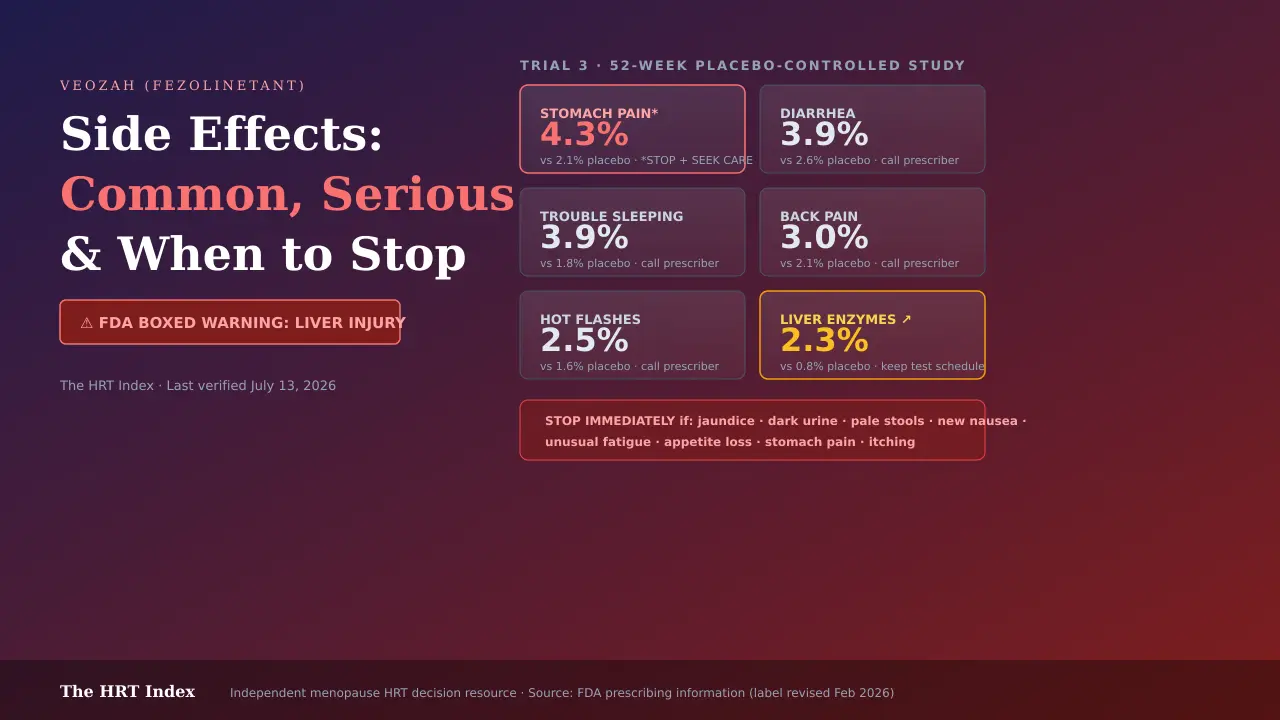
In Veozah’s 52-week placebo-controlled study (Trial 3), the most common side effects were stomach pain (4.3%), diarrhea (3.9%), trouble sleeping (3.9%), back pain (3.0%), hot flashes (2.5%), and raised liver enzymes (2.3%) — each reported more often than with a placebo. “Common” doesn’t mean “always harmless,” though. Stomach pain is on this list AND on the liver-warning list, so it gets treated with extra care.
Below is The HRT Index Veozah Side-Effect Action Matrix.The percentages come straight from the label’s 52-week study (Trial 3, which included 609 women on Veozah 45 mg and 610 on placebo). We added the placebo column so you can see the difference between the two groups, and an action column so you know your next move.
| Side effect | Label: Veozah | Label: placebo | The gap | Label-based action |
|---|---|---|---|---|
| Stomach (abdominal) pain | 4.3% | 2.1% | +2.2 pts | Stop and seek care.Stomach pain is also a possible liver-injury sign. Don’t decide on your own that it’s “just common.” |
| Diarrhea | 3.9% | 2.6% | +1.3 pts | A listed common reaction. Tell your prescriber if it bothers you or doesn’t go away. Stay hydrated. |
| Trouble sleeping (insomnia) | 3.9% | 1.8% | +2.1 pts | A listed common reaction. Tell your prescriber if it doesn’t go away. Ask before changing when you take your dose. |
| Back pain | 3.0% | 2.1% | +0.9 pts | A listed common reaction. Tell your prescriber if it’s severe or persistent. |
| Hot flashes | 2.5% | 1.6% | +0.9 pts | Yes — the drug that treats hot flashes still lists them. Ongoing flashes may mean it isn’t fully working yet; talk to your prescriber. |
| Raised liver enzymes (blood test only — not a feeling) | 2.3% | 0.8% | +1.5 pts | Often causes no symptoms at all.This is exactly why the blood tests matter more than “I feel fine.” |
Why we flagged stomach pain twice
Stomach pain was the single most common side effect in the study. It’s also on the FDA’s official list of “stop and seek care” liver-warning signs. That’s not a contradiction — it’s the exact reason you shouldn’t decide on your own that new belly pain is “nothing.” The page can’t tell the two apart by name alone, and neither can you. So new stomach pain gets the warning action, not a shrug.
Want the plain rule for your symptom — stop now, or call your prescriber?
Which Veozah side effects mean you should stop and get medical care?
Stop Veozah immediately and seek medical care — including a liver blood test — if you develop new fatigue, appetite loss, nausea, vomiting, itching, yellow skin or eyes (jaundice), pale stools, dark urine, or stomach pain. These are the label’s official signs of possible liver injury. Any one of them is enough. They are not “watch and wait a few days” symptoms.
Veozah can, in rare cases, cause serious liver injury. The FDA first warned about this on September 12, 2024, then on December 16, 2024 added a boxed warning — the most serious warning the FDA gives a medicine, printed in a black box at the top of the label. See our full Veozah liver warning explainer →
The full stop-now list, in plain words:
- New fatigue— wiped out in a way that isn’t like you
- Losing your appetite
- Nausea or throwing up
- Itching
- Yellow skin or eyes (jaundice)
- Pale or light-colored stools
- Dark urine
- Stomach (abdominal) pain
If you develop any one of these, stop taking Veozah and seek medical care right away. Contact the clinician who prescribed it or an urgent medical service, and ask for a liver blood test. According to the FDA, stopping the medicine could prevent the liver injury from getting worse.
What “seek medical care” means here:
- Contact your prescriber or an urgent medical service promptly.
- Ask for liver blood tests.
- Do notrestart Veozah on your own afterward. That’s a decision for your clinician.
Why “within 40 days” doesn’t mean you’re safe after day 40
You may read that the rare serious cases reported to the FDA happened within about 40 daysof starting Veozah. That’s true — and worth knowing. But it does not mean day 40 is a finish line. Keep watching for the warning signs the whole time you take it, and keep every scheduled blood test.
How rare is the serious kind?
The FDA describes serious liver injury as rare.We won’t put a hard percentage on it, because these are voluntary reports that come from an unknown number of users — you can’t calculate a reliable rate from them. What we can tell you is what the studies showed, which is the next section.
When it’s an emergency
Call emergency services now for anything life-threatening — severe trouble breathing, fainting, or another medical emergency. No website should ever slow down real emergency care.
Report a suspected side effect
Reporting to FDA MedWatch helps track safety patterns. It doesn’t prove the drug caused it — and it’s not a substitute for contacting your clinician.
How can you tell a common Veozah side effect from a liver-warning symptom?
You often can’t tell by the symptom name alone — that’s the honest answer. Stomach pain is on both lists. Nausea and fatigue are warning signs even though they’re not on the “common side effects” table. So the safe rule is simple: match your symptom against the official warning list first, and when in doubt, stop and call.
The HRT Index overlap map (built from the current Trial 3 table and the label’s liver-warning list):
| Listed common reaction (usually milder) | Liver-warning sign (stop and seek care) | On BOTH lists |
|---|---|---|
|
| Stomach pain Always use stop-and-seek-care action |
Raised liver enzymes sit in their own box — they’re a blood-test result, not something you feel.
Three things this map makes clear — and they’re the whole point:
- Stomach pain is on both lists.So new belly pain never gets an automatic “that’s normal.” It gets the stop-and-seek-care action.
- Nausea and fatigue are warning signs — even though they’re not on the common side-effects table. This surprises people. New nausea or new fatigue means stop and get care, not push through.
- Feeling fine doesn’t mean your liver is fine.In the studies, women with raised liver enzymes were generally symptom-free. That single fact is why the blood tests aren’t optional.
Still weighing Veozah against other menopause options?
The right path depends on your symptoms, history, and what you can monitor. Use our care-path tool to match your situation to the right provider — after any urgent symptom has been handled.
How common are Veozah side effects, really?
In the 52-week study (Trial 3), the listed side effects showed up in 2.3% to 4.3% of women on Veozah — 0.9 to 2.2 percentage points above placebo. The serious liver injuries are rarer, and because they come from voluntary reports, there’s no reliable percentage for them — only that the FDA calls them rare.
Numbers calm nerves better than adjectives, so let’s put these in context. Take stomach pain, the most common one. It was reported in 4.3% of women on Veozah and 2.1% on placebo — an observed difference of 2.2 percentage points, or about 2 more reports per 100 women in this trial. Randomly splitting women into two groups lets us compare them fairly, but that subtraction still isn’t proof the drug caused every extra case, and it isn’t a prediction for you personally.
We’re also not going to say “double the risk.” Technically 4.3% versus 2.1% is roughly double — but “double” makes a small number sound bigger than it is. The observed difference is what matters, and it’s small.
About the liver enzymes
Across the three studies, enzyme levels rose past three times the normal limit in 2.3% of women on Veozah versus 0.9% on placebo. In the trials, women with these elevations were generally symptom-free, and the values returned to their starting point (or close to it) without lasting harm — whether women kept taking the drug, paused, or stopped. (That pooled figure is separate from Trial 3’s 2.3%-vs-0.8% entry above; both round to 2.3% by coincidence.)
One more honest note on comparisons
You can’t compare these numbers to another drug’s study numbers. The label says so directly. Different studies, different patients, different rules. Use these to understand Veozah, not to rank it against something else.
What liver tests do you need on Veozah, and when?
Before you start Veozah, the label calls for a baseline liver blood panel — ALT, AST, alkaline phosphatase, and bilirubin (total and direct). After you start, you need blood tests monthly for the first 3 months, then again at month 6 and month 9, plus any time warning symptoms appear.
Think of it as a schedule, not a suggestion.
| When | What gets checked |
|---|---|
| Before your first pill (baseline) | Full liver panel: ALT, AST, alkaline phosphatase, bilirubin (total and direct) |
| Month 1 | Liver blood test |
| Month 2 | Liver blood test |
| Month 3 | Liver blood test |
| Month 6 | Liver blood test |
| Month 9 | Liver blood test |
| Any time you get a warning sign | Stop, seek medical care, and get a liver test right away |
When Veozah should not be started
Your clinician won’t begin it if your baseline ALT or AST is already at least twice the normal limit, or your total bilirubin is at least twice the normal limit. Your clinician reads these values in context and checks for other possible causes — it’s not something to eyeball yourself.
When it should be stopped — the clinical thresholds
The label directs a clinician to stop Veozah if liver enzymes climb above five times the normal limit, or above three times the normal limit together with total bilirubin above twice the normal limit. If enzymes go above three times normal, the label calls for more frequent testing until they settle and a check for other causes. Your clinician reads the numbers and acts. Your job is to show up for the tests and report symptoms.
What if you miss a scheduled liver test?
Call your prescriber and reschedule it. Don’t assume the next one will cover it, and don’t decide on your own that feeling fine means you can skip it. Monitoring is designed to catch liver changes — including the silent kind — early.
Who should not take Veozah?
Veozah is contraindicated (a firm “no”) if you have known cirrhosis, severe kidney impairment or kidney failure, or if you take any CYP1A2-inhibitor medicine. It also shouldn’t be started if your baseline liver tests are already too high. Pregnancy is different — it’s not a contraindication, but there isn’t enough data to judge the risk.
| Condition / situation | What it means |
|---|---|
| Known cirrhosis (serious liver scarring) | Firm contraindication. If you’ve been told you have cirrhosis, Veozah is not an option. |
| Severe kidney impairment (eGFR 15–29) or kidney failure (eGFR <15) | Also a firm no. Mild or moderate kidney function reduction doesn’t automatically rule Veozah out — this contraindication is about the severe end. Your clinician will confirm where you fall. |
| Any CYP1A2-inhibitor medicine | Firm contraindication — covers weak, moderate, and strong inhibitors. See the interactions section below. |
| Baseline liver tests already elevated (≥2× normal ALT/AST or bilirubin) | Can’t start until values improve. Your clinician investigates the cause first. |
| Pregnancy | Not listed as a contraindication, but there are no adequate human data to judge the risk. Tell your prescriber if you are pregnant, think you may be, or could become pregnant. |
What medicines interact with Veozah?
Veozah is a CYP1A2 substrate — your body clears it using an enzyme called CYP1A2. Any drug that blocks that enzyme makes Veozah levels rise, so the label says Veozah can’t be combined with weak, moderate, OR strong CYP1A2 inhibitors. The safe move is to have a pharmacist check your full list — not to rely on a short web list.
CYP1A2 is one of your liver’s cleanup crews. When inhibitor drugs slow it down, Veozah builds up higher than intended. That’s why this isn’t a “space them out” situation — it’s a “don’t combine” situation.
| Drug (example) | Type | Peak Veozah level rose | Total Veozah exposure rose |
|---|---|---|---|
| Fluvoxamine (antidepressant) | Strong CYP1A2 inhibitor | ~80% | ~840% |
| Mexiletine (heart-rhythm medicine) | Moderate CYP1A2 inhibitor | ~40% | ~360% |
| Cimetidine (heartburn medicine — including OTC) | Weak CYP1A2 inhibitor | ~30% | ~100% |
Why a short list is never enough on its own: drug lists change over time; the same drug has different brand and generic names; you might not realize an OTC product or supplement even counts; and the rule covers every CYP1A2 inhibitor, not just three famous ones.
Copy-and-paste question for your pharmacist:
“I take Veozah (fezolinetant), which can’t be combined with CYP1A2 inhibitors. Can you check every prescription, over-the-counter medicine, and supplement on my list?”
And never stop another prescribed medicine on your own to make room for Veozah — let a clinician sort that out.
How long do Veozah side effects last?
The label doesn’t give one set timeline for how long side effects last, so be wary of any page that promises they’ll vanish in “a few days.” In everyday use, mild effects like diarrhea or back pain often ease over the first weeks. But warning signs are different — those need action now, not patience.
The label reports how often side effects happened, not how longthey lasted — and people differ. So here’s a better plan than guessing: write it down.A short log turns “I don’t feel right” into something your clinician can actually use.
Track these for your clinician:
- The symptom and when it started (date and time)
- How bad it is (1–10 scale works fine)
- Whether it’s tied to when you take your dose
- Food or alcohol around that time
- Any new medicine or supplement you’ve started
- Whether it’s hurting your sleep, eating, or daily life
- Your last liver-test date
One firm rule on dosing changes
Don’t cut, crush, chew, halve, or switch to every-other-day on your own. The label says take one 45 mg tablet once a day and swallow it whole. If the dose feels like too much, that’s a conversation with your prescriber — not a DIY change. This “wait and discuss” approach never applies to warning signs — those get the stop-and-seek-care action.
Does Veozah cause weight gain, hair loss, headaches, nausea, or fatigue?
Weight gain, hair loss, and headaches are NOT listed among Veozah’s common side effects — but “not listed” isn’t the same as “impossible” for any one person. Nausea and fatigue are different: both are official liver-warning signs, so they get the stop-and-seek-care action, not a shrug.
| Symptom people search | Label status | What to do |
|---|---|---|
| Weight gain | Not a listed side effect in studies | Mention any change to your clinician (menopause itself shifts weight and appetite) |
| Weight loss | Not a listed effect | Severe or ongoing diarrhea can affect weight — worth a call to your prescriber |
| Hair loss | Not on the common side-effects list | New hair thinning has many possible causes — deserves a proper check, not a guess |
| Headaches / dizziness | Neither is on the common side-effects list | A bad or lasting headache is always worth getting checked |
| Nausea | Official liver-warning sign | Stop and seek care — do not treat as “normal adjustment” |
| Fatigue / unusual tiredness | Official liver-warning sign | Stop and seek care — do not wait it out |
Can you drink alcohol on Veozah?
The U.S. label does not set a “safe number of drinks” or name an alcohol interaction — so no honest page can hand you a limit. But because Veozah’s boxed safety concern is the liver, and alcohol can also affect the liver, the responsible answer is to ask your prescriber or pharmacist based on your own liver history and test results.
The absence of a stated limit is not the same as “alcohol is safe” — it just means the label doesn’t address it. Bring these questions to your clinician:
- Does my liver history change your advice?
- Should I skip alcohol until my early blood tests come back clear?
- Do any of my other medicines add liver risk?
- Which symptoms should send me in right away?
What should you do when a Veozah side effect starts?
Your next step depends on the symptom. Warning signs mean stop and get care right away. Ongoing but non-warning effects mean call your prescriber. Nobody should change, split, or restart Veozah based on a website, including this one.
- Any warning sign?(Jaundice, dark urine, pale stools, nausea, vomiting, itching, unusual fatigue, appetite loss, stomach pain.) → Stop and seek medical care right away. Ask for a liver test.
- Persistent or rough non-warning effect?(Insomnia that won’t quit, diarrhea wearing you down, back pain that’s severe, anything hurting your eating, sleep, or daily life.) → Call your prescriber.Don’t change the dose yourself.
- Not sure which bucket you’re in?→ Write it down and, if there’s any doubt, treat it as a warning sign and call.
- Started something new?→ Ask a pharmacist to screen it for CYP1A2 interactions.
- Want to help future patients? → You can report a suspected side effect through FDA MedWatch (not a substitute for contacting your clinician).
What if the side effects aren’t worth it — or Veozah just isn’t right for you?
If you can’t tolerate Veozah, or a contraindication rules it out, you have good options — and the right one depends on your health history. A clinician can help tell a drug side effect apart from menopause itself, and talk through whether to stop or switch.
The damaging admission we promised you
Veozah’s serious liver risk is uncommon, but it’s real — and its required monitoring is a genuine hassle. That’s one baseline blood test before you start, plus five more tests through month 9, on top of watching for symptoms. An estradiol patch simply doesn’t ask that of you.
But read the next part, because it matters just as much: that risk is rare, the enzyme changes in studies were usually silent and reversible, and the monitoring exists precisely to catch a problem before you’d ever feel it. For a woman who can’t or won’t take estrogen, Veozah is one of the few FDA-approved non-hormonal options that works directly on the NK3 signaling pathway that drives menopausal hot flashes.
How to decide cleanly
- If reliable blood-test monitoring isn’t realistic, or you have a contraindication→ Veozah probably isn’t your best path, and that’s completely okay. An estradiol patch or pill (if you’re a candidate) doesn’t carry this liver-testing schedule — though it has a different risk profile and its own boxed warnings, so it’s a real conversation, not a free pass.
- If you can do the monitoring and want a non-hormonal option→ Veozah is a legitimate, FDA-approved choice worth discussing with your prescriber.
Your other options, briefly
- Systemic menopausal hormone therapy (estrogen) — for women who are candidates, usually paired with a progestogen if you still have your uterus. Different risk profile; no routine liver-testing requirement.
- Lynkuet (elinzanetant) — a newer FDA-approved non-hormonal pill (approved October 2025) that blocks two brain receptors (a dual NK1/NK3 antagonist), with its own label and risk profile. Fewer liver tests required.
- Brisdelle (low-dose paroxetine) — an FDA-approved non-hormonal option, plus other off-label approaches your clinician may raise.
Ruled Veozah out — or still weighing it against other options?
Use The HRT Index’s Find My HRT Path tool to match your situation to the right provider — and to flag when online care isn’t the right starting point — before your first consult. (Educational care-path matching — for non-urgent decisions, not for an active warning symptom.)
What do real patients say about Veozah side effects?
Patient stories are useful for one thing: showing what women actually go through and worry about. They can’t tell you how often a side effect happens, whether Veozah caused it, or what you should do.
Important note
Individual reports — not evidence of how often something happens, what causes it, or what you’ll experience.
In menopause communities like Reddit’s r/Menopause and on drug-review sites, the questions that come up most are the same ones this page answers: Is this nausea normal or is it my liver? Should I stop, or wait? How long does the tiredness last? Can I take half a tablet?
What we want you to take from that: “tired and nauseous” maps directly onto the liver-warning list. The responsible response to those posts isn’t “that’s normal, push through.” It’s: new nausea or fatigue is a reason to stop and call, not to wait. Patient voices point you toward caution here, not away from it.
For deeper analysis of how Veozah performs for real users, see our Veozah reviews page →
How we researched and verified this Veozah side-effects guide
We built this page from the current FDA prescribing information and the FDA’s liver-safety communication, checked every number against the label, and did the placebo math ourselves. This is editorial research — not medical advice, and not reviewed by a clinician.
What we actually verified
- The label revision date (February 2026)
- The common side-effect names and study percentages (Trial 3, n=609/610)
- The placebo percentages and our percentage-point math
- The official liver-warning symptoms
- The full blood-test schedule (baseline, months 1–3, 6, and 9) and start/stop thresholds
- The contraindications
- The CYP1A2-inhibitor rule and exposure figures
- The “swallow whole” instruction
- The FDA’s reason for adding the boxed warning
🚫 What we did NOT claim
- We did not personally take or test Veozah
- We did not diagnose any patient or reviewer
- We did not put a fake percentage on the rare serious liver cases
- We did not have a clinician medically review this page (editorial research)
- We did not treat forum posts as proof of anything
Spot something out of date? Send us a correction and we’ll recheck it.
Veozah side effects: frequently asked questions
What is the most common side effect of Veozah?
What are the serious side effects of Veozah?
Can Veozah cause liver damage?
When should I stop taking Veozah?
What blood tests does Veozah require?
Does Veozah cause weight gain?
Does Veozah cause hair loss?
Does Veozah cause headaches?
Is nausea a common Veozah side effect?
Is fatigue a Veozah side effect?
How long do Veozah side effects last?
Can you drink alcohol with Veozah?
Can you take cimetidine with Veozah?
Can you split a Veozah tablet?
Can liver problems happen without symptoms?
Can I restart Veozah after stopping it?
Is Veozah a hormone?
How do I report a possible Veozah side effect?
Sources
- U.S. Food and Drug Administration — FDA adds warning about rare occurrence of serious liver injury with use of Veozah (fezolinetant) (initial warning September 12, 2024; boxed warning added December 16, 2024).
- Veozah (fezolinetant) FDA prescribing information and Medication Guide (label revised February 2026) — boxed warning, adverse reactions and rates, contraindications, drug interactions and exposure figures, hepatic monitoring schedule and thresholds, dosing.
- Lynkuet (elinzanetant) FDA prescribing information — non-hormonal dual NK1/NK3 receptor antagonist for menopausal vasomotor symptoms.
- Brisdelle (paroxetine 7.5 mg) FDA prescribing information — non-hormonal treatment for moderate-to-severe menopausal vasomotor symptoms.
The HRT Index is the independent menopause HRT decision layer for women. Educational content only; not a substitute for professional medical advice, diagnosis, or treatment.
Still not sure which menopause treatment path is right for you?
Take our free ~90-second matching quiz. Find My HRT Path is educational care-path matching for non-urgent decisions — please don’t use it instead of seeking medical care for a possible Veozah warning sign.
Your situation changes the answer
Find My HRT Path
The right online menopause care isn't the same for every woman. It depends on your symptoms, what you've already tried, your age, your state and your health history — and some situations belong with an in-person clinician first. Because a general answer can't resolve those for you, use The HRT Index's Find My HRT Path tool to match your answers to an online option that fits, and to flag when online care isn't the right starting point, before your first consult.
See My HRT Match