
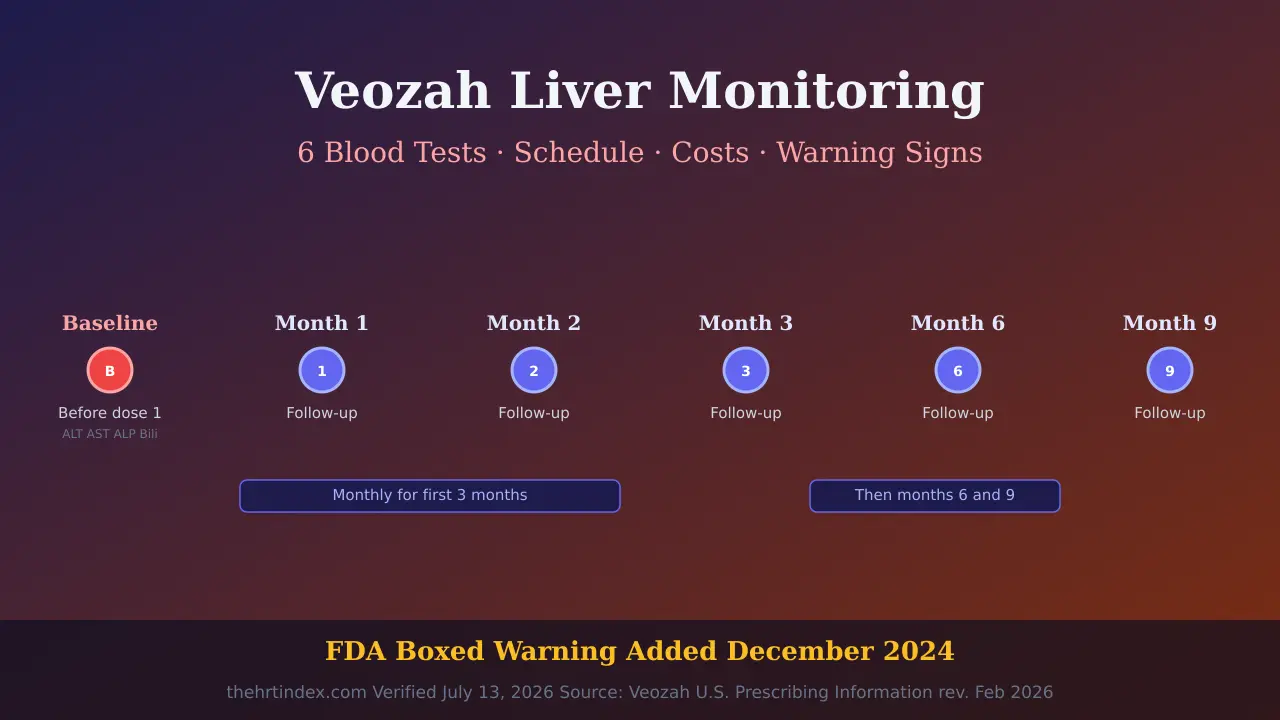
This page is for you if you’re: considering, starting, or already taking Veozah; trying to map your test dates; or unsure what a result means or what to do about a missed test.
This page can’t: read your personal lab result, clear you to start or continue Veozah, tell you to restart after an abnormal result, or replace urgent care when a warning symptom is present.
Your schedule at a glance
| When | Required checkpoint |
|---|---|
| Before your first dose | Baseline liver blood test |
| Month 1 | Follow-up liver blood test |
| Month 2 | Follow-up liver blood test |
| Month 3 | Follow-up liver blood test |
| Month 6 | Follow-up liver blood test |
| Month 9 | Follow-up liver blood test |
Not sure where to start? Jump to your situation:
- Haven’t started yet → the schedule and the baseline test
- On it and feeling fine → the date planner
- Missed a test → what to do about a missed test
- A result came back high → high result, no symptoms
We built this page because the answer is scattered across the FDA safety communication, the prescribing information, and lab-price pages. We put them in one place and show our sources and exact label wording, because on a liver topic you deserve to check our work.
Before you go deeper: if you’re still deciding whether Veozah is right for you at all, use The HRT Index’s Find My HRT Path tool to match your situation to the right provider before your first consult. If Veozah is already prescribed and you just need the monitoring nailed down, keep reading.
What are the Veozah liver monitoring requirements?
Veozah requires a liver blood test before your first dose, monthly for the first 3 months, then at months 6 and 9 — six scheduled checkpoints in the first nine months if results stay normal. Baseline testing includes ALT, AST, ALP, and total and direct bilirubin. Symptoms of liver injury can trigger an unscheduled test and immediate discontinuation at any time.
Here’s the full schedule with what to line up at each step. “Baseline” means before you ever take a pill.
| When | The test | What to confirm |
|---|---|---|
| Before your first dose | Baseline liver panel (ALT, AST, ALP, total + direct bilirubin) | Your results were reviewed before you start |
| Month 1 | Follow-up liver test | The order is placed and someone will read the result |
| Month 2 | Follow-up liver test | Same |
| Month 3 | Follow-up liver test | Same |
| Month 6 | Follow-up liver test | Same |
| Month 9 | Follow-up liver test | Same |
Two things worth saying plainly. These are six blood tests, and they don’t each need a separate doctor visit. And after month 9, the label lists no more routinetests — but that’s not the same as “no test ever again,” since a symptom or a high result can still call for one.
Do the follow-up tests use the same five markers?
The label spells out ALT, AST, ALP, total bilirubin, and direct bilirubin for baselinetesting. For the later checkpoints, it uses the broader phrase “follow-up hepatic laboratory tests” rather than naming a specific set of markers or a billing code. Confirm the exact follow-up order with your prescriber rather than assuming every draw is billed the same way.
Why some websites show a different schedule
If you’ve seen “months 3, 6, and 9” somewhere, that page is out of date. That was the original 2023 schedule. In late 2024 the FDA added testing at months 1 and 2, so the current schedule is monthly for the first three months, then 6 and 9. We cover exactly what changed and when below.
When are your Veozah liver tests due?
The follow-up checkpoints fall one, two, three, six, and nine months after your first dose. Veozah’s label sets month-based checkpoints but does not define a “grace window” — how many days early or late is acceptable — so treat any calculated date as a planning date and confirm the exact timing with your prescriber.
▶ Build my Veozah liver-test calendar
Enter your first-dose date to get your six planning dates. Your date is calculated entirely on your device — we don’t save it or send it anywhere.
Privacy: 100% client-side. We never store or transmit the date you enter.
What counts as “month 1”?
The planner uses the same calendar day one month later where it can (with sensible handling for month-ends), and labels every result a planning date. The label doesn’t set a universal window, so your prescriber’s timing always wins over a calendar.
What if you started before the warning changed?
Don’t try to rebuild a schedule from memory. Call your prescribing team, confirm which tests you’ve already done, and ask what comes next.
What if you already took your first dose before any baseline test?
Contact your prescriber promptly. The label calls for baseline testing beforeyou start, and this page won’t invent a retroactive schedule or tell you to keep going while you wait.
Which liver tests do you need before you start Veozah?
Before Veozah is started, the prescribing information calls for ALT, AST, alkaline phosphatase (ALP), total bilirubin, and direct bilirubin. Treatment should not begin if ALT or AST is at least twice the lab’s upper limit of normal, or if total bilirubin is at least twice that limit.
- ALT (alanine aminotransferase)— an enzyme that leaks into the blood when liver cells are stressed or damaged. One of the two main “is the liver irritated?” numbers.
- AST (aspartate aminotransferase)— the second enzyme in that pair. AST is also found in muscle and other tissues, so it isn’t liver-only. ALT and AST together are called transaminases.
- ALP (alkaline phosphatase)— an enzyme found in the liver and other places, including bone. In liver testing it helps flag a bile-duct pattern, but on its own a high ALP doesn’t prove the liver is the source.
- Total and direct bilirubin— bilirubin is a yellowish waste product your liver clears. When it builds up, skin and eyes can look yellow (jaundice). The baseline checks both the total and the “direct” portion.
What does “ULN” mean?
ULN is the upper limit of normal— the top of the normal range printed by the lab that ran your test. It’s the reference point for every threshold rule. Use your lab’s number, not a range you found online, because labs differ.
Can a recent liver panel count as the baseline?
Maybe. The label says testing must happen before you start, but it doesn’t set a maximum age for an earlier test. Ask your prescriber whether a recent panel is current and complete.
Do you have to fast?
The Veozah label doesn’t specify fasting for the liver panel. Follow whatever your lab or clinician tells you, because other tests drawn at the same visit may have their own prep rules.
What results mean Veozah should not be started or should be stopped?
Do not start Veozah if ALT or AST is 2× ULN or higher, or if total bilirubin is 2× ULN or higher. During treatment, it should be discontinued if transaminases go above 5× ULN, or above 3× ULN when total bilirubin is also above 2× ULN. Transaminases above 3× ULN otherwise call for more frequent testing until they resolve.
Your clinician uses these thresholds — this is here so you understand what they’re watching, not so you diagnose yourself.
Before you start — the “do not begin” rule
| Baseline result | What the label says |
|---|---|
| ALT is 2× ULN or higher | Do not start |
| AST is 2× ULN or higher | Do not start |
| Total bilirubin is 2× ULN or higher | Do not start |
During treatment — the “stop” rule
| Result while on Veozah | What the label says |
|---|---|
| Transaminases above 5× ULN | Discontinue |
| Transaminases above 3× ULN andtotal bilirubin above 2× ULN | Discontinue |
| Transaminases above 3× ULN (without that bilirubin combination) | More frequent follow-up testing until it resolves; look for other causes |
Why “at least” and “above” are not the same word. The before-you-start rule uses 2× ULN or higher(the label’s “≥”), while the stop rules use above 5× or above 3× with bilirubin above 2×(the label’s “>”). That’s the actual wording, and swapping the symbols changes the meaning.
Which symptoms mean you should stop Veozah and seek medical care now?
Veozah’s prescribing information says to stop the drug immediately and seek medical care — including liver blood tests — if you develop new fatigue, loss of appetite, nausea, vomiting, new or unusual itching, jaundice, pale stools, dark urine, or belly pain. These symptoms override the routine test calendar; do not wait for the next scheduled test.
Screenshot this list. If any of these show up, the schedule stops being the point.
Stop Veozah immediately and seek medical care if you develop any of these:
- New or unusual tiredness
- Loss of appetite
- Nausea
- Vomiting
- New or unusual itching
- Yellow skin or eyes (jaundice)
- Pale, light-colored stools
- Dark urine
- Belly (abdominal) pain — including pain on the upper-right side
What if it might be something else?
The label’s instruction is based on havingthese symptoms, not on being sure Veozah caused them. You don’t have to prove the cause first. Stop and get evaluated, and let the clinician sort out why.
When is it an emergency?
Follow your care team’s guidance for urgent symptoms. Call emergency services for anything that feels immediately dangerous — trouble breathing, fainting, or a symptom that’s escalating fast.
Why does Veozah need liver monitoring?
Veozah carries an FDA boxed warning because serious liver injury has been reported after approval. In three clinical trials, transaminase elevations above 3× ULN occurred in 2.3% of women on Veozah versus 0.9% on placebo, and no serum total bilirubin elevations above 2× ULN occurred. The current label says the frequency of the post-approval cases can’t be reliably estimated.
Quick vocabulary. Veozah (fezolinetant) is a nonhormonalpill for moderate-to-severe hot flashes and night sweats (vasomotor symptoms, VMS). It’s a neurokinin 3 (NK3) receptor antagonist — it blocks a brain messenger called neurokinin B from binding to the NK3 receptor. A boxed warningis the FDA’s most prominent warning type.
What the trials showed
Across three 52-week studies, 1,100 women received Veozah and 952 received placebo. Enzyme elevations above 3× ULN showed up in 2.3% on the drug versus 0.9% on placebo. Those women were generally without symptoms, no one had serum total bilirubin climb above 2× ULN, and levels returned to or near where they started — whether the women kept taking it, paused, or stopped.
What happened after approval
Once Veozah was in broader use, the current label reports cases of serious drug-induced liver injury within 40 days of starting, with peaks reaching up to 50× ULN for transaminases, up to 4× ULN for ALP, and up to 5× ULN for bilirubin, alongside symptoms like fatigue, nausea, itching, jaundice, pale stools, and dark urine. In the cases described in the label, the abnormalities gradually resolved after Veozah was stopped — but that does not predict what would happen for any one person.
| Clinical trials | After approval | |
|---|---|---|
| Where the data comes from | 3 controlled 52-week trials (1,100 on Veozah, 952 on placebo) | Voluntary case reports, from a group of unknown size |
| Can you get a reliable rate? | Yes | No — the label says the frequency can't be reliably estimated |
| Enzyme elevations above 3× ULN | 2.3% on Veozah vs 0.9% on placebo | Not a rate — individual cases |
| Symptoms | Generally none | Fatigue, nausea, itching, jaundice, pale stools, dark urine |
| Peak lab values | No total bilirubin above 2× ULN | Transaminases up to 50× ULN, ALP up to 4×, bilirubin up to 5× |
| What happened | Returned to/near baseline with continuation, pause, or stopping | Gradually resolved after stopping, in the reported cases |
The timeline, so you can see how we got here
| Date | What happened |
|---|---|
| May 2023 | FDA approves Veozah — the first NK3 receptor antagonist for menopausal hot flashes |
| September 2024 | FDA warns about serious liver injury; adds monthly testing at months 1 and 2 |
| December 2024 | FDA adds the boxed warning — its most prominent warning |
| February 2026 | Current label revision; post-approval section reports cases with peaks up to 50× ULN for transaminases, 4× ULN for ALP, and 5× ULN for bilirubin |
What if you miss a Veozah liver test?
Veozah’s label does not set a self-directed grace period for a missed test. Contact your prescribing team promptly to ask when to complete it and whether anything about your treatment should change while you wait. If you have any possible liver-injury symptom, follow the stop-and-seek-care instruction instead of waiting.
Don’t just wait for the next checkpoint. Whether waiting is fine depends on the timing, your last results, and your clinician’s judgment — the label doesn’t bless waiting automatically. A quick message clears it up.
Safety check first
If you have any symptom from the warning list above, don’t send a routine message and wait — stop Veozah and seek medical care now. The tool below is only for when you have no warning symptoms.
▶ Copy my missed-test message
Only use this if you have no warning symptoms. If you have any symptom from the warning list above, stop Veozah and seek medical care instead of sending a message.
This is an editorial template from The HRT Index, not an FDA instruction. The final message is yours to edit before sending.
Check the box above to enable copying.
Weekend or travel getting in the way?
Arrange the timing with your care team ahead of time instead of inventing your own window. There’s no official “give or take a week” in the label.
Can the pharmacy hold your refill over a missed test?
Refill and lab rules vary by prescriber, pharmacy, insurer, and program. The FDA sets the testing schedule, not a universal refill rule, so ask your specific pharmacy.
What if your liver enzymes are high but you feel fine?
Feeling well doesn’t make a high result unimportant, because in the trials most enzyme elevations caused no symptoms at all. Contact your prescribing team promptly so the result can be compared against your lab’s ULN and managed under the label’s rules for more frequent testing or stopping.
Symptoms and lab results are two separate safety tracks
| Situation | What to do |
|---|---|
| Symptom present (any from the warning list) | Stop Veozah and seek care now, even before a scheduled test |
| No symptom, but an abnormal result | Contact your team promptly; your clinician applies the label thresholds |
| No symptom and no known abnormal result | Keep to your scheduled monitoring |
Neither track replaces the other — that’s the whole reason the monitoring exists.
What happens above 3× ULN?
The label calls for more frequent follow-up testing until the numbers resolve, plus a look for other possible causes. Above the stop thresholds (5× ULN, or 3× with bilirubin above 2×), the label says to discontinue.
What if ALP or bilirubin is high by itself?
The label doesn’t give a patient-directed stop rule for an isolated ALP or direct-bilirubin bump. Contact your prescribing team for interpretation — and remember, any warning symptom still means stop and seek care right away.
Can you restart after a high result?
The current label gives clear rules for stopping and for follow-up, but it does not publish a do-it-yourself restart protocol. Any decision to restart belongs to your treating clinician after they’ve looked at the full pattern, your symptoms, and repeat testing. (That’s our read of the label’s silence on restarting — we’re flagging it as an inference, not a quote.)
Can you take Veozah with liver disease, kidney disease, or other medicines?
Veozah is contraindicated — meaning it should not be used — in women with known cirrhosis, severe kidney impairment or end-stage renal disease, or who take a weak, moderate, or strong CYP1A2 inhibitor. Other liver histories and your full medication list still need individual review before starting.
Cirrhosis
Known cirrhosis is a contraindication — a clear line, not a “maybe.” Separately, the label notes that Child-Pugh A or B liver impairment raised Veozah levels in its pharmacokinetic data, and Child-Pugh C was not studied.
Other liver history or past high enzymes
These aren’t automatic contraindications the way cirrhosis is, but they absolutely matter to your baseline test and your clinician’s decision. And remember, the baseline ALT, AST, and total-bilirubin thresholds can still keep you from starting.
Severe kidney impairment and end-stage renal disease
Both are listed contraindications. The label defines severe kidney impairment as an eGFR of 15 to under 30 mL/min/1.73 m², and end-stage renal disease as an eGFR under 15. It recommends no dose change for mild impairment (eGFR 60 to under 90) or moderate impairment (eGFR 30 to under 60). Make sure kidney function is on the table before you start.
CYP1A2 inhibitors
CYP1A2 is a liver enzyme that helps clear Veozah from your body. Certain medicines block it and raise Veozah levels — and weak, moderate, and strong inhibitors are all covered by the contraindication. Examples include fluvoxamine, mexiletine, and cimetidine. This is exactly why your prescriber needs your full medication list. For detail on drug interactions and other side effects, see our Veozah side effects and interactions page.
What to bring to the medication review
- Every prescription
- Every over-the-counter medicine
- All vitamins and herbal products
- Anything you recently stopped
- Your pharmacy’s contact info
How much do Veozah liver tests cost, and who orders them?
The prescribing information sets the tests and timing but does not lock in one ordering, lab, review, or payment process. One important catch: a panel labeled a “liver test” doesn’t automatically include direct bilirubin, which Veozah’s baseline requires.
Five questions to ask before your first pill
- Has my full baseline panel been ordered — including direct bilirubin?
- Who will review the result before I start?
- Are my month 1, 2, 3, 6, and 9 orders already in the system?
- How will I be told if a result is abnormal?
- Who do I contact after hours if symptoms show up?
Make sure the panel is complete — the direct-bilirubin trap
Veozah’s baseline needs five markers. Not every “liver panel” has all five — the one that’s easy to miss is direct bilirubin.
| Marker Veozah’s baseline needs | Hepatic function panel (CPT 80076) | Standard CMP (CPT 80053) |
|---|---|---|
| ALT | Included | Included |
| AST | Included | Included |
| ALP | Included | Included |
| Total bilirubin | Included | Included |
| Direct bilirubin | Included | Not included |
A standard CMP covers four of the five markers but leaves out direct bilirubin. Request A Test confirms its CMP includes every hepatic-panel component except direct bilirubin. If a CMP is all that’s ordered, ask whether direct bilirubin needs to be added.
What does the monitoring cost? (July 2026 examples)
- A direct-access hepatic function panel (all five baseline markers) commonly runs about $20–$50 per test. Request A Test lists this panel through the LabCorp network at $43 total (a $39 panel plus a $4 order fee) and through the Quest network for roughly $33.
- Ordered through a hospital or clinic, CareRoute puts the same panel at about $30–$80, with a national average around $42.58.
- If you use Medicare, the CMS Clinical Laboratory Fee Schedule is a payment benchmark — not a quoted cash price and not a promise that a given test is covered with nothing owed.
▶ Estimate my monitoring cost
Enter the price you were quoted and how many checkpoints you have left to get a planning estimate. Costs can differ between checkpoints.
Planning estimate only — the exact panel and cost can differ by checkpoint. Confirm with your lab before you pay.
A note on saving money
A lower advertised price only helps if the order actually includes direct bilirubin, the lab is one your prescriber will accept, the site is in network, and the result gets routed to whoever reviews it. Compare the real quote for the lab your prescriber will use — not just the cheapest sticker price.
Can an online clinician handle the testing?
Some telehealth menopause practices can place a local lab order and review your results, but the setup varies. Our Find My HRT Path quiz points you to online care that fits your answers — about 90 seconds. For complete cost context, see Veozah cost without insurance.
What makes Veozah’s liver monitoring feel hard — and what helps
The questions that come up most about Veozah’s liver tests are fear of liver damage, nerves before the first follow-up test, and frustration with repeated bloodwork. These are real barriers worth naming.
- “The liver stuff scares me.” Fair. The warning is real. But it comes with a specific, finite plan — the schedule, symptoms, and thresholds on this page are the core of it. Knowing the plan is what turns fear into a checklist.
- “My first liver test is coming up and I’m anxious.” Normal. In the trials, women with enzyme elevations were generally without symptoms, and levels returned toward where they started. Your job is to show up for the test.
- “Monthly tests sound like a lot.” They’re monthly for three months, then month 6 and month 9 — six checkpoints total through month 9. The planner above makes the dates painless.
These reflect concerns that come up often, in our own words. We don’t publish invented quotes or use anyone’s experience as proof the drug is safe or works.
What does the monitoring burden mean for whether Veozah fits you?
Veozah is not a set-it-and-forget-it pill: it requires a baseline test plus five follow-up tests through month 9. If completing that monitoring isn’t realistic for you because of access, cost, travel, or follow-through, skipping the tests is not the workaround — the practical fit of the treatment is what should be reconsidered, with a clinician.
Veozah does not offer a low-monitoring experience. If easy, minimal bloodwork is your top priority, another path may fit you better — and our nonhormonal and hormonal options comparison lays out the alternatives.
Here’s the case for it anyway. Veozah is an FDA-approved, nonhormonal option for moderate-to-severe hot flashes — a genuine choice for women who want to skip hormones or can’t take them, and who meet its prescribing criteria. Whether the tradeoff is worth it comes down to the benefit you actually get, your contraindications, and whether you can realistically complete the monitoring. The liver risk is real, and the testing doesn’t remove it — it’s there to catch a possible problem early and guide what happens next.
When a different path deserves a conversation
- You can’t reliably complete the monitoring
- A contraindication applies to you
- Your baseline values won’t let you start
- You had to stop because of the thresholds
- You want to revisit hormonal vs. nonhormonal choices
- Your symptoms go beyond hot flashes and night sweats
▶ See if Veozah fits your situation
Find My HRT Path finds online care that fits your symptoms, health history, age, and state — and flags when online care isn’t the right first step. About 90 seconds.
Find My HRT Path →What we actually verified
This page is built on Veozah’s current U.S. prescribing information (revised February 2026), the FDA safety communication, and current lab-pricing data, with each source dated. Our decision aids are labeled as decision support, not FDA instructions.
Last verified: . Current U.S. prescribing information checked: revised February 26, 2026. Editorial status: researched and edited by The HRT Index; not medically reviewed by a clinician.
Correction note — updated
We replaced an earlier single-case description (“more than 10× normal”) with the current February 2026 prescribing information’s wording: cases of serious drug-induced hepatotoxicity within 40 days of starting, with peaks up to 50× ULN for transaminases, 4× ULN for ALP, and 5× ULN for bilirubin.
| What we’re claiming | Where it comes from |
|---|---|
| Schedule, baseline panel, thresholds, contraindications | Veozah current U.S. prescribing information (Astellas), revised Feb 2026 |
| Boxed-warning history and patient guidance | FDA Drug Safety Communication (updated Dec 16, 2024) |
| Clinical-trial and post-approval liver data | Veozah current U.S. prescribing information |
| Monitoring cost and panel composition | Direct-access lab pricing and CMS benchmark, checked July 2026 |
| Direct bilirubin not in a standard CMP | Request A Test hepatic-panel documentation, July 2026 |
| What women worry about | Common concerns, in our own words, labeled as non-medical |
| Planner, checklists, missed-test message | The HRT Index editorial tools — not an FDA protocol |
Frequently asked questions about Veozah liver monitoring
Does Veozah require blood tests?
Yes. The current U.S. prescribing information calls for a liver blood test before treatment, monthly for the first 3 months, then at months 6 and 9. Extra testing is also needed if symptoms suggest liver injury.
How many scheduled liver tests are there in the first year?
Six: baseline, month 1, month 2, month 3, month 6, and month 9. A symptom or an abnormal result can add tests on top of those.
What tests are in the baseline panel?
ALT, AST, ALP, total bilirubin, and direct bilirubin. Those are the markers named in the label for baseline testing; your lab may print slightly different names.
Do follow-up tests use the same five markers?
The label names those five markers for baseline testing but uses the broader phrase 'hepatic laboratory tests' for the scheduled follow-ups. Confirm the exact follow-up order with your prescriber.
Do I need a test every month forever?
No. Monthly testing applies only to the first 3 months, followed by month 6 and month 9. There is no ongoing monthly schedule after that unless symptoms or results call for it.
What if I miss month 1, 2, 3, 6, or 9?
Contact your prescribing team promptly. The label does not set a grace period or approve waiting automatically for the next checkpoint. If you have a warning symptom, stop and seek care instead.
Can I keep taking Veozah while I wait for a missed test?
There is no universal yes or no — ask your prescriber. Anyone with a possible liver-injury symptom should follow the label and stop immediately while seeking care.
Can a self-ordered liver panel count for Veozah monitoring?
It may include the correct markers, but it does not automatically become part of your prescriber's monitoring. Before you buy, confirm your prescriber will accept the lab, receive the result, review it, and act on it.
Will a standard CMP cover the Veozah baseline?
Not fully. A CMP includes ALT, AST, ALP, and total bilirubin, but not direct bilirubin, which the baseline requires. Ask whether direct bilirubin needs to be added.
What if my result is abnormal but I have no symptoms?
Contact your prescribing team promptly. Women with ALT or AST elevations in the trials were generally without symptoms, and the label uses lab thresholds — not just symptoms — to decide on more testing or stopping.
Can I restart Veozah after an abnormal liver test?
The current label gives stop and follow-up rules but no self-directed restart protocol. Any restart is a clinician decision based on your result pattern, symptoms, other possible causes, and repeat testing.
Can I start if my ALT or AST is only slightly high?
The label's line is whether ALT or AST reaches 2x your lab's ULN or higher — that is a 'do not start.' Anything below or near that has to be read in context by a clinician; this page cannot clear an individual result.
What if you took your first dose before baseline testing?
Contact your prescriber promptly. The label requires baseline testing before you start; this page will not build a retroactive schedule or tell you to continue while you wait.
Does a normal baseline mean there is no later risk?
No. A normal baseline is one required condition before you begin — contraindications, interacting medicines, and your prescriber's assessment still apply — and the serious post-approval cases happened after starting, which is why follow-up testing and symptom awareness matter.
Can I drink alcohol on Veozah?
The label does not give a safe amount. Ask your prescriber, especially if you have any liver history, an abnormal result, or other things that stress the liver.
Do I have to fast for the test?
The Veozah label does not specify fasting for the liver panel. Follow your lab's instructions, since other tests at the same visit might.
Is the Veozah boxed warning the same as a black box warning?
Yes — 'black box warning' is the informal name; the FDA's term is boxed warning. It was added in December 2024 to highlight the rare-but-serious liver injury risk and the updated testing.
Was Veozah recalled?
No. The 2024 FDA actions were a safety warning, stronger monitoring, and a boxed-warning label change — not a recall.
Why do some pages say only months 3, 6, and 9?
That was the original 2023 schedule. The strengthened label added monthly testing for the first 3 months, so pages still showing only 3, 6, and 9 are out of date.
The bottom line
Veozah monitoring is manageable the moment it’s concrete: baseline results reviewed before you start, follow-up tests at months 1, 2, 3, 6, and 9, immediate action if a warning symptom shows up, and a named person responsible for reading each result. Six blood tests in nine months, plus one panel that has to include direct bilirubin. The monitoring isn’t fine print — it’s a real part of the decision, and now you have it in full.
Still not sure which menopause treatment path fits you?
Take our free Find My HRT Path quiz — about 90 seconds, personalized to your symptoms, history, age, and state.
Start the quiz →Keep going
Sources
- U.S. Food and Drug Administration — FDA adds warning about rare occurrence of serious liver injury with use of Veozah (fezolinetant) (Drug Safety Communication; boxed warning update dated December 16, 2024).
- Veozah (fezolinetant) — current U.S. Prescribing Information, Astellas Pharma US, Inc. (label revised February 26, 2026; boxed warning; hepatic monitoring schedule; do-not-start and discontinuation thresholds; clinical-trial and postmarketing hepatotoxicity data; contraindications), via DailyMed.
- U.S. FDA — FDA Approves Novel Drug to Treat Moderate to Severe Hot Flashes Caused by Menopause (May 2023 approval).
- Centers for Medicare & Medicaid Services — Clinical Laboratory Fee Schedule (hepatic function panel, CPT 80076 benchmark).
- Request A Test and CareRoute — hepatic function panel composition and direct-access/clinic pricing, checked July 2026.
Educational information only. This page is not medical advice and is not a substitute for your prescriber. Always follow the specific instructions of the clinician who prescribed your Veozah.
Keep reading:
For treatment fit and the wider cost context, see the full fezolinetant decision guide.