
Cost Breakdown · July 2026
Pandia Health Menopause Cost in 2026: Real Prices, the $150 Rule, and Who It Fits
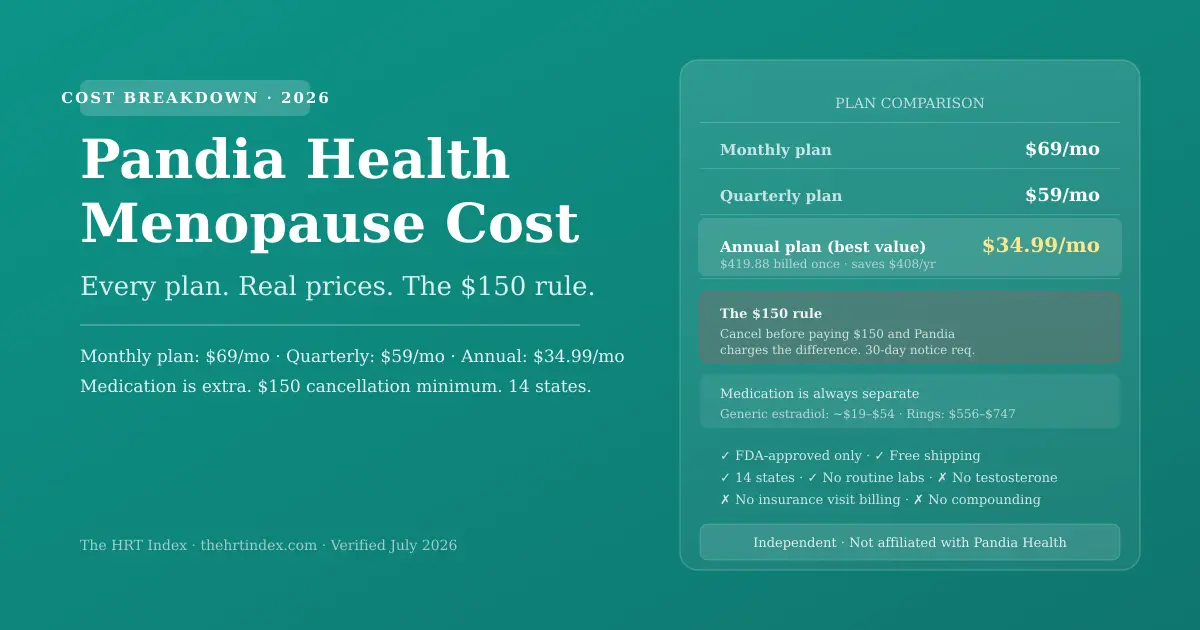
Pandia Health menopause cost is a membership: $69 billed monthly, $177 billed every three months, or $419.88 billed for a full year ($34.99/month equivalent). Your medication is a separate cost. Pandia doesn't routinely require bloodwork (though a doctor can order it, and Veozah requires liver tests), the hormones are FDA-approved, and its doctors write new prescriptions in 14 states.
That's the answer. Now the part most reviews skip: that “$34.99” isn't a small monthly charge you can quit next month, and there's a $150 ruleburied in the cancellation policy that catches people off guard. Below we break down what you'll actually pay in year one, the fine print nobody advertises, who Pandia fits, and where to go if it doesn't — in plain English.
Pandia Health menopause cost at a glance
| Best for | Women who want FDA-approved (not compounded) hormones, delivered free, on a low monthly membership — and who don't need the visit billed to insurance. |
|---|---|
| Not for | Women who want testosterone, who need the visit covered by insurance, who want routine bloodwork built into every intake, or who live outside Pandia's prescribing states. |
| What you're billed | $69 monthly · $177 quarterly · $419.88 yearly ($34.99/mo equivalent). All plans auto-renew. Medication is extra. |
| Cancellation | 30 days' written notice; a $150 minimum applies if you cancel early (after a doctor reviews your intake). |
| Hormone type | FDA-approved only. No compounded hormones. |
| States (new Rx) | 14 states (Georgia is disputed on Pandia's own pages — confirm in intake). |
| Insurance | May apply to your medication, not the visit. |
| Labs | Not routine (a doctor may order them; Veozah requires liver tests). |
| Testosterone | Not prescribed. |
| Our take | A strong, FDA-approved-only option for convenient menopause care — ifyou're in a covered state and the membership setup fits you. |
Sources are linked throughout; pricing, states, and insurance checked .
Your situation changes the answer — Find My HRT Path
The right online HRT provider isn't the same for every woman. It depends on your symptoms, what you have tried so far, your age, your state and your health history — and some situations belong with an in-person clinician first. Because a general answer can't resolve those for you, use The HRT Index's Find My HRT Path tool to match your situation to the right provider.
- What it asks:your symptoms, what you've tried, your age, your state, and any health history a clinician should know about
- What you get:the online menopause service that best fits your answers, with its listed price — plus a clear flag when online care isn't the right starting point
- Cost:free · about a minute · no signup
How much does Pandia Health cost for menopause?
Pandia menopause care is a membership. You're charged $69 each month, $177 every three months, or $419.88 once a year — which works out to $34.99 a month, but it's billed as a single yearly charge. Medication is not included in that fee. FSA and HSA cards are accepted for the membership.
Here's Pandia's published pricing, plain and simple:
| Plan | You're charged | Works out to | What's included | The trade-off |
|---|---|---|---|---|
| Monthly | $69 every month | $69/mo | Unlimited messaging with menopause doctors, free shipping, easy refills. Auto-renews. | Highest monthly rate; no workshops |
| 3 months (most popular) | $177 every 3 months | $59/mo | Everything above + live menopause workshops. Auto-renews. | You prepay $177 |
| 1 year (best value) | $419.88 once, up front | $34.99/mo | Everything above. Auto-renews. | You prepay a full year |
Two things to notice right away. First, on the annual plan you don't get billed “$34.99 a month” — you get billed $419.88 in one shot. Same core membership, lower rate, but a bigger single charge than the sticker suggests. Second, every plan auto-renews until you cancel with notice (more on that below).
What each plan actually costs you over a year
| Plan | Effective monthly rate | Cost over 12 months | Saves vs. monthly (per year) |
|---|---|---|---|
| Monthly | $69.00 | $828 | — |
| 3-month | $59.00 | $708 | $120 |
| 1-year | $34.99 | $419.88 | $408.12 |
The annual plan cuts your yearly care fee almost in half — from $828 to $419.88, a saving of exactly $408.12 (Pandia rounds it to “about $409”). That's real money ifyou're confident you'll use Pandia for the year. If you're not sure yet, the monthly plan costs more over time but keeps your upfront payment small.
Four things the “$34.99” headline hides
Before you anchor on that number, here's what it doesn't tell you:
- 1It's the annual rate, billed up front. $34.99 is $419.88 charged once — not a small monthly bill you can stop anytime.
- 2Medication is separate. The membership pays for the doctor and the service. Your hormones cost extra.
- 3Leaving early has a floor. Cancel before you've paid $150 total, and Pandia charges the difference (details below).
- 4Insurance doesn't touch the membership. The fee is the same whether you're insured or not — insurance only applies to your medication.
How much do Pandia menopause medications cost without insurance?
Pandia lists cash prices for each medication on its product pages, but it doesn't publish one universal monthly drug cost — and the listed prices are per fill, not per month. Generic hormones are usually the cheapest option; brand-name pills and vaginal rings cost much more. Your real number depends on the exact drug, the quantity dispensed, and whether you use insurance.
Because medication is billed separately, your true monthly cost is the membership plus your hormones.
For the medication half, here are prices Pandia currently lists on its own product pages. Read these as per-fillunit prices to confirm at checkout — not guaranteed monthly totals, because Pandia's pages don't always spell out the quantity or refill interval.
| Example medication (FDA-approved) | Pandia-listed cash price | Note |
|---|---|---|
| Generic estradiol tablet (0.5 mg) | ~$19 | Confirm quantity/refill |
| Generic estradiol patch | ~$54 | Confirm quantity/refill |
| Progesterone (200 mg) | ~$27 | Confirm quantity/refill |
| Estradiol vaginal cream | ~$40 | Confirm quantity/refill |
| Vaginal tablets (Vagifem / Yuvafem) | ~$63 | Confirm quantity/refill |
| Estring (vaginal ring) | ~$556 | One ring lasts ~90 days |
| Femring (vaginal ring) | ~$703–$747 | One ring lasts ~90 days; systemic ring |
| Prempro (combination pill) | ~$247 | Brand-name |
| Bijuva (combination pill) | ~$254 | Brand-name |
| Premarin vaginal cream | ~$463 | Brand-name |
These are Pandia-listed cash prices checked in — not guaranteed monthly or annual costs. Confirm the exact drug, dose, quantity, refill timing, and checkout price before you pay. Prices change.
The practical takeaway: if you're prescribed a generic(like estradiol plus progesterone), your medication is often modest — commonly $0–$50 a month with insurance, or a low double-digit per-fill cash price. If you need a brand-name pill or a ring, price it carefully, because the gap is large. And remember the rings last about 90 days, so a $556 ring isn't a $556 month.
What is Pandia Health's cancellation fee?
Here's the catch. Pandia says “cancel anytime,” and you can — but cancellations need 30 days' written notice, and once a doctor has reviewed your health form, Pandia can bring your total payments up to a $150 minimum if you cancel before reaching it. That consultation is non-refundable once it's been reviewed. “Cancel anytime” does not mean “leave today, pay nothing.”
This is the one real “gotcha” in Pandia's pricing, and it's worth understanding beforeyou pick a plan. Straight from Pandia's own cancellation policy, which describes the $150 as the cost of your initial doctor consultation:
- Monthly:No minimum number of months. But if you cancel having paid less than $150, you're charged the difference. Pandia's own example: cancel after one month ($69 paid) and you're billed $81to reach the $150 minimum. Once you've paid at least $150, there's no extra charge just to hit that floor — though the 30-day notice still applies.
- 3-month ($177):Pandia's example shows a qualifying cancellation in the second month returning about $27($177 paid − $150 minimum), depending on when your written notice lands. Cancel in the final 30 days and there's no refund.
- Annual ($419.88):With 30 days' notice, Pandia refunds unused full months on a prorated basis after the $150 minimum, processed in 7–10 business days. The exact number of refundable months depends on your effective cancellation date.
Pandia's price is not a no-strings “$34.99 you can quit next month.” The best rate means paying for a year up front, medication costs extra, and a $150 minimum applies if you cancel early. If total flexibility is your top priority, that's a real mark against Pandia's cheapest plan.
But if you plan to stick with Pandia for the year, that trade is an easy one to make. The $150 is just the cost of your first doctor consult; the effective care fee on the annual plan works out to about $35 a month for menopause-certified doctors; the membership fee is the same whether you're insured or not; and there are no surprise per-visit bills, because it's a flat membership instead of an insurance claim.
Two ways to protect yourself:
- ✓Want to keep it flexible? The month-to-month plan ($69) keeps your upfront payment small. The same 30-day notice still applies.
- ✓When you enroll, set a calendar reminderabout 35 days before your renewal date so the 30-day notice window doesn't sneak up on you.
Why do some Pandia Health pages still show $129?
Pandia's main consumer menopause page now uses the membership pricing above. But a separate, still-live Pandia page shows an older model — a $129 initial consultation plus $60 follow-ups. If you land on that one, confirm which pricing and checkout apply to you before you pay.
Older reviews that quote “$129 for a Pandia consult” are describing that former one-time-visit model. The current membership pricing ($69 / $177 / $419.88) is what you'll see on Pandia's main menopause page. Because Pandia's own pages don't fully agree yet, the safe move is simple: check the price on the exact page where you sign up, and make sure it matches before you enter a card.
Does Pandia Health require labs or bloodwork?
Not routinely. Pandia bases its care on your health questionnaire and doesn't require baseline hormone testing to start — which is standard for most women over 45. But a doctor may order testing for specific concerns, and one medication, Veozah, requires scheduled liver tests. So “no labs” isn't quite true for everyone.
For most women, skipping routine bloodwork is normal practice — menopause is usually diagnosed from your symptoms and age, because hormone levels swing too much day to day to be reliable. Two things to keep in mind:
- ➤A doctor can still order tests if something in your history calls for it.
- ⚠Veozah (a non-hormonal option) is the exception. The FDA requires liver blood tests before treatment, monthly for the first three months, and again at months six and nine, and patients are told to stop the drug and seek care if they notice signs of liver injury. If you're considering Veozah, factor that in.
One more note: Pandia's consent form flags that if you take systemic (whole-body) estrogen, you should be up to date on mammogram screening per current guidelines. If you have unusual bleeding, a complicated history, or symptoms a questionnaire can't explain, that's a reason to want testing or an in-person visit — and a good telehealth doctor will tell you when you've crossed that line.
Is Pandia Health legit for menopause?
Yes — Pandia Health is a real, established telehealth company, not a fly-by-night site. It was founded in 2016, its menopause care is led by a board-certified OB/GYN who holds the national menopause specialty credential, and it carries pharmacy certification. Its reviews skew strongly positive, with the occasional pointed complaint. A company being legitimate still doesn't mean its model is right for you — that's what the rest of this page is for.
Specialist-led care
Dr. Catherine Hansen, MD, MPH — a board-certified OB/GYN and Menopause Society Certified Practitioner (MSCP) — leads Pandia's menopause team. The MSCP credential means passing a national exam in menopause medicine; more than 2,000 clinicians have earned it.
Credentialed founder
Pandia was co-founded by Dr. Sophia Yen, MD, MPH, a clinical faculty member at Stanford. Worth being precise: her specialty is adolescent medicine, so the menopause care itself is run by the OB/GYN team, not by Yen personally.
LegitScript certified
Pandia carries LegitScript certification — the standard legitimate online pharmacies use to show they follow the rules. Founded 2016.
Does Pandia use FDA-approved or compounded hormones?
Pandia prescribes FDA-approved hormones only — it does not prescribe compounded hormones. That's a real point in its favor, because the FDA and major medical groups recommend FDA-approved hormone therapy over compounded “bioidentical” versions, which aren't reviewed or approved the same way. If you specifically want a custom compounded cream, Pandia isn't your provider.
This is the most important distinction in online menopause care, and most reviews skate past it. Let's define the words in plain English.
- Bioidenticalmeans a hormone that's chemically identical to the ones your body makes. Here's the catch the marketing hides: bioidentical and FDA-approved are not opposites. Plenty of FDA-approved products — like estradiol patches and micronized progesterone — are bioidentical.
- FDA-approvedmeans the FDA reviewed that specific finished drug for safety and effectiveness for its approved use, and oversees how it's manufactured.
- Compounded means a pharmacy custom-prepares the medication for you. A compounded drug is not FDA-approved— the finished product hasn't been reviewed by the FDA for safety, effectiveness, or consistent dosing.
The FDA says it recommends FDA-approved hormone therapy and has no evidence that compounded “bioidentical” hormones are safer or more effective. The American College of Obstetricians and Gynecologists notes that “bioidentical” is often used as a marketing word to imply a product is more natural and safer than it's actually been shown to be.
What states is Pandia Health available in for menopause?
Pandia can write new menopause prescriptions in 14 states: Arizona, California, Colorado, Florida, Illinois, Michigan, Minnesota, Nevada, New York, Ohio, Oregon, Pennsylvania, Texas, and Wyoming. Georgia is inconsistent across Pandia's own pages, so confirm it in the sign-up flow before you pay. Pandia ships the medications it prescribes free of charge.
| State | Status |
|---|---|
| AZ, CA, CO, FL, IL, MI, MN, NV, NY, OH, OR, PA, TX, WY | Listed on Pandia's main prescribing FAQ |
| Georgia (GA) | Shows on some Pandia pages, not the main FAQ — confirm in intake |
| Everywhere else | Not listed for new prescriptions — verify in the sign-up flow |
Source: Pandia's “which states” FAQ. Pandia's own pages don't fully agree — the main FAQ lists 14 states, while a contact page says “15” but displays the same 14.
Does Pandia Health take insurance?
Pandia can bill most insurance for your medication, but not for the doctor visit. Your hormones can run through Pandia's pharmacy to major insurers; the membership fee is cash or card only. That split is the cost detail that confuses people most — and “accepted” is not the same as “covered.”
For medication — often yes
Pandia Pharmacy bills many major plans, including Aetna, Cigna, UnitedHealthcare, LA Care, FamilyPact, and Medicaid in several states (AZ, CA, CO, MD, MI, OH, PA).
Not accepted for medication (July 2026): Cal Optima, Care, Humana, Kaiser, Sunshine Health, StayWell, Tricare.
For the visit/membership — no
Insurance isn't billed. Pandia keeps the fee low instead and takes cash or credit. FSA and HSA cards are accepted for the membership — but card acceptance isn't the same as your account approving the expense, so confirm with your plan administrator.
Want to avoid surprises? Copy and paste this when you start:
“Before I begin: will the medication you prescribe be billed through my insurance, what's my likely copay, is prior authorization needed, and is the membership reimbursable through my FSA/HSA?”
Two things to keep straight. First, acceptance isn't coverage— even when Pandia's pharmacy takes your carrier, your actual cost still depends on your plan's formulary, your copay, your deductible, and whether the drug needs prior authorization. Don't assume “$0”; confirm it. Second, pharmacy insurance acceptance doesn't mean Pandia can prescribe in that state — for example, Maryland Medicaid is accepted for medication even though Maryland isn't one of the 14 prescribing states.
What menopause medications does Pandia prescribe (and does it do testosterone)?
Pandia lists a range of FDA-approved menopause medications — estrogen patches and pills, progesterone, combination pills, vaginal estrogen, and two non-hormonal options — but it does not prescribe testosterone. That covers standard menopause care well. It's a mismatch only if you specifically want testosterone or compounded products.
| Type | How it's used | Examples Pandia lists |
|---|---|---|
| Estradiol patch (systemic) | Whole-body symptoms — hot flashes and night sweats | Dotti, Lyllana, Vivelle-Dot, Minivelle, Climara, Climara Pro, generic patch |
| Estradiol pill (systemic) | Same whole-body symptoms, in a daily tablet | Estrace, generic estradiol tablets |
| Progesterone | Protects the uterine lining if you take estrogen and still have a uterus; often taken at bedtime because it can cause drowsiness | Prometrium, generic progesterone |
| Combination pill (systemic) | Estrogen + a progestogen in one pill | Bijuva, Prempro, Fyavolv, norethindrone acetate / ethinyl estradiol |
| Local vaginal estrogen | Genitourinary syndrome of menopause (GSM) — dryness, painful sex, and urinary symptoms | Estradiol vaginal cream, Vagifem, Yuvafem, Estring, estradiol vaginal tablets |
| Systemic vaginal ring | Vaginally-inserted ring that delivers whole-body estrogen (not just local — carries systemic-estrogen considerations) | Femring |
| Non-hormonal | Options a doctor may consider if you'd rather not use hormones or have a reason to avoid them | Low-dose paroxetine (Brisdelle) and Veozah |
How does Pandia menopause treatment work?
Pandia is asynchronous — you message instead of booking a video call. You fill out a health questionnaire, a menopause doctor reviews it (usually within 1–2 business days) and, if it's appropriate, prescribes a plan; your medication ships free; and refills and questions are handled by message. It's built for convenience — great if you'd rather type than sit on a video visit, less ideal if you want face-to-face time.
- 1Share your history. You answer questions about your symptoms, health background, and goals.
- 2A doctor reviews it. A menopause-trained doctor builds an FDA-approved plan for you. There's no scheduled video call, and Pandia's own consent notes you won't message a doctor in real time.
- 3Your meds ship free. Prescriptions Pandia fills are delivered to your door at no shipping cost, in discreet packaging.
- 4Refills and check-ins. You get refill reminders and can message your care team. Pandia advertises 24/7 access to support — though doctor messages aren't real-time, and a review or reply may take one to two business days.
Pandia Health vs Midi vs Hers vs Winona for menopause
Choose Pandia if you're in a covered state, want FDA-approved hormones, and are fine paying the visit out of pocket. Choose Midi if you want an insurance-covered video visit, all-50-state access, labs, or testosterone. Choose Hers if you want a big self-pay platform with several formulation options. Choose Winona if you specifically want compounded, custom-mixed hormones — and know those aren't FDA-approved.
| Pandia Health | Midi Health | Hers | Winona | |
|---|---|---|---|---|
| Hormone type | FDA-approved only | FDA-approved options (some Custom Rx / testosterone are compounded) | FDA-approved estradiol/progesterone | Both FDA-approved and compounded (labeled) |
| Visit billed to insurance? | No (membership) | Yes — most PPO; not Medicare/Medicaid | No (self-pay) | No |
| Meds billed to insurance? | Yes | Yes | No (self-pay; HSA/FSA eligible) | No |
| Testosterone for women? | No | Yes (off-label, ~25 states) | Not a focus | No (offers DHEA) |
| Labs? | Not routine | Can order labs | Not routine | Not routine |
| States (new Rx) | 14 | All 50 | Not all 50 | ~38 states/territories |
| Typical price | $34.99–$69/mo + meds | Self-pay $250 initial / $150 follow-up; or insurance | Oral from $79/mo; patch from $134/mo (12-mo plan) | FDA-approved patch from $149/mo; compounded cream from $89/mo |
| Visit style | Async (messaging) | Video | Async / app | Async |
Sources, checked . Midi prescribes FDA-approved hormones for standard menopause care (some Custom Rx and testosterone products are compounded), is available in all 50 states, bills most PPO plans (not Medicare or Medicaid), self-pays at $250 for an initial visit and $150 for follow-ups. Hers menopause plans are self-pay (HSA/FSA eligible) and include patch, oral, progesterone, and vaginal-estrogen options. Winona offers both FDA-approved finished products and a compounded body cream — those are clearly separated; Winona doesn't bill insurance.
Quick routing — find yourself here
- ➤FDA-approved + covered state + self-pay visit → Pandia.
- ➤Insurance-covered visit, all 50 states, testosterone, or labs → Midi Health
- ➤Big-name self-pay platform with several plan options → Hers
- ➤Compounded/custom hormones (not FDA-approved; Winona also has FDA-approved options) → Winona
- ➤Direct-pay video visit with labs if ordered → Sesame
Is hormone therapy for menopause safe?
For healthy women under 60, or within 10 years of their last period, who have bothersome symptoms and no reasons to avoid it, major guidelines generally find the benefits of FDA-approved hormone therapy outweigh the risks — and in late 2025, U.S. regulators began updating their guidance to reflect that. Safety still depends on your age, history, dose, and type, which is why a doctor has to sign off.
What the experts say
The Menopause Society — the leading authority — states that hormone therapy is the most effective treatment for hot flashes and night sweats and for vaginal and urinary symptoms, and that it helps protect bone. For healthy women under 60 or within 10 years of menopause, the benefit-risk balance is generally favorable. Starting later, or after 60, shifts that balance because risks rise.
What changed in late 2025
On November 10, 2025, the FDA and HHS announced they were removing the broad “black box” warning from menopause hormone products, and asked drugmakers to update their labels. By early 2026 the FDA had approved revised labels for the first several products, with others following product by product. That original warning traced back to a 2002 study (the Women's Health Initiative) that used older oral conjugated estrogens plus a progestin in women whose average age was 63.
What did not change
The FDA kept the boxed warning about uterine (endometrial) cancerfor estrogen-only products. The practical meaning: if you still have a uterus and take systemic estrogen, you'll generally also need progesterone — standard practice, and exactly the kind of plan a menopause doctor builds.
This is genuinely good news for women who were scared off HRT for two decades — but it's not a green light for everyone. Some clinicians still urge caution with certain histories (blood clots, certain cancers, heart disease). It's an individual decision, made with a licensed clinician who reviews your history. Read our full guide to HRT safety →
What to ask before you pay
Before you commit, get clear on six things: your state eligibility, what they'll prescribe, how your medication is billed, whether you'll need progesterone, the exact cancellation terms, and what happens to your money if a doctor decides Pandia isn't right for you.
Copy and paste this into your first message:
- 1Am I eligible for new menopause prescriptions in my state (including Georgia, if that's me)?
- 2Will everything you prescribe be FDA-approved? (Pandia: yes — that's all it prescribes.)
- 3Do you prescribe compounded hormones or testosterone? (Pandia: no to both.)
- 4Will my medication be billed to insurance, what's my likely copay, and is prior authorization needed?
- 5What's my estimated medication cost — exact drug, dose, and quantity — before anything ships?
- 6If I still have a uterus, how will you decide whether I need progesterone?
- 7What's the exact cancellation deadline and fee for my plan? (Remember the $150 minimum and 30-day notice.)
- 8If a doctor decides Pandia isn't appropriate for me after I pay, what happens to my payment?
The bottom line: should you use Pandia Health for menopause?
Pandia Health is a strong FDA-approved-only choice for convenient online menopause care — if you live in a covered state, want FDA-approved hormones delivered free, and don't need the visit billed to insurance. It earns its keep on the things that matter most: menopause-certified doctors, FDA-approved (not compounded) medication, no routine labs, and a low, predictable membership. It's not the universal best — and we'd rather you skip it than pay for the wrong fit.
Choose Pandia if you:
- ✓Live in a prescribing state
- ✓Want FDA-approved hormones (not compounded)
- ✓Prefer messaging over video visits
- ✓Like free delivery and simple refills
- ✓Plan to use insurance for your medication
- ✓Don't need testosterone
- ✓Are okay paying for a year up front (or will pay $69/mo for flexibility)
Skip Pandia (and use the alternative) if you:
- ✗Want testosterone → Midi
- ✗Need the visit billed to insurance → Midi
- ✗Live outside its states → Midi (all 50)
- ✗Want compounded hormones (note: not FDA-approved) → Winona
- ✗Want a face-to-face video visit → Midi
If you've been putting this off because online menopause care felt less legitimate, here's the fair read: Pandia's strongest case isn't hype. It's the combination of certified doctors, FDA-approved medication, free delivery, and an honest list of who it's notfor. If none of the dealbreakers above apply to you, it's a reasonable place to start — now that you know the real price, the $150 rule, and where the line is.
Ready to check Pandia eligibility?
Plain link — we earn nothing if you join Pandia Health.
What we actually checked
We don't ask you to take our word for it. Here's what Pandia states, what we checked against its live pages, and what you should still confirm for yourself. To be clear: this is documentation review — we read Pandia's current pages and public sources; we did not test its checkout, insurance billing, shipping, or cancellation firsthand.
| Claim | What Pandia states | Source we checked | What you should verify |
|---|---|---|---|
| Membership price | $69 / $177 / $419.88 per term | Menopause page — annual billed up front; auto-renews; medication separate; FSA/HSA accepted | Confirm the price at checkout |
| Cancellation / $150 rule | 30-day notice; $150 minimum after review | Consent page — $81 monthly example, ~$27 quarterly refund, prorated annual refund in 7–10 business days | Confirm your plan's exact terms before committing |
| Hormone type | FDA-approved only; no compounded | Menopause page | — |
| Testosterone | Not prescribed | Pandia FAQ | — |
| Labs | Not routine; Veozah requires liver tests | Menopause page + FDA Veozah warning | — |
| States (new Rx) | 14 on the main FAQ | States FAQ — Georgia inconsistent across pages | Confirm your state (incl. GA) in intake |
| Insurance | Medication yes; visit no | Menopause page — accepted/declined insurer lists | Confirm your plan and copay |
| Reviews | Strong customer ratings | Trustpilot 4.9/5, 483 reviews; BBB B+, not accredited | Ratings/counts shift over time |
Prices, states, and policies change. We re-check this page on a regular schedule and update the date when we do. Last verified: .
Pandia Health menopause cost FAQ
How much does Pandia Health cost for menopause?+
Is the $34.99 Pandia plan billed monthly?+
Is medication included in Pandia's membership?+
What is Pandia's cancellation fee?+
Can I get a refund from Pandia?+
Does Pandia Health take insurance?+
Does Pandia Health prescribe testosterone?+
Does Pandia use compounded or FDA-approved hormones?+
What states is Pandia Health available in?+
Does Pandia Health require labs or bloodwork?+
Why do some websites say Pandia costs $129?+
Is Pandia better than Midi for menopause?+
Sources & references
- ‣Pandia Health, Menopause Care
- ‣Pandia Health, Asynchronous Telemedicine Consent (cancellation terms)
- ‣Pandia Health, Which states can Pandia prescribe in?
- ‣Pandia Health, Do you prescribe testosterone?
- ‣FDA, Menopause (women's health topics)
- ‣FDA/HHS, HHS Advances Women's Health, Removes Misleading FDA Warnings on HRT (November 10, 2025)
- ‣FDA, FDA adds warning about rare occurrence of serious liver injury — Veozah (December 2024)
- ‣ACOG, Compounded Bioidentical Menopausal Hormone Therapy (2023)
- ‣The Menopause Society, Hormone Therapy Position Statement
- ‣Trustpilot — pandiahealth.com
- ‣Better Business Bureau — Pandia Health, Sunnyvale CA