
Is there a progesterone patch?
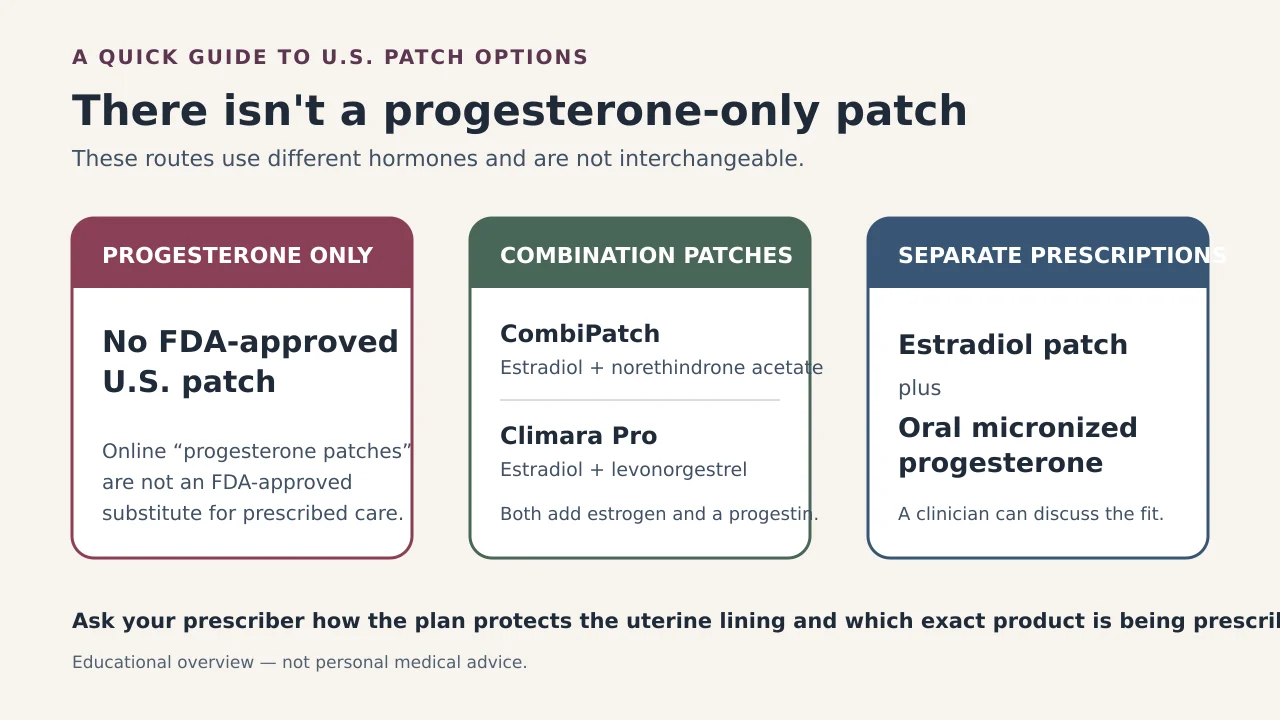
No FDA-approved progesterone skin patch is available in the U.S. A prescription patch described as a "progesterone patch" may instead be a combination patch that pairs estradiol with a progestin. The active ingredients tell you which it is.
FDA says it plainly in its menopause guidance: therapy that contains only progesterone or a progestin "comes in pills," while combination therapy most commonly comes in pills or skin patches (FDA).
The product's route matters too. An approved progesterone capsule or vaginal product does not make a progesterone cream or patch FDA-approved.
Table 1 — Progesterone routes and their role in HRT (primary guidance and labels checked October 17, 2026)
| Route | Example | Role in menopause hormone therapy |
|---|---|---|
| By mouth | Prometrium and generic micronized progesterone capsules; Bijuva (estradiol and progesterone in one capsule) | Yes. The usual way progesterone is prescribed with estrogen. |
| Vaginal | Crinone gel, Endometrin insert | Approved uses include fertility treatment and, for some products, secondary amenorrhea (periods that have stopped). HRT lining protection is off-label. |
| Through the skin (patch, cream, gel) | None approved | — |
Source: FDA menopause hormone-therapy guidance, Prometrium label, Crinone label, Endometrin label. This table compares current HRT-relevant routes; it is not a complete historical approval inventory.
Progesterone, progestin and progestogen: what's the difference?
These three words cause most of the confusion. Here they are in plain terms.
- Progesterone is the actual hormone your ovaries make. Micronized progesterone is the same molecule, ground into tiny particles so your body can absorb it from a capsule.
- A progestin is a lab-made medicine that acts like progesterone in the body. Norethindrone acetate, levonorgestrel and medroxyprogesterone acetate are progestins.
- A progestogen is the group name that covers both.
You'll also see the word bioidentical. It only means the molecule matches the one your body makes. It says nothing about how the medicine is taken, whether FDA approved it, or whether it's safer. FDA-approved micronized progesterone capsules are available. A pharmacy-mixed progesterone cream is bioidentical but not FDA-approved.
Why do searches show so many different patches?
Because "hormone patch" covers very different medicines. Three show up again and again, and the label's active-ingredient line tells them apart.
| What the label says | What it is |
|---|---|
| Estradiol | An estrogen-only patch (Climara, Vivelle-Dot, Dotti, Lyllana and generics). No progesterone or progestin. |
| Estradiol and norethindrone acetate | CombiPatch, a combination patch |
| Estradiol and levonorgestrel | Climara Pro, a combination patch |
Two more sources of confusion:
- Birth-control patches (Xulane, Zafemy, Twirla) contain a different estrogen, ethinyl estradiol, plus a progestin. They prevent pregnancy. They aren't menopause HRT.
- U.K. names. Readers in the U.K. may be on Evorel Conti, Estradot Conti or FemSeven Conti. Those are combination patches too, with estradiol plus norethisterone acetate or levonorgestrel (British Menopause Society). They aren't sold under those names in the U.S.
So if a friend says she's "on the progesterone patch," ask which active ingredients are on the box.
The progesterone patch reality check: every option, compared
Only two FDA-approved patches put a lining-protecting hormone in your patch: CombiPatch and Climara Pro. An estrogen patch plus progesterone capsules costs far less in the medicine-only cash examples below. Online "progesterone patches" and creams aren't FDA-approved and aren't proven to protect the uterine lining.
This table is the heart of the page. It lines up every way women look for "progesterone in a patch," with what's actually in each option, its FDA status and lining-protection role, what it costs, and the one question worth asking.
Table 2 — The progesterone patch reality check (checked October 17, 2026)
| Option | What's actually in it | FDA status and uterine-lining role | How you use it | Published cash price (source below) | Who it may fit | Watch out for | The question to ask |
|---|---|---|---|---|---|---|---|
| CombiPatch | Estradiol 0.05 mg/day plus norethindrone acetate (a progestin) 0.14 or 0.25 mg/day | FDA-approved combination HRT for women with a uterus; contains a progestin for lining protection. | One patch, changed twice a week, on the lower belly | $267.81 for 8 patches (28 days of continuous use) | Wants one patch and can get it covered or use the maker's savings offer | Brand-name only; a progestin, not progesterone; contains estrogen | "Would a combination patch fit my whole plan, and does my plan cover CombiPatch?" |
| Climara Pro | Estradiol 0.045 mg/day plus levonorgestrel (a progestin) 0.015 mg/day | FDA-approved combination HRT for women with a uterus; contains a progestin for lining protection. | One patch, changed once a week, on the lower belly or upper buttock | $251.82 for 4 patches (28 days) | Wants an all-in-one patch changed weekly | Brand-name only; one strength; easy to confuse with estrogen-only Climara | "Is the single Climara Pro strength right for my symptoms?" |
| Estrogen patch plus progesterone capsules | Estradiol in a patch; micronized progesterone in a capsule | FDA-approved versions of both medicines are available. Prometrium's lining-protection indication was studied with conjugated estrogen tablets, so pairing it with a patch is a common clinician choice rather than a labeled pair. | Patch on your skin plus a capsule by mouth, usually at bedtime | Generic twice-weekly patch $63.81 for 8, plus progesterone 100 mg $11.77 for 30 (200 mg: $17.54 for 30) | Wants lower medicine costs among the cash examples shown; each dose can be reviewed separately | The capsule can cause drowsiness or dizziness | "If the capsule bothers me, what would we change first?" |
| Estrogen patch plus a levonorgestrel IUD | Estradiol patch plus a hormonal IUD placed in the uterus | Not in the U.S. for this purpose (off-label). U.K. guidance supports the 52 mg IUD for lining protection. | IUD placed in a clinic; lasts years | Depends on your plan and clinic. Not priced here. | Also needs birth control, or can't tolerate pills | Needs an in-person procedure; off-label use in the U.S. | "Is a 52 mg levonorgestrel IUD an option for protecting my lining?" |
| Estrogen patch plus vaginal progesterone | Estradiol patch plus progesterone used vaginally | Not FDA-approved for this HRT use. Vaginal products have other labeled uses, including fertility treatment and secondary amenorrhea. | Inserted vaginally on a schedule your clinician sets | Not priced here | Has side effects from oral progesterone | Limited evidence on the best schedule | "How would we confirm my lining is protected?" |
| Compounded progesterone cream (prescription) | Progesterone mixed by a pharmacy into a cream | No. Compounded drugs aren't FDA-approved. | Rubbed on the skin | Varies | Not a lining-protection plan | Skin absorption is unreliable for this job | "Why a compounded cream when approved options exist?" |
| Over-the-counter "progesterone" patch or cream | Varies. Check the label; some contain wild yam or unknown amounts. | No | Sold without a prescription | Varies | Not a stand-in for HRT | False reassurance if you use estrogen | "Is anything in this box an FDA-approved medicine?" |
| Birth-control patch (Xulane, Zafemy, Twirla) | Ethinyl estradiol plus a progestin | No. It's birth control, not menopause HRT. | Weekly | Not priced here | Perimenopausal women who need birth control, if a clinician agrees | Different hormones and purpose; its own warnings | "Do I need birth control, HRT or both?" |
| Gala Health HRT (online care) | Estradiol pill or patch, plus separate progesterone, per Gala. Exact products not named. | Gala's main pages describe FDA-approved forms. Exact products unconfirmed. | Online assessment, clinician review, medicine shipped | $69 a month advertised ("all included," per Gala) | Paying cash, no prescriber, open to an estrogen patch with a progesterone capsule | No combination patch listed. Confirm progesterone is in the price. | "Is progesterone included in the $69, and which patch would you send?" |
How to read this table: medicine prices are Drugs.com starting cash prices on October 17, 2026. They aren't insurance prices or pharmacy quotes. Gala's price is its provider-published HRT offer, not a medicine-only quote. Generic estradiol patch prices come from the Drugs.com estradiol patch price guide, checked the same day. See our estradiol patch reviews for more on those patches. "Not priced here" means a real cost exists that we couldn't price fairly. It isn't $0. Strengths come from FDA labels and aren't dose advice.
Sources: CombiPatch label, Climara Pro label, Prometrium label, British Menopause Society, FDA on compounded drugs, Drugs.com price guides for CombiPatch, Climara Pro and progesterone, Gala hormone health.
What the table tells you
If you want one patch for everything, CombiPatch and Climara Pro are the only FDA-approved choices. Both use a progestin, not progesterone, and both include estrogen.
If cost matters most, the generic estrogen patch plus progesterone capsule examples have much lower medicine-only cash prices than the combination patches. The cost section does the math.
If you're pairing an online "progesterone patch" with a prescription estrogen, that's the one setup to fix soon. Contact your prescriber promptly. Don't stop or change your estrogen on your own.
Read your own label: two quick examples
These are examples of reading a label, not real patients.
Example 1. The box says "estradiol transdermal system, 0.05 mg/day." The table puts that in the estrogen-only group. It has no progesterone or progestin in it. Your next question: "What in my plan protects my uterine lining?"
Example 2. The box says "estradiol and levonorgestrel." That's Climara Pro, a combination patch. Your next question: "How does this fit with the rest of my prescriptions?" The label alone can't tell you whether to add or drop anything else.
A 20-second self-check
Ask yourself what you're really trying to change. Your answer points to a different conversation.
- "I just hate taking pills." A combination patch may be worth asking about, if estrogen is right for you anyway.
- "The progesterone makes me feel bad." The problem may be the hormone, not the pill. A patch with a progestin is a different hormone, which can help or not. That's for your prescriber.
- "I want progesterone specifically." Then a combination patch isn't the match, because it uses a progestin.
- "I want to spend less." Price the generic patch-plus-capsule option against the combination patch using your own pharmacy or insurance quote.
A table can show you the options. It can't tell you which one fits your body or which kind of care you need. The right online menopause care isn't the same for every woman — it depends on your symptoms, what you've already tried, your age, your state and your health history. Some situations belong with an in-person clinician first. Use The HRT Index's Find My HRT Path tool to explore a featured care option for your situation — and to flag when online care isn't the right starting point — before your first consult.
Free, about 60 seconds, no email required. It asks about your symptoms, what you've tried, your age, your state and your health history. It helps you pick a care starting point. It doesn't confirm a patch is available, check your insurance, or decide which medicine you need. See how it works.
What's in a combination patch, and how is it different from progesterone?
A combination patch holds estradiol and a progestin, so one patch treats menopause symptoms and protects the uterine lining. CombiPatch uses norethindrone acetate and is changed twice a week. Climara Pro uses levonorgestrel and is changed once a week. Neither contains progesterone itself.
CombiPatch: two hormones, changed twice a week
According to its FDA label (revised February 2024), CombiPatch is for women with a uterus. It's labeled to treat:
- moderate to severe hot flashes and night sweats from menopause
- moderate to severe vaginal and vulvar dryness and thinning from menopause (the label says to consider vaginal products if that's the only problem)
- low estrogen caused by certain ovarian conditions or surgery
It comes in two strengths. Both release 0.05 mg of estradiol a day. One releases 0.14 mg of norethindrone acetate a day, and the other 0.25 mg. You change it every three to four days, on the lower belly.
The label describes two ways to use it. In a continuous combined plan, you wear CombiPatch the whole month. In a continuous sequential plan, you wear an estrogen-only patch for two weeks, then CombiPatch for two weeks. Bleeding patterns differ between the two. Your clinician chooses; this page doesn't.
(CombiPatch label on DailyMed)
Climara Pro: why "Pro" changes everything
Climara Pro is for women with a uterus. It's labeled to treat moderate to severe hot flashes and to help prevent bone loss after menopause. It comes in one strength: 0.045 mg of estradiol and 0.015 mg of levonorgestrel a day. You change it once a week, on the lower belly or upper buttock.
Here's the label-reading lesson. Climara (no "Pro") is estrogen only. It has no progestin and does nothing to protect your lining. The names look almost identical. Check the active ingredients every time you pick up a refill.
(Climara Pro label on DailyMed)
Progestin or progesterone: does it matter?
Both can protect the uterine lining when the dose and schedule are right. But they're different molecules, so women can feel them differently. If the progesterone capsule bothered you, a progestin patch isn't just a new delivery method. It's a different hormone. That might suit you better, or it might not.
What a patch can't promise is the sleepiness some women value from bedtime progesterone. That drowsy effect is tied to oral progesterone. You can't assume a progestin patch will give the same effect.
Table 3 — Combination patches vs patch plus capsule
| CombiPatch | Climara Pro | Estrogen patch + progesterone capsule | |
|---|---|---|---|
| Lining-protecting hormone | Norethindrone acetate (progestin) | Levonorgestrel (progestin) | Micronized progesterone |
| How often you change or take it | Patch twice a week | Patch once a week | Patch on its own schedule, plus a capsule daily or on a monthly cycle |
| Strength choices | 2 (estrogen fixed at 0.05 mg/day) | 1 | Many patch strengths; capsule dose set separately |
| Generic available? | None listed | None listed | Yes, both |
| Starting cash price, about 28 days | $267.81 | $251.82 | About $75.58 (patch + 100 mg capsules) |
| One thing to know | Two label regimens | Don't confuse with Climara | Two prescriptions, two things to remember |
Prices: Drugs.com, October 17, 2026. Patch + capsule combines a $63.81 generic patch box with an $11.77 box of 30 capsules. The CombiPatch price assumes continuous combination-patch use; a sequential regimen also needs its estrogen-only prescription priced.
A quick example of the tradeoff. Say a clinician wants to raise a woman's estrogen dose. On patch plus capsule, the clinician can change the patch strength separately, while checking whether the progesterone dose and schedule still protect the lining. On Climara Pro, there's only one strength, so changing the dose may mean changing products. Simple can also mean less flexible. (This is an illustration, not a real case. BMS guidance says progestogen protection must be proportionate to the estrogen dose.)
Do you need progesterone if you already use an estrogen patch?
If you have a uterus and use an estrogen-only patch, you generally need a progestogen too, to protect your uterine lining. If your patch is a combination patch, the progestin is already built in. So the first step is finding out which kind of patch you have.
If you have a uterus
A patch that treats hot flashes is systemic, which means the estrogen travels through your whole body, including your uterus. On its own, that estrogen can make the endometrium (the lining inside your uterus) grow too thick. Doctors call that overgrowth endometrial hyperplasia. Over time it can lead to endometrial cancer.
A progestogen keeps the lining in check. The Menopause Society says women with a uterus who use systemic estrogen need estrogen plus a progestogen to protect against uterine cancer (The Menopause Society).
How much does it matter? In a trial lasting up to three years in Prometrium's label, hyperplasia showed up in 6% of women taking oral conjugated estrogens with cyclic progesterone, compared with 64% taking the same estrogen alone (Prometrium label). Those figures describe that trial, not every estrogen patch or hormone plan. That's why a patch on your skin doesn't let you skip this step. The route changed. The need didn't.
The useful question isn't "Does every patch user need a progesterone pill?" It's "Which part of my prescription protects my lining?"
If you've had a hysterectomy
Women without a uterus usually take estrogen alone, because the progestogen's main job in HRT is protecting the lining. There are exceptions tied to surgery details and health history. If you've had a hysterectomy and you're unsure, ask your prescriber. Don't drop a medicine on your own. Our guide on whether you need progesterone if you have a uterus goes deeper.
If you only use low-dose vaginal estrogen
Low-dose vaginal estrogen for dryness or painful sex works mostly where you put it. The Menopause Society doesn't advise adding a progestogen for women using low-dose vaginal estrogen (2022 position statement). It notes that long-term safety data are limited.
One catch: not every vaginal product is low-dose. Femring, for example, is a vaginal ring that delivers whole-body estrogen. See our vaginal estrogen guide for the difference.
What if progesterone pills don't agree with you?
If progesterone capsules leave you groggy, dizzy or just not yourself, tell your prescriber exactly what's happening. Options include changing the timing or schedule, trying a different progestogen, a combination patch, or, in some cases, a levonorgestrel IUD or vaginal progesterone (both off-label for this use in the U.S.). Don't just stop: if you have a uterus, systemic estrogen without a progestogen can thicken your lining.
You're not imagining it. If the nightly capsule is the hardest part of your hormone plan, you don't have to pretend a side effect is easy to live with.
What the capsule can do
The Prometrium label warns that progesterone can cause dizziness and drowsiness, which is one reason it's usually taken at bedtime (Prometrium label). Other effects women report include breast tenderness and headache. Some ease with time, and some don't.
Two practical points:
- Allergy check. Prometrium capsules contain peanut oil. If you have a peanut allergy, say so. Other makers' ingredients can differ, so check your own label.
- A patch isn't a guaranteed fix. Switching to a progestin patch changes the hormone. It doesn't promise that tiredness or mood symptoms will go away.
Before you change anything: what's really the problem?
Your answer changes the conversation.
| What's bothering you | What that suggests discussing |
|---|---|
| Swallowing pills, or remembering a daily pill | Whether a combination patch fits your whole plan |
| Grogginess the next morning | Timing and schedule first, then other options |
| Mood changes or feeling "off" | Whether a different progestogen or route might suit you |
| You'd rather avoid estrogen | A combination patch won't help, because it contains estrogen |
| Cost | Compare your actual quotes; the generic patch-plus-capsule examples below cost less in cash than brand-only combination patches |
Options to talk through with your prescriber
Table 4 — Ways a clinician may adjust lining protection (no personal dosing)
| Option | What changes | Reason to discuss it | Tradeoff | FDA status for this use |
|---|---|---|---|---|
| Change the timing | When you take the capsule | Daytime grogginess | May not help mood effects | The label calls for bedtime dosing |
| Change the schedule (daily vs part of each month) | How many days a month you take it | Side-effect or bleeding patterns | A monthly cycle can bring monthly bleeding | Both patterns are used in practice; your clinician chooses |
| Combination patch | The hormone and the route, together | Wants one patch | Brand-only cost; contains estrogen; a progestin | FDA-approved |
| Different oral progestogen | The molecule | Specific side effects | Its own side-effect profile | FDA-approved options exist, such as medroxyprogesterone acetate |
| Levonorgestrel IUD | Local progestin inside the uterus | Can't tolerate pills; also needs birth control | Needs in-person placement; not guaranteed to avoid mood effects | Off-label in the U.S. for this purpose |
| Vaginal progesterone | The route | Side effects from swallowing it | Limited evidence on the best schedule | Off-label in the U.S. for this purpose |
Off-label means using an FDA-approved medicine in a way its label doesn't list. It's legal and common. It just means you and your clinician should talk about why and how protection will be confirmed.
The British Menopause Society says the 52 mg levonorgestrel IUD gives adequate lining protection with estrogen. It also says evidence on the best vaginal progesterone schedule is limited (BMS, reviewed February 2026). That's U.K. guidance. In the U.S., both uses are off-label (Mirena label, Crinone label).
Please don't insert an oral capsule vaginally, cut a patch, or skip doses to test things on your own. Bring the question to your prescriber.
A message you can send your prescriber
Copy this into your patient portal and fill in the blanks:
"I've been using [estrogen patch name and strength] with [progesterone name, strength and schedule] since [date]. I'm having [side effect], and it's affecting [sleep / work / mood / daily life]. I want to keep my uterine lining protected. Could we talk about changing the timing or schedule, a combination patch like CombiPatch or Climara Pro, or another route? Would my insurance cover a combination patch?"
No one to send that to? If you don't have a prescriber, or can't get a response, and you're paying cash, an online service can review your whole plan. Gala's online HRT service lists an estradiol patch and separate micronized progesterone, with a clinician who reviews your history and adjusts treatment over time, per Gala. Before you pay, ask whether progesterone is included in the price and which form you'd get. Gala doesn't list a combination patch, so if that's specifically what you want, ask first or use one of the other routes below.
Affiliate link. A Gala clinician decides whether any treatment fits you. A prescription is never guaranteed.
Why isn't there a progesterone-only patch?
Progesterone taken through the skin has not been shown to provide dependable uterine-lining protection during estrogen therapy. The British Menopause Society says skin absorption of micronized progesterone is variable and "unlikely to provide sufficient estrogen opposition," and advises against giving it through the skin as part of HRT. FDA-approved combination patches use the progestins levonorgestrel or norethindrone acetate, with product-specific evidence for those patches.
A patch only works if enough medicine gets through your skin, day after day, at a steady rate. For lining protection, that amount has to be enough to counter the estrogen. Current evidence does not support using progesterone through the skin for dependable lining protection during estrogen therapy. No FDA-approved progesterone patch is available.
What the evidence actually measured
A small 2000 study in the journal Climacteric tested a progesterone cream in 27 postmenopausal women who were also taking estrogen. The researchers looked for the changes in the uterine lining that show progesterone is doing its job. The cream didn't produce them (Wren et al., 2000).
Keep that study in proportion. It was small and short, and it tested particular cream regimens. It doesn't prove that no progesterone ever crosses the skin. But it fits with what guidance groups conclude today. The British Menopause Society cites a systematic review that reached the same conclusion: skin progesterone doesn't give enough lining protection (BMS).
This is also why feeling better on a cream, or a saliva test that shows progesterone, doesn't settle the question. Neither one measures what's happening in your uterine lining.
What FDA approval does and doesn't tell you
FDA approves a finished product: a specific medicine, made a specific way, for a specific use, by a specific route. A compounded cream doesn't become "approved" because progesterone also appears in an approved capsule. FDA says compounded drugs aren't FDA-approved, and it doesn't check them for safety, effectiveness or quality before they're sold (FDA).
Compounding has real uses, such as for an allergy to an ingredient in an approved product. It isn't a safer or more natural version of approved medicine. More in compounded vs FDA-approved HRT.
Do "progesterone patches" sold online or over the counter work?
Patches and creams sold without a prescription aren't FDA-approved progesterone medicines, and none is proven to protect the uterine lining. If you use an estrogen patch and have a uterus, an over-the-counter product is not a safe stand-in for a prescribed progestogen. Treat promises about sleep or "hormone balance" as unproven.
A product name on a shopping page can make a cream, patch or oil sound like an approved medicine. Check the active ingredients and approval record before relying on it.
How to tell what you're looking at
Use this five-step check on any product.
- Does it need a prescription? If not, it isn't an FDA-approved progesterone medicine.
- Is it listed as approved? A National Drug Code (NDC) alone does not prove FDA approval. Both the NDC Directory and DailyMed include some unapproved products. Check the exact medicine in FDA's Drugs@FDA database, not just its ingredient or NDC (FDA explains NDC listings).
- *Is the main ingredient wild yam (Dioscorea) or "diosgenin"?* Wild yam is a plant, not progesterone. It has not been shown to turn into progesterone in the body (Memorial Sloan Kettering).
- Does the label say "homeopathic"? That's a different category. It isn't FDA-approved progesterone therapy.
- Does it promise to "balance hormones," fix sleep, or replace HRT? A big promise without an approval is a red flag.
Compounded progesterone cream
This one is different: a clinician prescribes it and a pharmacy mixes it. But it's still not FDA-approved, and current guidance doesn't treat skin progesterone as lining protection. Some clinicians prescribe progesterone cream for other reasons, for example in women without a uterus. That's a clinical call. It isn't a substitute for protection when you have a uterus and use systemic estrogen.
"But it helps me sleep"
Sleepiness is a known effect of progesterone capsules taken by mouth. Research on oral progesterone does not establish the same sleep benefit from a cream or patch. If sleep is the goal, that's a conversation about your whole plan, not a reason to switch to a cream. Using progesterone to treat insomnia is off-label (The Menopause Society).
If you've been using an over-the-counter product alongside a prescription estrogen, contact your prescriber promptly. Don't stop or change your estrogen on your own.
How much does a progesterone patch option cost?
At the starting cash prices below, a combination patch costs about $252 to $268 for 28 days of continuous use. Both products are brand-only. The selected twice-weekly estrogen patch plus progesterone capsule example costs about $76 in initial medicine purchases; it is not the lowest-priced patch strength or schedule shown. Insurance, maker savings programs and visit fees can change those numbers a lot.
We priced each option the same way: medicine only, at Drugs.com's starting cash prices on October 17, 2026. These aren't insurance prices, and they don't include visits, labs or shipping.
Table 5 — Box prices we used (Drugs.com, October 17, 2026)
| Medicine | Box | Starting cash price | Days a box covers |
|---|---|---|---|
| CombiPatch (either strength, used continuously) | 8 patches | $267.81 | 28 (changed twice a week) |
| Climara Pro | 4 patches | $251.82 | 28 (changed weekly) |
| Generic estradiol patch, twice weekly, 0.0375–0.1 mg/day | 8 patches | $63.81 | 28 |
| Generic estradiol patch, twice weekly, 0.025 mg/day | 8 patches | $58.60 | 28 |
| Generic estradiol patch, once weekly | 4 patches | $48.41–$56.38, depending on strength | 28 |
| Progesterone 100 mg capsules | 30 capsules | $11.77 | 30 if taken daily |
| Progesterone 200 mg capsules | 30 capsules | $17.54 | 30 if taken daily |
Table 6 — Medicine-only cash math
| Setup | Initial purchases covering at least 28 days | Approximate daily medicine use cost | 3 boxes of each (84 days of patches) | 13 boxes of each (364 days of patches) |
|---|---|---|---|---|
| CombiPatch, used continuously | $267.81 | $9.56 | $803.43 | $3,481.53 |
| Climara Pro | $251.82 | $8.99 | $755.46 | $3,273.66 |
| Generic twice-weekly estradiol patch + progesterone 100 mg | $75.58 | About $2.67 | $226.74 | $982.54 |
| Same patch + progesterone 200 mg | $81.35 | About $2.86 | $244.05 | $1,057.55 |
How we did the math: patch boxes cover 28 days of continuous use. CombiPatch used in a sequential plan also needs a separately priced estrogen-only product. The capsule examples assume one capsule each day, so 30 capsules cover 30 days; this is arithmetic, not a suggested schedule. Buying 3 capsule boxes leaves 6 capsules after 84 days; buying 13 leaves 26 after 364 days. Daily medicine use costs combine $63.81 ÷ 28 with the capsule box price ÷ 30, so they differ slightly from spending divided by patch-covered days. A cyclic prescription needs its actual capsule count and price. Not included: visits, labs, insurance, taxes and shipping.
A worked example, in plain words
Over 364 days (52 weeks) of continuous use, CombiPatch at its starting cash price comes to $3,481.53. The selected generic estrogen patch plus 100 mg progesterone capsule example comes to $982.54, assuming one capsule each day. That's a difference of $2,498.99 over 364 days, before any visits. It is not a 365-day purchase total or a dose recommendation.
That gap is a reason to price a generic patch plus capsules before paying cash for a combination patch. It's also why insurance coverage or a maker's savings program matters so much if you want a combination patch.
Maker savings programs (promotions, not standing prices)
The maker's terms matter more than a savings-directory summary. These offers are separate from the starting cash prices above; eligibility, pharmacy pricing and program limits can change the result.
- CombiPatch: the manufacturer's July 2026 offer gives eligible cash-paying patients $75 off a prescription, for up to 12 prescriptions a year and no more than once a month. It excludes government-insurance reimbursement and cannot be combined with another discount or prescription savings card (current offer and full terms). Ask your pharmacy for the price under this offer; do not subtract $75 from a Drugs.com discount-card price.
- Climara Pro (Bayer): the product savings page advertises payments as low as $25, with savings capped at $50 a month. That page is dated January 2024, and current activation terms could not be confirmed. Ask your pharmacy to check the current program before counting a discount in your budget (Bayer product savings page).
- Bayer patient assistance: Climara Pro is on the foundation's medicine list. Its September 2026 application lists an income limit of 300% of the federal poverty level for most Bayer medicines, plus other requirements. People with no insurance, or whose medicine is not covered, may qualify. Meeting the income figure does not guarantee approval. Use Bayer's official assistance page to check.
Manufacturer savings cards usually exclude government insurance such as Medicare or Medicaid. Patient assistance is a separate program with its own rules. Check the terms for the program you plan to use.
If you have insurance
Brand-only medicines may sit on a higher price tier or need prior approval from your plan. Generic estradiol patches and generic progesterone are widely available. Ask your pharmacy to price both: the combination patch, and the generic patch plus capsules. Then you'll see your real gap.
Care costs on top of medicine
If you need a prescriber, include the cost of care. A medicine bundle and a visit-only fee are different: do not add a bundle price to pharmacy medicines already included in it. Here's what three routes publish.
Table 7 — Published care prices (checked October 17, 2026)
| Route | Published price | What's included, per the provider | Insurance |
|---|---|---|---|
| Gala Health HRT | $69 a month advertised on Gala's dedicated HRT offer. That page says "flat," the same every month you stay. | Clinician review, prescribed hormone therapy, free shipping, messaging and dose changes, per Gala. The public offer does not itemize whether $69 covers both an estradiol patch and progesterone, or any labs your clinician orders. | Not billed. FSA and HSA accepted. |
| Midi Health, self-pay | $250 first visit, $150 follow-up visit | Visits. Medicines are billed through your pharmacy. | In-network with many commercial plans. Does not accept Medicaid or Medi-Cal patients. Medicare members may self-pay, but Midi says they cannot submit claims for its visits, medicines or associated services. |
| Your current clinician | Your plan's visit cost | Visit. Medicines at your pharmacy. | Depends on your plan |
Source: Gala HRT offer, Gala hormone health, Midi pricing and insurance.
How Gala compares on price. Twelve $69 charges come to $828; thirteen come to $897. Confirm the actual billing dates rather than assuming a calendar-month or 30-day schedule. Those amounts sit close to the $982.54 medicine-only pharmacy example for 364 days, and Gala says its price also includes the clinician and follow-up. The periods differ and Gala's exact medicines and any required extras aren't confirmed, so this is a useful comparison, not a proven saving or complete treatment total. Three $69 charges equal $207; that's charge arithmetic, not a verified 90-day treatment total.
If you're paying cash anyway, Gala's advertised price lands near what the patch and capsules alone cost at a pharmacy, and Gala says the clinician and dose changes come with it. Check that the price on your screen covers both medicines before you pay.
Affiliate link. Gala doesn't bill insurance. A Gala clinician decides whether treatment fits you.
Can you get a combination patch or patch-based HRT online?
Yes, if a licensed clinician thinks it fits you. Online services can prescribe an estrogen patch with separate progesterone, and some insurance-based services send prescriptions for brand combination patches to your own pharmacy. Check the actual medicines a service offers before you pay: "we offer HRT" doesn't confirm a specific combination patch.
Who fits which route
Table 8 — Choose the route by what you need
| Your situation | Best next step | Why | Still confirm |
|---|---|---|---|
| Paying cash; want an estrogen patch; fine with a separate progesterone capsule | Gala Health HRT | Patch and progesterone both listed; one advertised monthly price; follow-up included, per Gala | Is progesterone in the $69? Which patch? Is your state served? |
| Want a combination patch, have commercial insurance | Your current clinician, or an in-network service such as Midi Health | Insurance or a savings card may substantially change the price of a brand combination patch | Exact medicine offered, plan coverage and prior approval |
| Want Climara Pro specifically | Your prescriber, or a service that names it | Exact-product fit matters more than a general HRT menu | Product, availability, full quote |
| Want an IUD for lining protection | An in-person gynecologist | It requires a procedure | Off-label discussion |
| Have Medicare or Medicaid | A clinician your plan covers | Gala doesn't bill insurance; Midi excludes Medicaid patients and says Medicare members cannot submit its care or medicine claims | Your plan's drug list |
| Unexplained bleeding, past blood clot, stroke or heart attack, or breast or uterine cancer | An in-person clinician first | Needs an exam and a history review | — |
| Not sure what kind of care you need | The HRT Index's Find My HRT Path tool | Sorts by symptoms, what you've tried, age, state and health history | It doesn't decide your medicine |
Gala Health HRT: what it offers for this need
Gala's hormone-health program lists four treatment types: estradiol as a pill or patch; micronized progesterone, which Gala says protects the uterine lining during estrogen treatment and may improve sleep; vaginal estradiol cream or tablets; and non-hormonal options, including fezolinetant. A clinician must approve every treatment, and care is online with prescription delivery and ongoing support (Gala hormone health, non-hormonal treatments). Oral progesterone's use for insomnia is off-label; The Menopause Society's statement discusses the sleep evidence.
Where Gala is strong for readers of this page:
- The estrogen patch is on the menu. Gala says its clinicians choose between a pill and a transdermal patch based on your history.
- Progesterone is on the menu too, as a bedtime-style oral capsule, per Gala.
- Follow-up is built in. Gala advertises messaging seven days a week and dose adjustments as your body changes, for as long as you're treated.
- One advertised price. $69 a month, with no membership fee and, per Gala, no price increase when your dose changes. Confirm your exact plan and price before you pay.
- Speed. Gala says a provider usually reviews your answers within 24 hours, with free 1–2 day shipping. Some states require a short video visit first.
Where it isn't the obvious first stop: if you want one patch for everything, Gala doesn't list CombiPatch or Climara Pro. It also doesn't bill insurance.
Gala's offer and the details to confirm (checked October 17, 2026)
| What Gala says, or what's still open | |
|---|---|
| Estrogen | Estradiol "pill or patch"; listed as "oral or transdermal" |
| Progesterone | Main page: "daily oral." $69 page: "oral capsule." Gala's FAQ also says "oral or vaginal progesterone." Ask which you'd get. Vaginal use for lining protection is off-label in the U.S. |
| Combination patch | Not listed on the pages we read |
| Price | $69 a month advertised on the dedicated HRT offer. No membership fee. FSA and HSA accepted. Confirm both medicines, any labs and the amount charged today. |
| Insurance | Not billed |
| FDA-approved or compounded? | Gala's main pages describe FDA-approved bioidentical forms. A different Gala HRT page carries a compounded-medication notice. That doesn't prove Gala dispenses compounded HRT, but it means you should ask for the exact product name. |
| States and age | "Most U.S. states," confirmed in the assessment; Gala says you won't be charged if it can't serve your state. No HRT age range published. |
| Progesterone and IUDs | Gala's $69 page says progesterone is skipped "if an IUD already covers it." Whether your IUD is enough protection is a clinical decision, not a checkout setting. |
| Cancelling | Gala's HRT page permits pausing or cancelling from your account. Its linked policy requires at least 72 hours before billing or another charge may apply, and uses weight-loss wording. It says the first charge follows intake; an alternate HRT page says you are charged if approved. Confirm charge timing and which cancellation and refund terms govern HRT before paying. |
Sources: Gala hormone health, Gala progesterone, Gala estradiol, Gala $69 HRT offer. Policy sources: alternate HRT page, linked refund policy, linked terms. Full policy analysis: our Gala Health HRT review.
One woman's words, published by Gala on its HRT page: "Gala's provider walked me through the options." — Allison, 51. (Selected and published by Gala. We didn't verify it. It describes the care conversation, not a medical result.)
If you want a clinician to consider an estrogen patch with separate progesterone, and you're paying cash, Gala's online assessment is a direct way to start that conversation. Gala says it takes about five minutes. Ask about the exact products and what the $69 covers before you pay.
Affiliate link. Prescription only if a Gala clinician approves.
When another route fits better
Need insurance to pay? Midi Health says it's in-network with most PPO plans and sends prescriptions to your own pharmacy, so ask whether it can prescribe your exact combination patch and whether your plan covers it. It does not accept Medicaid or Medi-Cal patients. Medicare members may self-pay, but Midi says they cannot submit claims for its visits, medicines or associated services. Check your exact plan first: Check Midi coverage.
Want Climara Pro by name? Pandia Health has a Climara Pro page. On October 17, 2026, it showed "$254 generic equivalent, $0 with most insurance." Climara Pro had no generic listed on Drugs.com that day, so ask Pandia exactly which product that price covers, the supply length and whether it serves your state. If you need Pandia to provide menopause care, its monthly plan is $69 a month, with medicines extra; it does not bill insurance for consultations. It asks for cancellation 30 days before the next bill and says an early cancellation fee may apply. An existing prescription may be transferred without starting a new care plan. Confirm which route applies to you (Climara Pro listing, care prices and terms). Our Climara Pro online prescription guide has more on this medicine; use the provider's current quote for price and availability.
Prefer someone local? The Menopause Society keeps a free directory of menopause practitioners. A listing doesn't promise insurance or open appointments, but it's a solid start.
Before you pay, and before your first refill
Whatever route you pick, get these answers first:
- The exact products: brand or generic, maker, strength, and whether each is an FDA-approved finished product.
- The amount charged today, and whether that's before or after the clinician reviews you.
- The billing pattern: every calendar month, every 28 days, or every 30 days, and any minimum commitment.
- What's included: both medicines? Labs? Shipping?
- The refill plan: how much medicine ships at a time, and who handles a delayed fill.
- Leaving: how to cancel, the deadline before the next bill, and what's refunded if you aren't prescribed anything.
Supply is part of this too. FDA said on September 3, 2026, that estradiol patches remain available overall, but specific brands vary by pharmacy and location. It advises talking with your pharmacist and prescriber about another suitable FDA-approved patch, and not stopping or changing medicine on your own (FDA). If your progesterone is the problem, see what to do if progesterone is out of stock.
Who should — and shouldn't — use a combination patch?
Combination patches are meant for women with a uterus who need whole-body estrogen. Their labels list reasons not to use them, including unexplained vaginal bleeding, breast cancer or a history of it, blood clots, stroke or heart attack, liver disease and pregnancy. A clinician who knows your history weighs the rest.
Reasons the labels say not to use them
The CombiPatch and Climara Pro labels list situations where they shouldn't be used. These include:
- vaginal bleeding that hasn't been explained
- breast cancer now or in the past, or other cancers that estrogen can feed
- a blood clot in the legs or lungs, now or in the past
- a stroke or heart attack, now or in the past
- known conditions that increase blood-clot risk, such as protein C, protein S or antithrombin deficiency
- liver problems
- a serious allergic reaction to the product
- pregnancy (CombiPatch lists it as a contraindication; Climara Pro is not indicated in pregnancy)
(CombiPatch label; Climara Pro label)
If one of these is part of your history, start with an in-person clinician. Some women in that group can use non-hormonal treatment for hot flashes; see our non-hormonal options guide.
Timing still matters
The Menopause Society says the benefit-risk balance is generally favorable for treating bothersome menopause symptoms in healthy women younger than 60 or within 10 years of menopause, if they have no contraindications (The Menopause Society). Outside that window, the decision is more individual. It isn't an automatic no.
Patch vs pill for clot risk
Estrogen through the skin skips the liver's first pass. The Menopause Society says clot risk may be lower with a transdermal estrogen such as a patch, gel or spray. "May" is the honest word: much of the evidence comes from observational studies. More in estradiol patch vs pill.
What the 2026 label changes mean here
On February 12, 2026, FDA approved updated labels for six menopause hormone products, removing boxed-warning language about heart disease, breast cancer and probable dementia (FDA announcement). Neither combination patch was among those six. The CombiPatch label we read (revised February 2024) and the Climara Pro label still carry a boxed warning. Labels may differ by product and version, and the changes don't make hormone therapy risk-free or right for everyone. See our 2026 label changes explainer and HRT benefits and risks.
When to get help
Call 911 for chest pain, trouble breathing, sudden weakness or numbness on one side, trouble speaking, a sudden severe headache or vision change, or swelling of the face, tongue or throat. Get urgent care for a painful, swollen leg. Call your clinician promptly about new or unusual vaginal bleeding or a new breast lump. (MedlinePlus)
Progesterone patch in perimenopause: what about birth control?
Menopause hormone therapy isn't birth control, and combination HRT patches aren't contraceptives. Birth-control patches such as Xulane, Zafemy and Twirla contain ethinyl estradiol plus a progestin, at doses meant to prevent pregnancy. If you could still get pregnant, ask whether you need birth control, HRT, or both.
In perimenopause, periods can be irregular and pregnancy is still possible. That changes the conversation:
- Bring your bleeding pattern to your visit: how often, how heavy, and any bleeding between periods. Bleeding that can't be explained gets checked first.
- Ask about contraception directly. A combination HRT patch won't reliably prevent pregnancy.
- A levonorgestrel IUD can provide birth control and, per U.K. guidance, lining protection alongside estrogen. Many women in perimenopause ask about it. In the U.S., the HRT use is off-label.
- Birth-control patches carry their own warnings, including about cigarette smoking. They're a different decision from menopause HRT.
Sources: Xulane label, Zafemy label, Twirla label.
More in switching from birth control to HRT and our perimenopause symptoms checklist.
What to ask before you start or switch
Bring the name of every hormone you use and the reason you want a change. These questions keep the focus on your whole plan, so fixing one problem doesn't create another.
Your appointment questions
- What are the exact active ingredients in my current patch and any capsule?
- Do I need estrogen, progesterone specifically, another progestogen, or a different kind of care?
- If uterine protection is needed, which part of my prescription provides it?
- Would a combination patch fix my problem, and how would it change the rest of my plan?
- Is each medicine and use on-label or off-label, and why are you recommending it?
- Could my symptoms come from the medicine, from something else, or both?
- What should I do about bleeding, side effects, a patch that won't stick, or a refill I can't get?
- What will I pay now and later, including visits and labs, and does my plan cover a combination patch?
Printable: your progesterone and patch discussion sheet
Fill this in before your visit. "Not sure" is a fine answer. Keep it private; you don't need to send it to us.
| What to write down | Your notes |
|---|---|
| My estrogen: name, maker, strength as printed (mg/day), how often I change it | |
| My progestogen: name, form (capsule, patch, IUD, other), strength and schedule | |
| What's bothering me, when it started, and how it affects my day | |
| What I'd like to ask about: ☐ timing ☐ schedule ☐ CombiPatch ☐ Climara Pro ☐ IUD ☐ vaginal route ☐ other | |
| My insurance plan, or "paying cash" | |
| Pharmacy quotes: medicine, box price, how many, how many days | |
| Any bleeding I can't explain (yes / no / not sure) | |
| My questions |
Example, label details only: Estrogen: generic estradiol patch, 0.05 mg/day, twice a week. Progestogen: progesterone 100 mg capsule, at bedtime. Question: would a combination patch cost more on my plan? This shows how to fill in the sheet. It's not a suggested treatment.
How we checked this page
We compared FDA guidance and current drug labels with providers' published offers and pharmacy cash prices, checked on October 17, 2026. We didn't use any product or receive care, so this is documentation research. Where we couldn't confirm something, we say so.
We use The HRT Index Verification Standard, which groups our checks under five pillars in this order. We don't publish scores.
Table 9 — The HRT Index Verification Standard on this page
| Pillar | What it meant here |
|---|---|
| 1. Clinical legitimacy | Checked the patch ingredients and approval status against FDA guidance and current labels; kept compounded and over-the-counter products separate from approved medicines |
| 2. Care quality | Described each care route's published review and follow-up model without assuming response times or results |
| 3. Medication fit | Separated progesterone, progestins, estrogen-only patches, combination patches and compounded products; marked off-label uses |
| 4. Price transparency | Showed box size, days covered, per-day, 84-day and 364-day math; kept promotions apart from standing prices; marked unknown costs as unknown |
| 5. Access | Checked insurance fit, maker savings programs, online routes, supply notes and when in-person care comes first |
Gala's featured position is a commercial placement. It doesn't mean Gala is clinically better or right for everyone. We also list routes we earn nothing from, including Midi Health, Pandia Health and The Menopause Society's directory. See our methodology, medical review policy and affiliate disclosure.
Dates. Research and fact checks: October 17, 2026. Prices, provider terms and labels change; we recheck featured-provider prices monthly and the full page quarterly, and sooner when something material changes. Spot something out of date? Our corrections page explains how to tell us.
Progesterone patch FAQ
Is there a progesterone-only patch?
No FDA-approved progesterone-only skin patch is available in the U.S. FDA's menopause guidance says progestogen-alone therapy comes in pills; the two combination HRT patches contain a progestin instead.
What is the combined estrogen-progesterone patch called?
In the U.S., CombiPatch (estradiol and norethindrone acetate) and Climara Pro (estradiol and levonorgestrel). Both contain a progestin rather than progesterone itself.
Is there a generic CombiPatch or Climara Pro?
Drugs.com listed no generic for either on October 17, 2026. Both are sold as brand-name products only.
Can a combination patch replace just my progesterone capsule?
Not on its own. A combination patch also contains estrogen, so it changes your whole plan, not just the progesterone part. Your prescriber has to review both medicines together.
Does progesterone cream protect the uterus?
It isn't proven to. The British Menopause Society advises against giving progesterone through the skin as part of HRT because absorption is too variable.
Is there a natural or bioidentical progesterone patch?
No FDA-approved one. "Bioidentical" describes a molecule that matches one your body makes. "Natural" does not establish FDA approval or reliable treatment. FDA-approved bioidentical progesterone comes as a capsule.
Do progesterone patches help with sleep?
Research on oral micronized progesterone does not establish the same sleep benefit from a combination HRT patch, cream or over-the-counter patch. These products are not interchangeable sleep treatments. Progesterone is not FDA-approved to treat insomnia.
Can I use an estrogen patch without progesterone?
If you have a uterus, you generally need a progestogen with systemic estrogen. If you've had a hysterectomy, estrogen alone is usually the plan. Low-dose vaginal estrogen generally doesn't need a progestogen.
Why are the numbers on patches and capsules so different?
A patch lists how much it releases each day, such as 0.05 mg/day. A capsule lists how much it contains, such as 100 mg. Different hormones and routes don't convert milligram for milligram, so don't compare them as doses.
Can I cut a combination patch to lower the dose?
Not unless your prescriber tells you to. Change your dose only with your prescriber.
Does Gala sell a progesterone patch?
Gala lists an estradiol pill or patch and separate micronized progesterone. The pages we read didn't list a progesterone-only patch, CombiPatch or Climara Pro. Ask about the exact product you want before paying.
Is a birth-control patch the same as a menopause patch?
No. Birth-control patches contain ethinyl estradiol and a progestin at doses meant to prevent pregnancy. Menopause HRT isn't reliable birth control.
I'm in the U.K. What's the equivalent there?
The U.K. has several combination patches, including Evorel Conti, Estradot Conti and FemSeven Conti. Like the U.S. versions, they pair estradiol with a progestin.
The bottom line
- There's no FDA-approved progesterone patch. Progesterone used through the skin has not been shown to provide dependable uterine-lining protection during estrogen therapy.
- Two combination patches exist: CombiPatch and Climara Pro. They pair estradiol with a progestin, and their listed medicine-only cash prices are far higher than the generic patch-plus-capsule examples shown here.
- Over-the-counter "progesterone" patches and creams aren't a lining-protection plan.
- If the capsule bothers you, you have real options. Bring the message script and the questions above to your prescriber.
Still not sure whether you need a new prescriber, a different progestogen, or just a better question for the one you have? The HRT Index's Find My HRT Path tool asks about your symptoms, what you've tried, your age, your state and your health history. Then it points you to a featured online option, or flags when online care isn't the right place to start. It's free, takes about 60 seconds and doesn't ask for your email.
Already have a clinician who knows your history? Starting there is a great choice.
Sources
FDA and drug labels (checked October 17, 2026)
- FDA: Hormone Replacement Therapies Can Help Women with Bothersome Menopausal Symptoms
- FDA: Menopause — Medicines to Help You
- Drugs@FDA database
- FDA: National Drug Code Directory — listing is not approval
- CombiPatch label, DailyMed (revised February 2024)
- Climara Pro label, DailyMed
- Prometrium FDA label, revised February 2026
- Crinone label
- Endometrin label
- Mirena label — U.S. indications
- Contraceptive patch labels: Xulane, Zafemy, Twirla
- FDA: Compounding and the FDA — Questions and Answers
- FDA: Labeling changes to menopausal hormone therapy products (February 12, 2026)
- FDA: Update on estradiol transdermal patch availability (September 3, 2026)
- MedlinePlus: Estrogen and progestin transdermal patch
Clinical guidance and research
- The Menopause Society: Hormone therapy
- The Menopause Society: 2022 hormone therapy position statement
- British Menopause Society: Progestogens and endometrial protection (reviewed February 2026)
- Wren BG et al. Effect of sequential transdermal progesterone cream on endometrium, bleeding pattern, and plasma and salivary progesterone levels in postmenopausal women. Climacteric, 2000
Prices and savings (checked October 17, 2026; current Climara Pro card activation terms unresolved)
- Drugs.com price guides: CombiPatch, Climara Pro, progesterone, estradiol patch
- CombiPatch current cash-pay savings terms, July 2026
- Climara Pro product savings page, dated January 2024 — current activation terms unconfirmed
- Bayer patient assistance: medicine list, official help page, September 2026 enrollment form and criteria
Care providers (checked October 17, 2026)
- Gala Health: hormone health, progesterone, estradiol, $69 HRT offer
- Gala HRT detail and policy sources: non-hormonal treatments, alternate HRT page, refund policy linked from HRT offer, terms linked from HRT offer
- Midi Health: pricing and insurance
- Pandia Health: Climara Pro listing, menopause care pricing and cancellation terms
- The Menopause Society: find a menopause practitioner
The HRT Index is an independent editorial publication. We are not a healthcare provider, pharmacy or telehealth service. Nothing on this page is medical advice, a diagnosis or a treatment plan. For decisions about starting, stopping or changing hormone therapy, talk with a licensed clinician who knows your history. In an emergency, call 911. Consumer health data privacy policy.
Keep reading: Progesterone pills online · Climara Pro online prescription · Estradiol patch reviews · FDA-approved HRT medication list · Gala Health HRT review · If progesterone is out of stock