Estradiol Unit Converter: pmol/L to pg/mL, Plus 9 Postmenopausal Test Ranges
By The HRT Index Editorial Team · Updated September 2026 · Editorial research — not medically reviewed
To convert estradiol from pmol/L to pg/mL, divide by 3.671: 200 pmol/L is about 54.48 pg/mL . Multiply to go back. Across nine U.S. and U.K. test menus from seven organizations, the top of the "postmenopausal" range runs from 10 to 54.7 pg/mL, a 5.5-fold gap , according to The HRT Index's September 2026 review of published lab ranges. First, the converter.
What's my estradiol result in the other unit?
Estradiol (E2, oestradiol) only. Type the number from your report, pick the unit it's in, and read it in the other unit. If your result has a "<" or ">" sign, pick that too.
Estradiol unit converter
For comparison, nine test menus from seven organizations put the top of the postmenopausal range between 10 and 54.7 pg/mL (36.71 to 200.80 pmol/L). Use the range on your own report.
Quick check: for a positive estradiol value, the pmol/L number is about 3.7 times the pg/mL number. Converting pmol/L to pg/mL makes the number smaller; going back makes it bigger. Zero stays zero.
Key estradiol conversion statistics
- <span id="stat-1"></span>Estradiol pmol/L ÷ 3.671 = pg/mL, and pg/mL × 3.671 = pmol/L. That's the factor printed in the AMA Manual of Style's units converter and Mayo Clinic Laboratories' SI conversion table, both checked September 29, 2026.
- <span id="stat-2"></span>Across nine U.S. and U.K. test menus from seven organizations, the top of the "postmenopausal" estradiol range runs from 10 to 54.7 pg/mL (36.71 to 200.80 pmol/L), a 5.5-fold gap (The HRT Index analysis of published lab ranges, September 2026). Table 1 and sources.
- <span id="stat-3"></span>The middle value of those nine postmenopausal limits is 110 pmol/L (29.96 pg/mL), set by North Bristol NHS Trust (The HRT Index analysis, September 2026). North Bristol.
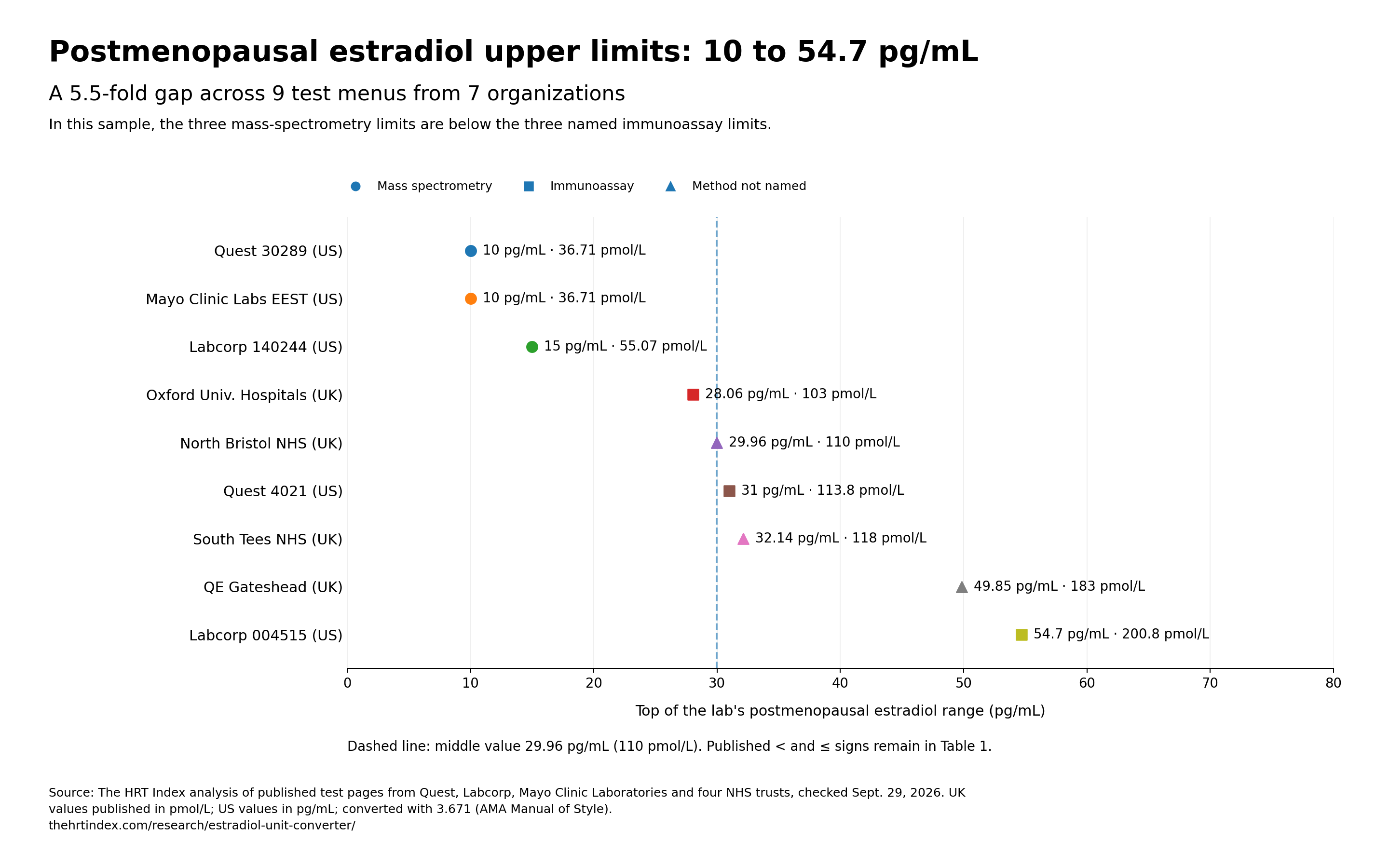
- <span id="stat-4"></span>The three mass-spectrometry tests in that group set their postmenopausal limit at 10 to 15 pg/mL, while the three test menus that name an immunoassay set theirs at 28.06 to 54.7 pg/mL (Quest, Labcorp, Mayo Clinic Laboratories and Oxford University Hospitals test pages, September 2026). Test-menu comparison.
- <span id="stat-5"></span>Male upper limits across all nine test menus vary about 1.5-fold, from 29 to 43.86 pg/mL (The HRT Index analysis, September 2026). Oxford adult limit and Table 2.
- <span id="stat-6"></span>Mayo Clinic Laboratories lists 25 pg/mL (about 91.78 pmol/L) as its estradiol immunoassay's limit of quantitation—the lowest level it can report as a reliable amount—and names mass spectrometry as the preferred method for low levels in postmenopausal women (checked September 29, 2026). Mayo ESTS.
- <span id="stat-7"></span>Converting estradiol in the wrong direction makes the answer about 13.5 times off (3.671 × 3.671 ≈ 13.48); one of nine sources checked, a retrieved EndMemo static table, printed the direction backward; another retrieval returned 404 (The HRT Index audit, September 29, 2026). Dated content check.
- <span id="stat-8"></span>Mayo Clinic Laboratories prints two factors for its mass-spectrometry estradiol test, 3.671 and 3.676, so 100 pg/mL becomes either 367.10 or 367.60 pmol/L (The HRT Index audit, September 29, 2026). Mayo SI and Mayo EEST.
- <span id="stat-9"></span>The 3.671 factor matches estradiol's chemistry after rounding: its formula, C18H24O2, gives a calculated 272.388 grams per mole using CIAAW's abridged atomic weights; 1,000 ÷ 272.388 is about 3.67123 (CIAAW; NIST Chemistry WebBook; The HRT Index calculation, September 2026). CIAAW and NIST.
- <span id="stat-10"></span>In 1,508 women tested in May–July 2023 while using estradiol patches, gels or sprays at one U.K. specialist clinic, the median blood level was 355.26 pmol/L (96.77 pg/mL) (Glynne et al., Menopause, February 2025). Original paper.
- <span id="stat-11"></span>The British Menopause Society says no serum estradiol threshold has been established for preventing bone loss or fractures (BMS Tool for Clinicians, July 2025). That is not a claim that hormone therapy has no bone benefit. BMS guidance.
- <span id="stat-12"></span>The Endocrine Society's 2017 monitoring guide names a 100–200 pg/mL peak physiologic range for transgender women, equivalent to 367.10–734.20 pmol/L. Its bounds are about 22% higher than the 300–600 pmol/L range described for U.K. gender clinics in a 2024 Society for Endocrinology guideline (The HRT Index calculation). These statements have different wording and are not two national dosing rules. Endocrine Society and Society for Endocrinology.
On this page: How to convert · Conversion chart · pg/mL vs. pmol/L · Lab ranges · Converter check · Levels on HRT · How we built this · Cite · Download · FAQ · Sources
How do you convert estradiol pmol/L to pg/mL?
Divide the pmol/L number by 3.671 to get pg/mL. So 200 pmol/L is about 54.48 pg/mL, and 500 pmol/L is about 136.20 pg/mL. This works for estradiol only; other hormones need their own factor.
Say your U.K. report says 250 pmol/L. Divide: 250 ÷ 3.671 ≈ 68.10. That's about 68.10 pg/mL, the same blood level written the U.S. way.
How do you convert pg/mL to pmol/L?
Multiply the pg/mL number by 3.671. So 100 pg/mL is 367.10 pmol/L, and 200 pg/mL is 734.20 pmol/L.
Got a U.S. result of 30 pg/mL? 30 × 3.671 = 110.13 pmol/L. Same blood, different ruler.
Estradiol conversion chart
Here are 50 values worked out both ways. They're math examples, not normal ranges or targets. Outputs are rounded to two decimals.
| pmol/L | pg/mL |
|---|---|
| 0 | 0.00 |
| 1 | 0.27 |
| 5 | 1.36 |
| 10 | 2.72 |
| 20 | 5.45 |
| 25 | 6.81 |
| 30 | 8.17 |
| 40 | 10.90 |
| 50 | 13.62 |
| 75 | 20.43 |
| 100 | 27.24 |
| 150 | 40.86 |
| 200 | 54.48 |
| 250 | 68.10 |
| 300 | 81.72 |
| 367.1 | 100.00 |
| 400 | 108.96 |
| 500 | 136.20 |
| 600 | 163.44 |
| 734.2 | 200.00 |
| 750 | 204.30 |
| 800 | 217.92 |
| 1,000 | 272.41 |
| 1,500 | 408.61 |
| 2,000 | 544.81 |
Source: The HRT Index calculations, September 29, 2026, using the 3.671 factor from the AMA Manual of Style and Mayo Clinic Laboratories. Rounded to 2 decimals.
| pg/mL | pmol/L |
|---|---|
| 0 | 0.00 |
| 1 | 3.67 |
| 2 | 7.34 |
| 5 | 18.36 |
| 10 | 36.71 |
| 15 | 55.07 |
| 20 | 73.42 |
| 25 | 91.78 |
| 30 | 110.13 |
| 40 | 146.84 |
| 50 | 183.55 |
| 60 | 220.26 |
| 75 | 275.33 |
| 80 | 293.68 |
| 100 | 367.10 |
| 125 | 458.88 |
| 150 | 550.65 |
| 175 | 642.43 |
| 200 | 734.20 |
| 250 | 917.75 |
| 300 | 1,101.30 |
| 400 | 1,468.40 |
| 500 | 1,835.50 |
| 750 | 2,753.25 |
| 1,000 | 3,671.00 |
Source: The HRT Index calculations, September 29, 2026, using the 3.671 factor from the AMA Manual of Style and Mayo Clinic Laboratories. Rounded to 2 decimals.
Need a number that isn't here? The free download covers every whole number from 0 to 1,000 pg/mL and from 0 to 4,000 pmol/L.
Where does 3.671 come from?
It comes from estradiol's molar mass: the weight of one mole of its molecules. Estradiol's formula is C18H24O2, which adds up to 272.388 grams per mole using CIAAW's abridged atomic weights. And 1,000 ÷ 272.388 is about 3.67123, rounded here to 3.671.
| Element | Atoms | Atomic weight | Subtotal |
|---|---|---|---|
| Carbon | 18 | 12.011 | 216.198 |
| Hydrogen | 24 | 1.0080 | 24.192 |
| Oxygen | 2 | 15.999 | 31.998 |
| Total | 272.388 g/mol |
Source: atomic weights from the Commission on Isotopic Abundances and Atomic Weights (CIAAW); formula from NIST Chemistry WebBook, both checked September 29, 2026. Sum by The HRT Index.
Here's why the 1,000 is there. A milliliter is a thousandth of a liter. And one picomole of estradiol weighs 272.388 picograms. So 1 pg/mL is 1,000 picograms in a liter, and 1,000 ÷ 272.388 is about 3.671 picomoles.
How exact is it? Adding the uncertainty bounds listed by CIAAW gives a calculated factor interval of about 3.6707 to 3.6718. This is a check on the chemistry, not a measure of blood-test accuracy. We use the rounded 3.671 convention printed by AMA and Mayo throughout the converter.
What if my result says "less than"?
Keep the sign and convert the number. A result of "<20 pmol/L" stays below the converted limit, which is about 5.45 pg/mL. That's a ceiling, not a measured value. The full converted boundary is 20 ÷ 3.671; rounding must not turn it into an exact measurement.
Labs do this all the time. Labcorp's standard estradiol test lists the low end of its postmenopausal range as "<6.0 pg/mL," which stays below the converted limit of about 22.03 pmol/L.
Is pg/mL the same as pmol/L?
No. They describe the same blood level in two different ways. For estradiol, 1 pg/mL equals 3.671 pmol/L, so a positive pmol/L number is about 3.7 times the pg/mL number. Zero stays zero.
pg/mL means picograms per milliliter. It's a weight: how many trillionths of a gram of estradiol are in a milliliter of blood serum.
pmol/L means picomoles per liter. It's a count: how many estradiol molecules are in a liter, bundled into picomoles.
The lab decides which one you see. In the nine lab test menus we checked, all five U.S. menus report pg/mL and all four NHS menus report pmol/L.
What about ng/L? It's the same number as pg/mL: 80 ng/L is 80 pg/mL. A picogram is a thousandth of a nanogram, and a milliliter is a thousandth of a liter, so the two thousandths cancel.
What about nmol/L? Divide pmol/L by 1,000. So 734.20 pmol/L is 0.7342 nmol/L.
For more terms like these, see our menopause and HRT glossary.
How much do "postmenopausal" estradiol ranges differ between labs?
By about 5.5 times. Across nine U.S. and U.K. test menus from seven organizations we checked on September 29, 2026, the top of the "postmenopausal" range runs from 10 to 54.7 pg/mL (36.71 to 200.80 pmol/L). The middle value is 110 pmol/L (29.96 pg/mL).
Here's what that looks like in real life. Say your result is 40 pg/mL, which is 146.84 pmol/L. As a numeric example, it falls below the published upper limit for two test menus on this list and above the limit for the other seven. We did not test the same sample at those labs; this is not a prediction of how another assay would measure it.
| Lab and test | Country | Method the lab names | Published limit | pg/mL | pmol/L |
|---|---|---|---|---|---|
| Quest 30289, Estradiol, Ultrasensitive | U.S. | Mass spectrometry | ≤10 pg/mL | 10 | 36.71 |
| Mayo Clinic Laboratories EEST, Estradiol, Serum | U.S. | Mass spectrometry (LC-MS/MS) | <10 pg/mL | 10 | 36.71 |
| Labcorp 140244, Estradiol, Sensitive | U.S. | Mass spectrometry (LC/MS-MS) | <15.0 pg/mL | 15.0 | 55.07 |
| Oxford University Hospitals | U.K. | Immunoassay | <103 pmol/L | 28.06 | 103 |
| North Bristol NHS Trust | U.K. | Not named | <110 pmol/L | 29.96 | 110 |
| Quest 4021, Estradiol | U.S. | Immunoassay | ≤31 pg/mL | 31 | 113.80 |
| South Tees Hospitals NHS | U.K. | Not named | <118 pmol/L | 32.14 | 118 |
| QE Gateshead (South of Tyne and Wear Pathology Centre) | U.K. | Not named | <183 pmol/L | 49.85 | 183 |
| Labcorp 004515, Estradiol | U.S. | Immunoassay (ECLIA) | <6.0–54.7 pg/mL | 54.7 | 200.80 |
Source: each lab's published test page, checked September 29, 2026. U.S. labs publish pg/mL; U.K. labs publish pmol/L. The other unit is converted with 3.671 by The HRT Index. South Tees' page was last updated April 27, 2022.
Dot chart of nine test menus' upper limits from seven organizations for postmenopausal estradiol. They range from 10 pg/mL at Quest and Mayo's mass-spectrometry tests to 54.7 pg/mL at Labcorp's immunoassay, a 5.5-fold gap, with a middle value of 29.96 pg/mL (110 pmol/L).
Source: Source: The HRT Index analysis of published test pages from Quest, Labcorp, Mayo Clinic Laboratories and four NHS trusts, checked Sept. 29, 2026. UK values published in pmol/L; US values in pg/mL; converted with 3.671 (AMA Manual of Style). thehrtindex.com/research/estradiol-unit-converter/
One more yardstick. A research team using a mass-spectrometry method traced to the reference method set the postmenopausal limit at under 26 pmol/L, or 7.08 pg/mL (Verdonk et al., 2019). That's a study, not a lab menu, so it isn't one of the nine.
Does the test method matter?
It lines up with the gap. The three mass-spectrometry tests set their postmenopausal limit at 10 to 15 pg/mL. The three labs that name an immunoassay set theirs at 28.06 to 54.7 pg/mL.
The two methods work differently. Mass spectrometry sorts charged particles by their mass-to-charge ratio. An immunoassay catches estradiol with antibodies. Mayo Clinic Laboratories lists 25 pg/mL (about 91.78 pmol/L) as this immunoassay's limit of quantitation, and it names mass spectrometry as the preferred method for low levels in postmenopausal women.
We can't prove the method causes the whole gap. Labs also build their ranges from different groups of people. But the pattern is clean: on this list, every mass-spectrometry limit is lower than every immunoassay limit.
The British Menopause Society puts it plainly: "Results between different labs should not be compared." (BMS Tool for Clinicians, July 2025)
Do men's ranges differ as much?
Not in this sample. Across all nine test menus, male upper limits run from 29 to 43.86 pg/mL (106.46 to 161 pmol/L). That's about a 1.5-fold spread.
| Lab and test | Country | Published limit | pg/mL | pmol/L |
|---|---|---|---|---|
| Quest 30289 | U.S. | ≤29 pg/mL | 29 | 106.46 |
| North Bristol NHS Trust | U.K. | <120 pmol/L | 32.69 | 120 |
| Labcorp 140244 | U.S. | 8.0–35.0 pg/mL | 35.0 | 128.49 |
| Quest 4021 | U.S. | ≤39 pg/mL | 39 | 143.17 |
| South Tees Hospitals NHS | U.K. | <146 pmol/L | 39.77 | 146 |
| Mayo Clinic Laboratories EEST | U.S. | 10–40 pg/mL | 40 | 146.84 |
| Labcorp 004515 | U.S. | 7.6–42.6 pg/mL | 42.6 | 156.38 |
| QE Gateshead | U.K. | 0–160 pmol/L | 43.58 | 160 |
| Oxford University Hospitals | U.K. | <161 pmol/L (men over 18) | 43.86 | 161 |
Source: the same lab test pages as Table 1, checked September 29, 2026. Oxford's adult male row is for men over 18. Converted with 3.671 by The HRT Index.
The male upper limits cluster more closely in this sample than the postmenopausal limits. This comparison does not test agreement between assays at the same blood level.
What does this mean for my result?
Compare your number with the range printed on your own report, not with another lab's range or a chart online. A converter changes the unit. It doesn't change what the result means.
If you're choosing between tests, our guide to estradiol blood tests online compares standard and sensitive versions.
Why do estradiol converters give different answers?
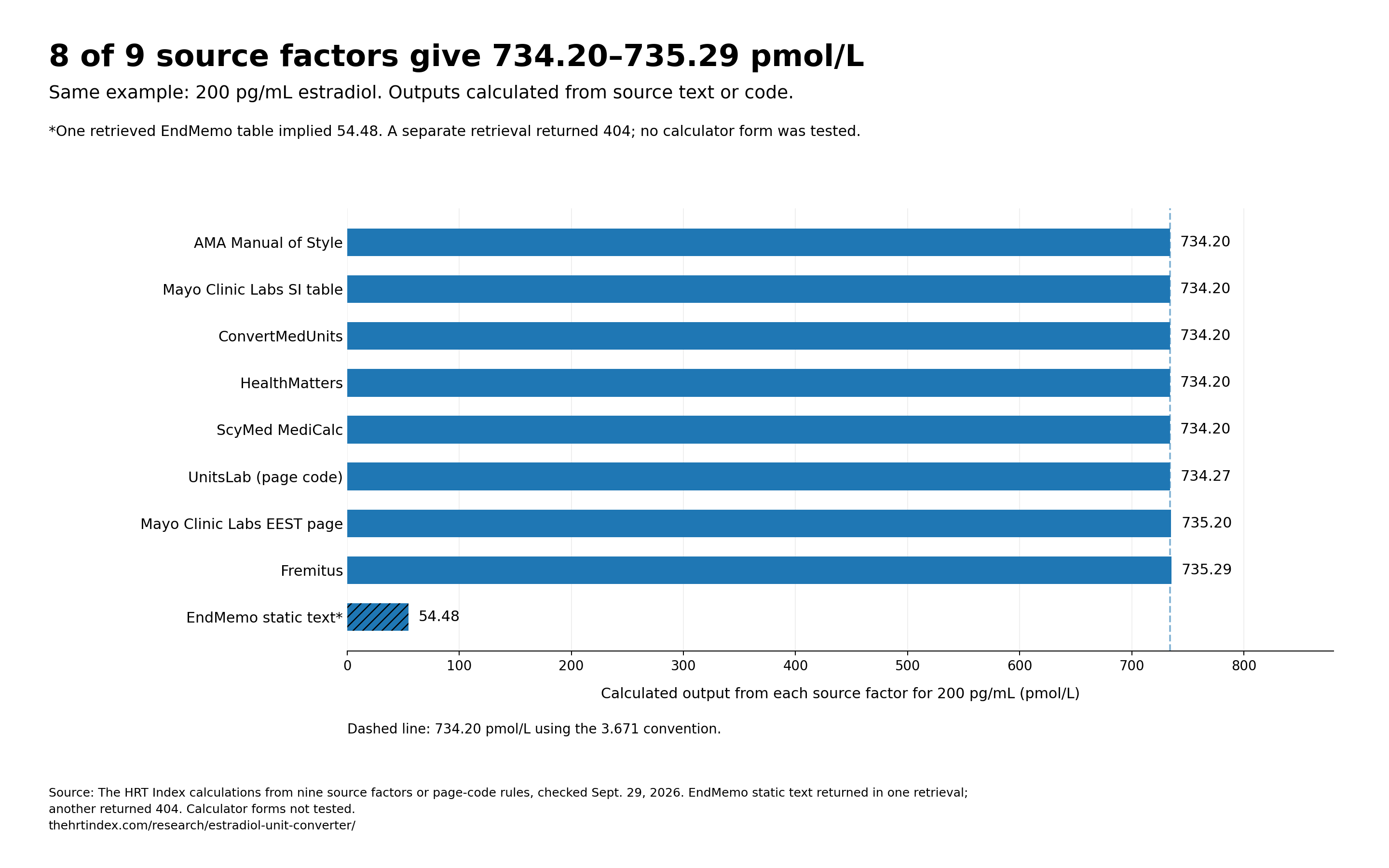
Mostly, their stated factors agree. Applying eight of the nine sources' printed factors or page-code factors to 200 pg/mL gives 734.20 to 735.29 pmol/L. A retrieved EndMemo static table printed the reverse factor under the wrong direction; that factor would give 54.48 pmol/L. We checked these sources on September 29, 2026, not the behavior of their calculator forms.
| Source | Printed factor or page-code rule | Our calculated output for 200 pg/mL (pmol/L) |
|---|---|---|
| AMA Manual of Style, units converter | × 3.671 | 734.20 |
| Mayo Clinic Laboratories, SI conversion table | × 3.671 | 734.20 |
| ConvertMedUnits | × 3.671 | 734.20 |
| HealthMatters | × 3.671 | 734.20 |
| ScyMed MediCalc | × 3.671 | 734.20 |
| UnitsLab | 1 pmol/L = 0.27238 pg/mL (in page code) | 734.27 |
| Mayo Clinic Laboratories, EEST test page | × 3.676 | 735.20 |
| Fremitus | pmol/L × 0.272 = pg/mL | 735.29 |
| EndMemo, static conversion table | "1 pg/mL = 0.272405 pmol/L" | 54.48 |
| Chemistry check: 1,000 ÷ 272.388 | × 3.67123 | 734.25 |
Source: The HRT Index calculations from each source's printed factor or page code, checked September 29, 2026. For EndMemo, a fresh retrieval returned the static table with HTTP 200, while another retrieval returned 404. Its row is a dated content observation, not a live form test. All nine displayed outputs are our calculations; no calculator form was tested.
Bar chart of calculated outputs from nine source factors. Eight give 734.20–735.29 pmol/L for 200 pg/mL estradiol. A reversed factor in a retrieved EndMemo static table implies 54.48, about 13.5 times too low. Another retrieval returned 404; calculator forms were not tested.
Source: Source: The HRT Index calculations from nine source factors or page-code rules, checked Sept. 29, 2026. EndMemo static text returned in one retrieval; another returned 404. Calculator forms not tested. thehrtindex.com/research/estradiol-unit-converter/
Which mistake actually matters?
Direction. Multiply when you should divide, and the answer is about 13.5 times off, because the factor gets applied twice: 3.671 × 3.671 ≈ 13.48.
The retrieved EndMemo table printed "1 pg/mL = 0.272405 pmol/L." Applied to 200 pg/mL, that rule gives about 54.48 pmol/L. But 54.48 is the rounded answer to the opposite question: 200 pmol/L is about 54.48 pg/mL. The conflicting 200 and 404 retrievals mean this is a dated finding about returned text, not a claim that the live calculator behaves that way.
The differences between the other published factors are much smaller. Among the eight sources that agree, the biggest gap is 1.09 pmol/L at 200 pg/mL. That's 0.15%.
Why does Mayo Clinic Laboratories print two factors?
Mayo's SI conversion table uses 3.671 for its mass-spectrometry estradiol test. Its estradiol test page uses 3.676 and says that's based on a molecular weight of 272. At 100 pg/mL, that's 367.10 versus 367.60 pmol/L, a gap of 0.5 pmol/L.
The rounded weight is consistent with the second number: 1,000 ÷ 272 is about 3.676. Our calculated weight of 272.388 gives about 3.67123. Mayo does not explain why its two pages differ. For a methods section, pick one factor and name it.
Can I use 3.671 for other hormones?
No. Each hormone has its own factor because each molecule weighs a different amount. Estriol, for example, uses 3.468, so using estradiol's 3.671 would be off by about 6%.
| Hormone | Formula | Weight (g/mol) | To convert | Multiply by |
|---|---|---|---|---|
| Estradiol (E2) | C18H24O2 | 272.388 | pg/mL → pmol/L | 3.671 |
| Estrone (E1) | C18H22O2 | 270.372 | pg/mL → pmol/L | 3.699 |
| Estriol (E3) | C18H24O3 | 288.387 | pg/mL → pmol/L | 3.468 |
| Testosterone | C19H28O2 | 288.431 | ng/dL → nmol/L | 0.03467 |
| Progesterone | C21H30O2 | 314.469 | ng/mL → nmol/L | 3.180 |
Source: molecular formulas from NIST Chemistry WebBook: estradiol, estrone, estriol, testosterone, progesterone. Molar masses and factors calculated by The HRT Index from CIAAW's abridged atomic weights, checked September 29, 2026. These masses are our calculations, not NIST's printed molecular-weight values; the factors are rounded as shown.
Vitamin B12 and free T3 show up in the same units, but they're different molecules with different factors. This converter is for estradiol only.
What should my estradiol level be on HRT in pmol/L?
There's no single agreed blood-level target for typical menopause HRT. The British Menopause Society says blood levels match symptom relief poorly and that no serum estradiol threshold has been established for preventing bone loss or fractures. It discusses good symptom control around 200 pmol/L (about 54.48 pg/mL) in earlier implant research after ovary removal. That is the BMS account of that setting, not a verified threshold for every treatment.
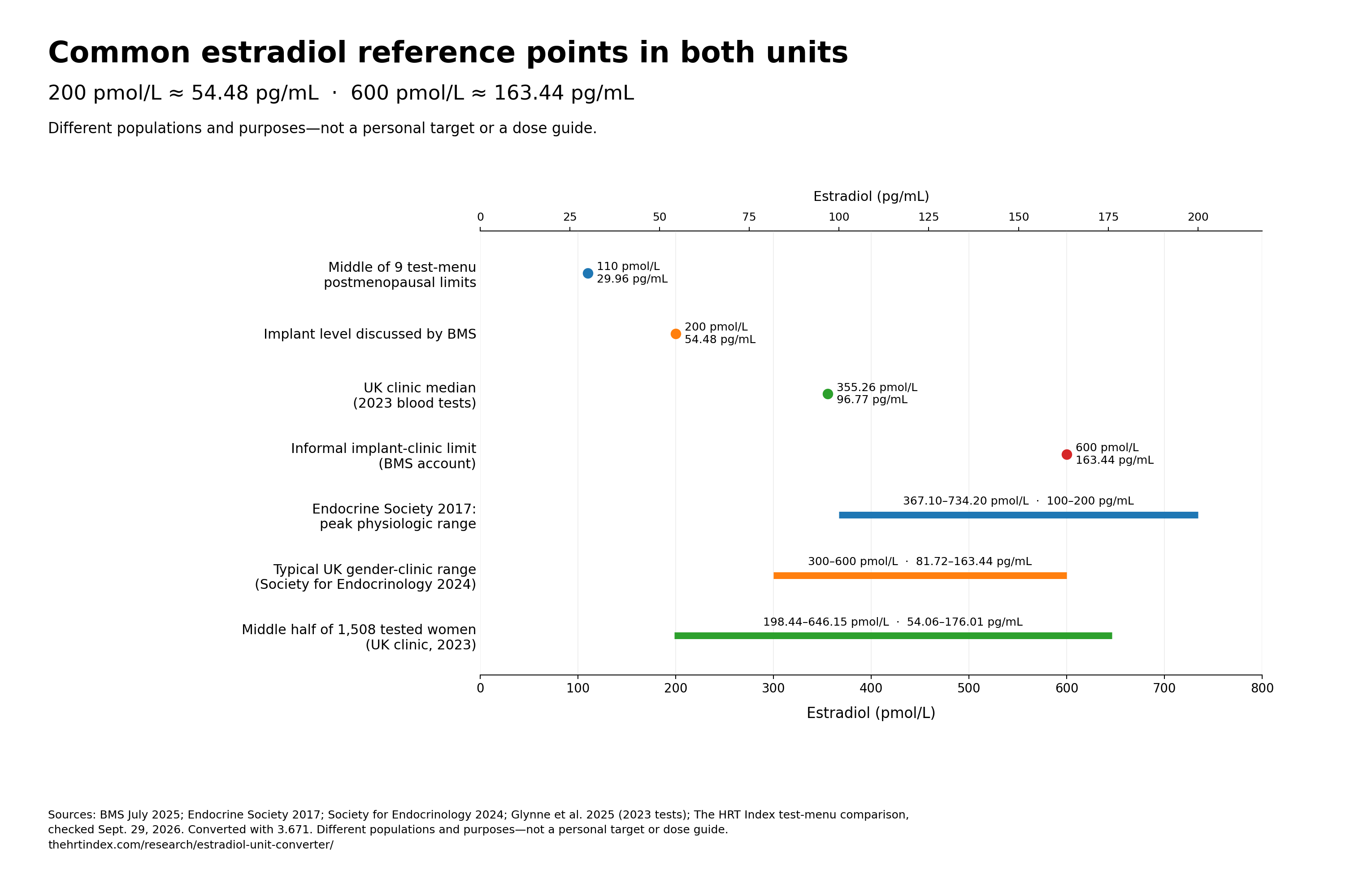
That's frustrating if you wanted a target. But it's useful too: one number on its own can't tell you whether your HRT is working. Here are the reference points that come up most, in both units.
| Reference point | Source | pmol/L | pg/mL |
|---|---|---|---|
| Symptom-control level discussed by BMS for implants after ovary removal | BMS, 2025 | around 200 | 54.48 |
| Upper limit some implant clinics use informally (BMS: not based on robust evidence) | BMS, 2025 | 600 | 163.44 |
| Median in 1,508 tested women on transdermal estradiol at one U.K. clinic, May–July 2023 | Glynne et al., 2025 | 355.26 | 96.77 |
| Middle half of those 1,508 women | Glynne et al., 2025 | 198.44–646.15 | 54.06–176.01 |
| Median among 588 women aged 18–39 sampled at different menstrual phases | Skiba et al., 2019, Table 2 | 372.61 | 101.50 |
| Cutoff in an observational fracture study of women aged 65+ not taking estrogen | Cummings et al., 1998 | below the limit of about 18.36 | below 5 |
| Range described as typical practice in U.K. gender clinics | Society for Endocrinology, 2024 | 300–600 | 81.72–163.44 |
| Peak physiologic range that the monitoring guide says estradiol should not exceed in transgender women | Endocrine Society, 2017, Table 15 | 367.10–734.20 | 100–200 |
| Turner syndrome: stated pg/mL goal at full adult replacement; see source-unit conflict below | International consensus guideline, 2024, R 3.7 | 367.10–550.65 (our conversion) | 100–150 |
| Limit of quantitation for Mayo's ESTS immunoassay | Mayo Clinic Laboratories | 91.78 | 25 |
Source: the original papers, guidelines and lab page linked in each row, checked September 29, 2026. Converted with 3.671 by The HRT Index; derived values are rounded. These rows mix study findings, a test limit and guidance for different groups. They are not a personal target or a dose guide.
<span id="turner-unit-conflict"></span>The Turner guideline has a unit conflict. Its stated goal at full adult replacement is 100–150 pg/mL. Its text also prints 350–500 pmol/L in one place and 367–550 pmol/L in the recommendation summary; the BMS account uses 350–500 pmol/L. With the factor used here, 100–150 pg/mL converts to 367.10–550.65 pmol/L, while 350–500 pmol/L converts to 95.34–136.20 pg/mL. We show the conflict rather than call those pairs equivalent. The reason for it is not established.
<span id="fracture-study-context"></span>What the fracture finding means: in Cummings et al.'s 1998 observational study, women aged 65 or older who were not taking estrogen and had estradiol below 5 pg/mL had an adjusted relative risk of 2.5 for hip fracture and 2.5 for vertebral fracture, compared with women at or above 5 pg/mL. This is an association in that group, not proof that raising a level to a certain number prevents fractures.
Number line showing estradiol reference points in pmol/L and pg/mL: 110 pmol/L (29.96 pg/mL) is the middle of nine test menus' postmenopausal limits, 200 pmol/L (54.48 pg/mL) the Implant level discussed by BMS, 355.26 pmol/L (96.77 pg/mL) a U.K. clinic median, and 600 pmol/L (163.44 pg/mL) an informal implant limit, with the Endocrine Society 2017 peak physiologic range and the typical U.K. clinic range described in a 2024 guideline shown as bars. These have different purposes.
Source: Sources: BMS July 2025; Endocrine Society 2017; Society for Endocrinology 2024; Glynne et al. 2025 (2023 tests); The HRT Index test-menu comparison, checked Sept. 29, 2026. Converted with 3.671. Different populations and purposes—not a personal target or dose guide. thehrtindex.com/research/estradiol-unit-converter/
Wondering whether you need a blood test at all? See do you need blood tests for HRT? For what a normal check-in covers, see HRT monitoring and follow-up.
What did a big U.K. clinic study find?
In 1,508 women tested between May 1 and July 31, 2023, while using estradiol patches, gels or sprays at one U.K. specialist clinic, the median blood level was 355.26 pmol/L (96.77 pg/mL). The middle half ran from 198.44 to 646.15 pmol/L (54.06 to 176.01 pg/mL). The paper was first published online in December 2024 and appeared in the February 2025 issue.
Median means half were above it and half below. The middle half is the band between the lowest quarter and the highest quarter. Here the upper end of that band is about 3.26 times the lower end. The women used different products and doses. The study shows wide variation in measured blood levels; it does not isolate absorption as the only cause.
Two limits to keep in mind. It's one clinic, Newson Health. And this was the group who had blood tests, not every woman using HRT. Other researchers wrote letters to the journal about the study, which the authors answered (Menopause, 2025); the existence of those letters is not itself evidence that the reported median is wrong.
How do the published transgender-care ranges compare?
The numbers differ, and so does the wording. The Endocrine Society's 2017 monitoring table says serum estradiol should not exceed the peak physiologic range of 100–200 pg/mL, or 367.10–734.20 pmol/L. A 2024 Society for Endocrinology guideline describes U.K. gender clinics as typically aiming for 300–600 pmol/L. The first range's bounds are about 22% higher. That arithmetic does not turn them into two national dosing rules or show that one is better.
Is this the same as an estradiol dose conversion?
No. This page converts a blood level. A dose conversion compares medicines, like a patch versus a pill. If that's what you need, see our estradiol patch dose conversion chart.
If you're converting a result because you're on HRT and still have symptoms, Find My HRT Path is our free tool for comparing care options before your next appointment.
How we built this
On September 29, 2026, we did six things:
- Read the published estradiol ranges on nine lab test pages: Quest (tests 4021 and 30289), Labcorp (004515 and 140244), Mayo Clinic Laboratories (EEST), and four NHS trusts (Oxford, North Bristol, South Tees and Gateshead).
- Read the conversion factor printed by nine converters and reference tables, including the AMA Manual of Style and Mayo Clinic Laboratories.
- Worked out estradiol's molar mass from its NIST molecular formula and the CIAAW abridged atomic weights.
- Converted the lab limits, study summaries and worked examples with 3.671, keeping precision until the final two-decimal display (half up). The source-factor audit uses each source's own rule; the chemistry check is a separate calculation.
- Calculated what one example, 200 pg/mL, gives under each source's printed or coded factor. We did not test the forms.
- Read reference points in the BMS July 2025 tool, the original Endocrine Society 2017, Society for Endocrinology 2024 and Turner syndrome 2024 guidelines, and the original Skiba, Cummings and Glynne papers. Preserved each source's population and dates.
We read all nine lab test pages, the source factors or code, and the BMS tool. Skiba's median comes from the original paper's Table 2; Glynne's figures and testing dates come from the original paper; Cummings and Verdonk come from their original study abstracts. The Endocrine Society wording comes from Table 15 of the original guideline. The implant reference point is attributed to the BMS account: the underlying trial abstract did not verify the 200 pmol/L figure.
We recomputed all 5,004 conversion rows with decimal arithmetic and checked their rounding and reverse conversions independently with exact fractions. That verifies the reference data, not the calculator implementation. The companion file contains 28 acceptance tests whose expected numeric values were checked; the live interface, privacy behavior and fallback still need testing before release.
Every ledger row names its source, records its published value or a labeled calculation, and gives the check date. The separate conversion file gives each input, formula and rounded output. The ledger keeps point estimates separate from upper limits and records source conflicts. Anyone with a calculator can redo the math.
What this data does and doesn't show
It shows the stated estradiol conversion convention, how the upper limits of nine published postmenopausal test ranges compare, and where a printed conversion rule goes wrong.
It doesn't show:
- Every lab. These are nine test menus from seven organizations, not a census. Quest and Labcorp each contribute two tests.
- Why each range differs. Labs use different methods and different reference groups, and North Bristol, South Tees and Gateshead don't name their method on the page.
- Lower limits. We compared the top of each range.
- Whether your result is healthy, or what dose you should take. That's a conversation with your clinician.
- How every calculator behaves live. We checked source text or code, not form outputs. EndMemo returned conflicting content and 404 responses.
- A new medical review or patient study. No clinician reviewer is claimed, and no patients were tested for this page.
How to cite this page
Cite the AMA Manual of Style or Mayo Clinic Laboratories for the 3.671 factor itself. Cite The HRT Index for the lab-range comparison, the converter check, or the tables and charts.
The HRT Index Editorial Team. "Estradiol Unit Converter: pmol/L to pg/mL, Plus 9 Postmenopausal Test Ranges." The HRT Index. Updated September 29, 2026. https://thehrtindex.com/research/estradiol-unit-converter/
For a methods section:
Estradiol concentrations were converted using 1 pg/mL = 3.671 pmol/L (AMA Manual of Style; The HRT Index, Estradiol Unit Converter, 2026).
<span id="reuse"></span>Reuse: You're welcome to reuse the tables, charts, calculations and dataset material we own or may license. Please name The HRT Index as the source of our contribution, keep each lab's and publisher's credit for their own figures, and follow their terms. This permission does not cover third-party text, images or software.
Download the data
- Download Estradiol units ledger CSV (45 rows; verified 2026-09-29)
- Download Estradiol conversion table CSV (5,004 rows; verified 2026-09-29)
Two free CSV files. No sign-up.
- estradiol-units-ledger.csv (45 rows): nine test menus' postmenopausal and male limits, two research benchmarks, the nine-source factor check, the reference points in both units, and factors for four related hormones. Every row has a source link and check date.
- estradiol-conversion-table.csv (5,004 rows): every whole number from 0 to 1,000 pg/mL and from 0 to 4,000 pmol/L, plus 367.1 and 734.2 pmol/L, converted with 3.671.
Frequently asked questions
Is pg/mL the same as pmol/L?
No. For estradiol, 1 pg/mL equals 3.671 pmol/L, so a positive pmol/L number is about 3.7 times the pg/mL number. Zero stays zero. They describe the same blood level in different units.
How do I convert estradiol pmol/L to pg/mL?
Divide by 3.671. For example, 200 pmol/L is about 54.48 pg/mL. To go from pg/mL to pmol/L, multiply by 3.671.
What is 200 pg/mL in pmol/L?
734.20 pmol/L (200 × 3.671). For 200 pmol/L, the reverse answer is about 54.48 pg/mL.
What is 100, 250 or 500 pmol/L in pg/mL?
100 pmol/L is about 27.24 pg/mL, 250 pmol/L about 68.10 pg/mL, and 500 pmol/L about 136.20 pg/mL. Each is the pmol/L number divided by 3.671.
What should my estradiol level be on HRT in pmol/L?
There's no single agreed blood-level target for typical menopause HRT. The British Menopause Society says blood levels match symptom relief poorly and that no serum threshold has been established for preventing bone loss or fractures. Ask your clinician how your result fits your care.
What is a normal estradiol level after menopause in pmol/L?
It depends on the lab. Across the nine test menus from seven organizations we checked, the top of the postmenopausal range runs from 36.71 to 200.80 pmol/L (10 to 54.7 pg/mL), with a middle value of 110 pmol/L. Use the range printed on your own report.
Is ng/L the same as pg/mL?
Yes. The mass-concentration numbers are identical, so 80 ng/L is 80 pg/mL. For estradiol, that converts to 293.68 pmol/L.
Can I use this converter for oestradiol?
Yes. Oestradiol is the British spelling of estradiol, the same hormone. Just check that your report names estradiol (E2), not estrone or another estrogen.
Can I use 3.671 for vitamin B12, free T3 or testosterone?
No. Each molecule has its own factor. Testosterone, for example, uses 0.03467 to turn ng/dL into nmol/L.
Sources
Sources used for the figures were checked September 29, 2026. Source publication years and study data periods remain as labeled. EndMemo had conflicting retrievals, as explained in Table 3.
- AMA Manual of Style (Oxford Academic). Units of measure converter: Estradiol (E2), serum. https://academic.oup.com/amamanualofstyle/si-conversion-calculator
- Mayo Clinic Laboratories. International System of Units (SI) Conversion. https://www.mayocliniclabs.com/order-tests/si-unit-conversion.html
- Mayo Clinic Laboratories. EEST: Estradiol, Serum, reference values. https://www.mayocliniclabs.com/test-catalog/overview/81816
- Mayo Clinic Laboratories. ESTS: Estradiol, Rapid, Immunoassay, Serum. https://www.mayocliniclabs.com/test-catalog/overview/8575
- Quest Diagnostics. Test 4021, Estradiol. https://testdirectory.questdiagnostics.com/test/test-detail/4021/estradiol?cc=MASTER
- Quest Diagnostics. Test 30289, Estradiol, Ultrasensitive, LC/MS. https://testdirectory.questdiagnostics.com/test/test-detail/30289/estradiol-ultrasensitive-lcmsms?cc=MASTER
- Labcorp. Test 004515, Estradiol. https://www.labcorp.com/tests/004515/estradiol
- Labcorp. Test 140244, Estradiol, Sensitive, LC/MS. https://www.labcorp.com/tests/140244/estradiol-sensitive-lc-ms
- Oxford University Hospitals NHS Foundation Trust. Oestradiol. https://www.ouh.nhs.uk/biochemistry/tests/tests-catalogue/oestradiol/
- North Bristol NHS Trust (Severn Pathology). Oestradiol. https://www.nbt.nhs.uk/severn-pathology/requesting/test-information/oestradiol
- South Tees Hospitals NHS Foundation Trust. Oestradiol (page last updated April 27, 2022). https://www.southtees.nhs.uk/services/pathology/tests/oestradiol/
- South of Tyne and Wear Pathology Centre, Queen Elizabeth Hospital, Gateshead. Oestradiol. https://www.thepathologycentre.org/test/oestradiol/
- Verdonk SJE, et al. Estradiol reference intervals in women during the menstrual cycle, postmenopausal women and men using an LC-MS/MS method. 2019. https://pubmed.ncbi.nlm.nih.gov/30981845/
- Commission on Isotopic Abundances and Atomic Weights (CIAAW). Abridged standard atomic weights. https://ciaaw.org/abridged-atomic-weights.htm
- NIST Chemistry WebBook. Estradiol molecular formula (C18H24O2); used for the formula, not its printed molecular weight. https://webbook.nist.gov/cgi/cbook.cgi?ID=C50282
- NIST Chemistry WebBook. Estrone, estriol and testosterone molecular formulas. https://webbook.nist.gov/cgi/cbook.cgi?ID=53-16-7 ; https://webbook.nist.gov/cgi/cbook.cgi?ID=50-27-1 ; https://webbook.nist.gov/cgi/cbook.cgi?ID=C58220
- NIST Chemistry WebBook. Progesterone molecular formula. https://webbook.nist.gov/cgi/cbook.cgi?ID=57-83-0
- British Menopause Society. Tool for Clinicians: Measurement of serum estradiol in the menopause transition. July 2025. https://thebms.org.uk/wp-content/uploads/2025/11/24-NEW-BMS-ToolsforClinicians-Measurement-of-serum-estradiol-JULY2025-C.pdf
- Glynne S, Reisel D, Kamal A, et al. The range and variation in serum estradiol concentration in perimenopausal and postmenopausal women treated with transdermal estradiol in a real-world setting: a cross-sectional study. Menopause 2025;32(2):103–111. https://pmc.ncbi.nlm.nih.gov/articles/PMC12147738/
- Glynne S. In reply. Menopause 2025;32(10):986–987. https://pubmed.ncbi.nlm.nih.gov/41027121/
- Endocrine Society. Endocrine Treatment of Gender-Dysphoric/Gender-Incongruent Persons (Hembree WC, et al., 2017), monitoring table for transgender women. https://academic.oup.com/jcem/article/102/11/3869/4157558
- Nolan BJ, Cheung AS. Relationship between serum estradiol concentrations and clinical outcomes in transgender individuals undergoing feminizing hormone therapy: a narrative review. Transgender Health 2021. https://pmc.ncbi.nlm.nih.gov/articles/PMC8363983
- ConvertMedUnits. Estradiol Conversion Calculator. https://convertmedunits.com/estradiol-conversion-calculator/
- HealthMatters. Male Estradiol Calculator: Convert pg/mL to pmol/L. May 27, 2026. https://blog.healthmatters.io/2026/05/27/male-estradiol-calculator-convert-pg-ml-to-pmol-l-and-interpret-your-result/
- ScyMed MediCalc. Estradiol (E2) unit conversion. http://www.scymed.com/en/smnxtm/tmbbcpb1.htm
- UnitsLab. Estradiol (E2). https://unitslab.com/node/113
- Fremitus (Medical laboratory). Estradiol unit converter calculator. https://en.fremitus.pl/estradiol-unit-converter-calculator/
- EndMemo. Estradiol pg/mL pmol/L Unit Conversion. https://www.endmemo.com/medical/unitconvert/Estradiol.php
- Skiba MA, et al. Androgens During the Reproductive Years: What Is Normal for Women? The Journal of Clinical Endocrinology & Metabolism. 2019;104(11):5382–5392. Table 2, overall estradiol median and range. https://academic.oup.com/jcem/article/104/11/5382/5544500
- Cummings SR, et al. Endogenous hormones and the risk of hip and vertebral fractures among older women. New England Journal of Medicine. 1998;339:733–738. https://www.nejm.org/doi/full/10.1056/NEJM199809103391104
- Society for Endocrinology. Guideline for understanding, diagnosing and treating female hypogonadism. 2024. Section describing estradiol ranges used by U.K. gender clinics. https://onlinelibrary.wiley.com/doi/10.1111/cen.15097
- Gravholt CH, et al. Clinical practice guidelines for the care of girls and women with Turner syndrome: proceedings from the 2023 Aarhus International Turner Syndrome Meeting. European Journal of Endocrinology. 2024;190(6):G53–G151. Recommendation R 3.7 and full-adult-replacement discussion; conflicting printed unit equivalents are retained in the page's note. https://academic.oup.com/ejendo/article/190/6/G53/7674241 ; https://pmc.ncbi.nlm.nih.gov/articles/PMC11759048/
The HRT Index Research is the research and reference section of thehrtindex.com.