
Vaginal Estrogen Tablets Online: Prices, Prescribers, and What We Verified
By The HRT Index Editorial Team. Last verified: July 10, 2026 · Editorial research — not reviewed by a clinician · Educational only, not medical advice · How we make money.
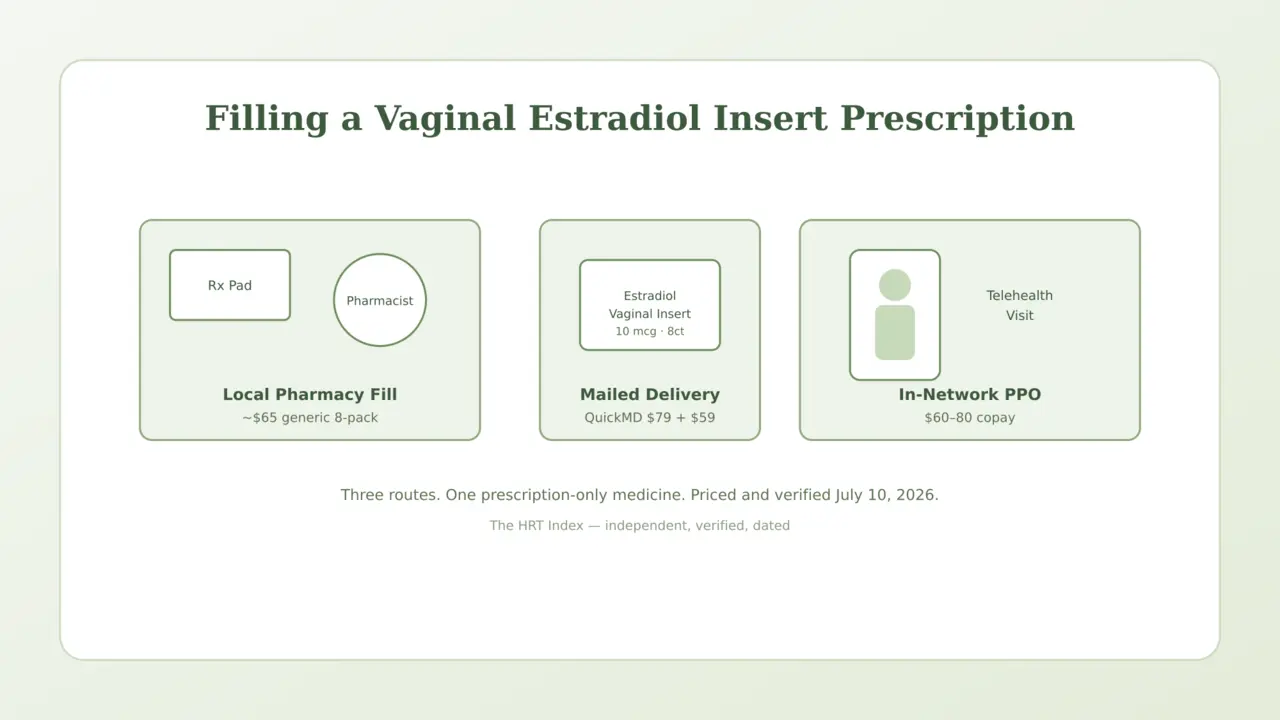
Yes — a licensed U.S. clinician can prescribe vaginal estrogen tablets online. What it costs comes down to one question most pages skip: do you already have a prescription? If you do, a generic 8-pack runs about $65 at a pharmacy and you don't need another visit. If you don't, QuickMD publishes the clearest total we found — $79 for the visit, $59 for a 30-day supply, shipped.
That's the short answer. Two things you should know before you click anything.
First: most of the menopause brands you've seen advertised don't list the tablet. We checked eight providers on July 10, 2026. Only three publicly name a vaginal estradiol tablet or insert on their own product pages. The rest name cream, or name nothing specific at all.
Second: the black box is probably still in the box. The FDA announced it was removing the boxed warning from menopause hormone therapy. You saw the headlines. But when we checked FDA's own published list, the vaginal tablet's label had not been updated. Estring — a ring — was the only vaginal product on it.
Neither of those things is a scandal. Both are things you'd want to know before you paid someone. Here's all of it, priced.
When our answer changes
- You're on Medicaid or Medi-Cal. Midi Health cannot treat you at all — not even as a self-pay patient. Skip to the cash-pay routes.
- You're on Medicare. Midi doesn't bill Medicare. You can still see them as a self-pay patient, but you can't submit claims for the visit or the medication. Your Part D plan may still cover the drug at your own pharmacy.
- Your symptoms are mostly external — burning or soreness on the vulva rather than inside. A tablet is not designed for external use. Read the format section before you buy anything.
- You have unexplained bleeding after menopause. Contact a clinician promptly. Don't start here.
Where can you get vaginal estrogen tablets online?
There is no single cheapest route.The lowest-cost path for a woman who already holds a prescription is a pharmacy fill, at roughly $65 cash for a generic 8-pack. For a new patient who wants medication mailed, QuickMD publishes a $79 visit plus $59 per 30-day supply. For a woman with commercial PPO insurance, a telehealth visit that sends the prescription to her own pharmacy lets her pharmacy benefit pay for the drug — often a $60 to $80 copay.
This is the table we wish someone had handed us. Every cell below was read off a provider's own page or a drug label on July 10, 2026.
We use three labels, and we use them strictly: Verified = we read it on a primary label or the provider's own page. Provider-stated = the company says it; we couldn't independently confirm the product detail. Not disclosed = they don't publish it.
| Route | Names a vaginal tablet? | Visit cost | Medicine | Who fills it | Insurance |
|---|---|---|---|---|---|
| Already have a prescription | n/a | $0 | ~$65 cash, generic 8-pack (verified) | Any pharmacy | Pharmacy benefit or discount card |
| Midi Health | No (verified) | Plan-specific copay, in-network PPO | Your pharmacy's price | Your own pharmacy | In-network with most PPOs. No Medicaid. No Medicare billing. |
| Sesame Care | No (verified) | Varies by clinician | Varies by pharmacy | Your own pharmacy | No visit billing. Pharmacy benefit still applies to the drug. |
| QuickMD | Yes (provider-stated) | $79 | $59 / 30-day supply | Mailed by QuickMD | None. Cash-pay. |
| Interlude | Yes (provider-stated) | One-time consult fee | Box of 18 inserts | Mailed by Interlude | None. HSA/FSA accepted. |
| Pandia Health | Yes (provider-stated) | Membership pricing | Check current price | Mailed by Pandia | Provider states insurance may apply |
Evernow also appears to offer vaginal estradiol tablets. We could not confirm it from Evernow's own product page on the day we checked, so we've left it out of the table rather than guess. Worth a look if the routes above don't fit.
Three providers we reviewed do not match this page's intent at all: Hers lists estradiol vaginal cream. Winona lists a compounded vaginal estrogen cream. Inner Balance's Oestra is a compounded estradiol-and-progesterone cream. None of them is a vaginal estrogen tablet. We explain all three below rather than hiding them in a footnote.
This page is for you if
- You specifically want the vaginal estradiol tablet or insert, not a cream
- You want the whole price — the visit and the medicine, not one of them
- You already have a prescription and want a cheaper way to fill it
- You want to know what these companies do and don't publish before you hand over your health history
This page is not for you if
- You're looking for vaginal estrogen without a prescription. There is no legal route, and we won't help you find one.
- Your main problem is hot flashes or night sweats. A low-dose vaginal tablet isn't built for that.
- You want a compounded cream and believe it's the same thing as the tablet. It isn't. We show you why below.
How we make money. The HRT Index earns a commission if you begin care with Midi Health, Sesame Care, or Hers through our links. It costs you nothing extra. We earn nothing from QuickMD, Interlude, Pandia Health, or your pharmacy — and those routes appear here anyway, in the same table, with the same detail.
It didn't change what we found. Neither of the two companies that pay us names the tablet on its website. We say so above, in the first table, before any button.
The HRT Index is the independent decision resource for online menopause and HRT care — comparing telehealth providers on clinical legitimacy, care quality, medication fit, price transparency, and access, with every claim verified and dated, so women can choose the path that fits their situation before their first consult.
Which route is cheapest — with insurance, with cash, or with a prescription you already have?
A woman who already holds a valid prescription pays only the pharmacy price, roughly $65 cash for a generic 8-pack. A woman with commercial PPO coverage usually pays least by having a prescription sent to her own pharmacy, where her drug benefit applies. A woman paying cash who wants the medicine mailed will pay $138 through QuickMD, the clearest published total we found among direct-shipping services.
Start with three questions about yourself, not with a logo.
1. Do you already have a prescription?
Then stop shopping for a clinician. You need a cheaper pharmacy, not another visit.
Ask for the generic estradiol vaginal insert, 10 mcg. Cash price runs about $65.28 for eight (Drugs.com, checked 7/10/2026). Brand-name Vagifem runs about $174.11 for the same eight on the same site — and GoodRx lists an average cash price closer to $208.30. Same strength, same schedule, a fraction of the price.
Then do the thing nobody tells you to do. Ask the pharmacist to run it twice — once through your insurance, once as a cash price with a discount card. Sometimes the coupon beats the copay. Asking costs nothing.
One catch worth knowing: Interlude states it does not accept a prescription transferred into its service. If you already have one, it buys you nothing there.
2. Do you have commercial PPO insurance?
Then the prescription should go to your own pharmacy, not into somebody's fulfillment box.
Here's why. About 76% of insurance plans cover Vagifem, at a copay of $60 to $80 (GoodRx). A mail-order cash price can't compete with a copay it never touches. QuickMD's $59 and Interlude's box are cash transactions. They don't run through your drug benefit.
Midi Health is in-network with most PPO plans, operates in all 50 states, prescribes FDA-approved hormone therapy, and e-prescribes to the pharmacy you already use. Midi notes that coverage varies by plan and that deductibles, coinsurance, and copays may still apply.
3. Are you paying cash?
Then compare the total, not the advertisement.
| Cash route | Visit | Medicine | Published total | Fulfillment |
|---|---|---|---|---|
| QuickMD | $79 | $59 / 30-day supply | $138 | Mailed |
| Interlude | One-time consult fee | Box of 18 inserts | Check at checkout | Mailed |
| Sesame Care | Varies by clinician | Your pharmacy's price | Not calculable in advance | Your pharmacy |
| Pandia Health | Membership pricing | Check current price | Not calculable in advance | Mailed |
QuickMD charges $79 per visit, no subscription, offers same-day appointments, and — if a clinician prescribes — fills estradiol vaginal inserts through QuickMD Home Delivery at $59 for a 30-day supply. QuickMD states plainly that the $59 excludes the visit and that a prescription is never guaranteed. That's honest, and rarer than it should be.
We earn nothing from QuickMD. We're telling you about it because it published the clearest number on the internet for this drug, and a page that only lists its own partners is an advertisement wearing a lab coat.
One question to ask QuickMD before you pay: how many inserts is a “30-day supply”? At maintenance dosing that's eight. During your first two weeks it's fourteen. Their page doesn't say which you get. It should.
Not sure which of those three you are? That's the actual question, and it takes about 90 seconds to answer. It also flags when online care isn't the right starting point. No provider link at the end of it.
Find your route with Find My HRT Path →The right online HRT provider isn't the same for every woman — it depends on your symptoms, what you have tried so far, your age, your state and your health history. Some situations belong with an in-person clinician first. Because a general answer can't resolve those for you, use The HRT Index's Find My HRT Path tool to match your situation to the right provider.
Can you really buy vaginal estrogen tablets online?
Vaginal estrogen tablets are prescription-only in the United States, so nothing legitimate ships without a prescription. What you can obtain online is the prescription — through a clinician licensed in your state — after which the medicine is either filled at your pharmacy or mailed by a telehealth service that runs its own fulfillment. Any website selling vaginal estradiol with no prescription is operating illegally.
First, the words. The confusion is real, and it costs women money.
“Tablet” and “insert” usually mean the same product here — but not always. Vagifem, Yuvafem, and their generics are tablet-style vaginal inserts: a tiny tablet, 6 mm across per the Vagifem label, preloaded in a disposable applicator. You insert it, push the plunger, throw the applicator away. Interlude calls the same category “suppositories.”
But “vaginal insert” is a broader bucket. Imvexxy is a softgel estradiol insert with no applicator. Intrarosa is a prasterone insert — not an estrogen at all. Similar search words do not make them the same medicine.
Local, not whole-body. This medicine acts on the tissue where you place it: the vagina, the urethra, the bladder neck. Clinicians call the cluster of problems it treats genitourinary syndrome of menopause, or GSM — dryness, burning, itching, painful sex (the medical word is dyspareunia), urgency, and repeat urinary tract infections. It is not the same as swallowing an estrogen pill, which sends hormone through your bloodstream.
You are paying for two separate things. This is where the advertised prices stop making sense. There's the clinical fee — visit, consult, membership. And there's the medicine. QuickMD's $59 insert is real. So is the $79 visit you have to buy first. A page that shows you one and not the other isn't lying. It's just not helping.
What the eight providers actually publish
This is our own audit, run on July 10, 2026, on each company's own public pages. Anyone can reproduce it.
| Provider | Tablet/insert named? | Cream named? | Ring named? |
|---|---|---|---|
| QuickMD | Yes | Yes | No |
| Interlude | Yes | Yes | No |
| Pandia Health | Yes | — | — |
| Midi Health | No | — | Yes |
| Sesame Care | No | — | No |
| Hers | No | Yes (FDA-approved) | No |
| Winona | No | Yes (compounded) | No |
| Inner Balance (Oestra) | No | Yes (compounded) | No |
Three of eight. And note what Sesame's menopause page does list under vaginal options: Intrarosa — which is prasterone, not estrogen. Its “Estradiol” card reads generic for Estrace, Climara, Divigel — and Estrace is sold as both an oral tablet and a vaginal cream. That doesn't tell a woman searching for a vaginal insert whether she can get one.
We can't tell you why the industry landed here. We can tell you what we found: the companies spending the most on menopause advertising are not the companies naming this product.
Dispensing data points the same way, from the outside. Between July 2025 and February 2026, U.S. vaginal cream dispensing rose 15.2% while vaginal inserts and rings rose 1.9% (Truveta). That's an observation about the market, not a claim that one formulation is medically better than another.
“No prescription needed” is the reddest flag there is
Estradiol vaginal inserts are prescription drugs. A licensed clinician must evaluate you. Every legitimate service on this page says so on its own website.
If a site offers to mail you vaginal estradiol without one, close the tab. We won't name them and we won't link to them.
Does the vaginal estrogen tablet still have a boxed warning?
As of July 10, 2026, yes. In November 2025 the FDA requested labeling changes for menopause hormone therapies, including removing cardiovascular disease, breast cancer, and probable dementia language from boxed warnings. On February 12, 2026, the FDA approved changes for six named products. Estring, a vaginal ring, was the only vaginal product among them. The current Vagifem and Yuvafem prescribing information still carries a boxed warning.
If you filled this prescription expecting the warning to be gone, and it wasn't — you weren't misled. Here is exactly what happened, and what it does and doesn't mean.
The boxed warning status tracker
Checked against FDA's published list of menopausal hormone therapies with updated prescribing information on July 10, 2026. FDA states 29 companies submitted proposed labeling changes; six products were approved in the first batch. We re-check this list monthly.
| Product | Form | Maker | On FDA's updated-labeling list? |
|---|---|---|---|
| Estring | Vaginal ring | Pfizer | Yes — approved 2/12/2026 |
| Vagifem | Vaginal insert (tablet) | Novo Nordisk | No |
| Yuvafem | Vaginal insert (tablet) | Amneal | No |
| Imvexxy | Vaginal insert (softgel) | Mayne Pharma | No |
| Estrace cream | Vaginal cream | AbbVie | No |
| Premarin vaginal cream | Vaginal cream | Pfizer | No |
| Generic estradiol vaginal inserts | Vaginal insert | Various | Not individually audited — check the label for the exact product you're dispensed |
For Estring, FDA's action removed the cardiovascular disease, breast cancer, and probable dementia risk statements from the boxed warning. Removing that language does not remove the label's contraindications or its other warnings, which live elsewhere in the prescribing information.
What the FDA actually asked for
For all menopause hormone therapies, systemic and local vaginal:
- Remove cardiovascular disease, breast cancer, and probable dementia language from the boxed warning
- Remove endometrial (uterine) cancer language except in systemic estrogen-only drugs, where that warning stays
- Remove the old “lowest effective dose for the shortest time” instruction
- Condense the safety section and prioritize the information most relevant to local vaginal use
What that does — and doesn't — tell you about your tablet
Estring's label changed. The tablet's hasn't. That does not mean the tablet is a different or riskier medicine than the ring. It means one manufacturer's submission has been approved and another's has not. FDA has not said when, whether, or in exactly what form the tablet labels will change. Anyone who tells you otherwise is guessing.
What the experts said
The Menopause Society agreed with removing the boxed warning from low-dose vaginal estrogen, noting the warning may have deterred women from a therapy for a condition most menopausal women eventually experience. ACOG applauded the vaginal estrogen change specifically. FDA's panelists pushed hardest on vaginal estrogen because so little of it reaches the bloodstream.
And what did not change
- Absorption is low, not zero. In a 29-patient pharmacokinetic study reported in the Vagifem label, the mean estradiol concentration at Day 83 was 5.5 pg/mL. The same label states that systemic absorption occurs. “Zero absorption” is not an accurate description of this drug.
- Blood clots, ischemic stroke, and gallbladder disease remain established risks in the estrogen class.
- Unexplained bleeding after menopause requires evaluation. The label calls for diagnostic steps, including sampling the uterine lining when indicated, to rule out cancer.
- A breast cancer history was not settled by a label change. Specialists at the San Antonio Breast Cancer Symposium said so directly. That belongs in shared decision-making with your gynecologic clinician and, where relevant, your oncologist.
If the warning was the thing standing between you and this decision — and it still isn't resolved for your history — don't guess your way through it.
About 90 seconds. It tells you when online care isn't the right first step.
Get your personalized action plan with Find My HRT Path →Which providers actually prescribe the tablet?
QuickMD, Interlude, and Pandia Health publicly name a vaginal estradiol tablet or insert on their own product pages and mail it to you. Midi Health and Sesame Care do not name it publicly, but both send prescriptions to the patient's own pharmacy, which is the only route where a drug benefit or a discount card can lower the medication price. Hers lists estradiol vaginal cream. Winona and Inner Balance list compounded creams, which are not FDA-approved finished products.
Each provider below gets the same treatment: the punchline first, then what we verified, then what nobody's telling you.
Midi Health — the insurance route
Punchline: Midi is the only option here that is in-network with most commercial PPO plans across all 50 states and sends the prescription to your own pharmacy. That combination is what turns a $208 insert into a $60 copay.
Verified: Live video visits with menopause-trained clinicians. All 50 states. FDA-approved hormone therapy. Prescription e-sent to the pharmacy you already use. In-network with most PPO plans, with coverage varying by plan.
The damaging admission
Midi's published medication list does not name the vaginal estradiol tablet. It names a pill, a patch, a vaginal ring, and topical cream or gel. Not the insert.
If you want a company that tells you the exact product on its website before you pay a dollar, QuickMD, Interlude, and Pandia do — and we've linked all three, unpaid, above. Go use one.
But look at what Midi is actually built to do. It doesn't run a pharmacy. It isn't trying to sell you a box. It writes a prescription and sends it to your pharmacy — which is the only arrangement on this page where your insurance, or a discount card, gets to compete for the lowest price on the drug itself. The shipped-cash services can't offer that, because their price is the price.
So the question isn't whether Midi sells the tablet. It's whether the clinician you meet will prescribe it. That is a one-sentence question at your visit, and you should ask it before you book:
“Can you send a 10 mcg estradiol vaginal insert to my pharmacy?”
If the answer is no, you've spent nothing. If it's yes, you've found the cheapest insured route on this page.
Two limitations you need in writing
Midi cannot treat Medicaid or Medi-Cal patients at this time — not even as self-pay patients. That is a hard exclusion, in Midi's own words.
Midi is not covered by Medicare. Midi can accept Medicare beneficiaries as self-pay patients, but Midi states those patients cannot submit claims related to their Midi visits, medications, or associated services. Your Part D plan may still cover the drug at your own pharmacy — that's a separate benefit.
Self-pay visit pricing isn't published on Midi's pricing page. Third-party reviews report roughly $150 to $250 per visit. Confirm it before you book.
One more thing. Midi separately runs a “Custom Rx” line of compounded products, including compounded vaginal-health products, which Midi states insurance cannot cover. That is a different pathway from an FDA-approved prescription sent to a retail pharmacy. Know which one you're being offered.
A Midi patient, from a testimonial published on Midi's own website: “I got a same day appointment and they took my insurance.”Provider-hosted testimonial. Not independently authenticated. It describes how quickly she was seen — not medical results. Individual experiences vary.
Does that sound like your situation — commercial PPO, local symptoms, and you'd rather your insurance paid for the medicine than a subscription?
Check whether Midi is in-network with your plan →Then ask the one question above at your visit. If they can't, you haven't lost anything.
Sesame Care — the cash marketplace route
Punchline: You choose your own clinician, and the prescription goes to your own pharmacy — where a coupon or your drug benefit can still do the work.
Verified: Sesame is a marketplace, not a subscription-only brand. You pick the clinician. Prescriptions go to your preferred pharmacy for pickup. Sesame does not bill insurance for the visit, and provides a prescription savings card. If you do have insurance, the medication itself may be covered depending on your plan. Basic labs are included in its menopause subscription; medication costs are not. Sesame's general telehealth visits start at $34.
What Sesame doesn't name: the vaginal estradiol tablet. Its menopause page lists estradiol, estrogen/progestin, progesterone, and Intrarosa — a prasterone insert, which is not an estrogen. Visit prices vary by clinician and location, so no fixed all-in total exists until you pick one.
So ask before you book. You can read a clinician's profile, and you can message. The question is the same:
“Do you prescribe 10 mcg estradiol vaginal inserts?”
And skip the subscription if you don't need it. Sesame's menopause subscription includes labs and unlimited messaging. That earns its keep if you want ongoing dose adjustments. For one vaginal estrogen prescription, a single visit is the honest recommendation. We'd earn more if you subscribed. We're telling you not to.
A Sesame patient, from a testimonial published on Sesame's own menopause page: “I was able to pick them up from my local Costco in a few hours.”Provider-hosted testimonial, attributed only as “Real Sesame patient.” Not independently authenticated. Describes speed of access, not treatment results.
Paying cash, and you'd rather fill at a pharmacy where a coupon can compete?
See current visit prices and choose your clinician on Sesame →Message them the question above before you book. It takes a minute and it settles everything.
QuickMD — the clearest published cash total (we earn nothing)
$79 visit + $59 per 30-day supply = $138, shipped, no subscription, same-day appointments available. QuickMD publicly names estradiol vaginal inserts and states that the medication price excludes the visit and that a prescription is never guaranteed.
Not disclosed: the manufacturer, the NDC, how many inserts a “30-day supply” contains, refill policy, and how it handles insurance.
Ask about the quantity. Everything else on their page is admirably plain.
See QuickMD's estradiol vaginal insert page.
Interlude — 18 inserts in a box, with arithmetic you have to do yourself (we earn nothing)
Interlude ships estradiol vaginal suppositories, 10 mcg, described on its own site as an FDA-approved generic of Vagifem. Each box holds 18 pre-filled applicators. One consult fee covers refills for up to a year. Free shipping. No insurance; HSA and FSA accepted.
Check the current medication price and consult fee at checkout. We could not confirm them from a dated source, so we won't print numbers we haven't seen. Interlude's own pages also give differing refill counts in different places — ask them which is correct before you pay.
Not disclosed: the manufacturer and NDC of the generic it dispenses.
Two things that will cost you if you don't know them.
One: Interlude states it does not accept a prescription transferred into its service. If you already have one, it's worth nothing here.
Two — and this is the calculation nobody is doing for you: an 18-insert box lasts a new starter about four weeks (14 daily loading inserts, then 4 twice-weekly). For a woman already on twice-weekly maintenance, the same box lasts about nine weeks. Same box. Same price. Wildly different value depending on where you are in treatment.
That's not a knock on Interlude. It's arithmetic, and it applies to every “30-day supply” and every “two-month supply” advertised on this page.
See Interlude's estradiol vaginal suppository page.
Pandia Health — names the tablet, mails it (we earn nothing)
Pandia publicly names estradiol vaginal tablets, 10 mcg, as a generic equivalent, and describes the standard labeled schedule: one tablet daily for two weeks, then twice weekly.
Check before you pay: the required membership or consult charge, the exact quantity per shipment, whether Pandia can write a new prescription in your state, and the final insured cost. Pandia states insurance may apply; the complete first-fill total isn't publicly calculable from its pages.
See Pandia Health's estradiol vaginal tablets page.
Hers — FDA-approved cream, not tablets
Hers lists estradiol vaginal cream. Estradiol vaginal cream is an FDA-approved product category. Hers does not publish the manufacturer or NDC of what it dispenses, and it isn't available in every state.
If cream fits your symptoms — and for external soreness it may genuinely fit better than a tablet — Hers is a legitimate option. Check supply: specific estradiol vaginal cream presentations are currently on a shortage list.
If you've concluded cream is the right form for you:
Check Hers' current menopause pricing and state availability →Winona and Inner Balance (Oestra) — compounded creams
Winona lists a compounded vaginal estrogen cream at $89 for a 30-day supply, cash-pay, HSA/FSA accepted. Inner Balance's Oestra is a compounded estradiol-and-progesterone vaginal cream.
Now the precise part, because precision matters more than tact here.
Compounded drugs are not FDA-approved finished products. They are prepared by licensed compounders under federal and state rules. The FDA does not review them for safety, effectiveness, or manufacturing quality before they're marketed. FDA's guidance is that compounded drugs are appropriate when a patient's medical need cannot be met by an FDA-approved drug. ACOG advises preferring FDA-approved products over compounded bioidentical hormones.
Compounded is not more natural. It is not safer. It is not the same thing as the vaginal estrogen tablet you searched for, and we will not present it as one.
If a compounded cream is what you and a clinician decide on, that's a real choice made with real information. Here's the full explanation: compounded vs. FDA-approved hormone therapy.
And you should know: Winona pays us more than any other partner on this page. It's still the wrong answer to this search, and we've just spent four paragraphs telling you so. Now you know exactly how much our recommendations are for sale.
What do vaginal estrogen tablets cost for a full year?
A generic estradiol vaginal insert costs about $65.28 for eight, and about 76% of insurance plans cover brand-name Vagifem at a $60 to $80 copay per fill. But eight inserts is not one month when you're starting. The labeled schedule is one insert daily for two weeks, then twice weekly — which works out to roughly 114 inserts in year one and 104 in a maintenance year.
Here's the number nobody publishes. Do the arithmetic with us.
The loading phase changes everything
From the Vagifem and Yuvafem prescribing information:
- Weeks 1–2: one insert every day. 14 inserts.
- After that: one insert twice a week. Pick two days. Keep them.
So year one needs about 114 inserts. A maintenance year needs about 104.
An 8-pack is four weeks of maintenance. During your loading phase, an 8-pack is gone in eight days.
What that costs in whole boxes
You can't buy a quarter of a carton. So here's the real math, in boxes you can actually purchase — using the 8-count carton, which is what most pharmacies stock.
| Boxes needed | Cost per box | Medicine cost | |
|---|---|---|---|
| Year one, generic (120 inserts) | 15 | ~$65.28 | ~$979 |
| Maintenance year, generic (104 inserts) | 13 | ~$65.28 | ~$849 |
| Year one, brand Vagifem (120 inserts) | 15 | ~$174.11 | ~$2,612 |
| Maintenance year, brand Vagifem (104 inserts) | 13 | ~$174.11 | ~$2,263 |
Prices: Drugs.com, checked 7/10/2026. Medicine only — excludes the visit, membership, follow-ups, and shipping. These are variable cash estimates, not guaranteed pharmacy prices.
If you're insured, you're not paying those numbers. About 76% of plans cover Vagifem at a $60 to $80 copay per fill. How many fills you need depends on your plan's quantity limit — which is exactly the question to ask your pharmacist, and one no article can answer for you.
One more thing worth money. The Vagifem label lists cartons of 8 or 18 applicators. An 18-count carton happens to cover the labeled first 28 days almost exactly: 14 daily, then 4 twice-weekly. Ask your pharmacy whether it can dispense the 18-count for your first fill. It may cost less than two 8-counts. It may not. Ask.
Three questions that save real money
- “Is my first fill an 8-count or an 18-count?”
- “When you say 30-day supply, how many inserts is that during my loading phase?” Ask QuickMD. Ask Interlude. Ask anyone mailing you a box.
- “Can you run this as cash and as insurance?” Every single time.
This is educational price math. Follow the prescription you're actually given — not this article.
Paying cash and want the number for your pharmacy, not ours?
See current visit prices on Sesame →On a PPO plan?
Check whether Midi is in-network with your plan →Vagifem, Yuvafem, generic, or Imvexxy — what's the difference?
Vagifem, Yuvafem, and generic estradiol vaginal inserts are 10 mcg tablet-style inserts approved for atrophic vaginitis due to menopause. Imvexxy is a different product — an applicator-free softgel insert available in 4 mcg and 10 mcg, approved for a different indication: moderate to severe painful sex due to menopause. On December 8, 2025, the FDA approved the first generic version of Imvexxy.
| Vagifem | Yuvafem | Generic insert | Imvexxy | |
|---|---|---|---|---|
| Strength | 10 mcg | 10 mcg | 10 mcg | 4 mcg or 10 mcg |
| Form | Tablet in applicator | Tablet in applicator | Tablet in applicator | Softgel, no applicator |
| Maker | Novo Nordisk | Amneal | Various | Mayne Pharma |
| Approved to treat | Atrophic vaginitis due to menopause | Atrophic vaginitis due to menopause | Same | Moderate–severe painful sex due to menopause |
| Cash, 8-pack | ~$174–$208 | — | ~$65 | ~$267 average retail |
| Generic exists? | Yes | It is a generic | — | Yes, approved 12/8/2025 |
| On FDA's updated-labeling list? | No | No | No | No |
Three things to pull out of that table.
One. Yuvafem is an FDA-approved generic version of Vagifem — not a copy of it. The FDA requires an approved generic to match the reference drug in active ingredient, dosage form, strength, route, and conditions of use, and to meet the same standards for quality, strength, purity, and stability. Manufacturers, inactive ingredients, applicators, packaging, and NDC numbers can still differ. That's a statement the FDA makes about generics. It is not a statement anyone may make about compounded drugs. The distinction is legal, not stylistic.
Two. Imvexxy is not interchangeable with Vagifem or Yuvafem — it's approved for a different labeled indication, comes in a different form with no applicator, and offers a 4 mcg strength the tablets don't have.
Three. The generic tablet is the cheapest FDA-approved option in this table by a wide margin. If cost is your driving question and your prescriber agrees the tablet form fits your symptoms, ask specifically for the generic.
What to ask before you pay
Before entering payment information, confirm the exact product, its strength, how many inserts you're getting, whether the visit fee and the medication fee are separate, whether refills need another paid visit, and whether cancelling ends your prescription support. “Estradiol treatment” is not the same promise as “a 10 mcg FDA-approved estradiol vaginal insert.”
We built this list out of the specific gaps we hit while researching this page. Nine questions. Print it.
The medicine
- Is this an FDA-approved product or a compounded one?
- Exact name and strength? (You want: estradiol vaginal insert, 10 mcg.)
- How many inserts am I getting — 8, 18, or something else?
- If you say “30-day supply,” how many inserts is that during my two-week loading phase?
The money
- Is the visit fee separate from the medicine? What's the total?
- Is this an introductory price? When does it end?
- Does a refill require another paid visit — and if I cancel, do I keep the prescription?
Access
- Does the prescription go to my pharmacy, or only to yours?
- Am I getting a refund if no prescription is issued?
Ask these of everyone — including the two companies that pay us.
How we verified this
What we did, and when.
On July 10, 2026 we read: FDA's published list of menopausal hormone therapies with updated prescribing information; the FDA press announcement of 2/12/2026 and the labeling-change request of 11/10/2025; FDA's 12/8/2025 first-generic Imvexxy approval; the current DailyMed labels for Vagifem and Yuvafem; the ASHP drug shortage bulletin for estradiol vaginal cream; the 2025 AUA/SUFU/AUGS guideline on GSM and AUA's published summary of it; ACOG's clinical consensus on urogenital symptoms after estrogen-dependent breast cancer; published cash prices on GoodRx and Drugs.com; and the public product, pricing, insurance, and fulfillment pages of Midi Health, Sesame Care, Hers, Winona, Inner Balance, QuickMD, Interlude, and Pandia Health.
What we did not do. We did not sign up for any provider, buy medication, complete a clinical intake, or test a cancellation flow. We did not independently authenticate the two provider-hosted testimonials quoted above. We could not confirm Interlude's current medication price or Pandia's current membership charge from a dated source, so we printed neither. We did not audit the label of every generic manufacturer's insert. We are not clinicians, and this page has not been reviewed by one.
Evidence labels. Every commercial claim above is marked verified, provider-stated, or not disclosed. We never mark an inferred product route as verified.
How we review providers. Under The HRT Index Verification Standard: we read every published price, separate FDA-approved from compounded, verify state availability and insurance, and re-check on a fixed schedule — top providers monthly, the full roster quarterly. We evaluate providers on five pillars, in this order: clinical legitimacy, care quality, medication fit, price transparency, access. We assign no numeric scores, because one number would hide the exact tradeoffs this page exists to show you.
Frequently asked questions
- Can you buy vaginal estrogen tablets online without a prescription?
- No. Estradiol vaginal inserts are prescription-only in the United States. Any website offering to mail them without a prescription is operating outside U.S. law. What you can get online is the prescription itself.
- Can you get vaginal estrogen tablets online the same day?
- You can often get the visit the same day — QuickMD and Sesame both offer same-day appointments. A prescription is a clinical decision and is never guaranteed. If one is written and sent to your pharmacy, you may be able to pick it up that afternoon.
- How much do vaginal estrogen tablets cost without insurance?
- About $65.28 for an 8-pack of the generic estradiol vaginal insert, per Drugs.com pricing checked July 10, 2026. Brand Vagifem runs about $174.11 on the same site. These are variable cash estimates, not guaranteed pharmacy prices. Check before you fill.
- Is Vagifem the same as Yuvafem?
- Yuvafem is an FDA-approved generic version of Vagifem: same active ingredient, dosage form, strength, route, and approved use, meeting the same quality standards. Manufacturer, inactive ingredients, applicator, and packaging can differ.
- Does vaginal estrogen still have a boxed warning in 2026?
- On the tablet, yes, as of July 10, 2026. FDA approved labeling changes for six products on February 12, 2026, and Estring — a vaginal ring — was the only vaginal product among them. Vagifem's and Yuvafem's current prescribing information still carries a boxed warning.
- Is vaginal estrogen absorbed into the bloodstream?
- Yes, at low levels. In a 29-patient pharmacokinetic study reported in the Vagifem label, the mean estradiol concentration at Day 83 was 5.5 pg/mL. The label states that systemic absorption occurs. “Zero absorption” is not accurate.
- Do I need progesterone with vaginal estrogen?
- Low-dose vaginal estrogen is generally used without an added progestogen, but that is your prescriber's decision. Systemic estrogen is different: with a uterus, it generally requires a progestogen to protect the uterine lining. Any bleeding after menopause needs evaluation either way.
- Can I use vaginal estrogen if I've had breast cancer?
- This requires individualized shared decision-making with your gynecologic clinician and, where relevant, your oncologist — particularly during aromatase inhibitor treatment. The 2026 label change did not resolve it. Do not settle this from a telehealth intake form.
- Can vaginal estrogen help with recurrent UTIs?
- The 2025 AUA/SUFU/AUGS guideline states that clinicians should recommend local low-dose vaginal estrogen to reduce future UTI risk in women who have GSM and recurrent infections — a moderate recommendation, Grade B evidence. It does not treat an infection you currently have.
- How long do vaginal estrogen tablets take to work?
- The pivotal trials for the 10 mcg insert used a 12-week efficacy endpoint. The label's schedule — daily for two weeks, then twice weekly — assumes a long game.
- Why do so many telehealth brands sell cream instead of tablets?
- We can't tell you why. We can tell you what we found: of eight providers we checked on July 10, 2026, three publicly name a vaginal estradiol tablet or insert. Separately, U.S. vaginal cream dispensing rose 15.2% between July 2025 and February 2026 while inserts and rings rose 1.9%.
- Is compounded vaginal estrogen the same as the FDA-approved tablet?
- No. Compounded preparations are not FDA-approved finished products. The FDA does not review them for safety, effectiveness, or manufacturing quality before marketing. ACOG advises preferring FDA-approved products. Compounded is not more natural, not safer, and not equivalent.
- Does Medicare cover vaginal estrogen tablets?
- Your Part D plan may cover the drug — it depends on the plan, the product, the quantity, and the pharmacy. Separately, Midi Health is not covered by Medicare, though it can see Medicare beneficiaries as self-pay patients who cannot submit claims.
- Is there a shortage of vaginal estrogen right now?
- ASHP lists specified estradiol 0.01% vaginal cream presentations in shortage, per a bulletin created June 6, 2026, with two manufacturers on back order and one on allocation. No ASHP bulletin for estradiol vaginal inserts was found on July 10, 2026. ASHP's list is not the FDA's shortage list.
- What if the insert falls out or doesn't seem to dissolve?
- Follow your product's patient instructions and call your pharmacist or prescriber. Don't insert a second dose based on an article. If insertion hurts, that's a reason to call, not to push through.
- Can I switch from cream to a tablet?
- Often, yes — but timing, dose, and whether your symptoms are internal or external all matter. Ask your prescriber. And check supply: specific cream presentations are currently harder to get than the insert.
What is the best way to get vaginal estrogen tablets online?
There is no single best route. A woman with a current prescription pays least by price-shopping pharmacies. A woman with commercial PPO coverage usually pays least through a telehealth visit that sends the prescription to her own pharmacy. A woman paying cash who wants medication mailed has a published total of $138 through QuickMD. A woman with unexplained bleeding or a complex cancer history should start with a clinician, not a website.
Six situations. One line each.
- You have a prescription already → Price-shop pharmacies. Ask for the generic. Ask them to run it both ways. About $65 for eight.
- You have commercial PPO insurance → Midi Health. Ask at your visit whether they'll send a 10 mcg estradiol vaginal insert to your pharmacy.
- You're paying cash and want a pharmacy fill → Sesame Care. Choose your clinician. Ask before you book.
- You're paying cash and want it mailed → QuickMD, $138 published. Or Interlude, or Pandia. We earn nothing from any of them.
- You're on Medicare or Medicaid → Not Midi. Ask your Part D or Medicaid plan directly what it covers.
- You have bleeding, or a cancer or clot history → A clinician first. Please.
And take this with you: the box you open will probably still have a boxed warning printed on it. Estring's label was updated in February. The tablet's had not been, when we checked in July. That is a fact about paperwork, not a fact about your medicine.
You spent a long time not saying this out loud. You don't have to be certain to take the next step — you only have to know which door you're standing in front of.
Still not sure which HRT program is right for you?
Take our free matching quiz — about 90 seconds. Answer a few questions about your symptoms, what you have tried, your age, your state, and your health history. You'll get a personalized action plan — and a clear flag if online care isn't the right starting point for you.
Find My HRT Path →Sources
All accessed July 10, 2026.
- Menopausal Hormone Therapies with Updated Prescribing Information. U.S. FDA, Drug Safety and Availability. Checked July 10, 2026.
- FDA Approves Labeling Changes to Menopausal Hormone Therapy Products. FDA press announcement, February 12, 2026.
- FDA Requests Labeling Changes Related to Safety Information to Clarify Benefit-Risk Considerations. FDA, November 10, 2025.
- FDA Approves First Generic Estradiol Vaginal Insert for Treatment of Moderate to Severe Dyspareunia. FDA, December 8, 2025.
- VAGIFEM (estradiol vaginal insert) Label. DailyMed, U.S. National Library of Medicine.
- YUVAFEM (estradiol vaginal insert) Label. DailyMed, U.S. National Library of Medicine.
- ASHP Drug Shortage Detail: Estradiol Vaginal Cream. American Society of Health-System Pharmacists. Bulletin created June 6, 2026.
- AUA/SUFU/AUGS Clinical Guideline: Genitourinary Syndrome of Menopause, 2025. American Urological Association.
- ACOG Clinical Consensus: Urogenital Symptoms After Estrogen-Dependent Breast Cancer. American College of Obstetricians and Gynecologists.
- Estradiol Topical price guide. GoodRx. Checked July 10, 2026.
- Vagifem price guide. Drugs.com. Checked July 10, 2026.
- Estrogens drug class comparison. GoodRx. Checked July 10, 2026.
- Imvexxy price and coupons. GoodRx. Checked July 10, 2026.
- Midi Health. HRT; Pricing & Insurance. joinmidi.com. Retrieved July 2026.
- Sesame. Menopause Treatment; Telehealth Visit. sesamecare.com. Retrieved July 2026.
- QuickMD. Estradiol Vaginal Inserts. quick.md. Retrieved July 2026.
- Interlude. Estradiol Suppositories, Generic. getinterlude.com. Retrieved July 2026.
- Pandia Health. Estradiol Vaginal Tablets. pandiahealth.com. Retrieved July 2026.
- Hers. Menopause. forhers.com. Retrieved July 2026.
- Winona. Vaginal Estrogen Cream. bywinona.com. Retrieved July 2026.
- Estrogen-Based Hormone Replacement Therapy dispensing trends. Truveta Research. Retrieved July 2026.
Last updated: July 10, 2026. Researched and written by The HRT Index editorial team. We re-check FDA label status, shortages, and pricing monthly, and the full provider roster quarterly.
The HRT Index is reader-supported. We may earn a commission from some provider links on this page. Commissions never change whether we label a product FDA-approved or compounded, and they never change our verdict. Find My HRT Path collects sensitive health information and is governed by our consumer health data and privacy policy. See our full affiliate disclosure.