
Weight Watchers Menopause Review: HRT, Plans and What You'll Really Pay
Our Weight Watchers menopause review comes down to one rule: WW's Med+ Meno plan makes sense if you want a weight-loss program and menopause care together. Its advertised fees are $65, then $88 a month, before HRT medicine. If symptoms matter more than weight, an HRT-focused service may fit better.
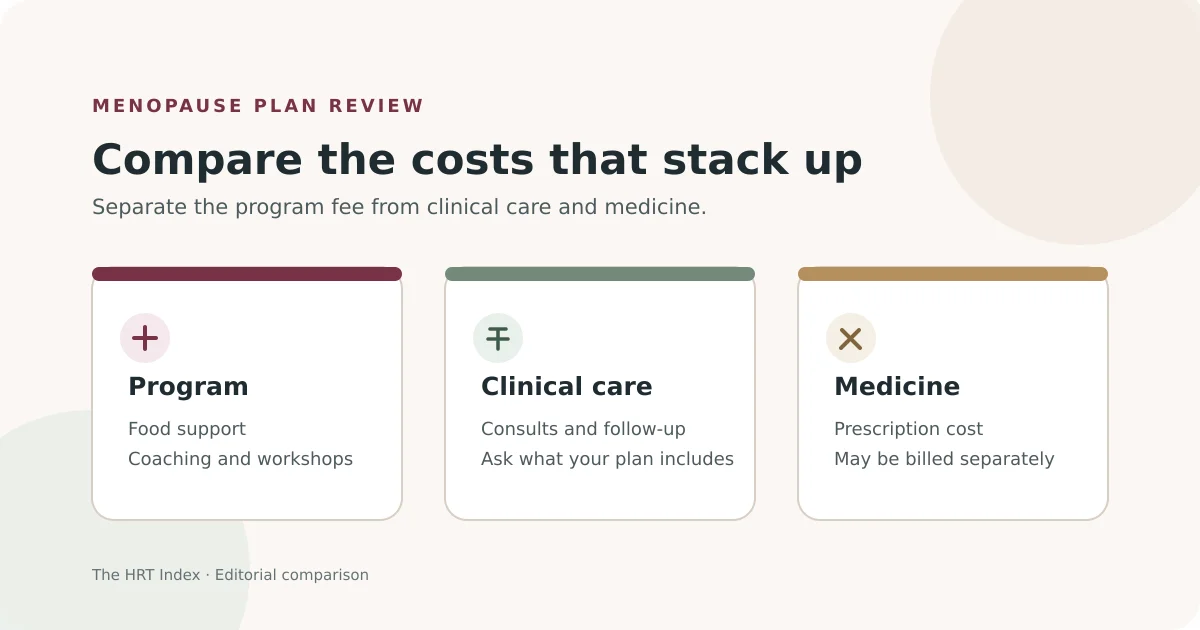
WeightWatchers for Menopause is likely a good fit if you:
- Want structured eating help, coaches and workshops built for midlife
- Would like one clinic that can consider HRT and, if you qualify, a GLP-1 weight-loss medicine
- Have insurance that may pay for HRT medication or dietitian visits
- Are comfortable with the payment commitment in your selected offer
Start somewhere else if you:
- Mainly want relief from hot flashes, night sweats or poor sleep, and don't want a diet program
- Need a confirmed plan with no multi-month payment commitment
- Need a non-hormonal prescription such as fezolinetant, or want testosterone (WW doesn't list either)
- Have unexplained vaginal bleeding that needs evaluation, or a history such as a blood clot, stroke, heart attack, or breast or uterine cancer that needs an individual clinician or specialist review before choosing treatment. Some situations require an in-person exam.
Already have an HRT prescriber you like? Core+ Meno may give you WW's food support without adding another prescriber. If you only want a nutrition visit, WW also offers standalone dietitian care.
One thing to know up front. The contract matters more than the monthly price. WW's general terms include plans with multi-month commitments, but we couldn't confirm the term attached to the menopause prices on its comparison page. If your offer requires 12 monthly payments at $65, then $88, leaving after three charges would still leave nine $88 payments: $792. We show the conditional math below so you can decide with your eyes open.
The HRT Index is the independent decision resource for online menopause and HRT care — comparing telehealth providers on clinical legitimacy, care quality, medication fit, price transparency, and access, with every claim verified and dated, so women can choose the path that fits their situation before their first consult.
Our WeightWatchers links on this page are plain links, not affiliate links. We may earn a commission if you start care with Gala through our link, and that can affect which alternatives we feature. It doesn't change what we report. This is a review of public documents, not a firsthand care review. How we make money.
What we actually verified · Last verified October 2026
We read, on October 19, 2026: WeightWatchers' U.S. menopause, plan comparison, kit, kit FAQ, public consultation offer, plans and dietitian pages; its Workshops + Digital Membership Terms and WW Clinic Terms & Conditions (both last updated February 9, 2026); and its business outcomes report. We also read Gala's HRT pages, dedicated $69 offer and linked general policies, and Midi's pricing page. We checked medical points against The Menopause Society, FDA, Mayo Clinic, an older Cochrane review and the primary abstract of a 2024 study in Menopause.
For more on Gala: our Gala Health HRT review covers its offer and open questions in detail. The commercial facts here were checked against the provider pages directly.
We confirmed in published pages: the comparison advertises Med+ Meno at $65 for the first month, then $88 a month, and Core+ Meno starting at $22 a month. WW's current kit page advertises an extra fee "as low as" $30 a month; its older FAQ gives different kit prices. WW states that all menopause hormone therapy its clinicians prescribe is FDA-approved. The menopause program itself isn't covered by insurance. The consultation offer is $65, then $155 a month unless you cancel or switch plans.
We did not: join, pay, use the member app, talk to a WW clinician or receive medication.
We could not confirm: the commitment and renewal attached to the $22 and $65/$88 offers, the exact patch and pill products or current combined kit price, ongoing kit access after a one-time consult, the menopause-specific state and age limits, or who pays for all required tests. Gala's exact products, complete prescription price and HRT-specific policy scope also remain open.
On this page: Who it's best for · Which plan · Real cost · Cancelling · Food plan · HRT medicines · Weight and HRT · Does it work · After you sign up · Insurance and access · WW vs Gala vs others · Health factors · Questions to ask · How we reviewed · Quick answers
Weight Watchers menopause review: who is it best for?
WeightWatchers for Menopause is most worth it for women who want WW's food-and-habit support as part of their menopause care, and who will actually use the coaching, workshops or clinic. If you mainly want a prescription review, or an insurance-covered visit, compare a menopause provider or your own clinician before paying for services you may not use.
Here's the simplest way to think about it. WeightWatchers now sells two different things under one roof:
- A weight program tuned for midlife: Points, menopause lessons, workshops and coaches.
- A medical service through WW's affiliated medical groups, where a clinician can prescribe menopause hormone therapy, a GLP-1 medicine, or both, if appropriate.
You can buy the first without the second. You can't really get the second without paying for WW's membership too. That's why the most useful question isn't "Is it good?" It's "What do I want help with?"
A 15-second self-check
Answer these to yourself. Nobody else sees them, and there are no wrong answers.
- Is weight a real goal for me right now, not just something I've noticed?
- Would I actually join workshops or use a dietitian, given my schedule?
- Do I already have a doctor or nurse practitioner I trust for hormones?
- Can I accept the payment commitment in my offer, even if I stop using it?
What your answers mean:
- Yes to 1, 2 and 4, no to 3: WW's Med+ Meno plan is a real candidate. Keep reading for the cost.
- Yes to 1 and 2, yes to 3: You may only need the cheaper Core+ Meno plan and can keep your own prescriber.
- No to 1: You're paying for a weight program you don't need. An HRT-focused service or your own clinician is the simpler start.
- No to 4: Look closely at the contract section before joining anything.
When WW's combined approach makes sense
The value is in wanting the pieces together. Picture a 52-year-old who liked WW years ago, has gained weight since her periods became irregular, and now wakes up soaked at 3 a.m. She wants help with food, help with sleep, and a clinician to talk through hormones. WW is built for her. That's our judgment about fit, based on what WW sells. It isn't proof that WW gets better medical results than other services.
When another starting point is more useful
Now picture a 49-year-old whose only real problem is hot flashes. She doesn't want to count anything. For her, $88 a month for a weight program plus an HRT kit is paying for parts she won't touch. An HRT-only service, or her own gynecologist, is a cleaner fit.
And if weight gain is your only concern, hormone therapy isn't the answer to that on its own. We explain why in the weight section.
Which WeightWatchers menopause plan do you actually need?
WeightWatchers sells Core+ Meno, a menopause-tuned weight program without included ongoing prescribing care, and Med+ Meno, which adds a menopause-trained clinician who can prescribe HRT or a GLP-1 if appropriate. A third route, the "one-time consult," gives you an initial month with a clinician and then renews. HRT and GLP-1 medicines cost extra under the published menopause offer.
Here's what each route buys, side by side. Prices and features come from WW's menopause comparison page, its one-time-consult checkout page and its HRT kit page, all read October 19, 2026.
| What you get | Core+ Meno | Med+ Meno | One-time consult route | Keep your own prescriber + Core+ Meno |
|---|---|---|---|---|
| Points program tailored for perimenopause and menopause | Yes | Yes | Yes (1 month) | Yes |
| Personal protein, fiber and water targets | Yes | Yes | Yes (1 month) | Yes |
| Menopause lessons with daily actions | Yes | Yes | Yes (1 month) | Yes |
| Menopause workshops and app Connect groups | Yes | Yes | Yes (1 month) | Yes |
| Registered dietitian visits | Available; "as low as $0 with most insurance" | Available; "usually covered by insurance," with a self-pay option | Not stated | Available |
| First visit with a menopause-trained clinician | Extra cost | Included | Included (30 minutes) | Your own clinician |
| Ongoing clinician check-ins | Not included | Monthly virtual check-ins | Initial month of chat; confirm support after renewal | Your own clinician |
| Access to HRT or GLP-1 prescriptions | Extra cost | Yes, if a clinician decides it's appropriate | Yes, if appropriate | Your own clinician |
| HRT or GLP-1 medicine itself | Not included | Not included | Not included | Your pharmacy |
| Symptom and progress tracking | Listed "Coming Soon" | Listed "Coming Soon" | Not stated | — |
| Who it fits | Wants WW's food and community, no prescribing | Wants food, community and a menopause clinic together | Wants one clinician conversation before deciding | Happy with current care, wants only WW's food support |
Two words to know before you go further:
- Systemic hormone therapy means hormones that travel through your whole body, such as pills, patches, gels and sprays. These treat hot flashes and night sweats.
- Local hormone therapy means low-dose vaginal estrogen that mostly stays where it's placed. It treats dryness, pain with sex and some urinary symptoms, but not hot flashes.
Is Core+ Meno the same as a clinic membership?
No. Core+ Meno is the lifestyle program. WW's comparison table lists the first clinician consult, ongoing visits and access to medication as "additional cost" for Core+ Meno. If you join for workshops, you still need to decide who will handle any prescription: WW's clinic, your own clinician, or nobody yet.
Does the "one-time consult" really happen once?
The consult happens once. The billing doesn't stop by itself. WW's checkout page says you pay $65 for the consultation plus one month of membership, then the plan "auto-renews for $155/mo" unless you cancel or switch to a $90-a-month 12-month plan. If you only want the initial month, check your actual renewal date and submit cancellation before it, allowing for processing time.
How is the menopause plan different from regular WW?
Members describe a different ZeroPoint food list and a "bullseye" that tracks protein, fiber and water. The Holy Mess, a long-running WW member blog, reported in its October 2026 update that avocado and low-fat dairy count as ZeroPoint foods on the menopause plan, while potatoes don't. We haven't seen the member app ourselves, so treat these as member reports. We cover what the food plan adds in its own section.
How much does the Weight Watchers menopause program really cost?
As of October 19, 2026, WW's comparison advertises Med+ Meno at $65 for the first month and then $88 a month: $1,033 across twelve charges if those prices stay the same, before medicine. Adding twelve $30 kit charges gives a $1,393 scenario, not a confirmed full treatment bill. Core+ Meno starts at $22 a month; its selected offer's term and renewal need checking.
WW's pages show monthly prices. They don't add them up, and the kit price lives on a different page. So we did the adding.
Table A: What WeightWatchers' menopause routes cost (WW's published prices, read October 19, 2026)
| Route | Advertised initial care fee | After that | Commitment and renewal | HRT medicine | First 3 care-fee charges | + three $30 kit charges: scenario | Twelve care-fee charges: scenario | + twelve $30 kit charges: scenario | Still owed after 3 charges |
|---|---|---|---|---|---|---|---|---|---|
| Core+ Meno | Starting at $22/month; exact first charge needs checking | Selected renewal price not confirmed | Not established for the displayed starting price | Clinical care and medicine extra | $66 only if three charges are $22 | Not applicable | $264 only if all twelve charges are $22 | Not applicable | Unknown until the selected commitment is confirmed |
| Med+ Meno | $65 for the first month; total due now depends on extras | $88 a month | Not established for this offer | Extra: current kit page advertises starting at $30/mo; insured pharmacy cost varies | $241 | $331, incomplete subtotal | $1,033 | $1,393, incomplete subtotal | $792 only if the agreement requires twelve payments at these rates |
| One-time consult | $65 consultation plus one month | $155 a month unless you cancel or switch | Auto-renews; no longer minimum term stated on this page; the $90 switch is a 12-month plan | Extra | $375 for three unchanged charges; initial care fee is $65 if renewal is canceled in time | Kit price and continued refill access need confirmation | No fixed twelve-payment commitment established | — | Depends on the agreement and cancellation timing |
Sources: WW menopause plan comparison, one-time consult checkout, Hormone Therapy Kit, dated kit FAQ and U.S. plans, read October 19, 2026. Math: $65 + $88 + $88 = $241; $65 + ($88 × 11) = $1,033; $30 × 12 = $360. Three charges are not a verified 90-day total. The examples assume the stated prices persist; medicine and care billing dates may differ.
How to read the table:
- The first charge is not the full commitment. The Med+ Meno comparison advertises a $65 first month. Twelve care-fee charges at $65, then $88, add to $1,033, but your actual agreement decides how many payments you owe.
- The kit price is an advertised starting point. The current product page says "as low as $30," while its older FAQ lists different prices. Confirm the exact kit, supply, pharmacy and charge. Insurance may change your pharmacy bill, but copays, deductibles and other cost-sharing depend on the product and plan.
- An unknown cost is not $0. WW doesn't say who pays for lab tests if a clinician orders them. If you'd need labs, your total is incomplete until you know.
- Promotions aren't the regular price. WW also advertises general offers, such as half off a 12-month plan and a $25 first month on its standard Med+ GLP-1 plan. Those can change any time, and they aren't the menopause plan prices in this table.
Where WW's own pages don't match
We found places where WW's pages show different offers or leave conditions unclear. None of this means anything shady. It means you should check your checkout screen.
| Topic | One WW page says | Another WW page says | What to ask |
|---|---|---|---|
| Core+ Meno term | Comparison page: starting at $22/month | General plans page describes 12-month offers, but its plan grid did not load; we couldn't tie a term to this menopause price | "What will Core+ Meno cost me each month, and for how many months?" |
| Clinic plan price | Med+ Meno: $88/month after the first month | One-time consult: $155/month renewal, or a switch to a $90/month 12-month plan | "Which offer, services, commitment and renewal price am I accepting?" |
| Kit price and access | Current kit page: starting at $30/month, with a Clinic subscription or one-time consultation | November 21, 2025 FAQ: $29.90 for patch plus progesterone or $26.50 patch-only; requires Clinic membership | "What is today's kit price, and can I keep refilling after a one-time consult without a continuing Clinic plan?" |
| Clinician support | Comparison table shows "ongoing clinician support not included" under both plan names | The same table lists monthly clinician check-ins for Med+ Meno | "Does my plan include monthly check-ins with a clinician?" |
Build your own bill
Here's a worksheet you can fill in from your own checkout screen. It doesn't ask anything about your health.
MY WEIGHTWATCHERS MENOPAUSE BILL (keep this private)

Plan name and date I checked: _____________________________
Actual checkout total due today: $______  or  UNKNOWN
Care fee within that total:      $______  on __________
Later care charges:              $______ every ______, starting __________
Exact commitment: ______ payments / through ______ / none confirmed / UNKNOWN
Next renewal date: __________   Renewal term and price: __________________
If I cancel: request by ______   Takes effect on ______  or  UNKNOWN

Medicine or kit (cash price or actual copay):
  $______ per charge; first date ______; repeats every ______
  Supply per shipment ______; next shipment/charge ______
  Separate renewal or cancellation terms: __________________
  Add another line if medicines have different prices or schedules.

Labs, visits, dietitian, shipping, taxes, or other required charges:
  What ______; $______ on ______; repeats ______; or UNKNOWN
  Mark INCLUDED only when confirmed, and say which payment includes it.

MY FIRST 3 CARE CHARGES  = initial care fee + next 2 care charges
MY FIRST 12 CARE CHARGES = initial care fee + next 11 care charges
  These are payment counts, not a promise about 90 days or a calendar year.

MY DATE WINDOW: from ______, including that date, to ______, excluding that date
  Add every care, medicine, and extra charge due inside that window once.

IF I CANCEL: add any unpaid care charges the actual agreement still requires,
  plus confirmed cancellation fees. Check medicine renewals separately.
  If the term or effective date is unknown, the amount still owed is UNKNOWN.

If a required cost or billing date is UNKNOWN, my full total is INCOMPLETE.
I can still show the known subtotal. I don't replace UNKNOWN with $0.
Example, using the advertised care fees: $65 + $88 + $88 = $241 for three care charges. An initial $65 care charge followed by eleven at $88 would total $1,033 across twelve charges. Those calculations do not establish a 12-month contract.
For a separate illustration, suppose the kit costs $30 per charge and three kit charges fall inside the same chosen window as those first three care charges. The known subtotal would be $331. Twelve care charges plus twelve $30 kit charges would total $1,393. The $30 figure is an advertised-price scenario, not a confirmed lowest bill; actual kit pricing, dates and any required extras still need checking.
If a confirmed agreement required twelve care payments at those rates, nine remaining $88 payments would total $792 after the first three were paid. Without that confirmed commitment, the amount still owed is unknown. Required labs or other unpriced charges would also leave the full treatment total incomplete.
WW Menopause Plan Cost Checker
Compare payment counts and actual billing dates separately. A price quoted per month does not, by itself, tell you how many charges land in 90 days. The worksheet above works even when a final bill is still incomplete.
If you've read this far and WW sounds right for you, the next step is simple: look at the live plans and make sure your checkout matches these numbers.
Check the commitment, the renewal date and the medicine price on the checkout screen before you pay.
Not sure WW is even the right kind of care? The right online menopause care isn't the same for every woman — it depends on your symptoms, what you've already tried, your age, your state and your health history. Some situations belong with an in-person clinician first. Use The HRT Index's Find My HRT Path tool to explore a featured care option for your situation — and to flag when online care isn't the right starting point — before your first consult.
It's free, takes about 60 seconds and doesn't ask for your email. It asks five questions: what's bothering you most, what you've tried, your age, your state and any health history a clinician should know about. If weight gain is the only thing you pick, it points you to a weight-care finder and also shows an option for menopause care. It doesn't diagnose anything or decide whether you should take hormones; a clinician does that. We may earn a commission from the providers it features, and that affects which ones appear. How the tool works.
Same symptoms, other ways to pay
If your main goal is symptom relief, WW's bundle isn't the only way to get HRT. Here's how the same need prices out elsewhere. We checked Gala's $69 HRT offer, its hormone-health page, its general cancellation policy and Midi's pricing page on October 19, 2026. Our Gala Health HRT review explains the remaining questions about products and billing.
Table B: Getting menopause care without WW's program
| Route | First charge or visit | Then | Contract | Is medicine in the price? | Early charges: example | 12-month cash charges: example | Insurance | Checked |
|---|---|---|---|---|---|---|---|---|
| Gala HRT | $69 advertised; confirm amount and payment timing at checkout | $69 a month advertised; exact billing interval unconfirmed | Gala advertises no contract; confirm the HRT-specific cancellation rules below | Gala says medication is included; confirm your full prescription and any lab costs | 3 charges × $69 = $207 | 12 monthly charges = $828; 14 charges in 365 days if billed every 28 days = $966 | Doesn't bill insurance; HSA and FSA accepted | Oct 19, 2026 |
| Midi Health | $250 self-pay first visit, or your plan's cost-sharing | $150 self-pay follow-ups | Visit-based | No; pharmacy and any separately billed labs are extra | $400 for one self-pay first visit plus one follow-up, before medication and labs | Depends on visits, medication and labs | In-network with most PPO plans, per Midi; check your exact plan | Oct 19, 2026 |
| Your own clinician | Visit price or your plan's cost-sharing | Visit price or cost-sharing | Practice-specific | Usually separate pharmacy costs; ask about labs | Varies | Varies | Your plan and clinician's network status | — |
These are billing examples, not complete treatment quotes. Gala's $207 is three charges, whatever their spacing. If billing were every 28 days with the first charge on day 0, four charges would fall within 90 days, totaling $276, and fourteen would fall within 365 days, totaling $966. The fourteenth charge would prepay another cycle. We haven't confirmed that Gala uses that interval; $828 assumes twelve $69 calendar-month charges. Midi's $400 example covers two visits, not a promised 90-day package. Unknown required medicine or lab costs are still missing from a total, not zero.
A worked example. Dana is a hypothetical 51-year-old paying cash, with hot flashes and 20 pounds she can't shake.
- If Dana's WW checkout offers a $65 first month, eleven $88 months and twelve kit charges at $30, those listed charges total $1,393. That uses the current kit advertisement as a scenario; it doesn't establish her commitment or cover any extra costs.
- If Gala charges Dana $69 twelve times, those charges total $828. If it charges every 28 days starting on day 0, fourteen charges within 365 days total $966. Gala describes medication as included, but Dana must confirm her full prescription, lab costs and billing interval.
- WW's listed charges in those examples are $427 or $565 higher. That is a comparison of assumed charges, not a confirmed saving or a separate price for WW's coaching and program.
If Dana would use the workshops, a dietitian and maybe a GLP-1, WW's broader service gives her something to weigh against the price. If she mainly wants her nights back, compare the complete HRT quotes first.
Now say Dana's insurance covers a generic estradiol patch and progesterone. WW's membership still comes out of her pocket, because insurance doesn't cover it; the twelve-payment example above totals $1,033 before medicine. Her medicine may cost a copay, deductible or coinsurance. An in-network visit with Midi or her own doctor, plus covered prescriptions, may cost less than either cash option. Check that first.
If you mostly want your symptoms treated, Gala's advertised $69-a-month HRT offer is worth a look. Gala says medication is included and advertises no contract. Its linked general policy requires cancellation at least 72 hours before billing; confirm that this policy applies to your HRT order, what your full prescription costs and when your next charge will happen before you pay.
We may earn a commission. A clinician decides whether any treatment is right for you.
Can you cancel the Weight Watchers menopause plan?
You can request cancellation at any time, but WW's Clinic Terms say it takes effect at the end of the applicable billing or commitment period. Subscription fees are generally nonrefundable, with stated exceptions, and the terms make the initial consultation fee nonrefundable. The number of payments you still owe depends on your selected offer; we couldn't confirm a 12-month requirement for the advertised $65/$88 menopause plan.
This is the section that prevents the most regret, so here are the rules in order. They come from WW's Clinic Terms & Conditions and Workshops + Digital Membership Terms, both last updated February 9, 2026.
1. When cancelling takes effect. For commitment plans, the terms say cancellation takes effect "at the end of the commitment plan period." WW says it tries to process cancellation requests within 72 hours.
2. What you still owe. The terms say that if you cancel, you "must pay the applicable monthly subscription fee" until the end of the commitment period. This applies whether or not you used the program that month.
3. Refunds. The initial consultation fee "is not refundable." Monthly fees generally aren't refundable either. There are two main exceptions:
- A medical reason. If your membership is cancelled for a medical reason, WW says it will refund the unused part of the period you've paid for, except fixed upfront fees such as the consultation fee.
- WW ends your membership for reasons other than a terms violation. WW also reserves the right to charge an administrative fee on those refunds, where the law allows.
4. Short cancel windows in some states. WW's Workshops + Digital Membership Terms give buyers in certain states, including California, Florida, Illinois and New York, a three-business-day cancellation right. That agreement says it doesn't govern clinical care. Check which agreement and state-specific provision applies to each charge; don't assume this automatically refunds Clinic fees.
5. Renewal. The renewal term depends on the offer. WW's Clinic Terms describe plans that become monthly after a commitment and plans that renew for another commitment period. They also say WW can change subscription fees with at least 30 days' written notice.
6. If your medicine is out of stock. The Clinic Terms say paying the fee "does not guarantee medication availability." A shortage doesn't by itself entitle you to a fee refund under those terms; the separate refund exceptions above still matter.
What this looks like with real dates
Hypothetical: your chosen offer requires twelve monthly payments, starting at $65 and then $88. You join on November 1 and decide after the February 1 charge that it isn't for you. These are assumed contract terms, not a confirmed commitment for today's comparison-page offer.
- You've paid $65 + $88 + $88 + $88 = $329 for November through February.
- The commitment runs through October. That's 8 more charges of $88, or $704.
- Your membership total is still $1,033. Stopping use early doesn't, by itself, end payments remaining under a commitment.
That's the honest catch. It doesn't make WW a bad service. It makes the decision before you join the one that counts.
Check your prescription before you leave
There's a second rule that matters more than money if WW prescribes your hormones. WW's Clinic Terms say: "The Providers will not send transfer prescriptions or file prior authorizations for members who have unsubscribed within the past 30 days." The terms also say refills require you to answer a set of questions that are reviewed before the refill is sent.
So if you plan to leave, line up your next prescriber before you cancel. Use this checklist:
- Write down your plan name, next billing date and commitment end date.
- Ask WW's care team what you'd still owe if you cancelled today.
- Save the cancellation and refund terms that apply to your plan.
- Ask who will prescribe for you next, and when they can see you.
- Ask your current WW clinician and pharmacy what's needed to move your prescription while you're still a member.
- Check when your next medicine shipment and charge are due, separately from membership.
- Ask for your visit notes and medication list.
- Request written confirmation of your cancellation and its effective date.
- Compare the confirmation with your next bill.
This checklist is about records and timing. It isn't advice to stop, start, switch or stockpile any medicine.
Existing members and Lifetime members
If you already belong to WW, upgrading changes your plan, your price and possibly your commitment. Ask for the new price, the new end date, and whether any promotional rate you have now goes away.
Lifetime members, the people who reached goal and keep free membership by staying near it, should ask one more question. The Holy Mess reported that, after calling WW twice, its team understood that Lifetime members lose their free Lifetime status when they enroll in the menopause program. We couldn't confirm that in WW's published terms, so ask WW directly before switching.
Our read from reader discussions. In the r/weightwatchers thread "Is the menopause plan worth twice the price?", the original poster explained that her job is too hectic for workshops, and one reply was blunt: "Feels like a scam. Menopause isn't magic." A ConsumerAffairs reviewer who joined WW's Med+ GLP-1 program in 2026 said cancelling didn't end what she owed and felt the year-long obligation wasn't made clear at sign-up. Those are individual accounts, not proof of the menopause offer's terms. They show why it's worth checking both the features you'd use and the payments you'd owe.
What actually changes in the menopause food plan?
The menopause plan keeps WW's Points system and adds menopause lessons, personal targets for protein, fiber and water, and menopause-focused workshops. The real question is whether you'd use those tools. A "menopause" label doesn't make a food program a medical treatment.
Points and nutrition targets
Points are WW's way of turning a food's nutrition into one number, so you track a daily budget instead of calories. ZeroPoint foods are foods you don't have to track. On the menopause plan, WW says its nutrition plan is tailored to boost your intake of protein, fiber, calcium and whole foods, and it sets personal macro and nutrient targets.
Member reports gathered by The Holy Mess describe a different ZeroPoint list (avocado and low-fat dairy in, potatoes out) and a protein, fiber and water "bullseye." The same site argues you can get close to this on WW's regular plan by eating a little lower-carb and adding healthy fats, which is worth knowing if price is your main concern. We haven't used the app ourselves, so we can't confirm the exact targets it gives you.
Workshops, coaches and registered dietitians
These are three different kinds of help:
- Coaches lead workshops. They're trained by WW, and WW says its menopause coaches have menopause training. Coaching isn't a prescribing visit.
- Workshops are group sessions, virtual or in person. WW says menopause workshops cover nutrition for your stage, strength training and "real talk about symptoms."
- Registered dietitians (RDs) provide professional nutrition care. WW offers RD visits that are "as low as $0 with most insurance," with copays, coinsurance and deductibles possible. Ask whether your actual insurance policy covers the visit.
"Access to dietitians" means you can book them. It doesn't mean every visit is free. If you plan to see one, check your cost-sharing before you count it in your budget. WW also offers standalone dietitian visits without an existing WW membership, so you don't need to buy a menopause plan just to get nutrition help.
The Holy Mess team attended several menopause workshops during launch week and found them mostly promotional at that point. That was an early impression, and workshops may have changed since.
Which app features are live?
WW's own comparison table still labels perimenopause and menopause symptom tracking, and progress tracking, as "Coming Soon" for both menopause plans. Until that launches, a simple note on your phone works fine: list your top three symptoms, how often they happen, and how they affect your sleep or day. Bring it to any clinician.
What menopause medicines can WW clinicians prescribe?
WW says its clinicians can prescribe estradiol pills, patches, gel and spray, oral progesterone, combined estrogen-progesterone tablets, and vaginal estradiol creams and tablets, and that all menopause hormone therapy they prescribe is FDA-approved. The menu doesn't guarantee you a particular brand or any prescription; a clinician decides what fits your symptoms and history.
First, three terms in plain words:
- Menopause hormone therapy (MHT) is the medical name for what most people call HRT.
- FDA-approved means the finished medicine, the actual pill or patch, was reviewed by the U.S. Food and Drug Administration for safety, effectiveness and quality.
- Compounded means a pharmacy mixes a medicine for one patient. The FDA says compounded drugs are not FDA-approved. "Bioidentical" describes the hormone's shape, not whether the product is approved.
WW's statement that all its MHT is FDA-approved is a clear point in its favor. Some online services are vaguer. It's still WW's statement: we couldn't match a specific dispensed product to an FDA record, because WW doesn't name the brands.
What WW lists, and what Gala lists, for comparison
| Medicine type | What it's generally for | WW lists it? | Gala lists it? | What to confirm |
|---|---|---|---|---|
| Estradiol pill (systemic) | Hot flashes, night sweats | Yes | Yes | Exact product and pharmacy price |
| Estradiol patch (systemic) | Hot flashes, night sweats | Yes; the HRT kit is built around a patch | Yes | Brand, strength, stock |
| Estradiol gel or spray (systemic) | Hot flashes, night sweats | Yes | Not listed | Brand and coverage |
| Oral progesterone | Protecting the uterine lining when you take systemic estrogen | Yes | Yes (Gala lists micronized progesterone) | How your plan protects your uterus |
| Combined estradiol + progesterone tablet | Both jobs in one pill | Yes | Not listed | Product and coverage |
| Vaginal estradiol cream or tablet (local) | Dryness, pain with sex, some urinary symptoms | Yes | Yes | Whether local treatment fits your symptoms |
| Non-hormonal prescription, such as fezolinetant | Hot flashes when hormones aren't right or wanted | Not listed | Yes; Gala names fezolinetant | Monitoring and cost |
| Testosterone | — | Not listed | Not listed | Ask a qualified clinician |
Sources, read October 19, 2026: provider menus from WW's menopause FAQ and HRT kit, and Gala's hormone health, progesterone and non-hormonal treatment pages. Treatment purposes: The Menopause Society and the Veozah label.
The HRT kit
WW's Hormone Therapy Kit page describes a monthly supply of an estradiol patch and progesterone pills, or a patch on its own, with "personalized dosing," 2-day delivery and cash pay accepted. The kit costs extra, "as low as $30/mo." To get one, WW says you need a WW menopause clinic subscription or a one-time consultation with a menopause clinician. The photos are marked "not representative of actual product," and the medicine is dispensed by a licensed pharmacy.
WW's November 21, 2025 kit FAQ lists $29.90 for the patch-plus-progesterone kit and $26.50 for a patch alone, and says Clinic membership is required. That differs from the current product page. Confirm today's exact kit charge and whether ongoing refills after a one-time consult require a continuing Clinic plan.
WW's Clinic Terms name Carepoint Pharmacy for its oral medication kits. We couldn't confirm which pharmacy fills the HRT kit, which includes a patch. Ask.
Can you ask for a patch rather than a pill?
Yes, it's worth asking. WW lists both, and its kit uses a patch. The Menopause Society says the risk of blood clots may be lower with estrogen through the skin, such as a patch, gel or spray, than with pills. "May be" is the honest wording; your history decides. If you need one specific brand you're already using, confirm it's available before switching services.
If you have a uterus
For the systemic estradiol options listed here, women who still have a uterus also need a way to protect the uterine lining, usually a progestogen such as progesterone. The Menopause Society explains that this helps prevent overgrowth of the lining. WW's kit pairs a patch with progesterone. If you're offered a different form, ask: "How does my plan protect my uterine lining?"
If you've had a hysterectomy, the answer is often different, which is exactly why a clinician needs your full history.
What WW doesn't list
Non-hormonal hot-flash medicine. Fezolinetant (brand name Veozah) is an FDA-approved non-hormonal pill for moderate to severe hot flashes and night sweats due to menopause. Its prescribing label carries a boxed warning, the FDA's strongest, about serious liver injury, and calls for liver blood tests before treatment, monthly for the first three months, and at months six and nine. WW's menopause pages don't list it. If you can't or don't want to take hormones, a service that offers non-hormonal options, or your own clinician, is a better starting point.
Testosterone. In the United States, testosterone is a Schedule III controlled substance and needs a prescription. No testosterone product is FDA-approved to treat menopause symptoms or low sexual desire in women. Using an approved testosterone product for those purposes is off-label; a compounded testosterone product is not FDA-approved. Neither WW nor Gala lists it.
Will HRT help you lose weight on Weight Watchers?
Not directly. Menopause experts don't recommend hormone therapy for preventing or treating weight gain; its proven jobs are hot flashes, night sweats, vaginal symptoms and protecting bones. It may help with where fat settles and with sleep, which can make a food plan easier to stick to, but the scale usually moves because of eating, activity or a weight-loss medicine.
That matters on this page, because WW's marketing puts weight and hormones side by side.
What the evidence says:
- The Menopause Society lists weight gain among the age-related changes hormone therapy isn't meant to treat.
- Mayo Clinic menopause specialists have written that hormone therapy isn't recommended for preventing or managing weight gain.
- An older Cochrane review, with searches through July 2005, found no evidence that hormone therapy added to or prevented the weight gain normally experienced around menopause.
What WW's own pages say: WW's FAQ is careful. It says hormone therapy is "not a weight-loss medication." Its kit page goes further, saying the estradiol-and-progesterone kit "can support weight loss." We side with the menopause guidance: a weight goal alone is not a reason to start HRT.
What about HRT plus a GLP-1? WW also says hormone therapy combined with a GLP-1 can lead to more weight loss than a GLP-1 alone. That's based on early research. A 2024 Mayo Clinic study in Menopause looked back at 106 postmenopausal women on semaglutide. The 16 who also used hormone therapy lost an average of 16% of their body weight after a year, compared with 12% for the 90 who didn't (Hurtado et al., 2024, primary abstract). That's a 4-percentage-point difference in a small group. This retrospective study does not establish that hormone therapy caused it; the authors call for larger studies. It's interesting. It isn't a reason to start HRT for weight.
How does weight change at midlife? Aging, loss of muscle, poorer sleep and activity changes can affect weight. Menopause also changes where fat settles, often shifting it toward the belly. There isn't one weight change every woman should expect.
So who is WW's bundle really for? It earns its price when you have both menopause symptoms worth treating and a weight goal you want help with, especially if a GLP-1 might be part of that. If weight is your only concern, start with weight care. Find My HRT Path points weight-only answers toward The Rx Index's weight-care finder, while also offering an optional menopause-care route. You can go to the weight-care finder directly: compare midlife weight-care options on The Rx Index.
For the deeper explanation, read what HRT helps with weight loss and HRT vs GLP-1 for menopause weight gain.
Does the Weight Watchers menopause plan work? What the evidence shows
WW's published evidence is narrow. The weight study it highlights is a WW-funded analysis of 165 women aged 45 and older, described in its footnote, and its symptom figure comes from a self-reported internal analysis of 142 members over about six weeks. Neither can tell you what the program will do for you, and neither isolates the effect of HRT.
Here are the numbers you'll see in WW's marketing, and what each one actually measured.
| Claim you'll see | What the source actually reports | What it helps show | What it doesn't show |
|---|---|---|---|
| "Members of menopausal age lost 6.8% of their body weight (14.1 lbs) in just 6 months" | WW's footnote describes a secondary analysis of a 6-month randomized trial: 165 women aged 45 or older with complete data, comparing WW with standard nutrition advice. Funded by WW; full study methods not independently reviewed here. | WW reports a benefit from its nutrition program in that group | A menopause-only group, any HRT effect, or results for today's combined program |
| "Nearly four times more weight" than going it alone | WW attributes this to the same funded analysis | WW reports that its food program beat basic advice in that trial | That it beats other structured programs |
| "52.5% reduction in severity of menopause symptoms after just one month" | WW's internal analysis of 142 Med+ for Menopause members on hormone therapy: average symptom scores fell from 22.1 to 10.5 (out of 40) after about 44 days. "Not a randomized, controlled trial. Self-reported outcomes." (WW 2025 Year in Review) | Members on HRT reported feeling better on average | How many women improved, what caused it (hormones, support, time), or how it compares with HRT elsewhere |
| "Lost on average 18.6% of their body weight (40.1 lbs) in one year" | WW's launch announcement reports this for women of menopausal age enrolled in WW Clinic; it does not clearly identify the clinic cohort or medication mix behind the figure | A provider-reported clinic result | How much came from medication, nutrition support or other factors; any separate HRT effect |
| Hormone therapy plus a GLP-1 means more weight loss | A separate Mayo Clinic study: 16 HT users vs 90 non-users on semaglutide, 16% vs 12% weight loss at one year; retrospective | An association worth studying | Cause and effect, or a reason to take HRT for weight |
Sources: WW menopause page and HRT kit page footnotes; WW 2025 Year in Review; WW launch announcement; Hurtado et al., Menopause, 2024 — primary abstract in Mayo Clinic's publication repository. These source texts were read October 19, 2026; this was not a full-methods review of the underlying WW trial or the Hurtado paper.
What the weight studies tell you
WW cites randomized-trial evidence for its nutrition program. That's worth something. But "45 or older" isn't the same as "in menopause," and a clinic result that includes GLP-1 users cannot show what the food program alone achieved. Use the food-program evidence for the food program, and ask what medicine was involved before reading anything into a big clinic number.
What a symptom-score change means
A drop from 22.1 to 10.5 is an average change in a score, measured by members themselves, among those who answered. WW's summary reports no comparison group. Hormone therapy is well known to relieve hot flashes for many women, so improvement on HRT isn't surprising. The number shows WW's members reported feeling better. It doesn't show WW's care is better than HRT from anywhere else.
What real members say
Member stories can show how supported someone felt. They can't tell you what's typical.
"From the moment I signed up for WW Clinic, I felt seen and heard." — Kimmi, identified by WW as a WW Clinic member, on WW's menopause page (checked October 19, 2026)
WW chose and published that quote, along with Kimmi's weight-loss number. Treat it as one woman's experience of being listened to, which matters, not as a result you should expect.
On the other side, reader discussions and complaints focus on price, workshops people don't have time for, and the contract. A smooth sign-up tells you little about refills in month six. Read a few recent three-star reviews wherever you look, not just the best and worst.
What happens after you sign up?
On Med+ Meno, you take a short online quiz, have a 30-minute video visit with a menopause-trained clinician, and, if treatment is appropriate, get a plan with monthly check-ins and medicine shipped to you. The one-time consult gives you the first visit plus a month of chat access, then auto-renews at $155 a month unless you cancel or switch. Confirm what ongoing clinician access the renewing plan includes.
Here's the process as WW describes it on its HRT kit and consult pages:
- Take WW's quiz. About five minutes, covering your medical history and menopause stage.
- Meet a menopause clinician. A 30-minute virtual consultation to review symptoms and options, which can include hormone therapy, GLP-1 medicines or both.
- Get a treatment plan, if appropriate. No prescription is guaranteed.
- Ongoing care. WW describes monthly check-ins to track progress, manage side effects and adjust your plan. Refills require answering a set of questions that are reviewed first.
- The program side. Nutrition guidance, workshops, fitness content and WW's member community continue alongside.
Who provides the medical care? WW's Clinic Terms say health care comes from independent practitioners in WW's affiliated medical groups, which the terms name. WW itself isn't a licensed medical provider. WW's consult page names a senior medical director for WW Clinic, and WW announced a chief medical officer in 2025. We didn't look up individual clinicians' licenses; you can check your clinician's license on your state board's website once you know their name.
Before your first visit
A good consult goes faster when you bring:
- The symptoms bothering you most, and how they affect sleep, work or relationships
- Changes to your periods, and the date of your last one
- Every medicine and supplement you take
- Treatments you've already tried, and how they went
- Your health history, including any clots, stroke, heart disease, liver disease, migraines with aura, or breast or uterine cancer, in you or close family
- Any product preference that matters to you, such as a patch, gel or one specific brand
This is a conversation list, not a self-diagnosis tool. Keep it on paper or in a private note, not on any website.
Does insurance cover the Weight Watchers menopause plan or its HRT?
WW's menopause membership isn't covered by insurance. WW says registered dietitian visits usually are, and that most insurance plans cover HRT if a WW clinician prescribes it. Your medicine and visit costs still depend on the exact product, coverage and cost-sharing, while the monthly membership stays out of pocket.
Ask four separate questions, because each has a different answer:
| What you're paying for | Does insurance help? | What WW says | Your check |
|---|---|---|---|
| WW membership (Core+ Meno or Med+ Meno) | No | "Not covered by insurance" | Budget the full membership yourself |
| Registered dietitian visits | Often | "As low as $0 with most insurance"; copays, coinsurance and deductibles may apply | Ask whether your Medicare or other policy is accepted and what you'd owe |
| HRT medicine | Often | "Most insurance plans will cover it" if prescribed; WW's care team helps with coverage | Ask your plan about the exact product |
| Lab tests | Unknown | Not stated | Ask WW who orders and who pays |
HSA and FSA: WW's menopause pages didn't say whether you can pay with an HSA or FSA card. Ask WW and your account administrator. Gala says it accepts both.
Where WW has an edge: compared with Gala, which doesn't bill insurance, WW says its care team can help with coverage for your medicine. If you want WW's program anyway and your plan covers a generic patch, compare the insured pharmacy quote with the cash kit price.
Where insurance points elsewhere: if your plan covers an in-network menopause visit, you may be able to use that clinician and your pharmacy without a membership fee. Your visit and prescription each have their own cost-sharing. Midi Health says it's in-network with most PPO plans and lets you check by plan and state.
If using insurance for visits would change your decision, check your exact plan before comparing cash prices.
Who can use WW's menopause care?
| Requirement | What we found | Source |
|---|---|---|
| Age | 18+ for WW's clinic services. WW says the menopause program is "likely best for women 35 and older" and that "no one is turned away." No clinical age range for prescribing is published. | WW Clinic Terms; WW menopause FAQ |
| Where you live | U.S. citizen or resident with a valid U.S. mailing address; services for people located in the U.S. No state list for menopause prescribing was found. | WW Clinic Terms |
| Eating disorders | WW's healthcare-services terms require no active anorexia or bulimia diagnosis within the past 12 months. | WW Clinic Terms, healthcare-services section |
| Pregnancy | WW's healthcare-services terms exclude people who are pregnant or trying to conceive. | WW Clinic Terms, healthcare-services section |
| Health history | A clinician decides. WW notes women whose last period was more than 10 years ago may be advised not to start hormone therapy. | WW menopause FAQ |
| Perimenopause | Yes. WW markets the program for perimenopause, menopause and postmenopause. | WW menopause page |
How does WW compare with Gala and other menopause care?
WeightWatchers is the clearer fit when its food program and community are part of what you want. Gala is worth comparing when your main aim is symptom care on a cash budget: it advertises $69 a month and no contract, though your complete quote and HRT cancellation rules need confirmation. An in-network clinician may fit better if you want insurance to pay for visits.
| WW Med+ Meno | Gala HRT | Midi Health | Your own clinician | |
|---|---|---|---|---|
| Best for | Weight plus symptoms, in one place, with coaching | Symptoms first and cash pay; confirm the complete quote | Insurance-billed online visits | Continuity with someone who knows you |
| Price | $65, then $88/mo advertised; confirm your offer; medicine extra | $69/mo advertised; confirm your complete quote and billing interval | $250 first visit, $150 follow-ups self-pay, or your plan's cost-sharing; medication and labs extra | Visit price or your plan's cost-sharing |
| Medicine in the price? | No (kit "as low as" $30/mo, or your pharmacy cost-sharing) | Gala says yes; full prescription and lab inclusions need confirmation | No (pharmacy) | Usually separate pharmacy costs |
| FDA-approved or compounded | WW says all MHT is FDA-approved; exact products not independently confirmed | Gala says FDA-approved forms; exact products not independently confirmed; another landing page carries a general compounded-drug notice | Confirm the prescribed product | Confirm the prescribed product |
| Forms | Pill, patch, gel, spray, combo tablet, vaginal | Pill, patch, micronized progesterone, vaginal | Prescriber's choice | Prescriber's choice |
| Non-hormonal Rx | Not listed | Yes, including fezolinetant | Ask | Ask |
| Insurance | Medicine and dietitians often; membership no | Not billed; HSA/FSA accepted | In-network with most PPO plans | Your plan |
| Contract | Commitment depends on the offer; confirm whether your checkout requires 12 months | Gala advertises no contract; linked general policy has a 72-hour cutoff, but HRT-specific terms need confirmation | Visit-based | Practice-specific |
| WW food program and workshops | Yes | Not in the HRT plan | No; separate weight-management care is available | No; ask about separate support |
| Our link | Plain link, no commission | Affiliate | Plain link, no commission | — |
| Checked | Oct 19, 2026 | Oct 19, 2026 | Oct 19, 2026 | — |
Sources: WW's menopause comparison; Gala's $69 HRT offer, hormone-health page, other HRT landing page and general cancellation policy; Midi's pricing and weight-management page. Checked October 19, 2026. These are documented service features, not a patient test.
Where Gala earns its place in this review
Gala's HRT plan is built around one thing: getting a clinician to look at your menopause symptoms and, if appropriate, prescribe treatment, with no diet program attached. Gala lists four treatment types:
- Estradiol pills or patches — systemic estrogen for hot flashes, night sweats and other menopause symptoms.
- Micronized progesterone — protects the uterine lining during systemic estrogen treatment for women who have a uterus.
- Vaginal estradiol cream or tablets — local treatment for vaginal dryness and painful sex. Low-dose local treatment isn't for hot flashes.
- Non-hormonal medicines, including fezolinetant — for hot flashes and night sweats in women who can't or prefer not to use hormones. Fezolinetant needs the liver monitoring described above.
All of Gala's treatments require a clinician's approval. Gala describes online care with prescription delivery and ongoing support, and says provider messaging, symptom check-ins and dose changes are included for as long as you're treated. It doesn't bill insurance, accepts HSA and FSA cards, and displays a LegitScript seal on its pages.
Gala's published menu: hormone health, micronized progesterone and non-hormonal options, including fezolinetant, checked October 19, 2026. Listing a medicine doesn't establish that it is included in the $69 offer.
"Within three weeks of starting estradiol I was sleeping through the night again." — Marisa, 49, as published by Gala on its hormone-health page (checked October 19, 2026)
Gala selected and published that story. It's one woman's experience, not a typical result.
Gala's strongest reasons to compare: a lower advertised HRT price, an advertised no-contract option and listed non-hormonal medicines. Confirm the complete cost and HRT cancellation rules before choosing on price or flexibility. WW's strongest reasons to compare: an insurance route for medicine, explicitly listed gel and spray options, and its food program and workshops alongside clinical care. WW states that its MHT is FDA-approved; ask for the exact prescribed product.
The candid limitation. Gala advertises a bundled HRT price, but we couldn't confirm the exact medicine you'd get, whether every prescribed medicine is included, or what labs might cost. Its HRT pages link to general policies written partly for its weight-loss service. The broad "cancel anytime" promise leaves out the general refund policy's 72-hour billing cutoff; confirm which terms govern your HRT order. The pages also differ on whether the first charge happens when you finish intake or after clinical approval. Ask for the HRT terms in writing before you pay. Our Gala Health HRT review lists seven questions to send them.
If you want help with menopause symptoms and don't need WW's food-and-workshop program, Gala is worth a closer look. Review its HRT options and confirm the medication, full price and next billing date before paying.
We may earn a commission. Gala's weight-loss program is separate from its HRT plan, and we don't compare the two here.
Who should choose what
| Your situation | Best starting point | Why |
|---|---|---|
| Weight is your main goal; symptoms are mild | WW Core+ Meno, or a weight-care clinic | Hormone therapy isn't a weight treatment |
| Weight and hot flashes, want one place, open to a GLP-1 | WW Med+ Meno | Program, clinic, HRT and GLP-1 access together |
| Menopause symptoms first, paying cash, interested in care without a long commitment | Gala | $69/mo and no contract advertised; confirm your complete quote and HRT cancellation terms |
| Insurance covers online or office visits | Midi or your own clinician | Check your plan's copay, deductible and coinsurance |
| Happy with your current prescriber, want food support only | WW Core+ Meno | No second prescriber needed |
| Will only take FDA-approved, named products | WW, or a provider that publishes its menu | WW states all MHT is FDA-approved; still ask for the brand |
| Need a non-hormonal prescription | Gala or your clinician | WW doesn't list one |
| A WW Lifetime member at goal | Ask WW first | Reported loss of free Lifetime status |
| Ages 35 to 39 | Find My HRT Path or your clinician | WW publishes no clinical age range |
| Unexplained bleeding, past clot, stroke, heart attack, breast or uterine cancer, liver disease | Your clinician or an appropriate specialist | These need an individual medical review; unexplained bleeding may also require an in-person exam and tests |
What health factors could change the right choice?
Your age, how long it's been since your last period, whether you have a uterus, and any history of blood clots, stroke, heart disease, liver disease, or breast or uterine cancer all change which treatment and which kind of care make sense. A clinician weighs these, not a review page or a quiz.
A few facts worth knowing before any consult:
Timing matters. The Menopause Society says the balance of benefits and risks is generally more favorable for healthy women who start systemic hormone therapy before age 60 or within 10 years of menopause. Starting later carries greater absolute risks, so the decision needs a careful individual review. That doesn't mean an automatic no.
Some histories usually rule out systemic hormone therapy. The Menopause Society lists breast cancer, uterine cancer, unexplained uterine bleeding, liver disease, a history of blood clots and cardiovascular disease as reasons women generally shouldn't use systemic hormone therapy. If one of those is yours, start with a clinician or specialist who can review your history and discuss options. Low-dose vaginal estrogen is a separate decision.
Bleeding comes first. Bleeding after menopause, or bleeding you can't explain, needs medical evaluation before starting systemic HRT. An in-person exam and tests may be needed; a clinician should decide what evaluation fits.
Labels changed in 2026. On February 12, 2026, the FDA approved labeling changes for an initial six menopausal hormone therapy products, removing some boxed-warning statements. That isn't a finding that hormones are risk-free, and it doesn't change the status of compounded products. Our 2026 label changes explainer has the details.
Taking a GLP-1 too? A weight-loss medicine and hormone therapy have different purposes and separate decisions. If you take both, make sure one clinician knows about everything you take. Read taking HRT and a GLP-1 together for the questions to ask.
None of this is advice to start, stop or change a medicine. It's what to bring up so the clinician has the full picture. To find a certified menopause practitioner near you, The Menopause Society keeps a public directory.
What should you ask WeightWatchers before you pay?
Eight questions settle the parts WW's pages leave open: the exact monthly charge, the commitment and renewal date, the kit's products and price, insurance, labs, what happens if you aren't prescribed anything, what you'd owe if you leave, and Lifetime status.
Copy these into a message to WW's care team or customer service:
- "What will I be charged today, every month after, and for how many months?"
- "Is my plan a 12-month commitment, and on what date does it renew?"
- "If I'm prescribed HRT, which exact brand and strength will be in my kit, which pharmacy fills it, and what will it cost each month?"
- "Will you bill my insurance for the medicine? What will my copay be?"
- "Will I need lab tests, and who pays for them?"
- "If the clinician decides not to prescribe anything, can I leave the clinic plan, and is anything refunded?"
- "If I cancel in month 3, exactly how much will I still owe?"
- "I'm a Lifetime member. Do I lose that status if I switch?"
Keep a record:
WEIGHTWATCHERS MENOPAUSE — MY ANSWERS (private)

Date I asked: __________
1. Today: $______   Monthly: $______   Months: ______
2. Commitment: ______   Renews on: __________
3. Kit brand/strength: ____________   Pharmacy: __________   $______/mo
4. Insurance for medicine: yes / no   Copay: $______
5. Labs needed? ______   Who pays: ______
6. If not prescribed: _______________________________
7. Owed if I quit in month 3: $______
8. Lifetime status after switching: ______________________

My decision:  WW Core+ Meno  /  WW Med+ Meno  /  HRT-only service  /  my own clinician
How did we review WeightWatchers for menopause?
We read WeightWatchers' public menopause, kit, checkout and plan pages and its two sets of terms on October 19, 2026, and checked medical claims against the FDA, The Menopause Society, Mayo Clinic, a Cochrane review and published research. We didn't sign up or receive care, so this is a documentation review, and we give WW no score.
We use The HRT Index Verification Standard, five public decision pillars in this order:
| Pillar | What we looked for | What we found for WW | Status |
|---|---|---|---|
| 1. Clinical legitimacy | A real entity, licensed clinicians, review before prescribing | Care from independent practitioners in WW's affiliated medical groups, named in its Clinic Terms; clinician decides; LegitScript seal shown on WW's plans page | Model documented; individual licenses not checked |
| 2. Care quality | Follow-up, check-ins, refills, continuity | 30-minute first visit; monthly check-ins on Med+ Meno; refill questionnaires; providers won't send transfer prescriptions or file prior authorizations for members unsubscribed within the past 30 days; symptom tracking "Coming Soon" | Advertised; not tested |
| 3. Medication fit | Forms, FDA-approved vs compounded, systemic and local, non-hormonal | Broad menu; WW states all MHT is FDA-approved; brands not named; non-hormonal and testosterone not listed | Partly confirmed |
| 4. Price transparency | Full price, contract, refunds, extras | Prices published; kit priced separately; commitment unconfirmed for the comparison-page offers; four differences or gaps across pages; labs unknown | Partly transparent |
| 5. Access | Insurance, states, ages, speed | WW says medicine and dietitian visits may be covered, membership not; general Clinic requirement 18+ and U.S. access; no menopause-specific state list or prescribing age range confirmed | Partly confirmed |
What would change our view: WW naming its kit products and the combined kit price; publishing clear commitment and renewal terms for each menopause offer; adding a non-hormonal prescription; publishing a state list; a clear pattern of menopause-specific complaints or praise.
What a documentation review can't tell you: how quickly clinicians reply, how refills feel in month six, or how you'll feel on treatment. Only members know that.
Our full process is in our methodology. We may earn commissions through this page's Gala links; its WeightWatchers and Midi links are plain links. Commission can affect which alternatives we feature; it doesn't change the facts we report about any of them.
Weight Watchers menopause plan: quick answers
How much is the Weight Watchers menopause program? As of October 19, 2026, Core+ Meno starts at $22 a month. Med+ Meno is $65 the first month, then $88 a month. We couldn't confirm those offers' commitments and renewal terms. HRT medicine is extra; the current kit page advertises starting at $30 a month, while an older FAQ lists different prices.
Does Weight Watchers prescribe HRT? Yes. Clinicians in WW's affiliated medical groups can prescribe menopause hormone therapy if they decide it's appropriate. A prescription isn't guaranteed.
Is Weight Watchers HRT FDA-approved? WW says all menopause hormone therapy its clinicians prescribe is FDA-approved. It doesn't name the brands, so ask which product you'll get.
Can I cancel early? You can request cancellation, but WW's terms make it effective at the end of the applicable billing or commitment period. Fees are generally nonrefundable, with stated exceptions. Check your selected offer before calculating what you'd still owe.
Can I join during perimenopause? Yes. WW markets the program for perimenopause, menopause and postmenopause. Perimenopause is the transition years before your periods stop for good. A clinician still decides what treatment, if any, fits.
Do I have to take a GLP-1 to get menopause care? No. WW describes HRT and GLP-1 medicines as separate options. Your clinician and your own goals decide what's offered.
Is the HRT kit price my complete monthly cost? No. The kit costs extra. Under the comparison-page Med+ Meno offer, the care fee after the first month is $88, before medicine and any other required costs. The one-time-consult route has different fees and unresolved ongoing kit access.
Can I keep my current HRT prescriber and just use WW's food plan? Yes. Core+ Meno gives you the food program and workshops without a new prescriber. Keep your clinician informed about any big changes in eating or activity.
Will HRT help me lose weight? Not directly. Hormone therapy treats menopause symptoms; it isn't a weight-loss treatment. WW's food program or a weight-loss medicine is what usually moves the scale.
Will Find My HRT Path tell me whether I should take hormones? No. It's a care-navigation tool that shows a featured online option or guidance about a different starting point. A clinician decides whether any treatment is right for you.
Bottom line: should you join WeightWatchers for menopause?
Join WW's Med+ Meno plan if you'll use the food program and want HRT, and possibly a GLP-1, from one place, and you're comfortable with the commitment in your selected offer. If you mainly want symptom relief, compare an HRT-focused service and its cancellation terms. If insurance covers your visits, check that first.
The whole page in four lines:
- What you get: a menopause-tuned WW program, plus a clinic that can prescribe HRT or a GLP-1 on Med+ Meno.
- What it costs: $241 for the first three Med+ Meno care-fee charges; twelve charges would total $1,033 if the advertised rates persist. Add twelve $30 kit charges and the subtotal is $1,393, before any other required costs.
- The catch: the offer's commitment and renewal need checking. WW's providers won't send transfer prescriptions or file prior authorizations for members unsubscribed within the past 30 days, so plan continuity before leaving.
- The medicine: a broad menu WW says is all FDA-approved, but not a weight-loss treatment, and no non-hormonal option listed.
Three ways forward:
- WW fits you: check the live plan, the renewal date and the medicine cost, using the questions above.
- Symptoms come first: look at Gala's HRT plan and confirm the medicine and billing date, or check an in-network provider.
- You still don't know where to start: that's normal, and it's what our free tool is for.
You don't need to choose a medicine before your first consult. If you're still unsure which kind of online menopause care fits your situation, The HRT Index's Find My HRT Path tool asks about your symptoms, what you've tried, your age, your state and your health history. Then it shows a featured care option, or guidance when online care isn't the right starting point. It's free, takes about 60 seconds and needs no email. It isn't a medical clearance test, and a clinician makes any treatment decision.
And if you already have a doctor who knows your history, it's always fair to ask them first.
Sources
WeightWatchers (all read October 19, 2026)
- WeightWatchers — Menopause
- WeightWatchers — Menopause plan comparison and FAQ
- WeightWatchers — Menopause Hormone Therapy Kit
- WeightWatchers — Your top questions about Menopause Hormone Therapy Kits, answered, published November 21, 2025; older prices and membership requirement differ from the current kit page
- WeightWatchers — Menopause one-time consult checkout
- WeightWatchers — U.S. plans and pricing
- WeightWatchers — Registered dietitians
- WeightWatchers — WW Clinic Terms & Conditions, last updated February 9, 2026
- WeightWatchers — Workshops + Digital Membership Terms & Conditions, last updated February 9, 2026
- WeightWatchers for Business — 2025 Year in Review
- WW International — Menopause program launch announcement, September 8, 2025
Gala and other providers
- Gala — Hormone Health, read October 19, 2026
- Gala — Dedicated $69 HRT offer, read October 19, 2026; HRT offer despite the domain name
- Gala — HRT landing page, read October 19, 2026; no dollar price displayed in the retrieved text
- Gala — Progesterone and non-hormonal treatment, read October 19, 2026
- Gala — Refund policy and terms and conditions, read October 19, 2026; general policies, with HRT applicability needing confirmation
- The HRT Index — Gala Health HRT review, related editorial guide, read October 19, 2026
- Midi Health — Pricing and insurance and weight management, read October 19, 2026
Medical and regulatory (read October 19, 2026; evidence dates noted below)
- The Menopause Society — Hormone Therapy
- The Menopause Society — Misinformation Surrounding Hormone Therapy, 2024
- Mayo Clinic — Weight gain in women at midlife and the role of menopausal hormone therapy, February 25, 2017
- Cochrane — Hormone replacement therapy and body weight, older review, searches through July 2005
- Hurtado MD et al. Weight loss response to semaglutide in postmenopausal women with and without hormone therapy use. Menopause, 2024 — primary abstract in Mayo Clinic's research repository; full publication on PMC
- FDA — Compounding and the FDA: Questions and Answers
- FDA — Labeling changes to menopausal hormone therapy products, February 12, 2026
- DailyMed — Veozah (fezolinetant) prescribing label, updated February 26, 2026
- DEA — Controlled Substance Schedules
- FDA — Testosterone replacement in menopausal women: public workshop notice, August 18, 2026
Member and reader perspectives (used for questions people ask, not as proof)
- The Holy Mess — Weight Watchers Menopause Plan: An Honest Review, updated October 14, 2026
- Reddit r/weightwatchers — "Is the menopause plan worth twice the price?"
- ConsumerAffairs — WeightWatchers reviews
The HRT Index is an independent editorial publication. We are not a healthcare provider, pharmacy or telehealth service. Nothing here is medical advice, a diagnosis or a treatment plan. For decisions about starting, stopping or changing hormone therapy, talk with a licensed clinician who knows your history. In an emergency, call 911.
Keep reading: