
Fezolinetant for hot flashes (brand name Veozah) is a once-daily, FDA-approved nonhormonal prescription pill for moderate-to-severe hot flashes due to menopause. In two main trials, it cut about 2.1 to 2.6 more hot flashes a day than placebo. It carries a boxed warning for rare but serious liver injury and requires blood tests before and during treatment.
The short version
- Worth asking about if: hot flashes or night sweats are your main problem, you've gone through menopause, and you can't take estrogen or would rather not.
- Think twice if: you're open to hormone therapy (it's still the most effective treatment), you still get periods, or regular blood tests would be hard for you.
- Not for you if: you have cirrhosis, severe kidney disease or kidney failure, or you take a medicine that blocks the liver enzyme CYP1A2, such as fluvoxamine.
- Plan for: six liver blood tests in the first nine months, and about $485 to $700 for the medicine alone per 30-day fill if you pay cash. With commercial insurance and the maker's savings card, it can be far less.
Here's the part most drug pages skip: getting a prescription is only part of this decision. You also need someone to order and read your blood tests, and a price you can keep paying. A visit fee alone won't tell you what fezolinetant care will cost. This guide walks you through all three.
The HRT Index is the independent decision resource for online menopause and HRT care — comparing telehealth providers on clinical legitimacy, care quality, medication fit, price transparency, and access, with every claim verified and dated, so women can choose the path that fits their situation before their first consult.
What we actually verified · Last verified October 2026
- The drug: the current FDA prescribing information for Veozah (revised February 2026), the FDA's liver-safety warning (December 2024) and the main published trials. Checked October 16, 2026. - Guidance: The Menopause Society's 2023 position statement on non-hormone treatments. - Costs: the maker's savings-card terms, GoodRx displayed cash prices (checked October 17, 2026 UTC) and Medicare's 2026 drug-cost cap. - Care routes: what Gala Health, Midi Health and the Veozah website's telehealth link publish about prescribing fezolinetant and what they charge. - What we did not do: take fezolinetant, get care from any of these services or buy anything. This is a review of public documents. Provider statements are labeled as theirs. - How we make money: we may earn a commission if you start care through our Gala link. That doesn't change any fact on this page. How we make money
Find your situation fast
| If this sounds like you | What matters most | Go to |
|---|---|---|
| Hot flashes are my main problem and I want to avoid hormones | How well it works and whether it fits you | Does it work? · Fit Check |
| I'm worried about the liver warning | What the warning means and the test schedule | Liver warning |
| I want my insurance to pay | Drug coverage and visit coverage are two separate questions | Cost |
| I could take hormones but I'm not sure | HRT is the most effective treatment overall; compare honestly | Fezolinetant vs. HRT |
| I've had breast cancer | The main SKYLIGHT trials excluded a history of cancer | After breast cancer |
| I already take Veozah and feel unwell (yellow skin or eyes, dark urine, belly pain) | This isn't a shopping question | Stop and call your prescriber |
| I already have a doctor who knows my history | You may not need a new service | Checklist to bring |
Does fezolinetant work for hot flashes?
Yes, for many women. In two large trials of postmenopausal women aged 40 to 65, fezolinetant 45 mg cut about 2.1 to 2.6 more moderate-to-severe hot flashes a day than placebo at weeks 4 and 12. Women started noticing a difference as early as the first week, though the trials measured average results, not a promise for any one person.
What the trial numbers actually mean
Two studies led to Veozah's approval in May 2023. They're called SKYLIGHT 1 and SKYLIGHT 2. Women in them had at least seven moderate-to-severe hot flashes a day. Women were assigned in equal groups to fezolinetant 30 mg, fezolinetant 45 mg or a placebo, which is a look-alike pill with no medicine in it. The table below compares the approved 45 mg dose with placebo.
Here's what happened, straight from the FDA label. "Fewer" means fewer moderate-to-severe hot flashes in 24 hours.
| Trial and time point | Starting average per day (45 mg group) | Fewer per day on fezolinetant | Fewer per day on placebo | Extra benefit from fezolinetant (label-reported) |
|---|---|---|---|---|
| SKYLIGHT 1, week 4 | 10.4 | 5.4 | 3.3 | 2.1 |
| SKYLIGHT 1, week 12 | 10.4 | 6.4 | 3.9 | 2.6 |
| SKYLIGHT 2, week 4 | 11.8 | 6.3 | 3.7 | 2.6 |
| SKYLIGHT 2, week 12 | 11.8 | 7.5 | 5.0 | 2.5 |
Source: Veozah prescribing information, section 14, revised February 2026, checked October 16, 2026. The "extra benefit" column is the study's own adjusted estimate. It won't always match simple subtraction of the rounded numbers, so we show it as reported.
Notice the placebo column. Women taking a pill with no medicine still had 3 to 5 fewer hot flashes a day. That's common in hot flash studies. It doesn't mean the symptoms were imagined. Hot flashes naturally rise and fall, and simply tracking them can change how they feel. That's why the fair way to judge the drug is the last column: what it added on top of placebo.
Hot flashes also got a little less intense. By week 12, severity scores dropped an extra 0.2 to 0.3 points beyond placebo. Women started the trials with an average severity score of 2.4.
A real-life way to picture it
Say you have about 10 moderate-to-severe hot flashes a day, like the average woman in SKYLIGHT 1.
- By week 12 on fezolinetant: women in that trial averaged about 6.4 fewer a day. That leaves roughly 4.
- By week 12 on placebo: women averaged about 3.9 fewer a day. That leaves roughly 6.
- The drug's own share: about 2.6 fewer hot flashes a day. That's roughly 18 fewer a week.
This is a rounded illustration using the trial's adjusted changes, not a reported end-of-study count. The results are averages across many women. Some did much better. Some noticed little change. The trials don't tell you which group you'll be in, and nobody can promise you'll be hot-flash free.
Is 2 or 3 fewer a day worth it? Only you can answer that, and it depends on which hot flashes go away. Losing the one that wakes you at 3 a.m. or soaks you during a meeting matters more than losing a mild one. Before your appointment, think about what change would actually make your days better.
How soon you might notice a change
In both SKYLIGHT trials, improvement showed up as early as week 1. The main results were measured at weeks 4 and 12. So early change is possible, but it isn't guaranteed.
If you don't feel much in the first few days, that's a question for your prescriber. It isn't a reason to take extra tablets or add other medicines on your own. A useful question to ask at the start: "When will we check whether this is helping enough?"
Does fezolinetant keep working over time?
In SKYLIGHT 1 and 2, the placebo comparison lasted 12 weeks. After that, everyone took fezolinetant for up to 40 more weeks, and the improvements held during that time. Because no one was on placebo after week 12, those later months show the benefit lasting, not an exact placebo comparison.
A separate trial called DAYLIGHT tested fezolinetant for 24 weeks in 453 women aged 40 to 65 for whom hormone therapy was considered unsuitable. That group included women with medical reasons to avoid hormones, women who had stopped hormones before, and women who simply preferred not to use them. At 24 weeks, fezolinetant cut about 1.9 more moderate-to-severe hot flashes a day than placebo. Hot flash frequency fell about 76% from baseline on fezolinetant, versus 59% on placebo. The trial was funded by Astellas, the company that makes Veozah. (DAYLIGHT, BMJ, November 2024)
The main SKYLIGHT trials followed women for up to 52 weeks; they don't settle very long-term benefit or safety. The label doesn't set a time limit, so how long to stay on it is a decision for you and your prescriber.
If relief seems to fade or hot flashes return, bring the timing to your prescriber rather than changing how you take it. An average that held up in a trial cannot tell you how your own symptoms will change.
What about night sweats and sleep?
Night sweats are hot flashes that happen while you sleep. Doctors call both "vasomotor symptoms," and that's what Veozah is approved to treat. So night sweats are part of what fezolinetant is meant to help.
Veozah is not approved as a sleep medicine. In DAYLIGHT, women on fezolinetant reported less sleep disruption than women on placebo. In preliminary real-world data Astellas released on October 2, 2026, women had fewer nighttime awakenings than at the start, using patient reports and wearable measurements. Those OPTION-VMS results are early, company-reported and not a placebo comparison. One more thing: trouble sleeping (insomnia) is one of the listed side effects, in about 4% of women in the year-long safety trial.
Fezolinetant is one good option, not the only one. The right online menopause care isn't the same for every woman — it depends on your symptoms, what you've already tried, your age, your state and your health history. Some situations belong with an in-person clinician first. Use The HRT Index's Find My HRT Path tool to explore a featured care option for your situation — and to flag when online care isn't the right starting point — before your first consult.
Five quick questions. No email. Your answers are processed in your browser and aren't stored. This is care navigation, not a medical decision. A clinician decides what treatment, if any, fits.
How fezolinetant works (and why it isn't a hormone)
Fezolinetant blocks a brain chemical called neurokinin B from landing on the NK3 receptor in the brain's temperature-control center. When estrogen drops at menopause, that signal can get too strong and set off hot flashes. Fezolinetant turns it down without adding any estrogen or other hormone.
Think of a thermostat set on a hair trigger. Before menopause, estrogen helps keep the brain's "too hot" signal in check. When estrogen falls, a group of nerve cells called KNDy neurons can become overactive. They send bursts of neurokinin B that tell your body it's overheating, even when it isn't. Your body flushes, sweats and tries to cool down. That's a hot flash.
A receptor is like a docking spot where a chemical signal lands. Fezolinetant sits in the NK3 receptor's docking spot so neurokinin B can't. That's why doctors call it an NK3 receptor antagonist: it blocks the receptor.
The Veozah patient information says it plainly: Veozah is not a hormone. It's not an antidepressant either. That matters if you can't take estrogen. But "not a hormone" isn't the same as "studied in every health history." We cover cancer history below.
The thermostat picture has limits. Fezolinetant works on this one signal. It doesn't replace estrogen, and it isn't approved for other menopause changes such as vaginal dryness, mood, bone loss or weight.
Who should consider fezolinetant for hot flashes?
Fezolinetant was studied in postmenopausal women aged 40 to 65 with frequent moderate-to-severe hot flashes. It's most useful for women in that group who can't or don't want to use hormones. It should not be used by women with cirrhosis, severe kidney disease or kidney failure, or women taking medicines that block the CYP1A2 liver enzyme.
The Fit Check
This table matches common situations to what the label and trials say. It's a guide for your conversation with a clinician, not a way to clear yourself for treatment. Only a prescriber who reviews your full history and medicines can decide.
| If you… | What the evidence says | What to do with this |
|---|---|---|
| Have gone 12+ months without a period (or had both ovaries removed), are 40–65, have frequent moderate-to-severe hot flashes, and can't or don't want hormones | You match the women who were studied | Strong reason to ask about fezolinetant |
| Are open to hormones and have no history of breast or hormone-sensitive cancer, blood clots, stroke or liver disease | Hormone therapy is still the most effective treatment; fezolinetant is still an option | Compare both before choosing (see below) |
| Still get periods, even irregular ones (perimenopause) | Not approved for perimenopause; the main SKYLIGHT trials enrolled postmenopausal women | Ask about other options |
| Have cirrhosis (advanced liver scarring) | The label says do not use | Tell your clinician; this is a firm no |
| Have severe kidney disease or kidney failure | The label says do not use | Have your clinician review your kidney numbers |
| Take a CYP1A2-blocking medicine (examples in the label: fluvoxamine, mexiletine, cimetidine) | The label says do not take together | Bring your full medicine list to a pharmacist or prescriber |
| Take estrogen by mouth | Estrogen use was excluded from the main SKYLIGHT trials; the maker says estrogen mildly blocks CYP1A2 | Ask before combining |
| Have had breast or another hormone-sensitive cancer | The main SKYLIGHT trials excluded women with a cancer history; dedicated evidence is still developing | Talk with your oncology team first |
| Are pregnant or planning pregnancy | No data in pregnancy | Tell your clinician before treatment |
| Are over 65 | Too few women over 65 were studied to know if results differ | Ask your clinician |
| Can't get blood drawn six times in nine months | Testing is required, not optional | Look at options with lighter monitoring |
Source: Veozah prescribing information sections 4, 5, 8 and 12; SKYLIGHT trial eligibility; Astellas medical information. Checked October 16, 2026.
Five quick questions that change your next step
You don't have to share these answers with anyone. Just notice where they point.
- Have you gone 12 months without a period? If not, you may still be in perimenopause, and fezolinetant isn't approved for that stage.
- Would you consider estrogen if a clinician said it was safe for you? If yes, it's worth comparing hormone therapy too. It usually works better for hot flashes.
- Have you ever had breast cancer or another hormone-sensitive cancer? If yes, start with the team that manages your cancer care.
- Can you get blood drawn six times over nine months? If that sounds hard, ask about options with less monitoring.
- Do you have commercial insurance through work or a marketplace plan? If yes, check a pharmacy route that bills your plan and accepts the maker's savings card. That may lower the drug cost; the pharmacy must confirm your actual price.
Age limits: the drug label vs. a website's rules
The trials enrolled women aged 40 to 65, and the average age was 54. That describes who was studied. It's not an FDA age rule.
Telehealth companies set their own age rules too. Those are business and service rules, not drug approval. A website that serves you at 38 or 68 isn't saying the drug was tested at your age. And a service turning you away doesn't mean the drug is wrong for you. Keep those two things separate.
The fezolinetant liver warning: what it means for you
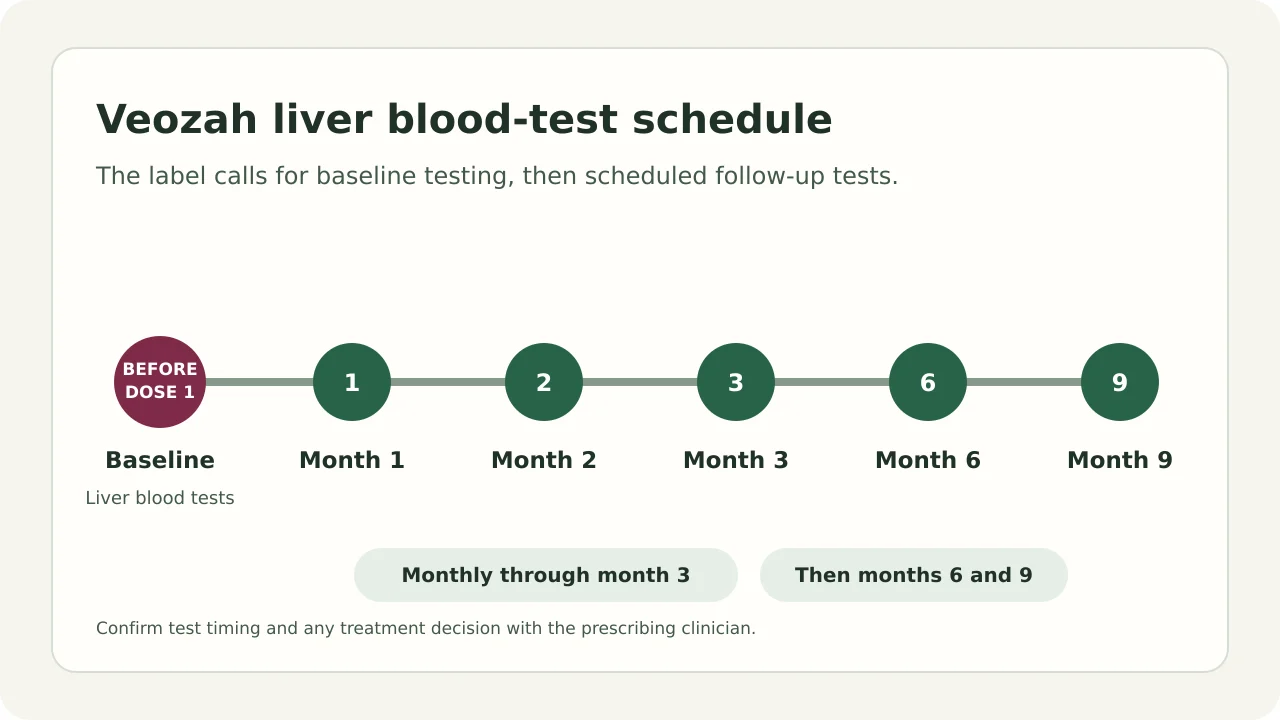
In December 2024, the FDA added a boxed warning, its strongest kind, to Veozah after rare reports of serious liver injury. You need liver blood tests before starting, every month for the first three months, and again at months 6 and 9. If you notice signs of liver trouble, the FDA says to stop taking it and contact your prescriber right away.
How the warning came about
The FDA first warned about liver injury in September 2024. In December 2024 it upgraded that to a boxed warning. In one case the FDA reviewed, liver symptoms appeared within about 40 days of starting the drug. (FDA Drug Safety Communication)
Other countries reacted too. Europe, the UK and Australia all added stronger liver-monitoring advice in 2025. Their exact schedules differ a bit. If you're in the U.S., follow the U.S. label and your prescriber.
How rare is it?
Rare, but serious enough that monitoring is required.
- In the clinical trials: liver enzymes rose to more than three times the normal upper limit in 2.3% of women on fezolinetant, compared with 0.9% on placebo. Liver enzymes are proteins that leak into the blood when liver cells are stressed. A rise isn't the same as liver damage, but it's a warning sign doctors watch.
- In the year-long safety trial (SKYLIGHT 4): no cases met "Hy's law," a pattern doctors use to flag the most serious drug-related liver injury.
- After approval: the label describes rare reports of much larger rises, along with symptoms like fatigue, itching and jaundice (yellow skin or eyes).
Please don't read the 2.3% as your chance of liver damage. It's the rate of an enzyme rise in testing, which is exactly why the tests exist: to catch changes early.
Your first-year blood-test calendar
This is the first part of our care-and-cost worksheet. The test timing comes from the FDA label. The "who and what to confirm" column is our own framework for making the schedule work in real life.
| When | Test | Total tests so far | What to confirm before you start |
|---|---|---|---|
| Before your first dose | Baseline liver panel: ALT, AST, ALP, total and direct bilirubin | 1 | Who orders it, where you go, what it costs, and who reviews the result before you start |
| Month 1 | Liver panel | 2 | Is the lab order already in place? Who calls you with results? |
| Month 2 | Liver panel | 3 | How do results reach your prescriber? Is there a separate fee? |
| Month 3 | Liver panel | 4 | When do you and your prescriber also check whether it's helping enough? |
| Month 6 | Liver panel | 5 | Does your care plan still include result review and refills? |
| Month 9 | Liver panel | 6 | Same questions, especially if your insurance or provider has changed |
| Any time you have symptoms or abnormal results | Extra testing as your clinician decides | No fixed number | How to reach your prescribing team fast, without waiting for the next scheduled test |
Source: Veozah prescribing information, boxed warning and section 2, checked October 16, 2026.
That's six testing visits through month 9. It doesn't mean six doctor visits. Most people just go to a lab. Your prescriber sets the exact dates and can order more tests if needed.
Example dates (approximate): if you start on November 1, 2026, you'd get your baseline test before that day. Then roughly December 1, 2026, followed by January 1, February 1, May 1 and August 1, 2027.
What the tests are, in plain words:
- ALT and AST are liver enzymes.
- ALP is another enzyme linked to the liver and bile ducts.
- Bilirubin is a yellow substance the liver clears from the blood.
These aren't hormone tests. Even if a menopause service says it usually doesn't need hormone labs, Veozah still needs these liver tests.
Your prescriber uses set limits from the label to decide whether you can start and whether to stop. For example, the label says to stop if certain enzymes climb above five times the normal upper limit. You don't need to read your own results against those numbers. That's your prescriber's job, and they should tell you whom to call about results.
Signs of liver trouble: stop and call
If you take Veozah and notice any of these, the FDA says to stop taking it and contact your prescriber right away:
- Feeling more tired than usual - Nausea or vomiting - Unusual itching - Yellow skin or yellow whites of the eyes (jaundice) - Pale or light-colored stools - Dark urine - Swelling of the belly, or pain in the upper right side of the belly - Loss of appetite
Don't wait for your next scheduled blood test.
Source: FDA Drug Safety Communication and the Veozah label, section 5.1.
Normal results at the start don't guarantee normal results later, which is why testing continues. Monitoring lowers the chance of a problem going unnoticed. It doesn't remove the risk.
Side effects, drug interactions and uterine safety
The most common side effects in the year-long safety trial were stomach pain, diarrhea, trouble sleeping, back pain and hot flashes, each in fewer than 5 in 100 women. Fezolinetant must not be taken with medicines that block the CYP1A2 liver enzyme. Estrogen use was excluded from the main SKYLIGHT trials.
Common side effects
These are the side effects reported in at least 2% of women on Veozah, and more often than on placebo, in the 52-week trial.
| Side effect | Veozah 45 mg (609 women) | Placebo (610 women) |
|---|---|---|
| Stomach (abdominal) pain | 4.3% | 2.1% |
| Diarrhea | 3.9% | 2.6% |
| Trouble sleeping (insomnia) | 3.9% | 1.8% |
| Back pain | 3.0% | 2.1% |
| Hot flash | 2.5% | 1.6% |
| Liver enzyme rise | 2.3% | 0.8% |
Source: Veozah prescribing information, section 6.1, table 1. Checked October 16, 2026.
A few things women often search for:
- Weight gain or loss: weight change isn't listed among Veozah's side effects.
- Feeling sleepy or tired: drowsiness isn't listed as a common side effect. Insomnia is. But new, unusual tiredness can be a sign of liver trouble. Follow the FDA's stop-and-call advice.
- Constipation or dry mouth: neither is in the label's side-effect list.
If a side effect bothers you or doesn't go away, tell your prescriber. Possible liver symptoms need the urgent action listed above.
Medicines that don't mix with fezolinetant
Your liver uses an enzyme called CYP1A2 to clear fezolinetant from your body. Some medicines slow that enzyme down. When that happens, fezolinetant can build up. That's why the label says not to take Veozah with CYP1A2 inhibitors.
The label gives these examples:
- Fluvoxamine, an antidepressant, blocks CYP1A2 strongly.
- Mexiletine, a heart-rhythm medicine, blocks it moderately.
- Cimetidine, an acid reducer sold over the counter, blocks it weakly.
That's not a full list. "Weak" doesn't mean the combination is allowed. Bring every prescription, over-the-counter medicine and supplement to your pharmacist or prescriber.
Estrogen: Astellas's medical-information team says estrogen is a weak CYP1A2 inhibitor. Its modeling predicted that estradiol taken by mouth could raise overall fezolinetant exposure by about 57%. It predicted no clinically meaningful change from low-dose vaginal estradiol. These are modeling results, not a clinical combination trial. The main SKYLIGHT trials excluded estrogen use, so ask before combining the two. (Astellas medical information)
Please don't stop, space out or change another medicine on your own to make room for fezolinetant. That's a decision for your prescriber.
What about the uterine lining?
Systemic estrogen taken alone can thicken the lining of the uterus (the endometrium), which is why women with a uterus generally also need a progestogen, such as progesterone, to protect it. Low-dose vaginal estrogen is different. Fezolinetant isn't estrogen, but the FDA still checked the lining in long-term trials.
- Pooled 12-month results (label): 2 of 350 women on the 45 mg dose (0.6%) had a lining problem. One had simple overgrowth of the lining (hyperplasia) without abnormal cells. One had endometrial cancer. No cases were seen in 186 women on placebo.
- What the label concluded: the rate stayed within the standard used to judge lining safety.
Any unexpected vaginal bleeding after menopause should be checked by a clinician, whatever medicines you take.
Pregnancy and women over 65
There's no data on Veozah in pregnancy. The label also says too few women over 65 were studied to know whether they respond differently. Both are reasons to talk it through with a clinician, not to guess.
How much does fezolinetant cost?
With commercial insurance that approves it, the maker's savings card can make Veozah $0 for the first month and as little as $30 a month after that. Paying cash, GoodRx displayed about $485 to $700 for thirty 45 mg tablets when checked on October 17, 2026 UTC, and there's no generic. Visits and liver tests can cost extra.
Your cost depends on how you pay
| How you pay | What's available | What to check next |
|---|---|---|
| Commercial insurance (through work or a marketplace plan) that approves Veozah | For eligible patients, the Astellas savings card may make the first 30-day prescription $0, then as little as $30 per monthly refill. Up to $4,000 in help per calendar year. | Ask your pharmacy to run the claim and tell you your real copay before you fill it |
| Commercial insurance that denies the claim | Astellas may reduce or discontinue assistance; terms describe up to $1,250 total for two 28–31-day fills when assistance is available | Ask your prescriber about prior authorization or an appeal before the help runs out |
| Medicare, Medicaid or other government coverage | The savings card can't be used. Coverage depends on your plan's drug list. Medicare Part D caps out-of-pocket spending on covered Part D drugs at $2,100 in calendar year 2026. | Check your plan's formulary or call the plan |
| No insurance | Astellas Patient Assistance Program: you may pay $0 if you qualify | Apply at the official Veozah support resource |
| Paying cash at the pharmacy | GoodRx displayed a $484.75 coupon price and about $700.45 retail for thirty 45 mg tablets. The savings card isn't valid for cash payers. | Get a current quote for your ZIP code |
| Cash-pay online care (a service that doesn't bill insurance) | A visit or membership price may not include Veozah or the liver tests | Get a written quote for this exact drug and the lab plan before you pay |
Source: Veozah savings terms, checked October 16, 2026; GoodRx Veozah prices, checked October 17, 2026 UTC (displayed prices; pharmacy and location can change the quote); CMS 2026 Part D fact sheet.
A note on the $4,000 cap: that's the most the card will pay in a year. It's not a promise that you'll never pay more than $4,000.
Astellas says 75% of Veozah prescriptions nationwide were approved for payment by insurers between April 2025 and March 2026. That's the company's own figure, based on Symphony Health claims data. It counts prescriptions submitted for payment, including those patients did not pick up; it is not the share of women or insurance plans with coverage.
First three fills and 12 fills: the drug-only math
These are examples, not quotes. They cover the medicine only. Visits, lab tests and any service fees come on top. Three 30-day fills supply 90 days; twelve supply 360 days, not a full calendar year.
| Situation | First fill | First 3 fills (90 days if each is 30 days) | 12 fills (360 days if each is 30 days) |
|---|---|---|---|
| Eligible commercial plan + best advertised card price on every illustrated fill | $0 | $0 + $30 + $30 = $60 | $0 + (11 × $30) = $330 |
| Cash at the lowest GoodRx price we saw | $484.75 | 3 × $484.75 = $1,454.25 | 12 × $484.75 = $5,817.00 |
| Cash at the retail price shown | $700.45 | 3 × $700.45 = $2,101.35 | 12 × $700.45 = $8,405.40 |
| Medicare Part D, if your plan covers it | Depends on your plan | Depends on your plan and fill dates | $2,100 is the calendar-2026 cap for covered Part D drug spending, not a rolling 12-fill cap |
The card row assumes you qualify for the best advertised price on each fill. Real copays can be higher, and future program terms may change. The Medicare cap does not include premiums, uncovered medicines, visits or labs.
A denied-claim example (hypothetical): say your plan denies the claim and your pharmacy charges $700.45 per fill. Two fills would cost $1,400.90. If the program confirmed $1,250 of assistance for those two fills, you'd pay $150.90 for them. A third fill at the same price with no further assistance would bring the three-fill drug subtotal to $851.35. This assumes the assistance is actually granted; it is not guaranteed after a denial. Your pharmacy's price and later coverage may differ.
Add up everything, not just the pill
This is the second part of our care-and-cost worksheet. Fill in what you know. If a required cost is still unknown, your total is incomplete, not zero.
Cost planner · entries are not saved
Plan your confirmed costs and liver-test dates
Enter only amounts and dates you have actually confirmed. The planner does not estimate insurance coverage, savings-card benefits, medical eligibility, or a copay from your plan.
Your planning totals
These are known subtotals from entries marked confirmed. Any missing amount or charge date keeps the relevant total incomplete.
- Due by the budget as-of date
- Known costs due by the as-of date: cost unknown — quote needed. Missing: budget as-of date.
- Pre-start setup, shown separately
- Pre-start setup: cost unknown — quote needed. Missing: planned treatment start date.
- First 90 days [start, start + 90 days)
- First 90 days: cost unknown — quote needed. Missing: planned treatment start date.
- First calendar 12 months [start, anniversary)
- First calendar 12 months: cost unknown — quote needed. Missing: planned treatment start date.
Confirmed medication supply entered: no days entered. A 30-day schedule can create 13 fills inside a 365-day window (days 0 through 360); the tool does not assume 12 fills.
Optional illustration: unchanged future fill prices
This is separate from confirmed totals. Use it only when the first-fill and refill amounts are confirmed, and assume the refill price stays unchanged. It does not infer a benefit from coverage or claim status.
Privacy: this tool runs in this browser tab only. It does not submit, store, or send your entries, and it does not put them in the page URL. Entries clear when you leave or refresh. Copying or printing happens only when you choose it.
Planning aid only. Confirm medication prices, test timing, coverage, and required care with your pharmacy, plan, lab, and prescriber. It is not medical advice, insurance advice, or a treatment recommendation.
| Cost | Setup through the month-3 test | After that | If you don't know it yet |
|---|---|---|---|
| First visit | Actual charge or copay | Usually not repeated | Write "quote needed" |
| Follow-up visits or result reviews | Actual number and cost; not every lab needs a paid visit | Per your clinician's plan | Don't guess a number of visits |
| Membership or service fee | Actual charges by billing date | Renewal amount and how often it bills | Ask if billing is every calendar month or every 28 days |
| The medicine | Actual cost for each fill | Refill cost; note if insurance or savings change | Don't assume the cheapest promo price |
| Liver tests | Baseline, months 1, 2 and 3 (4 tests) | Months 6 and 9 (2 tests), plus any extras | "Unknown" is not $0 |
| Shipping or pharmacy fees | Actual charges | Actual charges | Use $0 only if confirmed |
| Anything else required | Any documented admin or care fees | As they apply | Write down what's missing |
| Total | Add only confirmed items | Redo when terms change | Shows "known subtotal — total incomplete" until every required item is known |
Four scheduled blood tests fall from baseline through the month-3 test. That is not always the same as the first 90 days: for a November 1 start, the February 1 test is 92 days later. Use actual dates when adding bills.
The formula: total for a time period = visits + follow-ups + service fees actually due + medicine + lab tests + shipping + other required charges. If something is truly included in another price, count it once.
Worked example: a woman with commercial insurance qualifies for the $0 first fill and pays $30 for each of the next two fills. Her medicine subtotal for three fills is $60. She doesn't yet know her visit copay or lab costs. Her honest result is: "$60 medicine subtotal; total care cost incomplete." That's the math, not a typical cost.
If insurance says no
A denial isn't always the final word. It doesn't mean the drug is wrong for you, and it doesn't mean an appeal will work. Ask why the claim was denied and whether prior authorization or an appeal is available.
Ask your plan or pharmacy these questions:
- Is Veozah on my plan's drug list (formulary)?
- Do I need prior authorization? That's a form your prescriber sends to show why you need it.
- Do I have to try another treatment first? This is called step therapy. Some plans want you to try estradiol or an antidepressant before Veozah.
- Who sends the paperwork or appeal: my prescriber's office or me?
- Are my lab tests and my prescriber in network?
- What will my next fill cost if the savings help runs out?
Astellas runs a support line for coverage questions: VEOZAH Support Solutions, 1-866-239-1637. Plans vary a lot, so ask your own what the denial means and what to do next.
Is there a generic fezolinetant?
No. As of October 2026, Veozah is the only fezolinetant product in the U.S. Its new-drug exclusivity runs through May 12, 2028, and listed patents run to 2031 and 2034. (FDA Orange Book) That doesn't tell us when a generic will arrive. Be careful with any website selling cheap "fezolinetant" without a prescription.
For more detail on carrier rules and payment options, see Veozah cost without insurance, the Veozah savings card, Veozah prior authorization, does insurance cover Veozah, is Veozah covered by Medicare, and using an HSA for Veozah.
Fezolinetant vs. HRT and other hot flash treatments
Hormone therapy is still the most effective treatment for hot flashes, according to The Menopause Society. Fezolinetant is one of several well-supported non-hormone choices, alongside elinzanetant (Lynkuet), certain antidepressants, gabapentin, oxybutynin, cognitive behavioral therapy and clinical hypnosis. The best fit depends on your symptoms, your health history, your other medicines and what you can keep up with.
HRT: still the most effective option, if it's safe for you
The Menopause Society's 2023 position statement on non-hormone therapy says hormone therapy remains the most effective treatment for hot flashes. That's not a reason to push you toward hormones if you'd rather not take them. It's a fact worth knowing before you choose.
Here's how the two compare in plain terms:
- What they do: systemic hormone therapy (HRT) is estrogen that works throughout your body, as a pill, patch, gel or spray. It treats hot flashes by replacing some of the estrogen your body stopped making. Fezolinetant treats hot flashes by quieting the brain signal without adding estrogen.
- If you have a uterus: systemic estrogen generally needs a progestogen, such as progesterone, to protect the uterine lining. Fezolinetant doesn't.
- Monitoring: HRT doesn't need routine liver tests. Fezolinetant does.
- Who can't use it: HRT isn't right for some health histories, such as breast cancer, past blood clots or stroke. That's exactly where non-hormone options matter most.
Low-dose vaginal estrogen is different from systemic HRT. It treats vaginal dryness and urinary symptoms. It isn't a hot flash treatment.
The cost gap can be big. If hormones suit you, Gala advertises cash-pay HRT at $69 a month. Twelve monthly payments at that price would be $828; confirm the actual billing interval and which medicines are included. Twelve 30-day fills of fezolinetant at the cash prices above cost about $5,800 to $8,400 for the drug alone, covering 360 days. With commercial insurance and the savings card, fezolinetant can cost far less. Those are different medicines, so compare cost only after you know which one fits you.
If you're open to hormones, or want one clinician to weigh both. Gala says its clinicians prescribe FDA-approved forms of estradiol (pill or patch), progesterone and vaginal estradiol. Its HRT plan is advertised at $69 a month, flat. Gala says that covers the medicine, provider review, ongoing messaging and free shipping, with no membership fee and no insurance. Gala also lists fezolinetant among its non-hormonal options. Gala is cash-pay. It hasn't published whether fezolinetant is included in that $69, so ask before you pay. Its HRT pages also conflict on medication status: one mentions compounded medicines. Confirm the exact finished product and what the quoted plan includes. Compounded medicines are not FDA-approved.
We may earn a commission if you start care through this link. A Gala clinician decides whether any treatment is right for you.
For a deeper side-by-side, see Veozah vs. HRT and HRT for hot flashes.
All your options side by side
| Option | Hormone? | FDA-approved for menopause hot flashes? | Menopause Society 2023 | How it's taken | Main tradeoff | Routine lab monitoring? |
|---|---|---|---|---|---|---|
| Systemic HRT (estradiol, generally plus a progestogen if you have a uterus) | Yes | Yes (FDA-approved products) | Most effective treatment | Pill, patch, gel or spray | Not right for some histories, such as breast cancer, clots or stroke | Not routine |
| Fezolinetant (Veozah) | No | Yes, May 2023 | Recommended (strongest evidence level) | 45 mg tablet once a day | Liver warning and testing; cost | Yes: 6 liver tests in 9 months |
| Elinzanetant (Lynkuet) | No | Yes, October 2025 | Approved after the 2023 statement | Two 60 mg capsules at bedtime | Drowsiness; not for use in pregnancy; seizure warning updated August 2026 | Liver tests at baseline and 3 months |
| Paroxetine 7.5 mg (Brisdelle) | No | Yes, at this specific low dose | SSRIs/SNRIs recommended (strongest evidence level) | One capsule at bedtime | Antidepressant-class warnings; may reduce tamoxifen's effect | Not routine |
| Other SSRIs/SNRIs (such as venlafaxine) | No | No (off-label use) | Recommended (strongest evidence level) | Daily | Side effects and drug interactions vary | Not routine |
| Gabapentin | No | No (off-label use) | Recommended (strongest evidence level) | Often at bedtime | Drowsiness and dizziness | Not routine |
| Oxybutynin | No | No (off-label use) | Recommended | Daily | Side effects and age-related concerns to discuss | Not routine |
| Cognitive behavioral therapy (CBT) or clinical hypnosis | No | Not a drug | Recommended (strongest evidence level) | Sessions with a trained provider | Time and finding a provider | None |
Source: The Menopause Society 2023 Nonhormone Therapy Position Statement; Veozah label; Lynkuet label (revised August 2026); Brisdelle label. "Off-label" means a doctor prescribes an approved drug for a use the FDA hasn't specifically approved. These treatments were studied using different comparisons and measures, so this table doesn't rank them.
A note on paroxetine: only the 7.5 mg dose is FDA-approved for hot flashes. Higher doses used for depression aren't the same approval. Its label warns that it may make tamoxifen less effective for breast cancer and suggests considering avoiding that combination.
More head-to-head guides: Veozah vs. paroxetine, Veozah vs. gabapentin, Veozah vs. venlafaxine, oxybutynin vs. Veozah and other non-hormonal menopause options.
Fezolinetant vs. Lynkuet (elinzanetant)
Lynkuet is the newer drug in the same family. Both target the brain's temperature signal, but they differ in ways that can decide which one fits you.
| Veozah (fezolinetant) | Lynkuet (elinzanetant) | |
|---|---|---|
| FDA approval | May 12, 2023 | October 24, 2025 |
| How it works | Blocks the NK3 receptor | Blocks NK1 and NK3 receptors |
| Dose | One 45 mg tablet once a day, any time | Two 60 mg capsules once a day at bedtime |
| Boxed liver warning | Yes (December 2024) | No boxed warning; liver enzyme rise is a listed warning |
| Liver blood tests | Before starting, months 1, 2, 3, 6 and 9 | Before starting and at 3 months |
| Other key warnings | Liver injury | Daytime drowsiness and impairment; pregnancy loss (not for use in pregnancy); seizures (warning updated August 2026) |
| Breast cancer | Cancer history was excluded from the main SKYLIGHT trials; a dedicated trial is underway | FDA accepted an application for hot flashes caused by breast cancer hormone treatment, with Priority Review (September 28, 2026); not yet approved for that use |
| Savings card (commercial insurance) | $0 first month, then as little as $30 | As little as $25 a month |
| Head-to-head trial | None published | None published |
Source: Veozah label; Lynkuet label; Bayer, September 28, 2026; Lynkuet savings. Checked October 16, 2026.
How to think about it: if frequent blood tests are your biggest worry, Lynkuet's lighter schedule may matter. If daytime drowsiness would be a problem for your job or driving, that may tip you toward Veozah. Neither has been proven better than the other. See our full Veozah vs. Lynkuet comparison.
What about supplements, or no medicine at all?
You don't have to take a prescription. Some women decide their hot flashes are manageable, and that's a fair choice. But it helps to know what the evidence supports.
The Menopause Society doesn't recommend supplements and herbal remedies, soy, paced breathing, cooling techniques, avoiding triggers, exercise or yoga, acupuncture, clonidine or pregabalin specifically for treating hot flashes. Some of those, like exercise, are great for your health in other ways. The reasons for not recommending them differ: weak or inconsistent evidence, side effects, or better-supported choices. Weight loss and a procedure called stellate ganglion block have some support. See non-hormonal menopause options for more.
Fezolinetant after breast cancer, in perimenopause or with HRT
"Non-hormonal" doesn't mean right for every health history. If you've had breast cancer, still get periods, or already take hormones or another hot flash medicine, fezolinetant hasn't been well studied in your situation. These cases need a clinician who knows your full history.
If you've had breast cancer or take hormone-blocking treatment
If estrogen is off the table because of cancer, hot flashes can feel like one more thing you're told to live with. You deserve real options, and there are some worth discussing.
Here's what's known about fezolinetant:
- The main SKYLIGHT trials excluded cancer history. The exception was basal cell skin cancer, so those trials do not establish how fezolinetant performs during breast cancer treatment.
- The maker says the evidence isn't settled. Astellas says safety and effectiveness have not been established for people with cancer. (Astellas medical information)
- A trial is underway. A Phase 3 trial in women with breast cancer, called HIGHLIGHT 1, is ongoing.
- For comparison, Lynkuet: the FDA accepted Bayer's application for hot flashes caused by breast cancer hormone treatment, based on a trial called OASIS-4, and gave it Priority Review in September 2026. It isn't approved for that use yet.
Because fezolinetant isn't a hormone, it may be worth discussing with your oncology team. That isn't the same as proven long-term safety in cancer survivors. Please start with the team that manages your cancer care. Bring these questions:
- Is a non-hormone hot flash treatment reasonable with my current cancer treatment?
- Does fezolinetant interact with my cancer medicines?
- If I take tamoxifen, which hot flash options should I avoid? (Some antidepressants, including paroxetine, may weaken tamoxifen.)
- Who will order and review my liver tests?
If you'd like help finding a starting point, The HRT Index's Find My HRT Path tool sends women with a history of breast or hormone-sensitive cancer to an option whose clinicians review that history first. It doesn't replace your oncology team. Breastcancer.org also keeps a helpful patient guide to Veozah.
If you still get periods
Fezolinetant isn't approved for perimenopause, the years before your periods stop. Astellas says it isn't indicated for pre- or perimenopause. The main SKYLIGHT trials enrolled postmenopausal women: at least 12 months without periods, at least 6 months without periods plus a qualifying follicle-stimulating hormone (FSH) blood result, or both ovaries removed.
Irregular periods aren't proof you've reached menopause. If you still bleed sometimes, ask about options that fit this stage. Any bleeding after a year without periods should be checked by a clinician.
If you already use estrogen, progesterone or another hot flash medicine
The main SKYLIGHT trials didn't allow hormone therapy or other hot flash treatments, so they don't establish how well combinations work or how safe they are. Estrogen taken by mouth may also raise fezolinetant levels, as covered above.
If you're on HRT and still having hot flashes, the answer might be a dose or form change, a different medicine, or looking for another cause. That's a conversation with your prescriber. See hot flashes not improving on HRT.
How to get fezolinetant prescribed, online or in person
Your OB-GYN, primary care clinician or an appropriate online menopause clinician may be able to prescribe fezolinetant and manage the required monitoring. If you have commercial insurance, pick a route that sends the prescription to a pharmacy that bills your plan, so the savings card can work. Whichever route you choose, make sure someone is lined up to order and review your liver tests.
Your main routes, compared
| What matters | Gala Health | Midi Health | Your current clinician |
|---|---|---|---|
| Says it offers fezolinetant? | Lists fezolinetant among its non-hormonal options | Lists fezolinetant (Veozah) among its non-hormonal prescriptions | Ask whether they prescribe it and manage monitoring |
| Care style | Online assessment (about 5 minutes); a U.S.-licensed provider reviews it, usually within 24 hours; some states need a short video visit; messaging 7 days a week | Scheduled virtual visits | Your existing office or telehealth setup |
| Published visit or plan price | HRT plan advertised at $69/month flat; fezolinetant price not published | Self-pay visits: $250 first, $150 follow-up; with insurance, your plan's cost-sharing | Your visit copay or charge |
| Ongoing billing | Advertised $69/month for HRT, no membership fee; confirm the renewal interval and fezolinetant charge | Per visit | Per visit |
| Medicine cost | Not stated for fezolinetant | Separate: billed through your pharmacy | Separate: billed through your pharmacy |
| Liver tests | Not described for fezolinetant; Gala says routine hormone labs usually aren't needed (that's different from Veozah's liver tests) | Says it generally uses Labcorp drop-in locations and can order tests elsewhere | Ask who orders and reviews them |
| Insurance | Cash-pay only; FSA/HSA accepted | In-network with most PPO plans; Medicare is out of network (self-pay allowed, but no claims for visits, medicines or services); no Medicaid, even self-pay | Your plan's rules |
| Where | "Most U.S. states"; you aren't charged if your state isn't served | Says it's available in all 50 states | Your area |
| Cancellation | "Cancel anytime" advertised; a linked GLP-1-branded policy states 72 hours' notice and refunds only for medical disqualification. Whether that policy governs HRT is unclear | Ask about visit change rules | Practice policy |
| Best fit | Open to hormones, or wants one online clinician to weigh HRT and non-hormone options, paying cash | Has commercial PPO insurance and wants fezolinetant specifically, with a menopause specialist | Already has a trusted clinician who can handle the liver tests |
Source: Gala hormone health, Gala non-hormonal, HRT offer, alternate HRT page, linked refund policy and terms; Midi pricing and insurance, appointment charges, billing and menopause and breast cancer page. Provider statements are their own, checked October 16–17, 2026. We didn't test these services.
Midi says it requires a card when you book but charges after the visit, with medicines and labs separate. Gala's $69 figure is an advertised HRT price, not a verified fezolinetant quote or amount due today.
Other routes:
- The Veozah website's telehealth link: it connects to a third-party telehealth company called UpScript. Astellas says that company sets and collects its own fee and may not take insurance. We couldn't see that fee for Veozah.
- Evernow: publishes a Veozah prescribing page and offers visits that may be insurance-eligible. See does Evernow prescribe Veozah?
- More routes: see best online Veozah providers and how to get Veozah prescribed online.
Where Gala fits
Gala is a strong fit for two kinds of readers:
- You're open to hormones. Gala advertises HRT at a flat $69 a month and says its options include FDA-approved forms of estradiol and progesterone. Confirm which finished products your quote includes. Since hormone therapy is the most effective hot flash treatment, the advertised price may offer good value if the treatment fits you.
- You want one online clinician to weigh hormones and non-hormone options, including fezolinetant. Gala explicitly lists fezolinetant and says it usually reviews assessments within 24 hours, with messaging seven days a week.
Here's the honest limit: Gala hasn't published what fezolinetant costs through its service, whether the $69 covers it, or how it handles Veozah's liver tests. Those answers change your real cost a lot, so get them before you pay.
"Gala's provider walked me through the options" — Allison, 51, in a testimonial Gala publishes on its hormone health page. This is a provider-published comment about its HRT service, not independently verified, and not a fezolinetant result.
Questions to ask Gala before you pay:
- Do you prescribe brand-name Veozah to someone in my state and age group?
- Is fezolinetant included in the $69 a month, or billed separately? What do I pay today, and what at renewal?
- Can the prescription go to my own pharmacy so I can use my insurance and the Astellas savings card?
- Who orders my baseline and follow-up liver tests, where do I get them, and what do they cost?
- Who reviews each result, contacts me, and handles refills or an abnormal result?
- Does the 72-hour cancellation rule apply to this plan, and what happens to pending lab results if I leave?
Gala lists fezolinetant as one of its non-hormonal options. If online, cash-pay care suits you, start the assessment with those questions ready.
We may earn a commission. Prescription depends on a Gala clinician's review. Confirm your state, the exact medicine, lab arrangements and charges before paying.
Want the full picture on Gala's care, costs and cancellation terms? Read our Gala Health HRT review.
Where Midi fits
If insurance matters most to you and you want fezolinetant specifically, compare a route that bills your plan before paying cash. With commercial insurance, the drug can go through your plan and the savings card. Midi says it's in-network with most PPO plans, lists fezolinetant, and generally sends bloodwork to Labcorp locations.
Two limits to know: Midi says Medicare beneficiaries can only come as self-pay patients and can't submit any claims for Midi visits or medicines. And Midi says it can't treat Medicaid or Medi-Cal patients, even as self-pay. If either applies to you, check your own plan's options first.
This is a non-affiliate link. We don't earn money from this link.
If you already have a clinician
You may not need a new service at all. Ask whether your OB-GYN or primary care clinician prescribes fezolinetant, orders and reviews liver tests locally, and bills your plan. Take the checklist below to that appointment.
Taking fezolinetant day to day
The labeled dose of Veozah is one 45 mg tablet by mouth once a day, with or without food, at about the same time each day. Swallow it whole with liquid; don't cut, crush or chew it. Your prescription label and pharmacist are your best guides, and this page doesn't change anyone's treatment.
How to take it
- One tablet, once a day. With or without food.
- About the same time every day. Pick a time you'll remember.
- Swallow it whole with a drink. Don't split, crush or chew it.
- If you miss a dose: the label says to take it as soon as you can, unless your next dose is less than 12 hours away. In that case, skip it and take the next one at the usual time. Never take two to catch up.
The official Veozah Patient Information has the full instructions. Your pharmacist can walk you through it.
If it isn't helping enough, or seems to fade
Keep a simple note to bring to your prescriber. Write down:
- Roughly how many hot flashes you have each day and night
- Any missed doses
- Any side effects
- Any new medicines or supplements
Then bring it to your prescriber. A note like "eight a day before, five now, still waking twice a night" makes the conversation much easier than "it's not working."
Please don't take extra tablets, take breaks, or add another hot flash medicine on your own. If relief is fading, your prescriber may look at other options. Our guide to Veozah alternatives covers what women often consider next.
Contact your prescriber for a review if relief isn't enough. Possible liver symptoms need action right away. Use the stop-and-call list for those.
Questions to ask before you start or pay
The best appointment starts with your goal and ends with a clear plan. Before you start fezolinetant or pay for a visit, you should know what medicine you'll get, what you'll likely pay, who reviews your blood tests, and how to get help between visits.
This is the third part of our care-and-cost worksheet. Copy it, print it, or screenshot it.
| Ask this | A good answer includes |
|---|---|
| Are my symptoms likely from menopause, and is fezolinetant worth trying for me? | Your clinician's view of the cause, your goals, your risks and other options, including HRT |
| What exact product will I get? | The brand name (Veozah), the dose, and which pharmacy fills it |
| Have you checked all my medicines and supplements? | A full review for CYP1A2 inhibitors and other interactions |
| Are my liver and kidney numbers OK to start? | A baseline test result reviewed before your first dose |
| Who orders and reviews my liver tests? | A named care team, a lab location, approximate dates and a contact for results |
| What will I pay now, in the first three months and after that? | Visit, medicine, lab, membership and shipping costs, with unknowns named |
| Who handles prior authorization or an appeal? | The person or team responsible and what paperwork is needed |
| When will we decide whether it's helping enough? | A check-in time, and what you should track until then |
| What should I do if I get liver symptoms? | A direct way to reach your prescriber fast |
| What happens to refills and pending test results if I switch or cancel? | A written plan, not just a cancel button |
| (If you've had cancer) Has my oncology team weighed in? | Your cancer team's agreement before you start |
This is a conversation and paperwork guide. It isn't a diagnosis, a drug-interaction checker or medical clearance.
How we checked this guide
We checked medical claims against the current FDA label, FDA safety notices, published trials and The Menopause Society. We checked commercial claims against each provider's own pages. This is editorial research from public documents, not a patient test, and no clinician reviewed this page.
For this guide, we apply The HRT Index Verification Standard through five pillars:
| Pillar | What we checked for this guide | Where the limits are |
|---|---|---|
| 1. Clinical legitimacy | Veozah is an FDA-approved, brand-name finished product (approved May 2023), sold by prescription only. We used the current label (revised February 2026). | We didn't check any individual clinician's license. |
| 2. Care quality | How each route handles assessment, messaging, lab orders, result review, refills and continuity, as the providers describe it | What a provider advertises isn't the same as care we've tested. |
| 3. Medication fit | The approved use, the women studied, who shouldn't take it, drug interactions, and special situations like cancer history and perimenopause | A provider listing an ingredient doesn't prove it will prescribe that product for you. |
| 4. Price transparency | Savings-card terms, cash prices, Medicare's 2026 cap, visit fees, what a plan price includes, and what's left unknown | If a required cost is unknown, the total is incomplete, never zero. |
| 5. Access | Insurance rules, state and age limits, lab access, and when another setting is the better start | Your insurer and provider must confirm your own case. |
This guide does not use provider scores or star ratings. We recheck top-provider prices monthly and the full roster quarterly, sooner when something important changes. If you spot an error, our corrections page explains how we fix it. Read more about our methodology.
About money: The HRT Index earns commissions from some providers, including Gala. Featured placement is labeled and doesn't mean a provider is medically better. The Midi, Evernow and UpScript links here are non-affiliate links. See how we make money.
Fezolinetant FAQ
Is fezolinetant the same as Veozah?
Yes. Fezolinetant is the active ingredient, and Veozah is the U.S. brand name made by Astellas. In Europe it's sold as Veoza. Seeing the ingredient name doesn't mean a cheaper generic is available. There isn't one in the U.S.
Does fezolinetant have estrogen in it?
No. The label says Veozah is not a hormone. It contains no estrogen, progesterone or testosterone.
Is fezolinetant an antidepressant?
No. It's an NK3 receptor antagonist, a different kind of drug. Some antidepressants are also used for hot flashes, which is why people mix them up.
How fast does fezolinetant work for hot flashes?
In the main trials, improvement started as early as week 1. The main average effects were measured at weeks 4 and 12. Everyone's timing is different.
Will fezolinetant stop every hot flash?
Probably not. The trials showed average drops, about 2 to 2.6 fewer hot flashes a day than placebo. Some women improve a lot, and some don't notice much.
Does fezolinetant help with night sweats?
Night sweats are hot flashes that happen during sleep, and Veozah is approved to treat both. It isn't approved as a sleep medicine, and insomnia is one possible side effect.
Does fezolinetant cause weight gain?
Weight change isn't listed among Veozah's side effects. It also isn't approved to treat weight, mood or vaginal dryness.
Can I get fezolinetant without a prescription or blood tests?
No. Veozah is prescription-only, and liver tests are part of its labeled care. Be wary of any site offering it without a prescription or labs.
Can I use the Veozah savings card with Medicare?
No. The card isn't valid for anyone whose prescriptions are paid in whole or part by Medicare, Medicaid or other government programs. Check your Part D plan instead.
How long can I take fezolinetant?
The label doesn't set a limit. The trials followed women for up to 52 weeks. How long to continue is something to review regularly with your prescriber.
Is Veozah or Lynkuet better?
Neither has been proven better. They differ in dosing time, side effects and how often you need liver tests. See the comparison table above.
Still deciding where to begin?
You don't have to figure this out alone. The HRT Index's Find My HRT Path tool asks five quick questions:
- What's bothering you most
- What you've already tried
- Your age
- Your state
- Your health history
Then it points you to a featured care option, or tells you when an in-person clinician is the better place to start. It's free, takes about 60 seconds, and doesn't ask for your email. A clinician still decides which treatment, if any, is right for you.
Sources and check dates
Source checks: October 16–17, 2026. Document dates are shown separately.
- Veozah (fezolinetant) prescribing information and Patient Information, DailyMed — revised February 2026
- FDA Drug Safety Communication on Veozah and liver injury — September 12, 2024; updated December 16, 2024
- SKYLIGHT 1, The Lancet, 2023
- SKYLIGHT 2, Journal of Clinical Endocrinology & Metabolism, 2023
- SKYLIGHT 4, Obstetrics & Gynecology, 2023
- DAYLIGHT, BMJ, November 2024
- The Menopause Society 2023 Nonhormone Therapy Position Statement
- Astellas medical information: fezolinetant and estrogens, cancer patients, perimenopause
- Veozah savings and support terms
- GoodRx Veozah prices — displayed prices checked October 17, 2026 UTC; not a stated provider update date
- CMS 2026 Medicare Part D fact sheet
- FDA Orange Book, Veozah patents and exclusivity
- Lynkuet (elinzanetant) prescribing information — revised August 2026
- Bayer: FDA accepts Lynkuet application for breast cancer-related hot flashes — September 28, 2026
- Brisdelle (paroxetine 7.5 mg) prescribing information
- Gala Health: hormone health and non-hormonal options
- Midi Health: pricing and insurance and menopause and breast cancer
- Breastcancer.org: Veozah
- SKYLIGHT 2 full trial report — trial design and postmenopause criteria
- The Menopause Society: hormone therapy — systemic versus local treatment and uterine protection
- Astellas OPTION-VMS preliminary results — October 2, 2026; company-reported observations, not a placebo comparison
- EMA liver-safety communication — dissemination January 13, 2025
- UK MHRA liver-safety update — April 10, 2025
- Australia TGA liver-safety update — October 16, 2025
- Lynkuet original FDA label — October 2025; seizure warning was already present
- Lynkuet savings terms
- Paroxetine mesylate 7.5 mg current generic label — revised December 2025; read alongside the historical Brisdelle label
- Gala HRT offer, alternate HRT page, refund policy and terms
- Midi billing timing, appointment fees and Medicare/Medicaid rules
- Evernow Veozah prescribing page
- FDA: compounded drugs and approval status — checked October 17, 2026 UTC