
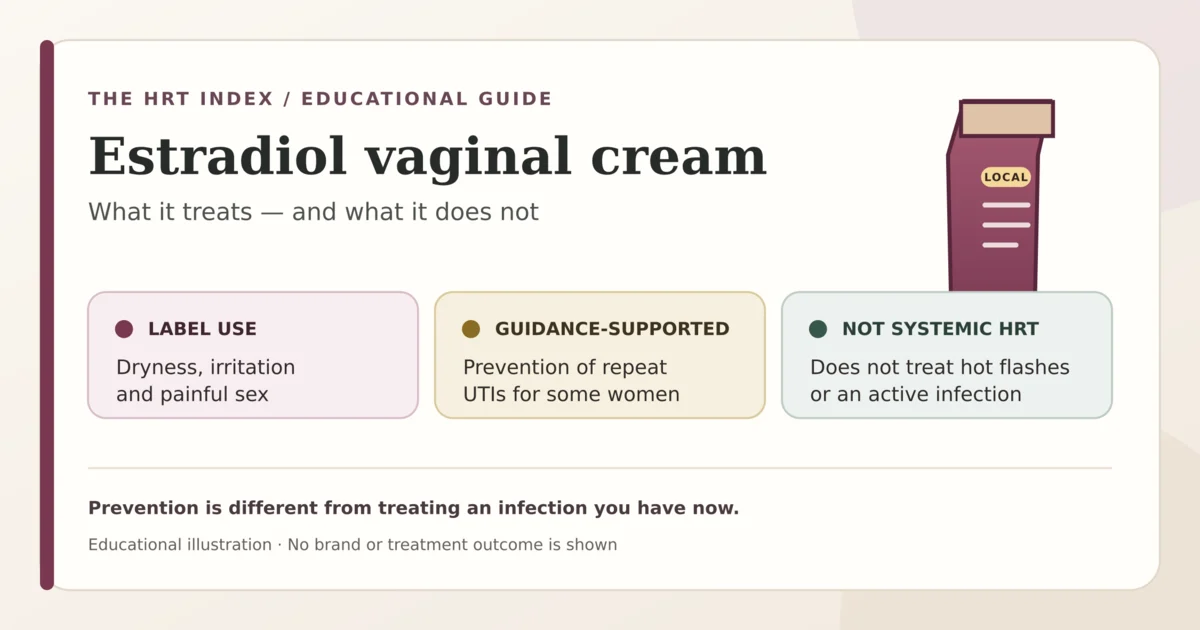
If you're wondering what is estradiol vaginal cream used for, here's the short answer: it treats moderate to severe vaginal dryness, burning, itching and painful sex caused by low estrogen after menopause. Guidelines also support it to help prevent repeat urinary tract infections (UTIs). It won't clear an infection you have right now, and it won't stop hot flashes.
At a glance
- Made for: dryness, burning, itching and pain with sex from menopause. This is the use on its FDA label.
- Also recommended for: lowering the chance of repeat UTIs during perimenopause or menopause. NIH guidance supports this use; it is not listed on the cream label.
- Not for: hot flashes, night sweats, bone protection, low desire, an active infection, or your face. It is not an antibiotic.
- Ask first if: you've had breast cancer, you have bleeding no one has explained, or you're pregnant or breastfeeding.
One honest caution before we go further: dryness and burning don't tell you the cause on their own. Infections, skin conditions and products like soaps can cause the same feelings. Sometimes a clinician needs to look before choosing a treatment.
The HRT Index is the independent decision resource for online menopause and HRT care — comparing telehealth providers on clinical legitimacy, care quality, medication fit, price transparency, and access, with every claim verified and dated, so women can choose the path that fits their situation before their first consult.
What we actually verified · Last verified October 2026
We read on October 17, 2026: prescribing labels for estradiol vaginal cream 0.01% on DailyMed; the FDA's November 2025 labeling request and February 12, 2026 labeling approvals; The Menopause Society's 2022 position statement, 2020 GSM abstract and patient guide; NIH guidance on bladder infections; Gala Health's HRT pages and linked terms; and GoodRx's selected cream prices and Companion pricing.
We confirmed: the cream's approved use and warnings; that the reviewed cream labels still carry boxed warnings; clinical guidance supporting UTI prevention; the displayed cream prices and paid-program conditions for the location shown; and that Gala lists vaginal estradiol cream or tablets.
We did not: buy the cream, use a telehealth service, receive a prescription or talk to a clinician. This is documentation research, not a patient test.
We could not confirm: which exact vaginal product Gala would dispense to you, the full price and terms for your prescription, Cost Plus's current delivered total, or your insurance copay.
We may earn a commission if you start care through some links on this page, including Gala. That doesn't change what we report. How we make money.
On this page: Uses · Symptom check · How it works · Cream vs. patch · UTIs · Safety · How it's used · Cost · Get checked first · Alternatives · Where to get it · Questions to ask · FAQ
What is estradiol vaginal cream used for? The full map of uses
Estradiol vaginal cream is FDA-approved to treat moderate to severe vaginal and vulvar changes caused by menopause — dryness, burning, itching and painful sex. The Menopause Society and NIH also support low-dose vaginal estrogen to help prevent repeat UTIs in appropriate women in or after menopause. That prevention use is not listed on this cream's label. It isn't designed for hot flashes, bones, libido or infections.
First, two terms you'll see a lot.
Genitourinary syndrome of menopause (GSM) is the name doctors now use for the menopause changes in the vagina, vulva (the outer genital area), urethra (the tube that carries urine out) and bladder. It includes dryness, irritation, pain with sex, and some bladder symptoms. The Menopause Society's 2020 position statement estimates it affects about 27% to 84% of postmenopausal women, depending on the study, and says it is likely under-diagnosed and under-treated.
Vulvar and vaginal atrophy is the older name for the thinning and drying part of GSM. It's the term on the cream's label.
Here's the map of uses, sorted by the type of backing.
Status key: FDA-labeled use · supported by clinical guidance · specialist or conflicting use · not an intended use
Swipe or scroll horizontally to view every column.
| What people use it for | Status | What the evidence says | What it means for you | Source |
|---|---|---|---|---|
| Vaginal dryness, itching or burning after menopause | FDA label | The label approves it for "moderate to severe symptoms of vulvar and vaginal atrophy due to menopause." | This is the main job. If this is your symptom and low estrogen is the cause, it's the textbook match. | DailyMed label |
| Pain with sex caused by thin, dry tissue | Part of the label's atrophy use · clinical guidance | The Menopause Society supports low-dose vaginal estrogen for GSM, including dryness, irritation and pain with sexual activity. | A good match when the pain comes from menopause-related dryness. Pain from other causes needs its own look. | DailyMed; The Menopause Society |
| Repeat UTIs after menopause (prevention) | Supported by clinical guidance, not on the label | NIDDK says clinicians may prescribe low-dose vaginal estrogen for repeat bladder infections during perimenopause or menopause. | It helps lower the chance of the next infection. It does not treat one you have today. | NIDDK |
| Urgency, frequency or bladder symptoms that come with GSM | Clinical guidance | The Menopause Society says low-dose vaginal estrogen may help urinary symptoms, including overactive bladder. | Worth asking about. It's an option, not a sure fix for bladder problems. | The Menopause Society |
| Dryness that's still there while you take hormone replacement therapy (HRT) pills or patches | Clinical guidance | The Menopause Society says vaginal estrogen may still be needed when vaginal symptoms persist with low-dose oral or transdermal HRT. | Whole-body HRT doesn't always fix vaginal symptoms. Adding a local treatment is an option to discuss with your prescriber. | The Menopause Society |
| GSM after breast cancer | Label and clinical-guidance difference | ACOG supports discussing low-dose vaginal estrogen after nonhormonal treatment has failed, with the care team involved. The cream's label lists past breast cancer as a reason not to use it. | This is a decision for you, your gynecologist and your oncologist. | ACOG evidence appendix; DailyMed |
| Dryness while breastfeeding | Not recommended by this label | The label says it should not be used during breastfeeding, and estrogen can lower milk supply. | Talk with your OB first. | DailyMed |
| Labial adhesions (fused labia) in young girls | Pediatric, off-label | A pediatric clinician may prescribe estrogen cream for significant labial adhesions; mild adhesions may only need monitoring. Estradiol vaginal cream is not indicated in children. | Only under a pediatrician's direction. Never borrow from an adult's tube. | Boston Children's Young Women's Health; Cleveland Clinic |
| Hot flashes and night sweats | Not what it's for | This is a local treatment. Medicines for bothersome hot flashes include whole-body (systemic) estrogen and non-hormonal options. | If hot flashes are your main problem, this cream is the wrong tool. | DailyMed; The Menopause Society |
| Bone protection | Not what it's for | Osteoporosis prevention is on some systemic estradiol labels, not on the vaginal cream's label. | Don't count on it for your bones. | DailyMed |
| Low sex drive | Not a desire drug | It treats tissue, not desire. If pain was making you avoid sex, comfort can help indirectly. | Ask about desire as its own question. | The HRT Index: libido |
| An active UTI, yeast infection or bacterial vaginosis (BV) | Not a treatment | It's a hormone, not an antibiotic or antifungal. A yeast infection is listed as a possible side effect. | Get tested and treated first. | DailyMed; NIDDK |
| Face or neck wrinkles | Not approved for facial use | The label is for vaginal use only. | Ask a dermatologist about products made for skin. | Cleveland Clinic |
Source: Sources read October 17, 2026. "Labeled" refers to FDA-approved estradiol vaginal cream 0.01% products such as generic Estrace. It does not describe compounded creams.
The one use on the label
Every FDA-approved estradiol vaginal cream 0.01% we reviewed lists one indication: moderate to severe symptoms of vulvar and vaginal atrophy due to menopause. In plain words, that means tissue in and around the vagina that has become thin, dry, fragile and uncomfortable because estrogen dropped.
Notice the two conditions built in. The symptoms are "moderate to severe," and they're "due to menopause." Mild dryness may do fine with a moisturizer. Dryness from another cause may need a different treatment.
Uses backed by guidelines but not on the label
"Off-label" means a clinician prescribes an approved medicine for a use that isn't written on its label. In the U.S., clinicians can generally do this when they judge it medically appropriate. The FDA has not approved that specific use; ask what studies or guidelines support it.
For estradiol vaginal cream, preventing repeat UTIs is an important off-label use. The NIH describes low-dose vaginal estrogen as an option for repeat bladder infections during perimenopause or menopause. We cover it in its own section below.
What it's not for
If your night sweats wake you at 3 a.m., this cream won't change that. If you have a burning bladder infection today, it won't clear it. If you want firmer skin on your face, it isn't made for that. Knowing what a medicine can't do is just as useful as knowing what it can.
Which symptoms does it help — and which need something else?
Estradiol vaginal cream can help dryness, burning, itching and painful sex caused by menopause-related tissue changes, and help prevent repeat UTIs in appropriate patients. It is not a treatment for hot flashes or night sweats, or a general sleep or mood medicine. Bleeding after menopause is a "get checked first" symptom, not a cream symptom.
Find your main symptom in the left column.
Swipe or scroll horizontally to view every column.
| Your main symptom | Does estradiol vaginal cream target it? | Better-matched option if not | Sensible next step |
|---|---|---|---|
| Dryness, itching or burning "down there" | Yes, when caused by menopause-related tissue changes (label use) | A moisturizer may be enough when it's mild | Your prescriber or an online menopause service |
| Pain with sex from dryness | Yes | A lubricant during sex helps in the moment | Same |
| Repeat UTIs after menopause | Yes, to help prevent them (guideline use) | Testing and antibiotics for any current infection | A clinician who can order a urine culture |
| Bladder urgency or frequency along with dryness | Maybe (clinical guidance) | A bladder evaluation | A clinician exam |
| Hot flashes or night sweats | No | Systemic estrogen, or a non-hormonal option such as fezolinetant | See HRT for hot flashes |
| Dryness and hot flashes | Partly — the dryness only | Systemic HRT, sometimes with local treatment too | A service that can treat both |
| Low desire with no pain | No | A desire-focused conversation | Libido guide |
| Any bleeding after menopause | Get the cause checked promptly | An in-person exam | A gynecologist, not online-first |
| Dryness while breastfeeding, on birth control or under 35 | Ask first | The cause may be different | An OB-GYN |
Two short examples, made up to show how this works (not real patients):
- Maria, 58, has had three UTIs this year, and sex has started to hurt. Both problems sit right in the cream's lane. Her next step is a clinician who can confirm the cause and talk about prevention.
- Jen, 49, has night sweats most nights and some dryness. The cream would only help half her problem. She needs a conversation about whole-body treatment, maybe with local treatment added.
A quick self-check
These answers stay in your head. Nobody sees them. But they change the best route.
- Is my main bother vaginal or urinary, rather than hot flashes?
- Have I had any bleeding after menopause that no one has explained?
- Have I ever had breast cancer, or been told to avoid estrogen?
- Yes, no, no: local treatment is worth discussing if menopause-related tissue changes explain your symptoms. An infection or another cause may still need checking. See where to get it — or, if you already have a prescription, the questions to ask.
- Bleeding or cancer history: start with an in-person clinician or your cancer team. See when to get checked first.
- Hot flashes are the main bother, or you have both: cream alone would not treat your full set of symptoms.
If your answers don't land neatly in one place, that's normal. The right online menopause care isn't the same for every woman — it depends on your symptoms, what you've already tried, your age, your state and your health history. Some situations belong with an in-person clinician first. Use The HRT Index's Find My HRT Path tool to explore a featured care option for your situation — and to flag when online care isn't the right starting point — before your first consult.
It's free, takes about 60 seconds and doesn't ask for your email. It asks five questions, and "vaginal dryness or painful sex" is one of the choices. It doesn't diagnose anything or decide whether you should use hormones. A clinician does that. We may earn a commission from the providers it features, and that affects which ones appear.
How does estradiol vaginal cream work, and is it systemic?
Estradiol vaginal cream puts a small amount of estrogen right where the tissue needs it. That helps the vaginal lining thicken, make more of its own moisture and return to a healthier balance. At low doses, The Menopause Society says very little reaches the bloodstream — but the FDA label still says some absorption "may occur."
What changes after menopause
Before menopause, your ovaries make estradiol, the main form of estrogen. The tissue of the vagina, vulva, urethra and bladder has lots of estrogen receptors. Think of them as docking spots that keep the tissue thick, stretchy and moist.
When estrogen drops, that tissue gets thinner and drier. It loses some stretch. Its natural acid balance shifts, so the "good" bacteria called lactobacilli may thin out. That's why the same change can show up as dryness, pain with sex, irritation and repeat UTIs. A University of Rochester menopause clinician explains it this way: estradiol helps keep blood flow, moisture and protective bacteria in this area.
A moisturizer adds water for a day or two. Estradiol works on the tissue itself. The Menopause Society describes vaginal estrogen as both moisturizing and rebuilding the tissue.
Local vs. systemic, in plain words
- Local means it works mainly where you put it.
- Systemic means it travels through your whole body.
Estradiol vaginal cream is used for local symptoms. The Menopause Society says very little goes into your blood at low doses, so the risks are far lower than with whole-body estrogen. Its 2022 statement describes minimal systemic absorption. The amount absorbed can vary with the product and how it is used.
That's "very little," not "none." The FDA label says plainly that "systemic absorption may occur." How much depends on the product and how much you use. Some marketing pages say vaginal estradiol has no whole-body exposure at all. That goes further than the label.
So, is estradiol cream systemic? It's designed to be local. A small amount can reach the blood.
What's in the tube: reading the label
- Ingredient: estradiol, an estrogen hormone. So yes, estradiol cream is a hormone, and yes, it is estrogen.
- Strength: "0.01%" means each gram of cream contains 0.1 milligram (mg) of estradiol. That's 100 micrograms per gram. This is just how to read the label. It's not a dose and not how much reaches your blood.
- Tube: the standard size is 42.5 grams, with a reusable applicator marked in grams.
- Brand and generic: Estrace is the brand. Several companies make the FDA-approved generic. You can see them on DailyMed.
- Your instructions: the amount and how often are on your prescription. They're separate from the strength.
If you've seen "estradiol 1 mg" or "estradiol 2 mg," those are usually tablet strengths, not cream. Don't compare a gram of cream to a pill or a patch as if they were the same dose. They aren't.
Is estradiol the same as estriol?
No. Estriol is a different, weaker form of estrogen. In the U.S., estriol creams are usually made by compounding pharmacies, which mix a medicine for one patient. The FDA says compounded drugs are not FDA-approved and that it does not review their safety, effectiveness or quality before they are marketed.
The Menopause Society says custom-compounded hormones are not safer or more effective than approved bioidentical hormones. "Bioidentical" describes the molecule. It doesn't tell you whether the finished product is FDA-approved. Our guide to compounded vs. FDA-approved HRT goes deeper.
How is estradiol cream different from a patch, pill, tablet or ring?
The route and the product decide what an estrogen treatment is built to do. Vaginal cream and other low-dose vaginal products focus on local symptoms, while patches and pills send estrogen through the whole body for hot flashes and other goals. Two products can both contain estradiol and still do different jobs.
This is one of the most common worries we see. One woman in a menopause forum discussion put it simply: she was afraid she was "effectively double dosing" with a patch and a cream. It's a fair question, and it deserves a real answer from her prescriber.
Swipe or scroll horizontally to view every column.
| Product | Its main job | Local or systemic | What's different | Question to ask |
|---|---|---|---|---|
| Estradiol vaginal cream 0.01% (Estrace, generics) | Menopause vaginal and vulvar symptoms | Local treatment; systemic absorption can occur | Measured with an applicator; amount can be adjusted by the prescriber | "Show me the exact amount and where it goes." |
| Vaginal estradiol tablets or inserts (Vagifem, its generic Yuvafem, Imvexxy) | Local vaginal symptoms (exact use depends on product) | Local | A small premeasured insert. Less mess than cream. Not a pill you swallow. | "Would an insert fit me better than cream?" |
| Estring (estradiol vaginal ring) | Local menopausal vaginal symptoms | Local | Soft ring that stays in place and is replaced about every 3 months | "Is this the local ring you mean?" |
| Femring (vaginal ring) | Moderate to severe hot flashes/night sweats and vulvar/vaginal atrophy symptoms due to menopause | Systemic | Placed in the vagina but works through the whole body | "Is this a systemic ring or a local one?" |
| Estradiol patch, gel, spray or pill | Hot flashes, night sweats, other whole-body symptoms | Systemic | Different delivery, goals and safety talk. A uterus usually needs progesterone protection. | "Which symptoms is this meant to treat?" |
| Premarin vaginal cream | Vaginal symptoms (a different estrogen: conjugated estrogens) | Local treatment; systemic absorption occurs | Not estradiol. People sometimes mix up the names. | "Which estrogen is in my cream?" |
| Vaginal moisturizer or lubricant | Comfort without a prescription | Not a hormone | Moisturizers help every day; lubricants reduce friction during sex | "Could a non-hormonal option be enough?" |
Product facts from FDA labeling on DailyMed and The Menopause Society, checked October 17, 2026. We don't compare doses across products, because a gram of cream and a patch's daily release aren't the same thing.
Why you might get a cream when you already use a patch
A patch or pill can calm hot flashes and still leave vaginal dryness behind. The Menopause Society says that if you take low-dose oral or skin estrogen, you may need to add a vaginal estrogen to get relief.
So getting both isn't automatically a mistake. Each one may have a separate job. But the decision belongs to the clinician who sees your full medicine list. Don't add a cream on your own, and don't use extra patch to "cover" dryness.
Here's a made-up example. Someone's hot flashes improve on a patch, but sex still hurts. Her next visit should be about that leftover symptom: what's causing it, and whether a local treatment fits. It isn't a sign she needs a bigger patch.
Our guide to using vaginal estrogen with HRT pills or patches covers this in more depth.
Already have two prescriptions? Take one clear question to your prescriber: "What separate job is each medicine meant to do?" You'll find it, and seven more, in our questions to ask.
Can estradiol vaginal cream prevent UTIs?
Yes, for many women in or after menopause who keep getting UTIs. NIDDK says a clinician may prescribe low-dose vaginal estrogen during perimenopause or menopause to help prevent repeat bladder infections. It works as prevention only. It is not an antibiotic, and it won't clear an infection you have right now.
This is the use that surprises most people, so let's be clear about what it is and isn't.
How it helps
The NIH's kidney and urology institute says that if you're in perimenopause or menopause and get repeat bladder infections, a clinician may prescribe low-dose vaginal estrogen. It explains that this increases "good bacteria" and helps prevent infection.
The idea is simple. Healthier tissue and more protective bacteria near the urethra make it harder for infection-causing bacteria to settle in.
What it doesn't do
It doesn't kill bacteria. When a bladder infection is caused by bacteria, the NIH says clinicians usually prescribe antibiotics chosen for that bacteria and your allergies. So the cream and an antibiotic do two different jobs: one treats today's infection, and the other helps lower the chance of the next one.
That's also the answer to a question people type into search engines: is estradiol cream an antibiotic? No. It's a hormone.
What to bring to the conversation
- The dates of your past UTIs, as best you remember.
- Whether each one was confirmed with a urine test or culture.
- What antibiotics you took and whether they worked.
- Whether you also have dryness or pain with sex.
When a UTI can't wait
Urinary symptoms with fever, chills, nausea, vomiting, or pain in your back or side can mean a kidney infection. That needs prompt medical care, the same day. A cream is not a substitute for that visit.
How long until it helps with UTIs?
No label or guideline we read promises a timeframe for UTI prevention. Ask your clinician when you'll review whether it's working.
Is estradiol vaginal cream safe? Why the label sounds scarier than the guidelines
For most women who are good candidates, low-dose vaginal estrogen is considered one of the lower-risk hormone treatments, because so little reaches the blood. The confusing part is that many cream labels still carry a boxed warning written with whole-body hormone therapy in mind, while current guidance distinguishes low-dose vaginal estrogen from whole-body hormone therapy. Some health histories still call for extra care.
If you opened your pharmacy leaflet and felt your stomach drop, you're not alone. Here's what's going on.
What a boxed warning is
A boxed warning is the FDA's most prominent safety warning. It sits in a black box at the top of the label. For years, estrogen products — including vaginal ones — shared the same class-wide box about endometrial cancer, heart disease and stroke, breast cancer and probable dementia.
What changed, and what hasn't yet
- November 10, 2025: the FDA asked drug companies to change menopause hormone labels. For all products, including local vaginal ones, it asked them to remove the boxed language about heart disease, breast cancer and probable dementia. It also asked them to remove the endometrial-cancer box language except on systemic estrogen-alone products.
- February 12, 2026: the FDA approved the first label changes for six products. 29 companies had submitted changes. The only vaginal product in that first group was Estring, the local ring.
- As of October 17, 2026: the generic estradiol vaginal cream label we read on DailyMed still carried the full boxed warning.
So a request is not the same as a finished label change. Your cream's leaflet may still show older wording. It may change at a later refill. You can ask your pharmacist whether your product's label has been updated. Our explainer on the 2026 HRT label changes tracks this.
Label, guidelines and marketing, side by side
Swipe or scroll horizontally to view every column.
| Question | The cream's FDA label says (DailyMed, read Oct 17, 2026) | Medical guidance or FDA updates | Marketing pages say | What to do with that |
|---|---|---|---|---|
| Boxed warning | Still boxed: endometrial cancer, cardiovascular disorders, breast cancer, probable dementia | FDA asked in Nov 2025 for local vaginal products to drop these box statements; Estring's label changed Feb 2026 | — | Older leaflet language may not reflect the FDA's newer view for local products. Ask your pharmacist. |
| Does any get into my blood? | "Systemic absorption may occur." | Minimal systemic absorption with low-dose vaginal estrogen (The Menopause Society). This does not mean no absorption. | Some say "without systemic hormone exposure" | "Very little," not "none." |
| Do I need progesterone too? | Adding a progestin is "generally recommended" for a woman with a uterus | With low-dose vaginal estrogen, a progestogen is not indicated (The Menopause Society, 2020), though trials haven't studied endometrial safety beyond one year | — | Ask whether the low-dose exception applies to your exact prescription. Report any bleeding. |
| Breast cancer | Don't use with known, suspected or past breast cancer | ACOG: discuss low-dose vaginal estrogen after nonhormonal treatment fails; involve the cancer team, especially with aromatase inhibitors | — | Survivors start with their oncologist. |
| Repeat UTIs | Not a label use | NIDDK: a clinician may prescribe low-dose vaginal estrogen for repeat infections in perimenopause or menopause | — | It's guideline-backed, not label-approved. |
| Breastfeeding | Should not be used during lactation | — | — | Ask your OB. |
Do you need progesterone with vaginal estradiol?
The endometrium is the lining of the uterus. Estrogen alone can make it grow too thick, which is why women with a uterus who take systemic estrogen usually also take a progestogen, such as progesterone, for protection.
For low-dose vaginal estrogen, The Menopause Society's 2020 statement says a progestogen is not indicated. It also notes that clinical trials haven't studied endometrial safety beyond one year. Its 2022 statement repeats this low-dose distinction.
The cream label gives a broader instruction to discuss adding a progestin if you have a uterus. The low-dose guidance is more specific: ask your prescriber whether your exact cream prescription falls within it, and report any vaginal bleeding right away. If you already take progesterone because you're on a patch or pill, this guidance is not a reason to stop it. Ask your prescriber what each medicine is for.
What about breast cancer?
The Menopause Society's 2022 statement reports reassuring cancer findings from long-term observational studies of vaginal estrogen users. Those findings do not prove that every product and dose is risk-free.
For breast cancer survivors, it's more careful. The American College of Obstetricians and Gynecologists' 2021 clinical consensus says to try non-hormonal options first. If they aren't enough, low-dose vaginal estrogen can be discussed. For someone taking an aromatase inhibitor (a type of breast cancer medicine), that decision should involve you, your gynecologist and your oncologist together. None of this cancels the label's contraindication. It means the choice belongs to your care team, not to a checkout page.
Who should not use it, according to the label
The FDA label says not to use estradiol vaginal cream if you have:
- Abnormal genital bleeding that hasn't been diagnosed
- Known, suspected or past breast cancer
- A known or suspected cancer that grows with estrogen
- A current or past blood clot in a leg or lung (DVT or PE)
- A current or past stroke or heart attack
- A serious allergic reaction to this cream
- Liver disease or liver problems
- A known clotting disorder, such as protein C, protein S or antithrombin deficiency
- A known or suspected pregnancy
The Cleveland Clinic medicine guide also lists medicines to mention, including aromatase inhibitors, tamoxifen, raloxifene and warfarin.
Side effects to know about
The label lists these among the possible side effects:
- Burning, irritation or itching where you insert it
- Vaginal yeast infection
- Breast pain
- Headache
- Irregular spotting or bleeding
- Stomach cramps or bloating
- Nausea
- Fluid retention
Burning and irritation are listed side effects. The cause may still need checking. Don't push through it quietly. Tell your prescriber, who may check the cause or suggest a different form. And as always, report any bleeding.
Clinical-trial evidence for endometrial safety beyond one year is limited. That's another reason unexplained bleeding always gets checked.
How is estradiol vaginal cream used, and how long until it helps?
Estradiol vaginal cream goes inside the vagina using the marked applicator that comes with the tube. It's usually used daily at first, then a few times a week once the tissue recovers. Your prescription sets your amount and schedule. Most people need weeks to notice change, and the NHS says it can take up to three months to work fully.
What the label's schedule looks like
This is what the FDA label prints. It is not advice for you, and your prescriber may write a different amount.
- Start: 2 to 4 grams a day for one or two weeks.
- Then: about half that amount for a similar period.
- Maintenance: 1 gram, one to three times a week, once the tissue has recovered.
Your prescription label wins. If it says something different from the above, follow your prescription and ask your pharmacist if anything is unclear.
Get three things in writing
Strength, amount and schedule are three separate things. The tube shows the strength (0.01%). Your prescription should show the amount (grams, using the applicator marks) and how often. If any of the three is missing or confusing, ask before you start.
One forum post summed up the problem in four words: the applicator "does not make sense." You're allowed to ask your pharmacist to show you the exact mark. Try: "Please show me the mark on this applicator, and write down where, how much and how often I should use it."
Step by step, from the medicine guide
The product's patient leaflet and Cleveland Clinic medicine guide describe the basics. Follow the instructions supplied with your exact tube and applicator:
- Wash your hands.
- Fill the applicator to the prescribed mark.
- Lie on your back with your knees bent.
- Insert the applicator gently and push the plunger.
- Wash the applicator as its leaflet directs, using mild soap and warm water. Do not boil it or use hot water.
- Wash your hands again.
Many people use it at bedtime so it stays in place longer. If you miss a dose, use it when you remember unless your next one is close. Don't double up.
What about using it at the opening instead of inside?
Some clinicians have patients apply a small amount to the vaginal opening, especially for discomfort there. A University of Rochester menopause clinician describes this approach. It isn't the label's default. If inserting the applicator worries you, ask whether external use fits your prescription.
How long until it helps?
The NHS says vaginal estrogen can take up to three months to work fully, and to speak to a doctor if you don't feel better by then.
Good signs of progress are less day-to-day dryness, less burning, and more comfort with sex or exercise. If a symptom stays the same, changes or gets worse, that's a reason to follow up, not to guess a new dose.
Do you have to use it forever?
Not necessarily. But symptoms can come back when you stop. The NHS says menopause symptoms might return after stopping vaginal estrogen. The FDA label asks you to talk regularly with your provider about whether you still need it. How long to continue is a decision you revisit together.
Sex, condoms and practical questions
Leaks, mess and timing around sex are real reasons people stop using a treatment. Mention them. Your pharmacist can tell you whether your exact cream has any advice about condoms or other barrier products. If cream doesn't suit your life, an insert or ring may — see alternatives.
Will a tube last long? A quick calculation
For this 52-week example, imagine a written prescription that says 2 grams daily for one week, then 1 gram daily for one week, then 1 gram twice weekly. This is a supply calculation, not a schedule to start or change to. For a 42.5-gram tube:
- First two weeks: 14 g + 7 g = 21 grams.
- That leaves 21.5 grams. At 2 grams a week, that is about 10.75 more weeks.
- The first tube lasts roughly 12–13 weeks in this example.
- Later full tubes, at 2 grams a week, last about 21 weeks (42.5 ÷ 2 = 21.25).
- Over 52 weeks, or 364 days: 21 g + (50 weeks × 2 g) = 121 grams.
- That requires 3 whole tubes, containing 127.5 grams in total. The arithmetic leaves 6.5 grams beyond the amount modeled.
At a different prescribed maintenance amount of 1 gram three times weekly, a full tube would provide roughly 14 weeks (42.5 ÷ 3 = 14.17). These are estimates: the exact days of use, how much remains in the tube, and the pharmacy's supply instructions affect refill timing. A fraction left in a tube is not an instruction to use a smaller amount.
To estimate your own supply, use the numbers on your written prescription. If the amount or schedule is unclear, ask your prescriber or pharmacist to explain it.
What does estradiol vaginal cream cost?
For one 42.5-gram tube of generic estradiol vaginal cream 0.01%, we verified a $36.74 standard GoodRx coupon price at Harris Teeter in ZIP 23917 on October 17, 2026. Lower displayed Companion prices require a paid membership. Your total also depends on any visit charges, extra pharmacy fees, shipping and insurance coverage. The table below separates those costs.
Cash prices for one tube (generic, 0.01%, 42.5 g)
The GoodRx observations below were for one tube in ZIP 23917. We checked them on October 17, 2026; GoodRx marked the coupon prices updated October 16. Check that any quote shows the cream, its strength and tube size; estradiol patches and oral tablets have different prices.
Swipe or scroll horizontally to view every column.
| Where | Price per tube | What's added or required | Checked |
|---|---|---|---|
| Harris Teeter via standard GoodRx coupon | $36.74 | Standard coupon price; no Companion membership required. Prescription required. | Oct 17, 2026 |
| CVS / Target CVS via GoodRx Companion | $32.22 | Paid Companion membership; fee not included in this tube price. | Oct 17, 2026 |
| Walgreens via GoodRx Companion | $44.74 | Paid Companion membership; fee not included in this tube price. | Oct 17, 2026 |
| Walmart via GoodRx Companion | $40.87 | Paid Companion membership; fee not included in this tube price. | Oct 17, 2026 |
| Food Lion / Giant Pharmacy via GoodRx Companion | $27.74 | Paid Companion membership; fee not included in this tube price. | Oct 17, 2026 |
| Harris Teeter via GoodRx Companion | $32.74 | Paid Companion membership; fee not included in this tube price. | Oct 17, 2026 |
| Mark Cuban Cost Plus Drugs (mail order) | Check the current quote | Ask for the current price for your prescribed quantity and the delivered total. Check which dispensing fees are already included and whether shipping is extra. | Get a current quote |
| GoodRx's displayed average retail benchmark | $310.37 | Cream-specific aggregate retail figure; not a guaranteed quote from a pharmacy near you. | Oct 17, 2026 |
| Your insurance or Medicare Part D plan | Your plan's cost | Check the exact product, strength, quantity, formulary status, deductible and copay with your plan. | Check your plan |
Companion is a paid program. GoodRx lists $14.99 monthly or $119.88 paid annually. The annual plan's $9.99 monthly equivalent is billed as an annual charge. Membership is separate from the medicine price, and its discounts are used instead of insurance for that purchase, not combined with an insurance copay. A standard GoodRx coupon does not require Companion.
Prices can change and vary by location. The medicine prices exclude membership unless stated, any other applicable charges, and any prescription or follow-up visit. Check the pharmacy's final quote. An existing valid prescription does not necessarily require a new paid visit.
What 52 weeks might cost: a worked example
The hypothetical prescription example above uses 121 grams over 52 weeks, so it needs 3 whole tubes. This table assumes three separate one-tube fills at unchanged prices. It estimates spending; it does not authorize a supply or tell you when to refill.
Swipe or scroll horizontally to view every column.
| Route | Math | Medicine and listed program cost over 52 weeks | What's still missing |
|---|---|---|---|
| Harris Teeter, standard GoodRx coupon | 3 × $36.74 | $110.22 | Any prescription or follow-up care, extra fees or applicable tax |
| CVS / Target CVS, Companion with a new annual membership | 3 × $32.22 + $119.88 | $216.54 | Any prescription or follow-up care and other costs |
| Harris Teeter, Companion with a new annual membership | 3 × $32.74 + $119.88 | $218.10 | Any prescription or follow-up care and other costs |
| Walgreens, Companion with a new annual membership | 3 × $44.74 + $119.88 | $254.10 | Any prescription or follow-up care and other costs |
| Cost Plus Drugs | A current one-tube quote and its included/extra fees are needed first | Not calculated | Verified medicine price, fee treatment, shipping and any care costs |
| GoodRx average retail benchmark | 3 × $310.37 | $931.11 | A real local pharmacy quote and any care costs |
The membership changes the comparison. The CVS medicine subtotal alone is $96.66, but adding a new annual Companion membership makes it $216.54. If you already pay for Companion for other reasons, show that existing membership cost separately rather than treating it as a new fee for every prescription. Twelve monthly Companion charges would be $179.88 instead of the $119.88 annual charge; this table uses the annual option and excludes introductory trial offers.
This is a 52-week example, not a quote for future fills. Your prescription may use more or less cream. Costs that are unknown remain missing, so these figures are not complete care totals. They also do not assume you can buy all three tubes at once.
The visit is part of the cost
You need a valid prescription, but that does not always mean paying for a new visit. If you already have a prescription or a clinician who manages it, ask whether a refill needs an appointment and whether another charge applies.
- Your own doctor or gynecologist. Check whether the clinician is in your plan's network and what any required visit would cost after your deductible or copay.
- An online menopause service. Some charge per visit and send the prescription to your pharmacy. Others, like Gala, advertise a bundle of care and medicine. Confirm that the quoted charge covers your exact prescription. Our guide to getting vaginal estrogen online compares the routes.
Insurance, HSA and FSA
Coverage and copays depend on your insurance or Medicare Part D plan, its formulary and deductible, and the exact product and quantity. Check the drug list for "estradiol vaginal cream" and ask for your cost at the pharmacy you plan to use. Compare that quote with a standard cash coupon price before choosing how to pay.
HSA and FSA cards can usually be used for prescription medicine. You're using a tax-advantaged account, not insurance paying for the prescription. Check your account's rules if you're unsure.
The takeaway: if you only need the cream and already have a prescriber, the medicine itself can be inexpensive. Paying more makes sense when you're paying for something else too — like ongoing access to a clinician who can also treat your other menopause symptoms.
When should you get checked in person first?
Get checked first — ideally in person — if you have vaginal bleeding after menopause that no one has explained, symptoms of an active infection, or new unusual discharge or pain. A history of breast or other estrogen-sensitive cancer, pregnancy or breastfeeding also calls for a direct conversation with your clinician before starting. A cream isn't a way to find out what's wrong.
Bleeding after menopause
Bleeding after menopause should always be checked. It isn't always serious, but it needs a proper look before anyone blames dryness or starts a hormone. The cream's label lists undiagnosed bleeding as a reason not to use it. This is a time for a gynecologist, not an online-first visit.
Signs of an infection
- Burning when you pee, needing to go often, cloudy urine: possibly a bladder infection. Get tested.
- Fever, chills, nausea, vomiting, or back or side pain with urinary symptoms: possibly a kidney infection. Get same-day care.
- New discharge that smells, itches or looks different: possibly yeast, BV or another infection. Get it checked.
This needs a medical assessment. Use a care route that can examine you or arrange the testing you need.
Other situations to raise first
- Breast cancer or another estrogen-sensitive cancer, now or in the past. Start with your oncologist and gynecologist together.
- Pregnancy or breastfeeding. The label says not to use it.
- Under 35, or still having regular periods, with dryness. The cause may be something else, such as birth control or breastfeeding.
- Pain with sex that feels sharp, deep or new. Pain can have causes beyond dryness, like pelvic floor muscle tension or infection.
- Severe symptoms — chest pain, trouble breathing, sudden weakness, a severe allergic reaction. Call 911.
Our Find My HRT Path tool follows the same caution. If you're under 35 or have bleeding a doctor hasn't explained, it shows guidance only, without any partner links. You can read how Find My HRT Path works. To find a menopause practitioner near you, use The Menopause Society's public directory. Check each clinician's listed credentials.
What if estradiol cream isn't a good fit? Your alternatives
Estradiol cream is one of several options for vaginal symptoms. Non-hormonal moisturizers and lubricants can be enough for milder symptoms, and other FDA-approved vaginal estrogens come as inserts or a ring. Vaginal DHEA and an oral medicine called ospemifene are other prescription options with their own labels and cautions.
Moisturizers and lubricants
They're not the same thing.
- Vaginal moisturizers are used every few days to keep tissue comfortable over time.
- Lubricants are used during sex to reduce friction in the moment.
The Menopause Society lists both as first steps for GSM. ACOG recommends trying them first for breast cancer survivors. They don't change the tissue the way estrogen does, but for mild symptoms they may be all you need.
Other vaginal estrogen forms
If cream is messy or the applicator bothers you:
- Inserts or tablets (Vagifem, its generic Yuvafem, Imvexxy) are small, premeasured and less messy. See Yuvafem cost without insurance.
- A local ring (Estring) stays in place for about three months, so there's nothing to remember day to day. Make sure it's the local ring, not Femring, which is systemic.
Non-estrogen prescription options
The Menopause Society's 2020 statement lists these as effective for moderate to severe GSM:
- Vaginal DHEA (prasterone, sold as Intrarosa): a nightly vaginal insert. The body converts it into small amounts of hormones locally. It isn't hormone-free; it's a different approach.
- Ospemifene (Osphena): a daily pill that acts like estrogen in vaginal tissue. It has its own warnings and isn't a casual swap.
Each has its own label and safety talk. They're options to discuss, not to combine on your own. See our guide to non-hormonal menopause options.
Compounded creams
Some online services sell custom-mixed estradiol or estriol creams. These are compounded, and the FDA says compounded drugs are not FDA-approved. They can be a legitimate prescribed choice for specific needs. But they aren't the same as an FDA-approved finished product, and The Menopause Society says they're not safer or more effective. If FDA approval matters to you, ask for the exact product name before you pay.
Where can you get estradiol vaginal cream — and when does Gala Health fit?
You need a clinician's prescription. If you already have a prescriber, a generic sent to a discount or mail-order pharmacy may be the lower-cost route. If you want online care instead — especially if you also have hot flashes or sleep trouble — Gala Health lists vaginal estradiol cream or tablets alongside estradiol pills and patches, progesterone and non-hormonal options. Confirm the price for your exact prescription or combination before paying. If insurance matters most, start with your own doctor or an in-network service.
A new provider isn't required just to understand a prescription you already have. Your prescriber and pharmacist can explain its purpose, instructions and refills.
Start here
Swipe or scroll horizontally to view every column.
| Your situation | Best first step | Why |
|---|---|---|
| You already have a prescription | Compare your pharmacy, insurance and cash-discount prices | One GoodRx example was $36.74 for a 42.5 g tube; your price can differ (see cost) |
| You have insurance and a doctor you trust | Ask your own clinician | The visit and medicine may be covered |
| You want insurance to pay, but online | Compare in-network online services | See getting vaginal estrogen online |
| Paying cash, and you want online care that can treat vaginal and whole-body symptoms | Gala Health, if its age, state and care limits fit | Lists vaginal estradiol plus systemic and non-hormonal options; confirm your exact product and price |
| Not sure what kind of care fits | Find My HRT Path | Matches five answers to a featured option or flags in-person care |
| Unexplained vaginal bleeding | A clinician who can examine you and arrange tests | The cause needs checking before treatment |
| Breast cancer history | Your gynecologist and cancer team | Treatment needs an individual discussion of your history and options |
| Pregnant or breastfeeding | Your obstetric clinician | The cream's label restricts use; ask about options for your situation |
Gala Health for vaginal symptoms: what we verified
On October 17, 2026, we read Gala's hormone-health page, vaginal estradiol page, $69 HRT landing page, terms and refund policy. We read documents only. We did not join, pay, receive care or receive medicine.
Here's what Gala publishes, and what you'd still need to confirm.
Swipe or scroll horizontally to view every column.
| Detail | What Gala publishes | What to confirm before you pay |
|---|---|---|
| Vaginal treatment | Low-dose local vaginal estradiol cream or tablet for dryness and painful sex; usable alone or alongside systemic HRT | The exact product name, maker, strength and refill interval; whether UTI prevention fits your situation |
| Other treatments | Estradiol pill or patch; progesterone; non-hormonal options (Gala names fezolinetant) | Which fit your symptoms — a clinician decides |
| FDA-approved or compounded | Gala's FAQ says it prescribes FDA-approved bioidentical forms | One other Gala landing page carries a compounded-medication notice. Ask which you'd get. |
| Price | $69 a month advertised as "flat," covering the telehealth visit, prescription and shipping, with no membership fee | Whether $69 covers your exact vaginal prescription or combination, any required lab costs, the amount due today and the billing interval |
| Care | A US-licensed clinician reviews your assessment, usually within a day by Gala's account; some states require a short video visit; ongoing messaging and dose changes included | Who your clinician is, how to reach them, when refills require review and whether prescriptions and records can transfer if you leave |
| Shipping | Free, with 1–2 day delivery advertised after processing | Actual timing for your order |
| Insurance | Doesn't bill insurance; HSA and FSA accepted | Your account's rules |
| Age and states | "Most US states"; Gala says you won't be charged if it can't serve your state. We did not find a published HRT age range. | Your age and state |
| Cancelling | Marketing says no contract and cancel anytime; Gala's general policy requires notice at least 72 hours before your billing date | Any minimum paid term, whether the 72-hour rule applies to HRT, and how to cancel in writing |
| Payment and refunds | Its linked general subscription policy says the first charge follows intake completion and generally excludes cancellation refunds. It describes medical-disqualification refunds differently in two places. | Whether these terms govern HRT, when you are charged and whether all charges are refunded if no prescription is issued |
Provider statements, read October 2026. Where Gala's pages say different things, we show both.
Where Gala is a strong fit
You have vaginal symptoms plus hot flashes, night sweats or poor sleep. This is Gala's clearest advantage for this topic. One online clinician can consider local vaginal estradiol, estradiol pills or patches, progesterone and non-hormonal options. Gala advertises a $69 monthly HRT plan. Confirm the price for your exact prescription or combination before paying.
You don't like cream. Gala lists both a vaginal cream and a vaginal tablet. If the applicator or mess has put you off, a clinician can consider the other form.
You're paying cash, or you don't have a gynecologist you can see soon. Gala's model is built for women without insurance billing, and it accepts HSA and FSA cards.
You want ongoing follow-up, not a one-time prescription. Gala says messaging, symptom check-ins and dose changes are included as long as you're treated.
What to know before you choose Gala
- If you only need the cream and already have a prescriber, compare refill costs first. At the $36.74 GoodRx example above, three tubes cost $110.22 before any prescription-visit cost. Your prescription may use more or less cream. Twelve $69 Gala charges equal $828; that is not a confirmed first-year or all-in cost. Confirm the billing interval, your exact prescription and any required extras. Gala's value is in the care and the wider range of treatments, not the tube.
- Gala doesn't name the exact vaginal product on the pages we read. If FDA approval or a specific product matters to you, ask before you pay.
- Gala's vaginal-estradiol page says "without systemic hormone exposure." The cream's label says systemic absorption may occur. Your health history still matters.
- No insurance billing.
- Mind the billing date. Screenshot your checkout, note the renewal date, and cancel in writing early if you decide to stop.
One woman's words about the experience, published by Gala: "Gala's provider walked me through the options" — Allison, 51, in a testimonial on Gala's HRT page. Gala chose and posted it. It speaks to how she felt about the service, not to what vaginal estradiol will do for you.
Three questions to ask Gala before you pay:
- "If I'm prescribed vaginal estradiol, what is the exact product name, and is it FDA-approved or compounded?"
- "Does the $69 monthly price cover my exact prescription or combination and any required labs, and what's due today?"
- "How often am I billed, how do refills work, and what cancellation and refund rules apply to my HRT plan?"
If you want an online clinician to discuss your dryness, pain or prevention of repeat UTIs — and maybe your hot flashes too — Gala's assessment takes about five minutes by its account, and Gala says your plan and price are shown before you pay.
Gala may pay The HRT Index if you start care. A prescription is never guaranteed. A licensed clinician decides what's right for you. For the full picture, read our Gala Health HRT review.
If insurance or an exam matters most, Gala isn't the right first stop. Start with a clinician who can meet that need — your own doctor, an in-network service from our online vaginal estrogen guide, or a practitioner from The Menopause Society's directory.
What should you ask before a first prescription or a follow-up?
A good visit should leave you knowing what the medicine is meant to help, how to use it and when you'll check whether it's working. The list below makes that conversation easier. Bring it to your current clinician, a pharmacist or a new consultation, and pick the questions that matter to you.
Your estradiol cream question list
- What symptom or condition is this prescription meant to help? (Dryness? Pain with sex? UTI prevention? All three?)
- Have other causes of my symptoms been considered? (Infection, skin conditions, products I use.)
- Is this an FDA-approved product or a compounded one? What's the exact name and strength?
- Please show me the amount on the applicator, and write down where, how much and how often I should use it.
- How does this fit with my other medicines, including any estrogen or progesterone I already take?
- What improvement should I look for, when will we review it, and what should I report sooner?
- Would a moisturizer, lubricant, insert or local ring fit my needs better?
- What will I pay now and later, how do refills work, and can the prescription go to a discount or mail-order pharmacy?
For your pharmacist: "Has this product's label been updated since the FDA's 2026 changes?" and "Is there any advice about condoms with this cream?"
Here's how one reader might use it (an illustrative example). She already uses a patch and has just been offered cream. She brings questions 1, 4, 5 and 6. She leaves knowing what each medicine is for, how much cream to use, and when to check in. That's a focused visit — not a decision to use both on her own.
How we checked this guide
We read the FDA label for estradiol vaginal cream, the FDA's 2025 and 2026 labeling actions, The Menopause Society's guidance, NIH guidance on bladder infections, provider pages and pharmacy prices, all on October 17, 2026. We did not test any product or service. This is documentation research, labeled honestly, and not medically reviewed by a clinician.
We use The HRT Index Verification Standard. For a medicine guide like this one, the five pillars shape what we checked when we describe care routes. We don't assign scores.
Swipe or scroll horizontally to view every column.
| Pillar | What we checked here |
|---|---|
| 1. Clinical legitimacy | Prescription required; a licensed clinician decides; FDA-approved product vs. compounded |
| 2. Care quality | Follow-up, help with side effects, and guidance when online care isn't enough |
| 3. Medication fit | Local vs. systemic match to your symptom; whether the exact product is named |
| 4. Price transparency | Tube price, added fees, visit costs, recurring charges, and unknowns flagged as unknown |
| 5. Access | Insurance or cash, pharmacy options, state availability |
We separate four kinds of information on this page: what the FDA label says, what medical guidelines say, what providers say about themselves, and our own editorial judgment. When they disagree, we show you both sides.
Our full approach is in our methodology. We earn commissions from some providers, including Gala, and we explain how in our affiliate disclosure. Pages that aren't clinically reviewed say so; see our medical review policy. If you spot an error, tell us and we'll fix it.
Common questions about estradiol vaginal cream
Is estradiol vaginal cream an antibiotic?
No. It's an estrogen hormone. It can lower the chance of future UTIs after menopause, but it doesn't treat an infection you have now. A current bacterial infection usually needs antibiotics.
Is estradiol cream a hormone?
Yes. Estradiol is the main form of estrogen your ovaries made before menopause. The cream puts a small amount of it directly into vaginal tissue.
Is estradiol vaginal cream systemic?
It's designed to be local. The Menopause Society says very little reaches the blood at low doses. The FDA label still notes that some absorption may occur.
Will estradiol vaginal cream help my hot flashes?
No. When hot flashes or night sweats need treatment, options include systemic estrogen, such as a patch or pill, and non-hormonal medicines. If you have both hot flashes and dryness, ask about treating each one.
Do I need progesterone with vaginal estradiol cream?
The Menopause Society says a progestogen isn't indicated with low-dose vaginal estrogen alone. The cream label advises women with a uterus to discuss whether a progestin is appropriate. Ask whether the low-dose exception applies to your exact prescription, and report any vaginal bleeding.
Can I use it if I'm not sexually active?
Yes, if your clinician prescribes it. Dryness, burning and repeat UTIs can affect daily comfort whether or not you're having sex. The decision follows your symptoms, not your sex life.
Can it be prescribed during perimenopause?
The U.S. label describes use after menopause, so prescribing earlier is off-label and a clinician's call. The NIH notes that vaginal estrogen may be prescribed for repeat UTIs during perimenopause or menopause.
Do I need blood tests first?
Usually not for hormone levels. The FDA label for estradiol vaginal cream says blood levels of follicle-stimulating hormone (FSH) and estradiol haven't been shown useful for managing these vaginal symptoms. An exam or urine test may still be needed if your symptoms call for it.
Is estradiol vaginal cream the same as Premarin cream?
No. Premarin vaginal cream contains conjugated estrogens, a different estrogen. Both are FDA-approved vaginal creams. Check which one is on your prescription.
What's the difference between estriol and estradiol cream?
Estriol is a weaker form of estrogen. In the U.S., estriol creams are typically compounded and not FDA-approved. Estradiol cream 0.01% is available as an FDA-approved brand and generic.
Can I use estradiol vaginal cream on my face?
It isn't approved or labeled for facial use, and the label says it's for vaginal use. If you're concerned about your skin, ask a dermatologist about products made for it.
Is it available over the counter?
No. In the U.S., estradiol vaginal cream needs a prescription. Over-the-counter moisturizers and lubricants are different products and don't change the tissue the same way.
What if the cream burns or doesn't help?
Tell your prescriber. Burning is a listed side effect, and its cause may need checking. The next step might be a different form, like an insert — not guessing a new amount on your own.
How long can I use it?
There's no set end date on the label. It asks you to talk regularly with your provider about whether you still need it. Symptoms can come back after you stop.
The bottom line
Estradiol vaginal cream is made for the vaginal and vulvar changes of menopause: dryness, burning, itching and pain with sex. Guidelines also back it to help prevent repeat UTIs. It won't treat hot flashes or an active infection.
With prescribed low-dose vaginal treatment, very little reaches the blood. The scary box on many cream leaflets reflects older, class-wide wording the FDA has asked companies to change for local products. Bleeding, a cancer history, pregnancy or breastfeeding still mean a careful conversation first.
Once you have a prescription, the generic can be inexpensive — one GoodRx example was $36.74 for a 42.5 g tube, before any prescription-visit cost. If you'd like online care that can handle vaginal symptoms and whole-body ones in one place, Gala is worth a look.
Still not sure whether you need local cream, whole-body HRT or a non-hormonal option? The HRT Index's Find My HRT Path tool is a free matching quiz. It asks about your symptoms, what you've tried, your age, your state and your health history. Then it shows a featured care option, or flags when online care isn't the right starting point. It takes about 60 seconds, with no email required.
Ready for online care now? See Gala's vaginal estradiol options
And if you already have a clinician you trust, the question list is a great thing to bring to your next visit.
Sources
FDA and product labeling (read October 17, 2026)
- DailyMed — Padagis estradiol vaginal cream 0.01%, prescribing and patient information, revised October 2025
- DailyMed — Mylan/Viatris estradiol vaginal cream, revised February 2026; FDA approval record, ANDA 208788
- DailyMed — Estrace brand cream, record updated May 29, 2024; other estradiol vaginal cream labels
- DailyMed — Estring, revised April 2026; Femring, revised November 2023
- FDA — Premarin vaginal cream prescribing information, revised April 2025
- FDA — Requests labeling changes to clarify benefit/risk considerations for menopausal hormone therapy, November 10, 2025
- FDA — Approves labeling changes to menopausal hormone therapy products, February 12, 2026
- FDA — Menopausal hormone therapies with updated prescribing information
- FDA — Compounding and the FDA: questions and answers
- FDA — Understanding unapproved use of approved drugs, or off-label use
Medical guidance (read October 17, 2026)
- The Menopause Society — 2020 GSM position statement, abstract
- The Menopause Society — 2022 hormone therapy position statement, especially the genitourinary and urinary sections
- The Menopause Society — Hormone therapy patient guide
- ACOG — Treatment of urogenital symptoms in individuals with a history of estrogen-dependent breast cancer (2021); publisher-hosted evidence appendix
- NIDDK — Treatment for bladder infection (UTI) in adults; symptoms and causes
- NHS — Common questions about vaginal oestrogen; vaginal dryness
- Cleveland Clinic — Estradiol vaginal cream
- University of Rochester Medical Center — Menopause blog: estradiol cream at the vaginal opening
- Boston Children's Center for Young Women's Health — Labial adhesions, parent guide, updated December 19, 2023
- The Menopause Society — Find a menopause practitioner
Prices, coverage and providers (check date: October 17, 2026)
- GoodRx — Selected 42.5 g tube of estradiol vaginal cream 0.01%, observed for ZIP 23917; coupon prices marked updated October 16, 2026
- GoodRx — Companion pricing and membership terms
- Cost Plus Drugs — Estradiol vaginal cream 0.01%, 42.5 g, a comparison destination; get a current delivered quote
- Medicare — Outpatient prescription-drug coverage
- IRS Publication 502 — Medical expenses; Publication 969 — Health savings accounts and other tax-favored health plans
- Gala Health — Hormone health; vaginal estradiol
- Gala — $69 HRT landing page; other HRT landing page with compounded-medication notice
- Gala — Terms of service, updated September 22, 2026; subscription cancellation and refund policy, updated February 2026. Ask which terms apply to your HRT plan.
Reader language (discussion wording, not medical evidence)
- r/Menopause — Worry about a patch and vaginal cream, u/Tigger808
- r/AskWomenOver60 — Applicator and leaflet concerns, u/bordermom61
The HRT Index is an independent editorial publication. We are not a healthcare provider, pharmacy or telehealth service. Nothing here is medical advice, a diagnosis or a treatment plan. For decisions about starting, stopping or changing hormone therapy, talk with a licensed clinician who knows your history. In an emergency, call 911.
Keep reading