
Can You Use Vaginal Estrogen With Systemic HRT?
Disclosure: The HRT Index is reader-supported. We may earn a commission if you start care through some provider links, at no extra cost to you. Affiliate relationships never change our editorial criteria or what we verify.
Can you use vaginal estrogen with systemic HRT? Usually, yes — when the added product is a recommended low-dose local vaginal estrogen. When systemic HRT (a patch, gel, spray, or pill that treats your whole body) clears your hot flashes but leaves vaginal dryness, painful sex, or urinary symptoms behind, clinicians often add low-dose vaginal estrogen on top of it. Because so little of the local kind reaches your blood, it rarely means “too much estrogen.” The answer changes if the vaginal product is actually systemic (like Femring), if a cream or compounded formula can’t be pinned to an exact dose, or if your systemic product is Duavee — whose label says don’t add more estrogen.
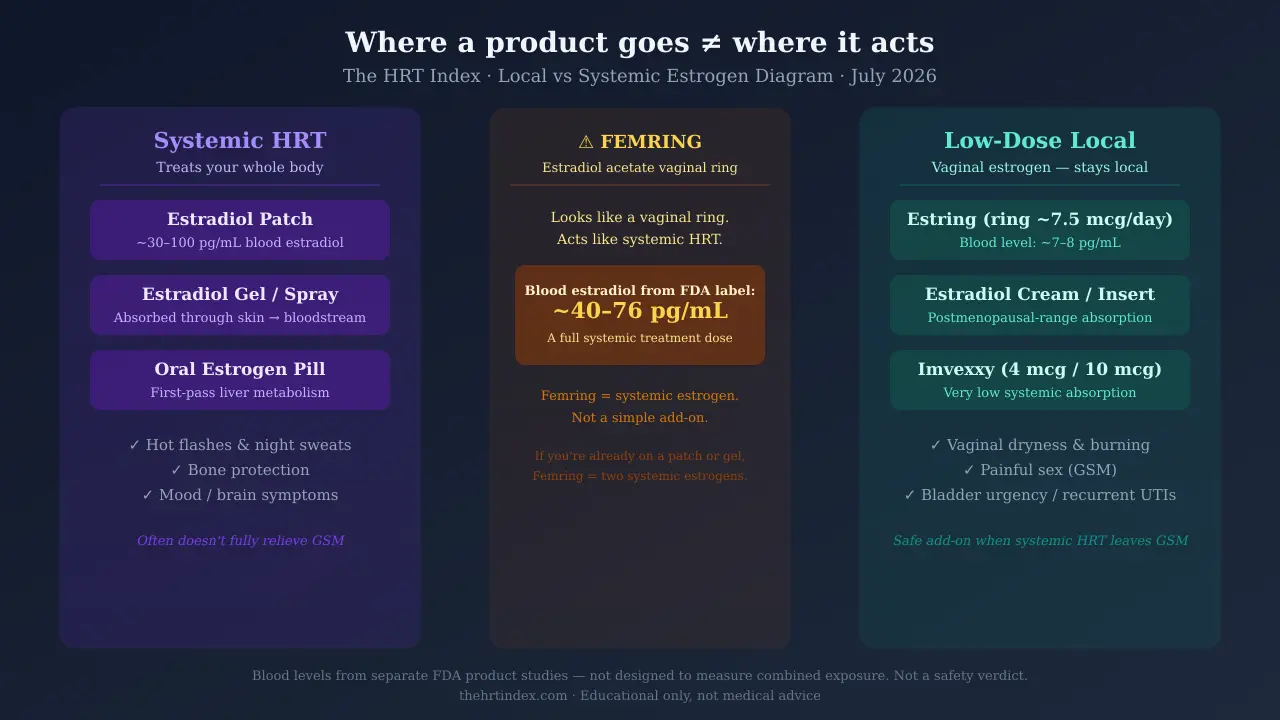
Here’s the thing that trips people up: the word “vaginal” tells you where a product goes, not how much estrogen ends up in your blood. Two products can both be “a ring you put in your vagina” and behave like completely different drugs. The blood-level numbers from the FDA labels below aren’t close. Once you can tell which kind you actually have, this gets simple.
This page is for you if:
- You’re already on a systemic patch, gel, spray, or pill.
- Hot flashes got better, but dryness, burning, pain with sex, urgency, or repeat UTIs remain.
- A clinician suggested a vaginal cream, insert, tablet, or ring — and you’re wondering if that’s normal, or too much.
This page can’t finish the decision for you if:
- You don’t know your product’s exact brand and strength (find that first).
- The product is Femring or another systemic estrogen.
- Your systemic product is Duavee (its label says don’t add estrogen).
- You have unexplained bleeding after menopause, a history of estrogen-sensitive breast cancer, or you take an aromatase inhibitor.
| Your question | The short answer |
|---|---|
| Can I use both at once? | Often yes — when the vaginal product is a true low-dose local one |
| Am I “double dosing” estrogen? | Almost never with a low-dose local product — your blood level barely moves. A systemic ring like Femring is the exception |
| Do I automatically need more progesterone? | Usually not for the vaginal add-on itself. Your systemic estrogen sets that rule — with Duavee as a specific exception |
| What’s the #1 trap? | Estring is local. Femring is systemic. Same shape, very different drug |
| What should I do first? | Find the exact brand and strength of what you were prescribed |
The right online HRT provider isn’t the same for every woman
It depends on your symptoms, what you have tried so far, your age, your state and your health history. Some situations belong with an in-person clinician first. Because a general answer can’t resolve those for you, use The HRT Index’s Find My HRT Path toolto match your situation to the right provider — and to flag when online care isn’t the right starting point — before your first consult.
Sort my situation →Can you use vaginal estrogen with systemic HRT?
Yes — a recommended low-dose vaginal estrogen is commonly added to systemic HRT when vaginal or urinary symptoms don’t fully clear on the patch, gel, or pill alone. The British Society for Sexual Medicine estimates that about 10–25% of women on systemic HRT still have lingering urogenital symptoms, and menopause and urology guidance supports giving them local vaginal estrogen in addition to their systemic therapy. The answer only changes if the vaginal product is actually systemic, the dose is unclear, or your medical history calls for extra review.
Systemic HRT and vaginal estrogen have different main targets
Systemic HRT (patch / gel / spray / pill)
- Sends estrogen through your whole body
- Most effective for hot flashes & night sweats
- Protects your bones
- Often doesn’t fully relieve vaginal/bladder symptoms for everyone
Low-dose local vaginal estrogen
- Works mainly in the tissue where you place it
- Targets genitourinary syndrome of menopause (GSM)
- Treats dryness, burning, painful sex, urgency, recurrent UTIs
- Blood estrogen stays near postmenopausal range
So if your systemic HRT fixed the flashes but sex still hurts, that’s not a sign you failed at HRT. Systemic estrogen does circulate to vaginal and bladder tissue — it just doesn’t fully relieve GSM for everyone. Your vaginal or urinary tissue may still need estrogen delivered right there. The British Society for Sexual Medicine puts it plainly: around 10–25% of women taking systemic HRT keep having urogenital symptoms, and these women can be given vaginal hormones in addition to systemic HRT. The Menopause Society’s 2020 GSM guidance and the 2025 AUA/SUFU/AUGS guidelinesay the same — when vaginal or urinary symptoms remain, add local low-dose vaginal estrogen.
The honest part, because you deserve it
The specific combinationof low-dose vaginal estrogen layered on top of systemic HRT has never been tested in its own dedicated long-term trial. The 2025 AUA guideline supports offering it — but classifies that concurrent-use advice as expert consensus, not a finding from a head-to-head combination study. That doesn’t mean it’s risky. It’s done routinely, the local dose is tiny, and the major menopause and urology groups support it when symptoms persist. It means the truthful answer is “widely used, barely absorbed, and guideline-supported — and a shared decision with your clinician,” not a blanket “totally safe, don’t think about it.”
Three questions come up over and over from women in exactly this spot: “Wouldn’t it be easier to just turn up my patch dose?” · “Do I need progesterone with a vaginal cream?” · “Does it really just stay local?”If any of those is running through your head, you’re in the right place — we answer all three below.
Is my vaginal estrogen local or systemic?
“Vaginal” describes where a product goes, not how much estrogen reaches your blood — and that difference decides everything. A true low-dose local product (like Estring, low-dose creams, or low-dose inserts) keeps your blood estrogen near an untreated postmenopausal level, so it layers safely on a systemic regimen. A systemic vaginal product (like Femring) delivers a full body-wide dose and should be treated as a change to your main HRT, not a small add-on.
This is the most useful thing on this page. We put the current FDA-label data side by side below. Look at the blood-level column.
The HRT Index Local + Systemic Estrogen Classification Matrix
Assembled by The HRT Index from current FDA prescribing information (accessdata.fda.gov / DailyMed) and The Menopause Society’s 2020 GSM position statement. “Blood estradiol level” = the level reported in each product’s own FDA label. Version 1.0 — last verified July 2026.
Block 1 — FDA-approved vaginal estrogen products
| Product | What it is | FDA-labeled role | Blood estradiol level (from FDA label) | As an add-on to systemic HRT |
|---|---|---|---|---|
| Estring (estradiol vaginal ring) | Ring releasing ~7.5 mcg/day for 90 days | Low-dose local; for vulvar/vaginal atrophy only — not hot flashes | Steady-state ~7–8 pg/mL(7.8, 7.0, 7.0, 8.1 at wks 12/24/36/48); brief first-dose peak; back in untreated range after 8 hrs | Recognized low-dose local add-on when GSM persists (expert-consensus guidance). Confirm your product, history, and endometrial-protection plan with your prescriber |
| Estradiol vaginal cream (generic; brand Estrace) | Cream; dose set by grams + schedule | Local at low maintenance doses; label notes some absorption | Depends on exact grams and frequency | Usually a fine local add-on — but concentration, grams, and schedule need to be confirmed; “a cream” isn’t a fixed dose. Read what vaginal estradiol cream is used for. |
| Estradiol vaginal insert/tablet (generic Yuvafem; brand Vagifem, 10 mcg) | Small tablet; daily to start, then 2×/week | Local | LowLabel reports postmenopausal-range serum estradiol | Usually a fine local add-on — verify current strength |
| Estradiol vaginal softgel (Imvexxy 4 mcg / 10 mcg; generic FDA-approved Dec 2025) | Softgel; 2×/week maintenance | Local | LowLabel reports postmenopausal-range serum estradiol | Usually a fine local add-on |
| Premarin vaginal cream (conjugated estrogens) | Cream; dose set by grams + schedule | Local at low doses; label notes absorption occurs | Depends on grams + schedule (conjugated estrogens; serum estradiol alone isn’t the full picture) | Usually a fine local add-on — dose-dependent, confirm it |
| FemringSystemic(estradiol acetate ring) | Ring releasing 0.05 or 0.10 mg/day for 90 days | SYSTEMIC — treats hot flashes and vaginal symptoms | ~40.6 pg/mL (0.05 mg) to ~76 pg/mL (0.10 mg)A full systemic treatment dose | Not a simple add-on. This IS systemic estrogen. Don’t layer it on another systemic product without your prescriber redesigning the plan |
Block 2 — Other FDA-approved prescription GSM treatments (not vaginal estrogen)
| Product | What it is | Key point for someone on systemic HRT |
|---|---|---|
| Intrarosa (prasterone / DHEA) | Vaginal insert — a non-estrogen drug (DHEA) | Often called “non-estrogen,” and it isn’t an estrogen drug. But your body converts DHEA into both androgens and estrogens in the tissue, so it’s not biologically estrogen-free. It’s a low-exposure, FDA-approved local option; guidance says it can be offered to women already on systemic estrogen |
| Osphena (ospemifene) | An oral pill — a SERM (acts like estrogen in some tissues, blocks it in others), not an estrogen | Its FDA label says do not use it at the same time as estrogens. So Osphena is an alternative to estrogen — not an add-on to your systemic HRT. See our ospemifene vs vaginal estrogen comparison |
Block 3 — Compounded vaginal formulations (not FDA-approved finished drugs)
| Product | Key point |
|---|---|
| Compounded vaginal estradiol / estriol (mixed to order) | Can’t be classified from a standard label.The FDA doesn’t review compounded drugs before sale for safety, quality, or how much estrogen they deliver, so no one can promise it’s equivalent to, safer than, or more “natural” than an FDA-approved product, and its absorption can’t be read off a label. Get the exact ingredient, concentration, amount per dose, and whether it’s meant to act locally or systemically. |
Footnote: these blood-level numbers come from separate product studies that were notdesigned to measure combined exposure with a patch, gel, or pill. They can’t be added to your systemic dose to calculate your personal blood level or a personalized safety verdict — they’re here to show each product’s labeled role and exposure.
The Estring vs Femring trap — read this twice
Both are “estradiol vaginal rings.” You’d describe both the exact same way to a friend. But Estring’s own FDA label reports it keeps blood estradiol around 7–8 pg/mLat steady state — essentially the level of a postmenopausal woman on no estrogen at all (there’s a brief spike when you first insert it, then it settles). Femring’s label reports average blood estradiol of 40.6 pg/mL at its low dose and 76 pg/mL at its high dose.That’s roughly five to ten times higher — though these are separate studies, not a head-to-head trial.
Estring — Local only
Indicated only for local vaginal symptoms. Blood level ~7–8 pg/mL at steady state. A recognized low-dose local add-on.
Femring — Systemic
Indicated for hot flashes and vaginal symptoms because it is systemic HRT. If you’re already on a patch and someone calls Femring “just a ring for dryness,” that’s two systemic estrogens.
Estring is indicated only for local vaginal symptoms. Femring is indicated for hot flashes and vaginal symptoms because it is a systemic estrogen, built to be your main HRT. Your first move is simple: find the exact brand and strength of what you were prescribed. Everything downstream depends on it.
Will using both give you “too much estrogen”?
For most women, no.A recommended low-dose vaginal estrogen is barely absorbed — the numbers in the product labels show blood estrogen staying near the untreated postmenopausal range — so adding it doesn’t meaningfully stack on top of your systemic dose. Absorption isn’t literally zero, and it isn’t the same for every product, but a true low-dose local estrogen barely moves your whole-body level. The clear exception is a systemic vaginal ring like Femring, which delivers a full body-wide dose.
| Product added to systemic HRT | Blood estradiol from its FDA label | Does it “stack” on systemic dose? |
|---|---|---|
| Estring (local ring) | ~7–8 pg/mL at steady state | Negligible — postmenopausal range |
| Low-dose insert/tablet (Vagifem, Imvexxy, Yuvafem) | Postmenopausal range per label | Negligible |
| Low-dose cream at maintenance dose | Depends on grams + frequency | Small — confirm dose with prescriber |
| Femring (systemic ring) | ~40–76 pg/mL | Yes — this IS systemic estrogen |
| Compounded vaginal estrogen | Unknown — no FDA review of absorption | Can't be determined from a label |
A compliance point that protects you: the Block 1 and Block 2 products are all FDA-approvedfor their labeled uses, meaning the FDA reviewed each one for safety, quality, and how much estrogen it actually delivers. That review covered each product on its own — not the combined local-plus-systemic routine described here. Compounded vaginal estrogen (Block 3) is a different category and isn’t FDA-approved. Keeping those straight is exactly the information you need to answer this page’s question for your product.
There is one more practical point. Even within the low-dose local category, cream absorption varies by the number of grams prescribed and how often you use it. A high-dose initiation phase (e.g., nightly for two weeks) involves more absorption than the once- or twice-weekly maintenance phase. If you have a uterus and are using a cream with your systemic HRT, your prescriber may have an opinion on whether the schedule affects endometrial protection — that’s worth asking directly. For the low-dose insert forms (tablets, softgels), the amounts involved are small enough that major guidelines generally don’t raise a red flag.
What about turning up my patch dose instead?
It’s a reasonable question, but the answer is usually no — not because a higher systemic dose is dangerous, but because it doesn’t reliably solve vaginal and bladder symptoms better. GSM tissue often needs estrogen delivered locally, not just circulated there. Persistent dryness on adequate systemic HRT is generally treated by adding local estrogen, not by increasing the whole-body dose. If you also still have hot flashes or other systemic symptoms, that’s a different conversation — your whole regimen may deserve a review.
Do I need more progesterone for vaginal estrogen?
For most women adding a low-dose local vaginal estrogen to their systemic HRT: no, the vaginal add-on doesn’t change your progesterone plan. Your systemic estrogen sets the progesterone rule. If you have a uterus and are on systemic HRT, you already need (or are taking) a progestogen to protect your endometrium from the systemic estrogen — and a low-dose local vaginal product doesn’t meaningfully add to that estrogen exposure.
The Menopause Society’s 2020 GSM position statement is explicit: a progestogen is not routinely indicated to protect the endometrium when a recommended low-dose vaginal estrogen is added to systemic therapy. This is because the blood-estrogen levels from these products are low enough that they are unlikely to drive endometrial growth on their own.
Important caveat: the endometrial safety data for local vaginal estrogen has been studied to approximately one year. Your clinician may have their own monitoring approach. Any unexplained bleeding after menopause — whatever products you’re using — needs clinical evaluation.
| Your situation | Progesterone picture |
|---|---|
| Systemic HRT + low-dose local vaginal estrogen, uterus intact | You need progestogen for the systemic HRT. The vaginal add-on doesn't routinely change that — guideline consensus is that it doesn't add meaningful endometrial risk on its own. |
| Systemic HRT + low-dose local vaginal estrogen, no uterus (hysterectomy) | No endometrial protection needed either way — the uterus is gone. Confirm with your prescriber for any other considerations. |
| Systemic HRT + Femring instead of local estrogen | Femring is systemic. If you have a uterus you need progestogen for it, just as you would for any systemic estrogen. |
| Duavee + anything | Duavee's label explicitly says: do not add progestins or additional estrogens. It contains its own built-in uterine protection (bazedoxifene). Adding vaginal estrogen is specifically contraindicated by the label. |
The cream labels have historically included language advising discussion of a progestin with your prescriber, so if yours does, that’s not a contradiction — it’s worth raising with your clinician to understand whether it applies to your specific dose and schedule. The point is that the low-dose vaginal estrogen itself is not the driver of progesterone need; your systemic regimen is.
For a deeper look at how progestogen fits into HRT overall, see our guide on progesterone online.
Situations that need a higher-review conversation
Most women adding low-dose local vaginal estrogen to their systemic HRT don’t face any special contraindication beyond what their systemic regimen already involves. But a few situations call for more individual clinical review before combining:
Unexplained postmenopausal bleeding
New or unexplained bleeding after menopause needs a clinical evaluation, whatever products you’re using. Don’t wait it out or adjust your dose to try to stop it. This applies whether or not you’re using vaginal estrogen.
History of estrogen-sensitive breast cancer
Non-hormonal options come first. ACOG says low-dose vaginal estrogen may be considered after discussion when those aren’t enough — including for women on tamoxifen — while aromatase-inhibitor users should decide together with their gynecologist and oncologist. A large observational study of 42,113 women with prior breast cancer found recurrence rates of 17.6% vs 17.1% (RR 1.03; 95% CI 0.91–1.18), but study design limits what can be concluded from that alone. See our guide on vaginal estrogen after breast cancer.
Duavee (conjugated estrogens/bazedoxifene)
Duavee’s FDA label explicitly says: women taking Duavee should not take progestins, additional estrogens, or additional estrogen agonists/antagonists. If your systemic HRT is Duavee, adding vaginal estrogen is specifically contraindicated by the product label. The whole regimen needs a prescriber review.
Aromatase inhibitors
Women taking an aromatase inhibitor (AI) for breast cancer treatment face a different calculation — even low-dose local estrogen may have implications for AI effectiveness, which is why the decision belongs with the oncologist and gynecologist together. This is separate from the tamoxifen situation.
The Feb 2026 FDA boxed-warning update
In November 2025, the FDA announced a boxed-warning labeling initiative for menopausal hormone therapies. On February 12, 2026, the agency published a first list of six products with updated labeling — Estring was the only vaginal estrogen in that group. The update reflects an ongoing FDA review of MHT labeling; it isn’t a new safety finding that changes clinical guidance on low-dose local products.
Not sure whether online care is the right starting point for your situation?
Is online care right for me, or should I start in person? →Getting care for GSM on top of systemic HRT
If your situation fits the “for you if” description at the top of this page — you’re on systemic HRT, your flashes are managed, but you still have dryness, painful sex, urgency, or repeat UTIs — the next practical step is raising it with a clinician. Many online menopause providers can evaluate GSM and prescribe low-dose local vaginal estrogen alongside your existing regimen, or help you find out whether your existing product is the right one.
Affiliate disclosure: The HRT Index earns a commission from the providers below if you start care through our links, at no extra cost to you. This doesn’t change which providers we mention or what we verify about them.
Midi Health
Menopause-focused telehealth that accepts many insurance plans. Prescribes FDA-approved vaginal estrogen. Good fit if you want insurance coverage evaluated alongside your systemic HRT.
Check Midi’s insurance coverage →Sesame Care
Cash-pay marketplace where you pay a flat fee for a menopause visit. Good fit if you prefer to pay out-of-pocket or want a second opinion on your current regimen.
Browse Sesame menopause visits →Looking for all providers that offer vaginal estrogen? See our best online HRT with vaginal estrogen comparison, including FDA-approved vs compounded options and the Estring/Femring distinction at each provider.
Prescriber checklist: questions to bring to your appointment
- ●Given my systemic HRT, is a low-dose local vaginal estrogen appropriate for my GSM symptoms?
- ●Which form — ring (Estring), cream, insert, or softgel — fits my situation and my existing routine best?
- ●My systemic HRT is [product + dose]. Does the vaginal add-on change my progestogen plan at all?
- ●Is my vaginal product FDA-approved, or is it compounded? If compounded, what is the exact ingredient, concentration, and dose per application?
- ●What would prompt you to change or stop the vaginal product?
- ●How long should I try it before assessing whether it’s working?
Common questions
Can I use vaginal estrogen on the same day as my patch?
There’s no universal rule that they must be on separate days. Follow each product’s own schedule and your prescriber’s instructions rather than inventing a gap. If unsure, ask whether both should simply run on their normal schedules.
Why am I still dry while taking HRT?
Because whole-body estrogen doesn’t fully relieve vaginal and bladder symptoms for everyone. Persistent dryness on systemic HRT is common and usually points to needing low-dose local estrogen — not necessarily a higher systemic dose. See our overview of how low-dose vaginal estrogen works for the full picture. If you also still have hot flashes, your whole regimen may deserve a review.
Does vaginal estrogen raise blood estrogen levels?
A little — absorption isn’t zero, but it’s small with low-dose local products, and it varies by product and dose. Low-dose inserts, creams at maintenance dose, and Estring keep blood estradiol near the postmenopausal range per their labels. A systemic vaginal ring like Femring is the clear exception.
Can vaginal estrogen help recurrent UTIs?
Yes, for the right person. The 2025 AUA/SUFU/AUGS guideline recommends low-dose vaginal estrogen to help reduce future UTIs in postmenopausal women with GSM and recurrent infections. It’s a preventive treatment that improves the tissue over time — not an antibiotic for an active infection. For details, see our guide on vaginal estrogen for recurrent UTIs.
What if I bleed after starting treatment?
New or unexplained bleeding after menopause needs a clinical evaluation, whatever products you’re using. Don’t wait it out or adjust your dose to make it stop. This applies regardless of whether you’re using vaginal estrogen, systemic HRT, or both.
Can someone with a breast cancer history use vaginal estrogen?
Only as an individualized decision. Non-hormonal options come first. ACOG says low-dose vaginal estrogen may be considered after discussion when those aren’t enough — including for women on tamoxifen — while aromatase-inhibitor users should decide together with their gynecologist and oncologist. See our full guide on vaginal estrogen after breast cancer.
Are compounded vaginal hormones the same as FDA-approved ones?
No. Compounded products aren’t FDA-approved, and the FDA doesn’t review them before sale for safety, quality, or how much estrogen they deliver. They shouldn’t be described as equivalent to, safer than, or more natural than FDA-approved products. If yours is compounded, get the exact ingredient, strength, and amount per dose from your prescriber.
What we actually verified
Verified from current primary or authoritative sources (as of July 2026):
- FDA prescribing information for Estring (~7.5 mcg/day; steady-state serum estradiol ~7–8 pg/mL; local indication), Femring (0.05 and 0.10 mg/day; average serum estradiol ~40.6 and ~76 pg/mL; systemic indication for hot flashes), Imvexxy (4 mcg and 10 mcg; low absorption), Estrace and Premarin vaginal creams (absorption occurs), Intrarosa/prasterone (converts to androgens and estrogens; not estrogen-free), Osphena/ospemifene (do not use concomitantly with estrogens), and Duavee (do not add progestins or additional estrogens)
- The Menopause Society’s 2020 GSM position statement (combining local and systemic estrogen; progestogen not indicated for recommended low-dose vaginal estrogen; endometrial safety studied to about one year)
- The AUA/SUFU/AUGS 2025 GSM guideline (offering local vaginal estrogen alongside systemic estrogen as expert-consensus guidance; recurrent-UTI recommendation)
- ACOG’s shared-decision pathway for breast-cancer history, distinguishing tamoxifen from aromatase-inhibitor use
- The FDA’s November 10, 2025 boxed-warning initiative and its February 12, 2026 first list of six products with updated labeling (Estring the only vaginal estrogen in that group)
- A large observational study of women with prior breast cancer (recurrence 17.6% vs. 17.1%; RR 1.03; 95% CI 0.91–1.18)
- The British Society for Sexual Medicine GSM position statement (10–25% of women on systemic HRT with persistent urogenital symptoms)
What this page can’t determine:
Whether this combination is right for you, your exact diagnosis, your specific prescription instructions, every generic or compounded formulation, your current insurance coverage, or whether a specific provider will prescribe a specific product. It also can’t calculate your combined blood-estrogen level from label averages.
How this was made:
We reviewed FDA prescribing information for each named product, professional-society guidance for medical context, and consumer and provider pages only for pricing and to understand the questions women are asking. This is editorial research, not medical advice, and it is not medically reviewed by a clinician. Version 1.0.
— Written by The HRT Index Editorial Team. Educational only — not medical advice.
Sources
- FDA — Estring (estradiol vaginal system) prescribing information, accessdata.fda.gov / DailyMed (release rate ~7.5 mcg/day over 90 days; steady-state serum estradiol 7.8/7.0/7.0/8.1 pg/mL; initial first-dose peak; local indication; low systemic absorption)
- FDA — Femring (estradiol acetate vaginal ring) prescribing information, accessdata.fda.gov / DailyMed (0.05 and 0.10 mg/day; average serum estradiol 40.6 and 76 pg/mL; systemic indication for vasomotor symptoms)
- FDA — Imvexxy (estradiol vaginal insert) prescribing information (4 mcg and 10 mcg); FDA approval of the first generic estradiol vaginal insert, December 8, 2025
- FDA — Estrace and Premarin vaginal cream prescribing information (systemic absorption language)
- FDA — Intrarosa (prasterone) prescribing information (converts to active androgens and estrogens)
- FDA — Osphena (ospemifene) prescribing information (“do not use OSPHENA concomitantly with estrogens and estrogen agonists/antagonists”)
- FDA — Duavee (conjugated estrogens/bazedoxifene) prescribing information (“women taking DUAVEE should not take progestins, additional estrogens or additional estrogen agonist/antagonists”)
- The Menopause Society (formerly NAMS) — 2020 Genitourinary Syndrome of Menopause Position Statement (combining local + systemic; progestogen not indicated for recommended low-dose vaginal estrogen; endometrial safety studied ≤1 year; Estring vs Femring roles)
- American Urological Association / SUFU / AUGS — 2025 Genitourinary Syndrome of Menopause Guideline (offering local vaginal estrogen alongside systemic estrogen; recurrent-UTI recommendation; concurrent use graded as expert opinion)
- British Society for Sexual Medicine — GSM Position Statement (about 10–25% of women on systemic HRT with persistent urogenital symptoms)
- ACOG — Treatment of Urogenital Symptoms in Individuals With a History of Estrogen-Dependent Breast Cancer (shared decision-making; tamoxifen vs. aromatase-inhibitor distinction)
- FDA / HHS — November 10, 2025 boxed-warning initiative and February 12, 2026 first list of products with updated menopausal hormone therapy labeling; The Menopause Society public comment agreeing with the decision
- Breast-cancer recurrence — large observational study of 42,113 women with prior breast cancer (recurrence 17.6% vs. 17.1%; RR 1.03; 95% CI 0.91–1.18)
Related reading on The HRT Index
- How low-dose vaginal estrogen works — formulations, safety, and provider options
- Vaginal estrogen vs systemic estrogen: which one fits your symptoms?
- Vaginal estrogen ring vs cream: Estring, Femring, and which fits you
- Vaginal estrogen after breast cancer: what ACOG says
- Vaginal estrogen for recurrent UTIs: the 2025 AUA guideline
- Vaginal estrogen for bladder symptoms (2026)
- Is vaginal estrogen safe long-term?
- Ospemifene vs vaginal estrogen: when to use each
- Progesterone online: which forms, who needs it, and where to get it
Still not sure which HRT program is right for you?
Take our free 90-second matching quiz →Keep reading:
For cream-specific reports about irritation and daily use, read estradiol vaginal cream reviews.