
Vaginal Estrogen Ring vs Cream: Which Is Right for You?
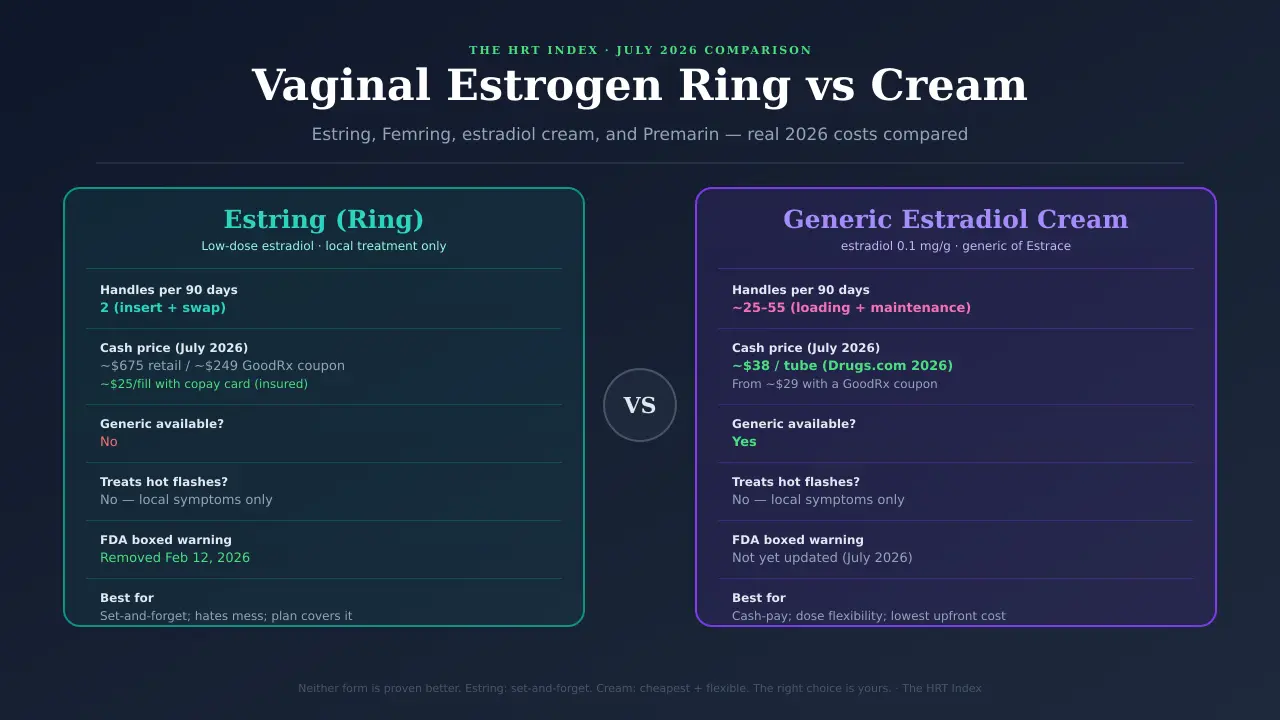
The short version: for a vaginal estrogen ring vs cream, neither one wins for everyone. Studies haven’t shown that either clearly beats the other for relieving dryness, irritation, or painful sex. The ring (Estring) is one insertion every 90 days. The cream means applying it a few times a week, with more say over the dose. And before you compare anything else, you need to know one thing most pages skip: whether “the ring” means low-dose Estring (a local treatment) or high-dose Femring (which treats your whole body). Get that distinction right and the rest of this decision gets a lot easier.
Ring (Estring) is best if:
You want to set it and forget it — one insertion every three months, minimal upkeep.
Cream is best if:
You’re paying cash and want the cheapest option, or you want more control over the dose.
Not a pick-it-yourself moment if:
You have hot flashes, unexplained bleeding, estrogen-sensitive cancer history, or a ring that keeps falling out.
| Your biggest priority | Form to ask about | The catch |
|---|---|---|
| Fewest applications, least fuss | Estring (ring) | Only if you can comfortably keep a ring in place |
| Lowest cost without insurance | Generic estradiol cream | You'll apply it several times a week |
| More control over dose or placement | Cream | The exact product and instructions matter |
| Hot flashes and vaginal symptoms | A systemic (whole-body) HRT conversation | A low-dose ring like Estring won't treat hot flashes |
| Whatever your plan actually covers | Check coverage first | Compare the real 90-day cost, not one coupon |
The HRT Index is the independent decision resource for online menopause and HRT care — comparing telehealth providers on clinical legitimacy, care quality, medication fit, price transparency, and access, with every claim verified and dated, so women can choose the path that fits their situation before their first consult.
Before you choose, read this
The right online care next step isn’t the same for every woman. It depends on your symptoms, your age, what you have tried, your health history, and your state. Some situations belong with an in-person clinician first. Use The HRT Index’s Find My HRT Path toolto match your situation to cash-pay online care — and to flag when online care isn’t the right starting point — before your first consult.
Is a vaginal estrogen ring or cream better?
Neither is better for everyone. Comparative research has not shown a clear winner between a vaginal estrogen ring and cream for symptom relief. In one older 12-week trial, 83% of Estring users and 82% of conjugated-estrogen cream usersimproved on doctor and patient ratings of vaginal symptoms — nearly identical. So the real choice isn’t “which works better.” It’s which one fits your body, your budget, and your routine.
The 10-second version:
- ✓The ring wins on convenience. You put it in once and leave it for three months.
- ✓The cream wins on flexibility and price. Your clinician can fine-tune the dose, and the generic is cheap.
- ✓A Cochrane review (two studies, 341 women) found no clear difference in how women rated their symptoms, though it rated the evidence low quality.
The ring is not proven to work better than the cream. Its real edge is convenience, not stronger results. Some women dislike having something inside them for months. Some can’t keep a ring in place. Some just respond better to the cream. So if you want more control over your dose, or you’re worried a ring won’t stay put, the cream may be the better path for you. But if your real problem is mess and remembering to do it, the ring replaces repeated applications with one insertion every 90 days. That’s the trade.
First — is your ring Estring or Femring? (This changes everything)
Estring and Femring are both vaginal rings, but they do two different jobs. Estring releases about 7.5 micrograms of estradiol a day and treats localvaginal and urinary symptoms only. Femring is designed to send estrogen through your whole body — it releases the equivalent of 0.05 or 0.10 milligrams of estradiol a day and also treats hot flashes. Mixing them up can change your treatment goal, your risk conversation, and whether you need progesterone.
What Estring is
A soft, low-dose estradiol ring. You wear it for 90 days, then swap it. Its FDA-approved job is treating moderate-to-severe symptoms of vulvar and vaginal atrophy. It is not approved to treat hot flashes.
What Femring is
A higher-dose ring made with estradiol acetate. Also worn about three months, but it’s systemic— treats hot flashes and night sweats along with vaginal symptoms. If you still have a uterus, your clinician will usually add a progestogen.
Why this matters
A medicine can sit in your vagina and still be built to dose your entire body. Always find out the exact product name before you compare safety, cost, or whether you need progesterone. “Vaginal” does not automatically mean “local.” See our in-depth Femring vs Estring comparison.
So when you searched “vaginal estrogen ring vs cream,” the fair comparison is usually Estring (local) vs a vaginal estrogen cream (local). Femring is a different tool for a different problem.
Not sure if local or whole-body fits you? Match your symptoms →How do Estring and vaginal estrogen creams compare side by side?
“Estrogen cream” isn’t one product either.The two main creams use different active ingredients: Estrace (and its generic) is estradiol, while Premarin cream is conjugated estrogens — a different mix. That’s why “Estrace vs Premarin” is not simply “generic vs brand.” Here’s every FDA-approved option lined up, with what we confirmed and what you still need to check.
| Feature | Estring (ring) | Estradiol cream (generic Estrace) | Premarin cream |
|---|---|---|---|
| Active ingredient | Estradiol | Estradiol (0.1 mg/g) | Conjugated estrogens (0.625 mg/g) |
| FDA status | FDA-approved (brand only) | FDA-approved (generic exists) | FDA-approved (brand only) |
| FDA-labeled use | Moderate-to-severe vulvar & vaginal atrophy | Vulvar & vaginal atrophy | Atrophic vaginitis / vulvar & vaginal atrophy |
| Treats hot flashes? | No | No | No |
| How you use it | Insert once, replace every 90 days | Applicator; daily 1–2 wks, then 1–3×/week | Applicator; loading then intermittent (per label) |
| Cash price (July 2026) | ~$675 per ring (one ring lasts 90 days) | Generic ~$38 per 42.5 g tube | ~$590 per tube |
| With a discount coupon | From ~$249 per ring (GoodRx) | From ~$29 (GoodRx) | ~$237 with coupon (GoodRx) |
| Copay card (insured) | As little as ~$25/fill (verify terms) | N/A — generic is usually cheapest | Pfizer savings card (verify) |
| Generic available? | No | Yes | No |
| Systemic absorption | Occurs; ~7–8 pg/mL blood estradiol (within no-treatment range) | Occurs; depends on dose, schedule, placement | Occurs; depends on regimen |
| Progestogen if uterus? | Guidance generally says not needed | Guidance generally says not needed, but cream label still advises discussing a progestin | Same as estradiol cream |
| Mess / sex | Nothing to apply; can stay in during sex; low-profile | Can be messy; apply as directed | Can weaken latex condoms/diaphragms — see below |
| Best for | Set-and-forget; hates mess; struggles to keep a routine; plan covers it at an okay price | Cash-pay and budget-focused; wants dose flexibility | Someone specifically prescribed conjugated estrogens |
| Main downside | Pricey without insurance or a coupon; some dislike inserting a ring | Daily-then-weekly upkeep; mess | Brand-only cost; the barrier-contraceptive warning |
Prices are dated snapshots that vary by pharmacy, ZIP code, coupon, and insurance — confirm your own at checkout. Sources: FDA prescribing information; GoodRx and Drugs.com (July 2026); AUA/SUFU/AUGS GSM guideline.
Femring is not in this table on purpose
Femring delivers a higher, whole-body dose (0.05 or 0.10 mg/day) and treats hot flashes too. If you have a uterus, it usually needs added progestogen. If your only symptoms are vaginal or urinary, the low-dose local options above are your real comparison.
What we actually verified
Current FDA labeling for Estring, estradiol vaginal cream, and Premarin cream; the February 12, 2026 FDA boxed-warning change (Estring was one of the six products updated); and the pricing above from GoodRx and Drugs.com. We did not personally use these products, time a checkout, or confirm any single insurance plan. Your exact price, coverage, and state availability still need direct confirmation.
Which is easier to use — a vaginal estrogen ring or cream?
Over your first 90 days, a vaginal cream takes roughly 25 to 55 applications(there’s a daily “loading” stretch at the start), then settles to about 13 to 39 over the next 90 days. The ring takes two actions total: put it in, take it out or replace it. That gap in handling is the real day-to-day difference.
| Form and schedule | First 90 days | Every 90 days after | What the number leaves out |
|---|---|---|---|
| Estring | 2 (insert + remove/replace) | 2 | Repositioning, cleaning, or an unexpected removal |
| Femring | 2 (insert + remove/replace) | 2 | The bigger whole-body-treatment decision behind it |
| Estradiol cream | ~25–55 (daily loading + taper, then 1–3×/week) | ~13–39 | Varies with how long your loading phase runs |
| Premarin, twice weekly | ~26 | ~26 | Any different schedule your clinician sets |
| Premarin, 21-days-on / 7-off | ~69 application days | ~69 application days | Missed doses or dose changes |
Counts are arithmetic from the labeled schedules — not a claim that one form sticks better than another. Source: FDA prescribing information.
Your anatomy matters
If you have pelvic organ prolapse, a shortened or narrowed vagina, or ongoing irritation, a ring may be harder to keep in place. The Estring label spells out these cautions. In that case, a cream or tablet may be simpler.
Mess and travel
The ring leaves little residue. Cream can leak, so many women use it at bedtime. If you travel a lot or value zero cleanup, that’s a point for the ring.
What women often say about the trade-off
Common themes from menopause community discussions — these describe convenience and personal experience, not medical proof, and not typical results.
Women who love the ring tend to say the same thing: they like not thinking about it. Three months, done. Women who prefer the cream often value the control, or found the ring uncomfortable. And here’s the honest part: some women say the ring didn’t help them and switched to cream — and others did the exact opposite. Response is personal. If your first form doesn’t work, that’s information, not failure. Tell your clinician and adjust.
Does a vaginal estrogen ring or cream have more systemic absorption?
The route alone doesn’t answer this.Estring is a low-dose local ring, but some estrogen still reaches your bloodstream — its label reports blood estradiol around 7–8 pg/mL, within the range of women using no estrogen, plus a brief peak right after insertion. Creams are also absorbed to some degree, depending on the dose, schedule, and placement. There’s no reliable head-to-head that ranks the cream’s absorption against the ring’s, so don’t assume one is “safer” on that basis.
Both are farlower than systemic estrogen (pills, patches, gels). But “low” is not “zero,” and for women with a history of hormone-sensitive cancer, this distinction matters and belongs with your oncologist — not a telehealth intake form. See our vaginal estrogen after breast cancer guide.
Estring absorption detail (from the FDA label)
Mean plasma estradiol levels in a 14-patient study: ~7.6 pg/mL at 24 hours, declining over the first two weeks, then stabilizing within the postmenopausal no-treatment range for the rest of the 90-day wear. The label notes FSH and estradiol blood tests are not shown to be useful for managing vaginal atrophy.
Cost in 2026: ring vs cream
Without insurance, generic estradiol cream is far cheaperthan Estring. With insurance or a manufacturer copay card, the gap can shrink dramatically. Here’s where prices sat in July 2026:
| Product | Cash retail | With coupon | Copay card / insured |
|---|---|---|---|
| Estring (90-day ring) | ~$675 / ring | ~$249 (GoodRx) | ~$25/fill (Pfizer card, eligible insured — verify terms) |
| Generic estradiol cream (42.5 g) | ~$38 / tube | ~$29 (GoodRx) | Usually cheapest already as generic |
| Premarin cream (30 g) | ~$590 / tube | ~$237 (GoodRx) | Pfizer savings card (verify) |
July 2026 snapshots from GoodRx and Drugs.com. Prices vary by pharmacy, location, and plan. Verify your own before committing.
The 90-day comparison:One Estring ring covers 90 days. A tube of generic estradiol cream (42.5 g) typically lasts roughly one to two months depending on schedule, so the 90-day cream cost is usually $38–$80 at cash price — but the ring can come down to ~$25/fill for commercially insured patients using the Pfizer copay card. Your insurance plan may also cover Estring better than you expect. The only way to know your real price is to run your specific plan against a pharmacy quote.
For a deeper cost breakdown, see our Estring cost without insurance guide and our cheapest vaginal estrogen guide.
Is vaginal estrogen safe? The February 2026 FDA update
On , the FDA announced changes to menopausal hormone therapy boxed warnings. On , the first batch of six products received updated labels — and Estring was one of them.The boxed warning was removed from Estring because the systemic absorption at its low local dose doesn’t justify the same risk language as whole-body hormone therapy.
| Product | Boxed-warning status (July 2026) |
|---|---|
| Estring (vaginal ring) | Updated — boxed warning removed (Feb 12, 2026) |
| Generic estradiol cream / Estrace | Not yet updated — may still show old warnings |
| Premarin Vaginal Cream | Not yet updated — may still show old warnings |
| Femring (systemic ring) | Systemic product — different risk conversation applies |
Verified against FDA’s “Menopausal Hormone Therapies — Updated Prescribing Information” page and DailyMed current labels, July 2026. Check your exact product’s DailyMed label — this list updates as more approvals come through.
For the full safety breakdown, see our long-term vaginal estrogen safety guide.
Side effects and downsides of each
Estring ring
- Vaginal discomfort, irritation, or a sensation of the ring during insertion or wear
- Ring can fall out, especially with prolapse or certain anatomy
- Partner may notice it during sex (can remove and reinsert)
- Leukorrhea (vaginal discharge) reported in clinical studies
- Not suitable for everyone — the label lists cautions for specific anatomical conditions
Estradiol cream
- Leakage and mess — the most common reason women stop
- Requires handling an applicator several times a week
- Measuring grams correctly can cause uncertainty
- Occasional local irritation
- Premarin specifically: can weaken latex barriers
For both forms:report any unexpected vaginal bleeding after menopause right away. It’s always worth evaluating — it doesn’t automatically mean anything serious, but it needs a clinician, not a wait-and-see.
Who needs a clinician first?
See someone in person first if you have:
- Unexplained bleeding after menopause
- New or severe pelvic pain
- Signs of a possible infection
- Vulvar lumps, sores, or skin changes
- A ring that keeps falling out, or pain inserting it
- Significant prolapse
- A complex cancer history
- Symptoms that haven’t improved as expected
Find My HRT Path is built to flagthese situations and steer you toward in-person care when that’s the safer move — not to diagnose you.
Do you need progesterone with vaginal estrogen?
Usually not — for local, low-dosevaginal estrogen like Estring or generic estradiol cream, current guidance generally does not call for routine progesterone, even if you have a uterus. The doses are low enough that the endometrial-protection rationale doesn’t typically apply.
Three important caveats: (1) the cream labels still advise discussing a progestin with your clinician; (2) Femring is systemic— if you still have a uterus, you will almost certainly need added progestogen; (3) long-term data at low local doses are limited. Always confirm with your prescriber, and report any bleeding after menopause immediately.
Sex and real-life questions
Can Estring stay in during sex?
Yes, per the Estring patient information. However, some women prefer to remove and reinsert it. If it’s uncomfortable for either partner, removal before sex is an option — just be sure to reinsert promptly after.
Can cream be used around the vulva for sex-related pain?
Some clinicians direct cream application around the vaginal opening or vulva for outside pain and dryness — but follow your prescriber’s specific instructions for your product, and let them know if pain during sex is your main symptom.
Premarin cream and latex barriers
Premarin Vaginal Cream’s FDA label warns it can weaken latex or rubber condoms, diaphragms, and cervical caps. Consumer drug information extends that caution to estrogen creams generally. Check your exact product and ask your pharmacist before using it alongside any latex barrier.
Breast cancer history and vaginal estrogen
Women with a history of hormone-sensitive breast cancer have a more complex conversation ahead of them. ACOG and major oncology societies acknowledge that quality-of-life concerns from severe GSM are real and that, for some patients on aromatase inhibitors or with severe symptoms, low-dose vaginal estrogen may be discussed as a shared decision with their oncologist. This is nota routine telehealth intake question — it belongs with your oncologist or a menopause specialist who knows your full history.
For a thorough evidence review, see our vaginal estrogen after breast cancer guide.
Vaginal estrogen for recurrent UTIs
The AUA/SUFU/AUGS 2025 Genitourinary Syndrome of Menopause guideline gives local vaginal estrogen a strong recommendation to help reduce recurrent UTIs in appropriate patients. Both Estring and vaginal estrogen cream are covered by this guidance. This is a preventivebenefit — it lowers the risk of future infections, not an antibiotic that treats an active one. The benefit typically takes a few months of consistent use to show up.
For the full picture on UTI prevention, see our vaginal estrogen for recurrent UTIs guide.
Which fits your situation?
| Your situation | Consider | Note |
|---|---|---|
| You hate mess and want to forget about it | Estring (ring) | Confirm your plan covers it at a reasonable price first |
| You're paying cash, price is the priority | Generic estradiol cream (~$38) | Cheapest option by far; still needs a prescription |
| Outside symptoms or vulvar burning | Cream (clinician-directed placement) | Tablet or ring can't be placed on outside tissue |
| Hot flashes plus vaginal symptoms | Systemic HRT conversation, not just a local ring | Estring won't treat hot flashes |
| Ring keeps falling out or hurts | Cream or tablet instead | Don't force a painful ring — tell your clinician |
| You want dose flexibility | Cream | Clinician can adjust grams; fixed ring cannot be adjusted |
| Unexplained bleeding, cancer history, aromatase inhibitor | In-person clinician first | Not a telehealth-intake decision |
Where to get vaginal estrogen online
Both Estring and vaginal estrogen cream require a prescription. A telehealth clinician can write that for you — the prescription is then sent to your local pharmacy. For more on how to get Estring online, see our Estring online prescription guide. Two online menopause services that handle this well:
Midi Health (partner)
All 50 states · takes insurance · real menopause clinicians · ~$250 self-pay first visit, ~$150 follow-ups (or your copay in-network)
Best if you want to use insurance or a copay card for Estring, or want a practice that treats menopause all day.
Check whether Midi is in-network with your plan →Sesame (partner)
Nationwide marketplace · pick your own clinician · menopause visits from ~$34 · prescription sent to your own pharmacy
Best if you’re paying cash and will use a pharmacy coupon for generic cream.
See current visit prices and pick a clinician on Sesame →Midi Health and Sesame are The HRT Index partner links. The HRT Index may earn a commission if you use them. Partnership does not decide which options we include or how we rank them.
What to ask your clinician first
Save or print this list and take it to your appointment. Or let the tool build a tailored version with your situation flagged.
Product and purpose
- ◦What's the exact brand or generic name?
- ◦Is it FDA-approved or compounded?
- ◦Is it for local symptoms, whole-body symptoms, or both?
- ◦Is it Estring or Femring?
How to use it
- ◦Is there a daily 'loading' period first?
- ◦What's the ongoing schedule?
- ◦Where exactly does the cream go?
- ◦Who inserts and removes the ring, and what if it falls out?
- ◦Can it stay in during sex, and could it affect condoms or a diaphragm?
Uterus, bleeding, follow-up
- ◦Does having a uterus change the plan for this product?
- ◦What kind of bleeding means I should call?
- ◦When do we check if it's working?
Cost and access
- ◦Is prior authorization required?
- ◦What's my real 90-day cost, all-in?
- ◦Is there a cheaper covered alternative?
- ◦What happens if it's out of stock?
How we verified this comparison
We built this using The HRT Index Verification Standard — our documented process: read every published price, separate FDA-approved from compounded, verify state availability and insurance, and re-check on a fixed schedule (top providers monthly, the full roster quarterly), dating every claim. Medical facts here come from FDA labels and major medical societies; community comments were used only to understand real-world experience, never as medical proof.
We judge every provider on five things, always in this order:
- 1.Clinical legitimacy — is the care real, licensed, and appropriate?
- 2.Care quality — does the model actually help you?
- 3.Medication fit — FDA-approved vs compounded, and what suits you?
- 4.Price transparency — is the real cost clear?
- 5.Access — states, insurance, and availability.
Frequently asked questions about vaginal estrogen ring vs cream
Is Estring better than estrogen cream?
Neither is clearly better. Studies show similar symptom relief (about 83% vs 82% in one trial, and no clear difference in a Cochrane review), so the ring's real advantage is convenience, not stronger results. Choose based on cost, mess, and how much daily effort you want.
Is Femring the same as Estring?
No. Estring is a low-dose ring that treats local vaginal and urinary symptoms only. Femring is a higher-dose, whole-body estrogen that also treats hot flashes — and if you have a uterus, it usually needs added progesterone.
Which has less systemic absorption, the ring or the cream?
There's no reliable ranking. Estring keeps blood estradiol around 7–8 pg/mL (within the no-treatment range), and creams are absorbed to a degree that depends on dose, schedule, and placement. Both are far lower than estrogen pills.
Is vaginal estrogen cream stronger than the ring?
"Stronger" isn't the useful question. They contain different amounts and act mostly locally. Compare the exact ingredient, dose, schedule, and what you're treating instead.
Can vaginal estrogen cream be used externally?
Only as your prescriber directs for your exact product and symptoms. Some clinicians direct cream to the vulva or vaginal opening — follow their instructions rather than improvising.
Can vaginal estrogen cream weaken condoms?
Premarin vaginal cream can weaken latex or rubber condoms, diaphragms, and cervical caps. Don't assume that applies to every vaginal cream — check your exact product's label and ask your pharmacist.
Can you use the ring and cream together?
Don't combine products on your own. A clinician may tailor treatment in certain cases, but the exact products, dose, and reason need professional review.
How long does Estring take to work?
Estring's patient information says full effect may take about two to three weeks. If symptoms don't improve or get worse, that's a reason to reassess — not to assume you just need more time.
Can a partner feel Estring during sex?
Possibly. The ring can stay in during sex, but whether it's noticed varies. You can also remove and reinsert it if you prefer.
What if Estring falls out?
Rinse it in lukewarm water and reinsert it per the label. If it keeps happening, talk to your clinician — fit or anatomy may be the issue.
Does Estring help hot flashes?
No — it's not approved for hot flashes. Femring is the vaginal ring approved for whole-body symptoms like hot flashes.
Is vaginal estrogen safe long-term?
For most women, low-dose local vaginal estrogen is considered safe, and in February 2026 the FDA removed the boxed warning from Estring and five other products. Use the lowest effective dose, reassess periodically, report any unexpected bleeding, and review your history with a clinician.
Which is cheaper, the ring or the cream?
Without insurance, generic estradiol cream is far cheaper (about $38 per tube) than Estring at retail (about $675 per 90-day ring in a July 2026 snapshot). With insurance or a copay card, the gap can shrink. Check your own plan.
Do you need progesterone with vaginal estrogen?
For low-dose local vaginal estrogen, current guidance generally doesn't call for routine progesterone if you have a uterus — but the cream labels still advise discussing a progestin, systemic Femring is different, and any unexplained bleeding needs evaluation. Confirm with your prescriber for your exact product.
Is compounded vaginal cream the same as FDA-approved cream?
No. Compounded drugs are not FDA-approved, and the FDA doesn't review them for safety, effectiveness, or quality before they're sold. A compounded cream shouldn't be treated as equivalent to, or a generic of, an FDA-approved product.
Are estrogen or FSH blood tests routinely used to manage vaginal atrophy?
Not routinely. Estring's label notes that blood FSH and estradiol tests aren't shown to be useful for managing vaginal atrophy, though your clinician may order tests for other reasons.
Still not sure which HRT program is right for you?
Take our free 90-second matching quiz. Find My HRT Path does not diagnose a condition or decide whether a prescription is right for you.
Find My HRT Path →Sources
- 1.American Urological Association / AUGS / SUFU — Genitourinary Syndrome of Menopause guideline (2025); recurrent-UTI guidance. auanet.org
- 2.U.S. FDA — Updated prescribing information for Estring, estradiol vaginal cream, Premarin vaginal cream; Feb 12, 2026 boxed-warning change; Nov 10, 2025 announcement. fda.gov
- 3.Estring (estradiol vaginal ring) FDA prescribing information and patient labeling — DailyMed, Pfizer. dailymed.nlm.nih.gov
- 4.Premarin Vaginal Cream prescribing information — DailyMed; MedlinePlus consumer information (latex-barrier warning). dailymed.nlm.nih.gov
- 5.The Menopause Society — position statement on FDA hormone therapy announcement (Nov 2025). menopause.org
- 6.ACOG — guidance on individualized use of vaginal estrogen; compounded bioidentical hormones. acog.org
- 7.Cochrane Review: ring vs cream for vaginal atrophy (Suckling J, et al.) — two trials, 341 women, no clear difference in symptom ratings. cochranelibrary.com
- 8.GoodRx and Drugs.com — cash and coupon pricing for Estring, generic estradiol cream, Premarin cream (verified July 2026). goodrx.com
- 9.Midi Health and Sesame — provider pricing, insurance model, and prescribing details from official pages (verified July 2026). joinmidi.com
The HRT Index is the independent decision resource for online menopause and HRT care for women. Educational only — not medical advice. FDA-approved and compounded options are always labeled distinctly; compounded is never implied to be safer, more natural, or equivalent to FDA-approved medication.
Last updated: · Last verified:
By The HRT Index Editorial Team. This is independent editorial research and is not medically reviewed by a clinician. Prices and policies change — confirm at checkout.