
Side Effects Guide · Updated July 2026
Vaginal Estrogen Side Effects: What’s Common, What’s Not, and When to Call
Most vaginal estrogen side effects are mild and local — burning, itching, more discharge, or light spotting, often in the first few weeks as your body adjusts. The serious body-wide warnings on the box came largely from studies of estrogen pills; low-dose vaginal estrogen puts very little hormone into your bloodstream. One symptom, though, should never be brushed off as routine: unexplained bleeding after menopause needs a prompt check.
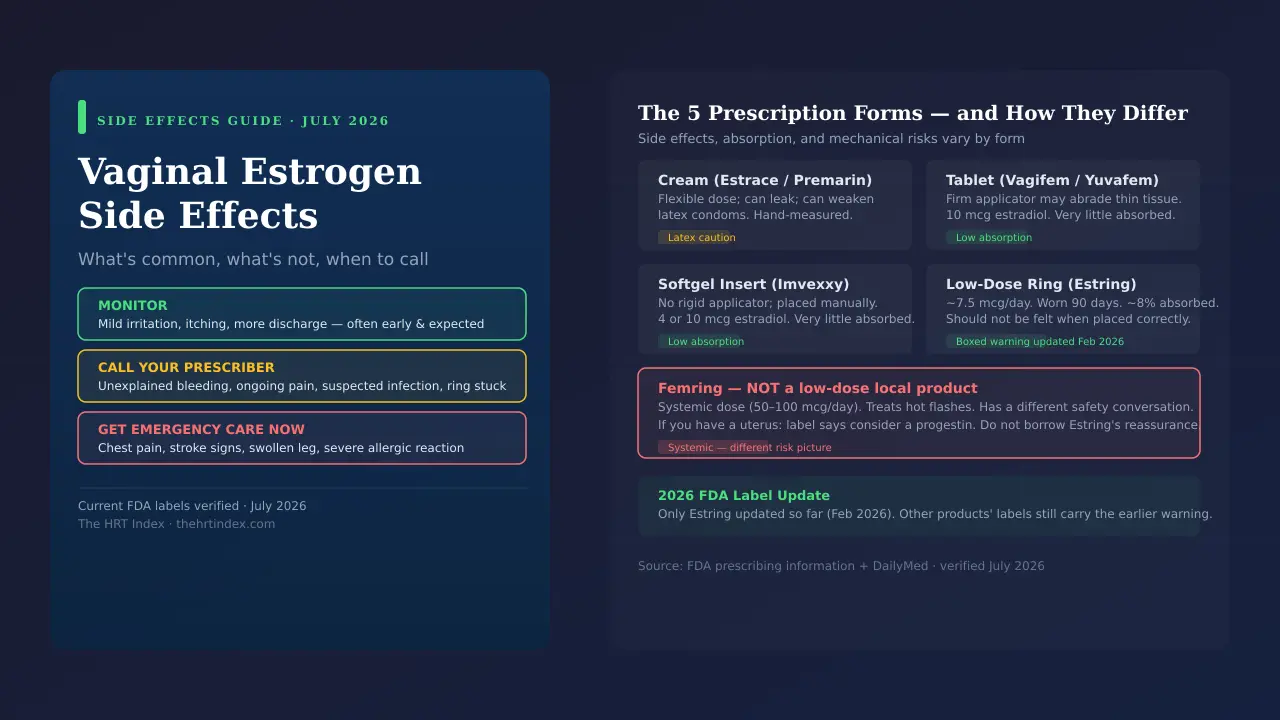
Your quick decision guide
Get emergency care now — don’t wait
Chest pain, sudden shortness of breath, coughing up blood, swelling or warmth in one leg or arm, sudden weakness or trouble speaking, sudden vision changes, a sudden new severe headache, or swelling of the face, lips, tongue, or throat.
| What’s happening | What to do |
|---|---|
| A mild symptom listed for your product (irritation, itching, more discharge, breast tenderness), not getting worse, no warning signs | Keep using it exactly as prescribed; tell your prescriber if it lasts, gets worse, or bothers you |
| Unexplained bleeding after menopause, ongoing pelvic pain, new odor or heavy discharge, painful urination, severe burning, a suspected infection, a breast change, or a ring that hurts or is stuck | Contact your prescriber promptly |
| Chest pain, sudden trouble breathing, coughing up blood, swelling or warmth in one leg or arm, sudden weakness, trouble speaking, sudden vision changes, a sudden new severe headache, or swelling of the face, tongue, or throat | Get emergency care now — don’t wait for an online answer |
Assembled from current U.S. drug information (MedlinePlus) and the product labels cited throughout this page.
What we verified for this page
We read the FDA’s 2025–2026 announcements and its live list of updated labels, plus the current U.S. labels for Estring, Vagifem, Imvexxy, Premarin Vaginal Cream, a currently marketed generic estradiol vaginal cream, and Femring. We cross-checked clinical guidance against The Menopause Society, the American Urological Association, and ACOG. We tell you the date we checked it and how to re-check it. Sources are listed at the bottom. This page is editorial research, not medically reviewed — see our methodology and medical review policy.
What we did not do: we did not use these products ourselves, collect patient outcomes, decide whether any individual reader is medically eligible, or have a clinician review this page.
What are the most common vaginal estrogen side effects?
The most commonly reported side effects are local: vaginal burning or irritation, itching, more discharge, mild spotting, and yeast-type symptoms. Some products also list headache, breast tenderness, back pain, or nausea. A symptom showing up during treatment is “reported” — it does not prove the medicine caused it, because menopause, an infection, or another cause can produce the same symptoms.
For most women, side effects from low-dose vaginal estrogen are mild and mostly “down there.” The most commonly reported ones are:
- Burning or irritation in or around the vagina
- Itching
- More discharge than usual
- Light spotting, especially early on
- Vaginal or yeast-type infections
- Headache
- Breast tenderness
- Nausea or mild belly discomfort
The numbers are reassuring when you actually see them. In the 12-month trial behind Vagifem (a 10-microgram estradiol tablet), side effects reported more than placebo were yeast infection (8% vs. 3% on placebo) and vaginal itching (8% vs. 2%) — mild, and not far above placebo. In the Estring studies, headache was reported by 13% of ring users and by 16% of the women using a comparison cream. That comparison doesn’t prove the ring caused any one woman’s headache — a higherrate in the comparison group means the trial didn’t pin that headache on the ring.
The key idea to hold onto: a “reported” side effect is not the same as a “caused” one. Trials count every symptom a woman has, whether or not the medicine is behind it. Menopause itself, an unrelated infection, another medication, or plain bad luck can cause the same symptoms. Timing (“it started after my second dose”) is useful information for your clinician — but it isn’t proof.
| Usually mild — worth noting, not panicking | Needs more than a “probably just a side effect” shrug |
|---|---|
| Mild irritation, itching, headache, breast tenderness, a bit more discharge early on | Bleeding after menopause, severe pelvic pain, fever, bad odor, trouble urinating, a new breast lump, or any sudden nerve symptom |
Which vaginal estrogen side effects need urgent care?
Get emergency care for chest pain, sudden shortness of breath, coughing up blood, swelling or warmth in one leg or arm, stroke-like symptoms (sudden weakness, trouble speaking, vision loss), a sudden new severe headache, or a severe allergic reaction. Contact your prescriber promptly — not 911 — for unexplained bleeding after menopause, ongoing pelvic pain, a suspected infection, or a vaginal ring that’s painful or stuck.
Call emergency services now if you have:
- Chest pain, or sudden shortness of breath
- Coughing up blood
- Pain, warmth, or swelling in one leg or one arm
- Sudden weakness or numbness, trouble speaking, or sudden vision changes
- A sudden new severe headache, especially with weakness, speech trouble, or vision changes
- Swelling of your face, lips, tongue, or throat, or trouble breathing or swallowing
These are the classic signs of a blood clot, a stroke, or a serious allergic reaction (MedlinePlus; product labels). They’re uncommon, and because low-dose vaginal estrogen puts so little hormone into your blood, the pill-based risk numbers don’t transfer directly to it. But none of these should wait for an online tool or a message reply.
Contact your prescriber promptly for:
- Any unexplained bleeding after menopause
- Bleeding that keeps happening or is heavy
- Significant or ongoing pelvic or belly pain
- Severe or worsening burning
- Discharge with a bad smell, fever, or painful urination
- A new breast lump, or a change in a nipple
- A vaginal ring that’s painful, stuck, or causing spotting
The mindset shift that helps: “low dose” is a reason to feel calmer about the whole-body warnings, not a reason to ignore an urgent symptom. If you actually have chest pain or one swollen leg right now, the cause doesn’t matter — you get seen. Full stop.
Did the FDA remove the boxed warnings on vaginal estrogen?
In part, and it’s still in progress. The strongest warnings on estrogen labels — clot, stroke, breast cancer, dementia — came largely from Women’s Health Initiative trials of estrogen pillsand were applied to the whole class, vaginal products included. On November 10, 2025, the FDA requested that this language be revised or removed. On February 12, 2026, it approved the first six revised labels. Among vaginal products, only Estring’s has been updated so far, so most other labels still carry the earlier warning.
If one thing sent you searching tonight, we’d bet it was the leaflet. You opened the box, saw a wall of text about cancer and blood clots and dementia, and thought: what did my doctor just give me?
Here’s the honest history. The WHI enrolled about 27,000 women — average age in their 60s — and tested estrogen pillsin two forms: oral conjugated estrogens alone, and oral conjugated estrogens plus a progestin. Those trials began in the 1990s and were not studies of today’s low-dose vaginal products. But the warning was applied to the whole class anyway, cream and ring included. Doctors and specialty groups pushed back for years, and in late 2025 the FDA agreed the labels needed to change.
Here’s what’s happened, by the numbers:
- November 10, 2025:The FDA requested changes to menopausal-hormone-therapy labeling — removing the boxed-warning statements about heart disease, breast cancer, and probable dementia from estrogen products, both systemic and vaginal.
- February 12, 2026:The FDA approved the first batch of revised labels — six products in total. Among vaginal estrogen products, only Estring was in that first batch.
- The FDA proposed keeping the boxed uterine-lining (endometrial) cancer warning for systemic, estrogen-only products.
The FDA’s conclusion wasn’t “these risks are gone.” It was that several class-wide warning statements didn’t accurately communicate the benefit-and-risk evidence across today’s menopausal hormone products, so they should be revised or removed. That’s different from saying every warning, contraindication, or product-specific risk has disappeared.
Current boxed-warning status by product
| Product (form) | Estrogen and dose | Boxed warning officially updated by the FDA? |
|---|---|---|
| Estring (ring) | estradiol, ~7.5 mcg/day | Yes — first revised February 2026; current DailyMed label updated April 2026 |
| Vagifem / Yuvafem / generic (tablet) | estradiol, 10 mcg | Not yet in the FDA’s first batch |
| Imvexxy (softgel insert) | estradiol, 4 or 10 mcg | Not yet in the FDA’s first batch |
| Estrace / generic (cream) | estradiol, 0.01% | Not yet in the FDA’s first batch |
| Premarin Vaginal Cream | conjugated estrogens, 0.625 mg/g | Not yet in the FDA’s first batch |
| Femring (ring) | estradiol acetate — a systemic dose | Not yet in the FDA’s first batch — and note it’s a full-body dose product |
What the studies actually measured
| Reported in vaginal estrogen’s own product studies (mostly local, mostly mild) | Serious risks whose numbers came from estrogen-pillstudies — not measured for each low-dose vaginal product |
|---|---|
| Burning or irritation (often early) | Blood clots |
| More or changed discharge | Stroke |
| Itching; yeast infection | Heart attack |
| Light spotting (early) | Breast cancer |
| Breast tenderness (sometimes, later) | Probable dementia |
| Headache | Uterine-lining cancer† |
† The FDA proposed keeping the boxed uterine-cancer warning for systemic, estrogen-only products. Several vaginal-product labels still contain endometrial-cancer language too; menopause specialists generally treat low-dose vaginal estrogen differently.
To be clear: “the numbers came from pill studies” does not mean “risk-free.” The right column isn’t a list of things that can’t happen — it’s a list whose scary figures were measured with a different medicine, in older women. Low-dose vaginal estrogen puts very little hormone into your blood. Your personal history still matters, and a few situations (a past estrogen-sensitive cancer, a clotting disorder) genuinely need a clinician’s call.
Not sure whether online care is the right starting point for your situation — or which next step fits your symptoms, your age, your history, and your state?
Get your personalized HRT care-path plan →Find My HRT Path helps you choose a care route. It doesn’t assess an urgent symptom or replace your current prescriber.
Do side effects differ between cream, tablets, inserts, and rings?
Yes. The estrogen, the dose, the applicator, and the device all differ, so the side effects and the “mechanical” problems differ too. Cream can leak and can weaken latex condoms. Rigid applicators can scratch fragile tissue. Rings can shift or, uncommonly, cause irritation. And one “ring,” Femring, isn’t low-dose at all — it’s a systemic dose and shouldn’t be lumped in with the others.
People assume all vaginal estrogen is basically the same. It isn’t. Here’s how the forms compare — including how much hormone reaches your bloodstream, which is the number that drives most of the fear. For a deeper look at the long-term safety evidence, see our guide to whether vaginal estrogen is safe long term.
| Product | Estrogen and dose | Local or systemic? | Reaches the bloodstream? | Add progesterone if you have a uterus? |
|---|---|---|---|---|
| Imvexxy (softgel insert) | estradiol, 4 or 10 mcg | Local, low-dose | Very little — blood levels stay near a normal post-menopause baseline | Usually not needed for low-dose vaginal† |
| Estring (ring) | estradiol, ~7.5 mcg/day | Local, low-dose | Very little — about 8% of the released dose is absorbed | Usually not needed for low-dose vaginal† |
| Vagifem / Yuvafem / generic (tablet) | estradiol, 10 mcg | Local, low-dose | Very little | Usually not needed for low-dose vaginal† |
| Estrace / generic (cream) | estradiol, 0.01% | Vaginally applied; some absorption occurs | Depends on how many grams you use and how often | Usually not needed at low doses† |
| Premarin Vaginal Cream | conjugated estrogens, 0.625 mg/g | Vaginally applied; label states systemic absorption occurs | Measurable; label says to consider oral-estrogen warnings | Usually not needed at low, occasional doses† |
| Femring (ring) | estradiol acetate, 0.05 or 0.10 mg/day | Systemic — also treats hot flashes | Systemic (like an HRT dose) | Yes — label says a woman with a uterus should generally be considered for a progestin |
† For standard low-dose vaginal estrogen, The Menopause Society and the American Urological Association generally do not advise adding a progestogen, and routine checks of the uterine lining aren’t recommended in a woman with no symptoms. Some product labels still tell clinicians to consider a progestin — so the exact product, your regimen, and any bleeding decide what your prescriber does.
Product-specific things worth knowing
- Creamis flexible, but it can leak, and — this one surprises people — estrogen creams can weaken latex. The Premarin Vaginal Cream label warns it can weaken condoms, diaphragms, and cervical caps made of latex or rubber; MedlinePlus gives the same caution for estrogen vaginal cream generally. If you rely on latex for contraception or STI protection, ask your pharmacist about your exact product and about non-latex options. This applies to creams, not the ring or tablet.
- Tabletscome with a firm applicator. Vagifem’s label warns its applicator can cause vaginal abrasion, especially in severely thinned tissue. If insertion hurts or causes bleeding, don’t force it — tell your prescriber.
- Softgel inserts (Imvexxy) are placed manually, without a rigid applicator.
- Estringshould sit in the top third of the vagina, and when placed correctly you shouldn’t feel it. If you do, it’s usually not in far enough. After marketing, vaginal-wall adherence, difficult or painful removal, erosion, ulceration, expulsion, and irritation have all been reported. Rare cases of toxic shock syndrome have also been reported with vaginal rings. Any ring that’s painful or hard to remove is a “call your clinician” moment.
- Femring is not Estring. Both are rings you put in the vagina, but Femring delivers a systemicdose and is approved to treat hot flashes. Don’t borrow Estring’s “barely absorbed” reassurance for Femring — the safety conversation is different, and if you have a uterus, its label says a progestin should generally be considered. See our full comparison of vaginal vs. systemic estrogen for more.
What about compounded vaginal estrogen?
Compounded vaginal estrogen — mixed by a pharmacy to a prescription — does not have its own FDA-approved prescribing information or FDA-reviewed, product-specific trial data. Compounded drugs are not FDA-approved, and the FDA does not verify their safety, effectiveness, or quality before they’re sold. Its exact ingredients, strength, and quality controls have to be checked with your pharmacy, and its side effects can’t simply be copied from an approved product.
An FDA-approved product like Estring or Vagifem has been through FDA review and comes with standardized labeling and clinical-trial data. A compounded prescription does not. So we can’t tell you it has “the same” side effects as an approved product, and no one should tell you it’s automatically safer, more natural, or equivalent — those claims aren’t established.
If you’re using a compounded product, get these details from your prescriber or pharmacy: the exact estrogen and concentration, the base it’s mixed in, the amount and schedule, the dispensing pharmacy, and the beyond-use date. If a symptom comes up, those details are what your clinician needs.
Can vaginal estrogen cause bleeding or spotting?
Spotting is listed for some vaginal-estrogen products and can also follow a small scratch from an applicator or a ring. But any unexplained bleeding after menopause should be checked by a clinician rather than assumed to be a harmless side effect — because you can’t tell the cause from timing alone.
Yes, some spotting can occur, and it can also follow mechanical irritation of thin tissue. Vaginal hemorrhage was reported by 4% of women in the Estring trials and 5% in the comparison cream. So spotting is on the map. But timing alone can’t establish the cause.
The rule we won’t soften
Bleeding after menopause is never something to self-diagnose as “just the estrogen.” Post-menopausal bleeding can have causes that have nothing to do with your cream or ring — including changes in the uterine lining that need to be ruled out. An article cannot tell you which one you have. A clinician can.
If you have bleeding, don’t stop and restart your medicine on your own — just call, and be ready to share: when it started; whether it’s spotting or a real flow; color, pain; whether it followed applying the medicine or having sex; your exact product and dose; your last natural period; and whether you still have your uterus and cervix.
Can vaginal estrogen cause burning, itching, or discharge?
Burning, itching, and more discharge are reported with some vaginal-estrogen products, especially early on. More discharge is often a good sign — Estring’s label says increased secretions may mean the medicine is working, and that full symptom relief can take two to three weeks. But burning, odor, or fever are not signs it’s “working,” and severe, worsening, or foul-smelling symptoms need a look.
When tissue has gone months or years without estrogen, it’s thin and dry. Start low-dose vaginal estrogen and that tissue begins to rebuild — more blood flow, more moisture, a healthier acid balance. Estring’s own FDA-approved leaflet says two useful things about that process: (1) it takes about 2 to 3 weeks to restore the tissue and feel the full effect; and (2) the most common effect is increased vaginal secretions— and the label says these “indicate that Estring is working,” because they’re like the natural moisture you had before menopause.
So more discharge, on its own, is frequently a good sign — not a red flag. The important line: that “it’s working” note is about discharge. It does not mean burning, worsening pain, odor, fever, or a suspected infection is a sign the medicine is working. Those need to be checked, not toughed out.
- The applicator can be the problem, not the medicine.If burning happens right at insertion, a firm applicator scraping thin tissue may be the cause. If the applicator hurts or causes bleeding, don’t force it — ask your prescriber or pharmacist about your options, which may include a different form.
- “Settling” is different from “spreading.” Record whether mild irritation is improving, staying the same, or getting worse. Contact your prescriber if it persists, worsens, recurs with each dose, or bothers you. Severe burning, a bad smell, discharge with fever, or symptoms that keep escalating can mean a yeast infection or something else that needs testing.
Can it cause headaches, breast tenderness, weight gain, or trouble sleeping?
Headache, breast tenderness, and mild nausea are reported with several vaginal-estrogen products. Insomnia, weight change, and hair loss appear in some product information but not consistently — meaning they’ve been reported, not proven to be caused by the medicine. Because so little hormone reaches the bloodstream, whole-body symptoms are less common than with estrogen pills, but they still vary by product.
- Headacheis reported with several products — 13% with Estring in its trials (and 16% with the comparison cream), meaning the trial didn’t pin headache on the ring.
- Breast tenderness or painis listed for some products. A brand-new lump, a nipple change, or a focal breast change is a different, “call your clinician” issue.
- Sleep changes:Insomnia was reported in about 4% of Estring users (and 0% of the comparison cream) — worth knowing, but a single number in one product doesn’t prove it happens to everyone.
- Weight gain and hair lossappear in some patient leaflets, but they’re nonspecific, with many possible causes. We won’t promise they’re from the estrogen, and we won’t promise they’ll vanish if you stop.
One rule protects you from a common trap: do not compare a low percentage in one product’s label to a higher percentage in another and conclude the first one is “safer.” The labels checked for this page warn that adverse-event rates from different clinical trials can’t be directly compared — different patients, doses, and rules. Imvexxy’s label, for example, lists headache as the only adverse reaction that reached its trial’s reporting bar (at least 3% of an Imvexxy group and more than placebo). That does notmean Imvexxy causes fewer side effects than Vagifem or Estring — it means its trial was set up differently.
Does low-dose vaginal estrogen get into your bloodstream?
A small amount can be absorbed, but low-dose vaginal products keep blood estrogen at or near a normal post-menopause level — much lower than estrogen pills or patches. “Local” means very low exposure, not zero. How much gets absorbed varies by the product, the dose, and how thin the tissue is when you start.
In the Estring pharmacokinetic study, mean steady-state estradiol settled to roughly 7–8 pg/mL. On average, about 8% of the released dosewas absorbed into the body (95% confidence interval 2.8%–12.8%, from a study of 14 women). Softgel inserts absorb even less than a same-dose tablet in head-to-head testing; creams depend on how much you use; and Premarin cream’s label notes that real systemic absorption occurs.
So “local” is real — but it’s “very low,” not “none.” That distinction matters especially for women with a past estrogen-sensitive cancer or women on aromatase inhibitors, where even small amounts get scrutinized. See our guide to vaginal estrogen after breast cancer for that group specifically.
For general context on how these products work and what symptoms they treat, see our overview of vaginal estrogen for menopause symptoms. For safety evidence across longer time periods, see is vaginal estrogen safe long term?
Frequently asked questions
What to do next
If you have an emergency sign, get emergency care. If you have unexplained bleeding or a symptom that’s persistent or worrying, contact your prescriber. If your symptom is mild and you’re just not sure, track it against your product. And if the real question is where to get appropriate menopause care — not how to handle an emergency — get a plan before you book.
Emergency warning sign
Chest pain, trouble breathing, a swollen leg, stroke-like symptoms, or facial swelling — get emergency care now. Don’t wait for a quiz, an email, or an appointment.
Non-emergency symptom or any bleeding
Contact your prescribing clinician. Keep a simple symptom record so you can show them the product, the timing, and the trend instead of guessing.
Not sure whether online care fits your situation
The right provider depends on your symptoms, your history, whether you have a uterus, your state, and your budget. Some situations should start in person.
Still not sure which HRT program is right for you?
Take our free matching quiz — about 90 seconds. Match your symptoms, your history, and your state to the right next step, and flag if you should see someone in person first.
Take the free 90-second quiz →Verification & methodology
Product label statuses and prescribing information were checked against DailyMed and manufacturer labeling in July 2026. FDA announcements are linked directly in Sources. Clinical guidance cross-checked against The Menopause Society, the American Urological Association, and ACOG. This page is educational only — not medical advice. See our methodology and medical review policy.
Last updated: ·Last verified:
Sources
- U.S. FDA — FDA Requests Labeling Changes for Menopausal Hormone Therapies (Nov 10, 2025)
- U.S. FDA — FDA Approves Labeling Changes to Menopausal Hormone Therapy Products (Feb 12, 2026)
- Estring (estradiol vaginal system) FDA prescribing information / patient leaflet (DailyMed, updated April 2026)
- MedlinePlus — Estrogen Vaginal drug information (side effects; warning signs; latex-barrier caution)
- U.S. FDA — Menopause / compounded hormone therapy
- The Menopause Society — 2020 Genitourinary Syndrome of Menopause position statement; hormone therapy guidance
- American Urological Association / SUFU / AUGS — Genitourinary Syndrome of Menopause guideline
- ACOG — Treatment of urogenital symptoms in individuals with a history of estrogen-dependent breast cancer
Product prescribing information for Vagifem, Imvexxy, Premarin Vaginal Cream, and Femring was consulted in July 2026 via DailyMed and manufacturer resources. Pharmacokinetic literature on systemic estradiol levels with low-dose vaginal estrogens (relative absorption of softgel inserts vs. tablets) was also reviewed.