
Alora vs Dotti: What to Do Now That Alora's FDA Approval Has Been Withdrawn
By The HRT Index Editorial Team. Last verified: July 10, 2026. Editorial research, independently verified against FDA, Federal Register, and DailyMed primary sources. Not medically reviewed by a clinician. Educational only — this is not medical advice.
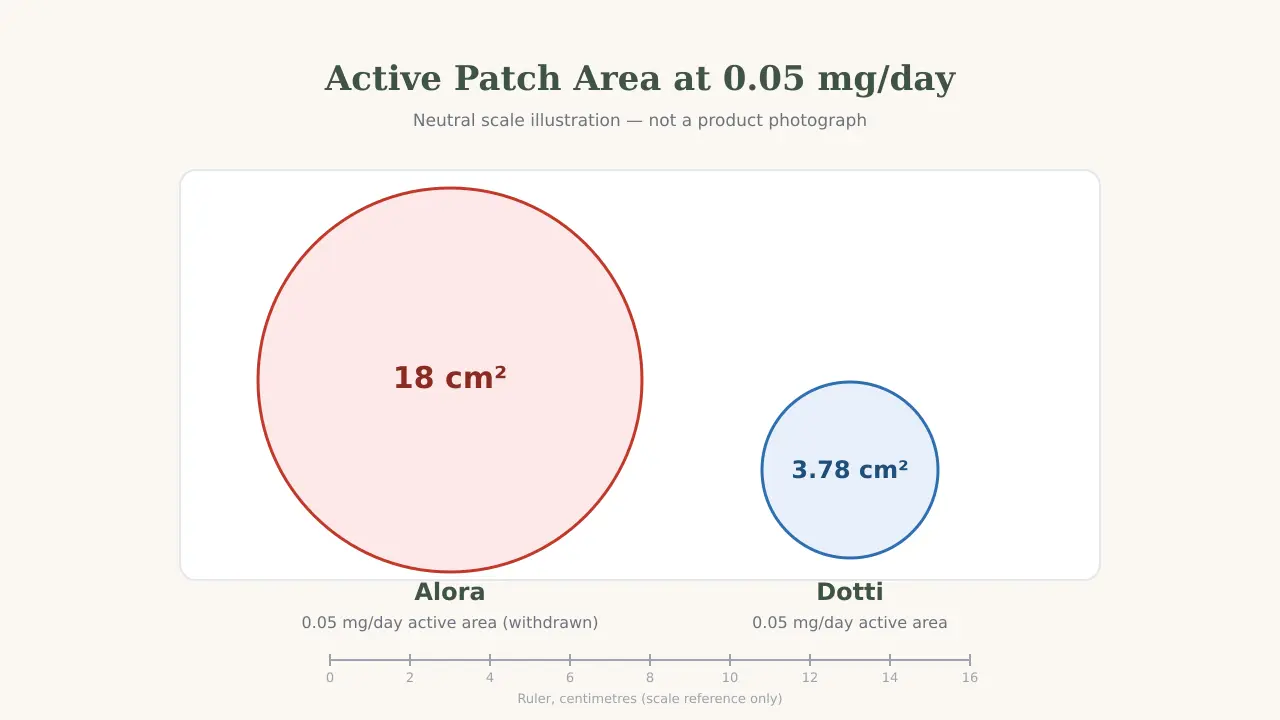
Alora vs Dotti is no longer a live choice between two brands. The FDA withdrew Alora's approval — the entire application, all four strengths — effective September 3, 2025. Dotti is still FDA-approved and still being made, but whether you can fill it depends on which strength you were prescribed. Three of the five are on back order right now.
Before you spiral: Alora was not pulled for safety. AbbVie told the FDA it had stopped selling the product and asked the agency to close the file. That is a paperwork ending, not a warning. Nobody found anything wrong with the patch you were wearing.
There's a second thing worth knowing, and it explains a lot of confusion. At every matching strength, a Dotti patch covers about 21% of Alora's skin area and holds about 41% of Alora's estradiol. Same labeled dose. Very different patch. We'll show you the arithmetic, explain why less estradiol in the patch does not mean a weaker dose, and tell you exactly where the published evidence stops.
The answer changes if:
- You're holding an Alora prescription. A pharmacy generally can't order new Alora — distributing it without an approved application is now unlawful. But the FDA's own notice allowed stock already sitting in the supply chain on September 3, 2025 to be dispensed until it ran out or expired. Ask your pharmacy directly. Then get a new prescription.
- You were switched from Vivelle-Dot, not Alora. That's a different question with a different answer. See our Dotti vs Vivelle-Dot page.
- Your only symptoms are vaginal dryness, painful sex, or urinary discomfort. A whole-body patch may not be the first thing to ask about. Skip to that section below.
Some provider links below are affiliate links, and we may earn a commission at no extra cost to you. What appears on this page is decided under The HRT Index Verification Standard — never by payout. No provider on this page is presented as guaranteeing a specific manufacturer, NDC, or pharmacy stock.
Alora vs Dotti: the decision, in one table
All rows checked July 10, 2026. Sources listed at the bottom of this page.
| Question | Alora | Dotti | What to do |
|---|---|---|---|
| Is it FDA-approved today? | No. Approval of NDA 020655 was withdrawn effective Sept 3, 2025 | Yes. Approved under an ANDA (the generic pathway) | Stop planning around Alora |
| Why was it withdrawn? | AbbVie said it was no longer marketed and asked FDA to withdraw. Not a safety action | Don't panic about what you took | |
| Can a pharmacy fill it? | Generally no new supply. Unexpired stock on hand as of Sept 3, 2025 could still be dispensed | Yes, when your strength is in stock | Call and ask. Then get a new script |
| Is it in stock? | Not being supplied | Depends on strength — see below | Know your strength before you call |
| Is Dotti a generic of Alora? | Nothing was ever FDA-rated as a substitute for Alora. Dotti's approval references Vivelle-Dot, not Alora | A Dotti-for-Alora swap isn't an automatic substitution | |
| What strengths? | 0.025, 0.05, 0.075, 0.1 mg/day | 0.025, 0.0375, 0.05, 0.075, 0.1 mg/day | Dotti has one extra, lower rung |
| Boxed warning? | Full, on its final label | Full, on its current label | It has not been removed for patches |
| Cash price | No reliable current price. It isn't sold | GoodRx showed a lowest coupon price of $38.07 on July 8, 2026 | Confirm your price at the counter |
Not sure whether to ask about another patch, a gel, a spray, a pill, or local vaginal estrogen? Use The HRT Index's Find My HRT Path tool to find online care that fits your symptoms, what you have tried, your age, your state, and your health history. It's free, and you'll see your best match or guidance on the right next step.
Use Find My HRT Path →Best for you if / Not for you if
| Dotti may fit you if | Dotti may not be your answer if |
|---|---|
| You want a much smaller twice-weekly patch than Alora was | Your symptoms returned after a switch to Dotti and haven't settled |
| You need a starting dose below 0.05 mg/day — Dotti has a 0.0375 mg/day, Alora never did | You wore your patch on your outer hip. Dotti's label doesn't list the hip. Alora's did |
| You're paying cash and want a coupon price near the generic | Your pharmacy can't get your strength (0.025, 0.05, and 0.075 are on back order) |
| Your prescriber will write a manufacturer on the prescription | Vaginal dryness or painful sex is your entire symptom list |
The HRT Index is the independent decision resource for online menopause and HRT care — comparing telehealth providers on clinical legitimacy, care quality, medication fit, price transparency, and access, with every claim verified and dated, so women can choose the path that fits their situation before their first consult.
What we actually verified
We didn't summarize other websites. We opened the source documents.
- We read the Federal Register notice withdrawing Alora's approval (90 FR 36440, published August 4, 2025, Docket FDA-2025-N-2422), and the correction published October 3, 2025 (90 FR 48056), which changed only Zinecard's application number and did not affect Alora.
- We read Alora's final FDA-approved prescribing information, revised May 2025 before the withdrawal.
- We read Dotti's current DailyMed label, revised May 2024, packaged by Amneal Pharmaceuticals.
- We did the arithmetic ourselves and cross-checked it against Alora's own measured absorption figure. It matched.
- We checked the FDA's list of menopausal hormone therapies with updated prescribing information on July 10, 2026. No estradiol patch is on it.
- We pulled cash prices from GoodRx and SingleCare on July 10, 2026.
What we did not do: wear either patch, or run a study. We did not find a published head-to-head clinical study of Alora versus Dotti in the FDA labels or the sources we reviewed through July 10, 2026. Anyone who tells you one “works better” is giving you an opinion.
Clinical and product-spec rows in our tables come from FDA or DailyMed labeling. Approval, availability, and price rows come from separately dated regulatory and commercial checks. Ratios and delivery-per-area figures are our calculations, and we label them that way every time.
Before you change anything
Do not change your dose, cut a patch, stop treatment, or swap one estradiol product for another without a prescriber or pharmacist confirming the plan. Two patches carrying the same mg/day on the box are not automatically interchangeable.
Dotti's current label lists these contraindications — reasons a prescriber should not give it to you at all: undiagnosed abnormal genital bleeding; breast cancer or a history of breast cancer; estrogen-dependent cancer; active or previous deep vein thrombosis or pulmonary embolism; active or previous arterial clotting disease such as stroke or heart attack; known allergic reaction, angioedema, or hypersensitivity to Dotti; liver impairment or disease; and protein C, protein S, or antithrombin deficiency or other known thrombophilic disorders. This is not a complete list — review the full label with your prescriber.
The right online HRT provider isn't the same for every woman — it depends on your symptoms, what you have tried so far, your age, your state and your health history. Some situations belong with an in-person clinician first. Because a general answer can't resolve those for you, use The HRT Index's Find My HRT Path tool to match your situation to the right provider — before you book anything.
One small thing, before you read on
Go get your patch box. Write down three things:
- The manufacturer (it's on the carton)
- The full NDC number (also on the carton — a long number in three parts)
- The strength, in mg/day
Then add the date your patch changed and the date anything about how you felt changed.
That's it. Four lines on a piece of paper. It is the single most useful thing you can bring to a prescriber, and almost nobody brings it. Everything below will make more sense once you have it in front of you.
Was Alora discontinued, or was it withdrawn by the FDA?
Both, in that order.AbbVie stopped marketing Alora, then formally asked the FDA to withdraw approval of the application. The FDA granted that request, and approval of NDA 020655 — all four strengths, plus every amendment and supplement — was withdrawn effective September 3, 2025. The withdrawal was not based on safety or effectiveness.
This distinction matters more than anything else on this page, so let's be precise about what happened.
The chronology, assembled
We put this together from four separate primary documents. As far as we could find, it has not been published in one place before.
| When | What happened | Source |
|---|---|---|
| Dec 1996 | Alora 0.05, 0.075, and 0.1 mg/day approved | FDA approval records |
| Apr 2002 | Alora 0.025 mg/day approved | FDA approval records |
| Mar 2021 | A discontinuation notice for Alora appears in FDA discontinuation reporting | Reported via FirstWord Pharma — we have not confirmed the exact date at FDA |
| Oct 2023 | Orange Book listings for Alora move from Allergan to AbbVie | FDA Orange Book changes list |
| May 2025 | FDA approves a labeling supplement for Alora | FDA prescribing information, rev. 5/2025 |
| Aug 4, 2025 | FDA publishes notice withdrawing 39 NDAs, Alora among them | 90 FR 36440 |
| Sept 3, 2025 | Alora's approval is withdrawn | 90 FR 36440 |
| Oct 3, 2025 | A correction is published. It fixes Zinecard's application number only. Alora unaffected | 90 FR 48056 |
Look at May 2025. The FDA approved an updated Alora label four months before withdrawing the drug's approval entirely. That's why a current-looking Alora label still sits on the FDA's own servers today, and it's why so many websites — and possibly your prescriber's software — still act as though Alora is a live option.
It isn't.
What “withdrawn” actually means here
The Federal Register notice is unusually plain. The applicants informed the FDA that the drugs were no longer marketed and requested withdrawal. They waived their right to a hearing. The FDA processed the request under 21 CFR 314.150(c).
Three consequences follow, and each one answers a question you probably have.
It was not a safety recall. No new risk was found. No adverse event triggered it. If you took Alora for a decade, nothing about this notice suggests you were harmed. This is the part that several 2026 articles get wrong by omission, and it's the part that matters most to your peace of mind.
New Alora cannot lawfully be distributed. The notice states that introducing these products into interstate commerce without an approved application violates federal law. So your pharmacy cannot order more.
But existing stock wasn't instantly frozen. The same notice says products in inventory on September 3, 2025 could continue to be dispensed until inventories were depleted or the product expired. Nearly two years on, the odds of unexpired Alora sitting on a shelf are slim — but “slim” is not “zero,” and you are allowed to ask. If a pharmacy says it has some, that's lawful.
Could it come back? The notice says the withdrawal is “without prejudice to refiling,” which means the legal door is not bolted shut. We have seen no announcement that AbbVie intends to walk back through it.
A warning we'd rather you hear from us. Drugs.com's Alora availability record carries an explicit caution that fraudulent online pharmacies may try to sell an illegal generic version of Alora. There is no approved generic Alora. There never was. If a website offers to sell you Alora today, close the tab.
Is Dotti a generic of Alora, or of Vivelle-Dot?
Dotti is an ANDA product — approved through the generic pathway — and its approval references Vivelle-Dot, not Alora. Nothing was ever FDA-rated as an interchangeable substitute for Alora. That means a pharmacist swapping you into Dotti was not performing a routine Alora substitution, because no such substitution exists.
An ANDA is an Abbreviated New Drug Application: the pathway a company uses to get a generic approved by proving it delivers the same drug into the blood the same way as an already-approved reference product. It doesn't have to repeat the original trials. It has to match the original product.
Dotti's own label describes it as “the revised formulation with smaller system sizes,” shown to be bioequivalent to “the original formulation of estradiol transdermal system, used in the clinical trials.” Drugs.com's generic-availability record for Vivelle-Dot lists Dotti among its generics. The label itself never names a brand.
Alora took the other road. It held its own New Drug Application, NDA 020655, with its own clinical trials. No generic was ever approved against it.
So here's what that means for you. Whether a pharmacy may substitute one product for another depends on the therapeutic-equivalence group in the FDA's Orange Book, your state's dispensing law, what your prescriber wrote, your insurance, and what's on the shelf. A Dotti-for-Vivelle-Dot swap fits Dotti's approval relationship neatly. A change from Alora to Dotti is a different decision — a prescribing or dispensing choice someone made, not an automatic generic substitution.
If your pharmacy told you it “substituted” Dotti, go look at your last box. Read the brand name and the manufacturer. That one line on the carton tells you which conversation you're actually having.
What is physically different between Alora and Dotti?
At every matching strength, a Dotti patch covers about 21% of the skin area an Alora patch covered and holds about 41% of Alora's estradiol — while being labeled to deliver the same milligrams per day. Both are estradiol, the same hormone your ovaries made, delivered through skin. The difference lives entirely in the adhesive that holds the drug and releases it.
Here is the comparison, built from the two labels. We did not find this exact strength-by-strength table in any source we reviewed as of July 10, 2026.
Patch area and estradiol payload, side by side
| Delivered dose | Alora active area | Estradiol in an Alora patch | Dotti active area | Estradiol in a Dotti patch | Dotti area as % of Alora | Dotti payload as % of Alora |
|---|---|---|---|---|---|---|
| 0.025 mg/day | 9 cm² | 0.77 mg | 1.89 cm² | 0.314 mg | 21% | 41% |
| 0.0375 mg/day | never made | — | 2.83 cm² | 0.470 mg | — | — |
| 0.05 mg/day | 18 cm² | 1.5 mg | 3.78 cm² | 0.627 mg | 21% | 42% |
| 0.075 mg/day | 27 cm² | 2.3 mg | 5.66 cm² | 0.940 mg | 21% | 41% |
| 0.1 mg/day | 36 cm² | 3.1 mg | 7.55 cm² | 1.253 mg | 21% | 40% |
That 21% holds at all four matching strengths. It isn't a rounding accident. It's two different adhesive systems hitting the same delivery target from opposite directions.
At 0.05 mg/day, Alora's active area was 18 cm² and Dotti's is 3.78 cm². Nearly five Dotti patches would fit inside the space one Alora patch used to occupy.
One correction to a claim you'll see elsewhere: Dotti is not the smallest twice-weekly estradiol patch on the market. At 0.05 mg/day, Minivelle's labeled active area is 3.30 cm² — smaller than Dotti's 3.78 cm². Dotti is dramatically smaller than Alora. It is not the smallest.
Two other real differences
Dotti has a rung Alora never had. Dotti comes in 0.0375 mg/day. Alora didn't. Dotti's label starts hot-flash treatment at 0.0375 mg/day; Alora's started at 0.05. If you're sensitive to estrogen, restarting after a break, or hunting for the lowest dose that works, that extra rung is a real advantage — and a legitimate reason a clinician might have chosen Dotti on purpose rather than by accident.
Alora could go on your hip. Dotti can't. Alora's label approved the lower abdomen, the upper quadrant of the buttock, and the outer aspect of the hip. Dotti's label approves the trunk — abdomen or buttocks — and does not list the hip. Neither goes on the breasts.
That isn't trivia. Both labels show that where you put the patch changes your blood levels. In a single-dose study of 31 women in Alora's label, the hip produced a peak estradiol level of 69 pg/mL versus 53 pg/mL on the abdomen, a difference the label calls statistically significant. In Dotti's label, the 0.1 mg/day system applied to the buttocks produced a mean peak of 145 pg/mL versus 133 pg/mL on the abdomen.
If you moved your patch to a new spot the same month you changed brands, you changed two variables at once. That's worth telling your prescriber.
Do Alora and Dotti deliver the same dose?
Both are labeled to deliver the same milligrams of estradiol per day at matching strengths, and their published blood-level figures are close. The estradiol printed on the box is the amount loaded into the adhesive — not the amount that reaches your bloodstream. A patch holding less drug is not a weaker patch.
This trips up nearly everyone, so let's slow down.
Payload is not dose
Every used patch you throw away still has estradiol in it. Sometimes most of it. The number on the label — 1.5 mg for Alora at 0.05 mg/day, 0.627 mg for Dotti at the same strength — is the payload: what sits in the adhesive on day one. The dose is what crosses your skin over the wear period. Different adhesive designs need very different payloads to release the same dose.
Do the division and the gap is startling:
| Product, at 0.05 mg/day | Estradiol loaded per 1 mg/day of labeled delivery | Labeled daily delivery ÷ active patch area |
|---|---|---|
| Alora | 30.0 mg | 0.0028 mg/cm² |
| Dotti | 12.5 mg | 0.0132 mg/cm² |
| Minivelle | 16.6 mg | 0.0152 mg/cm² |
At 0.05 mg/day, Alora held about 2.39 times Dotti's estradiol payload across about 4.76 times the active area.
Here's how we know the arithmetic is sound. Alora's own label reports that across 251 measured wear-occasions in 123 postmenopausal women, the average absorbed dose was 0.003 ± 0.001 mg of estradiol per cm² per day. Our calculated 0.0028 for Alora lands inside that band. The math checks itself against the manufacturer's own measurement.
What the blood-level data show, and what they don't
Both labels publish steady-state blood levels. Both also warn, in almost identical language, that you cannot compare across products this way.
| At 0.05 mg/day, applied to the abdomen | Peak (Cmax) | Average (Cavg) | Trough (Cmin) |
|---|---|---|---|
| Alora (20 women, repeat dosing) | 92 pg/mL | 64 pg/mL | 43 pg/mL |
| Original formulation data reproduced in Dotti's label | 83 pg/mL | 57 pg/mL | 41 pg/mL |
Numerically close. But read that second row label carefully: those are not Dotti's numbers. They are the original formulation's numbers, printed in Dotti's label because Dotti was approved by proving bioequivalence to that formulation. This is not a head-to-head study, and it is not the evidence the FDA used to approve Dotti — that evidence was a comparison against Dotti's reference product, not against Alora.
Now read what Alora's own label says in section 12.2, and note that Dotti's label says the same thing almost word for word:
A serum concentration does not predict an individual woman's therapeutic response, nor her risk for adverse outcomes. Exposure comparisons across different estrogen products to infer efficacy or safety for the individual woman may not be valid.
Both manufacturers are telling you, in their own labels, that a population average cannot promise anything about your body. Alora's label separately notes that person-to-person variation in skin permeability runs around 20%.
That is where the published evidence stops. Nobody has studied whether a patch that concentrates its delivery into one-fifth the skin area behaves differently, person to person, than one that spreads it out. We're not being coy — that study does not exist, and you deserve to know exactly where the map ends rather than be handed a theory dressed up as a finding.
Which patch sticks better, Alora or Dotti?
The commonly quoted comparison — 97% for Alora versus 85% for Dotti — is not valid, because the two labels are counting different things.Alora's 97% figure includes patches that were partly lifting. Dotti's 85% counts only patches that stayed completely stuck. These came from separate studies of different products, so they cannot be pooled into a winner.
This is the most misread pair of numbers in the estradiol patch world. Look at what each label actually did.
| Alora | Dotti | |
|---|---|---|
| Study | 408 healthy postmenopausal women wearing placebo patches matching the 18 cm² size, twice weekly for 4 weeks; 968 observations | 471 observations pooled from 3 short-term trials; about 80% of the systems were 0.05 mg/day |
| Headline result | ~97% partial or complete adhesion | 85% adhered completely over the 3.5-day wear |
| Complete detachment | ~3% | 3%, reapplied or replaced |
| Participant instructions | Told not to do strenuous activity, take baths, use hot tubs, or swim | Not stated in the public label |
| Sizes actually tested | Only the 18 cm². The label states adhesion of the 9, 27, and 36 cm² sizes has not been studied | Mostly the 0.05 mg/day size |
Read that Alora row again. Its headline adhesion number came from women told not to bathe or swim, wearing a fake patch, in one of its four sizes — and the label openly admits the other three sizes were never studied for adhesion at all.
What we can say with confidence: the 97%-versus-85% comparison is meaningless as published. Both labels happen to report roughly 3% complete detachment, but those figures came from different studies and do not prove the two patches adhere equally in real life.
What we can't say: which one will stay on your skin. No head-to-head adhesion study exists.
What actually helps: application site, skin prep, friction from clothing, heat, sweating, and bathing all affect adhesion, and the labels don't tell us which factor wins for any individual. Both labels give the same practical instructions — press the patch down with your palm for a full 10 seconds, rotate sites with at least a week between repeats, and avoid your waistline, because tight clothing rubs patches off.
And both labels say the same thing about a patch that falls off: you can reapply the same one. If it won't stick, put a new one on a different spot and keep your original change-day schedule. Don't restart the clock.
What side effects does each label actually report?
Alora's label reports breast pain as its most common adverse reaction, rising from 8.0% on placebo to 34.8% at the 0.075 mg/day dose. Dotti's label lists headache, breast tenderness, and irregular bleeding or spotting among reactions occurring in 10% or more of patients, and reports application-site redness and irritation in 3.2% or fewer. These come from different trials with different designs, and neither label permits comparing them directly.
Alora's dose curve
From Alora's two-year bone-density trial in 355 women. This table lists only reactions occurring in more than 2% of women and more often than with the placebo patch.
| Reaction | Placebo (n=87) | Alora 0.025 (n=89) | Alora 0.05 (n=90) | Alora 0.075 (n=89) |
|---|---|---|---|---|
| Breast pain | 8.0% | 14.6% | 17.8% | 34.8% |
| Breast enlargement | 3.4% | — | — | 6.7% |
| Back pain | 5.7% | — | 7.9% | 7.9% |
| Rash | 5.7% | 6.7% | 8.9% | — |
| Dizziness | 0% | — | 7.8% | 4.5% |
The reported rate of breast pain rose across the three Alora dose groups, from 14.6% at 0.025 mg/day to 34.8% at 0.075 mg/day. If your breasts started aching after a dose increase, that is not in your head. It was the most commonly reported reaction in Alora's own trial.
The absence that tells you something about the table, not about your skin
Application-site reaction does not appear in Alora's table above. That's because it didn't clear the table's threshold: more than 2% of women and more often than placebo.
Be careful with what that does and doesn't prove. It does not identify what causes skin reactions, and it does not show that Alora and a placebo patch irritated skin identically. It tells you the reaction wasn't reported more often on the drug than on the fake patch in this trial, and so it wasn't printed. That's a fact about how adverse-reaction tables are built — and it's why reading past the headline matters.
Dotti's reported reactions
Dotti's label names headache, breast tenderness, nasopharyngitis, sinusitis, sinus headache, upper respiratory infection, back pain, depression, and irregular vaginal bleeding or spotting as reactions occurring in 10% or more of patients. Application-site redness and irritation were seen in 3.2% or fewer across treatment groups.
Do not put 34.8% and 3.2% in the same sentence. They measure different reactions, in different trials, over different durations. Both labels state outright that adverse reaction rates from one drug's trials cannot be compared to another's. We show you both because you deserve to see what each company actually measured — not because one wins.
Why did my symptoms come back after my pharmacy switched me to Dotti?
Dotti's FDA label states plainly that no clinical trials were conducted with Dotti. Its approval came through the generic pathway, by proving bioequivalence to the original formulation, whose trial data appear in Dotti's label. On Drugs.com, Dotti carries an average patient rating of 3.9 out of 10 across 59 reviews, with 64% of reviewers reporting a negative experience— checked July 10, 2026. Generic estradiol patches average 4.7 out of 10 across 183 reviews. Climara averages 6.3 across 63.
We're not going to soften that. It's the most important paragraph on this page.
The honest version
What's true, and uncomfortable: no trial was ever run on this exact patch. Alora had two of its own — a 12-week placebo-controlled trial in 268 women showing 0.05 and 0.1 mg/day reduced the frequency and severity of moderate-to-severe hot flashes more than placebo, and a two-year bone-density trial in 355 women in which lumbar spine bone density rose across the Alora dose groups while it fell in the placebo group. If a product with its own trial file is what you need to feel safe, Alora had one — and Alora's approval is withdrawn. You cannot have it. That door is closed.
Here's what the generic pathway actually buys you. Because Dotti had to demonstrate it delivers estradiol into the blood the same way as the formulation that ran those trials, the evidence behind the molecule and the transdermal route still stands behind Dotti — and its label reproduces that trial data in full. And because it went through that pathway, a pharmacist is permitted to dispense it as a substitute within its equivalence group. That is precisely why it is the patch you can actually get in 2026. Alora's trial file is worth nothing to you if you can't buy Alora.
What bioequivalence never promised is that your skin behaves like the study average.
If you want a patch with its own product-specific trial record, that's a real preference, and Dotti isn't it. Look at Climara or Minivelle with your prescriber, or read our once-weekly vs twice-weekly estradiol patch comparison. We'd rather point you somewhere useful than talk you into something.
How to read a 3.9 out of 10
Several of Dotti's most prominent negative reviews describe the same sequence: an unwanted manufacturer change, then symptoms returning, then relief on switching back. That is a recurring theme in the reviews — not a measured rate, and not proof that Dotti caused anything.
These are voluntary, self-selected online reviews. They cannot establish comparative effectiveness, how often side effects occur, or how likely you are to do well or badly. Nobody writes a review about the month nothing happened. Read a 3.9 as a map of substitution distress, not as a verdict on the medicine.
These are individual, unverified consumer reviews from a public pharmacy review page. They cannot establish safety, effectiveness, or cause.
“All generics are not equal!!!”
— Drugs.com reviewer, October 2022
Her frustration is legitimate. The patches genuinely are not identical objects — the 21% figure above proves that. What her experience cannot tell us, and what no review can, is whether the difference she felt lived in the patch, in her skin, in the timing, or somewhere else entirely.
So here's the useful thing to do with all of it. A change in your symptoms after a switch is not proof of anything, and it is not nothing. It is a reason to write down the dates and call your prescriber — not to change your dose, stop treatment, or ride it out alone while you decide whether you're imagining it.
You are not being difficult. You are being specific. That's what a prescriber can actually work with.
Affiliate disclosure: The HRT Index may earn a commission if you book through the provider links below, at no extra cost to you. The providers did not review or approve this article, and no company paid to be included.
Does this sound like your situation?
The thing you need isn't a new brand. It's a clinician who will write a manufacturer on the prescription and talk through what changed.
Check whether Midi Health accepts your insurance
See whether a clinician can discuss a manufacturer-specific estradiol prescription in your state. Midi Health works with insurance and prescribes FDA-approved hormone therapy. Whether a specific product can be prescribed for you is a clinical decision, made in your visit.
Check whether Midi accepts your insurance →How do I get my pharmacy to give me a specific estradiol patch manufacturer?
A prescriber can prohibit substitution — commonly recorded as “dispense as written,” or DAW-1 — and name a preferred product or its full NDC number.Whether the pharmacy can then fill it depends on the prescription being valid, that exact product being available, your state's dispensing rules, and your insurance. If it can't be filled, the pharmacy or prescriber will need to discuss an alternative.
Most women never learn this option exists. It is not a guarantee. It is a lever, and it's yours to ask for.
Use the full NDC, not a prefix
Every drug carton carries an NDC — National Drug Code — printed as three numbers separated by dashes. The first segment is the labeler code, which identifies the company that put its name on the package. That's a manufacturer, repackager, or relabeler. On its own, it does not tell anyone your strength or package size.
So don't say “the one made by Amneal.” Read the full NDC off your carton and give all three parts. Amneal's five Dotti listings on DailyMed are 65162-989, 65162-992, 65162-993, 65162-995, and 65162-997, each supplied in 4-count and 8-count packages. Yours is on the box. Copy it exactly. (You may see it written with an extra zero — 65162-0992-08 — which is the same code in billing format.)
Say this to your prescriber
“The patch I've done well on is labeled by ______, at ______ mg/day, NDC ______. Could you decide whether to prescribe that exact product, and if it's appropriate, mark substitution as not permitted and include the full NDC? If it's unavailable or not covered, what's the backup plan?”
Say this to your pharmacist
“Which manufacturer are you dispensing today? Is that the same one as last time? If it's different, can you order the one I had, and how long would that take? Can your system record a manufacturer preference on my profile?”
Some pharmacy systems can store that preference and some can't. Ask anyway. Almost no one does.
Bring the paper
You wrote it down at the top of this page: manufacturer, full NDC, strength, and the dates. Bring that. A prescriber facing “I think it stopped working” and a prescriber facing four dated lines are two different prescribers.
If your current prescriber won't rewrite it, or you're paying cash and don't want to wait weeks for an opening
See current menopause-visit availability in your state through Sesame Care. You're booking a single appointment, not a subscription. Bring your four lines and ask for exactly what you need.
See Sesame menopause visit availability →Which Dotti strengths are back-ordered right now?
ASHP's estradiol transdermal system shortage bulletin, last updated July 1, 2026, lists Dotti 0.025, 0.05, and 0.075 mg/day eight-count cartons on back order with no estimated release date. Dotti 0.0375 and 0.1 mg/day are listed as available.A national listing does not guarantee your local pharmacy's shelf — call before you drive.
Note which three those are. 0.05 mg/day is the most commonly dispensed twice-weekly strength, and it's the one on back order. If you've spent six weeks confused about why your refill keeps failing, that's why.
Why the FDA and ASHP disagree
The FDA has not listed any estradiol patch on its drug shortage database. It told CNBC in June 2026 that all six manufacturers are producing at full capacity. Meanwhile ASHP — the American Society of Health-System Pharmacists, which collects reports from pharmacists and patients — began listing estrogen patches in January 2026. By March, AARP counted 10 patch products on ASHP's bulletin. By May, journalists counted 14 brands or doses.
Both can be right, and understanding why saves you a phone call.
An FDA shortage listing generally requires a manufacturer to report a supply disruption. If every plant is running flat out and demand simply exceeds output, there's no disruption to report — and the shelf is empty anyway. ASHP's list is populated by the people standing in front of that shelf.
Why patches specifically? Manufacturers told NPR and CNBC that transdermal patches are complex to make: the drug has to be dissolved into an adhesive and coated to a precise thickness. Amneal confirmed to NPR a significant increase in demand following the FDA's removal of boxed warnings from other hormone therapy products. Prescriptions for estrogen patches rose 162% over two years, according to HealthVerity data reported by CNBC.
Practical move: ask your pharmacy and your insurer how early your plan allows a refill, and whether a shortage, travel, or continuity-of-therapy override is available. Refill-too-soon rules vary by plan, by drug, and by state. Don't assume you can simply refill a week early — ask, then plan around the answer.
Does Dotti still have a black box warning?
Yes. On February 12, 2026, the FDA approved labeling changes removing cardiovascular disease, breast cancer, and probable dementia from the boxed warning — but only for six products: Prometrium, Divigel, Cenestin, Enjuvia, Estring, and Bijuva. No estradiol patch is among them.Dotti's current label, revised May 2024, carries the full boxed warning. So did Alora's final label.
A boxed warning — the “black box” — is the strongest warning the FDA puts on a prescription label.
The timeline, plainly:
- November 10, 2025: HHS and the FDA announce they will begin removing the broad boxed warnings from menopausal hormone therapy products, citing a re-analysis of Women's Health Initiative data in younger women.
- February 12, 2026: The FDA approves the first batch of labeling changes. Six products. The agency has said 29 companies submitted proposals.
- July 10, 2026: We checked the FDA's own published list. It still names those six. No patch has been added.
The endometrial cancer boxed warning stays on systemic estrogen-alone products regardless. The FDA's labeling initiative retained it.
So what should you do with the box on your Dotti carton? Read it. Dotti's current boxed warning remains in effect unless and until the FDA approves revised labeling for Dotti. The changes approved for six other products do not amend Dotti's label, and you should not treat the warning as though it has been lifted for your patch. It hasn't.
We re-check this monthly. If a patch appears on the FDA's list, this section changes and the date at the top of this page changes with it.
How much does Dotti cost without insurance?
On July 10, 2026, GoodRx displayed a lowest coupon price of $38.07 for eight Dotti 0.05 mg/day patches, against a modeled retail estimate of $123.58; GoodRx stamped its coupon prices as updated July 8, 2026. SingleCare displayed $51.57 with its membership terms, against a modeled retail estimate of $190.93.Generic estradiol patches ran roughly $36 to $53 for eight patches. Alora has no reliable current price, because it isn't sold.
Three things in that paragraph are worth pausing on.
The brand name may not be costing you much. On the same GoodRx surface we checked, Dotti's lowest coupon price was $38.07 and generic estradiol patch's lowest was $36.23 — a difference of about two dollars a month. Coupon prices move by pharmacy and ZIP code, so check both for your own strength and location. But if you've been avoiding Dotti because it sounds expensive, that assumption may be costing you nothing and gaining you nothing. Price is probably not the reason to choose or refuse it.
“Average retail price” is a model, not a receipt. Two coupon sites showed retail estimates for the identical carton that differ by more than sixty dollars. Neither is a posted price. Treat every retail estimate you read — including in our table — as directional only. Your actual price has to be confirmed at the counter. We won't guess it for you.
Coverage is plan-specific, not category-specific. Medicare Part D coverage varies by plan and by product. Look up your exact Dotti or estradiol-patch NDC in your plan's current formulary and check the tier, prior-authorization status, quantity limit, and preferred pharmacy before you count on coverage. Ask your pharmacy whether any current Dotti savings program applies — we did not verify one.
What if your only symptoms are vaginal dryness, painful sex, or urinary discomfort?
If vulvar and vaginal symptoms are your entire complaint, a whole-body estradiol patch may not be the first thing to ask about. Both the Alora and Dotti labels carry the same Limitation of Use: when prescribing solely for moderate to severe symptoms of vulvar and vaginal atrophy, first consider the use of topical vaginal products. That instruction is printed in the FDA-approved prescribing information for both.
Read that again, because it's coming from the drug companies themselves, in the labels the FDA approved.
A patch sends estradiol through your whole body. Low-dose vaginal estrogen — creams, tablets, inserts, or a ring — is designed to treat local genitourinary symptoms, and systemic absorption is generally minimal at standard low doses, though absorption varies by product and dose. If hot flashes, night sweats, and sleep aren't your problem, a patch may be more medicine than your problem requires.
Both labels carry a second Limitation of Use worth knowing: when prescribing solely to prevent postmenopausal osteoporosis, first consider non-estrogen medications, and consider estrogen only for women at significant risk.
We would rather lose you here than send you down the wrong road. If vaginal dryness or pain with sex is your whole list, this comparison isn't your page.
Read our vaginal estrogen guide →Do I need progesterone with Dotti or another estradiol patch?
If you have a uterus and use systemic estrogen, ask how your endometrium — the lining of your uterus — will be protected. Estrogen used without adequate protection increases endometrial cancer risk.Dotti's label instructs that when estrogen is prescribed for a postmenopausal woman with a uterus, a prescriber should generally consider adding a progestogen. A woman without a uterus generally doesn't need one, though the label notes an exception for a history of endometriosis.
This is not a footnote. It is the one boxed warning the FDA specifically did not remove in 2026.
Progestogen is the umbrella term for progesterone and the synthetic progestins. Adding one is the standard way to protect the uterine lining from unopposed estrogen. The exact drug, dose, and schedule are an individualized prescription, and there are other endometrial-protection strategies a clinician may use. What matters is that someone has a plan and has told you what it is.
If a prescriber hands you an estradiol patch and never asks whether you have a uterus, that is a reason to ask a second question.
One more number to carry into that conversation. Alora's own trial data showed reported breast pain rising from 8.0% on placebo to 34.8% at 0.075 mg/day. Dose matters. Both labels instruct prescribers to use the lowest effective dose for the shortest duration consistent with your goals, and Dotti's label says to attempt to taper or discontinue at three-to-six-month intervals. Ask when your next reassessment is scheduled.
Report any unexpected vaginal bleeding to your clinician promptly. Both labels are unambiguous about this.
What are the alternatives if you can't get your Dotti strength?
Don't guess at a substitute, and don't cut or alter a patch unless your prescriber or pharmacist confirms that specific product can be used that way. Ask which FDA-approved options fit your dose and route, and whether your prescription allows substitution. Availability shifts week to week and pharmacy to pharmacy.
Options to raise with a clinician, not to switch to on your own:
| Option | What it is | Worth knowing |
|---|---|---|
| Vivelle-Dot | The product Dotti's approval references | Also affected by 2026 supply constraints |
| Minivelle | Twice-weekly patch from Noven | Different payload: 0.83 mg at 0.05 mg/day, versus Dotti's 0.627 mg |
| Lyllana | Amneal's other estradiol patch | Availability has varied by strength on ASHP's bulletin |
| Sandoz, Viatris, Zydus generics | Twice-weekly matrix patches | ASHP has reported Viatris products available when others weren't |
| Climara | Once-weekly patch | Different wear schedule entirely — see our once-weekly comparison |
| Estradiol gel or spray | Transdermal, no adhesive patch | Avoids first-pass liver metabolism, the way a patch does. A real option if adhesive irritates your skin |
| Oral estradiol | Tablet | Goes through the liver first. Route choice and clotting-risk considerations depend on your history and your clinician's assessment |
One line we will not cross. FDA-approved patches and compounded hormone preparations are not the same thing, and we will never present them as interchangeable. A compounded product has not been reviewed by the FDA for safety, effectiveness, or manufacturing quality. If a company offers to solve your shortage with compounded estrogen, that is a different decision with a different risk profile, and it deserves its own careful conversation — not a swap made in a panic about a refill.
How The HRT Index verified this comparison
This page was built under The HRT Index Verification Standard — our documented process: read every published price, separate FDA-approved from compounded, verify availability and insurance, and re-check on a fixed schedule.
We sort every claim into one of three buckets, and we label them:
- Medical and regulatory facts — approval status, boxed warnings, dosing, patch dimensions, adhesion data, adverse reaction rates, contraindications. Sourced only to the Federal Register, FDA prescribing information, DailyMed, and FDA announcements.
- Commercial facts — prices, availability, back-order status. Dated to the day we checked and traced to a named source.
- Our calculations and editorial conclusions — the 21% ratio, the payload figures, the delivery-per-area column, our reading of the review data. Labeled as ours every time, never dressed up as findings.
What is still open, and we're telling you rather than hiding it
- ASHP's bulletin blocks automated checking and updates frequently. Our figures reflect its July 1, 2026 update.
- We have not confirmed the exact date of Alora's 2021 discontinuation report against an FDA source. The 2025 withdrawal is confirmed at the Federal Register.
- Dotti's label does not name its reference brand. We rely on Drugs.com's Vivelle-Dot generic-availability record for that relationship.
- Patient review figures move. Ours were checked July 10, 2026.
Refresh schedule: shortage status and the FDA labeling list, monthly. Prices, monthly. Product labels and patient rating data, quarterly. The “Last verified” date at the top changes only when we actually re-check. If you find something wrong here, tell us and we'll fix it and log the change.
Who is not on this page, and why
We have affiliate relationships with Winona and Inner Balance (Oestra). Neither appears as a recommendation here.
Both are compounded providers. This is a brand-name, FDA-approved transdermal estradiol page, and pointing a woman who just lost her FDA-approved patch toward a compounded-first provider would be the most trust-destroying move available on this site. Under our FDA-Approved Override rule, compounded providers are never featured as recommendations on FDA-approved brand pages — regardless of what we're paid.
Affiliate disclosure: The HRT Index may earn a commission when you book through links on this page. It doesn't change what we found in the labels, and it didn't change what we wrote.
The HRT Index evaluates providers on five pillars, in this order: clinical legitimacy, care quality, medication fit, price transparency, and access.
Where this leaves you
Alora is not coming back to your pharmacy, and nobody found anything wrong with it. AbbVie stopped making it and the FDA closed the file.
Dotti is a real, FDA-approved medicine. It is about a fifth the size of what you used to wear — not because it's weaker, but because it's built differently. Your strength may or may not be on the shelf this month, and that has nothing to do with you.
If your patch is working, you're fine. If it isn't, you now have four lines on a piece of paper and three words most women never hear: dispense as written.
That's not being difficult. That's being specific. Go be specific.
Still not sure which HRT path fits your situation?
Take our free matching quiz. Answer a few questions about your symptoms, what you have tried, your age, your health history, and your state. You'll get a personalized next step — and a clear flag if online care isn't the right starting point for you.
Take our free matching quiz →Frequently asked questions
- Is Alora discontinued or was it withdrawn by the FDA?
- Both. AbbVie stopped marketing Alora and asked the FDA to withdraw approval of the application. The FDA withdrew approval of NDA 020655 — all four strengths — effective September 3, 2025, and published the notice in the Federal Register. It was not a safety action, and the notice says the withdrawal is without prejudice to refiling.
- Can my pharmacy still fill an Alora prescription?
- Generally no. New Alora cannot lawfully be distributed without an approved application. The FDA's notice allowed inventory already on hand as of September 3, 2025 to be dispensed until it was depleted or expired, so a pharmacy can check whether any lawful unexpired stock remains. Otherwise you need a new prescription for a different product.
- Was Alora recalled or found unsafe?
- No. The applicants told the FDA the products were no longer marketed and requested that approval be withdrawn. No safety or effectiveness finding was involved. Beware of any website selling “Alora” or “generic Alora” today — no generic Alora was ever approved.
- Is Dotti a generic of Alora?
- No. Dotti is an ANDA product whose approval references Vivelle-Dot. Nothing was ever FDA-rated as an interchangeable substitute for Alora, so a Dotti-for-Alora change is a prescribing or dispensing decision, not an automatic generic substitution.
- Is Dotti the same as Alora?
- No. Both are estradiol transdermal systems, but they are physically different patches. At 0.05 mg/day, Alora's active area was 18 cm² holding 1.5 mg of estradiol; Dotti's is 3.78 cm² holding 0.627 mg. Both are labeled to deliver 0.05 mg per day.
- Is Dotti weaker because it holds less estradiol?
- No. The milligrams on the box are the amount loaded into the adhesive, not the amount that reaches your bloodstream. Every used patch still contains estradiol. Both products are labeled to deliver the same dose per day.
- Which Dotti strengths are back-ordered?
- ASHP's bulletin, last updated July 1, 2026, lists Dotti 0.025, 0.05, and 0.075 mg/day eight-count cartons on back order with no estimated release date. Dotti 0.0375 and 0.1 mg/day are listed as available. Local stock varies — call your pharmacy.
- Can I ask for a specific manufacturer?
- Yes. Your prescriber can prohibit substitution, commonly recorded as DAW-1, and name the product or full NDC. Whether the pharmacy can fill it still depends on availability, state rules, and your insurance.
- Does Dotti still have a boxed warning?
- Yes. The FDA's February 12, 2026 labeling changes covered six products: Prometrium, Divigel, Cenestin, Enjuvia, Estring, and Bijuva. No estradiol patch was included. Dotti's current label carries the full boxed warning, and it remains in effect for Dotti unless the FDA approves revised labeling for it.
- What does Dotti cost without insurance?
- GoodRx displayed a lowest coupon price of $38.07 for eight 0.05 mg/day patches when we checked on July 10, 2026, with coupon prices stamped as updated July 8, 2026. SingleCare displayed $51.57 under its membership terms. Confirm your price at the counter.
- Can I put a Dotti patch on my hip?
- Dotti's label approves the trunk — abdomen or buttocks — and does not list the hip. Alora's label did approve the outer hip. Neither goes on the breasts. Ask your prescriber before using a site the label doesn't list.
- What if my patch falls off?
- Both labels say you may reapply the same patch, or apply a new one to a different spot. Either way, keep your original change-day schedule.
- Do I need progesterone with an estradiol patch?
- If you have a uterus and use systemic estrogen, ask how your endometrium will be protected. A progestogen is commonly prescribed, but the exact strategy depends on your situation. This warning was not removed in the FDA's 2026 labeling changes.
- Is Dotti compounded hormone therapy?
- No. Dotti is an FDA-approved prescription estradiol transdermal system. Compounded hormone preparations are not FDA-approved, and the two are not interchangeable.
Sources
All accessed July 10, 2026.
- Teva Branded Pharmaceutical Products R&D, Inc., et al.; Withdrawal of Approval of 39 New Drug Applications. Federal Register, 90 FR 36440, published August 4, 2025. Docket No. FDA-2025-N-2422. Alora, NDA 020655, AbbVie Inc. Approval withdrawn as of September 3, 2025.
- Same notice; Correction. Federal Register, 90 FR 48056, published October 3, 2025. Corrects Zinecard's application number only. Alora unaffected.
- ALORA (estradiol transdermal system) Prescribing Information, revised 5/2025. U.S. Food and Drug Administration, NDA 020655. Sections 2, 3, 6.1, 11, 12.2, 12.3, 12.6, 14.1, 14.2.
- DOTTI (estradiol transdermal system) Label, revised 5/2024. DailyMed, U.S. National Library of Medicine. Packager: Amneal Pharmaceuticals LLC. Marketing category: ANDA. Sections 2.5, 4, 6.1, 11, 12.2, 12.3, 14.1, 14.2, 16.
- MINIVELLE (estradiol transdermal system) Label. DailyMed. Noven Pharmaceuticals. Active surface areas and estradiol content.
- FDA Approves Labeling Changes to Menopausal Hormone Therapy Products. FDA press announcement, February 12, 2026.
- Menopausal Hormone Therapies with Updated Prescribing Information. U.S. FDA, Drug Safety and Availability. Checked July 10, 2026.
- HHS Advances Women's Health, Removes Misleading FDA Warnings on Hormone Replacement Therapy. FDA press announcement, November 10, 2025.
- National Drug Code Directory. U.S. Food and Drug Administration. Labeler code definition.
- Generic Alora Availability. Drugs.com, updated June 11, 2026. Includes warning regarding fraudulent online pharmacies.
- Generic Vivelle-Dot Availability. Drugs.com. Dotti listed among Vivelle-Dot generics.
- Orange Book Changes List, October 2023. U.S. Food and Drug Administration.
- American Society of Health-System Pharmacists. Drug Shortage Detail: Estradiol Transdermal System. Bulletin last updated July 1, 2026.
- Estrogen patches are in short supply as women seek menopause support. CNBC, June 26, 2026. HealthVerity prescription data; FDA statement.
- FDA claims there's no estrogen patch shortage as women struggle to get prescriptions filled. NBC News, May 2026.
- Why the “mad scramble” to fill hormone therapy prescriptions for menopause. NPR, March 10, 2026. Amneal statement.
- How to Navigate Estrogen Patch Shortages. AARP, March 13, 2026.
- Dotti prices and coupons. GoodRx. Coupon prices stamped updated 07/08/26; checked July 10, 2026.
- Dotti coupons and cost. SingleCare. Checked July 10, 2026.
- Estradiol Patch price guide. Drugs.com. Checked July 10, 2026.
- Dotti user reviews and ratings. Drugs.com. 3.9/10 across 59 reviews, 64% negative; checked July 10, 2026.
- Midi Health. Pricing & Insurance; HRT; How Midi Works. joinmidi.com. Retrieved July 2026.
- Sesame. Menopause Treatment; Telehealth Visit; Medication. sesamecare.com. Retrieved July 2026.
Last updated: July 10, 2026. Researched and written by The HRT Index editorial team. Prices, supply, and FDA labeling change. We re-check pricing, supply, and label status monthly, and providers quarterly. If you find an error, email partners@thehrtindex.com. We date every fix.
The HRT Index is reader-supported. We may earn a commission from some provider links on this page. Commissions never change whether we label a product FDA-approved or compounded, and they never change our verdict. Find My HRT Path collects sensitive health information and is governed by our consumer health data and privacy policy. See our full affiliate disclosure.