Does HRT help ADHD symptoms, or just menopause symptoms?
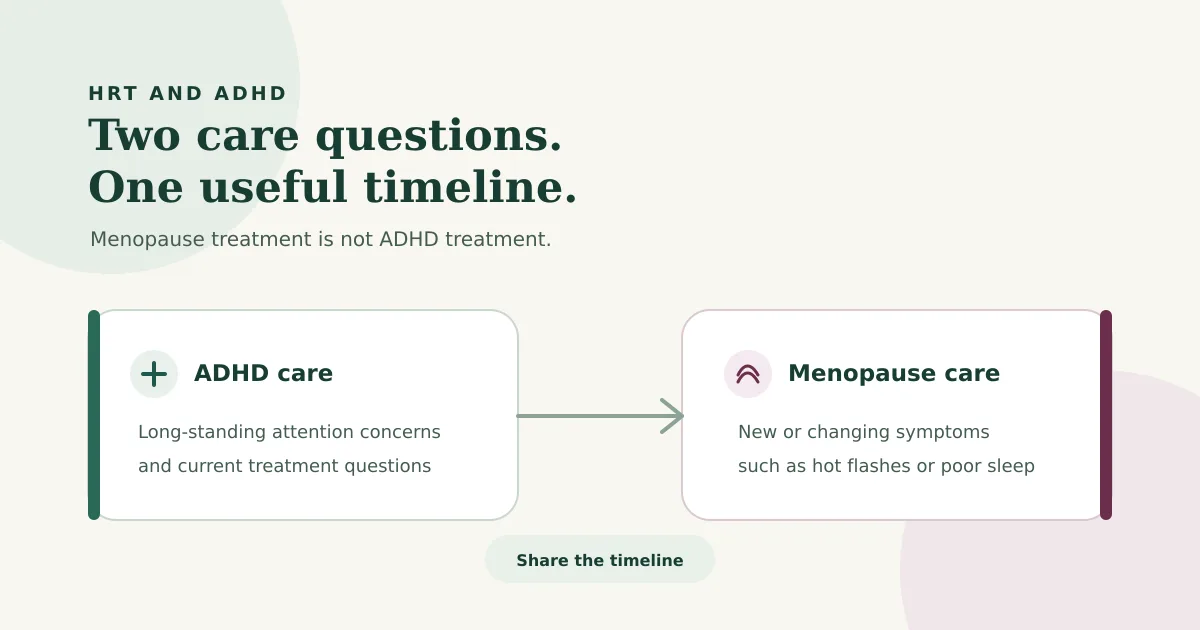
HRT treats menopause symptoms. It is not an established ADHD treatment. When night sweats, broken sleep or mood swings are piling on top of ADHD, easing them can make daily life more manageable, but that is different from treating ADHD itself.
A few quick definitions, because the words get used loosely online:
- HRT means hormone replacement therapy. Doctors also call it menopausal hormone therapy or MHT. It usually means estrogen, plus a progesterone-type hormone if you still have a uterus.
- ADHD means attention-deficit/hyperactivity disorder. It's a brain-development condition that starts in childhood and often lasts for life.
- Executive function is your brain's "manager." It plans, starts tasks, switches between them and holds what you were doing in mind.
- Perimenopause is the transition leading up to your final period and through the first year afterward. Natural menopause is confirmed after 12 months without a period when there is no other cause.
Here's the key idea. Women often come to this question wanting one of several different things. Each one has a different answer.
Match what you want help with to what the evidence can say
| What you're noticing | What the evidence lets us say | What it doesn't show | A useful next step |
|---|---|---|---|
| You have ADHD, and now night sweats and broken sleep too | Menopause treatment may remove an extra source of strain. | That HRT replaces ADHD care. | Bring both concerns to your appointments. |
| Mental fog around perimenopause or menopause | Sleep, mood, hormones, medicines and health issues can all affect thinking in midlife. | That fog alone means ADHD, or that you need HRT. | Ask about timing, sleep, mood, medicines and other causes. |
| Your ADHD medicine seems weaker | A change in how it works deserves a review. | That estrogen is the cause, or that a higher dose is needed. | Write down specific changes and tell your ADHD prescriber. |
| You want a hormone to improve focus | No HRT type is proven best for ADHD. | That a patch, progesterone or a compounded blend is an ADHD fix. | Choose menopause treatment for its real job, with a clinician. |
| Sleep got better, but starting tasks is still hard | Improvement can show up in one area and not another. | That treatment "failed" or you need more estrogen. | Have the remaining problem reviewed on its own. |
| New, worsening or unexplained memory problems | Several causes may need checking. | That age or menopause explains it. | See your usual clinician. Sudden symptoms need emergency care. |
This table applies the research to everyday situations. It is not a diagnostic tool. Sources: The Menopause Society, NIMH, Wynchank & Kooij, 2026, KEEPS-Cog.
A simple example. Losing the thread in a 9 a.m. meeting after you woke up drenched three times overnight is worth telling a clinician. It's real information. It just doesn't explain every focus problem you've ever had.
Why does ADHD feel harder in perimenopause?
Perimenopause adds broken sleep, hot flashes and mood swings to days that already took a lot of effort. Estrogen also helps the brain use dopamine, a chemical messenger involved in attention and motivation, so swings and drops in estrogen may matter too. That link is real enough to study, but it isn't proof that adding hormones back treats ADHD.
If your coping systems suddenly stopped working, you're not imagining it, and you're not alone.
Estrogen and dopamine, in plain words
Dopamine is one of the brain's chemical messengers. It helps you start tasks, stay on them and feel rewarded when you finish. Stimulant ADHD medicines work by increasing the activity of dopamine and a related messenger, noradrenaline.
Estrogen helps the brain make dopamine and keeps it around longer, especially in the brain's planning center, the prefrontal cortex. That's the summary from a 2026 review on ADHD in midlife women by Dutch ADHD specialists Dora Wynchank and Sandra Kooij, published in Drugs & Aging. (Wynchank & Kooij, 2026)
So a picture many women find helpful: estrogen is like extra fuel for an engine that already runs a little rough. When the fuel level swings and then drops, you notice the rough running much more.
But be careful with the next step. "Low estrogen means low dopamine, so estrogen fixes ADHD" sounds logical. It hasn't been shown in people. ADHD isn't a single chemical shortage, and a blood test can't pick your ADHD treatment.
It's not only hormones. It's the pile-up.
Think about what a perimenopausal week can hold:
- Night sweats that wake you two or three times, so you start the day already tired.
- Mood swings or irritability that make emotional control harder. (Our guide to perimenopause irritability and rage goes deeper.)
- Brain fog and word-finding trouble that many women notice in these years.
- Midlife load: kids, aging parents, work at its most demanding.
Each one makes attention harder for anyone. Stack them on ADHD and the systems you built over decades can buckle. That doesn't mean your ADHD diagnosis was wrong. It doesn't mean every new symptom is hormonal, either. More on sleep and mood in our guides to sleep in perimenopause and mood and thinking changes.
A small, practical help while you sort out care: when everything feels like too much, write down only the very next physical step ("open the invoice file"). Cut any demand you can drop this month. Neither is treatment. Both buy you breathing room.
What the numbers say
Researchers have only recently started studying ADHD and menopause together. Here's what the best recent studies found.
- Women with ADHD reported much heavier perimenopause symptoms. In a national Icelandic study of 5,392 women aged 35 to 55, the estimated share with severe symptoms after accounting for age was 54.2% among women reporting ADHD and 30.1% among women without ADHD. The symptom-score gap was biggest at ages 35 to 39. The researchers suggested symptoms may appear earlier, but the study did not track when perimenopause began. Some symptoms on its scale can have other causes. ADHD was self-reported, and the study had no treatment data. (Jakobsdóttir Smári et al., European Psychiatry, 2025)
- Women in one survey often recalled worse symptoms around menopause. In a Monash-led online survey of 600 women reporting an ADHD diagnosis, respondents often recalled worse symptoms around menopause. Yet ADHD symptom scores measured at the time of the survey were similar across the hormonal life-stage groups. That's self-report from people who chose to take part. (Osianlis et al., Journal of Psychiatric Research, 2026)
- Symptom level mattered more than the label. A King's College London study of 656 women aged 45 to 60 found that women with more ADHD symptoms reported more menopause complaints. But women with and without a formal ADHD diagnosis didn't differ significantly once the researchers corrected for running many comparisons. (Chapman et al., Journal of Attention Disorders, 2025)
What this means for you: the link between ADHD and a rougher menopause is real enough to take seriously. It doesn't mean every woman with ADHD will have a hard time, and none of these studies tested HRT.
Is it ADHD, perimenopause brain fog, or both?
ADHD starts in childhood, while new brain fog can show up around perimenopause, so when your symptoms began is a useful first clue. The two can overlap. Timing alone can't tell you the cause; HRT is aimed at menopause symptoms, while ADHD and other causes need their own assessment.
It helps to think in two layers.
- Layer 1, the ADHD layer: lifelong patterns of distraction, disorganization, impulsivity or trouble starting tasks. These began in childhood, even if nobody named them then.
- Layer 2, the possible menopause layer: new or worse problems that arrived around perimenopause, like broken sleep, night sweats, mood swings, word-finding trouble and fog. Their timing is worth noting, but it doesn't prove hormones caused each one.
Doctors diagnosing ADHD in adults look for symptoms that started before age 12, according to the U.S. National Institute of Mental Health. (NIMH, 2024) That's why a midlife ADHD diagnosis often means ADHD was missed earlier, not that it began at 45. They may talk to family, look at old school reports or use structured interviews. You don't need school reports to ask for an assessment. They just help.
The "Which layer is it?" check
Take a moment. Answer yes, no or not sure for yourself. These questions help you describe what changed; they don't identify the cause or decide whether HRT fits you.
- Have trouble focusing, finishing tasks or staying organized been part of your life since childhood?
- Did things clearly get worse in the last few years, around the time your periods started changing or stopped?
- Are you having hot flashes, night sweats, or waking at night most nights?
- If you take ADHD medication, does it seem to work less well than it used to?
- Do any of these apply: bleeding you can't explain; a past blood clot, stroke or heart attack; breast or uterine cancer; liver disease; current thoughts of harming yourself; or sudden confusion, trouble speaking, or weakness on one side?
What to bring up from your answers:
| Your pattern | What to discuss | A useful conversation | What to ask about HRT |
|---|---|---|---|
| Any "yes" or "not sure" to question 5 | Check the specific concern before choosing a care route | If you have sudden confusion, speech trouble or one-sided weakness, call 911. For thoughts of self-harm, call or text 988; immediate danger needs 911. Otherwise, discuss the history with a clinician who can arrange an exam if needed. Being unsure about a past diagnosis is not itself an emergency. | Ask a clinician to review the concern; this check cannot clear you for hormones. |
| Yes to 1, 2 and 3 | Earlier attention problems and newer menopause symptoms | Bring both histories to your usual clinician or menopause clinician, and involve your ADHD prescriber if you have one. | Ask what menopause treatment may help and what needs separate ADHD care. |
| No or not sure to 1, yes to 2 and 3 | Recent changes, menopause symptoms and any gaps in childhood history | Ask your usual clinician about menopause symptoms and other causes. Ask about an ADHD assessment if the history or difficulties warrant one; you needn't wait for an HRT trial. | Ask about the menopause symptoms, without assuming hormones explain all the focus trouble. |
| Yes to 1, no to 2 and 3 | Long-standing focus or organization problems | An ADHD clinician or your regular doctor | HRT is not an established treatment for focus trouble alone. |
| Yes to 2, but no or not sure to 3 | Newer thinking changes without clear hot flashes or night sweats | A clinician who looks at the whole picture: sleep, mood, thyroid, medicines | Ask what symptoms or other medical reasons would support treatment. See HRT without hot flashes. |
| Not sure to 1, and no or not sure to 2 | Gaps in the timeline | Your usual clinician, for a fuller check | Timing alone isn't enough to decide. |
| Any other combination | The details that don't fit neatly | Your usual clinician. Bring the appointment sheet. | Talk it through first. |
| Yes to 4 (add unless urgent help comes first) | A change in how your medicine seems to work | Your ADHD prescriber. Tell them about sleep, menopause symptoms and other changes. | Ask how to coordinate any changes; don't adjust either prescription yourself. |
Built from NIMH guidance on adult ADHD, The Menopause Society's cognition guidance and the 2026 Wynchank & Kooij review. It organizes your next conversation. It can't diagnose ADHD or tell you whether hormones are right for you.
Two illustrations (fictional, not patient stories):
- Maria, 46, has always lost keys and missed deadlines, but she coped with lists and alarms. Over the last year her periods became irregular, she wakes sweaty most nights, and now the lists don't work. She answers yes to 1, 2 and 3. Those are two histories to bring to a clinician, not proof of two causes. A menopause visit makes sense, and she keeps her ADHD prescriber informed.
- Dana, 51, never had focus trouble before. Her periods stopped last year, and she's foggy and forgetful, but she sleeps fine and has no hot flashes. She answers no to 1 and 3, yes to 2. A clinician should look at the whole picture before anyone assumes ADHD or reaches for hormones.
New brain fog deserves a wider look
Thinking problems in midlife have many possible causes besides hormones and ADHD. Poor sleep, depression or anxiety, sleep apnea, some medicines, alcohol, and health issues like thyroid problems or low vitamin B12 can all play a part. (MedlinePlus; our mood guide) A clinician decides which tests make sense for you. There's no universal panel to buy.
If several things changed at once, say a new medication, worse sleep and changing periods all in the same month, a timeline helps everyone see the overlap. It won't prove which one caused the problem, and that's fine.
Your next step, if menopause care is part of the question
If you want help with menopause symptoms as well as focus, the next question is practical: where do you actually get menopause care?
The right online menopause care isn't the same for every woman — it depends on your symptoms, what you've already tried, your age, your state and your health history. Some situations belong with an in-person clinician first. Use The HRT Index's Find My HRT Path tool to explore a featured care option for your situation — and to flag when online care isn't the right starting point — before your first consult.
It's free, takes about 60 seconds, and doesn't ask for your email. You can choose "Brain fog or forgetfulness" as one of your symptoms. It's menopause-care navigation, not an ADHD assessment, and it doesn't decide whether hormones are right for you. A clinician does that.
What does the research actually show about HRT and ADHD?
In the evidence we reviewed, we found no randomized trial establishing HRT as a treatment for ADHD symptoms in perimenopausal or menopausal women with ADHD. An April 2026 expert review says HRT's effect on ADHD treatment outcomes "has not been formally evaluated." Later survey research suggests many women feel better on HRT, but surveys can't show that hormones caused the change.
That doesn't mean HRT is useless for women with ADHD. "Not proven" and "proven not to work" are different things. It means the honest answer today rests on surveys, expert experience and research on menopause in general.
First, how to read the evidence
- A randomized trial splits people by chance into a treatment group and a comparison group. It's the best way to show a treatment caused a change.
- A survey asks people what they experienced. It's great for spotting patterns. It can't prove cause, and people who choose to answer may differ from people who don't.
- A preprint is a study shared before other scientists have checked it for a journal.
- "Feeling clearer" and "scoring better on thinking tests" are different results. Both matter. They aren't the same thing.
The evidence, claim by claim
| Claim you'll see online | Best evidence we found | Type of study | What it shows | What it doesn't show |
|---|---|---|---|---|
| "HRT treats ADHD" | Wynchank & Kooij, Drugs & Aging, April 2026; Osianlis et al. systematic review, 2025 | Expert review; systematic review | Neither review establishes HRT as an ADHD treatment. The 2025 review included no studies focused on menopause in its search through January 24, 2025. | That HRT has been proven ineffective for every woman, or that newer survey findings establish a treatment effect. |
| "HRT sharpens thinking" | The Menopause Society; KEEPS-Cog, 2015 | Guidance; randomized trial (693 enrolled; 662 in the cognitive analyses) | After natural menopause, HRT is "not recommended to improve cognition." In KEEPS-Cog, neither an oral nor a patch regimen improved thinking-test scores during follow-up of up to 4 years. | That nobody feels clearer when sleep and hot flashes improve. Not an ADHD study. |
| "HRT helps mood" | Gordon et al., JAMA Psychiatry, 2018; KEEPS-Cog | Randomized trials | In 172 initially nondepressed women aged 45 to 60, a year of estradiol patches plus periodic progesterone reduced the share developing significant depressive symptoms (17.3% vs 32.3% on placebo), with benefit on mood scores in the early menopause transition. In KEEPS-Cog, oral conjugated equine estrogens improved depression and anxiety scores; transdermal estradiol did not. | That prevention of depressive symptoms treats existing depression or ADHD. Results differ by stage and regimen. |
| "Women with ADHD have a harder perimenopause" | Iceland SAGA cohort, 2025 | Population study, one point in time | Age-adjusted severe-symptom estimates: 54.2% vs 30.1%; largest mean symptom-score gap at ages 35–39 | Cause or the age when perimenopause began. ADHD self-reported. No treatment data. |
| "It's the diagnosis that matters" | Chapman et al., 2025 | Survey of 656 women | More ADHD symptoms went with more menopause complaints | Differences by formal diagnosis weren't significant after correction |
| "Estrogen patches help ADHD most" | Stevens et al., preprint, August 2026 | Survey of 453 women already on HRT; preprint (no peer-reviewed version located October 24, 2026) | Women using estrogen patches, gels or sprays, and those using testosterone, most often reported improvement. Progesterone-containing options showed lower, more mixed reports. | Cause or which hormone is best. The authors say so themselves. |
| "ADHD medicine helps menopause brain fog" | Epperson et al., Psychopharmacology, 2015 | Small randomized crossover trial (32 women without ADHD) | Lisdexamfetamine (Vyvanse) improved self-rated executive function and delayed recall over 4 weeks. Systolic blood pressure and heart rate rose. | Long-term safety. It's an ADHD drug used off-label here, not HRT. |
A closer look at the 2026 survey
This is the only study we found that asked women on HRT directly about ADHD-type symptoms, so it's worth understanding well.
Researchers analyzed answers from 453 women using HRT who reported changes in five areas: inattention, hyperactivity, impulsivity, emotional regulation and rejection sensitivity. About 78% lived in the UK. About 41% had a formal ADHD diagnosis; the rest suspected ADHD. Women were recruited through social media and menopause communities. The study was funded by Newson Global, a company with commercial interests in menopause care, and several authors work there.
The pattern: women on estrogen through the skin (patch, gel or spray), and those using testosterone, most often said symptoms improved. Women on progesterone-containing options reported improvement less often, with more mixed results.
What the authors themselves say matters most. They write that cause and the superiority of any hormone can't be established, that many women used several hormones at once, and that improvements may have come partly from better sleep, mood and menopause symptoms rather than from changes to ADHD. The questionnaire also lacked a clear "no change" answer, so unanswered items were hard to interpret. When the team handled those answers more cautiously, the hormone-type association no longer met its statistical threshold for hyperactivity. Treat this as an early signal worth studying, not a guide to which hormone to request.
What this means for you: if you have menopause symptoms, HRT is a reasonable thing to discuss, and some women with ADHD say they feel better on it. If you're hoping a hormone will fix focus on its own, the evidence doesn't support that yet.
Who should consider HRT, and who should start somewhere else?
HRT is worth discussing if your ADHD-type struggles got worse alongside menopause symptoms and you have no medical reason to avoid hormones. If focus is your only concern, or you have a history like blood clots, stroke or breast cancer, a different first conversation makes more sense.
HRT is worth a conversation if:
- ✅ Your focus or mood got worse and you have night sweats, hot flashes or broken sleep.
- ✅ Mood swings or irritability arrived with your changing cycle.
- ✅ Your ADHD medicine seems weaker and you have clear menopause symptoms.
- ✅ You have bothersome menopause symptoms, are under 60 or within about 10 years of your last period, and have no reason to avoid systemic hormones. That's when The Menopause Society says the benefit-risk balance for treating symptoms tends to be most favorable. Age alone isn't a reason to start HRT. (The Menopause Society)
Start somewhere else if:
- ❌ Focus trouble is lifelong and you have no menopause symptoms. See an ADHD clinician.
- ❌ You have bleeding you can't explain, or a history of blood clots, stroke, heart attack, breast or uterine cancer, or liver disease. See a clinician who can examine you first.
- ❌ You're having thoughts of harming yourself. Call or text 988 now.
- ⚠️ You have brain fog but no hot flashes. It's possible to discuss, but less clear. Read HRT without hot flashes.
If your menopause came before 45, especially before 40, or both ovaries were removed before the usual menopause age, the conversation is different. Unless there is a reason to avoid it, hormone therapy is often recommended until around the usual menopause age for reasons that include bone health. Don't let general advice about focus after natural menopause stop you from asking. (The Menopause Society's hormone-therapy position statement)
Safety in one minute
- 2026 label change. On February 12, 2026, the FDA approved labeling changes for an initial group of six menopausal hormone therapy products, removing boxed-warning statements about cardiovascular disease, breast cancer and probable dementia. Cardiovascular and breast cancer risks remain in other label warnings, and the boxed warning about endometrial cancer remains for systemic estrogen-alone products. This doesn't make HRT risk-free, approve compounded products, or establish a benefit for ADHD. (FDA announcement; FDA's explanation; our explainer)
- Route matters. The Menopause Society says clot risk may be lower with estrogen through the skin than with pills. (The Menopause Society)
- Your history decides. A clinician weighs your age, timing, uterus, and personal and family history. More in our HRT benefits and risks guide.
Ready to talk to a clinician about the menopause side?
Some readers already know what they need. Your ADHD care is handled, or it isn't today's problem. You have night sweats, hot flashes or broken sleep. You prefer cash-pay online care.
If that's you, Gala is a straightforward way to have a licensed clinician look at your menopause symptoms online. Gala lists estradiol as a pill or a patch, micronized progesterone, vaginal estradiol and non-hormonal options including fezolinetant. Its dedicated HRT page advertises $69 a month covering the visit, prescription and shipping, and its main page says messaging and dose check-ins continue for as long as you're treated. (Checked October 24, 2026.)
One thing to know before you click: Gala's HRT pages don't list ADHD medication or ADHD care, so keep your ADHD prescriber in the loop. Gala also doesn't name its exact products up front. Ask which one you'd get, whether it's FDA-approved, whether $69 covers both medicines if you need estrogen and progesterone, and whether labs cost extra.
Cash-pay care. Treatment depends on clinician review and your state. We may earn a commission. Want every detail first? See what we verified about Gala or read our Gala HRT review.
Patch, pill or progesterone: which HRT matters for ADHD symptoms?
No type of HRT is proven best for ADHD symptoms. Each type has its own medical job, like treating hot flashes, protecting the uterus or easing vaginal dryness. Your clinician picks the type and route for those jobs and your health history, not for focus.
You'll see confident claims online that estrogen patches are "best for ADHD." The 2026 survey found more reports of improvement with some treatments, but it cannot rank their effects. And in the KEEPS-Cog randomized trial, the oral conjugated-equine-estrogen regimen, not the estradiol patch regimen, was linked to better depression and anxiety scores. (KEEPS-Cog) That was a different outcome in women not selected for ADHD. There's no ADHD winner.
Systemic and local: two different jobs
- Systemic treatment travels through your whole body. Estrogen pills, patches, gels and sprays are systemic. They treat hot flashes and night sweats.
- Local treatment stays mostly where you put it. Low-dose vaginal estrogen is local. It treats dryness, painful sex and some urinary symptoms. It does not treat hot flashes and is not an established treatment for ADHD or general thinking problems.
That matters in real life. If night sweats are wrecking your sleep, a vaginal cream isn't the right tool. Tell the clinician which symptom bothers you most.
What each type does
| Treatment | Its medical job | U.S. approval status | What's known for ADHD-type symptoms | Question to ask |
|---|---|---|---|---|
| Estradiol patch, gel or spray (systemic, through the skin) | Hot flashes and night sweats; some products also prevent bone loss | FDA-approved products exist. Indications differ by product. Compounded versions are not FDA-approved. | Linked to reported improvement in one 2026 survey; that does not prove an ADHD treatment effect or a best route. | "Which exact product and strength, and why does this route fit me?" |
| Estradiol pill (systemic, by mouth) | Hot flashes and night sweats; bone-loss prevention with indicated products | FDA-approved products exist | No randomized ADHD benefit established. KEEPS-Cog used a different oral estrogen, conjugated equine estrogens, so its mood finding cannot be assigned to estradiol pills. | "Is a pill or a skin route better for my clot risk?" |
| Micronized progesterone (by mouth) | Protects the uterine lining when you take systemic estrogen and have a uterus | FDA-approved oral products exist, including Prometrium. Its label covers uterine-lining protection with conjugated estrogens and specifies bedtime use. | Lower, more mixed reports in the survey. Can cause drowsiness and dizziness. | "Is this the right progestogen for me, and what should I report?" |
| Hormonal IUD (levonorgestrel) | Contraception; some clinicians use an appropriate device to protect the uterus during HRT | FDA-approved contraceptive devices exist. Use for uterine protection with HRT is off-label in the U.S. | Lower reports of improvement in the survey do not establish worsening or a treatment effect. | "Is my exact IUD, at its current age, enough protection with this estrogen?" |
| Low-dose vaginal estradiol cream or tablet (local) | Dryness, painful sex, some urinary symptoms | FDA-approved products exist | No established ADHD treatment benefit | "Is local treatment enough for my symptoms?" |
| Fezolinetant (Veozah), non-hormonal | Moderate to severe hot flashes from menopause | FDA-approved, with a boxed warning about rare liver injury | None. Not HRT, not an ADHD medicine. | "Who orders and pays for the liver blood tests?" |
| Testosterone (for women) | Low sexual desire that causes distress, after menopause | Schedule III controlled substance. No product is FDA-approved for women. Use of an approved product is off-label; compounded products are unapproved. | Self-reports only | "Is there any reason this applies to me?" |
Source: FDA on menopause treatments; Prometrium label, rev. 02/2026; Veozah (fezolinetant) label on DailyMed; The Menopause Society on off-label IUD use; Mirena label; 2019 Global Consensus on testosterone; Stevens et al. preprint.
On fezolinetant, the FDA calls for liver blood tests before starting, monthly for the first three months, and at months six and nine. If a clinician suggests it, ask how those tests will be arranged and who pays. Our guide to fezolinetant for hot flashes has more.
"Bioidentical" doesn't tell you what you're getting
"Bioidentical" means the hormone has the same shape as the one your body makes. It says nothing about approval. Many FDA-approved estradiol and progesterone products are bioidentical. So are many compounded ones.
FDA-approved means the finished product, the actual patch or capsule, was reviewed for safety, effectiveness and consistent quality. Compounded means a pharmacy mixed it for an individual. The FDA says compounded drugs aren't FDA-approved, and it doesn't check them for safety or effectiveness before they're sold. (FDA on menopause)
So whenever you see "bioidentical," ask two things: What's the exact product and maker? And is it FDA-approved or compounded? Neither kind is established as an ADHD treatment. More in our guides to compounded vs FDA-approved HRT, the FDA-approved HRT medication list, and estradiol patch reviews.
Does progesterone make ADHD symptoms worse?
Oral progesterone can cause drowsiness or dizziness, but whether it worsens ADHD itself is not established. Fewer reports of improvement in a survey do not prove worsening. If you have a uterus and take systemic estradiol, you still need protection for the uterine lining, so the answer is a conversation about type and timing, not skipping it.
A progestogen is progesterone or a hormone with similar effects. Micronized progesterone is progesterone made into very small particles; FDA-approved oral capsules exist.
Why uterine protection isn't optional with systemic estrogen
Systemic estrogen without adequate uterine protection makes the lining of the uterus grow. Over time that raises the risk of uterine cancer. A progestogen keeps the lining in check. The Menopause Society recommends adequate progestogen with systemic estrogen when you have a uterus; a specific conjugated-estrogens/bazedoxifene combination provides protection another way. If you've had a hysterectomy, you usually don't need a progestogen. Low-dose vaginal estrogen usually doesn't need one either. These are different regimens for a clinician to choose with you. (The Menopause Society)
What we know about progesterone and focus
- Lab research: Wynchank and Kooij's review explains that progesterone, through a substance the body makes from it called allopregnanolone, can reduce dopamine release in the brain's planning center in animal studies. That could, in theory, blunt focus or make stimulants feel weaker. (Wynchank & Kooij, 2026)
- Survey: in the 2026 preprint, women on progesterone-containing options reported improvement less often. The authors stress this doesn't show progesterone is clinically worse.
- Label and sleep evidence: oral micronized progesterone can cause temporary drowsiness and dizziness, and the Prometrium label specifies bedtime use. Research also supports some sleep benefits, but that is different from improving ADHD. Tell your prescriber about grogginess and follow your own product's instructions. (Prometrium label; The Menopause Society)
What to ask instead of skipping it
- "Which progestogen would I use, and in what form?"
- "Can I take it at night?"
- "Is a hormonal IUD an option for me?"
- "If I feel foggy or low on it, what should I report, and how fast?"
If you feel worse on a progestogen, tell your prescriber. There are different types and schedules to discuss. Don't stop it on your own while you're still taking estrogen. Our guides to progesterone in perimenopause and progesterone and anxiety go deeper.
What about testosterone?
Testosterone gets a lot of attention in ADHD and menopause circles. Some women in the 2026 survey said it helped. Participants often used more than one hormone, so the study could not isolate testosterone's effect.
Here's where things stand in the U.S. Testosterone is a Schedule III controlled substance and needs a prescription. No testosterone product is FDA-approved for women; prescribing an approved testosterone product for a woman is off-label, while compounded testosterone is not FDA-approved at all. A 2019 global consensus of menopause and endocrine societies found good evidence for one use only: low sexual desire that causes distress after menopause, diagnosed after a full assessment. It found insufficient evidence that testosterone improves thinking. (Global Consensus Position Statement, 2019; FDA testosterone information; Schedule III product labeling)
Gala's HRT pages don't list testosterone. If you're curious, see our libido guide and ask a qualified clinician.
Can you take HRT with ADHD medication?
HRT and ADHD medicines can sometimes be prescribed together, but whether that's right for you depends on your exact medicines and health history. One expert team describes adding HRT when a well-titrated stimulant is working but menopause symptoms still need treatment. That is not evidence that HRT makes stimulants work better or a rule about which treatment comes first.
Why your medicine might feel weaker
Many women say their stimulant works less well in low-estrogen times: the days before a period, after giving birth, and in perimenopause. A small Dutch study raised stimulant doses in the week before periods for nine women and reported better ADHD and mood symptoms. (de Jong et al., 2023)
But here's the honest part. According to Wynchank and Kooij, no study has directly shown that reproductive-hormone changes alter stimulant exposure or action in women with ADHD. Their April 2026 review found no randomized trials of ADHD medicines specifically in perimenopausal or menopausal women with ADHD. The small trial below studied women without ADHD. (Wynchank & Kooij, 2026)
Something else may be going on, too. Broken sleep, low mood and new stress can all make a medicine feel weaker, even if nothing about the medicine changed.
How one expert team handles both
Wynchank and Kooij run an adult ADHD clinic in the Netherlands. They describe their own approach this way:
- If a woman's stimulant is working well with few side effects but she still has menopause symptoms, they add HRT where it's medically appropriate, instead of changing the stimulant first.
- They change one thing at a time, so it's clear what helped or caused side effects.
- They watch blood pressure, pulse and sleep for both treatments.
That's one experienced team's practice, not a rule for everyone. It's a useful starting point for your own conversation.
Can HRT replace ADHD medication?
No study supports that. HRT treats the menopause layer. ADHD medication treats the ADHD layer. If you feel much better after starting HRT, that's great news to share with your prescriber. It isn't a signal to stop your ADHD medicine on your own.
If you're on a long waitlist for an ADHD assessment and someone suggests trying HRT first, ask a clear follow-up: "What's the plan if my sleep and hot flashes improve but my focus doesn't?"
What about ADHD medicine for menopause brain fog?
A small 2015 trial gave lisdexamfetamine (Vyvanse) to 32 women aged 45 to 60 who had new focus and memory problems at menopause but no lifetime ADHD. Over four weeks it improved self-rated executive function and delayed recall. Systolic blood pressure and heart rate went up, though they stayed in the normal range on average. (Epperson et al., 2015) That's off-label use, and long-term safety in this group isn't known. It's interesting research, not a recommendation, and it says nothing about HRT.
Questions to ask
For both prescribers:
- "Here's everything I take, including supplements. Is there anything I should watch for together?"
- "Who will check my blood pressure, side effects, and whether each treatment is doing its job?"
- "Can we review my sleep, symptoms and daily functioning before deciding what to change?"
A pharmacist can also check your exact combination. Starting, stopping, switching or changing a dose belongs with your prescriber.
Your "What changed?" appointment sheet
Bring a short timeline, your full medicine list and a few real examples of what's harder now. Keeping symptoms, sleep and daily tasks separate gives a clinician far more to work with than "I feel worse." You don't need to finish any tracking before you book.
As one member of a Reddit perimenopause discussion put it: "I don't know how to track what med is doing what to my body." That's exactly what this sheet is for. It organizes what you already know. It doesn't diagnose anything.
The sheet
| What to fill in | What to write | Example |
|---|---|---|
| My main concern | One task or situation that matters to you | "I lose the thread in work meetings." |
| Before this change | Earlier focus, organization or task trouble, if any. Childhood counts. | "I've missed deadlines since school, but this feels different." |
| What's new or worse | Roughly when it started, and what changed | "For about three months I've been waking at night and making more mistakes." |
| Menopause changes | Period changes, hot flashes, night sweats, vaginal symptoms, mood. "Not sure" is fine. | "My periods are irregular and I wake up sweaty." |
| Sleep | Rough hours and wake-ups, with dates. Leave blanks blank. | "About 6 hours, awake twice, most nights since August." |
| A daily-life example | One specific task that was missed, late or unusually hard | "Needed three reminders to send one invoice." |
| Medicines and supplements | Name, how you take it, schedule, who prescribed it, dates of any changes your clinician made | Copy from your labels. Include ADHD and menopause medicines. |
| What improved, what didn't | Keep body symptoms, sleep, clear-headedness and tasks separate | "Fewer night sweats. Still missing appointments." |
| My questions | What each clinician should look at, and who coordinates | "Which part might menopause care help? Who looks at my focus?" |
This is our editorial organization of the questions clinicians ask, drawn from NIMH and the 2026 Wynchank & Kooij review. It isn't a validated clinical tool.
Keep it private. Fill it in on paper or your own device and hand it straight to your clinician. Don't send it to us.
Download the printable appointment sheet
Two worked examples
These are made-up illustrations, not real patients or expected results.
Example A: Better nights, same task trouble. After starting menopause treatment her clinician prescribed, a reader writes: "Night sweats: down from most nights to about once a week. Sleep: 7 hours instead of 5½. Paperwork: still can't make myself start it." Her sheet makes the next question obvious: something else needs a look for the paperwork problem. That's information for her clinicians, not a reason to change either prescription herself.
Example B: Three changes at once. Another reader notes that in September her sleep got worse, her periods turned irregular, and her ADHD medication was switched to a new form. Her sheet lets both prescribers see the overlap at a glance. It can't tell anyone which change caused the trouble, and it doesn't need to.
Want to track for a few weeks? A simple log
If you like data, this optional log can show patterns. Copy it into a notebook or notes app. Fill in what you can.
| Date | Period or bleeding? | Hot flashes (0 = none, 3 = many) | Night wake-ups (count) | Hours slept | Focus (0 = hard day, 3 = manageable day) | Mood (0 = low, 3 = good) | ADHD medicine taken? | Notes |
|---|---|---|---|---|---|---|---|---|
| Mon | No | 2 | 3 | 5.5 | 1 | 1 | Yes, 7 a.m. | Lost the thread at 9 a.m. meeting |
| Tue | No | 0 | 0 | 7.5 | 2 | 2 | Yes, 7 a.m. | Finished the report |
The scores are just your own shorthand, not a medical scale. For hot flashes, use 1 for a few and 2 for several; for focus and mood, 1 and 2 are the steps between the endpoints. Use the same meanings each day, and leave anything you don't know blank. If you see that focus drops on mornings after bad nights, that's a concrete pattern to show a clinician. Wynchank and Kooij suggest this kind of cycle and mood tracking to help women and clinicians see changes across hormonal phases.
You don't need weeks of data to book an appointment. Bring the changes, not a diagnosis you have to prove.
How long does HRT take to help, and when should you get a review?
There's no proven timeline for HRT and ADHD symptoms. Hot flashes and sleep often improve within days or weeks of starting HRT, and the NHS describes a review about three months after starting or changing it. That's a menopause check-in, not a deadline for your focus to improve.
The UK's NHS says menopause symptoms should improve "after a few days or weeks," with a review usually about three months after you start. (NHS) U.S. clinicians set their own follow-up schedules, so ask yours.
In the 2026 survey, many women said they noticed changes in ADHD-type symptoms within weeks. That's what they reported, not a measured result.
Agree on the goal before you start
At your first visit, ask:
- "Which symptom is this treatment meant to help?"
- "When will we check how it's going?"
- "If my night sweats improve but my focus doesn't, what should we look at next?"
Using the appointment sheet before and after gives you both a fair comparison.
Don't wait for the review if something worries you
New side effects or a big change in how you feel deserve a call sooner. Read the patient information that comes with your medicine. And if nothing improves, that's useful too. It means it's time to revisit the original goal and look for other causes, not to push through for months.
Who should you see first: a menopause clinician, an ADHD clinician, or both?
A menopause clinician can help with bothersome menopause symptoms; an ADHD clinician can assess long-standing attention problems or review ADHD treatment. New or unexplained thinking changes need a broader look from your regular clinician. You can seek both kinds of care without waiting for one treatment to fail. Do not assume menopause care includes ADHD assessment or medication management.
Match the service to the job
| Your situation | Best place to start | What it can do | Published pricing (checked Oct 24, 2026) | Watch out for |
|---|---|---|---|---|
| New or unexplained focus or memory change | Your regular doctor; ADHD assessment if needed | Look at all the causes | Your plan's usual cost | A menopause service may not check every cause |
| ADHD care in place, plus bothersome menopause symptoms, paying cash | Gala HRT (affiliate) | Online clinician review; estradiol pill or patch, progesterone, vaginal estradiol, non-hormonal options; messaging and dose check-ins | $69 a month advertised, including visit, prescription and shipping | ADHD care not listed. Confirm exact product, what's included, and cancel terms. |
| You want insurance to pay for menopause visits | Midi Health (not an affiliate), or an in-network clinician | Insurance-billed online menopause visits; confirm your exact plan and state | Your plan's cost-sharing, or self-pay $250 first visit and $150 return visit; medicines and labs extra | Midi says Medicare patients must self-pay, with no claims to Medicare by either party. Medicaid/Medi-Cal patients are not accepted, even as self-pay. Confirm ADHD services separately. |
| Complicated health history, or you want an exam | A menopause specialist near you | In-person care | Varies | Use The Menopause Society's practitioner directory. A listing isn't an endorsement. |
| ADHD assessment or medication review | Psychiatrist or ADHD clinician | Diagnosis and ADHD medicines | Varies | Waitlists can be long. Ask them to coordinate with your menopause clinician. |
| Not sure which online menopause option fits you | The HRT Index's Find My HRT Path | Points you to a featured online option, or to guidance when online care isn't right | Free | Navigation only, not a diagnosis or eligibility check |
Source: Gala hormone health and HRT landing pages; Midi pricing and insurance; NIMH. All provider details checked October 24, 2026.
Comparing costs fairly
A cash subscription and an insurance visit aren't the same kind of bill. Compare the visit, the medicine, any labs and the follow-ups you'll need for the same care. Below are separate examples of charge counts and visit counts, not matched time periods or recommended appointment schedules. Your clinician decides what follow-up you need.
| Gala (cash) | Midi (self-pay, no insurance) | |
|---|---|---|
| What the published price covers | Visit, prescription and shipping, per Gala's HRT page | Visit fee only |
| Illustration: two Gala charges / two Midi visits | 2 advertised monthly charges × $69 = $138 | 1 first visit + 1 return: $250 + $150 = $400 in visit fees |
| Illustration: three Gala charges / three Midi visits | 3 advertised monthly charges × $69 = $207 | 1 first visit + 2 returns: $250 + $150 + $150 = $550 in visit fees |
| Medicine | Gala says it's included; confirm both medicines are covered if you need estrogen and progesterone | Extra, at your pharmacy |
| Labs, if ordered | Inclusion and amount unknown; ask | Extra if ordered; amount depends on the tests and coverage |
| Total | Incomplete until labs, any extra medicine, and billing dates are confirmed | Incomplete until medicine and labs are added |
"Unknown" means we couldn't confirm it, not that it's $0. These figures are not a 60- or 90-day price comparison. Midi confirms that visit fees exclude medicines and labs. With insurance, its cost depends on your plan and could be far lower. For cost examples across more providers, see HRT cost in 2026.
If you have a PPO plan with a low copay, an in-network visit and a covered generic at your pharmacy may beat any cash price.
Where Gala fits, and what to confirm first
Gala fits a cash-pay woman who wants a clinician to review her menopause symptoms online, likes having a patch or pill option, and wants the visit, medicine and shipping on one monthly bill. Its published HRT offer does not establish ADHD diagnosis or ADHD medication management, so keep the clinician handling your ADHD involved.
What we actually verified · Last verified October 2026 We read on October 24, 2026: Gala's main hormone-health page, two HRT landing pages, its non-hormonal treatment page, its general refund policy dated February 2026, and its terms dated September 22, 2026. Those policy documents still use GLP-1 or weight-loss wording; their exact application to an HRT order remains unconfirmed. We did not: sign up, pay, talk to a Gala clinician or receive medication. These are Gala's published statements, not a patient test, and not an endorsement of HRT for ADHD.
| What you want to know | What Gala says or shows | What it means for you |
|---|---|---|
| Treatments listed | Estradiol pill or patch; micronized progesterone; vaginal estradiol cream or tablets; non-hormonal options including fezolinetant | A clinician decides what, if anything, you get |
| Advertised price | "The same $69 every month for as long as you stay," on its dedicated HRT page | An advertised offer. Check your checkout screen. |
| What $69 covers | Telehealth visit, prescription and shipping; no membership fee | Ask whether estrogen and progesterone are both covered, and who pays for any labs |
| Amount due today | Not confirmed | Ask before you enter a card |
| When you're charged | One HRT page says you're charged "if approved." The linked general refund policy says the first charge happens when you complete the intake. | Ask: "When exactly will my card be charged, and which terms govern my HRT order?" |
| Billing interval | "Every month" on one page, "every cycle" on another | Ask whether it's a calendar month or a fixed number of days |
| Insurance | Not billed. HSA and FSA cards accepted. | Better fit if you're paying cash |
| Ongoing care | Provider messaging, symptom check-ins and dose adjustments "for as long as you're treated"; support 7 days a week | Useful if you want a way to report how you're doing |
| Product approval | Its FAQ says "FDA-approved bioidentical forms." Another HRT page's footer carries a compounded-medication notice. | Ask: "What's the exact product and maker, and is it FDA-approved or compounded?" |
| States and age | "Most US states"; not charged if your state isn't served. We did not find an HRT-specific age range in the public pages we read. | Confirm that Gala serves your age and state. |
| Cancelling and commitment | HRT pages advertise no contract and say you can pause or cancel from your account. The general refund policy requires the request to be received at least 72 hours before billing. | Ask whether this policy governs your HRT order and when cancellation must be received. Note your billing date and keep written confirmation. |
| Refunds | The linked general policy generally excludes cancellation refunds except for medical disqualification. It uses both full-refund and refund-of-the-remainder wording. | Ask what is refunded if nothing is prescribed, and which policy governs your HRT order. |
| Refills and continuity | Ongoing messaging is advertised; the HRT refill timetable and prescription-transfer process were not confirmed. | Ask how refills are approved, what care continues after cancellation, and how to obtain your records and prescription details. |
| ADHD care | Not listed on its HRT pages | Keep your ADHD prescriber |
| Testosterone | Not listed on its HRT pages | Look elsewhere if that's your goal |
What the price looks like in practice: at the advertised $69, three charges come to $207; four would be $276. These are subtotals of advertised charges, not 90-day quotes. The number of charges depends on your start date and renewal schedule, including with calendar-month billing. Labs and any medicine not covered would be extra. Confirm the scheduled charge dates and full price before you pay.
In a customer's words. On one of its HRT pages, Gala publishes this from a woman identified as Donna, 55, an HRT patient: "Everything was online and simple." Gala chose and posted it, and we couldn't verify it. It speaks to convenience, not to ADHD or to results you should expect.
If menopause symptoms are part of what's making daily life harder, Gala offers a cash-pay way to have a clinician look at that part, with a patch or pill on the table and follow-up messaging included. Look at the medicine, the full price and the cancel terms before you pay, and keep ADHD questions with the clinician who manages that care.
Cash-pay care. Treatment depends on clinician review and your state. We may earn a commission. Full details in our Gala HRT review and Gala vs Midi comparison.
When do focus or memory changes need a different kind of care first?
A new or worsening change in thinking deserves a clinician's attention, even if menopause seems like the obvious cause. Some signs need help right away: sudden confusion, trouble speaking, or weakness on one side. Those are possible stroke signs, and you should call 911.
Get help now - Sudden confusion, trouble speaking or understanding, face drooping, or weakness or numbness on one side: call 911. These can be stroke signs. (CDC) - Thoughts of harming yourself: call or text 988 in the U.S. If you are in immediate danger or cannot stay safe, call 911 or go to the nearest emergency room. (988 Lifeline)
See a clinician who can examine you before starting hormones if you have:
- Bleeding you can't explain, especially after menopause. It needs checking before starting HRT.
- A history of blood clots, stroke or heart attack. These are reasons systemic hormone therapy is generally avoided. A patch is not automatic clearance to use it. Your clinician should review the exact history and options.
- Breast cancer, uterine cancer or another hormone-sensitive cancer. Non-hormonal options or specialist care usually come first.
- Liver disease. This can rule out some treatments, including fezolinetant.
- Memory loss that's getting worse quickly, getting lost in familiar places, or changes in personality. These need a full medical evaluation.
Sources: The Menopause Society's systemic hormone-therapy guidance, Veozah labeling, and MedlinePlus.
Worried this is early dementia? That fear is very common in midlife brain fog. Dementia before the mid-60s is rare, and menopause-related fog usually doesn't keep getting worse. (Maki & Jaff, Climacteric, 2022) Still, anything that's steadily worsening deserves an evaluation, not reassurance from a website.
Find My HRT Path's published guide says it shows guidance without provider links for unexplained vaginal bleeding. Other health histories may still lead to a featured care option. The tool cannot clear a medical red flag or replace the clinical assessment described above. Here's how the tool works.
How we researched this page
We read the newest research on ADHD and menopause, menopause and FDA guidance, and provider pages, and we dated every commercial fact. We didn't test any treatment or complete any provider's intake. Where we couldn't confirm something, we say so instead of guessing.
What we did, on October 24, 2026:
- Read the full text of the 2026 Wynchank and Kooij review, the 2026 Stevens survey preprint through an author-paper mirror, the KEEPS-Cog trial and the Iceland cohort study. Read primary abstracts or full papers for the other studies, with access limits recorded in our source notes.
- Read current pages from The Menopause Society, the FDA, NIMH, the NHS and the Prometrium label.
- Re-read Gala's hormone-health page and two HRT landing pages, and Midi's pricing and insurance page.
- Read Gala's general refund policy and terms directly, and kept their unresolved HRT applicability visible.
How we apply The HRT Index Verification Standard here:
- Clinical legitimacy: health claims come from the FDA, The Menopause Society, NIMH and research papers, with preliminary preprint findings clearly marked. Provider marketing is not clinical evidence. Provider statements are labeled as provider statements.
- Care quality: we looked at follow-up and messaging, and at the line between menopause care and ADHD care.
- Medication fit: we separated systemic and local treatment, FDA-approved and compounded products, and on-label and off-label uses.
- Price transparency: we listed what's advertised, what's included, and what's still unknown, and we never count an unknown as $0.
- Access: we noted insurance, states, age and how to get started.
We don't give providers scores on this page. Some providers pay us a commission, including Gala. That can affect which providers we feature and where buttons appear. It doesn't change the research. Read our methodology and affiliate disclosure.
The bottom line on HRT and ADHD
HRT is not an established ADHD treatment. It can ease menopause symptoms, including night sweats and related broken sleep, that make ADHD so much harder in perimenopause. Some women feel clearer once those settle. The right first step depends on the symptoms and history you need help with.
- Long-standing attention problems? Start with an ADHD clinician or your regular doctor.
- Bothersome menopause symptoms? Start with a menopause clinician.
- Both concerns? Ask how your clinicians will coordinate care and any treatment changes, and bring your appointment sheet.
You don't have to figure out every cause before you ask for help. Bring the changes you've noticed to a clinician. If your next question is which online menopause care fits you, our free matching quiz asks about your symptoms, what you've tried, your age, your state and your health history. Then it shows a featured care option, or tells you when online care isn't the right place to start. It takes about 60 seconds and doesn't ask for your email.
Quick answers
Can HRT help with ADHD? It can ease menopause symptoms that make ADHD harder, like night sweats and broken sleep. It is not an established ADHD treatment; surveys do not prove a treatment effect. See the research.
Can HRT replace my ADHD medication? No study supports that. Talk to your prescriber before changing any ADHD medicine, even if you feel much better on HRT.
Can I take Vyvanse or Adderall with HRT? They can sometimes be prescribed together, depending on the exact medicines and your health history. Tell both prescribers about everything you take and ask how they will coordinate any changes. See HRT with ADHD medication.
Are estrogen patches best for ADHD? No HRT type is proven best for ADHD. A patch may suit your menopause treatment for other reasons, like clot risk. See which HRT matters.
Can progesterone make me foggy? Oral micronized progesterone can cause drowsiness and dizziness; the Prometrium label specifies bedtime use. Follow your own product's directions and tell your prescriber if it bothers you. Don't stop a progestogen prescribed to protect your uterus without discussing it with them.
Can menopause cause ADHD? No. ADHD starts in childhood. Menopause can make long-standing ADHD more noticeable, or cause ADHD-like brain fog in women without ADHD.
Does HRT help brain fog? The Menopause Society doesn't recommend HRT just to improve thinking after natural menopause. It may help indirectly when fog comes with night sweats and broken sleep. See HRT without hot flashes.
Can a hormone test tell me if HRT will help my ADHD? No. Hormone levels swing a lot in perimenopause, and a hormone result can't diagnose ADHD or predict how you'll respond. A clinician may order specific tests for specific questions.
Why did my ADHD meds stop working in perimenopause? Possible reasons include hormone shifts, poor sleep, low mood and new stress, but research hasn't confirmed the cause. Tell your prescriber what changed. An optional short log may help; you don't need to wait weeks before asking.
Should I get an ADHD assessment or try HRT first? Long-standing attention problems may warrant an ADHD assessment, while bothersome menopause symptoms deserve a menopause-care conversation. New or unexplained thinking changes need a wider assessment. You don't have to complete an HRT trial before seeking ADHD care. Use the conversation check to prepare.
Can I get HRT online if I have ADHD? Having ADHD does not automatically rule out online menopause care or HRT. A clinician reviews your full history and medicines, and provider age and state limits still matter. Find My HRT Path can point you to a featured care option or guidance when online care isn't the right starting point.
Does Gala prescribe ADHD medication? Gala's HRT pages don't list ADHD medication or ADHD care. Keep your ADHD prescriber.
Sources
ADHD and menopause research
- Wynchank D, Kooij S. Pharmacological Management of ADHD in Women Across Perimenopause, Menopause and Post-Menopause. Drugs & Aging. 2026;43:385–395. Published April 22, 2026. Read October 24, 2026.
- Jakobsdóttir Smári U, et al. Perimenopausal symptoms in women with and without ADHD: a population-based cohort study. European Psychiatry. 2025;68:e133. Read October 24, 2026.
- Stevens M, et al. Perceived Effects of Hormone Treatment (HRT) on ADHD Symptoms in Perimenopausal and Menopausal Women: A Cross-Sectional Survey. Research Square preprint, posted August 27, 2026; funded by Newson Global. No peer-reviewed version located October 24, 2026. Full paper read via its author-paper mirror; the Research Square page was inaccessible during this audit.
- Chapman L, et al. Examining the Link Between ADHD Symptoms and Menopausal Experiences. Journal of Attention Disorders. 2025;29:1263–1277.
- Osianlis E, et al. ADHD and Sex Hormones in Females: A Systematic Review. Journal of Attention Disorders. 2025;29:706–723.
- Osianlis E, et al. ADHD in females: Survey findings on symptoms across hormonal life stages. Journal of Psychiatric Research. 2026;193:208–215. Primary abstract read October 24, 2026; full-text menopause-response denominator not confirmed.
- Monash University. Research suggests there may be a systemic underdiagnosis of ADHD in women. News release on Osianlis et al., Journal of Psychiatric Research; background only, not the source for the corrected study finding.
- de Jong M, et al. Female-specific pharmacotherapy in ADHD: premenstrual adjustment of psychostimulant dosage. Frontiers in Psychiatry. 2023.
- Epperson CN, et al. New onset executive function difficulties at menopause: a possible role for lisdexamfetamine. Psychopharmacology. 2015;232:3091–3100.
Menopause, thinking and mood
- The Menopause Society. Mental Health (page modified June 5, 2025) and Hormone Therapy. Read October 24, 2026.
- The Menopause Society. 2022 Hormone Therapy Position Statement, including uterine protection, off-label IUD use, sleep and early-menopause sections; Premature Menopause. Checked October 24, 2026.
- Gleason CE, et al. Effects of Hormone Therapy on Cognition and Mood in Recently Postmenopausal Women: KEEPS-Cog. PLOS Medicine. 2015. Read October 24, 2026.
- Gordon JL, et al. Efficacy of Transdermal Estradiol and Micronized Progesterone in the Prevention of Depressive Symptoms in the Menopause Transition. JAMA Psychiatry. 2018;75:149–157. Primary journal full text read October 24, 2026.
- Maki PM, Jaff NG. Brain fog in menopause: a health-care professional's guide for decision-making and counseling on cognition. Climacteric. 2022;25:570–578.
- Davis SR, et al. Global Consensus Position Statement on the Use of Testosterone Therapy for Women. Journal of Clinical Endocrinology & Metabolism. 2019;104(10):4660–4666. Paper checked via its full-text mirror.
Government and labeling
- National Institute of Mental Health. ADHD in Adults: 4 Things to Know. NIH Publication 24-MH-3573, 2024. Read October 24, 2026.
- FDA. Hormone Replacement Therapies Can Help Women with Bothersome Menopausal Symptoms; Menopause; FDA approves labeling changes for menopausal hormone therapy products, February 12, 2026.
- FDA. Prometrium prescribing information, revised February 2026. Read October 24, 2026.
- DailyMed. Veozah (fezolinetant) prescribing information, with boxed liver warning and testing schedule, revised February 2026; checked October 24, 2026.
- FDA. Testosterone Information, June 2026; testosterone gel labeling, including Schedule III status. Checked October 24, 2026.
- Bayer. Mirena U.S. prescribing information, revised July 2024; current manufacturer-linked label checked October 24, 2026.
- NHS. About hormone replacement therapy (HRT). Last reviewed February 7, 2023. Read October 24, 2026.
- CDC. Signs and Symptoms of Stroke.
- MedlinePlus. Memory loss.
- 988 Suicide & Crisis Lifeline. Immediate help and emergency guidance. Checked October 24, 2026.
Providers (read October 24, 2026 unless noted)
- Gala. Hormone Health, HRT price page, alternate HRT page and Donna testimonial, non-hormonal options, general refund policy (February 2026), and terms (September 22, 2026). Primary text read October 24, 2026. The last two documents use GLP-1/weight-loss wording; HRT applicability is not confirmed.
- Midi Health. Pricing and insurance; visit fees exclude medicines and labs; Medicare and Medicaid self-pay rules. Read October 24, 2026.
- The Menopause Society. Find a Menopause Practitioner.
The HRT Index is an independent editorial publication. We're not a healthcare provider, pharmacy or telehealth service. Nothing here is medical advice, a diagnosis or a treatment plan. For decisions about starting, stopping or changing hormone therapy or ADHD medication, talk with a licensed clinician who knows your history. In an emergency, call 911. If you're thinking about harming yourself, call or text 988.
Keep reading: Mood and thinking in perimenopause · Sleep in perimenopause · HRT without hot flashes · Perimenopause symptoms checklist · Non-hormonal options · Best online HRT providers