
The honest part, up front
A symptom list cannot tell you that you need more estrogen.
Not ours. Not anyone’s. The symptoms people call “signs your dose is too low” — hot flashes, night sweats, bad sleep, low mood — are the same symptoms produced by at least seven other things. That’s not a technicality. It’s the whole problem, and it’s why “sounds like you need a higher dose” is the most confidently wrong sentence in menopause care.
We can’t make that leap honestly, so we don’t. What we can do is give you the checks in an order that gets you answers fastest — and tell you exactly why they’re in that order.
What should I do if my HRT is not working? The nine checks
When hormone therapy isn’t working, “not working” is an observation rather than a diagnosis. Persistent symptoms can reflect timing, product delivery, a mismatch between the symptom and the treatment, a recent product change, an adverse effect, another medical condition, or dose. Prescription hormones should not be started, stopped, or adjusted without a prescriber.
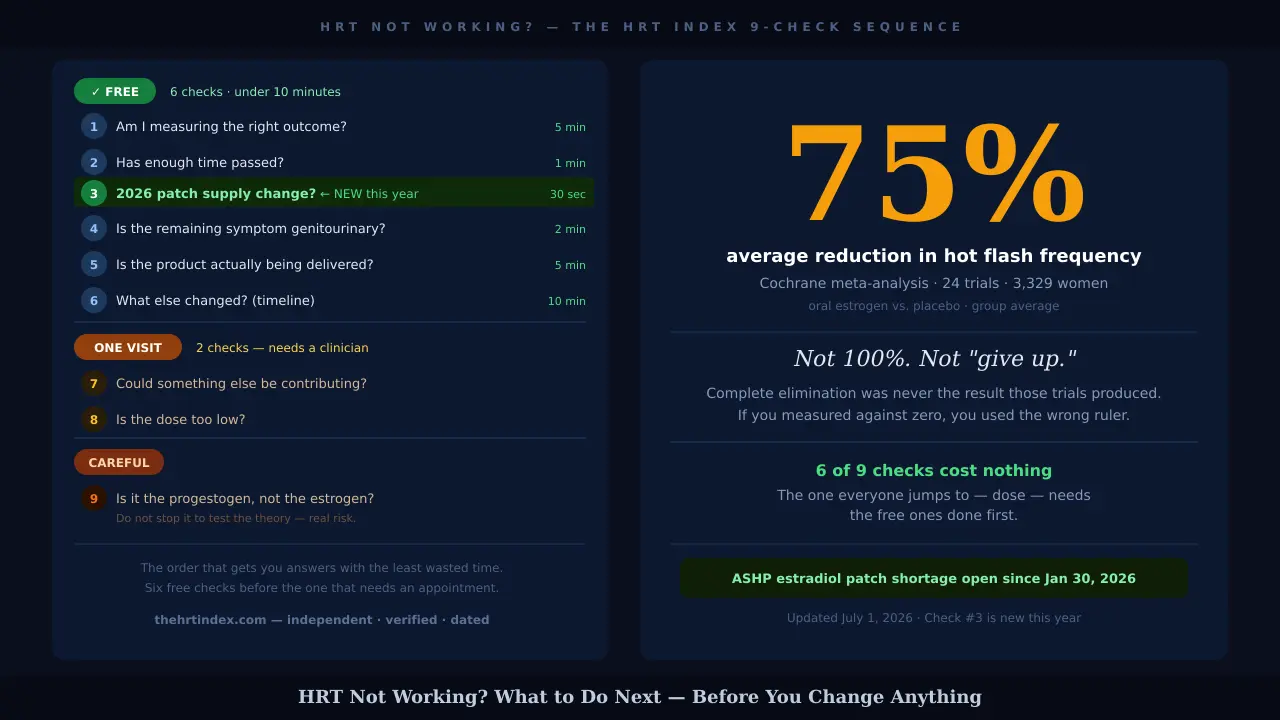
The HRT Index Nine-Check Sequence
An editorial troubleshooting order, not a prevalence ranking. It does not diagnose you and it does not recommend a dose.
Here’s exactly how we ordered it — so you can argue with it:
- Urgency first. Anything that needs care now goes above anything that can wait.
- Can you check it without changing your treatment? Checks that cost nothing and risk nothing come before checks that need an appointment.
- Time and cost to verify. Thirty seconds beats three weeks.
- Symptom specificity.Checks that can rule something in or out beat checks that can’t.
- Does it need a clinician? Things only a clinician can do come last, so you arrive with the groundwork done.
| # | Check | Time | Cost |
|---|---|---|---|
| 1 | Am I measuring the right outcome? | 5 min | Free |
| 2 | Has enough time passed? | 1 min | Free |
| 3 | Did my patch change during the 2026 supply disruption?NEW 2026 | 30 sec | Free |
| 4 | Is the remaining symptom genitourinary? | 2 min | Free |
| 5 | Is the product actually being delivered? | 5 min | Free |
| 6 | What else changed? | 10 min | Free |
| 7 | Could something else be contributing? | One visit | Varies |
| 8 | Is the dose too low? | One visit | Varies |
| 9 | Is it the progestogen, not the estrogen? | 5 min | Free |
Look at the cost column. Six of the nine cost you nothing and take under ten minutes. The one everyone jumps to — dose — needs an appointment, and it can’t really be evaluated until the free ones are done. That’s not us being cautious. It’s the order that respects your time.
The right online HRT provider isn’t the same for every woman
It depends on your symptoms, what you have tried, age, state, and health history. Use the tool to match your situation.
Get your personalized HRT action plan →Free · No dose recommendations, ever · Flags when online care isn’t the right starting point
Is my HRT working less — or am I measuring the wrong outcome?
In a Cochrane meta-analysis of 24 randomized controlled trials covering 3,329 women, oral estrogen or oral estrogen-plus-progestogen reduced hot flash frequency by a pooled average of about 75% compared with placebo. That is a group-level average from trials of oral therapy. It is not an individual success threshold, not a ceiling on the benefit any one person can get, and not a reason to accept symptoms you find unacceptable.
Start here because it’s free, it takes five minutes, and it changes how you read every other check. The Cochrane review pooled 24 randomized trials and 3,329 women. Averaged across all of them, hot flash frequency fell by roughly 75% compared with placebo.
Seventy-five percent. Not a hundred.
Read what that is and isn’t, because it matters both ways. It’s an average across a group, from trials of oralestrogen. It doesn’t mean you personally should hit 75%. It doesn’t mean 75% is the definition of success. And it absolutely doesn’t mean nothing more can be done for you. Complete elimination of hot flashes was never the result these trials produced. If you’ve been measuring yourself against zero, you’ve been measuring against a number that isn’t on the table.
Do your own arithmetic:
| Where you started | 75% off would look like | What that means |
|---|---|---|
| 12 hot flashes a day | About 3 a day | Near the pooled average benefit. Whether that's enough is your call — but the treatment is doing something. |
| 10 a day | About 2–3 a day | Near the pooled average. Same question. |
| 8 a day | About 2 a day | Near the pooled average. Same question. |
| 10 a day | Still 9–10 a day | Well short of the pooled average. Keep reading. |
| 10 a day | Zero, then back to 10 | Different problem entirely → check #3 and #6 |
Define your target before you judge the result
“Is it working?” is unanswerable. “Are my night sweats down from six nights a week to two?” is answerable in fourteen days.
Pick the one symptom you started HRT to fix. Write down its number now:
- • Hot flashes per day
- • Nights per week you wake up sweating
- • Times per night you wake up hot
- • Days per week the symptom stopped you doing something
That’s your baseline. “I still feel awful” gets you a shrug. “Night sweats went from six nights a week to five over three months on 0.05 mg” gets you a conversation.
How long should HRT take to work?
Some menopause symptoms may begin improving within weeks of starting hormone therapy, and around three months is a common point to review efficacy and tolerability. Sleep, mood, cognitive, vaginal, and urinary symptoms may follow different patterns from hot flashes and may have independent causes. Symptoms that are worsening, significant side effects, unexpected bleeding, or an inability to use the product correctly are reasons to make contact sooner.
Most pages give you one timeline. That’s the error, because your symptoms don’t share a clock.
| Symptom | Pattern | Why it can differ |
|---|---|---|
| Hot flashes / night sweats | Often the first to shift, sometimes within weeks | The symptom hormone therapy most directly targets |
| Sleep | May trail hot flash relief | If heat is what’s waking you, sleep can’t settle until the heat does |
| Mood / brain fog | Often the slowest and least predictable | May be downstream of sleep — or may have a separate cause entirely |
| Vaginal dryness / painful sex | May not respond to systemic HRT | Often needs a separate local-treatment discussion → check #4 |
There’s a chain in that middle column: night sweats → sleep → mood and fog. If your hot flashes are much better but you still feel foggy at six weeks, you may be watching that chain resolve from the bottom up. Or the fog may be its own thing. Both are common, and the way you tell them apart is whether the sleep improved first.
When not to wait
Three months is a common review point, not a sentence. Contact your prescriber sooner if:
- • Symptoms are getting worse, not just failing to improve
- • You have new side effects that are significant or won’t settle
- • You have bleeding you weren’t told to expect
- • You can’t use the product correctly — it won’t stick, you can’t tolerate it, you can’t get it
- • Any red flag from the top of this page appears
“Give it three months” is reasonable for a stable, tolerable regimen. It is not reasonable for a regimen that’s making you feel worse, and you are allowed to say so out loud.
Did my estrogen patch manufacturer change during the 2026 supply disruption?
NEW THIS YEAREstradiol transdermal patches have been listed on the American Society of Health-System Pharmacists (ASHP) drug shortage bulletin since January 30, 2026, with the bulletin updated on July 1, 2026. Affected manufacturers have varied over the course of the disruption and have included both once-weekly and twice-weekly products. Because availability changes by product, strength, package, pharmacy, and date, a patient may receive a different manufacturer’s product at the same labeled delivery rate. Comparing the manufacturer and wear schedule on the last two prescription labels is a free check.
This one’s new. It didn’t apply in 2024 and it may not apply next year.
What happened
On November 10, 2025, the FDA initiated class-wide labeling changes for menopausal hormone therapy, moving to remove boxed warnings about cardiovascular disease, breast cancer, and dementia that had sat on those labels since 2003. On February 12, 2026, updated labeling was approved for an initial six products. Demand moved fast. By January 30, 2026, ASHP had opened a shortage bulletin on estradiol transdermal systems. It’s still open, and it was updated on July 1, 2026.
What that means at your pharmacy
Manufacturers have moved on and off the affected list as the disruption has run — Amneal, Noven, Zydus, and Sandoz have all appeared. Both once-weekly and twice-weekly products have been affected. Availability varies by product, strength, package size, pharmacy, and week.
Which is why we’re not printing a status table here. Any table we published would be wrong by the time you read it, and a wrong table is worse than none. ASHP’s bulletin is the live source, and your pharmacist has the version that matters — what’s actually on their shelf today.
Why this can look like “my HRT stopped working”
Your prescription says estradiol 0.05 mg/24hr. It doesn’t name a manufacturer. So when your pharmacy can’t get one, they fill it with another separately FDA-approved estradiol transdermal product at the same labeled delivery rate — often without a phone call. Those products aren’t identical. They can differ in adhesive, dimensions, wear schedule, and instructions. If your body was managing on one and you were switched to another, the timing can look exactly like your HRT randomly quitting.
Do this now. Thirty seconds.
Get your last two patch boxes, or your last two pharmacy receipts, and compare two things:
- The manufacturer.Small print on the label — Amneal, Noven, Viatris, Mylan, Sandoz, Zydus, Bayer, or a brand name like Dotti, Lyllana, Vivelle-Dot, Climara, Minivelle, Alora.
- The wear schedule.Once-weekly or twice-weekly. This is not a detail. A once-weekly product and a twice-weekly product are used differently, and a switch between them is a change to your directions — not just a change of manufacturer.
If either changed around the time your symptoms did, you’ve got something concrete for your prescriber. That took thirty seconds and cost nothing.
What to ask for
- Ask your pharmacist:“Which manufacturer did you fill this with? Has it changed? Can you order the one I was on before, or does another pharmacy nearby stock it?”
- Ask your prescriber about a different route, not a different dose. Gels, sprays, and pills are FDA-approved and aren’t affected by patch supply.
- Ask whether a longer fill is possible— that depends on your prescription, your insurer, state rules, and current supply.
- Don’t cut, ration, stretch, or re-wear patchesto make a short supply last. It makes your delivery unpredictable in exactly the way that creates the problem you’re trying to solve.
Why your doctor may say there’s no shortage
Because the FDA and ASHP use different criteria and different reporting systems, and they can list different things at the same time. If you’re told there’s no shortage, you’re being told one system’s answer. Your pharmacist has the other one.
Why are vaginal or urinary symptoms still present when my hot flashes improved?
Systemic estrogen therapy can improve vulvar and vaginal symptoms, but genitourinary syndrome of menopause (GSM) may persist during systemic treatment. The 2025 AUA/SUFU/AUGS guideline states that in patients with GSM who are on systemic estrogen therapy, clinicians should offer the option of local low-dose vaginal estrogen or vaginal DHEA. Unlike hot flashes, which typically improve with time, GSM usually worsens over time without treatment.
Here’s the confusing version of “my HRT isn’t working”: your hot flashes improved. Your sleep improved. And you’re still dry, still sore, still dreading sex, still running to the bathroom. So you conclude the HRT is half-failing and ask for more. More systemic estrogen is often not the move.
Genitourinary syndrome of menopause (GSM)is the current term for what used to be called vaginal atrophy. It covers vaginal dryness, burning, itching, pain with sex, urinary urgency, painful urination, and repeat UTIs — all traced to the tissue of the vulva, vagina, and lower urinary tract losing estrogen.
Two facts that change the plan
One: The 2025 joint guideline from the American Urological Association, SUFU, and AUGS is specific: local vaginal treatments are preferred over systemic therapy for GSM itself. And for women already on systemic estrogen who still have GSM symptoms, the guideline says clinicians should offer the option of adding local vaginal estrogen or vaginal DHEA.
Two — and this is the one that should move you: The Menopause Society states that unlike hot flashes, which typically improve with time, GSM usually gets worse over time without treatment. Waiting costs you.
| Systemic HRT (patch, pill, gel, spray) | Local vaginal treatment | |
|---|---|---|
| Targets | Hot flashes, night sweats, whole-body symptoms | The vulvar, vaginal, and lower urinary tissue directly |
| For GSM specifically | Can help; may not fully resolve it | Preferred for GSM, per the 2025 AUA/SUFU/AUGS guideline |
| Estrogen reaching bloodstream | Systemic, by design | Minimal compared with systemic HRT |
| Can you use both? | Current guidance supports offering the option after individual review | Same |
| Routine endometrial surveillance just for using it? | Discuss with your clinician | Not recommended solely because of low-dose local use — but any postmenopausal or unexplained bleeding still needs evaluation |
FDA-approved prescription options used for GSM
Three different classes of medicine — they work differently, they’re regulated differently, and they’re not interchangeable.
Low-dose vaginal estrogen
- Estrace, Premarin vaginal cream
- Vagifem (vaginal tablet)
- Imvexxy (vaginal softgel insert)
- Estring (vaginal ring)
Vaginal DHEA
Intrarosa (prasterone) — a vaginal insert. Not vaginal estrogen.
Oral SERM
Osphena (ospemifene) — a selective estrogen receptor modulator taken by mouth. Not a local treatment.
On recurrent UTIs: the 2025 guideline gives a Grade B recommendation for local low-dose vaginal estrogen to reduce the risk of future UTIs in appropriate postmenopausal patients. If you’re on your third UTI of the year and nobody has raised vaginal estrogen, raise it.
Vaginal estrogen options compared →Is my patch or gel actually getting in?
Systemic exposure to transdermal estradiol varies substantially between individuals and is influenced by application site, skin condition, adherence, and product-specific instructions. Adding an extra patch, cutting a patch, or doubling a gel application changes delivery unpredictably and is not a substitute for clinical review.
Systemic HRT only works if the hormone crosses your skin. Poor adhesion makes delivery less reliable — and unreliable delivery makes every other answer on this page harder to trust.
The patch checklist
Go through it honestly. Nobody’s watching.
- Do you know whether yours is once-weekly or twice-weekly? (More people get this wrong than you'd think — especially now, with products being substituted that don't share a schedule.)
- Are you changing it on the right days, consistently?
- Are the edges lifting before it's due to come off?
- Has it ever come off in the shower, in bed, at the gym?
- Are you applying it where your product's label says to? (This varies by brand — yours has a specific answer.)
- Any lotion, oil, sunscreen, or powder on that skin?
- Is the skin under it red, itchy, or irritated?
- Are you rotating sites?
- Does clothing rub it — a waistband, a bra strap?
For gels and sprays
These products are not interchangeable. Divigel isn’t EstroGel isn’t Elestrin isn’t Evamist — different sites, different drying times, different rules about washing and skin contact with other people.
- • Read the instructions for your exact product — the paper in the box
- • Log pumps or sprays, time, and site for two weeks
- • Ask your pharmacist about your specific product: drying time, washing, skin-to-skin contact, missed doses
| Don’t | Because |
|---|---|
| Add a second patch | You now have an unknown dose, and nobody can troubleshoot from there |
| Cut or tape a patch | Unless your product's label, pharmacist, or prescriber confirms it for that product — some patches don't tolerate it |
| Double your gel | Same problem as the extra patch, with worse precision |
| Copy someone else's routine | Their product isn't your product |
Why did HRT work at first and then stop?
When hormone therapy is effective and symptoms later return, the chronology is useful information. An abrupt return close to a refill or product change points toward checking the product first. A gradual return over months points toward checking what else has changed. Tachyphylaxis has been described in menopause practice, but symptoms alone cannot establish it and no universal laboratory threshold confirms it.
This is a different problem from “it never worked,” and it deserves a different method. Some clinicians do describe tachyphylaxis — a reduced response over time. So we’re not going to tell you it’s impossible. But you can’t diagnose it from symptoms, no lab threshold confirms it, and it’s a dead-end explanation to reach for first.
First: was it a cliff or a slope?
| Your pattern | What to check first | What this cannot prove |
|---|---|---|
| Cliff — fine, then not fine, within a couple of weeks | The product. Refills, manufacturer or schedule changes, a new pharmacy, new medications. → Check #3 | Refill timing can’t prove one product delivered less than another |
| Slope — slid back over 3–6+ months | What else changed — weight, illness, sleep, a new medication — and where you are in the transition | A gradual return can’t prove the transition caused it |
| One symptom only, the rest still fine | Whether it’s genitourinary → Check #4 | One remaining symptom can’t by itself diagnose GSM |
Pull up your pharmacy history— most chains show it in the app — and write down every refill date for the last twelve months. Now write down when your symptoms came back. If those cluster together, you have a temporal association worth discussing. That’s not proof of anything. It’s ten minutes of work that turns a vague complaint into a specific question, and specific questions get answered.
The change audit
The product
- Manufacturer changed → check #3
- Wear schedule changed (once- to twice-weekly, or reverse)
- New pharmacy
- Brand → generic, or a different generic
- Dose or route changed
- Progestogen changed — product, dose, or schedule
- Missed or late doses
Your body and your life
- New prescription medication
- New supplement, including herbal
- Significant weight change
- New illness or diagnosis
- A long stretch of bad sleep
- Major stress
- Alcohol intake changed
- You crossed from perimenopause into menopause
The framing
- Your symptoms are the same, but your tolerance for them changed
- You had a good stretch and now judge normal against that
Sometimes what changed is what you’re comparing against — and knowing that is worth as much as any box above it.
What if HRT is making me feel worse?
New symptoms that begin after starting or changing hormone therapy are a different clinical question from the original symptoms failing to improve. Headache, breast tenderness, nausea, mood change, and skin reactions are recognized adverse effects of estradiol products. New or worsening symptoms after a treatment change warrant contacting the prescriber rather than waiting for a scheduled review.
Everything above assumes your original symptoms are hanging around. This is the other version: something newshowed up, and it arrived with the treatment. Those are not the same problem and they don’t have the same answer.
| Pattern | The more useful reading |
|---|---|
| Original hot flashes never improved | Persistent symptoms → work checks 1–6 |
| New breast tenderness after starting or changing | Possible adverse effect or poor fit — not evidence the dose is low |
| New nausea or headache after a change | Possible treatment effect — discuss with your prescriber |
| New skin irritation under a patch | Application site or product issue → check #5 |
| New low mood or flatness | May track the progestogen rather than the estrogen → check #9 |
| New bleeding | Regimen- and timing-specific → check #9 and the red flags at the top |
The trap here is obvious once you see it
A new symptom after a change is not evidence you need more. It’s evidence something changed. Those point in opposite directions, and guessing wrong costs you months. Write down when the new symptom started relative to when the treatment started or changed, and which product changed. That single sentence does most of the work at your appointment.
What if I take oral HRT rather than a patch or gel?
Oral hormone therapy has a different troubleshooting pathway from transdermal products. Adherence and timing, medication interactions, and product changes are relevant, while patch-specific issues such as adhesion and application site are not. Serum estradiol is particularly difficult to interpret in patients taking oral estradiol and should not be treated as a direct measure of individual dose adequacy.
Much of the internet’s HRT troubleshooting advice — including a fair chunk of this page — is patch-shaped. If you take a pill, here’s your version.
What still applies to you
Checks 1, 2, 4, 6, 7, and 9 apply to you unchanged. Expectation calibration, timing, GSM, the change audit, new symptoms, and the progestogen question don’t care about your route.
What doesn’t apply
Adhesion, application site, lotions, and the patch supply disruption. Check #3 is patch-specific.
What’s specific to oral HRT users
- •Adherence and timing. Missed doses matter more than people admit. Take it at the same time daily and note any gaps for two weeks before your review.
- •Missed-dose instructions are product-specific. Ask your pharmacist what to do for your exact product rather than doubling up.
- •Interactions.Some medications affect how oral estrogen is processed. Bring your full list — including supplements — to your review.
- •Blood levels are especially hard to read. Serum estradiol is particularly difficult to interpret with oral estradiol, and it isn’t a direct measure of whether your dose is right for you.
The route question itself is a legitimate thing to raise. If the pill isn’t working for you, “should we look at a different route?” is often a better question than “should we go up a dose?”
Could the progestogen be the problem instead of the estrogen?
Careful — do not stop your progestogen on your ownWomen with a uterus who use systemic estrogen generally require a progestogen to protect the uterine lining. The FDA’s November 10, 2025 labeling initiative did not seek removal of the boxed warning for endometrial cancer from systemic estrogen-alone products. Stopping or skipping a prescribed progestogen without clinical direction removes that protection.
This check is last because acting on it wrongly carries the most risk on this page. If you have a uterus and you’re on systemic estrogen, you’re almost certainly also on a progestogen— micronized progesterone, a synthetic progestin, or a hormonal IUD. It isn’t there for your symptoms. It’s there to protect the lining of your uterus.
Here’s why it belongs on a page about HRT not working: for some women, the progestogen is the part causing trouble. Low mood, bloating, breast tenderness, sleepiness, feeling flat. And because it all started at once, the whole regimen gets labelled “not working” — when the estrogen may be doing fine.
The one thing not to do
Do not stop your progestogen on your own. Not to test a theory. Not for a month. When the FDA moved to remove boxed warnings from menopausal hormone therapy in November 2025, it moved on the warnings about heart disease, breast cancer, and dementia. It did not seek removal of the boxed warning for endometrial cancer on systemic estrogen-alone products. That warning is the reason your progestogen exists. Removing your protection while you’re still on estrogen is the one change on this page with a serious, documented risk attached.
What to do instead
Your progestogen isn’t one thing, and swapping is a normal clinical move:
- • Type — different progestogens have different pharmacologic and adverse-effect profiles
- • Timing — micronized progesterone is often taken at bedtime because it may cause drowsiness; follow your product label
- • Schedule — continuous versus cyclical changes both side effects and bleeding pattern
- • Route — a levonorgestrel IUD delivers progestogen mainly within the uterus and may reduce systemic exposure
Ask this at your appointment:
“I think my progesterone might be the part I’m not tolerating. I’m not going to stop it. Can we look at a different type, a different timing, or an IUD?”
On bleeding
Bleeding is common in the first six months of systemic HRT and in the first three months after a dose or product change. What’s expected depends on your regimen. Any postmenopausal or otherwise unexplained bleeding: report it promptly for evaluation. Heavy bleeding, bleeding that won’t stop, or bleeding with faintness, weakness, or severe pain: urgent or emergency care. It’s usually nothing. It gets checked anyway, every time, because of the small number of times it isn’t.
Could something else be causing this? Four look-alikes worth asking about
Several conditions produce symptoms that overlap with menopause, including thyroid dysfunction, iron deficiency, obstructive sleep apnea, and depression. They can coexist with menopause rather than replace it. Evaluation may involve history, symptom screening, laboratory testing, or sleep testing depending on the condition. This list is not exhaustive.
This is the one that costs women years.
The trap: you’re 51. You’re exhausted, foggy, moody, sleeping badly, gaining weight. Menopause explains all of it. So does an underactive thyroid. So does iron deficiency. So does sleep apnea. So does depression. And because menopause explains it — because you’re the right age, and because you said you’re in menopause — nobody looks further. Your HRT gets increased instead. It doesn’t help, because it was never going to. These aren’t alternatives to menopause. They can sit on top of it.
| Look-alike | Overlaps on | A clue worth mentioning | How it’s usually assessed |
|---|---|---|---|
| Thyroid (underactive) | Fatigue, weight gain, fog, low mood, feeling cold | Cold when others aren't; constipation; hair and eyebrow thinning | Blood testing |
| Iron deficiency | Fatigue, fog, breathlessness, restless legs, hair loss | Heavy perimenopausal bleeding is a major risk factor and gets normalized constantly | Blood testing |
| Sleep apnea | Exhaustion, fog, mood, morning headache, night waking | Snoring, waking gasping, still tired after eight hours | History and screening; sometimes a sleep study |
| Depression | Fatigue, fog, sleep, low mood, low libido, no motivation | Loss of pleasure in things you used to love; it doesn't lift when the hot flashes do | Clinical screening and evaluation |
On iron specifically
If you had heavy periods in perimenopause — extremely common — your iron stores may have been running down for years. A standard blood count can look fine while ferritin is low. It’s worth asking whether ferritin or iron studies are appropriate for you, especially with heavy bleeding, dietary risk, previous iron deficiency, or restless legs.
Say this at your next appointment:
“Before we change my HRT dose, could we review whether thyroid testing, iron studies, depression screening, or a sleep apnea assessment would be appropriate for my symptoms?”
One sentence. It doesn’t order every test on every reader — it asks the right person which of them fits you.
Is my HRT dose too low?
Persistent vasomotor symptoms after an adequate trial can support a clinical review of dose, route, or formulation. Symptoms alone cannot establish that an estrogen dose is insufficient, because timing, delivery, product changes, symptom–treatment mismatch, adverse effects, and other conditions can produce the same presentation. ACOG and The Menopause Society recommend a symptom-based approach to management rather than titrating hormone therapy against laboratory values.
Here it is. The one you came for. It’s check #8 for a reason you can now see: the checks above it are free, fast, and change the answer. If you’ve worked down to here having done them, then yes — a dose, route, or formulation review is exactly the right thing to ask for.
When this conversation goes further
A dose review is more informative when:
- • Your target symptom — hot flashes, night sweats — is still disruptive
- • You’re at or past the three-month mark
- • You know the product is being used correctly and the manufacturer or schedule hasn’t changed
- • The symptom is systemic, not genitourinary
- • You have numbers, not vibes
HRT dose too low symptoms — the least specific list in menopause medicine
Common “HRT dose too low symptoms” are essentially the return or persistence of the symptoms you started treatment for — hot flashes, night sweats, disrupted sleep, mood changes. Which is exactly the problem. That list is identical to the list for most of the other checks on this page. It’s the least specific list in menopause medicine, which is why it can’t do the job people want it to do. There is no symptom that says “low dose” and only “low dose.”
Say this instead of “I need a higher dose”
“My night sweats are still waking me four nights a week after fourteen weeks on 0.05 mg. I’ve confirmed the manufacturer and schedule haven’t changed and I’m applying it correctly. Should we be looking at dose, or route, or something else?”
That does five things at once: gives a number, a timeline, a dose, pre-empts the obvious objections, and hands the clinical decision back to the clinician. It’s very hard to shrug at.
Do I need a blood test to check my estradiol level?
Routine estradiol testing is not recommended for monitoring menopausal hormone therapy in most women. ACOG and The Menopause Society recommend a symptom-based approach rather than titrating to laboratory values. Estradiol levels fluctuate substantially, and published reference ranges vary widely between sources because they are built for different purposes.
You’ve seen the pitch: get your levels tested, find out if you’re “optimized,” discover your dose is subtherapeutic. It’s compelling. It feels scientific. It feels like what your dismissive GP should have been doing.
We compared four published ranges
The same units, side by side. Built for different purposes — read the table with that in mind.
| Source | Type | Stated aim | In pg/mL |
|---|---|---|---|
| Dr. Mary Claire Haver (published March 2026) | Individual clinician position | Floor for bone protection; uses LC/MS assay | 25–70 |
| MenoHello, menopause information site (Nov 2025) | Site-published range | General symptom management | 60–150 |
| Oova, hormone-testing company | Commercial testing range | Testing-service reference | 60–100 |
| Summerhill Health, UK menopause clinic | Clinic therapeutic range | Clinic treatment target (UK practice) | ~82–218 |
Say your estradiol comes back at 45 pg/mL
- • Above Haver’s stated floor.
- • Below MenoHello’s published range.
- • Below Oova’s published range.
- • Well below Summerhill’s clinic target.
Same blood. Same afternoon. Four different verdicts, because you’re being measured against four different rulers built for four different jobs. No single universal target can be derived from these.
What US guidelines say
ACOG and The Menopause Society recommend a symptom-basedapproach: treatment is guided by how you feel and what side effects you’re getting, not by a lab value. Routine estradiol, progesterone, and testosterone measurement isn’t required for initial management. FSH is not a reliable measure of HRT absorption or dose adequacy, and commercial saliva and urine panels haven’t been established as tools for optimizing your dose.
When a test earns its cost
- • Your prescriber suspects poor absorption (after confirming check #5)
- • You have premature ovarian insufficiency or another condition with its own monitoring goals
- • Something needs ruling out that isn’t estrogen
- • You’re on a treatment where levels genuinely guide dosing (e.g. an implant)
When it’s mostly theatre
- • You’re four weeks in
- • Your symptoms are controlled and you want a gold star
- • The result is being read against a range published by a company selling the fix
- • It’s an at-home test you plan to use to justify changing your own dose
The question that ends the argument:
“Would this result change what we do? And how would you read it alongside my symptoms and my route?”
A clear yes means get the test. A vague answer tells you more than the number would.
Find an online care option that fits you
Looking for online care? The quiz uses your symptoms, what you have tried, age, state, and health history to suggest a starting point.
Get your personalized HRT action plan →Free · Shows your match and its listed price · Flags when online care isn’t the right starting point
What should I bring to an HRT review?
A structured symptom and product record improves the quality of a hormone therapy review. Useful information includes the target symptom with a frequency count, the exact product name and manufacturer, the wear schedule, the start or change date, adherence and application details, recent product or pharmacy changes, new medications, and any adverse effects or bleeding.
Two weeks of tracking. That’s the whole ask. It turns “I still feel terrible” — which gets you a shrug — into a clinical picture, which gets you a plan.
The product
- • Exact name and strength as printed on the label
- • Manufacturer — and whether it changed
- • Wear schedule — once- or twice-weekly, and whether that changed
- • Route
- • Start date, or the date it last changed
- • Your progestogen: name, dose, schedule
- • Missed doses in the last month: how many
- • Patch adhesion: any lifting, any falling off
- • Any pharmacy or brand change, with the date
The target symptom — pick one and count it
- • Hot flashes per day
- • Nights per week with sweats
- • Wake-ups per night
- • Days per week it stopped you doing something
New since starting
- • Headaches, breast tenderness, nausea, mood change, skin reaction
- • Any bleeding: date, amount, duration
- • New medications or supplements
- • Illness, major stress, sleep disruption, weight change
The message you can copy and send today
Most practices have a portal. Most portals have a message box. This one gets read:
Subject: HRT review request — symptoms not controlled
I started [exact product, strength, route] on [date]. My main goal was [symptom].
Since then: [what improved, with a number]. But [what hasn’t, with a number].
I’ve checked: [manufacturer and schedule changed / didn’t change], [doses missed / not missed], [patch adhering / not adhering].
Before we consider a dose change, could we review timing, route, whether some of this is genitourinary and needs local treatment, and whether other contributors should be assessed?
I’m not changing anything until I hear from you.
That last line matters more than you’d think. It tells your clinician you’re a partner, not a risk — and it changes the tone of the reply you get.
When should I consider a different menopause clinician?
Changing providers does not resolve most causes of hormone therapy non-response, because most of the relevant checks are done by the existing prescriber who already holds the patient’s records and history. A different clinician becomes relevant primarily when the current prescriber will not review the regimen, will not consider assessment beyond a dose change, or does not manage menopause routinely.
Let’s be honest about who this section is for
If your prescriber will engage, stay put.They have your history, your records, your bleeding pattern, and your prescription. Many readers should start there — the script above is built for exactly that conversation. We earn a commission if you click through to a provider. We’re telling you to try your own prescriber first anyway, because for most people it’s the faster route.
When a different clinician is the right call
- • You’ve asked for a review and been told to “just give it more time” — twice
- • You raised other possible contributors and were brushed off
- • You raised vaginal symptoms and got a shrug
- • Your prescriber won’t discuss anything except raising or stopping the dose
- • Your prescriber doesn’t do menopause routinely, and it shows
- • You’ve moved, lost coverage, or lost your clinician
What to compare — for this problem specifically
For your problem, which is diagnostic, these matter more than price:
- • Can they order testing when it’s clinically indicated?
- • Can they move you across FDA-approved routes — patch, pill, gel, vaginal?
- • Is there a live conversation, or a form?
- • Insurance, or cash-pay — and what’s the total, including labs and medication?
- • Your state, and licensure
- • Follow-up — can you get back to the same clinician?
- • Cancellation and refund terms before you commit
Price still matters. It’s just not the thing that answers your question.
How the four services we cover compare
Sources: each provider’s published materials, verified July 2026. “Best for” below is The HRT Index’s editorial conclusion from verified facts — not a medical ranking.
| Medication model | Testing | Access | Cost (provider-stated) | Insurance | |
|---|---|---|---|---|---|
| Midi Health | FDA-approved hormonal and non-hormonal options as clinically appropriate | Clinicians may order bloodwork or imaging when medically appropriate | Live video visits, ~30 min initial | $250 initial, $150 ongoing (self-pay) — excludes labs and medication | In-network with most PPO plans incl. Aetna, Cigna, Anthem BCBS, UnitedHealthcare. No Medicaid/Medi-Cal. Not covered by Medicare. |
| Sesame Care | Varies by clinician | Basic labs listed as included when ordered, with state exceptions | Menopause subscription with provider choice, video visits, ongoing messaging | Subscription; medication costs separate | Cash-pay marketplace |
| Hers | Estradiol pills and patches, progesterone pills, estradiol vaginal cream | Limited | Online provider evaluation, ongoing messaging | From $79/mo oral, $134/mo patch on a 12-month plan | Cash-pay |
| Winona | Mixed: estrogen patches, tablets, and progesterone capsules are FDA-approved. Body creams are compounded — not FDA-approved. Does not prescribe testosterone. | Not verified in reviewed public materials | Online medical evaluation, clinician messaging via portal | Patch $149/mo; estrogen + progesterone cream from $89/mo | Does not accept insurance; HSA/FSA accepted |
Why Midi leads on this page — and not on every page
Because of what you’re actually trying to do here. You don’t need hormones — you already have hormones. You need someone to work out why they aren’t working. That means testing when it’s indicated, route flexibility, and a real appointment. Midi is a menopause-focused telehealth practice. Its clinicians may order bloodwork or imaging when medically appropriate, it works with insurance, it prescribes FDA-approved options, and the initial visit is a live video consult of about 30 minutes — not a form.
Parts that will rule Midi out for some of you:
- • Medicaid or Medi-Cal: Midi cannot treat you — not even as a self-pay patient. Ask your existing prescriber for a menopause review, or look for a local clinician who takes your coverage.
- • Medicare: Midi isn’t covered. You can pay out of pocket, but you can’t submit those claims to Medicare.
- • Non-PPO plans: This is $250 then $150 per visit before labs and medication. Confirm in-network status before you book.
Menopause-focused live visits · FDA-approved medication options · Confirm current pricing and coverage at intake
If you want a second opinion with provider choice
Sesame lets you pick your clinician and includes basic labs when they’re ordered, with some state exceptions — which matters here, because testing is often the point. Medication costs are separate. Read the current cancellation and refund terms before you commit; they’re specific about what’s refundable and when.
See the current menopause subscription and cancellation terms →Provider choice · Video visits and ongoing messaging · Confirm lab coverage in your state before booking
If cost is the binding constraint
Hers publishes its pricing openly: from $79/month for oral plans and $134/month for patch planson a 12-month plan, covering estradiol pills and patches, progesterone pills, and estradiol vaginal cream, with an online provider evaluation and ongoing messaging. That’s a real option if what’s stopping you is the price of the door. Its testing capability is limited — so if your remaining question is “is this actually my thyroid,” this isn’t the tool for that part.
See current plan pricing and medication options →Published pricing · Cash-pay · Compare total annual cost including medication before you commit
Where Winona fits — and a correction we owe them
Winona is often described as compounded-only. That’s wrong, and we’ve said it ourselves in an earlier version of this page.Per Winona’s own published materials: its estrogen patches, estrogen tablets, and progesterone capsules are FDA-approved. Its estrogen and progesterone body creams are compounded and are not FDA-approved— Winona states this plainly itself. It does not currently prescribe testosterone, and it doesn’t take insurance, though HSA/FSA works at checkout.
Two things to hold onto for this page:
- We couldn’t verify lab-ordering in Winona’s public materials. On a page about running a differential, that’s the capability that matters most — confirm it before you pay if that’s what you need.
- On the compounded creams: if your FDA-approved HRT isn’t working and the proposed fix is a switch to a compounded cream, the implied claim is that compounded works better. The FDA states it does not have evidence that compounded “bioidentical” hormones are safer or more effective than FDA-approved menopause hormone therapy.
FDA-approved patches and tablets available · HSA/FSA accepted · Confirm lab-ordering before booking if needed
What if it still isn’t enough after a proper review?
When symptoms remain inadequately controlled after an adequate trial and a structured review, options include referral to a clinician with menopause expertise, a change of route or formulation, addition of local therapy for genitourinary symptoms, assessment of other contributors, or FDA-approved non-hormonal treatments for vasomotor symptoms. An incomplete response to hormone therapy does not mean no treatment will help.
Some women do everything on this page and still don’t land where they want. That deserves a straight answer, not a motivational one. “HRT didn’t fix everything” is not the same as “nothing will help.” Those get collapsed together constantly, and the collapse is what makes women give up.
| If | Then |
|---|---|
| Nobody has worked the checks properly | A menopause-focused clinician. The Menopause Society maintains a directory of certified practitioners. This is a real specialty and generalists vary enormously in how much menopause they do. |
| Hot flashes persist and you want non-hormonal options | The FDA has approved non-hormonal treatments for moderate-to-severe vasomotor symptoms, including fezolinetant and elinzanetant (approved October 24, 2025). Non-hormonal options → |
| Genitourinary symptoms persist despite systemic HRT | Local vaginal estrogen or vaginal DHEA, per the 2025 AUA/SUFU/AUGS guideline. Vaginal estrogen options → |
| Sleep and mood problems persist after hot flash relief | Consider whether look-alikes (thyroid, iron, sleep apnea, depression) have been assessed. Sleep → · Mood → |
| Side effects make HRT intolerable | Route change (from pill to patch or gel), progestogen change, or dose adjustment — all legitimate clinical conversations before stopping entirely. |
Frequently asked questions
Short answers to the most common follow-up questions about HRT not working. Each links to the fuller reasoning on this page.
What should I do if my HRT isn't working after 3 months?
Ask for a structured review, and go in with numbers. Before you do, spend ten minutes on the free checks: confirm your patch manufacturer and wear schedule haven't changed, confirm you're using it correctly, and work out whether your remaining symptom is systemic or genitourinary. Three months is a common review point, not a sentence — if things are getting worse, contact your prescriber sooner.
How do I know if my HRT is working at all?
Pick the one symptom you started treatment for and count it for two weeks. In pooled trials of oral hormone therapy, hot flash frequency fell by an average of about 75% versus placebo — a group average, not a personal target and not a ceiling. It does mean complete elimination wasn't the result those trials produced, so if you've been measuring against zero, you've been measuring against the wrong number.
Can HRT suddenly stop working?
Symptoms can return, but "suddenly stopped working" describes what you felt, not what happened. The useful question is whether it was a cliff or a slope. An abrupt return close to a refill points at checking the product first. A gradual slide over months points at checking what else changed.
Can you build a tolerance to HRT?
Tachyphylaxis — a reduced response over time — has been described in menopause practice, so it isn't impossible. But you can't diagnose it from symptoms, no lab threshold confirms it, and it's a dead end to reach for first. Check what changed before you land there: refills, manufacturers, wear schedule, other medications, weight, sleep, and the transition itself.
Should I increase my HRT dose if my symptoms come back?
Not on your own. Never adjust prescription hormones yourself — it makes your actual dose unknown, which removes your prescriber's ability to help. Dose is the eighth of nine checks on this page, because the ones above it are free and change the answer. If you've done those, a dose, route, or formulation review is exactly the right thing to ask for.
Why is my estrogen patch not working all of a sudden?
Check the manufacturer and the wear schedule on your last two boxes. Estradiol patches have been on the ASHP shortage bulletin since January 30, 2026, updated July 1, 2026, so pharmacies have been substituting between separately FDA-approved products at the same labeled delivery rate — sometimes without a call. A change that lines up with your symptoms is worth documenting; it doesn't prove the new product delivered less.
Is there an estrogen patch shortage in 2026?
ASHP has listed estradiol transdermal systems on its shortage bulletin since January 30, 2026, with the bulletin updated July 1, 2026. Affected manufacturers have varied and have included both once-weekly and twice-weekly products. FDA and ASHP use different shortage criteria and reporting systems and may list different things at the same time — check both, and ask your pharmacist what's actually available.
Why am I still tired on HRT?
Fatigue is the least specific symptom in menopause. It can be persistent night sweats disrupting sleep, it can be the progestogen, or it can be something that isn't menopause — thyroid dysfunction, iron deficiency, sleep apnea, and depression all present this way and can coexist with menopause. No single blood test distinguishes them; ask which assessments fit your symptoms.
Why is my vaginal dryness not improving even though my hot flashes are better?
Systemic estrogen can help genitourinary symptoms, but it may not resolve them. The 2025 AUA/SUFU/AUGS guideline says clinicians should offer local vaginal estrogen or vaginal DHEA to women with genitourinary syndrome of menopause who are already on systemic estrogen. Unlike hot flashes, GSM usually worsens over time without treatment.
Can I use vaginal estrogen while I'm on systemic HRT?
Current guidance supports offering that option to women with genitourinary syndrome of menopause already on systemic estrogen, after individual review. The 2025 AUA/SUFU/AUGS guideline also says routine endometrial surveillance isn't recommended solely because of low-dose local vaginal estrogen use — though any postmenopausal or unexplained bleeding still needs evaluation.
Could my progesterone be the problem instead of my estrogen?
It can be, and it gets missed because everything started at once, so the whole regimen gets labelled as failing. Do not stop it to test the theory. The FDA's November 2025 labeling initiative did not seek removal of the endometrial cancer boxed warning from systemic estrogen-alone products, and that warning is why the progestogen exists. Ask about a different type, timing, or an IUD instead.
Do I need a blood test to check my estradiol level?
Usually not. ACOG and The Menopause Society recommend treating symptoms rather than titrating to a lab value, and levels fluctuate enough that single results are unreliable. Published reference ranges also disagree because they are built for different purposes. The useful question is whether the result would change the clinical decision.
What if my HRT is making me feel worse?
That is a different question from your original symptoms failing to improve, and it has a different answer. Headache, breast tenderness, nausea, mood change, and skin reactions are recognized adverse effects of estradiol products. Note when the new symptom started relative to the treatment change, and contact your prescriber rather than waiting if it is significant, persistent, or worsening. A new symptom after a change is not evidence you need more.
Does everyone feel better on HRT?
No. In pooled trials, hormone therapy reduced hot flash frequency by an average of about 75% versus placebo — not 100%, and averages hide a lot of variation. A realistic goal is a defined target symptom meaningfully improved with tolerable side effects.
Should I switch providers if my HRT isn't working?
Usually not. Most of the relevant checks are done by the prescriber you already have, who already holds your records. Switching becomes relevant when your prescriber won't review the regimen, won't consider anything beyond a dose change, or doesn't manage menopause routinely. Then what matters is whether the service can order testing when indicated, switch across FDA-approved routes, and provide a live consultation.
What HRT symptoms need urgent care?
Chest pain with breathlessness, one-sided leg pain or swelling, stroke signs, coughing up blood, severe allergic symptoms, or heavy bleeding with faintness or severe pain require emergency care. Thoughts of self-harm: call or text 988. Any postmenopausal or unexplained bleeding, or a new breast lump or change, needs prompt clinical assessment. These need urgent attention whether or not HRT is the cause.
Still not sure where to start with online care?
The quiz suggests a cash-pay online option based on your symptoms, what you have tried, age, state, and health history — or flags when online care isn’t the right starting point.
Find My HRT Path →Free · No dose recommendations, ever · Flags when you need in-person care instead
Educational only — not medical advice. This page does not diagnose any condition and does not recommend a dose. Do not start, stop, or change prescription hormone therapy without your prescriber. FDA-approved and compounded products are labeled distinctly throughout, and nothing here should be read as implying they are equivalent.
Last updated: · Last verified: July 2026· Supply information re-verified monthly
The HRT Index earns a commission when readers start care through some of the provider links on this page; see our affiliate disclosure page.